Introduction to Radar
Cross Section
Reduction (RCS)
Radar Cross Section (RCS) is a measure of how detectable an object is
by radar. It is the projected area of a reflective object that intercepts a
radar signal and reflects back to the radar receiver.
HU by Hassan Ullah
Importance of RCS Reduction
1 Invisibility to Radar Systems
Reducing RCS is crucial for military aircraft and ships to remain undetected
by enemy radar systems, providing a significant tactical advantage in
warfare.
2 Enhanced National Security
RCS reduction contributes to maintaining national security by making it
difficult for adversaries to track and target military assets effectively.
3 Civil Applications
For commercial aircraft and other civilian applications, RCS reduction plays
a role in improving safety and minimizing interference with civilian radars.
Basic Principles of RCS Reduction
Shape Modification
Optimizing the shape of the
object to deflect or absorb
incoming radar waves,
minimizing the reflective
surface area.
Material Selection
Using advanced materials
with radar-absorbing
properties to reduce radar
wave reflection and
scattering.
Edge Treatment
Applying special edge
treatments to reduce radar
wave reflection and
diffraction, making the
object less visible to radar
detection.
Stealth Technology and Its
Applications
1 Military Aircraft
Stealth technology is extensively used in military aircraft to achieve low RCS,
enhancing their survivability in hostile environments.
2 Naval Vessels
Stealth features are integrated into naval vessels to minimize RCS, making them less
susceptible to detection by enemy radar systems.
3 Missiles and UAVs
Radar-evading characteristics are employed in missiles and unmanned aerial
vehicles (UAVs) to facilitate covert operations.
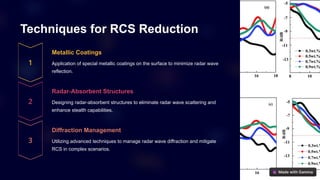
Techniques for RCS Reduction
Metallic Coatings
Application of special metallic coatings on the surface to minimize radar wave
reflection.
Radar-Absorbent Structures
Designing radar-absorbent structures to eliminate radar wave scattering and
enhance stealth capabilities.
Diffraction Management
Utilizing advanced techniques to manage radar wave diffraction and mitigate
RCS in complex scenarios.
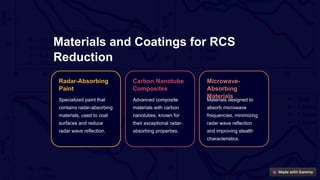
Materials and Coatings for RCS
Reduction
Radar-Absorbing
Paint
Specialized paint that
contains radar-absorbing
materials, used to coat
surfaces and reduce
radar wave reflection.
Carbon Nanotube
Composites
Advanced composite
materials with carbon
nanotubes, known for
their exceptional radar-
absorbing properties.
Microwave-
Absorbing
Materials
Materials designed to
absorb microwave
frequencies, minimizing
radar wave reflection
and improving stealth
characteristics.
Challenges in RCS Reduction
1
Complex Geometries
2
Multi-Frequency Operation
3
Durability Requirements
4
Cost-Effective Implementation
Future Trends in RCS Reduction
Advanced Stealth Composites Next-Generation Radar-Absorbing Materials
Holographic Radar Decoys Smart Skin Technology

Introduction to Radar Cross Section Reduction (Stealth Technologies).pptx

  • 1.
    Introduction to Radar CrossSection Reduction (RCS) Radar Cross Section (RCS) is a measure of how detectable an object is by radar. It is the projected area of a reflective object that intercepts a radar signal and reflects back to the radar receiver. HU by Hassan Ullah
  • 2.
    Importance of RCSReduction 1 Invisibility to Radar Systems Reducing RCS is crucial for military aircraft and ships to remain undetected by enemy radar systems, providing a significant tactical advantage in warfare. 2 Enhanced National Security RCS reduction contributes to maintaining national security by making it difficult for adversaries to track and target military assets effectively. 3 Civil Applications For commercial aircraft and other civilian applications, RCS reduction plays a role in improving safety and minimizing interference with civilian radars.
  • 3.
    Basic Principles ofRCS Reduction Shape Modification Optimizing the shape of the object to deflect or absorb incoming radar waves, minimizing the reflective surface area. Material Selection Using advanced materials with radar-absorbing properties to reduce radar wave reflection and scattering. Edge Treatment Applying special edge treatments to reduce radar wave reflection and diffraction, making the object less visible to radar detection.
  • 4.
    Stealth Technology andIts Applications 1 Military Aircraft Stealth technology is extensively used in military aircraft to achieve low RCS, enhancing their survivability in hostile environments. 2 Naval Vessels Stealth features are integrated into naval vessels to minimize RCS, making them less susceptible to detection by enemy radar systems. 3 Missiles and UAVs Radar-evading characteristics are employed in missiles and unmanned aerial vehicles (UAVs) to facilitate covert operations.
  • 5.
    Techniques for RCSReduction Metallic Coatings Application of special metallic coatings on the surface to minimize radar wave reflection. Radar-Absorbent Structures Designing radar-absorbent structures to eliminate radar wave scattering and enhance stealth capabilities. Diffraction Management Utilizing advanced techniques to manage radar wave diffraction and mitigate RCS in complex scenarios.
  • 6.
    Materials and Coatingsfor RCS Reduction Radar-Absorbing Paint Specialized paint that contains radar-absorbing materials, used to coat surfaces and reduce radar wave reflection. Carbon Nanotube Composites Advanced composite materials with carbon nanotubes, known for their exceptional radar- absorbing properties. Microwave- Absorbing Materials Materials designed to absorb microwave frequencies, minimizing radar wave reflection and improving stealth characteristics.
  • 7.
    Challenges in RCSReduction 1 Complex Geometries 2 Multi-Frequency Operation 3 Durability Requirements 4 Cost-Effective Implementation
  • 8.
    Future Trends inRCS Reduction Advanced Stealth Composites Next-Generation Radar-Absorbing Materials Holographic Radar Decoys Smart Skin Technology