Introduction to Python
Clent Campos Agunod
Overview
• What is Python?
• Features of
Python
• Installing Python
• IDLE
• Data types
• Syntax
• Print function
• Built-in math
operations
• Variables
Python is a high-level, interpreted programming language
known for its simplicity and readability. It allows developers to write
clear and concise code, making it easier to learn and use.
What is Python?
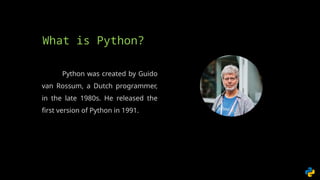
Python was created by Guido
van Rossum, a Dutch programmer,
in the late 1980s. He released the
first version of Python in 1991.
What is Python?
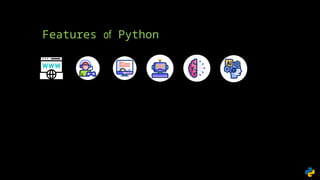
Features of Python
Features of Python
Web
development
Features of Python
Game
development
Features of Python
Software
development
Features of Python
Robotic
s
Features of Python
Machine
Learning
Features of Python
Artificial
Intelligence
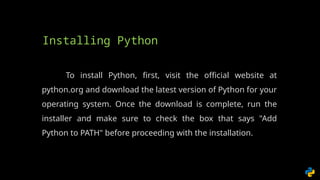
To install Python, first, visit the official website at
python.org and download the latest version of Python for your
operating system. Once the download is complete, run the
installer and make sure to check the box that says "Add
Python to PATH" before proceeding with the installation.
Installing Python
The latest stable version of Python as of October 2024 is
Python 3.12.1.
Installing Python
IDLE stands for “Integrated Development and Learning
Environment”, is a simple, easy-to-use interface for writing
and running Python code. It includes a code editor with
features like syntax highlighting, auto-completion, and an
interactive shell that allows real-time code execution and
testing.
IDLE
Integrated Development and
Learning Environment (IDLE)
Virtual Studio Code (VS
Code)
Integrated Development and
Learning Environment (IDLE)
PyChar
m
Integrated Development and
Learning Environment (IDLE)
spyder
Integrated Development and
Learning Environment (IDLE)
The code editor in Visual Studio Code (VS Code) is a
lightweight, powerful tool designed for writing and editing
code.
Integrated Development and
Learning Environment (IDLE)
The terminal in Visual Studio Code (VS Code) is an
integrated command-line interface that allows users to
execute commands directly within the editor.
Data types are classifications that specify the type of
value, determining how the data can be used and
manipulated.
Data Types
Python provides several built-in data types to work with,
such as strings, integers, floats, booleans, lists, tuples,
dictionaries, and sets. Each of these types serves a specific
purpose, allowing you to handle different types of data
efficiently.
Data Types
Python provides several built-in data types to work with,
such as strings, integers, floats, booleans, lists, tuples,
dictionaries, and sets. Each of these types serves a specific
purpose, allowing you to handle different types of data
efficiently.
Data Types
A String in Python is a sequence of characters enclosed
in quotes, either single (') or double ("). Strings can include
letters, numbers, symbols, and spaces.
Example: “Hello Students!”
String
An Integer in Python is a data type that represents
whole numbers without any decimal points. Integers can be
positive, negative, or zero. They are used for counting,
indexing, and performing arithmetic operations.
Example: 1 , 2 , 5, -1 , -2, -100, 96
Integer
A Float in Python is a data type used to represent
decimal numbers or real numbers. It allows for more precise
calculations than integers, as it can store values that include a
fractional component.
Example: 1.5 , 2.99 , 5.001, -1.5 , -2.490, -100.0999, 96.7
Float
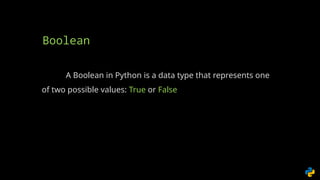
A Boolean in Python is a data type that represents one
of two possible values: True or False
Boolean
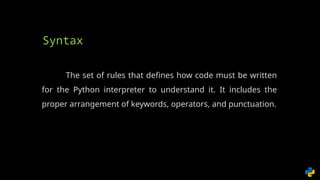
The set of rules that defines how code must be written
for the Python interpreter to understand it. It includes the
proper arrangement of keywords, operators, and punctuation.
Syntax
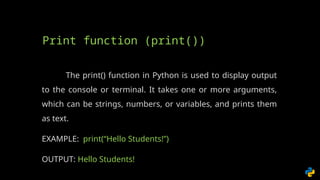
The print() function in Python is used to display output
to the console or terminal. It takes one or more arguments,
which can be strings, numbers, or variables, and prints them
as text.
EXAMPLE: print(“Hello Students!”)
OUTPUT: Hello Students!
Print function (print())
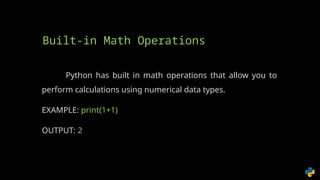
Python has built in math operations that allow you to
perform calculations using numerical data types.
EXAMPLE: print(1+1)
OUTPUT: 2
Built-in Math Operations
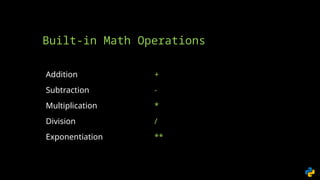
+
-
*
/
**
Built-in Math Operations
Addition
Subtraction
Multiplication
Division
Exponentiation
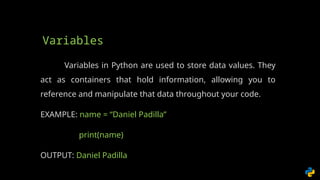
Variables in Python are used to store data values. They
act as containers that hold information, allowing you to
reference and manipulate that data throughout your code.
EXAMPLE: name = “Daniel Padilla”
print(name)
OUTPUT: Daniel Padilla
Variables
References:
[1]GeeksforGeeks. (2024, September 24). Introduction to
Python. GeeksforGeeks.
https://www.geeksforgeeks.org/introduction- to-python/
[2]W3Schools.com. (n.d.).
https://www.w3schools.com/python/python_intro.asp

Introduction-to-Python.pptx grade 9 ICT.

  • 1.
  • 2.
    Overview • What isPython? • Features of Python • Installing Python • IDLE • Data types • Syntax • Print function • Built-in math operations • Variables
  • 3.
    Python is ahigh-level, interpreted programming language known for its simplicity and readability. It allows developers to write clear and concise code, making it easier to learn and use. What is Python?
  • 4.
    Python was createdby Guido van Rossum, a Dutch programmer, in the late 1980s. He released the first version of Python in 1991. What is Python?
  • 5.
  • 6.
  • 7.
  • 8.
  • 9.
  • 10.
  • 11.
  • 12.
    To install Python,first, visit the official website at python.org and download the latest version of Python for your operating system. Once the download is complete, run the installer and make sure to check the box that says "Add Python to PATH" before proceeding with the installation. Installing Python
  • 13.
    The latest stableversion of Python as of October 2024 is Python 3.12.1. Installing Python
  • 14.
    IDLE stands for“Integrated Development and Learning Environment”, is a simple, easy-to-use interface for writing and running Python code. It includes a code editor with features like syntax highlighting, auto-completion, and an interactive shell that allows real-time code execution and testing. IDLE
  • 15.
    Integrated Development and LearningEnvironment (IDLE) Virtual Studio Code (VS Code)
  • 16.
    Integrated Development and LearningEnvironment (IDLE) PyChar m
  • 17.
    Integrated Development and LearningEnvironment (IDLE) spyder
  • 18.
    Integrated Development and LearningEnvironment (IDLE) The code editor in Visual Studio Code (VS Code) is a lightweight, powerful tool designed for writing and editing code.
  • 19.
    Integrated Development and LearningEnvironment (IDLE) The terminal in Visual Studio Code (VS Code) is an integrated command-line interface that allows users to execute commands directly within the editor.
  • 20.
    Data types areclassifications that specify the type of value, determining how the data can be used and manipulated. Data Types
  • 21.
    Python provides severalbuilt-in data types to work with, such as strings, integers, floats, booleans, lists, tuples, dictionaries, and sets. Each of these types serves a specific purpose, allowing you to handle different types of data efficiently. Data Types
  • 22.
    Python provides severalbuilt-in data types to work with, such as strings, integers, floats, booleans, lists, tuples, dictionaries, and sets. Each of these types serves a specific purpose, allowing you to handle different types of data efficiently. Data Types
  • 23.
    A String inPython is a sequence of characters enclosed in quotes, either single (') or double ("). Strings can include letters, numbers, symbols, and spaces. Example: “Hello Students!” String
  • 24.
    An Integer inPython is a data type that represents whole numbers without any decimal points. Integers can be positive, negative, or zero. They are used for counting, indexing, and performing arithmetic operations. Example: 1 , 2 , 5, -1 , -2, -100, 96 Integer
  • 25.
    A Float inPython is a data type used to represent decimal numbers or real numbers. It allows for more precise calculations than integers, as it can store values that include a fractional component. Example: 1.5 , 2.99 , 5.001, -1.5 , -2.490, -100.0999, 96.7 Float
  • 26.
    A Boolean inPython is a data type that represents one of two possible values: True or False Boolean
  • 27.
    The set ofrules that defines how code must be written for the Python interpreter to understand it. It includes the proper arrangement of keywords, operators, and punctuation. Syntax
  • 28.
    The print() functionin Python is used to display output to the console or terminal. It takes one or more arguments, which can be strings, numbers, or variables, and prints them as text. EXAMPLE: print(“Hello Students!”) OUTPUT: Hello Students! Print function (print())
  • 29.
    Python has builtin math operations that allow you to perform calculations using numerical data types. EXAMPLE: print(1+1) OUTPUT: 2 Built-in Math Operations
  • 30.
  • 31.
    Variables in Pythonare used to store data values. They act as containers that hold information, allowing you to reference and manipulate that data throughout your code. EXAMPLE: name = “Daniel Padilla” print(name) OUTPUT: Daniel Padilla Variables
  • 32.
    References: [1]GeeksforGeeks. (2024, September24). Introduction to Python. GeeksforGeeks. https://www.geeksforgeeks.org/introduction- to-python/ [2]W3Schools.com. (n.d.). https://www.w3schools.com/python/python_intro.asp