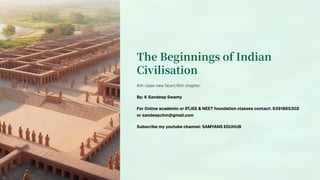
The Beginnings of Indian
Civilisation
6th class new Ncert/6th chapter.
By: K Sandeep Swamy
For Online academic or IITJEE & NEET foundation classes contact: 9391865302
or sandeepchm@gmail.com
Subscribe my youtube channel: SAMYANS EDUHUB
A Glimpse into Ancient India
India's most ancient civilization, known as the Harappan, Indus, or
Indus-Sarasvati Civilization, was truly remarkable in many ways. The
Harappan or Indus-Sarasvati Civilization was special because it had a
balanced society, where the rich and poor lived more equally. It focused
on living peacefully, not taking advantage of others.
Imagine cities with advanced technology, busy markets, and beautiful art. This shows how ancient India grew from small villages to large cities and
became a great civilization.
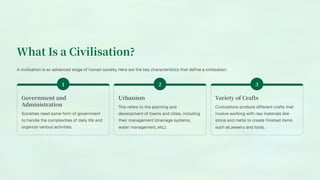
What Is a Civilisation?
A civilisation is an advanced stage of human society. Here are the key characteristics that define a civilisation:
Government and
Administration
Societies need some form of government
to handle the complexities of daily life and
organize various activities.
Urbanism
This refers to the planning and
development of towns and cities, including
their management (drainage systems,
water management, etc.).
Variety of Crafts
Civilizations produce different crafts that
involve working with raw materials like
stone and metal to create finished items
such as jewelry and tools.
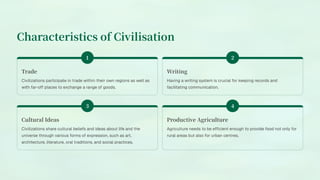
Characteristics of Civilisation
Trade
Civilizations participate in trade within their own regions as well as
with far-off places to exchange a range of goods.
Writing
Having a writing system is crucial for keeping records and
facilitating communication.
Cultural Ideas
Civilizations share cultural beliefs and ideas about life and the
universe through various forms of expression, such as art,
architecture, literature, oral traditions, and social practices.
Productive Agriculture
Agriculture needs to be efficient enough to provide food not only for
rural areas but also for urban centres.
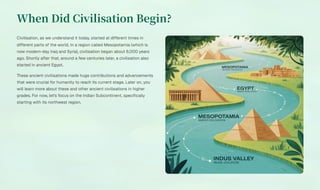
When Did Civilisation Begin?
Civilisation, as we understand it today, started at different times in
different parts of the world. In a region called Mesopotamia (which is
now modern-day Iraq and Syria), civilisation began about 6,000 years
ago. Shortly after that, around a few centuries later, a civilisation also
started in ancient Egypt.
These ancient civilisations made huge contributions and advancements
that were crucial for humanity to reach its current stage. Later on, you
will learn more about these and other ancient civilisations in higher
grades. For now, let's focus on the Indian Subcontinent, specifically
starting with its northwest region.
Test Your Knowledge
Try yourself:
What is one of the key characteristics that define a civilisation?
Developed technology
1.
Advanced agriculture
2.
Efficient communication
3.
Variety of crafts
4.
View Solution
From Village to City
Let's Discuss the First Urbanisation of India:
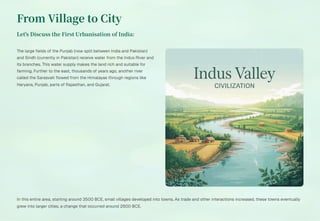
The large fields of the Punjab (now split between India and Pakistan)
and Sindh (currently in Pakistan) receive water from the Indus River and
its branches. This water supply makes the land rich and suitable for
farming. Further to the east, thousands of years ago, another river
called the Sarasvati flowed from the Himalayas through regions like
Haryana, Punjab, parts of Rajasthan, and Gujarat.
In this entire area, starting around 3500 BCE, small villages developed into towns. As trade and other interactions increased, these towns eventually
grew into larger cities, a change that occurred around 2600 BCE.
The Indus-Sarasvati Civilization
Archaeologists refer to this ancient civilization using several names: Indus, Harappan, Indus-Sarasvati, or Sindhu-Sarasvati civilization. All these
names are applicable, and the people living in this civilization are known as Harappans. This civilization is recognized as one of the oldest in the world
and it's called the 'First Urbanisation of India'.
Why are the people of this ancient civilization called 'Harappans' today?
The term 'Harappans' comes from the city of Harappa, which is located in present-day Pakistan's Punjab region. Harappa was the first city
of this civilization to be excavated or dug up by archaeologists. This excavation happened a long time ago, between 1920 and 1921, which is
more than a century back.
The Sarasvati River
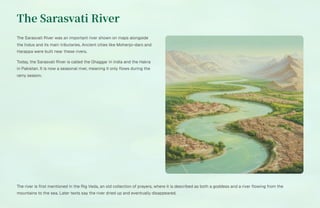
The Sarasvati River was an important river shown on maps alongside
the Indus and its main tributaries. Ancient cities like Mohenjo-daro and
Harappa were built near these rivers.
Today, the Sarasvati River is called the Ghaggar in India and the Hakra
in Pakistan. It is now a seasonal river, meaning it only flows during the
rainy season.
The river is first mentioned in the Rig Veda, an old collection of prayers, where it is described as both a goddess and a river flowing from the
mountains to the sea. Later texts say the river dried up and eventually disappeared.
Town-Planning
Harappa and Mohenjo Daro were the cities that led to the discovery of The Indus Valley Civilisation in .
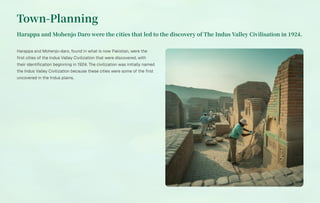
Harappa and Mohenjo-daro, found in what is now Pakistan, were the
first cities of the Indus Valley Civilization that were discovered, with
their identification beginning in 1924. The civilization was initially named
the Indus Valley Civilization because these cities were some of the first
uncovered in the Indus plains.
Discovery and Expansion
As research progressed, other important cities like Dholavira (in Gujarat), Rakhigarhi (in Haryana), and Ganweriwala (in the Cholistan desert of
Pakistan) were found, along with many smaller sites such as Lothal in Gujarat. Excavations are still ongoing today, helping to uncover more details
about this ancient civilization.
One significant region is the Sarasvati basin, which includes major cities like Rakhigarhi and Ganweriwala, along with smaller sites like Farmana (in
Haryana) and Kalibangan (in Rajasthan). This area also has towns such as Bhirrana and Banawali, both located in Haryana. The high number of these
sites in the Sarasvati basin indicates its importance in the Indus Valley Civilization.
Town Planning and Architecture
City Design
The large cities of the Harappan civilization
were designed with careful planning. They
had wide streets that were often oriented
towards the cardinal directions (north,
south, east, west). Most cities were
surrounded by fortifications (defensive
walls).
City Sections
The cities had two main sections:
Upper Town: This area was likely where
the local elite lived.
Lower Town: This section was where
the common people resided.
Buildings
Some large buildings in these cities served
collective purposes, such as warehouses
where goods to be transported were
stored. The streets were lined with
individual houses of different sizes. All the
houses were made of bricks and were
generally of similar construction quality,
regardless of the size of the house.
The Great Bath of Mohenjo-Daro
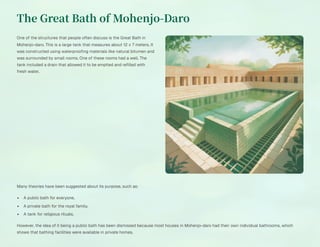
One of the structures that people often discuss is the Great Bath in
Mohenjo-daro. This is a large tank that measures about 12 x 7 meters. It
was constructed using waterproofing materials like natural bitumen and
was surrounded by small rooms. One of these rooms had a well. The
tank included a drain that allowed it to be emptied and refilled with
fresh water.
Many theories have been suggested about its purpose, such as:
A public bath for everyone.
A private bath for the royal family.
A tank for religious rituals.
However, the idea of it being a public bath has been dismissed because most houses in Mohenjo-daro had their own individual bathrooms, which
shows that bathing facilities were available in private homes.
Water Management
The Harappans had advanced water management systems. They had separate bathing areas, drains under
streets, and even large reservoirs for water storage and distribution.
The Harappans placed a high value on water management and
cleanliness. Their homes often included separate bathing areas that
were connected to a larger system of drains running beneath the
streets to dispose of wastewater.
Water Sources and Storage
In the city of Mohenjo-daro, residents obtained water from several brick wells. In other
locations, water sources included ponds, nearby streams, or artificial lakes.
For example, in Dholavira, which is situated in the Rann of Kutch in Gujarat, one of the
largest reservoirs was an impressive 73 meters long! Dholavira featured at least six
large reservoirs, some constructed from stones and others carved out of rock. These
reservoirs were often connected by underground drains to enable effective water
harvesting and distribution.
Test Your Knowledge
Try yourself:
What was a common feature of houses in the larger cities of the Harappan civilization?
Well-planned urban settlements.
1.
Individual bathrooms.
2.
Large reservoirs for water storage.
3.
Underground drains beneath streets.
4.
View Solution
What Did the Harappans Eat?
The Harappans established many of their communities near the banks
of rivers, both large and small. This was a clever decision as it provided
easy access to water and supported agriculture by enriching the soil.
Archaeological findings reveal that the Harappans cultivated different
types of cereals, including barley, wheat, some millets, and occasionally
rice. They also grew pulses and various kinds of vegetables.
Harappan Agriculture
Notably, they were the first in Eurasia to grow cotton, which they used to make clothing. The Harappans created farming tools, such as the plough,
some of which are still in use by farmers today.
Large-scale farming was organized through hundreds of small rural sites or villages. Similar to modern times, cities depended on receiving enough
agricultural produce from rural areas daily.
The Harappans also domesticated animals for meat and engaged in fishing in rivers and the ocean. This is evident from the numerous animal and fish
bones discovered during excavations.
Harappan Diet
Cereals
Barley, wheat, millets, and occasionally rice formed the staple
diet of the Harappans.
Pulses
Various types of pulses were cultivated to provide protein in their
diet.
Spices
Scientific research on clay pots has revealed the use of turmeric,
ginger, and other ingredients in Harappan cooking.
Animal Products
Meat from domesticated animals and fish from rivers and oceans
were important protein sources.
Scientific research on clay pots has provided insights into what the Harappans cooked. These pots contained typical items like dairy products and
unexpected ingredients such as turmeric, ginger, and remnants of bananas. This indicates that their diet was quite varied and diverse!
A Brisk Trade
The Harappans were actively engaged in trade both within their own
society and with other cultures in India and beyond. They exported
various goods, including:
Ornaments
Timber
Everyday items
Possibly gold, cotton, and food
Harappan Crafts
A highly sought-after product was beads made from carnelian, a reddish stone primarily found in Gujarat. Harappan artisans developed unique
methods to drill and embellish these beads.
They also crafted beautiful bangles from conch shells, which required skilled techniques due to the difficulty of working with shells.
It is not entirely clear what the Harappans imported in exchange, but they likely acquired copper, as it was not readily available in their area.
Trade Routes and Dockyards
To support trade, the Harappans utilized various routes, including land
paths, rivers, and the sea for long-distance exchanges. This period
marks the start of significant maritime activity in India.
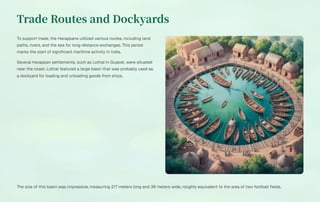
Several Harappan settlements, such as Lothal in Gujarat, were situated
near the coast. Lothal featured a large basin that was probably used as
a dockyard for loading and unloading goods from ships.
The size of this basin was impressive, measuring 217 meters long and 36 meters wide, roughly equivalent to the area of two football fields.
Trade Seals
The Harappans utilized small seals made from a soft stone called
steatite for managing their extensive trade. These seals were only a few
centimeters in size.
Typically, they featured animal figures and various symbols carved into
them. These symbols are part of an ancient writing system that remains
partially understood today.
The seals likely aided traders in recognizing their goods and identifying one another. They played a significant role in the trade activities of the
Harappan civilization.
Test Your Knowledge
Try yourself:
What was one of the most popular items exported by the Harappans?
Gold
1.
Cotton
2.
Beads made from carnelian
3.
Timber
4.
View Solution
The Harappans and Bronze
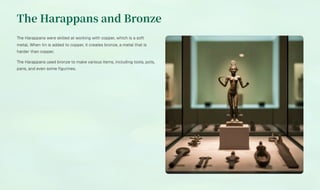
The Harappans were skilled at working with copper, which is a soft
metal. When tin is added to copper, it creates bronze, a metal that is
harder than copper.
The Harappans used bronze to make various items, including tools, pots,
pans, and even some figurines.
The End or a New Beginning?
Around 1900 BCE, the Sindhu-Sarasvati civilization started to decline, despite its
earlier successes. Cities were gradually abandoned, and those who stayed behind
began to resort to a rural lifestyle. It seemed that the original government or leadership
was gone, leading to the Harappans spreading out into many small villages.
Theories of Decline
Archaeologists have suggested several reasons for this decline, but initial thoughts of wars or invasions causing destruction were not supported by
evidence. There is no proof that the Harappans had a military or weapons, indicating that the civilization was mostly peaceful.
Climatic Change
Around 2200 BCE, a global change in climate caused less rainfall
and a drier environment, making it hard to grow food and possibly
leading to food shortages in the cities.
Drought and River Drying
The Sarasvati River dried up in its central area, which led to the
abandonment of cities like Kalibangan and Banawali.
Although other factors may have played a role, these two emphasize how much the civilization relied on climate and the environment for its survival.
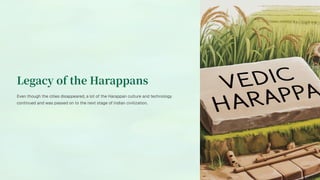
Legacy of the Harappans
Even though the cities disappeared, a lot of the Harappan culture and technology
continued and was passed on to the next stage of Indian civilization.
Conclusion
The story of the Indus, Harappan, or Sindhu-Sarasvatī civilisation is a tale of remarkable achievements and resilience. Their planned cities, advanced
water management systems, vibrant trade networks, and diverse crafts paint a picture of a highly sophisticated society.
Even as their cities faded away, the legacy of the Harappans lived on, shaping the future of Indian civilisation. Understanding their journey helps us
appreciate the ingenuity and adaptability of our ancestors, reminding us of the incredible human spirit that continues to drive progress today.
Key Words
Metallurgy
Includes the techniques of extracting
metals from nature, purifying or combining
them, as well as the scientific study of
metals and their properties.
Tributary
A river that flows into a larger river (or
lake). For instance, the Yamuna is a
tributary of the Ganga.
Fortification
A massive wall surrounding a settlement or
city, generally for protective purposes.
More Key Terms
Elite
Here, the word refers to the higher layers of the society, such as
rulers, officials, administrators, and often priests.
Reservoir
A large natural or artificial place where water is stored.
Pulses
A category of crops that includes beans, peas and lentils (dal).
Carnelian
A brownish-red mineral commonly used as a semi-precious stone.
FAQs on The Beginnings of Indian Civilisation
What defines a civilization, and how does it differ from a simple village society?
A civilization is characterized by advanced social, political, and economic structures, including written communication, urban development,
and organized governance. Unlike a simple village society that may rely on subsistence farming and informal social structures, a civilization
typically features distinct social hierarchies, specialized labor, and complex trade systems.
More FAQs
How did the transition from villages to cities
occur in ancient civilizations?
In the Indus-Sarasvati region, small villages began developing
around 3500 BCE near river banks that provided fertile soil. As
agricultural production increased and trade expanded, these
villages grew into towns and eventually into cities around 2600
BCE, marking the First Urbanisation of India.
What were the key features of town planning in
ancient civilizations?
Harappan cities featured carefully planned layouts with wide
streets oriented to cardinal directions, fortified walls, and distinct
upper and lower towns. Buildings were constructed with
standardized bricks, and houses of all sizes had similar
construction quality, suggesting a relatively egalitarian society.
Final FAQs
What role did water management play in the
development of ancient urban centres?
Water management was crucial to Harappan civilization. Cities
featured sophisticated systems including private bathrooms
connected to street drains, brick wells, and large reservoirs. In
Dholavira, six massive reservoirs connected by underground
drains enabled effective water harvesting and distribution,
demonstrating advanced engineering skills.
What evidence suggests that the Harappans
engaged in trade, and what were some of the
goods exchanged?
Evidence of Harappan trade includes dockyards like the one at
Lothal, trade seals with symbols, and artifacts found far from their
origin. They exported ornaments, timber, everyday items, carnelian
beads, and shell bangles. They likely imported copper, which
wasn't readily available in their region. Trade routes included land
paths, rivers, and sea routes.
Summary: The Remarkable Harappan Legacy
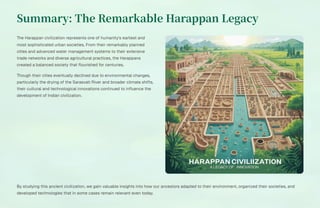
The Harappan civilization represents one of humanity's earliest and
most sophisticated urban societies. From their remarkably planned
cities and advanced water management systems to their extensive
trade networks and diverse agricultural practices, the Harappans
created a balanced society that flourished for centuries.
Though their cities eventually declined due to environmental changes,
particularly the drying of the Sarasvati River and broader climate shifts,
their cultural and technological innovations continued to influence the
development of Indian civilization.
By studying this ancient civilization, we gain valuable insights into how our ancestors adapted to their environment, organized their societies, and
developed technologies that in some cases remain relevant even today.