Introduction to Passive Circuit
Elements
Marks 8
Visit for more Learning Resources
Introduction
• In all electronics circuits we have to use different electronics
components such as Resistors, Capacitors, Inductors
Transformers and Semiconductor devices such as Diodes,
Transistors etc.…
• In this chapter we are going to discuss about
– various materials used to manufacture these devices
– Types
– Construction
– Properties of devices and components
Application of Electronics
• Communication and Entertainment
• Defense Application
• Industrial Applications
• Medical Science
• Instrumentation
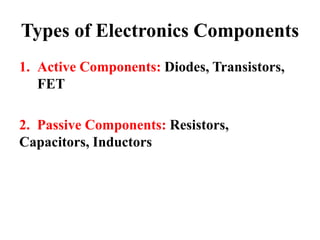
Types of Electronics Components
1. Active Components: Diodes, Transistors,
FET
2. Passive Components: Resistors,
Capacitors, Inductors
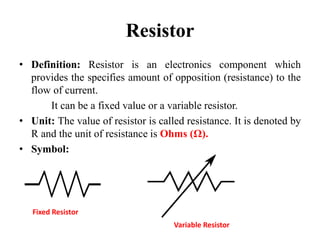
Resistor
• Definition: Resistor is an electronics component which
provides the specifies amount of opposition (resistance) to the
flow of current.
It can be a fixed value or a variable resistor.
• Unit: The value of resistor is called resistance. It is denoted by
R and the unit of resistance is Ohms (Ω).
• Symbol:
Fixed Resistor
Variable Resistor
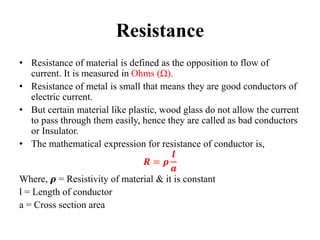
Resistance
• Resistance of material is defined as the opposition to flow of
current. It is measured in Ohms (Ω).
• Resistance of metal is small that means they are good conductors of
electric current.
• But certain material like plastic, wood glass do not allow the current
to pass through them easily, hence they are called as bad conductors
or Insulator.
• The mathematical expression for resistance of conductor is,
𝑹 = 𝝆
𝒍
𝒂
Where, 𝝆 = Resistivity of material & it is constant
l = Length of conductor
a = Cross section area
Classification of Resistors
Resistors
– Linear
• Fixed
• Variable
– Non Linear
• Thermistor (TDR)
• LDR
• VDR
For more detail contact us

Introduction to Passive Circuit Elements.pptx

  • 1.
    Introduction to PassiveCircuit Elements Marks 8 Visit for more Learning Resources
  • 2.
    Introduction • In allelectronics circuits we have to use different electronics components such as Resistors, Capacitors, Inductors Transformers and Semiconductor devices such as Diodes, Transistors etc.… • In this chapter we are going to discuss about – various materials used to manufacture these devices – Types – Construction – Properties of devices and components
  • 3.
    Application of Electronics •Communication and Entertainment • Defense Application • Industrial Applications • Medical Science • Instrumentation
  • 4.
    Types of ElectronicsComponents 1. Active Components: Diodes, Transistors, FET 2. Passive Components: Resistors, Capacitors, Inductors
  • 5.
    Resistor • Definition: Resistoris an electronics component which provides the specifies amount of opposition (resistance) to the flow of current. It can be a fixed value or a variable resistor. • Unit: The value of resistor is called resistance. It is denoted by R and the unit of resistance is Ohms (Ω). • Symbol: Fixed Resistor Variable Resistor
  • 6.
    Resistance • Resistance ofmaterial is defined as the opposition to flow of current. It is measured in Ohms (Ω). • Resistance of metal is small that means they are good conductors of electric current. • But certain material like plastic, wood glass do not allow the current to pass through them easily, hence they are called as bad conductors or Insulator. • The mathematical expression for resistance of conductor is, 𝑹 = 𝝆 𝒍 𝒂 Where, 𝝆 = Resistivity of material & it is constant l = Length of conductor a = Cross section area
  • 7.
    Classification of Resistors Resistors –Linear • Fixed • Variable – Non Linear • Thermistor (TDR) • LDR • VDR For more detail contact us