

Online qualitative research
methods
The various different methods
•
•
•
•
•
•

Live online focus groups
Bulletin board focus groups
Market research online communities
Qualitative research panels
Diaries, blogs and journals
Individual depth interviews
How these methods work
• Questions are posted and responses given in
writing (rather than verbally or via webcam)
• Usually both researchers and participants can
upload images, videos or other files as part of
their questions or answers
• Typically it is possible for observers to login to
view the research in real-time or retrospectively
• Participants are normally given their incentives
after the research, rather than beforehand (as
for face to face research)
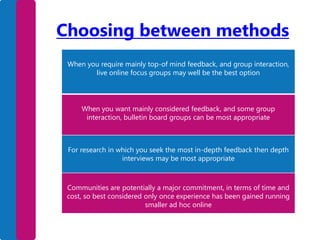
Choosing between methods
When you require mainly top-of mind feedback, and group interaction,
live online focus groups may well be the best option

When you want mainly considered feedback, and some group
interaction, bulletin board groups can be most appropriate

For research in which you seek the most in-depth feedback then depth
interviews may be most appropriate

Communities are potentially a major commitment, in terms of time and
cost, so best considered only once experience has been gained running
smaller ad hoc online
Some example research
applications
• Product testing
• Concept development
• Customer experience and
satisfaction
• Advertising and marketing
communications
development
• Category management
• Employee engagement
• And more…..
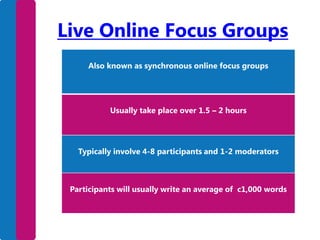
Live Online Focus Groups
Also known as synchronous online focus groups

Usually take place over 1.5 – 2 hours

Typically involve 4-8 participants and 1-2 moderators

Participants will usually write an average of c1,000 words
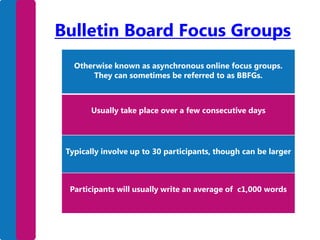
Bulletin Board Focus Groups
Otherwise known as asynchronous online focus groups.
They can sometimes be referred to as BBFGs.

Usually take place over a few consecutive days

Typically involve up to 30 participants, though can be larger

Participants will usually write an average of c1,000 words
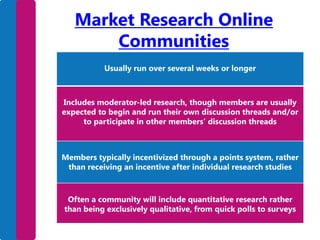
Market Research Online
Communities
Usually run over several weeks or longer

Includes moderator-led research, though members are usually
expected to begin and run their own discussion threads and/or
to participate in other members’ discussion threads

Members typically incentivized through a points system, rather
than receiving an incentive after individual research studies

Often a community will include quantitative research rather
than being exclusively qualitative, from quick polls to surveys
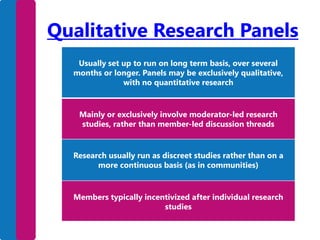
Qualitative Research Panels
Usually set up to run on long term basis, over several
months or longer. Panels may be exclusively qualitative,
with no quantitative research

Mainly or exclusively involve moderator-led research
studies, rather than member-led discussion threads

Research usually run as discreet studies rather than on a
more continuous basis (as in communities)

Members typically incentivized after individual research
studies
Diaries, Blogs & Journals
The terms diary, blog and journal are often used
interchangeably

They can be used for pre-tasks before either face to face or
online groups, or on a standalone basis for ethnographic
research

Whilst diaries and journals are private, a blog is public.
Diaries and journals are not designed to invite comments by
readers, whereas a blog is designed to do so

The moderator briefs participants on the frequency and
types of entries they are seeking
Individual Depth Interviews
Set up as a one-to-one interview between the participant
and the moderator, often referred to as IDIs

These can be run either in real-time or on an asynchronous
basis depending on the project brief

To the moderator and participants online IDIs look and feel
the same as live online groups or bulletin board groups
except that no participant sees any other participants’
answers.

Participants usually write an average of c1,000 words
Getting started
• Create an account on one of the online qualitative
research software tools (Google: Online qualitative
research software)
• Make sure you are getting access to the full version of
the software that you decide to try, for free, with no
strings or commitment
• Prepare a discussion guide in the same way as you
would for a face to face group
• Recruit a small number of colleagues, friends or (best
of all) friends of friends
• Try a live online group and a bulletin board group,
each with c4-6 participants
• Keep a track on how much time you are spending on
each stage of your research
www.mrqual.com

An Introduction to Online Qualitative Research Methods

  • 1.
  • 2.
    The various differentmethods • • • • • • Live online focus groups Bulletin board focus groups Market research online communities Qualitative research panels Diaries, blogs and journals Individual depth interviews
  • 3.
    How these methodswork • Questions are posted and responses given in writing (rather than verbally or via webcam) • Usually both researchers and participants can upload images, videos or other files as part of their questions or answers • Typically it is possible for observers to login to view the research in real-time or retrospectively • Participants are normally given their incentives after the research, rather than beforehand (as for face to face research)
  • 4.
    Choosing between methods Whenyou require mainly top-of mind feedback, and group interaction, live online focus groups may well be the best option When you want mainly considered feedback, and some group interaction, bulletin board groups can be most appropriate For research in which you seek the most in-depth feedback then depth interviews may be most appropriate Communities are potentially a major commitment, in terms of time and cost, so best considered only once experience has been gained running smaller ad hoc online
  • 5.
    Some example research applications •Product testing • Concept development • Customer experience and satisfaction • Advertising and marketing communications development • Category management • Employee engagement • And more…..
  • 6.
    Live Online FocusGroups Also known as synchronous online focus groups Usually take place over 1.5 – 2 hours Typically involve 4-8 participants and 1-2 moderators Participants will usually write an average of c1,000 words
  • 7.
    Bulletin Board FocusGroups Otherwise known as asynchronous online focus groups. They can sometimes be referred to as BBFGs. Usually take place over a few consecutive days Typically involve up to 30 participants, though can be larger Participants will usually write an average of c1,000 words
  • 8.
    Market Research Online Communities Usuallyrun over several weeks or longer Includes moderator-led research, though members are usually expected to begin and run their own discussion threads and/or to participate in other members’ discussion threads Members typically incentivized through a points system, rather than receiving an incentive after individual research studies Often a community will include quantitative research rather than being exclusively qualitative, from quick polls to surveys
  • 9.
    Qualitative Research Panels Usuallyset up to run on long term basis, over several months or longer. Panels may be exclusively qualitative, with no quantitative research Mainly or exclusively involve moderator-led research studies, rather than member-led discussion threads Research usually run as discreet studies rather than on a more continuous basis (as in communities) Members typically incentivized after individual research studies
  • 10.
    Diaries, Blogs &Journals The terms diary, blog and journal are often used interchangeably They can be used for pre-tasks before either face to face or online groups, or on a standalone basis for ethnographic research Whilst diaries and journals are private, a blog is public. Diaries and journals are not designed to invite comments by readers, whereas a blog is designed to do so The moderator briefs participants on the frequency and types of entries they are seeking
  • 11.
    Individual Depth Interviews Setup as a one-to-one interview between the participant and the moderator, often referred to as IDIs These can be run either in real-time or on an asynchronous basis depending on the project brief To the moderator and participants online IDIs look and feel the same as live online groups or bulletin board groups except that no participant sees any other participants’ answers. Participants usually write an average of c1,000 words
  • 12.
    Getting started • Createan account on one of the online qualitative research software tools (Google: Online qualitative research software) • Make sure you are getting access to the full version of the software that you decide to try, for free, with no strings or commitment • Prepare a discussion guide in the same way as you would for a face to face group • Recruit a small number of colleagues, friends or (best of all) friends of friends • Try a live online group and a bulletin board group, each with c4-6 participants • Keep a track on how much time you are spending on each stage of your research
  • 13.