Introduction to Nouns Countable vs. Uncountable Nouns
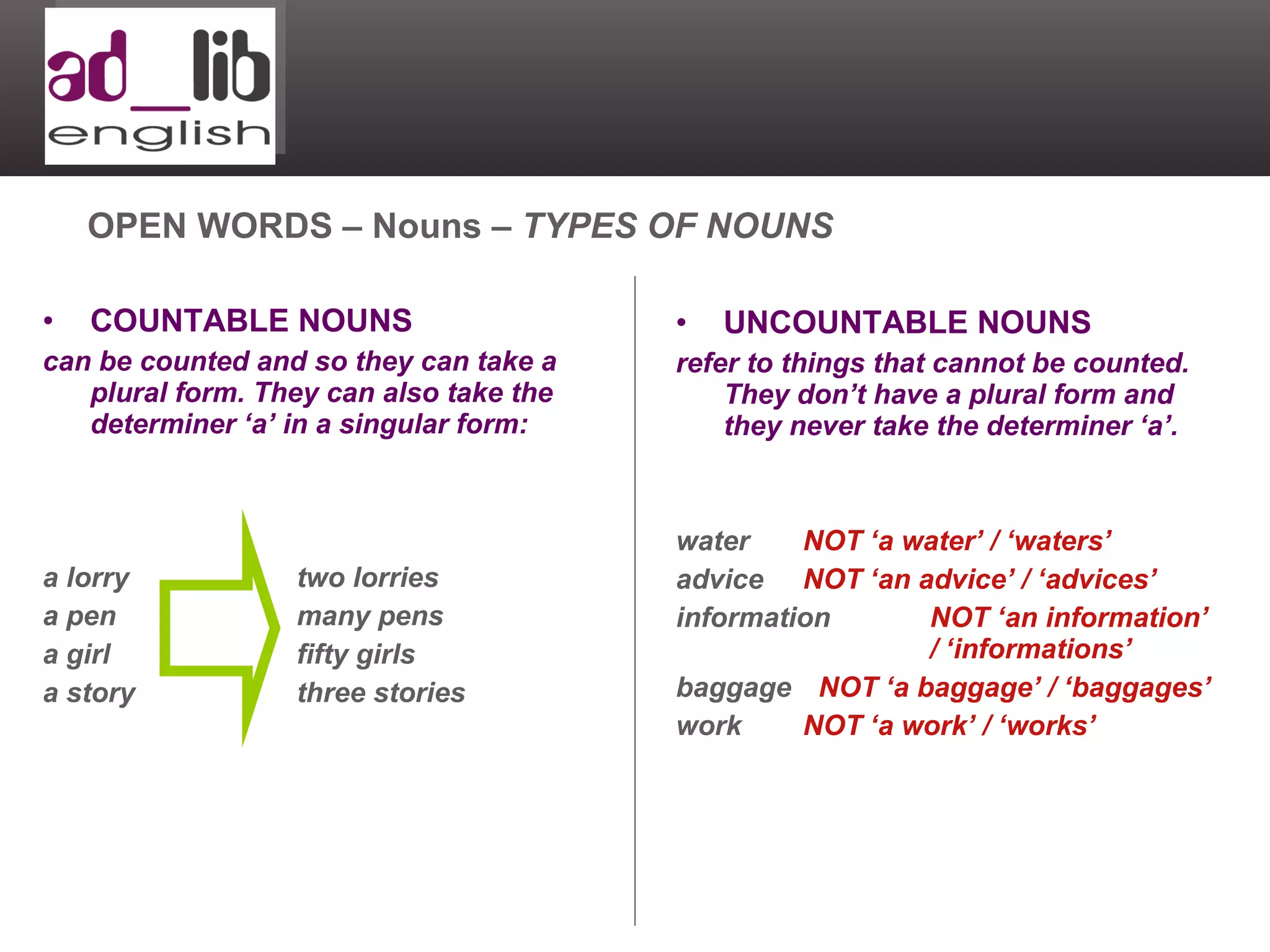
COUNTABLE NOUNS can be counted and so they can take a plural form. They can also take the determiner ‘a’ in a singular form: a lorry two lorries a pen many pens a girl fifty girls a story three stories OPEN WORDS – Nouns –  TYPES OF NOUNS UNCOUNTABLE NOUNS refer to things that cannot be counted. They don’t have a plural form and they never take the determiner ‘a’. water NOT ‘a water’ / ‘waters’ advice NOT ‘an advice’ / ‘advices’ information  NOT ‘an information’  / ‘informations’ baggage   NOT ‘a baggage’ / ‘baggages’ work NOT ‘a work’ / ‘works’
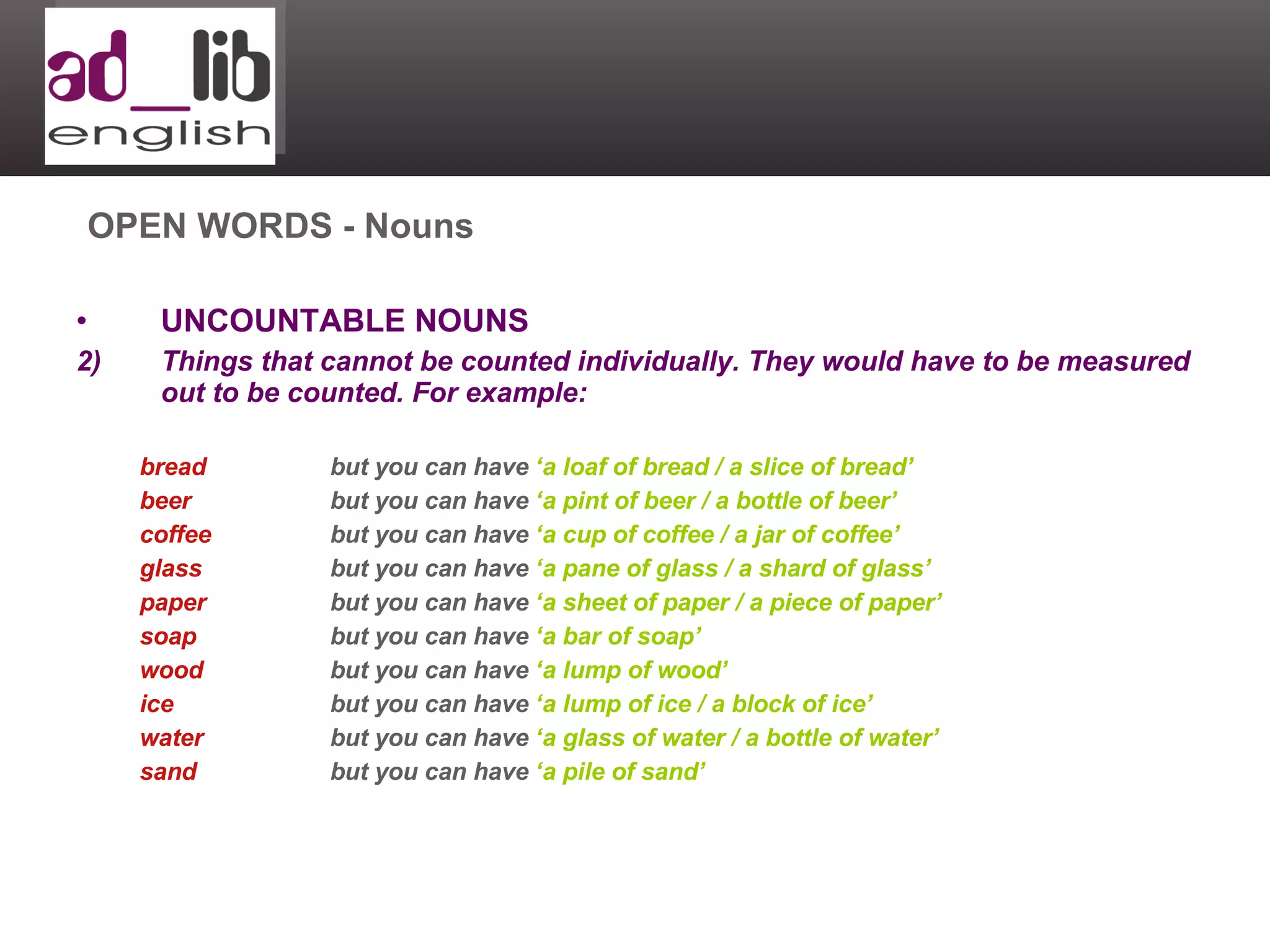
UNCOUNTABLE NOUNS Things that cannot be counted individually. They would have to be measured out to be counted. For example: bread but you can have  ‘a loaf of bread / a slice of bread’ beer but you can have  ‘a pint of beer / a bottle of beer’ coffee but you can have  ‘a cup of coffee / a jar of coffee’ glass but you can have  ‘a pane of glass / a shard of glass’ paper but you can have  ‘a sheet of paper / a piece of paper’ soap but you can have  ‘a bar of soap’ wood but you can have  ‘a lump of wood’ ice but you can have  ‘a lump of ice / a block of ice’ water but you can have  ‘a glass of water / a bottle of water’ sand but you can have  ‘a pile of sand’ OPEN WORDS - Nouns
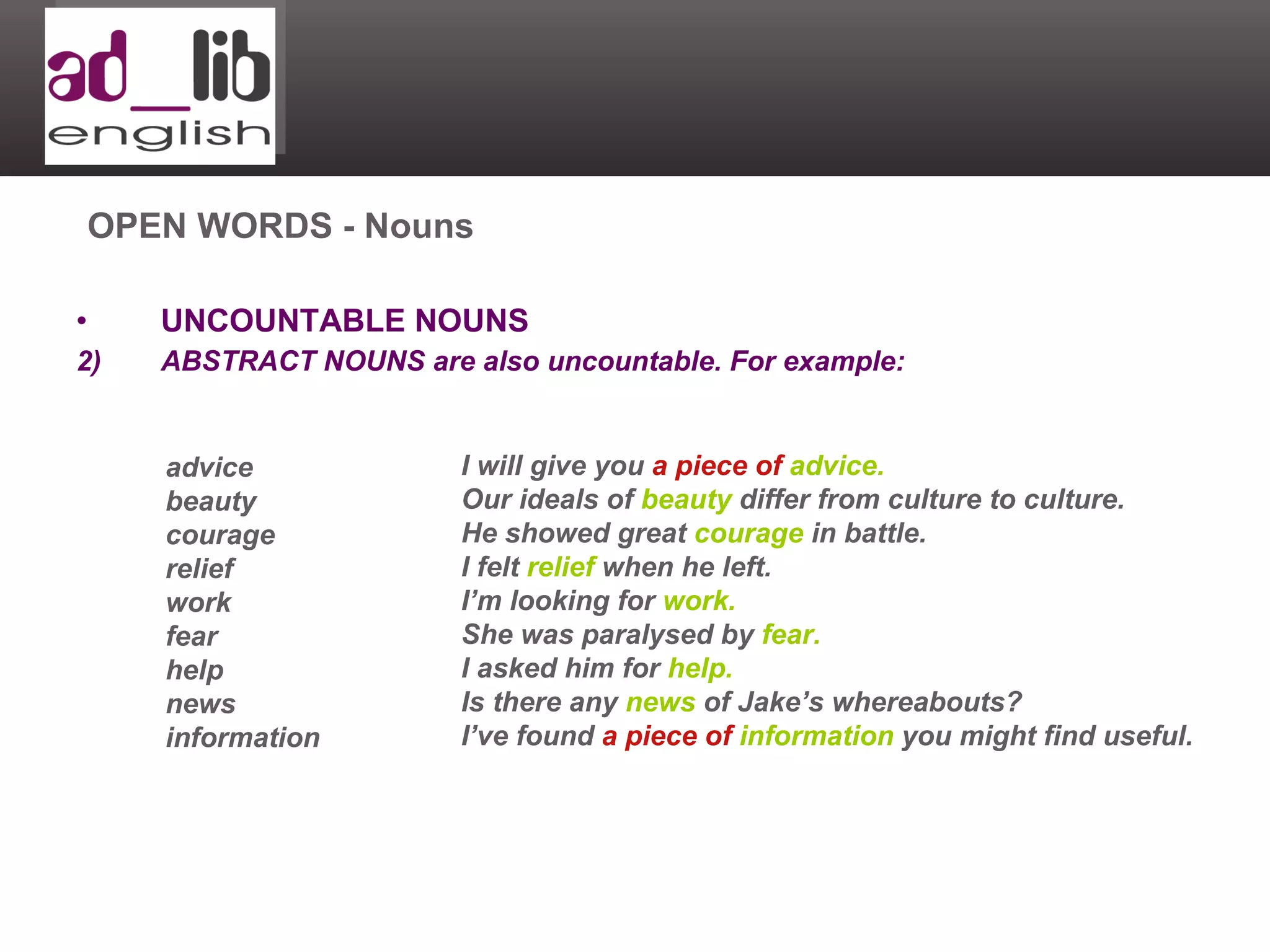
UNCOUNTABLE NOUNS ABSTRACT NOUNS are also uncountable. For example: OPEN WORDS - Nouns advice beauty courage relief work fear help news information I will give you  a piece of   advice. Our ideals of  beauty  differ from culture to culture. He showed great  courage  in battle. I felt  relief  when he left. I’m looking for  work. She was paralysed by  fear. I asked him for  help. Is there any  news  of Jake’s whereabouts?  I’ve found  a piece of   information  you might find useful.
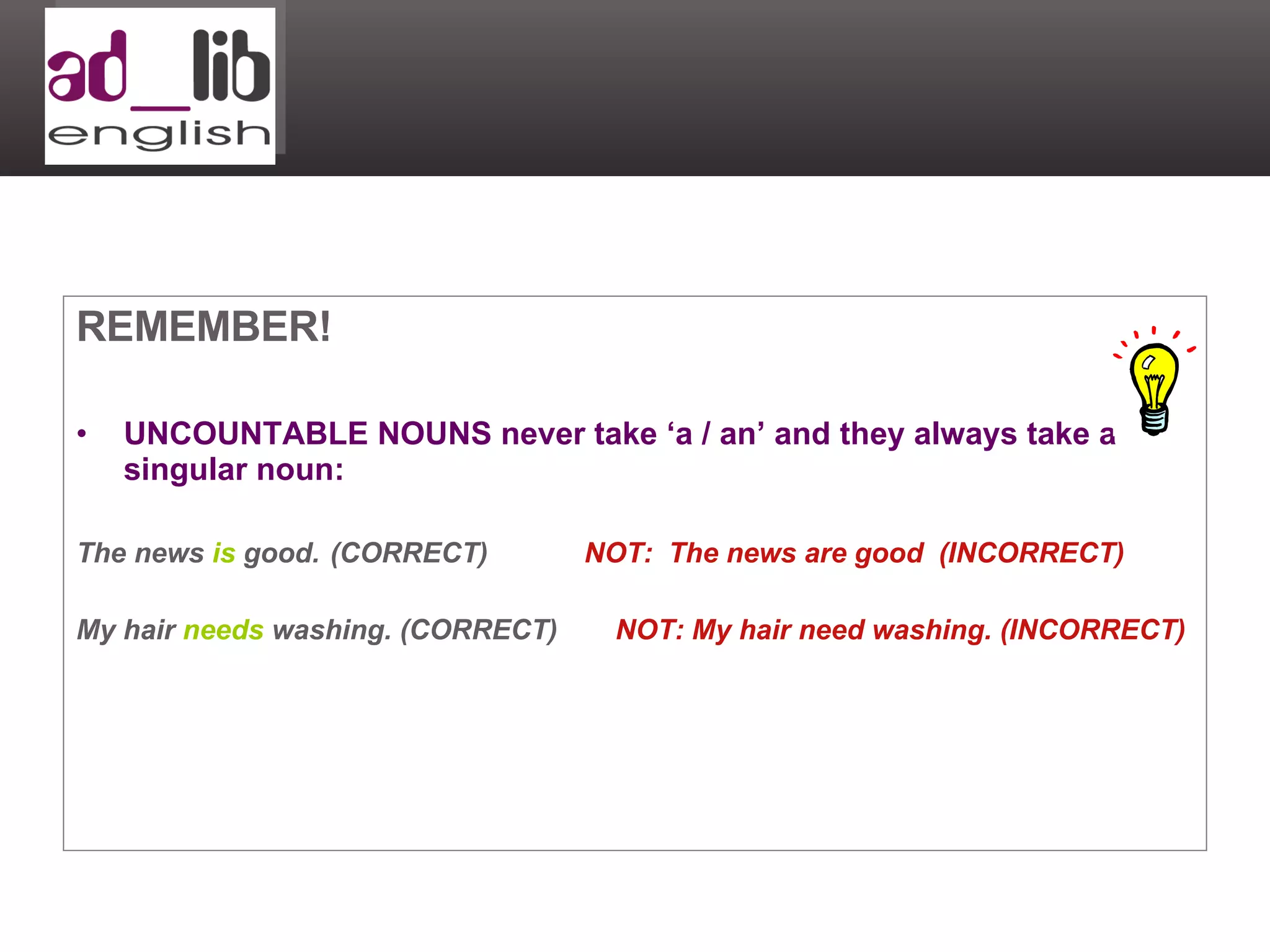
REMEMBER! UNCOUNTABLE NOUNS never take ‘a / an’ and they always take a singular noun: The news  is  good. (CORRECT) NOT:  The news are good  (INCORRECT) My hair  needs  washing. (CORRECT)   NOT: My hair need washing. (INCORRECT)
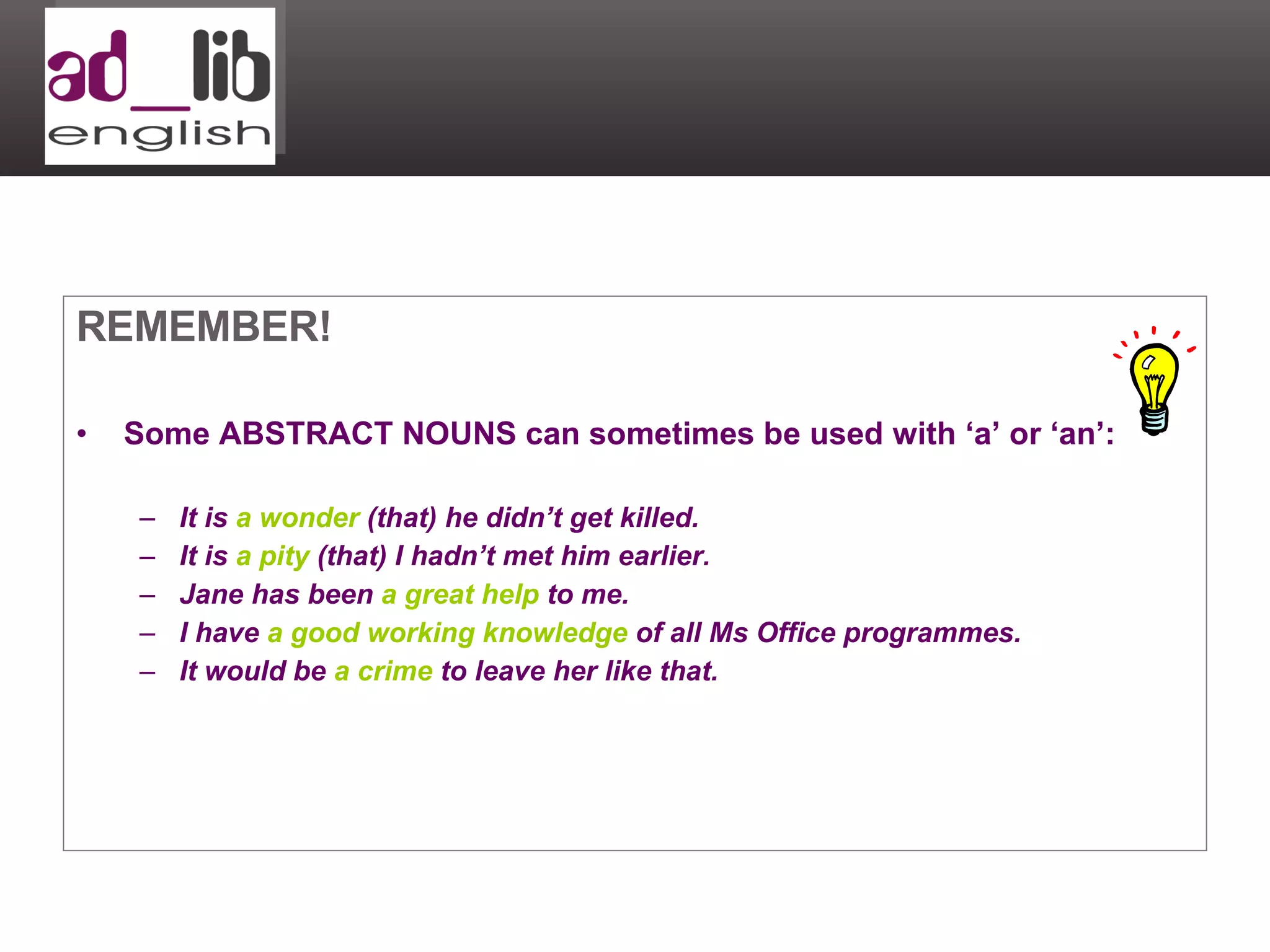
REMEMBER! Some ABSTRACT NOUNS can sometimes be used with ‘a’ or ‘an’: It is  a wonder  (that) he didn’t get killed. It is  a pity  (that) I hadn’t met him earlier. Jane has been  a   great help  to me. I have  a good working knowledge  of all Ms Office programmes. It would be  a crime  to leave her like that.
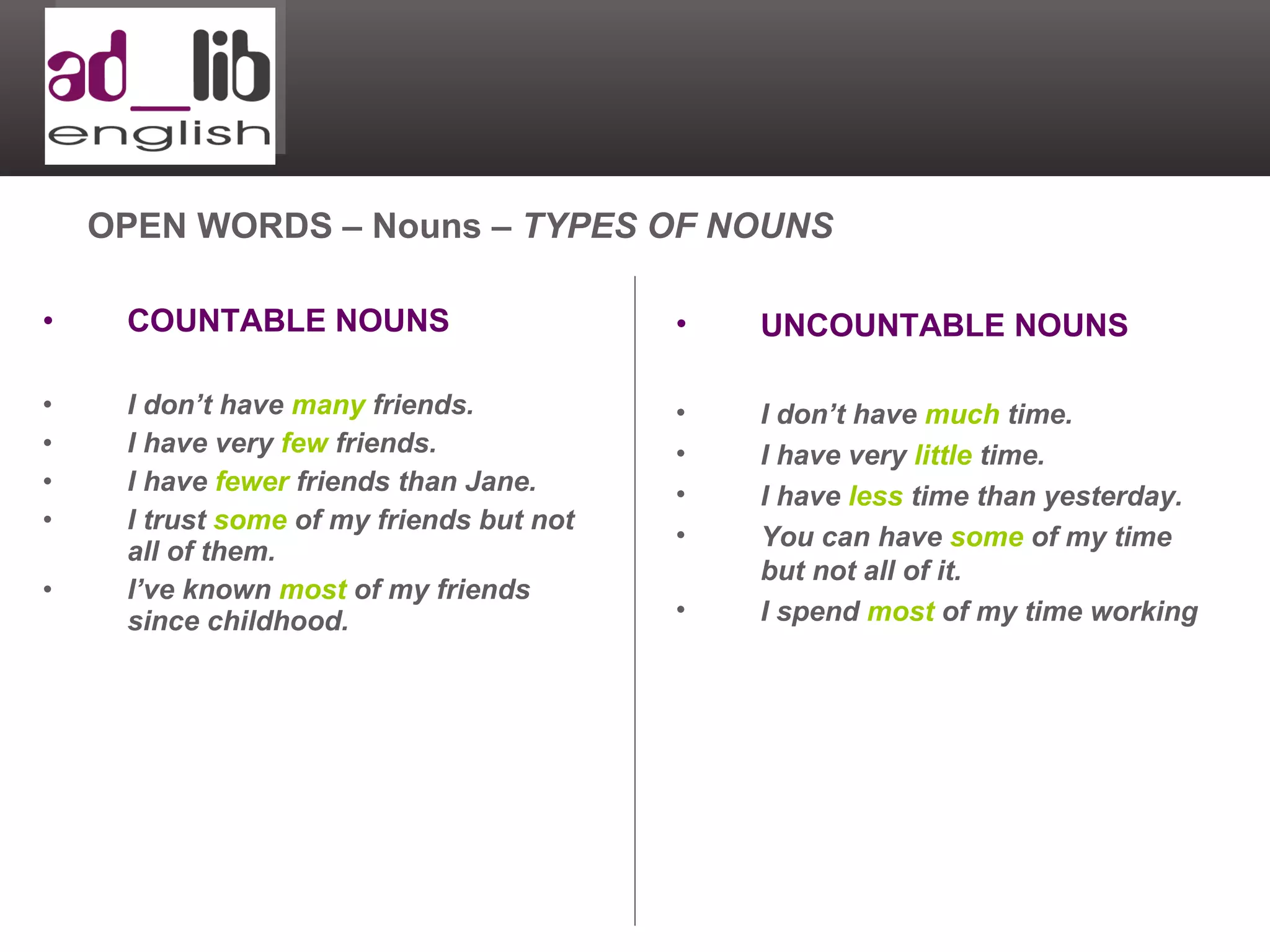
COUNTABLE NOUNS I don’t have  many  friends. I have very  few  friends. I have  fewer  friends than Jane. I trust  some  of my friends but not all of them. I’ve known  most  of my friends since childhood. OPEN WORDS – Nouns –  TYPES OF NOUNS UNCOUNTABLE NOUNS I don’t have  much  time. I have very  little  time. I have  less  time than yesterday. You can have  some  of my time but not all of it. I spend  most  of my time working
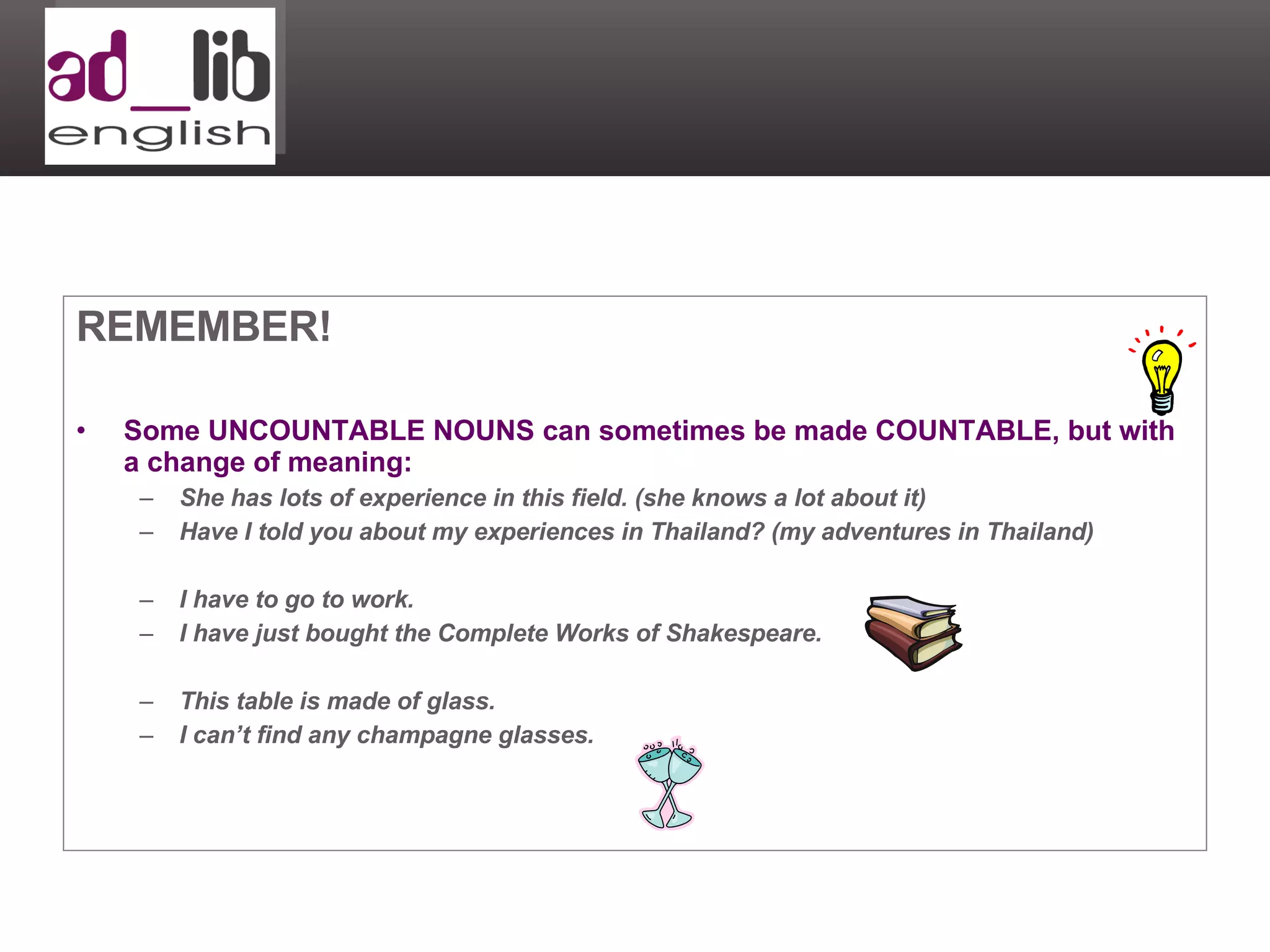
REMEMBER! Some UNCOUNTABLE NOUNS can sometimes be made COUNTABLE, but with a change of meaning: She has lots of experience in this field. (she knows a lot about it) Have I told you about my experiences in Thailand? (my adventures in Thailand) I have to go to work. I have just bought the Complete Works of Shakespeare. This table is made of glass. I can’t find any champagne glasses.
Introduction to Grammar TYPES OF WORDS Adjectives COMING SOON!
Introduction To English Nouns - part 4

Introduction To English Nouns - part 4

  • 1.
    Introduction to NounsCountable vs. Uncountable Nouns
  • 2.
    COUNTABLE NOUNS canbe counted and so they can take a plural form. They can also take the determiner ‘a’ in a singular form: a lorry two lorries a pen many pens a girl fifty girls a story three stories OPEN WORDS – Nouns – TYPES OF NOUNS UNCOUNTABLE NOUNS refer to things that cannot be counted. They don’t have a plural form and they never take the determiner ‘a’. water NOT ‘a water’ / ‘waters’ advice NOT ‘an advice’ / ‘advices’ information NOT ‘an information’ / ‘informations’ baggage NOT ‘a baggage’ / ‘baggages’ work NOT ‘a work’ / ‘works’
  • 3.
    UNCOUNTABLE NOUNS Thingsthat cannot be counted individually. They would have to be measured out to be counted. For example: bread but you can have ‘a loaf of bread / a slice of bread’ beer but you can have ‘a pint of beer / a bottle of beer’ coffee but you can have ‘a cup of coffee / a jar of coffee’ glass but you can have ‘a pane of glass / a shard of glass’ paper but you can have ‘a sheet of paper / a piece of paper’ soap but you can have ‘a bar of soap’ wood but you can have ‘a lump of wood’ ice but you can have ‘a lump of ice / a block of ice’ water but you can have ‘a glass of water / a bottle of water’ sand but you can have ‘a pile of sand’ OPEN WORDS - Nouns
  • 4.
    UNCOUNTABLE NOUNS ABSTRACTNOUNS are also uncountable. For example: OPEN WORDS - Nouns advice beauty courage relief work fear help news information I will give you a piece of advice. Our ideals of beauty differ from culture to culture. He showed great courage in battle. I felt relief when he left. I’m looking for work. She was paralysed by fear. I asked him for help. Is there any news of Jake’s whereabouts? I’ve found a piece of information you might find useful.
  • 5.
    REMEMBER! UNCOUNTABLE NOUNSnever take ‘a / an’ and they always take a singular noun: The news is good. (CORRECT) NOT: The news are good (INCORRECT) My hair needs washing. (CORRECT) NOT: My hair need washing. (INCORRECT)
  • 6.
    REMEMBER! Some ABSTRACTNOUNS can sometimes be used with ‘a’ or ‘an’: It is a wonder (that) he didn’t get killed. It is a pity (that) I hadn’t met him earlier. Jane has been a great help to me. I have a good working knowledge of all Ms Office programmes. It would be a crime to leave her like that.
  • 7.
    COUNTABLE NOUNS Idon’t have many friends. I have very few friends. I have fewer friends than Jane. I trust some of my friends but not all of them. I’ve known most of my friends since childhood. OPEN WORDS – Nouns – TYPES OF NOUNS UNCOUNTABLE NOUNS I don’t have much time. I have very little time. I have less time than yesterday. You can have some of my time but not all of it. I spend most of my time working
  • 8.
    REMEMBER! Some UNCOUNTABLENOUNS can sometimes be made COUNTABLE, but with a change of meaning: She has lots of experience in this field. (she knows a lot about it) Have I told you about my experiences in Thailand? (my adventures in Thailand) I have to go to work. I have just bought the Complete Works of Shakespeare. This table is made of glass. I can’t find any champagne glasses.
  • 9.
    Introduction to GrammarTYPES OF WORDS Adjectives COMING SOON!