NOSQL OVERVIEW
NOSQL DATABASES
• A cheeky acronym for Not Only SQL
• More confrontationally, No to SQL.
THE RISE OF NOSQL
DATABASES
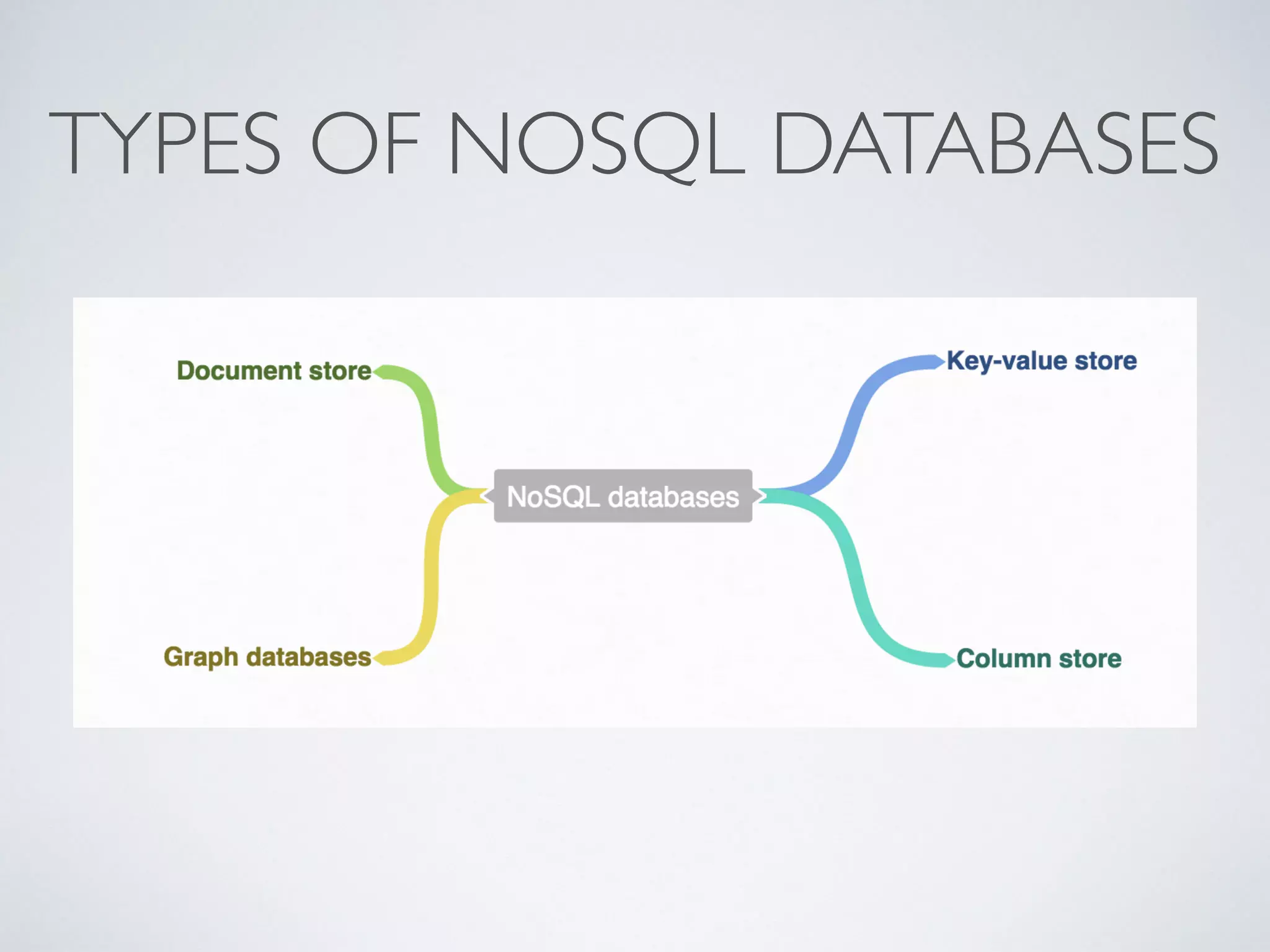
TYPES OF NOSQL DATABASES
DOCUMENT STORES
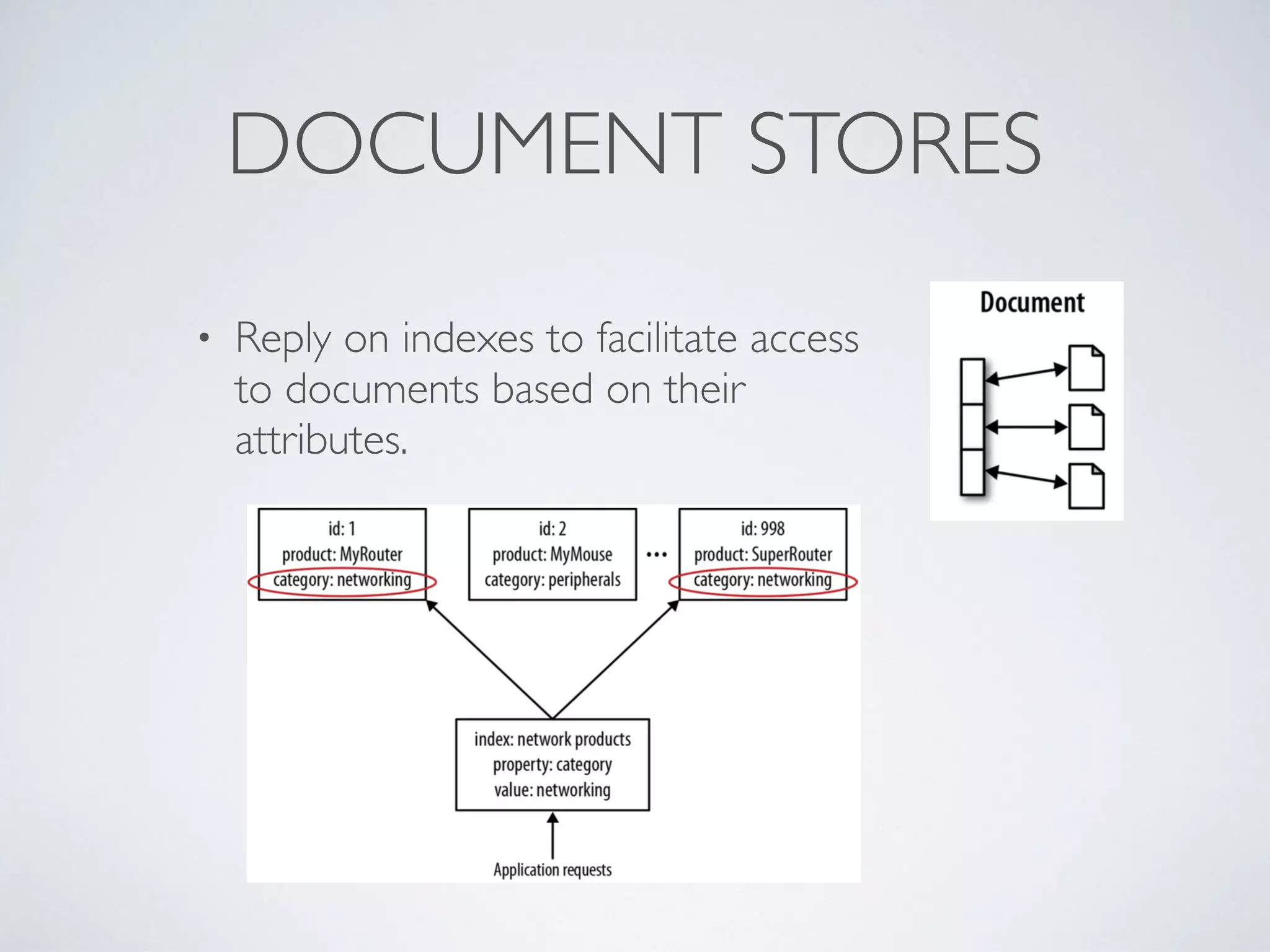
• Reply on indexes to facilitate access
to documents based on their
attributes.
DOCUMENT STORES
• Data model of a document store is one
of disconnected entities
• Should scale horizontally, as there’s no
contended state between mutually
independent records at write time
• Limitation:Transactions are limited to the
level of an individual record.
• Support for operating across sets of
documents atomically is emerging
KEYVALUE STORES
• Large, distributed hash map data
structures that store and retrieve
opaque values by key
• Level of insight offered into data is due
to data opacity.
• To retrieve insight across individual
records, a cluster computing framework
like Map reduce or spark is used.
KEY-VALUE STORES
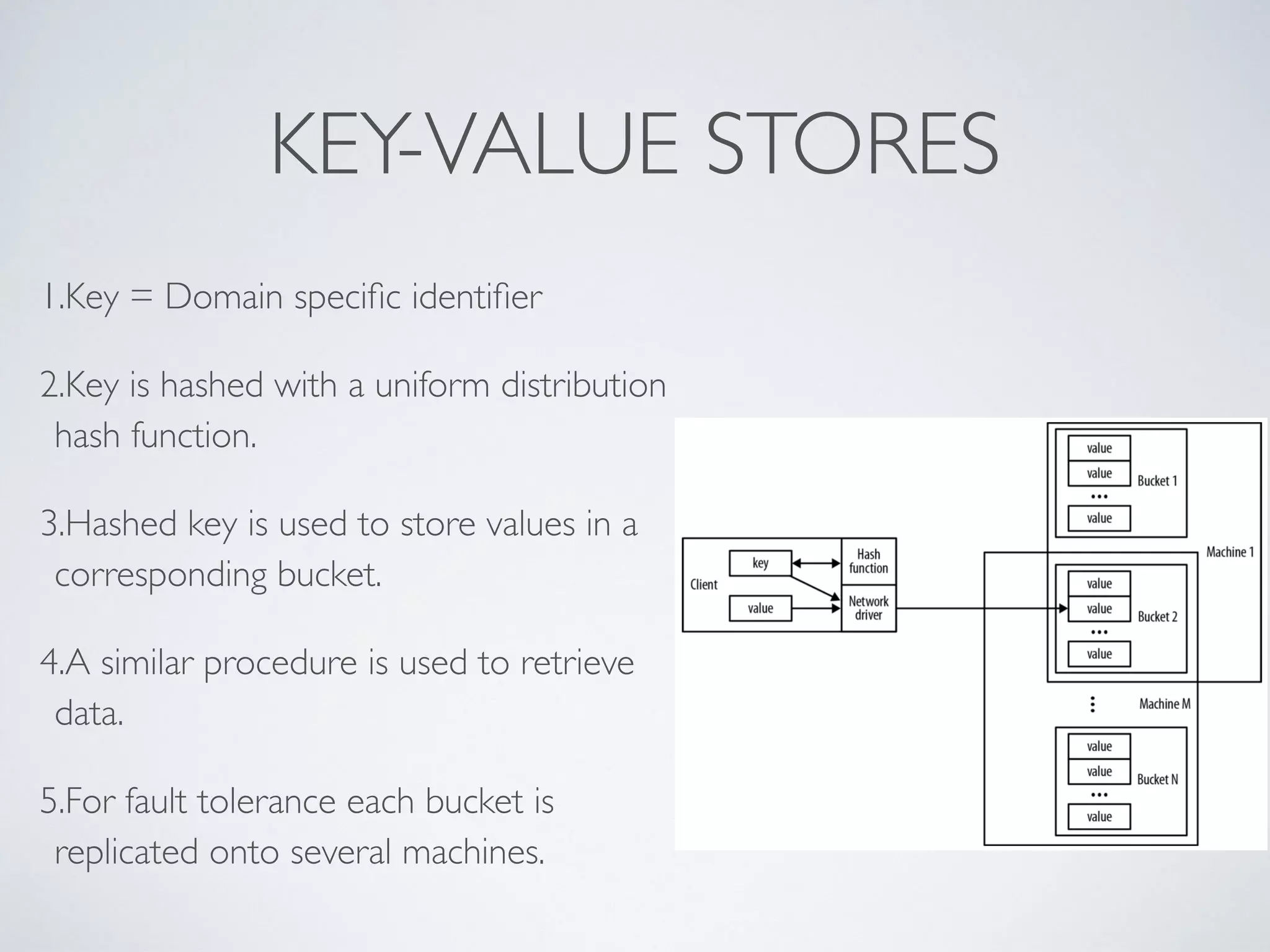
1.Key = Domain specific identifier
2.Key is hashed with a uniform distribution
hash function.
3.Hashed key is used to store values in a
corresponding bucket.
4.A similar procedure is used to retrieve
data.
5.For fault tolerance each bucket is
replicated onto several machines.
COLUMN FAMILY
• Modelled on Google’s
BigTable.
• Logically speaking, it’s just a
map of maps.
COLUMN FAMILY
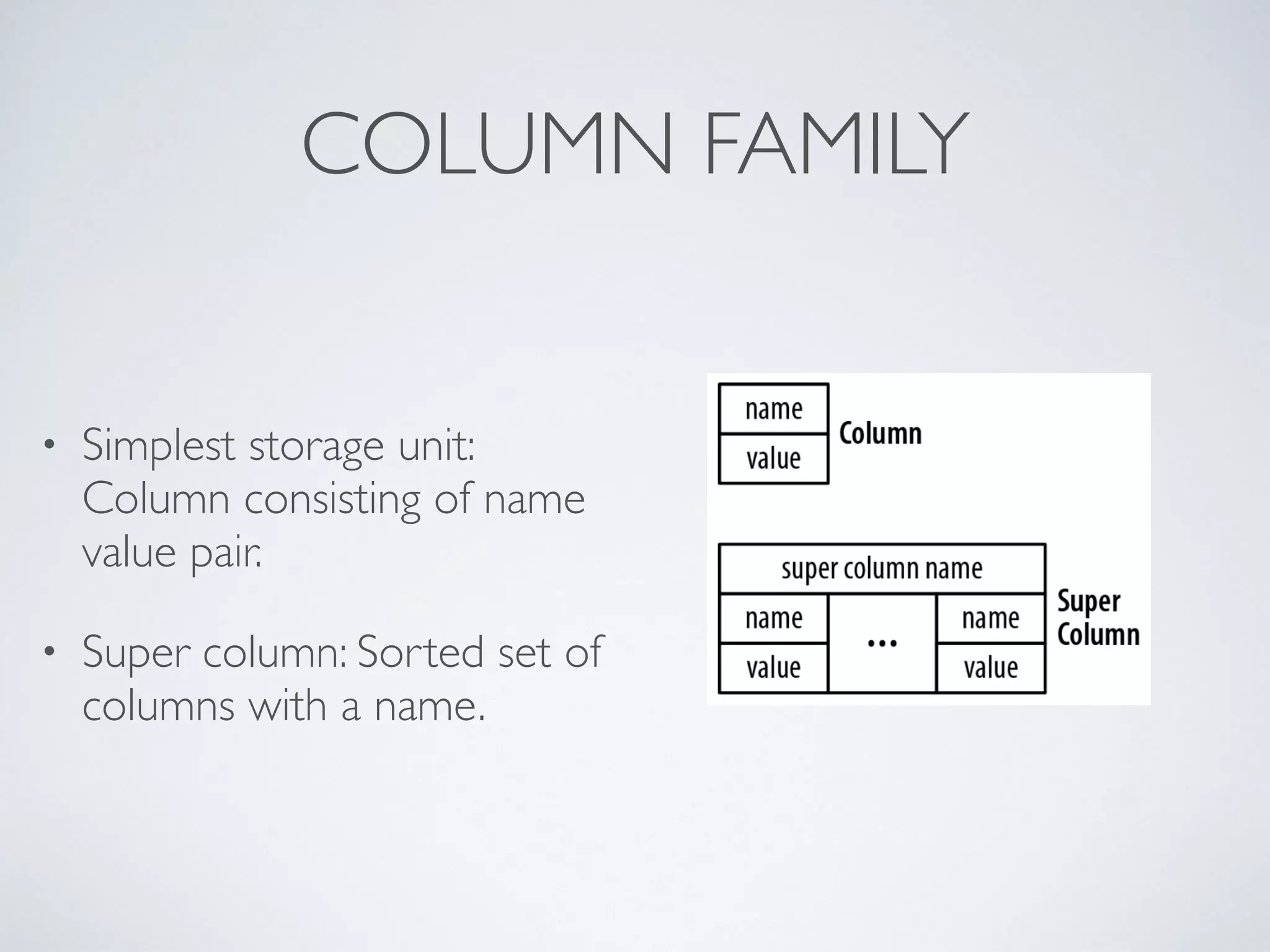
• Simplest storage unit:
Column consisting of name
value pair.
• Super column: Sorted set of
columns with a name.
COLUMN FAMILY
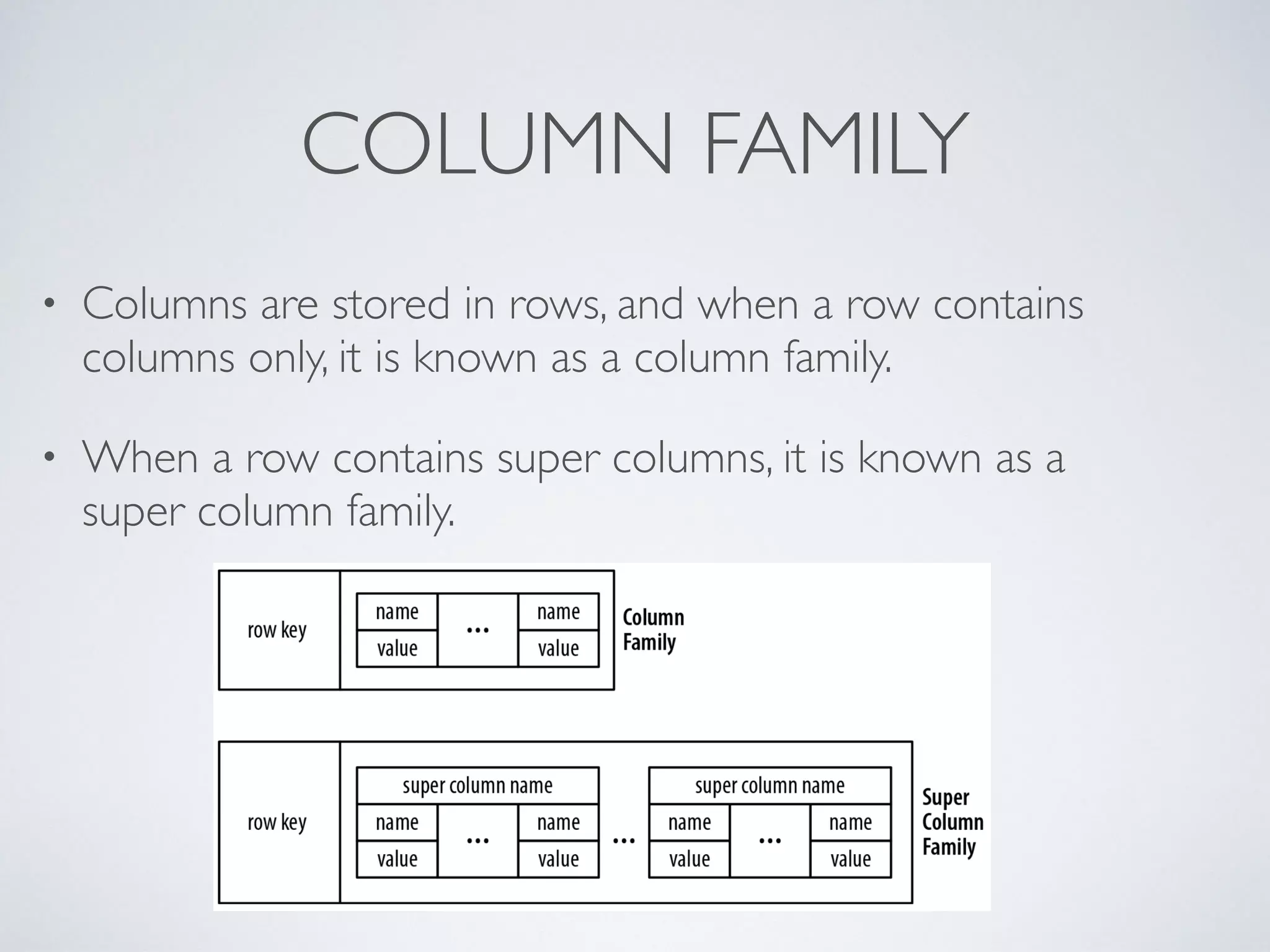
• Columns are stored in rows, and when a row contains
columns only, it is known as a column family.
• When a row contains super columns, it is known as a
super column family.
COLUMN FAMILY
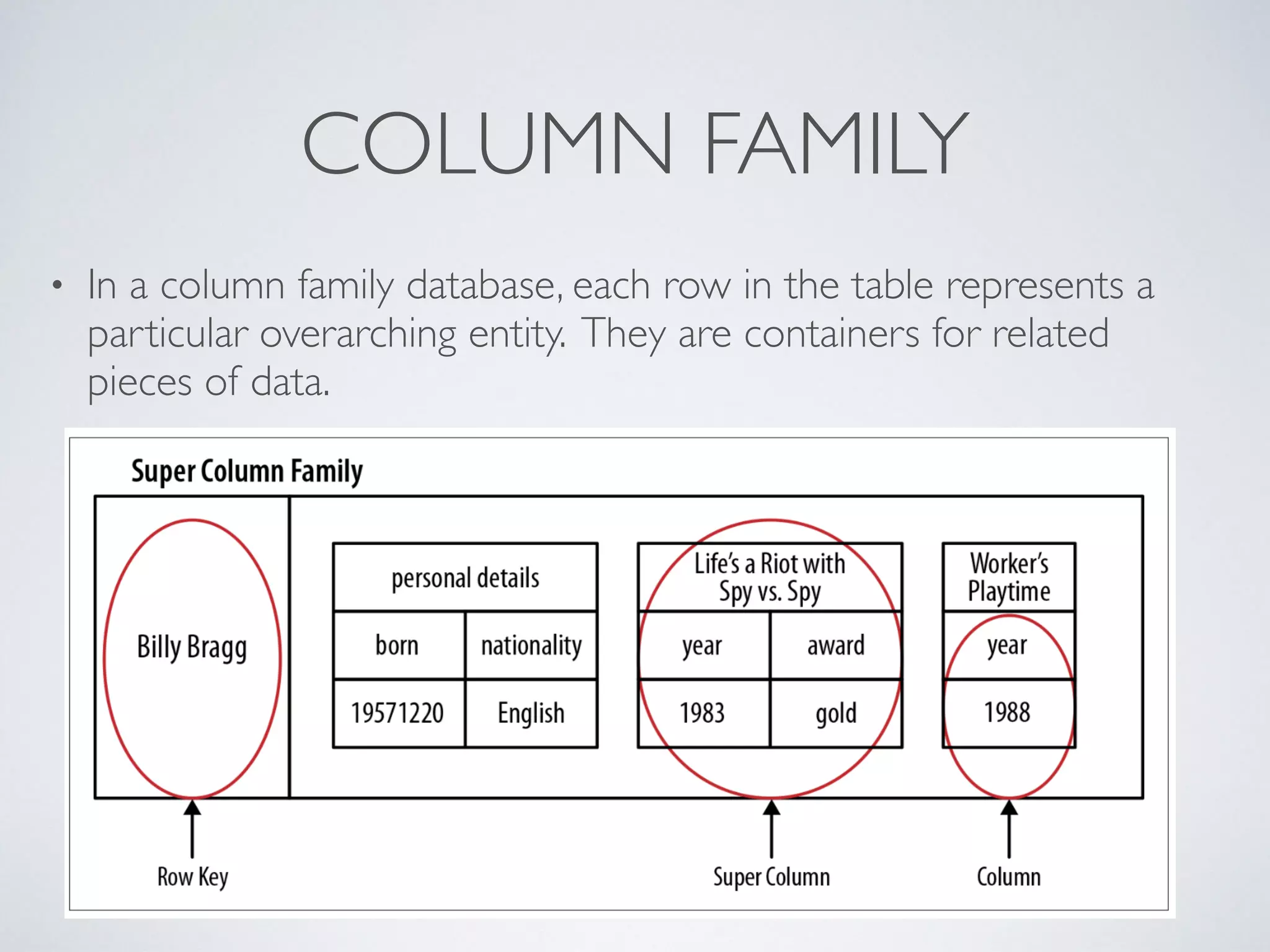
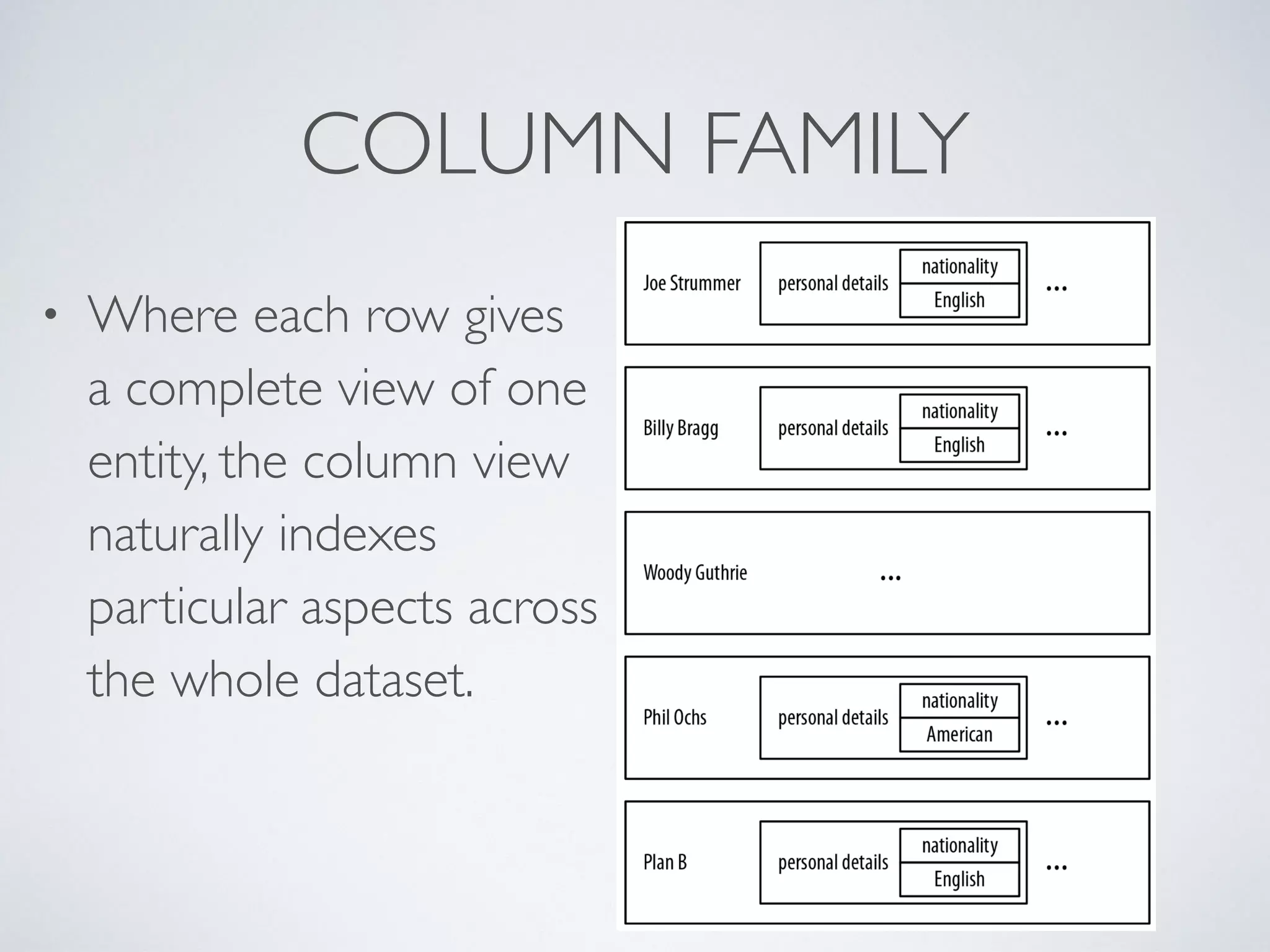
• In a column family database, each row in the table represents a
particular overarching entity. They are containers for related
pieces of data.
COLUMN FAMILY
• Where each row gives
a complete view of one
entity, the column view
naturally indexes
particular aspects across
the whole dataset.
GRAPH DATABASES
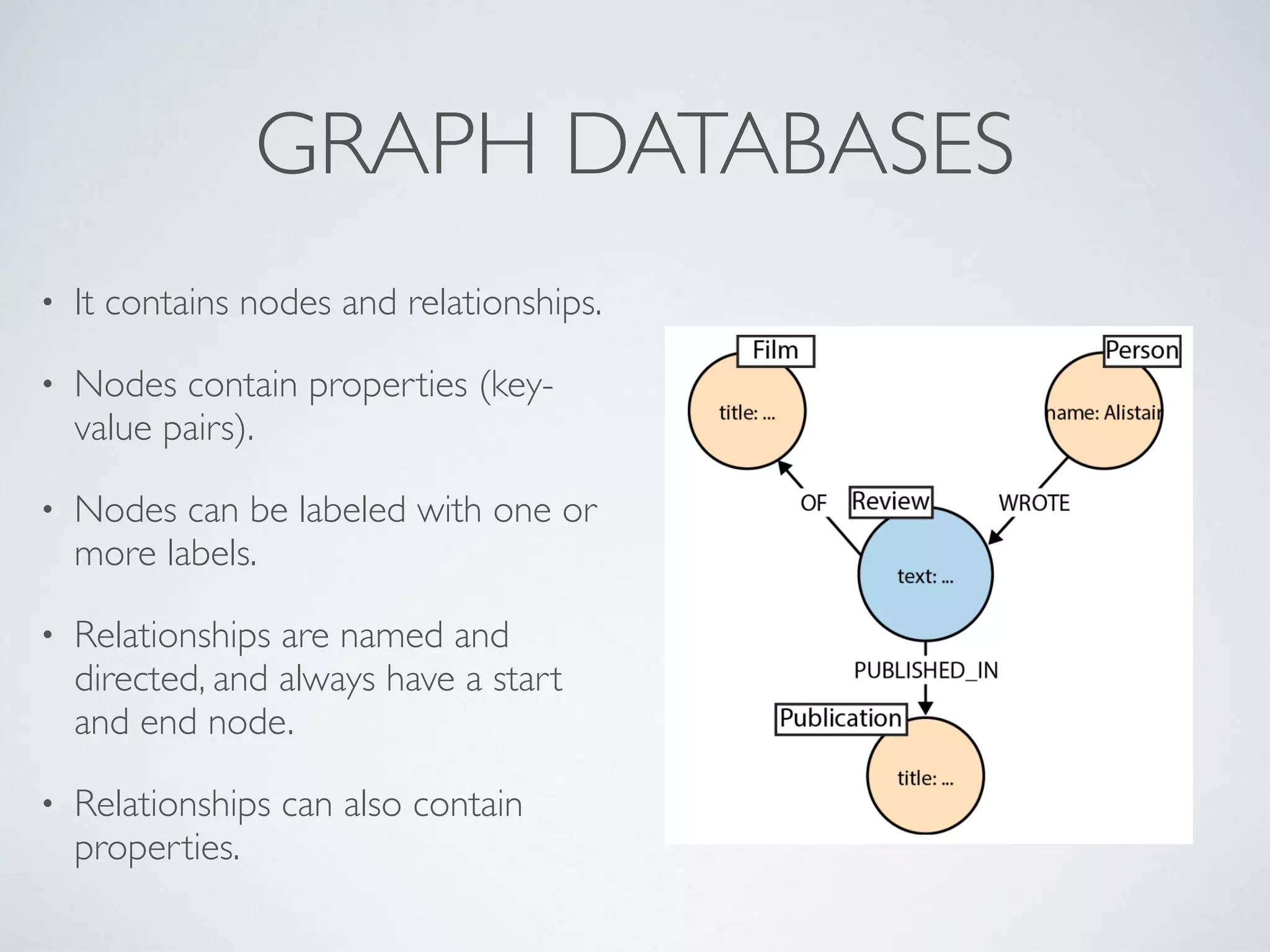
• It contains nodes and relationships.
• Nodes contain properties (key-
value pairs).
• Nodes can be labeled with one or
more labels.
• Relationships are named and
directed, and always have a start
and end node.
• Relationships can also contain
properties.
GRAPH DATABASES
• Don’t depend heavily on
indexes because the graph itself
provides a natural adjacency
index
• Relationships attached to a
node naturally provide a direct
connection to other related
nodes of interest.
• Graph queries use this locality
to traverse through the graph
by chasing pointers.

Introduction to NOSQL quadrants

  • 1.
  • 2.
    NOSQL DATABASES • Acheeky acronym for Not Only SQL • More confrontationally, No to SQL.
  • 3.
    THE RISE OFNOSQL DATABASES
  • 4.
    TYPES OF NOSQLDATABASES
  • 5.
    DOCUMENT STORES • Replyon indexes to facilitate access to documents based on their attributes.
  • 6.
    DOCUMENT STORES • Datamodel of a document store is one of disconnected entities • Should scale horizontally, as there’s no contended state between mutually independent records at write time • Limitation:Transactions are limited to the level of an individual record. • Support for operating across sets of documents atomically is emerging
  • 7.
    KEYVALUE STORES • Large,distributed hash map data structures that store and retrieve opaque values by key • Level of insight offered into data is due to data opacity. • To retrieve insight across individual records, a cluster computing framework like Map reduce or spark is used.
  • 8.
    KEY-VALUE STORES 1.Key =Domain specific identifier 2.Key is hashed with a uniform distribution hash function. 3.Hashed key is used to store values in a corresponding bucket. 4.A similar procedure is used to retrieve data. 5.For fault tolerance each bucket is replicated onto several machines.
  • 9.
    COLUMN FAMILY • Modelledon Google’s BigTable. • Logically speaking, it’s just a map of maps.
  • 10.
    COLUMN FAMILY • Simpleststorage unit: Column consisting of name value pair. • Super column: Sorted set of columns with a name.
  • 11.
    COLUMN FAMILY • Columnsare stored in rows, and when a row contains columns only, it is known as a column family. • When a row contains super columns, it is known as a super column family.
  • 12.
    COLUMN FAMILY • Ina column family database, each row in the table represents a particular overarching entity. They are containers for related pieces of data.
  • 13.
    COLUMN FAMILY • Whereeach row gives a complete view of one entity, the column view naturally indexes particular aspects across the whole dataset.
  • 14.
    GRAPH DATABASES • Itcontains nodes and relationships. • Nodes contain properties (key- value pairs). • Nodes can be labeled with one or more labels. • Relationships are named and directed, and always have a start and end node. • Relationships can also contain properties.
  • 15.
    GRAPH DATABASES • Don’tdepend heavily on indexes because the graph itself provides a natural adjacency index • Relationships attached to a node naturally provide a direct connection to other related nodes of interest. • Graph queries use this locality to traverse through the graph by chasing pointers.