Introduction to Neuroscience
Memory & Learning,
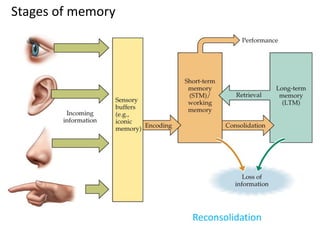
Stages of memory
Reconsolidation
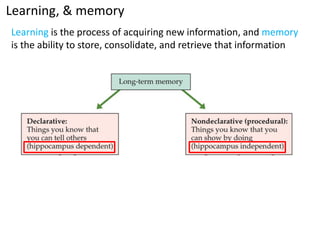
Learning, & memory
Learning is the process of acquiring new information, and memory
is the ability to store, consolidate, and retrieve that information
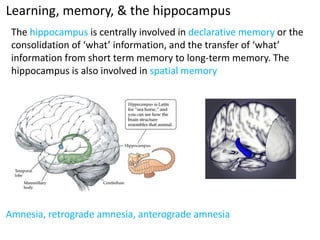
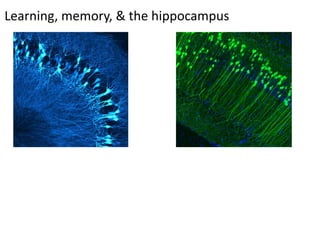
Learning, memory, & the hippocampus
The hippocampus is centrally involved in declarative memory or the
consolidation of ‘what’ information, and the transfer of ‘what’
information from short term memory to long-term memory. The
hippocampus is also involved in spatial memory
Amnesia, retrograde amnesia, anterograde amnesia
Learning, memory, & the hippocampus
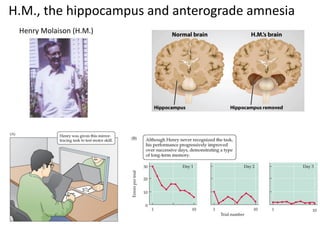
H.M., the hippocampus and anterograde amnesia
Henry Molaison (H.M.)
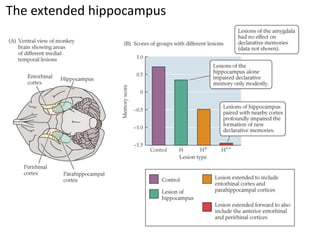
The extended hippocampus
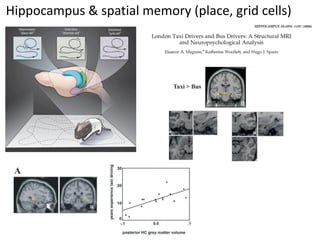
Hippocampus & spatial memory (place, grid cells)
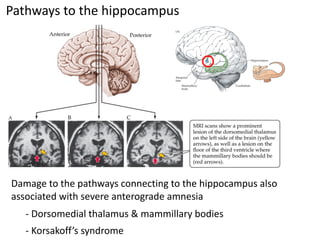
Pathways to the hippocampus
Damage to the pathways connecting to the hippocampus also
associated with severe anterograde amnesia
- Dorsomedial thalamus & mammillary bodies
- Korsakoff’s syndrome
Exam 2 is Monday, March 11 from 3pm to 4:20pm in Harris Hall, Room 107
Review session will be on Sunday, March 10 at 8pm in 217 Fisk Hall
Accessible NU
- Sign up now
- ANU exam with us will be in L28 Harris Hall. We will be there starting at
2:30pm om March 11
- Contact ANU if have accommodations to take with them
We will post grades for third writing assignment by this Thursday
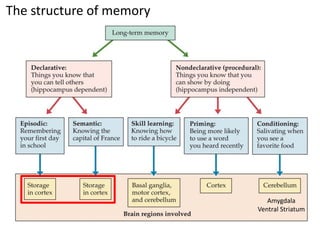
The structure of memory
Amygdala
Ventral Striatum
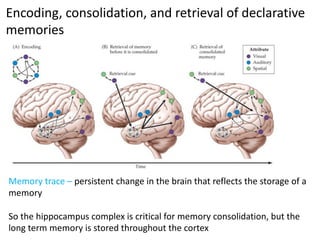
Encoding, consolidation, and retrieval of declarative
memories
Memory trace – persistent change in the brain that reflects the storage of a
memory
So the hippocampus complex is critical for memory consolidation, but the
long term memory is stored throughout the cortex
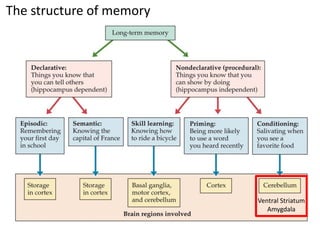
The structure of memory
Amygdala
Ventral Striatum
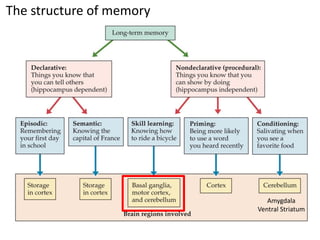
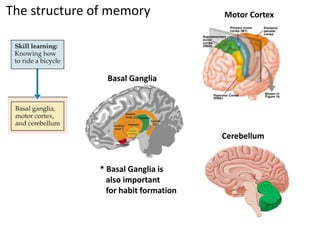
The structure of memory Motor Cortex
Basal Ganglia
Cerebellum
* Basal Ganglia is
also important
for habit formation
The structure of memory
Ventral Striatum
Amygdala
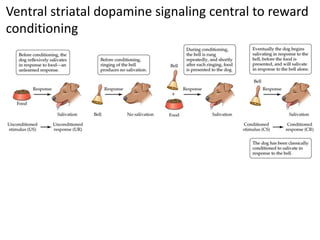
Ventral striatal dopamine signaling central to reward
conditioning
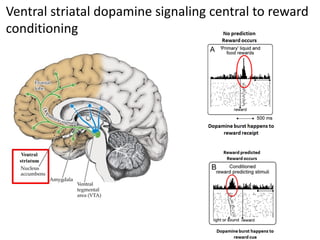
Ventral striatal dopamine signaling central to reward
conditioning
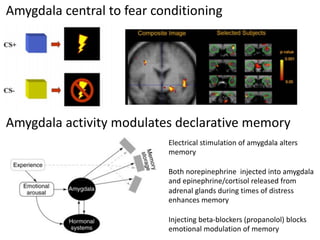
Amygdala central to fear conditioning
Amygdala activity modulates declarative memory
Electrical stimulation of amygdala alters
memory
Both norepinephrine injected into amygdala
and epinephrine/cortisol released from
adrenal glands during times of distress
enhances memory
Injecting beta-blockers (propanolol) blocks
emotional modulation of memory
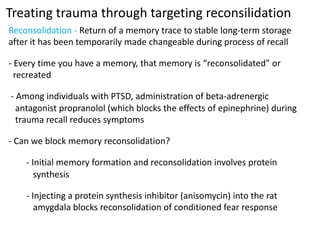
Treating trauma through targeting reconsilidation
Reconsolidation - Return of a memory trace to stable long-term storage
after it has been temporarily made changeable during process of recall
- Every time you have a memory, that memory is “reconsolidated” or
recreated
- Among individuals with PTSD, administration of beta-adrenergic
antagonist propranolol (which blocks the effects of epinephrine) during
trauma recall reduces symptoms
- Can we block memory reconsolidation?
- Initial memory formation and reconsolidation involves protein
synthesis
- Injecting a protein synthesis inhibitor (anisomycin) into the rat
amygdala blocks reconsolidation of conditioned fear response
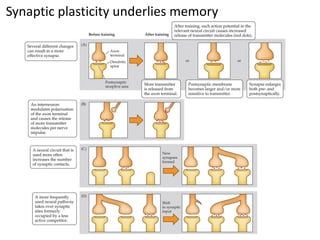
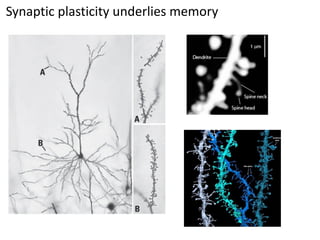
Synaptic plasticity underlies memory
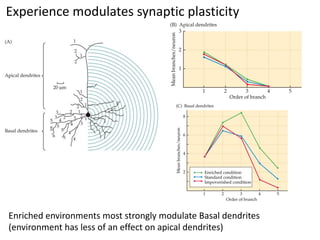
Experience modulates synaptic plasticity
Enriched environments most strongly modulate Basal dendrites
(environment has less of an effect on apical dendrites)
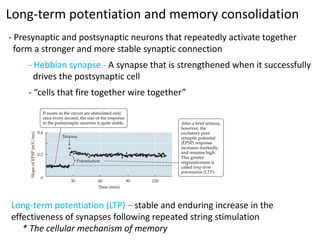
Long-term potentiation and memory consolidation
- Presynaptic and postsynaptic neurons that repeatedly activate together
form a stronger and more stable synaptic connection
- Hebbian synapse - A synapse that is strengthened when it successfully
drives the postsynaptic cell
- “cells that fire together wire together”
Long-term potentiation (LTP) – stable and enduring increase in the
effectiveness of synapses following repeated string stimulation
* The cellular mechanism of memory
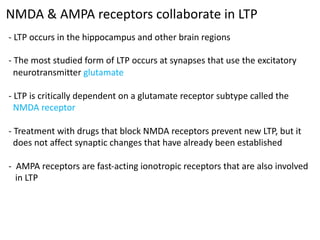
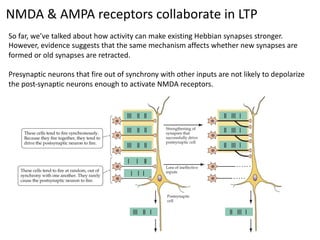
NMDA & AMPA receptors collaborate in LTP
- LTP occurs in the hippocampus and other brain regions
- The most studied form of LTP occurs at synapses that use the excitatory
neurotransmitter glutamate
- LTP is critically dependent on a glutamate receptor subtype called the
NMDA receptor
- Treatment with drugs that block NMDA receptors prevent new LTP, but it
does not affect synaptic changes that have already been established
- AMPA receptors are fast-acting ionotropic receptors that are also involved
in LTP
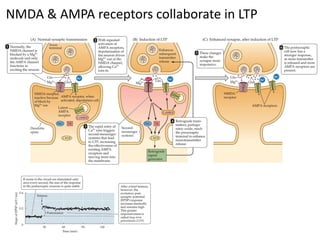
NMDA & AMPA receptors collaborate in LTP
So far, we’ve talked about how activity can make existing Hebbian synapses stronger.
However, evidence suggests that the same mechanism affects whether new synapses are
formed or old synapses are retracted.
Presynaptic neurons that fire out of synchrony with other inputs are not likely to depolarize
the post-synaptic neurons enough to activate NMDA receptors.
Shadow slides – do not study
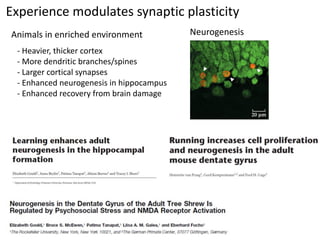
Experience modulates synaptic plasticity
Animals in enriched environment
- Heavier, thicker cortex
- More dendritic branches/spines
- Larger cortical synapses
- Enhanced neurogenesis in hippocampus
- Enhanced recovery from brain damage
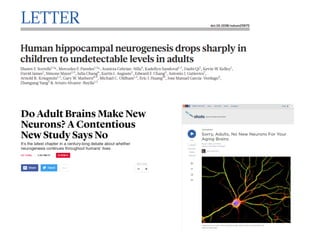
Neurogenesis
1. Final exam is Wednesday, June 7 at 3pm
2. The last Assignment will be due May 24th please be aware the TAs are using Turnitin
which has a detector for the use of ChatGPT
- Submit on canvas
3. The review session for the final will be held Thursday, June 1st 8-9:30pm in Tech LR3
4. The Accessible NU location for the final will be Wednesday, June 7 2-5pm in Annenberg
G32 (same date of regular exam)
5. Makeup exams for internship students will be held:
- Friday, May 26 11:30-12:50 in Cresap 318
- Wednesday, May 31st during regular class hours 2-3:20 in Harris Hall

Introduction to neuroscience presentation on memory and learning

  • 1.
  • 2.
  • 3.
    Learning, & memory Learningis the process of acquiring new information, and memory is the ability to store, consolidate, and retrieve that information
  • 4.
    Learning, memory, &the hippocampus The hippocampus is centrally involved in declarative memory or the consolidation of ‘what’ information, and the transfer of ‘what’ information from short term memory to long-term memory. The hippocampus is also involved in spatial memory Amnesia, retrograde amnesia, anterograde amnesia
  • 5.
    Learning, memory, &the hippocampus
  • 6.
    H.M., the hippocampusand anterograde amnesia Henry Molaison (H.M.)
  • 7.
  • 8.
    Hippocampus & spatialmemory (place, grid cells)
  • 9.
    Pathways to thehippocampus Damage to the pathways connecting to the hippocampus also associated with severe anterograde amnesia - Dorsomedial thalamus & mammillary bodies - Korsakoff’s syndrome
  • 10.
    Exam 2 isMonday, March 11 from 3pm to 4:20pm in Harris Hall, Room 107 Review session will be on Sunday, March 10 at 8pm in 217 Fisk Hall Accessible NU - Sign up now - ANU exam with us will be in L28 Harris Hall. We will be there starting at 2:30pm om March 11 - Contact ANU if have accommodations to take with them We will post grades for third writing assignment by this Thursday
  • 11.
    The structure ofmemory Amygdala Ventral Striatum
  • 12.
    Encoding, consolidation, andretrieval of declarative memories Memory trace – persistent change in the brain that reflects the storage of a memory So the hippocampus complex is critical for memory consolidation, but the long term memory is stored throughout the cortex
  • 13.
    The structure ofmemory Amygdala Ventral Striatum
  • 14.
    The structure ofmemory Motor Cortex Basal Ganglia Cerebellum * Basal Ganglia is also important for habit formation
  • 15.
    The structure ofmemory Ventral Striatum Amygdala
  • 16.
    Ventral striatal dopaminesignaling central to reward conditioning
  • 17.
    Ventral striatal dopaminesignaling central to reward conditioning
  • 18.
    Amygdala central tofear conditioning Amygdala activity modulates declarative memory Electrical stimulation of amygdala alters memory Both norepinephrine injected into amygdala and epinephrine/cortisol released from adrenal glands during times of distress enhances memory Injecting beta-blockers (propanolol) blocks emotional modulation of memory
  • 19.
    Treating trauma throughtargeting reconsilidation Reconsolidation - Return of a memory trace to stable long-term storage after it has been temporarily made changeable during process of recall - Every time you have a memory, that memory is “reconsolidated” or recreated - Among individuals with PTSD, administration of beta-adrenergic antagonist propranolol (which blocks the effects of epinephrine) during trauma recall reduces symptoms - Can we block memory reconsolidation? - Initial memory formation and reconsolidation involves protein synthesis - Injecting a protein synthesis inhibitor (anisomycin) into the rat amygdala blocks reconsolidation of conditioned fear response
  • 20.
  • 21.
  • 22.
    Experience modulates synapticplasticity Enriched environments most strongly modulate Basal dendrites (environment has less of an effect on apical dendrites)
  • 23.
    Long-term potentiation andmemory consolidation - Presynaptic and postsynaptic neurons that repeatedly activate together form a stronger and more stable synaptic connection - Hebbian synapse - A synapse that is strengthened when it successfully drives the postsynaptic cell - “cells that fire together wire together” Long-term potentiation (LTP) – stable and enduring increase in the effectiveness of synapses following repeated string stimulation * The cellular mechanism of memory
  • 24.
    NMDA & AMPAreceptors collaborate in LTP - LTP occurs in the hippocampus and other brain regions - The most studied form of LTP occurs at synapses that use the excitatory neurotransmitter glutamate - LTP is critically dependent on a glutamate receptor subtype called the NMDA receptor - Treatment with drugs that block NMDA receptors prevent new LTP, but it does not affect synaptic changes that have already been established - AMPA receptors are fast-acting ionotropic receptors that are also involved in LTP
  • 25.
    NMDA & AMPAreceptors collaborate in LTP
  • 26.
    NMDA & AMPAreceptors collaborate in LTP So far, we’ve talked about how activity can make existing Hebbian synapses stronger. However, evidence suggests that the same mechanism affects whether new synapses are formed or old synapses are retracted. Presynaptic neurons that fire out of synchrony with other inputs are not likely to depolarize the post-synaptic neurons enough to activate NMDA receptors.
  • 27.
    Shadow slides –do not study
  • 28.
    Experience modulates synapticplasticity Animals in enriched environment - Heavier, thicker cortex - More dendritic branches/spines - Larger cortical synapses - Enhanced neurogenesis in hippocampus - Enhanced recovery from brain damage Neurogenesis
  • 30.
    1. Final examis Wednesday, June 7 at 3pm 2. The last Assignment will be due May 24th please be aware the TAs are using Turnitin which has a detector for the use of ChatGPT - Submit on canvas 3. The review session for the final will be held Thursday, June 1st 8-9:30pm in Tech LR3 4. The Accessible NU location for the final will be Wednesday, June 7 2-5pm in Annenberg G32 (same date of regular exam) 5. Makeup exams for internship students will be held: - Friday, May 26 11:30-12:50 in Cresap 318 - Wednesday, May 31st during regular class hours 2-3:20 in Harris Hall