VP AIOps for the Autonomous Database
Sandesh Rao
From DBA’s to Data Scientists
Introduction to Machine Learning
@sandeshr
https://www.linkedin.com/in/raosandesh/
https://www.slideshare.net/SandeshRao4
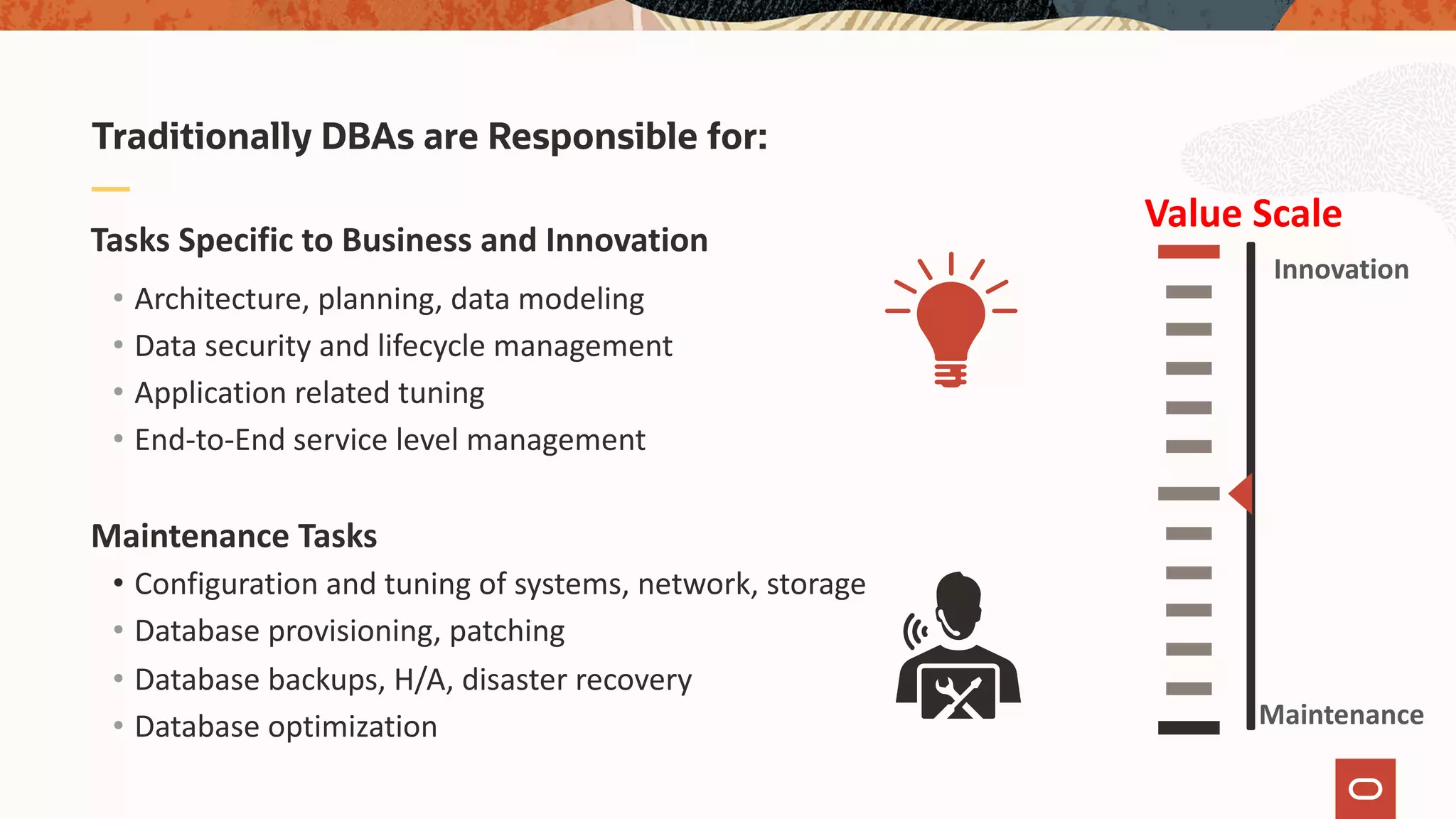
Tasks Specific to Business and Innovation
• Architecture, planning, data modeling
• Data security and lifecycle management
• Application related tuning
• End-to-End service level management
Maintenance Tasks
• Configuration and tuning of systems, network, storage
• Database provisioning, patching
• Database backups, H/A, disaster recovery
• Database optimization
Traditionally DBAs are Responsible for:
Value Scale
Innovation
Maintenance
Tasks Specific to Business and Innovation
• Architecture, planning, data modeling
• Data security and lifecycle management
• Application related tuning
• End-to-End service level management
Maintenance Tasks
• Configuration and tuning of systems, network, storage
• Database provisioning, patching
• Database backups, H/A, disaster recovery
• Database optimization
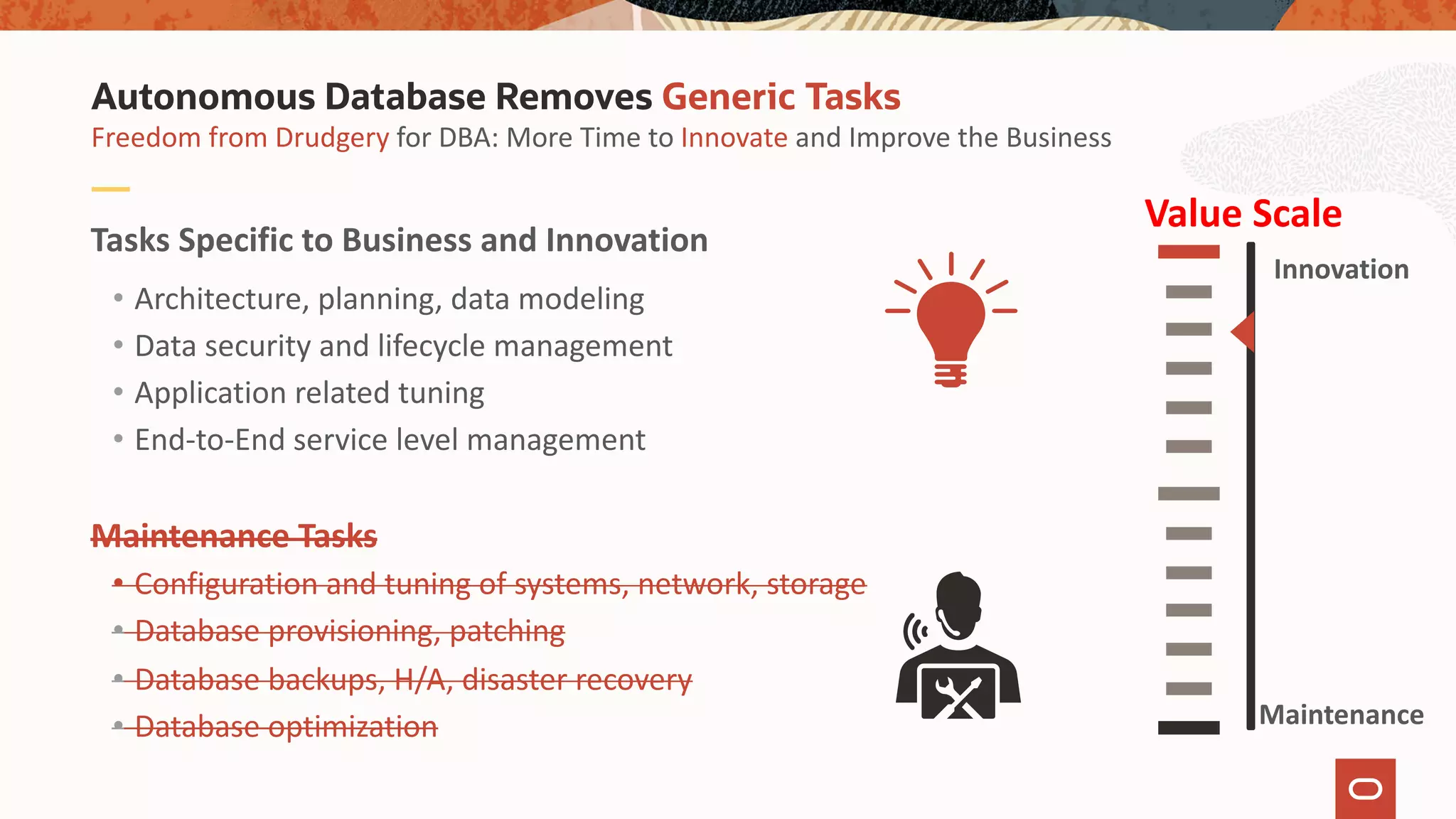
Freedom from Drudgery for DBA: More Time to Innovate and Improve the Business
Autonomous Database Removes Generic Tasks
Value Scale
Innovation
Maintenance
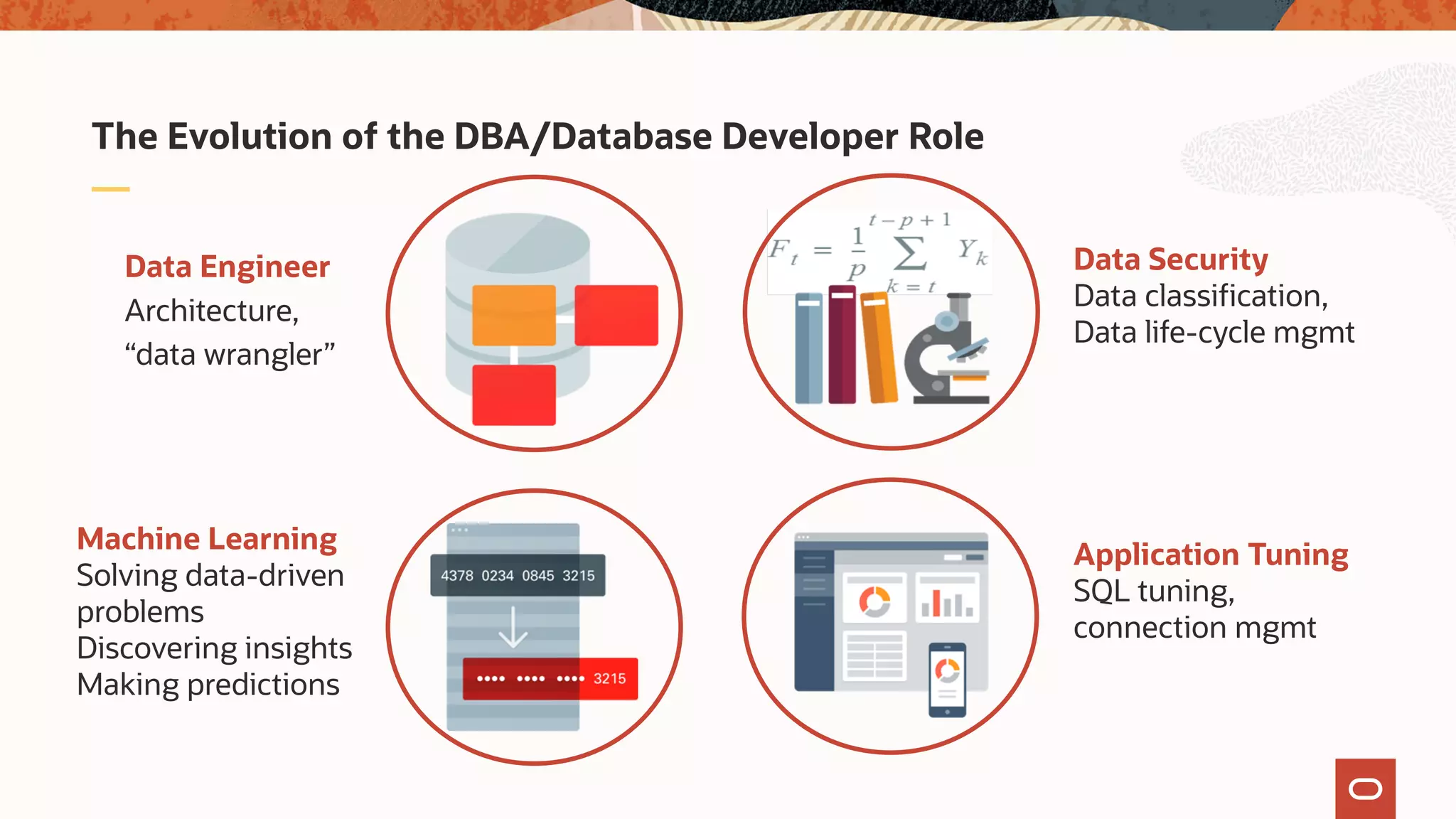
Machine Learning
Solving data-driven
problems
Discovering insights
Making predictions
Data Security
Data classification,
Data life-cycle mgmt
Application Tuning
SQL tuning,
connection mgmt
The Evolution of the DBA/Database Developer Role
Data Engineer
Architecture,
“data wrangler”
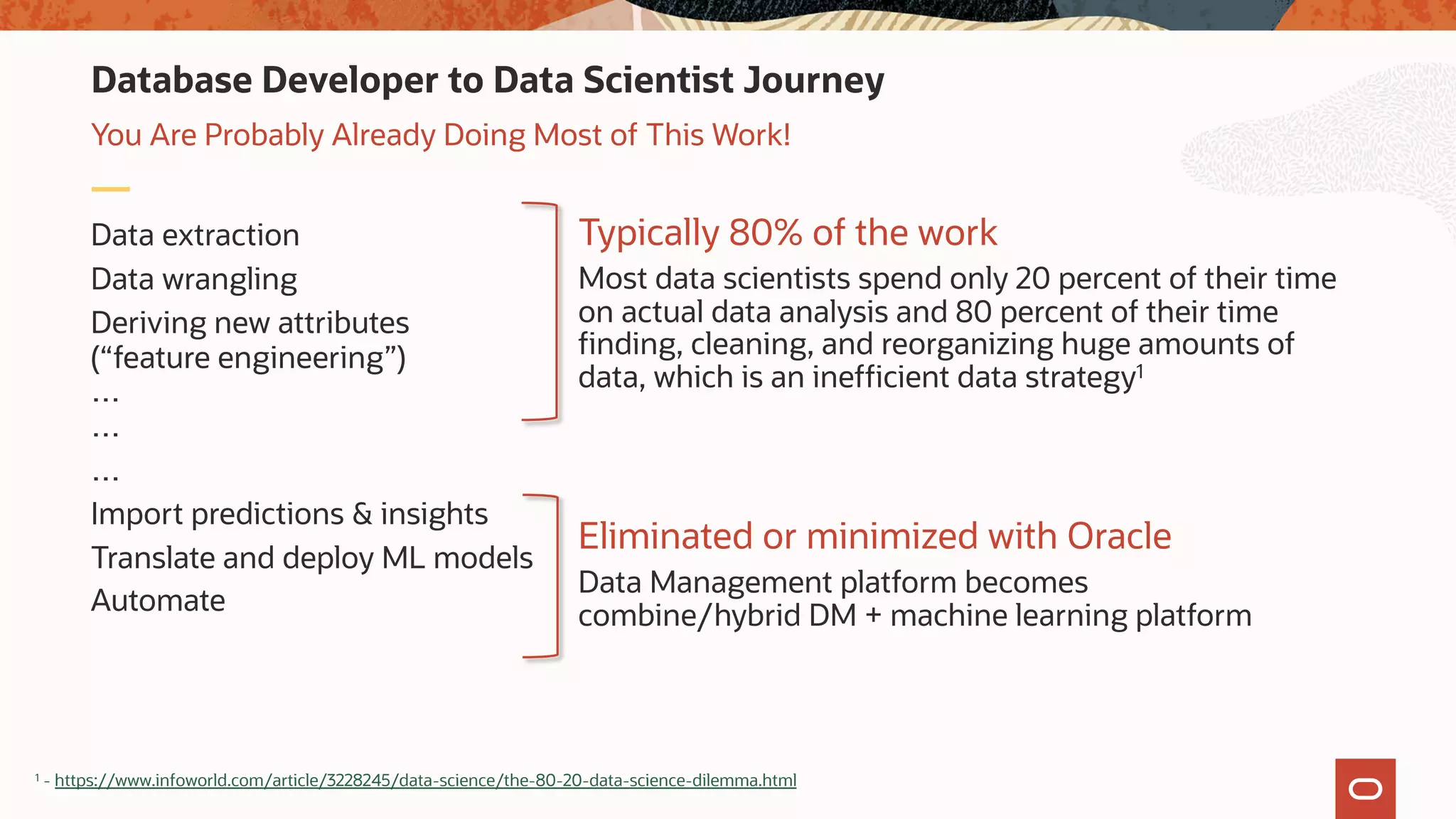
Data extraction
Data wrangling
Deriving new attributes
(“feature engineering”)
…
…
…
Import predictions & insights
Translate and deploy ML models
Automate
You Are Probably Already Doing Most of This Work!
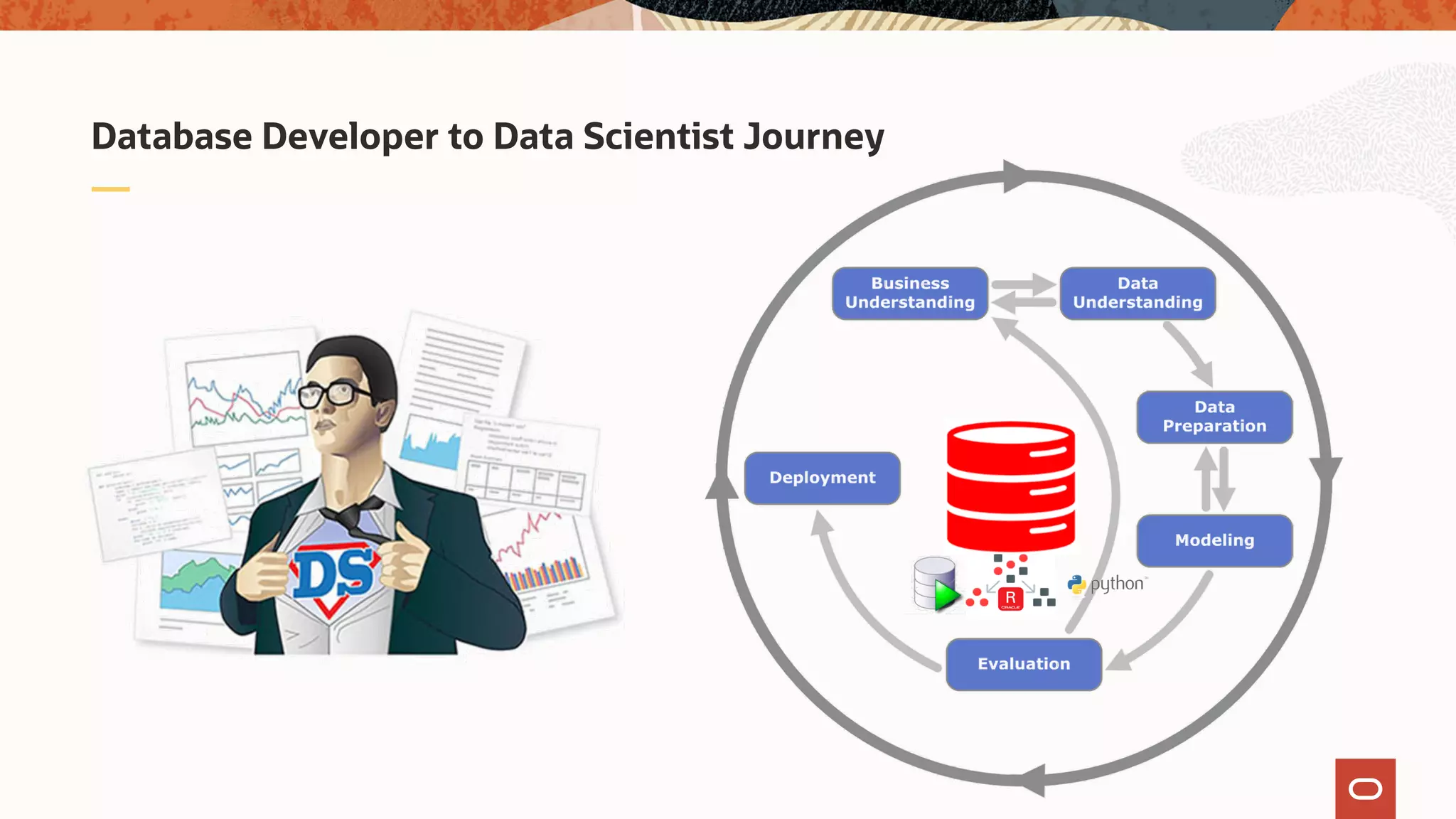
Database Developer to Data Scientist Journey
1 - https://www.infoworld.com/article/3228245/data-science/the-80-20-data-science-dilemma.html
Typically 80% of the work
Most data scientists spend only 20 percent of their time
on actual data analysis and 80 percent of their time
finding, cleaning, and reorganizing huge amounts of
data, which is an inefficient data strategy1
Eliminated or minimized with Oracle
Data Management platform becomes
combine/hybrid DM + machine learning platform
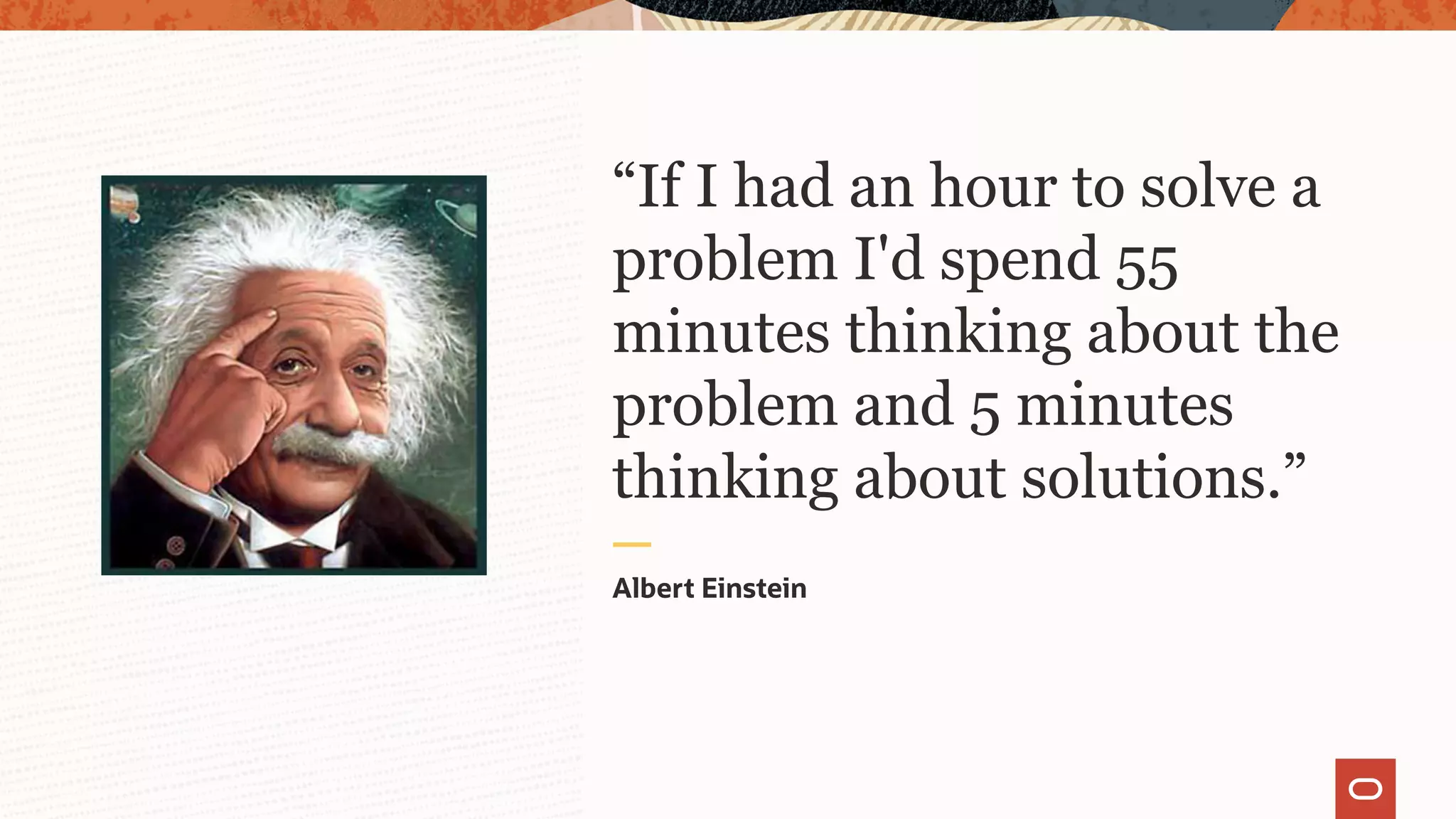
Albert Einstein
“If I had an hour to solve a
problem I'd spend 55
minutes thinking about the
problem and 5 minutes
thinking about solutions.”
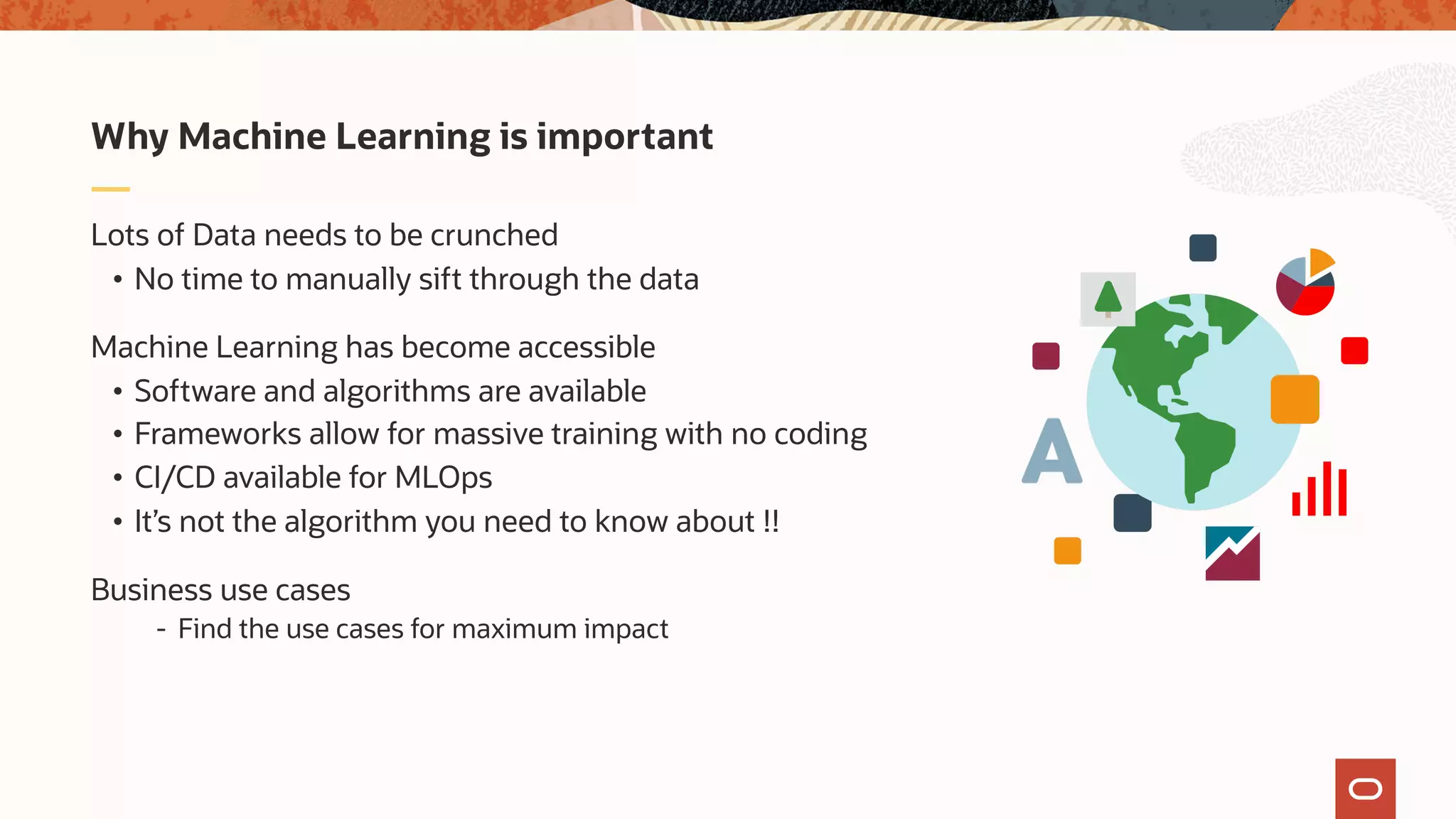
Lots of Data needs to be crunched
• No time to manually sift through the data
Machine Learning has become accessible
• Software and algorithms are available
• Frameworks allow for massive training with no coding
• CI/CD available for MLOps
• It’s not the algorithm you need to know about !!
Business use cases
- Find the use cases for maximum impact
Why Machine Learning is important
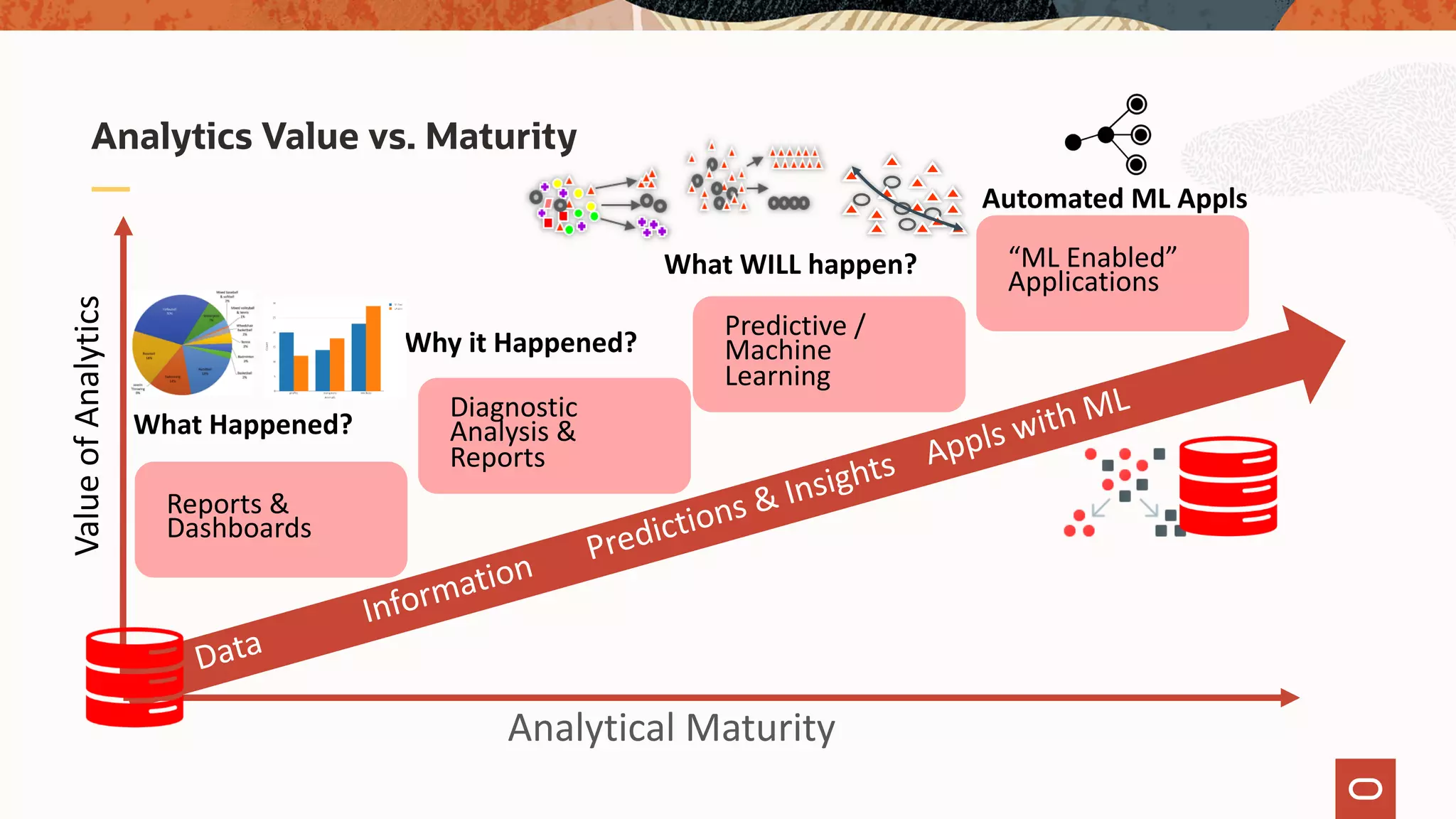
Analytics Value vs. Maturity
Reports &
Dashboards
Data
Information
Predictions & Insights Appls with ML
Analytical Maturity
ValueofAnalytics
Diagnostic
Analysis &
Reports
Predictive /
Machine
Learning
“ML Enabled”
Applications
What Happened?
Why it Happened?
What WILL happen?
Automated ML Appls
Database Developer to Data Scientist Journey
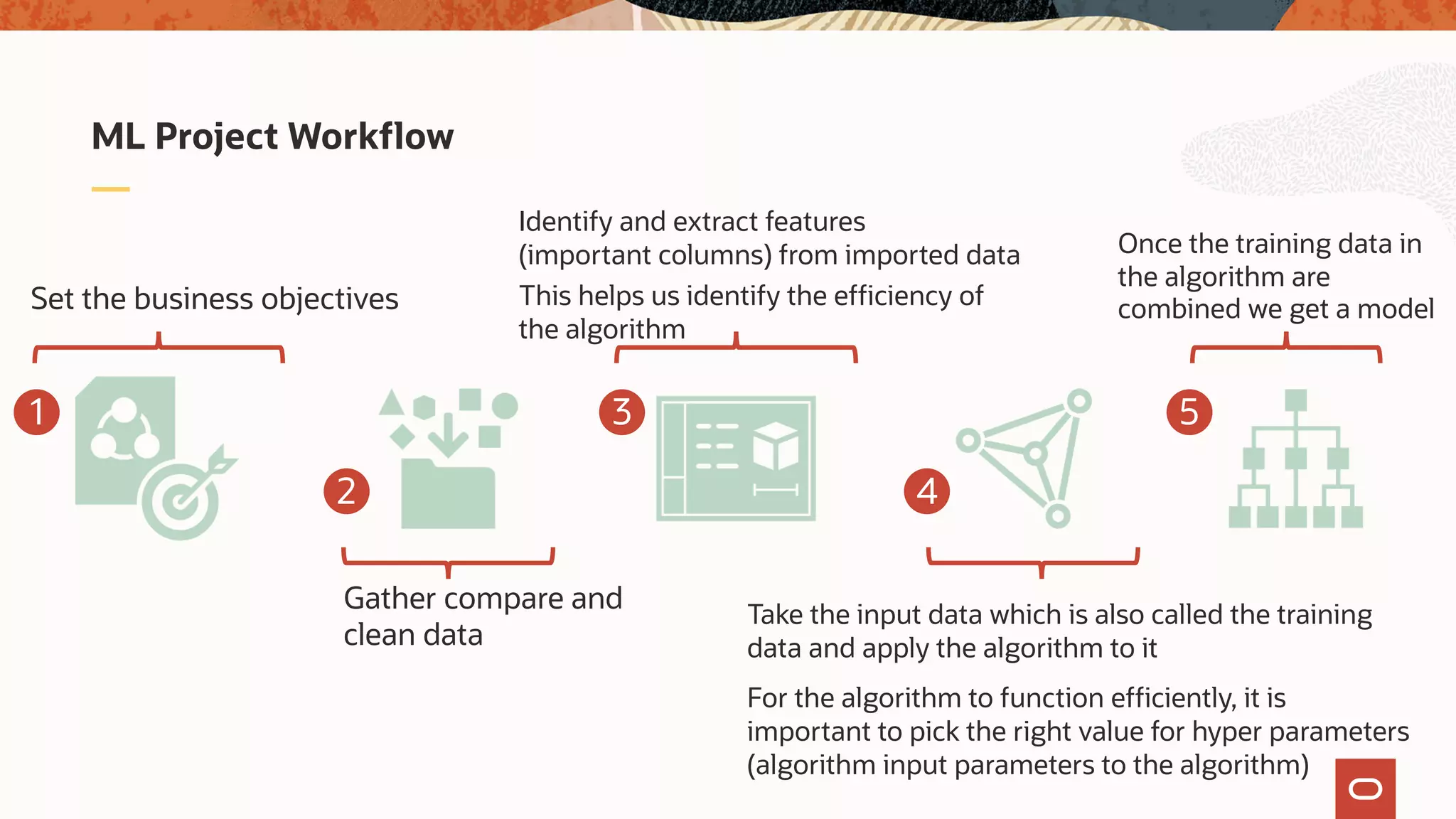
ML Project Workflow
Set the business objectives
Gather compare and
clean data
Identify and extract features
(important columns) from imported data
This helps us identify the efficiency of
the algorithm
Take the input data which is also called the training
data and apply the algorithm to it
For the algorithm to function efficiently, it is
important to pick the right value for hyper parameters
(algorithm input parameters to the algorithm)
Once the training data in
the algorithm are
combined we get a model
1
2
3
4
5
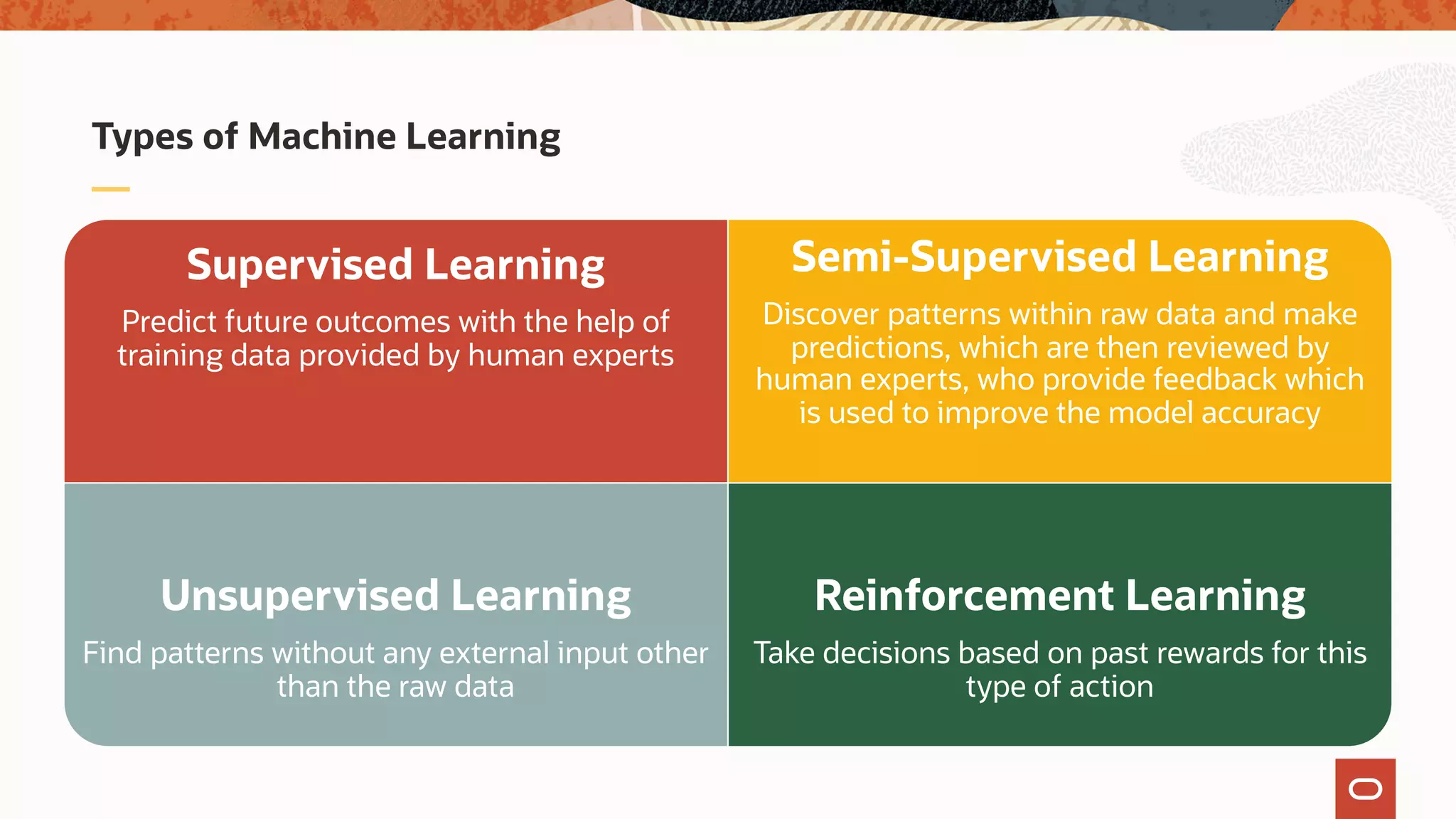
Types of Machine Learning
Supervised Learning
Predict future outcomes with the help of
training data provided by human experts
Semi-Supervised Learning
Discover patterns within raw data and make
predictions, which are then reviewed by
human experts, who provide feedback which
is used to improve the model accuracy
Unsupervised Learning
Find patterns without any external input other
than the raw data
Reinforcement Learning
Take decisions based on past rewards for this
type of action
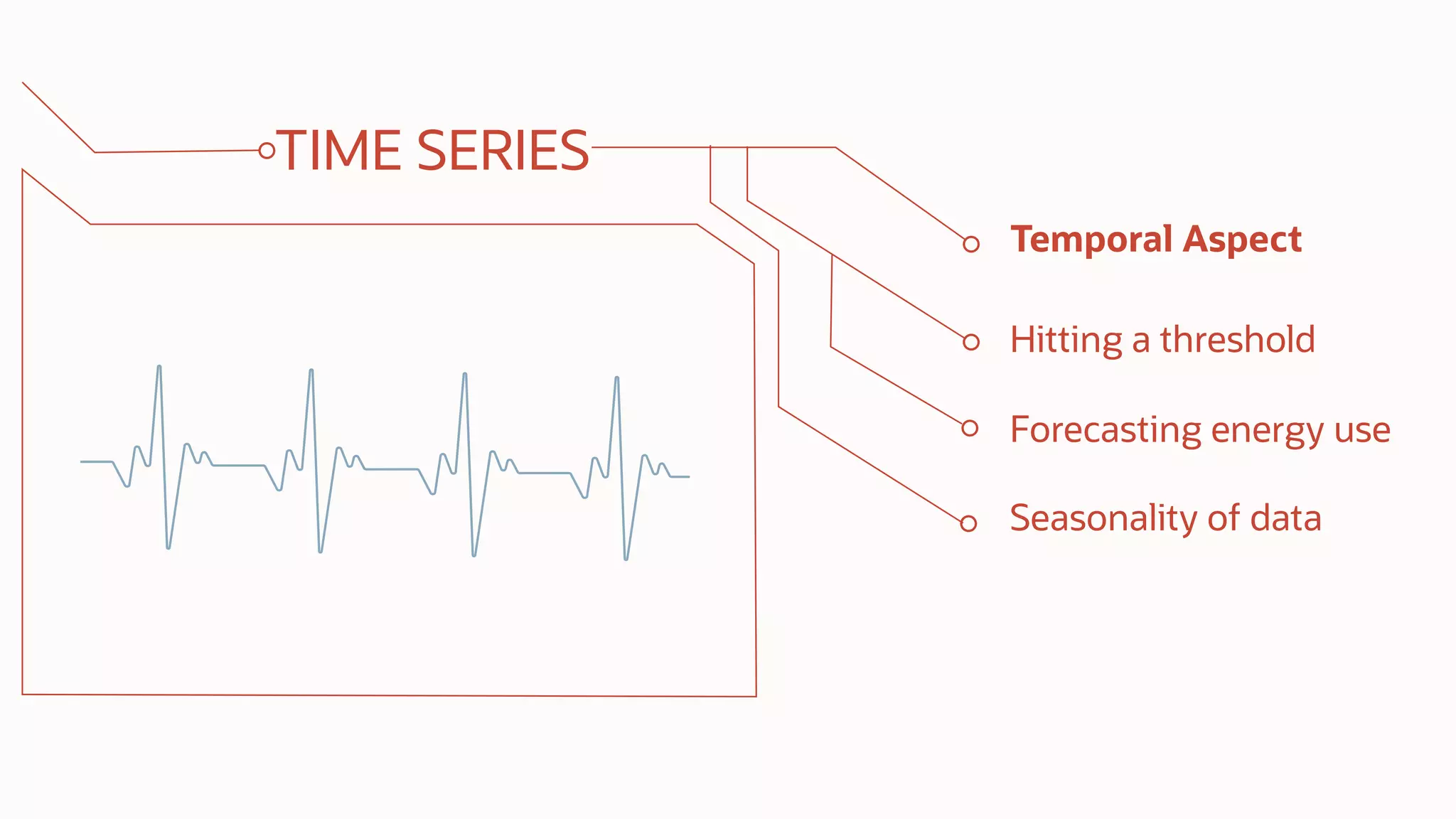
TIME SERIES
Temporal Aspect
Hitting a threshold
Forecasting energy use
Seasonality of data
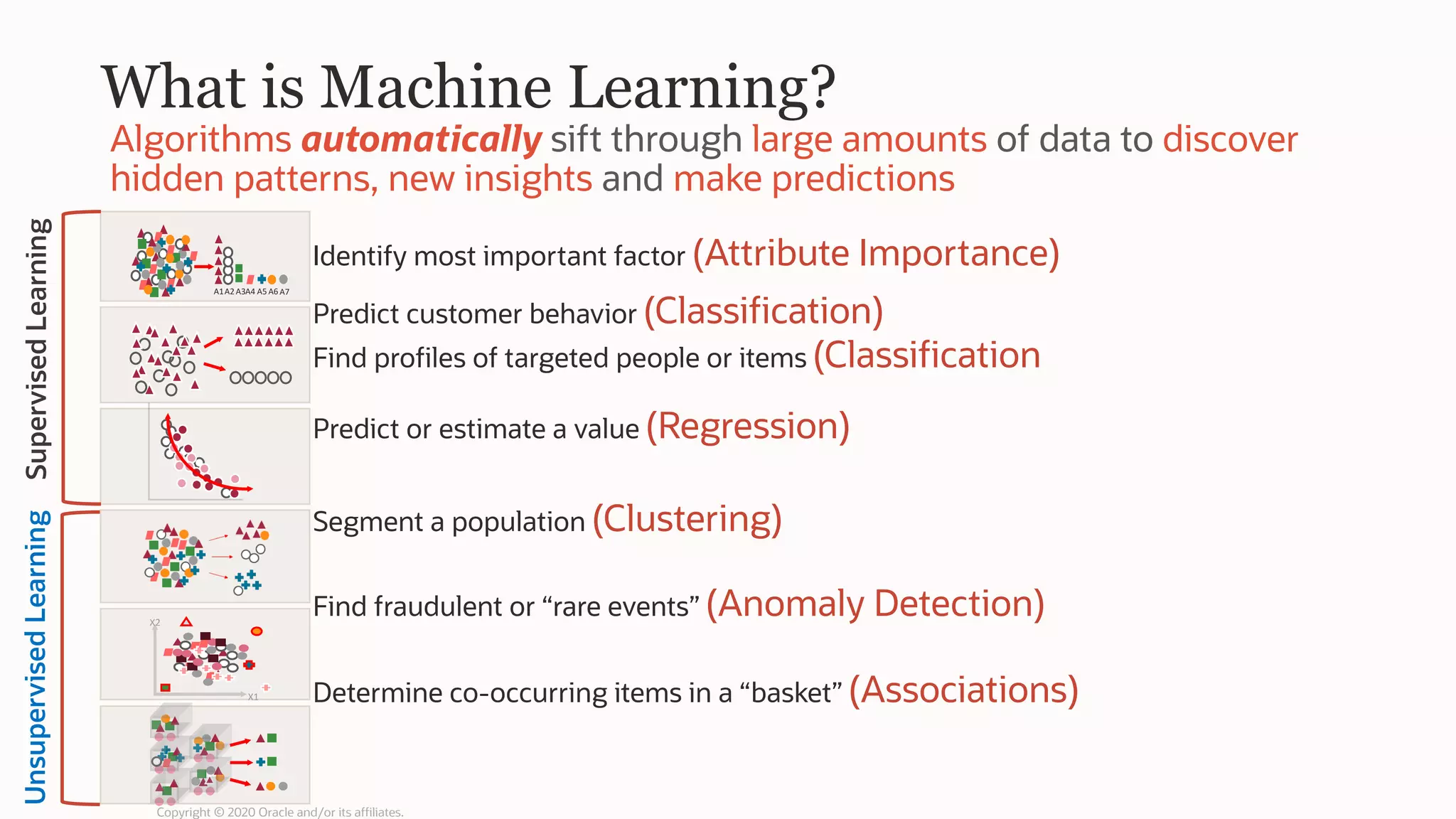
Algorithms automatically sift through large amounts of data to discover
hidden patterns, new insights and make predictions
What is Machine Learning?
Identify most important factor (Attribute Importance)
Predict customer behavior (Classification)
Find profiles of targeted people or items (Classification
Predict or estimate a value (Regression)
Segment a population (Clustering)
Find fraudulent or “rare events” (Anomaly Detection)
Determine co-occurring items in a “basket” (Associations)X1
X2
A1A2A3A4 A5A6 A7
SupervisedLearningUnsupervisedLearning
Copyright © 2020 Oracle and/or its affiliates.
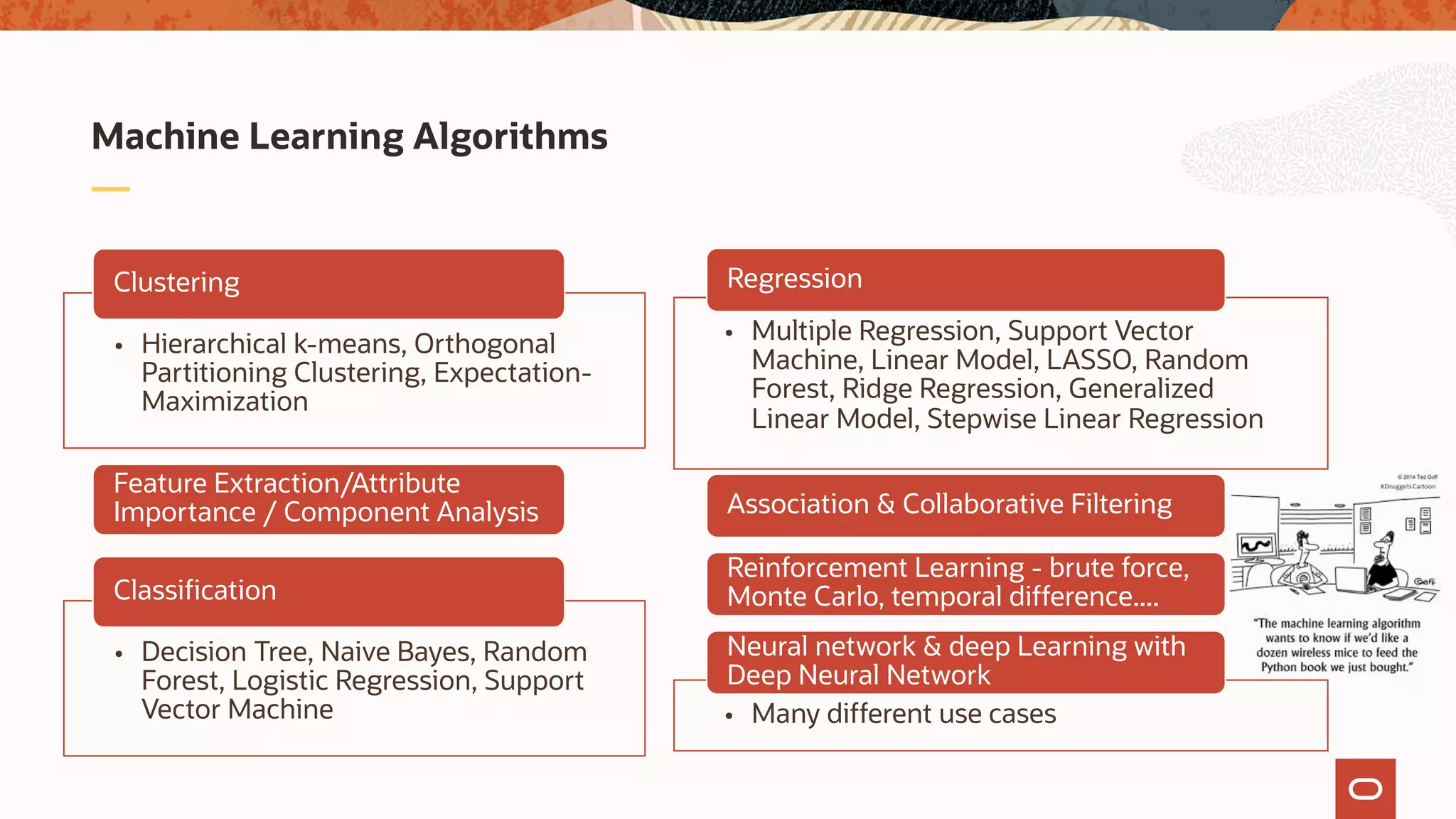
Machine Learning Algorithms
• Multiple Regression, Support Vector
Machine, Linear Model, LASSO, Random
Forest, Ridge Regression, Generalized
Linear Model, Stepwise Linear Regression
Regression
Association & Collaborative Filtering
Reinforcement Learning - brute force,
Monte Carlo, temporal difference....
• Many different use cases
Neural network & deep Learning with
Deep Neural Network
• Hierarchical k-means, Orthogonal
Partitioning Clustering, Expectation-
Maximization
Clustering
Feature Extraction/Attribute
Importance / Component Analysis
• Decision Tree, Naive Bayes, Random
Forest, Logistic Regression, Support
Vector Machine
Classification
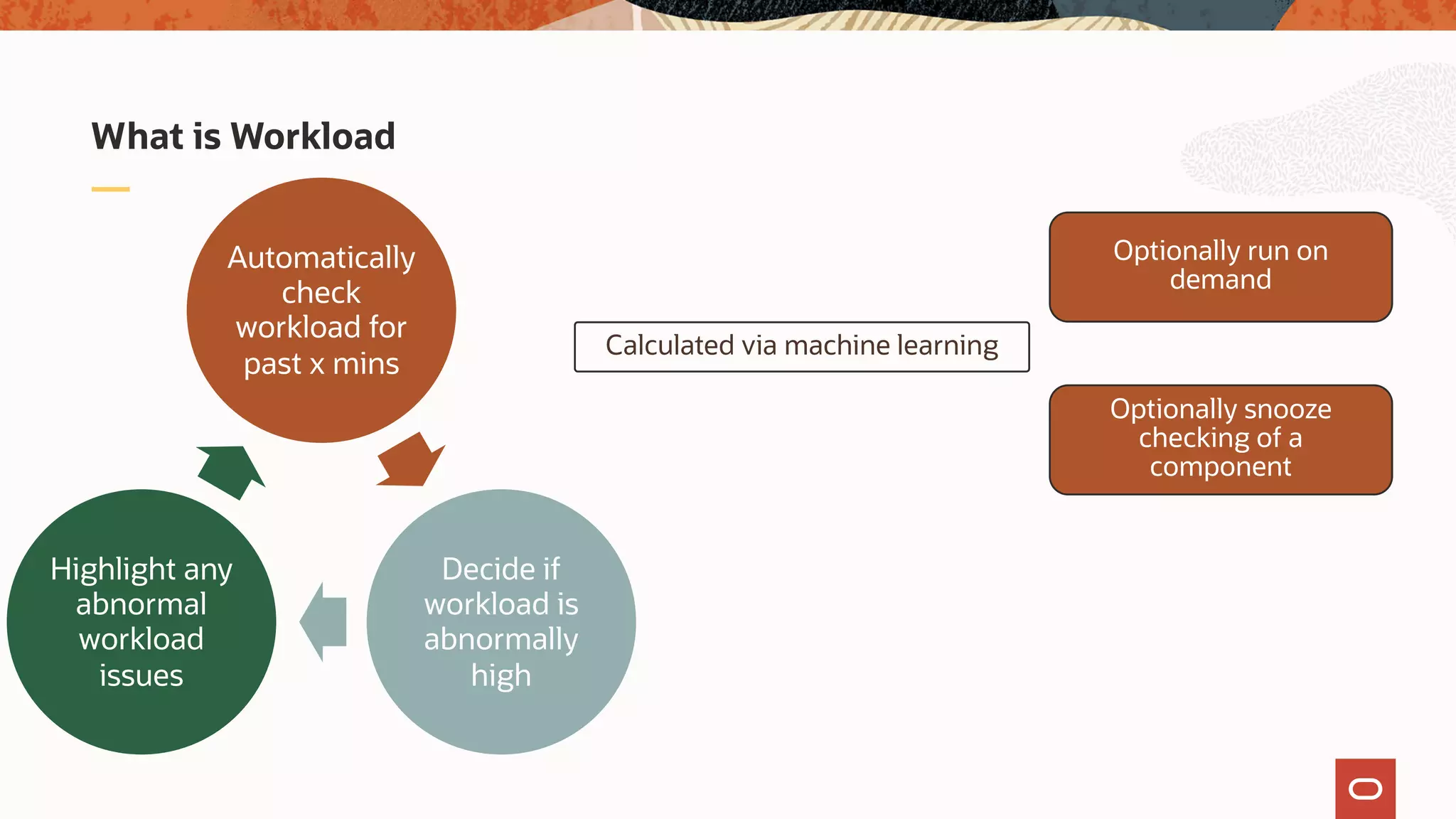
What is Workload
Automatically
check
workload for
past x mins
Decide if
workload is
abnormally
high
Highlight any
abnormal
workload
issues
Optionally run on
demand
Optionally snooze
checking of a
component
Calculated via machine learning
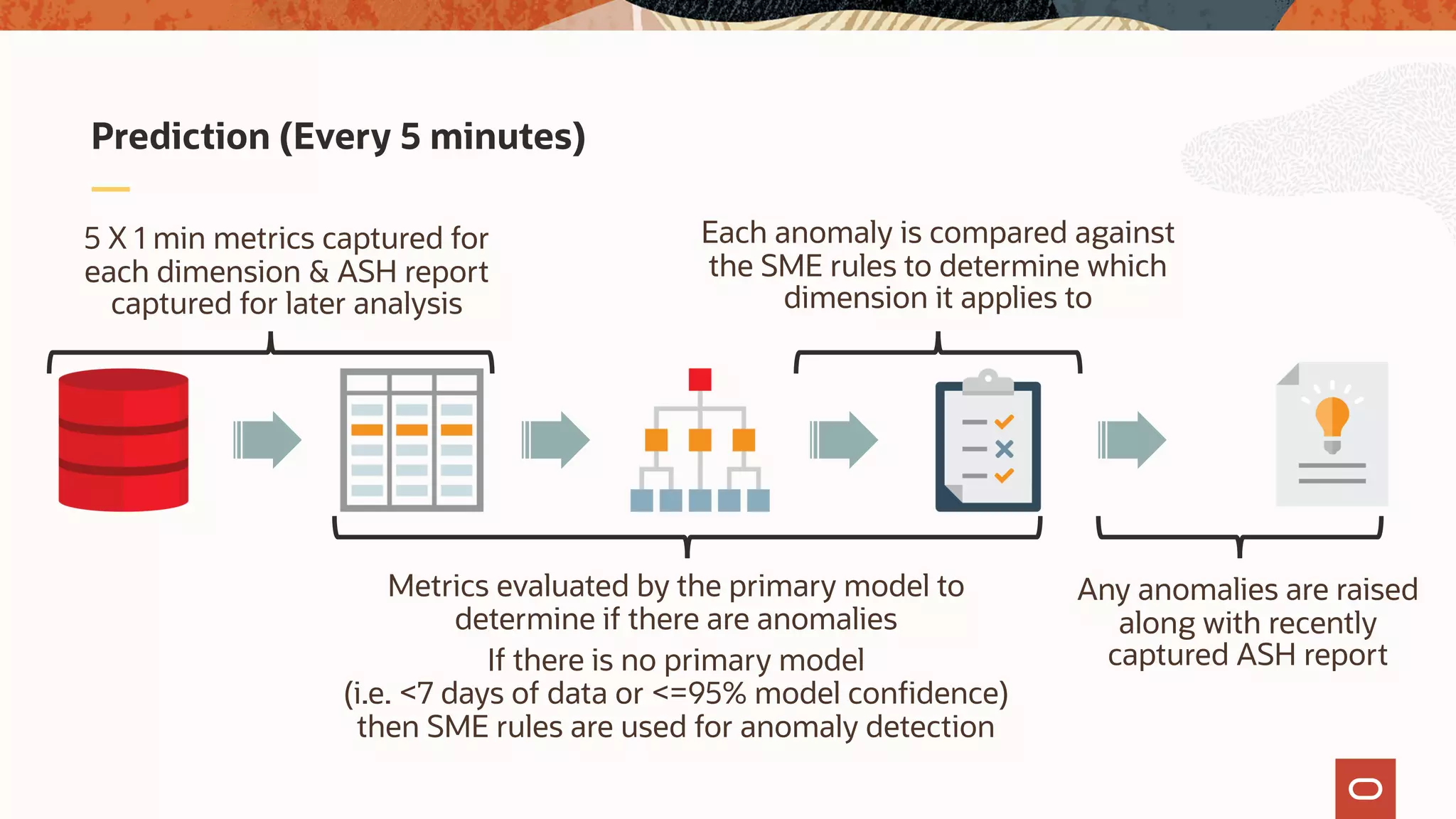
Prediction (Every 5 minutes)
5 X 1 min metrics captured for
each dimension & ASH report
captured for later analysis
Metrics evaluated by the primary model to
determine if there are anomalies
If there is no primary model
(i.e. <7 days of data or <=95% model confidence)
then SME rules are used for anomaly detection
Each anomaly is compared against
the SME rules to determine which
dimension it applies to
Any anomalies are raised
along with recently
captured ASH report
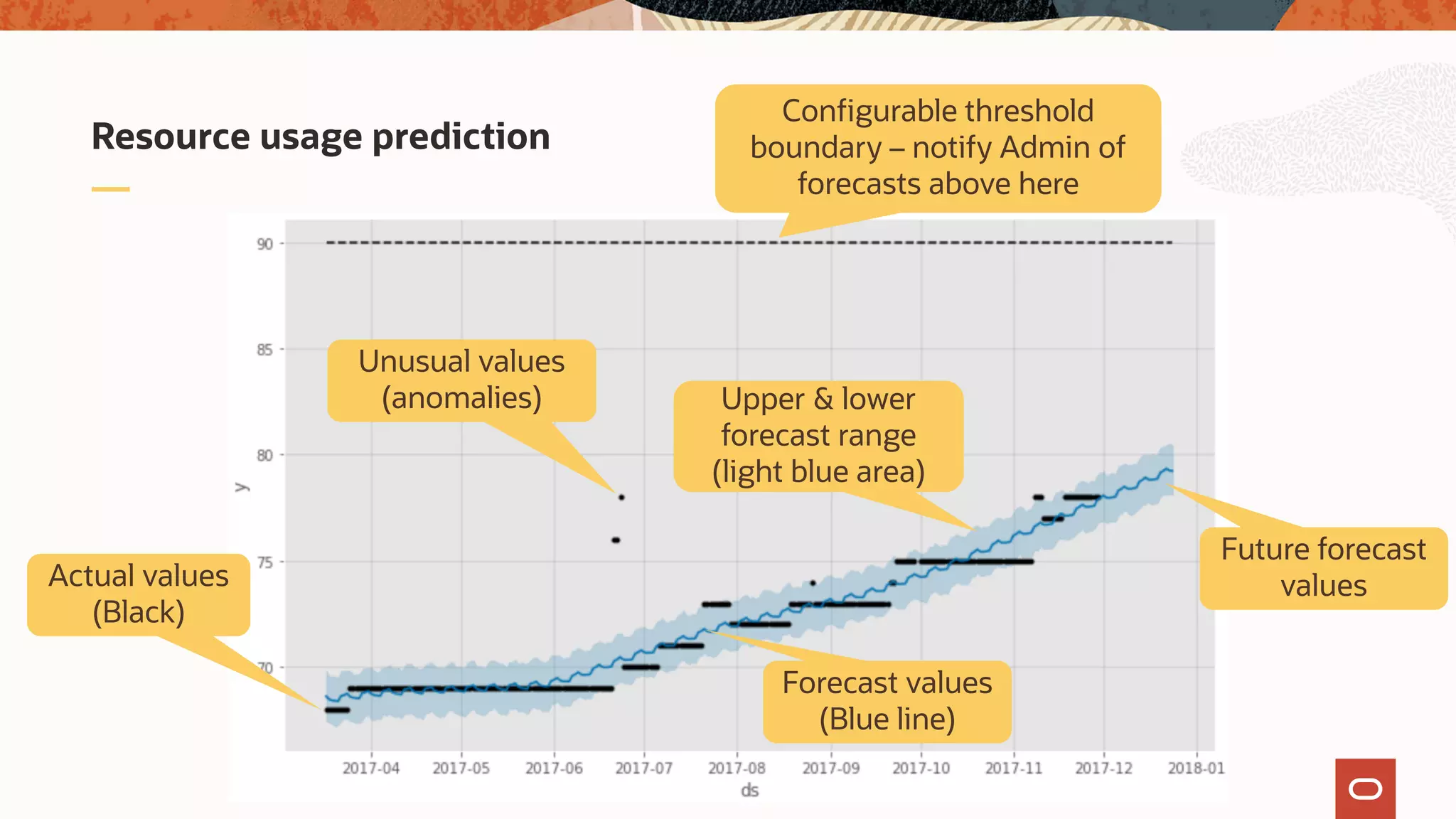
Resource usage prediction
Configurable threshold
boundary – notify Admin of
forecasts above here
Actual values
(Black)
Forecast values
(Blue line)
Upper & lower
forecast range
(light blue area)
Unusual values
(anomalies)
Future forecast
values
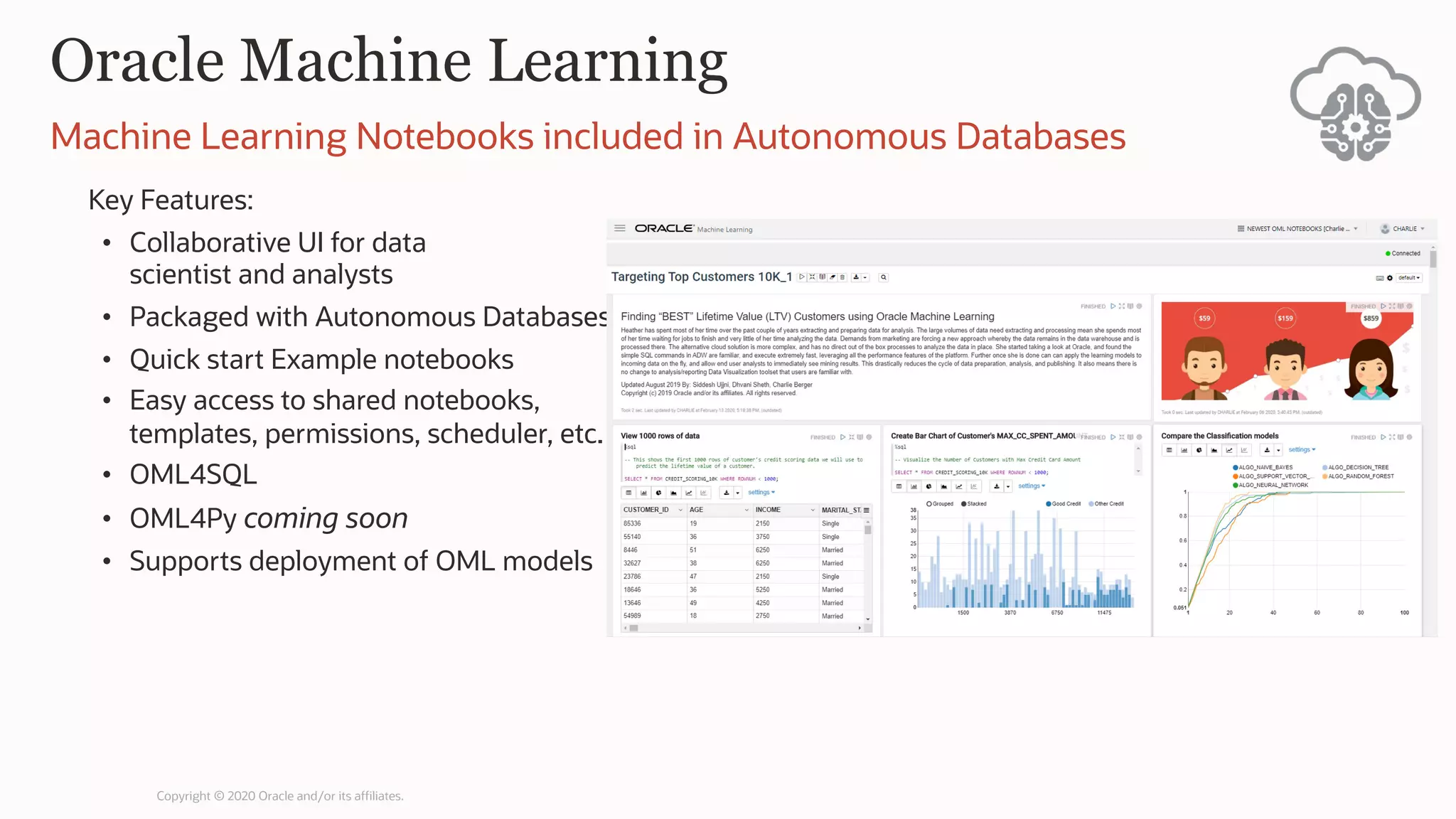
Oracle Machine Learning
Key Features:
• Collaborative UI for data
scientist and analysts
• Packaged with Autonomous Databases
• Quick start Example notebooks
• Easy access to shared notebooks,
templates, permissions, scheduler, etc.
• OML4SQL
• OML4Py coming soon
• Supports deployment of OML models
Machine Learning Notebooks included in Autonomous Databases
Copyright © 2020 Oracle and/or its affiliates.
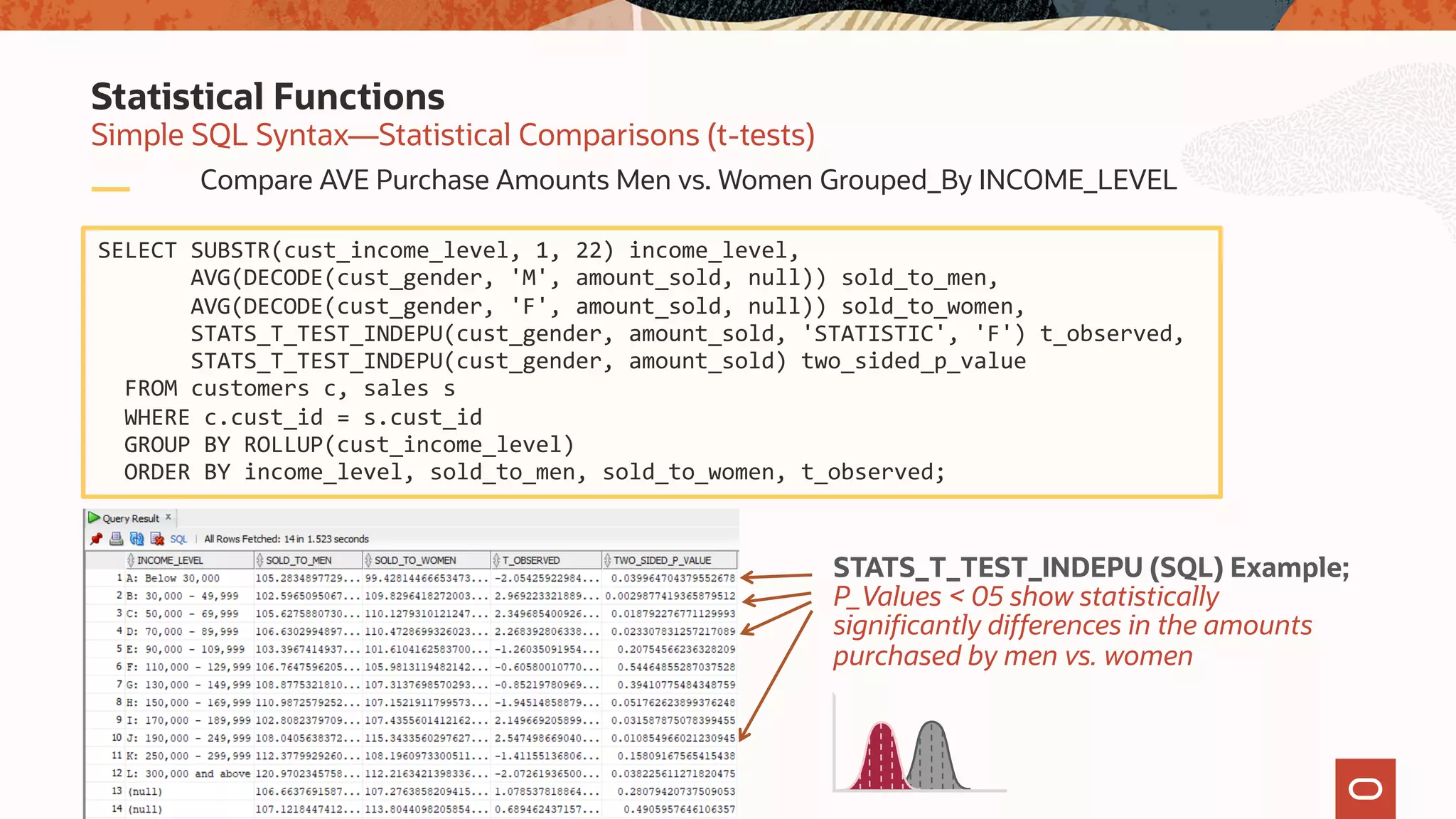
Simple SQL Syntax—Statistical Comparisons (t-tests)
Compare AVE Purchase Amounts Men vs. Women Grouped_By INCOME_LEVEL
Statistical Functions
SELECT SUBSTR(cust_income_level, 1, 22) income_level,
AVG(DECODE(cust_gender, 'M', amount_sold, null)) sold_to_men,
AVG(DECODE(cust_gender, 'F', amount_sold, null)) sold_to_women,
STATS_T_TEST_INDEPU(cust_gender, amount_sold, 'STATISTIC', 'F') t_observed,
STATS_T_TEST_INDEPU(cust_gender, amount_sold) two_sided_p_value
FROM customers c, sales s
WHERE c.cust_id = s.cust_id
GROUP BY ROLLUP(cust_income_level)
ORDER BY income_level, sold_to_men, sold_to_women, t_observed;
STATS_T_TEST_INDEPU (SQL) Example;
P_Values < 05 show statistically
significantly differences in the amounts
purchased by men vs. women
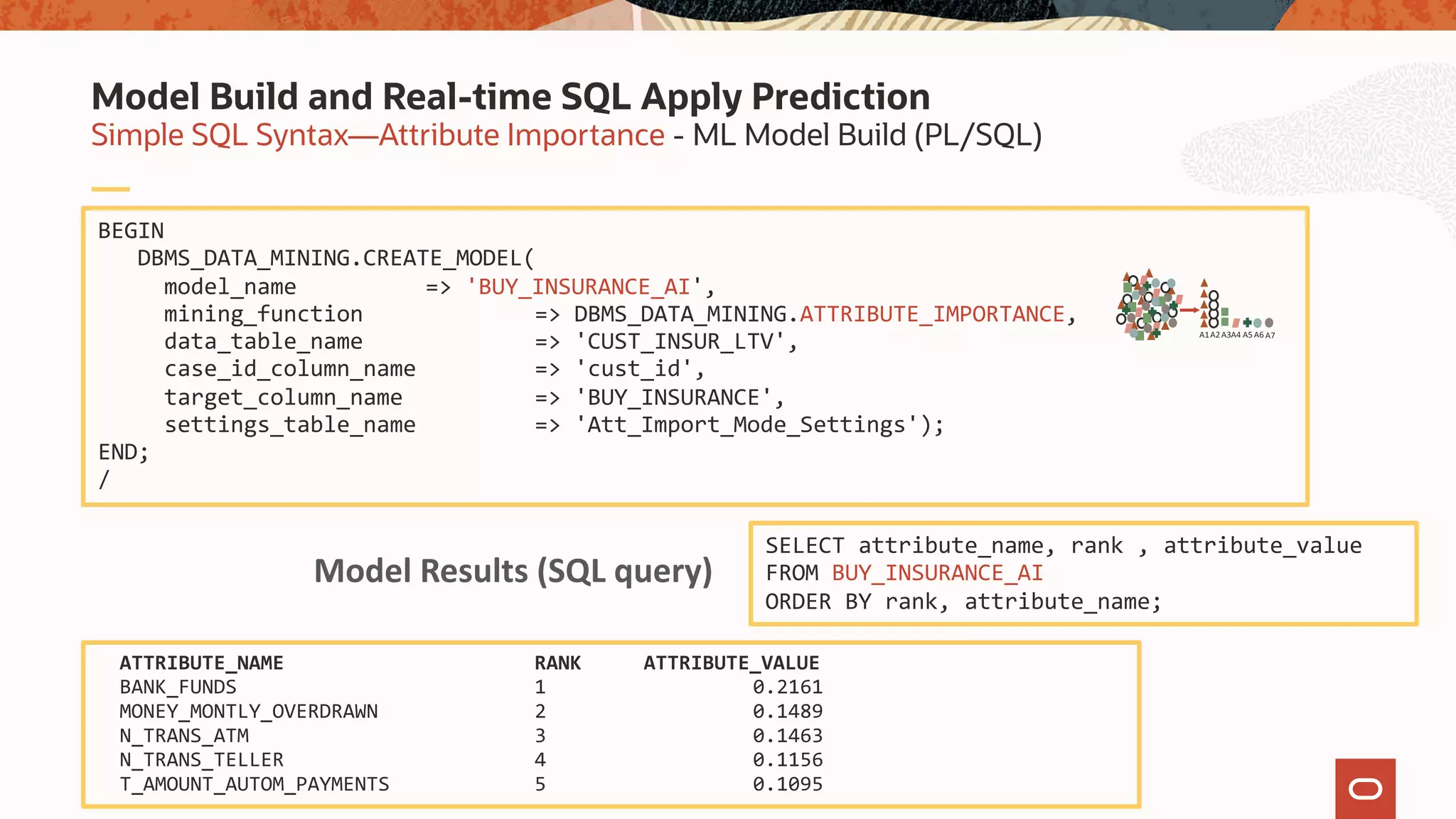
Simple SQL Syntax—Attribute Importance - ML Model Build (PL/SQL)
Model Build and Real-time SQL Apply Prediction
BEGIN
DBMS_DATA_MINING.CREATE_MODEL(
model_name => 'BUY_INSURANCE_AI',
mining_function => DBMS_DATA_MINING.ATTRIBUTE_IMPORTANCE,
data_table_name => 'CUST_INSUR_LTV',
case_id_column_name => 'cust_id',
target_column_name => 'BUY_INSURANCE',
settings_table_name => 'Att_Import_Mode_Settings');
END;
/
SELECT attribute_name, rank , attribute_value
FROM BUY_INSURANCE_AI
ORDER BY rank, attribute_name;
Model Results (SQL query)
ATTRIBUTE_NAME RANK ATTRIBUTE_VALUE
BANK_FUNDS 1 0.2161
MONEY_MONTLY_OVERDRAWN 2 0.1489
N_TRANS_ATM 3 0.1463
N_TRANS_TELLER 4 0.1156
T_AMOUNT_AUTOM_PAYMENTS 5 0.1095
A1A2A3A4 A5A6 A7
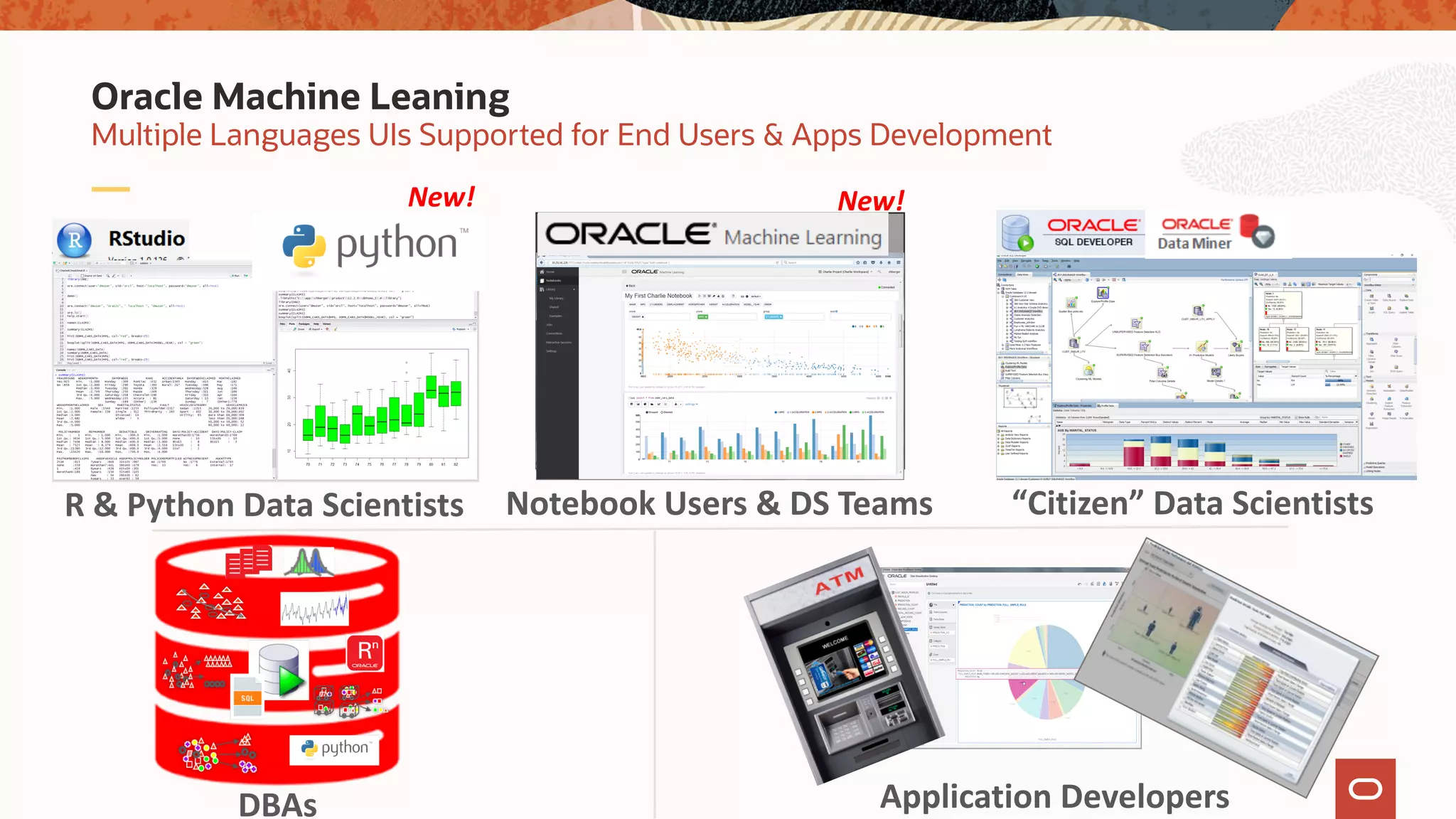
Multiple Languages UIs Supported for End Users & Apps Development
Oracle Machine Leaning
Application DevelopersDBAs
R & Python Data Scientists “Citizen” Data ScientistsNotebook Users & DS Teams
New! New!
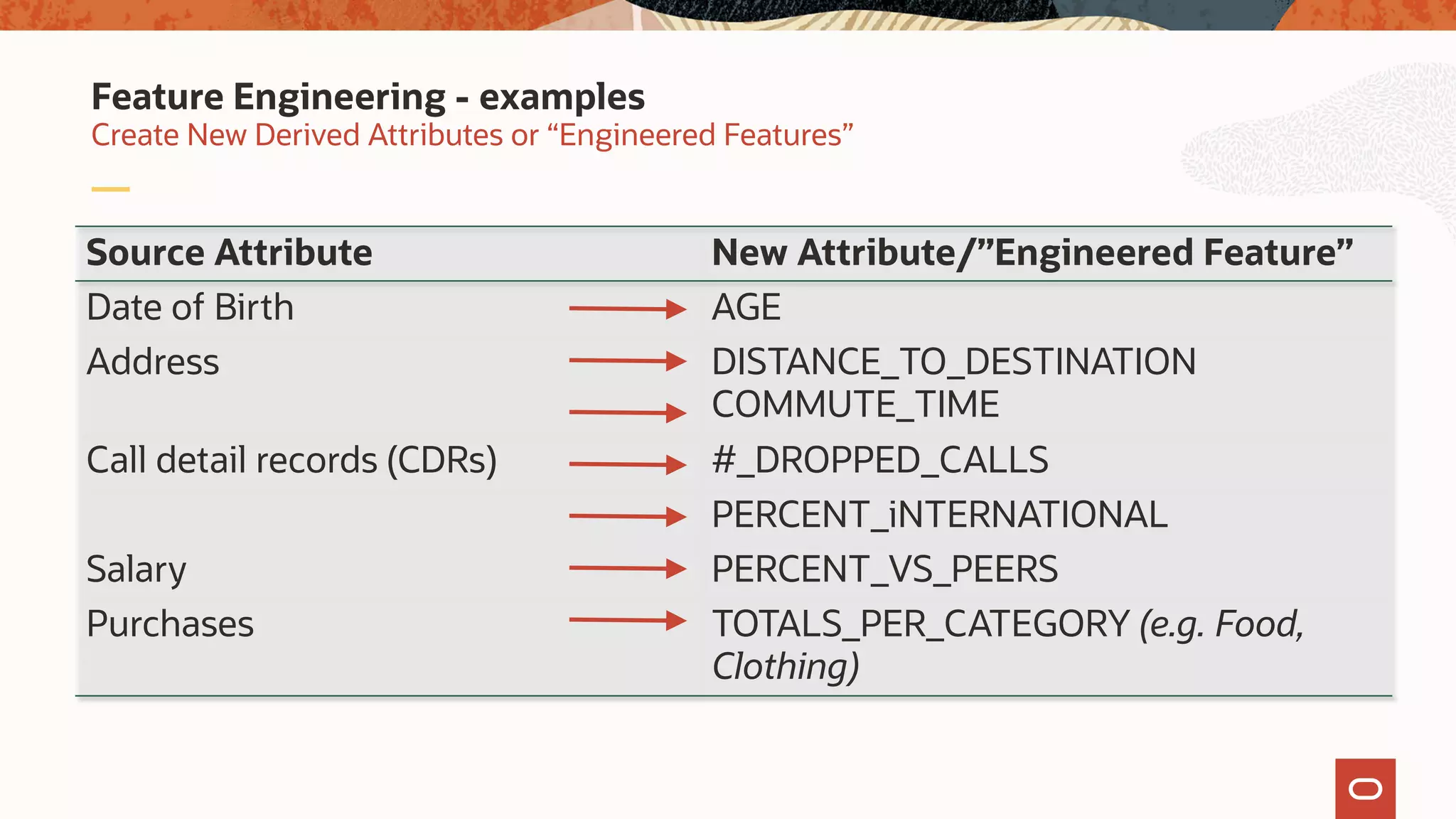
Create New Derived Attributes or “Engineered Features”
Feature Engineering - examples
Source Attribute New Attribute/”Engineered Feature”
Date of Birth AGE
Address DISTANCE_TO_DESTINATION
COMMUTE_TIME
Call detail records (CDRs) #_DROPPED_CALLS
PERCENT_iNTERNATIONAL
Salary PERCENT_VS_PEERS
Purchases TOTALS_PER_CATEGORY (e.g. Food,
Clothing)
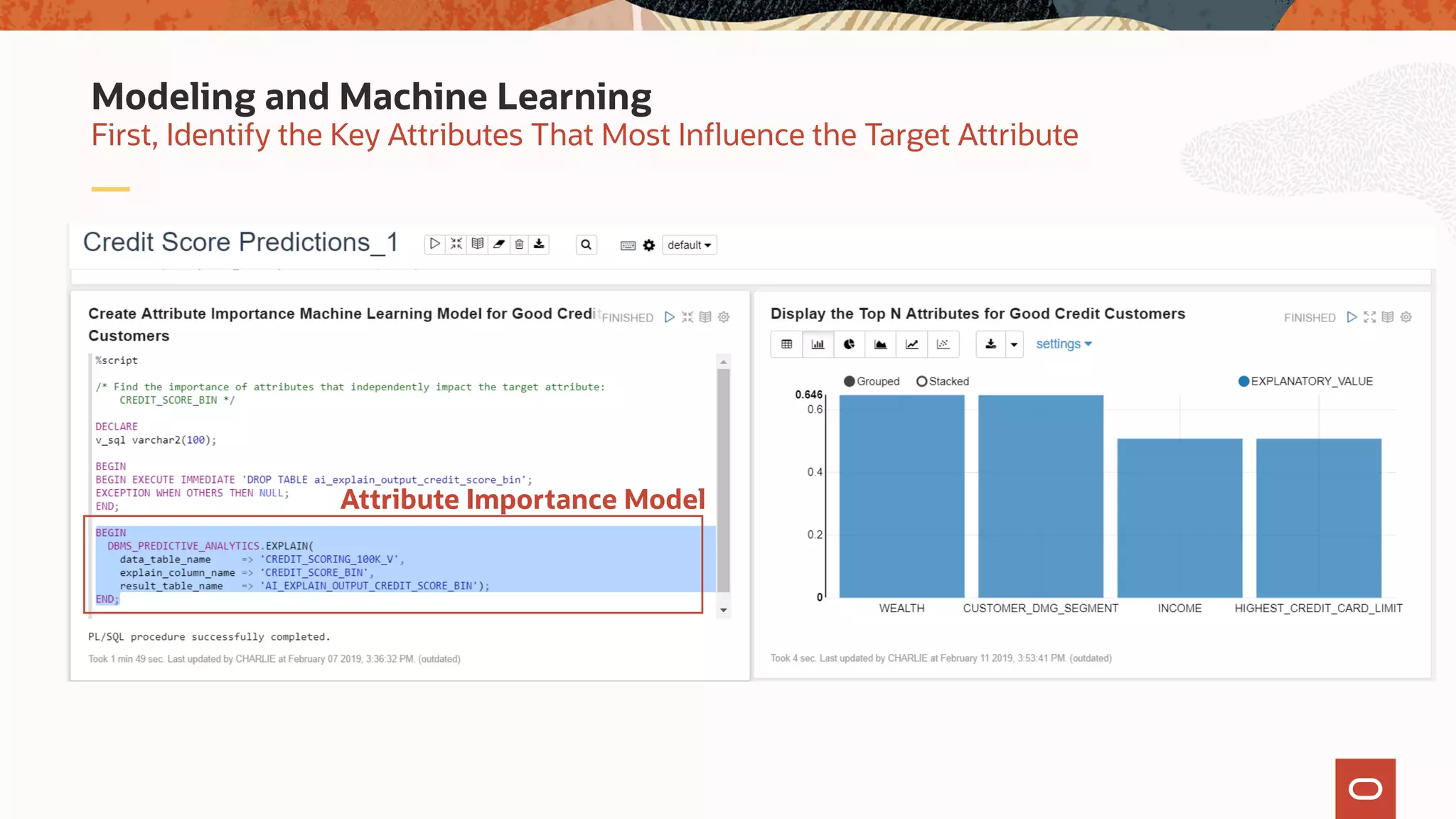
First, Identify the Key Attributes That Most Influence the Target Attribute
Modeling and Machine Learning
Attribute Importance Model
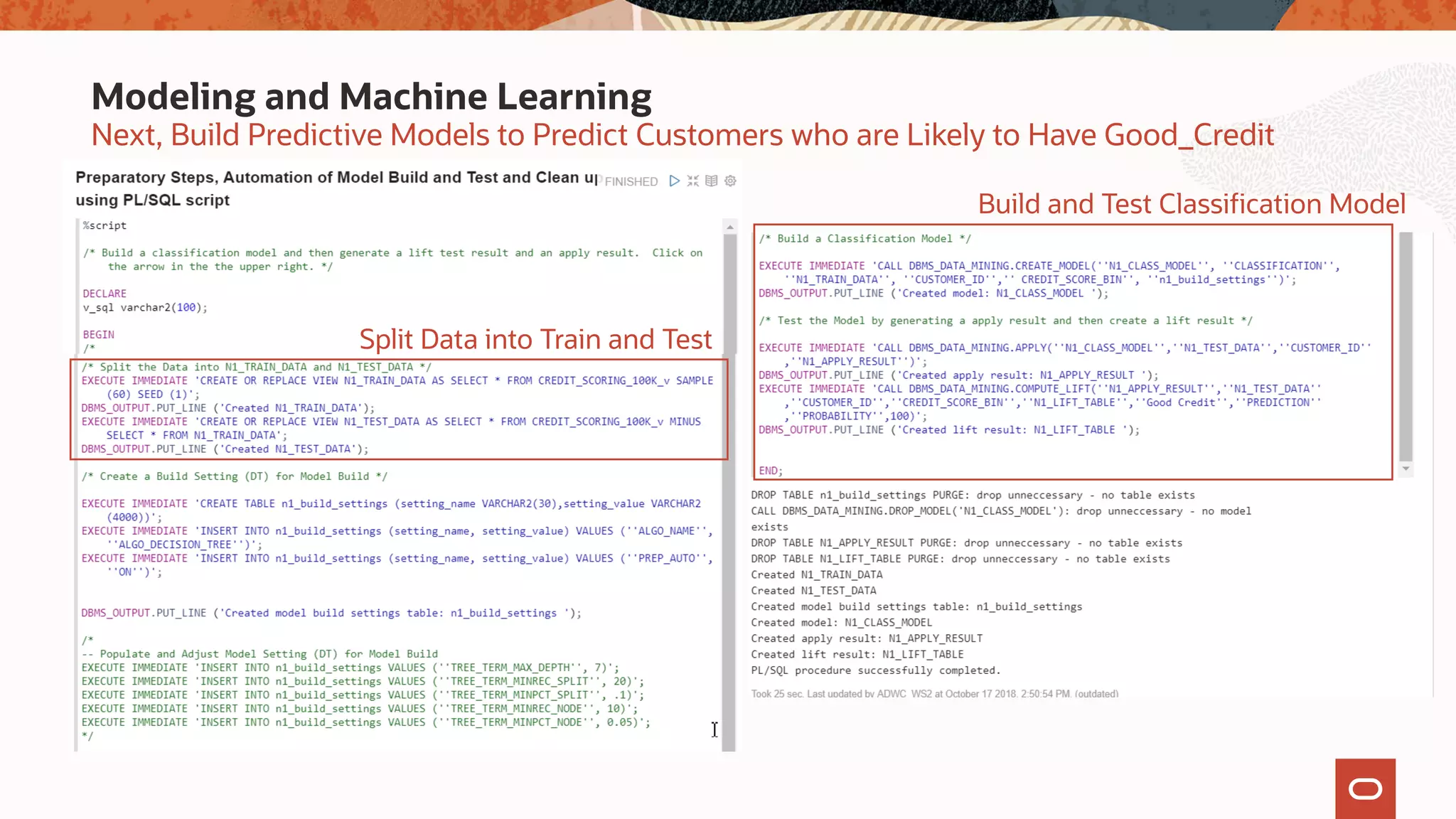
Next, Build Predictive Models to Predict Customers who are Likely to Have Good_Credit
Modeling and Machine Learning
Split Data into Train and Test
Build and Test Classification Model
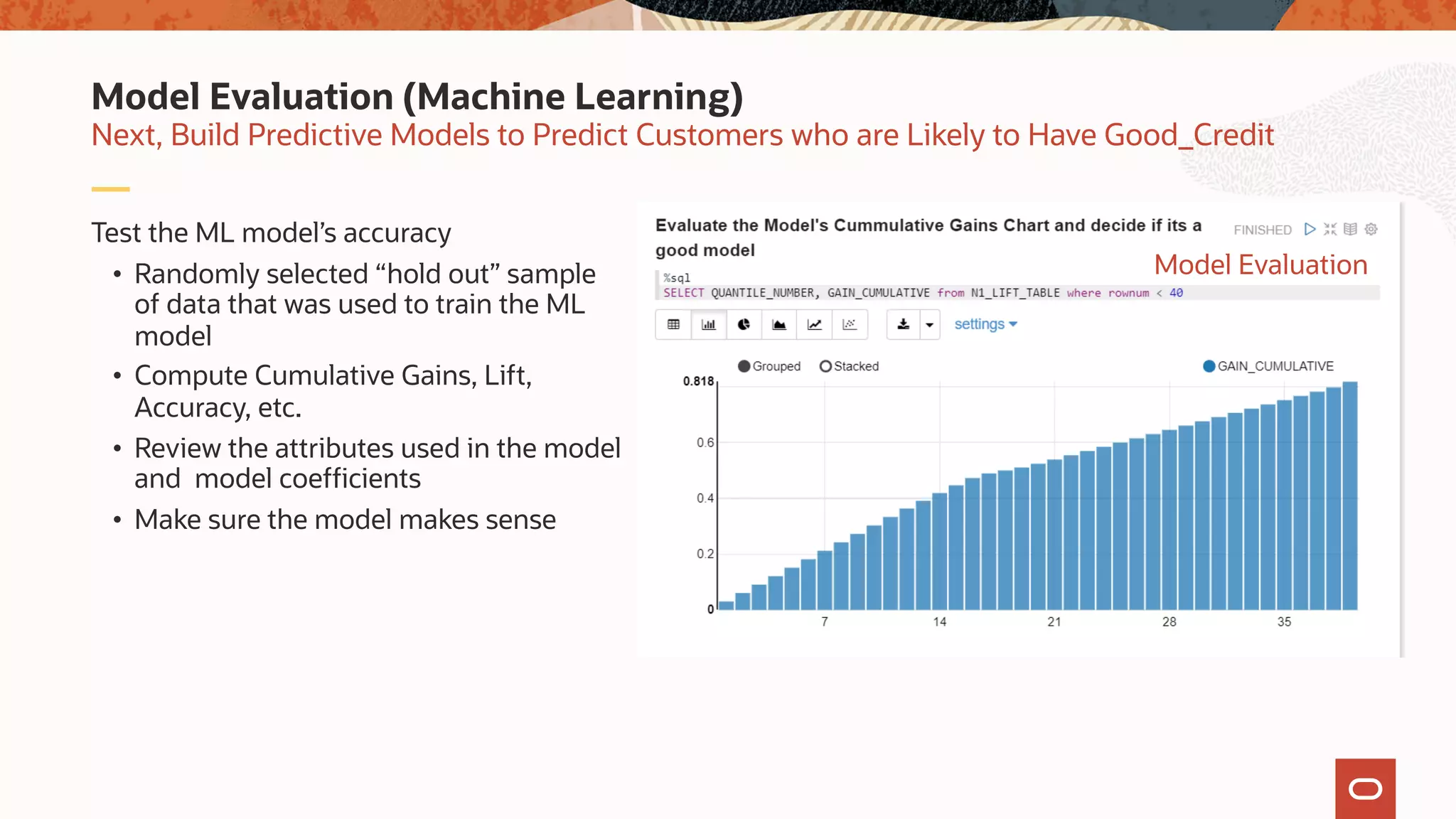
Test the ML model’s accuracy
• Randomly selected “hold out” sample
of data that was used to train the ML
model
• Compute Cumulative Gains, Lift,
Accuracy, etc.
• Review the attributes used in the model
and model coefficients
• Make sure the model makes sense
Next, Build Predictive Models to Predict Customers who are Likely to Have Good_Credit
Model Evaluation (Machine Learning)
Model Evaluation
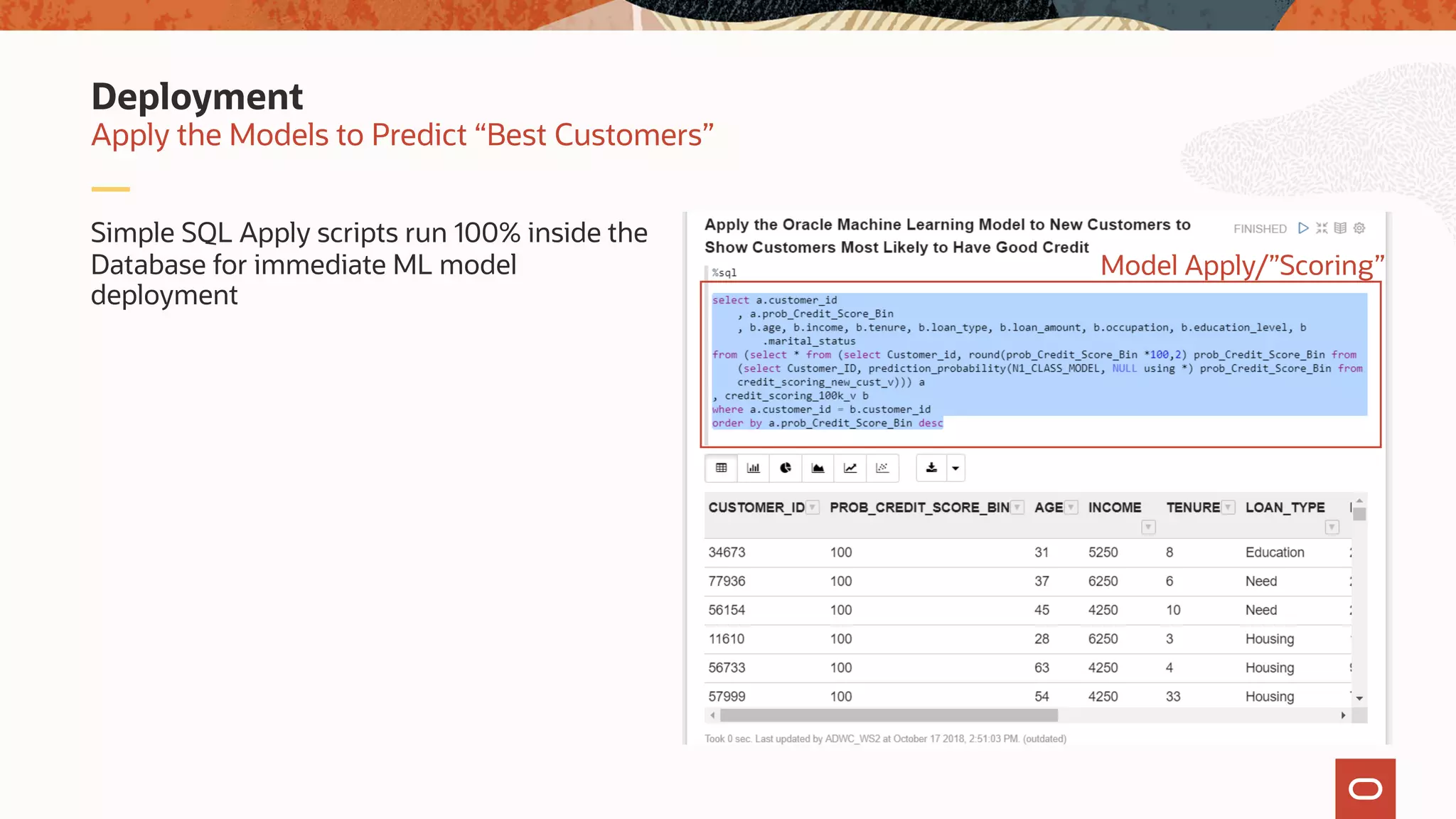
Simple SQL Apply scripts run 100% inside the
Database for immediate ML model
deployment
Apply the Models to Predict “Best Customers”
Deployment
Model Apply/”Scoring”
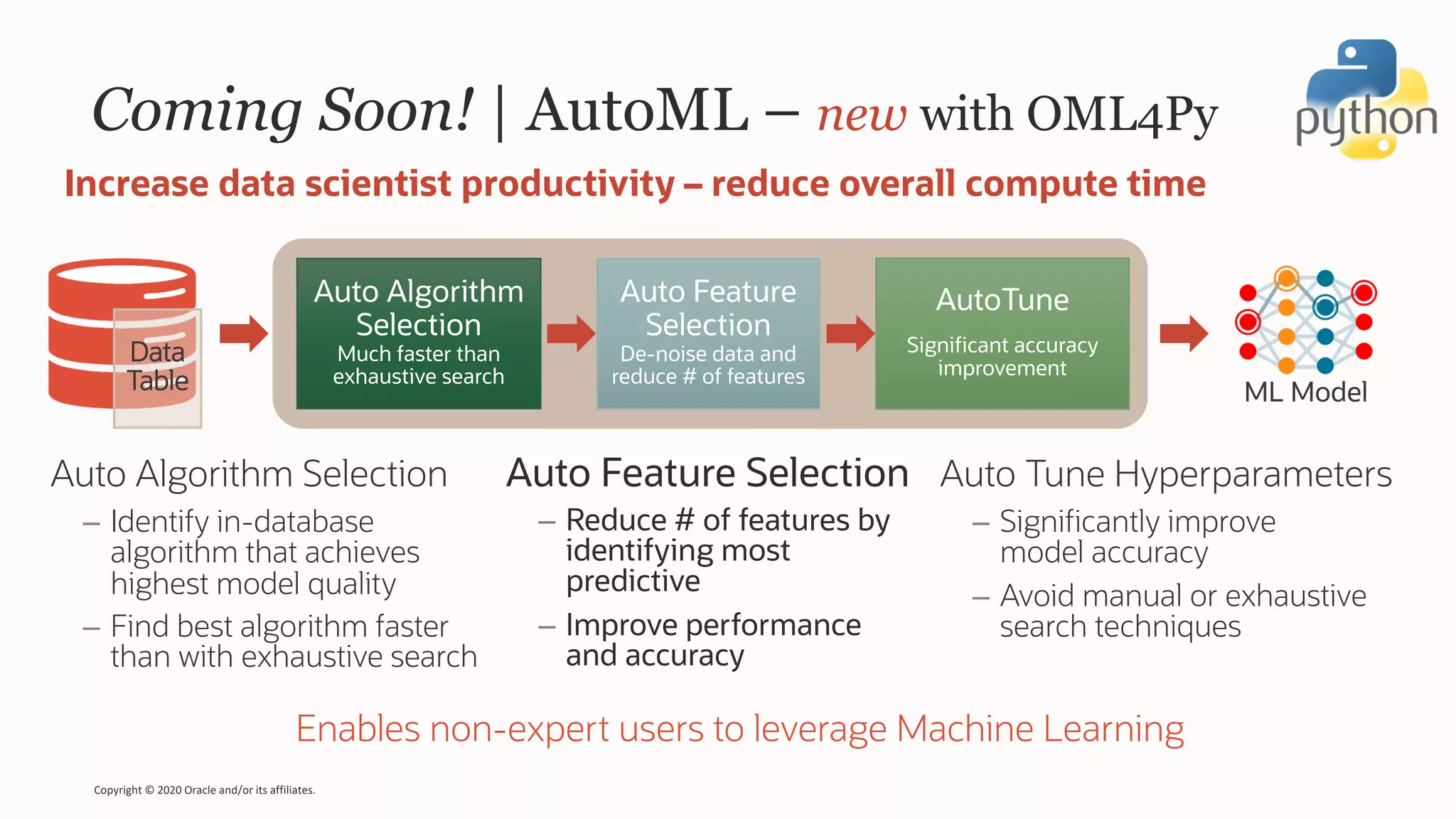
Coming Soon! | AutoML – new with OML4Py
Auto Feature Selection
– Reduce # of features by
identifying most
predictive
– Improve performance
and accuracy
Increase data scientist productivity – reduce overall compute time
Auto Algorithm
Selection
Much faster than
exhaustive search
Auto Feature
Selection
De-noise data and
reduce # of features
AutoTune
Significant accuracy
improvement
Auto Algorithm Selection
– Identify in-database
algorithm that achieves
highest model quality
– Find best algorithm faster
than with exhaustive search
Auto Tune Hyperparameters
– Significantly improve
model accuracy
– Avoid manual or exhaustive
search techniques
Copyright © 2020 Oracle and/or its affiliates.
Enables non-expert users to leverage Machine Learning
Data
Table ML Model
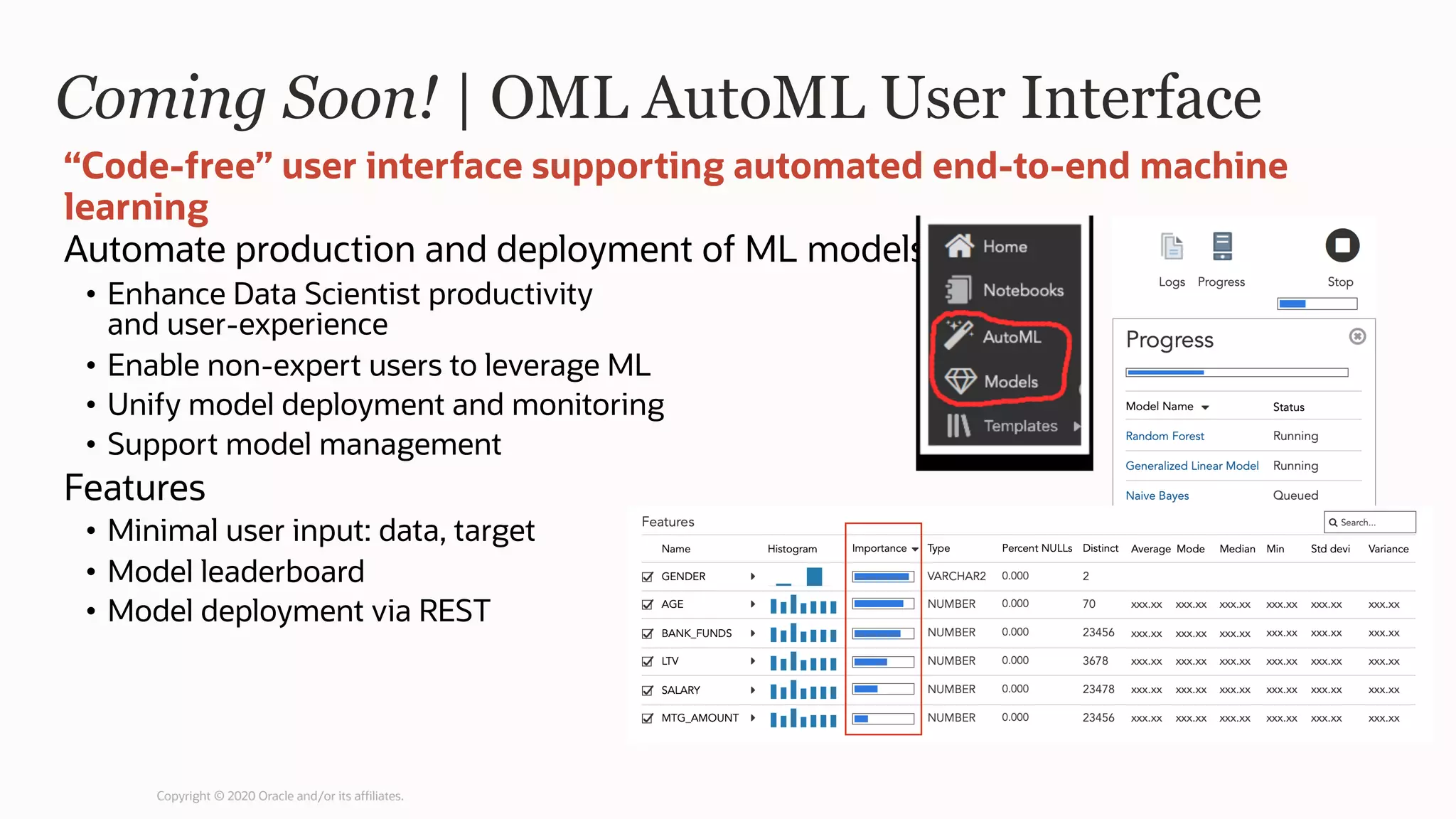
Coming Soon! | OML AutoML User Interface
Automate production and deployment of ML models
• Enhance Data Scientist productivity
and user-experience
• Enable non-expert users to leverage ML
• Unify model deployment and monitoring
• Support model management
Features
• Minimal user input: data, target
• Model leaderboard
• Model deployment via REST
“Code-free” user interface supporting automated end-to-end machine
learning
Copyright © 2020 Oracle and/or its affiliates.
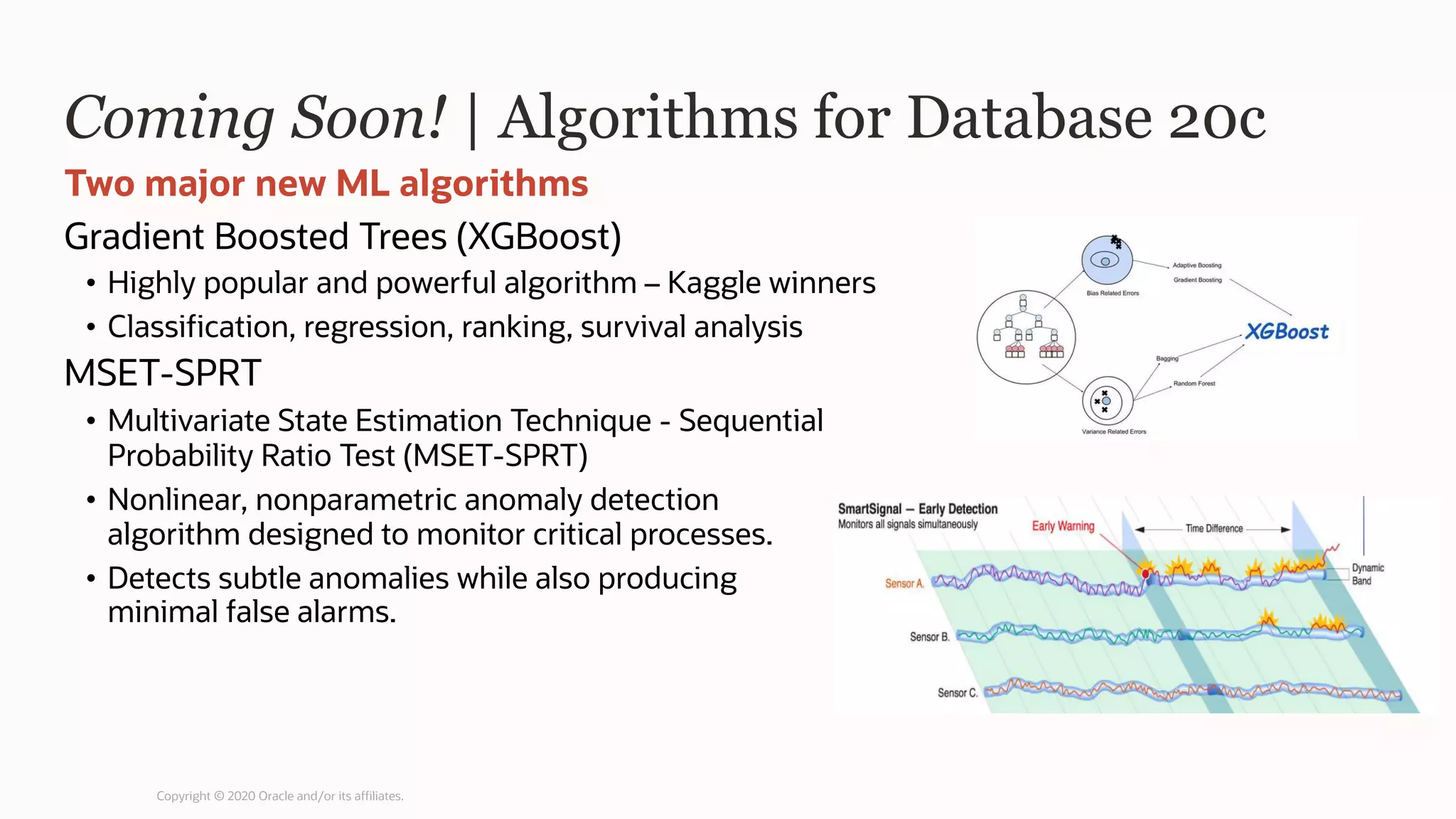
Coming Soon! | Algorithms for Database 20c
Gradient Boosted Trees (XGBoost)
• Highly popular and powerful algorithm – Kaggle winners
• Classification, regression, ranking, survival analysis
MSET-SPRT
• Multivariate State Estimation Technique - Sequential
Probability Ratio Test (MSET-SPRT)
• Nonlinear, nonparametric anomaly detection
algorithm designed to monitor critical processes.
• Detects subtle anomalies while also producing
minimal false alarms.
Two major new ML algorithms
Copyright © 2020 Oracle and/or its affiliates.
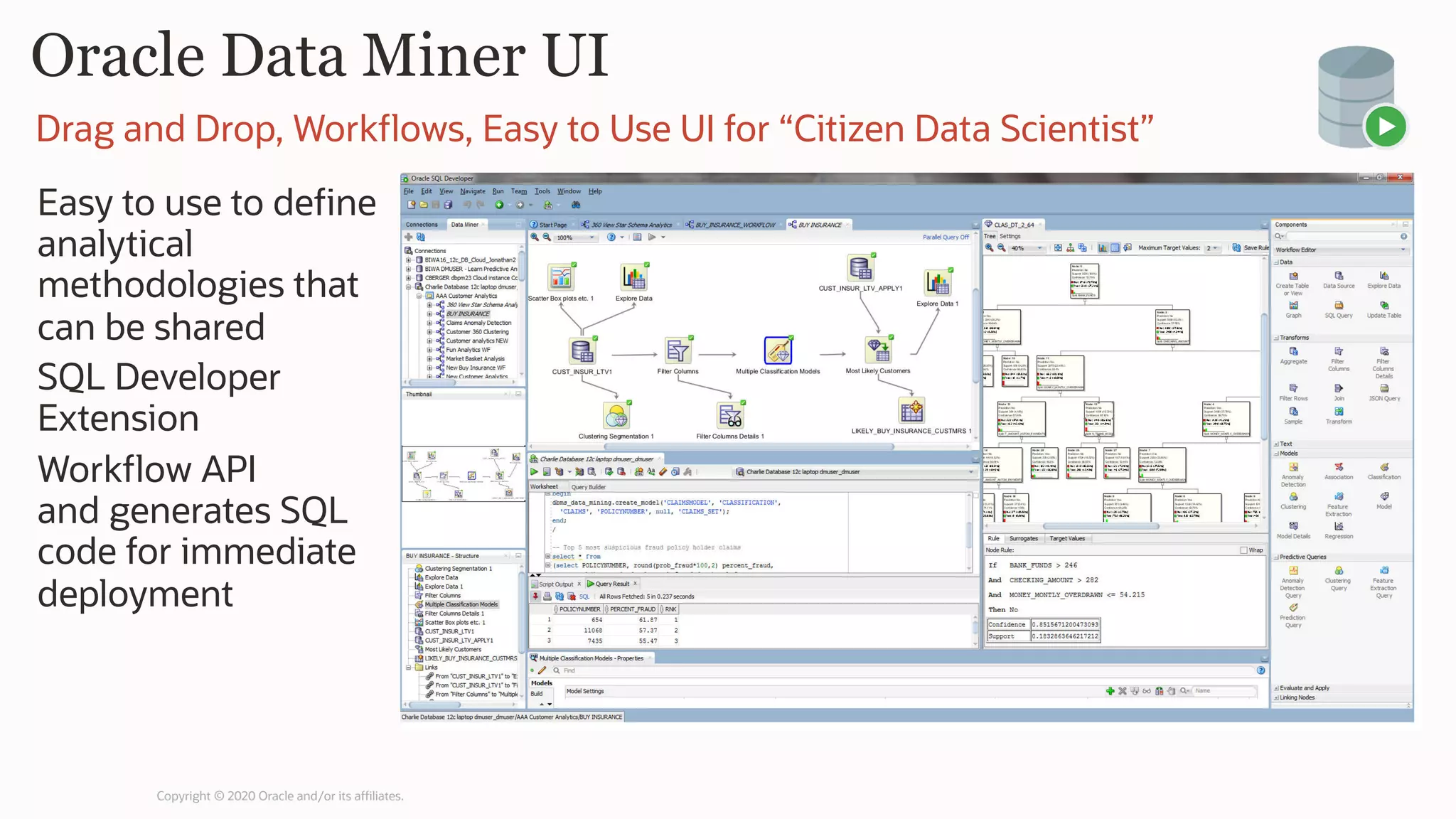
Oracle Data Miner UI
Easy to use to define
analytical
methodologies that
can be shared
SQL Developer
Extension
Workflow API
and generates SQL
code for immediate
deployment
Drag and Drop, Workflows, Easy to Use UI for “Citizen Data Scientist”
Copyright © 2020 Oracle and/or its affiliates.
Congratulations!
Almost there J
Data Scientist
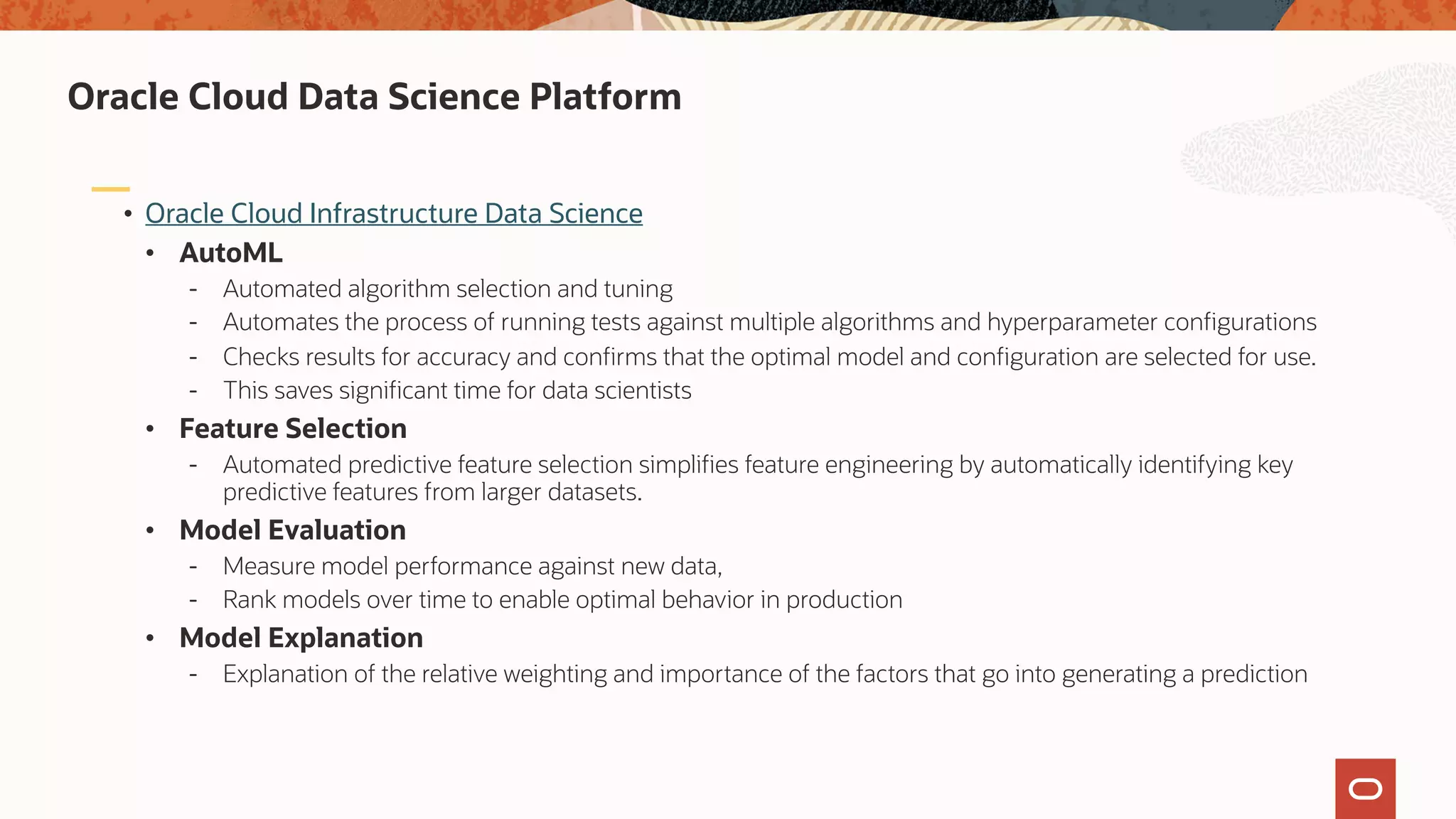
• Oracle Cloud Infrastructure Data Science
• AutoML
- Automated algorithm selection and tuning
- Automates the process of running tests against multiple algorithms and hyperparameter configurations
- Checks results for accuracy and confirms that the optimal model and configuration are selected for use.
- This saves significant time for data scientists
• Feature Selection
- Automated predictive feature selection simplifies feature engineering by automatically identifying key
predictive features from larger datasets.
• Model Evaluation
- Measure model performance against new data,
- Rank models over time to enable optimal behavior in production
• Model Explanation
- Explanation of the relative weighting and importance of the factors that go into generating a prediction
Oracle Cloud Data Science Platform
• Oracle Cloud Infrastructure Data Science
• Notebook Sessions
- Built-in cloud-hosted JupyterLab notebook sessions enable teams to build and train models
using Python.
• Visualization Tools
- Use popular open source visualization tools like plotly, matplotlib, and bokeh to visualize and
explore data.
• Open Source Machine Learning Frameworks
- Launch notebook sessions with popular machine learning frameworks like TensorFlow, Jupyter,
Dask, Keras, XGboost, and scikit-learn, or bring your own packages.
Oracle Cloud Data Science Platform
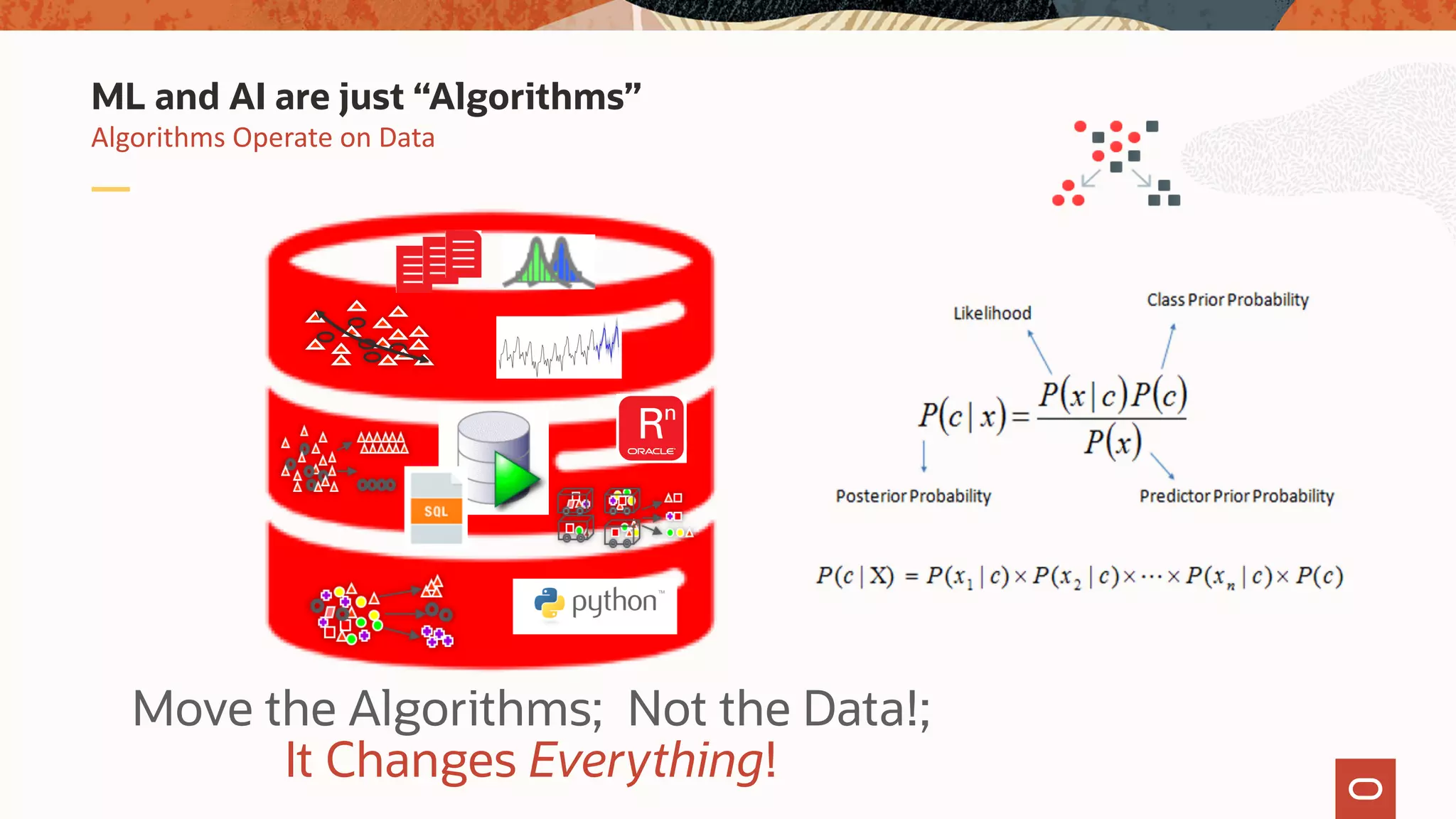
Algorithms Operate on Data
ML and AI are just “Algorithms”
Move the Algorithms; Not the Data!;
It Changes Everything!
Thank You
Any Questions ?
Sandesh Rao
VP AIOps for the Autonomous Database
@sandeshr
https://www.linkedin.com/in/raosandesh/
https://www.slideshare.net/SandeshRao4

Introduction to Machine learning - DBA's to data scientists - Oct 2020 - OGBEmea

  • 1.
    VP AIOps forthe Autonomous Database Sandesh Rao From DBA’s to Data Scientists Introduction to Machine Learning @sandeshr https://www.linkedin.com/in/raosandesh/ https://www.slideshare.net/SandeshRao4
  • 2.
    Tasks Specific toBusiness and Innovation • Architecture, planning, data modeling • Data security and lifecycle management • Application related tuning • End-to-End service level management Maintenance Tasks • Configuration and tuning of systems, network, storage • Database provisioning, patching • Database backups, H/A, disaster recovery • Database optimization Traditionally DBAs are Responsible for: Value Scale Innovation Maintenance
  • 3.
    Tasks Specific toBusiness and Innovation • Architecture, planning, data modeling • Data security and lifecycle management • Application related tuning • End-to-End service level management Maintenance Tasks • Configuration and tuning of systems, network, storage • Database provisioning, patching • Database backups, H/A, disaster recovery • Database optimization Freedom from Drudgery for DBA: More Time to Innovate and Improve the Business Autonomous Database Removes Generic Tasks Value Scale Innovation Maintenance
  • 4.
    Machine Learning Solving data-driven problems Discoveringinsights Making predictions Data Security Data classification, Data life-cycle mgmt Application Tuning SQL tuning, connection mgmt The Evolution of the DBA/Database Developer Role Data Engineer Architecture, “data wrangler”
  • 5.
    Data extraction Data wrangling Derivingnew attributes (“feature engineering”) … … … Import predictions & insights Translate and deploy ML models Automate You Are Probably Already Doing Most of This Work! Database Developer to Data Scientist Journey 1 - https://www.infoworld.com/article/3228245/data-science/the-80-20-data-science-dilemma.html Typically 80% of the work Most data scientists spend only 20 percent of their time on actual data analysis and 80 percent of their time finding, cleaning, and reorganizing huge amounts of data, which is an inefficient data strategy1 Eliminated or minimized with Oracle Data Management platform becomes combine/hybrid DM + machine learning platform
  • 6.
    Albert Einstein “If Ihad an hour to solve a problem I'd spend 55 minutes thinking about the problem and 5 minutes thinking about solutions.”
  • 7.
    Lots of Dataneeds to be crunched • No time to manually sift through the data Machine Learning has become accessible • Software and algorithms are available • Frameworks allow for massive training with no coding • CI/CD available for MLOps • It’s not the algorithm you need to know about !! Business use cases - Find the use cases for maximum impact Why Machine Learning is important
  • 8.
    Analytics Value vs.Maturity Reports & Dashboards Data Information Predictions & Insights Appls with ML Analytical Maturity ValueofAnalytics Diagnostic Analysis & Reports Predictive / Machine Learning “ML Enabled” Applications What Happened? Why it Happened? What WILL happen? Automated ML Appls
  • 9.
    Database Developer toData Scientist Journey
  • 10.
    ML Project Workflow Setthe business objectives Gather compare and clean data Identify and extract features (important columns) from imported data This helps us identify the efficiency of the algorithm Take the input data which is also called the training data and apply the algorithm to it For the algorithm to function efficiently, it is important to pick the right value for hyper parameters (algorithm input parameters to the algorithm) Once the training data in the algorithm are combined we get a model 1 2 3 4 5
  • 11.
    Types of MachineLearning Supervised Learning Predict future outcomes with the help of training data provided by human experts Semi-Supervised Learning Discover patterns within raw data and make predictions, which are then reviewed by human experts, who provide feedback which is used to improve the model accuracy Unsupervised Learning Find patterns without any external input other than the raw data Reinforcement Learning Take decisions based on past rewards for this type of action
  • 12.
    TIME SERIES Temporal Aspect Hittinga threshold Forecasting energy use Seasonality of data
  • 13.
    Algorithms automatically siftthrough large amounts of data to discover hidden patterns, new insights and make predictions What is Machine Learning? Identify most important factor (Attribute Importance) Predict customer behavior (Classification) Find profiles of targeted people or items (Classification Predict or estimate a value (Regression) Segment a population (Clustering) Find fraudulent or “rare events” (Anomaly Detection) Determine co-occurring items in a “basket” (Associations)X1 X2 A1A2A3A4 A5A6 A7 SupervisedLearningUnsupervisedLearning Copyright © 2020 Oracle and/or its affiliates.
  • 14.
    Machine Learning Algorithms •Multiple Regression, Support Vector Machine, Linear Model, LASSO, Random Forest, Ridge Regression, Generalized Linear Model, Stepwise Linear Regression Regression Association & Collaborative Filtering Reinforcement Learning - brute force, Monte Carlo, temporal difference.... • Many different use cases Neural network & deep Learning with Deep Neural Network • Hierarchical k-means, Orthogonal Partitioning Clustering, Expectation- Maximization Clustering Feature Extraction/Attribute Importance / Component Analysis • Decision Tree, Naive Bayes, Random Forest, Logistic Regression, Support Vector Machine Classification
  • 15.
    What is Workload Automatically check workloadfor past x mins Decide if workload is abnormally high Highlight any abnormal workload issues Optionally run on demand Optionally snooze checking of a component Calculated via machine learning
  • 16.
    Prediction (Every 5minutes) 5 X 1 min metrics captured for each dimension & ASH report captured for later analysis Metrics evaluated by the primary model to determine if there are anomalies If there is no primary model (i.e. <7 days of data or <=95% model confidence) then SME rules are used for anomaly detection Each anomaly is compared against the SME rules to determine which dimension it applies to Any anomalies are raised along with recently captured ASH report
  • 17.
    Resource usage prediction Configurablethreshold boundary – notify Admin of forecasts above here Actual values (Black) Forecast values (Blue line) Upper & lower forecast range (light blue area) Unusual values (anomalies) Future forecast values
  • 18.
    Oracle Machine Learning KeyFeatures: • Collaborative UI for data scientist and analysts • Packaged with Autonomous Databases • Quick start Example notebooks • Easy access to shared notebooks, templates, permissions, scheduler, etc. • OML4SQL • OML4Py coming soon • Supports deployment of OML models Machine Learning Notebooks included in Autonomous Databases Copyright © 2020 Oracle and/or its affiliates.
  • 19.
    Simple SQL Syntax—StatisticalComparisons (t-tests) Compare AVE Purchase Amounts Men vs. Women Grouped_By INCOME_LEVEL Statistical Functions SELECT SUBSTR(cust_income_level, 1, 22) income_level, AVG(DECODE(cust_gender, 'M', amount_sold, null)) sold_to_men, AVG(DECODE(cust_gender, 'F', amount_sold, null)) sold_to_women, STATS_T_TEST_INDEPU(cust_gender, amount_sold, 'STATISTIC', 'F') t_observed, STATS_T_TEST_INDEPU(cust_gender, amount_sold) two_sided_p_value FROM customers c, sales s WHERE c.cust_id = s.cust_id GROUP BY ROLLUP(cust_income_level) ORDER BY income_level, sold_to_men, sold_to_women, t_observed; STATS_T_TEST_INDEPU (SQL) Example; P_Values < 05 show statistically significantly differences in the amounts purchased by men vs. women
  • 20.
    Simple SQL Syntax—AttributeImportance - ML Model Build (PL/SQL) Model Build and Real-time SQL Apply Prediction BEGIN DBMS_DATA_MINING.CREATE_MODEL( model_name => 'BUY_INSURANCE_AI', mining_function => DBMS_DATA_MINING.ATTRIBUTE_IMPORTANCE, data_table_name => 'CUST_INSUR_LTV', case_id_column_name => 'cust_id', target_column_name => 'BUY_INSURANCE', settings_table_name => 'Att_Import_Mode_Settings'); END; / SELECT attribute_name, rank , attribute_value FROM BUY_INSURANCE_AI ORDER BY rank, attribute_name; Model Results (SQL query) ATTRIBUTE_NAME RANK ATTRIBUTE_VALUE BANK_FUNDS 1 0.2161 MONEY_MONTLY_OVERDRAWN 2 0.1489 N_TRANS_ATM 3 0.1463 N_TRANS_TELLER 4 0.1156 T_AMOUNT_AUTOM_PAYMENTS 5 0.1095 A1A2A3A4 A5A6 A7
  • 21.
    Multiple Languages UIsSupported for End Users & Apps Development Oracle Machine Leaning Application DevelopersDBAs R & Python Data Scientists “Citizen” Data ScientistsNotebook Users & DS Teams New! New!
  • 22.
    Create New DerivedAttributes or “Engineered Features” Feature Engineering - examples Source Attribute New Attribute/”Engineered Feature” Date of Birth AGE Address DISTANCE_TO_DESTINATION COMMUTE_TIME Call detail records (CDRs) #_DROPPED_CALLS PERCENT_iNTERNATIONAL Salary PERCENT_VS_PEERS Purchases TOTALS_PER_CATEGORY (e.g. Food, Clothing)
  • 23.
    First, Identify theKey Attributes That Most Influence the Target Attribute Modeling and Machine Learning Attribute Importance Model
  • 24.
    Next, Build PredictiveModels to Predict Customers who are Likely to Have Good_Credit Modeling and Machine Learning Split Data into Train and Test Build and Test Classification Model
  • 25.
    Test the MLmodel’s accuracy • Randomly selected “hold out” sample of data that was used to train the ML model • Compute Cumulative Gains, Lift, Accuracy, etc. • Review the attributes used in the model and model coefficients • Make sure the model makes sense Next, Build Predictive Models to Predict Customers who are Likely to Have Good_Credit Model Evaluation (Machine Learning) Model Evaluation
  • 26.
    Simple SQL Applyscripts run 100% inside the Database for immediate ML model deployment Apply the Models to Predict “Best Customers” Deployment Model Apply/”Scoring”
  • 27.
    Coming Soon! |AutoML – new with OML4Py Auto Feature Selection – Reduce # of features by identifying most predictive – Improve performance and accuracy Increase data scientist productivity – reduce overall compute time Auto Algorithm Selection Much faster than exhaustive search Auto Feature Selection De-noise data and reduce # of features AutoTune Significant accuracy improvement Auto Algorithm Selection – Identify in-database algorithm that achieves highest model quality – Find best algorithm faster than with exhaustive search Auto Tune Hyperparameters – Significantly improve model accuracy – Avoid manual or exhaustive search techniques Copyright © 2020 Oracle and/or its affiliates. Enables non-expert users to leverage Machine Learning Data Table ML Model
  • 28.
    Coming Soon! |OML AutoML User Interface Automate production and deployment of ML models • Enhance Data Scientist productivity and user-experience • Enable non-expert users to leverage ML • Unify model deployment and monitoring • Support model management Features • Minimal user input: data, target • Model leaderboard • Model deployment via REST “Code-free” user interface supporting automated end-to-end machine learning Copyright © 2020 Oracle and/or its affiliates.
  • 29.
    Coming Soon! |Algorithms for Database 20c Gradient Boosted Trees (XGBoost) • Highly popular and powerful algorithm – Kaggle winners • Classification, regression, ranking, survival analysis MSET-SPRT • Multivariate State Estimation Technique - Sequential Probability Ratio Test (MSET-SPRT) • Nonlinear, nonparametric anomaly detection algorithm designed to monitor critical processes. • Detects subtle anomalies while also producing minimal false alarms. Two major new ML algorithms Copyright © 2020 Oracle and/or its affiliates.
  • 30.
    Oracle Data MinerUI Easy to use to define analytical methodologies that can be shared SQL Developer Extension Workflow API and generates SQL code for immediate deployment Drag and Drop, Workflows, Easy to Use UI for “Citizen Data Scientist” Copyright © 2020 Oracle and/or its affiliates.
  • 31.
  • 32.
    • Oracle CloudInfrastructure Data Science • AutoML - Automated algorithm selection and tuning - Automates the process of running tests against multiple algorithms and hyperparameter configurations - Checks results for accuracy and confirms that the optimal model and configuration are selected for use. - This saves significant time for data scientists • Feature Selection - Automated predictive feature selection simplifies feature engineering by automatically identifying key predictive features from larger datasets. • Model Evaluation - Measure model performance against new data, - Rank models over time to enable optimal behavior in production • Model Explanation - Explanation of the relative weighting and importance of the factors that go into generating a prediction Oracle Cloud Data Science Platform
  • 33.
    • Oracle CloudInfrastructure Data Science • Notebook Sessions - Built-in cloud-hosted JupyterLab notebook sessions enable teams to build and train models using Python. • Visualization Tools - Use popular open source visualization tools like plotly, matplotlib, and bokeh to visualize and explore data. • Open Source Machine Learning Frameworks - Launch notebook sessions with popular machine learning frameworks like TensorFlow, Jupyter, Dask, Keras, XGboost, and scikit-learn, or bring your own packages. Oracle Cloud Data Science Platform
  • 34.
    Algorithms Operate onData ML and AI are just “Algorithms” Move the Algorithms; Not the Data!; It Changes Everything!
  • 35.
    Thank You Any Questions? Sandesh Rao VP AIOps for the Autonomous Database @sandeshr https://www.linkedin.com/in/raosandesh/ https://www.slideshare.net/SandeshRao4