ECE 8443 – Pattern Recognition
ECE 8527 – Introduction to Machine Learning and Pattern Recognition
• Objectives:
Course Introduction
Typical Applications
• Resources:
Syllabus
Internet Books and Notes
D.H.S: Chapter 1
Glossary
LECTURE 01: COURSE OVERVIEW
ECE 8527: Lecture 01, Slide 1
• Pattern Recognition: “the act of taking raw data and taking an action based
on the category of the pattern.”
• Common Applications: speech recognition, fingerprint identification
(biometrics), DNA sequence identification
• Related Terminology:
 Machine Learning: The ability of a machine to improve its performance
based on previous results.
 Machine Understanding: acting on the intentions of the user
generating the data.
• Related Fields: artificial intelligence, signal processing and discipline-specific
research (e.g., target recognition, speech recognition, natural language
processing).
Terminology
ECE 8527: Lecture 01, Slide 2
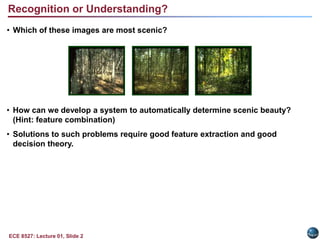
• Which of these images are most scenic?
• How can we develop a system to automatically determine scenic beauty?
(Hint: feature combination)
• Solutions to such problems require good feature extraction and good
decision theory.
Recognition or Understanding?
ECE 8527: Lecture 01, Slide 3
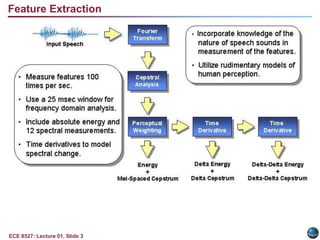
Feature Extraction
ECE 8527: Lecture 01, Slide 4
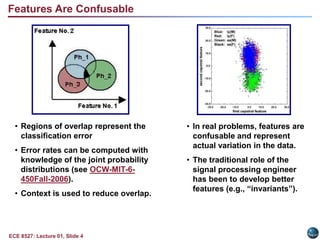
• Regions of overlap represent the
classification error
• Error rates can be computed with
knowledge of the joint probability
distributions (see OCW-MIT-6-
450Fall-2006).
• Context is used to reduce overlap.
• In real problems, features are
confusable and represent
actual variation in the data.
• The traditional role of the
signal processing engineer
has been to develop better
features (e.g., “invariants”).
Features Are Confusable
ECE 8527: Lecture 01, Slide 5
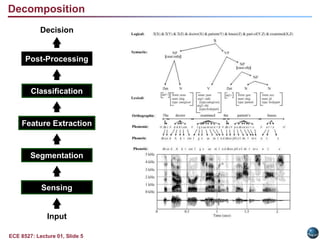
Feature Extraction
Post-Processing
Classification
Segmentation
Sensing
Input
Decision
Decomposition
ECE 8527: Lecture 01, Slide 6
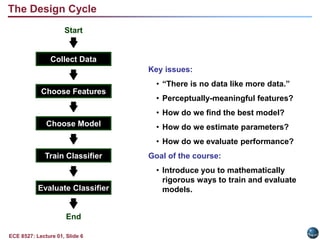
Train Classifier
Choose Model
Choose Features
Evaluate Classifier
End
Collect Data
Start
Key issues:
• “There is no data like more data.”
• Perceptually-meaningful features?
• How do we find the best model?
• How do we estimate parameters?
• How do we evaluate performance?
Goal of the course:
• Introduce you to mathematically
rigorous ways to train and evaluate
models.
The Design Cycle
ECE 8527: Lecture 01, Slide 7
• I got 100% accuracy on...
 Almost any algorithm works some of the time, but few real-world problems
have ever been completely solved.
 Training on the evaluation data is forbidden.
 Once you use evaluation data, you should discard it.
• My algorithm is better because...
 Statistical significance and experimental design play a big role in
determining the validity of a result.
 There is always some probability a random choice of an algorithm will
produce a better result.
• Hence, in this course, we will also learn how to evaluate algorithms.
Common Mistakes
ECE 8527: Lecture 01, Slide 8
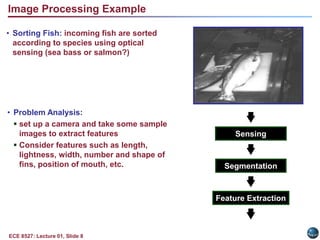
• Sorting Fish: incoming fish are sorted
according to species using optical
sensing (sea bass or salmon?)
Feature Extraction
Segmentation
Sensing
• Problem Analysis:
 set up a camera and take some sample
images to extract features
 Consider features such as length,
lightness, width, number and shape of
fins, position of mouth, etc.
Image Processing Example
ECE 8527: Lecture 01, Slide 9
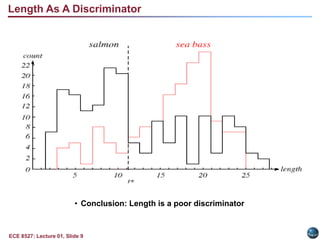
• Conclusion: Length is a poor discriminator
Length As A Discriminator
ECE 8527: Lecture 01, Slide 10
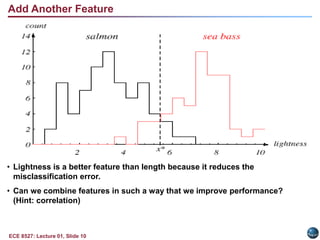
• Lightness is a better feature than length because it reduces the
misclassification error.
• Can we combine features in such a way that we improve performance?
(Hint: correlation)
Add Another Feature
ECE 8527: Lecture 01, Slide 11
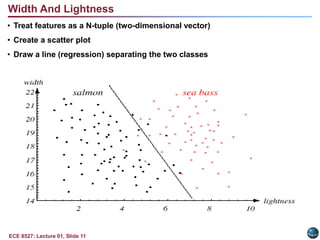
• Treat features as a N-tuple (two-dimensional vector)
• Create a scatter plot
• Draw a line (regression) separating the two classes
Width And Lightness
ECE 8527: Lecture 01, Slide 12
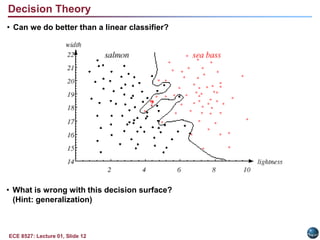
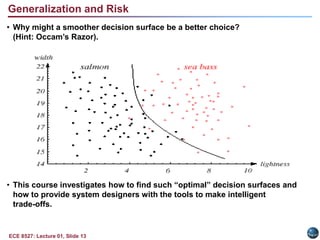
• Can we do better than a linear classifier?
• What is wrong with this decision surface?
(Hint: generalization)
Decision Theory
ECE 8527: Lecture 01, Slide 13
• Why might a smoother decision surface be a better choice?
(Hint: Occam’s Razor).
• This course investigates how to find such “optimal” decision surfaces and
how to provide system designers with the tools to make intelligent
trade-offs.
Generalization and Risk
ECE 8527: Lecture 01, Slide 14
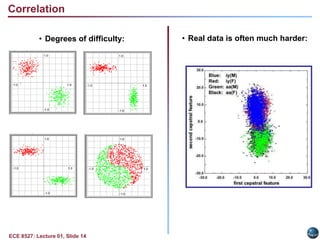
• Degrees of difficulty: • Real data is often much harder:
Correlation
ECE 8527: Lecture 01, Slide 15
….
• There are many excellent resources on
the Internet that demonstrate pattern
recognition concepts.
• There are many MATLAB toolboxes
that implement state of the art
algorithms.
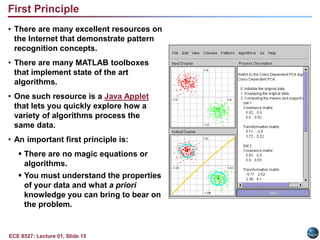
• One such resource is a Java Applet
that lets you quickly explore how a
variety of algorithms process the
same data.
• An important first principle is:
 There are no magic equations or
algorithms.
 You must understand the properties
of your data and what a priori
knowledge you can bring to bear on
the problem.
First Principle
ECE 8527: Lecture 01, Slide 16
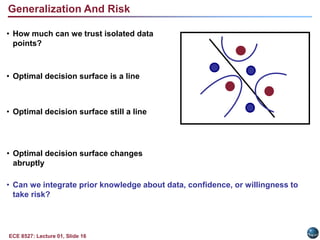
• How much can we trust isolated data
points?
• Optimal decision surface is a line
• Optimal decision surface changes
abruptly
• Optimal decision surface still a line
• Can we integrate prior knowledge about data, confidence, or willingness to
take risk?
Generalization And Risk
ECE 8527: Lecture 01, Slide 17
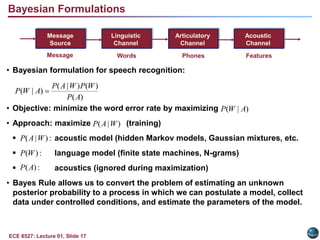
Bayesian Formulations
• Bayesian formulation for speech recognition:
• Objective: minimize the word error rate by maximizing
• Approach: maximize (training)
 acoustic model (hidden Markov models, Gaussian mixtures, etc.
 language model (finite state machines, N-grams)
 acoustics (ignored during maximization)
• Bayes Rule allows us to convert the problem of estimating an unknown
posterior probability to a process in which we can postulate a model, collect
data under controlled conditions, and estimate the parameters of the model.
)
(
)
(
)
|
(
)
|
(
A
P
W
P
W
A
P
A
W
P 
)
|
( A
W
P
)
|
( W
A
P
:
)
|
( W
A
P
:
)
(W
P
:
)
(A
P
Message
Source
Linguistic
Channel
Articulatory
Channel
Acoustic
Channel
Message Words Phones Features
ECE 8527: Lecture 01, Slide 18
Summary
• Pattern recognition vs. machine learning vs. machine understanding
• First principle of pattern recognition?
• We will focus more on decision theory and less on feature extraction.
• This course emphasizes statistical and data-driven methods for optimizing
system design and parameter values.
• Second most important principle?

Introduction to machine learning and pattern recognition

  • 1.
    ECE 8443 –Pattern Recognition ECE 8527 – Introduction to Machine Learning and Pattern Recognition • Objectives: Course Introduction Typical Applications • Resources: Syllabus Internet Books and Notes D.H.S: Chapter 1 Glossary LECTURE 01: COURSE OVERVIEW
  • 2.
    ECE 8527: Lecture01, Slide 1 • Pattern Recognition: “the act of taking raw data and taking an action based on the category of the pattern.” • Common Applications: speech recognition, fingerprint identification (biometrics), DNA sequence identification • Related Terminology:  Machine Learning: The ability of a machine to improve its performance based on previous results.  Machine Understanding: acting on the intentions of the user generating the data. • Related Fields: artificial intelligence, signal processing and discipline-specific research (e.g., target recognition, speech recognition, natural language processing). Terminology
  • 3.
    ECE 8527: Lecture01, Slide 2 • Which of these images are most scenic? • How can we develop a system to automatically determine scenic beauty? (Hint: feature combination) • Solutions to such problems require good feature extraction and good decision theory. Recognition or Understanding?
  • 4.
    ECE 8527: Lecture01, Slide 3 Feature Extraction
  • 5.
    ECE 8527: Lecture01, Slide 4 • Regions of overlap represent the classification error • Error rates can be computed with knowledge of the joint probability distributions (see OCW-MIT-6- 450Fall-2006). • Context is used to reduce overlap. • In real problems, features are confusable and represent actual variation in the data. • The traditional role of the signal processing engineer has been to develop better features (e.g., “invariants”). Features Are Confusable
  • 6.
    ECE 8527: Lecture01, Slide 5 Feature Extraction Post-Processing Classification Segmentation Sensing Input Decision Decomposition
  • 7.
    ECE 8527: Lecture01, Slide 6 Train Classifier Choose Model Choose Features Evaluate Classifier End Collect Data Start Key issues: • “There is no data like more data.” • Perceptually-meaningful features? • How do we find the best model? • How do we estimate parameters? • How do we evaluate performance? Goal of the course: • Introduce you to mathematically rigorous ways to train and evaluate models. The Design Cycle
  • 8.
    ECE 8527: Lecture01, Slide 7 • I got 100% accuracy on...  Almost any algorithm works some of the time, but few real-world problems have ever been completely solved.  Training on the evaluation data is forbidden.  Once you use evaluation data, you should discard it. • My algorithm is better because...  Statistical significance and experimental design play a big role in determining the validity of a result.  There is always some probability a random choice of an algorithm will produce a better result. • Hence, in this course, we will also learn how to evaluate algorithms. Common Mistakes
  • 9.
    ECE 8527: Lecture01, Slide 8 • Sorting Fish: incoming fish are sorted according to species using optical sensing (sea bass or salmon?) Feature Extraction Segmentation Sensing • Problem Analysis:  set up a camera and take some sample images to extract features  Consider features such as length, lightness, width, number and shape of fins, position of mouth, etc. Image Processing Example
  • 10.
    ECE 8527: Lecture01, Slide 9 • Conclusion: Length is a poor discriminator Length As A Discriminator
  • 11.
    ECE 8527: Lecture01, Slide 10 • Lightness is a better feature than length because it reduces the misclassification error. • Can we combine features in such a way that we improve performance? (Hint: correlation) Add Another Feature
  • 12.
    ECE 8527: Lecture01, Slide 11 • Treat features as a N-tuple (two-dimensional vector) • Create a scatter plot • Draw a line (regression) separating the two classes Width And Lightness
  • 13.
    ECE 8527: Lecture01, Slide 12 • Can we do better than a linear classifier? • What is wrong with this decision surface? (Hint: generalization) Decision Theory
  • 14.
    ECE 8527: Lecture01, Slide 13 • Why might a smoother decision surface be a better choice? (Hint: Occam’s Razor). • This course investigates how to find such “optimal” decision surfaces and how to provide system designers with the tools to make intelligent trade-offs. Generalization and Risk
  • 15.
    ECE 8527: Lecture01, Slide 14 • Degrees of difficulty: • Real data is often much harder: Correlation
  • 16.
    ECE 8527: Lecture01, Slide 15 …. • There are many excellent resources on the Internet that demonstrate pattern recognition concepts. • There are many MATLAB toolboxes that implement state of the art algorithms. • One such resource is a Java Applet that lets you quickly explore how a variety of algorithms process the same data. • An important first principle is:  There are no magic equations or algorithms.  You must understand the properties of your data and what a priori knowledge you can bring to bear on the problem. First Principle
  • 17.
    ECE 8527: Lecture01, Slide 16 • How much can we trust isolated data points? • Optimal decision surface is a line • Optimal decision surface changes abruptly • Optimal decision surface still a line • Can we integrate prior knowledge about data, confidence, or willingness to take risk? Generalization And Risk
  • 18.
    ECE 8527: Lecture01, Slide 17 Bayesian Formulations • Bayesian formulation for speech recognition: • Objective: minimize the word error rate by maximizing • Approach: maximize (training)  acoustic model (hidden Markov models, Gaussian mixtures, etc.  language model (finite state machines, N-grams)  acoustics (ignored during maximization) • Bayes Rule allows us to convert the problem of estimating an unknown posterior probability to a process in which we can postulate a model, collect data under controlled conditions, and estimate the parameters of the model. ) ( ) ( ) | ( ) | ( A P W P W A P A W P  ) | ( A W P ) | ( W A P : ) | ( W A P : ) (W P : ) (A P Message Source Linguistic Channel Articulatory Channel Acoustic Channel Message Words Phones Features
  • 19.
    ECE 8527: Lecture01, Slide 18 Summary • Pattern recognition vs. machine learning vs. machine understanding • First principle of pattern recognition? • We will focus more on decision theory and less on feature extraction. • This course emphasizes statistical and data-driven methods for optimizing system design and parameter values. • Second most important principle?