CIS 419/519
Introduction to
Machine Learning
Instructor: Eric Eaton
www.seas.upenn.edu/~cis519
These slides were assembled by Eric Eaton, with grateful acknowledgement of the many others who made
their course materials freely available online. Feel free to reuse or adapt these slides for your own academic
purposes, provided that you include proper attribution. Please send comments and corrections to Eric.
1
Robot Image Credit: Viktoriya Sukhanova © 123RF.com
What is Machine Learning?
“Learning is any process by which a system
improves performance from experience.”
- Herbert Simon
Definition by Tom Mitchell (1998):
Machine Learning is the study of algorithms
that • improve their performance P
• at some task T
• with experience E.
A well-defined learning task is given by <P, T,
E>. 3
Traditional Programming
Data
ProgramOutput Computer
Machine Learning
Data
Output
Computer
Program
Slide credit: Pedro Domingos
4
When Do We Use Machine Learning?
ML is used when:
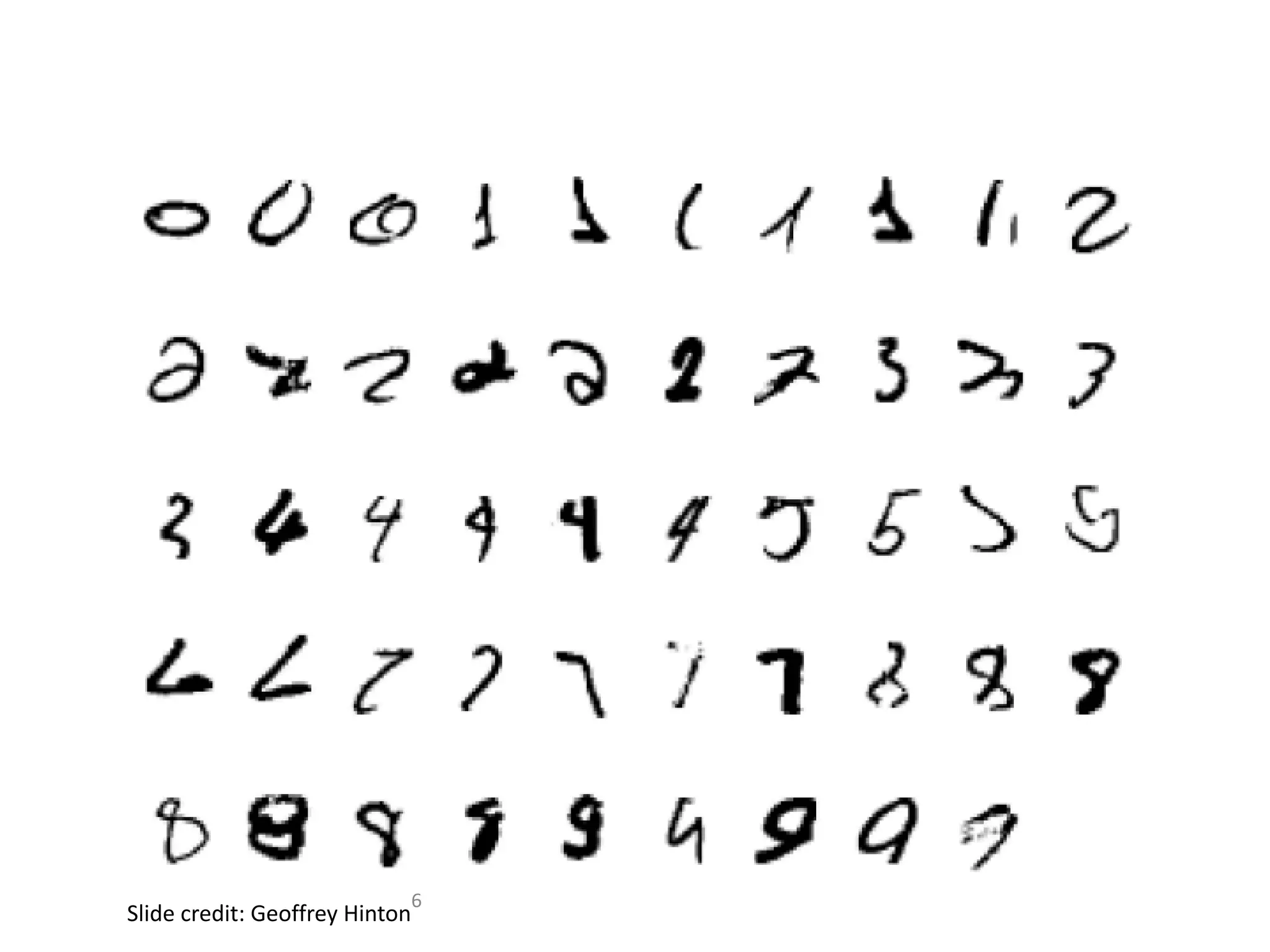
• Human expertise does not exist (navigating on Mars) •
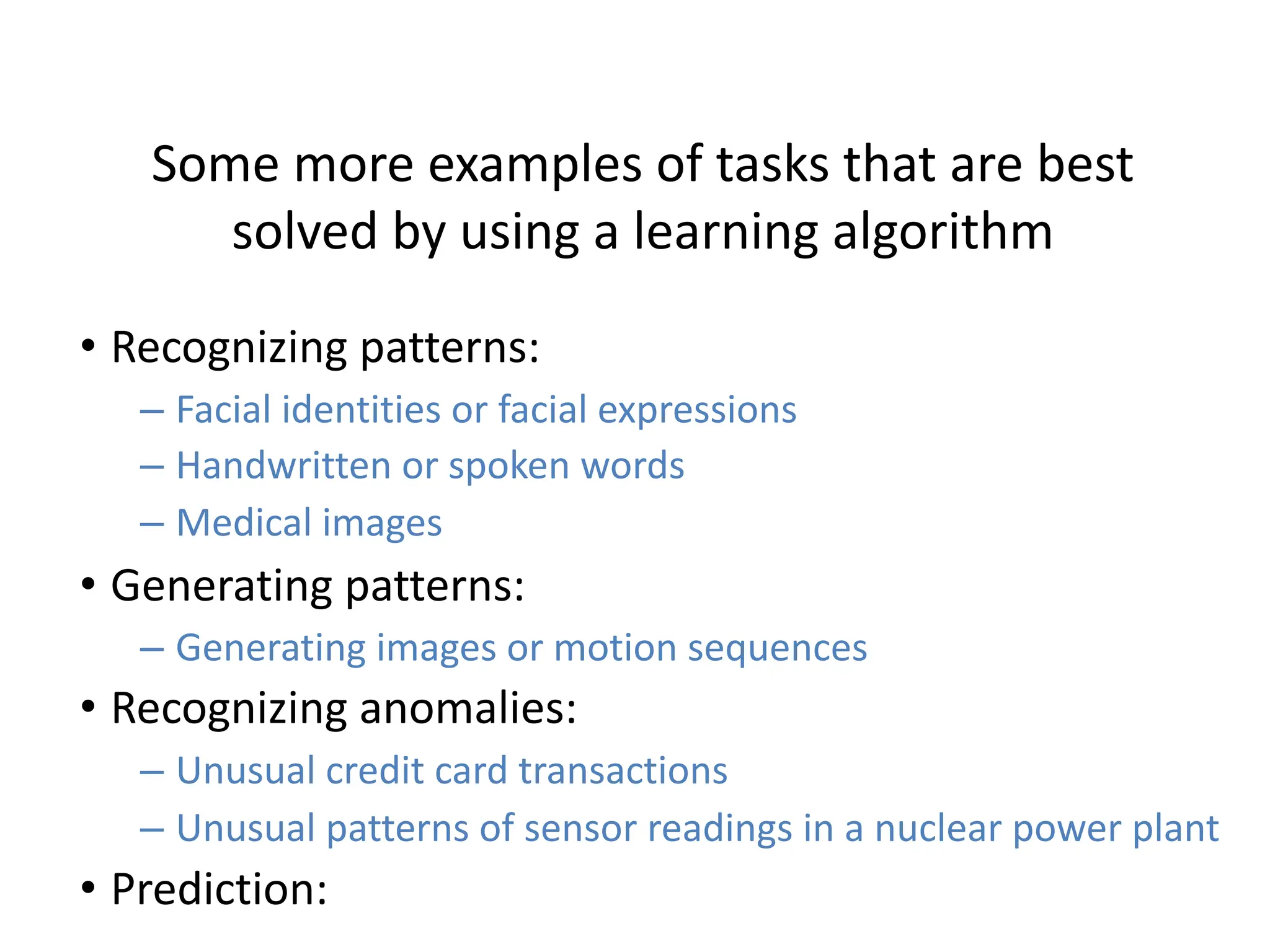
Humans can’t explain their expertise (speech recognition) •
Models must be customized (personalized medicine)
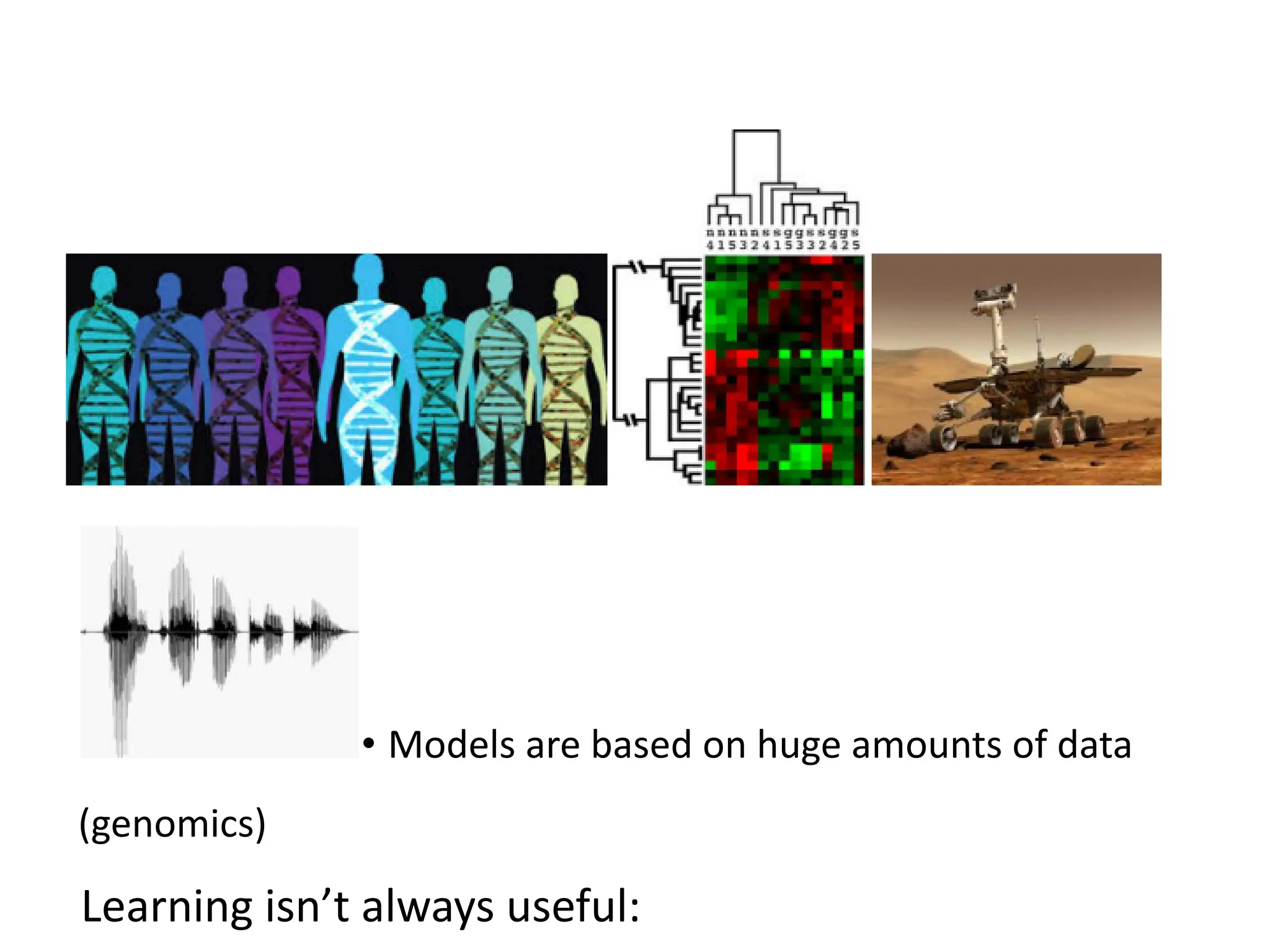
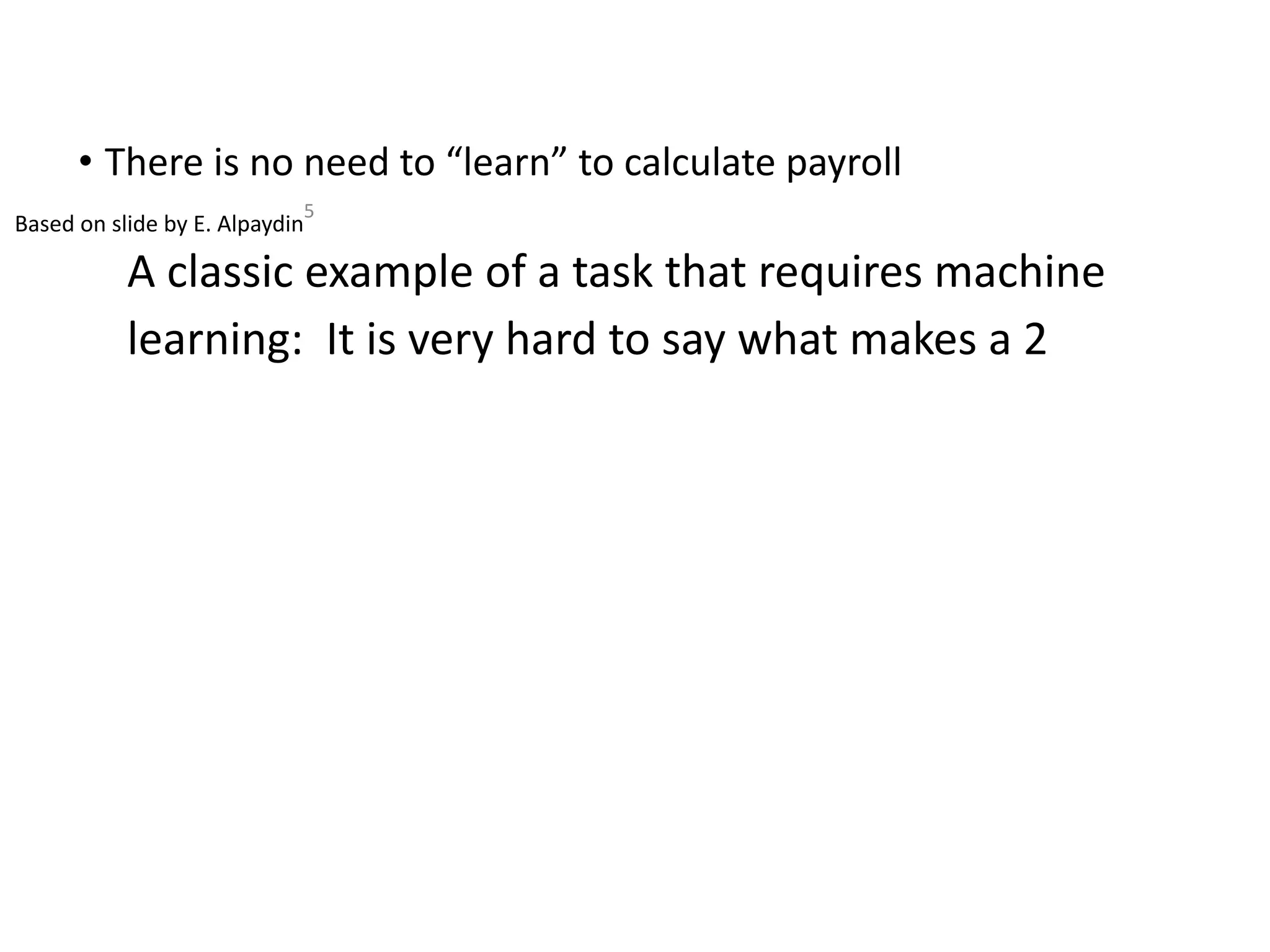
• Models are based on huge amounts of data
(genomics)
Learning isn’t always useful:
• There is no need to “learn” to calculate payroll
Based on slide by E. Alpaydin
5
A classic example of a task that requires machine
learning: It is very hard to say what makes a 2
Slide credit: Geoffrey Hinton
6
Some more examples of tasks that are best
solved by using a learning algorithm
• Recognizing patterns:
– Facial identities or facial expressions
– Handwritten or spoken words
– Medical images
• Generating patterns:
– Generating images or motion sequences
• Recognizing anomalies:
– Unusual credit card transactions
– Unusual patterns of sensor readings in a nuclear power plant
• Prediction:
– Future stock prices or currency exchange rates
Slide credit: Geoffrey Hinton
7
Sample Applications
• Web search
• Computational biology
• Finance
• E-commerce
• Space exploration
• Robotics
• Information extraction
• Social networks
• Debugging software
• [Your favorite area]
Slide credit: Pedro Domingos
8
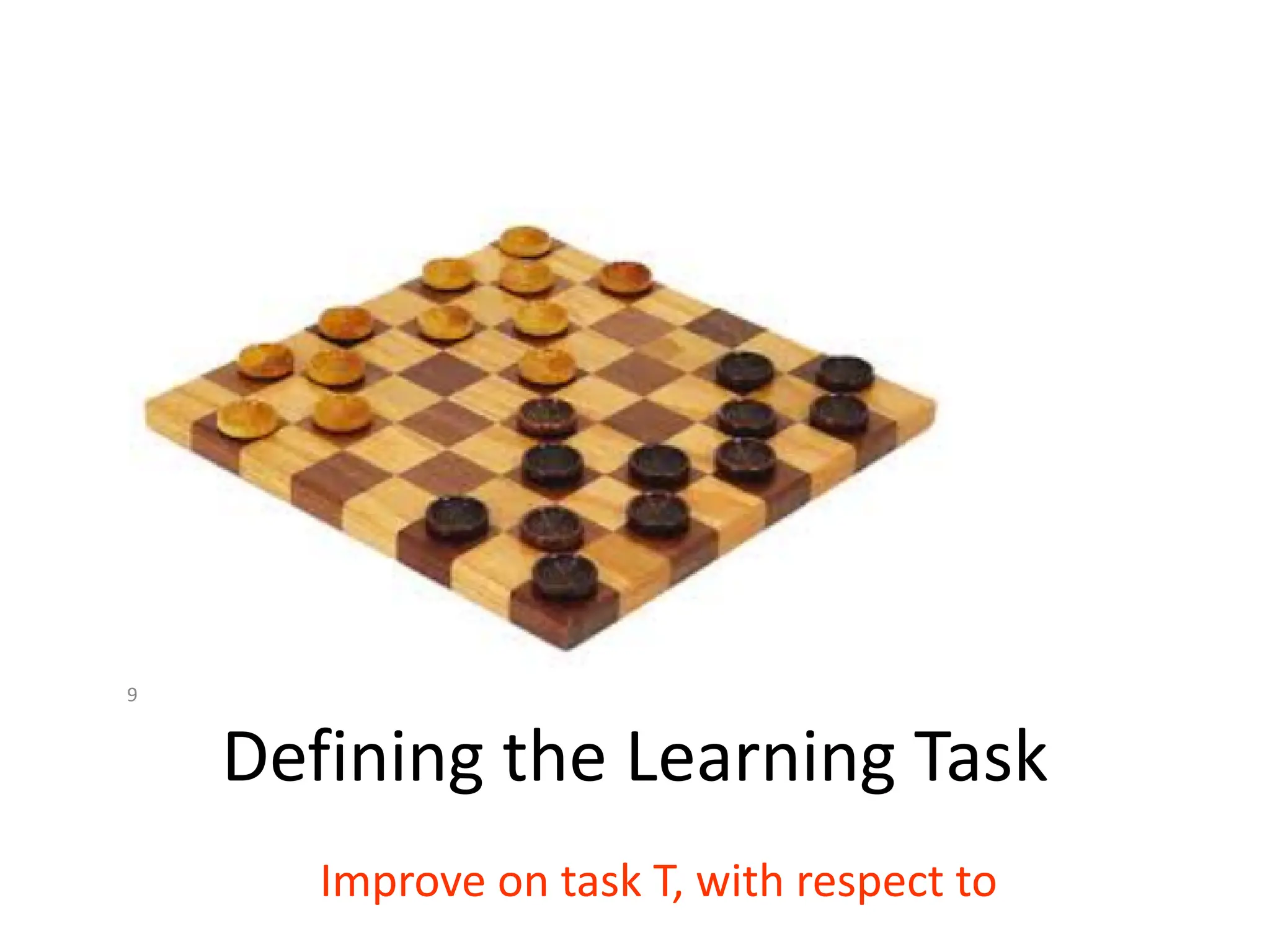
Samuel’s Checkers-Player
“Machine Learning: Field of study that gives
computers the ability to learn without being
explicitly programmed.” -Arthur Samuel
(1959)
9
Defining the Learning Task
Improve on task T, with respect to
performance metric P, based on experience E
T: Playing checkers
P: Percentage of games won against an arbitrary opponent
E: Playing practice games against itself
T: Recognizing hand-written words
P: Percentage of words correctly classified
E: Database of human-labeled images of handwritten words
T: Driving on four-lane highways using vision sensors
P: Average distance traveled before a human-judged error
E: A sequence of images and steering commands recorded while
observing a human driver.
T: Categorize email messages as spam or legitimate.
P: Percentage of email messages correctly classified.
E: Database of emails, some with human-given labels
Slide credit: Ray Mooney
10
State of the Art Applications of
Machine Learning
11
Autonomous Cars
• Nevada made it legal for
autonomous cars to drive on
roads in June 2011
• As of 2013, four states (Nevada,
Florida, California, and
Michigan) have legalized
autonomous cars
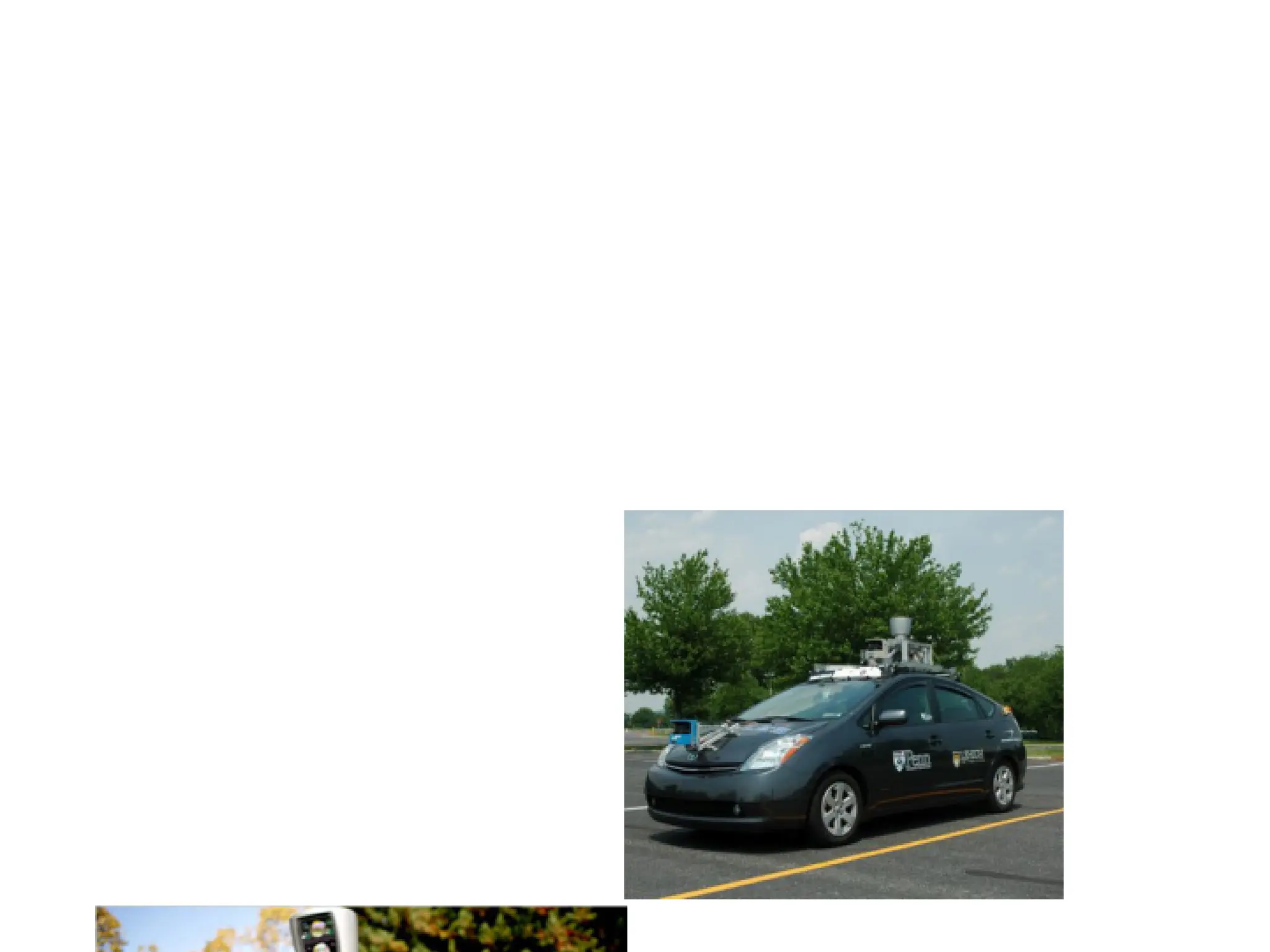
Penn’s Autonomous Car 🡪
12
(Ben Franklin Racing Team)
Autonomous Car Sensors 13
Technology
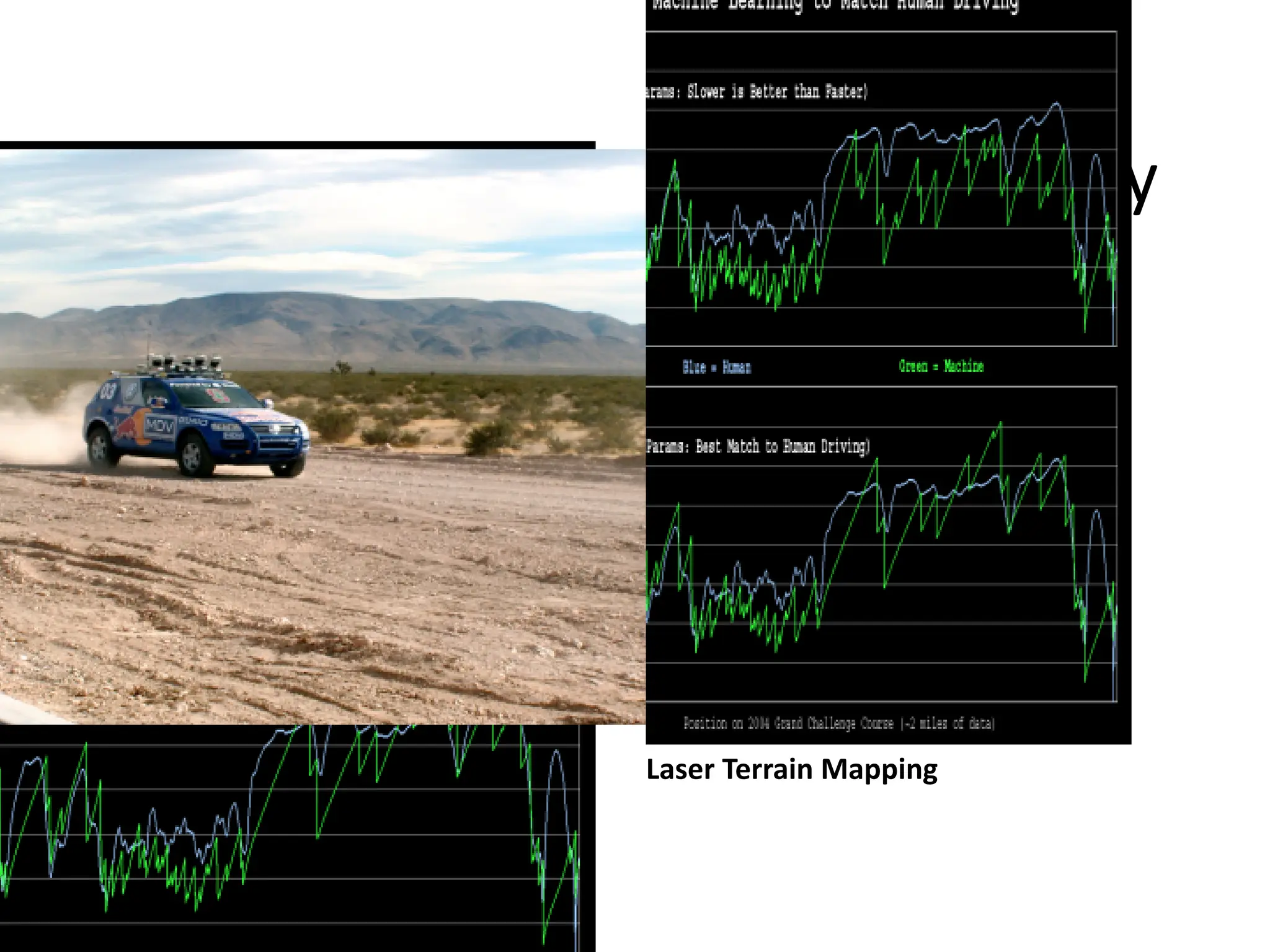
Laser Terrain Mapping
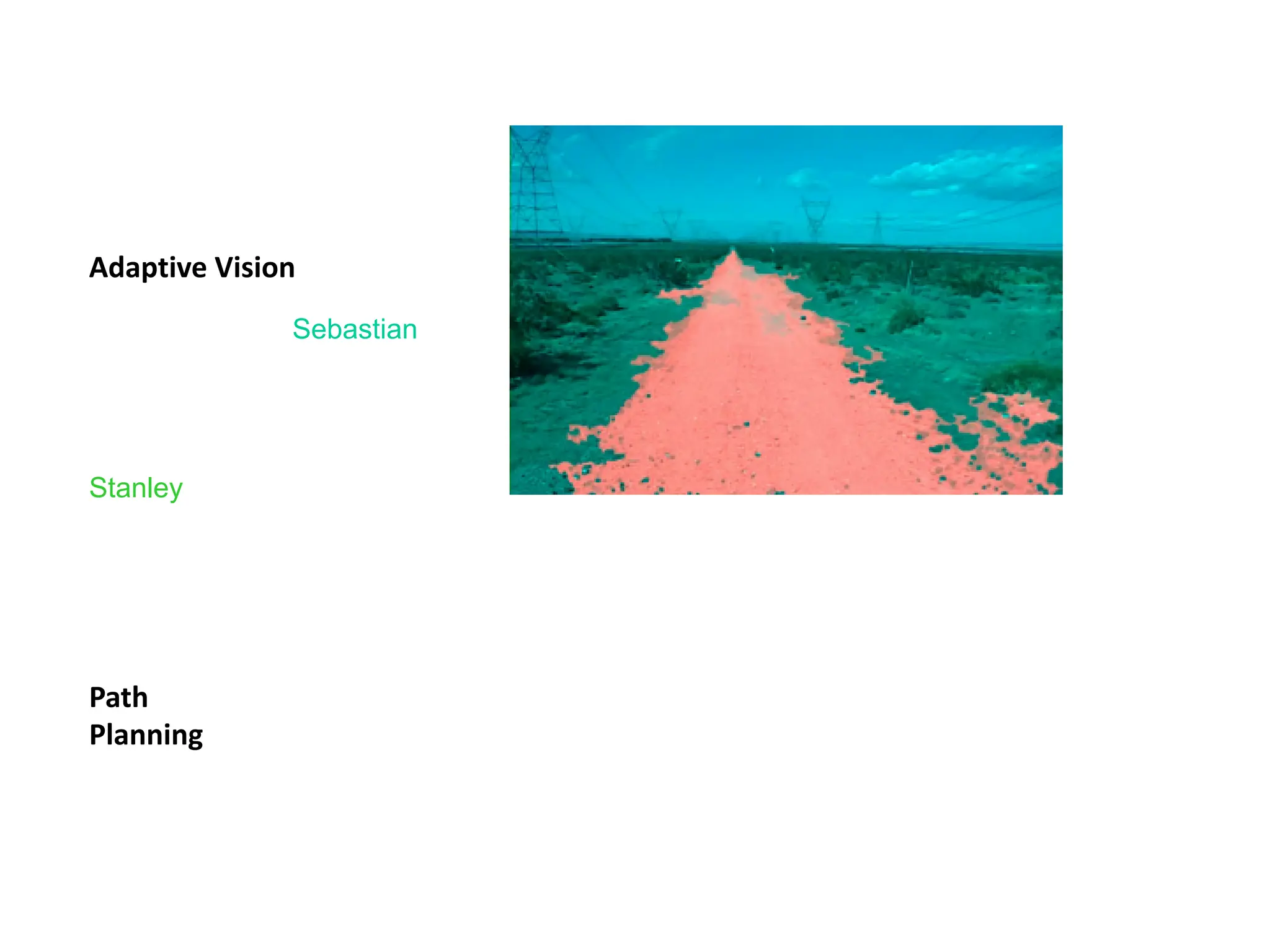
Adaptive Vision Learning from
Human Drivers Sebastian
Stanley
Path
Planning
Images and movies taken from Sebastian Thrun’s multimedia website. 14
Deep Learning in the Headlines
15
Deep Belief Net on Face
Images
object models
object parts
(combination
of edges)
edges
pixels
Based on materials
16
by Andrew Ng
Learning of Object Parts
Examples of learned object parts from object categories
Faces Cars Elephants Chairs
Slide credit: Andrew Ng
17
Training on Multiple Objects
Trained on 4 classes (cars, faces,
motorbikes, airplanes).
Second layer: Shared-features
and object-specific features.
Third layer: More specific
features.
Slide credit: Andrew Ng
18
Scene Labeling via Deep
Learning
[Farabet et al. ICML 2012, PAMI 2013] 19
Inference from Deep Learned Models
Generating posterior samples from faces by “filling in” experiments (cf. Lee
and Mumford, 2003). Combine bottom-up and top-down inference.
Input images
Samples from
feedforward
Inference
(control)
Samples from
Full posterior
inference
Slide credit: Andrew Ng
20
Machine Learning in
Automatic Speech Recognition A
Typical Speech Recognition System
ML used to predict of phone states from the sound
spectrogram
Deep learning has state-of-the-art results
# Hidden Layers 1 2 4 8 10 12
Word Error Rate % 16.0 12.8 11.4 10.9 11.0 11.1
Baseline GMM performance = 15.4%
[Zeiler et al. “On rectified linear units for speech
recognition” ICASSP 2013]
21
Impact of Deep Learning in Speech
Technology
Slide credit: Li Deng, MS Research
22
Types of Learning
23
Types of Learning
• Supervised (inductive) learning
– Given: training data + desired outputs
(labels) • Unsupervised learning
– Given: training data (without desired
outputs) • Semi-supervised learning
– Given: training data + a few desired
outputs • Reinforcement learning
– Rewards from sequence of actions
Based on slide by Pedro Domingos
24
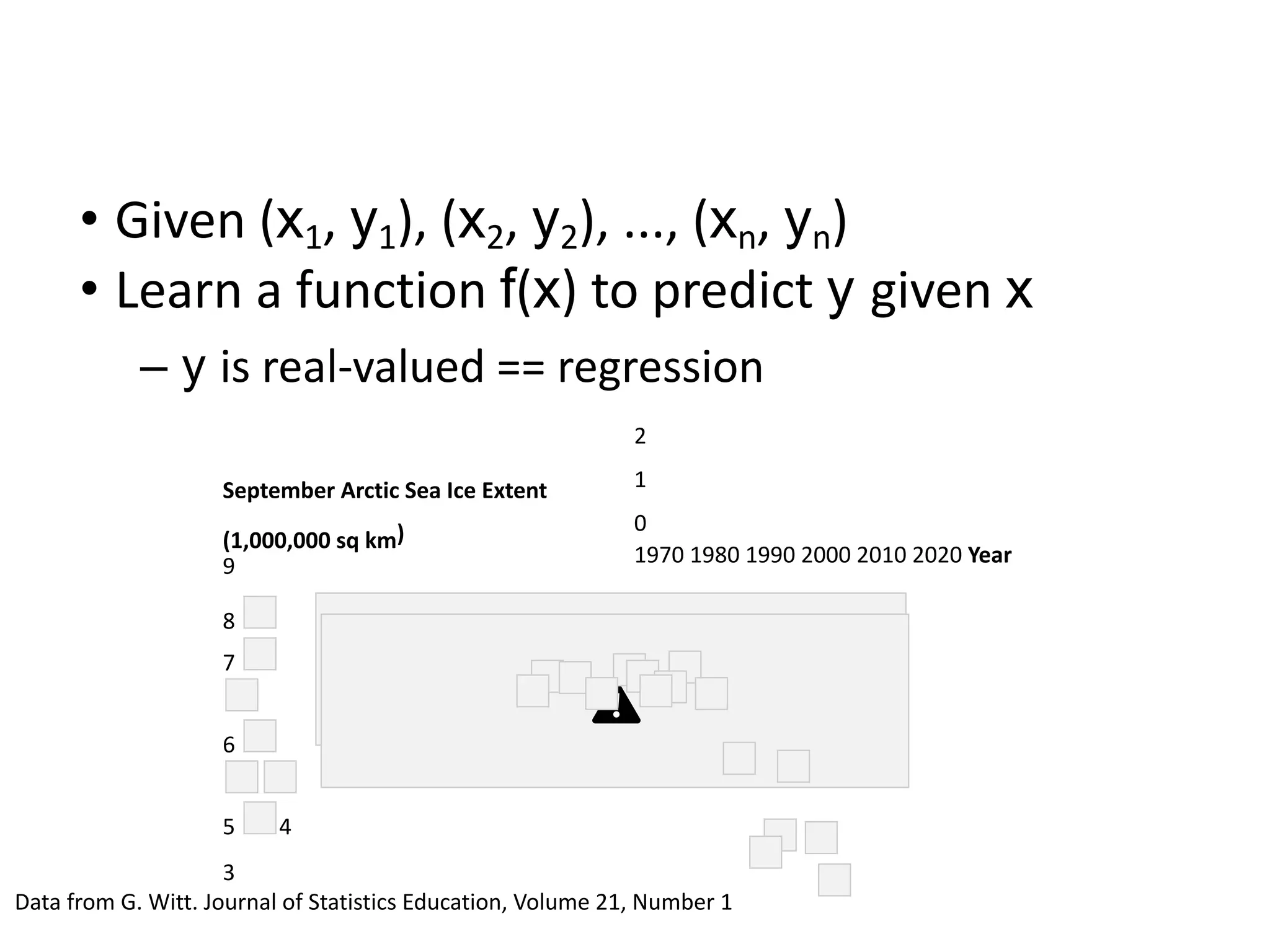
Supervised Learning: Regression
• Given (x1, y1), (x2, y2), ..., (xn, yn)
• Learn a function f(x) to predict y given x
– y is real-valued == regression
September Arctic Sea Ice Extent
(1,000,000 sq km)
9
8
7
6
5 4
3
2
1
0
1970 1980 1990 2000 2010 2020 Year
Data from G. Witt. Journal of Statistics Education, Volume 21, Number 1
(2013)
26
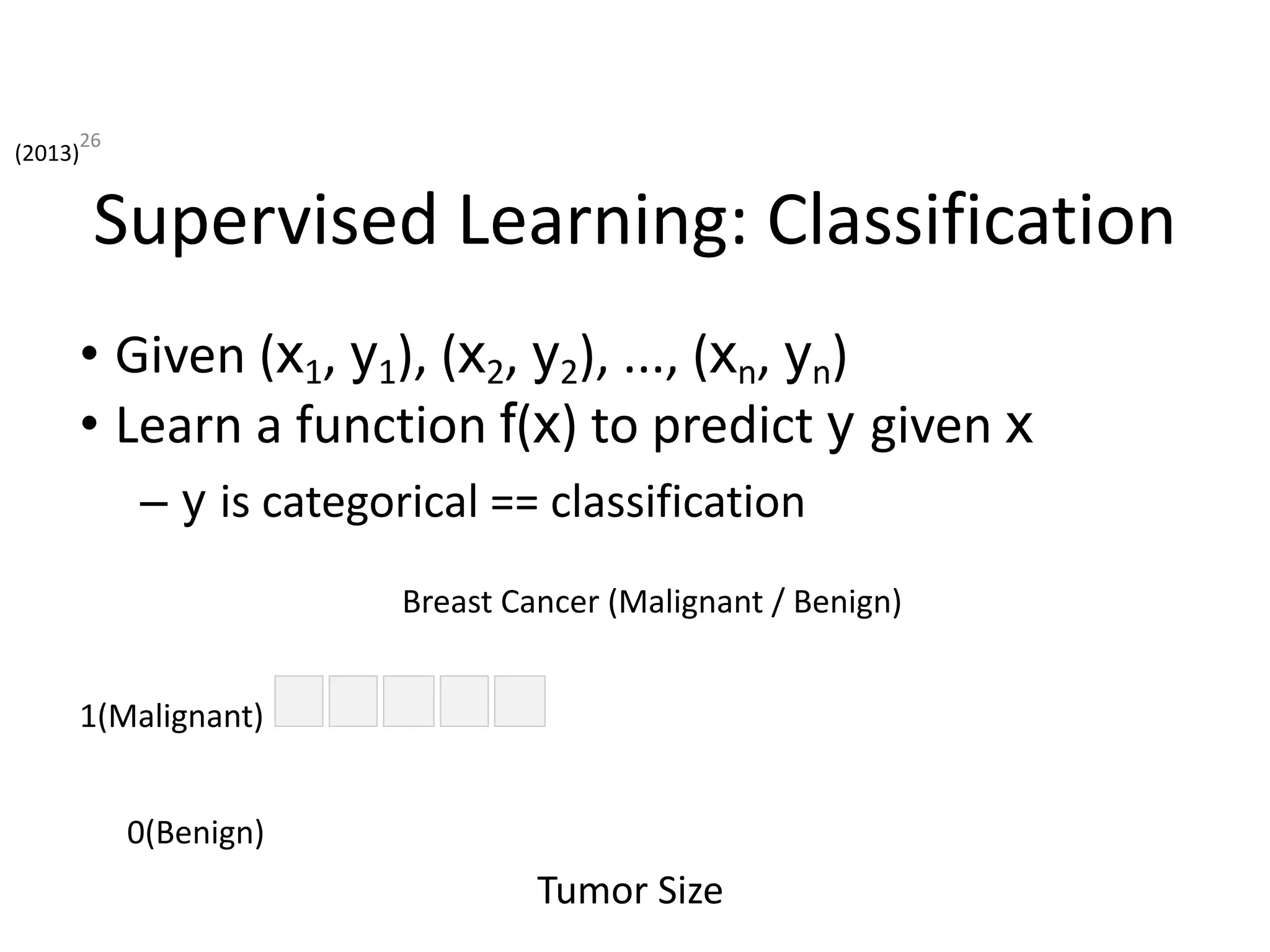
Supervised Learning: Classification
• Given (x1, y1), (x2, y2), ..., (xn, yn)
• Learn a function f(x) to predict y given x
– y is categorical == classification
Breast Cancer (Malignant / Benign)
1(Malignant)
0(Benign)
Tumor Size
Based on example by Andrew Ng
27
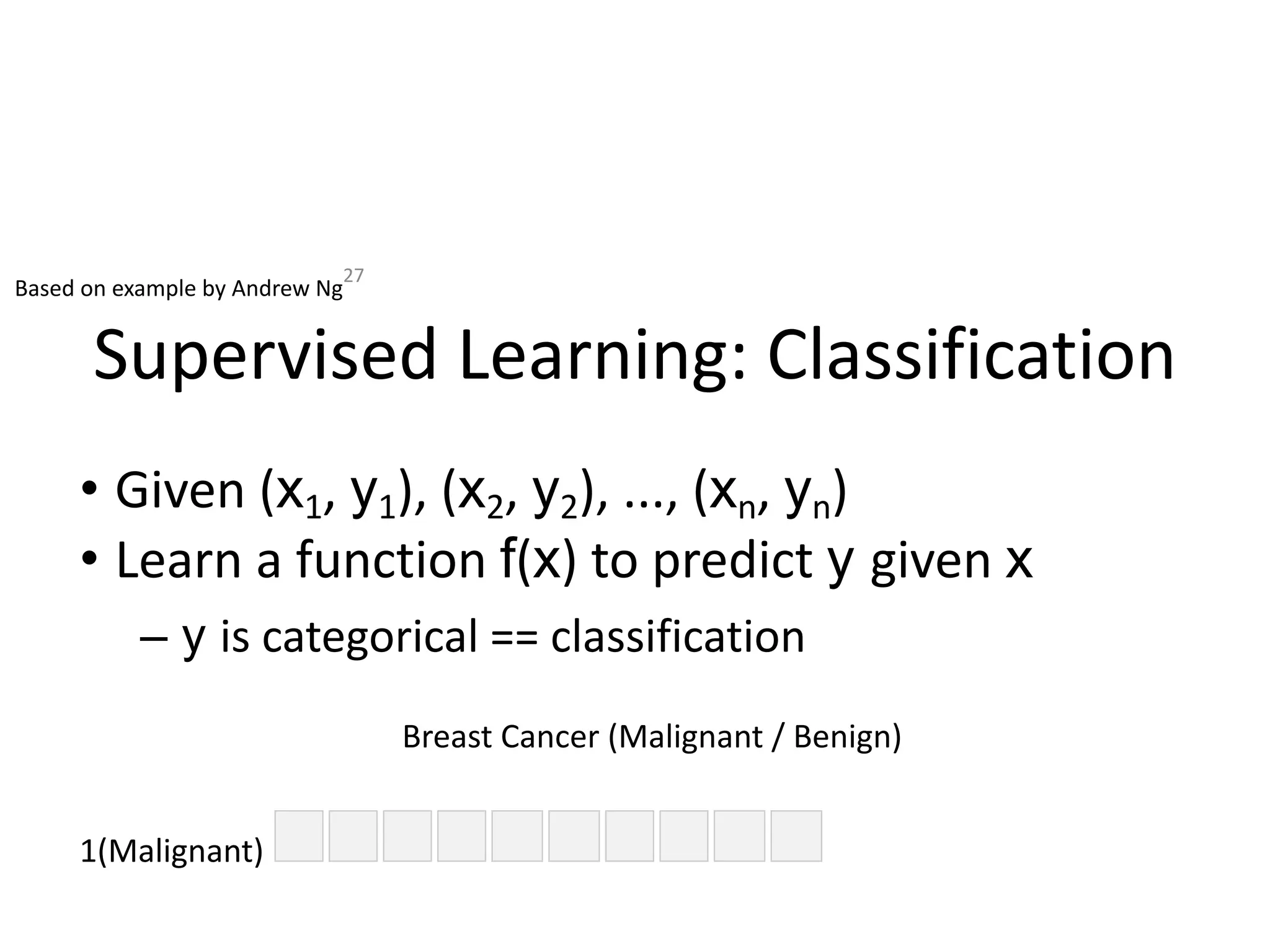
Supervised Learning: Classification
• Given (x1, y1), (x2, y2), ..., (xn, yn)
• Learn a function f(x) to predict y given x
– y is categorical == classification
Breast Cancer (Malignant / Benign)
1(Malignant)
0(Benign)
Tumor Size
Tumor Size Based on example by Andrew Ng28
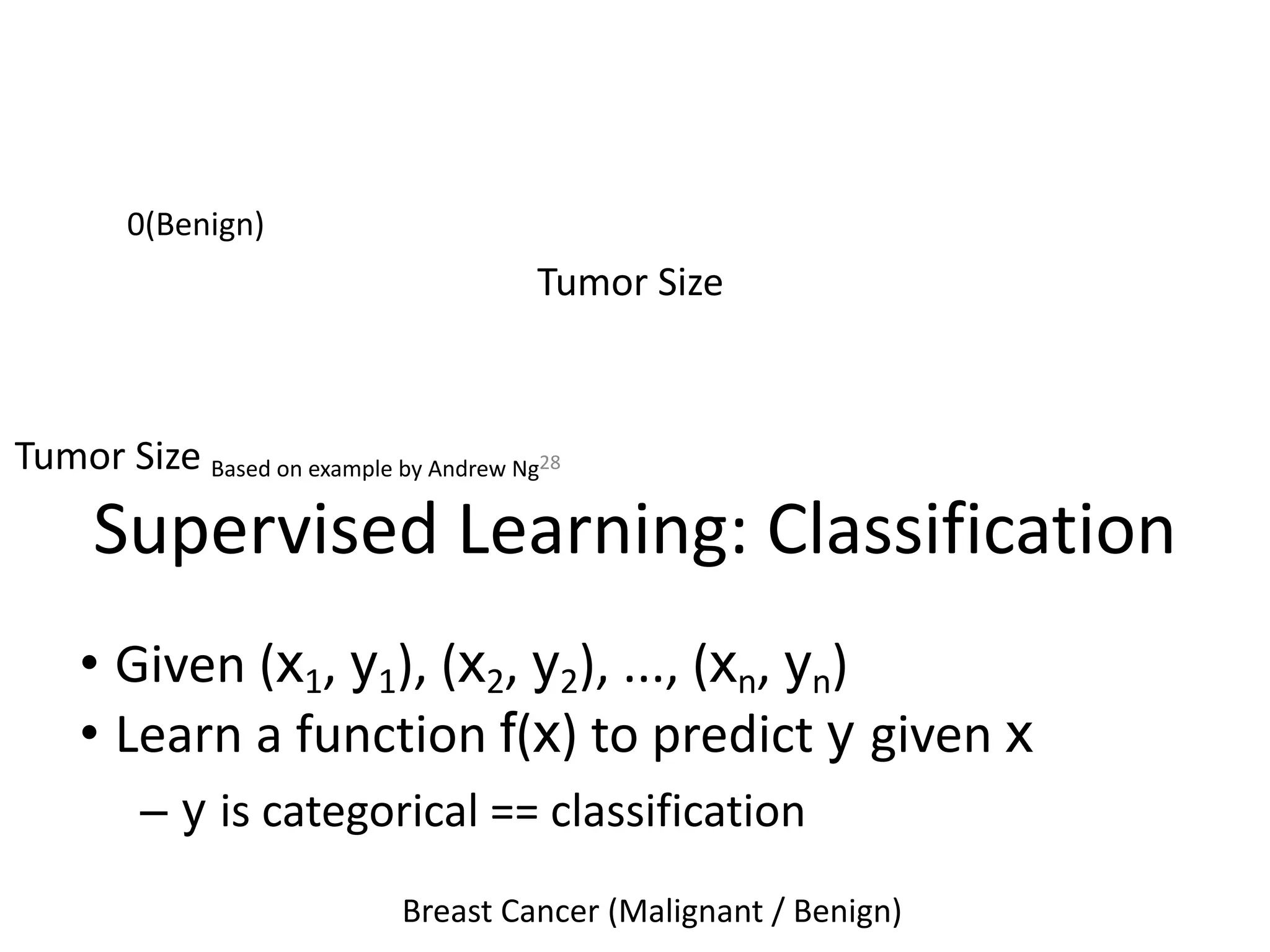
Supervised Learning: Classification
• Given (x1, y1), (x2, y2), ..., (xn, yn)
• Learn a function f(x) to predict y given x
– y is categorical == classification
Breast Cancer (Malignant / Benign)
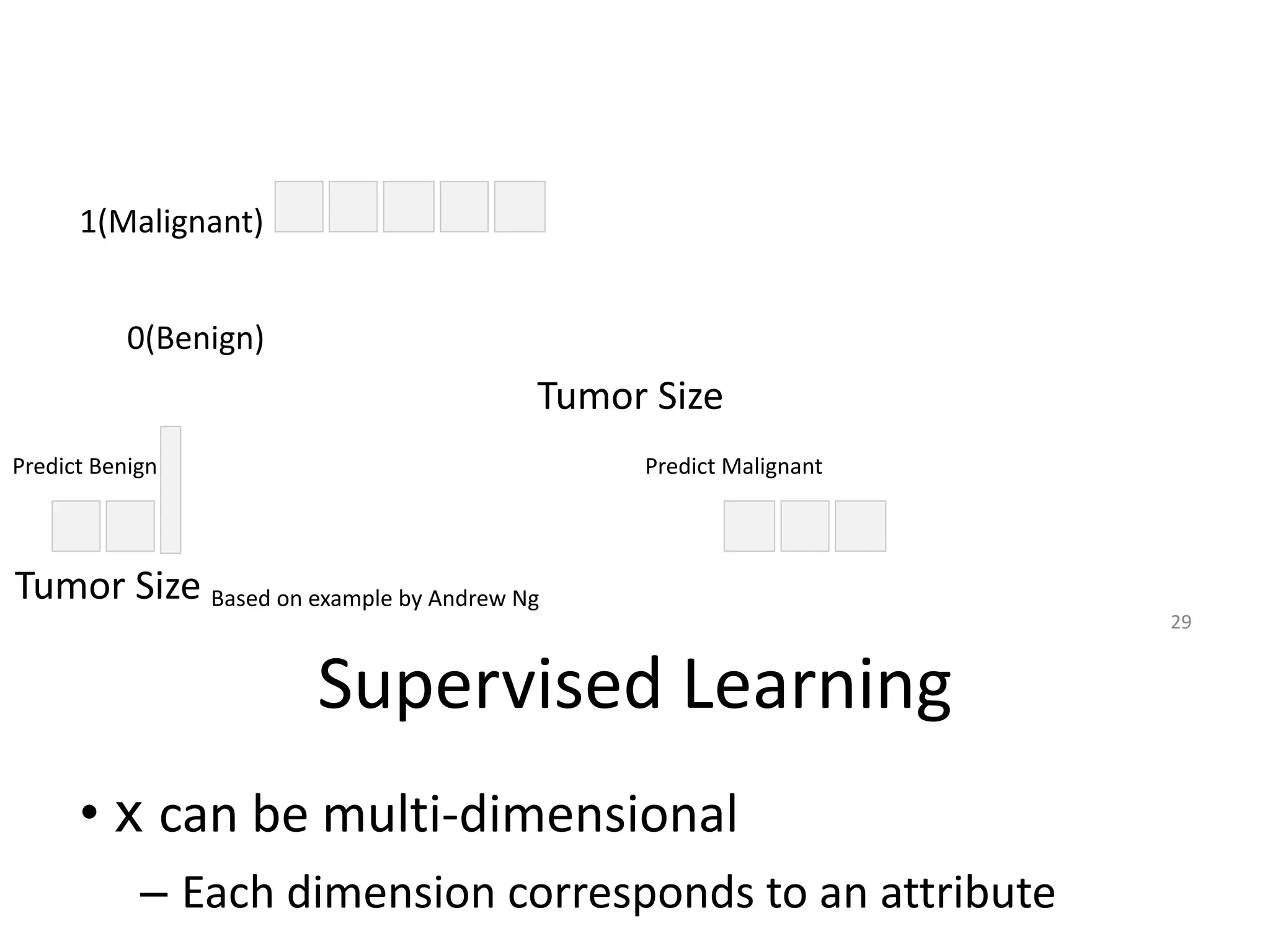
1(Malignant)
0(Benign)
Tumor Size
Predict Benign Predict Malignant
Tumor Size Based on example by Andrew Ng
29
Supervised Learning
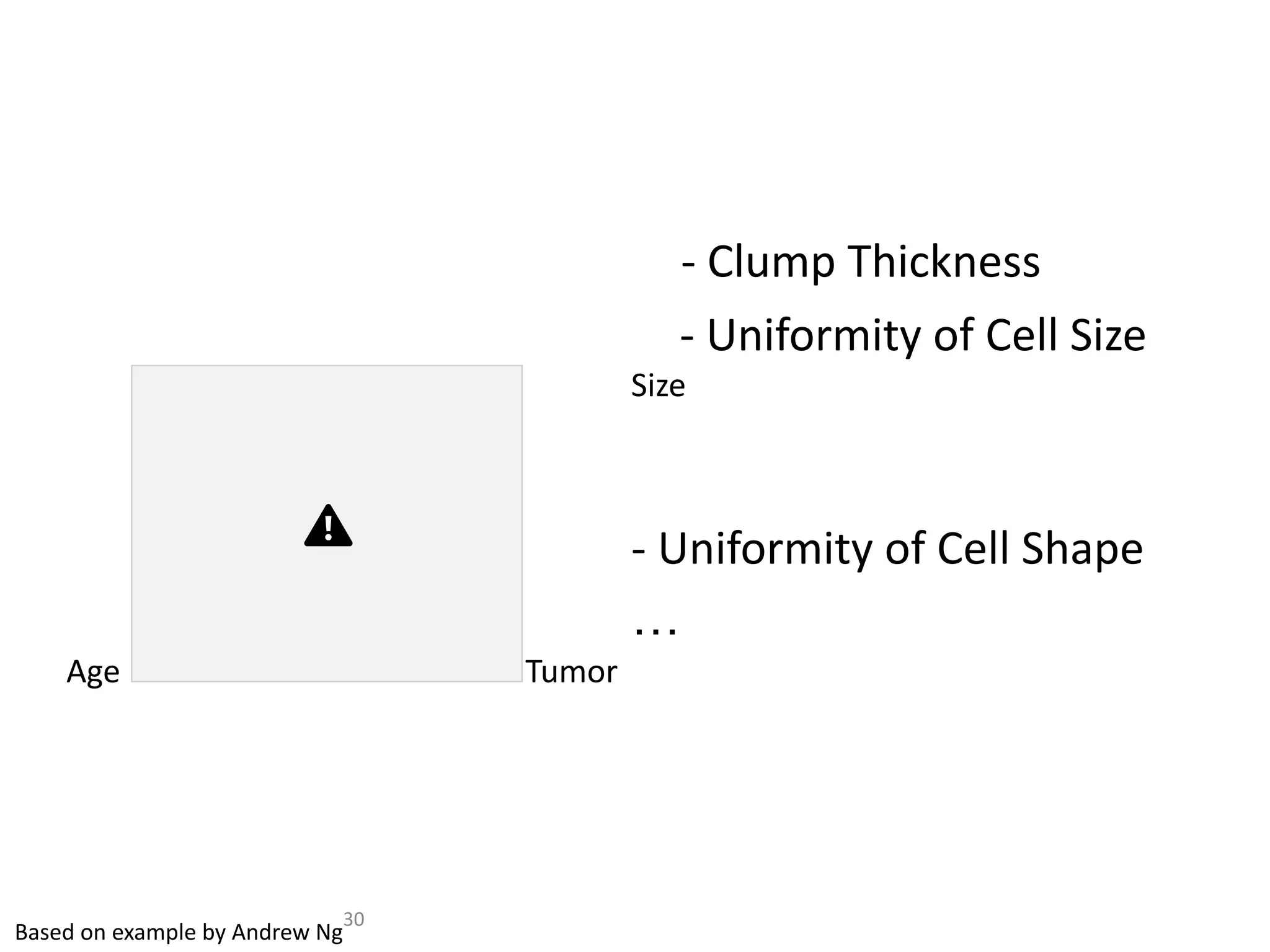
• x can be multi-dimensional
– Each dimension corresponds to an attribute
- Clump Thickness
- Uniformity of Cell Size
Age Tumor
Size
- Uniformity of Cell Shape
…
Based on example by Andrew Ng
30
Unsupervised Learning
• Given x1, x2, ..., xn (without labels) •
Output hidden structure behind the x’s –
E.g., clustering
31
Unsupervised Learning
Genomics application: group individuals by genetic similarity
Genes
[Source: Daphne Koller]
Individuals 32
Unsupervised Learning
Organize computing clusters Social network
analysis
Image credit: NASA/JPL-Caltech/E. Churchwell (Univ. of Wisconsin, Madison)
Market segmentation
Astronomical data analysis
33
Slide credit: Andrew Ng
Unsupervised Learning
• Independent component analysis – separate a
combined signal into its original sources
Image credit: statsoft.com Audio from http://www.ism.ac.jp/~shiro/research/blindsep.html
34
Unsupervised Learning
• Independent component analysis – separate a
combined signal into its original sources
Image credit: statsoft.com Audio from http://www.ism.ac.jp/~shiro/research/blindsep.html
35
Reinforcement Learning
• Given a sequence of states and actions with
(delayed) rewards, output a policy
– Policy is a mapping from states 🡪 actions that
tells you what to do in a given state
• Examples:
– Credit assignment problem
– Game playing
– Robot in a maze
– Balance a pole on your hand
36
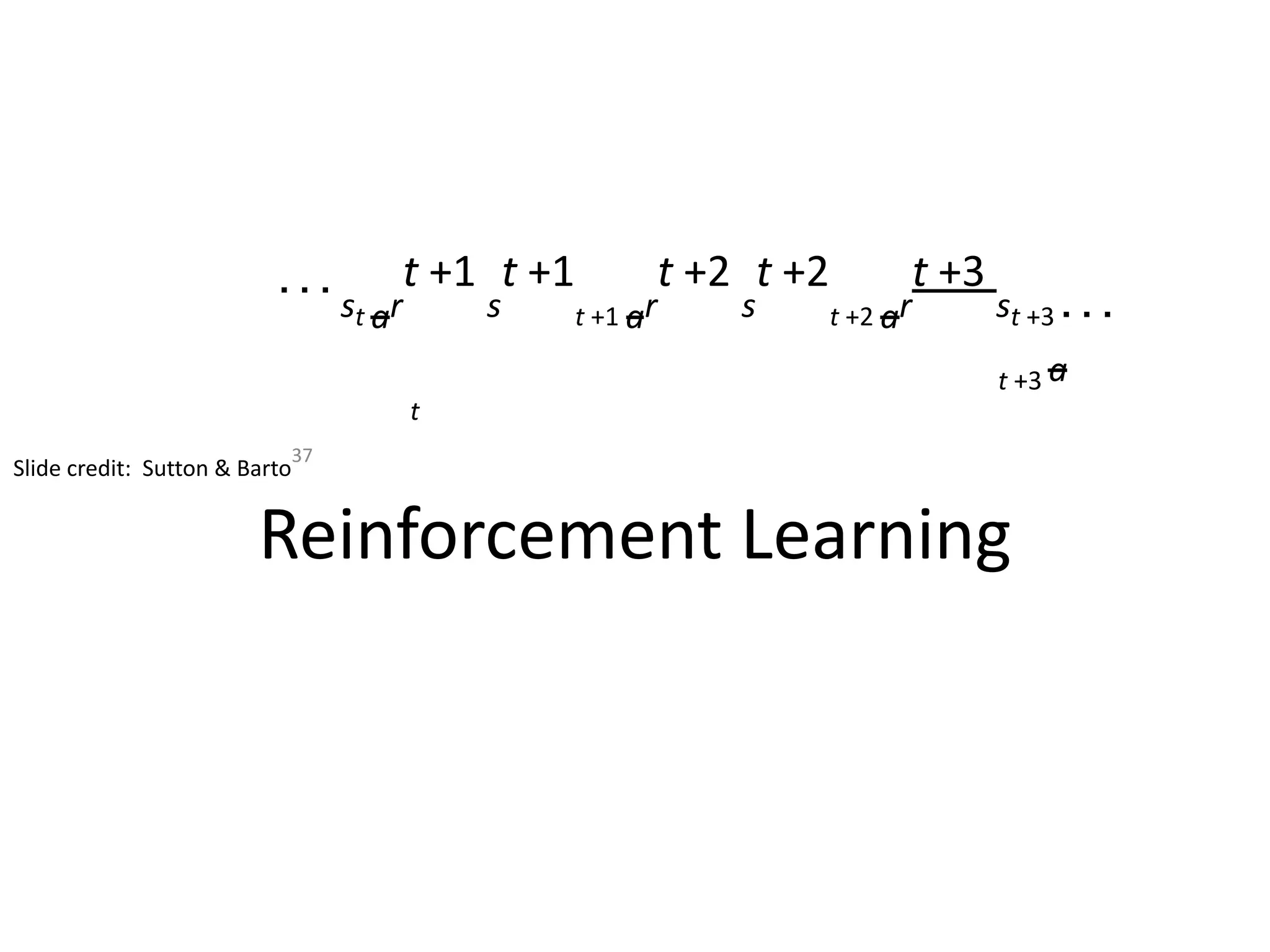
The Agent-Environment
Interface
Agent and environment interact at discrete time steps : t = 0, 1, 2,
K Agent observes state at step t: st ∈S
produces action at step t : at ∈ A(st )
gets resulting reward : rt +1 ∈ℜ
and resulting next state : st +1
. . .
st ar
t +1
s
t +1
t +1 ar
t +2
s
t +2
t +2 ar
t +3
st +3 . . .
t +3 a
t
Slide credit: Sutton & Barto
37
Reinforcement Learning
https://www.youtube.com/watch?v=4cgWya-wjgY 38
Inverse Reinforcement Learning
• Learn policy from user demonstrations
Stanford Autonomous Helicopter
http://heli.stanford.edu/
https://www.youtube.com/watch?v=VCdxqn0fcnE 39
Framing a Learning Problem 40
Designing a Learning System
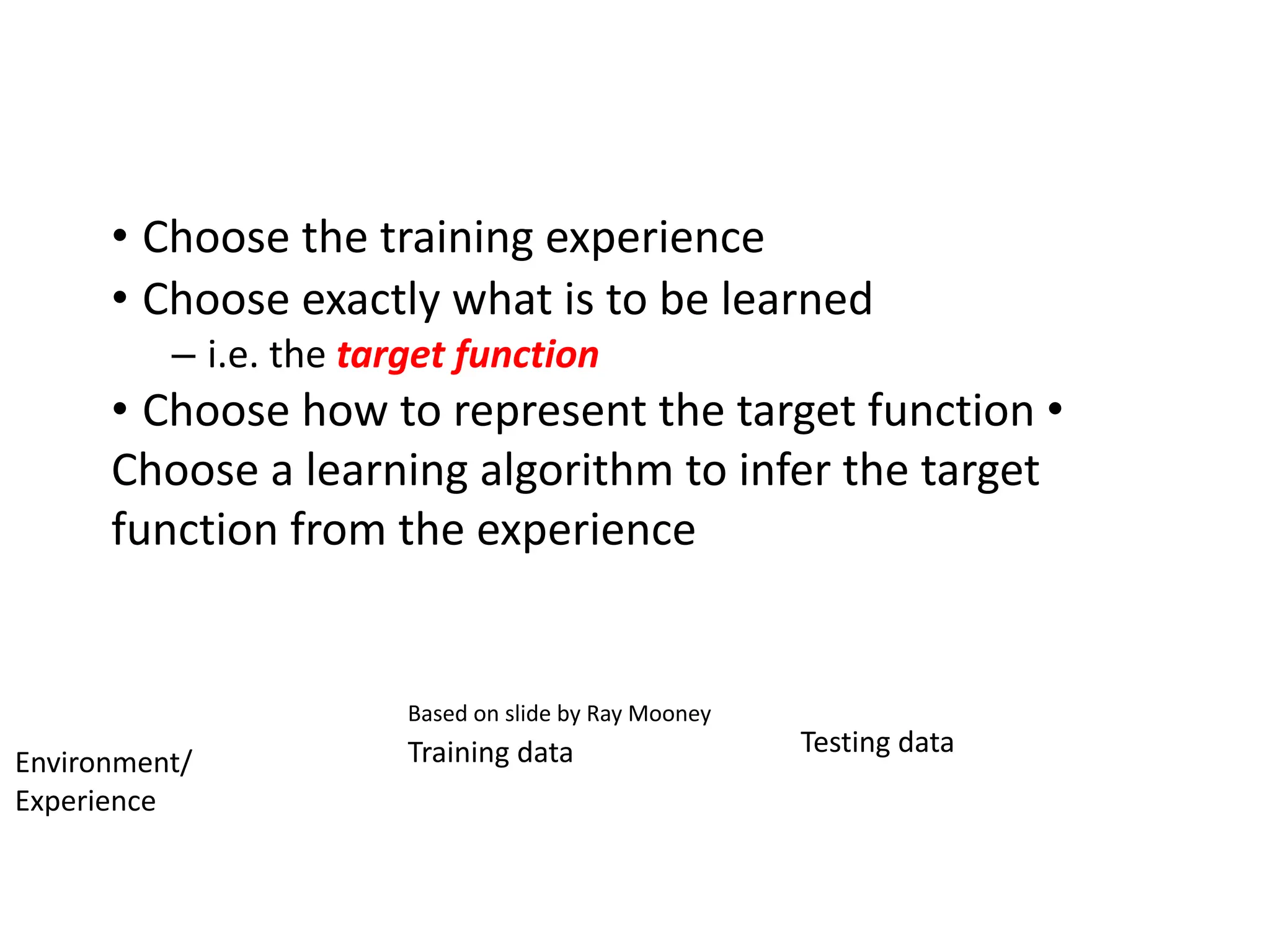
• Choose the training experience
• Choose exactly what is to be learned
– i.e. the target function
• Choose how to represent the target function •
Choose a learning algorithm to infer the target
function from the experience
Environment/
Experience
Based on slide by Ray Mooney
Training data Testing data
41
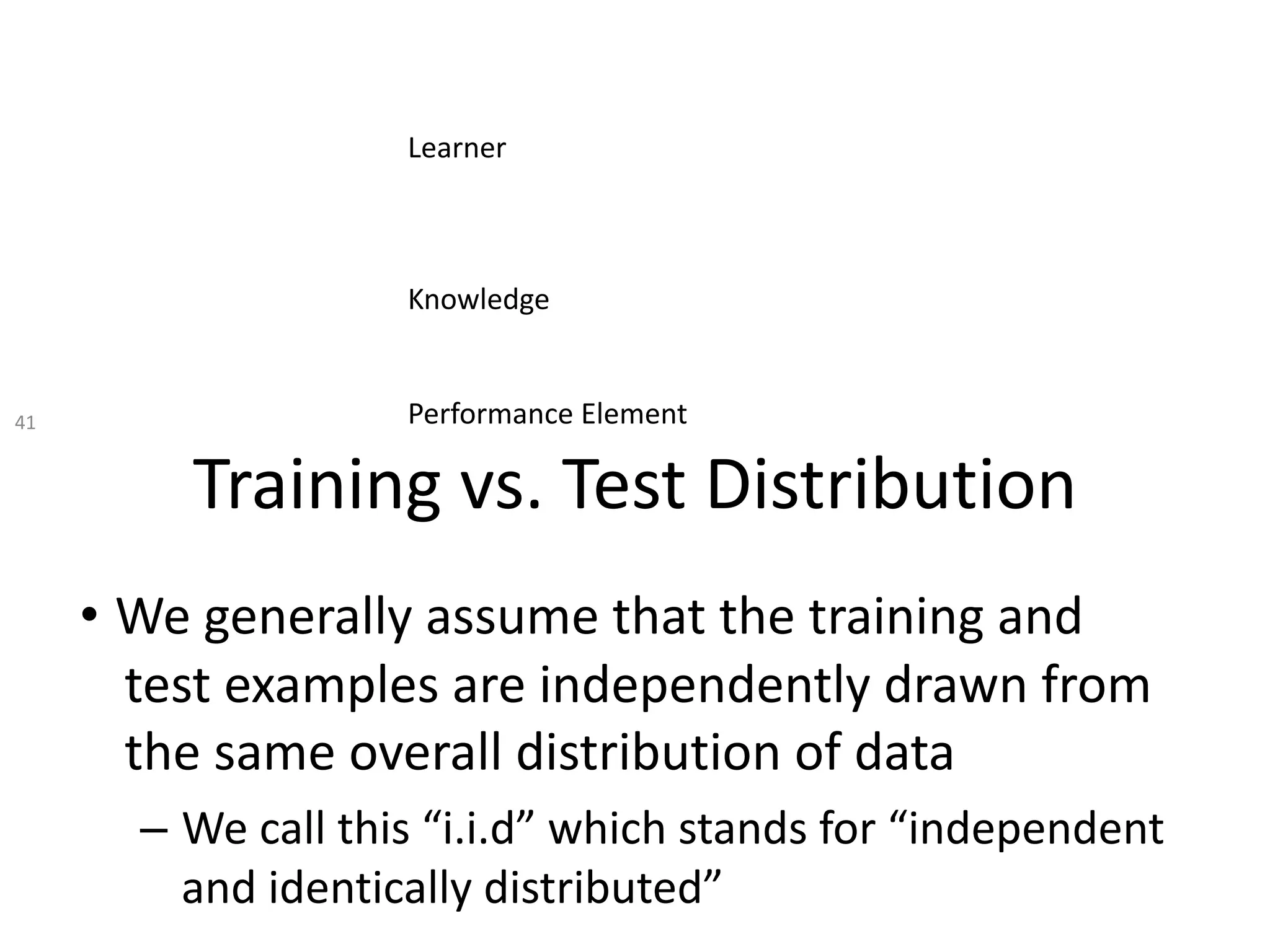
Learner
Knowledge
Performance Element
Training vs. Test Distribution
• We generally assume that the training and
test examples are independently drawn from
the same overall distribution of data
– We call this “i.i.d” which stands for “independent
and identically distributed”
• If examples are not independent, requires
collective classification
• If test distribution is different, requires
transfer learning
Slide credit: Ray Mooney
42
ML in a Nutshell
• Tens of thousands of machine learning
algorithms
– Hundreds new every year
• Every ML algorithm has three components:
– Representation
– Optimization
– Evaluation
Slide credit: Pedro Domingos
43
Various Function Representations
• Numerical functions
– Linear regression
– Neural networks
– Support vector machines
• Symbolic functions
– Decision trees
– Rules in propositional logic
– Rules in first-order predicate logic
• Instance-based functions
– Nearest-neighbor
– Case-based
• Probabilistic Graphical Models
– Naïve Bayes
– Bayesian networks
– Hidden-Markov Models (HMMs)
– Probabilistic Context Free Grammars (PCFGs)
– Markov networks
Slide credit: Ray Mooney
44
Various Search/Optimization
Algorithms
• Gradient descent
– Perceptron
– Backpropagation
• Dynamic Programming
– HMM Learning
– PCFG Learning
• Divide and Conquer
– Decision tree induction
– Rule learning
• Evolutionary Computation
– Genetic Algorithms (GAs)
– Genetic Programming (GP)
– Neuro-evolution
Slide credit: Ray Mooney
45
Evaluation
• Accuracy
• Precision and recall
• Squared error
• Likelihood
• Posterior probability
• Cost / Utility
• Margin
• Entropy
• K-L divergence
• etc.
Slide credit: Pedro Domingos
47
Loop
ML in Practice
• Understand domain, prior
knowledge, and goals • Data
integration, selection, cleaning,
pre-processing, etc. • Learn
models
• Interpret results
• Consolidate and deploy
discovered knowledge
Based on a slide by Pedro Domingos
48
Lessons Learned about Learning
• Learning can be viewed as using direct or indirect
experience to approximate a chosen target
function.
• Function approximation can be viewed as a search
through a space of hypotheses (representations of
functions) for one that best fits a set of training
data.
• Different learning methods assume different
hypothesis spaces (representation languages) and/or
employ different search techniques.
Slide credit: Ray Mooney
49
A Brief History of
Machine Learning
50
History of Machine Learning
• 1950s
– Samuel’s checker player
– Selfridge’s Pandemonium
• 1960s:
– Neural networks: Perceptron
– Pattern recognition
– Learning in the limit theory
– Minsky and Papert prove limitations of Perceptron
• 1970s:
– Symbolic concept induction
– Winston’s arch learner
– Expert systems and the knowledge acquisition bottleneck
– Quinlan’s ID3
– Michalski’s AQ and soybean diagnosis
– Scientific discovery with BACON
– Mathematical discovery with AM
Slide credit: Ray Mooney
51
History of Machine Learning (cont.)
• 1980s:
– Advanced decision tree and rule learning
– Explanation-based Learning (EBL)
– Learning and planning and problem solving
– Utility problem
– Analogy
– Cognitive architectures
– Resurgence of neural networks (connectionism, backpropagation)
– Valiant’s PAC Learning Theory
– Focus on experimental methodology
• 1990s
– Data mining
– Adaptive software agents and web applications
– Text learning
– Reinforcement learning (RL)
– Inductive Logic Programming (ILP)
– Ensembles: Bagging, Boosting, and Stacking
– Bayes Net learning
Slide credit: Ray Mooney
52
History of Machine Learning (cont.)
• 2000s
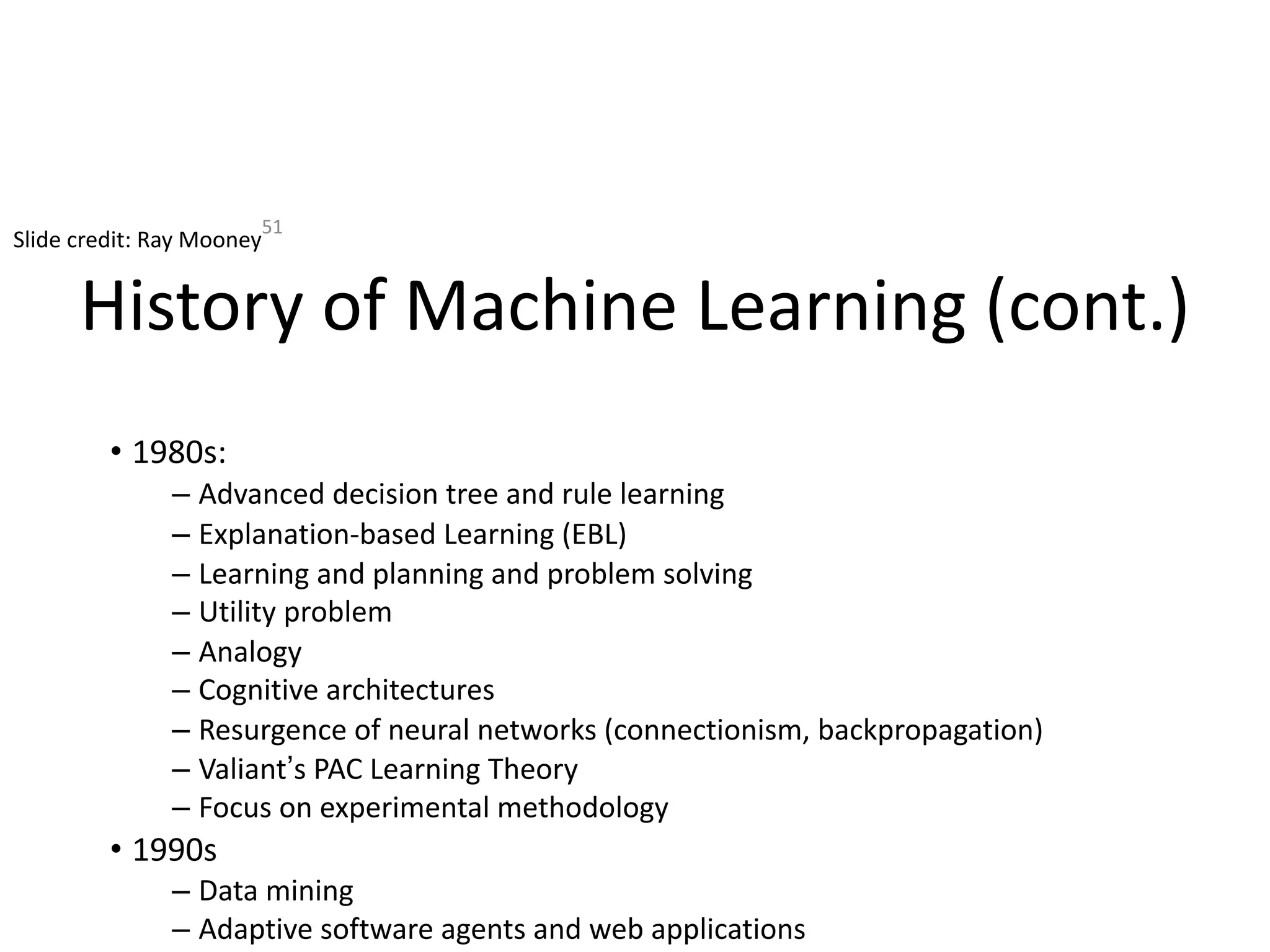
– Support vector machines & kernel methods
– Graphical models
– Statistical relational learning
– Transfer learning
– Sequence labeling
– Collective classification and structured outputs
– Computer Systems Applications (Compilers, Debugging, Graphics, Security)
– E-mail management
– Personalized assistants that learn
– Learning in robotics and vision
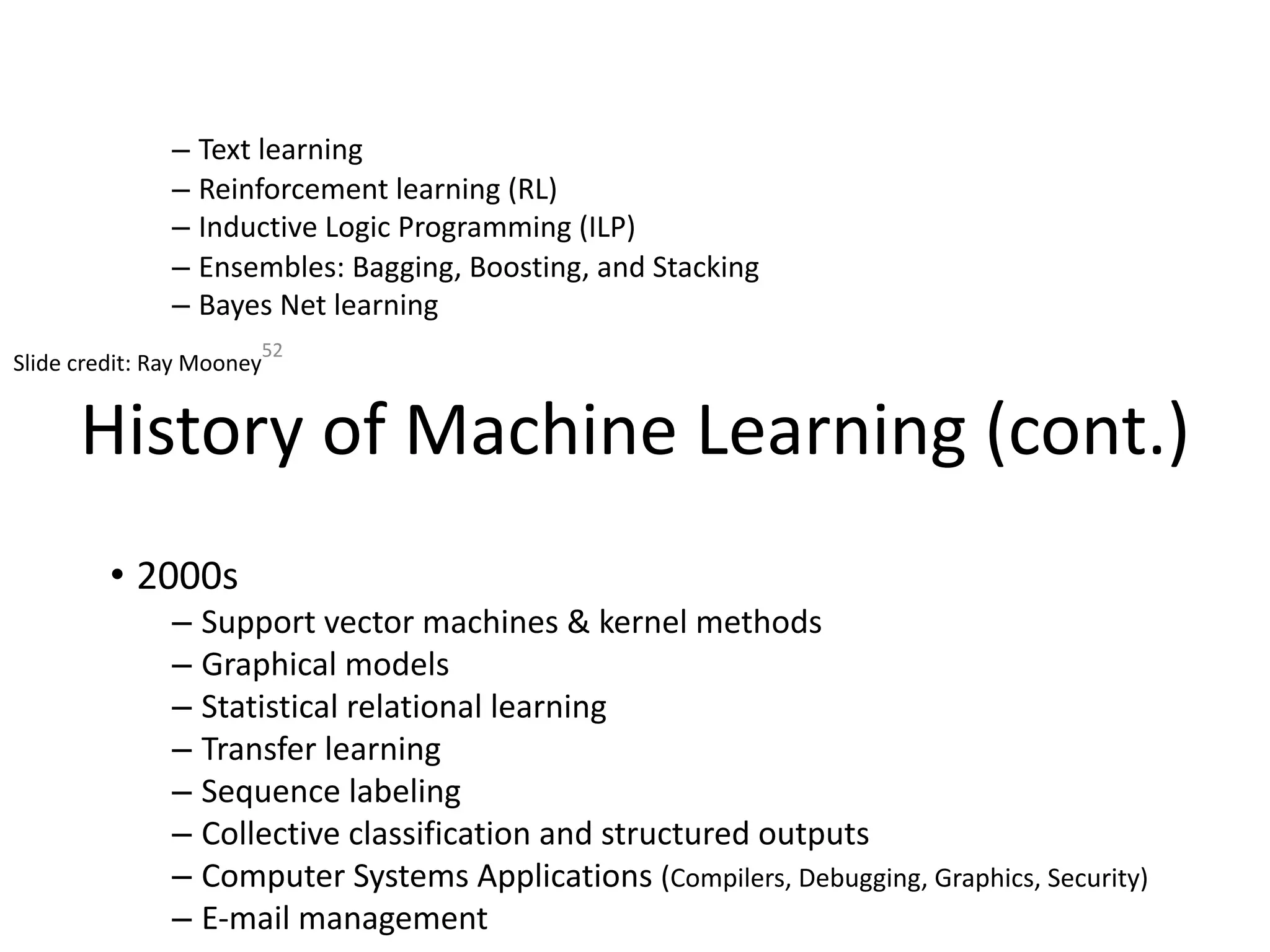
• 2010s
– Deep learning systems
– Learning for big data
– Bayesian methods
– Multi-task & lifelong learning
– Applications to vision, speech, social networks, learning to read, etc.
– ???
Based on slide by Ray Mooney
53
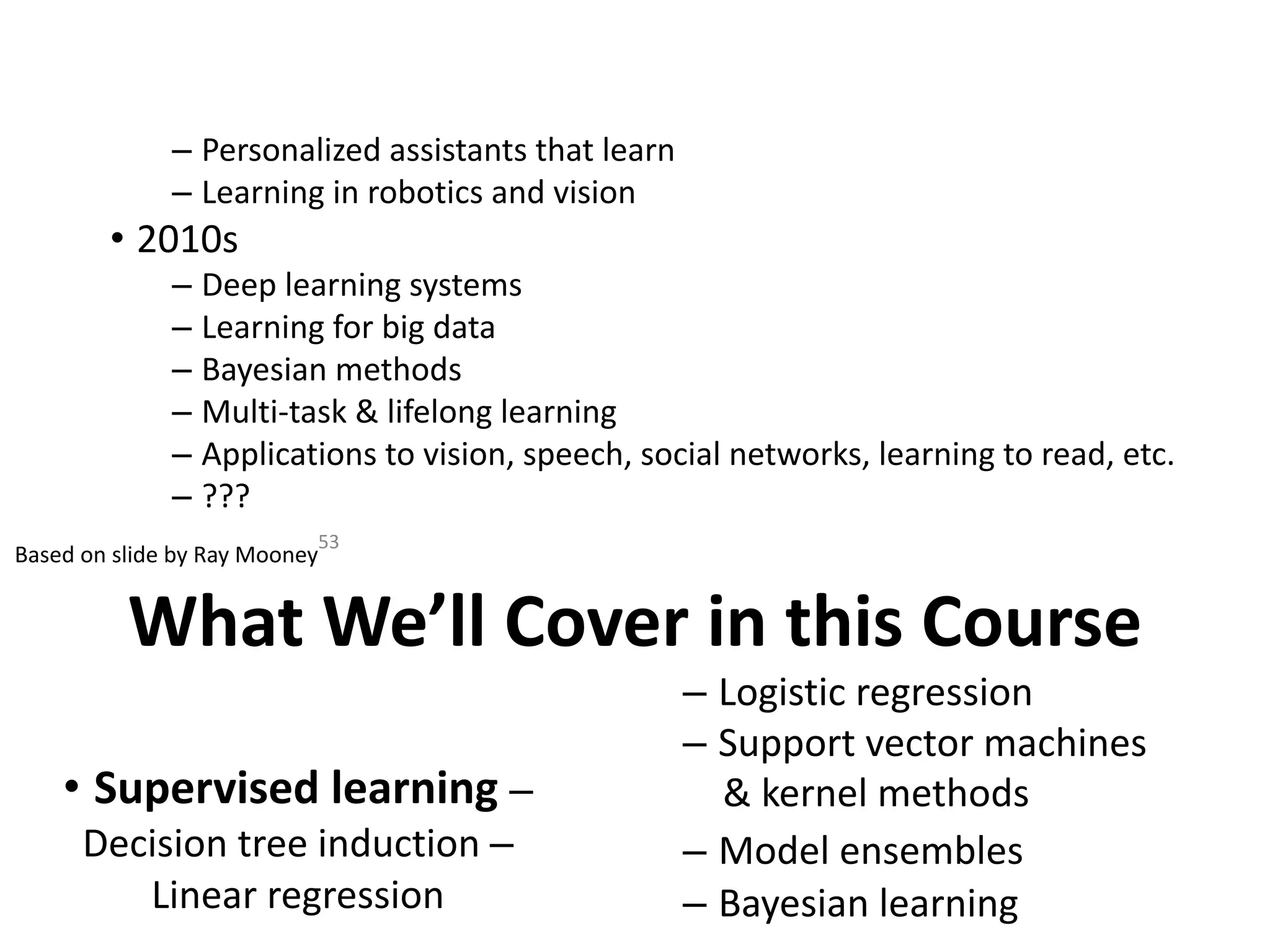
What We’ll Cover in this Course
• Supervised learning –
Decision tree induction –
Linear regression
– Logistic regression
– Support vector machines
& kernel methods
– Model ensembles
– Bayesian learning
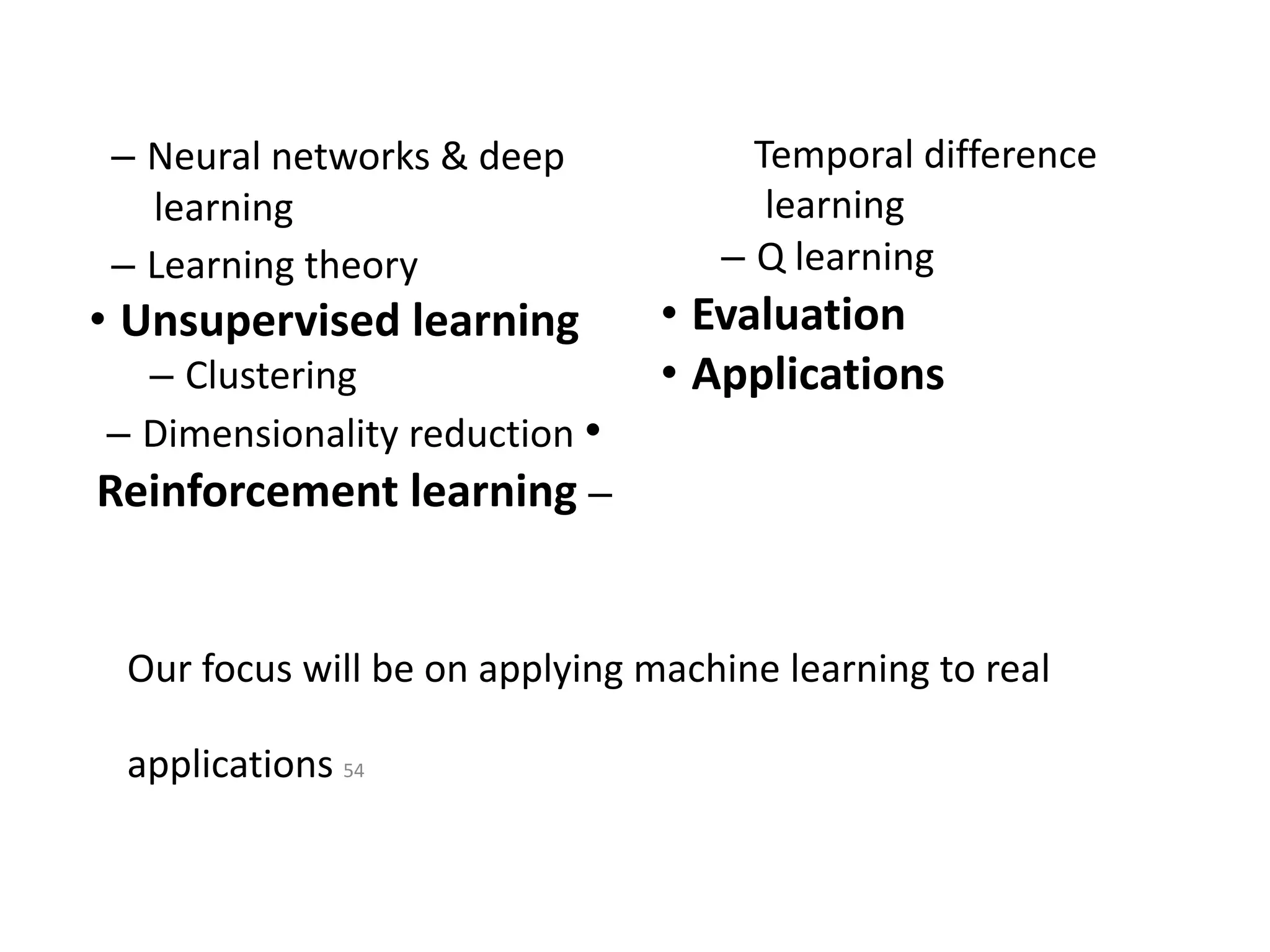
– Neural networks & deep
learning
– Learning theory
• Unsupervised learning
– Clustering
– Dimensionality reduction •
Reinforcement learning –
Temporal difference
learning
– Q learning
• Evaluation
• Applications
Our focus will be on applying machine learning to real
applications 54

01_introduction to machine learning algorithms and basics .pdf

  • 1.
    CIS 419/519 Introduction to MachineLearning Instructor: Eric Eaton www.seas.upenn.edu/~cis519 These slides were assembled by Eric Eaton, with grateful acknowledgement of the many others who made their course materials freely available online. Feel free to reuse or adapt these slides for your own academic purposes, provided that you include proper attribution. Please send comments and corrections to Eric. 1 Robot Image Credit: Viktoriya Sukhanova © 123RF.com
  • 2.
    What is MachineLearning? “Learning is any process by which a system improves performance from experience.” - Herbert Simon Definition by Tom Mitchell (1998): Machine Learning is the study of algorithms that • improve their performance P • at some task T • with experience E.
  • 3.
    A well-defined learningtask is given by <P, T, E>. 3 Traditional Programming Data ProgramOutput Computer Machine Learning
  • 4.
    Data Output Computer Program Slide credit: PedroDomingos 4 When Do We Use Machine Learning? ML is used when: • Human expertise does not exist (navigating on Mars) • Humans can’t explain their expertise (speech recognition) • Models must be customized (personalized medicine)
  • 5.
    • Models arebased on huge amounts of data (genomics) Learning isn’t always useful:
  • 6.
    • There isno need to “learn” to calculate payroll Based on slide by E. Alpaydin 5 A classic example of a task that requires machine learning: It is very hard to say what makes a 2
  • 7.
  • 8.
    Some more examplesof tasks that are best solved by using a learning algorithm • Recognizing patterns: – Facial identities or facial expressions – Handwritten or spoken words – Medical images • Generating patterns: – Generating images or motion sequences • Recognizing anomalies: – Unusual credit card transactions – Unusual patterns of sensor readings in a nuclear power plant • Prediction:
  • 9.
    – Future stockprices or currency exchange rates Slide credit: Geoffrey Hinton 7 Sample Applications • Web search • Computational biology • Finance • E-commerce • Space exploration • Robotics • Information extraction • Social networks
  • 10.
    • Debugging software •[Your favorite area] Slide credit: Pedro Domingos 8 Samuel’s Checkers-Player “Machine Learning: Field of study that gives computers the ability to learn without being explicitly programmed.” -Arthur Samuel (1959)
  • 11.
    9 Defining the LearningTask Improve on task T, with respect to
  • 12.
    performance metric P,based on experience E T: Playing checkers P: Percentage of games won against an arbitrary opponent E: Playing practice games against itself T: Recognizing hand-written words P: Percentage of words correctly classified E: Database of human-labeled images of handwritten words T: Driving on four-lane highways using vision sensors P: Average distance traveled before a human-judged error E: A sequence of images and steering commands recorded while observing a human driver. T: Categorize email messages as spam or legitimate. P: Percentage of email messages correctly classified. E: Database of emails, some with human-given labels Slide credit: Ray Mooney 10
  • 13.
    State of theArt Applications of Machine Learning 11 Autonomous Cars
  • 15.
    • Nevada madeit legal for autonomous cars to drive on roads in June 2011 • As of 2013, four states (Nevada, Florida, California, and Michigan) have legalized autonomous cars Penn’s Autonomous Car 🡪 12 (Ben Franklin Racing Team)
  • 16.
  • 17.
  • 18.
    Adaptive Vision Learningfrom Human Drivers Sebastian Stanley Path Planning
  • 19.
    Images and moviestaken from Sebastian Thrun’s multimedia website. 14 Deep Learning in the Headlines
  • 21.
  • 22.
  • 23.
  • 24.
  • 25.
    Learning of ObjectParts Examples of learned object parts from object categories Faces Cars Elephants Chairs
  • 26.
    Slide credit: AndrewNg 17 Training on Multiple Objects Trained on 4 classes (cars, faces, motorbikes, airplanes). Second layer: Shared-features
  • 27.
    and object-specific features. Thirdlayer: More specific features. Slide credit: Andrew Ng 18 Scene Labeling via Deep Learning
  • 28.
    [Farabet et al.ICML 2012, PAMI 2013] 19 Inference from Deep Learned Models Generating posterior samples from faces by “filling in” experiments (cf. Lee and Mumford, 2003). Combine bottom-up and top-down inference.
  • 29.
    Input images Samples from feedforward Inference (control) Samplesfrom Full posterior inference Slide credit: Andrew Ng 20 Machine Learning in
  • 30.
    Automatic Speech RecognitionA Typical Speech Recognition System
  • 31.
    ML used topredict of phone states from the sound spectrogram Deep learning has state-of-the-art results # Hidden Layers 1 2 4 8 10 12 Word Error Rate % 16.0 12.8 11.4 10.9 11.0 11.1 Baseline GMM performance = 15.4% [Zeiler et al. “On rectified linear units for speech recognition” ICASSP 2013] 21 Impact of Deep Learning in Speech
  • 32.
  • 33.
    Slide credit: LiDeng, MS Research 22 Types of Learning
  • 34.
    23 Types of Learning •Supervised (inductive) learning
  • 35.
    – Given: trainingdata + desired outputs (labels) • Unsupervised learning – Given: training data (without desired outputs) • Semi-supervised learning – Given: training data + a few desired outputs • Reinforcement learning – Rewards from sequence of actions Based on slide by Pedro Domingos 24 Supervised Learning: Regression
  • 36.
    • Given (x1,y1), (x2, y2), ..., (xn, yn) • Learn a function f(x) to predict y given x – y is real-valued == regression September Arctic Sea Ice Extent (1,000,000 sq km) 9 8 7 6 5 4 3 2 1 0 1970 1980 1990 2000 2010 2020 Year Data from G. Witt. Journal of Statistics Education, Volume 21, Number 1
  • 37.
    (2013) 26 Supervised Learning: Classification •Given (x1, y1), (x2, y2), ..., (xn, yn) • Learn a function f(x) to predict y given x – y is categorical == classification Breast Cancer (Malignant / Benign) 1(Malignant) 0(Benign) Tumor Size
  • 38.
    Based on exampleby Andrew Ng 27 Supervised Learning: Classification • Given (x1, y1), (x2, y2), ..., (xn, yn) • Learn a function f(x) to predict y given x – y is categorical == classification Breast Cancer (Malignant / Benign) 1(Malignant)
  • 39.
    0(Benign) Tumor Size Tumor SizeBased on example by Andrew Ng28 Supervised Learning: Classification • Given (x1, y1), (x2, y2), ..., (xn, yn) • Learn a function f(x) to predict y given x – y is categorical == classification Breast Cancer (Malignant / Benign)
  • 40.
    1(Malignant) 0(Benign) Tumor Size Predict BenignPredict Malignant Tumor Size Based on example by Andrew Ng 29 Supervised Learning • x can be multi-dimensional – Each dimension corresponds to an attribute
  • 41.
    - Clump Thickness -Uniformity of Cell Size Age Tumor Size - Uniformity of Cell Shape … Based on example by Andrew Ng 30
  • 42.
    Unsupervised Learning • Givenx1, x2, ..., xn (without labels) • Output hidden structure behind the x’s – E.g., clustering
  • 43.
    31 Unsupervised Learning Genomics application:group individuals by genetic similarity
  • 44.
  • 45.
    Organize computing clustersSocial network analysis
  • 46.
    Image credit: NASA/JPL-Caltech/E.Churchwell (Univ. of Wisconsin, Madison) Market segmentation Astronomical data analysis 33 Slide credit: Andrew Ng Unsupervised Learning • Independent component analysis – separate a combined signal into its original sources
  • 48.
    Image credit: statsoft.comAudio from http://www.ism.ac.jp/~shiro/research/blindsep.html 34 Unsupervised Learning • Independent component analysis – separate a combined signal into its original sources
  • 50.
    Image credit: statsoft.comAudio from http://www.ism.ac.jp/~shiro/research/blindsep.html 35 Reinforcement Learning • Given a sequence of states and actions with (delayed) rewards, output a policy – Policy is a mapping from states 🡪 actions that tells you what to do in a given state
  • 51.
    • Examples: – Creditassignment problem – Game playing – Robot in a maze – Balance a pole on your hand 36 The Agent-Environment
  • 52.
    Interface Agent and environmentinteract at discrete time steps : t = 0, 1, 2, K Agent observes state at step t: st ∈S produces action at step t : at ∈ A(st ) gets resulting reward : rt +1 ∈ℜ and resulting next state : st +1
  • 53.
    . . . star t +1 s t +1 t +1 ar t +2 s t +2 t +2 ar t +3 st +3 . . . t +3 a t Slide credit: Sutton & Barto 37 Reinforcement Learning
  • 54.
  • 55.
    Inverse Reinforcement Learning •Learn policy from user demonstrations Stanford Autonomous Helicopter http://heli.stanford.edu/
  • 56.
    https://www.youtube.com/watch?v=VCdxqn0fcnE 39 Framing aLearning Problem 40 Designing a Learning System
  • 57.
    • Choose thetraining experience • Choose exactly what is to be learned – i.e. the target function • Choose how to represent the target function • Choose a learning algorithm to infer the target function from the experience Environment/ Experience Based on slide by Ray Mooney Training data Testing data
  • 58.
    41 Learner Knowledge Performance Element Training vs.Test Distribution • We generally assume that the training and test examples are independently drawn from the same overall distribution of data – We call this “i.i.d” which stands for “independent and identically distributed”
  • 59.
    • If examplesare not independent, requires collective classification • If test distribution is different, requires transfer learning Slide credit: Ray Mooney 42 ML in a Nutshell • Tens of thousands of machine learning algorithms – Hundreds new every year
  • 60.
    • Every MLalgorithm has three components: – Representation – Optimization – Evaluation Slide credit: Pedro Domingos 43 Various Function Representations • Numerical functions
  • 61.
    – Linear regression –Neural networks – Support vector machines • Symbolic functions – Decision trees – Rules in propositional logic – Rules in first-order predicate logic • Instance-based functions – Nearest-neighbor – Case-based • Probabilistic Graphical Models – Naïve Bayes – Bayesian networks – Hidden-Markov Models (HMMs) – Probabilistic Context Free Grammars (PCFGs) – Markov networks Slide credit: Ray Mooney 44 Various Search/Optimization
  • 62.
    Algorithms • Gradient descent –Perceptron – Backpropagation • Dynamic Programming – HMM Learning – PCFG Learning • Divide and Conquer – Decision tree induction – Rule learning • Evolutionary Computation – Genetic Algorithms (GAs) – Genetic Programming (GP) – Neuro-evolution
  • 63.
    Slide credit: RayMooney 45 Evaluation • Accuracy • Precision and recall • Squared error • Likelihood • Posterior probability • Cost / Utility • Margin • Entropy
  • 64.
    • K-L divergence •etc. Slide credit: Pedro Domingos 47 Loop ML in Practice • Understand domain, prior knowledge, and goals • Data integration, selection, cleaning, pre-processing, etc. • Learn models • Interpret results
  • 65.
    • Consolidate anddeploy discovered knowledge Based on a slide by Pedro Domingos 48 Lessons Learned about Learning • Learning can be viewed as using direct or indirect experience to approximate a chosen target
  • 66.
    function. • Function approximationcan be viewed as a search through a space of hypotheses (representations of functions) for one that best fits a set of training data. • Different learning methods assume different hypothesis spaces (representation languages) and/or employ different search techniques. Slide credit: Ray Mooney 49
  • 67.
    A Brief Historyof Machine Learning 50 History of Machine Learning
  • 68.
    • 1950s – Samuel’schecker player – Selfridge’s Pandemonium • 1960s: – Neural networks: Perceptron – Pattern recognition – Learning in the limit theory – Minsky and Papert prove limitations of Perceptron • 1970s: – Symbolic concept induction – Winston’s arch learner – Expert systems and the knowledge acquisition bottleneck – Quinlan’s ID3 – Michalski’s AQ and soybean diagnosis – Scientific discovery with BACON – Mathematical discovery with AM
  • 69.
    Slide credit: RayMooney 51 History of Machine Learning (cont.) • 1980s: – Advanced decision tree and rule learning – Explanation-based Learning (EBL) – Learning and planning and problem solving – Utility problem – Analogy – Cognitive architectures – Resurgence of neural networks (connectionism, backpropagation) – Valiant’s PAC Learning Theory – Focus on experimental methodology • 1990s – Data mining – Adaptive software agents and web applications
  • 70.
    – Text learning –Reinforcement learning (RL) – Inductive Logic Programming (ILP) – Ensembles: Bagging, Boosting, and Stacking – Bayes Net learning Slide credit: Ray Mooney 52 History of Machine Learning (cont.) • 2000s – Support vector machines & kernel methods – Graphical models – Statistical relational learning – Transfer learning – Sequence labeling – Collective classification and structured outputs – Computer Systems Applications (Compilers, Debugging, Graphics, Security) – E-mail management
  • 71.
    – Personalized assistantsthat learn – Learning in robotics and vision • 2010s – Deep learning systems – Learning for big data – Bayesian methods – Multi-task & lifelong learning – Applications to vision, speech, social networks, learning to read, etc. – ??? Based on slide by Ray Mooney 53 What We’ll Cover in this Course • Supervised learning – Decision tree induction – Linear regression – Logistic regression – Support vector machines & kernel methods – Model ensembles – Bayesian learning
  • 72.
    – Neural networks& deep learning – Learning theory • Unsupervised learning – Clustering – Dimensionality reduction • Reinforcement learning – Temporal difference learning – Q learning • Evaluation • Applications Our focus will be on applying machine learning to real applications 54