Introduction to LTspice IV
Why called LTspice IV?
• LTspice IV stands for Linear Technology
simulation program with integrated circuit
emphasis version 4.
• It is freeware software implementing a SPICE
simulator of electronic circuits, produced by
semiconductor manufacturer: Linear Technology
Corporation (LTC)[A.1].
• It provides a schematic capture and waveform
viewer with enhancements and models to speed
the simulation[A.2].
Why using LTspice IV?
• LTspice IV can do simulation for advanced
technologies; e.g. 90nm, 65nm, … etc, while
PSpice A/D cadence version 16.0 can not
withstand for new technology process.
Start your LTspice IV file
• After downloading LTspice IV from
http://www.linear.com/designtools/software/
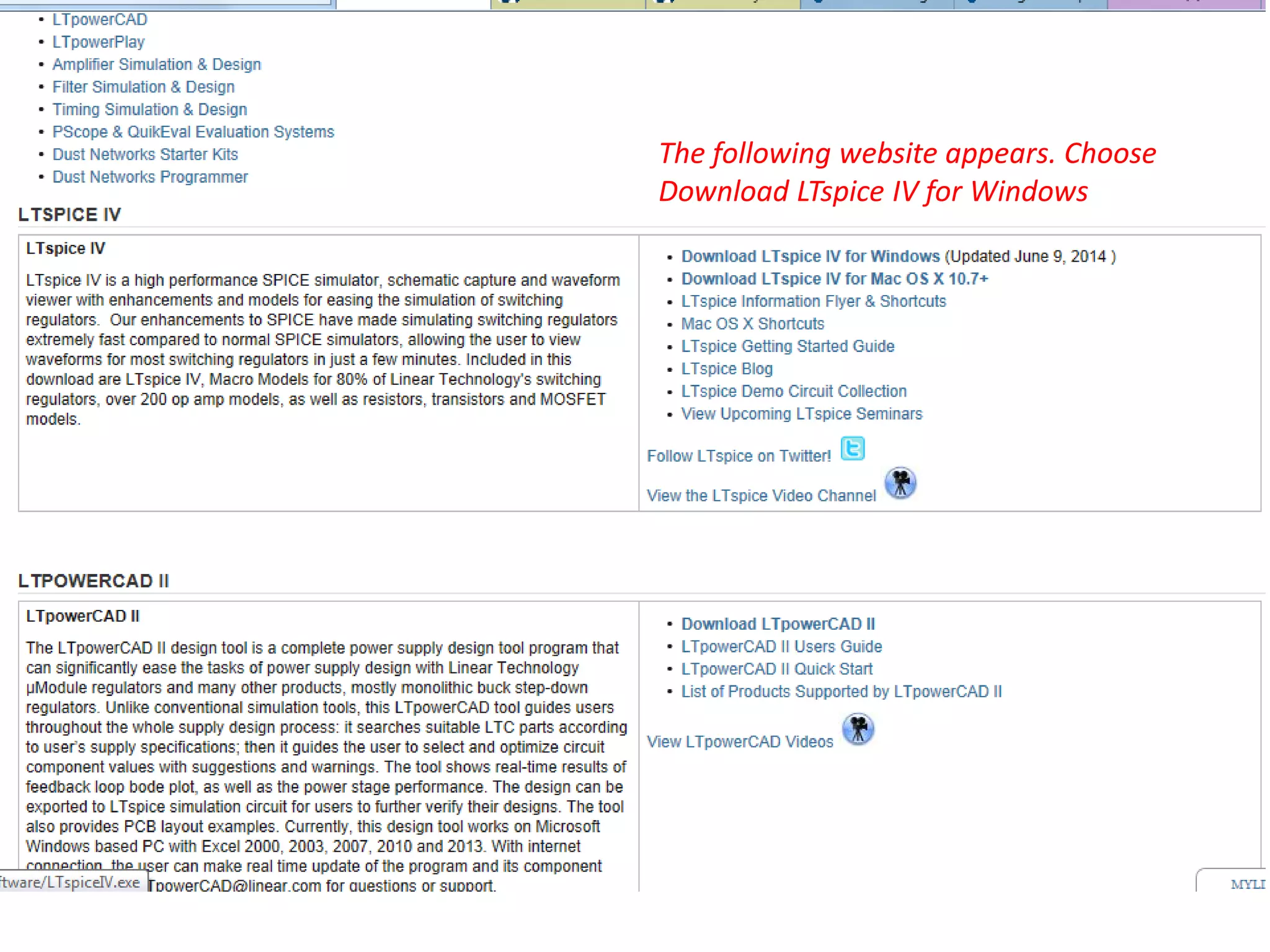
The following website appears. Choose
Download LTspice IV for Windows
Start your LTspice IV file
• double click on LTspice IV icon .
• To start your work:
File New Schematic
Or press on New Schematic
This icon appears after
selecting New schematic
Example
• Build voltage divider circuit; which consists of
two resistors, their values 1k and 2k, and 10V
voltage supply.
Press on component icon
to get the elements
After you press on
component icon, the
following window appears
Write in this box
or search to get
the element
• To get voltage supply, you can write voltage,
battery, or cell. All of them give you voltage
source either DC, AC, Pulse, Sine, PWL, Exp,
or SFFT.
Right click on the element
to choose its type and to
specify its value.
If it is DC voltage source
enter its value here
If not press Advanced
Select
the
type
of
signal
AC
Value
Enter the value of
resistor
To insert the ground Another way to insert resistor
To connect elements using wire
* Simulate the circuit by choosing
Simulate  run
Select type of analysis
After selecting type of
analysis and choosing
the node, the plot
window appears.
The output
How to deal with MOSFET?
• There are two types of MOS for both NMOS and
PMOS in LTspice IV:
1. nmos and pmos: the substrate is connected to
the source.
2. nmos4 and pmos4: the substrate is not
connected to the source. For this type you can
add the model you are working on; e.g. TSMC
or IBM 0.25μm, 90nm, …, etc.
The model of NMOS should be saved in notepad (.txt) where here the name of the model is
CMOSN
How to deal with MOSFET?
nmos nmos4
Choosing nmos4
right click on it the
following window
appears
Name of the
model
Length of
transistor
To write the model file
Select SPICE
directive
Write
.include name_of_the_txt_model_file.txt
Note: it should be saved in the file that your are w
spice file.
After connecting the circuit
as shown and selecting the
type of analysis which is
.dc VG 0.01 1.2 1m
, the circuit is completed.
Press plot
simulation
after selecting
plot window,
then press
Visible Trance
When you press on Visible
Trance the following window
appears . Then select the
variable you want .
To copy the
plot go to
Tools Copy
bitmap to
clipboard, then
paste it in your
document.
To export the
plot to Matlab
go to
FileExport
This window will
appear. Select the
variable that you want.
By default it also
exports the x-axis
variable; in this plot is
Vg. The exported file
will be saved in the
current file you are
working in as notepad
file .txt
The exported
file contains
two columns,
Vg and Id(M1)
This is the m.file that must be saved in the current file you are working in.
% post process an LT-spice simulation with Matlab
clear all;
clc;
close all;
% dlmread: read ASCII-delimited file of numeric data into matrix
data = dlmread('model1_IdvsVgs90.txt','',1,0) %(‘name of txt file’, skip one row (headings))
% '' means let Matlab figure out the delimiter
% 1,0 means read data whose upper left corner is at row 1 and col 0
VGS = data(:,1);
ID = 1000*data(:,2); % to make current in mA
%plot the magnitude frequency response of the RC circuit
plot(VGS,ID)
xlabel('V_G_S(V)');
ylabel('I_D(mA)');
title(' The IV Characteristic of NMOS transistor using 90nm technology')
grid
Matlab plot
0 0.2 0.4 0.6 0.8 1 1.2 1.4
0
0.02
0.04
0.06
0.08
0.1
0.12
0.14
0.16
0.18
0.2
VGS
(V)
I
D
(mA)
The IV Characteristic of NMOS transistor using 90nm technology
Extra about LTspice plot
How to thicken up the lines in your schematic or
simulations?
1. Open the control panel (tools menu bar).
2. To thicken the schematic lines, Select the
Drafting Options tab and check "Draft Thick
Lines“.
3. To thicken simulation lines, Select the
Waveforms tab and check "Plot data with thick
lines“.
Extra about LTspice
Can LTspice deal with netlist?
Yes, the user can start working on LTspice using
netlist.
Fileopenselect Netlist .cir  type any name
of non-exist file then the netlist window will be
open.
Extra references
• http://denethor.wlu.ca/ltspice/
• http://www2.cose.isu.edu/~chiustev/courses/E
E4429/LTspice_Basics.pdf
• http://eecs.oregonstate.edu/education/docs/tuto
rials/LT%20Spice_VarResistor.pdf
• http://web02.gonzaga.edu/faculty/talarico/2014
-08/ee303/ho.html
• http://web02.gonzaga.edu/faculty/talarico/eeng
304/documents/class-CAD.html
• http://denethor.wlu.ca/ltspice/#otheranalysis
To plot the power dissipation
• http://www.linear.com/solutions/1148
A very good book to start and deal with LTspice
• E. Bruun, CMOS Integrated Circuit Simulation
with LTspice IV a Tutorial Guide, 1st ed., 2015.
Thank you

Introduction to l tspice iv

  • 1.
  • 2.
    Why called LTspiceIV? • LTspice IV stands for Linear Technology simulation program with integrated circuit emphasis version 4. • It is freeware software implementing a SPICE simulator of electronic circuits, produced by semiconductor manufacturer: Linear Technology Corporation (LTC)[A.1]. • It provides a schematic capture and waveform viewer with enhancements and models to speed the simulation[A.2].
  • 3.
    Why using LTspiceIV? • LTspice IV can do simulation for advanced technologies; e.g. 90nm, 65nm, … etc, while PSpice A/D cadence version 16.0 can not withstand for new technology process.
  • 4.
    Start your LTspiceIV file • After downloading LTspice IV from http://www.linear.com/designtools/software/
  • 5.
    The following websiteappears. Choose Download LTspice IV for Windows
  • 6.
    Start your LTspiceIV file • double click on LTspice IV icon . • To start your work: File New Schematic
  • 7.
    Or press onNew Schematic
  • 8.
    This icon appearsafter selecting New schematic
  • 9.
    Example • Build voltagedivider circuit; which consists of two resistors, their values 1k and 2k, and 10V voltage supply.
  • 10.
    Press on componenticon to get the elements After you press on component icon, the following window appears Write in this box or search to get the element
  • 11.
    • To getvoltage supply, you can write voltage, battery, or cell. All of them give you voltage source either DC, AC, Pulse, Sine, PWL, Exp, or SFFT.
  • 12.
    Right click onthe element to choose its type and to specify its value. If it is DC voltage source enter its value here If not press Advanced
  • 13.
  • 14.
    Enter the valueof resistor
  • 15.
    To insert theground Another way to insert resistor
  • 16.
  • 17.
    * Simulate thecircuit by choosing Simulate  run
  • 18.
  • 19.
    After selecting typeof analysis and choosing the node, the plot window appears. The output
  • 20.
    How to dealwith MOSFET? • There are two types of MOS for both NMOS and PMOS in LTspice IV: 1. nmos and pmos: the substrate is connected to the source. 2. nmos4 and pmos4: the substrate is not connected to the source. For this type you can add the model you are working on; e.g. TSMC or IBM 0.25μm, 90nm, …, etc.
  • 21.
    The model ofNMOS should be saved in notepad (.txt) where here the name of the model is CMOSN
  • 22.
    How to dealwith MOSFET? nmos nmos4
  • 23.
    Choosing nmos4 right clickon it the following window appears Name of the model Length of transistor
  • 24.
    To write themodel file Select SPICE directive Write .include name_of_the_txt_model_file.txt Note: it should be saved in the file that your are w spice file.
  • 25.
    After connecting thecircuit as shown and selecting the type of analysis which is .dc VG 0.01 1.2 1m , the circuit is completed.
  • 26.
    Press plot simulation after selecting plotwindow, then press Visible Trance
  • 27.
    When you presson Visible Trance the following window appears . Then select the variable you want .
  • 28.
    To copy the plotgo to Tools Copy bitmap to clipboard, then paste it in your document.
  • 29.
    To export the plotto Matlab go to FileExport
  • 30.
    This window will appear.Select the variable that you want. By default it also exports the x-axis variable; in this plot is Vg. The exported file will be saved in the current file you are working in as notepad file .txt
  • 31.
    The exported file contains twocolumns, Vg and Id(M1)
  • 32.
    This is them.file that must be saved in the current file you are working in. % post process an LT-spice simulation with Matlab clear all; clc; close all; % dlmread: read ASCII-delimited file of numeric data into matrix data = dlmread('model1_IdvsVgs90.txt','',1,0) %(‘name of txt file’, skip one row (headings)) % '' means let Matlab figure out the delimiter % 1,0 means read data whose upper left corner is at row 1 and col 0 VGS = data(:,1); ID = 1000*data(:,2); % to make current in mA %plot the magnitude frequency response of the RC circuit plot(VGS,ID) xlabel('V_G_S(V)'); ylabel('I_D(mA)'); title(' The IV Characteristic of NMOS transistor using 90nm technology') grid
  • 33.
    Matlab plot 0 0.20.4 0.6 0.8 1 1.2 1.4 0 0.02 0.04 0.06 0.08 0.1 0.12 0.14 0.16 0.18 0.2 VGS (V) I D (mA) The IV Characteristic of NMOS transistor using 90nm technology
  • 34.
    Extra about LTspiceplot How to thicken up the lines in your schematic or simulations? 1. Open the control panel (tools menu bar). 2. To thicken the schematic lines, Select the Drafting Options tab and check "Draft Thick Lines“. 3. To thicken simulation lines, Select the Waveforms tab and check "Plot data with thick lines“.
  • 35.
    Extra about LTspice CanLTspice deal with netlist? Yes, the user can start working on LTspice using netlist. Fileopenselect Netlist .cir  type any name of non-exist file then the netlist window will be open.
  • 36.
    Extra references • http://denethor.wlu.ca/ltspice/ •http://www2.cose.isu.edu/~chiustev/courses/E E4429/LTspice_Basics.pdf • http://eecs.oregonstate.edu/education/docs/tuto rials/LT%20Spice_VarResistor.pdf • http://web02.gonzaga.edu/faculty/talarico/2014 -08/ee303/ho.html • http://web02.gonzaga.edu/faculty/talarico/eeng 304/documents/class-CAD.html
  • 37.
    • http://denethor.wlu.ca/ltspice/#otheranalysis To plotthe power dissipation • http://www.linear.com/solutions/1148 A very good book to start and deal with LTspice • E. Bruun, CMOS Integrated Circuit Simulation with LTspice IV a Tutorial Guide, 1st ed., 2015.
  • 38.

Editor's Notes

  • #2 The symbol: http://upload.wikimedia.org/wikipedia/en/f/fd/Linear-Technology-logo.png
  • #3 [A.1] http://en.wikipedia.org/wiki/LTspice [A.2] http://www.linear.com/designtools/software/
  • #33 The Matlab code is from: http://web02.gonzaga.edu/faculty/talarico/eeng304/ho/exportdata.pdf
  • #35 http://jeastham.blogspot.ae/2011/10/thick-lines-in-ltspice.html
  • #36 http://jeastham.blogspot.ae/2011/10/thick-lines-in-ltspice.html
  • #38 Erik Bruun’s book is available on: http://bookboon.com/en/cmos-integrated-circuit-simulation-with-ltspice-iv-ebook