© 2003 Prentice Hall, Inc. All rights reserved.
1
Chapter 3 - Introduction to Java
Applets
Outline
3.1 Introduction
3.2 Sample Applets from the Java 2 Software Development Kit
3.3 Simple Java Applet: Drawing a String
3.4 Drawing Strings and Lines
3.5 Adding Floating-Point Numbers
3.6 Java Applet Internet and World Wide Web Resources
3.7 (Optional Case Study) Thinking About Objects: Identifying
the Classes in a Problem Statement
© 2003 Prentice Hall, Inc. All rights reserved.
2
3.1 Introduction
• Applet
– Program that runs in
• appletviewer (test utility for applets)
• Web browser (IE, Communicator)
– Executes when HTML (Hypertext Markup Language)
document containing applet is opened and downloaded
– Applications run in command windows
• Notes
– Mimic several features of Chapter 2 to reinforce them
– Focus on fundamental programming concepts first
• Explanations will come later
© 2003 Prentice Hall, Inc. All rights reserved.
3
3.2 Sample Applets from the Java 2
Software Development Kit
• Sample Applets
– Provided in Java 2 Software Development Kit (J2SDK)
– Source code included (.java files)
• Study and mimic source code to learn new features
• All programmers begin by mimicking existing programs
– Located in demo directory of J2SDK install
– Can download demos and J2SDK from
java.sun.com/j2se/1.4.1/
© 2003 Prentice Hall, Inc. All rights reserved.
4
3.2 Sample Applets from the Java 2
Software Development Kit
• Running applets
– In command prompt, change to demo subdirectory of applet
cd c:j2sdk1.4.1demoapplets
cd appletDirectoryName
– There will be an HTML file used to execute applet
– Type appletviewer example1.html
• appletviewer loads the html file specified as its command-
line argument
• From the HTML file, determines which applet to load (more
section 3.3)
– Applet will run, Reload and Quit commands under
Applet menu
© 2003 Prentice Hall, Inc. All rights reserved.
5
3.2 Sample Applets from the Java 2
Software Development Kit
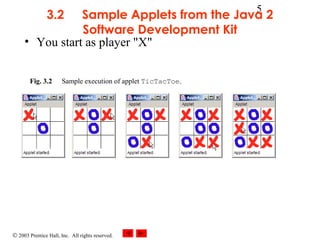
• You start as player "X"
Fig. 3.2 Sample execution of applet TicTacToe.
© 2003 Prentice Hall, Inc. All rights reserved.
6
3.2 Sample Applets from the Java 2
Software Development Kit
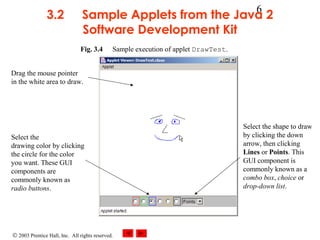
Fig. 3.4 Sample execution of applet DrawTest.
Drag the mouse pointer
in the white area to draw.
Select the
drawing color by clicking
the circle for the color
you want. These GUI
components are
commonly known as
radio buttons.
Select the shape to draw
by clicking the down
arrow, then clicking
Lines or Points. This
GUI component is
commonly known as a
combo box, choice or
drop-down list.
© 2003 Prentice Hall, Inc. All rights reserved.
7
3.2 Sample Applets from the Java 2
Software Development Kit
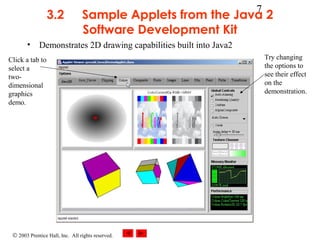
• Demonstrates 2D drawing capabilities built into Java2
Click a tab to
select a
two-
dimensional
graphics
demo.
Try changing
the options to
see their effect
on the
demonstration.
© 2003 Prentice Hall, Inc. All rights reserved.
8
3.3 Simple Java Applet: Drawing a String
• Now, create applets of our own
– Take a while before we can write applets like in the demos
– Cover many of same techniques
• Upcoming program
– Create an applet to display
"Welcome to Java Programming!"
– Show applet and HTML file, then discuss them line by line
© 2003 Prentice Hall, Inc.
All rights reserved.
Outline
9
Java applet
Program Output
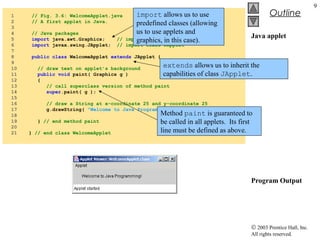
1 // Fig. 3.6: WelcomeApplet.java
2 // A first applet in Java.
3
4 // Java packages
5 import java.awt.Graphics; // import class Graphics
6 import javax.swing.JApplet; // import class JApplet
7
8 public class WelcomeApplet extends JApplet {
9
10 // draw text on applet’s background
11 public void paint( Graphics g )
12 {
13 // call superclass version of method paint
14 super.paint( g );
15
16 // draw a String at x-coordinate 25 and y-coordinate 25
17 g.drawString( "Welcome to Java Programming!", 25, 25 );
18
19 } // end method paint
20
21 } // end class WelcomeApplet
import allows us to use
predefined classes (allowing
us to use applets and
graphics, in this case).
extends allows us to inherit the
capabilities of class JApplet.
Method paint is guaranteed to
be called in all applets. Its first
line must be defined as above.
© 2003 Prentice Hall, Inc. All rights reserved.
10
3.3 Simple Java Applet: Drawing a String
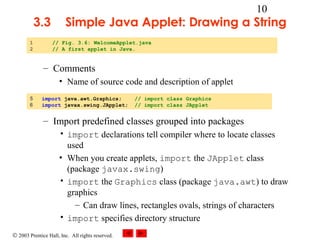
– Comments
• Name of source code and description of applet
– Import predefined classes grouped into packages
• import declarations tell compiler where to locate classes
used
• When you create applets, import the JApplet class
(package javax.swing)
• import the Graphics class (package java.awt) to draw
graphics
– Can draw lines, rectangles ovals, strings of characters
• import specifies directory structure
5 import java.awt.Graphics; // import class Graphics
6 import javax.swing.JApplet; // import class JApplet
1 // Fig. 3.6: WelcomeApplet.java
2 // A first applet in Java.
© 2003 Prentice Hall, Inc. All rights reserved.
11
3.3 Simple Java Applet: Drawing a String
– Applets have at least one class declaration (like applications)
• Rarely create classes from scratch
– Use pieces of existing classes
– Inheritance - create new classes from old ones (ch. 9)
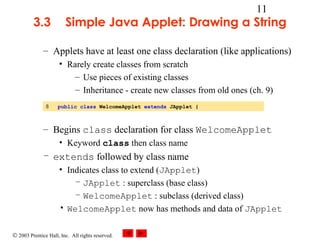
– Begins class declaration for class WelcomeApplet
• Keyword class then class name
– extends followed by class name
• Indicates class to extend (JApplet)
– JApplet : superclass (base class)
– WelcomeApplet : subclass (derived class)
• WelcomeApplet now has methods and data of JApplet
8 public class WelcomeApplet extends JApplet {
© 2003 Prentice Hall, Inc. All rights reserved.
12
3.3 Simple Java Applet: Drawing a String
– Class JApplet defined for us
• Someone else defined "what it means to be an applet"
– Applets require over 200 methods!
• extends JApplet
– Inherit methods, do not have to declare them all
• Do not need to know every detail of class JApplet
8 public class WelcomeApplet extends JApplet {
© 2003 Prentice Hall, Inc. All rights reserved.
13
3.3 Simple Java Applet: Drawing a String
– Class WelcomeApplet is a blueprint
• appletviewer or browser creates an object of class
WelcomeApplet
– Keyword public required
– File can only have one public class
– public class name must be file name
8 public class WelcomeApplet extends JApplet {
© 2003 Prentice Hall, Inc. All rights reserved.
14
3.3 Simple Java Applet: Drawing a String
– Our class inherits method paint from JApplet
• By default, paint has empty body
• Override (redefine) paint in our class
– Methods paint, init, and start
• Guaranteed to be called automatically
• Our applet gets "free" version of these by inheriting from
JApplet
– Free versions have empty body (do nothing)
– Every applet does not need all three methods
• Override the ones you need
– Applet container “draws itself” by calling method paint
11 public void paint( Graphics g )
© 2003 Prentice Hall, Inc. All rights reserved.
15
3.3 Simple Java Applet: Drawing a String
– Method paint
• Lines 11-19 are the declaration of paint
• Draws graphics on screen
• void indicates paint returns nothing when finishes task
• Parenthesis define parameter list - where methods receive data
to perform tasks
– Normally, data passed by programmer, as in
JOptionPane.showMessageDialog
• paint gets parameters automatically
– Graphics object used by paint
• Mimic paint's first line
11 public void paint( Graphics g )
© 2003 Prentice Hall, Inc. All rights reserved.
16
3.3 Simple Java Applet: Drawing a String
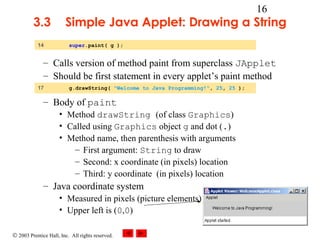
– Calls version of method paint from superclass JApplet
– Should be first statement in every applet’s paint method
– Body of paint
• Method drawString (of class Graphics)
• Called using Graphics object g and dot (.)
• Method name, then parenthesis with arguments
– First argument: String to draw
– Second: x coordinate (in pixels) location
– Third: y coordinate (in pixels) location
– Java coordinate system
• Measured in pixels (picture elements)
• Upper left is (0,0)
14 super.paint( g );
17 g.drawString( "Welcome to Java Programming!", 25, 25 );
© 2003 Prentice Hall, Inc. All rights reserved.
17
3.3 Simple Java Applet: Drawing a String
• Running the applet
– Compile
• javac WelcomeApplet.java
• If no errors, bytecodes stored in WelcomeApplet.class
– Create an HTML file
• Loads the applet into appletviewer or a browser
• Ends in .htm or .html
– To execute an applet
• Create an HTML file indicating which applet the browser (or
appletviewer) should load and execute
© 2003 Prentice Hall, Inc. All rights reserved.
18
3.3 Simple Java Applet: Drawing a String
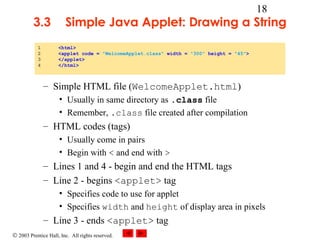
– Simple HTML file (WelcomeApplet.html)
• Usually in same directory as .class file
• Remember, .class file created after compilation
– HTML codes (tags)
• Usually come in pairs
• Begin with < and end with >
– Lines 1 and 4 - begin and end the HTML tags
– Line 2 - begins <applet> tag
• Specifies code to use for applet
• Specifies width and height of display area in pixels
– Line 3 - ends <applet> tag
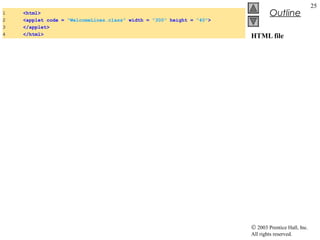
1 <html>
2 <applet code = "WelcomeApplet.class" width = "300" height = "45">
3 </applet>
4 </html>
© 2003 Prentice Hall, Inc. All rights reserved.
19
3.3 Simple Java Applet: Drawing a String
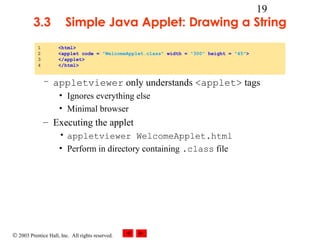
– appletviewer only understands <applet> tags
• Ignores everything else
• Minimal browser
– Executing the applet
• appletviewer WelcomeApplet.html
• Perform in directory containing .class file
1 <html>
2 <applet code = "WelcomeApplet.class" width = "300" height = "45">
3 </applet>
4 </html>
© 2003 Prentice Hall, Inc. All rights reserved.
20
3.3 Simple Java Applet: Drawing a String
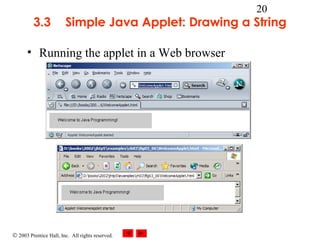
• Running the applet in a Web browser
© 2003 Prentice Hall, Inc. All rights reserved.
21
3.4 Drawing Strings and Lines
• More applets
– First example
• Display two lines of text
• Use drawString to simulate a new line with two
drawString statements
– Second example
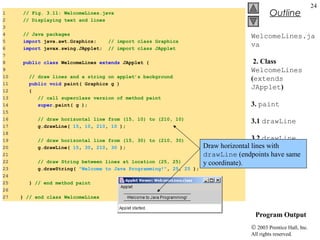
• Method g.drawLine(x1, y1, x2, y2 )
– Draws a line from (x1, y1) to (x2, y2)
– Remember that (0, 0) is upper left
• Use drawLine to draw a line beneath and above a string
© 2003 Prentice Hall, Inc.
All rights reserved.
Outline
22
1 // Fig. 3.9: WelcomeApplet2.java
2 // Displaying multiple strings in an applet.
3
4 // Java packages
5 import java.awt.Graphics; // import class Graphics
6 import javax.swing.JApplet; // import class JApplet
7
8 public class WelcomeApplet2 extends JApplet {
9
10 // draw text on applet’s background
11 public void paint( Graphics g )
12 {
13 // call superclass version of method paint
14 super.paint( g );
15
16 // draw two Strings at different locations
17 g.drawString( "Welcome to", 25, 25 );
18 g.drawString( "Java Programming!", 25, 40 );
19
20 } // end method paint
21
22 } // end class WelcomeApplet2
WelcomeApplet2.j
ava
1. import
2. Class
WelcomeApplet2
(extends JApplet)
3. paint
3.1 drawString
3.2 drawString
on same x coordinate,
but 15 pixels down
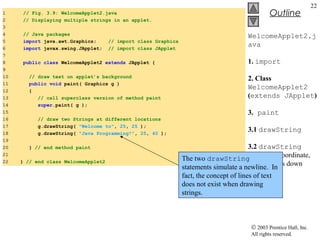
The two drawString
statements simulate a newline. In
fact, the concept of lines of text
does not exist when drawing
strings.
© 2003 Prentice Hall, Inc.
All rights reserved.
Outline
23
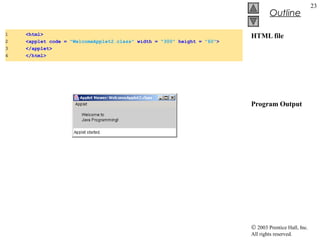
HTML file
Program Output
1 <html>
2 <applet code = "WelcomeApplet2.class" width = "300" height = "60">
3 </applet>
4 </html>
© 2003 Prentice Hall, Inc.
All rights reserved.
Outline
24
WelcomeLines.ja
va
2. Class
WelcomeLines
(extends
JApplet)
3. paint
3.1 drawLine
3.2 drawLine
3.3 drawString
Program Output
1 // Fig. 3.11: WelcomeLines.java
2 // Displaying text and lines
3
4 // Java packages
5 import java.awt.Graphics; // import class Graphics
6 import javax.swing.JApplet; // import class JApplet
7
8 public class WelcomeLines extends JApplet {
9
10 // draw lines and a string on applet’s background
11 public void paint( Graphics g )
12 {
13 // call superclass version of method paint
14 super.paint( g );
15
16 // draw horizontal line from (15, 10) to (210, 10)
17 g.drawLine( 15, 10, 210, 10 );
18
19 // draw horizontal line from (15, 30) to (210, 30)
20 g.drawLine( 15, 30, 210, 30 );
21
22 // draw String between lines at location (25, 25)
23 g.drawString( "Welcome to Java Programming!", 25, 25 );
24
25 } // end method paint
26
27 } // end class WelcomeLines
Draw horizontal lines with
drawLine (endpoints have same
y coordinate).
© 2003 Prentice Hall, Inc.
All rights reserved.
Outline
25
HTML file
1 <html>
2 <applet code = "WelcomeLines.class" width = "300" height = "40">
3 </applet>
4 </html>
© 2003 Prentice Hall, Inc. All rights reserved.
26
3.4 Drawing Strings and Lines
• Method drawLine of class Graphics
– Takes as arguments Graphics object and line’s end points
– X and y coordinate of first endpoint
– X and y coordinate of second endpoint
© 2003 Prentice Hall, Inc. All rights reserved.
27
3.5 Adding Floating-Point Numbers
• Next applet
– Mimics application for adding two integers (Fig 2.9)
• This time, use floating point numbers (numbers with a decimal
point)
– Using primitive types
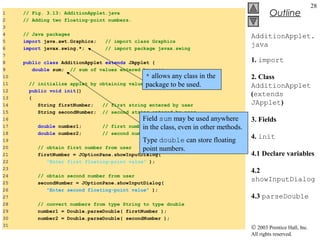
• double – double precision floating-point numbers
• float – single precision floating-point numbers
– Show program, then discuss
© 2003 Prentice Hall, Inc.
All rights reserved.
Outline
28
AdditionApplet.
java
1. import
2. Class
AdditionApplet
(extends
JApplet)
3. Fields
4. init
4.1 Declare variables
4.2
showInputDialog
4.3 parseDouble
2 // Adding two floating-point numbers
3 import java.awt.Graphics; // import class Graphics
5
6 public class AdditionApplet extends JApplet {
7 double sum; // sum of the values entered by the user
8
9 public void init()
10 {
11 String firstNumber, // first string entered by user
12 secondNumber; // second string entered by user
13 double number1, // first number to add
14 number2; // second number to add
15
16 // read in first number from user
17 firstNumber =
18 JOptionPane.showInputDialog(
19 "Enter first floating-point value" );
20
21 // read in second number from user
22 secondNumber =
23 JOptionPane.showInputDialog(
24 "Enter second floating-point value" );
25
1 // Fig. 3.13: AdditionApplet.java
2 // Adding two floating-point numbers.
3
4 // Java packages
5 import java.awt.Graphics; // import class Graphics
6 import javax.swing.*; // import package javax.swing
7
8 public class AdditionApplet extends JApplet {
9 double sum; // sum of values entered by user
10
11 // initialize applet by obtaining values from user
12 public void init()
13 {
14 String firstNumber; // first string entered by user
15 String secondNumber; // second string entered by user
16
17 double number1; // first number to add
18 double number2; // second number to add
19
20 // obtain first number from user
21 firstNumber = JOptionPane.showInputDialog(
22 "Enter first floating-point value" );
23
24 // obtain second number from user
25 secondNumber = JOptionPane.showInputDialog(
26 "Enter second floating-point value" );
27
28 // convert numbers from type String to type double
29 number1 = Double.parseDouble( firstNumber );
30 number2 = Double.parseDouble( secondNumber );
31
* allows any class in the
package to be used.
Field sum may be used anywhere
in the class, even in other methods.
Type double can store floating
point numbers.
© 2003 Prentice Hall, Inc.
All rights reserved.
Outline
29
5. Draw applet
contents
5.1 Draw a rectangle
5.2 Draw the results
HTML file
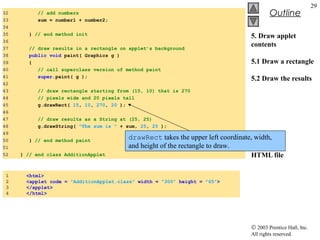
31 // add the numbers
32 sum = number1 + number2;
33 }
34
35 public void paint( Graphics g )
36 {
37 // draw the results with g.drawString
38 g.drawRect( 15, 10, 270, 20 );
39 g.drawString( "The sum is " + sum, 25, 25 );
40 }
41 }
1 <html>
2 <applet code="AdditionApplet.class" width=300 height=50>
3 </applet>
4 </html>
32 // add numbers
33 sum = number1 + number2;
34
35 } // end method init
36
37 // draw results in a rectangle on applet’s background
38 public void paint( Graphics g )
39 {
40 // call superclass version of method paint
41 super.paint( g );
42
43 // draw rectangle starting from (15, 10) that is 270
44 // pixels wide and 20 pixels tall
45 g.drawRect( 15, 10, 270, 20 );
46
47 // draw results as a String at (25, 25)
48 g.drawString( "The sum is " + sum, 25, 25 );
49
50 } // end method paint
51
52 } // end class AdditionApplet
1 <html>
2 <applet code = "AdditionApplet.class" width = "300" height = "65">
3 </applet>
4 </html>
drawRect takes the upper left coordinate, width,
and height of the rectangle to draw.
© 2003 Prentice Hall, Inc.
All rights reserved.
Outline
30
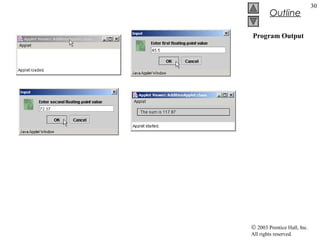
Program Output
© 2003 Prentice Hall, Inc. All rights reserved.
31
3.5 Adding Floating-Point Numbers
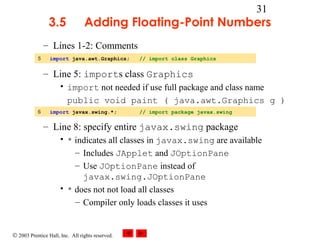
– Lines 1-2: Comments
– Line 5: imports class Graphics
• import not needed if use full package and class name
public void paint ( java.awt.Graphics g )
– Line 8: specify entire javax.swing package
• * indicates all classes in javax.swing are available
– Includes JApplet and JOptionPane
– Use JOptionPane instead of
javax.swing.JOptionPane
• * does not not load all classes
– Compiler only loads classes it uses
5 import java.awt.Graphics; // import class Graphics
6 import javax.swing.*; // import package javax.swing
© 2003 Prentice Hall, Inc. All rights reserved.
32
3.5 Adding Floating-Point Numbers
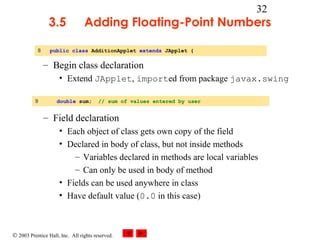
– Begin class declaration
• Extend JApplet, imported from package javax.swing
– Field declaration
• Each object of class gets own copy of the field
• Declared in body of class, but not inside methods
– Variables declared in methods are local variables
– Can only be used in body of method
• Fields can be used anywhere in class
• Have default value (0.0 in this case)
8 public class AdditionApplet extends JApplet {
9 double sum; // sum of values entered by user
© 2003 Prentice Hall, Inc. All rights reserved.
33
3.5 Adding Floating-Point Numbers
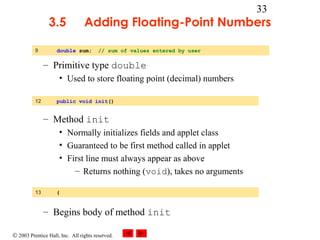
– Primitive type double
• Used to store floating point (decimal) numbers
– Method init
• Normally initializes fields and applet class
• Guaranteed to be first method called in applet
• First line must always appear as above
– Returns nothing (void), takes no arguments
– Begins body of method init
9 double sum; // sum of values entered by user
12 public void init()
13 {
© 2003 Prentice Hall, Inc. All rights reserved.
34
3.5 Adding Floating-Point Numbers
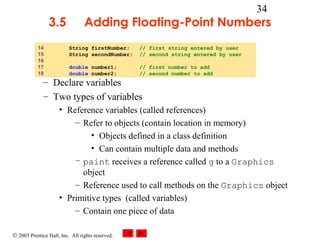
– Declare variables
– Two types of variables
• Reference variables (called references)
– Refer to objects (contain location in memory)
• Objects defined in a class definition
• Can contain multiple data and methods
– paint receives a reference called g to a Graphics
object
– Reference used to call methods on the Graphics object
• Primitive types (called variables)
– Contain one piece of data
14 String firstNumber; // first string entered by user
15 String secondNumber; // second string entered by user
16
17 double number1; // first number to add
18 double number2; // second number to add
© 2003 Prentice Hall, Inc. All rights reserved.
35
3.5 Adding Floating-Point Numbers
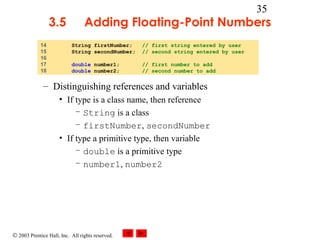
– Distinguishing references and variables
• If type is a class name, then reference
– String is a class
– firstNumber, secondNumber
• If type a primitive type, then variable
– double is a primitive type
– number1, number2
14 String firstNumber; // first string entered by user
15 String secondNumber; // second string entered by user
16
17 double number1; // first number to add
18 double number2; // second number to add
© 2003 Prentice Hall, Inc. All rights reserved.
36
3.5 Adding Floating-Point Numbers
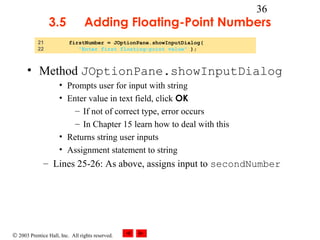
• Method JOptionPane.showInputDialog
• Prompts user for input with string
• Enter value in text field, click OK
– If not of correct type, error occurs
– In Chapter 15 learn how to deal with this
• Returns string user inputs
• Assignment statement to string
– Lines 25-26: As above, assigns input to secondNumber
21 firstNumber = JOptionPane.showInputDialog(
22 "Enter first floating-point value" );
© 2003 Prentice Hall, Inc. All rights reserved.
37
3.5 Adding Floating-Point Numbers
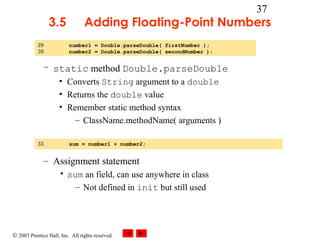
– static method Double.parseDouble
• Converts String argument to a double
• Returns the double value
• Remember static method syntax
– ClassName.methodName( arguments )
– Assignment statement
• sum an field, can use anywhere in class
– Not defined in init but still used
33 sum = number1 + number2;
29 number1 = Double.parseDouble( firstNumber );
30 number2 = Double.parseDouble( secondNumber );
© 2003 Prentice Hall, Inc. All rights reserved.
38
3.5 Adding Floating-Point Numbers
– Ends method init
• appletviewer (or browser) calls inherited method start
• start usually used with multithreading
– Advanced concept, in Chapter 16
– We do not declare it, so empty declaration in JApplet
used
• Next, method paint called
– Method drawRect( x1, y1, width, height )
• Draw rectangle, upper left corner (x1, y1), specified width
and height
• Line 45 draws rectangle starting at (15, 10) with a width of
270 pixels and a height of 20 pixels
35 } // end method init
45 g.drawRect( 15, 10, 270, 20 );
© 2003 Prentice Hall, Inc. All rights reserved.
39
3.5 Adding Floating-Point Numbers
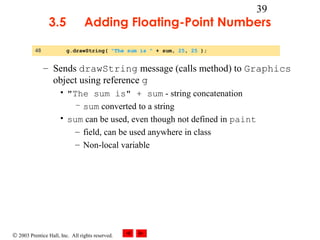
– Sends drawString message (calls method) to Graphics
object using reference g
• "The sum is" + sum - string concatenation
– sum converted to a string
• sum can be used, even though not defined in paint
– field, can be used anywhere in class
– Non-local variable
48 g.drawString( "The sum is " + sum, 25, 25 );
© 2003 Prentice Hall, Inc. All rights reserved.
40
3.6 Java Applet Internet and World Wide
Web Resources
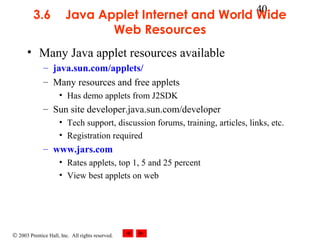
• Many Java applet resources available
– java.sun.com/applets/
– Many resources and free applets
• Has demo applets from J2SDK
– Sun site developer.java.sun.com/developer
• Tech support, discussion forums, training, articles, links, etc.
• Registration required
– www.jars.com
• Rates applets, top 1, 5 and 25 percent
• View best applets on web
© 2003 Prentice Hall, Inc. All rights reserved.
413.7 (Optional Case Study) Thinking About
Objects: Identifying the Classes in a
Problem Statement
• Identifying classes in a System
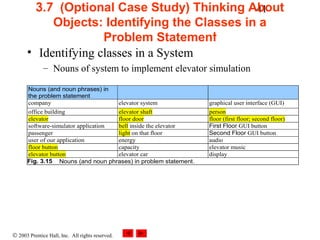
– Nouns of system to implement elevator simulation
Nouns (and noun phrases) in
the problem statement
company elevator system graphical user interface (GUI)
office building elevator shaft person
elevator floor door floor (first floor; second floor)
software-simulator application bell inside the elevator First Floor GUI button
passenger light on that floor Second Floor GUI button
user of our application energy audio
floor button capacity elevator music
elevator button elevator car display
Fig. 3.15 Nouns (and noun phrases) in problem statement.
© 2003 Prentice Hall, Inc. All rights reserved.
423.7 (Optional Case Study) Thinking About
Objects: Identifying the Classes in a
Problem Statement
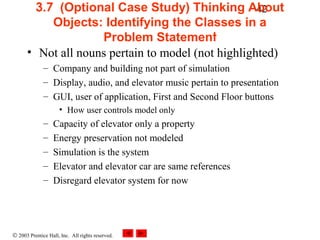
• Not all nouns pertain to model (not highlighted)
– Company and building not part of simulation
– Display, audio, and elevator music pertain to presentation
– GUI, user of application, First and Second Floor buttons
• How user controls model only
– Capacity of elevator only a property
– Energy preservation not modeled
– Simulation is the system
– Elevator and elevator car are same references
– Disregard elevator system for now
© 2003 Prentice Hall, Inc. All rights reserved.
433.7 (Optional Case Study) Thinking About
Objects: Identifying the Classes in a
Problem Statement
• Nouns highlighted to be implemented in system
– Elevator button and floor button separate functions
– Capitalize class names
• Each separate word in class name also capitalized
• ElevatorShaft, Elevator, Person, Floor,
ElevatorDoor, FloorDoor, ElevatorButton,
FloorButton, Bell, and Light
© 2003 Prentice Hall, Inc. All rights reserved.
443.7 (Optional Case Study) Thinking About
Objects: Identifying the Classes in a
Problem Statement
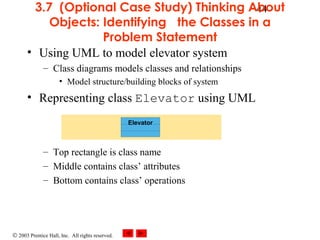
• Using UML to model elevator system
– Class diagrams models classes and relationships
• Model structure/building blocks of system
• Representing class Elevator using UML
– Top rectangle is class name
– Middle contains class’ attributes
– Bottom contains class’ operations
Elevator
© 2003 Prentice Hall, Inc. All rights reserved.
453.7 (Optional Case Study) Thinking About
Objects: Identifying the Classes in a
Problem Statement
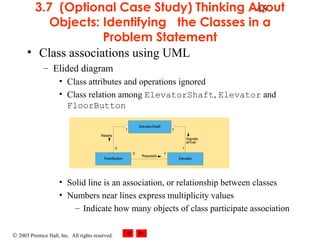
• Class associations using UML
– Elided diagram
• Class attributes and operations ignored
• Class relation among ElevatorShaft, Elevator and
FloorButton
• Solid line is an association, or relationship between classes
• Numbers near lines express multiplicity values
– Indicate how many objects of class participate association
Requests
1
1 1
2
2
ElevatorShaft
FloorButton Elevator
1
Resets
Signals
arrival
© 2003 Prentice Hall, Inc. All rights reserved.
463.7 (Optional Case Study) Thinking About
Objects: Identifying the Classes in a
Problem Statement
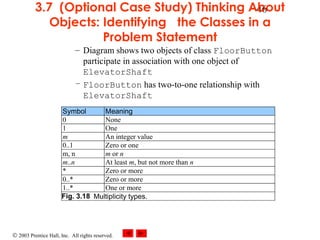
– Diagram shows two objects of class FloorButton
participate in association with one object of
ElevatorShaft
– FloorButton has two-to-one relationship with
ElevatorShaft
Symbol Meaning
0 None
1 One
m An integer value
0..1 Zero or one
m, n m or n
m..n At least m, but not more than n
* Zero or more
0..* Zero or more
1..* One or more
Fig. 3.18 Multiplicity types.
© 2003 Prentice Hall, Inc. All rights reserved.
473.7 (Optional Case Study) Thinking About
Objects: Identifying the Classes in a
Problem Statement
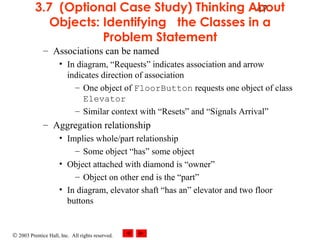
– Associations can be named
• In diagram, “Requests” indicates association and arrow
indicates direction of association
– One object of FloorButton requests one object of class
Elevator
– Similar context with “Resets” and “Signals Arrival”
– Aggregation relationship
• Implies whole/part relationship
– Some object “has” some object
• Object attached with diamond is “owner”
– Object on other end is the “part”
• In diagram, elevator shaft “has an” elevator and two floor
buttons
© 2003 Prentice Hall, Inc. All rights reserved.
483.7 (Optional Case Study) Thinking About
Objects: Identifying the Classes in a
Problem Statement
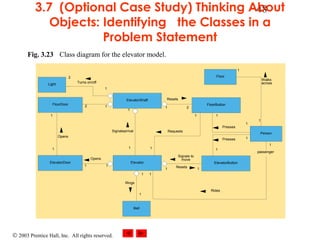
Fig. 3.23 Class diagram for the elevator model.
1
1
1
1 22
1
1
1
1 1
1
1
1
1
2
1
1
1
1
1
Person
FloorDoor
Light
Floor
ElevatorShaft
FloorButton
ElevatorDoor Elevator ElevatorButton
Bell
Requests
Presses
Presses
Rides
Signals to
move
Resets
Resets
Walks
across
Opens
Opens
1
Rings
Turns on/off
Signalsarrival
1
1
1
1
passenger
© 2003 Prentice Hall, Inc. All rights reserved.
493.7 (Optional Case Study) Thinking About
Objects: Identifying the Classes in a
Problem Statement
• The complete class diagram for elevator model
– Several of many and aggregates
• Elevator is aggregation of ElevatorDoor,
ElevatorButton and Bell
– Several of many associations
• Person “presses” buttons
• Person also “rides” Elevator and “walks” across Floor

Introduction to Java Applets

  • 1.
    © 2003 PrenticeHall, Inc. All rights reserved. 1 Chapter 3 - Introduction to Java Applets Outline 3.1 Introduction 3.2 Sample Applets from the Java 2 Software Development Kit 3.3 Simple Java Applet: Drawing a String 3.4 Drawing Strings and Lines 3.5 Adding Floating-Point Numbers 3.6 Java Applet Internet and World Wide Web Resources 3.7 (Optional Case Study) Thinking About Objects: Identifying the Classes in a Problem Statement
  • 2.
    © 2003 PrenticeHall, Inc. All rights reserved. 2 3.1 Introduction • Applet – Program that runs in • appletviewer (test utility for applets) • Web browser (IE, Communicator) – Executes when HTML (Hypertext Markup Language) document containing applet is opened and downloaded – Applications run in command windows • Notes – Mimic several features of Chapter 2 to reinforce them – Focus on fundamental programming concepts first • Explanations will come later
  • 3.
    © 2003 PrenticeHall, Inc. All rights reserved. 3 3.2 Sample Applets from the Java 2 Software Development Kit • Sample Applets – Provided in Java 2 Software Development Kit (J2SDK) – Source code included (.java files) • Study and mimic source code to learn new features • All programmers begin by mimicking existing programs – Located in demo directory of J2SDK install – Can download demos and J2SDK from java.sun.com/j2se/1.4.1/
  • 4.
    © 2003 PrenticeHall, Inc. All rights reserved. 4 3.2 Sample Applets from the Java 2 Software Development Kit • Running applets – In command prompt, change to demo subdirectory of applet cd c:j2sdk1.4.1demoapplets cd appletDirectoryName – There will be an HTML file used to execute applet – Type appletviewer example1.html • appletviewer loads the html file specified as its command- line argument • From the HTML file, determines which applet to load (more section 3.3) – Applet will run, Reload and Quit commands under Applet menu
  • 5.
    © 2003 PrenticeHall, Inc. All rights reserved. 5 3.2 Sample Applets from the Java 2 Software Development Kit • You start as player "X" Fig. 3.2 Sample execution of applet TicTacToe.
  • 6.
    © 2003 PrenticeHall, Inc. All rights reserved. 6 3.2 Sample Applets from the Java 2 Software Development Kit Fig. 3.4 Sample execution of applet DrawTest. Drag the mouse pointer in the white area to draw. Select the drawing color by clicking the circle for the color you want. These GUI components are commonly known as radio buttons. Select the shape to draw by clicking the down arrow, then clicking Lines or Points. This GUI component is commonly known as a combo box, choice or drop-down list.
  • 7.
    © 2003 PrenticeHall, Inc. All rights reserved. 7 3.2 Sample Applets from the Java 2 Software Development Kit • Demonstrates 2D drawing capabilities built into Java2 Click a tab to select a two- dimensional graphics demo. Try changing the options to see their effect on the demonstration.
  • 8.
    © 2003 PrenticeHall, Inc. All rights reserved. 8 3.3 Simple Java Applet: Drawing a String • Now, create applets of our own – Take a while before we can write applets like in the demos – Cover many of same techniques • Upcoming program – Create an applet to display "Welcome to Java Programming!" – Show applet and HTML file, then discuss them line by line
  • 9.
    © 2003 PrenticeHall, Inc. All rights reserved. Outline 9 Java applet Program Output 1 // Fig. 3.6: WelcomeApplet.java 2 // A first applet in Java. 3 4 // Java packages 5 import java.awt.Graphics; // import class Graphics 6 import javax.swing.JApplet; // import class JApplet 7 8 public class WelcomeApplet extends JApplet { 9 10 // draw text on applet’s background 11 public void paint( Graphics g ) 12 { 13 // call superclass version of method paint 14 super.paint( g ); 15 16 // draw a String at x-coordinate 25 and y-coordinate 25 17 g.drawString( "Welcome to Java Programming!", 25, 25 ); 18 19 } // end method paint 20 21 } // end class WelcomeApplet import allows us to use predefined classes (allowing us to use applets and graphics, in this case). extends allows us to inherit the capabilities of class JApplet. Method paint is guaranteed to be called in all applets. Its first line must be defined as above.
  • 10.
    © 2003 PrenticeHall, Inc. All rights reserved. 10 3.3 Simple Java Applet: Drawing a String – Comments • Name of source code and description of applet – Import predefined classes grouped into packages • import declarations tell compiler where to locate classes used • When you create applets, import the JApplet class (package javax.swing) • import the Graphics class (package java.awt) to draw graphics – Can draw lines, rectangles ovals, strings of characters • import specifies directory structure 5 import java.awt.Graphics; // import class Graphics 6 import javax.swing.JApplet; // import class JApplet 1 // Fig. 3.6: WelcomeApplet.java 2 // A first applet in Java.
  • 11.
    © 2003 PrenticeHall, Inc. All rights reserved. 11 3.3 Simple Java Applet: Drawing a String – Applets have at least one class declaration (like applications) • Rarely create classes from scratch – Use pieces of existing classes – Inheritance - create new classes from old ones (ch. 9) – Begins class declaration for class WelcomeApplet • Keyword class then class name – extends followed by class name • Indicates class to extend (JApplet) – JApplet : superclass (base class) – WelcomeApplet : subclass (derived class) • WelcomeApplet now has methods and data of JApplet 8 public class WelcomeApplet extends JApplet {
  • 12.
    © 2003 PrenticeHall, Inc. All rights reserved. 12 3.3 Simple Java Applet: Drawing a String – Class JApplet defined for us • Someone else defined "what it means to be an applet" – Applets require over 200 methods! • extends JApplet – Inherit methods, do not have to declare them all • Do not need to know every detail of class JApplet 8 public class WelcomeApplet extends JApplet {
  • 13.
    © 2003 PrenticeHall, Inc. All rights reserved. 13 3.3 Simple Java Applet: Drawing a String – Class WelcomeApplet is a blueprint • appletviewer or browser creates an object of class WelcomeApplet – Keyword public required – File can only have one public class – public class name must be file name 8 public class WelcomeApplet extends JApplet {
  • 14.
    © 2003 PrenticeHall, Inc. All rights reserved. 14 3.3 Simple Java Applet: Drawing a String – Our class inherits method paint from JApplet • By default, paint has empty body • Override (redefine) paint in our class – Methods paint, init, and start • Guaranteed to be called automatically • Our applet gets "free" version of these by inheriting from JApplet – Free versions have empty body (do nothing) – Every applet does not need all three methods • Override the ones you need – Applet container “draws itself” by calling method paint 11 public void paint( Graphics g )
  • 15.
    © 2003 PrenticeHall, Inc. All rights reserved. 15 3.3 Simple Java Applet: Drawing a String – Method paint • Lines 11-19 are the declaration of paint • Draws graphics on screen • void indicates paint returns nothing when finishes task • Parenthesis define parameter list - where methods receive data to perform tasks – Normally, data passed by programmer, as in JOptionPane.showMessageDialog • paint gets parameters automatically – Graphics object used by paint • Mimic paint's first line 11 public void paint( Graphics g )
  • 16.
    © 2003 PrenticeHall, Inc. All rights reserved. 16 3.3 Simple Java Applet: Drawing a String – Calls version of method paint from superclass JApplet – Should be first statement in every applet’s paint method – Body of paint • Method drawString (of class Graphics) • Called using Graphics object g and dot (.) • Method name, then parenthesis with arguments – First argument: String to draw – Second: x coordinate (in pixels) location – Third: y coordinate (in pixels) location – Java coordinate system • Measured in pixels (picture elements) • Upper left is (0,0) 14 super.paint( g ); 17 g.drawString( "Welcome to Java Programming!", 25, 25 );
  • 17.
    © 2003 PrenticeHall, Inc. All rights reserved. 17 3.3 Simple Java Applet: Drawing a String • Running the applet – Compile • javac WelcomeApplet.java • If no errors, bytecodes stored in WelcomeApplet.class – Create an HTML file • Loads the applet into appletviewer or a browser • Ends in .htm or .html – To execute an applet • Create an HTML file indicating which applet the browser (or appletviewer) should load and execute
  • 18.
    © 2003 PrenticeHall, Inc. All rights reserved. 18 3.3 Simple Java Applet: Drawing a String – Simple HTML file (WelcomeApplet.html) • Usually in same directory as .class file • Remember, .class file created after compilation – HTML codes (tags) • Usually come in pairs • Begin with < and end with > – Lines 1 and 4 - begin and end the HTML tags – Line 2 - begins <applet> tag • Specifies code to use for applet • Specifies width and height of display area in pixels – Line 3 - ends <applet> tag 1 <html> 2 <applet code = "WelcomeApplet.class" width = "300" height = "45"> 3 </applet> 4 </html>
  • 19.
    © 2003 PrenticeHall, Inc. All rights reserved. 19 3.3 Simple Java Applet: Drawing a String – appletviewer only understands <applet> tags • Ignores everything else • Minimal browser – Executing the applet • appletviewer WelcomeApplet.html • Perform in directory containing .class file 1 <html> 2 <applet code = "WelcomeApplet.class" width = "300" height = "45"> 3 </applet> 4 </html>
  • 20.
    © 2003 PrenticeHall, Inc. All rights reserved. 20 3.3 Simple Java Applet: Drawing a String • Running the applet in a Web browser
  • 21.
    © 2003 PrenticeHall, Inc. All rights reserved. 21 3.4 Drawing Strings and Lines • More applets – First example • Display two lines of text • Use drawString to simulate a new line with two drawString statements – Second example • Method g.drawLine(x1, y1, x2, y2 ) – Draws a line from (x1, y1) to (x2, y2) – Remember that (0, 0) is upper left • Use drawLine to draw a line beneath and above a string
  • 22.
    © 2003 PrenticeHall, Inc. All rights reserved. Outline 22 1 // Fig. 3.9: WelcomeApplet2.java 2 // Displaying multiple strings in an applet. 3 4 // Java packages 5 import java.awt.Graphics; // import class Graphics 6 import javax.swing.JApplet; // import class JApplet 7 8 public class WelcomeApplet2 extends JApplet { 9 10 // draw text on applet’s background 11 public void paint( Graphics g ) 12 { 13 // call superclass version of method paint 14 super.paint( g ); 15 16 // draw two Strings at different locations 17 g.drawString( "Welcome to", 25, 25 ); 18 g.drawString( "Java Programming!", 25, 40 ); 19 20 } // end method paint 21 22 } // end class WelcomeApplet2 WelcomeApplet2.j ava 1. import 2. Class WelcomeApplet2 (extends JApplet) 3. paint 3.1 drawString 3.2 drawString on same x coordinate, but 15 pixels down The two drawString statements simulate a newline. In fact, the concept of lines of text does not exist when drawing strings.
  • 23.
    © 2003 PrenticeHall, Inc. All rights reserved. Outline 23 HTML file Program Output 1 <html> 2 <applet code = "WelcomeApplet2.class" width = "300" height = "60"> 3 </applet> 4 </html>
  • 24.
    © 2003 PrenticeHall, Inc. All rights reserved. Outline 24 WelcomeLines.ja va 2. Class WelcomeLines (extends JApplet) 3. paint 3.1 drawLine 3.2 drawLine 3.3 drawString Program Output 1 // Fig. 3.11: WelcomeLines.java 2 // Displaying text and lines 3 4 // Java packages 5 import java.awt.Graphics; // import class Graphics 6 import javax.swing.JApplet; // import class JApplet 7 8 public class WelcomeLines extends JApplet { 9 10 // draw lines and a string on applet’s background 11 public void paint( Graphics g ) 12 { 13 // call superclass version of method paint 14 super.paint( g ); 15 16 // draw horizontal line from (15, 10) to (210, 10) 17 g.drawLine( 15, 10, 210, 10 ); 18 19 // draw horizontal line from (15, 30) to (210, 30) 20 g.drawLine( 15, 30, 210, 30 ); 21 22 // draw String between lines at location (25, 25) 23 g.drawString( "Welcome to Java Programming!", 25, 25 ); 24 25 } // end method paint 26 27 } // end class WelcomeLines Draw horizontal lines with drawLine (endpoints have same y coordinate).
  • 25.
    © 2003 PrenticeHall, Inc. All rights reserved. Outline 25 HTML file 1 <html> 2 <applet code = "WelcomeLines.class" width = "300" height = "40"> 3 </applet> 4 </html>
  • 26.
    © 2003 PrenticeHall, Inc. All rights reserved. 26 3.4 Drawing Strings and Lines • Method drawLine of class Graphics – Takes as arguments Graphics object and line’s end points – X and y coordinate of first endpoint – X and y coordinate of second endpoint
  • 27.
    © 2003 PrenticeHall, Inc. All rights reserved. 27 3.5 Adding Floating-Point Numbers • Next applet – Mimics application for adding two integers (Fig 2.9) • This time, use floating point numbers (numbers with a decimal point) – Using primitive types • double – double precision floating-point numbers • float – single precision floating-point numbers – Show program, then discuss
  • 28.
    © 2003 PrenticeHall, Inc. All rights reserved. Outline 28 AdditionApplet. java 1. import 2. Class AdditionApplet (extends JApplet) 3. Fields 4. init 4.1 Declare variables 4.2 showInputDialog 4.3 parseDouble 2 // Adding two floating-point numbers 3 import java.awt.Graphics; // import class Graphics 5 6 public class AdditionApplet extends JApplet { 7 double sum; // sum of the values entered by the user 8 9 public void init() 10 { 11 String firstNumber, // first string entered by user 12 secondNumber; // second string entered by user 13 double number1, // first number to add 14 number2; // second number to add 15 16 // read in first number from user 17 firstNumber = 18 JOptionPane.showInputDialog( 19 "Enter first floating-point value" ); 20 21 // read in second number from user 22 secondNumber = 23 JOptionPane.showInputDialog( 24 "Enter second floating-point value" ); 25 1 // Fig. 3.13: AdditionApplet.java 2 // Adding two floating-point numbers. 3 4 // Java packages 5 import java.awt.Graphics; // import class Graphics 6 import javax.swing.*; // import package javax.swing 7 8 public class AdditionApplet extends JApplet { 9 double sum; // sum of values entered by user 10 11 // initialize applet by obtaining values from user 12 public void init() 13 { 14 String firstNumber; // first string entered by user 15 String secondNumber; // second string entered by user 16 17 double number1; // first number to add 18 double number2; // second number to add 19 20 // obtain first number from user 21 firstNumber = JOptionPane.showInputDialog( 22 "Enter first floating-point value" ); 23 24 // obtain second number from user 25 secondNumber = JOptionPane.showInputDialog( 26 "Enter second floating-point value" ); 27 28 // convert numbers from type String to type double 29 number1 = Double.parseDouble( firstNumber ); 30 number2 = Double.parseDouble( secondNumber ); 31 * allows any class in the package to be used. Field sum may be used anywhere in the class, even in other methods. Type double can store floating point numbers.
  • 29.
    © 2003 PrenticeHall, Inc. All rights reserved. Outline 29 5. Draw applet contents 5.1 Draw a rectangle 5.2 Draw the results HTML file 31 // add the numbers 32 sum = number1 + number2; 33 } 34 35 public void paint( Graphics g ) 36 { 37 // draw the results with g.drawString 38 g.drawRect( 15, 10, 270, 20 ); 39 g.drawString( "The sum is " + sum, 25, 25 ); 40 } 41 } 1 <html> 2 <applet code="AdditionApplet.class" width=300 height=50> 3 </applet> 4 </html> 32 // add numbers 33 sum = number1 + number2; 34 35 } // end method init 36 37 // draw results in a rectangle on applet’s background 38 public void paint( Graphics g ) 39 { 40 // call superclass version of method paint 41 super.paint( g ); 42 43 // draw rectangle starting from (15, 10) that is 270 44 // pixels wide and 20 pixels tall 45 g.drawRect( 15, 10, 270, 20 ); 46 47 // draw results as a String at (25, 25) 48 g.drawString( "The sum is " + sum, 25, 25 ); 49 50 } // end method paint 51 52 } // end class AdditionApplet 1 <html> 2 <applet code = "AdditionApplet.class" width = "300" height = "65"> 3 </applet> 4 </html> drawRect takes the upper left coordinate, width, and height of the rectangle to draw.
  • 30.
    © 2003 PrenticeHall, Inc. All rights reserved. Outline 30 Program Output
  • 31.
    © 2003 PrenticeHall, Inc. All rights reserved. 31 3.5 Adding Floating-Point Numbers – Lines 1-2: Comments – Line 5: imports class Graphics • import not needed if use full package and class name public void paint ( java.awt.Graphics g ) – Line 8: specify entire javax.swing package • * indicates all classes in javax.swing are available – Includes JApplet and JOptionPane – Use JOptionPane instead of javax.swing.JOptionPane • * does not not load all classes – Compiler only loads classes it uses 5 import java.awt.Graphics; // import class Graphics 6 import javax.swing.*; // import package javax.swing
  • 32.
    © 2003 PrenticeHall, Inc. All rights reserved. 32 3.5 Adding Floating-Point Numbers – Begin class declaration • Extend JApplet, imported from package javax.swing – Field declaration • Each object of class gets own copy of the field • Declared in body of class, but not inside methods – Variables declared in methods are local variables – Can only be used in body of method • Fields can be used anywhere in class • Have default value (0.0 in this case) 8 public class AdditionApplet extends JApplet { 9 double sum; // sum of values entered by user
  • 33.
    © 2003 PrenticeHall, Inc. All rights reserved. 33 3.5 Adding Floating-Point Numbers – Primitive type double • Used to store floating point (decimal) numbers – Method init • Normally initializes fields and applet class • Guaranteed to be first method called in applet • First line must always appear as above – Returns nothing (void), takes no arguments – Begins body of method init 9 double sum; // sum of values entered by user 12 public void init() 13 {
  • 34.
    © 2003 PrenticeHall, Inc. All rights reserved. 34 3.5 Adding Floating-Point Numbers – Declare variables – Two types of variables • Reference variables (called references) – Refer to objects (contain location in memory) • Objects defined in a class definition • Can contain multiple data and methods – paint receives a reference called g to a Graphics object – Reference used to call methods on the Graphics object • Primitive types (called variables) – Contain one piece of data 14 String firstNumber; // first string entered by user 15 String secondNumber; // second string entered by user 16 17 double number1; // first number to add 18 double number2; // second number to add
  • 35.
    © 2003 PrenticeHall, Inc. All rights reserved. 35 3.5 Adding Floating-Point Numbers – Distinguishing references and variables • If type is a class name, then reference – String is a class – firstNumber, secondNumber • If type a primitive type, then variable – double is a primitive type – number1, number2 14 String firstNumber; // first string entered by user 15 String secondNumber; // second string entered by user 16 17 double number1; // first number to add 18 double number2; // second number to add
  • 36.
    © 2003 PrenticeHall, Inc. All rights reserved. 36 3.5 Adding Floating-Point Numbers • Method JOptionPane.showInputDialog • Prompts user for input with string • Enter value in text field, click OK – If not of correct type, error occurs – In Chapter 15 learn how to deal with this • Returns string user inputs • Assignment statement to string – Lines 25-26: As above, assigns input to secondNumber 21 firstNumber = JOptionPane.showInputDialog( 22 "Enter first floating-point value" );
  • 37.
    © 2003 PrenticeHall, Inc. All rights reserved. 37 3.5 Adding Floating-Point Numbers – static method Double.parseDouble • Converts String argument to a double • Returns the double value • Remember static method syntax – ClassName.methodName( arguments ) – Assignment statement • sum an field, can use anywhere in class – Not defined in init but still used 33 sum = number1 + number2; 29 number1 = Double.parseDouble( firstNumber ); 30 number2 = Double.parseDouble( secondNumber );
  • 38.
    © 2003 PrenticeHall, Inc. All rights reserved. 38 3.5 Adding Floating-Point Numbers – Ends method init • appletviewer (or browser) calls inherited method start • start usually used with multithreading – Advanced concept, in Chapter 16 – We do not declare it, so empty declaration in JApplet used • Next, method paint called – Method drawRect( x1, y1, width, height ) • Draw rectangle, upper left corner (x1, y1), specified width and height • Line 45 draws rectangle starting at (15, 10) with a width of 270 pixels and a height of 20 pixels 35 } // end method init 45 g.drawRect( 15, 10, 270, 20 );
  • 39.
    © 2003 PrenticeHall, Inc. All rights reserved. 39 3.5 Adding Floating-Point Numbers – Sends drawString message (calls method) to Graphics object using reference g • "The sum is" + sum - string concatenation – sum converted to a string • sum can be used, even though not defined in paint – field, can be used anywhere in class – Non-local variable 48 g.drawString( "The sum is " + sum, 25, 25 );
  • 40.
    © 2003 PrenticeHall, Inc. All rights reserved. 40 3.6 Java Applet Internet and World Wide Web Resources • Many Java applet resources available – java.sun.com/applets/ – Many resources and free applets • Has demo applets from J2SDK – Sun site developer.java.sun.com/developer • Tech support, discussion forums, training, articles, links, etc. • Registration required – www.jars.com • Rates applets, top 1, 5 and 25 percent • View best applets on web
  • 41.
    © 2003 PrenticeHall, Inc. All rights reserved. 413.7 (Optional Case Study) Thinking About Objects: Identifying the Classes in a Problem Statement • Identifying classes in a System – Nouns of system to implement elevator simulation Nouns (and noun phrases) in the problem statement company elevator system graphical user interface (GUI) office building elevator shaft person elevator floor door floor (first floor; second floor) software-simulator application bell inside the elevator First Floor GUI button passenger light on that floor Second Floor GUI button user of our application energy audio floor button capacity elevator music elevator button elevator car display Fig. 3.15 Nouns (and noun phrases) in problem statement.
  • 42.
    © 2003 PrenticeHall, Inc. All rights reserved. 423.7 (Optional Case Study) Thinking About Objects: Identifying the Classes in a Problem Statement • Not all nouns pertain to model (not highlighted) – Company and building not part of simulation – Display, audio, and elevator music pertain to presentation – GUI, user of application, First and Second Floor buttons • How user controls model only – Capacity of elevator only a property – Energy preservation not modeled – Simulation is the system – Elevator and elevator car are same references – Disregard elevator system for now
  • 43.
    © 2003 PrenticeHall, Inc. All rights reserved. 433.7 (Optional Case Study) Thinking About Objects: Identifying the Classes in a Problem Statement • Nouns highlighted to be implemented in system – Elevator button and floor button separate functions – Capitalize class names • Each separate word in class name also capitalized • ElevatorShaft, Elevator, Person, Floor, ElevatorDoor, FloorDoor, ElevatorButton, FloorButton, Bell, and Light
  • 44.
    © 2003 PrenticeHall, Inc. All rights reserved. 443.7 (Optional Case Study) Thinking About Objects: Identifying the Classes in a Problem Statement • Using UML to model elevator system – Class diagrams models classes and relationships • Model structure/building blocks of system • Representing class Elevator using UML – Top rectangle is class name – Middle contains class’ attributes – Bottom contains class’ operations Elevator
  • 45.
    © 2003 PrenticeHall, Inc. All rights reserved. 453.7 (Optional Case Study) Thinking About Objects: Identifying the Classes in a Problem Statement • Class associations using UML – Elided diagram • Class attributes and operations ignored • Class relation among ElevatorShaft, Elevator and FloorButton • Solid line is an association, or relationship between classes • Numbers near lines express multiplicity values – Indicate how many objects of class participate association Requests 1 1 1 2 2 ElevatorShaft FloorButton Elevator 1 Resets Signals arrival
  • 46.
    © 2003 PrenticeHall, Inc. All rights reserved. 463.7 (Optional Case Study) Thinking About Objects: Identifying the Classes in a Problem Statement – Diagram shows two objects of class FloorButton participate in association with one object of ElevatorShaft – FloorButton has two-to-one relationship with ElevatorShaft Symbol Meaning 0 None 1 One m An integer value 0..1 Zero or one m, n m or n m..n At least m, but not more than n * Zero or more 0..* Zero or more 1..* One or more Fig. 3.18 Multiplicity types.
  • 47.
    © 2003 PrenticeHall, Inc. All rights reserved. 473.7 (Optional Case Study) Thinking About Objects: Identifying the Classes in a Problem Statement – Associations can be named • In diagram, “Requests” indicates association and arrow indicates direction of association – One object of FloorButton requests one object of class Elevator – Similar context with “Resets” and “Signals Arrival” – Aggregation relationship • Implies whole/part relationship – Some object “has” some object • Object attached with diamond is “owner” – Object on other end is the “part” • In diagram, elevator shaft “has an” elevator and two floor buttons
  • 48.
    © 2003 PrenticeHall, Inc. All rights reserved. 483.7 (Optional Case Study) Thinking About Objects: Identifying the Classes in a Problem Statement Fig. 3.23 Class diagram for the elevator model. 1 1 1 1 22 1 1 1 1 1 1 1 1 1 2 1 1 1 1 1 Person FloorDoor Light Floor ElevatorShaft FloorButton ElevatorDoor Elevator ElevatorButton Bell Requests Presses Presses Rides Signals to move Resets Resets Walks across Opens Opens 1 Rings Turns on/off Signalsarrival 1 1 1 1 passenger
  • 49.
    © 2003 PrenticeHall, Inc. All rights reserved. 493.7 (Optional Case Study) Thinking About Objects: Identifying the Classes in a Problem Statement • The complete class diagram for elevator model – Several of many and aggregates • Elevator is aggregation of ElevatorDoor, ElevatorButton and Bell – Several of many associations • Person “presses” buttons • Person also “rides” Elevator and “walks” across Floor