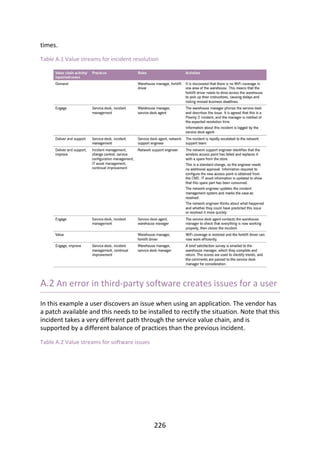
ITIL®	Foundation
ITIL	4	Edition
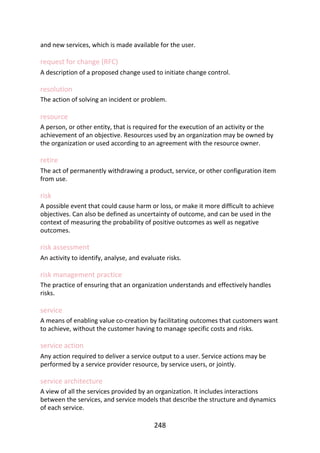
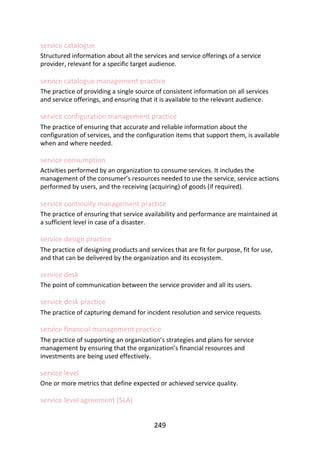
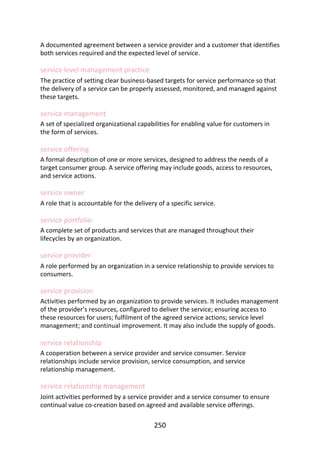
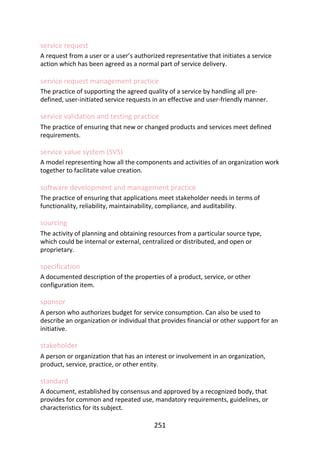
2
Published	by	TSO	(The	Stationery	Office),	part	of	Williams	Lea,	and	available	from:
Online
www.tsoshop.co.uk
Mail,	Telephone,	Fax	&	E-mail
TSO
PO	Box	29,	Norwich,	NR3	1GN
Telephone	orders/General	enquiries:	0333	202	5070
Fax	orders:	0333	202	5080
E-mail:	customer.services@tso.co.uk
Textphone	0333	202	5077
TSO@Blackwell	and	other	Accredited	Agents
AXELOS
Full	details	on	how	to	contact	AXELOS	can	be	found	at:
https://www.axelos.com
For	further	information	on	qualifications	and	training	accreditation,	please	visit:
https://www.axelos.com/certifications
https://www.axelos.com/archived-pages/becoming-an-axelos-partner/training-organization-
and-trainer-accreditation
For	all	other	enquiries,	please	email:	ask@axelos.com
Copyright	©	AXELOS	Limited	2019
All	rights	reserved.	No	part	of	this	publication	may	be	reproduced	in	any	form	or	by	any	means
without	permission	in	writing	from	AXELOS	Limited.
Applications	to	reuse,	reproduce	or	republish	material	in	this	publication	should	be	sent	to	the
licensing	team	at:	licensing@AXELOS.com
Registered	office	address:	30	Berners	Street,	London,	England,	W1T	3LR
AXELOS,	the	AXELOS	logo,	the	AXELOS	swirl	logo,	ITIL®,	MoP®,	M_o_R®,	MoV®,	MSP®,	P3M3®,
P3O®,	PRINCE2®,	PRINCE2	Agile®,	and	RESILIA®	are	registered	trade	marks	of	AXELOS	Limited.
AgileSHIFT™	is	a	trade	mark	of	AXELOS	Limited.
First	edition	2019
Second	impression	2019
3
ISBN	9780113316076
Printed	in	the	United	Kingdom	for	The	Stationery	Office
Material	is	FSC	certified	and	produced	using	ECF	pulp,	sourced	from	fully	sustainable	forests.
P002959377			c10			02/19
4
1
1.1
1.2
1.3
1.3.1
1.3.2
2
2.1
2.1.1
2.2
2.2.1
2.2.2
2.2.3
2.3
2.3.1
2.3.2
2.4
2.4.1
2.5
2.5.1
2.5.2
2.5.3
2.5.4
2.6
3
3.1
3.2
3.3
3.4
3.4.1
Contents
Welcome	to	ITIL	4
About	this	publication
Introduction
IT	service	management	in	the	modern	world
About	ITIL	4
The	structure	and	benefits	of	the	ITIL	4	framework
The	ITIL	SVS
The	four	dimensions	model
Key	concepts	of	service	management
Value	and	value	co-creation
Value	co-creation
Organizations,	service	providers,	service	consumers,	and	other
stakeholders
Service	providers
Service	consumers
Other	stakeholders
Products	and	services
Configuring	resources	for	value	creation
Service	offerings
Service	relationships
The	service	relationship	model
Value:	outcomes,	costs,	and	risks
Outcomes
Costs
Risks
Utility	and	warranty
Summary
The	four	dimensions	of	service	management
Organizations	and	people
Information	and	technology
Partners	and	suppliers
Value	streams	and	processes
Value	streams	for	service	management
5
3.4.2
3.5
3.6
4
4.1
4.2
4.3
4.3.1
4.3.2
4.3.3
4.3.4
4.3.5
4.3.6
4.3.7
4.3.8
4.4
4.4.1
4.4.2
4.5
4.5.1
4.5.2
4.5.3
4.5.4
4.5.5
4.5.6
4.6
4.6.1
4.6.2
4.7
4.8
5
5.1
5.1.1
5.1.2
5.1.3
5.1.4
5.1.5
5.1.6
Processes
External	factors
Summary
The	ITIL	service	value	system
Service	value	system	overview
Opportunity,	demand,	and	value
The	ITIL	guiding	principles
Focus	on	value
Start	where	you	are
Progress	iteratively	with	feedback
Collaborate	and	promote	visibility
Think	and	work	holistically
Keep	it	simple	and	practical
Optimize	and	automate
Principle	interaction
Governance
Governing	bodies	and	governance
Governance	in	the	SVS
Service	value	chain
Plan
Improve
Engage
Design	and	transition
Obtain/build
Deliver	and	support
Continual	improvement
Steps	of	the	continual	improvement	model
Continual	improvement	and	the	guiding	principles
Practices
Summary
ITIL	management	practices
General	management	practices
Architecture	management
Continual	improvement
Information	security	management
Knowledge	management
Measurement	and	reporting
Organizational	change	management
6
5.1.7
5.1.8
5.1.9
5.1.10
5.1.11
5.1.12
5.1.13
5.1.14
5.2
5.2.1
5.2.2
5.2.3
5.2.4
5.2.5
5.2.6
5.2.7
5.2.8
5.2.9
5.2.10
5.2.11
5.2.12
5.2.13
5.2.14
5.2.15
5.2.16
5.2.17
5.3
5.3.1
5.3.2
5.3.3
Portfolio	management
Project	management
Relationship	management
Risk	management
Service	financial	management
Strategy	management
Supplier	management
Workforce	and	talent	management
Service	management	practices
Availability	management
Business	analysis
Capacity	and	performance	management
Change	control
Incident	management
IT	asset	management
Monitoring	and	event	management
Problem	management
Release	management
Service	catalogue	management
Service	configuration	management
Service	continuity	management
Service	design
Service	desk
Service	level	management
Service	request	management
Service	validation	and	testing
Technical	management	practices
Deployment	management
Infrastructure	and	platform	management
Software	development	and	management
End	note:	The	ITIL	story,	one	year	on
Appendix	A:	Examples	of	value	streams
Further	research
Glossary
Acknowledgements
7
Welcome	to	ITIL	4
At	this	new	stage	in	the	development	of	the	IT	industry,	AXELOS	is	delighted	to
present	ITIL	4,	the	latest	step	in	the	evolution	of	IT	best	practice.	By	building	on	our
experience	and	bringing	fresh	and	forward-looking	thinking	to	the	marketplace,	ITIL
4	equips	your	business	to	deal	with	the	challenges	currently	faced	by	the	industry.
The	adoption	of	ITIL	as	the	most	widely	used	guidance	in	the	world	on	IT	service
management	(ITSM)	will	continue	with	ITIL	4.	It	ensures	continuity	with	existing
ways	of	working	(where	service	management	is	already	successful)	by	integrating
modern	and	emerging	practices	with	established	and	proven	know-how.	ITIL	4	also
provides	guidance	on	these	new	methods	to	help	individuals	and	organizations	to
see	their	benefits	and	move	towards	using	them	with	confidence,	focus,	and
minimal	disruption.
ITIL	4’s	holistic	approach	raises	the	profile	of	service	management	in	organizations
and	industries,	setting	it	within	a	more	strategic	context.	Its	focus	tends	to	be	on
end-to-end	product	and	service	management,	from	demand	to	value.
ITIL	4	is	the	result	of	a	great	amount	of	global	research	and	development	work
across	the	IT	and	service	management	industries;	this	work	has	involved	active
practitioners,	trainers,	consultants,	vendors,	technicians,	and	business	customers.
The	architect	team	has	collaborated	with	the	wider	stakeholders	and	users	of	ITIL	to
ensure	that	the	content	meets	the	modern	requirements	of	continuity,	innovation,
flexibility,	and	value.
ITIL	training	provides	individuals	with	a	structured	approach	for	developing	their
competencies	in	the	current	and	future	workplace.	The	accompanying	guidance	also
helps	organizations	to	take	advantage	of	the	new	and	upcoming	technologies,
succeed	in	making	their	digital	transformations,	and	create	value	as	needed	for
themselves	and	their	customers.
ITIL	Foundation	is	the	beginning	of	your	ITIL	4	journey.	It	will	open	your	mind	to	the
wider,	more	advanced	guidance	provided	in	the	other	ITIL	publications	and	training
that	will	support	your	growth	and	development.
Welcome	to	the	new	generation	of	IT	best	practice!
8
Mark	Basham
CEO
AXELOS	Global	Best	Practice
9
•
•
•
About	this	publication
ITIL	Foundation	is	the	first	publication	of	ITIL	4,	the	latest	evolution	of	the	most
widely	adopted	guidance	for	ITSM.	Its	audience	ranges	from	IT	and	business
students	taking	their	first	steps	in	service	management	to	seasoned	professionals
familiar	with	earlier	versions	of	ITIL	and	other	sources	of	industry	best	practice.
ITIL	4	Foundation	will:
provide	readers	with	an	understanding	of	the	ITIL	4	service	management
framework	and	how	it	has	evolved	to	adopt	modern	technologies	and	ways	of
working
explain	the	concepts	of	the	service	management	framework	to	support
candidates	studying	for	the	ITIL	4	Foundation	exam
act	as	a	reference	guide	that	practitioners	can	use	in	their	work,	further	studies,
and	professional	development.
We	hope	you	will	find	it	useful.
About	the	ITIL	story
The	guidance	provided	in	this	publication	can	be	adopted	and	adapted	for	all	types
of	organization	and	service.	To	show	how	the	concepts	of	ITIL	can	be	practically
applied	to	an	organization’s	activities,	ITIL	Foundation	follows	the	exploits	of	a
fictional	company	on	its	ITIL	journey.
This	company,	Axle	Car	Hire,	is	undergoing	a	transformation	to	modernize	its
services	and	improve	its	customer	satisfaction	and	retention	levels,	and	is	using	ITIL
to	do	this.	In	each	chapter	of	the	text,	the	employees	of	Axle	will	describe	how	the
company	is	improving	its	services,	and	explain	how	they	are	using	ITIL	best	practice
to	do	this.
ITIL	storyline	sections	appear	throughout	the	text,	separated	by	a	distinct	border.
Axle	Car	Hire
Axle	Car	Hire	is	a	global	company,	with	its	headquarters	based	in	Seattle.	Axle	was
formed	10	years	ago,	and	currently	employs	approximately	400	staff	across	Europe,
the	US,	and	Asia-Pacific.
Initially,	the	company	experienced	strong	growth	and	consistently	high	customer
satisfaction	ratings.	For	the	first	six	years,	repeat	business	accounted	for	around	30
10
per	cent	of	all	bookings.	Shareholders	could	expect	handsome	quarterly	dividends.
However,	over	the	past	four	years,	the	company	has	experienced	a	downturn.
Customer	satisfaction	ratings	have	consistently	declined	and	repeat	bookings	are
rare.	Competitors	are	offering	new	and	innovative	options	to	traditional	vehicle
hire.	Car-pooling,	ride-share,	and	driverless	cars	are	big	draws.	Customers	have	also
come	to	expect	online	and	app	interfaces	as	standard	for	the	company’s	services.
In	this	evolving	market,	Axle	Car	Hire	faces	an	uncertain	future.	The	board	is	keen	to
improve	customer	satisfaction	levels.	They	want	to	attract	and	retain	customers,
and	improve	the	company’s	bottom	line.	They’ve	appointed	a	new	CIO,	Henri.	Henri
was	chosen	for	his	experience	in	digitalized	services	and	his	track	record	in
successful,	large-scale	IT	transformations.	He	understands	the	impact	of	digital
service	offerings,	not	only	for	customer	satisfaction	levels,	but	also	for	employee
retention	rates.
Henri’s	strong	background	in	ITIL	and	ITSM	means	that	he	values	ITIL	certification,
and	his	hiring	policy	reflects	this.	Having	worked	with	Design	Thinking,	DevOps,	and
Agile	methodologies,	he	believes	sustainable	business	requires	a	blended	approach
to	ITSM.
Henri	is	keen	to	see	how	his	team	can	redefine	the	car-hire	experience	and	ensure
that	Axle	Car	Hire	is	the	first	choice	for	new	and	existing	customers.
Meet	the	Axle	employees
Here	are	four	key	employees	of	Axle	Car	Hire:
Henri	Is	the	new	CIO	of	Axle	Car	Hire.	He	is	a	successful	business	executive	who’s
prepared	to	shake	things	up.	He	believes	in	an	integrated	approach	to	ITSM.
Su	Is	the	Axle	Car	Hire	product	manager	for	travel	experience,	and	has	worked	for
Axle	for	the	past	five	years.	Su	is	smart,	meticulous,	and	passionate	about	the
environment.
Radhika	Is	the	Axle	Car	Hire	IT	business	analyst,	and	it	is	her	job	to	understand	the
user	requirements	of	Axle	Car	Hire	staff	and	customers.	She	is	inquisitive	and
energetic,	and	strives	to	maintain	a	positive	relationship	with	all	her	customers,
both	internal	and	external.	Radhika	works	mostly	on	discovery	and	planning
activities,	rather	than	in	IT	operations.	She	asks	a	lot	of	questions	and	is	great	at
spotting	patterns	and	trends.
Marco	Is	the	Axle	Car	Hire	IT	delivery	manager.	He	is	process-driven	and	continually
references	the	ITIL	framework	to	help	him	manage	positive	service	relationships.
However,	Marco	has	had	little	exposure	to	a	blended	or	collaborative	approach	to
service	management.
11
CHAPTER	1
INTRODUCTION
12
1	Introduction
1.1	IT	service	management	in	the	modern	world
According	to	the	World	Trade	Organization,1
	services	comprise	the	largest	and	most
dynamic	component	of	both	developed	and	developing	economies.	Services	are	the
main	way	that	organizations	create	value	for	themselves	and	their	customers.
Almost	all	services	today	are	IT-enabled,	which	means	there	is	tremendous	benefit
for	organizations	in	creating,	expanding,	and	improving	their	IT	service	management
capability.
Technology	is	advancing	faster	today	than	ever	before.	Developments	such	as	cloud
computing,	infrastructure	as	a	service	(IaaS),	machine	learning,	and	blockchain	have
opened	fresh	opportunities	for	value	creation,	and	led	to	IT	becoming	an	important
business	driver	and	source	of	competitive	advantage.	In	turn,	this	positions	IT
service	management	as	a	key	strategic	capability.
To	ensure	that	they	remain	relevant	and	successful,	many	organizations	are
embarking	on	major	transformational	programmes	to	exploit	these	opportunities.
While	these	transformations	are	often	referred	to	as	‘digital’,	they	are	about	more
than	technology.	They	are	an	evolution	in	the	way	organizations	work,	so	that	they
can	flourish	in	the	face	of	significant	and	ongoing	change.	Organizations	must
balance	the	need	for	stability	and	predictability	with	the	rising	need	for	operational
agility	and	increased	velocity.	Information	and	technology	are	becoming	more
thoroughly	integrated	with	other	organizational	capabilities,	silos	are	breaking
down,	and	cross-functional	teams	are	being	utilized	more	widely.	Service
management	is	changing	to	address	and	support	this	organizational	shift	and	ensure
opportunities	from	new	technologies,	and	new	ways	of	working,	are	maximized.
Service	management	is	evolving,	and	so	is	ITIL,	the	most	widely	adopted	guidance
on	IT	service	management	(ITSM)	in	the	world.
1.2	About	ITIL	4
ITIL	has	led	the	ITSM	industry	with	guidance,	training,	and	certification	programmes
for	more	than	30	years.	ITIL	4	brings	ITIL	up	to	date	by	re-shaping	much	of	the
established	ITSM	practices	in	the	wider	context	of	customer	experience,	value
streams,	and	digital	transformation,	as	well	as	embracing	new	ways	of	working,	such
as	Lean,	Agile,	and	DevOps.
13
•
•
•
•
•
ITIL	4	provides	the	guidance	organizations	need	to	address	new	service
management	challenges	and	utilize	the	potential	of	modern	technology.	It	is
designed	to	ensure	a	flexible,	coordinated	and	integrated	system	for	the	effective
governance	and	management	of	IT-enabled	services.
1.3	The	structure	and	benefits	of	the	ITIL	4	framework
The	key	components	of	the	ITIL	4	framework	are	the	ITIL	service	value	system	(SVS)
and	the	four	dimensions	model.
1.3.1 	The	ITIL	SVS
The	ITIL	SVS	represents	how	the	various	components	and	activities	of	the
organization	work	together	to	facilitate	value	creation	through	IT-enabled	services.
These	can	be	combined	in	a	flexible	way,	which	requires	integration	and
coordination	to	keep	the	organization	consistent.	The	ITIL	SVS	facilitates	this
integration	and	coordination	and	provides	a	strong,	unified,	value-focused	direction
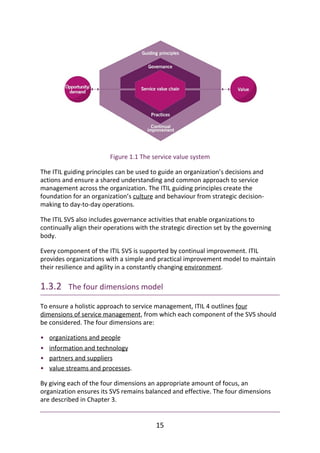
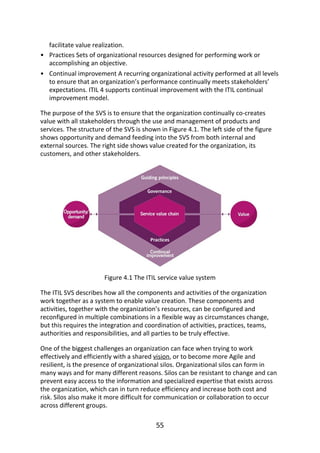
for	the	organization.	The	structure	of	the	ITIL	SVS	is	shown	in	Figure	1.1,	and	is
repeated	in	Chapter	4,	where	it	is	described	in	more	detail.
The	core	components	of	the	ITIL	SVS	are:
the	ITIL	service	value	chain
the	ITIL	practices
the	ITIL	guiding	principles
governance
continual	improvement.
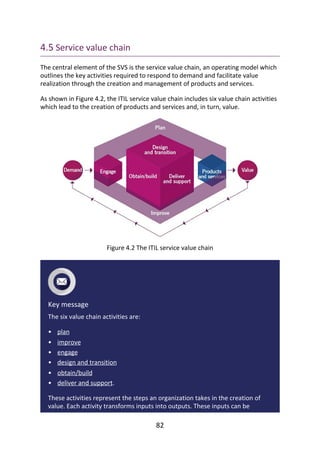
The	ITIL	service	value	chain	provides	an	operating	model	for	the	creation,	delivery,
and	continual	improvement	of	services.	It	is	a	flexible	model	that	defines	six	key
activities	that	can	be	combined	in	many	ways,	forming	multiple	value	streams.	The
service	value	chain	is	flexible	enough	to	be	adapted	to	multiple	approaches,
including	DevOps	and	centralized	IT,	to	address	the	need	for	multimodal	service
management.	The	adaptability	of	the	value	chain	enables	organizations	to	react	to
changing	demands	from	their	stakeholders	in	the	most	effective	and	efficient	ways.
The	flexibility	of	the	service	value	chain	is	further	enhanced	by	the	ITIL	practices.
Each	ITIL	practice	supports	multiple	service	value	chain	activities,	providing	a
comprehensive	and	versatile	toolset	for	ITSM	practitioners.
14
•
•
•
•
Figure	1.1	The	service	value	system
The	ITIL	guiding	principles	can	be	used	to	guide	an	organization’s	decisions	and
actions	and	ensure	a	shared	understanding	and	common	approach	to	service
management	across	the	organization.	The	ITIL	guiding	principles	create	the
foundation	for	an	organization’s	culture	and	behaviour	from	strategic	decision-
making	to	day-to-day	operations.
The	ITIL	SVS	also	includes	governance	activities	that	enable	organizations	to
continually	align	their	operations	with	the	strategic	direction	set	by	the	governing
body.
Every	component	of	the	ITIL	SVS	is	supported	by	continual	improvement.	ITIL
provides	organizations	with	a	simple	and	practical	improvement	model	to	maintain
their	resilience	and	agility	in	a	constantly	changing	environment.
1.3.2 	The	four	dimensions	model
To	ensure	a	holistic	approach	to	service	management,	ITIL	4	outlines	four
dimensions	of	service	management,	from	which	each	component	of	the	SVS	should
be	considered.	The	four	dimensions	are:
organizations	and	people
information	and	technology
partners	and	suppliers
value	streams	and	processes.
By	giving	each	of	the	four	dimensions	an	appropriate	amount	of	focus,	an
organization	ensures	its	SVS	remains	balanced	and	effective.	The	four	dimensions
are	described	in	Chapter	3.
15
The	ITIL	story:	The	CIO’s	vision	for	Axle
Henri:	These	days,	the	pace	of	industry	change	is	rapid,	with	the	term	‘Fourth
Industrial	Revolution’	now	widely	used.	Companies	such	as	Axle	are	competing
with	disruptors	that	include	driverless	cars	and	car	share.
Service	expectations	have	changed	since	Axle	was	created	10	years	ago.
Customers	want	immediate	access	to	services	via	apps	and	online	services.
Axle’s	booking	app	is	out	of	date,	and	our	technology	isn’t	keeping	pace	with
changes	in	our	service	offerings.
My	vision	for	Axle	is	that	we	become	the	most	recognized	car-hire	brand	in	the
world.	We’ll	continue	to	offer	outstanding	customer	service	while	maintaining
competitive	car-hire	rates.	After	all,	Axle	is	now	about	more	than	just	hiring	a
vehicle.	We	must	focus	on	our	customers’	whole	travel	experience.
Footnote:
1	https://www.wto.org/english/tratop_e/serv_e/serv_e.htm
16
CHAPTER	2
KEY	CONCEPTS	OF	SERVICE	MANAGEMENT
17
•
•
•
•
•
•
•
•
	
2	Key	concepts	of	service	management
A	shared	understanding	of	the	key	concepts	and	terminology	of	ITIL	by	organizations
and	individuals	is	critical	to	the	effective	use	of	this	guidance	to	address	real-world
service	management	challenges.	To	that	end,	this	chapter	explains	some	of	the	most
important	concepts	of	service	management,	including:
the	nature	of	value	and	value	co-creation
organizations,	service	providers,	service	consumers,	and	other	stakeholders
products	and	services
service	relationships
value:	outcomes,	costs,	and	risks.
These	concepts	apply	to	all	organizations	and	services,	regardless	of	their	nature
and	underpinning	technology.	But	the	first	thing	that	must	be	outlined	is	the	most
fundamental	question	of	all:	What	is	‘service	management’?
Definition:	Service	management
A	set	of	specialized	organizational	capabilities	for	enabling	value	for	customers
in	the	form	of	services.
Developing	the	specialized	organizational	capabilities	mentioned	in	the	definition
requires	an	understanding	of:
the	nature	of	value
the	nature	and	scope	of	the	stakeholders	involved
how	value	creation	is	enabled	through	services.
The	ITIL	story:	Axle’s	services
Su:	At	Axle,	our	service	is	travel	experience.	We	provide	this	service	to	our
customers	to	create	value	both	for	them	and	for	Axle.	Service	management
helps	us	to	realize	this	value.
18
The	ITIL	story:	Axle’s	customers
Here	are	three	of	Axle	Car	Hire’s	frequent	customers,	whom	you	will	meet	as
the	story	unfolds:
Ichika	Is	a	university	student	on	holiday	with	no	fixed	plans.	She	hopes	to	visit
music	festivals	as	part	of	her	travel	experience.	Apart	from	that,	her	travel	is
flexible.	She	is	tech-savvy	and	quickly	adapts	to	new	applications	and
solutions.	She	is	interested	in	trying	new	and	exciting	digital	services.
Faruq	Is	recently	retired	and	typically	holidays	alone.	He	is	thoughtful	and
enjoys	learning	about	and	adopting	new	technology.	Faruq	often	makes	his
travel	plans	on	the	go,	as	his	needs	can	change,	based	on	personal	or	health
considerations.
Amelia	Is	the	facilities	manager	at	an	organic	food	distribution	company	called
Food	for	Fuel.	Their	head	office	is	in	central	London,	but	many	Food	for	Fuel
consumers	are	in	regional	areas.	This	means	access	by	public	transport	is
typically	infrequent,	unreliable,	and	expensive.	Consequently,	Food	for	Fuel
provides	its	sales	staff	with	vehicles	to	enable	them	to	conveniently	and
reliably	visit	existing	and	potential	customers.
2.1	Value	and	value	co-creation
Key	message
The	purpose	of	an	organization	is	to	create	value	for	stakeholders.
The	term	‘value’	is	used	regularly	in	service	management,	and	it	is	a	key	focus	of	ITIL
4;	it	must	therefore	be	clearly	defined.
Definition:	Value
19
The	perceived	benefits,	usefulness,	and	importance	of	something.
Inherent	in	this	definition	is	the	understanding	that	value	is	subject	to	the
perception	of	the	stakeholders,	whether	they	be	the	customers	or	consumers	of	a
service,	or	part	of	the	service	provider	organization(s).	Value	can	be	subjective.
2.1.1 	Value	co-creation
There	was	a	time	when	organizations	self-identifying	as	‘service	providers’	saw	their
role	as	delivering	value	to	their	customers	in	much	the	same	way	that	a	package	is
delivered	to	a	building	by	a	delivery	company.	This	view	treated	the	relationship
between	the	service	provider	and	the	service	consumer	as	mono-directional	and
distant.	The	provider	delivers	the	service	and	the	consumer	receives	value;	the
consumer	plays	no	role	in	the	creation	of	value	for	themselves.	This	fails	to	take	into
consideration	the	highly	complex	and	interdependent	service	relationships	that
exist	in	reality.
Increasingly,	organizations	recognize	that	value	is	co-created	through	an	active
collaboration	between	providers	and	consumers,	as	well	as	other	organizations	that
are	part	of	the	relevant	service	relationships.	Providers	should	no	longer	attempt	to
work	in	isolation	to	define	what	will	be	of	value	to	their	customers	and	users,	but
actively	seek	to	establish	mutually	beneficial,	interactive	relationships	with	their
consumers,	empowering	them	to	be	creative	collaborators	in	the	service	value
chain.	Stakeholders	across	the	service	value	chain	contribute	to	the	definition	of
requirements,	the	design	of	service	solutions	and	even	to	the	service	creation
and/or	provisioning	itself	(see	section	4.5).
The	ITIL	story:	Value
Marco:	We’re	planning	to	release	a	generous	new	offering,	giving	an	extra	day
of	car	hire	with	every	booking.
Henri:	However,	we	must	remember	that	value	means	different	things	for
different	people.	Axle	has	a	broad	range	of	customers,	and	each	of	them	has
their	own	requirements	for	car	hire.	We	need	to	make	sure	that	any	changes
to	our	services	are	actually	providing	some	type	of	value	to	our	customers.
Ichika:	To	me,	‘value’	means	freedom	of	movement.	I	want	my	travel	to	be
easy,	hassle-free,	and	flexible.	I	opt	in	to	mailing	lists	and	subscriptions	when	it
suits	me.	I	take	frequent	short	trips	and	rarely	visit	the	same	location	twice.	An
extra	day	of	car	hire	won’t	always	suit	my	plans.
Faruq:	I	don’t	travel	often,	so	I	don’t	have	my	own	car.	The	value	of	a	car-hire
20
service	for	me	is	the	on-demand	availability	of	a	car	that	suits	my	needs.	I
spend	less	money	on	car	hire	each	year	than	it	would	cost	me	to	maintain	and
run	my	own	car.
Value	means	it	meets	my	budget.	Being	retired	means	I’m	flexible,	with	very
few	commitments	or	deadlines.	When	I’m	on	holiday,	I	only	plan	a	few	days
ahead.	An	extra	day	of	car	hire	offers	real	value	to	me.
Amelia:	The	value	of	car	hire	for	my	organization,	Food	for	Fuel,	is	two-fold.
First,	we	need	the	ability	to	reach	our	customers.	Second,	we’re	keen	to	lower
our	costs	and	risks	by	hiring	cars	instead	of	running	our	own	fleet.
As	a	regular	customer	who	books	car	hire	on	behalf	of	my	sales	reps	and	staff,
I	value	a	consistent	and	reliable	standard	of	service.	Travel	and	car	hire	at
Food	for	Fuel	is	pre-planned	and	typically	only	requires	daily	hire.	There’s	not
much	value	in	an	extra	day	of	car	hire	for	my	organization.
Henri:	We	also	have	to	think	about	how	value	is	created	for	Axle.	The	most
obvious	value	we	receive	when	we	hire	out	our	cars	is	revenue.	For	our	service
consumers,	value	includes	easy	access	to	a	vehicle	when	they	need	it,	without
the	overall	expense	of	car	ownership.	In	both	cases,	we	need	a	combination	of
the	two	for	the	value	to	be	realized.	In	that	way,	we	co-create	value	through
our	service	relationships.
Value	will	be	explored	in	greater	depth	later	in	this	chapter.	Before	that,	however,	it
is	important	to	outline	the	various	stakeholders	who	are	involved	in	value	co-
creation	and	the	language	used	in	ITIL	to	describe	them.
2.2	Organizations,	service	providers,	service	consumers,	and
other	stakeholders
In	service	management	there	are	many	different	kinds	of	stakeholder,	each	of	which
must	be	understood	in	the	context	of	the	creation	of	value	in	the	form	of	services.
First,	the	term	‘organization’	needs	to	be	defined.
Definition:	Organization
A	person	or	a	group	of	people	that	has	its	own	functions	with	responsibilities,
authorities,	and	relationships	to	achieve	its	objectives.
21
Organizations	vary	in	size	and	complexity,	and	in	their	relation	to	legal	entities,	from
a	single	person	or	a	team	to	a	complex	network	of	legal	entities	united	by	common
objectives,	relationships,	and	authorities.
As	societies	and	economies	evolve,	the	relationships	between	and	within
organizations	become	more	complex.	Each	organization	depends	on	others	in	its
operation	and	development.	Organizations	may	hold	different	roles,	depending	on
the	perspective	under	discussion.	For	example,	an	organization	that	coordinates
adventure	vacations	can	fill	the	role	of	a	service	provider	to	a	travel	agent	when	it
sells	a	vacation,	while	simultaneously	filling	the	role	of	service	consumer	when	it
purchases	airport	transfers	to	add	to	their	vacation	packages.
2.2.1 	Service	providers
Key	message
When	provisioning	services,	an	organization	takes	on	the	role	of	the	service
provider.	The	provider	can	be	external	to	the	consumer’s	organization,	or	they
can	both	be	part	of	the	same	organization.
In	the	most	traditional	views	of	ITSM,	the	provider	organization	is	seen	as	the	IT
department	of	a	company,	and	the	other	departments	or	other	functional	units	in
the	company	are	regarded	as	the	consumers.	This	is,	however,	only	one	very	simple
provider-consumer	model.	A	provider	could	be	selling	services	on	the	open	market
to	other	businesses,	to	individual	consumers,	or	it	could	be	part	of	a	service	alliance,
collaborating	to	provide	services	to	consumer	organizations.	The	key	is	that	the
organization	in	the	provider	role	has	a	clear	understanding	of	who	its	consumers	are
in	a	given	situation	and	who	the	other	stakeholders	are	in	the	associated	service
relationships.
The	ITIL	story:	Service	providers
Henri:	Axle	Car	Hire	acts	as	a	service	provider.	We	provide	cars	for	hire.	At	the
same	time,	other	organizations,	such	as	mechanics	and	the	companies	that	we
buy	our	cars	from,	act	as	service	providers	for	Axle.
22
•
•
•
•
•
•
2.2.2 	Service	consumers
Key	message
When	receiving	services,	an	organization	takes	on	the	role	of	the	service
consumer.
Service	consumer	is	a	generic	role	that	is	used	to	simplify	the	definition	and
description	of	the	structure	of	service	relationships.	In	practice,	there	are	more
specific	roles	involved	in	service	consumption,	such	as	customers,	users,	and
sponsors.	These	roles	can	be	separate	or	combined.
Definitions
Customer	A	person	who	defines	the	requirements	for	a	service	and	takes
responsibility	for	the	outcomes	of	service	consumption.
User	A	person	who	uses	services.
Sponsor	A	person	who	authorizes	budget	for	service	consumption.
For	example,	if	a	company	wishes	to	purchase	mobile	phone	services	for	its
employees	from	a	wireless	carrier	(the	service	provider),	the	various	consumer	roles
may	be	distributed	as	follows:
The	chief	information	officer	(CIO)	and	key	communications	team	members	fill
the	role	of	customer	when	they	analyse	the	mobile	communications
requirements	of	the	company’s	employees,	negotiate	the	contract	with	the
wireless	carrier	and	monitor	the	carrier’s	performance	against	the	contracted
requirements.
The	chief	financial	officer	(CFO)	fills	the	role	of	the	sponsor	when	they	review	the
proposed	service	arrangement	and	approve	the	cost	of	the	contract	as
negotiated.
The	employees	(including	the	CIO,	CFO,	and	communications	team	members)	fill
the	role	of	users	when	they	order,	receive,	and	use	the	mobile	phone	services	as
23
per	the	agreed	contract.
In	another	example,	an	individual	private	consumer	of	the	same	wireless	carrier	(a
person	using	the	mobile	network)	simultaneously	acts	as	a	user,	customer,	and
sponsor.
The	ITIL	story:	Axle’s	service	consumers
Su:	Our	most	obvious	service	consumers	are	the	people	and	organizations	who
hire	our	cars,	visit	our	offices,	and	use	our	website	and	booking	app.	For
example,	Ichika	and	Faruq	are	service	consumers,	and	so	is	Food	for	Fuel.	They
are	also	our	customers.
Radhika:	Users	are	the	people	who	make	use	of	our	services.	Our	car-hire	users
are	the	drivers	and	passengers	in	our	vehicles.
Marco:	Sponsors	are	the	people	who	authorize	budgets.	For	Axle	Car	Hire,	our
sponsors	include	Amelia	from	Food	for	Fuel,	who	approves	the	travel	budget
even	if	she	doesn’t	travel	herself.
Henri:	Individual	service	consumers	such	as	Ichika	and	Faruq	approve	their
own	budgets,	define	their	requirements	for	car	hire,	and	drive	the	cars.
Therefore,	Ichika	and	Faruq	act	as	sponsors,	customers,	and	users.	Sometimes,
though,	they	may	share	the	trip	with	fellow	drivers	(friends	or	family
members).	In	this	case,	their	contracts	will	include	other	users.
It	is	important	to	identify	these	roles	in	service	relationships	to	ensure	effective
communication	and	stakeholder	management.	Each	of	these	roles	may	have
different,	and	sometimes	even	conflicting,	expectations	from	services,	and	different
definitions	of	value.
2.2.3 	Other	stakeholders
A	key	focus	of	service	management,	and	of	ITIL,	is	the	way	that	organizations	co-
create	value	with	their	consumers	through	service	relationships.	Beyond	the
consumer	and	provider	roles,	there	are	usually	many	other	stakeholders	that	are
important	to	value	creation.	Examples	include	individual	employees	of	the	provider
organization,	partners	and	suppliers,	investors	and	shareholders,	government
organizations	such	as	regulators,	and	social	groups.	For	the	success,	and	even	the
continued	existence	of	an	organization,	it	is	important	that	relationships	with	all	key
stakeholders	are	understood	and	managed.	If	stakeholders	are	unhappy	with	what
the	organization	does	or	how	it	does	it,	the	provider’s	relationships	with	its
consumers	can	be	in	jeopardy.
24
Products	and	services	create	value	for	stakeholders	in	a	number	of	ways.	Some	are
quite	direct	such	as	the	generation	of	revenue,	while	others	are	more	indirect	such
as	employee	experience.	Table	2.1	provides	examples	of	value	for	several	different
types	of	stakeholder.
Detailed	recommendations	on	the	management	of	value	for	different	stakeholders
can	be	found	in	other	ITIL	4	publications	and	supplementary	materials.
Table	2.1	Examples	of	value	for	different	types	of	stakeholder
Stakeholder Example	of	value	for	stakeholder
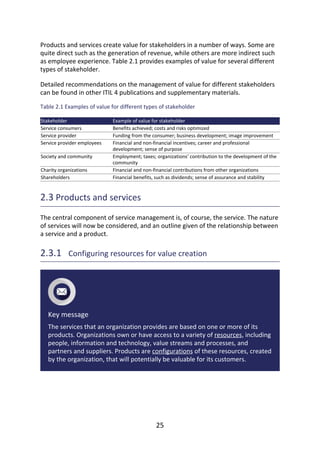
Service	consumers Benefits	achieved;	costs	and	risks	optimized
Service	provider Funding	from	the	consumer;	business	development;	image	improvement
Service	provider	employees Financial	and	non-financial	incentives;	career	and	professional
development;	sense	of	purpose
Society	and	community Employment;	taxes;	organizations’	contribution	to	the	development	of	the
community
Charity	organizations Financial	and	non-financial	contributions	from	other	organizations
Shareholders Financial	benefits,	such	as	dividends;	sense	of	assurance	and	stability
2.3	Products	and	services
The	central	component	of	service	management	is,	of	course,	the	service.	The	nature
of	services	will	now	be	considered,	and	an	outline	given	of	the	relationship	between
a	service	and	a	product.
2.3.1 	Configuring	resources	for	value	creation
Key	message
The	services	that	an	organization	provides	are	based	on	one	or	more	of	its
products.	Organizations	own	or	have	access	to	a	variety	of	resources,	including
people,	information	and	technology,	value	streams	and	processes,	and
partners	and	suppliers.	Products	are	configurations	of	these	resources,	created
by	the	organization,	that	will	potentially	be	valuable	for	its	customers.
25
•
•
Definitions
Services	A	means	of	enabling	value	co-creation	by	facilitating	outcomes
that	customers	want	to	achieve,	without	the	customer	having	to	manage
specific	costs	and	risks.
Product	A	configuration	of	an	organization’s	resources	designed	to	offer
value	for	a	consumer.
Each	product	that	an	organization	offers	is	created	with	a	number	of	target
consumer	groups	in	mind,	and	the	products	will	be	tailored	to	appeal	to,	and	meet
the	needs	of,	these	groups.	A	product	is	not	exclusive	to	one	consumer	group,	and
can	be	used	to	address	the	needs	of	several	different	groups.	For	example,	a
software	service	can	be	offered	as	a	‘lite’	version,	for	individual	users,	or	as	a	more
comprehensive	corporate	version.
Products	are	typically	complex	and	are	not	fully	visible	to	the	consumer.	The	portion
of	a	product	that	the	consumer	actually	sees	does	not	always	represent	all	of	the
components	that	comprise	the	product	and	support	its	delivery.	Organizations
define	which	product	components	their	consumers	see,	and	tailor	them	to	suit	their
target	consumer	groups.
2.3.2 	Service	offerings
Key	message
Service	providers	present	their	services	to	consumers	in	the	form	of	service
offerings,	which	describe	one	or	more	services	based	on	one	or	more
products.
26
•
•
•
Definition:	Service	offering
A	formal	description	of	one	or	more	services,	designed	to	address	the	needs	of
a	target	consumer	group.	A	service	offering	may	include	goods,	access	to
resources,	and	service	actions.
Service	offerings	may	include:
goods	to	be	supplied	to	a	consumer	(for	example,	a	mobile	phone).	Goods	are
supposed	to	be	transferred	from	the	provider	to	the	consumer,	with	the
consumer	taking	the	responsibility	for	their	future	use
access	to	resources	granted	or	licensed	to	a	consumer	under	agreed	terms	and
conditions	(for	example,	to	the	mobile	network,	or	to	the	network	storage).	The
resources	remain	under	the	provider’s	control	and	can	be	accessed	by	the
consumer	only	during	the	agreed	service	consumption	period
service	actions	performed	to	address	a	consumer’s	needs	(for	example,	user
support).	These	actions	are	performed	by	the	service	provider	according	to	the
agreement	with	the	consumer.
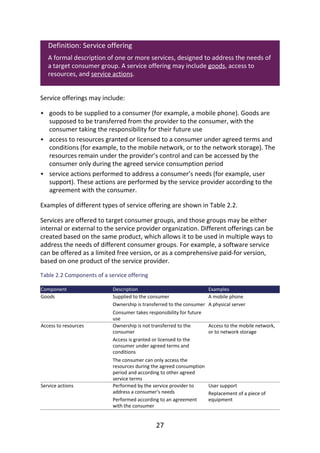
Examples	of	different	types	of	service	offering	are	shown	in	Table	2.2.
Services	are	offered	to	target	consumer	groups,	and	those	groups	may	be	either
internal	or	external	to	the	service	provider	organization.	Different	offerings	can	be
created	based	on	the	same	product,	which	allows	it	to	be	used	in	multiple	ways	to
address	the	needs	of	different	consumer	groups.	For	example,	a	software	service
can	be	offered	as	a	limited	free	version,	or	as	a	comprehensive	paid-for	version,
based	on	one	product	of	the	service	provider.
Table	2.2	Components	of	a	service	offering
Component Description Examples
Goods Supplied	to	the	consumer
Ownership	is	transferred	to	the	consumer
Consumer	takes	responsibility	for	future
use
A	mobile	phone
A	physical	server
Access	to	resources Ownership	is	not	transferred	to	the
consumer
Access	is	granted	or	licensed	to	the
consumer	under	agreed	terms	and
conditions
The	consumer	can	only	access	the
resources	during	the	agreed	consumption
period	and	according	to	other	agreed
service	terms
Access	to	the	mobile	network,
or	to	network	storage
Service	actions Performed	by	the	service	provider	to
address	a	consumer’s	needs
Performed	according	to	an	agreement
with	the	consumer
User	support
Replacement	of	a	piece	of
equipment
27
•
•
•
•
The	ITIL	story:	Axle’s	service	offerings
Su:	Axle’s	service	offerings	include	car	hire	and	the	various	options	we	provide
to	address	different	travel	needs.	These	offerings	include	discounted
insurance,	a	loyalty	programme,	and	complimentary	travel	products	which
include	bottled	water,	tissues,	badge	holders	for	parking	permits,	and	baby
seats.
Our	consumers	are	a	diverse	group	and	expect	different	travel	experiences.	For
example,	our	corporate	consumers	don’t	usually	need	baby	seats	or	weekend
rates.	At	the	same	time,	some	individual	customers	aren’t	interested	in	free
airport	car	collection	if	they’re	only	travelling	locally.
All	our	service	offerings	include	access	to	our	website	and	booking	app.
2.4	Service	relationships
To	create	value,	an	organization	must	do	more	than	simply	provide	a	service.	It	must
also	cooperate	with	the	consumers	in	service	relationships.
Key	message
Service	relationships	are	established	between	two	or	more	organizations	to
co-create	value.	In	a	service	relationship,	organizations	will	take	on	the	roles	of
service	providers	or	service	consumers.	The	two	roles	are	not	mutually
exclusive,	and	organizations	typically	both	provide	and	consume	a	number	of
services	at	any	given	time.
2.4.1 	The	service	relationship	model
When	services	are	delivered	by	the	provider,	they	create	new	resources	for	service
consumers,	or	modify	their	existing	ones.	For	example:
a	training	service	improves	the	skills	of	the	consumer’s	employees
a	broadband	service	allows	the	consumer’s	computers	to	communicate
a	car-hire	service	enables	the	consumer’s	staff	to	visit	clients
a	software	development	service	creates	a	new	application	for	the	service
28
•
•
•
•
•
•
•
•
•
•
consumer.
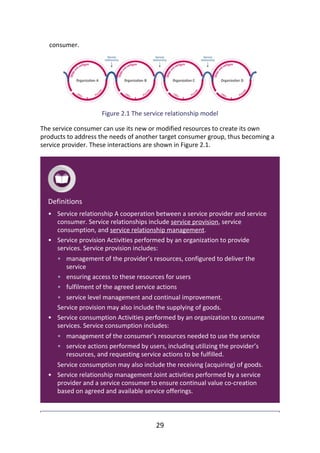
Figure	2.1	The	service	relationship	model
The	service	consumer	can	use	its	new	or	modified	resources	to	create	its	own
products	to	address	the	needs	of	another	target	consumer	group,	thus	becoming	a
service	provider.	These	interactions	are	shown	in	Figure	2.1.
Definitions
Service	relationship	A	cooperation	between	a	service	provider	and	service
consumer.	Service	relationships	include	service	provision,	service
consumption,	and	service	relationship	management.
Service	provision	Activities	performed	by	an	organization	to	provide
services.	Service	provision	includes:
management	of	the	provider’s	resources,	configured	to	deliver	the
service
ensuring	access	to	these	resources	for	users
fulfilment	of	the	agreed	service	actions
service	level	management	and	continual	improvement.
Service	provision	may	also	include	the	supplying	of	goods.
Service	consumption	Activities	performed	by	an	organization	to	consume
services.	Service	consumption	includes:
management	of	the	consumer’s	resources	needed	to	use	the	service
service	actions	performed	by	users,	including	utilizing	the	provider’s
resources,	and	requesting	service	actions	to	be	fulfilled.
Service	consumption	may	also	include	the	receiving	(acquiring)	of	goods.
Service	relationship	management	Joint	activities	performed	by	a	service
provider	and	a	service	consumer	to	ensure	continual	value	co-creation
based	on	agreed	and	available	service	offerings.
29
The	ITIL	story:	Axle’s	service	relationships
Henri:	Axle	has	service	relationships	with	many	service	providers	and
consumers,	both	internal	and	external.	Some	services	provided	to	Axle	create
new	resources	for	the	business,	such	as	car	manufacturers	selling	cars	to	us.
Other	services,	such	as	the	work	done	for	us	by	our	internal	car	cleaning	team,
and	mechanics	outside	of	Axle,	change	our	existing	resources	by	ensuring	that
our	cars	are	clean	and	functional.
Axle	can	use	these	resources	in	other	relationships	to	provide	its	own	services,
in	the	form	of	car	hire,	to	consumers,	i.e.	our	customers.
These	are	just	a	few	examples	of	the	service	relationships	that	Axle	has.	The
organization	as	a	whole	has	many	more.
2.5	Value:	outcomes,	costs,	and	risks
This	section	will	focus	on	how	an	organization	in	the	role	of	service	provider	should
evaluate	what	its	services	should	do	and	how	its	services	should	be	provided	to
meet	the	needs	of	consumers.
Key	message
Achieving	desired	outcomes	requires	resources	(and	therefore	costs)	and	is
often	associated	with	risks.	Service	providers	help	their	consumers	to	achieve
outcomes,	and	in	doing	so,	take	on	some	of	the	associated	risks	and	costs	(see
the	definition	of	service	in	section	2.3.1).	On	the	other	hand,	service
relationships	can	introduce	new	risks	and	costs,	and	in	some	cases,	can
negatively	affect	some	of	the	intended	outcomes,	while	supporting	others.
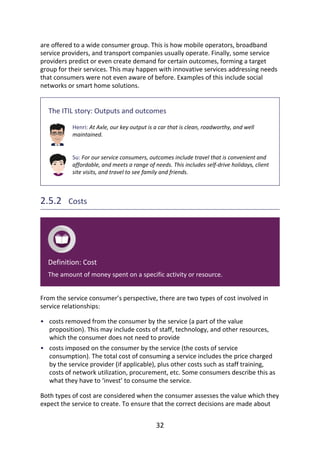
Service	relationships	are	perceived	as	valuable	only	when	they	have	more	positive
effects	than	negative,	as	depicted	in	Figure	2.2.	Outcomes,	and	how	they	influence
and	are	influenced	by	the	other	elements,	will	now	be	discussed.
2.5.1 	Outcomes
Acting	as	a	service	provider,	an	organization	produces	outputs	that	help	its
30
•
•
consumers	to	achieve	certain	outcomes.
Definitions
Output	A	tangible	or	intangible	deliverable	of	an	activity.
Outcome	A	result	for	a	stakeholder	enabled	by	one	or	more	outputs.
Figure	2.2	Achieving	value:	outcomes,	costs,	and	risks
It	is	important	to	be	clear	about	the	difference	between	outputs	and	outcomes.	For
example,	one	output	of	a	wedding	photography	service	may	be	an	album	in	which
selected	photos	are	artfully	arranged.	The	outcome	of	the	service,	however,	is	the
preservation	of	memories	and	the	ability	of	the	couple	and	their	family	and	friends
to	easily	recall	those	memories	by	looking	at	the	album.
Depending	on	the	relationship	between	the	provider	and	the	consumer,	it	can	be
difficult	for	the	provider	to	fully	understand	the	outcomes	that	the	consumer	wants
to	achieve.	In	some	cases	they	will	work	together	to	define	the	desired	outcomes.
For	example,	business	relationship	managers	(BRMs)	in	internal	IT	or	HR
departments	may	regularly	talk	with	customers	and	discuss	their	needs	and
expectations.	In	other	cases,	the	consumers	articulate	their	expectations	quite
clearly,	and	the	provider	expects	them	to	do	so,	such	as	when	standardized	services
31
•
•
are	offered	to	a	wide	consumer	group.	This	is	how	mobile	operators,	broadband
service	providers,	and	transport	companies	usually	operate.	Finally,	some	service
providers	predict	or	even	create	demand	for	certain	outcomes,	forming	a	target
group	for	their	services.	This	may	happen	with	innovative	services	addressing	needs
that	consumers	were	not	even	aware	of	before.	Examples	of	this	include	social
networks	or	smart	home	solutions.
The	ITIL	story:	Outputs	and	outcomes
Henri:	At	Axle,	our	key	output	is	a	car	that	is	clean,	roadworthy,	and	well
maintained.
Su:	For	our	service	consumers,	outcomes	include	travel	that	is	convenient	and
affordable,	and	meets	a	range	of	needs.	This	includes	self-drive	holidays,	client
site	visits,	and	travel	to	see	family	and	friends.
2.5.2 	Costs
Definition:	Cost
The	amount	of	money	spent	on	a	specific	activity	or	resource.
From	the	service	consumer’s	perspective,	there	are	two	types	of	cost	involved	in
service	relationships:
costs	removed	from	the	consumer	by	the	service	(a	part	of	the	value
proposition).	This	may	include	costs	of	staff,	technology,	and	other	resources,
which	the	consumer	does	not	need	to	provide
costs	imposed	on	the	consumer	by	the	service	(the	costs	of	service
consumption).	The	total	cost	of	consuming	a	service	includes	the	price	charged
by	the	service	provider	(if	applicable),	plus	other	costs	such	as	staff	training,
costs	of	network	utilization,	procurement,	etc.	Some	consumers	describe	this	as
what	they	have	to	‘invest’	to	consume	the	service.
Both	types	of	cost	are	considered	when	the	consumer	assesses	the	value	which	they
expect	the	service	to	create.	To	ensure	that	the	correct	decisions	are	made	about
32
•
•
•
•
•
the	service	relationship,	it	is	important	that	both	types	of	cost	are	fully	understood.
From	the	provider’s	perspective,	a	full	and	correct	understanding	of	the	cost	of
service	provision	is	essential.	Providers	need	to	ensure	that	services	are	delivered
within	budget	constraints	and	meet	the	financial	expectations	of	the	organization
(see	section	5.1.11).
2.5.3 	Risks
Definition:	Risk
A	possible	event	that	could	cause	harm	or	loss,	or	make	it	more	difficult	to
achieve	objectives.	Can	also	be	defined	as	uncertainty	of	outcome,	and	can	be
used	in	the	context	of	measuring	the	probability	of	positive	outcomes	as	well
as	negative	outcomes.
As	with	costs,	there	are	two	types	of	risk	that	are	of	concern	to	service	consumers:
risks	removed	from	a	consumer	by	the	service	(part	of	the	value	proposition).
These	may	include	failure	of	the	consumer’s	server	hardware	or	lack	of	staff
availability.	In	some	cases,	a	service	may	only	reduce	a	consumer’s	risks,	but	the
consumer	may	determine	that	this	reduction	is	sufficient	to	support	the	value
proposition
risks	imposed	on	a	consumer	by	the	service	(risks	of	service	consumption).	An
example	of	this	would	be	a	service	provider	ceasing	to	trade,	or	experiencing	a
security	breach.
It	is	the	duty	of	the	provider	to	manage	the	detailed	level	of	risk	on	behalf	of	the
consumer	(see	section	5.1.10).	This	should	be	handled	based	on	a	balance	of	what
matters	most	to	the	consumer	and	to	the	provider.	The	consumer	contributes	to	the
reduction	of	risk	through:
actively	participating	in	the	definition	of	the	requirements	of	the	service	and	the
clarification	of	its	required	outcomes
clearly	communicating	the	critical	success	factors	(CSFs)	and	constraints	that
apply	to	the	service
ensuring	the	provider	has	access	to	the	necessary	resources	of	the	consumer
throughout	the	service	relationship.
33
•
•
2.5.4 	Utility	and	warranty
To	evaluate	whether	a	service	or	service	offering	will	facilitate	the	outcomes	desired
by	the	consumers	and	therefore	create	value	for	them,	the	overall	utility	and
warranty	of	the	service	should	be	assessed.
Definitions
Utility	The	functionality	offered	by	a	product	or	service	to	meet	a	particular
need.	Utility	can	be	summarized	as	‘what	the	service	does’	and	can	be	used
to	determine	whether	a	service	is	‘fit	for	purpose’.	To	have	utility,	a	service
must	either	support	the	performance	of	the	consumer	or	remove
constraints	from	the	consumer.	Many	services	do	both.
Warranty	Assurance	that	a	product	or	service	will	meet	agreed
requirements.	Warranty	can	be	summarized	as	‘how	the	service	performs’
and	can	be	used	to	determine	whether	a	service	is	‘fit	for	use’.	Warranty
often	relates	to	service	levels	aligned	with	the	needs	of	service	consumers.
This	may	be	based	on	a	formal	agreement,	or	it	may	be	a	marketing
message	or	brand	image.	Warranty	typically	addresses	such	areas	as	the
availability	of	the	service,	its	capacity,	levels	of	security	and	continuity.	A
service	may	be	said	to	provide	acceptable	assurance,	or	‘warranty’,	if	all
defined	and	agreed	conditions	are	met.
The	assessment	of	a	service	must	take	into	consideration	the	impact	of	costs	and
risks	on	utility	and	warranty	to	generate	a	complete	picture	of	the	viability	of	a
service.
Both	utility	and	warranty	are	essential	for	a	service	to	facilitate	its	desired	outcomes
and	therefore	help	create	value.	For	example,	a	recreational	theme	park	may	offer
many	exciting	rides	designed	to	deliver	thrilling	experiences	for	park	visitors	(utility),
but	if	a	significant	number	of	the	rides	are	frequently	unavailable	due	to	mechanical
difficulties,	the	park	is	not	fulfilling	the	warranty	(it	is	not	fit	for	use)	and	the
consumers	will	not	receive	their	expected	value.	Likewise,	if	the	rides	are	always	up
and	running	during	advertised	hours,	but	they	do	not	have	features	that	provide	the
levels	of	excitement	expected	by	visitors,	the	utility	is	not	fulfilled,	even	though	the
warranty	is	sufficient.	Again,	consumers	would	not	receive	the	expected	value.
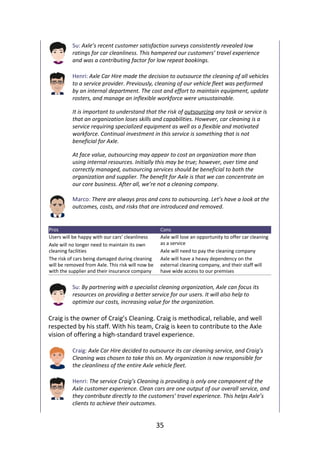
The	ITIL	story:	A	new	supplier	(Craig’s	Cleaning)
34
Su:	Axle’s	recent	customer	satisfaction	surveys	consistently	revealed	low
ratings	for	car	cleanliness.	This	hampered	our	customers’	travel	experience
and	was	a	contributing	factor	for	low	repeat	bookings.
Henri:	Axle	Car	Hire	made	the	decision	to	outsource	the	cleaning	of	all	vehicles
to	a	service	provider.	Previously,	cleaning	of	our	vehicle	fleet	was	performed
by	an	internal	department.	The	cost	and	effort	to	maintain	equipment,	update
rosters,	and	manage	an	inflexible	workforce	were	unsustainable.
It	is	important	to	understand	that	the	risk	of	outsourcing	any	task	or	service	is
that	an	organization	loses	skills	and	capabilities.	However,	car	cleaning	is	a
service	requiring	specialized	equipment	as	well	as	a	flexible	and	motivated
workforce.	Continual	investment	in	this	service	is	something	that	is	not
beneficial	for	Axle.
At	face	value,	outsourcing	may	appear	to	cost	an	organization	more	than
using	internal	resources.	Initially	this	may	be	true;	however,	over	time	and
correctly	managed,	outsourcing	services	should	be	beneficial	to	both	the
organization	and	supplier.	The	benefit	for	Axle	is	that	we	can	concentrate	on
our	core	business.	After	all,	we’re	not	a	cleaning	company.
Marco:	There	are	always	pros	and	cons	to	outsourcing.	Let’s	have	a	look	at	the
outcomes,	costs,	and	risks	that	are	introduced	and	removed.
Pros Cons
Users	will	be	happy	with	our	cars’	cleanliness
Axle	will	no	longer	need	to	maintain	its	own
cleaning	facilities
The	risk	of	cars	being	damaged	during	cleaning
will	be	removed	from	Axle.	This	risk	will	now	be
with	the	supplier	and	their	insurance	company
Axle	will	lose	an	opportunity	to	offer	car	cleaning
as	a	service
Axle	will	need	to	pay	the	cleaning	company
Axle	will	have	a	heavy	dependency	on	the
external	cleaning	company,	and	their	staff	will
have	wide	access	to	our	premises
Su:	By	partnering	with	a	specialist	cleaning	organization,	Axle	can	focus	its
resources	on	providing	a	better	service	for	our	users.	It	will	also	help	to
optimize	our	costs,	increasing	value	for	the	organization.
Craig	is	the	owner	of	Craig’s	Cleaning.	Craig	is	methodical,	reliable,	and	well
respected	by	his	staff.	With	his	team,	Craig	is	keen	to	contribute	to	the	Axle
vision	of	offering	a	high-standard	travel	experience.
Craig:	Axle	Car	Hire	decided	to	outsource	its	car	cleaning	service,	and	Craig’s
Cleaning	was	chosen	to	take	this	on.	My	organization	is	now	responsible	for
the	cleanliness	of	the	entire	Axle	vehicle	fleet.
Henri:	The	service	Craig’s	Cleaning	is	providing	is	only	one	component	of	the
Axle	customer	experience.	Clean	cars	are	one	output	of	our	overall	service,	and
they	contribute	directly	to	the	customers’	travel	experience.	This	helps	Axle’s
clients	to	achieve	their	outcomes.
35
Su:	Craig’s	Cleaning	is	doing	a	great	job!	The	cars	have	never	been	cleaner,
and	our	customer	satisfaction	ratings	for	car	cleanliness	are	steadily	on	the
increase.
Axle	and	Craig’s	Cleaning	have	worked	on	a	cleaning	schedule	together,	with
focus	on	car	cleaning	turnaround	times	during	peak	hours.	Axle	is	responsible
for	providing	Craig	and	his	team	with	timely	notice	of	any	changes	that	can
impact	this	schedule.	For	example,	Axle	may	need	to	expand	its	cleaning
requirements	in	the	light	of	new	service	offerings,	such	as	the	one	Marco	is
developing.
Marco:	Axle	has	a	goal	to	become	a	greener	company	and	help	the
environment.	We	would	like	Craig’s	Cleaning	to	support	us	in	this	goal	and	aim
for	the	same	sustainable	growth	as	us.
2.6	Summary
This	chapter	has	covered	the	key	concepts	in	service	management,	in	particular	the
nature	of	value	and	value	co-creation,	organizations,	products,	and	services.	It	has
explored	the	often	complex	relationships	between	service	providers	and	consumers,
and	the	various	stakeholders	involved.	The	chapter	has	also	covered	the	key
components	of	consumer	value:	benefits,	costs,	and	risks,	and	how	important	it	is	to
understand	the	needs	of	the	customer	when	designing	and	delivering	services.
These	concepts	will	be	built	upon	over	the	next	few	chapters,	and	guidance
provided	on	applying	them	in	practical	and	flexible	ways.
36
CHAPTER	3
THE	FOUR	DIMENSIONS	OF	SERVICE	MANAGEMENT
37
•
•
•
•
	
3	The	four	dimensions	of	service	management
The	previous	chapter	outlined	the	concepts	that	are	key	to	service	management.
The	objective	of	an	organization	is	to	create	value	for	its	stakeholders,	and	this	is
achieved	through	the	provision	and	consumption	of	services.	The	ways	in	which	the
various	components	and	activities	of	an	organization	work	together	to	create	this
value	is	described	by	the	ITIL	SVS.	However,	before	this	is	explored	further,	the	four
dimensions	of	service	management	must	be	introduced.	These	dimensions	are
relevant	to,	and	impact	upon,	all	elements	of	the	SVS.
To	achieve	their	desired	outcomes	and	work	as	effectively	as	possible,	organizations
should	consider	all	aspects	of	their	behaviour.	In	practice,	however,	organizations
often	become	too	focused	on	one	area	of	their	initiatives	and	neglect	the	others.
For	example,	process	improvements	may	be	planned	without	proper	consideration
for	the	people,	partners,	and	technology	involved,	or	technology	solutions	can	be
implemented	without	due	care	for	the	processes	or	people	they	are	supposed	to
support.	There	are	multiple	aspects	to	service	management,	and	none	of	these	are
sufficient	to	produce	the	required	outcomes	when	considered	in	isolation.
Key	message
To	support	a	holistic	approach	to	service	management,	ITIL	defines	four
dimensions	that	collectively	are	critical	to	the	effective	and	efficient	facilitation
of	value	for	customers	and	other	stakeholders	in	the	form	of	products	and
services.	These	are:
organizations	and	people
information	and	technology
partners	and	suppliers
value	streams	and	processes.
These	four	dimensions	represent	perspectives	which	are	relevant	to	the	whole
SVS,	including	the	entirety	of	the	service	value	chain	and	all	ITIL	practices.	The
four	dimensions	are	constrained	or	influenced	by	several	external	factors	that
are	often	beyond	the	control	of	the	SVS.
38
The	four	dimensions,	and	the	relationships	between	them,	are	represented	in	Figure
3.1.
Failing	to	address	all	four	dimensions	properly	may	result	in	services	becoming
undeliverable,	or	not	meeting	expectations	of	quality	or	efficiency.	For	example,
failing	to	consider	the	value	streams	and	processes	dimension	holistically	can	lead
to	wasteful	work,	duplication	of	efforts,	or	worse,	work	that	conflicts	with	what	is
being	done	elsewhere	in	the	organization.	Equally,	ignoring	the	partners	and
suppliers	dimension	could	mean	that	outsourced	services	are	misaligned	with	the
needs	of	the	organization.	The	four	dimensions	do	not	have	sharp	boundaries	and
may	overlap.	They	will	sometimes	interact	in	unpredictable	ways,	depending	on	the
level	of	complexity	and	uncertainty	in	which	an	organization	operates.
Figure	3.1	The	four	dimensions	of	service	management
It	is	important	to	note	that	the	four	dimensions	of	service	management	apply	to	all
services	being	managed,	as	well	as	to	the	SVS	in	general.	It	is	therefore	essential
that	these	perspectives	should	be	considered	for	every	service,	and	that	each	one
should	be	addressed	when	managing	and	improving	the	SVS	at	all	levels.
An	overview	of	the	four	dimensions	is	provided	below,	and	more	detailed	guidance
on	addressing	the	dimensions	in	practice	can	be	found	in	other	ITIL	4	publications.
The	ITIL	story:	The	four	dimensions	of	service	management
Henri:	As	an	IT	team,	we	are	responsible	for	the	information	and	technology	at
Axle	Car	Hire.	However,	effective	IT	management	is	much	more	than	just
managing	technology.	We	must	also	consider	the	wider	organization	and
people	involved	in	Axle’s	car-hire	service,	our	relationships	with	partners	and
39
suppliers,	and	the	value	streams,	processes,	and	technologies	that	we	use.
3.1	Organizations	and	people
The	first	dimension	of	service	management	is	organizations	and	people.
The	effectiveness	of	an	organization	cannot	be	assured	by	a	formally	established
structure	or	system	of	authority	alone.	The	organization	also	needs	a	culture	that
supports	its	objectives,	and	the	right	level	of	capacity	and	competency	among	its
workforce.	It	is	vital	that	the	leaders	of	the	organization	champion	and	advocate
values	which	motivate	people	to	work	in	desirable	ways.	Ultimately,	however,	it	is
the	way	in	which	an	organization	carries	out	its	work	that	creates	shared	values	and
attitudes,	which	over	time	are	considered	the	organization’s	culture.
Key	message
The	complexity	of	organizations	is	growing,	and	it	is	important	to	ensure	that
the	way	an	organization	is	structured	and	managed,	as	well	as	its	roles,
responsibilities,	and	systems	of	authority	and	communication,	is	well	defined
and	supports	its	overall	strategy	and	operating	model.
As	an	example,	it	is	useful	to	promote	a	culture	of	trust	and	transparency	in	an
organization	that	encourages	its	members	to	raise	and	escalate	issues	and	facilitates
corrective	actions	before	any	issues	have	an	impact	on	customers.	Adopting	the	ITIL
guiding	principles	can	be	a	good	starting	point	for	establishing	a	healthy
organizational	culture	(see	section	4.3).
People	(whether	customers,	employees	of	suppliers,	employees	of	the	service
provider,	or	any	other	stakeholder	in	the	service	relationship)	are	a	key	element	in
this	dimension.	Attention	should	be	paid	not	only	to	the	skills	and	competencies	of
teams	or	individual	members,	but	also	to	management	and	leadership	styles,	and	to
communication	and	collaboration	skills.	As	practices	evolve,	people	also	need	to
update	their	skills	and	competencies.	It	is	becoming	increasingly	important	for
people	to	understand	the	interfaces	between	their	specializations	and	roles	and
those	of	others	in	the	organization,	to	ensure	proper	levels	of	collaboration	and
coordination.	For	example,	in	some	areas	of	IT	(such	as	software	development	or
user	support),	there	is	a	growing	acknowledgement	that	everyone	should	have	a
broad	general	knowledge	of	the	other	areas	of	the	organization,	combined	with	a
40
deep	specialization	in	certain	fields.
Every	person	in	the	organization	should	have	a	clear	understanding	of	their
contribution	towards	creating	value	for	the	organization,	its	customers,	and	other
stakeholders.	Promoting	a	focus	on	value	creation	is	an	effective	method	of
breaking	down	organizational	silos.
The	organizations	and	people	dimension	of	a	service	covers	roles	and
responsibilities,	formal	organizational	structures,	culture,	and	required	staffing	and
competencies,	all	of	which	are	related	to	the	creation,	delivery,	and	improvement	of
a	service.
The	ITIL	story:	Axle’s	organization	and	people
Henri:	The	organizations	and	people	dimension	of	Axle’s	car-hire	services
includes	my	IT	team	and	other	teams	within	the	organization,	such	as
procurement,	HR,	and	facilities.
3.2	Information	and	technology
The	second	dimension	of	service	management	is	information	and	technology.	As
with	the	other	three	dimensions,	information	and	technology	applies	both	to	service
management	and	to	the	services	being	managed.
Detailed	guidance	on	the	role	of	information	and	technology	in	service	management
can	be	found	in	other	ITIL	publications.
Key	message
When	applied	to	the	SVS,	the	information	and	technology	dimension	includes
the	information	and	knowledge	necessary	for	the	management	of	services,	as
well	as	the	technologies	required.	It	also	incorporates	the	relationships
between	different	components	of	the	SVS,	such	as	the	inputs	and	outputs	of
activities	and	practices.
The	technologies	that	support	service	management	include,	but	are	not	limited	to,
workflow	management	systems,	knowledge	bases,	inventory	systems,
41
•
•
•
communication	systems,	and	analytical	tools.	Service	management	increasingly
benefits	from	developments	in	technology.	Artificial	intelligence,	machine	learning,
and	other	cognitive	computing	solutions	are	used	at	all	levels,	from	strategic
planning	and	portfolio	optimization	to	system	monitoring	and	user	support.	The	use
of	mobile	platforms,	cloud	solutions,	remote	collaboration	tools,	automated	testing,
and	deployment	solutions	has	become	common	practice	among	service	providers.
In	the	context	of	a	specific	IT	service,	this	dimension	includes	the	information
created,	managed,	and	used	in	the	course	of	service	provision	and	consumption,
and	the	technologies	that	support	and	enable	that	service.	The	specific	information
and	technologies	depend	on	the	nature	of	the	services	being	provided	and	usually
cover	all	levels	of	IT	architecture,	including	applications,	databases,	communication
systems,	and	their	integrations.	In	many	areas,	IT	services	use	the	latest	technology
developments,	such	as	blockchain,	artificial	intelligence,	and	cognitive	computing.
These	services	provide	a	business	differentiation	potential	to	early	adopters,
especially	in	highly	competitive	industries.	Other	technology	solutions,	such	as	cloud
computing	or	mobile	apps,	have	become	common	practice	across	many	industries
globally.
In	relation	to	the	information	component	of	this	dimension,	organizations	should
consider	the	following	questions:
What	information	is	managed	by	the	services?
What	supporting	information	and	knowledge	are	needed	to	deliver	and	manage
the	services?
How	will	the	information	and	knowledge	assets	be	protected,	managed,
archived,	and	disposed	of?
For	many	services,	information	management	is	the	primary	means	of	enabling
customer	value.	For	example,	an	HR	service	facilitates	value	creation	for	its
customers	by	enabling	the	organization	to	access	and	maintain	accurate	information
about	its	employees,	their	employment,	and	their	benefits,	without	exposure	of
private	information	to	unauthorized	parties.	A	network	management	service
facilitates	value	creation	for	its	users	by	maintaining	and	providing	accurate
information	about	an	organization’s	active	network	connections	and	utilization,
allowing	it	to	adjust	its	network	bandwidth	capacity.	Information	is	generally	the	key
output	of	the	majority	of	IT	services	which	are	consumed	by	business	customers.
Another	key	consideration	in	this	dimension	is	how	information	is	exchanged
between	different	services	and	service	components.	The	information	architecture	of
the	various	services	needs	to	be	well	understood	and	continually	optimized,	taking
into	account	such	criteria	as	the	availability,	reliability,	accessibility,	timeliness,
accuracy,	and	relevance	of	the	information	provided	to	users	and	exchanged
between	services.
The	challenges	of	information	management,	such	as	those	presented	by	security
42
•
•
•
•
•
•
•
•
and	regulatory	compliance	requirements,	are	also	a	focus	of	this	dimension.	For
example,	an	organization	may	be	subject	to	the	European	Union’s	General	Data
Protection	Regulation	(GDPR),	which	influences	its	information	management
policies	and	practices.	Other	industries	or	countries	may	have	regulations	that
impose	constraints	on	the	collection	and	management	of	data	of	multinational
corporations.	For	example,	in	the	US	the	Health	Insurance	Portability	and
Accountability	Act	of	1996	provides	data	privacy	and	security	provisions	for
safeguarding	medical	information.
Most	services	nowadays	are	based	on	IT,	and	are	heavily	dependent	on	it.	When
considering	a	technology	for	use	in	the	planning,	design,	transition,	or	operation	of	a
product	or	service,	questions	an	organization	may	ask	include:
Is	this	technology	compatible	with	the	current	architecture	of	the	organization
and	its	customers?	Do	the	different	technology	products	used	by	the
organization	and	its	stakeholders	work	together?	How	are	emerging	technologies
(such	as	machine	learning,	artificial	intelligence,	and	Internet	of	Things)	likely	to
disrupt	the	service	or	the	organization?
Does	this	technology	raise	any	regulatory	or	other	compliance	issues	with	the
organization’s	policies	and	information	security	controls,	or	those	of	its
customers?
Is	this	a	technology	that	will	continue	to	be	viable	in	the	foreseeable	future?	Is
the	organization	willing	to	accept	the	risk	of	using	aging	technology,	or	of
embracing	emerging	or	unproven	technology?
Does	this	technology	align	with	the	strategy	of	the	service	provider,	or	its	service
consumers?
Does	the	organization	have	the	right	skills	across	its	staff	and	suppliers	to
support	and	maintain	the	technology?
Does	this	technology	have	sufficient	automation	capabilities	to	ensure	it	can	be
efficiently	developed,	deployed,	and	operated?
Does	this	technology	offer	additional	capabilities	that	might	be	leveraged	for
other	products	or	services?
Does	this	technology	introduce	new	risks	or	constraints	to	the	organization	(for
example,	locking	it	into	a	specific	vendor)?
The	culture	of	an	organization	may	have	a	significant	impact	on	the	technologies	it
chooses	to	use.	Some	organizations	may	have	more	of	an	interest	in	being	at	the
cutting	edge	of	technological	advances	than	others.	Equally	the	culture	of	some
organizations	may	be	more	traditional.	One	company	may	be	keen	to	take
advantage	of	artificial	intelligence,	while	another	may	barely	be	ready	for	advanced
data	analysis	tools.
The	nature	of	the	business	will	also	affect	the	technology	it	makes	use	of.	For
example,	a	company	that	does	significant	business	with	government	clients	may
43
•
•
•
•
have	restrictions	on	the	use	of	some	technologies,	or	have	significantly	higher
security	concerns	that	must	be	addressed.	Other	industries,	such	as	finance	or	life
sciences,	are	also	subject	to	restrictions	around	their	use	of	technology.	For
example,	they	usually	cannot	use	open	source	and	public	services	when	dealing	with
sensitive	data.
The	ITIL	story:	Axle’s	information	and	technology
Henri:	The	information	and	technology	dimension	of	Axle	Car	Hire	represents
the	information	created	and	managed	by	teams.	It	also	includes	the
technologies	that	support	and	enable	our	services.	Applications	and	databases
such	as	our	booking	app	and	financial	system	are	part	of	the	information	and
technology	dimension	as	well.
Definition:	Cloud	computing
A	model	for	enabling	on-demand	network	access	to	a	shared	pool	of
configurable	computing	resources	that	can	be	rapidly	provided	with	minimal
management	effort	or	provider	interaction.
ITSM	in	the	modern	world:	cloud	computing
ITSM	has	been	focusing	on	value	for	users	and	customers	for	years,	and	this
focus	is	usually	technology-agnostic:	what	matters	is	not	the	technology,	but
the	opportunities	it	creates	for	the	customers.	Although	for	the	most	part	this
is	a	perfectly	acceptable	approach,	organizations	cannot	ignore	new
architectural	solutions	and	the	evolution	of	technology	in	general.	Cloud
computing	has	become	an	architectural	shift	in	IT,	introducing	new
opportunities	and	risks,	and	organizations	have	had	to	react	to	it	in	ways	that
are	most	beneficial	for	themselves,	their	customers,	and	other	stakeholders.
Key	characteristics	of	cloud	computing	include:
on-demand	availability	(often	self-service)
network	access	(often	internet	access)
resource	pooling	(often	among	multiple	organizations)
rapid	elasticity	(often	automatic)
44
•
•
•
•
•
•
•
•
•
•
•
•
•
•
•
•
•
measured	service	(often	from	service	consumer’s	perspective).
In	the	context	of	ITSM,	cloud	computing	changes	service	architecture	and	the
distribution	of	responsibilities	between	service	consumers,	service	providers,
and	their	partners.	It	especially	applies	to	in-house	service	providers,	i.e.	the
organization’s	internal	IT	departments.	In	a	typical	situation,	adoption	of	the
cloud	computing	model:
replaces	some	infrastructure,	previously	managed	by	the	service	provider,
with	a	partner’s	cloud	service
decreases	or	removes	the	need	for	infrastructure	management	expertise
and	the	resources	of	the	service	provider
shifts	the	focus	of	service	monitoring	and	control	from	the	in-house
infrastructure	to	a	partner’s	services
changes	the	cost	structure	of	the	service	provider,	removing	specific	capital
expenditures	and	introducing	new	operating	expenditures	and	the	need	to
manage	them	appropriately
introduces	higher	requirements	for	network	availability	and	security
introduces	new	security	and	compliance	risks	and	requirements,	applicable
to	both	the	service	provider	and	its	partner	providing	the	cloud	service
provides	users	with	opportunities	to	scale	service	consumption	using	self-
service	via	simple	standard	requests,	or	even	without	any	requests.
All	these	affect	multiple	service	providers’	practices,	including,	but	not	limited
to:
service	level	management
measurement	and	reporting
information	security	management
service	continuity	management
supplier	management
incident	management
problem	management
service	request	management
service	configuration	management.
Another	important	effect	of	cloud	computing,	resulting	from	the	computing
resources’	elasticity,	is	that	the	cloud	infrastructure	may	enable	significantly
faster	deployment	of	new	and	changed	services,	thus	supporting	high-velocity
service	delivery.	The	ability	to	configure	and	deploy	computing	resources	with
the	same	speed	as	new	applications	is	an	important	prerequisite	for	the
success	of	DevOps	and	similar	initiatives.	This	supports	modern	organizations
45
in	their	need	for	faster	time	to	market	and	digitalization	of	their	services.
Considering	the	influence	of	cloud	computing	on	organizations,	it	is	important
to	make	decisions	about	the	use	of	this	model	at	the	strategic	level	of	the
organization,	involving	all	levels	of	stakeholders,	from	governance	to
operations.
3.3	Partners	and	suppliers
The	third	dimension	of	service	management	is	partners	and	suppliers.	Every
organization	and	every	service	depend	to	some	extent	on	services	provided	by	other
organizations.
Key	message
The	partners	and	suppliers	dimension	encompasses	an	organization’s
relationships	with	other	organizations	that	are	involved	in	the	design,
development,	deployment,	delivery,	support,	and/or	continual	improvement
of	services.	It	also	incorporates	contracts	and	other	agreements	between	the
organization	and	its	partners	or	suppliers.
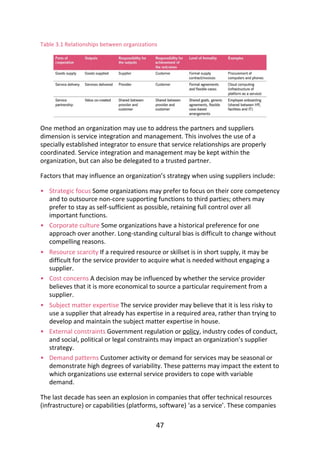
Relationships	between	organizations	may	involve	various	levels	of	integration	and
formality.	This	ranges	from	formal	contracts	with	clear	separation	of	responsibilities,
to	flexible	partnerships	where	parties	share	common	goals	and	risks,	and
collaborate	to	achieve	desired	outcomes.	Some	relationship	examples	are	shown	in
Table	3.1.	Note	that	the	forms	of	cooperation	described	are	not	fixed	but	exist	as	a
spectrum.	An	organization	acting	as	a	service	provider	will	have	a	position	on	this
spectrum,	which	will	vary	depending	on	its	strategy	and	objectives	for	customer
relationships.	Likewise,	when	an	organization	acts	as	a	service	consumer,	the	role	it
takes	on	will	depend	on	its	strategy	and	objectives	for	sourcing	and	supplier
management.	When	it	comes	to	using	partners	and	suppliers,	an	organization’s
strategy	should	be	based	on	its	goals,	culture,	and	business	environment.	For
example,	some	organizations	may	believe	that	they	will	be	best	served	by	focusing
their	attention	on	developing	certain	core	competencies,	using	partners	and
suppliers	to	provide	other	needs.	Other	organizations	may	choose	to	rely	as	much	as
possible	on	their	own	resources,	using	partners	and	suppliers	as	little	as	possible.
There	are,	of	course,	many	variations	between	these	two	opposite	approaches.
46
•
•
•
•
•
•
•
Table	3.1	Relationships	between	organizations
One	method	an	organization	may	use	to	address	the	partners	and	suppliers
dimension	is	service	integration	and	management.	This	involves	the	use	of	a
specially	established	integrator	to	ensure	that	service	relationships	are	properly
coordinated.	Service	integration	and	management	may	be	kept	within	the
organization,	but	can	also	be	delegated	to	a	trusted	partner.
Factors	that	may	influence	an	organization’s	strategy	when	using	suppliers	include:
Strategic	focus	Some	organizations	may	prefer	to	focus	on	their	core	competency
and	to	outsource	non-core	supporting	functions	to	third	parties;	others	may
prefer	to	stay	as	self-sufficient	as	possible,	retaining	full	control	over	all
important	functions.
Corporate	culture	Some	organizations	have	a	historical	preference	for	one
approach	over	another.	Long-standing	cultural	bias	is	difficult	to	change	without
compelling	reasons.
Resource	scarcity	If	a	required	resource	or	skillset	is	in	short	supply,	it	may	be
difficult	for	the	service	provider	to	acquire	what	is	needed	without	engaging	a
supplier.
Cost	concerns	A	decision	may	be	influenced	by	whether	the	service	provider
believes	that	it	is	more	economical	to	source	a	particular	requirement	from	a
supplier.
Subject	matter	expertise	The	service	provider	may	believe	that	it	is	less	risky	to
use	a	supplier	that	already	has	expertise	in	a	required	area,	rather	than	trying	to
develop	and	maintain	the	subject	matter	expertise	in	house.
External	constraints	Government	regulation	or	policy,	industry	codes	of	conduct,
and	social,	political	or	legal	constraints	may	impact	an	organization’s	supplier
strategy.
Demand	patterns	Customer	activity	or	demand	for	services	may	be	seasonal	or
demonstrate	high	degrees	of	variability.	These	patterns	may	impact	the	extent	to
which	organizations	use	external	service	providers	to	cope	with	variable
demand.
The	last	decade	has	seen	an	explosion	in	companies	that	offer	technical	resources
(infrastructure)	or	capabilities	(platforms,	software)	‘as	a	service’.	These	companies
47
bundle	goods	and	services	into	a	single	product	offering	that	can	be	consumed	as	a
utility,	and	is	typically	accounted	for	as	operating	expenditure.	This	frees	companies
from	investing	in	costly	infrastructure	and	software	assets	that	need	to	be
accounted	for	as	capital	expenditure.
The	ITIL	story:	Axle’s	partners	and	suppliers
Henri:	The	partners	and	suppliers	dimension	for	Axle	includes	suppliers	such	as
Go	Go	Gas	and	Craig’s	Cleaning,	as	well	as	internet	service	providers	and
developers.
3.4	Value	streams	and	processes
The	fourth	dimension	of	service	management	is	value	streams	and	processes.	Like
the	other	dimensions,	this	dimension	is	applicable	to	both	the	SVS	in	general,	and	to
specific	products	and	services.	In	both	contexts	it	defines	the	activities,	workflows,
controls,	and	procedures	needed	to	achieve	agreed	objectives.
Key	message
Applied	to	the	organization	and	its	SVS,	the	value	streams	and	processes
dimension	is	concerned	with	how	the	various	parts	of	the	organization	work	in
an	integrated	and	coordinated	way	to	enable	value	creation	through	products
and	services.	The	dimension	focuses	on	what	activities	the	organization
undertakes	and	how	they	are	organized,	as	well	as	how	the	organization
ensures	that	it	is	enabling	value	creation	for	all	stakeholders	efficiently	and
effectively.
ITIL	gives	organizations	acting	as	service	providers	an	operating	model	that	covers
all	the	key	activities	required	to	manage	products	and	services	effectively.	This	is
referred	to	as	the	ITIL	service	value	chain	(see	section	4.5).
The	service	value	chain	operating	model	is	generic	and	in	practice	it	can	follow
different	patterns.	These	patterns	within	the	value	chain	operation	are	called	value
streams.
48
3.4.1 	Value	streams	for	service	management
Key	message
A	value	stream	is	a	series	of	steps	that	an	organization	uses	to	create	and
deliver	products	and	services	to	a	service	consumer.	A	value	stream	is	a
combination	of	the	organization’s	value	chain	activities	(see	section	4.5	for
more	details	on	value	chain	activities	and	Appendix	A	for	examples	of	value
streams).
Definition:	Value	stream
A	series	of	steps	an	organization	undertakes	to	create	and	deliver	products
and	services	to	consumers.
Identifying	and	understanding	the	various	value	streams	an	organization	has	is
critical	to	improving	its	overall	performance.	Structuring	the	organization’s	activities
in	the	form	of	value	streams	allows	it	to	have	a	clear	picture	of	what	it	delivers	and
how,	and	to	make	continual	improvements	to	its	services.
Organizations	should	examine	how	they	perform	work	and	map	all	the	value
streams	they	can	identify.	This	will	enable	them	to	analyse	their	current	state	and
identify	any	barriers	to	workflow	and	non-value-adding	activities,	i.e.	waste.
Wasteful	activities	should	be	eliminated	to	increase	productivity.
Opportunities	to	increase	value-adding	activities	can	be	found	across	the	service
value	chain.	These	may	be	new	activities	or	modifications	to	existing	ones,	which
can	make	the	organization	more	productive.	Value	stream	optimization	may	include
process	automation	or	adoption	of	emerging	technologies	and	ways	of	working	to
gain	efficiencies	or	enhance	user	experience.
Value	streams	should	be	defined	by	organizations	for	each	of	their	products	and
services.	Depending	on	the	organization’s	strategy,	value	streams	can	be	redefined
to	react	to	changing	demand	and	other	circumstances,	or	remain	stable	for	a
49
•
•
•
significant	amount	of	time.	In	any	case,	they	should	be	continually	improved	to
ensure	that	the	organization	achieves	its	objectives	in	an	optimal	way.	Value	stream
mapping	is	described	in	more	detail	in	other	ITIL	4	publications.
3.4.2 	Processes
Key	message
A	process	is	a	set	of	activities	that	transform	inputs	to	outputs.	Processes
describe	what	is	done	to	accomplish	an	objective,	and	well-defined	processes
can	improve	productivity	within	and	across	organizations.	They	are	usually
detailed	in	procedures,	which	outline	who	is	involved	in	the	process,	and	work
instructions,	which	explain	how	they	are	carried	out.
Definition:	Process
A	set	of	interrelated	or	interacting	activities	that	transform	inputs	into
outputs.	A	process	takes	one	or	more	defined	inputs	and	turns	them	into
defined	outputs.	Processes	define	the	sequence	of	actions	and	their
dependencies.
When	applied	to	products	and	services,	this	dimension	helps	to	answer	the
following	questions,	critical	to	service	design,	delivery,	and	improvement:
What	is	the	generic	delivery	model	for	the	service,	and	how	does	the	service
work?
What	are	the	value	streams	involved	in	delivering	the	agreed	outputs	of	the
service?
Who,	or	what,	performs	the	required	service	actions?
Specific	answers	to	these	questions	will	vary	depending	on	the	nature	and
architecture	of	the	service.
50
•
•
•
The	ITIL	story:	Axle’s	value	streams	and	processes
Radhika:	The	value	streams	and	processes	dimension	represents	the	series	of
activities	that	are	carried	out	within	Axle.	Value	streams	help	Axle	to	identify
wasteful	activity	and	remove	obstacles	that	hinder	the	organization’s
productivity.
3.5	External	factors
Service	providers	do	not	operate	in	isolation.	They	are	affected	by	many	external
factors,	and	work	in	dynamic	and	complex	environments	that	can	exhibit	high
degrees	of	volatility	and	uncertainty	and	impose	constraints	on	how	the	service
provider	can	work.	To	analyse	these	external	factors,	frameworks	such	as	the
PESTLE	(or	PESTEL)	model	are	used.	PESTLE	is	an	acronym	for	the	political,
economic,	social,	technological,	legal,	and	environmental	factors	that	constrain	or
influence	how	a	service	provider	operates.
Collectively,	these	factors	influence	how	organizations	configure	their	resources	and
address	the	four	dimensions	of	service	management.	For	example:
Government	and	societal	attitudes	towards	environmentally	friendly	products
and	services	may	result	in	the	organization	investing	more	in	tools	and
technologies	that	meet	external	expectations.	An	organization	may	choose	to
partner	with	other	organizations	(or	source	services	from	external	providers)
who	can	demonstrate	environmentally	friendly	credentials.	For	example,	some
companies	publish	product	environmental	reports	that	describe	their	products’
performance	against	their	policies	around	climate	change,	safer	materials,	and
other	resources.
Economic	and	societal	factors	may	influence	organizations	to	create	several
versions	of	the	same	product	to	address	various	consumer	groups	that	show
different	buying	patterns.	One	example	is	music	and	video	streaming	services,
many	of	which	have	a	free	tier	(with	advertising),	a	premium	tier	(without
advertising),	and	in	some	cases	a	‘family	plan’	that	allows	multiple	individual
profiles	under	one	paid-for	account.
Data	protection	laws	or	regulations	(like	GDPR)	have	changed	how	companies
must	collect,	process,	access,	and	store	customer	data,	as	well	as	how	they	work
with	external	partners	and	suppliers.
3.6	Summary
The	four	dimensions	represent	a	holistic	approach	to	service	management,	and
organizations	should	ensure	that	there	is	a	balance	of	focus	between	each
51
dimension.	The	impact	of	external	factors	on	the	four	dimensions	should	also	be
considered.	All	four	dimensions	and	the	external	factors	that	affect	them	should	be
addressed	as	they	evolve,	considering	emerging	trends	and	opportunities.	It	is
essential	that	an	organization’s	SVS	is	considered	from	all	four	dimensions,	as	the
failure	to	adequately	address	or	account	for	one	dimension,	or	an	external	factor,
can	lead	to	sub-optimal	products	and	services.
The	ITIL	story:	Balancing	the	four	dimensions
Marco:	To	make	Axle’s	services	as	effective	as	possible,	we	use	the	best
combination	of	our	people,	our	teams,	our	value	streams,	and	our	ways	of
working.	We	now	engage	a	blended	approach	to	service	management,
incorporating	DevOps,	Design	Thinking,	and	Agile	into	product	development.
We	also	use	new	technologies	such	as	robotics,	AI,	and	machine	learning,
striving	to	be	efficient	and	Lean,	and	to	automate	wherever	possible.
52
CHAPTER	4
THE	ITIL	SERVICE	VALUE	SYSTEM
53
•
•
•
	
4	The	ITIL	service	valuesystem
4.1	Service	value	system	overview
For	service	management	to	function	properly,	it	needs	to	work	as	a	system.	The	ITIL
SVS	describes	the	inputs	to	this	system	(opportunity	and	demand),	the	elements	of
this	system	(organizational	governance,	service	management,	continual
improvement,	and	the	organization’s	capabilities	and	resources),	and	the	outputs
(achievement	of	organizational	objectives	and	value	for	the	organization,	its
customers,	and	other	stakeholders).
Key	message
The	ITIL	SVS	describes	how	all	the	components	and	activities	of	the
organization	work	together	as	a	system	to	enable	value	creation.	Each
organization’s	SVS	has	interfaces	with	other	organizations,	forming	an
ecosystem	that	can	in	turn	facilitate	value	for	those	organizations,	their
customers,	and	other	stakeholders.
The	key	inputs	to	the	SVS	are	opportunity	and	demand.	Opportunities	represent
options	or	possibilities	to	add	value	for	stakeholders	or	otherwise	improve	the
organization.	Demand	is	the	need	or	desire	for	products	and	services	among
internal	and	external	consumers.	The	outcome	of	the	SVS	is	value,	that	is,	the
perceived	benefits,	usefulness,	and	importance	of	something.	The	ITIL	SVS	can
enable	the	creation	of	many	different	types	of	value	for	a	wide	group	of
stakeholders.
The	ITIL	SVS	includes	the	following	components:
Guiding	principles	Recommendations	that	can	guide	an	organization	in	all
circumstances,	regardless	of	changes	in	its	goals,	strategies,	type	of	work,	or
management	structure.
Governance	The	means	by	which	an	organization	is	directed	and	controlled.
Service	value	chain	A	set	of	interconnected	activities	that	an	organization
performs	to	deliver	a	valuable	product	or	service	to	its	consumers	and	to
54
•
•
facilitate	value	realization.
Practices	Sets	of	organizational	resources	designed	for	performing	work	or
accomplishing	an	objective.
Continual	improvement	A	recurring	organizational	activity	performed	at	all	levels
to	ensure	that	an	organization’s	performance	continually	meets	stakeholders’
expectations.	ITIL	4	supports	continual	improvement	with	the	ITIL	continual
improvement	model.
The	purpose	of	the	SVS	is	to	ensure	that	the	organization	continually	co-creates
value	with	all	stakeholders	through	the	use	and	management	of	products	and
services.	The	structure	of	the	SVS	is	shown	in	Figure	4.1.	The	left	side	of	the	figure
shows	opportunity	and	demand	feeding	into	the	SVS	from	both	internal	and
external	sources.	The	right	side	shows	value	created	for	the	organization,	its
customers,	and	other	stakeholders.
Figure	4.1	The	ITIL	service	value	system
The	ITIL	SVS	describes	how	all	the	components	and	activities	of	the	organization
work	together	as	a	system	to	enable	value	creation.	These	components	and
activities,	together	with	the	organization’s	resources,	can	be	configured	and
reconfigured	in	multiple	combinations	in	a	flexible	way	as	circumstances	change,
but	this	requires	the	integration	and	coordination	of	activities,	practices,	teams,
authorities	and	responsibilities,	and	all	parties	to	be	truly	effective.
One	of	the	biggest	challenges	an	organization	can	face	when	trying	to	work
effectively	and	efficiently	with	a	shared	vision,	or	to	become	more	Agile	and
resilient,	is	the	presence	of	organizational	silos.	Organizational	silos	can	form	in
many	ways	and	for	many	different	reasons.	Silos	can	be	resistant	to	change	and	can
prevent	easy	access	to	the	information	and	specialized	expertise	that	exists	across
the	organization,	which	can	in	turn	reduce	efficiency	and	increase	both	cost	and
risk.	Silos	also	make	it	more	difficult	for	communication	or	collaboration	to	occur
across	different	groups.
55
A	siloed	organization	cannot	act	quickly	to	take	advantage	of	opportunities	or	to
optimize	the	use	of	resources	across	the	organization.	It	is	often	unable	to	make
effective	decisions	about	changes,	due	to	limited	visibility	and	many	hidden
agendas.	Practices	can	also	become	silos.	Many	organizations	have	implemented
practices	such	as	organizational	change	management	or	incident	management
without	clear	interfaces	with	other	practices.	All	practices	should	have	multiple
interfaces	with	one	another.	The	exchange	of	information	between	practices	should
be	triggered	at	key	points	in	the	workflow,	and	is	essential	to	the	proper	functioning
of	the	organization.
The	architecture	of	the	ITIL	SVS	specifically	enables	flexibility	and	discourages	siloed
working.	The	service	value	chain	activities	and	the	practices	in	the	SVS	do	not	form	a
fixed,	rigid	structure.	Rather,	they	can	be	combined	in	multiple	value	streams	to
address	the	needs	of	the	organization	in	a	variety	of	scenarios.	This	publication
provides	examples	of	service	value	streams,	but	none	of	them	are	definite	or
prescriptive.	Organizations	should	be	able	to	define	and	redefine	their	value
streams	in	a	flexible,	yet	safe	and	efficient	manner.	This	requires	continual
improvement	activity	to	be	carried	out	at	all	levels	of	the	organization;	the	ITIL
continual	improvement	model	helps	to	structure	this	activity.	Finally,	the	continual
improvement	and	overall	operation	of	an	organization	are	shaped	by	the	ITIL
guiding	principles.	The	guiding	principles	create	a	foundation	for	a	shared	culture
across	the	organization,	thus	supporting	collaboration	and	cooperation	within	and
between	the	teams,	and	removing	the	need	for	constraints	and	controls	previously
provided	by	silos.
With	these	components,	the	ITIL	SVS	supports	many	work	approaches,	such	as	Agile,
DevOps	and	Lean	(see	Glossary),	as	well	as	traditional	process	and	project
management,	with	a	flexible	value-oriented	operating	model.
An	organization	can	take	any	number	of	forms,	including,	but	not	limited	to,	sole
trader,	company,	corporation,	firm,	enterprise,	authority,	partnership,	charity	or
institution,	or	any	part	or	combination	thereof,	whether	incorporated	or	not,	and	be
either	public	or	private.	This	means	that	the	scope	of	the	SVS	can	be	a	whole
organization	or	a	smaller	subset	of	that	organization.	To	achieve	the	maximum	value
from	the	SVS	and	to	properly	address	the	issue	of	organizational	silos,	it	is
preferable	to	include	the	whole	organization	in	the	scope	rather	than	a	subset.
The	rest	of	this	chapter	will	explore	each	element	of	the	SVS.
Organizational	agility	and	organizational	resilience
For	an	organization	to	be	successful,	it	must	achieve	organizational	agility	to
support	internal	changes,	and	organizational	resilience	to	withstand	and	even
thrive	in	changing	external	circumstances.	The	organization	must	also	be
considered	as	part	of	a	larger	ecosystem	of	organizations,	all	delivering,
56
coordinating,	and	consuming	products	and	services.
Organizational	agility	is	the	ability	of	an	organization	to	move	and	adapt
quickly,	flexibly,	and	decisively	to	support	internal	changes.	These	might
include	changes	to	the	scope	of	the	organization,	mergers	and	acquisitions,
changing	organizational	practices,	or	technologies	requiring	different	skills	or
organizational	structure	and	changes	to	relationships	with	partners	and
suppliers.
Organizational	resilience	is	the	ability	of	an	organization	to	anticipate,	prepare
for,	respond	to,	and	adapt	to	both	incremental	changes	and	sudden
disruptions	from	an	external	perspective.	External	influences	could	be	political,
economic,	social,	technological,	legal	or	environmental.	Resilience	cannot	be
achieved	without	a	common	understanding	of	the	organization’s	priorities	and
objectives,	which	sets	the	direction	and	promotes	alignment	even	as	external
circumstances	change.
The	ITIL	SVS	provides	the	means	to	achieve	organizational	agility	and	resilience
and	to	facilitate	the	adoption	of	a	strong	unified	direction,	focused	on	value
and	understood	by	everyone	in	the	organization.	It	also	enables	continual
improvement	throughout	the	organization.
4.2	Opportunity,	demand,	and	value
Key	message
Opportunity	and	demand	trigger	activities	within	the	ITIL	SVS,	and	these
activities	lead	to	the	creation	of	value.	Opportunity	and	demand	are	always
entering	into	the	system,	but	the	organization	does	not	automatically	accept
all	opportunities	or	satisfy	all	demand.
Opportunity	represents	options	or	possibilities	to	add	value	for	stakeholders	or
otherwise	improve	the	organization.	There	may	not	be	demand	for	these
opportunities	yet,	but	they	can	still	trigger	work	within	the	system.	Organizations
should	prioritize	new	or	changed	services	with	opportunities	for	improvement	to
ensure	their	resources	are	correctly	allocated.
Demand	represents	the	need	or	desire	for	products	and	services	from	internal	and
57
external	customers.	A	definition	of	value,	and	what	constitutes	value	for	different
stakeholders,	can	be	found	in	Chapter	2.
4.3	The	ITIL	guiding	principles
Key	message
A	guiding	principle	is	a	recommendation	that	guides	an	organization	in	all
circumstances,	regardless	of	changes	in	its	goals,	strategies,	type	of	work,	or
management	structure.	A	guiding	principle	is	universal	and	enduring.
Table	4.1	Overview	of	the	guiding	principles
Guiding	principle Description
Focus	on	value Everything	that	the	organization	does	needs	to	map,	directly	or	indirectly,
to	value	for	the	stakeholders.
The	focus	on	value	principle	encompasses	many	perspectives,	including	the
experience	of	customers	and	users.
Start	where	you	are Do	not	start	from	scratch	and	build	something	new	without	considering
what	is	already	available	to	be	leveraged.	There	is	likely	to	be	a	great	deal
in	the	current	services,	processes,	programmes,	projects,	and	people	that
can	be	used	to	create	the	desired	outcome.
The	current	state	should	be	investigated	and	observed	directly	to	make
sure	it	is	fully	understood.
Progress	iteratively	with
feedback
Do	not	attempt	to	do	everything	at	once.	Even	huge	initiatives	must	be
accomplished	iteratively.
By	organizing	work	into	smaller,	manageable	sections	that	can	be	executed
and	completed	in	a	timely	manner,	it	is	easier	to	maintain	a	sharper	focus
on	each	effort.
Using	feedback	before,	throughout,	and	after	each	iteration	will	ensure
that	actions	are	focused	and	appropriate,	even	if	circumstances	change.
Collaborate	and	promote
visibility
Working	together	across	boundaries	produces	results	that	have	greater
buy-in,	more	relevance	to	objectives,	and	increased	likelihood	of	long-term
success.
Achieving	objectives	requires	information,	understanding,	and	trust.	Work
and	consequences	should	be	made	visible,	hidden	agendas	avoided,	and
information	shared	to	the	greatest	degree	possible.
Think	and	work	holistically No	service,	or	element	used	to	provide	a	service,	stands	alone.	The
outcomes	achieved	by	the	service	provider	and	service	consumer	will	suffer
unless	the	organization	works	on	the	service	as	a	whole,	not	just	on	its
parts.
Results	are	delivered	to	internal	and	external	customers	through	the
effective	and	efficient	management	and	dynamic	integration	of
information,	technology,	organization,	people,	practices,	partners,	and
agreements,	which	should	all	be	coordinated	to	provide	a	defined	value.
58
Keep	it	simple	and	practical If	a	process,	service,	action	or	metric	fails	to	provide	value	or	produce	a
useful	outcome,	eliminate	it.	In	a	process	or	procedure,	use	the	minimum
number	of	steps	necessary	to	accomplish	the	objective(s).	Always	use
outcome-based	thinking	to	produce	practical	solutions	that	deliver	results.
Optimize	and	automate Resources	of	all	types,	particularly	HR,	should	be	used	to	their	best	effect.
Eliminate	anything	that	is	truly	wasteful	and	use	technology	to	achieve
whatever	it	is	capable	of.	Human	intervention	should	only	happen	where	it
really	contributes	value.
The	guiding	principles	defined	here	embody	the	core	messages	of	ITIL	and	of	service
management	in	general,	supporting	successful	actions	and	good	decisions	of	all
types	and	at	all	levels.	They	can	be	used	to	guide	organizations	in	their	work	as	they
adopt	a	service	management	approach	and	adapt	ITIL	guidance	to	their	own	specific
needs	and	circumstances.	The	guiding	principles	encourage	and	support
organizations	in	continual	improvement	at	all	levels.
These	principles	are	also	reflected	in	many	other	frameworks,	methods,	standards,
philosophies,	and/or	bodies	of	knowledge,	such	as	Lean,	Agile,	DevOps,	and	COBIT.
This	allows	organizations	to	effectively	integrate	the	use	of	multiple	methods	into
an	overall	approach	to	service	management.
The	guiding	principles	are	applicable	to	practically	any	initiative	and	to	all
relationships	with	stakeholder	groups.	For	example,	the	first	principle,	focus	on
value,	can	(and	should)	be	applied	not	only	to	service	consumers,	but	to	all	relevant
stakeholders	and	their	respective	definitions	of	value.
Table	4.1	provides	a	high-level	introduction	to	the	guiding	principles.	Additional
details	for	each	principle	are	presented	later	in	this	chapter.
ITIL,	Agile,	and	DevOps
Agile	methods,	when	applied	to	software	development,	focus	on	the	delivery
of	incremental	changes	to	software	products	while	responding	to	the	changing
(or	evolving)	needs	of	users.	They	foster	a	culture	of	continual	learning,
flexibility,	and	willingness	to	try	new	approaches	and	adapt	to	rapidly	changing
needs.	Agile	ways	of	working	include	techniques	such	as	timeboxing	work,	self-
organizing	and	cross-functional	teams,	and	ongoing	collaboration	and
communication	with	customers	and	users.
Agile	software	development	teams	often	focus	on	the	rapid	delivery	of
product	increments	at	the	expense	of	a	more	holistic	view	that	considers	the
operability,	reliability,	and	maintainability	of	these	products	in	a	live
environment.	Similarly,	continual	learning	and	improvement	initiatives	can
focus	on	bettering	the	articulation	and	prioritization	of	user	needs,	or
streamlining	the	procedures	to	develop,	test,	and	deploy	working	software.
While	these	initiatives	can	provide	valuable	outcomes,	they	also	run	the	risk	of
being	out	of	sync	with	other	initiatives	at	a	service	level.
59
•
•
•
•
•
Just	as	Agile	techniques	provide	service	organizations	with	a	flow	of	product
and	software	increments,	ITIL	can	also	provide	software	development
organizations	with	a	wider	perspective	and	language	with	which	to	engage
other	service	teams.	Adopting	Agile	without	ITIL	can	lead	to	higher	costs	over
time,	such	as	the	costs	of	adopting	different	technologies	and	architectures,
and	costs	to	release,	operate,	and	maintain	software	increments.	Similarly,
implementing	ITIL	without	Agile	techniques	can	risk	losing	focus	on	value	for
customers	and	users,	creating	slow-moving	and	highly	centralized
bureaucracies.
When	Agile	and	ITIL	are	adopted	together,	software	development	and	service
management	can	progress	at	a	similar	cadence,	share	a	common	terminology,
and	ensure	that	the	organization	continues	to	co-create	value	with	all	its
stakeholders.	Some	of	the	ways	in	which	ITIL	and	Agile	can	work	together
include:
streamlining	practices	such	as	change	control
establishing	procedures	to	incorporate	and	prioritize	the	management	of
unplanned	interruptions	(incidents),	and	to	investigate	the	causes	of	failure
separating	interactions,	if	necessary,	between	‘systems	of	record’	(e.g.	the
configuration	management	database)	needed	to	manage	services	from
‘systems	of	engagement’	(e.g.	collaboration	tools)	used	by	software
development	teams.
DevOps	methods	build	on	Agile	software	development	and	service
management	techniques	by	emphasizing	close	collaboration	between	the
roles	of	software	development	and	technical	operations.	Using	high	degrees	of
automation	to	free	up	the	time	of	skilled	professionals	so	that	they	can	focus
on	value-adding	activities,	DevOps	is	able	to	shine	a	light	on	aspects	such	as
operability,	reliability,	and	maintainability	of	software	products	that	can	assist
in	the	management	of	services.	Cultural	aspects	that	DevOps	practitioners
advocate	can,	and	should,	be	extended	across	the	value	stream	and	all	service
value	chain	activities	so	that	product	and	service	teams	are	aligned	with	the
same	goals	and	use	the	same	methods.
It	is	often	said	that	DevOps	combines	software	development	techniques
(Agile),	good	governance	and	a	holistic	approach	to	value	co-creation	(ITIL),
and	an	obsession	with	learning	about	and	improving	the	way	in	which	value	is
generated	(Lean).	As	such,	the	adoption	of	DevOps	methods	presents	further
opportunities	to	improve	the	way	in	which	software	products	are	developed
and	managed,	such	as:
creating	fast	feedback	loops	from	delivery	and	support	to	software
development	and	technology	operations
streamlining	value	chain	activities	and	value	streams	so	that	demand	for
60
•
•
work	can	be	quickly	converted	to	value	for	multiple	stakeholders
differentiating	deployment	management	from	release	management
advocating	a	‘systems	view’	that	emphasizes	close	collaboration	between
enterprise	governance,	service	teams,	software	development,	and
technology	operations.
4.3.1 	Focus	on	value
Key	message
All	activities	conducted	by	the	organization	should	link	back,	directly	or
indirectly,	to	value	for	itself,	its	customers,	and	other	stakeholders.
This	section	is	mostly	focused	on	the	creation	of	value	for	service	consumers.
However,	a	service	also	contributes	to	value	for	the	organization	and	other
stakeholders.	This	value	may	come	in	various	forms,	such	as	revenue,	customer
loyalty,	lower	cost,	or	growth	opportunities.	The	following	recommendations	can	be
adapted	to	address	various	stakeholder	groups	and	the	value	that	is	created	for
them	by	the	organization.
4.3.1.1	Who	is	the	service	consumer?
When	focusing	on	value,	the	first	step	is	to	know	who	is	being	served.	In	each
situation	the	service	provider	must,	therefore,	determine	who	the	service	consumer
is	and	who	the	key	stakeholders	are	(for	example,	customers,	users,	or	sponsors;
see	section	2.2	for	more	details).	In	doing	this,	the	service	provider	should	consider
who	will	receive	value	from	what	is	being	delivered	or	improved.
The	ITIL	story:	Axle’s	new	technology
Axle	is	considering	introducing	several	pieces	of	new	technology	into	their
cars.	In	the	following	sections	the	Axle	team	looks	at	what	new	technology
could	be	introduced	and	uses	the	ITIL	guiding	principles	to	help	decide	on	the
best	course	of	action.
Su:	One	aspect	of	our	service	we	are	considering	is	the	collection	and	return	of
61
vehicles.	This	process	remains	very	manual.	Some	of	our	regional	depots
continue	to	use	paper-based	forms	to	register	customers.	Customers	don’t
want	to	waste	time	completing	forms	for	identification	when	this	information
has	already	been	provided	during	the	online	booking	process.
To	improve	the	customer	identification	process,	Axle	could	use	biometric
technology	to	identify	our	customers.
Marco:	Biometric	technology	uses	scanned	graphical	data	for	personal
identification.	It’s	fast	and	reliable,	and	widely	used	in	other	industries.	For
example,	the	airline	industry	is	using	it	for	security	screening,	check-in,	and
even	for	aircraft	boarding.	We	could	use	fingerprint	or	facial	recognition	scans
to	quickly	identify	our	customers,	and	automate	the	car	collection	and	return
process.
Radhika:	We	need	to	be	mindful	of	regulations	such	as	GDPR	and	the	possible
risks	to	data	security	this	technology	could	bring.
Marco:	Axle	also	wants	to	trial	automated	identification	of	damage	to
returned	vehicles,	including	scratches,	dents,	and	broken	lights.	Potentially	the
technology	could	even	identify	fuel	levels.	This	would	automate	the	calculation
of	any	fuel	charges	incurred	by	our	customers,	which	is	also	a	manual	process.
Su:	Our	customers	want	simplicity	and	speed	while	maintaining	comfort	and
safety	on	the	road.	Biometric	technology	and	car	scanning	would	be	a	source
of	opportunity	to	meet	evolving	customer	demands.
Marco:	Our	services	already	rely	on	technology,	and	the	intelligence	of
smartphones	and	personal	devices	to	meet	customer	needs	and	expectations.
The	adoption	of	biometric	technology	is	a	natural	progression.	Anyone	who
can	access	their	phone	with	a	thumbprint	or	facial	recognition	will	be
comfortable	and	confident	using	the	same	technology	to	collect	or	return	a
car.
Henri:	We	can’t	make	the	mistake	of	trying	to	implement	every	innovation	at
once,	even	if	they	all	sound	like	the	ideal	solution	for	Axle	Car	Hire.	We	need	a
framework	in	place	to	make	sure	value	is	realized,	and	to	govern	our	decisions.
It’s	also	important	that	none	of	our	existing	customers	are	disadvantaged,
even	as	we	venture	into	new	surroundings.	For	example,	not	all	our	customers
are	tech-savvy.	This	is	especially	true	for	our	elderly	customers,	who	represent
a	large	percentage	of	our	customer	base	for	leisure	travel.	We	also	need	to
balance	innovation	with	existing	operational	demands.
4.3.1.2	The	consumer’s	perspectives	of	value
Next	the	service	provider	must	understand	what	is	truly	of	value	to	the	service
62
•
•
•
•
•
•
•
•
•
•
consumer.	The	service	provider	needs	to	know:
why	the	consumer	uses	the	services
what	the	services	help	them	to	do
how	the	services	help	them	achieve	their	goals
the	role	of	cost/financial	consequences	for	the	service	consumer
the	risks	involved	for	the	service	consumer.
Value	can	come	in	many	forms,	such	as	increased	productivity,	reduced	negative
impact,	reduced	costs,	the	ability	to	pursue	new	markets,	or	a	better	competitive
position.	Value	for	the	service	consumer:
is	defined	by	their	own	needs
is	achieved	through	the	support	of	intended	outcomes	and	optimization	of	the
service	consumer’s	costs	and	risks
changes	over	time	and	in	different	circumstances.
4.3.1.3	The	customer	experience
An	important	element	of	value	is	the	experience	that	service	consumers	have	when
they	interact	with	the	service	and	the	service	provider.	This	is	frequently	called
customer	experience	(CX)	or	user	experience	(UX)	depending	on	the	adopted
definitions,	and	it	must	be	actively	managed.
CX	can	be	defined	as	the	entirety	of	the	interactions	a	customer	has	with	an
organization	and	its	products.	This	experience	can	determine	how	the	customer
feels	about	the	organization	and	its	products	and	services.
CX	is	both	objective	and	subjective.	For	example,	when	a	customer	orders	a	product
and	receives	what	they	ordered	at	the	promised	price	and	in	the	promised	delivery
time,	the	success	of	this	aspect	of	their	experience	is	objectively	measurable.	On	the
other	hand,	if	they	don’t	like	the	style	or	layout	of	the	website	they	are	ordering
from,	this	is	subjective.	Another	customer	might	really	enjoy	the	design.
4.3.1.4	Applying	the	principle
To	apply	this	principle	successfully,	consider	this	advice:
Know	how	service	consumers	use	each	service	Understand	their	expected
outcomes,	how	each	service	contributes	to	these,	and	how	the	service
consumers	perceive	the	service	provider.	Collect	feedback	on	value	on	an
ongoing	basis,	not	just	at	the	beginning	of	the	service	relationship.	Encourage	a
focus	on	value	among	all	staff	Teach	staff	to	be	aware	of	who	their	customers
63
•
•
are	and	to	understand	CX.
Focus	on	value	during	normal	operational	activity	as	well	as	during	improvement
initiatives	The	organization	as	a	whole	contributes	to	the	value	that	the	customer
perceives,	and	so	everybody	within	the	organization	must	maximize	the	value
they	create.	The	creation	of	value	should	not	be	left	only	to	the	people	working
on	exciting	projects	and	new	things.
Include	focus	on	value	in	every	step	of	any	improvement	initiative	Everybody
involved	in	an	improvement	initiative	needs	to	understand	what	outcomes	the
initiative	is	trying	to	facilitate,	how	its	value	will	be	measured,	and	how	they
should	be	contributing	to	the	co-creation	of	that	value.
The	ITIL	story:	Focus	on	value
Radhika:	When	Axle	expanded	to	the	Asia-Pacific	region,	we	undertook
research	focused	on	customers	travelling	outside	their	native	countries.	The
results	found	that	American	and	European	customers	travelling	to	these	areas
had	concerns	around	unfamiliar	road	rules	and	safety.
Marco:	Axle	is	introducing	a	certified,	third-party	driver	assistance	system
called	Axle	Aware.	The	system	checks	external	surroundings	and	internal
conditions	in	the	car.	It	includes	cameras	to	monitor	the	area	around	the	car,
and	an	artificial	intelligence	program	with	local	road	rules.	It	can	even	let	the
driver	know	when	fatigue	is	starting	to	set	in.
The	system	will	alert	the	driver	to	approaching	dangers	and	potential	road	rule
breaches.	For	example,	in	Australia,	local	road	rules	dictate	that	drivers	are
required	to	give	a	minimum	of	1	metre	when	passing	cyclists	at	a	speed	of	60
km/h	or	less,	or	1.5	metres	when	the	speed	is	more	than	60	km/h.
Su:	Many	visiting	tourists	will	be	mostly	focused	on	driving	on	the	correct	side
of	the	road	and	won’t	know	about	this	rule,	but	the	Axle	Aware	system	does!
Marco:	Studies	have	shown	that	systems	such	as	this	significantly	decrease
accident	rates	and	serious	injuries.
Su:	This	means	that	the	value	to	our	consumers	is	a	safer	travel	experience.	It
will	be	cheaper	too,	as	they	will	have	fewer	penalties	for	breaking	rules	they
are	not	familiar	with!
Henri:	The	value	for	Axle	Car	Hire	is	improved	customer	satisfaction,	reduced
repair	costs	and	lower	insurance	premiums.
Marco:	This	type	of	innovation	will	also	provide	additional	value	for	some	of
64
our	partners	and	suppliers.
Radhika:	For	example,	we’ve	updated	our	contract	with	our	fleet	maintenance
partner.	Maintenance	will	now	include	Axle	Aware.	The	value	to	our
maintenance	partner	is	the	additional	revenue.
4.3.2 	Start	where	you	are
Key	message
In	the	process	of	eliminating	old,	unsuccessful	methods	or	services	and
creating	something	better,	there	can	be	great	temptation	to	remove	what	has
been	done	in	the	past	and	build	something	completely	new.	This	is	rarely
necessary,	or	a	wise	decision.	This	approach	can	be	extremely	wasteful,	not
only	in	terms	of	time,	but	also	in	terms	of	the	loss	of	existing	services,
processes,	people,	and	tools	that	could	have	significant	value	in	the
improvement	effort.	Do	not	start	over	without	first	considering	what	is	already
available	to	be	leveraged.
The	ITIL	story:	Axle’s	booking	appMarco:
Marco:	The	Axle	booking	app	was	first	developed	two	years	ago.	The	app	is	no
longer	meeting	business	requirements.	It	can’t	cater	for	the	advances	in
technology	we’re	using	now,	such	as	the	biometric	system	and	the	driver
assistance	system.
For	example,	we	need	our	app	to	have	the	capability	to	scan	and	validate	our
customers’	fingerprints	and	facial	images.	The	current	coding	simply	can’t
support	that.	We	need	a	new	app!
4.3.2.1	Assess	where	you	are
Services	and	methods	already	in	place	should	be	measured	and/or	observed	directly
to	properly	understand	their	current	state	and	what	can	be	re-used	from	them.
Decisions	on	how	to	proceed	should	be	based	on	information	that	is	as	accurate	as
65
possible.	Within	organizations	there	is	frequently	a	discrepancy	between	reports
and	reality.	This	is	due	to	the	difficulty	of	accurately	measuring	certain	data,	or	the
unintentional	bias	or	distortion	of	data	that	is	produced	through	reports.	Getting
data	from	the	source	helps	to	avoid	assumptions	which,	if	proven	to	be	unfounded,
can	be	disastrous	to	timelines,	budgets,	and	the	quality	of	results.
Those	observing	an	activity	should	not	be	afraid	to	ask	what	may	seem	to	be	stupid
questions.	It	can	sometimes	be	beneficial	for	a	person	with	little	or	no	prior
knowledge	of	the	service	to	be	part	of	the	observation,	as	they	have	no
preconceptions	of	the	service,	and	may	spot	things	that	those	more	closely	involved
with	it	would	miss.
The	ITIL	story:	Assessing	the	current	state
Henri:	Everyone	likes	the	idea	of	a	new	app,	and	IT	is	keen	to	start	gathering
user	requirements	so	that	we	can	start	development.	However,	before	we
develop	an	entirely	new	app,	let’s	assess	the	current	state	of	the	app	we	have
to	see	if	there’s	any	functionality	we	can	re-use.
The	current	process	for	booking	a	car	meets	basic	requirements,	and	doesn’t
need	to	change.	We	just	need	additional	functionality.	For	example,	the
process	for	recording,	storing,	and	calculating	points	for	our	loyalty
programme	won’t	change.
We	should	also	consider	the	limits	of	the	technology	that	our	customers	use.	If
we	want	to	introduce	biometric	data	recognition,	users	will	need	to	have
modern	devices.	I	am	not	sure	they	all	do,	so	we	should	investigate	constraints
and	opportunities	here.
Marco:	Our	current	booking	app	is	working	well.	Incident	data	indicates	that
customers	make	very	few	calls	to	the	service	desk.	This	indicates	that	the
current	functionality	is	fit	for	use	and	meets	customer	requirements.
Henri:	However,	our	focus	groups	indicate	that	customers	avoid	using	the	app
because	it’s	slow	and	difficult	to	use.	Previously,	upgrades	focused	on
technology,	not	the	requirements	of	our	customers.	We	didn’t	have	the
flexibility	to	easily	configure	functionality	to	match	new	and	changing	service
offerings.	So	the	reliability	and	usability	of	the	booking	app	can’t	be	assessed
solely	using	the	data	from	incidents	logged.
We	need	to	confirm	these	findings	with	other	research.
4.3.2.2	The	role	of	measurement
The	use	of	measurement	is	important	to	this	principle.	It	should,	however,	support
66
•
•
•
•
but	not	replace	what	is	observed,	as	over-reliance	on	data	analytics	and	reporting
can	unintentionally	introduce	biases	and	risks	in	decision-making.	Organizations
should	consider	a	variety	of	techniques	to	develop	knowledge	of	the	environments
in	which	they	work.	Although	it	is	true	that	some	things	can	only	be	understood
through	measuring	their	effect	(for	example,	natural	phenomena	such	as	the	wind),
direct	observation	should	always	be	the	preferred	option.	Too	often	existing	data	is
used	with	no	consideration	of	direct	personal	investigation.
It	should	be	noted	that	the	act	of	measuring	can	sometimes	affect	the	results,

making	them	inaccurate.	For	example,	if	a	service	desk	knows	it	is	being	monitored
on	length	of	time	spent	on	the	phone,	it	might	focus	too	much	on	minimizing
customer	engagement	(thus	leading	to	good	reports),	rather	than	actually	helping
users	resolve	issues	to	their	satisfaction.	People	are	very	creative	in	finding	ways	to
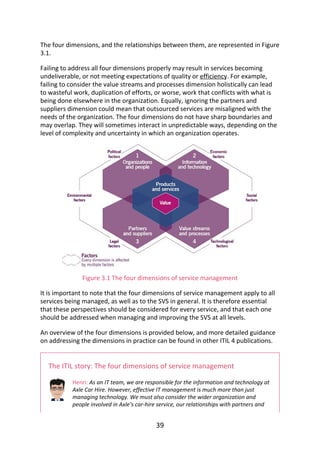
meet	the	metrics	they	are	measured	against.	Therefore,	metrics	need	to	be
meaningful	and	directly	relate	to	the	desired	outcome.
‘When	a	measure	becomes	a	target,	it	ceases	to	be	a	good	measure
Goodhart’s	Law’
4.3.2.3	Applying	the	principle
Having	a	proper	understanding	of	the	current	state	of	services	and	methods	is
important	to	selecting	which	elements	to	re-use,	alter,	or	build	upon.	To	apply	this
principle	successfully,	consider	this	advice:
Look	at	what	exists	as	objectively	as	possible,	using	the	customer	or	the	desired
outcome	as	the	starting	point.	Are	the	elements	of	the	current	state	fit	for
purpose	and	fit	for	use?	There	are	likely	to	be	many	elements	of	the	current
services,	practices,	projects,	and	skills	that	can	be	used	to	create	the	desired
future	state,	provided	the	people	making	this	judgement	are	objective.
When	examples	of	successful	practices	or	services	are	found	in	the	current	state,
determine	if	and	how	these	can	be	replicated	or	expanded	upon	to	achieve	the
desired	state.	In	many,	if	not	most,	cases,	leveraging	what	already	exists	will
reduce	the	amount	of	work	needed	to	transition	from	the	current	state	to	the
desired	state.	There	should	be	a	focus	on	learning	and	improvement,	not	just
replication	and	expansion.
Apply	your	risk	management	skills.	There	are	risks	associated	with	re-using
existing	practices	and	processes,	such	as	the	continuation	of	old	behaviours	that
are	damaging	to	the	service.	There	are	also	risks	associated	with	putting
something	new	in	place,	such	as	new	procedures	not	being	performed	correctly.
These	should	be	considered	as	part	of	the	decision-making	process,	and	the	risks
of	making	or	not	making	a	change	evaluated	to	decide	on	the	best	course	of
action.
Recognize	that	sometimes	nothing	from	the	current	state	can	be	re-used.
67
Regardless	of	how	desirable	it	may	be	to	re-use,	repurpose	and	recycle,	or	even
upcycle,	there	will	be	times	when	the	only	way	to	achieve	the	desired	result	is	to
start	over	entirely.	It	should	be	noted,	however,	that	these	situations	are	very
rare.
4.3.3 	Progress	iteratively	with	feedback
Key	message
Resist	the	temptation	to	do	everything	at	once.	Even	huge	initiatives	must	be
accomplished	iteratively.	By	organizing	work	into	smaller,	manageable	sections
that	can	be	executed	and	completed	in	a	timely	manner,	the	focus	on	each
effort	will	be	sharper	and	easier	to	maintain.
Improvement	iterations	can	be	sequential	or	simultaneous,	based	on	the
requirements	of	the	improvement	and	what	resources	are	available.	Each	individual
iteration	should	be	both	manageable	and	managed,	ensuring	that	tangible	results
are	returned	in	a	timely	manner	and	built	upon	to	create	further	improvement.
A	major	improvement	initiative	or	programme	may	be	organized	into	several
significant	improvement	initiatives,	and	each	of	these	may,	in	turn,	comprise	smaller
improvement	efforts.	The	overall	initiative	or	programme,	as	well	as	its	component
iterations,	must	be	continually	re-evaluated	and	potentially	revised	to	reflect	any
changes	in	circumstances	and	ensure	that	the	focus	on	value	has	not	been	lost.	This
re-evaluation	should	make	use	of	a	wide	range	of	feedback	channels	and	methods
to	ensure	that	the	status	of	the	initiative	and	its	progress	are	properly	understood.
4.3.3.1	The	role	of	feedback
Whether	working	to	improve	a	service,	group	of	services,	practice,	process,
technical	environment,	or	other	service	management	element,	no	improvement
iteration	occurs	in	a	vacuum.	While	the	iteration	is	being	undertaken,	circumstances
can	change	and	new	priorities	can	arise,	and	the	need	for	the	iteration	may	be
altered	or	even	eliminated.	Seeking	and	using	feedback	before,	throughout,	and
after	each	iteration	will	ensure	that	actions	are	focused	and	appropriate,	even	in
changing	circumstances.
A	feedback	loop	is	a	term	commonly	used	to	refer	to	a	situation	where	part	of	the
output	of	an	activity	is	used	for	new	input.	In	a	well-functioning	organization,
68
•
•
•
•
•
•
•
•
•
feedback	is	actively	collected	and	processed	along	the	value	chain.	Well-constructed
feedback	mechanisms	facilitate	understanding	of:
end	user	and	customer	perception	of	the	value	created
the	efficiency	and	effectiveness	of	value	chain	activities
the	effectiveness	of	service	governance	as	well	as	management	controls
the	interfaces	between	the	organization	and	its	partner	and	supplier	network
the	demand	for	products	and	services.
Once	received,	feedback	can	be	analysed	to	identify	improvement	opportunities,
risks,	and	issues.
4.3.3.2	Iteration	and	feedback	together
Working	in	a	timeboxed,	iterative	manner	with	feedback	loops	embedded	into	the
process	allows	for:
greater	flexibility
faster	responses	to	customer	and	business	needs
the	ability	to	discover	and	respond	to	failure	earlier
an	overall	improvement	in	quality.
Having	appropriate	feedback	loops	between	the	participants	of	an	activity	gives
them	a	better	understanding	of	where	their	work	comes	from,	where	their	outputs
go,	and	how	their	actions	and	outputs	affect	the	outcomes,	which	in	turn	enables
them	to	make	better	decisions.
The	ITIL	story:	Progress	iteratively
Marco:	It’s	now	been	three	months	since	Axle	released	the	first	iteration	of	its
new	app.	We	began	by	making	it	available	solely	to	trusted	VIP	customers.	We
worked	with	their	feedback	to	refine	the	booking	process.
Radhika:	We	learned	that	the	app	needed	to	be	flexible	so	we	could	make
changes	easily	based	on	rapidly	evolving	customer	requirements.	For	example,
our	business	customers	wanted	the	app	to	automatically	record	distance
travelled.	Working	with	our	product	team,	we	were	easily	able	to	add	this
functionality.
Su:	The	app	is	now	easily	configurable,	allowing	Axle	to	quickly	add	new
functions	and	features	based	on	customer	feedback.
69
•
•
•
4.3.3.3	Applying	the	principle
To	apply	this	principle	successfully,	consider	this	advice:
Comprehend	the	whole,	but	do	something	Sometimes	the	greatest	enemy	to
progressing	iteratively	is	the	desire	to	understand	and	account	for	everything.
This	can	lead	to	what	is	sometimes	called	‘analysis	paralysis’,	in	which	so	much
time	is	spent	analysing	the	situation	that	nothing	ever	gets	done	about	it.
Understanding	the	big	picture	is	important,	but	so	is	making	progress.	The
ecosystem	is	constantly	changing,	so	feedback	is	essential	Change	is	happening
constantly,	so	it	is	very	important	to	seek	and	use	feedback	at	all	times	and	at	all
levels.
Fast	does	not	mean	incomplete	Just	because	an	iteration	is	small	enough	to	be
done	quickly	does	not	mean	that	it	should	not	include	all	the	elements	necessary
for	success.	Any	iteration	should	be	produced	in	line	with	the	concept	of	the
minimum	viable	product.	A	minimum	viable	product	is	a	version	of	the	final
product	which	allows	the	maximum	amount	of	validated	learning	with	the	least
effort.
4.3.4 	Collaborate	and	promote	visibility
Key	message
When	initiatives	involve	the	right	people	in	the	correct	roles,	efforts	benefit
from	better	buy-in,	more	relevance	(because	better	information	is	available
for	decision-making)	and	increased	likelihood	of	long-term	success.
Creative	solutions,	enthusiastic	contributions,	and	important	perspectives	can	be
obtained	from	unexpected	sources,	so	inclusion	is	generally	a	better	policy	than
exclusion.	Cooperation	and	collaboration	are	better	than	isolated	work,	which	is
frequently	referred	to	as	‘silo	activity’.	Silos	can	occur	through	the	behaviour	of
individuals	and	teams,	but	also	through	structural	causes.	This	typically	happens
where	functions	or	business	units	in	an	organization	are	impeded	or	unable	to
collaborate,	because	their	processes,	systems,	documentation,	and	communications
are	designed	to	fulfil	the	needs	of	only	a	specific	part	of	the	organization.	Applying
the	guiding	principle	of	think	and	work	holistically	(see	section	4.3.5)	can	help
organizations	to	break	down	barriers	between	silos	of	work.
70
•
Recognition	of	the	need	for	genuine	collaboration	has	been	one	of	the	driving
factors	in	the	evolution	of	what	is	now	known	as	DevOps.	Without	effective
collaboration,	neither	Agile,	Lean,	nor	any	other	ITSM	framework	or	method	will
work.
Working	together	in	a	way	that	leads	to	real	accomplishment	requires	information,
understanding,	and	trust.	Work	and	its	results	should	be	made	visible,	hidden
agendas	should	be	avoided,	and	information	should	be	shared	to	the	greatest
degree	possible.	The	more	people	are	aware	of	what	is	happening	and	why,	the
more	they	will	be	willing	to	help.
When	improvement	activity	occurs	in	relative	silence,	or	with	only	a	small	group
being	aware	of	the	details,	assumptions	and	rumours	can	prevail.	Resistance	to
change	will	often	arise	as	staff	members	speculate	about	what	is	changing	and	how
it	might	impact	them.
4.3.4.1	Whom	to	collaborate	with
Identifying	and	managing	all	the	stakeholder	groups	that	an	organization	deals	with
is	important,	as	the	people	and	perspectives	necessary	for	successful	collaboration
can	be	sourced	within	these	stakeholder	groups.	As	the	name	suggests,	a
stakeholder	is	anyone	who	has	a	stake	in	the	activities	of	the	organization,	including
the	organization	itself,	its	customers	and/or	users,	and	many	others.	The	scope	of
stakeholders	can	be	extensive.
The	first	and	most	obvious	stakeholder	group	is	the	customers.	The	main	goal	of	a
service	provider	is	to	facilitate	outcomes	that	its	customers	are	interested	in,	so	the
customers	have	a	large	stake	in	the	service	provider’s	ability	to	manage	services
effectively.	Some	organizations,	however,	do	a	poor	job	of	interacting	with
customers.	A	service	provider	may	feel	that	it	is	too	difficult	to	get	input	or	feedback
from	the	customer,	and	that	the	resulting	delays	are	a	waste	of	time.	Equally,
customers	may	feel	that,	after	they	have	defined	their	requirements,	the	service
provider	can	be	left	to	deliver	the	service	with	no	further	contact	needed.	When	it
comes	to	the	improvement	of	a	service	provider’s	practices,	the	customer	may	not
see	any	need	to	be	involved	at	all.	In	the	end,	however,	the	right	level	of
collaboration	with	customers	will	lead	to	better	outcomes	for	the	organization,	its
customers,	and	other	stakeholders.
Other	examples	of	stakeholder	collaboration	include:
developers	working	with	other	internal	teams	to	ensure	that	what	is	being
developed	can	be	operated	efficiently	and	effectively.	Developers	should
collaborate	with	technical	and	non-technical	operational	teams	to	make	sure
that	they	are	ready,	willing,	and	able	to	transition	the	new	or	changed	service
into	operation,	perhaps	even	participating	in	testing.	Developers	can	also	work
71
•
•
•
•
with	operations	teams	to	investigate	defects	(problems)	and	to	develop
workarounds	or	permanent	fixes	to	resolve	these	defects
suppliers	collaborating	with	the	organization	to	define	its	requirements	and
brainstorm	solutions	to	customer	problems
relationship	managers	collaborating	with	service	consumers	to	achieve	a
comprehensive	understanding	of	service	consumer	needs	and	priorities
customers	collaborating	with	each	other	to	create	a	shared	understanding	of
their	business	issues
internal	and	external	suppliers	collaborating	with	each	other	to	review	shared
processes	and	identify	opportunities	for	optimization	and	potential	automation.
4.3.4.2	Communication	for	improvement
The	contribution	to	improvement	of	each	stakeholder	group	at	each	level	should	be
understood;	it	is	also	important	to	define	the	most	effective	methods	to	engage
with	them.	For	example,	the	contribution	to	improvement	from	customers	of	a
public	cloud	service	may	be	through	a	survey	or	checklist	of	options	for	different
functionalities.	For	an	internal	customer	group,	the	contribution	to	improvement
may	come	from	feedback	solicited	via	a	workshop	or	a	collaboration	tool	on	the
organization’s	intranet.
Some	contributors	may	need	to	be	involved	at	a	very	detailed	level,	while	others	can
simply	be	involved	as	reviewers	or	approvers.	Depending	on	the	service	and	the
relationship	between	the	service	provider	and	the	service	consumer,	the
expectations	about	the	level	and	type	of	collaboration	can	vary	significantly.
4.3.4.3	Increasing	urgency	through	visibility
When	stakeholders	(whether	internal	or	external)	have	poor	visibility	of	the
workload	and	progression	of	work,	there	is	a	risk	of	creating	the	impression	that	the
work	is	not	a	priority.	If	an	initiative	is	communicated	to	a	team,	department,	or
another	organization	and	then	is	never,	or	rarely,	mentioned	again,	the	perception
will	be	that	the	change	is	not	important.	Equally,	when	staff	members	attempt	to
prioritize	improvement	work	versus	other	tasks	that	have	daily	urgency,
improvement	work	may	seem	to	be	a	low-priority	activity	unless	its	importance	has
been	made	transparent	and	it	is	supported	by	the	organization’s	management.
Insufficient	visibility	of	work	leads	to	poor	decision-making,	which	in	turn	impacts
the	organization’s	ability	to	improve	internal	capabilities.	It	will	then	become
difficult	to	drive	improvements	as	it	will	not	be	clear	which	ones	are	likely	to	have
the	greatest	positive	impact	on	results.	To	avoid	this,	the	organization	needs	to
perform	such	critical	analysis	activities	as:
72
•
•
•
•
•
•
understanding	the	flow	of	work	in	progress
identifying	bottlenecks,	as	well	as	excess	capacity
uncovering	waste.
It	is	important	to	involve	and	address	the	needs	of	stakeholders	at	all	levels.	Leaders
at	various	levels	should	also	provide	appropriate	information	relating	to	the
improvement	work	in	their	own	communications	to	others.	Together,	these	actions
will	serve	to	reinforce	what	is	being	done,	why	it	is	being	done,	and	how	it	relates	to
the	stated	vision,	mission,	goals,	and	objectives	of	the	organization.	Determining	the
type,	method,	and	frequency	of	such	messaging	is	one	of	the	central	activities
related	to	communication.
The	ITIL	story:	Working	collaboratively
Henri:	As	well	as	being	iterative,	our	work	on	the	new	Axle	booking	app	is	also
collaborative.	We	include	many	of	our	teams,	such	as	developers,	testers,	and
support	staff,	and	of	course,	our	customers	and	users.	This	approach	enables
us	to	improve	our	services	in	a	more	responsive	and	targeted	manner,	based
on	feedback.
4.3.4.4	Applying	the	principle
To	apply	this	principle	successfully,	consider	this	advice:
Collaboration	does	not	mean	consensus	It	is	not	necessary,	or	even	always	wise,
to	get	consensus	from	everyone	involved	in	an	initiative	before	proceeding.
Some	organizations	are	so	concerned	with	getting	consensus	that	they	try	to
make	everyone	happy	and	end	up	either	doing	nothing	or	producing	something
that	does	not	properly	suit	anyone’s	needs.	Communicate	in	a	way	the	audience
can	hear	In	an	attempt	to	bring	different	stakeholders	into	the	loop,	many
organizations	use	very	traditional	methods	of	communication,	or	they	use	the
same	method	for	all	communication.	Selecting	the	right	method	and	message	for
each	audience	is	critical	for	success.
Decisions	can	only	be	made	on	visible	data	Making	decisions	in	the	absence	of
data	is	risky.	Decisions	should	be	made	about	what	data	is	needed,	and	therefore
what	work	needs	to	be	made	visible.	There	may	be	a	cost	to	collecting	data,	and
the	organization	must	balance	that	cost	against	the	benefit	and	intended	usage
of	the	data.
4.3.5 	Think	and	work	holistically
73
•
•
Key	message
No	service,	practice,	process,	department,	or	supplier	stands	alone.	The
outputs	that	the	organization	delivers	to	itself,	its	customers,	and	other
stakeholders	will	suffer	unless	it	works	in	an	integrated	way	to	handle	its
activities	as	a	whole,	rather	than	as	separate	parts.	All	the	organization’s
activities	should	be	focused	on	the	delivery	of	value.
Services	are	delivered	to	internal	and	external	service	consumers	through	the
coordination	and	integration	of	the	four	dimensions	of	service	management	(see
Chapter	3).
Taking	a	holistic	approach	to	service	management	includes	establishing	an
understanding	of	how	all	the	parts	of	an	organization	work	together	in	an	integrated
way.	It	requires	end-to-end	visibility	of	how	demand	is	captured	and	translated	into
outcomes.	In	a	complex	system,	the	alteration	of	one	element	can	impact	others
and,	where	possible,	these	impacts	need	to	be	identified,	analysed	and	planned	for.
The	ITIL	story:	Think	and	work	holistically
Su:	Currently,	Axle	is	working	on	many	initiatives.	We	have	a	schedule	of
iterative	releases	of	our	new	booking	app,	as	well	as	our	Axle	Aware	advanced
driver	assistance	system,	and	the	new	biometric	scanning	for	collection	and
return	of	vehicles.
Henri:	With	so	much	activity,	we	need	to	understand	the	impacts	both
upstream	and	downstream.	For	example,	a	decision	to	expand	our	booking
app	with	a	new	functionality	would	need	to	consider	any	resource	constraints
for	our	support	teams.
4.3.5.1	Applying	the	principle
To	apply	this	principle	successfully,	consider	this	advice:
Recognize	the	complexity	of	the	systems	Different	levels	of	complexity	require
different	heuristics	for	decision-making.	Applying	methods	and	rules	designed	for
a	simple	system	can	be	ineffective	or	even	harmful	in	a	complex	system,	where
relationships	between	components	are	complicated	and	change	more
frequently.	Collaboration	is	key	to	thinking	and	working	holistically	If	the	right
74
•
•
mechanisms	are	put	in	place	for	all	relevant	stakeholders	to	collaborate	in	a
timely	manner,	it	will	be	possible	to	address	any	issue	holistically	without	being
unduly	delayed.
Where	possible,	look	for	patterns	in	the	needs	of	and	interactions	between
system	elements	Draw	on	knowledge	in	each	area	to	identify	what	is	essential
for	success,	and	which	relationships	between	elements	influence	the	outcomes.
With	this	information,	needs	can	be	anticipated,	standards	can	be	set,	and	a
holistic	view	point	can	be	achieved.
Automation	can	facilitate	working	holistically	Where	the	opportunity	and
sufficient	resources	are	available,	automation	can	support	end-to-end	visibility
for	the	organization	and	provide	an	efficient	means	of	integrated	management.
4.3.6 	Keep	it	simple	and	practical
Key	message
Always	use	the	minimum	number	of	steps	to	accomplish	an	objective.
Outcome-based	thinking	should	be	used	to	produce	practical	solutions	that
deliver	valuable	outcomes.	If	a	process,	service,	action,	or	metric	fails	to
provide	value	or	produce	a	useful	outcome,	then	eliminate	it.	Although	this
principle	may	seem	obvious,	it	is	frequently	ignored,	resulting	in	overly
complex	methods	of	work	that	rarely	maximize	outcomes	or	minimize	cost.
Trying	to	provide	a	solution	for	every	exception	will	often	lead	to	over-complication.
When	creating	a	process	or	a	service,	designers	need	to	think	about	exceptions,	but
they	cannot	cover	them	all.	Instead,	rules	should	be	designed	that	can	be	used	to
handle	exceptions	generally.
The	ITIL	story:	Judging	what	to	keep
Su:	Axle’s	marketing	department	has	indicated	they	would	like	to	launch	a	new
end-of-year	promotion.	The	promotion	would	include	a	free	upgrade	to	a
luxury	vehicle	during	February	and	the	chance	to	win	an	overseas	holiday.
To	enter,	customers	will	submit	an	article	titled	‘My	Best	Driving	Holiday
Adventure’.	The	marketing	team	will	then	collect	and	analyse	the	customer
data	and	create	an	app	that	targets	their	travel	preferences.
75
Henri:	Our	developers	are	already	busy	with	an	implementation	schedule	for
biometric	services.	We	need	speed	to	market	for	this	functionality.	We	must
prioritize	our	work	based	on	the	expected	value.
4.3.6.1	Judging	what	to	keep
When	analysing	a	practice,	process,	service,	metric,	or	other	improvement	target,
always	ask	whether	it	contributes	to	value	creation.
When	designing	or	improving	service	management,	it	is	better	to	start	with	an
uncomplicated	approach	and	then	carefully	add	controls,	activities,	or	metrics	when
it	is	seen	that	they	are	truly	needed.
Critical	to	keeping	service	management	simple	and	practical	is	understanding
exactly	how	something	contributes	to	value	creation.	For	example,	a	step	in	a
process	may	be	perceived	by	the	operational	staff	involved	as	a	waste	of	time.
However,	from	a	corporate	perspective,	the	same	step	may	be	important	for
regulatory	compliance	and	therefore	valuable	in	an	indirect,	but	nevertheless
important,	way.	It	is	necessary	to	establish	and	communicate	a	holistic	view	of	the
organization’s	work	so	that	individual	teams	or	groups	can	think	holistically	about
how	their	work	is	being	influenced	by,	and	in	turn	influences,	others.
The	ITIL	story:	Judging	what	to	keep
Marco:	Our	original	booking	app	captured	a	lot	of	data,	such	as	how	long	it
took	a	customer	to	complete	each	form	in	the	booking	app.	But	we	discovered
that	the	data	provided	little	value	for	decision-making.	The	true	value	lay	in
how	long	the	overall	booking	process	took.	We	refined	the	booking	app	fields
and	improved	its	overall	speed	by	removing	this	data	capture	function.
4.3.6.2	Conflicting	objectives
When	designing,	managing,	or	operating	practices,	be	mindful	of	conflicting
objectives.	For	example,	the	management	of	an	organization	may	want	to	collect	a
large	amount	of	data	to	make	decisions,	whereas	the	people	who	must	do	the
record-keeping	may	want	a	simpler	process	that	does	not	require	as	much	data
entry.	Through	the	application	of	this	and	the	other	guiding	principles,	the
organization	should	agree	on	a	balance	between	its	competing	objectives.	In	this
example,	this	could	mean	that	services	should	only	generate	data	that	will	truly
provide	value	to	the	decision-making	process,	and	record-keeping	should	be
simplified	and	automated	where	possible	to	maximize	value	and	reduce	non-value-
adding	work.
76
•
•
•
•
•
•
4.3.6.3	Applying	the	principle
To	apply	this	principle	successfully,	consider	this	advice:
Ensure	value	Every	activity	should	contribute	to	the	creation	of	value.
Simplicity	is	the	ultimate	sophistication	It	may	seem	harder	to	simplify,	but	it	is
often	more	effective.	Do	fewer	things,	but	do	them	better	Minimizing	activities
to	include	only	those	with	value	for	one	or	more	stakeholders	will	allow	more
focus	on	the	quality	of	those	actions.
Respect	the	time	of	the	people	involved	A	process	that	is	too	complicated	and
bureaucratic	is	a	poor	use	of	the	time	of	the	people	involved.
Easier	to	understand,	more	likely	to	adopt	To	embed	a	practice,	make	sure	it	is
easy	to	follow.
Simplicity	is	the	best	route	to	achieving	quick	wins	Whether	in	a	project,	or	when
improving	daily	operations	activities,	quick	wins	allow	organizations	to
demonstrate	progress	and	manage	stakeholder	expectations.	Working	in	an
iterative	way	with	feedback	will	quickly	deliver	incremental	value	at	regular
intervals.
4.3.7 	Optimize	and	automate
Key	message
Organizations	must	maximize	the	value	of	the	work	carried	out	by	their	human
and	technical	resources.	The	four	dimensions	model	(outlined	in	Chapter	3)
provides	a	holistic	view	of	the	various	constraints,	resource	types,	and	other
areas	that	should	be	considered	when	designing,	managing,	or	operating	an
organization.	Technology	can	help	organizations	to	scale	up	and	take	on
frequent	and	repetitive	tasks,	allowing	human	resources	to	be	used	for	more
complex	decision-making.	However,	technology	should	not	always	be	relied
upon	without	the	capability	of	human	intervention,	as	automation	for
automation’s	sake	can	increase	costs	and	reduce	organizational	robustness
and	resilience.
Optimization	means	to	make	something	as	effective	and	useful	as	it	needs	to	be.
Before	an	activity	can	be	effectively	automated,	it	should	be	optimized	to	whatever
degree	is	possible	and	reasonable.	It	is	essential	that	limits	are	set	on	the
77
•
•
•
•
•
•
optimization	of	services	and	practices,	as	they	exist	within	a	set	of	constraints	which
may	include	financial	limitations,	compliance	requirements,	time	constraints,	and
resource	availability.
4.3.7.1	The	road	to	optimization
There	are	many	ways	in	which	practices	and	services	can	be	optimized.	The
concepts	and	practices	described	in	ITIL,	particularly	the	practices	of	continual
improvement,	and	measurement	and	reporting	(see	sections	5.1.2	and	5.1.5),	are
essential	to	this	effort.	The	specific	practices	an	organization	uses	to	improve	and
optimize	performance	may	draw	upon	guidance	from	ITIL,	Lean,	DevOps,	Kanban,
and	other	sources.	Regardless	of	the	specific	techniques,	the	path	to	optimization
follows	these	high-level	steps:
Understand	and	agree	the	context	in	which	the	proposed	optimization	exists	This
includes	agreeing	the	overall	vision	and	objectives	of	the	organization.	Assess	the
current	state	of	the	proposed	optimization	This	will	help	to	understand	where	it
can	be	improved	and	which	improvement	opportunities	are	likely	to	produce	the
biggest	positive	impact.
Agree	what	the	future	state	and	priorities	of	the	organization	should	be,	focusing
on	simplification	and	value	This	typically	also	includes	standardization	of
practices	and	services,	which	will	make	it	easier	to	automate	or	optimize	further
at	a	later	point.
Ensure	the	optimization	has	the	appropriate	level	of	stakeholder	engagement
and	commitment
Execute	the	improvements	in	an	iterative	way	Use	metrics	and	other	feedback	to
check	progress,	stay	on	track,	and	adjust	the	approach	to	the	optimization	as
needed.
Continually	monitor	the	impact	of	optimization	This	will	help	to	identify
opportunities	to	improve	methods	of	working.
4.3.7.2	Using	automation
Automation	typically	refers	to	the	use	of	technology	to	perform	a	step	or	series	of
steps	correctly	and	consistently	with	limited	or	no	human	intervention.	For	example,
in	organizations	adopting	continuous	deployment,	it	refers	to	the	automatic	and
continuous	release	of	code	from	development	through	to	live,	and	often	automatic
testing	occurring	in	each	environment.	In	its	simplest	form,	however,	automation
could	also	mean	the	standardization	and	streamlining	of	manual	tasks,	such	as
defining	the	rules	of	part	of	a	process	to	allow	decisions	to	be	made	‘automatically’.
Efficiency	can	be	greatly	increased	by	reducing	the	need	for	human	involvement	to
stop	and	evaluate	each	part	of	a	process.
78
•
•
•
•
•
Opportunities	for	automation	can	be	found	across	the	entire	organization.	Looking
for	opportunities	to	automate	standard	and	repeating	tasks	can	help	save	the
organization	costs,	reduce	human	error,	and	improve	employee	experience.
The	ITIL	story:	Optimize	and	automate
Marco:	Axle	has	started	to	trial	the	new	biometric	technology,	and	the	tests
are	going	well.	We’re	keen	to	implement	this	technology	in	all	our	depots.
Radhika:	Before	Axle	introduced	biometrics,	there	were	many	manual,	paper-
based	processes.	Axle	staff	used	paper	checklists	to	carry	out	vehicle	damage
checks.	Their	notes	then	had	to	be	entered	in	a	database,	which	was	only
available	on	desktop	computers.	It	was	not	real	time	or	accessible	across	other
systems.
Su:	This	work	was	usually	put	aside	until	the	end	of	the	day,	and	details	were
often	lost.	We	had	to	improve	the	process	of	data	capture	before	automating.
Radhika:	We	can	automate	almost	anything.	But	let’s	get	the	business	rules
and	processes	right	first.
4.3.7.3	Applying	the	principle
To	apply	this	principle	successfully,	consider	this	advice:
Simplify	and/or	optimize	before	automating	Attempting	to	automate	something
that	is	complex	or	sub-optimal	is	unlikely	to	achieve	the	desired	outcome.	Take
time	to	map	out	the	standard	and	repeating	processes	as	far	as	possible,	and
streamline	where	you	can	(optimize).	From	there	you	can	start	to	automate.
Define	your	metrics	The	intended	and	actual	result	of	the	optimization	should	be
evaluated	using	an	appropriate	set	of	metrics.	Use	the	same	metrics	to	define
the	baseline	and	measure	the	achievements.	Make	sure	that	the	metrics	are
outcome-based	and	focused	on	value.	Use	the	other	guiding	principles	when
applying	this	one	When	optimizing	and	automating,	it	is	smart	to	follow	the
other	principles	as	well:
Progress	iteratively	with	feedback	Iterative	optimization	and	automation	will
make	progress	visible	and	increase	stakeholder	buy-in	for	future	iterations.
Keep	it	simple	and	practical	It	is	possible	for	something	to	be	simple,	but	not
optimized,	so	use	these	two	principles	together	when	selecting
improvements.
79
•
•
Focus	on	value	Selecting	what	to	optimize	and	automate	and	how	to	do	so
should	be	based	on	what	will	create	the	best	value	for	the	organization.
Start	where	you	are	The	technology	already	available	in	the	organization	may
have	features	and	functionalities	that	are	currently	untapped	or	under-
utilized.	Make	use	of	what	is	already	there	to	implement	opportunities	for
optimization	and	automation	quickly	and	economically.
4.3.8 	Principle	interaction
As	well	as	being	aware	of	the	ITIL	guiding	principles,	it	is	also	important	to	recognize
that	they	interact	with	and	depend	upon	each	other.	For	example,	if	an	organization
is	committed	to	progressing	iteratively	with	feedback,	it	should	also	think	and	work
holistically	to	ensure	that	each	iteration	of	an	improvement	includes	all	the
elements	necessary	to	deliver	real	results.	Similarly,	making	use	of	appropriate
feedback	is	key	to	collaboration,	and	focusing	on	what	will	truly	be	valuable	to	the
customer	makes	it	easier	to	keep	things	simple	and	practical.
Organizations	should	not	use	just	one	or	two	of	the	principles,	but	should	consider
the	relevance	of	each	of	them	and	how	they	apply	together.	Not	all	principles	will	be
critical	in	every	situation,	but	they	should	all	be	reviewed	on	each	occasion	to
determine	how	appropriate	they	are.
4.4	Governance
4.4.1 	Governing	bodies	and	governance
Key	message
Every	organization	is	directed	by	a	governing	body,	i.e.	a	person	or	group	of
people	who	are	accountable	at	the	highest	level	for	the	performance	and
compliance	of	the	organization.	All	sizes	and	types	of	organization	perform
governance	activities;	the	governing	body	may	be	a	board	of	directors	or
executive	managers	who	take	on	a	separate	governance	role	when	they	are
performing	governance	activities.	The	governing	body	is	accountable	for	the
organization’s	compliance	with	policies	and	any	external	regulations.
Organizational	governance	is	a	system	by	which	an	organization	is	directed	and
80
•
•
•
•
•
•
•
controlled.	Governance	is	realized	through	the	following	activities:
Evaluate	The	evaluation	of	the	organization,	its	strategy,	portfolios,	and
relationships	with	other	parties.	The	governing	body	evaluates	the	organization
on	a	regular	basis	as	stakeholders’	needs	and	external	circumstances	evolve.
Direct	The	governing	body	assigns	responsibility	for,	and	directs	the	preparation
and	implementation	of,	organizational	strategy	and	policies.	Strategies	set	the
direction	and	prioritization	for	organizational	activity,	future	investment,	etc.
Policies	establish	the	requirements	for	behaviour	across	the	organization	and,
where	relevant,	suppliers,	partners,	and	other	stakeholders.
Monitor	The	governing	body	monitors	the	performance	of	the	organization	and
its	practices,	products,	and	services.	The	purpose	of	this	is	to	ensure	that
performance	is	in	accordance	with	policies	and	direction.
Organizational	governance	evaluates,	directs,	and	monitors	all	the	organization’s
activities,	including	those	of	service	management.
4.4.2 	Governance	in	the	SVS
The	role	and	position	of	governance	in	the	ITIL	SVS	depends	on	how	the	SVS	is
applied	in	an	organization.	The	SVS	is	a	universal	model	that	can	be	applied	to	an
organization	as	a	whole,	or	to	one	or	more	of	its	units	or	products.	In	the	latter	case,
some	organizations	delegate	authority	to	perform	governance	activities	at	different
levels.	The	governing	body	of	the	organization	should	retain	oversight	of	this	to
ensure	alignment	with	the	objectives	and	priorities	of	the	organization.
In	ITIL	4,	the	guiding	principles	and	continual	improvement	apply	to	all	components
of	the	SVS,	including	governance.	In	an	organization,	the	governing	body	can	adopt
the	ITIL	guiding	principles	and	adapt	them,	or	define	its	own	specific	set	of	principles
and	communicate	them	across	the	organization.	The	governing	body	should	also
have	visibility	of	the	outcomes	of	continual	improvement	activities	and	the
measurement	of	value	for	the	organization	and	its	stakeholders.
Regardless	of	the	scope	of	the	SVS	and	the	positioning	of	the	components,	it	is
crucial	to	make	sure	that:
the	service	value	chain	and	the	organization’s	practices	work	in	line	with	the
direction	given	by	the	governing	body
the	governing	body	of	the	organization,	either	directly	or	through	delegation	of
authority,	maintains	oversight	of	the	SVS
both	the	governing	body	and	management	at	all	levels	maintain	alignment
through	a	clear	set	of	shared	principles	and	objectives
the	governance	and	management	at	all	levels	are	continually	improved	to	meet
expectations	of	the	stakeholders.
81
•
•
•
•
•
•
4.5	Service	value	chain
The	central	element	of	the	SVS	is	the	service	value	chain,	an	operating	model	which
outlines	the	key	activities	required	to	respond	to	demand	and	facilitate	value
realization	through	the	creation	and	management	of	products	and	services.
As	shown	in	Figure	4.2,	the	ITIL	service	value	chain	includes	six	value	chain	activities
which	lead	to	the	creation	of	products	and	services	and,	in	turn,	value.
Figure	4.2	The	ITIL	service	value	chain
Key	message
The	six	value	chain	activities	are:
plan
improve
engage
design	and	transition
obtain/build
deliver	and	support.
These	activities	represent	the	steps	an	organization	takes	in	the	creation	of
value.	Each	activity	transforms	inputs	into	outputs.	These	inputs	can	be
82
•
•
•
•
•
•
•
•
demand	from	outside	the	value	chain	or	outputs	of	other	activities.	All	the
activities	are	interconnected,	with	each	activity	receiving	and	providing
triggers	for	further	action.
To	convert	inputs	into	outputs,	the	value	chain	activities	use	different	combinations
of	ITIL	practices	(sets	of	resources	for	performing	certain	types	of	work),	drawing	on
internal	or	third-party	resources,	processes,	skills,	and	competencies	as	required.
For	example,	the	engage	activity	might	draw	on	supplier	management,	service	desk
management,	relationship	management,	and	service	request	management	to
respond	to	new	demands	for	products	and	services,	or	information	from	various
stakeholders	(see	Chapter	5	for	more	information	on	practices).
Regardless	of	which	practices	are	deployed,	there	are	some	common	rules	when
using	the	service	value	chain:
All	incoming	and	outgoing	interactions	with	parties	external	to	the	value	chain
are	performed	via	engage
All	new	resources	are	obtained	through	obtain/build
Planning	at	all	levels	is	performed	via	plan
Improvements	at	all	levels	are	initiated	and	managed	via	improve.
To	carry	out	a	certain	task	or	respond	to	a	particular	situation,	organizations	create
service	value	streams.	These	are	specific	combinations	of	activities	and	practices,
and	each	one	is	designed	for	a	particular	scenario.	Once	designed,	value	streams
should	be	subject	to	continual	improvement.
A	value	stream	might,	for	example,	be	created	for	a	situation	where	a	user	of	a
service	needs	an	incident	to	be	resolved.	The	value	stream	will	be	designed
specifically	to	resolve	this	issue,	and	will	provide	a	complete	guide	to	the	activities,
practices,	and	roles	involved.	A	more	detailed	outline	of	this	and	other	examples	of
value	streams	can	be	found	in	Appendix	A.
Example	of	a	service	value	chain,	its	practices,	and	value	streams
A	mobile	application	development	company	has	a	value	chain,	enabling	the
full	cycle	of	application	development	and	management,	from	business	analysis
to	development,	release,	and	support.	The	company	has	developed	a	number
of	practices,	supported	with	specialized	resources	and	techniques:
business	analysis
development
testing
release	and	deployment
83
•
•
•
•
•
•
support.
Although	the	high-level	steps	are	universal,	different	products	and	clients	need
different	streams	of	work.	For	example:
The	development	of	a	new	application	for	a	new	client	starts	with	initial
engagement	(pre-sale),	then	proceeds	to	business	analysis,	prototyping,
the	drawing	up	of	agreements,	development,	testing,	and	eventually	to
release	and	support.
Changing	an	existing	application	to	meet	new	requirements	of	existing
clients	does	not	include	pre-sale	and	involves	business	analysis,
development,	testing,	and	support	in	a	different	way.
Fixing	an	error	in	a	live	application	may	be	initiated	in	support,	proceed
with	rolling	back	to	a	previous	stable	version	(release),	then	moves	to
development,	testing,	and	release	of	a	fix.
Experiments	with	new	or	existing	applications	to	expand	the	target
audience	may	start	with	innovation	planning	and	prototyping,	then
proceed	to	development,	and	eventually	to	a	pilot	release	for	a	limited
group	of	users	to	test	their	perception	of	the	changes	made.
These	are	examples	of	value	streams:	they	combine	practices	and	value	chain
activities	in	various	ways	to	improve	products	and	services	and	increase
potential	value	for	the	consumers	and	the	organization.
ITSM	in	the	modern	world:	Agile	ITSM
For	an	organization	to	be	successful,	it	must	be	able	to	adapt	to	changing
circumstances	while	remaining	functional	and	effective.	This	might	include
changes	to	the	products	and	services	it	provides	and	consumes,	as	well	as
changes	to	its	structure	and	practices.	In	the	modern	world,	where	IT	is
essential	for	all	organizations,	IT	and	IT	management	are	expected	to	be	Agile.
For	many	IT	professionals,	agility	refers	to	software	development	and	is
associated	with	the	Agile	Manifesto,	proclaimed	in	2001.	The	manifesto
promoted	new	approaches	to	software	development,	and	valued	customer
experience,	collaboration,	and	rapid	changes	over	detailed	planning	and
documentation,	controls,	and	requirements.	Agile	software	development
methods	have	been	adopted	by	many	companies	and	software	teams	since
then,	and	in	many	cases	have	proven	to	be	effective.
Agile	software	development	usually	includes:
continually	evolving	requirements,	collected	through	feedback	analysis	and
84
•
•
•
•
direct	observation
breaking	development	work	into	small	increments	and	iterations
establishing	product-based	cross-functional	teams
visually	presenting	(Kanban)	and	regularly	discussing	(daily	stand-ups)	work
progress
presenting	a	working	(at	least,	the	minimum	viable)	software	to	the
stakeholders	at	the	end	of	each	iteration.
If	applied	successfully,	Agile	software	development	enables	fast	responses	to
the	evolving	needs	of	service	consumers.	However,	in	many	organizations,
Agile	software	development	has	not	provided	the	expected	benefits,	often	due
to	lack	of	Agile	methods	in	the	other	phases	of	the	service	lifecycle.	This
fragmented	agility	makes	little	sense	for	the	organization,	as	the	overall
performance	of	the	value	chain	is	defined	by	that	of	the	slowest	part.	A	holistic
approach	to	the	service	value	chain	should	be	adopted	to	make	sure	that	the
service	provider	is	Agile	throughout	the	service	lifecycle.	This	means	that
agility	should	become	a	quality	of	all	service	management	dimensions	and	all
service	value	chain	activities.
One	of	the	greatest	obstacles	to	service	value	chain	agility	used	to	be	the
rigidity	of	infrastructure	solutions.	It	could	take	months	to	deploy	the
necessary	infrastructure	for	a	new	software	program,	which	made	all
development	agility	invisible	and	irrelevant	for	the	service	consumer.	This
problem	has,	to	a	great	extent,	been	solved	as	technology	has	evolved.
Virtualization,	fast	broadband	and	mobile	connections,	and	cloud	computing
have	allowed	organizations	to	treat	their	IT	infrastructure	as	a	service	or	as	a
code,	thus	providing	infrastructure	changes	with	a	velocity	that	was	previously
only	possible	for	software.	Once	the	technical	problem	was	resolved,	Agile
methods	could	be	applied	to	infrastructure	configuration	and	deployment.
This	stimulated	integration	between	software	and	infrastructure	teams,	and
consequently	between	development	and	operations.
Many	principles	of	Agile	development	can	and	should	be	applied	to	service
operations	and	support.	Operational	changes	and	service	requests	can	be
handled	in	small	iterations	by	dedicated	product	or	service-focused	teams,
with	constant	feedback	and	high	visibility.	Daily	operational	activities	can	and
should	be	visible	and	prioritized	together	with	other	tasks.	All	service
management	activities	can	and	should	continually	provide,	collect,	and	process
feedback.
Agility	is	not	a	software	development	feature;	it	is	an	important	quality	of
organizations	in	their	entirety.	Agile	activities	require	Agile	funding	and
adjusted	financial	and	compliance	controls,	Agile	resourcing,	Agile	contracting,
Agile	procurement,	etc.	If	being	Agile	is	adopted	as	a	key	principle,	an
organization	should	be	able	to	survive	and	prosper	in	a	constantly	changing
85
environment.	Applied	in	a	fragmented	way,	Agile	methods	can	become	a
costly	and	wasteful	complication.
The	ITIL	story:	Value	chains	and	value	streams
Henri:	At	Axle	Car	Hire,	the	value	chain	is	the	way	that	our	company	operates.
It	has	multiple	value	streams.	Each	value	stream	adopts	and	adapts	the
activities	of	the	value	chain	for	carrying	out	particular	tasks.	For	example,
there	is	one	value	stream	for	innovation,	and	another	for	providing	standard
services	to	existing	customers.
The	value	stream	for	providing	standard	services	to	existing	customers
represents	the	activities	that	are	carried	out	when	a	customer	hires	a	car.	This
starts	with	engagement,	when	a	customer	contacts	Axle,	and	then	proceeds	to
delivery,	when	they	receive	a	car	(although	engagement	can	still	happen	at
this	stage).
Some	value	chain	activities	may	be	ongoing	throughout	a	particular	value
stream,	or	may	not	be	involved	at	all.	In	this	stream,	planning	activity	is
continuous,	but	design	and	procurement	activities	will	typically	not	be
involved.	The	stream	ends	with	more	engagement	activities,	when	cars	are
returned	by	customers,	feedback	is	given,	and	orders	are	closed.
Marco:	Value	chain	activities	do	not	have	to	happen	in	a	particular	order.
Axle’s	innovation	value	stream	is	triggered	by	opportunity,	and	then	goes	to
planning,	designing,	building	or	obtaining,	transitioning,	and	finally	to
delivering.	This	stream	often	includes	procurement	activities.	For	example,	we
procure	software	and	hardware	for	our	biometric	solutions.
Henri:	We	manage	value	streams	for	different	objectives,	combining	the	value
chain	activities	and	supporting	them	with	practices.	Every	value	stream	should
be	effective	and	efficient,	and	subject	to	continual	improvement.
The	following	sections	outline	the	value	chain	activities	and	define	the	purpose,
inputs,	and	outputs	for	each.	As	each	value	stream	is	made	up	of	a	different
combination	of	activities	and	practices,	the	inputs	and	outputs	listed	will	not	always
apply,	as	they	are	specific	to	particular	value	streams.	For	example,	the	‘strategic,
tactical,	and	operational	plans’	output	of	the	plan	value	chain	activity	is	formed	as	a
result	of	strategic,	tactical,	and	operational	planning	respectively.	Each	of	these
levels	is	likely	to	involve	different	resources,	have	a	different	planning	cycle,	and	be
triggered	by	different	events.	The	lists	of	inputs	and	outputs	given	are	not
prescriptive,	and	they	can	and	should	be	adjusted	when	organizations	design	their
value	streams.
86
•
•
•
•
•
•
•
•
•
•
•
4.5.1 	Plan
Key	message
The	purpose	of	the	plan	value	chain	activity	is	to	ensure	a	shared
understanding	of	the	vision,	current	status,	and	improvement	direction	for	all
four	dimensions	and	all	products	and	services	across	the	organization.
The	key	inputs	to	this	activity	are:
policies,	requirements,	and	constraints	provided	by	the	organization’s	governing
body
consolidated	demands	and	opportunities	provided	by	engage
value	chain	performance	information,	improvement	status	reports,	and
improvement	initiatives	from	improve
knowledge	and	information	about	new	and	changed	products	and	services	from
design	and	transition,	and	obtain/build
knowledge	and	information	about	third-party	service	components	from	engage.
The	key	outputs	of	this	activity	are:
strategic,	tactical,	and	operational	plans
portfolio	decisions	for	design	and	transition
architectures	and	policies	for	design	and	transition
improvement	opportunities	for	improve
a	product	and	service	portfolio	for	engage
contract	and	agreement	requirements	for	engage.
4.5.2 	Improve
Key	message
87
•
•
•
•
•
•
•
•
•
•
•
•
•
The	purpose	of	the	improve	value	chain	activity	is	to	ensure	continual
improvement	of	products,	services,	and	practices	across	all	value	chain
activities	and	the	four	dimensions	of	service	management.
The	key	inputs	to	this	value	chain	activity	are:
product	and	service	performance	information	provided	by	deliver	and	support
stakeholders’	feedback	provided	by	engage
performance	information	and	improvement	opportunities	provided	by	all	value
chain	activities
knowledge	and	information	about	new	and	changed	products	and	services	from
design	and	transition,	and	obtain/build
knowledge	and	information	about	third-party	service	components	from	engage.
The	key	outputs	of	this	value	chain	activity	are:
improvement	initiatives	for	all	value	chain	activities
value	chain	performance	information	for	plan	and	the	governing	body
improvement	status	reports	for	all	value	chain	activities
contract	and	agreement	requirements	for	engage
service	performance	information	for	design	and	transition.
4.5.3 	Engage
Key	message
The	purpose	of	the	engage	value	chain	activity	is	to	provide	a	good
understanding	of	stakeholder	needs,	transparency,	and	continual	engagement
and	good	relationships	with	all	stakeholders.
The	key	inputs	to	this	value	chain	activity	are:
a	product	and	service	portfolio	provided	by	plan
high-level	demand	for	services	and	products	provided	by	internal	and	external
customers
detailed	requirements	for	services	and	products	provided	by	customers
88
•
•
•
•
•
•
•
•
•
•
•
•
•
•
•
•
•
•
•
requests	and	feedback	from	customers
incidents,	service	requests,	and	feedback	from	users
information	on	the	completion	of	user	support	tasks	from	deliver	and	support
marketing	opportunities	from	current	and	potential	customers	and	users
cooperation	opportunities	and	feedback	provided	by	partners	and	suppliers
contract	and	agreement	requirements	from	all	value	chain	activities
knowledge	and	information	about	new	and	changed	products	and	services	from
design	and	transition,	and	obtain/build
knowledge	and	information	about	third-party	service	components	from	suppliers
and	partners
product	and	service	performance	information	from	deliver	and	support
improvement	initiatives	from	improve
improvement	status	reports	from	improve.
The	key	outputs	of	this	value	chain	activity	are:
consolidated	demands	and	opportunities	for	plan
product	and	service	requirements	for	design	and	transition
user	support	tasks	for	deliver	and	support
improvement	opportunities	and	stakeholders’	feedback	for	improve
change	or	project	initiation	requests	for	obtain/build
contracts	and	agreements	with	external	and	internal	suppliers	and	partners	for
design	and	transition,	and	obtain/build
knowledge	and	information	about	third-party	service	components	for	all	value
chain	activities
service	performance	reports	for	customers.
4.5.4 	Design	and	transition
Key	message
The	purpose	of	the	design	and	transition	value	chain	activity	is	to	ensure	that
products	and	services	continually	meet	stakeholder	expectations	for	quality,
costs,	and	time	to	market.
89
•
•
•
•
•
•
•
•
•
•
•
•
•
•
•
•
•
The	key	inputs	to	this	activity	are:
portfolio	decisions	provided	by	plan
architectures	and	policies	provided	by	plan
product	and	service	requirements	provided	by	engage
improvement	initiatives	provided	by	improve
improvement	status	reports	from	improve
service	performance	information	provided	by	deliver	and	support,	and	improve
service	components	from	obtain/build
knowledge	and	information	about	third-party	service	components	from	engage
knowledge	and	information	about	new	and	changed	products	and	services	from
obtain/build
contracts	and	agreements	with	external	and	internal	suppliers	and	partners
provided	by	engage.
The	key	outputs	of	this	activity	are:
requirements	and	specifications	for	obtain/build
contract	and	agreement	requirements	for	engage
new	and	changed	products	and	services	for	deliver	and	support
knowledge	and	information	about	new	and	changed	products	and	services	to	all
value	chain	activities
performance	information	and	improvement	opportunities	for	improve.
4.5.5 	Obtain/build
Key	message
The	purpose	of	the	obtain/build	value	chain	activity	is	to	ensure	that	service
components	are	available	when	and	where	they	are	needed,	and	meet	agreed
specifications.
The	key	inputs	to	this	activity	are:
architectures	and	policies	provided	by	plan
contracts	and	agreements	with	external	and	internal	suppliers	and	partners
90
•
•
•
•
•
•
•
•
•
•
•
•
•
•
•
•
•
•
provided	by	engage
goods	and	services	provided	by	external	and	internal	suppliers	and	partners
requirements	and	specifications	provided	by	design	and	transition
improvement	initiatives	provided	by	improve
improvement	status	reports	from	improve
change	or	project	initiation	requests	provided	by	engage
change	requests	provided	by	deliver	and	support
knowledge	and	information	about	new	and	changed	products	and	services	from
design	and	transition
knowledge	and	information	about	third-party	service	components	from	engage.
The	key	outputs	of	this	activity	are:
service	components	for	deliver	and	support
service	components	for	design	and	transition
knowledge	and	information	about	new	and	changed	service	components	to	all
value	chain	activities
contract	and	agreement	requirements	for	engage
performance	information	and	improvement	opportunities	for	improve.
4.5.6 	Deliver	and	support
Key	message
The	purpose	of	the	deliver	and	support	value	chain	activity	is	to	ensure	that
services	are	delivered	and	supported	according	to	agreed	specifications	and
stakeholders’	expectations.
The	key	inputs	to	this	activity	are:
new	and	changed	products	and	services	provided	by	design	and	transition
service	components	provided	by	obtain/build
improvement	initiatives	provided	by	improve
improvement	status	reports	from	improve
user	support	tasks	provided	by	engage
91
•
•
•
•
•
•
•
•
•
•
•
•
knowledge	and	information	about	new	and	changed	service	components	and
services	from	design	and	transition,	and	obtain/build
knowledge	and	information	about	third-party	service	components	from	engage.
The	key	outputs	of	this	activity	are:
services	delivered	to	customers	and	users
information	on	the	completion	of	user	support	tasks	for	engage
product	and	service	performance	information	for	engage	and	improve
improvement	opportunities	for	improve
contract	and	agreement	requirements	for	engage
change	requests	for	obtain/build
service	performance	information	for	design	and	transition.
Further	details	on	the	service	value	chain	activities	can	be	found	in	other	ITIL	4
publications	and	supplementary	materials.
4.6	Continual	improvement
Continual	improvement	takes	place	in	all	areas	of	the	organization	and	at	all	levels,
from	strategic	to	operational.	To	maximize	the	effectiveness	of	services,	each
person	who	contributes	to	the	provision	of	a	service	should	keep	continual
improvement	in	mind,	and	should	always	be	looking	for	opportunities	to	improve.
The	continual	improvement	model	applies	to	the	SVS	in	its	entirety,	as	well	as	to	all
of	the	organization’s	products,	services,	service	components,	and	relationships.	To
support	continual	improvement	at	all	levels,	the	ITIL	SVS	includes:
the	ITIL	continual	improvement	model,	which	provides	organizations	with	a
structured	approach	to	implementing	improvements
the	improve	service	value	chain	activity,	which	embeds	continual	improvement
into	the	value	chain
the	continual	improvement	practice,	supporting	organizations	in	their	day-to-day
improvement	efforts.
The	ITIL	continual	improvement	model	can	be	used	as	a	high-level	guide	to	support
improvement	initiatives.	Use	of	the	model	increases	the	likelihood	that	ITSM
initiatives	will	be	successful,	puts	a	strong	focus	on	customer	value,	and	ensures
that	improvement	efforts	can	be	linked	back	to	the	organization’s	vision.	The	model
supports	an	iterative	approach	to	improvement,	dividing	work	into	manageable
pieces	with	separate	goals	that	can	be	achieved	incrementally.
Figure	4.3	provides	a	high-level	overview	of	the	ITIL	continual	improvement	model.
92
Figure	4.3	The	continual	improvement	model
The	ITIL	story:	Improving	Axle
Henri	would	like	Axle	to	become	a	greener	company	and	introduce	more
environmentally	friendly	practices	into	its	work.	Over	the	following	sections
the	Axle	team	uses	the	steps	of	the	continual	improvement	model	to
implement	changes	to	the	organization.
Henri:	At	Axle	we	strive	for	continual	improvement	at	all	levels.	One	of	our
objectives	is	to	be	a	greener	business	and	incorporate	sustainable	principles
into	every	business	decision.	My	team	is	committed	to	this	initiative.	As	part	of
our	service	relationship	model,	our	partners	and	suppliers	are	also	involved	in
this.
It	is	important	to	remember	that	the	scope	and	details	of	each	step	of	the	model
will	vary	significantly	based	on	the	subject	and	the	type	of	improvement.	It	should
be	recognized	that	this	model	can	serve	as	a	workflow,	but	it	can	also	be	used
simply	as	a	high-level	reminder	of	a	sound	thought	process	to	ensure	improvements
are	properly	managed.	The	flow	seeks	to	ensure	that	improvements	are	linked	to
the	organization’s	goals	and	are	properly	prioritized,	and	that	improvement	actions
produce	sustainable	results.
Logic	and	common	sense	should	always	prevail	when	using	the	continual
improvement	model.	The	steps	of	this	model	do	not	need	to	be	carried	out	in	a
93
•
•
•
•
•
•
•
linear	fashion,	and	it	may	be	necessary	to	re-evaluate	and	return	to	a	previous	step
at	some	point.	Critical	judgement	should	always	be	applied	when	using	this	model.
4.6.1 	Steps	of	the	continual	improvement	model
This	section	provides	more	detail	on	each	step	of	the	continual	improvement	model.
An	organization	can	adjust	these	steps	to	its	culture	and	goals.	The	model	is	simple
and	flexible,	and	can	just	as	easily	be	used	in	an	Agile	culture	as	in	a	more	traditional
waterfall	culture.
4.6.4.1	Step	1:	What	is	the	vision?
Key	message
Each	improvement	initiative	should	support	the	organization’s	goals	and
objectives.	The	first	step	of	the	continual	improvement	model	is	to	define	the
vision	of	the	initiative.	This	provides	context	for	all	subsequent	decisions	and
links	individual	actions	to	the	organization’s	vision	for	the	future.
This	step	focuses	on	two	key	areas:
The	organization’s	vision	and	objectives	need	to	be	translated	for	the	specific
business	unit,	department,	team,	and/or	individual,	so	that	the	context,
objectives,	and	boundaries	for	any	improvement	initiative	are	understood.
A	high-level	vision	for	the	planned	improvement	needs	to	be	created.
The	work	within	this	step	should	ensure	that:
the	high-level	direction	has	been	understood
the	planned	improvement	initiative	is	described	and	understood	in	that	context
the	stakeholders	and	their	roles	have	been	understood
the	expected	value	to	be	realized	is	understood	and	agreed
the	role	of	the	person	or	team	responsible	for	carrying	out	the	improvement	is
clear	in	relation	to	achieving	the	organization’s	vision.
If	this	step	is	skipped,	improvements	might	only	be	optimized	for	the	people	or
teams	involved	rather	than	the	whole	organization,	or	non-value-adding	activities
might	become	the	sole	focus	of	improvements.
94
The	ITIL	story:	What	is	the	vision?
Henri:	Axle’s	vision	is	for	the	business	to	become	one	of	the	top	three	green
car-hire	companies	globally.	A	continual	improvement	initiative	called	Axle
Green	was	created	for	this	purpose.
Craig:	As	a	supplier	of	cleaning	services	to	Axle,	I’ll	support	them	in	this
improvement	initiative.
4.6.1.2	Step	2:	Where	are	we	now?
Key	message
The	success	of	an	improvement	initiative	depends	on	a	clear	and	accurate
understanding	of	the	starting	point	and	the	impact	of	the	initiative.	An
improvement	can	be	thought	of	as	a	journey	from	Point	A	to	Point	B,	and	this
step	clearly	defines	what	Point	A	looks	like.	A	journey	cannot	be	mapped	out	if
the	starting	point	is	not	known.
A	key	element	in	this	step	is	a	current	state	assessment.	This	is	an	assessment	of
existing	services,	including	the	users’	perception	of	value	received,	people’s
competencies	and	skills,	the	processes	and	procedures	involved,	and/or	the
capabilities	of	the	available	technological	solutions.	The	organization’s	culture,	i.e.
the	prevailing	values	and	attitudes	across	all	stakeholder	groups,	also	needs	to	be
understood	to	decide	what	level	of	organizational	change	management	is	required.
Current	state	assessments	should	be	done	through	objective	measurement
whenever	possible.	This	will	allow	for	an	accurate	understanding	of	the	issues
associated	with	the	current	state	and,	once	the	initiative	is	implemented,	enable
proper	measurement	of	the	level	of	improvement	achieved	by	comparison	with	the
initial	state.	If	a	good	measurement	system	is	in	place,	the	information	to	fulfil	this
step	may	already	have	been	provided	when	the	proposed	improvement	was	initially
documented.
If	this	step	is	skipped,	the	current	state	will	not	be	understood	and	there	will	not	be
an	objective	baseline	measurement.	It	will	therefore	be	difficult	to	track	and
measure	the	effectiveness	of	the	improvement	activities,	as	the	new	state	cannot
95
be	compared	with	a	previous	state	at	a	later	point.
The	ITIL	story:	Where	are	we	now?
Su:	We	need	to	understand	the	baseline.	How	do	we	know	if	we’ve	improved,
if	we	don’t	know	where	we	started?	Currently,	only	5	per	cent	of	the	vehicles	in
our	fleet	are	electric.
Craig:	Only	20	per	cent	of	my	cleaning	products	are	biodegradable.
4.6.1.3	Step	3:	Where	do	we	want	to	be?
Key	message
Just	as	the	previous	step	(Step	2)	describes	Point	A	on	the	improvement
journey,	Step	3	outlines	what	Point	B,	the	target	state	for	the	next	step	of	the
journey,	should	look	like.	A	journey	cannot	be	mapped	out	if	the	destination	is
not	clear.
Based	on	the	results	of	the	first	two	steps,	a	gap	analysis	can	be	performed,	which
evaluates	the	scope	and	nature	of	the	distance	to	be	travelled	from	the	starting
point	to	the	achievement	of	the	initiative’s	vision.	It	is	important	to	note	that	the
initial	vision	of	the	initiative	is	aspirational	and	may	never	be	achieved	in	full.
Improvement	is	the	goal,	not	perfection.	This	step	should	define	one	or	more
prioritized	actions	along	the	way	to	completing	the	vision	for	the	improvement,
based	on	what	is	known	at	the	starting	point.	Improvement	opportunities	can	be
identified	and	prioritized	based	on	the	gap	analysis,	and	improvement	objectives
can	be	set,	along	with	critical	success	factors	(CSFs)	and	key	performance	indicators
(KPIs).
The	agreed	objectives,	CSFs,	and	KPIs	need	to	follow	what	is	known	as	the	SMART
principle.	They	should	be	specific,	measurable,	achievable,	relevant,	and	time-
bound.	It	is	much	easier	to	define	the	route	of	the	improvement	journey	if	the	exact
destination	is	known.	It	is	important	to	note	that	the	target	state	represents
progress	towards	the	vision,	not	the	achievement	of	the	entire	vision.
96
If	this	step	is	skipped,	the	target	state	will	remain	unclear.	It	will	be	difficult	to
prepare	a	satisfactory	explanation	of	what	key	stakeholders	stand	to	gain	from	the
improvement	initiative,	which	may	result	in	low	support	or	even	pushback.
The	ITIL	story:	Where	do	we	want	to	be?
Su:	Within	five	years,	we	want	50	per	cent	of	our	fleet	to	consist	of	electric
vehicles.	The	other	half	should	comply	with	the	strictest	ecological
requirements	for	petrol	and	diesel	cars.
Craig:	One	of	my	targets	is	that	90	per	cent	of	my	cleaning	products	will	be
biodegradable	within	the	next	two	years.
Radhika:	This	is	a	great	initiative.	In	our	IT	team,	we	want	to	use
biodegradable	cups.	We	would	also	like	Axle	to	use	environmentally	friendly
light	bulbs	in	all	our	offices.
4.6.1.4	Step	4:	How	do	we	get	there?
Now	that	the	start	and	end	points	of	the	improvement	journey	have	been	defined,	a
specific	route	can	be	agreed.	Based	on	the	understanding	of	the	vision	of	the
improvement	and	the	current	and	target	states,	and	combining	that	knowledge	with
subject	matter	expertise,	a	plan	for	addressing	the	challenges	of	the	initiative	can	be
created.
Key	message
The	plan	for	Step	4	can	be	a	straightforward	and	direct	route	to	completing	a
single	simple	improvement,	or	it	may	be	more	involved.	The	most	effective
approach	to	executing	the	improvement	may	not	be	clear,	and	it	will
sometimes	be	necessary	to	design	experiments	that	will	test	which	options
have	the	most	potential.
Even	if	the	path	to	follow	is	clear,	it	may	be	most	effective	to	carry	out	the
work	in	a	series	of	iterations,	each	of	which	will	move	the	improvement
forward	part	of	the	way.	With	each	iteration,	there	is	an	opportunity	to	check
progress,	re-evaluate	the	approach,	and	change	direction	if	appropriate.
97
If	this	step	is	skipped,	the	execution	of	the	improvement	is	likely	to	flounder	and	fail
to	achieve	what	is	required	of	it.	Failed	improvements	erode	confidence	and	can
make	it	difficult	to	get	support	for	future	improvements.
The	ITIL	story:	How	do	we	get	there?
Craig:	My	plan	is	to	replace	our	current	stocks	of	cleaning	products	with
biodegradable	options	as	we	run	out.	Meanwhile,	we’ll	test	new	products	to
find	the	optimal	balance	of	price	and	quality.
Su:	Sometimes	knowing	how	you	get	there	is	easy,	but	replacing	half	of	our
fleet	with	electric	cars	is	a	bigger	challenge.	We	don’t	want	excess	cars	in	our
car	lots	if	they’re	not	being	used.	We	must	also	consider	specifics	and
infrastructure	in	different	countries,	as	well	as	local	regulations.
Radhika:	We’re	encouraging	the	use	of	ceramic	cups	over	plastic	ones.	We’re
discontinuing	the	purchase	of	plastic	cups,	and	we	are	buying	ceramic	cups	for
all	our	offices.
4.6.1.5	Step	5:	Take	action
Key	message
In	Step	5	the	plan	for	the	improvement	is	acted	upon.	This	could	involve	a
traditional	waterfall-style	approach,	but	it	could	be	more	appropriate	to	follow
an	Agile	approach	by	experimenting,	iterating,	changing	directions,	or	even
going	back	to	previous	steps.
Some	improvements	take	place	as	part	of	a	big	initiative	that	makes	a	lot	of	change,
whereas	other	improvements	are	small	but	significant.	In	some	cases,	a	larger
change	is	effected	through	the	implementation	of	multiple	smaller	improvement
iterations.	Even	if	the	path	to	complete	the	improvement	seemed	clear	when	it	was
planned,	it	is	important	to	remain	open	to	change	throughout	the	approach.
Achieving	the	desired	results	is	the	objective,	not	rigid	adherence	to	one	view	of
how	to	proceed.
98
During	the	improvement,	there	needs	to	be	continual	focus	on	measuring	progress
towards	the	vision	and	managing	risks,	as	well	as	ensuring	visibility	and	overall
awareness	of	the	initiative.	ITIL	practices	such	as	organizational	change
management	(section	5.1.6),	measurement	and	reporting	(section	5.1.5),	risk
management	(section	5.1.10)	and,	of	course,	continual	improvement	(section	5.1.2)
are	important	factors	in	achieving	success	in	this	step.
Once	this	step	is	completed,	the	work	will	be	at	the	end	point	of	the	journey,
resulting	in	a	new	current	state.
The	ITIL	story:	Take	action
Craig:	We	have	started	to	replace	our	stocks	of	cleaning	products	with
biodegradable	options.	We’ve	found	some	great	new	products	to	use,	and
even	managed	to	save	money	by	using	cheaper	alternatives	that	don’t
compromise	on	quality.
Su:	We	have	started	to	phase	out	some	of	our	older	petrol	and	diesel	cars	and
replace	them	with	new	electric	models.	We	have	carried	out	a	thorough	check
of	the	petrol	and	diesel	cars	we	are	keeping	to	ensure	they	meet	ecological
requirements,	and	will	take	action	to	fix	this	where	they	do	not.
Radhika:	We	have	brought	the	new	biodegradable	cups	and	environmentally
friendly	light	bulbs	into	our	offices	and	started	to	remove	the	plastic	cups.
4.6.1.6	Step	6:	Did	we	get	there?
This	step	involves	checking	the	destination	of	the	journey	to	be	sure	that	the	desired
point	has	been	reached.
Key	message
Too	often,	once	an	improvement	plan	is	set	in	motion,	it	is	assumed	that	the
expected	benefits	have	been	achieved,	and	that	attention	can	be	redirected	to
the	next	initiative.	In	reality,	the	path	to	improvement	is	filled	with	various
obstacles,	so	success	must	be	validated.
99
For	each	iteration	of	the	improvement	initiative,	both	the	progress	(have	the
original	objectives	been	achieved?)	and	the	value	(are	those	objectives	still
relevant?)	need	to	be	checked	and	confirmed.	If	the	desired	result	has	not	been
achieved,	additional	actions	to	complete	the	work	are	selected	and	undertaken,
commonly	resulting	in	a	new	iteration.
If	this	step	is	skipped,	it	is	hard	to	be	sure	whether	the	desired	or	promised
outcomes	were	actually	achieved,	and	any	lessons	from	this	iteration,	which	would
support	a	course	correction	if	needed,	will	be	lost.
The	ITIL	story:	Did	we	get	there?
Craig:	After	a	few	months	we	managed	to	hit	our	target	of	having	90	per	cent
of	our	products	being	biodegradable.
Su:	The	electric	cars	are	being	introduced,	but	for	logistical	reasons	it	is
proving	more	difficult	to	replace	the	petrol	and	diesel	cars	than	we	had
anticipated.	We	will	need	to	do	this	at	a	faster	pace	if	we	want	to	hit	our	five-
year	target.	We	may	now	have	to	reconsider	our	target,	and	decide	whether
we	should	do	more	to	support	it,	or	if	it	needs	to	be	revised.
Radhika:	Our	offices	now	have	biodegradable	cups	and	environmentally
friendly	light	bulbs.	Some	of	the	old	plastic	cups	are	still	being	used,	but	we
have	stopped	purchasing	more,	so	once	they	run	out	they’ll	be	gone.
4.6.1.7	Step	7:	How	do	we	keep	the	momentum	going?
Key	message
If	the	improvement	has	delivered	the	expected	value,	the	focus	of	the
initiative	should	shift	to	marketing	these	successes	and	reinforcing	any	new
methods	introduced.	This	is	to	ensure	that	the	progress	made	will	not	be	lost
and	to	build	support	and	momentum	for	the	next	improvements.
The	organizational	change	management	and	knowledge	management	practices
should	be	used	to	embed	the	changes	in	the	organization	and	ensure	that	the
improvements	and	changed	behaviours	are	not	at	risk	of	reversion.	Leaders	and
100
managers	should	help	their	teams	to	truly	integrate	new	work	methods	into	their
daily	work	and	institutionalize	new	behaviours.
If	the	expected	results	of	the	improvement	were	not	achieved,	stakeholders	need	to
be	informed	of	the	reasons	for	the	failure	of	the	initiative.	This	requires	a	thorough
analysis	of	the	improvement,	documenting	and	communicating	the	lessons	learned.
This	should	include	a	description	of	what	can	be	done	differently	in	the	next
iteration,	based	on	the	experience	gathered.	Transparency	is	important	for	future
efforts,	regardless	of	the	results	of	the	current	iteration.
If	this	step	is	skipped,	then	it	is	likely	that	improvements	will	remain	isolated	and
independent	initiatives,	and	any	progress	made	may	be	lost	over	time.	It	may	also
be	difficult	to	get	support	for	future	improvements,	and	embed	continual
improvement	in	the	organization’s	culture.
The	ITIL	story:	How	do	we	keep	the	momentum	going?
Craig:	Now	that	we	have	hit	our	target	we	will	monitor	any	new	products	we
buy	to	ensure	that	they	meet	our	standards	of	being	biodegradable.	We	will
also	be	on	the	lookout	for	any	opportunities	to	replace	our	remaining	non-
biodegradable	products	with	more	environmentally	friendly	alternatives.
Su:	We’ve	made	a	great	start	on	adding	new	electric	vehicles	to	the	Axle	fleet,
but	haven’t	hit	our	targets	yet.	Now	we	need	to	analyse	what	has	prevented
us	from	reaching	our	objectives,	record	what	lessons	we	have	learned,	and
decide	what	can	be	done	differently	in	the	future	to	make	the	introduction	of
electric	cars	more	effective.
Radhika:	We	will	continue	to	buy	ceramic	cups	and	environmentally	friendly
light	bulbs	for	our	offices.	We	will	also	consider	further	ways	to	make	our
offices	greener,	and	run	campaigns	with	staff	members	to	encourage	them	to
become	more	environmentally	aware.
4.6.2 	Continual	improvement	and	the	guiding	principles
Following	the	continual	improvement	model,	an	organization	may	significantly
benefit	from	applying	the	ITIL	guiding	principles.	All	the	principles	are	applicable	and
relevant	at	every	step	of	an	improvement	initiative.	However,	some	of	the	guiding
principles	are	especially	relevant	to	specific	steps	of	the	continual	improvement
model.	Following	these	principles	at	every	step	of	an	improvement	increases	the
chances	for	success	of	the	steps	and	the	overall	improvement	initiative.	Table	4.2
outlines	to	which	steps	of	the	continual	improvement	model	each	of	the	guiding
principles	is	particularly	relevant,	although	all	principles	are	applicable	to	all	steps	at
some	level.
101
Continual	improvement	is	not	only	an	integral	part	of	Lean,	but	also	Agile
(retrospectives),	DevOps	(continual	experimentation	and	learning,	and	mastery),
and	other	frameworks.	It	is	one	of	the	key	components	of	the	ITIL	SVS,	providing,
along	with	the	guiding	principles,	a	solid	platform	for	successful	service
management.
Table	4.2	The	steps	of	the	continual	improvement	model	linked	to	the	most	relevant	ITIL
guiding	principles
Continual	improvement	and	the	theory	of	constraints
In	an	increasingly	dynamic	business	environment,	an	enterprise’s	ability	to
change	quickly,	whether	in	response	to	external	factors	or	to	disrupt	the
market,	can	make	the	difference	between	failure	and	success.
When	planning	improvements,	it	is	crucial	to	focus	on	the	work	that	is	the
highest	priority.	According	to	the	theory	of	constraints	(ToC),	the	weakest	link
in	the	value	chain	determines	the	flow	and	throughput	of	the	system.	The
weakest	link	must	be	elevated	as	much	as	possible	(sometimes	revealing	a
new	weakest	link),	and	all	the	other	steps	in	the	value	chain	must	be	organized
around	it.
The	weakest	link	of	a	value	stream	can	be	determined	with	value	stream
mapping.	This	is	a	Lean	practice	that	examines	the	stream,	quantifies	its	waste
(for	example,	a	delay),	and	in	so	doing,	identifies	its	weakest	link.	If	the
weakest	link	is	the	development	of	information	systems,	then	the	application
of	Agile	principles	and	practices	can	improve	the	quality	of,	and	the	speed	with
which,	functionality	is	developed.	This	includes	the	critical	interaction	between
business	and	IT	in	which	the	required	functionality	is	defined	alongside	the
non-functional	requirements.	The	ITIL	4	practices	that	help	with	this	include,
among	others,	software	development	and	management,	business	analysis,
and	relationship	management.
If	the	weakest	link	is	the	speed	and	reliability	of	deployment,	then	using
DevOps	principles,	technical	practices	and	tools	can	make	a	significant
difference.	The	ITIL	4	practices	that	are	relevant	to	this	include	deployment
102
management,	release	management,	and	organizational	change	management.
Finally,	if	the	weakest	link	is	the	delivery	and	support	of	IT	services,	then	IT
operations	practices	and	tools	can	be	used,	such	as	the	ITIL	4	practices	of
incident	management,	problem	management,	service	desk,	and	infrastructure
and	platform	management.
4.7	Practices
A	practice	is	a	set	of	organizational	resources	designed	for	performing	work	or
accomplishing	an	objective.	These	resources	are	grouped	into	the	four	dimensions
of	service	management	(see	Chapter	3).	The	ITIL	SVS	includes	general	management,
service	management,	and	technical	management	practices,	as	described	in	Chapter
5.
4.8	Summary
The	ITIL	SVS	describes	how	all	the	components	and	activities	of	the	organization
work	together	as	a	system	to	enable	value	creation.	Each	organization’s	SVS	has
interfaces	with	other	organizations,	forming	an	ecosystem	that	facilitates	value
creation	for	the	organizations,	their	customers,	and	other	stakeholders.
The	ITIL	SVS	is	a	powerful	holistic	construct	for	the	governance	and	management	of
modern	products	and	services	that	enables	organizations	to	co-create	value	with
consumers.	The	SVS	includes	the	service	value	chain	activities	supported	by
universal	and	holistic	practices	that	allow	the	organization	to	manage	demands	of
all	types.	These	range	from	strategic	demands	that	enable	the	organization	to	thrive
in	a	competitive	landscape,	to	operational	requests	for	information,	services,	or
support.	Every	organization	participates	in	some	form	of	the	value	chain	activities
described	here,	even	when	many	of	them	are	performed	by	suppliers	and	partners.
ITIL	4	guidance	can	be	adapted	and	adopted	to	facilitate	value,	feedback,	and
continual	improvement	across	the	SVS.
103
CHAPTER	5
ITIL	MANAGEMENT	PRACTICES
104
•
•
•
	
5	ITIL	management	practices
The	ITIL	SVS	includes	14	general	management	practices,	17	service	management
practices,	and	three	technical	management	practices,	all	of	which	are	subject	to	the
four	dimensions	of	service	management	(see	Chapter	3).
Key	message
In	ITIL,	a	management	practice	is	a	set	of	organizational	resources	designed	for
performing	work	or	accomplishing	an	objective.	The	origins	of	the	practices
are	as	follows:
General	management	practices	have	been	adopted	and	adapted	for	service
management	from	general	business	management	domains.
Service	management	practices	have	been	developed	in	service
management	and	ITSM	industries.
Technical	management	practices	have	been	adapted	from	technology
management	domains	for	service	management	purposes	by	expanding	or
shifting	their	focus	from	technology	solutions	to	IT	services.
The	34	ITIL	management	practices	are	listed	in	Table	5.1.
Table	5.1	The	ITIL	management	practices
General	management	practices Service	management	practices Technical	management	practices
Architecture	management
Continual	improvement
Information	security	management
Knowledge	management
Measurement	and	reporting
Organizational	change
management
Portfolio	management
Project	management
Relationship	management
Risk	management
Service	financial	management
Strategy	management
Availability	management
Business	analysis
Capacity	and	performance
management
Change	control
Incident	management
IT	asset	management
Monitoring	and	event	management
Problem	management
Release	management
Service	catalogue	management
Service	configuration	management
Service	continuity	management
Deployment	management
Infrastructure	and	platform
management
Software	development	and
management
105
•
•
•
•
•
•
•
•
•
Supplier	management
Workforce	and	talent	management
Service	design
Service	desk
Service	level	management
Service	request	management
Service	validation	and	testing
ITSM	in	the	modern	world:	high-velocity	service	delivery
In	business	innovation	and	differentiation,	speed	to	market	is	a	key	success
factor.	If	an	organization	takes	too	long	to	implement	a	new	business	idea,	it	is
likely	to	be	done	faster	by	someone	else.	Because	of	this,	organizations	have
started	demanding	shorter	time	to	market	from	their	IT	service	providers.
For	service	providers	that	have	always	used	modern	technology,	this	has	not
been	a	big	challenge.	They	have	adopted	modern	ways	of	scaling	their
resources	and	established	appropriate	practices	for	project	and	product
management,	testing,	integration,	deployment,	release,	delivery,	and	support
of	IT	services.	These	practices	have	been	documented	and	have	triggered	the
development	of	new	IT	management	movements	and	practices,	such	as
DevOps.	However,	for	organizations	bearing	a	legacy	of	old	IT	architectures
and	IT	management	practices	focused	on	control	and	cost	efficiency,	the	new
business	demand	has	introduced	a	greater	challenge.
The	high-velocity	service	delivery	paradigm	includes:
focus	on	fast	delivery	of	new	and	changed	IT	services	to	users
continual	analysis	of	feedback	provided	for	IT	services	at	every	stage	of
their	lifecycle
agility	in	processing	the	feedback,	giving	rise	to	continual	and	fast
improvement	of	IT	services
an	end-to-end	approach	to	the	service	lifecycle,	from	ideation,	through
creation	and	delivery,	to	consumption	of	services
integration	of	product	and	service	management	practices
digitalization	of	IT	infrastructure	and	adoption	of	cloud	computing
extensive	automation	of	the	service	delivery	chain.
High-velocity	service	delivery	influences	all	the	practices	of	a	service	provider,
including	general	management	practices,	service	management	practices,	and
technical	management	practices.	For	example,	an	organization	aiming	to
deliver	and	improve	its	services	faster	than	others	needs	to	consider:
Agile	project	management
Agile	financial	management
106
•
•
•
•
•
•
•
•
product-based	organizational	structure
adaptive	risk	management,	and	audit	and	compliance	management
flexible	architecture	management
specific	architecture	technology	solutions,	such	as	microservices
complex	partner	and	supplier	environments
continual	monitoring	of	technology	innovations	and	experimenting
human-centred	design
infrastructure	management	focused	on	cloud	computing.
Even	if	only	some	of	the	services	in	a	provider’s	portfolio	need	high-velocity
delivery,	organizational	changes	of	a	significant	scale	are	required	to	enable
this,	especially	if	the	organization	has	a	legacy	of	low-velocity	services,
practices,	and	habits.	Moreover,	bi-modal	IT,	where	high-velocity	service
management	is	combined	with	traditional	practices,	introduces	even	more
complexity	and	greater	challenges.	However,	for	many	modern	organizations,
high-velocity	service	delivery	is	no	longer	an	option	but	a	necessity,	and	they
must	improve	their	service	management	practices	to	respond	to	this
challenge.
5.1	General	management	practices
5.1.1 	Architecture	management
Key	message
The	purpose	of	the	architecture	management	practice	is	to	provide	an
understanding	of	all	the	different	elements	that	make	up	an	organization	and
how	those	elements	interrelate,	enabling	the	organization	to	effectively
achieve	its	current	and	future	objectives.	It	provides	the	principles,	standards,
and	tools	that	enable	an	organization	to	manage	complex	change	in	a
structured	and	Agile	way.
Just	as	the	modern	organization’s	environment	and	ecosystem	have	become	more
complex,	so	have	its	challenges.	These	include	not	only	how	to	increase	efficiency
and	automation,	but	also	how	to	better	manage	the	complexity	of	the	environment
107
and	how	to	achieve	organizational	agility	and	resilience.	Without	the	visibility	and
coordination	made	possible	by	a	proper	architecture	management	practice,	an
organization	can	become	a	labyrinth	of	third-party	contracts,	variant	processes
across	different	organizational	silos,	various	products	and	services	that	have	been
needlessly	customized	for	different	customers,	and	a	legacy	infrastructure.	The
result	is	a	complex	landscape	where	any	change	becomes	far	more	difficult	to
implement	and	introduces	a	much	higher	risk.
A	complete	architecture	management	practice	should	address	all	architecture
domains:	business,	service,	information,	technology,	and	environment.	For	a	smaller
and	less	complex	organization,	the	architect	can	develop	a	single	integrated
architecture.
Architecture	types
Business	architecture
The	business	architecture	allows	the	organization	to	look	at	its	capabilities	in
terms	of	how	they	align	with	all	the	detailed	activities	required	to	create	value
for	the	organization	and	its	customers.	These	are	then	compared	with	the
organization’s	strategy	and	a	gap	analysis	of	the	target	state	against	current
capabilities	is	performed.	Identified	gaps	between	the	baseline	and	target
state	are	prioritized	and	these	capability	gaps	are	addressed	incrementally.	A
‘roadmap’	describes	the	transformation	from	current	to	future	state	to
achieve	the	organization’s	strategy.
Service	architecture
Service	architecture	gives	the	organization	a	view	of	all	the	services	it	provides,
including	interactions	between	the	services	and	service	models	that	describe
the	structure	(how	the	service	components	fit	together)	and	the	dynamics
(activities,	flow	of	resources,	and	interactions)	of	each	service.	A	service	model
can	be	used	as	a	template	or	blueprint	for	multiple	services.
Information	systems	architecture,	including	data	and	applications	architectures
The	information	architecture	describes	the	logical	and	physical	data	assets	of
the	organization	and	the	data	management	resources.	It	shows	how	the
information	resources	are	managed	and	shared	for	the	benefit	of	the
organization.
Information	is	a	valuable	asset	for	the	organization,	with	actual	and
measurable	value.	Information	is	the	basis	for	decision-making,	so	it	must
always	be	complete,	accurate,	and	accessible	to	those	who	are	authorized	to
access	it.	Information	systems	must	therefore	be	designed	and	managed	with
108
•
•
•
•
•
these	concepts	in	mind.
Technology	architecture
The	technology	architecture	defines	the	software	and	hardware	infrastructure
needed	to	support	the	portfolio	of	products	and	services.
Environmental	architecture
The	environmental	architecture	describes	the	external	factors	impacting	the
organization	and	the	drivers	for	change,	as	well	as	all	aspects,	types,	and	levels
of	environmental	control	and	their	management.	The	environment	includes
developmental,	technological,	business,	operational,	organizational,	political,
economic,	legal,	regulatory,	ecological,	and	social	influences.
Figure	5.1	shows	the	contribution	of	architecture	management	to	the	service	value
chain,	with	the	practice	being	involved	in	all	value	chain	activities;	however,	it	is
most	instrumental	in	the	plan,	improve,	and	design	and	transition	value	chain
activities:
Plan	The	architecture	management	practice	is	responsible	for	developing	and
maintaining	a	reference	architecture	that	describes	the	current	and	target
architectures	for	the	business,	information,	data,	application,	technology,	and
environment	perspectives.	This	is	used	as	a	basis	for	all	the	plan	value	chain
activity.
Improve	Many	opportunities	for	improvement	are	identified	through	review	of
the	business,	service,	information,	technical,	and	environment	architectures.
Engage	The	architecture	management	practice	facilitates	the	ability	to
understand	the	organization’s	readiness	to	address	new	or	under-served	markets
and	a	wider	variety	of	products	and	services,	and	more	quickly	respond	to
changing	circumstances.	The	architecture	management	practice	is	responsible
for	assessing	the	organization’s	capabilities	in	terms	of	how	they	align	with	all
the	detailed	activities	required	to	co-create	value	for	the	organization	and	its
customers.
Design	and	transition	Once	a	new	or	changed	product	or	service	is	approved	to
be	developed,	the	architecture,	design,	and	build	teams	will	continually	evaluate
whether	the	product/service	meets	the	investment	objectives.	The	architecture
management	practice	is	responsible	for	the	service	architecture,	which	describes
the	structure	(how	the	service	components	fit	together)	and	the	dynamics
(activities,	flow	of	resources,	and	interactions)	of	the	service.	A	service	model	can
be	used	as	a	template	or	blueprint	for	multiple	services	and	is	essential	to	the
design	and	transition	activity.
Obtain/build	The	reference	architectures	(business,	service,	information,
technical,	and	environmental)	facilitate	identification	of	what	products,	services,
109
•
or	service	components	need	to	be	obtained	or	built.
Deliver	and	support	The	reference	architectures	are	used	continually	as	part	of
the	operation,	restoration,	and	maintenance	of	products	and	services.
Figure	5.1	Heat	map	of	the	contribution	of	architecture	management	to	value	chain
activities
5.1.2 	Continual	improvement
Key	message
The	purpose	of	the	continual	improvement	practice	is	to	align	the
organization’s	practices	and	services	with	changing	business	needs	through
the	ongoing	improvement	of	products,	services,	and	practices,	or	any	element
involved	in	the	management	of	products	and	services.
Included	in	the	scope	of	the	continual	improvement	practice	is	the	development	of
improvement-related	methods	and	techniques	and	the	propagation	of	a	continual
improvement	culture	across	the	organization,	in	alignment	with	the	organization’s
overall	strategy.	The	commitment	to	and	practice	of	continual	improvement	must
be	embedded	into	every	fibre	of	the	organization.	If	it	is	not,	there	is	a	real	risk	that
daily	operational	concerns	and	major	project	work	will	eclipse	continual
110
•
•
•
•
•
•
•
•
improvement	efforts.
Key	activities	that	are	part	of	continual	improvement	practices	include:
encouraging	continual	improvement	across	the	organization
securing	time	and	budget	for	continual	improvement
identifying	and	logging	improvement	opportunities
assessing	and	prioritizing	improvement	opportunities
making	business	cases	for	improvement	action
planning	and	implementing	improvements
measuring	and	evaluating	improvement	results
coordinating	improvement	activities	across	the	organization.
There	are	many	methods,	models,	and	techniques	that	can	be	employed	for	making
improvements.	Different	types	of	improvement	may	call	for	different	improvement
methods.	For	example,	some	improvements	may	be	best	organized	into	a	multi-
phase	project,	while	others	may	be	more	appropriate	as	a	single	quick	effort.
The	ITIL	SVS	includes	the	continual	improvement	model	(see	Figure	4.3),	which	can
be	applied	to	any	type	of	improvement,	from	high-level	organizational	changes	to
individual	services	and	configuration	items	(CIs).	The	model	is	described	in	section
4.6.
When	assessing	the	current	state,	there	are	many	techniques	that	can	be	employed,
such	as	a	strength,	weakness,	opportunity,	and	threat	(SWOT)	analysis,	a	balanced
scorecard	review,	internal	and	external	assessments	and	audits,	or	perhaps	even	a
combination	of	several	techniques.	Organizations	should	develop	competencies	in
methodologies	and	techniques	that	will	meet	their	needs.
Approaches	to	continual	improvement	can	be	found	in	many	places.	Lean	methods
provide	perspectives	on	the	elimination	of	waste.	Agile	methods	focus	on	making
improvements	incrementally	at	a	cadence.	DevOps	methods	work	holistically	and
ensure	that	improvements	are	not	only	designed	well,	but	applied	effectively.
Although	there	are	a	number	of	methods	available,	organizations	should	not	try	to
formally	commit	to	too	many	different	approaches.	It	is	a	good	idea	to	select	a	few
key	methods	that	are	appropriate	to	the	types	of	improvement	the	organization
typically	handles	and	to	cultivate	those	methods.	In	this	way,	teams	will	have	a
shared	understanding	of	how	to	work	together	on	improvements	to	facilitate	a
greater	amount	of	change	at	a	quicker	rate.
This	does	not	mean,	however,	that	the	organization	should	not	try	new	approaches
or	allow	for	innovation.	Those	in	the	organization	with	skills	in	alternative	methods
should	be	encouraged	to	apply	them	when	it	makes	sense,	and	if	this	effort	is
successful,	the	alternative	method	may	be	added	to	the	organization’s	repertoire.
111
Older	methods	may	gradually	be	retired	in	favour	of	new	ones	if	better	results	are
achieved.
Continual	improvement	is	everyone’s	responsibility.	Although	there	may	be	a	group
of	staff	members	who	focus	on	this	work	full-time,	it	is	critical	that	everyone	in	the
organization	understands	that	active	participation	in	continual	improvement
activities	is	a	core	part	of	their	job.	To	ensure	that	this	is	more	than	a	good
intention,	it	is	wise	to	include	contribution	to	continual	improvement	in	all	job
descriptions	and	every	employee’s	objectives,	as	well	as	in	contracts	with	external
suppliers	and	contractors.
The	highest	levels	of	the	organization	need	to	take	responsibility	for	embedding
continual	improvement	into	the	way	that	people	think	and	work.	Without	their
leadership	and	visible	commitment	to	continual	improvement,	attitudes,	behaviour,
and	culture	will	not	evolve	to	a	point	where	improvements	are	considered	in
everything	that	is	done,	at	all	levels.
Training	and	other	enablement	assistance	should	be	provided	to	staff	members	to
help	them	feel	prepared	to	contribute	to	continual	improvement.	Although
everyone	should	contribute	in	some	way,	there	should	at	least	be	a	small	team
dedicated	full-time	to	leading	continual	improvement	efforts	and	advocating	the
practice	across	the	organization.	This	team	can	serve	as	coordinators,	guides,	and
mentors,	helping	others	in	the	organization	to	develop	the	skills	they	need	and
navigating	any	difficulties	that	may	be	encountered.
When	third-party	suppliers	form	part	of	the	service	landscape,	they	should	also	be
part	of	the	improvement	effort.	When	contracting	for	a	supplier’s	service,	the
contract	should	include	details	of	how	they	will	measure,	report	on,	and	improve
their	services	over	the	life	of	the	contract.	If	data	will	be	required	from	suppliers	to
operate	internal	improvements,	that	should	be	specified	in	the	contract	as	well.
Accurate	data,	carefully	analysed	and	understood,	is	the	foundation	of	fact-based
decision-making	for	improvement.	The	continual	improvement	practice	should	be
supported	by	relevant	data	sources	and	data	analysis	to	ensure	that	each	potential
improvement	is	sufficiently	understood	and	prioritized.
To	track	and	manage	improvement	ideas	from	identification	through	to	final	action,
organizations	use	a	database	or	structured	document	called	a	continual
improvement	register	(CIR).	There	can	be	more	than	one	CIR	in	an	organization,	as
multiple	CIRs	can	be	maintained	on	individual,	team,	departmental,	business	unit,
and	organizational	levels.	Some	organizations	maintain	a	single	master	CIR,	but
segment	how	it	is	used	and	by	whom	at	a	more	granular	level.
Improvement	ideas	can	also	initially	be	captured	in	other	places	and	through	other
practices,	such	as	during	project	execution	or	software	development	activities.	In
this	case,	it	is	important	to	document	for	attention	the	improvement	ideas	that
come	up	as	part	of	ongoing	continual	improvement.	As	new	ideas	are	documented,
112
•
CIRs	are	used	to	constantly	reprioritize	improvement	opportunities.	The	use	of	CIRs
provides	additional	value	because	they	help	to	make	things	visible.	This	is	not
limited	to	what	is	currently	being	done,	but	also	to	what	is	already	complete	and
what	has	been	set	aside	for	further	consideration	at	a	later	date.
It	does	not	matter	exactly	how	the	information	in	a	CIR	is	structured,	or	what	the
collections	of	improvement	ideas	are	called	in	any	given	organization.	What	is
important	is	that	improvement	ideas	are	captured,	documented,	assessed,
prioritized,	and	appropriately	acted	upon	to	ensure	that	the	organization	and	its
services	are	always	being	improved.
The	continual	improvement	practice	is	integral	to	the	development	and
maintenance	of	every	other	practice	as	well	as	to	the	complete	lifecycle	of	all
services	and	indeed	the	SVS	itself.	That	said,	there	are	some	practices	that	make	a
special	contribution	to	continual	improvement.	For	example,	the	organization’s
problem	management	practice	can	uncover	issues	that	will	be	managed	through
continual	improvement.	The	changes	initiated	through	continual	improvement	may
fail	without	the	critical	contributions	of	organizational	change	management.	And
many	improvement	initiatives	will	use	project	management	practices	to	organize
and	manage	their	execution.
Figure	5.2	Heat	map	of	the	contribution	of	continual	improvement	to	value	chain
activities
Figure	5.2	shows	the	contribution	of	continual	improvement	to	the	service	value
chain,	with	the	practice	being	involved	in	all	value	chain	activities:
Plan	The	continual	improvement	practice	is	applied	to	planning	activities,
methods,	and	techniques	to	make	sure	they	are	relevant	to	the	organization’s
113
•
•
•
•
•
current	objectives	and	context.
Improve	The	continual	improvement	practice	is	key	to	this	value	chain	activity.	It
structures	resources	and	activities,	enabling	improvement	at	all	levels	of	the
organization	and	the	SVS.
Engage,	design	and	transition,	obtain/build,	and	deliver	and	support	Each	of
these	value	chain	activities	is	subject	to	continual	improvement,	and	the
continual	improvement	practice	is	applied	to	all	of	them.
5.1.3 	Information	security	management
Key	message
The	purpose	of	the	information	security	management	practice	is	to	protect	the
information	needed	by	the	organization	to	conduct	its	business.	This	includes
understanding	and	managing	risks	to	the	confidentiality,	integrity,	and
availability	of	information,	as	well	as	other	aspects	of	information	security
such	as	authentication	(ensuring	someone	is	who	they	claim	to	be)	and	non-
repudiation	(ensuring	that	someone	can’t	deny	that	they	took	an	action).
The	required	security	is	established	by	means	of	policies,	processes,	behaviours,	risk
management,	and	controls,	which	must	maintain	a	balance	between:
Prevention	Ensuring	that	security	incidents	don’t	occur
Detection	Rapidly	and	reliably	detecting	incidents	that	can’t	be	prevented
Correction	Recovering	from	incidents	after	they	are	detected.
It	is	also	important	to	achieve	a	balance	between	protecting	the	organization	from
harm	and	allowing	it	to	innovate.	Information	security	controls	that	are	too
restrictive	may	do	more	harm	than	good,	or	may	be	circumvented	by	people	trying
to	do	work	more	easily.	Information	security	controls	should	consider	all	aspects	of
the	organization	and	align	with	its	risk	appetite.
Information	security	management	interacts	with	every	other	practice.	It	creates
controls	that	each	practice	must	consider	when	planning	how	work	will	be	done.	It
also	depends	on	other	practices	to	help	protect	information.
Information	security	management	must	be	driven	from	the	most	senior	level	in	the
organization,	based	on	clearly	understood	governance	requirements	and
114
•
•
•
•
•
•
•
•
•
•
organizational	policies.	Most	organizations	have	a	dedicated	information	security
team,	which	carries	out	risk	assessments	and	defines	policies,	procedures,	and
controls.	In	high-velocity	environments,	information	security	is	integrated	as	much
as	possible	into	the	daily	work	of	development	and	operations,	shifting	the	reliance
on	control	of	process	towards	verification	of	preconditions	such	as	expertise	and
integrity.
Information	security	is	critically	dependent	on	the	behaviour	of	people	throughout
the	organization.	Staff	who	have	been	trained	well	and	pay	attention	to	information
security	policies	and	other	controls	can	help	to	detect,	prevent,	and	correct
information	security	incidents.	Poorly	trained	or	insufficiently	motivated	staff	can	be
a	major	vulnerability.
Many	processes	and	procedures	are	required	to	support	information	security
management.	These	include:
an	information	security	incident	management	process
a	risk	management	process
a	control	review	and	audit	process
an	identity	and	access	management	process
event	management
procedures	for	penetration	testing,	vulnerability	scanning,	etc.
procedures	for	managing	information	security	related	changes,	such	as	firewall
configuration	changes.
Figure	5.3	shows	the	contribution	of	information	security	management	to	the
service	value	chain,	with	the	practice	being	involved	in	all	value	chain	activities:
Plan	Information	security	must	be	considered	in	all	planning	activity	and	must	be
built	into	every	practice	and	service.
Improve	Information	security	must	be	considered	in	all	improvement	value	chain
activity	to	ensure	that	vulnerabilities	are	not	introduced	when	making
improvements.
Engage	Information	security	requirements	for	new	and	changed	services	must	be
understood	and	captured.	All	levels	of	engagement,	from	operational	to
strategic,	must	support	information	security	and	encourage	the	behaviours
needed.	All	stakeholders	must	contribute	to	information	security,	including
customers,	users,	suppliers,	etc.
115
•
•
•
Figure	5.3	Heat	map	of	the	contribution	of	information	security	management	to
value	chain	activities
Design	and	transition	Information	security	must	be	considered	throughout	this
value	chain	activity,	with	effective	controls	being	designed	and	transitioned	into
operation.	The	design	and	transition	of	all	services	must	consider	information
security	aspects	as	well	as	all	other	utility	and	warranty	requirements.
Obtain/build	Information	security	must	be	built	into	all	components,	based	on
the	risk	analysis,	policies,	procedures,	and	controls	defined	by	information
security	management.	This	applies	whether	the	components	are	built	internally
or	procured	from	suppliers.
Deliver	and	support	Detection	and	correction	of	information	security	incidents
must	be	an	integral	part	of	this	value	chain	activity.
The	ITIL	story:	Axle’s	information	security	management
Su:	Our	travel	app	stores	a	lot	of	sensitive	data,	including	customer	and	credit
card	details.	Our	role	is	to	make	sure	this	data	is	secure.
Marco:	Some	of	the	data	is	also	stored	and	processed	by	our	partners,	who
helped	us	to	develop	the	app	and	continue	to	support	the	app	on	our	behalf.
Radhika:	We	use	the	data	to	analyse	customer	demand	and	the	use	of	our
fleet,	track	the	conditions	of	our	cars,	and	analyse	our	customers’	preferences
to	create	tailored	offerings.
116
Su:	Our	consumers	need	to	know	that	their	data	is	safe	and	will	not	be
misused.	We	regularly	undergo	external	audits	to	provide	assurance	for	our
stakeholders	and	to	confirm	compliance	with	national	and	international
regulations.
Henri:	As	CIO,	I	make	sure	everyone	who	works	in	and	with	Axle	is	aware	of
the	importance	of	information	security,	and	follows	Axle	policies	and
procedures	concerning	information	security	management.
5.1.4 	Knowledge	management
Key	message
The	purpose	of	the	knowledge	management	practice	is	to	maintain	and
improve	the	effective,	efficient,	and	convenient	use	of	information	and
knowledge	across	the	organization.
Knowledge	is	one	of	the	most	valuable	assets	of	an	organization.	The	knowledge
management	practice	provides	a	structured	approach	to	defining,	building,	re-using,
and	sharing	knowledge	(i.e.	information,	skills,	practices,	solutions,	and	problems)	in
various	forms.	As	methods	of	capturing	and	sharing	knowledge	move	more	towards
digital	solutions,	the	practice	of	knowledge	management	becomes	even	more
valuable.
117
•
•
•
Figure	5.4	Heat	map	of	the	contribution	of	knowledge	management	to	value	chain
activities
It	is	important	to	understand	that	‘knowledge’	is	not	simply	information.	Knowledge
is	the	use	of	information	in	a	particular	context.	This	needs	to	be	understood	with
both	the	user	of	the	knowledge	and	the	relevant	situation	in	mind.	For	example,
information	presented	in	the	form	of	a	300-page	manual	is	not	useful	for	a	service
desk	analyst	who	needs	to	find	a	fast	solution.	A	better	example	of	knowledge	that
is	fit	for	purpose	might	be	a	simplified	set	of	instructions	or	reference	points	that
allow	the	analyst	to	find	the	relevant	content	quickly.
Knowledge	management	aims	to	ensure	that	stakeholders	get	the	right	information,
in	the	proper	format,	at	the	right	level,	and	at	the	correct	time,	according	to	their
access	level	and	other	relevant	policies.	This	requires	a	procedure	for	the	acquisition
of	knowledge,	including	the	development,	capturing,	and	harvesting	of	unstructured
knowledge,	whether	it	is	formal	and	documented	or	informal	and	tacit	knowledge.
Figure	5.4	shows	the	contribution	of	knowledge	management	to	the	service	value
chain,	with	the	practice	being	involved	in	all	value	chain	activities:
Plan	Knowledge	management	helps	the	organization	to	make	sound	portfolio
decisions	and	to	define	its	strategy	and	other	plans,	and	supports	financial
management.
Improve	This	value	chain	activity	is	based	on	an	understanding	of	the	current
situation	and	trends,	supported	by	historical	information.	Knowledge
management	provides	context	for	the	assessment	of	achievements	and
improvement	planning.
Engage	Relationships	at	all	levels,	from	strategic	to	operational,	are	based	on	an
118
•
•
•
understanding	of	the	context	and	history	of	those	relationships.	Knowledge
management	helps	to	better	understand	stakeholders.
Design	and	transition	As	with	the	obtain/build	value	chain	activity,	knowledge	of
the	solutions	and	technologies	available,	and	the	re-use	of	information,	can
make	this	value	chain	activity	more	effective.
Obtain/build	The	efficiency	of	this	value	chain	activity	can	be	significantly
improved	with	sufficient	knowledge	of	the	solutions	and	technologies	available,
and	through	the	re-use	of	information.
Deliver	and	support	Ongoing	value	chain	activity	in	this	area	benefits	from
knowledge	management	through	re-use	of	solutions	in	standard	situations	and	a
better	understanding	of	the	context	of	non-standard	situations	that	require
analysis.
The	ITIL	story:	Axle’s	knowledge	management
Radhika:	Because	we’re	using	an	Agile	deployment	for	our	app	development,
we	need	to	make	sure	our	staff	have	up-to-date	knowledge	on	new	features.
Just	as	importantly,	knowledge	needs	to	be	retired	when	it’s	out	of	date.	For
example,	we	recently	discovered	the	printing	feature	of	our	app	was	not	being
used	by	our	customers.	We	removed	printing	and	replaced	it	with	a	new
function	to	send	information	from	the	app	by	email	instead.	As	part	of	release
management,	we’ve	already	provided	updated	knowledge	articles	to	our
service	desk	to	reflect	the	change.
Su:	Knowledge	management	is	more	than	just	data	collection.	At	Axle,	we
focus	on	open	communication	and	the	sharing	of	knowledge.	To	promote
collaboration	and	visibility,	we	make	sure	that	information,	problems,	and
concerns	are	openly	shared	between	our	teams	and	branches.
Henri:	But	we	also	need	to	follow	information	security	policies	and	make	sure
that	openness	does	not	mean	carelessness.
Marco:	We’re	testing	new	systems	based	on	AI	to	improve	our	forecasting	and
decision-making	at	all	levels,	from	strategic	planning	to	user	support.
5.1.5 	Measurement	and	reporting
119
•
•
Key	message
The	purpose	of	the	measurement	and	reporting	practice	is	to	support	good
decision-making	and	continual	improvement	by	decreasing	the	levels	of
uncertainty.	This	is	achieved	through	the	collection	of	relevant	data	on	various
managed	objects	and	the	valid	assessment	of	this	data	in	an	appropriate
context.	Managed	objects	include,	but	are	not	limited	to,	products	and
services,	practices	and	value	chain	activities,	teams	and	individuals,	suppliers
and	partners,	and	the	organization	as	a	whole.
Many	of	these	managed	objects	are	connected,	and	so	are	their	respective	metrics
and	indicators.	For	example,	to	set	clear	objectives	for	measurement	and	reporting,
there	is	a	need	to	understand	organizational	goals.	These	can	be	based	on	a	number
of	areas:	profit,	growth,	competitive	advantage,	customer	retention,
operational/public	service,	etc.	(see	the	focus	on	value	guiding	principle	in	section
4.3.1).	In	such	cases,	it	is	important	to	establish	a	clear	relationship	between	high-
level	and	subordinate	goals	and	the	objectives	that	relate	to	them.
For	the	set	goals,	operational	critical	success	factors	(CSFs)	can	be	defined.	Based	on
these	CSFs,	a	set	of	related	key	performance	indicators	(KPIs)	can	then	be	agreed
upon,	against	which	success	can	be	measured.
Definitions
Critical	success	factor	(CSF)	A	necessary	precondition	for	the	achievement
of	intended	results.
Key	performance	indicator	(KPI)	An	important	metric	used	to	evaluate	the
success	in	meeting	an	objective.
5.1.5.1	KPIs	and	behaviour
KPIs	for	individuals	can	work	as	a	competitive	motivator,	and	this	will	drive	positive
results	if	the	KPIs	are	set	to	meet	clear	business	goals.	However,	target-setting	for
individuals	can	also	have	a	negative	side,	driving	inappropriate	or	unsuitable
behaviours.	This	typically	happens	if	there	is	too	much	focus	placed	on	individual
KPIs.	For	example,	service	desk	staff	might	be	heavily	driven	to	keep	calls	short,	but
this	can	negatively	impact	on	customer	satisfaction,	and	even	resolution	times,	if
issues	are	not	properly	dealt	with.
120
•
•
•
•
•
•
Operational	KPIs	should	ideally	be	set	for	teams	rather	than	focusing	too	closely	on
individuals.	This	means	that	there	can	be	some	flexibility	in	the	targets	and
behaviours	allowed	by	the	team	as	a	whole.	Individuals	will,	of	course,	still	need
some	specific	guidelines	for	their	performance,	but	this	should	be	clearly	within	the
goals	of	the	team	and	organization,	and	all	targets	should	be	set	in	the	context	of
providing	value	for	the	organization.
5.1.5.2	Reporting
Data	collected	as	metrics	is	usually	presented	in	the	form	of	reports	or	dashboards.
It	is	important	to	remember	that	reports	are	intended	to	support	good	decision-
making,	so	their	content	should	be	relevant	to	the	recipients	of	the	information	and
related	to	the	required	topic.	Reports	and	dashboards	should	make	it	easy	for	the
recipient	to	see	what	needs	to	be	done	and	then	take	action.	As	such,	a	good	report
or	dashboard	should	answer	two	main	questions:	how	far	are	we	from	our	targets
and	what	bottlenecks	prevent	us	from	achieving	better	results?
Figure	5.5	shows	the	contribution	of	measurement	and	reporting	to	the	service
value	chain,	with	the	practice	being	involved	in	all	value	chain	activities:
Plan	Measurement	and	reporting	enables	strategy	and	service	portfolio	decisions
by	providing	details	on	current	performance	of	products	and	services.
Improve	Performance	is	constantly	monitored	and	evaluated	to	support
continual	improvement,	alignment,	and	value	creation.
Engage	Engagement	with	stakeholders	is	based	on	correct,	up-to-date,	and
sufficient	information	provided	in	the	form	of	dashboards	and	reports.
Design	and	transition	Measurement	and	reporting	provides	information	for
management	decisions	at	every	stage	before	going	live.
Obtain/build	The	practice	ensures	transparency	of	all	development	and
procurement	activities,	enabling	effective	management	and	integration	with	all
other	value	chain	activities.
Deliver	and	support	Ongoing	management	of	products	and	services	is	based	on
correct,	up-to-date,	and	sufficient	performance	information.
121
Figure	5.5	Heat	map	of	the	contribution	of	measurement	and	reporting	to	value
chain	activities
5.1.6 	Organizational	change	management
Key	message
The	purpose	of	the	organizational	change	management	practice	is	to	ensure
that	changes	in	an	organization	are	smoothly	and	successfully	implemented,
and	that	lasting	benefits	are	achieved	by	managing	the	human	aspects	of	the
changes.
Improvements	invariably	require	people	to	change	the	way	they	work,	their
behaviour,	and	sometimes	their	role.	Regardless	of	whether	the	change	is	to	a
practice,	the	structure	of	the	organization,	related	to	technology,	or	is	the
introduction	of	a	new	or	changed	service,	people	are	essential	to	the	success	of	the
change.	The	organizational	change	management	practice	aims	to	ensure	that
everyone	affected	by	the	change	accepts	and	supports	it.	This	is	achieved	by
removing	or	reducing	resistance	to	the	change,	eliminating	or	addressing	adverse
impacts,	and	providing	training,	awareness,	and	other	means	of	ensuring	a
successful	transition	to	the	changed	state.
122
•
•
•
•
Organizational	change	management	contributes	to	every	part	of	the	SVS,	wherever
the	cooperation,	participation,	and	enthusiasm	of	the	people	involved	are	required.
For	an	improvement	initiative	to	be	successful,	no	matter	what	the	level	or	scope	of
the	change	is,	there	are	certain	elements	that	are	essential	to	addressing	the	human
factor.	Organizational	change	management	must	ensure	that	the	following	are
established	and	maintained	throughout	the	change:
Clear	and	relevant	objectives	To	gain	support,	the	objectives	of	the	change	must
be	clear	and	make	sense	to	the	stakeholders,	based	on	the	context	of	the
organization.	The	change	must	be	seen	to	be	of	real	value.
Strong	and	committed	leadership	It	is	critical	that	the	change	has	the	active
support	of	sponsors	and	day-to-day	leaders	within	the	organization.	A	sponsor	is
a	manager	or	business	leader	who	will	advocate,	and	can	authorize,	the	change.
Leaders	should	visibly	support	and	consistently	communicate	their	commitment
to	the	change.
Willing	and	prepared	participants	To	be	successful,	a	change	needs	to	be	made
by	willing	participants.	In	part,	this	willingness	will	come	from	the	participants
being	convinced	of	the	importance	of	the	change.	In	addition,	the	more	prepared
participants	feel	they	are	to	make	the	changes	asked	of	them	through	relevant
training,	awareness,	and	regular	communications,	the	keener	they	will	be	to	go
forward.
Sustained	improvement	Many	changes	fail	because,	after	some	time	has	passed,
people	revert	to	old	ways	of	working.	Organizational	change	management	seeks
to	continually	reinforce	the	value	of	the	change	through	regular	communication,
addressing	any	impacts	and	consequences	of	the	change,	and	the	support	of
sponsors	and	leaders.	The	communication	of	value	will	be	stronger	when	metrics
are	used	to	validate	the	message.
5.1.6.1	Activities	of	organizational	change	management
The	key	activities	of	effective	organizational	change	management	are	outlined	in
Table	5.2.
Table	5.2	Organizational	change	management	activities
Activity Helps	to	deliver
Creation	of	a	sense	of	urgency Clear	and	relevant	objectives,	willing	participants
Stakeholder	management Strong	and	committed	participants
Sponsor	management Strong	and	committed	leadership
Communication Willing	and	prepared	participants
Empowerment Prepared	participants
Resistance	management Willing	participants
Reinforcement Sustained	improvement
The	activities	of	organizational	change	management	interact	with	those	of	many
other	practices,	particularly	continual	improvement	and	project	management.	Other
123
•
practices	with	important	links	to	organizational	change	management	include
measurement	and	reporting,	workforce	and	talent	management,	and	relationship
management.
The	various	audiences	affected	by	the	change	must	be	identified	and	their
characteristics	defined.	Not	all	people	will	respond	to	the	same	messaging	or	be
motivated	by	the	same	drivers.	It	is	particularly	important	in	organizational	change
management	to	take	cultural	differences	into	consideration,	whether	they	are
based	on	geography,	nationality,	corporate	history,	or	other	factors.
Unlike	other	practices,	accountability	for	organizational	change	management	cannot
be	transferred	to	an	external	supplier.	Someone	within	the	organization	itself	must
be	accountable	for	organizational	change	management,	even	if	the	execution	of
some	or	most	of	the	organizational	change	management	activities	is	delegated	to
other	people	or	groups	including	suppliers.	External	expertise	may,	however,	be
sought	to	supplement	the	organizational	change	management	capabilities	of	an
organization.	Sometimes	organizations	struggle	with	the	key	skillsets	needed	for
organizational	change	management	and	can	benefit	from	the	support	and	guidance
of	an	external	supplier.	Even	if	external	help	is	used,	the	overall	leadership	support
must	still	come	from	the	organization	itself.
Figure	5.6	shows	the	contribution	of	organizational	change	management	to	the
service	value	chain,	with	the	practice	being	involved	in	all	value	chain	activities:
Figure	5.6	Heat	map	of	the	contribution	of	organizational	change	management	to
value	chain	activities
Plan	Decisions	regarding	change	at	the	portfolio	level	cause	the	initiation	of
organizational	change	management	to	support	an	approved	initiative.
124
•
•
•
•
•
•
•
•
•
Improve	Without	proper	organizational	change	management,	improvement
cannot	be	sustained.
Engage	The	organizational	change	management	practice	actively	engages	with
stakeholders	at	all	stages	of	a	change.
Design	and	transition	Organizational	change	management	is	essential	for	the
deployment	of	a	new	service	or	a	significant	change	to	an	existing	one.
Obtain/build	Organizational	change	management	ensures	engagement	and
cooperation	within	and	across	projects.
Deliver	and	support	Organizational	change	management	continues	during	live
operations	and	support	to	ensure	that	the	change	has	been	adopted	and	is
sustained.
5.1.7 	Portfolio	management
Key	message
The	purpose	of	the	portfolio	management	practice	is	to	ensure	that	the
organization	has	the	right	mix	of	programmes,	projects,	products,	and	services
to	execute	the	organization’s	strategy	within	its	funding	and	resource
constraints.
Portfolio	management	is	a	coordinated	collection	of	strategic	decisions	that
together	enable	the	most	effective	balance	of	organizational	change	and	business	as
usual.	Portfolio	management	achieves	this	through	the	following	activities:
Developing	and	applying	a	systematic	framework	to	define	and	deliver	a
portfolio	of	products,	services,	programmes,	and	projects	in	support	of	specific
strategies	and	objectives.
Clearly	defining	products	and	services	and	linking	them	to	the	achievement	of
agreed	outcomes,	thus	ensuring	that	all	activities	in	the	service	value	chain	are
aligned	with	value	definition	and	the	related	CSFs.
Evaluating	and	prioritizing	incoming	product,	service,	or	project	proposals	and
other	change	initiatives,	based	on	resource	constraints,	existing	commitments,
and	the	organization’s	strategy	and	objectives.
Implementing	a	strategic	investment	appraisal	and	decision-making	process
based	on	an	understanding	of	the	value,	costs,	risks,	resource	constraints,	inter-
dependencies,	and	impact	on	existing	business	activities.
125
•
•
•
•
•
•
Analysing	and	tracking	investments	based	on	the	value	of	products,	services,
programmes,	and	projects	to	the	organization	and	its	customers.
Monitoring	the	performance	of	the	overall	portfolio	and	proposing	adjustments
in	response	to	any	changes	in	organizational	priorities.
Reviewing	the	portfolios	in	terms	of	progress,	outcomes,	costs,	risk,	benefits,	and
strategic	contribution.
Portfolio	management	plays	an	important	role	in	how	resources	are	allocated,
deployed,	and	managed	across	the	organization.	This	facilitates	the	alignment	of
resources	and	capabilities	with	customer	outcomes	as	part	of	the	strategy	execution
within	the	ITIL	SVS.
Portfolio	management	encompasses	a	number	of	different	portfolios,	including	the
following:
Product/service	portfolio	The	product/service	portfolio	is	the	complete	set	of
products	and/or	services	that	are	managed	by	the	organization,	and	it	represents
the	organization’s	commitments	and	investments	across	all	its	customers	and
market	spaces.	It	also	represents	current	contractual	commitments,	new	product
and	service	development,	and	ongoing	improvement	plans	initiated	as	a	result	of
continual	improvement.	The	portfolio	may	also	include	third-party	products	and
services,	which	are	an	integral	part	of	offerings	to	internal	and	external
customers.
Project	portfolio	The	project	portfolio	is	used	to	manage	and	coordinate	projects
that	have	been	authorized,	ensuring	objectives	are	met	within	time	and	cost
constraints	and	to	specification.	The	project	portfolio	also	ensures	that	projects
are	not	duplicated,	that	they	stay	within	the	agreed	scope,	and	that	resources
are	available	for	each	project.	It	is	the	tool	used	to	manage	single	projects	as	well
as	large-scale	programmes	consisting	of	multiple	projects.
Customer	portfolio	The	customer	portfolio	is	maintained	by	the	organization’s
relationship	management	practice,	which	provides	important	input	to	the
portfolio	management	practice.	The	customer	portfolio	is	used	to	record	all	the
organization’s	customers	and	is	the	relationship	manager’s	view	of	the	internal
and	external	customers	who	receive	products	and/or	services	from	the
organization.
Portfolio	management	uses	the	customer	portfolio	to	ensure	that	the
relationship	between	business	outcomes,	customers,	and	services	is	well
understood.	It	documents	these	linkages	and	is	validated	with	customers
through	the	relationship	management	practice.
Agile	portfolio	management
The	success	of	programmes	and	projects	has	historically	been	gauged	by	the
126
extent	to	which	implementation	has	been	completed	on	time	and	within
budget,	and	has	delivered	the	required	outputs,	outcomes,	and	benefits.	In
many	cases,	however,	organizations	have	struggled	to	demonstrate	a	return
on	their	investment	from	change,	and	there	is	an	increasing	recognition	that
true	success	is	only	possible	if	the	programme	or	project	was	the	‘right’
initiative	to	implement	in	the	first	place.	Agile	portfolio	management	takes	this
further,	with	an	increased	focus	on	visualizing	strategic	themes	and	the	ability
to	reprioritize	the	portfolio	swiftly,	increase	workflow,	reduce	batch	sizes	of
work,	and	control	the	length	of	longer-term	development	queues.
Traditional	portfolio	management	is	focused	on	top-down	planning	with	work
laid	out	over	longer	time	periods,	but	Agile	portfolio	management	takes	the
concept	of	build–measure–learn	cycles	used	by	individual	Agile	teams	and
applies	it	on	an	organization-wide	basis.	Teams	work	together,	use	modular
design,	and	share	findings.	This	results	in	tremendous	flexibility,	which	shifts
the	focus	from	continuing	to	execute	an	inflexible	plan	to	delivering	value	and
making	tangible	progress	according	to	business	strategy	and	goals.
Organizations	practising	Agile	portfolio	management	communicate	as	much	as
possible	across	the	business.	They	share	knowledge	and	break	barriers
between	organizational	silos.
Figure	5.7	Heat	map	of	the	contribution	of	portfolio	management	to	value	chain
activities
Figure	5.7	shows	the	contribution	of	portfolio	management	to	the	service	value
chain,	with	the	practice	being	involved	in	all	value	chain	activities:
127
•
•
•
•
•
Plan	Portfolio	management	provides	important	information	about	the	status	of
projects,	products,	and	services	currently	in	the	pipeline	or	catalogue	and	what
strategic	objectives	they	have	been	designed	to	meet,	which	is	essential	for
planning.	Portfolio	management	also	includes	reviewing	the	portfolios	in	terms
of	progress,	value	creation,	costs,	risk,	benefits,	and	strategic	contribution.
Improve	Portfolio	management	identifies	opportunities	to	improve	efficiency
and	increase	collaboration,	eliminate	duplication	between	projects,	and	identify
and	mitigate	risks.	Improvement	initiatives	are	prioritized	and	if	approved	may
be	added	to	the	relevant	portfolio.
Engage	When	opportunities	or	demand	are	identified	by	the	organization,	the
decisions	on	how	to	prioritize	these	are	made	based	upon	the	organization’s
strategy	plus	the	risk	assessment	and	resource	availability.
Design	and	transition,	obtain/build,	and	deliver	and	support	Portfolio
management	is	responsible	for	ensuring	that	products	and	services	are	clearly
defined	and	linked	to	the	achievement	of	business	outcomes,	so	that	these	value
chain	activities	are	aligned	with	value.
5.1.8 	Project	management
Key	message
The	purpose	of	the	project	management	practice	is	to	ensure	that	all	projects
in	the	organization	are	successfully	delivered.	This	is	achieved	by	planning,
delegating,	monitoring,	and	maintaining	control	of	all	aspects	of	a	project,	and
keeping	the	motivation	of	the	people	involved.
Projects	are	one	of	the	means	by	which	significant	changes	are	introduced	to	an
organization,	and	they	can	be	defined	as	temporary	structures	that	are	created	for
the	purpose	of	delivering	one	or	more	outputs	(or	products)	according	to	an	agreed
business	case.	They	may	be	a	stand-alone	initiative	or	part	of	a	larger	programme,
together	with	other	interrelated	projects,	for	more	complex	pieces	of
transformation.	However,	even	stand-alone	projects	should	be	considered	in	the
context	of	the	organization’s	project	portfolio.
There	are	different	approaches	to	the	way	in	which	projects	are	delivered,	with	the
waterfall	and	Agile	methods	being	the	most	common:
The	waterfall	method	works	well	in	environments	where	the	requirements	are
128
•
•
•
•
•
•
•
•
•
•
known	upfront	(and	unlikely	to	significantly	change),	and	where	definition	of	the
work	is	more	important	than	the	speed	of	delivery.
The	Agile	method	works	best	where	requirements	are	uncertain	and	likely	to
evolve	rapidly	over	time	(for	example,	as	business	needs	and	priorities	change),
and	where	speed	of	delivery	is	often	prioritized	over	the	definition	of	precise
requirements.
Successful	project	management	is	important	as	the	organization	must	balance	its
need	to:
maintain	current	business	operations	effectively	and	efficiently
transform	those	business	operations	to	change,	survive,	and	compete	in	the
market	place
continually	improve	its	products	and	services.
This	balance	between	projects	and	‘business	as	usual’	can	potentially	impact	a
number	of	areas,	including	resources	(people,	assets,	finances),	service	levels,
customer	relationships,	and	productivity,	and	so	the	organization’s	capacity	and
capability	must	be	considered	as	part	of	its	project	management	approach.
Projects	depend	on	the	behaviour	of	people	both	within	the	project	team	and	the
wider	organization.	The	best	project	plan	amounts	to	very	little	if	the	right	people
are	not	involved	at	the	right	time.	The	relationship	between	the	project	and	the
organization	also	needs	to	be	considered,	as	many	project	team	members	will	be
seconded	from	business	operations	on	a	full-	or	part-time	basis.
Figure	5.8	shows	the	contribution	of	project	management	to	the	service	value	chain,
with	the	practice	being	involved	in	all	value	chain	activities:
Plan	Project	management	supports	strategic	and	tactical	planning	with	methods
and	tools.
Improve	Many	improvement	initiatives	are	large	and	complex,	so	project
management	is	the	relevant	practice	to	manage	them.
Engage	Stakeholder	engagement	is	a	key	element	in	the	successful	delivery	of
any	project.	Project	management	provides	the	organization	with	stakeholder
management	tools	and	techniques.
Design	and	transition	Design	of	a	practice	or	service	can	be	managed	as	a	project
or	an	iteration	in	a	larger	project;	the	same	applies	to	some	transitions.
Obtain/build	Obtaining	new	resources	as	well	as	development	and	integration	is
usually	performed	as	a	project.	Various	project	management	techniques	are
applicable	to	this	activity.
Deliver	and	support	The	design,	transition,	and	handover	to	internal	or	external
service	consumers	for	operational	management	needs	to	be	well	planned	and
executed	to	ensure	that	business	as	usual	is	not	compromised.	The	project
129
•
•
•
management	practice	ensures	this	happens.
Figure	5.8	Heat	map	of	the	contribution	of	project	management	to	value	chain
activities
5.1.9 	Relationship	management
Key	message
The	purpose	of	the	relationship	management	practice	is	to	establish	and
nurture	the	links	between	the	organization	and	its	stakeholders	at	strategic
and	tactical	levels.	It	includes	the	identification,	analysis,	monitoring,	and
continual	improvement	of	relationships	with	and	between	stakeholders.
The	relationship	management	practice	ensures	that:
stakeholders’	needs	and	drivers	are	understood,	and	products	and	services	are
prioritized	appropriately
stakeholders’	satisfaction	is	high	and	a	constructive	relationship	between	the
organization	and	stakeholders	is	established	and	maintained
customers’	priorities	for	new	or	changed	products	and	services,	in	alignment
130
•
•
•
•
•
•
•
•
•
•
with	desired	business	outcomes,	are	effectively	established	and	articulated
any	stakeholders’	complaints	and	escalations	are	handled	well	through	a
sympathetic	(yet	formal)	process
products	and	services	facilitate	value	creation	for	the	service	consumers	as	well
as	for	the	organization
the	organization	facilitates	value	creation	for	all	stakeholders,	in	line	with	its
strategy	and	priorities
conflicting	stakeholder	requirements	are	mediated	appropriately.
Service	providers	quite	naturally	focus	most	of	their	efforts	on	their	relationships
with	service	consumers	(sponsors,	customers,	and	users).	It	is	a	very	important
stakeholder	group;	however,	organizations	should	ensure	that	they	understand	and
manage	their	relationships	with	various	stakeholders,	both	internal	and	external.
The	relationship	management	practice	should	apply	to	all	relevant	parties.	This
means	that	the	practice	contributes	to	all	service	value	chain	activities	and	multiple
value	streams.
Figure	5.9	shows	the	contribution	of	relationship	management	to	the	service	value
chain,	with	the	practice	being	involved	in	all	value	chain	activities:
Plan	Relationship	management	provides	information	on	the	requirements	and
expectations	of	internal	and	external	customers.	It	also	assists	with	strategic
assessment	and	prioritization	across	portfolios	as	well	as	evaluating	current	and
future	market	spaces,	which	are	essential	aspects	of	planning.
Improve	Relationship	management	seeks	to	harmonize	and	synergize	different
organizational	relationships	with	internal	and	external	customers	to	realize
targeted	benefits	through	continual	improvement.
Engage	Relationship	management	is	the	practice	responsible	for	engaging	with
internal	and	external	customers	to	understand	their	requirements	and	priorities.
Design	and	transition	Relationship	management	plays	a	key	role	in	coordinating
feedback	from	internal	and	external	customers	as	part	of	design.	It	also	ensures
that	inconvenience	and	adverse	impacts	to	customers	during	transition	are
prevented	or	minimized.
Obtain/build	Relationship	management	provides	the	customer	requirements	and
priorities	to	help	select	products,	services	or	service	components	to	be	obtained
or	built.
Deliver	and	support	Relationship	management	is	responsible	for	ensuring	that	a
high	level	of	customer	satisfaction	and	a	constructive	relationship	between	the
organization	and	its	customers	are	established	and	maintained.
131
Figure	5.9	Heat	map	of	the	contribution	of	relationship	management	to	value	chain
activities
5.1.10 	Risk	management
Key	message
The	purpose	of	the	risk	management	practice	is	to	ensure	that	the
organization	understands	and	effectively	handles	risks.	Managing	risk	is
essential	to	ensuring	the	ongoing	sustainability	of	an	organization	and	creating
value	for	its	customers.	Risk	management	is	an	integral	part	of	all
organizational	activities	and	therefore	central	to	the	organization’s	SVS	(see
section	2.5.3	for	a	definition	of	risk).
Risk	is	normally	perceived	as	something	to	be	avoided	because	of	its	association
with	threats,	and	although	this	is	generally	true,	risk	is	also	associated	with
opportunity.	Failure	to	take	opportunities	can	be	a	risk	in	itself.	The	opportunity
costs	of	under-served	market	spaces	and	unfulfilled	demand	is	a	risk	to	be	avoided.
The	organization’s	portfolio	can	be	mapped	to	an	underlying	portfolio	of	risks	to	be
managed.	When	service	management	is	effective,	products	and	services	in	the
service	catalogue	and	pipeline	represent	opportunities	to	create	and	capture	value
132
•
•
•
•
•
•
for	customers,	the	organization,	and	other	stakeholders.	Otherwise,	those	products
and	services	can	represent	threats	due	to	the	possibility	of	failure	associated	with
the	demand	patterns	they	attract,	the	commitments	they	require,	and	the	costs
they	generate.	Implementing	strategy	often	requires	changes	to	the	product	and
service	portfolio,	which	means	managing	associated	risks.
Decisions	about	risk	need	to	be	balanced	so	that	the	potential	benefits	are	worth
more	to	the	organization	than	the	cost	to	address	the	risk.	For	example,	innovation
is	inherently	risky	but	could	provide	major	benefits	in	improving	products	and
services,	achieving	competitive	advantage,	and	increasing	agility	and	resilience.	The
ability	of	the	organization	to	limit	its	exposure	to	risk	will	also	be	of	relevance.	The
aim	should	be	to	make	an	accurate	assessment	of	the	risks	in	a	given	situation,	and
analyse	the	potential	benefits.	The	risks	and	opportunities	presented	by	each	course
of	action	should	be	defined	to	identify	appropriate	responses.
For	risk	management	to	be	effective,	risks	need	to	be:
Identified	Uncertainties	that	would	affect	the	achievement	of	objectives	within
the	context	of	a	particular	organizational	activity.	These	uncertainties	must	be
considered	and	then	described	to	ensure	that	there	is	common	understanding.
Assessed	The	probability,	impact,	and	proximity	of	individual	risks	must	be
estimated	so	they	can	be	prioritized	and	the	overall	level	of	risk	(risk	exposure)
associated	with	the	organizational	activity	understood.
Treated	Appropriate	responses	to	risks	must	be	planned,	assigning	owners	and
actionees,	and	then	implemented,	monitored,	and	controlled.
The	following	principles	apply	specifically	to	the	risk	management	practice:
Risk	is	part	of	business	The	organization	should	ensure	that	risks	are
appropriately	managed.	This	does	not	mean	that	all	risks	are	to	be	avoided.	On
the	contrary,	risk-taking	is	required	to	ensure	long-term	sustainability.	However,
risks	need	to	be	identified,	understood,	and	assessed	against	the	levels	of	risk
the	organization	is	willing	to	take	(i.e.	the	risk	appetite),	and	appropriately
managed	and	monitored.
Risk	management	must	be	consistent	across	the	organization	It	is	vital	that	the
risk	management	practice	is	managed	holistically	to	achieve	consistency	across
the	whole	organization.	To	ensure	effectiveness,	there	should	be	ongoing
consultation	with	stakeholders	and	appropriate	flexibility	for	different	parts	of
the	organization.	This	flexibility	will	allow	tailored	risk	management	procedures
to	be	developed	so	that	organizational	units	and/or	customer-specific
circumstances	are	addressed.
Risk	management	culture	and	behaviours	are	important	The	appropriate	culture
and	behaviours	demonstrated	by	all	levels	of	the	organization’s	personnel	are
critical	and	must	be	embedded	as	part	of	the	‘way	we	do	things’.	This	will	be
demonstrated	by	behaviours	and	beliefs	such	as:
133
•
•
•
•
•
•
understanding	that	effective	risk	management	is	vital	for	the	sustainability	of
the	organization	and	supports	the	achievement	of	business	goals
using	proactive	risk	management	behaviours
ensuring	transparency	and	clarity	of	risk	management	procedures,	roles,
responsibilities,	and	accountabilities
actively	encouraging	and	following	up	the	reporting	of	risks,	incidents,	and
opportunities
ensuring	remuneration	structures	support	desired	behaviours	(i.e.	this	should
not	discourage	the	reporting	of	incidents	nor	encourage	over-reporting)
actively	encouraging	learning	and	growth	in	maturity	from	the	organization’s
experiences	and	the	experiences	of	other	organizations.
ISO	31000:2018	Risk	management
These	guidelines	provide	an	overall	and	general	perspective	of	the	purpose
and	principles	of	risk	management.	They	are	applicable	at	all	levels	in	any	type
of	organization.	ISO	31000	states	that	‘the	purpose	of	risk	management	is	the
creation	and	protection	of	value’	and	that	risk	management	‘improves
performance,	encourages	innovation	and	supports	the	achievement	of
objectives’.
Figure	5.10	Heat	map	of	the	contribution	of	risk	management	to	value	chain
activities
Figure	5.10	shows	the	contribution	of	risk	management	to	the	service	value	chain,
134
•
•
•
•
•
•
•
•
•
•
•
•
with	the	practice	being	involved	in	all	value	chain	activities:
Plan	Risk	management	provides	essential	inputs	to	the	organization’s	strategy
and	planning,	with	a	focus	on	risks	that	can	drive	variability	of	outcomes.	These
include:
shifts	in	customer	demand	and	priorities
legal	and	regulatory	changes
competitors
dependencies	on	suppliers	and	partners
technological	changes
conflicting	stakeholder	requirements.
Improve	All	improvement	initiatives	should	be	assessed	and	continually
controlled	by	risk	management.	The	practice	establishes	an	important
perspective	for	improvement	prioritization,	planning,	and	review.
Engage	The	risk	management	practice	helps	to	identify	key	stakeholders	and
optimize	engagement	based	on	such	information	as	risk	appetite	and	risk
profiles.
Design	and	transition	Products	and	services	should	be	designed	to	address
prioritized	risks.	For	example,	they	should	be	scalable	to	support	changes	in
demand	over	time.	For	the	organization,	new	or	changed	services	carry	varying
levels	of	risk	which	should	be	identified	and	assessed	before	the	change	is
approved.	If	approved,	the	risks	should	be	managed	as	part	of	the	change,
including	releases,	deployments,	and	projects.
Obtain/build	Risk	management	should	inform	decisions	about	the	obtaining	or
building	of	products,	services,	or	service	components.
Deliver	and	support	Risk	management	helps	to	ensure	that	the	ongoing	delivery
of	products	and	services	is	maintained	at	the	agreed	level	and	that	all	events	are
managed	according	to	the	risks	that	they	introduce.
5.1.11 	Service	financial	management
Key	message
The	purpose	of	the	service	financial	management	practice	is	to	support	the
organization’s	strategies	and	plans	for	service	management	by	ensuring	that
the	organization’s	financial	resources	and	investments	are	being	used
effectively.
135
•
•
•
•
•
•
Service	financial	management	supports	decision-making	by	the	governing	body	and
management	of	the	organization	regarding	where	to	best	allocate	financial
resources.	It	provides	visibility	into	the	budgeting,	costing,	and	accounting	activities
related	to	the	products	and	services.	To	be	effective	in	the	context	of	the	SVS,	this
practice	needs	to	be	aligned	with	the	organization’s	policies	and	practices	for
portfolio	management,	project	management,	and	relationship	management.
Finance	is	the	common	language	which	allows	the	organization	to	communicate
effectively	with	its	stakeholders.	Service	financial	management	is	responsible	for
managing	the	budgeting,	costing,	accounting,	and	charging	for	the	activities	of	an
organization,	acting	as	both	service	provider	and	service	consumer:
Budgeting/costing	This	is	an	activity	focused	on	predicting	and	controlling	the
income	and	expenditure	of	money	within	the	organization.	Budgeting	consists	of
a	periodic	negotiation	cycle	to	set	budgets	and	ongoing	monitoring	of	the
current	budgets.	To	accomplish	this	objective,	it	focuses	on	capturing	forecasted
and	actual	service	demand.	It	translates	this	demand	into	anticipated	operating
and	project	costs	used	for	setting	budgets	and	rates	to	ensure	adequate	funding
for	products	and	services.	Service-based	budgeting	seeks	to	understand	the
budget	and	establish	funding	models	based	on	the	full	cost	of	providing	or
consuming	a	service.
Accounting	This	activity	enables	the	organization	to	account	fully	for	the	way	its
money	is	spent,	allowing	it	to	compare	forecast	vs	actual	costs	and	expenditures
(particularly	the	ability	to	identify	usage	and	costs	by	customer,	service,	and
activity/cost	centre).	It	usually	involves	accounting	systems,	including	ledgers,
charts	of	accounts,	and	journals.
Charging	This	activity	is	required	to	formally	invoice	service	consumers	(usually
external)	for	the	services	provided	to	them.	It	is	important	to	note	that	while
charging	is	an	optional	practice,	all	services	require	a	funding	model,	because	all
costs	need	to	be	adequately	funded	by	an	agreed	method.
Figure	5.11	shows	the	contribution	of	service	financial	management	to	the	service
value	chain,	with	the	practice	being	involved	in	all	value	chain	activities:
Plan	Plans	at	all	levels	need	funding	based	on	information,	including	financial.
Service	financial	management	supports	planning	with	budgets,	reports,
forecasts,	and	other	relevant	information.
Improve	All	improvements	should	be	prioritized	with	return	on	investment	in
mind.	Service	financial	management	provides	tools	and	information	for
improvements	evaluation	and	prioritization.
Engage	Financial	considerations	are	important	for	establishing	and	maintaining
service	relationships	with	service	consumers,	suppliers,	and	partners.	For	some
stakeholders	(investors,	sponsors)	the	financial	aspect	of	the	relationship	is	the
136
•
•
•
most	important.	The	practice	supports	this	value	chain	activity	by	providing
financial	information.
Figure	5.11	Heat	map	of	the	contribution	of	service	financial	management	to	value
chain	activities
Design	and	transition	Service	financial	management	helps	to	keep	this	activity
cost-effective	by	providing	the	means	for	financial	planning	and	control.	It	also
ensures	transparency	of	costs	for	products	and	services	for	the	service	provider,
accounting	for	design	and	transition	expenditures.
Obtain/build	Obtaining	resources	of	all	types	is	supported	by	budgeting	(to
ensure	sufficient	funding)	and	accounting	(to	ensure	transparency	and
evaluation).
Deliver	and	support	Ongoing	operational	costs	are	a	significant	part	of	the
organization’s	expenditures.	For	commercial	organizations,	ongoing	service
delivery	activities	are	also	the	source	of	income.	Service	financial	management
helps	to	ensure	sufficient	understanding	of	both.	Charging	(if	applicable)
supports	the	service	provider	and	the	service	consumer	in	their	relationships
with	billing	and	reporting.
Evolution	of	financial	management	with	new	technology
Financial	management	refers	to	the	efficient	and	effective	management	of
money	in	the	most	appropriate	manner	to	accomplish	the	financial	objectives
of	the	organization.	Since	its	inception,	the	financial	management	discipline
has	gone	through	various	degrees	of	change,	improvement,	and	innovation.	A
key	component	of	this	change	has	been	the	emergence	of	new	technology.
137
Many	technological	developments	have	impacted	upon	financial	management,
but	the	three	key	innovations	are	the	introduction	of	a	greater	number	of
digital	technologies,	blockchain,	and	IT	budgets	and	payment	models.
Digital	technologies
Major	financial	institutions	are	now	analysing	and	using	the	latest	technologies
such	as	the	cloud,	big	data,	analytics,	and	artificial	intelligence	(AI)	to	gain,	or
even	just	to	maintain,	competitive	advantage	in	the	market	place.	However,
new	financial	organizations	are	also	using	these	technologies	and	starting
operations	without	any	legacy	IT,	technical	debt,	or	bureaucratic	processes,
which	means	they	tend	to	be	more	Agile.
Big	data	and	analytics	are	being	used	by	financial	organizations	to	gain	deeper
insight	into,	and	understanding	of,	their	customers.	The	amount	of	data	being
captured	is	phenomenal	and	requires	scalable	computing	power	to	process
the	data	efficiently	and	cost-effectively.	In	return,	this	deeper	customer
understanding	is	causing	financial	organizations	to	develop	new	and
innovative	products	and	services.	Data	is	now	being	referred	to	as	the	‘new
oil’,	as	organizations	are	scrambling	to	capture,	analyse,	and	exploit	it.
Blockchain
Another	evolution	in	financial	management	is	happening	through	a	specific
innovation	called	blockchain,	again	enabled	only	through	cloud-based	services.
Initially	blockchain	was	developed	to	enable	the	de-centralized	management
of	crypto-currencies,	allowing	transactions	to	be	audited	and	verified
automatically	and	inexpensively.
Blockchain	technologies	are	used	to	manage	public	digital	ledgers.	These
digital	ledgers	record	transactions	across	many	globally	distributed	computers.
The	distribution	of	records	ensures	that	each	record	cannot	be	changed
without	the	alteration	of	all	subsequent	records	(also	known	as	blocks)	and
without	the	consensus	of	the	entire	distributed	ledger	(also	called	the
network).
Global	financial	institutions	are	researching	how	this	blockchain	technology
can	provide	them	with	competitive	advantage	by	streamlining	back-office
functions	and	reducing	settlement	rates	for	banking	transactions.	New
financial	organizations	are	investigating	blockchain	to	deliver	alternative
banking	functions	at	a	fraction	of	the	cost	and	overheads	of	traditional	banks.
IT	budgets	and	payment	models
The	emergence	of	new	technology	has	not	just	affected	financial
organizations,	but	also	the	way	that	every	organization	manages	its	IT	services
from	a	financial	perspective.	Much	of	the	current	wave	of	technological
138
evolution	has	been	enabled	by	cloud	computing,	and	this	seems	likely	to
continue	for	the	foreseeable	future.	This	has	led	to	a	major	change	in	how	IT
services	are	obtained,	funded,	and	paid	for	by	organizations.
Traditionally,	IT	resources	were	obtained	using	upfront	capital	expenditure
(CAPEX).	However,	under	the	cloud	model,	the	provision	of	IT	infrastructure,
platforms,	and	software	is	provided	‘as	a	service’.	This	model	generally	uses
subscription-based	or	pay-as-you-use	charging	mechanisms	which	are	paid	for
out	of	operational	expenditure	(OPEX).
Another	area	that	has	seen	change	is	the	organization’s	approach	to	setting
and	managing	IT	budgets.	Flexible	IT	budgets	are	required	to	meet	the	costs	of
scaling	cloud-based	services	in	an	Agile	and	on-demand	way.	Fixed	IT	budgets,
often	forecast	months	in	advance,	struggle	to	account	for	the	scaling	of	IT
resources	in	this	way.
Procurement	rules	within	organizations	are	also	having	to	change.	There
remains	a	place	for	fixed-price	IT	projects	and	services;	however,	cloud-based
digital	services	are	generally	sold	under	a	variable-price	model,	i.e.	the	more
you	use	and	consume,	the	more	you	pay,	and	vice	versa.	Therefore,	those
organizations	that	have	not	updated	their	procurement	rules	to	allow	them	to
buy	variable-priced	IT	resources	will	face	a	large	self-made	barrier	preventing
them	from	using	cloud-based	digital	services.	To	be	as	effective	as	possible,
organizations	must	update	their	policies	and	educate	their	staff	to	ensure	that
they	can	purchase	IT	under	a	variable-priced	model.
5.1.12 	Strategy	management
Key	message
The	purpose	of	the	strategy	management	practice	is	to	formulate	the	goals	of
the	organization	and	adopt	the	courses	of	action	and	allocation	of	resources
necessary	for	achieving	those	goals.	Strategy	management	establishes	the
organization’s	direction,	focuses	effort,	defines	or	clarifies	the	organization’s
priorities,	and	provides	consistency	or	guidance	in	response	to	the
environment.
The	starting	point	for	strategy	management	is	to	understand	the	context	of	the
139
•
•
•
•
•
•
•
organization	and	define	the	desired	outcomes.	The	strategy	of	the	organization
establishes	criteria	and	mechanisms	that	help	to	decide	how	to	best	prioritize
resources,	capabilities,	and	investment	to	achieve	those	outcomes,	while	the
practice	ensures	that	the	strategy	is	defined,	agreed,	maintained,	and	achieved.
The	objectives	of	strategy	management	are	to:
analyse	the	environment	in	which	the	organization	exists	to	identify
opportunities	that	will	benefit	the	organization
identify	constraints	that	might	prevent	the	achievement	of	business	outcomes
and	define	how	those	constraints	could	be	removed	or	their	effects	reduced
decide	and	agree	the	organization’s	perspective	and	direction	with	relevant
stakeholders,	including	its	vision,	mission,	and	principles
establish	the	perspective	and	position	of	the	organization	relative	to	its
customers	and	competitors.	This	includes	defining	which	services	and	products
will	be	delivered	to	which	market	spaces	and	how	to	maintain	competitive
advantage
ensure	that	the	strategy	has	been	translated	into	tactical	and	operational	plans
for	each	organizational	unit	that	is	expected	to	deliver	on	the	strategy
ensure	the	strategy	is	implemented	through	execution	of	the	strategic	plans	and
coordination	of	efforts	at	the	strategic,	tactical,	and	operational	levels
manage	changes	to	the	strategies	and	related	documents,	ensuring	that
strategies	keep	pace	with	changes	to	internal	and	external	environments	and
other	relevant	factors.
Strategy	management	is	often	seen	as	the	responsibility	of	the	senior	management
and	governing	body	of	an	organization.	It	enables	them	to	set	the	objectives	of	the
organization,	to	specify	how	the	organization	will	meet	those	objectives,	and	to
prioritize	the	investments	that	are	required	to	meet	them.	However,	in	today’s
complex,	fast-changing	environment,	traditional	strategy	practices,	based	on	careful
deliberation,	extensive	research,	and	scenario	planning,	are	also	evolving.	Strategy
is	becoming	more	fluid	and	there	is	an	increased	focus	on	establishing	the	essential
purpose	and	principles	of	an	organization,	which	can	serve	as	the	guiding	direction
for	all	its	actions,	even	as	circumstances	change.	For	example,	a	Lean	strategy
process	can	be	used	to	balance	the	extremes	of	rigid	planning	and	uncontrolled
experimentation.	The	strategy	provides	the	overall	direction	and	alignment	of	the
organization,	serving	as	both	a	screen	that	innovative	ideas	must	pass	and	a	basis
for	evaluating	the	success	of	the	SVS.	It	encourages	employees	to	be	creative,	while
ensuring	that	they	are	in	harmony	with	the	organization	and	pursue	only	valuable
opportunities.
Strategy	must	enable	value	creation	for	the	organization.	A	good	business	model
describes	the	means	of	fulfilling	an	organization’s	objectives.	The	strategy	of	the
organization	should	include	some	way	to	make	its	services	and	products	uniquely
140
•
valuable	to	its	customers;	it	must	therefore	define	the	organization’s	approach	for
delivering	better	value.	The	need	for	a	strategy	is	not	limited	to	larger	organizations;
it	is	just	as	important	for	smaller	ones,	allowing	them	to	have	a	clear	perspective,
positioning,	and	plans	to	ensure	that	they	remain	relevant	to	their	customers.
Customers	want	solutions	that	break	through	performance	barriers	and	achieve
higher-quality	outcomes	with	little	or	no	increase	in	cost.	Such	solutions	are	usually
made	available	through	innovative	products	and	services.	The	strategy	should
balance	the	organization’s	need	to	deliver	both	efficient	and	effective	operations
with	innovation	and	future-focused	activities.
The	value	of	products	and	services	from	either	the	customer’s	or	the	organization’s
perspective	may	alter	over	time	due	to	changing	conditions,	events,	or	other	factors
outside	an	organization’s	control.	Strategy	management	ensures	a	carefully
considered	approach	to	the	organization’s	relationships	with	customers,	as	well	as
both	agility	and	resilience	in	dealing	with	the	variations	in	value	that	define	those
relationships.
A	high-performance	strategy	is	one	that	enables	an	organization	to	consistently
outperform	competing	alternatives	over	time,	across	business	cycles,	during
industry	disruptions,	and	when	changes	in	leadership	occur.	It	should	be	focused	on
what	needs	to	be	done	across	the	organization	to	facilitate	value	creation.
Figure	5.12	shows	the	contribution	of	strategy	management	to	the	service	value
chain,	with	the	practice	being	involved	in	all	value	chain	activities:
Plan	Strategy	management	ensures	that	the	organization’s	strategy	has	been
translated	into	tactical	and	operational	plans	for	each	organizational	unit	that	is
expected	to	deliver	on	the	strategy.
141
•
•
•
•
•
•
•
Figure	5.12	Heat	map	of	the	contribution	of	strategy	management	to	value	chain
activities
Improve	Strategy	management	provides	strategy	and	objectives	to	be	used	to
prioritize	and	evaluate	improvements.
Engage	When	opportunities	or	demand	are	identified	by	the	organization,	the
decisions	about	how	to	prioritize	these	are	based	upon	the	organization’s
strategy	plus	the	risk	assessment	and	resource	availability.
Design	and	transition,	obtain/build,	and	deliver	and	support	Strategy
management	ensures	the	strategy	is	implemented	through	execution	of	the
strategic	plans	in	coordination	with	these	activities.	It	also	provides	feedback	to
enable	the	measurement	and	evaluation	of	products	and	services	during	design
and	transition.
5.1.13 	Supplier	management
Key	message
The	purpose	of	the	supplier	management	practice	is	to	ensure	that	the
organization’s	suppliers	and	their	performances	are	managed	appropriately	to
support	the	seamless	provision	of	quality	products	and	services.	This	includes
creating	closer,	more	collaborative	relationships	with	key	suppliers	to	uncover
and	realize	new	value	and	reduce	the	risk	of	failure.
Activities	that	are	central	to	the	practice	include:
Creating	a	single	point	of	visibility	and	control	to	ensure	consistency	This	should
be	across	all	products,	services,	service	components,	and	procedures	provided	or
operated	by	internal	and	external	suppliers,	including	customers	acting	as
suppliers.
Maintaining	a	supplier	strategy,	policy,	and	contract	management	information
Negotiating	and	agreeing	contracts	and	arrangements	Agreements	need	to	be
aligned	with	business	needs	and	service	targets.	Contracts	with	external
suppliers	might	need	to	be	negotiated	or	agreed	through	the	legal,	procurement,
commercial,	or	contracts	functions	of	the	organization.	For	an	internal	supplier
there	will	need	to	be	an	internal	agreement.
Managing	relationships	and	contracts	with	internal	and	external	suppliers	This
should	be	done	when	planning,	designing,	building,	orchestrating,	transitioning,
142
•
•
•
•
•
and	operating	products	and	services,	working	closely	with	procurement	and
performance	management.
Managing	supplier	performance	Supplier	performance	should	be	monitored	to
ensure	that	they	meet	the	terms,	conditions,	and	targets	of	their	contracts	and
agreements,	while	aiming	to	increase	the	value	for	money	obtained	from
suppliers	and	the	products/services	they	provide.
5.1.13.1	Sourcing,	supplier	strategy,	and	relationships
The	supplier	strategy,	sometimes	called	the	sourcing	strategy,	defines	the
organization’s	plan	for	how	it	will	leverage	the	contribution	of	suppliers	in	the
achievement	of	its	overall	service	management	strategy.
Some	organizations	may	adopt	a	strategy	that	dictates	the	use	of	suppliers	only	in
very	specific	and	limited	circumstances,	while	another	organization	may	choose	to
make	extensive	use	of	suppliers	in	product	and	service	provision.	A	successful
sourcing	strategy	requires	a	thorough	understanding	of	an	organization’s	objectives,
the	resources	required	to	deliver	that	strategy,	the	environmental	(e.g.	market)
factors,	and	the	risks	associated	with	implementing	specific	approaches.
There	are	different	types	of	supplier	relationship	between	an	organization	and	its
suppliers	that	need	to	be	considered	as	part	of	the	organization’s	sourcing	strategy.
These	include:
Insourcing	The	products	or	services	are	developed	and/or	delivered	internally	by
the	organization.
Outsourcing	The	process	of	having	external	suppliers	provide	products	and
services	that	were	previously	provided	internally.	Outsourcing	involves
substitution,	i.e.	the	replacement	of	internal	capability	by	that	of	the	supplier.
Single	source	or	partnership	Procurement	of	a	product	or	service	from	one
supplier.	This	can	either	be	a	single	supplier	who	supplies	all	services	directly	or
an	external	service	integrator	who	manages	the	relationships	with	all	suppliers
and	integrates	their	services	on	behalf	of	the	organization.	These	close
relationships	(and	the	mutual	interdependence	they	create)	foster	high	quality,
reliability,	short	lead	times,	and	cooperative	action.
Multi-sourcing	Procurement	of	a	product	or	service	from	more	than	one
independent	supplier.	These	products	and	services	can	be	combined	to	form
new	services	which	the	organization	can	provide	to	internal	and	external
customers.	As	organizations	place	more	focus	on	increased	specialization	and
compartmentalization	of	capabilities	to	increase	agility,	multi-sourcing	is
increasingly	a	preferred	option.	Traditionally	organizations	have	managed	these
suppliers	separately	across	different	parts	of	the	organization,	but	there	is	a
move	towards	developing	an	internal	service	integration	capability	or	selecting
an	external	service	integrator.
143
•
•
•
•
•
•
•
•
•
Individual	suppliers	can	provide	support	services	and	products	that	independently
have	a	relatively	minor	and	fairly	indirect	role	in	value	generation,	but	collectively
make	a	much	more	direct	and	important	contribution	to	this	and	the
implementation	of	the	organization’s	strategy.
5.1.13.2	Evaluation	and	selection	of	suppliers
The	organization	should	evaluate	and	select	suppliers	based	on:
Importance	and	impact	The	value	of	the	service	to	the	business,	provided	by	the
supplier
Risk	The	risks	associated	with	using	the	service
Costs	The	cost	of	the	service	and	its	provision.
Other	important	factors	in	evaluating	and	selecting	suppliers	include	the	willingness
or	feasibility	of	a	supplier	to	customize	its	offerings	or	work	cooperatively	in	a	multi-
supplier	environment;	the	level	of	influence	of	the	organization	or	service	integrator
on	the	supplier’s	performance;	and	the	degree	of	dependence	of	one	supplier	on
other	suppliers.
5.1.13.3	Activities
Activities	of	the	supplier	management	practice	include:
Supplier	planning	The	purpose	of	this	activity	is	to	understand	new	or	changed
service	requirements	and	review	relevant	enterprise	documentation	to	develop
a	sourcing	strategy	and	supplier	management	plan,	working	in	conjunction	with
other	practices	such	as	business	analysis,	portfolio	management,	service	design,
and	service	level	management.
Evaluation	of	suppliers	and	contracts	The	purpose	of	this	activity	is	to	identify,
evaluate,	and	select	suppliers	for	the	delivery	of	new	or	changed	business
services.
Supplier	and	contract	negotiation	The	purpose	of	this	activity	is	to	develop,
negotiate,	review,	update,	finalize,	and	award	supplier	contracts.	The	failure	of
negotiations	will	trigger	a	new	contract,	an	updated	contract,	or	a	contract
termination.
Supplier	categorization	This	procedure	aims	to	categorize	suppliers	on	a	periodic
basis	and	after	the	awarding	of	new	or	updated	contracts.	Commonly	used
categories	include	strategic,	tactical,	and	commodity	suppliers.
Supplier	and	contract	management	The	purpose	of	this	activity	is	to	ensure	that
the	organization	obtains	value	for	money	and	the	delivery	of	the	agreed
performance	of	the	supplier	against	the	contract	and	targets.
Warranty	management	The	purpose	of	this	activity	is	to	manage	warranty
144
•
•
requirements	or	clauses	and	make	warranty	claims	when	a	warranty	issue	arises,
in	conjunction	with	performance	management.
Performance	management	This	activity	includes	the	setup	and	continuous
tracking	of	operational	measures	that	have	been	mutually	agreed	with	internal
and	external	suppliers.	It	focuses	on	the	key	measures,	which	can	then	be
consolidated	on	a	supplier	scorecard.	Monitoring	will	allow	for	the	identification
of	systemic	problems	and	improvement	opportunities	and	provide	a	basis	for
reporting.
Contract	renewal	and/or	termination	This	procedure	aims	to	manage	contract
renewals	and	terminations,	which	are	triggered	by	either	specific	or	periodic
reviews	of	supplier	performance.
5.1.13.4	Service	integration
Service	integration	is	responsible	for	coordinating	or	orchestrating	all	the	suppliers
involved	in	the	development	and	delivery	of	products	and	services.	It	focuses	on	the
end-to-end	provision	of	service,	ensuring	control	of	all	interfaces	and	outcomes
from	suppliers,	and	facilitating	collaboration	between	suppliers.	An	organization	can
either	perform	the	role	of	service	integrator	itself,	or	use	a	third-party	service
integrator.	It	is	possible	to	develop	a	hybrid	model,	where	the	organization	is
responsible	for	some	of	the	service	integration	function	and	augments	that
capability	with	that	of	an	external	service	integrator.	The	service	integration
function	can	also	be	operated	by	a	lead	supplier.	The	service	integrator	is	also
responsible	for	assurance;	this	includes	performance	management	and	reporting,
defining	roles	and	responsibilities,	maintaining	relationships	across	all	parties,	and
heading	regular	forums	and	steering	committees	to	address	issues,	agree	priorities,
and	make	decisions.
145
•
•
•
•
•
•
Figure	5.13	Heat	map	of	the	contribution	of	supplier	management	to	value	chain
activities
Figure	5.13	shows	the	contribution	of	supplier	management	to	the	service	value
chain,	with	the	practice	being	involved	in	all	value	chain	activities:
Plan	Supplier	management	provides	the	organization’s	approved	sourcing
strategy	and	plan.
Improve	The	practice	identifies	opportunities	for	improvement	with	existing
suppliers,	is	involved	in	the	selection	of	new	suppliers,	and	provides	ongoing
supplier	performance	management.
Engage	Supplier	management	is	responsible	for	engaging	with	all	suppliers	and
for	the	evaluation	and	selection	of	suppliers;	for	negotiating	and	agreeing
contracts	and	agreements;	and	for	ongoing	management	of	supplier
relationships.
Design	and	transition	Supplier	management	is	responsible	for	defining
requirements	for	contracts	and	agreements	related	to	new	or	changed	products
or	services,	in	alignment	with	the	organization’s	needs	and	service	targets.
Obtain/build	Supplier	management	supports	the	procurement	or	obtaining	of
products,	services,	and	service	components	from	third	parties.
Deliver	and	support	Supplier	performance	for	live	services	is	managed	by	this
practice	to	ensure	that	suppliers	meet	the	terms,	conditions,	and	targets	of	their
contracts	and	agreements.
The	ITIL	story:	Axle’s	supplier	management
Marco:	I’ve	been	assigned	to	the	supplier	management	role	at	Axle.	This
means	I’ll	be	managing	the	monthly	governance	forums	with	our	suppliers	to
track	their	service	performance	as	outlined	in	their	service	level	agreements.
I’ll	make	sure	the	contractual	obligations	of	our	suppliers	are	in	line	with	Axle
Car	Hire	business	outcomes.
Radhika:	For	example,	we	promise	our	customers	that	the	cars	will	always	be
clean.	We	used	to	have	our	cars	cleaned	weekly,	but	to	meet	the	new	service
promise,	Craig’s	Cleaning	will	clean	the	cars	each	time	they’re	returned	to	the
lot.
Henri:	Axle’s	services	depend	on	multiple	partners	and	suppliers.	We	work	with
car	dealers	and	manufacturers,	tyre	manufacturers,	cleaners,	and	roadside
assistance	providers.	We	also	have	Axle	agents	who	promote	our	offerings,
and	partners	in	a	loyalty	programme	who	provide	their	services	to	our	clients
on	special	terms.
Radhika:	We	use	many	partners’	and	suppliers’	services	for	our	IT	systems	as
well.	This	supports	Axle’s	work	on	many	levels,	from	internet	access	to
146
software	development.
Marco:	Greater	digitalization	at	Axle	means	more	opportunity	to	build	IT	into
our	service	offerings.	The	Axle	app	makes	it	possible	to	book	and	pay	for	car
hire	via	personal	devices.	The	Axle	Aware	system	is	installed	in	every	car	and	is
supported	by	IT	and	our	partners.	Fleet	maintenance	is	planned	based	on	the
hire	history	of	our	vehicles,	and	controlled	by	our	IT	systems.
Henri:	Because	of	this,	Axle’s	business	is	now	heavily	dependent	on	IT	and	non-
IT	suppliers.	Integrating	and	coordinating	these	services	is	part	of	supplier
management.	We	expect	our	suppliers	to	provide	a	consistent	level	of	quality
for	Axle	and	our	customers.
5.1.14 	Workforce	and	talent	management
Key	message
The	purpose	of	the	workforce	and	talent	management	practice	is	to	ensure
that	the	organization	has	the	right	people	with	the	appropriate	skills	and
knowledge	and	in	the	correct	roles	to	support	its	business	objectives.	The
practice	covers	a	broad	set	of	activities	focused	on	successfully	engaging	with
the	organization’s	employees	and	people	resources,	including	planning,
recruitment,	onboarding,	learning	and	development,	performance
measurement,	and	succession	planning.
Workforce	and	talent	management	plays	a	critical	role	in	establishing	organizational
velocity	by	helping	organizations	to	proactively	understand	and	forecast	future
demand	for	services.	It	also	ensures	that	the	right	people	with	the	necessary
competencies	are	available	at	the	right	time	to	deliver	the	services	required.
Achieving	this	objective	reduces	backlogs,	improves	quality,	avoids	rework	caused
by	defects,	and	reduces	wait	time	while	also	closing	knowledge	and	skills	gaps.	As
organizations	transform	their	practices	and	automation	and	organizational
capabilities	to	support	the	digital	economy	and	improve	speed	to	market,	having	the
right	talent	becomes	critical.
Workforce	and	talent	management	enables	organizations,	leaders,	and	managers	to
147
•
•
•
•
•
•
•
focus	on	creating	an	effective	and	actionable	people	strategy,	and	to	execute	that
strategy	at	various	levels	within	the	organization.	A	good	strategy	should	support
the	identification	of	roles	and	associated	knowledge,	as	well	as	the	skills	and
attitudes	needed	to	keep	an	organization	running	day	to	day.	It	should	also	address
the	emerging	technologies	and	leadership	and	organizational	change	capabilities
required	to	position	the	organization	for	future	growth.
The	idea	of	managing	and	developing	an	organization’s	workforce	and	talent	is	not
new.	However,	with	the	increased	use	of	third-party	suppliers	and	the	rapid
adoption	of	automation	for	repeatable	work,	traditional	roles	are	changing
dramatically.	Because	of	this,	workforce	and	talent	management	should	be	the
responsibility	of	leaders	and	managers	at	every	level	throughout	the	organization.
Definitions
Organizational	velocity	The	speed,	effectiveness,	and	efficiency	with	which
an	organization	operates.	Organizational	velocity	influences	time	to
market,	quality,	safety,	costs,	and	risks.
Competencies	The	combination	of	observable	and	measurable	knowledge,
skills,	abilities,	and	attitudes	that	contribute	to	enhanced	employee
performance	and	ultimately	result	in	organizational	success.
Skills	A	developed	proficiency	or	dexterity	in	thought,	verbal
communication,	or	physical	action.
Ability	The	power	or	aptitude	to	perform	physical	or	mental	activities
related	to	a	profession	or	trade.
Knowledge	The	understanding	of	facts	or	information	acquired	by	a	person
through	experience	or	education;	the	theoretical	or	practical	understanding
of	a	subject.
Attitude	A	set	of	emotions,	beliefs,	and	behaviours	towards	a	particular
object,	person,	thing,	or	event.
5.1.14.1	Workforce	and	talent	management	activities
The	activities	of	this	practice	cover	a	broad	range	of	areas	and	are	performed	by	a
variety	of	roles	for	specific	purposes,	including:
Workforce	planning	Translating	the	organization’s	strategy	and	objectives	into
desired	organizational	capabilities,	and	then	into	competencies	and	roles.
148
•
•
•
•
•
•
Recruitment	The	acquisition	of	new	employees	and	contractors	to	fill	identified
gaps	related	to	desired	capabilities.
Performance	measurement	The	delivery	of	regular	performance	measurement
and	assessments	against	established	job	roles	based	on	pre-defined
competencies.
Personal	development	An	employee’s	use	of	published	job	roles	and	competency
frameworks	to	proactively	plan	personal	growth	and	advancement.
Learning	and	development	Targeted	education	and	experiential	learning
opportunities	using	various	formal	and	non-formal	methods.
Mentoring	and	succession	planning	Formal	mentoring,	engagement,	and
succession	planning	activities	provided	by	leadership.
Figure	5.14	presents	the	activities	of	workforce	and	talent	management.
Figure	5.14	Workforce	and	talent	management	activities
Figure	5.15	shows	the	contribution	of	workforce	and	talent	management	to	the
service	value	chain,	with	the	practice	being	involved	in	all	value	chain	activities;
however,	it	is	a	primary	focus	of	plan	and	improve	activities:
Plan	Workforce	planning	is	a	specific	output	of	this	value	chain	activity,	as
leadership	and	management	evaluate	their	current	organizational	capabilities	in
relation	to	future	requirements	for	the	organization’s	resources,	as	well	as	the
products	and	services	defined	within	the	service	portfolio.
149
•
•
•
•
•
Improve	All	improvements	require	sufficiently	skilled	and	motivated	people.	The
workforce	and	talent	management	practice	ensures	understanding	and
fulfilment	of	these	requirements.
Engage	Workforce	and	talent	management	is	closely	linked	to	this	value	chain
activity.	It	works	with	practices	such	as	relationship	management,	service
request	management,	and	service	desk	to	understand	and	forecast	changing
service	demand	requirements,	and	how	this	will	impact	and	direct	workforce
planning	and	talent	management	activities.
Design	and	transition	Talent	management	is	important	to	this	value	chain
activity.	Specific	focus	is	given	to	knowledge,	skills,	and	abilities	related	to
systems	and	design	thinking.
Obtain/build	Talent	management	focuses	specifically	on	knowledge,	skills,	and
abilities	related	to	collaboration,	customer	focus,	quality,	speed,	and	cost
management.
Deliver	and	support	Specific	focus	by	talent	management	is	given	to	knowledge,
skills,	and	abilities	related	to	customer	service,	performance	management,	and
customer	interactions	and	relationships.
Figure	5.15	Heat	map	of	the	contribution	of	workforce	and	talent	management	to
value	chain	activities
5.2	Service	management	practices
5.2.1 	Availability	management
150
•
•
•
•
•
•
•
Key	message
The	purpose	of	the	availability	management	practice	is	to	ensure	that	services
deliver	agreed	levels	of	availability	to	meet	the	needs	of	customers	and	users.
Definition:	Availability
The	ability	of	an	IT	service	or	other	configuration	item	to	perform	its	agreed
function	when	required.
Availability	management	activities	include:
negotiating	and	agreeing	achievable	targets	for	availability
designing	infrastructure	and	applications	that	can	deliver	required	availability
levels
ensuring	that	services	and	components	are	able	to	collect	the	data	required	to
measure	availability
monitoring,	analysing,	and	reporting	on	availability
planning	improvements	to	availability.
In	the	simplest	terms,	the	availability	of	a	service	depends	on	how	frequently	the
service	fails,	and	how	quickly	it	recovers	after	a	failure.	These	are	often	expressed	as
mean	time	between	failures	(MTBF)	and	mean	time	to	restore	service	(MTRS):
MTBF	measures	how	frequently	the	service	fails.	For	example,	a	service	with	a
MTBF	of	four	weeks	fails,	on	average,	13	times	each	year.
MTRS	measures	how	quickly	service	is	restored	after	a	failure.	For	example,	a
service	with	a	MTRS	of	four	hours	will,	on	average,	fully	recover	from	failure	in
four	hours.	This	does	not	mean	that	service	will	always	be	restored	in	four	hours,
as	MTRS	is	an	average	over	many	incidents.
Older	services	were	often	designed	with	very	high	MTBF,	so	that	they	would	fail
infrequently.	More	recently	there	has	been	a	shift	towards	optimizing	service	design
to	minimize	MTRS,	so	that	services	can	be	recovered	very	quickly.	The	most
151
•
•
•
•
•
•
•
effective	way	to	do	this	is	to	design	anti-fragile	solutions,	which	recover
automatically	and	very	quickly,	with	virtually	no	business	impact.	For	some	services,
even	a	very	short	failure	can	be	catastrophic,	and	for	these	it	is	more	important	to
focus	on	increasing	MTBF.
The	way	that	availability	is	defined	must	be	appropriate	for	each	service.	It	is
important	to	understand	users’	and	customers’	views	on	availability	and	to	define
appropriate	metrics,	reports,	and	dashboards.	Many	organizations	calculate
percentage	availability	based	on	MTBF	and	MTRS,	but	these	percentage	figures
rarely	match	customers’	experience,	and	are	not	appropriate	for	most	services.
Other	things	that	should	be	considered	include:
which	vital	business	functions	are	affected	by	different	application	failures
at	what	point	is	slow	performance	so	bad	that	the	service	is	effectively	unusable
when	does	the	service	need	to	be	available,	and	when	can	the	service	provider
carry	out	maintenance	activities.
Measurements	that	work	well	for	some	services	include:
User	outage	minutes	Calculated	by	multiplying	incident	duration	by	the	number
of	users	impacted,	or	by	adding	up	the	number	of	minutes	each	user	is	affected.
This	works	well	for	services	that	directly	support	user	productivity;	for	example,
an	email	service.
Number	of	lost	transactions	Calculated	by	subtracting	the	number	of
transactions	from	the	number	expected	to	have	happened	during	the	time
period.	This	works	well	for	services	that	support	transaction-based	business
processes,	such	as	manufacturing	support.
Lost	business	value	Calculated	by	measuring	how	business	productivity	was
impacted	by	the	failures	of	supporting	services.	This	is	easily	understood	by
customers	and	can	be	useful	for	planning	investment	in	improved	availability.
However,	it	can	be	difficult	to	identify	which	lost	business	value	was	caused	by	IT
service	failures	and	which	had	other	causes.
User	satisfaction	Service	availability	is	one	of	the	most	important	and	visible
characteristics	of	services,	and	has	a	great	influence	on	user	satisfaction.	It	is
important	to	make	sure	that	users	are	satisfied	with	service	availability	in
addition	to	meeting	formally	agreed	availability	targets.
152
•
•
•
•
•
Figure	5.16	Heat	map	of	the	contribution	of	availability	management	to	value	chain
activities
Most	organizations	do	not	have	dedicated	availability	management	staff.	The
activities	needed	are	often	distributed	around	the	organization.	Some	organizations
include	availability	management	activities	as	part	of	risk	management,	while	others
combine	it	with	service	continuity	management	or	with	capacity	and	performance
management.	Some	organizations	have	site	reliability	engineers	(SREs)	who	manage
and	improve	the	availability	of	specific	products	or	services.
A	process	is	needed	for	the	regular	testing	of	failover	and	recovery	mechanisms.
Many	organizations	also	have	a	process	for	calculating	and	reporting	availability
metrics;	however,	availability	management	is	driven	as	much	by	culture,	experience,
and	knowledge	as	by	following	procedures.
Figure	5.16	shows	the	contribution	of	availability	management	to	the	service	value
chain,	with	the	practice	being	involved	in	all	value	chain	activities:
Plan	Availability	management	must	be	considered	in	service	portfolio	decisions
and	when	setting	goals	and	direction	for	services	and	practices.
Improve	When	planning	and	making	improvements,	availability	management
ensures	that	services	are	not	degraded.
Engage	Availability	requirements	for	new	and	changed	services	must	be
understood	and	captured.
Design	and	transition	New	and	changed	services	must	be	designed	to	meet
availability	targets	and	testing	of	availability	controls	is	needed	during	transition.
Obtain/build	Availability	is	a	consideration	when	building	components	or
obtaining	them	from	third	parties.
153
•
•
•
•
•
•
Deliver	and	support	This	activity	includes	measurement	of	availability	and
reacting	to	events	which	might	affect	the	ability	to	meet	availability	targets.
5.2.2 	Business	analysis
Key	message
The	purpose	of	the	business	analysis	practice	is	to	analyse	a	business	or	some
element	of	it,	define	its	associated	needs,	and	recommend	solutions	to
address	these	needs	and/or	solve	a	business	problem,	which	must	facilitate
value	creation	for	stakeholders.	Business	analysis	enables	an	organization	to
communicate	its	needs	in	a	meaningful	way,	express	the	rationale	for	change,
and	design	and	describe	solutions	that	enable	value	creation	in	alignment	with
the	organization’s	objectives.
Analysis	and	solutions	should	be	approached	in	a	holistic	way	that	includes
consideration	of	processes,	organizational	change,	technology,	information,	policies,
and	strategic	planning.	The	work	of	business	analysis	is	performed	primarily	by
business	analysts	(BAs),	although	others	may	contribute.
In	IT,	business	analysis	practices	are	frequently	applied	in	software	development
projects,	but	they	are	also	appropriate	to	higher-level	architectures,	services,	and
the	organization’s	service	value	system	(SVS)	in	general.	To	restrict	the	application
of	business	analysis	to	software	development	alone	is	to	run	the	risk	of	developing
incomplete	solutions.
The	key	activities	associated	with	business	analysis	are:
analysing	business	systems,	business	processes,	services,	or	architectures	in	the
changing	internal	and	external	context
identifying	and	prioritizing	parts	of	the	SVS,	and	products	and	services	that
require	improvement,	as	well	as	opportunities	for	innovation
evaluating	and	proposing	actions	that	can	be	taken	to	create	the	desired
improvement.	Actions	may	include	not	only	IT	system	changes,	but	also	process
changes,	alterations	to	organizational	structure,	and	staff	development
documenting	the	business	requirements	for	the	supporting	services	to	enable
the	desired	improvements
recommending	solutions	following	analysis	of	the	gathered	requirements	and
154
•
•
validating	these	with	stakeholders.
Business	requirements	can	be	utility-focused	or	warranty-focused.
Definitions
Warranty	requirements	Typically	non-functional	requirements	captured	as
inputs	from	key	stakeholders	and	other	practices.	Organizations	should	aim
to	manage	a	library	of	pre-defined	warranty	acceptance	criteria	for	use	in
practices	such	as	project	management	and	software	development	and
management.
Utility	requirements	Functional	requirements	which	have	been	defined	by
the	customer	and	are	unique	to	a	specific	product.
Business	analysis	should	ensure	the	most	efficient	and	comprehensive	achievement
of	these	activities,	but	not	make	the	error	of	analysis	without	intent	of	subsequent
action.	An	organization	should	not	attempt	to	analyse	an	issue	so	deeply	or	for	so
long	that	a	timely	solution	cannot	be	achieved,	or	try	to	solve	every	problem	with	a
single,	massive	initiative	that	fails	to	facilitate	value	creation	in	enough	time	to	be	of
practical	use.	The	processes	associated	with	this	practice	should	guard	against	these
mistakes.
The	scope	of	work	for	the	business	analysis	practice	includes	using	and	evaluating
information	from	operations	and	support	to	build	knowledge	of	how	the	services
and	practices	are	performing	in	the	live	environment.	This	knowledge	will	not	only
help	to	identify	areas	for	improvement	in	the	current	service	design,	but	also	reveal
lessons	learned	that	will	improve	future	designs.
The	role	of	business	analysis	may	be	defined	differently	from	organization	to
organization,	but	it	is	a	recognized	discipline	with	a	specific	set	of	skills.	Business
analysis	requires	not	only	critical	thinking	and	evaluation,	but	also	listening,
communication,	and	facilitation	skills,	the	ability	to	analyse	and	document	business
processes	and	use	cases,	and	perform	data	analysis	and	modelling.
When	the	system	or	service	being	analysed	crosses	many	organizational	boundaries,
it	is	important	that	the	various	business	units	involved	adopt	a	partner	relationship
to	ensure	a	holistic	analysis	and	comprehensive	solution	proposal.	If	compromises
are	needed	from	one	or	more	of	these	units,	a	collaborative,	partner-like
relationship	will	facilitate	a	solution	that	will	provide	value	for	all	the	parties.
155
•
•
•
•
•
•
Without	the	right	information,	business	analysis	cannot	be	successful,	and	to	be
effective,	it	needs	access	to	all	information	related	to	the	area	under	analysis.	For
business	processes,	for	example,	business	analysts	will	need	access	to	all	process
documentation,	including	process	flows,	procedures	and	work	instructions,	policies,
and	process	metrics.	They	may	need	to	interview	not	only	the	person	responsible
for	the	business	process,	but	also	those	who	participate	in	each	part	of	the	process
to	compile	a	clear	view	of	the	process	and	the	related	issues.
The	technologies	deployed	usually	include	whatever	system	the	organization	uses	to
gather	and	document	requirements,	as	well	as	project	management	systems	and
reporting	tools	for	gathering	and	processing	data	and	information	for	analysis.
Other	technologies	that	can	be	of	assistance	when	presenting	the	results	of	analysis
are	visual	modelling	and	mapping	tools	and	features	of	many	of	the	typical	office
productivity	suites	such	as	spreadsheets,	presentation	software,	and	word
processing.
As	with	all	practices,	business	analysis	cannot	ensure	successful	solutions	in
isolation.	For	example,	strategy	management	practices	provide	high-level	guidance
to	business	analysis,	which	then	directs	analysis	and	solution	recommendations.	In
turn,	the	recommendations	from	business	analysis	can	influence	technical	and	other
strategies.	To	ensure	the	participation	of	the	right	parties,	business	analysis	relies	on
relationship	management.	Furthermore,	the	natural	progression	through	the	service
value	chain	requires	interaction	between	business	analysis	activities	and	those	from
service	design,	software	development	and	management,	measurement	and
reporting,	and	many	others.
Figure	5.17	shows	the	contribution	of	business	analysis	to	the	service	value	chain,
with	the	practice	being	involved	in	all	value	chain	activities:
Plan	Business	analysis	contributes	to	strategic	decision-making	on	what	will	be
done	and	how.
Improve	All	levels	of	evaluation	and	improvement	benefit	from	business	analysis,
which	is	particularly	applicable	at	strategic	and	tactical	levels.
Engage	Business	analysis	is	key	to	the	gathering	of	requirements	during	this
value	chain	activity.
Design	and	transition	Gathering,	prioritization,	and	analysis	of	accurate
requirements	can	help	ensure	that	a	high-quality	solution	is	designed	and
progressed	to	operation.
Obtain/build	Business	analysis	skills	are	integral	to	the	definition	of	an	agreed
solution.
Deliver	and	support	Data	from	the	ongoing	delivery	of	a	service	can	be	part	of
business	analysis	activities	when	designing	changes	to	the	service,	as	well	as
when	looking	for	opportunities	for	continual	improvement.
156
Figure	5.17	Heat	map	of	the	contribution	of	business	analysis	to	value	chain
activities
5.2.3 	Capacity	and	performance	management
Key	message
The	purpose	of	the	capacity	and	performance	management	practice	is	to
ensure	that	services	achieve	agreed	and	expected	performance,	satisfying
current	and	future	demand	in	a	cost-effective	way.
Definition:	Performance
A	measure	of	what	is	achieved	or	delivered	by	a	system,	person,	team,
practice,	or	service.
157
•
•
•
•
•
•
•
•
•
•
•
Service	performance	is	usually	associated	with	the	number	of	service	actions
performed	in	a	timeframe	and	the	time	required	to	fulfil	a	service	action	at	a	given
level	of	demand.	Service	performance	depends	on	service	capacity,	which	is	defined
as	the	maximum	throughput	that	a	CI	or	service	can	deliver.	Specific	metrics	for
capacity	and	performance	depend	on	the	technology	and	business	nature	of	the
service	or	CI.
The	capacity	and	performance	management	practice	usually	deals	with	service
performance	and	the	performance	of	the	supporting	resources	on	which	it	depends,
such	as	infrastructure,	applications,	and	third-party	services.	In	many	organizations,
the	capacity	and	performance	management	practice	also	covers	the	capacity	and
performance	of	the	personnel.
The	capacity	and	performance	management	practice	includes	the	following
activities:
service	performance	and	capacity	analysis:
research	and	monitoring	of	the	current	service	performance
capacity	and	performance	modelling
service	performance	and	capacity	planning:
capacity	requirements	analysis
demand	forecasting	and	resource	planning
performance	improvement	planning.
Service	performance	is	an	important	aspect	of	the	expectations	and	requirements	of
customers	and	users,	and	therefore	significantly	contributes	to	their	satisfaction
with	the	services	they	use	and	the	value	they	perceive.	Capacity	and	performance
analysis	and	planning	contributes	to	service	planning	and	building,	as	well	as	to
ongoing	service	delivery,	evaluation,	and	improvement.	An	understanding	of
capacity	and	performance	models	and	patterns	helps	to	forecast	demand	and	to
deal	with	incidents	and	defects.
Figure	5.18	shows	the	contribution	of	capacity	and	performance	management	to
the	service	value	chain,	with	the	practice	being	involved	in	all	service	value	chain
activities:
Plan	Capacity	and	performance	management	supports	tactical	and	operational
planning	with	information	about	actual	demand	and	performance,	and	with
modelling	and	forecasting	tools	and	methods.
Improve	Improvements	are	identified	and	driven	by	performance	information
provided	by	this	practice.
Engage	Customers’	and	users’	expectations	are	managed	and	supported	by
information	about	performance	and	capacity	constraints	and	capabilities.
Design	and	transition	Capacity	and	performance	management	is	essential	for
158
•
•
product	and	service	design:	it	helps	to	ensure	that	new	and	changed	services	are
designed	for	optimum	performance,	capacity,	and	scalability.
Obtain/build	Capacity	and	performance	management	helps	to	ensure	that
components	and	services	being	obtained	or	built	meet	performance	needs	of	the
organization.
Deliver	and	support	Services	and	service	components	are	supported	and	tested
by	performance	and	capacity	targets,	metrics	and	measurement,	and	reporting
targets	and	tools.
Figure	5.18	Heat	map	of	the	contribution	of	capacity	and	performance	management
to	value	chain	activities
5.2.4 	Change	control
Key	message
The	purpose	of	the	change	control	practice	is	to	maximize	the	number	of
successful	service	and	product	changes	by	ensuring	that	risks	have	been
properly	assessed,	authorizing	changes	to	proceed,	and	managing	the	change
schedule.
159
•
•
Definition:	Change
The	addition,	modification,	or	removal	of	anything	that	could	have	a	direct	or
indirect	effect	on	services.
The	scope	of	change	control	is	defined	by	each	organization.	It	will	typically	include
all	IT	infrastructure,	applications,	documentation,	processes,	supplier	relationships,
and	anything	else	that	might	directly	or	indirectly	impact	a	product	or	service.
It	is	important	to	distinguish	change	control	from	organizational	change
management.	Organizational	change	management	manages	the	people	aspects	of
changes	to	ensure	that	improvements	and	organizational	transformation	initiatives
are	implemented	successfully.	Change	control	is	usually	focused	on	changes	in
products	and	services.
Change	control	must	balance	the	need	to	make	beneficial	changes	that	will	deliver
additional	value	with	the	need	to	protect	customers	and	users	from	the	adverse
effect	of	changes.	All	changes	should	be	assessed	by	people	who	are	able	to
understand	the	risks	and	the	expected	benefits;	the	changes	must	then	be
authorized	before	they	are	deployed.	This	assessment,	however,	should	not
introduce	unnecessary	delay.
The	person	or	group	who	authorizes	a	change	is	known	as	a	change	authority.	It	is
essential	that	the	correct	change	authority	is	assigned	to	each	type	of	change	to
ensure	that	change	control	is	both	efficient	and	effective.	In	high-velocity
organizations,	it	is	a	common	practice	to	decentralize	change	approval,	making	the
peer	review	a	top	predictor	of	high	performance.
There	are	three	types	of	change	that	are	each	managed	in	different	ways:
Standard	changes	These	are	low-risk,	pre-authorized	changes	that	are	well
understood	and	fully	documented,	and	can	be	implemented	without	needing
additional	authorization.	They	are	often	initiated	as	service	requests,	but	may
also	be	operational	changes.	When	the	procedure	for	a	standard	change	is
created	or	modified,	there	should	be	a	full	risk	assessment	and	authorization	as
for	any	other	change.	This	risk	assessment	does	not	need	to	be	repeated	each
time	the	standard	change	is	implemented;	it	only	needs	to	be	done	if	there	is	a
modification	to	the	way	it	is	carried	out.
Normal	changes	These	are	changes	that	need	to	be	scheduled,	assessed,	and
authorized	following	a	process.	Change	models	based	on	the	type	of	change
determine	the	roles	for	assessment	and	authorization.	Some	normal	changes	are
160
•
•
•
•
•
•
•
low	risk,	and	the	change	authority	for	these	is	usually	someone	who	can	make
rapid	decisions,	often	using	automation	to	speed	up	the	change.	Other	normal
changes	are	very	major	and	the	change	authority	could	be	as	high	as	the
management	board	(or	equivalent).	Initiation	of	a	normal	change	is	triggered	by
the	creation	of	a	change	request.	This	may	be	created	manually,	but
organizations	that	have	an	automated	pipeline	for	continuous	integration	and
continuous	deployment	often	automate	most	steps	of	the	change	control
process.
Emergency	changes	These	are	changes	that	must	be	implemented	as	soon	as
possible;	for	example,	to	resolve	an	incident	or	implement	a	security	patch.
Emergency	changes	are	not	typically	included	in	a	change	schedule,	and	the
process	for	assessment	and	authorization	is	expedited	to	ensure	they	can	be
implemented	quickly.	As	far	as	possible,	emergency	changes	should	be	subject	to
the	same	testing,	assessment,	and	authorization	as	normal	changes,	but	it	may
be	acceptable	to	defer	some	documentation	until	after	the	change	has	been
implemented,	and	sometimes	it	will	be	necessary	to	implement	the	change	with
less	testing	due	to	time	constraints.	There	may	also	be	a	separate	change
authority	for	emergency	changes,	typically	including	a	small	number	of	senior
managers	who	understand	the	business	risks	involved.
The	change	schedule	is	used	to	help	plan	changes,	assist	in	communication,	avoid
conflicts,	and	assign	resources.	It	can	also	be	used	after	changes	have	been
deployed	to	provide	information	needed	for	incident	management,	problem
management,	and	improvement	planning.	Regardless	of	who	the	change	authority
is,	they	may	need	to	communicate	widely	across	the	organization.	Risk	assessment,
for	instance,	may	require	them	to	gather	input	from	many	people	with	specialist
knowledge.	Additionally,	there	is	usually	a	need	to	communicate	information	about
the	change	to	ensure	people	are	fully	prepared	before	the	change	is	deployed.
Figure	5.19	shows	the	contribution	of	change	control	to	the	service	value	chain,	with
the	practice	being	involved	in	all	value	chain	activities:
Plan	Changes	to	product	and	service	portfolios,	policies,	and	practices	all	require
a	certain	level	of	control,	and	the	change	control	practice	is	used	to	provide	it.
Improve	Many	improvements	will	require	changes	to	be	made,	and	these	should
be	assessed	and	authorized	in	the	same	way	as	all	other	changes.
Engage	Customers	and	users	may	need	to	be	consulted	or	informed	about
changes,	depending	on	the	nature	of	the	change.
Design	and	transition	Many	changes	are	initiated	as	a	result	of	new	or	changed
services.	Change	control	activity	is	a	major	contributor	to	transition.
Obtain/build	Changes	to	components	are	subject	to	change	control,	whether
they	are	built	in	house	or	obtained	from	suppliers.
Deliver	and	support	Changes	may	have	an	impact	on	delivery	and	support,	and
information	about	changes	must	be	communicated	to	personnel	who	carry	out
161
this	value	chain	activity.	These	people	may	also	play	a	part	in	assessing	and
authorizing	changes.
Figure	5.19	Heat	map	of	the	contribution	of	change	control	to	value	chain	activities
The	ITIL	story:	Change	control
Henri:	The	car	hire	market	is	developing	faster	than	ever.	To	make	sure	that
Axle	meets	customer	demands	and	capitalizes	on	opportunities,	we	need	to
have	speed-to-market	and	to	experiment	with	new	ideas.	Our	new	service
offerings	will	see	a	lot	of	change	at	Axle.	Some	teams	will	need	to	double,
while	others	may	reduce.	We	need	to	bring	everyone	at	Axle	on	board.
Radhika:	The	change	control	practice	at	Axle	makes	sure	that	our	services
achieve	the	right	balance	of	flexibility	and	reliability.
Marco:	Some	of	our	processes	are	highly	automated	and	designed	for	the	fast
deployment	of	changes.	These	are	perfect	for	changes	to	our	booking	app	and
some	of	our	IT	systems.
Su:	In	other	cases,	such	as	when	we	update	our	vehicles,	we	use	a	mix	of
manual	and	automated	testing.	For	example,	the	Axle	Aware	road	monitoring
and	safety	system	requires	consultation	and	approval	before	we	can	update	it.
Marco:	Systems	such	as	Axle	Aware	can’t	be	altered	like	the	booking	app.	The
priority	for	those	changes	is	that	we	act	safely	and	comply	with	appropriate
regulations.	That’s	more	important	than	time	to	market.
162
5.2.5 	Incident	management
Key	message
The	purpose	of	the	incident	management	practice	is	to	minimize	the	negative
impact	of	incidents	by	restoring	normal	service	operation	as	quickly	as
possible.
Definition:	Incident
An	unplanned	interruption	to	a	service	or	reduction	in	the	quality	of	a	service.
Incident	management	can	have	an	enormous	impact	on	customer	and	user
satisfaction,	and	on	how	customers	and	users	perceive	the	service	provider.	Every
incident	should	be	logged	and	managed	to	ensure	that	it	is	resolved	in	a	time	that
meets	the	expectations	of	the	customer	and	user.	Target	resolution	times	are
agreed,	documented,	and	communicated	to	ensure	that	expectations	are	realistic.
Incidents	are	prioritized	based	on	an	agreed	classification	to	ensure	that	incidents
with	the	highest	business	impact	are	resolved	first.
Organizations	should	design	their	incident	management	practice	to	provide
appropriate	management	and	resource	allocation	to	different	types	of	incident.
Incidents	with	a	low	impact	must	be	managed	efficiently	to	ensure	that	they	do	not
consume	too	many	resources.	Incidents	with	a	larger	impact	may	require	more
resources	and	more	complex	management.	There	are	usually	separate	processes	for
managing	major	incidents,	and	for	managing	information	security	incidents.
Information	about	incidents	should	be	stored	in	incident	records	in	a	suitable	tool.
Ideally,	this	tool	should	also	provide	links	to	related	CIs,	changes,	problems,	known
errors,	and	other	knowledge	to	enable	quick	and	efficient	diagnosis	and	recovery.
Modern	IT	service	management	tools	can	provide	automated	matching	of	incidents
to	other	incidents,	problems,	or	known	errors,	and	can	even	provide	intelligent
analysis	of	incident	data	to	generate	recommendations	for	helping	with	future
incidents.
163
•
•
•
•
•
•
It	is	important	that	people	working	on	an	incident	provide	good-quality	updates	in	a
timely	fashion.	These	updates	should	include	information	about	symptoms,	business
impact,	CIs	affected,	actions	completed,	and	actions	planned.	Each	of	these	should
have	a	timestamp	and	information	about	the	people	involved,	so	that	the	people
involved	or	interested	can	be	kept	informed.	There	may	also	be	a	need	for	good
collaboration	tools	so	that	people	working	on	an	incident	can	collaborate
effectively.
Incidents	may	be	diagnosed	and	resolved	by	people	in	many	different	groups,
depending	on	the	complexity	of	the	issue	or	the	incident	type.	All	of	these	groups
need	to	understand	the	incident	management	process,	and	how	their	contribution
to	this	helps	to	manage	the	value,	outcomes,	costs,	and	risks	of	the	services
provided:
Some	incidents	will	be	resolved	by	the	users	themselves,	using	self-help.	Use	of
specific	self-help	records	should	be	captured	for	use	in	measurement	and
improvement	activities.
Some	incidents	will	be	resolved	by	the	service	desk.
More	complex	incidents	will	usually	be	escalated	to	a	support	team	for
resolution.	Typically,	the	routing	is	based	on	the	incident	category,	which	should
help	to	identify	the	correct	team.
Incidents	can	be	escalated	to	suppliers	or	partners,	who	offer	support	for	their
products	and	services.
The	most	complex	incidents,	and	all	major	incidents,	often	require	a	temporary
team	to	work	together	to	identify	the	resolution.	This	team	may	include
representatives	of	many	stakeholders,	including	the	service	provider,	suppliers,
users,	etc.
In	some	extreme	cases,	disaster	recovery	plans	may	be	invoked	to	resolve	an
incident.	Disaster	recovery	is	described	in	the	service	continuity	management
practice	(section	5.2.12).
Effective	incident	management	often	requires	a	high	level	of	collaboration	within
and	between	teams.	These	teams	may	include	the	service	desk,	technical	support,
application	support,	and	vendors.	Collaboration	can	facilitate	information-sharing
and	learning,	as	well	as	helping	to	solve	the	incident	more	efficiently	and	effectively.
Tip
Some	organizations	use	a	technique	called	swarming	to	help	manage
incidents.	This	involves	many	different	stakeholders	working	together	initially,
164
•
•
•
•
•
until	it	becomes	clear	which	of	them	is	best	placed	to	continue	and	which	can
move	on	to	other	tasks.
Third-party	products	and	services	that	are	used	as	components	of	a	service	require
support	agreements	which	align	the	obligations	of	the	supplier	with	the
commitments	made	by	the	service	provider	to	customers.	Incident	management
may	require	frequent	interaction	with	these	suppliers,	and	routine	management	of
this	aspect	of	supplier	contracts	is	often	part	of	the	incident	management	practice.
A	supplier	can	also	act	as	a	service	desk,	logging	and	managing	all	incidents	and
escalating	them	to	subject	matter	experts	or	other	parties	as	required.
There	should	be	a	formal	process	for	logging	and	managing	incidents.	This	process
does	not	usually	include	detailed	procedures	for	how	to	diagnose,	investigate,	and
resolve	incidents,	but	can	provide	techniques	for	making	investigation	and	diagnosis
more	efficient.	There	may	be	scripts	for	collecting	information	from	users	during
initial	contact,	and	this	may	lead	directly	to	diagnosis	and	resolution	of	simple
incidents.	Investigation	of	more	complicated	incidents	often	requires	knowledge
and	expertise,	rather	than	procedural	steps.
Dealing	with	incidents	is	possible	in	every	value	chain	activity,	though	the	most
visible	(due	to	effect	on	users)	are	incidents	in	an	operational	environment.
Figure	5.20	shows	the	contribution	of	incident	management	to	the	service	value
chain,	with	the	practice	being	applied	mainly	to	the	engage,	and	deliver	and	support
value	chain	activities.	Except	for	plan,	other	activities	may	use	information	about
incidents	to	help	set	priorities:
Improve	Incident	records	are	a	key	input	to	improvement	activities,	and	are
prioritized	both	in	terms	of	incident	frequency	and	severity.
Engage	Incidents	are	visible	to	users,	and	significant	incidents	are	also	visible	to
customers.	Good	incident	management	requires	regular	communication	to
understand	the	issues,	set	expectations,	provide	status	updates,	and	agree	that
the	issue	has	been	resolved	so	the	incident	can	be	closed.
Design	and	transition	Incidents	may	occur	in	test	environments,	as	well	as	during
service	release	and	deployment.	The	practice	ensures	these	incidents	are
resolved	in	a	timely	and	controlled	manner.
Obtain/build	Incidents	may	occur	in	development	environments.	Incident
management	practice	ensures	these	incidents	are	resolved	in	a	timely	and
controlled	manner.
Deliver	and	support	Incident	management	makes	a	significant	contribution	to
support.	This	value	chain	activity	includes	resolving	incidents	and	problems.
165
Figure	5.20	Heat	map	of	the	contribution	of	incident	management	to	value	chain
activities
The	ITIL	story:	Axle’s	incident	management
Radhika:	Axle	faces	many	potential	IT	and	non-IT	incidents.	Cars	can	break
down,	road	accidents	might	occur,	or	our	customers	might	face	challenges
with	unfamiliar	road	rules.
Marco:	A	car	booking	can	be	affected	by	an	error	in	our	app,	or	by	a	user
getting	lost	due	to	a	navigation	error	with	our	software.	When	incidents	occur,
we	have	to	be	ready	to	restore	normal	services	as	soon	as	possible.	We	also
have	to	make	sure	our	team	knows	how	and	when	to	switch	from	pre-defined
recovery	procedures	to	swarming	and	collective	analysis.
Radhika:	We	also	make	sure	that	such	cases	are	followed	by	investigation	and
improvements.
Henri:	Axle	has	developed	clear	processes	for	all	types	of	incidents,	with
workarounds	available	for	cases	that	happen	frequently,	such	as	a	tyre
puncture	or	loss	of	internet	connectivity.
Radhika:	Our	teams	work	together	with	our	suppliers	and	partners	to	ensure
fast	and	effective	incident	response.	We	develop	and	test	recovery	procedures
together	with	the	partners	involved	in	any	incidents	we	experience.
166
•
•
•
•
•
5.2.6 	IT	asset	management
Key	message
The	purpose	of	the	IT	asset	management	practice	is	to	plan	and	manage	the
full	lifecycle	of	all	IT	assets,	to	help	the	organization:
maximize	value
control	costs
manage	risks
support	decision-making	about	purchase,	re-use,	retirement,	and	disposal
of	assets
meet	regulatory	and	contractual	requirements.
Definition:	IT	asset
Any	financially	valuable	component	that	can	contribute	to	the	delivery	of	an	IT
product	or	service.
The	scope	of	IT	asset	management	typically	includes	all	software,	hardware,
networking,	cloud	services,	and	client	devices.	In	some	cases,	it	may	also	include
non-IT	assets	such	as	buildings	or	information	where	these	have	a	financial	value
and	are	required	to	deliver	an	IT	service.	IT	asset	management	can	include
operational	technology	(OT),	including	devices	that	are	part	of	the	Internet	of
Things.	These	are	typically	devices	that	were	not	traditionally	thought	of	as	IT
assets,	but	that	now	include	embedded	computing	capability	and	network
connectivity.
Types	of	asset	management
Asset	management	is	a	well-established	practice	that	includes	the	acquisition,
operation,	care,	and	disposal	of	organizational	assets,	particularly	critical
167
infrastructure.
IT	asset	management	(ITAM)	is	a	sub-practice	of	asset	management	that	is
specifically	aimed	at	managing	the	lifecycles	and	total	costs	of	IT	equipment
and	infrastructure.
Software	asset	management	(SAM)	is	an	aspect	of	IT	asset	management	that	is
specifically	aimed	at	managing	the	acquisition,	development,	release,
deployment,	maintenance,	and	eventual	retirement	of	software	assets.	SAM
procedures	provide	effective	management,	control,	and	protection	of
software	assets.
Understanding	the	cost	and	value	of	assets	is	essential	to	also	comprehending	the
cost	and	value	of	products	and	services,	and	is	therefore	an	important	underpinning
factor	in	everything	the	service	provider	does.	IT	asset	management	contributes	to
the	visibility	of	assets	and	their	value,	which	is	a	key	element	to	successful	service
management	as	well	as	being	useful	to	other	practices.
IT	asset	management	requires	accurate	inventory	information,	which	it	keeps	in	an
asset	register.	This	information	can	be	gathered	in	an	audit,	but	it	is	much	better	to
capture	it	as	part	of	the	processes	that	change	the	status	of	assets,	for	example,
when	new	hardware	is	delivered,	or	when	a	new	instance	of	a	cloud	service	is
requested.	If	IT	asset	management	has	good	interfaces	with	other	practices,
including	service	configuration	management,	incident	management,	change	control,
and	deployment	management,	then	the	asset	status	information	can	be	maintained
with	less	effort.	Audits	are	still	needed,	but	these	can	be	less	frequent,	and	are
easier	to	do	when	there	is	already	an	accurate	asset	register.
IT	asset	management	helps	to	optimize	the	use	of	valuable	resources.	For	example,
the	number	of	spare	computers	an	organization	requires	can	be	calculated	based	on
service	level	agreement	commitments,	the	measured	performance	of	service
requests,	and	demand	predictions	from	capacity	and	performance	management.
Some	organizations	discover	a	need	for	IT	asset	management	after	a	software
vendor	requests	an	audit	of	licence	use.	This	can	be	very	stressful	if	the	required
information	has	not	been	maintained,	and	can	lead	to	significant	costs,	both	in
carrying	out	the	audit	and	then	paying	any	additional	licence	costs	that	are
identified.	It	is	much	cheaper	and	easier	to	simply	maintain	information	about
software	licence	use	as	part	of	normal	IT	asset	management	activity,	and	to	provide
this	in	response	to	any	vendor	requests.	Software	runs	on	hardware,	so	the
management	of	software	and	hardware	assets	should	be	combined	to	ensure	that
all	licences	are	properly	managed.	For	the	same	reason,	the	management	of	cloud-
based	assets	should	also	be	included.
The	cost	of	cloud	services	can	easily	get	out	of	control	if	the	organization	does	not
168
•
•
•
•
manage	these	in	the	same	way	as	other	IT	assets.	Each	individual	use	of	a	cloud
service	may	be	relatively	cheap,	but	by	spending	in	small	amounts	it	is	easy	to
consume	much	more	resource	than	was	planned,	leaving	the	organization	with	a
correspondingly	large	bill.	Again,	good	IT	asset	management	can	help	to	control	this.
The	activities	and	requirements	of	IT	asset	management	will	vary	for	different	types
of	asset:
Hardware	assets	must	be	labelled	for	clear	identification.	It	is	important	to	know
where	they	are	and	to	help	protect	them	from	theft,	damage,	and	data	leakage.
They	may	need	special	handling	when	they	are	re-used	or	decommissioned;	for
example,	erasure	or	shredding	of	disk	drives	depends	on	information	security
requirements.	Hardware	assets	may	also	be	subject	to	regulatory	requirements,
such	as	the	EU	Waste	Electrical	and	Electronic	Equipment	Directive.
Software	assets	must	be	protected	from	unlawful	copying,	which	could	result	in
unlicensed	use.	The	organization	must	ensure	that	licence	terms	are	adhered	to
and	that	licences	are	only	re-used	in	ways	that	are	allowed	under	the	contract.	It
is	important	to	retain	verified	proof	of	purchase	and	entitlement	to	run	the
software.	It	is	very	easy	to	lose	software	licences	when	equipment	is
decommissioned,	so	it	is	important	that	the	IT	asset	management	process
recovers	these	licences	and	makes	them	available	for	re-use	where	appropriate.
Cloud-based	assets	must	be	assigned	to	specific	products	or	groups	so	that	costs
can	be	managed.	Funding	must	be	managed	so	that	the	organization	has	the
flexibility	to	invoke	new	instances	of	cloud	use	when	needed,	and	to	remove
instances	that	are	not	needed,	without	the	risk	of	uncontrolled	costs.
Contractual	arrangements	must	be	understood	and	adhered	to,	in	the	same	way
as	for	software	licences.
Client	assets	must	be	assigned	to	individuals	who	take	responsibility	for	their
care.	Processes	are	needed	to	manage	lost	or	stolen	devices,	and	tools	may	be
needed	to	erase	sensitive	data	from	them	or	otherwise	ensure	that	this	data	is
not	lost	or	stolen	with	the	device.
In	all	cases,	the	organization	needs	to	ensure	that	the	full	lifecycle	of	each	asset	is
managed.	This	includes	managing	asset	provisioning;	receiving,	decommissioning,
and	return;	hardware	disposal;	software	re-use;	leasing	management;	and
potentially	many	other	activities.
IT	asset	management	maintains	information	about	the	assets,	their	costs,	and
related	contracts.	Therefore,	the	IT	asset	register	is	often	combined	(or	federated)
with	the	information	stored	in	a	configuration	management	system	(CMS).	If	the
two	are	separate	then	it	is	important	that	assets	can	be	mapped	between	them,
usually	by	use	of	a	standard	naming	convention.	It	may	also	be	necessary	to
combine	(or	federate)	the	IT	asset	register	with	systems	used	to	manage	other
financial	assets,	or	with	systems	used	to	manage	suppliers.
169
•
•
•
•
•
•
•
•
•
In	some	organizations	there	is	a	centralized	team	responsible	for	IT	asset
management.	This	team	may	also	be	responsible	for	configuration	management.	In
other	organizations,	each	technical	team	may	be	responsible	for	management	of	the
IT	assets	they	support;	for	example,	the	storage	team	could	manage	storage	assets
while	the	networking	team	manages	network	assets.	Each	organization	must
consider	its	own	context	and	culture	to	choose	the	appropriate	level	of
centralization.	However,	having	some	central	roles	helps	to	ensure	asset	data
quality	and	the	development	of	expertise	on	specific	aspects	such	as	software
licensing	and	inventory	systems.
IT	asset	management	typically	includes	the	following	activities:
Define,	populate,	and	maintain	the	asset	register	in	terms	of	structure	and
content,	and	the	storage	facilities	for	assets	and	related	media
Control	the	asset	lifecycle	in	collaboration	with	other	practices	(for	example,
upgrading	obsolete	software	or	onboarding	new	staff	members	with	a	laptop
and	mobile	phone)	and	record	all	changes	to	assets	(status,	location,
characteristics,	assignment,	etc.)
Provide	current	and	historical	data,	reports,	and	support	to	other	practices	about
IT	assets
Audit	assets,	related	media,	and	conformity	(particularly	with	regulations,	and
licence	terms	and	conditions)	and	drive	corrective	and	preventive	improvements
to	deal	with	detected	issues.
Figure	5.21	shows	the	contribution	of	IT	asset	management	to	the	service	value
chain,	with	the	practice	being	applied	mainly	to	the	design	and	transition,	and
obtain/build	value	chain	activities:
Plan	Most	policies	and	guidance	for	IT	asset	management	comes	from	the
service	financial	management	practice.	Some	asset	management	policies	are
driven	by	governance	and	some	are	driven	by	other	practices,	such	as
information	security	management.	IT	asset	management	can	be	considered	a
strategic	practice	that	helps	the	organization	to	understand	and	manage	cost	and
value.
Improve	This	value	chain	activity	must	consider	the	impact	on	IT	assets,	and
some	improvements	will	directly	involve	IT	asset	management	in	helping	to
understand	and	manage	costs.
Engage	There	may	be	some	demand	for	IT	asset	management	from	stakeholders.
For	example,	a	user	may	report	a	lost	or	stolen	mobile	phone,	or	a	customer	may
require	reports	on	the	value	of	IT	assets.
Design	and	transition	This	value	chain	activity	changes	the	status	of	IT	assets,	and
so	drives	most	IT	asset	management	activity.
Obtain/build	IT	asset	management	supports	asset	procurement	to	ensure	that
assets	are	traceable	from	the	beginning	of	their	lifecycle.
170
• Deliver	and	support	IT	asset	management	helps	to	locate	IT	assets,	trace	their
movements,	and	control	their	status	in	the	organization.
Figure	5.21	Heat	map	of	the	contribution	of	IT	asset	management	to	value	chain
activities
5.2.7 	Monitoring	and	event	management
Key	message
The	purpose	of	the	monitoring	and	event	management	practice	is	to
systematically	observe	services	and	service	components,	and	record	and
report	selected	changes	of	state	identified	as	events.	This	practice	identifies
and	prioritizes	infrastructure,	services,	business	processes,	and	information
security	events,	and	establishes	the	appropriate	response	to	those	events,
including	responding	to	conditions	that	could	lead	to	potential	faults	or
incidents.
171
•
•
•
Definition:	Event
Any	change	of	state	that	has	significance	for	the	management	of	a	service	or
other	configuration	item	(CI).	Events	are	typically	recognized	through
notifications	created	by	an	IT	service,	CI,	or	monitoring	tool.
The	monitoring	and	event	management	practice	manages	events	throughout	their
lifecycle	to	prevent,	minimize,	or	eliminate	their	negative	impact	on	the	business.
The	monitoring	part	of	the	practice	focuses	on	the	systematic	observation	of
services	and	the	CIs	that	underpin	services	to	detect	conditions	of	potential
significance.	Monitoring	should	be	performed	in	a	highly	automated	manner,	and
can	be	done	actively	or	passively.	The	event	management	part	focuses	on	recording
and	managing	those	monitored	changes	of	state	that	are	defined	by	the
organization	as	an	event,	determining	their	significance,	and	identifying	and
initiating	the	correct	control	action	to	manage	them.	Frequently	the	correct	control
action	will	be	to	initiate	another	practice,	but	sometimes	it	will	be	to	take	no	action
other	than	to	continue	monitoring	the	situation.	Monitoring	is	necessary	for	event
management	to	take	place,	but	not	all	monitoring	results	in	the	detection	of	an
event.
Not	all	events	have	the	same	significance	or	require	the	same	response.	Events	are
often	classified	as	informational,	warning,	and	exceptions.	Informational	events	do
not	require	action	at	the	time	they	are	identified,	but	analysing	the	data	gathered
from	them	at	a	later	date	may	uncover	desirable,	proactive	steps	that	can	be
beneficial	to	the	service.	Warning	events	allow	action	to	be	taken	before	any
negative	impact	is	actually	experienced	by	the	business,	whereas	exception	events
indicate	that	a	breach	to	an	established	norm	has	been	identified	(for	example,	to	a
service	level	agreement).	Exception	events	require	action,	even	though	business
impact	may	not	yet	have	been	experienced.
The	processes	and	procedures	needed	in	the	monitoring	and	event	management
practice	must	address	these	key	activities	and	more:
identifying	what	services,	systems,	CIs,	or	other	service	components	should	be
monitored,	and	establishing	the	monitoring	strategy
implementing	and	maintaining	monitoring,	leveraging	both	the	native
monitoring	features	of	the	elements	being	observed	as	well	as	the	use	of
designed-for-purpose	monitoring	tools
establishing	and	maintaining	thresholds	and	other	criteria	for	determining	which
172
•
•
changes	of	state	will	be	treated	as	events,	and	choosing	criteria	to	define	each
type	of	event	(informational,	warning,	or	exception)
establishing	and	maintaining	policies	for	how	each	type	of	detected	event	should
be	handled	to	ensure	proper	management
implementing	processes	and	automations	required	to	operationalize	the	defined
thresholds,	criteria,	and	policies.
This	practice	is	highly	interactive	with	other	practices	participating	in	the	service
value	chain.	For	example,	some	events	will	indicate	a	current	issue	that	qualifies	as
an	incident.	In	this	case,	the	correct	control	action	will	be	to	initiate	activity	in	the
incident	management	practice.	Repeated	events	showing	performance	outside	of
desired	levels	may	be	evidence	of	a	potential	problem,	which	would	initiate	activity
in	the	problem	management	practice.	For	some	events,	the	correct	response	is	to
initiate	a	change,	engaging	the	change	control	practice.
Although	the	work	of	this	practice,	once	put	in	place,	is	highly	automated,	human
intervention	is	still	required,	and	is	in	fact	essential.	For	the	definition	of	monitoring
strategies	and	specific	thresholds	and	assessment	criteria,	it	can	help	to	bring	in	a
broad	range	of	perspectives,	including	infrastructure,	applications,	service	owners,
service	level	management,	and	representation	from	the	warranty-related	practices.
Remember	that	the	starting	point	for	this	practice	is	likely	to	be	simple,	setting	the
stage	for	a	later	increase	in	complexity,	so	it	is	important	that	the	expectations	of
participants	are	managed.
Organizations	and	people	are	also	critical	to	providing	an	appropriate	response	to
monitored	data	and	events,	in	alignment	with	policies	and	organizational	priorities.
Roles	and	responsibilities	must	be	clearly	defined,	and	each	person	or	group	must
have	easy,	timely	access	to	the	information	needed	to	perform	their	role.
Automation	is	key	to	successful	monitoring	and	event	management.	Some	service
components	come	equipped	with	built-in	monitoring	and	reporting	capabilities	that
can	be	configured	to	meet	the	needs	of	the	practice,	but	sometimes	it	is	necessary
to	implement	and	configure	purpose-built	monitoring	tools.	The	monitoring	itself
can	be	either	active	or	passive.	In	active	monitoring,	tools	will	poll	key	CIs,	looking	at
their	status	to	generate	alerts	when	an	exception	condition	is	identified.	In	passive
monitoring,	the	CI	itself	generates	the	operational	alerts.
Automated	tools	should	also	be	used	for	the	correlation	of	events.	These	features
may	be	provided	by	monitoring	tools	or	other	tools	such	as	ITSM	workflow	systems.
There	can	be	a	huge	volume	of	data	generated	by	this	practice,	but	without	clear
policies	and	strategies	on	how	to	limit,	filter,	and	use	this	data,	it	will	be	of	no	value.
If	third	parties	are	providing	products	or	services	in	the	overall	service	architecture,
they	should	also	supply	expertise	in	the	monitoring	and	reporting	capabilities	of
their	offerings.	Leveraging	this	expertise	can	save	time	when	trying	to	operationalize
monitoring	and	event	management	strategies	and	workflows.	If	some	IT	functions,
173
•
•
•
•
•
such	as	infrastructure	management,	are	partially	or	wholly	outsourced	to	a	supplier,
they	may	be	reluctant	to	expose	monitoring	or	event	data	related	to	the	elements
they	manage.	Don’t	ask	for	data	that	is	not	truly	needed,	but	if	data	is	required,
make	sure	that	the	provision	of	that	data	is	explicitly	part	of	the	contract	for	the
supplier’s	services.
Figure	5.22	shows	the	contribution	of	monitoring	and	event	management	to	the
service	value	chain,	with	the	practice	being	involved	in	all	value	chain	activities
except	plan:
Improve	The	monitoring	and	event	management	practice	is	essential	to	the	close
observation	of	the	environment	to	evaluate	and	proactively	improve	its	health
and	stability.
Engage	Monitoring	and	event	management	may	be	the	source	of	internal
engagement	for	action.
Design	and	transition	Monitoring	data	informs	design	decisions.	Monitoring	is	an
essential	component	of	transition:	it	provides	information	about	the	transition
success	in	all	environments.
Obtain/build	Monitoring	and	event	management	supports	development
environments,	ensuring	their	transparency	and	manageability.
Deliver	and	support	The	practice	guides	how	the	organization	manages	internal
support	of	identified	events,	initiating	other	practices	as	appropriate.
Figure	5.22	Heat	map	of	the	contribution	of	monitoring	and	event	management	to
value	chain	activities
5.2.8 	Problem	management
174
•
•
•
•
Key	message
The	purpose	of	the	problem	management	practice	is	to	reduce	the	likelihood
and	impact	of	incidents	by	identifying	actual	and	potential	causes	of	incidents,
and	managing	workarounds	and	known	errors.
Definitions
Problem	A	cause,	or	potential	cause,	of	one	or	more	incidents.
Known	error	A	problem	that	has	been	analysed	but	has	not	been	resolved.
Figure	5.23	The	phases	of	problem	management
Every	service	has	errors,	flaws,	or	vulnerabilities	that	may	cause	incidents.	They	may
include	errors	in	any	of	the	four	dimensions	of	service	management.	Many	errors
are	identified	and	resolved	before	a	service	goes	live.	However,	some	remain
unidentified	or	unresolved,	and	may	be	a	risk	to	live	services.	In	ITIL,	these	errors
are	called	problems	and	they	are	addressed	by	the	problem	management	practice.
Problems	are	related	to	incidents,	but	should	be	distinguished	as	they	are	managed
in	different	ways:
Incidents	have	an	impact	on	users	or	business	processes,	and	must	be	resolved
so	that	normal	business	activity	can	take	place.
Problems	are	the	causes	of	incidents.	They	require	investigation	and	analysis	to
identify	the	causes,	develop	workarounds,	and	recommend	longer-term
resolution.	This	reduces	the	number	and	impact	of	future	incidents.
Problem	management	involves	three	distinct	phases,	as	shown	in	Figure	5.23.
175
•
•
•
•
•
Problem	identification	activities	identify	and	log	problems.	These	include:
performing	trend	analysis	of	incident	records
detection	of	duplicate	and	recurring	issues	by	users,	service	desk,	and	technical
support	staff
during	major	incident	management,	identifying	a	risk	that	an	incident	could	recur
analysing	information	received	from	suppliers	and	partners
analysing	information	received	from	internal	software	developers,	test	teams,
and	project	teams.
Other	sources	of	information	can	also	lead	to	problems	being	identified.
Problem	control	activities	include	problem	analysis,	and	documenting	workarounds
and	known	errors.
Problems	are	prioritized	for	analysis	based	on	the	risk	that	they	pose,	and	are
managed	as	risks	based	on	their	potential	impact	and	probability.	It	is	not	essential
to	analyse	every	problem;	it	is	more	valuable	to	make	significant	progress	on	the
highest-priority	problems	than	to	investigate	every	minor	problem	that	the
organization	is	aware	of.
Incidents	typically	have	many	interrelated	causes,	and	the	relationships	between
them	can	be	complex.	Problem	control	should	consider	all	contributory	causes,
including	causes	that	contributed	to	the	duration	and	impact	of	incidents,	as	well	as
those	that	led	to	the	incidents	happening.	It	is	important	to	analyse	problems	from
the	perspective	of	all	four	dimensions	of	service	management.	For	example,	an
incident	that	was	caused	by	inaccurate	documentation	may	require	not	only	a
correction	to	that	documentation	but	also	training	and	awareness	for	support
personnel,	suppliers,	and	users.
When	a	problem	cannot	be	resolved	quickly,	it	is	often	useful	to	find	and	document
a	workaround	for	future	incidents,	based	on	an	understanding	of	the	problem.
Workarounds	are	documented	in	problem	records.	This	can	be	done	at	any	stage;	it
doesn’t	need	to	wait	for	analysis	to	be	complete.	If	a	workaround	has	been
documented	early	in	problem	control,	then	this	should	be	reviewed	and	improved
after	problem	analysis	has	been	completed.
Definition:	Workaround
A	solution	that	reduces	or	eliminates	the	impact	of	an	incident	or	problem	for
which	a	full	resolution	is	not	yet	available.	Some	workarounds	reduce	the
176
•
•
•
likelihood	of	incidents.
An	effective	incident	workaround	can	become	a	permanent	way	of	dealing	with
some	problems	when	resolving	the	problem	is	not	viable	or	cost-effective.	In	this
case,	the	problem	remains	in	the	known	error	status,	and	the	documented
workaround	is	applied	should	related	incidents	occur.	Every	documented
workaround	should	include	a	clear	definition	of	the	symptoms	to	which	it	applies.	In
some	cases,	workaround	application	can	be	automated.
For	other	problems,	a	way	to	fix	the	error	should	be	found.	This	is	a	part	of	error
control.	Error	control	activities	manage	known	errors,	which	are	problems	where
initial	analysis	has	been	completed;	it	usually	means	that	faulty	components	have
been	identified.	Error	control	also	includes	identification	of	potential	permanent
solutions	which	may	result	in	a	change	request	for	implementation	of	a	solution,	but
only	if	this	can	be	justified	in	terms	of	cost,	risks,	and	benefits.
Error	control	regularly	re-assesses	the	status	of	known	errors	that	have	not	been
resolved,	including	overall	impact	on	customers,	availability	and	cost	of	permanent
resolutions,	and	effectiveness	of	workarounds.	The	effectiveness	of	workarounds
should	be	evaluated	each	time	a	workaround	is	used,	as	the	workaround	may	be
improved	based	on	the	assessment.
Problem	management	activities	are	very	closely	related	to	incident	management.
The	practices	need	to	be	designed	to	work	together	within	the	value	chain.
Activities	from	these	two	practices	may	complement	each	other	(for	example,
identifying	the	causes	of	an	incident	is	a	problem	management	activity	that	may
lead	to	incident	resolution),	but	they	may	also	conflict	(for	example,	investigating
the	cause	of	an	incident	may	delay	actions	needed	to	restore	service).
Examples	of	interfaces	between	problem	management,	risk	management,	change
control,	knowledge	management,	and	continual	improvement	are	as	follows:
Problem	management	activities	can	be	organized	as	a	specific	case	of	risk
management:	they	aim	to	identify,	assess,	and	control	risks	in	any	of	the	four
dimensions	of	service	management.	It	is	useful	to	adopt	risk	management	tools
and	techniques	for	problem	management.
Implementation	of	problem	resolution	is	often	outside	the	scope	of	problem
management.	Problem	management	typically	initiates	resolution	via	change
control	and	participates	in	the	post-implementation	review;	however,	approving
and	implementing	changes	is	out	of	scope	for	the	problem	management
practice.
Output	from	the	problem	management	practice	includes	information	and
documentation	concerning	workarounds	and	known	errors.	In	addition,	problem
management	may	utilize	information	in	a	knowledge	management	system	to
177
•
investigate,	diagnose,	and	resolve	problems.
Problem	management	activities	can	identify	improvement	opportunities	in	all
four	dimensions	of	service	management.	Solutions	can	in	some	cases	be	treated
as	improvement	opportunities,	so	they	are	included	in	a	continual	improvement
register	(CIR),	and	continual	improvement	techniques	are	used	to	prioritize	and
manage	them,	sometimes	as	part	of	a	product	backlog.
Many	problem	management	activities	rely	on	the	knowledge	and	experience	of
staff,	rather	than	on	following	detailed	procedures.	People	responsible	for
diagnosing	problems	often	need	the	ability	to	understand	complex	systems,	and	to
think	about	how	different	failures	might	have	occurred.	Developing	this
combination	of	analytical	and	creative	ability	requires	mentoring	and	time,	as	well
as	suitable	training.
The	ITIL	story:	Axle’s	problem	management
Henri:	Axle	participates	in	feedback	programmes	with	all	our	car
manufacturers.	We	share	maintenance	and	repair	data	with	them	to	help
them	to	continually	improve	their	services.	In	return,	they	alert	us	to	any
potential	problems	in	our	vehicles.
Radhika:	Recently,	we	were	alerted	to	a	potential	problem	in	our	fleet.	A	car
manufacturer	had	recalled	a	popular	model	in	our	fleet	to	fix	an	error	found	in
the	airbag	activation	system.
Su:	Fortunately	it	was	found	before	Axle	experienced	any	incidents,	but	there
was	still	the	potential	for	issues	to	occur,	which	meant	it	was	a	problem	we
had	to	deal	with.
Marco:	We	follow	a	similar	practice	for	our	other	systems	and	services,
including	all	of	the	IT	components	we	use.
Radhika:	Axle’s	incident	management	practice	is	one	of	our	most	important
sources	of	information	on	errors	in	our	systems.	Any	major	incident	we
experience	is	followed	by	an	investigation	into	the	possible	causes.	Sometimes
this	will	lead	us	to	find	and	fix	errors	in	the	systems,	and	we	often	identify
ways	to	decrease	the	number	of	incidents	Axle	will	have	in	the	future.
178
•
•
•
•
•
Figure	5.24	Heat	map	of	the	contribution	of	problem	management	to	value	chain
activities
Problem	management	is	usually	focused	on	errors	in	operational	environments.
Figure	5.24	shows	the	contribution	of	problem	management	to	the	service	value
chain,	with	the	practice	being	applied	mainly	to	the	improve,	and	deliver	and
support	value	chain	activities:
Improve	This	is	the	main	focus	area	for	problem	management.	Effective	problem
management	provides	the	understanding	needed	to	reduce	the	number	of
incidents	and	the	impact	of	incidents	that	can’t	be	prevented.
Engage	Problems	that	have	a	significant	impact	on	services	will	be	visible	to
customers	and	users.	In	some	cases,	customers	may	wish	to	be	involved	in
problem	prioritization,	and	the	status	and	plans	for	managing	problems	should
be	communicated.	Workarounds	are	often	presented	to	users	via	a	service
portal.
Design	and	transition	Problem	management	provides	information	that	helps	to
improve	testing	and	knowledge	transfer.
Obtain/build	Product	defects	may	be	identified	by	problem	management;	these
are	then	managed	as	part	of	this	value	chain	activity.
Deliver	and	support	Problem	management	makes	a	significant	contribution	by
preventing	incident	repetition	and	supporting	timely	incident	resolution.
5.2.9 	Release	management
179
Key	message
The	purpose	of	the	release	management	practice	is	to	make	new	and	changed
services	and	features	available	for	use.
Definition:	Release
A	version	of	a	service	or	other	configuration	item,	or	a	collection	of
configuration	items,	that	is	made	available	for	use.
A	release	may	comprise	many	different	infrastructure	and	application	components
that	work	together	to	deliver	new	or	changed	functionality.	It	may	also	include
documentation,	training	(for	users	or	IT	staff),	updated	processes	or	tools,	and	any
other	components	that	are	required.	Each	component	of	a	release	may	be
developed	by	the	service	provider	or	procured	from	a	third	party	and	integrated	by
the	service	provider.
Releases	can	range	in	size	from	the	very	small,	involving	just	one	minor	changed
feature,	to	the	very	large,	involving	many	components	that	deliver	a	completely	new
service.	In	either	case,	a	release	plan	will	specify	the	exact	combination	of	new	and
changed	components	to	be	made	available,	and	the	timing	for	their	release.
A	release	schedule	is	used	to	document	the	timing	for	releases.	This	schedule	should
be	negotiated	and	agreed	with	customers	and	other	stakeholders.	A	release	post-
implementation	review	enables	learning	and	improvement,	and	helps	to	ensure	that
customers	are	satisfied.
In	some	environments,	almost	all	of	the	release	management	work	takes	place
before	deployment,	with	plans	in	place	as	to	exactly	which	components	will	be
deployed	in	a	particular	release.	The	deployment	then	makes	the	new	functionality
available.
180
•
Figure	5.25	Release	management	in	a	traditional/waterfall	environment
Figure	5.26	Release	management	in	an	Agile/DevOps	environment
Figure	5.25	shows	how	release	management	is	handled	in	a	traditional/waterfall
environment.	In	these	environments	release	management	and	deployment	may	be
combined	and	executed	as	a	single	process.
In	an	Agile/DevOps	environment	there	can	be	significant	release	management
activity	after	deployment.	In	these	cases,	software	and	infrastructure	are	typically
deployed	in	many	small	increments,	and	release	management	activity	enables	the
new	functionality	at	a	later	point.	This	may	be	done	as	a	very	small	change.	Figure
5.26	shows	how	release	management	is	handled	in	such	an	environment.
Release	management	is	often	staged,	with	pilot	releases	being	made	available	to	a
small	number	of	users	to	ensure	that	everything	is	working	correctly	before	the
release	is	given	to	additional	groups.	This	staged	approach	can	work	with	either	of
the	two	sequences	shown	in	Figures	5.25	and	5.26.	Sometimes	a	release	must	be
made	available	to	all	users	at	the	same	time,	as	when	a	major	restructuring	of	the
underlying	shared	data	is	required.
Staging	of	a	release	is	often	achieved	using	blue/green	releases	or	feature	flags:
Blue/green	releases	use	two	mirrored	production	environments.	Users	can	be
switched	to	an	environment	that	has	been	updated	with	the	new	functionality	by
use	of	network	tools	that	connect	them	to	the	correct	environment.
181
•
Feature	flags	enable	specific	features	to	be	released	to	individual	users	or	groups
in	a	controlled	way.	The	new	functionality	is	deployed	to	the	production
environment	without	being	released.	A	user	configuration	setting	then	releases
the	new	functionality	to	individual	users	(or	groups	of	users)	as	needed.
In	a	DevOps	environment,	release	management	is	often	integrated	with	the
continuous	integration	and	continuous	delivery	toolchain.	The	tools	of	release
management	may	be	the	responsibility	of	a	dedicated	person,	but	decisions	about
the	release	can	be	made	by	the	development	team.	In	a	more	traditional
environment,	releases	are	enabled	by	the	deployment	of	the	components.	Each
release	is	described	by	a	release	record	on	an	ITSM	tool.	Release	records	are	linked
to	CIs	and	change	records	to	maintain	information	about	the	release.
Components	of	a	release	are	often	provided	by	third	parties.	Examples	of	third-
party	components	include	cloud	infrastructure,	software	as	a	service	components,
and	third-party	support.	It	is	also	common	to	include	third-party	software,	or	open-
source	software,	as	part	of	application	development.	Release	management	needs	to
work	across	organizational	boundaries	to	ensure	that	all	components	are
compatible	and	to	provide	a	seamless	experience	for	users.	It	also	needs	to	consider
the	impact	of	changes	to	third-party	components,	and	to	plan	for	how	these	will	be
released.
Figure	5.27	Heat	map	of	the	contribution	of	release	management	to	value	chain
activities
Figure	5.27	shows	the	contribution	of	release	management	to	the	service	value
chain,	with	the	practice	being	involved	in	all	value	chain	activities:
182
•
•
•
•
•
•
Plan	Policies,	guidance,	and	timelines	for	releases	are	driven	by	the
organizational	strategy	and	service	portfolio.	The	size,	scope,	and	content	of
each	release	should	be	planned	and	managed.
Improve	New	or	changed	releases	may	be	required	to	deliver	improvements,	and
these	should	be	planned	and	managed	in	the	same	way	as	any	other	release.
Engage	The	content	and	cadence	of	releases	must	be	designed	to	match	the
needs	and	expectations	of	customers	and	users.
Design	and	transition	Release	management	ensures	that	new	or	changed
services	are	made	available	to	customers	in	a	controlled	way.
Obtain/build	Changes	to	components	are	normally	included	in	a	release,
delivered	in	a	controlled	way.
Deliver	and	support	Releases	may	impact	on	delivery	and	support.	Training,
documentation,	release	notes,	known	errors,	user	guides,	support	scripts,	etc.
are	provided	by	this	practice	to	facilitate	service	restoration.
The	ITIL	story:	Axle’s	release	management
Marco:	When	we	release	updates	to	our	booking	app,	we	make	sure	they’re
accompanied	by	user	awareness	and	marketing	campaigns	for	our	users,
customers,	and	teams.	We	provide	specific	training	for	the	service	desk	and
support	teams	that	are	internal	and	external.
Radhika:	Some	changes	may	need	extra	support	or	the	introduction	of	new
components.	For	example,	Axle	Aware	was	released	with	a	new	user	manual
to	explain	the	system.	We	also	made	sure	the	Aware	system	could	sync	with
the	Axle	booking	app	before	we	released	it.
Henri:	The	support	given	to	the	new	app	and	Axle	Aware	has	really	helped	the
release	of	both	of	these	new	offerings,	leading	to	great	first	impressions	and	a
strong	level	of	adoption	amongst	our	users	and	customers,	as	well	as	our	own
teams.
5.2.10 	Service	catalogue	management
Key	message
The	purpose	of	the	service	catalogue	management	practice	is	to	provide	a
183
•
•
•
single	source	of	consistent	information	on	all	services	and	service	offerings,
and	to	ensure	that	it	is	available	to	the	relevant	audience.
The	list	of	services	within	the	service	catalogue	represents	those	which	are	currently
available	and	is	a	subset	of	the	total	list	of	services	tracked	in	the	service	provider’s
service	portfolio.	Service	catalogue	management	ensures	that	service	and	product
descriptions	are	expressed	clearly	for	the	target	audience	to	support	stakeholder
engagement	and	service	delivery.	The	service	catalogue	may	take	many	forms	such
as	a	document,	online	portal,	or	a	tool	that	enables	the	current	list	of	services	to	be
communicated	to	the	audience.
5.2.10.1	Service	catalogue	management	activities
The	service	catalogue	management	practice	includes	an	ongoing	set	of	activities
related	to	publishing,	editing,	and	maintaining	service	and	product	descriptions	and
their	related	offerings.	It	provides	a	view	on	the	scope	of	what	services	are
available,	and	on	what	terms.	The	service	catalogue	management	practice	is
supported	by	roles	such	as	the	service	owner	and	others	responsible	for	managing,
editing,	and	keeping	up	to	date	the	list	of	available	services	as	they	are	introduced,
changed,	or	retired.
Tailored	views
As	described	above,	the	service	catalogue	enables	the	creation	of	value	and	is
used	by	many	different	practices	within	the	service	value	chain.	Because	of
this,	it	needs	to	be	flexible	regarding	what	service	details	and	attributes	it
presents,	based	on	its	intended	purpose.	As	such,	organizations	may	wish	to
consider	providing	different	views	of	the	catalogue	for	different	audiences.
The	full	list	of	services	within	a	service	catalogue	may	not	be	applicable	to	all
customers	and/or	users.	Likewise,	the	various	attributes	of	services	such	as
technical	specifications,	offerings,	agreements,	and	costs	are	not	applicable	to	all
service	consumer	types.	This	means	that	the	service	catalogue	should	be	able	to
provide	different	views	and	levels	of	detail	to	different	stakeholders.	Examples	of
views	include:
User	views	Provide	information	on	service	offerings	that	can	be	requested,	and
on	provisioning	details.
Customer	views	Provide	service	level,	financial,	and	service	performance	data.
IT	to	IT	customer	views	Provide	technical,	security,	and	process	information	for
use	in	service	delivery.
184
•
•
•
While	multiple	views	of	the	service	catalogue	are	possible,	the	creation	of	separate
or	isolated	service	catalogues	within	different	technology	systems	should	be
avoided	if	possible	as	this	will	promote	segregation,	variability,	and	complexity.
For	the	service	catalogue	to	be	perceived	as	useful	by	the	customer	organization	it
must	do	more	than	provide	a	static	platform	for	publishing	information	about	IT
services.	Unless	the	service	catalogue	enables	customer	engagement	by	supporting
discussions	related	to	standard	and	non-standard	service	offerings	and/or
automates	request	and	order	fulfilment	processes,	the	chances	of	its	ongoing
adoption	as	a	useful	and	meaningful	resource	are	minimal.	For	this	reason,	the
views	of	many	organizations	on	the	service	catalogue	are	focused	on	the
consumable	or	orderable	elements	of	service	offerings.	These	are	often	called
request	catalogues.
Definition:	Request	catalogue
A	view	of	the	service	catalogue,	providing	details	on	service	requests	for
existing	and	new	services,	which	is	made	available	for	the	user.
Figure	5.28	shows	the	contribution	of	service	catalogue	management	to	the	service
value	chain,	with	the	practice	being	involved	in	all	value	chain	activities:
Plan	The	service	catalogue	enables	strategy	and	service	portfolio	investment
decisions	by	providing	details	on	current	service	scope	and	offerings.
Improve	Service	catalogue	descriptions	and	demand	patterns	are	constantly
monitored	and	evaluated	to	support	continual	improvement,	alignment,	and
value	creation.
Engage	The	service	catalogue	enables	strategic,	tactical,	and	operational
relationships	with	customers	and	users	by	enabling	and	potentially	automating
various	aspects	of	practices	such	as	relationship	management,	request
management,	and	the	service	desk.
185
•
•
•
Figure	5.28	Heat	map	of	the	contribution	of	service	catalogue	management	to	value
chain	activities
Design	and	transition	The	service	catalogue	ensures	both	the	utility	and	warranty
aspects	of	services	are	considered	and	published,	including	the	information
security	policy,	IT	service	continuity	levels,	service	level	agreements,	and	service
offerings.	Additional	activities	include	the	definition	and	creation	of	service
descriptions,	request	models,	and	views	to	be	published.
Obtain/build	Service	catalogue	management	supports	this	value	chain	activity	by
providing	service	catalogue	views	for	procurement	of	components	and	services.
Deliver	and	support	The	service	catalogue	provides	context	for	how	the	service
will	be	delivered	and	supported,	and	publishes	expectations	related	to
agreements	and	performance.
5.2.11 	Service	configuration	management
Key	message
The	purpose	of	the	service	configuration	management	practice	is	to	ensure
that	accurate	and	reliable	information	about	the	configuration	of	services,	and
the	CIs	that	support	them,	is	available	when	and	where	it	is	needed.	This
includes	information	on	how	CIs	are	configured	and	the	relationships	between
186
them.
Definition:	Configuration	item
Any	component	that	needs	to	be	managed	in	order	to	deliver	an	IT	service.
Service	configuration	management	collects	and	manages	information	about	a	wide
variety	of	CIs,	typically	including	hardware,	software,	networks,	buildings,	people,
suppliers,	and	documentation.	Services	are	also	treated	as	CIs,	and	configuration
management	helps	the	organization	to	understand	how	the	many	CIs	that
contribute	to	each	service	work	together.	Figure	5.29	is	a	simplified	diagram
showing	how	multiple	CIs	contribute	to	an	IT	service.
Configuration	management	provides	information	on	the	CIs	that	contribute	to	each
service	and	their	relationships:	how	they	interact,	relate,	and	depend	on	each	other
to	create	value	for	customers	and	users.	This	includes	information	about
dependencies	between	services.	This	high-level	view	is	often	called	a	service	map	or
service	model,	and	forms	part	of	the	service	architecture.
It	is	important	that	the	effort	needed	to	collect	and	maintain	configuration
information	is	balanced	with	the	value	that	the	information	creates.	Maintaining
large	amounts	of	detailed	information	about	every	component,	and	its	relationships
to	other	components,	can	be	costly,	and	may	deliver	very	little	value.	The
requirements	for	configuration	management	must	be	based	on	an	understanding	of
the	organization’s	goals,	and	how	configuration	management	contributes	to	value
creation.
The	value	created	by	configuration	management	is	indirect,	but	enables	many	other
practices	to	work	efficiently	and	effectively.	As	such,	planning	for	configuration
management	should	start	by	understanding	who	needs	the	configuration
information,	how	it	will	be	used,	what	is	the	best	way	for	them	to	obtain	it,	and	who
can	maintain	and	update	this	information.	Sometimes	it	can	be	more	efficient	to
simply	collect	the	information	when	it	is	needed,	rather	than	to	have	it	collected	in
advance	and	maintained,	but	on	other	occasions	it	is	essential	to	have	information
available	in	a	configuration	management	system	(CMS).	The	type	and	amount	of
information	recorded	for	each	type	of	CI	should	be	based	on	the	value	of	that
information,	the	cost	of	maintaining	it,	and	how	the	information	will	be	used.
187
Figure	5.29	Simplified	service	model	for	a	typical	IT	service
Definition:	Configuration	management	system
A	set	of	tools,	data,	and	information	that	is	used	to	support	service
configuration	management.
Configuration	information	should	be	shared	in	a	controlled	way.	Some	information
could	be	sensitive;	for	example,	it	could	be	useful	to	someone	trying	to	breach
security	controls,	or	it	could	include	personal	information	about	users,	such	as
phone	numbers	and	home	addresses.
Configuration	information	can	be	stored	and	published	in	a	single	configuration
management	database	(CMDB)	for	the	whole	organization,	but	it	is	more	common
for	it	to	be	distributed	across	several	sources.	In	either	case	it	is	important	to
maintain	links	between	configuration	records,	so	that	people	can	see	the	full	set	of
information	they	need,	and	how	the	various	CIs	work	together.	Some	organizations
federate	CMDBs	to	provide	an	integrated	view.	Others	may	maintain	different	types
of	data;	for	example,	having	separate	data	stores	for	asset	management	data	(see
section	5.2.6),	configuration	details,	service	catalogue	information,	and	high-level
service	models.
Tools	that	are	used	to	log	incidents,	problems,	and	changes	need	access	to
188
•
•
•
•
•
•
•
•
configuration	records.	For	example,	an	organization	trying	to	identify	problems	with
a	service	may	need	to	find	incidents	related	to	a	specific	software	version,	or	model
of	disk	drive.	The	understanding	of	the	need	for	this	information	helps	to	establish
what	CI	attributes	should	be	stored	for	this	organization;	in	this	case	software
versions	and	disk	drive	models.	To	diagnose	incidents,	visibility	of	recent	changes	to
the	affected	CIs	may	be	needed,	so	relationships	between	CIs	and	changes	must	be
maintained.
Many	organizations	use	data	collection	tools	to	gather	detailed	configuration
information	from	infrastructure	and	applications,	and	use	this	to	populate	a	CMS.
This	can	be	effective,	but	can	also	encourage	the	collection	of	too	much	data
without	sufficient	information	on	relationships,	and	how	the	components	work
together	to	create	a	service.	Sometimes	configuration	information	is	used	to
actually	create	the	CI,	rather	than	just	to	document	it.	This	approach	is	used	for
‘infrastructure	as	a	code’,	where	information	on	the	infrastructure	is	managed	in	a
data	repository	and	used	to	automatically	configure	the	environment.
A	large	organization	may	have	a	team	that	is	dedicated	to	configuration
management.	In	other	organizations	this	practice	can	be	combined	with	change
control,	or	there	can	be	a	team	responsible	for	change,	configuration,	and	release
management.	Some	organizations	apply	a	distributed	model	where	functional
teams	take	ownership	of	updating	and	maintaining	the	CIs	within	their	control	and
oversight.
Configuration	management	typically	needs	processes	to:
identify	new	CIs,	and	add	them	to	the	CMS
update	configuration	data	when	changes	are	deployed
verify	that	configuration	records	are	correct
audit	applications	and	infrastructure	to	identify	any	that	are	not	documented.
Figure	5.30	shows	the	contribution	of	configuration	management	to	the	service
value	chain,	with	the	practice	being	involved	in	all	value	chain	activities:
Plan	Configuration	management	is	used	for	planning	new	or	changed	services.
Improve	Configuration	management,	like	every	other	aspect	of	service
management,	should	be	subject	to	measurement	and	continual	improvement.
Since	the	value	of	configuration	management	typically	comes	from	how	it
facilitates	other	practices,	it	is	important	to	understand	what	use	these	practices
are	making	of	configuration	information,	and	then	identify	how	this	can	be
improved.
Engage	Some	stakeholders	(partners	and	suppliers,	consumers,	regulators,	etc.)
may	require	and	use	configuration	information,	or	provide	their	configuration
information	to	the	organization.
Design	and	transition	Configuration	management	documents	how	assets	work
189
•
•
together	to	create	a	service.	This	information	is	used	to	support	many	value
chain	activities,	and	is	updated	as	part	of	the	transition	activity.
Obtain/build	Configuration	records	may	be	created	during	this	value	chain
activity,	describing	new	or	changed	services	and	components.	Sometimes
configuration	records	are	used	to	create	the	code	or	artefact	that	is	being	built.
Deliver	and	support	Information	on	CIs	is	essential	to	support	service	restoration.
Configuration	information	is	used	to	support	activities	of	the	incident
management	and	problem	management	practices.
Figure	5.30	Heat	map	of	the	contribution	of	service	configuration	management	to
value	chain	activities
5.2.12 	Service	continuity	management
Key	message
The	purpose	of	the	service	continuity	management	practice	is	to	ensure	that
the	availability	and	performance	of	a	service	are	maintained	at	sufficient	levels
in	case	of	a	disaster.	The	practice	provides	a	framework	for	building
organizational	resilience	with	the	capability	of	producing	an	effective	response
that	safeguards	the	interests	of	key	stakeholders	and	the	organization’s
reputation,	brand,	and	value-creating	activities.
190
•
Service	continuity	management	supports	an	overall	business	continuity
management	(BCM)	and	planning	capability	by	ensuring	that	IT	and	services	can	be
resumed	within	required	and	agreed	business	timescales	following	a	disaster	or
crisis.	It	is	triggered	when	a	service	disruption	or	organizational	risk	occurs	on	a
scale	that	is	greater	than	the	organization’s	ability	to	handle	it	with	normal	response
and	recovery	practices	such	as	incident	and	major	incident	management.	An
organizational	event	of	this	magnitude	is	typically	referred	to	as	a	disaster.
Each	organization	needs	to	understand	what	constitutes	a	disaster	in	its	own
context.	Establishing	what	is	meant	by	a	disaster	must	be	considered	and	defined
prior	to	a	trigger	event	at	both	an	organizational	and	on	a	per-service	level	using	a
business	impact	analysis.	The	Business	Continuity	Institute	defines	a	disaster	as:
‘…a	sudden	unplanned	event	that	causes	great	damage	or	serious	loss	to	an
organization.	It	results	in	an	organization	failing	to	provide	critical	business
functions	for	some	predetermined	minimum	period	of	time.’
The	sources	that	trigger	a	disaster	response	and	recovery	are	varied	and	complex,	as
are	the	number	of	stakeholders	and	the	different	aspects	of	potential	organizational
impact.	The	complex	risk	management	conditions	related	to	the	examples	in	Table
5.3	make	it	imperative	that	the	service	continuity	management	practice	be
thoroughly	thought	out,	designed	for	flexibility,	and	tested	on	a	regular	basis	to
ensure	that	services	can	be	recovered	at	a	speed	necessary	for	business	survival.
Table	5.3	Examples	of	disaster	sources,	stakeholders	involved,	and	organizational	impact
Disaster	sources Stakeholders	involved Organizational	impact
Supply	chain	failure
Terrorism
Weather
Cyber	attack
Health	emergency
Political	or	economic	event
Technology	failure
Public	crisis
Employees
Executives
Governing	body
Suppliers
IT	teams
Customers
Users
Communities
Lost	income
Damaged	reputation
Loss	of	competitive	advantage
Breach	of	law,	health	and	safety
regulations
Risk	to	personal	safety
Immediate	and	long-term	loss	of
market	share
Definitions
Recovery	time	objective	(RTO)	The	maximum	acceptable	period	of	time
following	a	service	disruption	that	can	elapse	before	the	lack	of	business
functionality	severely	impacts	the	organization.	This	represents	the
191
•
•
•
•
•
maximum	agreed	time	within	which	a	product	or	an	activity	must	be
resumed,	or	resources	must	be	recovered.
Recovery	point	objective	(RPO)	The	point	to	which	information	used	by	an
activity	must	be	restored	to	enable	the	activity	to	operate	on	resumption.
Disaster	recovery	plans	A	set	of	clearly	defined	plans	related	to	how	an
organization	will	recover	from	a	disaster	as	well	as	return	to	a	pre-disaster
condition,	considering	the	four	dimensions	of	service	management.
Business	impact	analysis	(BIA)	A	key	activity	in	the	practice	of	service
continuity	management	that	identifies	vital	business	functions	(VBFs)	and
their	dependencies.	These	dependencies	may	include	suppliers,	people,
other	business	processes,	and	IT	services.	BIA	defines	the	recovery
requirements	for	IT	services.	These	requirements	include	RTOs,	RPOs,	and
minimum	target	service	levels	for	each	IT	service.
Service	continuity	management	versus	incident	management
Service	continuity	management	focuses	on	those	events	that	the	business
considers	significant	enough	to	be	treated	as	a	disaster.	Less	significant	events
will	be	dealt	with	as	part	of	incident	management	or	major	incident
management.	The	distinction	between	disasters,	major	incidents,	and
incidents	needs	to	be	pre-defined,	agreed,	and	documented	with	clear
thresholds	and	triggers	for	calling	the	next	tier	of	response	and	recovery	into
action	without	unnecessary	delay	and	risk.
As	organizations	have	become	increasingly	dependent	on	technology-enabled
services,	the	need	for	high-availability	solutions	has	become	critical	to
organizational	resilience	and	competitiveness.	Organizations	achieve	high
availability	through	a	combination	of	business	planning,	technical	architecture
resilience,	availability	planning,	proactive	risk,	and	information	security
management,	as	well	as	through	incident	management	and	problem	management.
Figure	5.31	shows	the	contribution	of	service	continuity	management	to	the	service
value	chain,	with	the	practice	being	involved	in	all	value	chain	activities:
Plan	The	organization’s	leadership	and	governing	body	establish	an	initial	risk
appetite	for	the	organization	with	defined	scope,	policies,	supplier	strategies,
and	investment	in	recovery	options.	Service	continuity	management	supports
this	with	relevant	information	about	the	current	continuity	status	of	the
organization	and	with	tools	and	methods	for	planning	and	forecasting.
Improve	Service	continuity	management	ensures	that	continuity	plans,
measures,	and	mechanisms	are	continually	monitored	and	improved	in	line	with
changing	internal	and	external	circumstances.
192
•
•
•
•
Engage	Engagement	with	various	stakeholders	to	provide	assurance	with	regard
to	an	organization’s	readiness	for	disasters	is	supported	by	this	practice.
Design	and	transition	Service	continuity	management	ensures	that	products	and
services	are	designed	and	tested	according	to	the	organization’s	continuity
requirements.
Figure	5.31	Heat	map	of	the	contribution	of	service	continuity	management	to	value
chain	activities
Obtain/build	Service	continuity	management	ensures	that	continuity	is	built	into
the	organization’s	services	and	components,	and	that	procured	components	and
services	meet	the	organization’s	continuity	requirements.
Deliver	and	support	Ongoing	delivery,	operations,	and	support	are	performed	in
accordance	with	continuity	requirements	and	policies.
5.2.13 	Service	design
Key	message
The	purpose	of	the	service	design	practice	is	to	design	products	and	services
that	are	fit	for	purpose,	fit	for	use,	and	that	can	be	delivered	by	the
organization	and	its	ecosystem.	This	includes	planning	and	organizing	people,
193
•
•
•
•
•
•
•
partners	and	suppliers,	information,	communication,	technology,	and	practices
for	new	or	changed	products	and	services,	and	the	interaction	between	the
organization	and	its	customers.
If	products,	services,	or	practices	are	not	designed	properly,	they	will	not	necessarily
fulfil	customer	needs	or	facilitate	value	creation.	If	they	evolve	without	proper
architecture,	interfaces	or	controls,	they	are	less	able	to	deliver	the	overall	vision
and	needs	of	the	organization	and	its	internal	and	external	customers.
Even	when	a	product	or	service	is	well	designed,	delivering	a	solution	that	addresses
the	needs	of	both	the	organization	and	customer	in	a	cost-effective	and	resilient
way	can	be	difficult.	It	is	therefore	important	to	consider	iterative	and	incremental
approaches	to	service	design,	which	can	ensure	that	products	and	services
introduced	to	live	operation	can	continually	adapt	in	alignment	with	the	evolving
needs	of	the	organization	and	its	customers.
In	the	absence	of	formalized	service	design,	products	and	services	can	be	unduly
expensive	to	run	and	prone	to	failure,	resulting	in	resources	being	wasted	and	the
product	or	service	not	being	customer-centred	or	designed	holistically.	It	is	unlikely
that	any	improvement	programme	will	ever	be	able	to	achieve	what	proper	design
could	have	achieved	in	the	first	place.	Without	service	design,	cost-effective
products	and	services	that	deliver	what	customers	need	and	expect	are	extremely
hard	to	achieve.
Service	design	practice	should	also	ensure	that	the	customer’s	journey	from
demand	through	to	value	realization	is	as	pleasant	and	frictionless	as	it	can	be,	and
delivers	the	best	customer	outcome	possible.	This	is	achieved	by	focusing	on
customer	experience	(CX)	and	user	experience	(UX).
Adopting	and	implementing	a	service	design	practice	focused	on	CX	and	UX	will:
result	in	customer-centred	products	and	services	that	include	stakeholders	in
design	activities
consider	the	entire	environment	of	a	product	or	service
enable	projects	to	estimate	the	cost,	timing,	resource	requirement,	and	risks
associated	with	service	design	more	accurately
result	in	higher	volumes	of	successful	change
make	design	methods	easier	for	people	to	adopt	and	follow
enable	service	design	assets	to	be	shared	and	re-used	across	projects	and
services
increase	confidence	that	the	new	or	changed	product	or	service	can	be	delivered
to	specification	without	unexpectedly	affecting	other	products,	services,	or
stakeholders
194
•
•
•
•
•
•
•
•
•
•
•
•
•
ensure	that	new	or	changed	products	and	services	will	be	maintainable	and	cost-
effective.
It	is	important	that	a	holistic,	results-driven	approach	to	all	aspects	of	service	design
is	adopted,	and	that	when	changing	or	amending	any	of	the	individual	elements	of	a
service	design,	all	other	aspects	are	considered.	It	is	for	this	reason	that	the
coordination	aspect	of	service	design	with	the	whole	organization’s	SVS	is	essential.
Designing	and	developing	a	new	or	changed	product	or	service	should	not	be	done
in	isolation,	but	should	consider	the	impact	it	will	have	on:
other	products	and	services
all	relevant	parties,	including	customers	and	suppliers
the	existing	architectures
the	required	technology
the	service	management	practices
the	necessary	measurements	and	metrics.
Consideration	of	these	factors	will	not	only	ensure	that	the	design	addresses	the
functional	elements	of	the	service,	but	also	that	the	management	and	operational
requirements	are	regarded	as	a	fundamental	part	of	the	design,	and	are	not	added
as	an	afterthought.
Service	design	should	also	be	used	when	the	change	being	made	to	the	product	or
service	is	its	retirement.	Unless	the	retirement	of	a	product/service	is	carefully
planned,	it	could	cause	unexpected	negative	effects	on	customers	or	the
organization	that	might	otherwise	have	been	avoided.
Not	every	change	to	a	product	or	service	will	require	the	same	level	of	service
design	activity.	Every	change,	no	matter	how	small,	will	need	some	degree	of	design
work,	but	the	scale	of	the	activity	necessary	to	ensure	success	will	vary	greatly	from
one	change	type	to	another.	Organizations	must	define	what	level	of	design	activity
is	required	for	each	category	of	change,	and	ensure	that	everyone	within	the
organization	is	clear	on	these	criteria.
Service	design	supports	products	and	services	that:
are	business-	and	customer-oriented,	focused,	and	driven
are	cost-effective
meet	the	information	and	physical	security	requirements	of	the	organization	and
any	external	customers
are	flexible	and	adaptable,	yet	fit	for	purpose	at	the	point	of	delivery
can	absorb	an	ever-increasing	demand	in	the	volume	and	speed	of	change
meet	increasing	organizational	and	customer	demands	for	continuous	operation
195
•
•
•
•
•
•
are	managed	and	operated	to	an	acceptable	level	of	risk.
With	many	pressures	on	the	organization,	there	can	be	a	temptation	to	‘cut	corners’
on	the	coordination	of	practices	and	relevant	parties	for	service	design	activities,	or
to	ignore	them	completely.	This	should	be	avoided,	as	integration	and	coordination
are	essential	to	the	overall	quality	of	the	products	and	services	that	are	delivered.
5.2.13.1	Design	thinking
Design	thinking	is	a	practical	and	human-centred	approach	that	accelerates
innovation.	It	is	used	by	product	and	service	designers	as	well	as	organizations	to
solve	complex	problems	and	find	practical,	creative	solutions	that	meet	the	needs	of
the	organization	and	its	customers.	It	can	be	viewed	as	a	complementary	approach
to	Lean	and	Agile	methodologies.	Design	thinking	draws	upon	logic,	imagination,
intuition,	and	systems	thinking	to	explore	possibilities	and	to	create	desired
outcomes	that	benefit	customers.
Design	thinking	includes	a	series	of	activities:
Inspiration	and	empathy,	through	direct	observation	of	people	and	how	they
work	or	interact	with	products	and	services,	as	well	as	identifying	how	they
might	interact	differently	with	other	solutions.
Ideation,	which	combines	divergent	and	convergent	thinking.	Divergent	thinking
is	the	ability	to	offer	different,	unique,	or	variant	ideas,	while	convergent
thinking	is	the	ability	to	find	the	preferred	solution	to	a	given	problem.	Divergent
thinking	ensures	that	many	possible	solutions	are	explored,	and	convergent
thinking	narrows	these	down	to	a	final	preferred	solution.
Prototyping,	where	these	ideas	are	tested	early,	iterated,	and	refined.	A
prototype	helps	to	gather	feedback	and	improve	an	idea.	Prototypes	speed	up
the	process	of	innovation	by	allowing	service	designers	to	better	understand	the
strengths	and	weaknesses	of	new	solutions.
Implementation,	where	the	concepts	are	brought	to	life.	This	should	be
coordinated	with	all	relevant	service	management	practices	and	other	parties.
Agile	methodology	can	be	employed	to	develop	and	implement	the	solution	in
an	iterative	way.
Evaluation	(in	conjunction	with	other	practices,	including	project	management
and	release	management)	measures	the	actual	performance	of	product	or
service	implementation	to	ensure	acceptance	criteria	are	met,	and	to	find	any
opportunities	for	improvement.
Design	thinking	is	best	applied	by	multi-disciplinary	teams;	because	it	balances	the
perspectives	of	customers,	technology,	the	organization,	partners,	and	suppliers,	it
is	highly	integrative,	aligns	well	with	the	organization’s	SVS,	and	can	be	a	key
enabler	of	digital	transformation.
196
5.2.13.2	Customer	and	user	experience
The	CX	and	UX	aspects	of	service	design	are	essential	to	ensuring	products	and
services	deliver	the	desired	value	for	customers	and	the	organization.	CX	design	is
focused	on	managing	every	aspect	of	the	complete	CX,	including	time,	quality,	cost,
reliability,	and	effectiveness.	UX	looks	specifically	at	the	ease	of	use	of	the	product
or	service	and	how	the	customer	interacts	with	it.
Lean	user	experience
Lean	user	experience	(Lean	UX)	design	is	a	mindset,	a	culture,	and	a	process
that	embraces	Lean–Agile	methods.	It	implements	functionality	in	minimum
viable	increments,	and	determines	success	by	measuring	results	against	an
outcome	hypothesis.	Lean	UX	is	incredibly	useful	when	working	on	projects
where	Agile	development	methods	are	used.	The	core	objective	is	to	focus	on
obtaining	feedback	as	early	as	possible	so	that	it	can	be	used	to	make	quick
decisions.
Typical	questions	for	Lean	UX	might	include:	Who	are	the	customers	of	this
product/service	and	what	will	it	be	used	for?	When	is	it	used	and	under	what
circumstances?	What	will	be	the	most	important	functionality?	What	are	the
biggest	risks?
There	may	be	more	than	one	answer	to	each	question,	which	creates	a	greater
number	of	assumptions	than	it	might	be	practical	to	handle.	The	team	will
then	prioritize	these	assumptions	by	the	risks	they	represent	to	the
organization	and	its	customers.
197
•
•
•
•
•
Figure	5.32	Heat	map	of	the	contribution	of	service	design	to	value	chain	activities
Risk	identification,	assessment,	and	treatment	are	key	requirements	within	all
design	activities;	therefore	risk	management	must	be	included	as	an	integrated
aspect	of	service	design.	This	will	ensure	that	the	risks	involved	in	the	provision	of
products	and	services	and	the	operation	of	practices,	technology,	and	measurement
methods	are	aligned	with	organizational	risk	and	impact,	because	risk	management
is	embedded	within	all	design	processes	and	activities.
Figure	5.32	shows	the	contribution	of	service	design	to	the	service	value	chain,	with
the	practice	being	involved	in	all	value	chain	activities:
Plan	The	service	design	practice	includes	planning	and	organizing	the	people,
partners	and	suppliers,	information,	communication,	technology,	and	practices
for	new	or	changed	products	and	services,	and	the	interaction	between	the
organization	and	its	customers.
Improve	Service	design	can	be	used	to	improve	an	existing	service	as	well	as	to
create	a	new	service	from	scratch.	Services	can	be	designed	as	a	minimum	viable
service,	deployed,	and	then	iterated	and	improved	to	add	further	value	based	on
feedback.
Engage	Service	design	incorporates	CX	and	UX,	which	are	quintessential
examples	of	engagement.
Design	and	transition	The	purpose	of	service	design	is	to	design	products	and
services	that	are	easy	to	use,	desirable,	and	that	can	be	delivered	by	the
organization.
Obtain/build	Service	design	includes	the	identification	of	products,	services,	and
service	components	that	need	to	be	obtained	or	built	for	the	new	or	changed
service.
198
• Deliver	and	support	Service	design	manages	the	user’s	full	journey,	through
operation,	restoration,	and	maintenance	of	the	service.
5.2.14 	Service	desk
Key	message
The	purpose	of	the	service	desk	practice	is	to	capture	demand	for	incident
resolution	and	service	requests.	It	should	also	be	the	entry	point	and	single
point	of	contact	for	the	service	provider	with	all	of	its	users.
Service	desks	provide	a	clear	path	for	users	to	report	issues,	queries,	and	requests,
and	have	them	acknowledged,	classified,	owned,	and	actioned.	How	this	practice	is
managed	and	delivered	may	vary	from	a	physical	team	of	people	on	shift	work	to	a
distributed	mix	of	people	connected	virtually,	or	automated	technology	and	bots.
The	function	and	value	remain	the	same,	regardless	of	the	model.
With	increased	automation	and	the	gradual	removal	of	technical	debt,	the	focus	of
the	service	desk	is	to	provide	support	for	‘people	and	business’	rather	than	simply
technical	issues.	Service	desks	are	increasingly	being	used	to	get	various	matters
arranged,	explained,	and	coordinated,	rather	than	just	to	get	broken	technology
fixed,	and	the	service	desk	has	become	a	vital	part	of	any	service	operation.
A	key	point	to	be	understood	is	that,	no	matter	how	efficient	the	service	desk	and
its	people	are,	there	will	always	be	issues	that	need	escalation	and	underpinning
support	from	other	teams.	Support	and	development	teams	need	to	work	in	close
collaboration	with	the	service	desk	to	present	and	deliver	a	‘joined	up’	approach	to
users	and	customers.
The	service	desk	may	not	need	to	be	highly	technical,	although	some	are.	However,
even	if	the	service	desk	is	fairly	simple,	it	still	plays	a	vital	role	in	the	delivery	of
services,	and	must	be	actively	supported	by	its	peer	groups.	It	is	also	essential	to
understand	that	the	service	desk	has	a	major	influence	on	user	experience	and	how
the	service	provider	is	perceived	by	the	users.
Another	key	aspect	of	a	good	service	desk	is	its	practical	understanding	of	the	wider
business	context,	the	business	processes,	and	the	users.	Service	desks	add	value	not
simply	through	the	transactional	acts	of,	for	example,	incident	logging,	but	also	by
understanding	and	acting	on	the	business	context	of	this	action.	The	service	desk
199
•
•
•
•
•
•
•
•
•
•
•
•
•
•
•
should	be	the	empathetic	and	informed	link	between	the	service	provider	and	its
users.
With	increased	automation,	AI,	robotic	process	automation	(RPA),	and	chatbots,
service	desks	are	moving	to	provide	more	self-service	logging	and	resolution	directly
via	online	portals	and	mobile	applications.	The	impact	on	service	desks	is	reduced
phone	contact,	less	low-level	work,	and	a	greater	ability	to	focus	on	excellent	CX
when	personal	contact	is	needed.
Service	desks	provide	a	variety	of	channels	for	access.	These	include:
phone	calls,	which	can	include	specialized	technology,	such	as	interactive	voice
response	(IVR),	conference	calls,	voice	recognition,	and	others
service	portals	and	mobile	applications,	supported	by	service	and	request
catalogues,	and	knowledge	bases
chat,	through	live	chat	and	chatbots
email	for	logging	and	updating,	and	for	follow-up	surveys	and	confirmations.
Unstructured	emails	can	be	difficult	to	process,	but	emerging	technologies	based
on	AI	and	machine	learning	are	starting	to	address	this
walk-in	service	desks	are	becoming	more	prevalent	in	some	sectors,	e.g.	higher
education,	where	there	are	high	peaks	of	activity	that	demand	physical	presence
text	and	social	media	messaging,	which	are	useful	for	notifications	in	case	of
major	incidents	and	for	contacting	specific	stakeholder	groups,	but	can	also	be
used	to	allow	users	to	request	support
public	and	corporate	social	media	and	discussion	forums	for	contacting	the
service	provider	and	for	peer-to-peer	support.
Some	service	desks	have	a	limited	support	window	where	service	cover	is	available
(for	example,	08.00–20.00,	Monday–Friday).	Staff	are	therefore	expected	to	work	in
shift	patterns	to	provide	consistent	support	levels.
In	some	cases,	the	service	desk	is	a	tangible	team,	working	in	a	single	location.	A
centralized	service	desk	requires	supporting	technologies,	such	as:
intelligent	telephony	systems,	incorporating	computer-telephony	integration,
IVR,	and	automatic	call	distribution
workflow	systems	for	routing	and	escalation
workforce	management	and	resource	planning	systems
a	knowledge	base
call	recording	and	quality	control
remote	access	tools
dashboard	and	monitoring	tools
configuration	management	systems.
200
•
•
•
•
In	other	cases,	a	virtual	service	desk	allows	agents	to	work	from	multiple	locations,
geographically	dispersed.	A	virtual	service	desk	requires	more	sophisticated
supporting	technology,	involving	more	complex	routing	and	escalation;	these
solutions	are	often	cloud-based.
Figure	5.33	Heat	map	of	the	contribution	of	the	service	desk	to	value	chain	activities
Service	desk	staff	require	training	and	competency	across	a	number	of	broad
technical	and	business	areas.	In	particular,	they	need	to	demonstrate	excellent
customer	service	skills	such	as	empathy,	incident	analysis	and	prioritization,
effective	communication,	and	emotional	intelligence.	The	key	skill	is	to	be	able	to
fully	understand	and	diagnose	a	specific	incident	in	terms	of	business	priority,	and
to	take	appropriate	action	to	get	this	resolved,	using	available	skills,	knowledge,
people,	and	processes.
Figure	5.33	shows	the	contribution	of	the	service	desk	to	the	service	value	chain,
with	the	practice	being	involved	in	all	value	chain	activities	except	plan:
Improve	Service	desk	activities	are	constantly	monitored	and	evaluated	to
support	continual	improvement,	alignment,	and	value	creation.	Feedback	from
users	is	collected	by	the	service	desk	to	support	continual	improvement.
Engage	The	service	desk	is	the	main	channel	for	tactical	and	operational
engagement	with	users.
Design	and	transition	The	service	desk	provides	a	channel	for	communicating
with	users	about	new	and	changed	services.	Service	desk	staff	participate	in
release	planning,	testing,	and	early	life	support.
Obtain/build	Service	desk	staff	can	be	involved	in	acquiring	service	components
used	to	fulfil	service	requests	and	resolve	incidents.
201
•
•
•
•
•
Deliver	and	support	The	service	desk	is	the	coordination	point	for	managing
incidents	and	service	requests.
5.2.15 	Service	level	management
Key	message
The	purpose	of	the	service	level	management	practice	is	to	set	clear	business-
based	targets	for	service	levels,	and	to	ensure	that	delivery	of	services	is
properly	assessed,	monitored,	and	managed	against	these	targets.
Definition:	Service	level
One	or	more	metrics	that	define	expected	or	achieved	service	quality.
Service	level	management	provides	the	end-to-end	visibility	of	the	organization’s
services.	To	achieve	this,	service	level	management:
establishes	a	shared	view	of	the	services	and	target	service	levels	with	customers
ensures	the	organization	meets	the	defined	service	levels	through	the	collection,
analysis,	storage,	and	reporting	of	the	relevant	metrics	for	the	identified	services
performs	service	reviews	to	ensure	that	the	current	set	of	services	continues	to
meet	the	needs	of	the	organization	and	its	customers
captures	and	reports	on	service	issues,	including	performance	against	defined
service	levels.
The	skills	and	competencies	for	service	level	management	include	relationship
management,	business	liaison,	business	analysis,	and	commercial/supplier
management.	The	practice	requires	pragmatic	focus	on	the	whole	service	and	not
simply	its	constituent	parts;	for	example,	simple	individual	metrics	(such	as
percentage	system	availability)	should	not	be	taken	to	represent	the	whole	service.
5.2.15.1	Service	level	agreements
202
•
•
•
•
Definition:	Service	level	agreement
A	documented	agreement	between	a	service	provider	and	a	customer	that
identifies	both	services	required	and	the	expected	level	of	service.
Service	level	agreements	(SLAs)	have	long	been	used	as	a	tool	to	measure	the
performance	of	services	from	the	customer’s	point	of	view,	and	it	is	important	that
they	are	agreed	in	the	wider	business	context.	Using	SLAs	may	present	many
challenges;	often	they	do	not	fully	reflect	the	wider	service	performance	and	the
user	experience.
Some	of	the	key	requirements	for	successful	SLAs	include:
They	must	be	related	to	a	defined	‘service’	in	the	service	catalogue;	otherwise
they	are	simply	individual	metrics	without	a	purpose,	that	do	not	provide
adequate	visibility	or	reflect	the	service	perspective.
They	should	relate	to	defined	outcomes	and	not	simply	operational	metrics.	This
can	be	achieved	with	balanced	bundles	of	metrics,	such	as	customer	satisfaction
and	key	business	outcomes.
They	should	reflect	an	‘agreement’,	i.e.	engagement	and	discussion	between	the
service	provider	and	the	service	consumer.	It	is	important	to	involve	all
stakeholders,	including	partners,	sponsors,	users,	and	customers.
They	must	be	simply	written	and	easy	to	understand	and	use	for	all	parties.
In	many	cases,	using	single-system-based	metrics	as	targets	can	result	in
misalignment	and	a	disconnect	between	service	partners	regarding	the	success	of
the	service	delivery	and	the	user	experience.	For	example,	if	an	SLA	is	based	only	on
the	percentage	of	uptime	of	a	service,	it	can	be	deemed	to	be	successful	by	the
provider,	yet	still	miss	out	on	significant	business	functionalities	and	outcomes
which	are	important	to	the	consumer.	This	is	referred	to	as	the	‘watermelon	SLA’
effect.
The	watermelon	SLA	effect
Traditional	SLAs	have	been	based	on	individual	activities	such	as	incident
resolution	times,	system	availability	(‘99.9’),	and	volume	metrics	(e.g.	number
of	incidents	or	requests	handled).	Without	a	business	context	these	metrics
203
•
•
•
•
•
•
are	often	meaningless.	For	example,	although	a	system	availability	of	99.6%	is
impressive,	this	still	needs	to	align	with	key	business	requirements.	The	system
may	have	an	acceptable	unavailability	of	0.4%,	but	if	that	time	falls	when	there
is	an	important	process	happening	(such	as	a	commercial	transaction,	an
operating	theatre	in	use,	or	point-of-sale	tills	in	use),	then	customer/user
satisfaction	will	be	low,	regardless	of	whether	the	SLA	has	been	met.
This	can	be	problematic	for	the	service	provider	if	it	thinks	it	is	doing	a	great
job	(the	reports	are	all	green),	when	in	fact	its	customers	are	dissatisfied	with
the	service	received	and	also	frustrated	that	the	provider	doesn’t	notice	this.
This	is	known	as	the	watermelon	SLA	effect,	because	like	a	watermelon,	the
SLA	may	appear	green	on	the	outside,	but	is	actually	red	inside.
Service	level	management	identifies	metrics	and	measures	that	are	a	truthful
reflection	of	the	customer’s	actual	experience	and	level	of	satisfaction	with	the
whole	service.	These	will	vary	across	organizations	and	the	only	way	to	learn
what	these	are	is	to	find	out	directly	from	customers.
Service	level	management	requires	focus	and	effort	to	engage	and	listen	to	the
requirements,	issues,	concerns,	and	daily	needs	of	customers:
Engagement	is	needed	to	understand	and	confirm	the	actual	ongoing	needs	and
requirements	of	customers,	not	simply	what	is	interpreted	by	the	service
provider	or	has	been	agreed	several	years	before.
Listening	is	important	as	a	relationship-building	and	trust-building	activity,	to
show	customers	that	they	are	valued	and	understood.	This	helps	to	move	the
provider	away	from	always	being	in	‘solution	mode’	and	to	build	new,	more
constructive	partnerships.
The	activities	of	engaging	and	listening	provide	a	great	opportunity	to	build
improved	relationships	and	to	focus	on	what	really	needs	to	be	delivered.	It	also
gives	service	delivery	staff	an	experience-based	understanding	of	the	day-to-day
work	that	is	done	with	their	technology,	enabling	them	to	deliver	a	more	business-
focused	service.
Service	level	management	involves	collating	and	analysing	information	from	a
number	of	sources,	including:
Customer	engagement	This	involves	initial	listening,	discovery,	and	information
capture	on	which	to	base	metrics,	measurement,	and	ongoing	progress
discussions.	Consider	asking	customers	some	simple	open	questions	such	as:
What	does	your	work	involve?
How	does	technology	help	you?
What	are	your	key	business	times,	areas,	people,	and	activities?
204
•
•
•
•
•
•
•
•
•
•
•
•
•
•
•
What	differentiates	a	good	day	from	a	bad	day	for	you?
Which	of	these	activities	is	most	important	to	you?
What	are	your	goals,	objectives,	and	measurements	for	this	year?
What	is	the	best	measure	of	your	success?
On	what	do	you	base	your	opinion	and	evaluation	of	a	service	or
IT/technology?
How	can	we	help	you	more?
Customer	feedback	This	is	ideally	gathered	from	a	number	of	sources,	both
formal	and	informal,	including:
Surveys	These	can	be	from	immediate	feedback	such	as	follow-up	questions
to	incidents,	or	from	more	reflective	periodic	surveys	that	gauge	feedback	on
the	overall	service	experience.	Both	are	event-based.
Key	business-related	measures	These	are	measures	agreed	between	the
service	provider	and	its	customer,	based	on	what	the	customer	values	as
important.	This	could	be	a	bundle	of	SLA	metrics	or	a	very	specific	business
activity	such	as	a	sales	transaction,	project	completion,	or	operational
function	such	as	getting	an	ambulance	to	the	site	of	an	accident	within	x
minutes.
Operational	metrics	These	are	the	low-level	indicators	of	various	operational
activities	and	may	include	system	availability,	incident	response	and	fix	times,
change	and	request	processing	times,	and	system	response	times.
Business	metrics	These	can	be	any	business	activity	that	is	deemed	useful	or
valuable	by	the	customer	and	used	as	a	means	of	gauging	the	success	of	the
service.	These	can	vary	from	some	simple	transactional	binary	measures	such	as
ATM	or	POS	terminal	availability	during	business	hours	(09:00–17:00	daily)	or
successful	completion	of	business	activities	such	as	passenger	check-in.
Once	this	feedback	is	gathered	and	collated	for	ongoing	review,	it	can	be	used	as
input	to	design	suitable	measurement	and	reporting	models	and	practices.
Figure	5.34	shows	the	contribution	of	service	level	management	to	the	service	value
chain,	with	the	practice	being	applied	mainly	to	the	plan	and	engage	activities:
Plan	Service	level	management	supports	planning	of	the	product	and	service
portfolio	and	service	offerings	with	information	about	the	actual	service
performance	and	trends.
Improve	Service	feedback	from	users,	as	well	as	requirements	from	customers,
can	be	a	driving	force	for	service	improvement.
Engage	Service	level	management	ensures	ongoing	engagement	with	customers
and	users	through	feedback	processing	and	continual	service	review.
Design	and	transition	The	design	and	development	of	new	and	changed	services
receives	input	from	this	practice,	both	through	interaction	with	customers	and	as
205
•
•
part	of	the	feedback	loop	in	transition.
Obtain/build	Service	level	management	provides	objectives	for	components	and
service	performance,	as	well	as	for	measurement	and	reporting	capabilities	of
the	products	and	services.
Deliver	and	support	Service	level	management	communicates	service
performance	objectives	to	the	operations	and	support	teams	and	collects	their
feedback	as	an	input	for	service	improvement.
Figure	5.34	Heat	map	of	the	contribution	of	service	level	management	to	value
chain	activities
The	ITIL	story:	Axle’s	service	level	management
Su:	We	regularly	gather	feedback	from	our	customers	to	analyse	their
requirements	and	needs,	and	update	our	service	offerings	to	match	their
expectations.
Radhika:	We	can’t	put	every	single	customer	expectation	into	our	rental
agreements,	but	we	care	about	all	of	them	and	do	our	best	to	meet	them.
Su:	We	also	monitor	the	quality	of	the	services	provided	by	our	partners	and
suppliers,	such	as	the	work	done	for	us	by	Craig’s	Cleaning.	When	doing	this,
we	need	to	be	sure	that	the	quality	of	every	part	of	our	services	meets	or
exceeds	the	expectations	of	our	users.
206
•
•
•
•
•
5.2.16 	Service	request	management
Key	message
The	purpose	of	the	service	request	management	practice	is	to	support	the
agreed	quality	of	a	service	by	handling	all	pre-defined,	user-initiated	service
requests	in	an	effective	and	user-friendly	manner.
Definition:	Service	request
A	request	from	a	user	or	a	user’s	authorized	representative	that	initiates	a
service	action	which	has	been	agreed	as	a	normal	part	of	service	delivery.
Each	service	request	may	include	one	or	more	of	the	following:
a	request	for	a	service	delivery	action	(for	example,	providing	a	report	or
replacing	a	toner	cartridge)
a	request	for	information	(for	example,	how	to	create	a	document	or	what	the
hours	of	the	office	are)
a	request	for	provision	of	a	resource	or	service	(for	example,	providing	a	phone
or	laptop	to	a	user,	or	providing	a	virtual	server	for	a	development	team)
a	request	for	access	to	a	resource	or	service	(for	example,	providing	access	to	a
file	or	folder)
feedback,	compliments,	and	complaints	(for	example,	complaints	about	a	new
interface	or	compliments	to	a	support	team).
Fulfilment	of	service	requests	may	include	changes	to	services	or	their	components;
usually	these	are	standard	changes.	Service	requests	are	a	normal	part	of	service
delivery	and	are	not	a	failure	or	degradation	of	service,	which	are	handled	as
incidents.	Since	service	requests	are	pre-defined	and	pre-agreed	as	a	normal	part	of
service	delivery,	they	can	usually	be	formalized,	with	a	clear,	standard	procedure	for
initiation,	approval,	fulfilment,	and	management.	Some	service	requests	have	very
simple	workflows,	such	as	a	request	for	information.	Others,	such	as	the	setup	of	a
207
•
•
•
•
•
new	employee,	may	be	quite	complex	and	require	contributions	from	many	teams
and	systems	for	fulfilment.	Regardless	of	the	complexity,	the	steps	to	fulfil	the
request	should	be	well-known	and	proven.	This	allows	the	service	provider	to	agree
times	for	fulfilment	and	to	provide	clear	communication	of	the	status	of	the	request
to	users.
Some	service	requests	require	authorization	according	to	financial,	information
security,	or	other	policies,	while	others	may	not	need	any.	To	be	handled
successfully,	service	request	management	should	follow	these	guidelines:
Service	requests	and	their	fulfilment	should	be	standardized	and	automated	to
the	greatest	degree	possible.
Policies	should	be	established	regarding	what	service	requests	will	be	fulfilled
with	limited	or	even	no	additional	approvals	so	that	fulfilment	can	be
streamlined.
The	expectations	of	users	regarding	fulfilment	times	should	be	clearly	set,	based
on	what	the	organization	can	realistically	deliver.
Figure	5.35	Heat	map	of	the	contribution	of	service	request	management	to	value
chain	activities
Opportunities	for	improvement	should	be	identified	and	implemented	to
produce	faster	fulfilment	times	and	take	advantage	of	automation.
Policies	and	workflows	should	be	included	for	the	documenting	and	redirecting
of	any	requests	that	are	submitted	as	service	requests,	but	which	should	actually
be	managed	as	incidents	or	changes.
Some	service	requests	can	be	completely	fulfilled	by	automation	from	submission	to
208
•
•
•
•
•
closure,	allowing	for	a	complete	self-service	experience.	Examples	include	client
software	installation	or	provision	of	virtual	servers.
Service	request	management	is	dependent	upon	well-designed	processes	and
procedures,	which	are	operationalized	through	tracking	and	automation	tools	to
maximize	the	efficiency	of	the	practice.	Different	types	of	service	request	will	have
different	fulfilment	workflows,	but	both	efficiency	and	maintainability	will	be
improved	if	a	limited	number	of	workflow	models	are	identified.	When	new	service
requests	need	to	be	added	to	the	service	catalogue,	existing	workflow	models
should	be	leveraged	whenever	possible.
Figure	5.35	shows	the	contribution	of	service	request	management	to	the	service
value	chain,	with	the	practice	being	involved	in	all	service	value	chain	activities
except	the	plan	activity:
Improve	Service	request	management	can	provide	a	channel	for	improvement
initiatives,	compliments,	and	complaints	from	users.	It	also	contributes	to
improvement	by	providing	trend,	quality,	and	feedback	information	about
fulfilment	of	requests.
Engage	Service	request	management	includes	regular	communication	to	collect
user-specific	requirements,	set	expectations,	and	to	provide	status	updates.
Design	and	transition	Standard	service	components	may	be	transitioned	to	the
live	environment	through	service	request	fulfilment.
Obtain/build	Acquisition	of	pre-approved	service	components	may	be	fulfilled
through	service	requests.
Deliver	and	support	Service	request	management	makes	a	significant
contribution	to	normal	service	delivery.	This	activity	of	the	value	chain	is	mostly
concerned	with	ensuring	users	continue	to	be	productive,	and	sometimes
depends	heavily	on	fulfilment	of	their	requests.
5.2.17 	Service	validation	and	testing
Key	message
The	purpose	of	the	service	validation	and	testing	practice	is	to	ensure	that	new
or	changed	products	and	services	meet	defined	requirements.	The	definition
of	service	value	is	based	on	input	from	customers,	business	objectives,	and
regulatory	requirements,	and	is	documented	as	part	of	the	value	chain	activity
of	design	and	transition.	These	inputs	are	used	to	establish	measurable	quality
209
•
•
•
•
•
•
•
•
•
•
•
and	performance	indicators	that	support	the	definition	of	assurance	criteria
and	testing	requirements.
5.2.17.1	Service	validation
Service	validation	focuses	on	establishing	deployment	and	release	management
acceptance	criteria	(conditions	that	must	be	met	for	production	readiness),	which
are	verified	through	testing.	Acceptance	criteria	can	be	either	utility-	or	warranty-
focused,	and	are	defined	through	understanding	customer,	regulatory,	business,	risk
management,	and	security	requirements.
The	service	validation	activities	of	this	practice	establish,	verify,	and	document	both
utility-	and	warranty-focused	service	assurance	criteria	and	form	the	basis	for	the
scope	and	focus	of	testing	activities.
5.2.17.2	Testing
A	test	strategy	defines	an	overall	approach	to	testing.	It	can	apply	to	an
environment,	a	platform,	a	set	of	services,	or	an	individual	service.	Testing	should	be
carried	out	equally	on	both	in-house	developed	systems	and	externally	developed
solutions.	The	test	strategy	is	based	on	the	service	acceptance	criteria,	and	should
align	with	the	requirements	of	appropriate	stakeholders	to	ensure	testing	matches
the	risk	appetite	and	is	fit	for	purpose.
Typical	test	types	include:
Utility/functional	tests:
Unit	test	A	test	of	a	single	system	component
System	test	Overall	testing	of	the	system,	including	software	and	platforms
Integration	test	Testing	a	group	of	dependent	software	modules	together
Regression	test	Testing	whether	previously	working	functions	were	impacted.
Warranty/non-functional	tests:
Performance	and	capacity	test	Checking	speed	and	capacity	under	load
Security	test	Testing	vulnerability,	policy	compliance,	penetration,	and	denial
of	service	risk
Compliance	test	Checking	that	legal	and	regulatory	requirements	have	been
met
Operational	test	Testing	for	backup,	event	monitoring,	failover,	recovery,	and
reporting
Warranty	requirements	test	Checking	for	verification	of	necessary
documentation,	training,	support	model	definition,	and	knowledge	transfer
210
•
•
•
•
•
•
User	acceptance	test	The	test	performed	by	users	of	a	new	or	changed
system	to	approve	a	release.
Figure	5.36	shows	the	contribution	of	service	validation	and	testing	to	the	service
value	chain,	with	the	practice	being	involved	in	all	value	chain	activities	except	the
plan	activity:
Improve	Metrics	of	service	validation	and	testing,	such	as	escaped	defects,	test
coverage,	and	service	performance	against	SLAs	are	critical	success	measures
required	to	improve	CX	and	lower	risk.
Engage	Involvement	of	some	stakeholders	in	service	validation	and	testing
activities	helps	to	engage	them	and	improves	visibility	and	adoption	of	the
services.
Design	and	transition	Service	design,	knowledge	management,	performance
management,	deployment	management,	and	release	management	are	all	tightly
integrated	with	the	service	validation	and	testing	practice.
Obtain/build	Service	validation	and	testing	activities	are	closely	linked	to	all
practices	related	to	obtaining	services	from	external	service	providers,	as	well	as
to	project	management	and	software	development	activities	in	both	waterfall
and	Agile	methods.
Deliver	and	support	Known	errors	are	captured	by	service	validation	and	testing
and	shared	with	the	service	desk	and	incident	management	practices	to	enable
faster	service	restoration	timeframes.	Likewise,	information	regarding	service
disruption	or	escaped	defects	are	fed	back	into	service	validation	and	testing	to
increase	the	effectiveness	and	coverage	of	acceptance	criteria	and	testing
activities.
211
•
•
•
•
Figure	5.36	Heat	map	of	the	contribution	of	service	validation	and	testing	to	value
chain	activities
5.3	Technical	management	practices
5.3.1 	Deployment	management
Key	message
The	purpose	of	the	deployment	management	practice	is	to	move	new	or
changed	hardware,	software,	documentation,	processes,	or	any	other
component	to	live	environments.	It	may	also	be	involved	in	deploying
components	to	other	environments	for	testing	or	staging.
Deployment	management	works	closely	with	release	management	and	change
control,	but	is	a	separate	practice.	In	some	organizations	the	term	‘provisioning’	is
used	to	describe	the	deployment	of	infrastructure,	and	deployment	is	only	used	to
mean	software	deployment,	but	in	this	case	the	term	deployment	is	used	to	mean
both.
There	are	a	number	of	distinct	approaches	that	can	be	used	for	deployment.	Many
organizations	use	a	combination	of	these	approaches,	depending	on	their	specific
services	and	requirements	as	well	as	the	release	sizes,	types,	and	impact.
Phased	deployment	The	new	or	changed	components	are	deployed	to	just	part
of	the	production	environment	at	a	time,	for	example	to	users	in	one	office,	or
one	country.	This	operation	is	repeated	as	many	times	as	needed	until	the
deployment	is	complete.
Continuous	delivery	Components	are	integrated,	tested,	and	deployed	when
they	are	needed,	providing	frequent	opportunities	for	customer	feedback	loops.
Big	bang	deployment	New	or	changed	components	are	deployed	to	all	targets	at
the	same	time.	This	approach	is	sometimes	needed	when	dependencies	prevent
the	simultaneous	use	of	both	the	old	and	new	components.	For	example,	there
could	be	a	database	schema	change	that	is	not	compatible	with	previous
versions	of	some	components.
Pull	deployment	New	or	changed	software	is	made	available	in	a	controlled
repository,	and	users	download	the	software	to	client	devices	when	they	choose.
212
This	allows	users	to	control	the	timing	of	updates,	and	can	be	integrated	with
service	request	management	to	enable	users	to	request	software	only	when	it	is
needed.
Components	that	are	available	for	deployment	should	be	maintained	in	one	or	more
secure	locations	to	ensure	that	they	are	not	modified	before	deployment.	These
locations	are	collectively	referred	to	as	a	definitive	media	library	for	software	and
documentation,	and	a	definitive	hardware	store	for	hardware	components.
Tools	that	support	deployment	are	many	and	varied.	They	are	often	integrated	with
configuration	management	tools,	and	can	provide	support	for	audit	and	change
management.	Most	organizations	have	tools	for	deploying	client	software,	and
these	may	be	integrated	with	a	service	portal	to	support	a	request	management
practice.
Communication	around	deployments	is	part	of	release	management.	Individual
deployments	are	not	generally	of	interest	to	users	and	customers	until	they	are
released.
If	infrastructure	is	provided	as	a	service,	then	deployment	of	new	or	changed
servers,	storage,	or	networking	is	typically	managed	by	the	organization,	often
treating	the	infrastructure	as	a	code,	so	that	the	organization	can	automate
deployment.	In	these	environments	it	is	possible	that	some	deployments	may	be
under	the	control	of	the	supplier,	such	as	the	installation	of	firmware	updates,	or	if
they	provide	the	operating	system	as	well	as	the	infrastructure	they	may	deploy
operating	system	patches.	The	IT	organization	must	ensure	that	they	know	what
deployments	are	planned,	and	which	have	happened,	to	maintain	a	controlled
environment.
213
•
•
•
Figure	5.37	Heat	map	of	the	contribution	of	deployment	management	to	value
chain	activities
If	application	development	is	provided	as	a	service,	then	deployment	may	be	carried
out	by	the	external	application	developer,	by	the	in-house	IT	department,	or	by	a
service	integrator.	Again,	it	is	essential	that	the	organization	is	aware	of	all
deployments	so	that	a	controlled	environment	can	be	maintained.
In	an	environment	with	multiple	suppliers	it	is	important	to	understand	the	scope
and	boundaries	of	each	organization’s	deployment	activities,	and	how	these	will
interact.	Most	organizations	have	a	process	for	deployment,	and	this	is	often
supported	with	standard	tools	and	detailed	procedures	to	ensure	that	software	is
deployed	in	a	consistent	way.	It	is	common	to	have	different	processes	for	different
environments.	For	example,	there	may	be	one	process	for	the	deployment	of	client
application	software,	and	a	completely	different	process	for	the	deployment	of
server	operating	system	patches.
Figure	5.37	shows	the	contribution	of	deployment	management	to	the	service	value
chain,	with	the	practice	being	applied	mainly	to	the	design	and	transition,	and
obtain/build	value	chain	activities,	but	also	to	the	improve	activity:
Improve	Some	improvements	may	require	components	to	be	deployed	before
they	can	be	delivered,	and	these	should	be	planned	and	managed	in	the	same
way	as	any	other	deployment.
Design	and	transition	Deployment	management	moves	new	and	changed
components	to	live	environments,	so	it	is	a	vital	element	of	this	value	chain
activity.
Obtain/build	Changes	can	be	deployed	incrementally	as	part	of	this	value	chain
activity.	This	is	especially	common	in	DevOps	environments	using	a	complete
automated	toolchain	for	continuous	integration,	delivery,	and	deployment.
The	ITIL	story:	Axle’s	deployment	management
Marco:	Before	we	deploy	changes	to	our	booking	app,	we	release	the	changes
to	a	test	environment.	After	thorough	testing,	we	make	the	changes	available
to	our	users	and	customers.
Radhika:	We	recently	realized	that	the	same	logic	can	be	applied	to	some	of
our	non-digital	services	and	components.	For	example,	last	month	we
introduced	two	brand	new	hybrid	models	for	hire	in	some	bigger	cities.	We
created	a	promotional	service	offering	for	the	new	cars,	updated	our
marketing	materials,	trained	our	technicians	to	work	with	the	new	models,
and	deployed	everything	in	advance	–	including	the	vehicles.	This	happened
before	the	official	launch	of	the	hybrid	cars	by	the	manufacturer.	And	of
course,	it	happened	with	their	permission.
214
Su:	By	the	time	the	launch	date	arrived,	we	were	ready	to	go.	We	made	the
cars	available	to	hire	that	very	day.
Henri:	Partnering	with	our	manufacturer	meant	we	had	a	successful	and	well-
prepared	launch	that	created	a	buzz	with	our	customers	and	with	theirs.
5.3.2 	Infrastructure	and	platform	management
Key	message
The	purpose	of	the	infrastructure	and	platform	management	practice	is	to
oversee	the	infrastructure	and	platforms	used	by	an	organization.	When
carried	out	properly,	this	practice	enables	the	monitoring	of	technology
solutions	available	to	the	organization,	including	the	technology	of	external
service	providers.
IT	infrastructure	is	the	physical	and/or	virtual	technology	resources,	such	as	servers,
storage,	networks,	client	hardware,	middleware,	and	operating	systems	software,
that	provide	the	environments	needed	to	deliver	IT	services.	This	includes	any	CI	a
customer	uses	to	access	the	service	or	consume	a	product.	IT	infrastructure	may	be
managed	by	the	service	provider	or	by	an	external	supplier	as	dedicated,	shared,	or
cloud	services.	Infrastructure	and	platform	management	may	also	include	the
buildings	and	facilities	an	organization	uses	to	run	its	IT	infrastructure.
The	infrastructure	and	platform	management	practice	includes	the	provision	of
technology	needed	to	support	activities	that	create	value	for	the	organization	and
its	stakeholders.	This	can	include	being	ready	to	adopt	new	technologies	such	as
machine	learning,	chatbots,	artificial	intelligence,	mobile	device	management,	and
enterprise	mobility	management.
It	is	important	to	consider	that	every	single	organization	must	develop	its	own
strategy	to	achieve	the	intended	outcome	with	any	type	of	infrastructure	or
platform.	Each	organization	should	design	its	own	cloud	management	system	to
orchestrate	all	the	interrelated	components	of	infrastructure	and	platform	with	its
business	goals	and	the	intended	service	quality	and	operational	efficiency.
215
•
•
•
•
•
•
Figure	5.38	Heat	map	of	the	contribution	of	infrastructure	and	platform
management	to	value	chain	activities
Figure	5.38	shows	the	contribution	of	infrastructure	and	platform	management	to
the	service	value	chain,	with	the	practice	being	involved	in	all	value	chain	activities
except	the	engage	activity:
Plan	Infrastructure	and	platform	management	provides	information	about
technology	opportunities	and	constraints	that	is	used	for	the	organization’s
strategic	and	tactical	planning.
Improve	Information	about	technology	opportunities	that	can	support	continual
improvement,	and	any	constraints	of	the	technologies	in	use,	is	provided	by	this
practice.
Design	and	transition	Product	and	service	design	benefits	from	the	information
provided	about	technology	opportunities	and	constraints.
Obtain/build	Infrastructure	and	platform	management	is	a	critical	contributor	to
this	activity	as	it	provides	necessary	information	about	the	components	to	be
obtained.
Deliver	and	support	At	the	operational	level,	infrastructure	and	platform
management	supports	ongoing	maintenance	of	the	services	and	the
infrastructure,	including	any	executions	of	patch	management,	backups,	etc.
Cloud	service	models
Cloud	service	models	include:
Software	as	a	service	(SaaS)	The	consumer	can	use	the	applications	running
216
•
•
•
•
•
•
in	the	cloud	infrastructure	without	having	to	control	or	even	manage	the
underlying	cloud	infrastructure.
Platform	as	a	service	(PaaS)	The	consumer	can	deploy	onto	the	cloud
acquired	applications	created	using	programming	languages,	services,
libraries,	and/or	tools	supported	by	the	supplier	without	having	to	control
or	even	manage	the	underlying	cloud	infrastructure.	They	have	control	over
the	deployed	applications	and	sometimes	the	configuration	settings	for	the
application	and	hosting	environment.
Infrastructure	as	a	service	(IaaS)	The	consumer	can	get	processing,	storage,
and/or	any	other	computing	resources	without	having	to	control	the
underlying	infrastructure.
Cloud	service	deployment	models
Every	service	model	can	be	deployed	in	several	ways,	either	independently	or
using	a	mix	of	the	following:
Private	cloud	This	type	of	cloud	may	be	located	within	the	organization’s
premises	or	outside	of	it.	It	is	a	cloud	infrastructure	or	platform	to	be	used
exclusively	by	a	specific	organization	which,	at	the	same	time,	can	have	one
or	several	consumers.	This	cloud	is	normally	managed	and	owned	by	an
organization,	a	provider,	or	a	combination	of	both.
Public	cloud	This	type	of	cloud	is	located	on	the	cloud	provider	premises.	It
is	provisioned	for	open	use	and	may	be	owned,	managed,	and	operated	by
any	type	of	organization	interested	in	using	it.
Community	cloud	A	community	cloud	may	be	owned,	managed,	and
operated	by	one	or	more	of	the	stakeholders	in	the	community,	and	it	may
exist	on	or	off	the	organization’s	premises.	This	cloud	deployment	model
consists	of	several	cloud	services	that	are	meant	to	support	and	share	a
collection	of	cloud	service	customers	with	the	same	requirements	and	who
have	a	relationship	with	one	another.
Hybrid	cloud	This	cloud	infrastructure	is	a	composition	of	two	or	more
distinct	cloud	infrastructures	(private,	community,	or	public)	that	remain
unique	entities,	but	are	bound	together	by	standardized	or	proprietary
technology	that	enables	data	and	application	portability.
ITIL	practices	and	cloud	computing
The	advent	of	the	cloud	has	been	one	of	the	greatest	challenges	and
opportunities	within	the	IT	world	for	decades.	The	promise	of	rapid,	elastic
217
•
•
•
•
storage	and	IT	services	available	at	the	touch	of	a	button	is	one	that	many
organizations	struggle	to	deliver	internally,	not	because	the	benefits	are	not
there	to	be	had,	but	rather	because	their	own	ITSM	processes	and	controls
have	not	been	adapted	to	support	a	radically	different	way	of	working.
The	management	and	control	of	IT	services	is	a	key	skill	of	IT	departments	no
matter	where	those	services	are	physically	located,	and	the	processes	and
controls	offered	by	ITIL	are	readily	adaptable	to	support	the	management	of
those	cloud	services.
A	coordinated	response	to	the	management	of	cloud	services	is	essential.
Organizations	that	attempt	to	address	only	a	cloud	service	provision	as	an
operational	issue	will	suffer	on	the	tactical	front,	just	as	an	organization	that
attempts	to	control	cloud	services	on	a	tactical	front	will	suffer	at	the	strategic
level.	A	joined-up	approach	covering	all	three	levels,	strategic,	tactical,	and
operational,	is	required.
Apart	from	the	infrastructure	and	platform	management	practice,	the
operation	and	management	of	cloud-based	services	involves	many	other
practices.	It	should	be	noted	that	this	is	not	a	comprehensive	list:
Service	financial	management	One	of	the	adjustments	that	IT	departments
often	have	to	make	for	cloud	computing	is	to	their	fiscal	planning,	which
typically	uses	both	traditional	capital	expenditure	(CAPEX)	and	operational
expenditure	(OPEX).	With	the	advent	of	cloud	computing,	OPEX	is	preferred
over	CAPEX,	as	cloud	services	are	often	consumed	as	utilities	and	paid	out
of	the	operational	budget.	If	cloud	services	are	quicker	and	easier	to	access
than	in-house	services,	the	costs	associated	with	them	will	grow	as	more
parts	of	the	business	use	them.	The	IT	cost	model	must	be	adjusted,	and
the	service	financial	management	practice	can	help	to	determine	the
techniques	and	controls	required	to	ensure	that	the	organization	does	not
run	out	of	OPEX	unexpectedly.
Supplier	management	The	focus	of	this	practice	will	need	to	change	from
simply	selecting	suppliers	and	onboarding	them	to	acting	as	the	front	end
for	a	full-on	release	management	process.	This	will	ensure	that	areas	such
as	IT	security,	data	protection,	and	regulatory	compliance	are	routinely
assessed	prior	to	the	onboarding	of	a	new	cloud	offering.
Capacity	and	performance	management	Coupled	with	service	financial
management,	this	practice	should	establish	and	monitor	budgets,	with
thresholds	tracked	and	warnings	published	if	an	upswing	in	demand	leads
to	an	increase	in	the	cost	of	cloud	services.
Change	control	The	boundaries	of	this	practice	will	have	to	be	redefined,	as
cloud	service	providers	often	make	changes	with	minimal	customer
involvement,	and	almost	no	customer	approval.	Products	and	services	built
on	top	of	cloud	services	will	need	to	make	far	greater	use	of	standard
218
•
•
•
•
changes	to	unlock	the	benefits	that	cloud	platforms	(and	associated
business	models)	provide.
Incident	management	The	focus	of	this	practice	will	change	from	knowing
how	to	fix	in-house	issues,	to	knowing	which	service	is	supported	by	which
cloud	provider,	and	what	information	they	will	require	to	resolve	an	issue.
Greater	care	will	be	needed	to	support	impacted	customers	and	teams.
Deployment	management	This	practice	will	continue	to	be	critical	to	IT
departments,	but	the	ability	to	safely	onboard	or	offboard	a	cloud	provider
will	become	a	common	requirement	for	IT	departments.	Deployment
management	will	be	a	key	capability	for	successful	IT	organizations,	to
ensure	new	cloud	capabilities	are	rapidly	deployed	and	embedded	within
the	in-house	service	offerings.
5.3.3 	Software	development	and	management
Key	message
The	purpose	of	the	software	development	and	management	practice	is	to
ensure	that	applications	meet	internal	and	external	stakeholder	needs,	in
terms	of	functionality,	reliability,	maintainability,	compliance,	and	auditability.
The	term	‘software’	can	be	used	to	describe	anything	from	a	single	program	(or
suite	of	programs)	to	larger	constructs	(such	as	an	operating	system,	an	operating
environment,	or	a	database)	on	which	various	smaller	application	programs,
processes,	or	workflows	can	run.	Therefore	the	term	includes,	but	is	not	limited	to,
desktop	applications,	or	mobile	apps,	embedded	software	(controlling	machines	and
devices),	and	websites.
Software	applications,	whether	developed	in	house	or	by	a	partner	or	vendor,	are	of
critical	importance	in	the	delivery	of	customer	value	in	technology-enabled	business
services.	As	a	result,	software	development	and	management	is	a	key	practice	in
every	modern	IT	organization,	ensuring	that	applications	are	fit	for	purpose	and	use.
The	software	development	and	management	practice	encompasses	activities	such
as:
solution	architecture
solution	design	(user	interface,	CX,	service	design,	etc.)
219
•
•
•
•
•
•
•
software	development
software	testing	(which	can	include	several	components,	such	as	unit	testing,
integration	testing,	regression	testing,	information	security	testing,	and	user
acceptance	testing)
management	of	code	repositories	or	libraries	to	maintain	integrity	of	artefacts
package	creation,	for	the	effective	and	efficient	deployment	of	the	application
version	control,	sharing,	and	ongoing	management	of	smaller	blocks	of	code.
The	two	generally	accepted	approaches	to	software	development	are	referred	to	as
the	waterfall	and	Agile	methods	(see	section	5.1.8	for	more	information	on	these
methods).
Software	management	is	a	wider	practice,	encompassing	the	ongoing	activities	of
designing,	testing,	operating,	and	improving	software	applications	so	they	continue
to	facilitate	value	creation.	Software	components	can	be	continually	evaluated	using
a	lifecycle	that	tracks	the	component	from	ideation	through	to	ongoing
improvement,	and	eventually	retirement.	This	lifecycle	is	represented	in	Figure	5.39.
Figure	5.39	The	software	lifecycle
Figure	5.40	shows	the	contribution	of	software	development	and	management	to
the	service	value	chain,	with	the	practice	being	involved	in	all	value	chain	activities
except	the	engage	activity:
Plan	Software	development	and	management	provides	information	about
opportunities	and	constraints	related	to	the	creation	and	changing	of	the
organization’s	software.
Improve	Service	improvements	involving	software	components	of	the	services,
especially	those	developed	in	house,	rely	on	this	practice.
220
•
•
•
Design	and	transition	Software	development	and	management	allows	the
organization	to	holistically	design	and	manage	changes	to	products	and	services.
Obtain/build	The	creation	of	in-house	products	and	the	configuration	of	products
developed	by	partners	and	suppliers	depend	on	this	practice.
Deliver	and	support	Software	development	and	management	provides	delivery
and	support	teams	with	documentation	needed	to	use	products	that	facilitate
the	co-creation	of	value.
Figure	5.40	Heat	map	of	the	contribution	of	software	development	and
management	to	value	chain	activities
221
END	NOTE
THE	ITIL	STORY,	ONE	YEAR	ON
222
End	note
The	ITIL	story,	one	year	on
It	has	been	a	year	since	Henri	joined	Axle	Car	Hire.	There	has	been	significant
positive	change	during	this	period.	New	services,	such	as	biometrics	and	the
advanced	driver	assistance	system,	are	being	widely	adopted	by	Axle’s	consumers,
and	the	company	continues	to	gain	a	reputation	for	fast	and	reliable	service.
Customer	loyalty	has	improved,	with	a	large	increase	in	the	number	of	repeat
bookings.	Axle	has	also	been	awarded	Partner	of	the	Year	by	two	major	clients,
including	Food	for	Fuel.
The	Axle	Green	improvement	initiative	is	well	underway,	with	many	targets	to	make
the	company	more	environmentally	friendly	already	met.	Efforts	to	make	up	half	of
the	Axle	fleet	with	electric	cars	are	also	going	well,	and	the	company	has	made	great
progress	towards	hitting	this	target.	Henri’s	vision	to	become	the	most	recognized
car-hire	brand	in	the	world,	offering	a	full	travel	experience,	is	within	reach.
Axle	sees	how	the	concepts	of	ITIL	are	helping	it	to	fulfil	its	objectives.	The	adoption
and	adaptation	of	ITIL	guidance	helps	Axle	to	deliver	high-quality	services	and	create
value	for	itself	and	its	customers.
223
APPENDIX	A
EXAMPLES	OF	VALUE	STREAMS
224
A	Examples	of	value	streams
This	section	demonstrates	how	the	service	value	chain	can	be	applied	to	practical
situations	and	provides	examples	of	value	streams.	These	value	streams	show	how
activity	might	flow	through	the	value	chain.	These	are	not	models	to	be	copied,	but
simply	examples	to	give	an	understanding	of	how	the	value	chain	should	be	used.
The	examples	include	some	sample	job	roles.	These	are	just	roles	that	might	exist	in
the	fictional	organization	being	described	and	are	not	recommended	roles	for	every
organization.	To	aid	understanding,	the	first	value	stream	is	described	in	some
detail;	in	subsequent	examples	only	a	table	has	been	provided.
A.1	A	user	needs	an	incident	to	be	resolved
In	this	first	example	of	a	value	stream,	the	WiFi	in	a	warehouse	is	not	working
properly	because	a	wireless	access	point	has	failed.	This	has	a	significant	impact	on
the	business	because	the	forklift	driver	cannot	receive	instructions	quickly	enough,
and	as	such	there	is	a	risk	that	a	business	deadline	will	be	missed.	This	may	seem
like	a	relatively	straightforward	incident;	however,	it	can’t	be	resolved	by	simply
mechanically	following	the	steps	of	a	predetermined	incident	management
procedure.
First,	someone	must	notice	that	there	is	an	incident	and	know	how	to	report	it,	and
it	must	be	possible	for	that	person	to	communicate	the	urgency	of	the	situation
accurately	so	that	it	can	be	prioritized	correctly.	The	person	receiving	the	report
must	have	both	the	authority	to	escalate	the	incident	and	the	procedures	for	doing
so,	and	for	monitoring	the	progress	of	the	incident.	Resources	must	be	in	place	to
allow	for	a	sufficiently	rapid	escalation;	someone	must	have	the	skills,	knowledge,
and	tools	required	to	investigate	the	incident;	and	there	have	to	be	procedures	in
place	that	allow	standard	changes	to	be	implemented	without	a	requirement	to
obtain	additional	approval.	It	must	be	possible	for	someone	to	access	accurate
configuration	information	and	to	log	the	repair	once	it	has	been	completed.	It	must
also	be	possible	to	log	that	a	spare	part	has	been	consumed	and	to	re-order	it
against	future	need.	If	the	repair	is	to	be	of	any	value,	however,	the	warehouse
needs	to	be	told	what	has	happened,	so	that	normal	working	can	be	resumed.	It	is
also	important	to	check	how	well	the	incident	was	resolved,	to	see	if	there	are	any
lessons	to	be	learned.
Table	A.1	summarizes	the	different	actions	and	resources	required	to	resolve	this
apparently	simple	incident.	The	table	shows	how	multiple	practices	support	this
work,	with	some	practices	supporting	multiple	value	chain	activities	at	different
225
times.
Table	A.1	Value	streams	for	incident	resolution
A.2	An	error	in	third-party	software	creates	issues	for	a	user
In	this	example	a	user	discovers	an	issue	when	using	an	application.	The	vendor	has
a	patch	available	and	this	needs	to	be	installed	to	rectify	the	situation.	Note	that	this
incident	takes	a	very	different	path	through	the	service	value	chain,	and	is
supported	by	a	different	balance	of	practices	than	the	previous	incident.
Table	A.2	Value	streams	for	software	issues
226
A.3	Business	requirement	for	a	significant	new	IT	service
In	this	example	the	internal	IT	department	of	a	shoe	manufacturer	identifies	a	need
for	a	new	IT	service.
Table	A.3	Value	streams	for	creation	of	an	IT	service
227
228
A.4	Regulatory	change	requires	new	software	development
In	this	example	a	financial	organization	must	get	ready	to	meet	new	regulatory
requirements.
Table	A.4	Value	streams	for	new	software	development
229
FURTHER	RESEARCH
230
Further	research
AXELOS	publications
AXELOS	(2018)	A	Guide	to	AgileSHIFT™.	The	Stationery	Office,	London.
AXELOS	(2017)	Managing	Successful	Projects	with	PRINCE2®.	The	Stationery	Office,
London.
AXELOS	(2015)	PRINCE2	Agile®
.	The	Stationery	Office,	London.
AXELOS	(2015)	RESILIA®:	Cyber	Resilience	Best	Practice.	The	Stationery	Office,
London.
Cabinet	Office	(2011)	Managing	Successful	Programmes.	The	Stationery	Office,
London.
Office	of	Government	Commerce	(2010)	Management	of	Risk:	Guidance	for
Practitioners.	The	Stationery	Office,	London.
Office	of	Government	Commerce	(2010)	Management	of	Value.	The	Stationery
Office,	London.
Other	publications
Goldratt,	E.	and	Cox,	J.	(1992)	The	Goal:	A	Process	of	Ongoing	Improvement.	North
River	Press.
Hall,	J.	(2016).	ITSM,	DevOps,	and	why	three-tier	support	should	be	replaced	with
Swarming.	https://medium.com/@JonHall_/itsm-devops-and-why-the-three-tier-
structure-must-be-replaced-with-swarming-91e76ba22304
Humble,	J.,	Molesky,	J.	and	O’Reilly,	B.	(2015)	Lean	Enterprise:	How	High
Performance	Organizations	Innovate	at	Scale.	O’Reilly	Media.
Kim,	G.,	Behr,	K.	and	Spafford,	G.	(2013)	The	Phoenix	Project:	A	Novel	About	IT,
DevOps	and	Helping	Your	Business	Win.	IT	Revolution	Press.
Kim,	G.,	Debois,	P.	and	Willis,	J.	(2016)	The	DevOps	Handbook:	How	to	Create	World-
Class	Agility,	Reliability,	and	Security	in	Technology	Organizations.	IT	Revolution
Press.
Vargo,	S.	L.	and	Lusch,	R.	F.	(2016)	Institutions	and	axioms:	an	extension	and	update
of	service-dominant	logic.	Journal	of	the	Academy	of	Marketing	Science	44(4),	pp.	5–
23.
Vargo,	S.	L.	and	Lusch,	R.	F.	(2011)	Service-dominant	logic:	a	necessary	step.
European	Journal	of	Marketing	45(7),	pp.	1289–1309.
Vargo,	S.	L.	and	Lusch,	R.	F.	(2008)	Service-dominant	logic:	continuing	the	evolution.
Journal	of	the	Academy	of	Marketing	Science	36,	pp.	1–10.
231
Websites
Agile	Manifesto:	http://www.agilemanifesto.org
COBIT®
	2019:	http://www.isaca.org/Cobit/pages/default.aspx
Cynefin	Framework	for	decision	making:	https://cognitive-edge.com
International	Organization	for	Standardization	(ISO)	20000:
https://www.iso.org/standard/70636.html
Lean	IT:	http://leanitassociation.com
The	IT4IT™	standards:	https://publications.opengroup.org/standards/it4it
The	Open	Group	Architecture	Framework	(TOGAF®)	standards:
https://publications.opengroup.org/standards/togaf
The	Standard	+	Case	approach:	applying	Case	management	to	ITSM:
http://www.itskeptic.org/standard-case
Three	ways	of	DevOps:	https://itrevolution.com/?s=three+ways+of+devops
232
GLOSSARY
233
Glossary
acceptance	criteria
A	list	of	minimum	requirements	that	a	service	or	service	component	must	meet	for
it	to	be	acceptable	to	key	stakeholders.
Agile
An	umbrella	term	for	a	collection	of	frameworks	and	techniques	that	together
enable	teams	and	individuals	to	work	in	a	way	that	is	typified	by	collaboration,
prioritization,	iterative	and	incremental	delivery,	and	timeboxing.	There	are	several
specific	methods	(or	frameworks)	that	are	classed	as	Agile,	such	as	Scrum,	Lean,	and
Kanban.
architecture	management	practice
The	practice	of	providing	an	understanding	of	all	the	different	elements	that	make
up	an	organization	and	how	those	elements	relate	to	one	another.
asset	register
A	database	or	list	of	assets,	capturing	key	attributes	such	as	ownership	and	financial
value.
availability
The	ability	of	an	IT	service	or	other	configuration	item	to	perform	its	agreed
function	when	required.
availability	management	practice
The	practice	of	ensuring	that	services	deliver	agreed	levels	of	availability	to	meet
the	needs	of	customers	and	users.
baseline
A	report	or	metric	that	serves	as	a	starting	point	against	which	progress	or	change
can	be	assessed.
best	practice
A	way	of	working	that	has	been	proven	to	be	successful	by	multiple	organizations.
big	data
The	use	of	very	large	volumes	of	structured	and	unstructured	data	from	a	variety	of
sources	to	gain	new	insights.
234
business	analysis	practice
The	practice	of	analysing	a	business	or	some	element	of	a	business,	defining	its
needs	and	recommending	solutions	to	address	these	needs	and/or	solve	a	business
problem,	and	create	value	for	stakeholders.
business	case
A	justification	for	expenditure	of	organizational	resources,	providing	information
about	costs,	benefits,	options,	risks,	and	issues.
business	impact	analysis	(BIA)
A	key	activity	in	the	practice	of	service	continuity	management	that	identifies	vital
business	functions	and	their	dependencies.
business	relationship	manager	(BRM)
A	role	responsible	for	maintaining	good	relationships	with	one	or	more	customers.
call
An	interaction	(e.g.	a	telephone	call)	with	the	service	desk.	A	call	could	result	in	an
incident	or	a	service	request	being	logged.
call/contact	centre
An	organization	or	business	unit	that	handles	large	numbers	of	incoming	and
outgoing	calls	and	other	interactions.
capability
The	ability	of	an	organization,	person,	process,	application,	configuration	item,	or	IT
service	to	carry	out	an	activity.
capacity	and	performance	management	practice
The	practice	of	ensuring	that	services	achieve	agreed	and	expected	performance
levels,	satisfying	current	and	future	demand	in	a	cost-effective	way.
capacity	planning
The	activity	of	creating	a	plan	that	manages	resources	to	meet	demand	for	services.
change
The	addition,	modification,	or	removal	of	anything	that	could	have	a	direct	or
indirect	effect	on	services.
change	authority
A	person	or	group	responsible	for	authorizing	a	change.
235
change	control	practice
The	practice	of	ensuring	that	risks	are	properly	assessed,	authorizing	changes	to
proceed	and	managing	a	change	schedule	in	order	to	maximize	the	number	of
successful	service	and	product	changes.
change	model
A	repeatable	approach	to	the	management	of	a	particular	type	of	change.
change	schedule
A	calendar	that	shows	planned	and	historical	changes.
charging
The	activity	that	assigns	a	price	for	services.
cloud	computing
A	model	for	enabling	on-demand	network	access	to	a	shared	pool	of	configurable
computing	resources	that	can	be	rapidly	provided	with	minimal	management	effort
or	provider	interaction.
compliance
The	act	of	ensuring	that	a	standard	or	set	of	guidelines	is	followed,	or	that	proper,
consistent	accounting	or	other	practices	are	being	employed.
confidentiality
A	security	objective	that	ensures	information	is	not	made	available	or	disclosed	to
unauthorized	entities.
configuration
An	arrangement	of	configuration	items	(CIs)	or	other	resources	that	work	together
to	deliver	a	product	or	service.	Can	also	be	used	to	describe	the	parameter	settings
for	one	or	more	CIs.
configuration	item	(CI)
Any	component	that	needs	to	be	managed	in	order	to	deliver	an	IT	service.
configuration	management	database	(CMDB)
A	database	used	to	store	configuration	records	throughout	their	lifecycle.	The
CMDB	also	maintains	the	relationships	between	configuration	records.
configuration	management	system	(CMS)
A	set	of	tools,	data,	and	information	that	is	used	to	support	service	configuration
236
management.
configuration	record
A	record	containing	the	details	of	a	configuration	item	(CI).	Each	configuration
record	documents	the	lifecycle	of	a	single	CI.	Configuration	records	are	stored	in	a
configuration	management	database.
continual	improvement	practice
The	practice	of	aligning	an	organization’s	practices	and	services	with	changing
business	needs	through	the	ongoing	identification	and	improvement	of	all	elements
involved	in	the	effective	management	of	products	and	services.
continuous	deployment
An	integrated	set	of	practices	and	tools	used	to	deploy	software	changes	into	the
production	environment.	These	software	changes	have	already	passed	pre-defined
automated	tests.
continuous	integration/continuous	delivery
An	integrated	set	of	practices	and	tools	used	to	merge	developers’	code,	build	and
test	the	resulting	software,	and	package	it	so	that	it	is	ready	for	deployment.
control
The	means	of	managing	a	risk,	ensuring	that	a	business	objective	is	achieved,	or	that
a	process	is	followed.
cost
The	amount	of	money	spent	on	a	specific	activity	or	resource.
cost	centre
A	business	unit	or	project	to	which	costs	are	assigned.
critical	success	factor	(CSF)
A	necessary	precondition	for	the	achievement	of	intended	results.
culture
A	set	of	values	that	is	shared	by	a	group	of	people,	including	expectations	about
how	people	should	behave,	ideas,	beliefs,	and	practices.
customer
A	person	who	defines	the	requirements	for	a	service	and	takes	responsibility	for	the
outcomes	of	service	consumption.
237
customer	experience	(CX)
The	sum	of	functional	and	emotional	interactions	with	a	service	and	service	provider
as	perceived	by	a	service	consumer.
dashboard
A	real-time	graphical	representation	of	data.
deliver	and	support
The	value	chain	activity	that	ensures	services	are	delivered	and	supported	according
to	agreed	specifications	and	stakeholders’	expectations.
demand
Input	to	the	service	value	system	based	on	opportunities	and	needs	from	internal
and	external	stakeholders.
deployment
The	movement	of	any	service	component	into	any	environment.
deployment	management	practice
The	practice	of	moving	new	or	changed	hardware,	software,	documentation,
processes,	or	any	other	service	component	to	live	environments.
design	and	transition
The	value	chain	activity	that	ensures	products	and	services	continually	meet
stakeholder	expectations	for	quality,	costs,	and	time	to	market.
design	thinking
A	practical	and	human-centred	approach	used	by	product	and	service	designers	to
solve	complex	problems	and	find	practical	and	creative	solutions	that	meet	the
needs	of	an	organization	and	its	customers.
development	environment
An	environment	used	to	create	or	modify	IT	services	or	applications.
DevOps
An	organizational	culture	that	aims	to	improve	the	flow	of	value	to	customers.
DevOps	focuses	on	culture,	automation,	Lean,	measurement,	and	sharing	(CALMS).
digital	transformation
The	evolution	of	traditional	business	models	to	meet	the	needs	of	highly
empowered	customers,	with	technology	playing	an	enabling	role.
238
disaster
A	sudden	unplanned	event	that	causes	great	damage	or	serious	loss	to	an
organization.	A	disaster	results	in	an	organization	failing	to	provide	critical	business
functions	for	some	predetermined	minimum	period	of	time.
disaster	recovery	plans
A	set	of	clearly	defined	plans	related	to	how	an	organization	will	recover	from	a
disaster	as	well	as	return	to	a	pre-disaster	condition,	considering	the	four
dimensions	of	service	management.
driver
Something	that	influences	strategy,	objectives,	or	requirements.
effectiveness
A	measure	of	whether	the	objectives	of	a	practice,	service	or	activity	have	been
achieved.
efficiency
A	measure	of	whether	the	right	amount	of	resources	have	been	used	by	a	practice,
service,	or	activity.
emergency	change
A	change	that	must	be	introduced	as	soon	as	possible.
engage
The	value	chain	activity	that	provides	a	good	understanding	of	stakeholder	needs,
transparency,	continual	engagement,	and	good	relationships	with	all	stakeholders.
environment
A	subset	of	the	IT	infrastructure	that	is	used	for	a	particular	purpose,	for	example	a
live	environment	or	test	environment.	Can	also	mean	the	external	conditions	that
influence	or	affect	something.
error
A	flaw	or	vulnerability	that	may	cause	incidents.
error	control
Problem	management	activities	used	to	manage	known	errors.
escalation
The	act	of	sharing	awareness	or	transferring	ownership	of	an	issue	or	work	item.
239
event
Any	change	of	state	that	has	significance	for	the	management	of	a	service	or	other
configuration	item.
external	customer
A	customer	who	works	for	an	organization	other	than	the	service	provider.
failure
A	loss	of	ability	to	operate	to	specification,	or	to	deliver	the	required	output	or
outcome.
four	dimensions	of	service	management
The	four	perspectives	that	are	critical	to	the	effective	and	efficient	facilitation	of
value	for	customers	and	other	stakeholders	in	the	form	of	products	and	services.
goods
Tangible	resources	that	are	transferred	or	available	for	transfer	from	a	service
provider	to	a	service	consumer,	together	with	ownership	and	associated	rights	and
responsibilities.
governance
The	means	by	which	an	organization	is	directed	and	controlled.
identity
A	unique	name	that	is	used	to	identify	and	grant	system	access	rights	to	a	user,
person,	or	role.
improve
The	value	chain	activity	that	ensures	continual	improvement	of	products,	services,
and	practices	across	all	value	chain	activities	and	the	four	dimensions	of	service
management.
incident
An	unplanned	interruption	to	a	service	or	reduction	in	the	quality	of	a	service.
incident	management
The	practice	of	minimizing	the	negative	impact	of	incidents	by	restoring	normal
service	operation	as	quickly	as	possible.
information	and	technology
One	of	the	four	dimensions	of	service	management.	It	includes	the	information	and
240
knowledge	used	to	deliver	services,	and	the	information	and	technologies	used	to
manage	all	aspects	of	the	service	value	system.
information	security	management	practice
The	practice	of	protecting	an	organization	by	understanding	and	managing	risks	to
the	confidentiality,	integrity,	and	availability	of	information.
information	security	policy
The	policy	that	governs	an	organization’s	approach	to	information	security
management.
infrastructure	and	platform	management	practice
The	practice	of	overseeing	the	infrastructure	and	platforms	used	by	an	organization.
This	enables	the	monitoring	of	technology	solutions	available,	including	solutions
from	third	parties.
integrity
A	security	objective	that	ensures	information	is	only	modified	by	authorized
personnel	and	activities.
feedback	loop
A	technique	whereby	the	outputs	of	one	part	of	a	system	are	used	as	inputs	to	the
same	part	of	the	system.
internal	customer
A	customer	who	works	for	the	same	organization	as	the	service	provider.
Internet	of	Things
The	interconnection	of	devices	via	the	internet	that	were	not	traditionally	thought
of	as	IT	assets,	but	now	include	embedded	computing	capability	and	network
connectivity.
IT	asset
Any	financially	valuable	component	that	can	contribute	to	the	delivery	of	an	IT
product	or	service.
IT	asset	management	practice
The	practice	of	planning	and	managing	the	full	lifecycle	of	all	IT	assets.
IT	infrastructure
All	of	the	hardware,	software,	networks,	and	facilities	that	are	required	to	develop,
test,	deliver,	monitor,	manage,	and	support	IT	services.
241
IT	service
A	service	based	on	the	use	of	information	technology.
ITIL
Best-practice	guidance	for	IT	service	management.
ITIL	guiding	principles
Recommendations	that	can	guide	an	organization	in	all	circumstances,	regardless	of
changes	in	its	goals,	strategies,	type	of	work,	or	management	structure.
ITIL	service	value	chain
An	operating	model	for	service	providers	that	covers	all	the	key	activities	required
to	effectively	manage	products	and	services.
Kanban
A	method	for	visualizing	work,	identifying	potential	blockages	and	resource
conflicts,	and	managing	work	in	progress.
key	performance	indicator	(KPI)
An	important	metric	used	to	evaluate	the	success	in	meeting	an	objective.
knowledge	management	practice
The	practice	of	maintaining	and	improving	the	effective,	efficient,	and	convenient
use	of	information	and	knowledge	across	an	organization.
known	error
A	problem	that	has	been	analysed	but	has	not	been	resolved.
Lean
An	approach	that	focuses	on	improving	workflows	by	maximizing	value	through	the
elimination	of	waste.
lifecycle
The	full	set	of	stages,	transitions,	and	associated	statuses	in	the	life	of	a	service,
product,	practice,	or	other	entity.
live
Refers	to	a	service	or	other	configuration	item	operating	in	the	live	environment.
live	environment
A	controlled	environment	used	in	the	delivery	of	IT	services	to	service	consumers.
242
maintainability
The	ease	with	which	a	service	or	other	entity	can	be	repaired	or	modified.
major	incident
An	incident	with	significant	business	impact,	requiring	an	immediate	coordinated
resolution.
management	system
Interrelated	or	interacting	elements	that	establish	policy	and	objectives	and	enable
the	achievement	of	those	objectives.
maturity
A	measure	of	the	reliability,	efficiency	and	effectiveness	of	an	organization,	practice,
or	process.
mean	time	between	failures	(MTBF)
A	metric	of	how	frequently	a	service	or	other	configuration	item	fails.
mean	time	to	restore	service	(MTRS)
A	metric	of	how	quickly	a	service	is	restored	after	a	failure.
measurement	and	reporting
The	practice	of	supporting	good	decision-making	and	continual	improvement	by
decreasing	levels	of	uncertainty.
metric
A	measurement	or	calculation	that	is	monitored	or	reported	for	management	and
improvement.
minimum	viable	product	(MVP)
A	product	with	just	enough	features	to	satisfy	early	customers,	and	to	provide
feedback	for	future	product	development.
mission	statement
A	short	but	complete	description	of	the	overall	purpose	and	intentions	of	an
organization.	It	states	what	is	to	be	achieved,	but	not	how	this	should	be	done.
model
A	representation	of	a	system,	practice,	process,	service,	or	other	entity	that	is	used
to	understand	and	predict	its	behaviour	and	relationships.
243
modelling
The	activity	of	creating,	maintaining,	and	utilizing	models.
monitoring
Repeated	observation	of	a	system,	practice,	process,	service,	or	other	entity	to
detect	events	and	to	ensure	that	the	current	status	is	known.
monitoring	and	event	management	practice
The	practice	of	systematically	observing	services	and	service	components,	and
recording	and	reporting	selected	changes	of	state	identified	as	events.
obtain/build
The	value	chain	activity	that	ensures	service	components	are	available	when	and
where	they	are	needed,	and	that	they	meet	agreed	specifications.
operation
The	routine	running	and	management	of	an	activity,	product,	service,	or	other
configuration	item.
operational	technology
The	hardware	and	software	solutions	that	detect	or	cause	changes	in	physical
processes	through	direct	monitoring	and/or	control	of	physical	devices	such	as
valves,	pumps,	etc.
organization
A	person	or	a	group	of	people	that	has	its	own	functions	with	responsibilities,
authorities,	and	relationships	to	achieve	its	objectives.
organizational	change	management	practice
The	practice	of	ensuring	that	changes	in	an	organization	are	smoothly	and
successfully	implemented	and	that	lasting	benefits	are	achieved	by	managing	the
human	aspects	of	the	changes.
organizational	resilience
The	ability	of	an	organization	to	anticipate,	prepare	for,	respond	to,	and	adapt	to
unplanned	external	influences.
organizational	velocity
The	speed,	effectiveness,	and	efficiency	with	which	an	organization	operates.
Organizational	velocity	influences	time	to	market,	quality,	safety,	costs,	and	risks.
244
organizations	and	people
One	of	the	four	dimensions	of	service	management.	It	ensures	that	the	way	an
organization	is	structured	and	managed,	as	well	as	its	roles,	responsibilities,	and
systems	of	authority	and	communication,	is	well	defined	and	supports	its	overall
strategy	and	operating	model.
outcome
A	result	for	a	stakeholder	enabled	by	one	or	more	outputs.
output
A	tangible	or	intangible	deliverable	of	an	activity.
outsourcing
The	process	of	having	external	suppliers	provide	products	and	services	that	were
previously	provided	internally.
partners	and	suppliers
One	of	the	four	dimensions	of	service	management.	It	encompasses	the
relationships	an	organization	has	with	other	organizations	that	are	involved	in	the
design,	development,	deployment,	delivery,	support,	and/or	continual	improvement
of	services.
partnership
A	relationship	between	two	organizations	that	involves	working	closely	together	to
achieve	common	goals	and	objectives.
performance
A	measure	of	what	is	achieved	or	delivered	by	a	system,	person,	team,	practice,	or
service.
pilot
A	test	implementation	of	a	service	with	a	limited	scope	in	a	live	environment.
plan
The	value	chain	activity	that	ensures	a	shared	understanding	of	the	vision,	current
status,	and	improvement	direction	for	all	four	dimensions	and	all	products	and
services	across	an	organization.
policy
Formally	documented	management	expectations	and	intentions,	used	to	direct
decisions	and	activities.
245
portfolio	management	practice
The	practice	of	ensuring	that	an	organization	has	the	right	mix	of	programmes,
projects,	products,	and	services	to	execute	its	strategy	within	its	funding	and
resource	constraints.
post-implementation	review	(PIR)
A	review	after	the	implementation	of	a	change,	to	evaluate	success	and	identify
opportunities	for	improvement.
practice
A	set	of	organizational	resources	designed	for	performing	work	or	accomplishing	an
objective.
problem
A	cause,	or	potential	cause,	of	one	or	more	incidents.
problem	management	practice
The	practice	of	reducing	the	likelihood	and	impact	of	incidents	by	identifying	actual
and	potential	causes	of	incidents,	and	managing	workarounds	and	known	errors.
procedure
A	documented	way	to	carry	out	an	activity	or	a	process.
process
A	set	of	interrelated	or	interacting	activities	that	transform	inputs	into	outputs.	A
process	takes	one	or	more	defined	inputs	and	turns	them	into	defined	outputs.
Processes	define	the	sequence	of	actions	and	their	dependencies.
product
A	configuration	of	an	organization’s	resources	designed	to	offer	value	for	a
consumer.
production	environment
See	live	environment.
programme
A	set	of	related	projects	and	activities,	and	an	organization	structure	created	to
direct	and	oversee	them.
project
A	temporary	structure	that	is	created	for	the	purpose	of	delivering	one	or	more
246
outputs	(or	products)	according	to	an	agreed	business	case.
project	management	practice
The	practice	of	ensuring	that	all	an	organization’s	projects	are	successfully
delivered.
quick	win
An	improvement	that	is	expected	to	provide	a	return	on	investment	in	a	short
period	of	time	with	relatively	small	cost	and	effort.
record
A	document	stating	results	achieved	and	providing	evidence	of	activities	performed.
recovery
The	activity	of	returning	a	configuration	item	to	normal	operation	after	a	failure.
recovery	point	objective	(RPO)
The	point	to	which	information	used	by	an	activity	must	be	restored	to	enable	the
activity	to	operate	on	resumption.
recovery	time	objective	(RTO)
The	maximum	acceptable	period	of	time	following	a	service	disruption	that	can
elapse	before	the	lack	of	business	functionality	severely	impacts	the	organization.
relationship	management	practice
The	practice	of	establishing	and	nurturing	links	between	an	organization	and	its
stakeholders	at	strategic	and	tactical	levels.
release
A	version	of	a	service	or	other	configuration	item,	or	a	collection	of	configuration
items,	that	is	made	available	for	use.
release	management	practice
The	practice	of	making	new	and	changed	services	and	features	available	for	use.
reliability
The	ability	of	a	product,	service,	or	other	configuration	item	to	perform	its	intended
function	for	a	specified	period	of	time	or	number	of	cycles.
request	catalogue
A	view	of	the	service	catalogue,	providing	details	on	service	requests	for	existing
247
and	new	services,	which	is	made	available	for	the	user.
request	for	change	(RFC)
A	description	of	a	proposed	change	used	to	initiate	change	control.
resolution
The	action	of	solving	an	incident	or	problem.
resource
A	person,	or	other	entity,	that	is	required	for	the	execution	of	an	activity	or	the
achievement	of	an	objective.	Resources	used	by	an	organization	may	be	owned	by
the	organization	or	used	according	to	an	agreement	with	the	resource	owner.
retire
The	act	of	permanently	withdrawing	a	product,	service,	or	other	configuration	item
from	use.
risk
A	possible	event	that	could	cause	harm	or	loss,	or	make	it	more	difficult	to	achieve
objectives.	Can	also	be	defined	as	uncertainty	of	outcome,	and	can	be	used	in	the
context	of	measuring	the	probability	of	positive	outcomes	as	well	as	negative
outcomes.
risk	assessment
An	activity	to	identify,	analyse,	and	evaluate	risks.
risk	management	practice
The	practice	of	ensuring	that	an	organization	understands	and	effectively	handles
risks.
service
A	means	of	enabling	value	co-creation	by	facilitating	outcomes	that	customers	want
to	achieve,	without	the	customer	having	to	manage	specific	costs	and	risks.
service	action
Any	action	required	to	deliver	a	service	output	to	a	user.	Service	actions	may	be
performed	by	a	service	provider	resource,	by	service	users,	or	jointly.
service	architecture
A	view	of	all	the	services	provided	by	an	organization.	It	includes	interactions
between	the	services,	and	service	models	that	describe	the	structure	and	dynamics
of	each	service.
248
service	catalogue
Structured	information	about	all	the	services	and	service	offerings	of	a	service
provider,	relevant	for	a	specific	target	audience.
service	catalogue	management	practice
The	practice	of	providing	a	single	source	of	consistent	information	on	all	services
and	service	offerings,	and	ensuring	that	it	is	available	to	the	relevant	audience.
service	configuration	management	practice
The	practice	of	ensuring	that	accurate	and	reliable	information	about	the
configuration	of	services,	and	the	configuration	items	that	support	them,	is	available
when	and	where	needed.
service	consumption
Activities	performed	by	an	organization	to	consume	services.	It	includes	the
management	of	the	consumer’s	resources	needed	to	use	the	service,	service	actions
performed	by	users,	and	the	receiving	(acquiring)	of	goods	(if	required).
service	continuity	management	practice
The	practice	of	ensuring	that	service	availability	and	performance	are	maintained	at
a	sufficient	level	in	case	of	a	disaster.
service	design	practice
The	practice	of	designing	products	and	services	that	are	fit	for	purpose,	fit	for	use,
and	that	can	be	delivered	by	the	organization	and	its	ecosystem.
service	desk
The	point	of	communication	between	the	service	provider	and	all	its	users.
service	desk	practice
The	practice	of	capturing	demand	for	incident	resolution	and	service	requests.
service	financial	management	practice
The	practice	of	supporting	an	organization’s	strategies	and	plans	for	service
management	by	ensuring	that	the	organization’s	financial	resources	and
investments	are	being	used	effectively.
service	level
One	or	more	metrics	that	define	expected	or	achieved	service	quality.
service	level	agreement	(SLA)
249
A	documented	agreement	between	a	service	provider	and	a	customer	that	identifies
both	services	required	and	the	expected	level	of	service.
service	level	management	practice
The	practice	of	setting	clear	business-based	targets	for	service	performance	so	that
the	delivery	of	a	service	can	be	properly	assessed,	monitored,	and	managed	against
these	targets.
service	management
A	set	of	specialized	organizational	capabilities	for	enabling	value	for	customers	in
the	form	of	services.
service	offering
A	formal	description	of	one	or	more	services,	designed	to	address	the	needs	of	a
target	consumer	group.	A	service	offering	may	include	goods,	access	to	resources,
and	service	actions.
service	owner
A	role	that	is	accountable	for	the	delivery	of	a	specific	service.
service	portfolio
A	complete	set	of	products	and	services	that	are	managed	throughout	their
lifecycles	by	an	organization.
service	provider
A	role	performed	by	an	organization	in	a	service	relationship	to	provide	services	to
consumers.
service	provision
Activities	performed	by	an	organization	to	provide	services.	It	includes	management
of	the	provider’s	resources,	configured	to	deliver	the	service;	ensuring	access	to
these	resources	for	users;	fulfilment	of	the	agreed	service	actions;	service	level
management;	and	continual	improvement.	It	may	also	include	the	supply	of	goods.
service	relationship
A	cooperation	between	a	service	provider	and	service	consumer.	Service
relationships	include	service	provision,	service	consumption,	and	service
relationship	management.
service	relationship	management
Joint	activities	performed	by	a	service	provider	and	a	service	consumer	to	ensure
continual	value	co-creation	based	on	agreed	and	available	service	offerings.
250
service	request
A	request	from	a	user	or	a	user’s	authorized	representative	that	initiates	a	service
action	which	has	been	agreed	as	a	normal	part	of	service	delivery.
service	request	management	practice
The	practice	of	supporting	the	agreed	quality	of	a	service	by	handling	all	pre-
defined,	user-initiated	service	requests	in	an	effective	and	user-friendly	manner.
service	validation	and	testing	practice
The	practice	of	ensuring	that	new	or	changed	products	and	services	meet	defined
requirements.
service	value	system	(SVS)
A	model	representing	how	all	the	components	and	activities	of	an	organization	work
together	to	facilitate	value	creation.
software	development	and	management	practice
The	practice	of	ensuring	that	applications	meet	stakeholder	needs	in	terms	of
functionality,	reliability,	maintainability,	compliance,	and	auditability.
sourcing
The	activity	of	planning	and	obtaining	resources	from	a	particular	source	type,
which	could	be	internal	or	external,	centralized	or	distributed,	and	open	or
proprietary.
specification
A	documented	description	of	the	properties	of	a	product,	service,	or	other
configuration	item.
sponsor
A	person	who	authorizes	budget	for	service	consumption.	Can	also	be	used	to
describe	an	organization	or	individual	that	provides	financial	or	other	support	for	an
initiative.
stakeholder
A	person	or	organization	that	has	an	interest	or	involvement	in	an	organization,
product,	service,	practice,	or	other	entity.
standard
A	document,	established	by	consensus	and	approved	by	a	recognized	body,	that
provides	for	common	and	repeated	use,	mandatory	requirements,	guidelines,	or
characteristics	for	its	subject.
251
standard	change
A	low-risk,	pre-authorized	change	that	is	well	understood	and	fully	documented,
and	which	can	be	implemented	without	needing	additional	authorization.
status
A	description	of	the	specific	states	an	entity	can	have	at	a	given	time.
strategy	management	practice
The	practice	of	formulating	the	goals	of	an	organization	and	adopting	the	courses	of
action	and	allocation	of	resources	necessary	for	achieving	those	goals.
supplier
A	stakeholder	responsible	for	providing	services	that	are	used	by	an	organization.
supplier	management	practice
The	practice	of	ensuring	that	an	organization’s	suppliers	and	their	performance
levels	are	managed	appropriately	to	support	the	provision	of	seamless	quality
products	and	services.
support	team
A	team	with	the	responsibility	to	maintain	normal	operations,	address	users’
requests,	and	resolve	incidents	and	problems	related	to	specified	products,	services,
or	other	configuration	items.
system
A	combination	of	interacting	elements	organized	and	maintained	to	achieve	one	or
more	stated	purposes.
systems	thinking
A	holistic	approach	to	analysis	that	focuses	on	the	way	that	a	system’s	constituent
parts	work,	interrelate,	and	interact	over	time,	and	within	the	context	of	other
systems.
technical	debt
The	total	rework	backlog	accumulated	by	choosing	workarounds	instead	of	system
solutions	that	would	take	longer.
test	environment
A	controlled	environment	established	to	test	products,	services,	and	other
configuration	items.
252
third	party
A	stakeholder	external	to	an	organization.
throughput
A	measure	of	the	amount	of	work	performed	by	a	product,	service,	or	other	system
over	a	given	period	of	time.
transaction
A	unit	of	work	consisting	of	an	exchange	between	two	or	more	participants	or
systems.
use	case
A	technique	using	realistic	practical	scenarios	to	define	functional	requirements	and
to	design	tests.
user
A	person	who	uses	services.
utility
The	functionality	offered	by	a	product	or	service	to	meet	a	particular	need.	Utility
can	be	summarized	as	‘what	the	service	does’	and	can	be	used	to	determine
whether	a	service	is	‘fit	for	purpose’.	To	have	utility,	a	service	must	either	support
the	performance	of	the	consumer	or	remove	constraints	from	the	consumer.	Many
services	do	both.
utility	requirements
Functional	requirements	which	have	been	defined	by	the	customer	and	are	unique
to	a	specific	product.
validation
Confirmation	that	the	system,	product,	service,	or	other	entity	meets	the	agreed
specification.
value
The	perceived	benefits,	usefulness,	and	importance	of	something.
value	stream
A	series	of	steps	an	organization	undertakes	to	create	and	deliver	products	and
services	to	consumers.
value	streams	and	processes
253
One	of	the	four	dimensions	of	service	management.	It	defines	the	activities,
workflows,	controls,	and	procedures	needed	to	achieve	the	agreed	objectives.
vision
A	defined	aspiration	of	what	an	organization	would	like	to	become	in	the	future.
warranty
Assurance	that	a	product	or	service	will	meet	agreed	requirements.	Warranty	can
be	summarized	as	‘how	the	service	performs’	and	can	be	used	to	determine
whether	a	service	is	‘fit	for	use’.	Warranty	often	relates	to	service	levels	aligned	with
the	needs	of	service	consumers.	This	may	be	based	on	a	formal	agreement,	or	it
may	be	a	marketing	message	or	brand	image.	Warranty	typically	addresses	such
areas	as	the	availability	of	the	service,	its	capacity,	levels	of	security,	and	continuity.
A	service	may	be	said	to	provide	acceptable	assurance,	or	‘warranty’,	if	all	defined
and	agreed	conditions	are	met.
warranty	requirements
Typically	non-functional	requirements	captured	as	inputs	from	key	stakeholders	and
other	practices.
waterfall	method
A	development	approach	that	is	linear	and	sequential	with	distinct	objectives	for
each	phase	of	development.
work	instruction
A	detailed	description	to	be	followed	in	order	to	perform	an	activity.
workaround
A	solution	that	reduces	or	eliminates	the	impact	of	an	incident	or	problem	for	which
a	full	resolution	is	not	yet	available.	Some	workarounds	reduce	the	likelihood	of
incidents.
workforce	and	talent	management	practice
The	practice	of	ensuring	that	an	organization	has	the	right	people	with	the
appropriate	skills	and	knowledge	and	in	the	correct	roles	to	support	its	business
objectives.
254
ACKNOWLEDGEMENTS
255
Acknowledgements
AXELOS	Ltd	is	grateful	to	everyone	who	has	contributed	to	the	development	of	this
guidance	and	in	particular	would	like	to	thank	the	following	people.
Authoring	team
Roman	Jouravlev
Roman	works	at	AXELOS	as	a	portfolio	development	manager,	responsible	for	the
continual	development	of	ITIL.	He	joined	AXELOS	in	2016	after	working	for	more
than	15	years	in	ITSM,	mostly	in	Russia,	as	a	trainer,	consultant,	quality	manager,
and	(many	years	ago)	service	desk	manager.	Roman	has	authored	and	translated
several	books	and	many	articles	on	IT	service	management.
Akshay	Anand
Akshay	is	a	product	ambassador	at	AXELOS,	working	on	the	development	of	new
guidance	and	research	within	the	ITSM	portfolio.	With	experience	from	the	US,	UK,
and	India,	he	previously	advised	Fortune	100	clients	on	their	ITSM	capabilities,
implemented	toolsets	such	as	Remedy	and	ServiceNow,	and	headed	up	global	ITSM
activities	at	Macmillan	Publishing.	More	recently,	Akshay	has	focused	on	bringing
together	Agile	development	teams	and	ITSM	professionals	to	address	the	challenges
posed	by	emerging	technologies.	He	tweets	as	@bloreboy.
José	Carmona	Orbezo
José	works	at	AXELOS	as	head	of	product	management,	responsible	for	shaping	the
strategy	and	vision	of	the	AXELOS	product	portfolio.	He	joined	AXELOS	in	2016,	after
completing	his	MBA	at	Manchester	Business	School.	His	background	as	a
commercial	strategist	entails	product	management,	product	launch,	licensing,
marketing,	branding,	and	consumer	engagement.
Erin	Casteel
Erin	is	a	specialist	in	service	management	and	integration,	organizational
governance,	and	cybersecurity.	She	is	passionate	about	helping	organizations	to
build,	run,	and	improve	integrated,	organizational	ecosystems	that	enable	increased
agility,	resilience,	and	velocity.	Erin	is	particularly	focused	on	systems	thinking,
enterprise	architecture,	and	organizational	culture	to	support	digital	transformation.
Since	2006,	Erin	has	contributed	to	the	development	of	ISO/IEC	20000,	has	chaired
256
the	ISO/IEC	working	group,	and	has	edited	and	contributed	to	the	ISO/IEC	27000
series	of	standards	for	information	security	management.
Mauricio	Corona
Dr	Corona	is	an	experienced	IT	and	ITSM	professional,	considered	as	one	of	the	top
25	thought	leaders	in	technical	support	and	service	management,	and	as	one	of	the
top	100	influencers	in	IT	service	management.	He	holds	19	ITIL	certifications	as	well
as	certifications	in	COBIT,	ISO	20000	and	27000,	PRINCE2,	and	MCP.	In	addition	to
teaching	graduate-level	courses	in	Mexico	and	conducting	scientific	research	related
to	digital	transformation,	Dr	Corona	is	also	a	well-known	international	speaker.	In
2018	he	was	appointed	as	a	member	of	the	SDI	board	as	the	global	chief	of
transformation.
Troy	DuMoulin
Troy	is	a	leading	IT	governance	and	service	management	authority	with	more	than
20	years’	experience	in	executive	IT	service	management	training	and	consulting.
Troy	is	a	frequent	public	speaker,	and	is	a	published	author	and	contributor	to
multiple	ITSM	and	Lean	IT	books,	such	as	Defining	IT	Success	through	the	Service
Catalog	(2007),	ITIL	V3	Planning	to	Implement	IT	Service	Management	(2010)	and
ITIL	Continual	Service	Improvement	(2011).	Troy	was	recently	named	as	one	of	the
top	25	industry	influencers	in	tech	support.
Philip	Hearsum
Philip	joined	the	Office	of	Government	Commerce	(later	to	become	the	Cabinet
Office)	in	2010.	In	2013,	AXELOS	was	born	as	a	partnership	between	the	Cabinet
Office	and	Capita,	and	Philip	moved	into	the	role	he	holds	today	as	ITSM	portfolio
manager.	Philip	is	a	member	of	the	UK	working	group	for	ISO	20000.	He	holds	the
ITIL	V2	Manager,	V3	Expert,	PRINCE2	Practitioner,	RESILIA,	M_O_R,	ITIL	Practitioner
and	ISO	20000	consultant	certifications.	He	was	also	involved	in	the	ITIL	2011
update,	in	the	role	of	project	quality	assurance.
Lou	Hunnebeck
An	ITIL	expert	with	more	than	30	years’	experience	in	the	service	industries,	Lou	is	a
principal	adviser	at	DXC	Fruition.	Her	passion	for	improving	how	we	do	what	we	do
has	led	her	to	IT	service	management	from	a	background	of	process	consulting,
training,	and	service	management	systems	consulting.	Devoted	to	advancing	the	art
and	practice	of	service	management,	Lou	served	as	the	author	of	ITIL	Service	Design
(2011),	was	on	the	ITIL	senior	examination	panel,	served	on	the	architect	team,	and
was	co-author	for	ITIL	Practitioner	Guidance	(2016).	Lou	speaks	regularly	at	industry
meetings	to	spread	the	message	of	ITSM.
257
Margo	Leach
Margo	joined	AXELOS	in	2016,	bringing	diverse	experience	in	new	product	delivery,
product	management,	and	digital	and	business	transformation.	Previously
responsible	for	market-leading	product	portfolios	and	business-wide
transformations,	Margo	has	since	been	instrumental	in	the	development	and
management	of	the	PPM	and	ITSM	portfolios	at	AXELOS.	Leading	the	entire	product
function,	recent	successes	include	the	release	of	Managing	Successful	Projects	with
PRINCE2	(2017),	the	ongoing	evolution	of	the	ITIL	4	programme,	and	the	further
development	with	key	partners	of	global	markets	for	AXELOS.
Barclay	Rae
Barclay	is	an	experienced	ITSM	consultant,	analyst,	and	writer.	He	has	worked	on
approximately	700	ITSM	projects	over	the	last	25	years,	and	writes	blogs	and
research	and	white	papers	on	ITSM	topics	for	a	variety	of	industry	organizations	and
vendors.	Barclay	is	a	director	of	EssentialSM	and	was	CEO	of	itSMF	UK	from	2015	to
2018.	He	is	also	a	co-author	of	the	SDI	SDC	certification	standards,	a	participant	in
the	current	ISO/IEC	20000	revision,	and	a	co-architect	of	the	ITIL	Practitioner
scheme.	Barclay	is	an	associate	of	SDI	(as	a	consultant	and	auditor)	and	is	a	member
of	the	SDI	strategic	advisory	board.
Stuart	Rance
Stuart	is	a	consultant,	author,	and	expert	in	ITSM	and	information	security
management.	He	was	an	author	for	ITIL	Practitioner	(2016),	RESILIA™:	Cyber
Resilience	Best	Practice	(2015),	and	ITIL	Service	Transition	(2011).	Stuart	is	an
examiner	for	RESILIA	and	ITIL,	and	teaches	these	as	well	as	CISSP	and	others.	Stuart
also	provides	consulting	to	organizations	of	all	sizes,	helping	them	use	ideas	from	IT
service	management	and	information	security	management	to	increase	the	value
they	create	for	themselves	and	their	customers.
Takashi	Yagi
Takashi	is	a	service	management	professional	based	in	Japan,	and	was	one	of	the
core	members	of	itSMF	Japan	that	was	established	in	2003.	He	has	been	proactive
in	the	promotion	of	IT	service	management	best	practice	through	the	translation	of
ITIL	books,	including	ITIL	V2,	ITIL	V3,	and	the	ITIL	2011	editions.	Takashi	is	also	active
in	the	ISO	world,	working	as	the	convener	for	the	Special	Committee	40	Working
Group	2	in	Japan,	which	focuses	on	the	maintenance	and	development	of	ISO/IEC
20000.	He	served	as	the	co-editor	for	the	recently	published	ISO/IEC	20000-1.
The	ITIL	storyline
258
Katrina	Macdermid
Katrina	is	an	ITIL4	global	ambassador,	author,	and	creator	of	an	innovative
integrated	framework,	human-centred	ITIL	service	design.	She	is	an	ITIL	Master,
with	a	solid	background	in	designing	and	implementing	innovative	IT	operating
models	which	put	the	customer	experience	at	the	heart	of	all	ITIL	processes.	Katrina
has	been	responsible	for	the	successful	implementation	of	key	strategic
programmes	and	integrated	service	management	in	Australia’s	largest	and	iconic
global	organizations.	She	is	a	well-known	conference	speaker	on	human-centred	ITIL
service	design.
Project	team
David	Atkins Production	manager
Rachida	Chekaf Head	of	translations
Clémence	Court Product	and	community	coordinator
Adrian	Crago-Graham Head	of	PMO
Ricky	Elizabeth Brand	and	design	manager
James	Lord Examinations	officer
Michael	Macgregor Project	manager
James	Robertson Examinations	officer
Heigor	Simões	de	Freitas Product	manager	ITSM
Tom	Young Project	editor
Contributors
Lief	Andersson,	Virginia	Araújo,	Craig	Bennion,	Joseph	Caudle,	Stefan	Cronholm,
Pavel	Demin,	Domitien	Dijon,	Marie	DiRuzza,	Phyllis	Drucker,	John	Edmonds,
Douglas	Fidler,	Alfonso	Figueroa,	James	Gander,	Ann	Gerwitz,	Hannes	Göbel,	Bob
Gribben,	Damian	Harris,	Simon	Harris,	Denise	Heinle,	Matthew	Helm,	Peter	Hero,
Jessica	Hinkal,	Frantz	Honegger,	Peter	Hubbard,	Dmitriy	Isaychenko,	Marcus
Jackson,	Stéphane	Joret,	Michael	Keeling,	Claudine	Koers,	Shirley	Lacy,	Anton	Lykov,
Celisa	Manly,	Caspar	Miller,	James	Monek,	David	Moskowitz,	Christian	Nissen,	Mark
O’Loughlin,	Tatiana	Orlova,	Ben	Page,	Mitch	Pautz,	Tatiana	Peftieva,	Donka
Raytcheva,	Nicola	Reeves,	Frances	Scarff,	Nikolai	Schmidt-Ott,	Mark	Smalley,	Chris
Whitehead,	Paul	Wilkinson,	Martin	Wolf,	Sarah	Woodrow,	Ulla	Zeeberg
259
260

ITIL Foundation ITIL 4 Edition