Information and
Communication
Technology (ICT)
PRESENTED BY JAVED JAN
What is data? Explain different types of data.
 A collection of raw facts and figures is called data.
 The word raw means that the facts have not yet
been processed to get their exact meaning.
 Data is collected from different sources.
 It is collected for different purposes.
 Data may consist of numbers, characters, symbols
or pictures etc…
Data Types
 There are different types of data.
 Numeric Data Type:
 Numeric data type consists of numeric digits from “0” to “9”
like 10, 245 or -5. The Numeric type of data may either be
positive or negative.
 Alphabetic Data Type:
 Alphabetic data consists of alphabetic letters from “A” to
“Z” or “a” to “z” and blank spaces e.g. Testing, computer,
etc…
Data Types
 Alphanumeric Data Type:
 Alphanumeric data type consists of Numeric digits
from “0 to 9”, Alphabetic letters from “A to Z” and
all special characters like +, %, and @ etc…
 Graphic Data Type:
 Graphic data type includes charts, graphs,
pictures and drawings.
Data Types
 Audio Data Type:
 Sound is a representation of audio data includes
music, speech or any other types of sound or voices.
 Video Data Type:
 Video is set of full motion images played at a high
speed. Video is used to display actions and
movements.
Data Types
 Mixed Data Type:
 Mixed data type consists of more than one type of
data. Such as the combination of audio and video.
What is Information?
 The processed form of data is called information.
 Information is an organized and processed form of data. It is
more meaningful than data and is used for making decisions.
 Data is used as input for the processing and information is the
output of this processing.
 Examples are vouchers, bills, Identity cards etc…
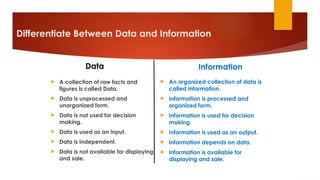
Differentiate Between Data and Information
Data
 A collection of raw facts and
figures is called Data.
 Data is unprocessed and
unorganized form.
 Data is not used for decision
making.
 Data is used as an input.
 Data is independent.
 Data is not available for displaying
and sale.
Information
 An organized collection of data is
called information.
 Information is processed and
organized form.
 Information is used for decision
making.
 Information is used as an output.
 Information depends on data.
 Information is available for
displaying and sale.
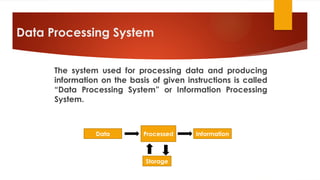
Data Processing System
The system used for processing data and producing
information on the basis of given instructions is called
“Data Processing System” or Information Processing
System.
Data Processed Information
Storage
Data Processing Cycle
Data processing cycle is a collection of steps required to convert data
into information. Different steps of data processing cycle are as follows:
 INPUT:
 In this step data is collected and given to the computer for processing.
 PROCESS:
 In this step, computer processes data for generation of information.
 OUTPUT:
 In this step, the information is given to the user as an output.
 STORAGE:
 In this steps, the information is stored in the computer for future use. This
step is optional.
Classification of Data Processing System
The classification of data processing system is classified
into two categories:
 Manual/Conventional Data Processing System
 Computer Based/Electronic Data Processing System
Data Processing System Classification
 An information system which uses the manual method of transforming data into information is
called The conventional (‫)عمومی‬/Data Processing or Traditional (‫)روایتی‬ Data Processing System.
 The human beings themselves collect, classify and arrange the data and perform manual
calculations and hence produce the required output result manually.
 It is very simple and inexpensive. Before the 20th
century almost data processing was done
manually.
 Clerical persons used paper, pen and pencil to maintain records in offices.
Manual/Conventional Data Processing System:
 An information system that uses computers, their hardware and software is called Electronic
Data Processing System.
 It uses computers hardware, software, internet and other telecommunication system network
 It completes all data manipulation and file updating electronically.
 It increases data processing speed and accuracy.
Computer Based/Electronic Data Processing System:
Data Processing System Classification
Advantage of electronic data processing
 The advantages of electronic data processing include speed, efficiency,
reduced labor, accuracy and reduced costs. In terms of speed,
information stored and managed through an electronic data processing
system.
 Electronic data processing is used to simplified complex process.
 Receiving recording, processing and retrieval of record in second.
 It is possible to access the desired record in second.
What is information technology?
 The merging (‫جانا‬ ‫)مل‬ of computer and communication is called information technology.
 IT is technology that merges computing with high speed communication links carrying data, sound,
image, graph and video.
 It manages a network of computer.
 Creating WEB pages. Producing video, selling, buying, and perform any type of business activity on the
internet.
 A computer and communication system is made up six elements.
1. People
2. Procedure
3. Data /Information
4. Hardware
5. Software.
6. communication
peoples
 It means the users or people who runs and execute the entire data
processing task and computer installations or the people who works in the
data processing environment.
Procedure
 Procedures are rules, policies, and methods for operating computers.
 The operation of a data processing system requires procedures for use in
obtaining and preparing data in order to operate the computer .
Data
 Data is called raw fact and figure. Data can take many form including
Text data, Audio, video and graphics and image data.
Hardware
 Physical parts of computer system is called hardware.
 For example input devices, output devices, and CPU such as keyboard,
mouse, motherboard, CD-ROM etc.
software
 The software consists of programs whose purpose is to communicate with
computer.
 The software includes operating system. i.e. MS-DOS, PC-DOS, UNIX, LINUX
etc.
 General purpose software like database etc.

Introduction to information Communication Technology Chapter 01.pptx

  • 1.
  • 2.
    What is data?Explain different types of data.  A collection of raw facts and figures is called data.  The word raw means that the facts have not yet been processed to get their exact meaning.  Data is collected from different sources.  It is collected for different purposes.  Data may consist of numbers, characters, symbols or pictures etc…
  • 3.
    Data Types  Thereare different types of data.  Numeric Data Type:  Numeric data type consists of numeric digits from “0” to “9” like 10, 245 or -5. The Numeric type of data may either be positive or negative.  Alphabetic Data Type:  Alphabetic data consists of alphabetic letters from “A” to “Z” or “a” to “z” and blank spaces e.g. Testing, computer, etc…
  • 4.
    Data Types  AlphanumericData Type:  Alphanumeric data type consists of Numeric digits from “0 to 9”, Alphabetic letters from “A to Z” and all special characters like +, %, and @ etc…  Graphic Data Type:  Graphic data type includes charts, graphs, pictures and drawings.
  • 5.
    Data Types  AudioData Type:  Sound is a representation of audio data includes music, speech or any other types of sound or voices.  Video Data Type:  Video is set of full motion images played at a high speed. Video is used to display actions and movements.
  • 6.
    Data Types  MixedData Type:  Mixed data type consists of more than one type of data. Such as the combination of audio and video.
  • 7.
    What is Information? The processed form of data is called information.  Information is an organized and processed form of data. It is more meaningful than data and is used for making decisions.  Data is used as input for the processing and information is the output of this processing.  Examples are vouchers, bills, Identity cards etc…
  • 8.
    Differentiate Between Dataand Information Data  A collection of raw facts and figures is called Data.  Data is unprocessed and unorganized form.  Data is not used for decision making.  Data is used as an input.  Data is independent.  Data is not available for displaying and sale. Information  An organized collection of data is called information.  Information is processed and organized form.  Information is used for decision making.  Information is used as an output.  Information depends on data.  Information is available for displaying and sale.
  • 9.
    Data Processing System Thesystem used for processing data and producing information on the basis of given instructions is called “Data Processing System” or Information Processing System. Data Processed Information Storage
  • 10.
    Data Processing Cycle Dataprocessing cycle is a collection of steps required to convert data into information. Different steps of data processing cycle are as follows:  INPUT:  In this step data is collected and given to the computer for processing.  PROCESS:  In this step, computer processes data for generation of information.  OUTPUT:  In this step, the information is given to the user as an output.  STORAGE:  In this steps, the information is stored in the computer for future use. This step is optional.
  • 11.
    Classification of DataProcessing System The classification of data processing system is classified into two categories:  Manual/Conventional Data Processing System  Computer Based/Electronic Data Processing System
  • 12.
    Data Processing SystemClassification  An information system which uses the manual method of transforming data into information is called The conventional (‫)عمومی‬/Data Processing or Traditional (‫)روایتی‬ Data Processing System.  The human beings themselves collect, classify and arrange the data and perform manual calculations and hence produce the required output result manually.  It is very simple and inexpensive. Before the 20th century almost data processing was done manually.  Clerical persons used paper, pen and pencil to maintain records in offices. Manual/Conventional Data Processing System:
  • 13.
     An informationsystem that uses computers, their hardware and software is called Electronic Data Processing System.  It uses computers hardware, software, internet and other telecommunication system network  It completes all data manipulation and file updating electronically.  It increases data processing speed and accuracy. Computer Based/Electronic Data Processing System: Data Processing System Classification
  • 14.
    Advantage of electronicdata processing  The advantages of electronic data processing include speed, efficiency, reduced labor, accuracy and reduced costs. In terms of speed, information stored and managed through an electronic data processing system.  Electronic data processing is used to simplified complex process.  Receiving recording, processing and retrieval of record in second.  It is possible to access the desired record in second.
  • 15.
    What is informationtechnology?  The merging (‫جانا‬ ‫)مل‬ of computer and communication is called information technology.  IT is technology that merges computing with high speed communication links carrying data, sound, image, graph and video.  It manages a network of computer.  Creating WEB pages. Producing video, selling, buying, and perform any type of business activity on the internet.  A computer and communication system is made up six elements. 1. People 2. Procedure 3. Data /Information 4. Hardware 5. Software. 6. communication
  • 16.
    peoples  It meansthe users or people who runs and execute the entire data processing task and computer installations or the people who works in the data processing environment.
  • 17.
    Procedure  Procedures arerules, policies, and methods for operating computers.  The operation of a data processing system requires procedures for use in obtaining and preparing data in order to operate the computer .
  • 18.
    Data  Data iscalled raw fact and figure. Data can take many form including Text data, Audio, video and graphics and image data.
  • 19.
    Hardware  Physical partsof computer system is called hardware.  For example input devices, output devices, and CPU such as keyboard, mouse, motherboard, CD-ROM etc.
  • 20.
    software  The softwareconsists of programs whose purpose is to communicate with computer.  The software includes operating system. i.e. MS-DOS, PC-DOS, UNIX, LINUX etc.  General purpose software like database etc.