Introduction to Harvard
(Author-Date) Referencing
Donna Irving – Health Studies
Librarian
What do you already know?
Have you done referencing before? If so
what style?

Why is referencing important (as many
reasons as you can think of)
What does citation mean?

What is a journal volume?
What are the important parts of a
reference?
Citations (pointers in the text)
Author’s surname (not initials) or name of
organisation

and year of publication (Author-Date)
the Dutch people, on average, are the tallest in the
world (Leroi, 2004) …
according to the Department of Health (2002) …
Smith’s research (2002) shows that…
Dark chocolate contains powerful antioxidants
called flavonoids which are known to protect the
body against cell-damaging free radicals according
to Beckett (2000). Some caution is necessary
however as key research in this area is funded by
the chocolate manufacturer Mars (BBC, 2009).
Where there is less controversy is in the effects of
chocolate on mood. Mood improvements, sadly,
are short-lived (Parker et al., 2006).
Quotations
“The personal is political” (Hanisch, 2009, p.204)
But keep direct quotations to an absolute minimum.
Useful when the words are famous, significant or
very apt.
Too many quotes will show you haven’t done the
necessary thinking for yourself
The reference list
At the end of your work
Full details of the sources you have used
In alphabetical order by author’s surname.
All the authors’ names are given
Not included in word count
Not a bibliography
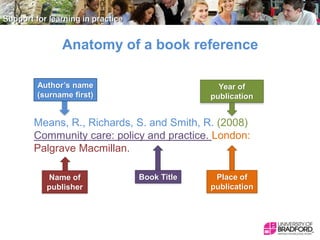
Anatomy of a book reference
Author’s name
(surname first)

Year of
publication

Means, R., Richards, S. and Smith, R. (2008)
Community care: policy and practice. London:
Palgrave Macmillan.
Name of
publisher

Book Title

Place of
publication
Provide a reference for a book called:
Learning to learn in Nursing Practice. By Kath
Sharples. Published by Learning Matters Ltd, in
Exeter, in 2009

How would you reference this?
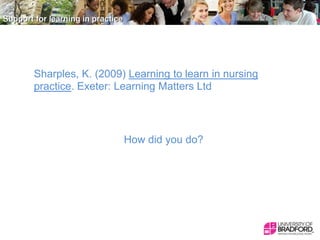
Sharples, K. (2009) Learning to learn in nursing
practice. Exeter: Learning Matters Ltd

How did you do?
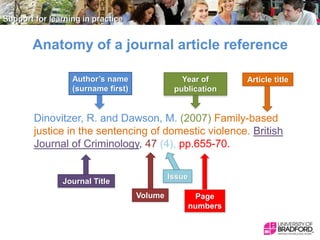
Anatomy of a journal article reference
Author’s name
(surname first)

Year of
publication

Article title

Dinovitzer, R. and Dawson, M. (2007) Family-based
justice in the sentencing of domestic violence. British
Journal of Criminology, 47 (4), pp.655-70.
Issue

Journal Title
Volume

Page
numbers
Provide a reference for an
article called:
How can we add skills to transform the healthcare
system. By Helen Bevan in 2010. Published in Journal
of research in nursing. Volume 15, number 2. Page
139
How did you do?
Bevan, H. (2010) How can we add skills to transform
the healthcare system. Journal of Research in
Nursing, 15 (2), p.139
Anatomy of an
electronic source reference
Author’s name
(surname first)

Year of
publication

Source title

Rutter, L. and Holland, M. (2002) Citing references:
the Harvard system [Online]. Poole: Bournemouth
University. Available from:
http://www.bournemouth.ac.uk/academic_services/doc
uments/Library/Citing_References.pdf [accessed 5
November 2008]
url
Date
accessed

Publisher (if
ascertainable)

Place of Publication
(if ascertainable)
Websites
You still need Author-Date
Put in [online], URL (web address) and date you
saw the page
If you can’t identify the author, cite the title.
BBC (2005) Is chocolate good for you? [Online].
London: BBC. Available from:
http://www.bbc.co.uk/science/hottopics/chocolate/good
foryou.shtml [Accessed 1 November, 2009]
Try this one:
Provide a reference for a website called:
Personal Care at Home consultation
By DoH in 2010
Available from www.dh.gov.uk/en/Consultations
Accessed 7 April 2012
Published by DoH in London
How did you do?
Department of Health (2010) Personal care at home
consultation [Online]. London: DoH. Available from:
www.dh.gov.uk/en/Consultations [accessed 7 April
2012].
Reference List
British Broadcasting Corporation (2009) Is chocolate
good for you? [online]. London: BBC. Available from:
http://www.bbc.co.uk/science/hottopics/chocolate/good
foryou.shtml [accessed 1 November, 2008].
Beckett, S.T. (2000) The Science of chocolate.
Cambridge: Royal Society of Chemistry.

Parker, G., Parker, I. and Brotchie, H. (2006) Mood
state effects of chocolate. Journal of Affective
Disorders, 92 (6), pp.149-159.
Key points
Remember it’s the Author-Date style. You need to
identify and credit the author.
It’s only a habit – get it right as soon as possible
Check if in doubt – the guide, lecturers or Library
staff
When making notes and copies, write on all the
details you’ll need for your reference
Help!
The Harvard referencing guide
Available online through library and blackboard
or print one out Online guide
Library staff can help with referencing
Endnote
What’s a bibliography
A bibliography is a list of everything you read,
whether or not you referred specifically to it (cited it)
in your assignment.
References are the full details of the sources you
have referred to (cited) in your assignment

Introduction to harvard referencing

  • 1.
    Introduction to Harvard (Author-Date)Referencing Donna Irving – Health Studies Librarian
  • 2.
    What do youalready know? Have you done referencing before? If so what style? Why is referencing important (as many reasons as you can think of) What does citation mean? What is a journal volume? What are the important parts of a reference?
  • 3.
    Citations (pointers inthe text) Author’s surname (not initials) or name of organisation and year of publication (Author-Date) the Dutch people, on average, are the tallest in the world (Leroi, 2004) … according to the Department of Health (2002) … Smith’s research (2002) shows that…
  • 4.
    Dark chocolate containspowerful antioxidants called flavonoids which are known to protect the body against cell-damaging free radicals according to Beckett (2000). Some caution is necessary however as key research in this area is funded by the chocolate manufacturer Mars (BBC, 2009). Where there is less controversy is in the effects of chocolate on mood. Mood improvements, sadly, are short-lived (Parker et al., 2006).
  • 5.
    Quotations “The personal ispolitical” (Hanisch, 2009, p.204) But keep direct quotations to an absolute minimum. Useful when the words are famous, significant or very apt. Too many quotes will show you haven’t done the necessary thinking for yourself
  • 6.
    The reference list Atthe end of your work Full details of the sources you have used In alphabetical order by author’s surname. All the authors’ names are given Not included in word count Not a bibliography
  • 7.
    Anatomy of abook reference Author’s name (surname first) Year of publication Means, R., Richards, S. and Smith, R. (2008) Community care: policy and practice. London: Palgrave Macmillan. Name of publisher Book Title Place of publication
  • 8.
    Provide a referencefor a book called: Learning to learn in Nursing Practice. By Kath Sharples. Published by Learning Matters Ltd, in Exeter, in 2009 How would you reference this?
  • 9.
    Sharples, K. (2009)Learning to learn in nursing practice. Exeter: Learning Matters Ltd How did you do?
  • 10.
    Anatomy of ajournal article reference Author’s name (surname first) Year of publication Article title Dinovitzer, R. and Dawson, M. (2007) Family-based justice in the sentencing of domestic violence. British Journal of Criminology, 47 (4), pp.655-70. Issue Journal Title Volume Page numbers
  • 11.
    Provide a referencefor an article called: How can we add skills to transform the healthcare system. By Helen Bevan in 2010. Published in Journal of research in nursing. Volume 15, number 2. Page 139
  • 12.
    How did youdo? Bevan, H. (2010) How can we add skills to transform the healthcare system. Journal of Research in Nursing, 15 (2), p.139
  • 13.
    Anatomy of an electronicsource reference Author’s name (surname first) Year of publication Source title Rutter, L. and Holland, M. (2002) Citing references: the Harvard system [Online]. Poole: Bournemouth University. Available from: http://www.bournemouth.ac.uk/academic_services/doc uments/Library/Citing_References.pdf [accessed 5 November 2008] url Date accessed Publisher (if ascertainable) Place of Publication (if ascertainable)
  • 14.
    Websites You still needAuthor-Date Put in [online], URL (web address) and date you saw the page If you can’t identify the author, cite the title. BBC (2005) Is chocolate good for you? [Online]. London: BBC. Available from: http://www.bbc.co.uk/science/hottopics/chocolate/good foryou.shtml [Accessed 1 November, 2009]
  • 15.
    Try this one: Providea reference for a website called: Personal Care at Home consultation By DoH in 2010 Available from www.dh.gov.uk/en/Consultations Accessed 7 April 2012 Published by DoH in London
  • 16.
    How did youdo? Department of Health (2010) Personal care at home consultation [Online]. London: DoH. Available from: www.dh.gov.uk/en/Consultations [accessed 7 April 2012].
  • 17.
    Reference List British BroadcastingCorporation (2009) Is chocolate good for you? [online]. London: BBC. Available from: http://www.bbc.co.uk/science/hottopics/chocolate/good foryou.shtml [accessed 1 November, 2008]. Beckett, S.T. (2000) The Science of chocolate. Cambridge: Royal Society of Chemistry. Parker, G., Parker, I. and Brotchie, H. (2006) Mood state effects of chocolate. Journal of Affective Disorders, 92 (6), pp.149-159.
  • 18.
    Key points Remember it’sthe Author-Date style. You need to identify and credit the author. It’s only a habit – get it right as soon as possible Check if in doubt – the guide, lecturers or Library staff When making notes and copies, write on all the details you’ll need for your reference
  • 19.
    Help! The Harvard referencingguide Available online through library and blackboard or print one out Online guide Library staff can help with referencing Endnote
  • 20.
    What’s a bibliography Abibliography is a list of everything you read, whether or not you referred specifically to it (cited it) in your assignment. References are the full details of the sources you have referred to (cited) in your assignment