INTRODUCTION
TO HADOOP
INTRODUCTION
▪Hadoop is an Apache open source framework written in
java that allows distributed processing of large datasets
across clusters of computers using simple programming
models.The Hadoop framework application works in an
environment that provides
distributed storage and computation across clusters of
computers
ARCHITECTURE
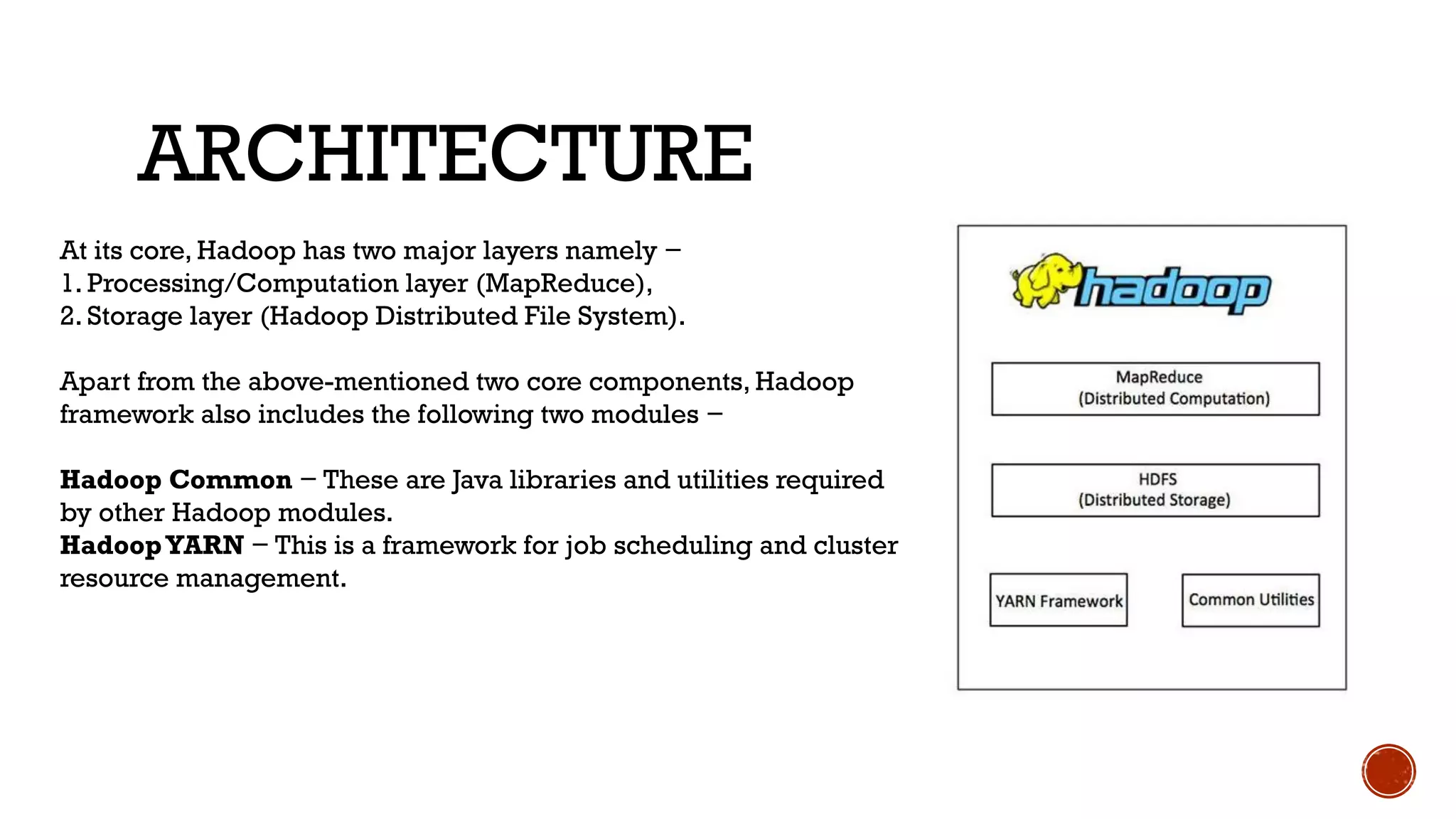
At its core, Hadoop has two major layers namely −
1. Processing/Computation layer (MapReduce),
2. Storage layer (Hadoop Distributed File System).
Apart from the above-mentioned two core components, Hadoop
framework also includes the following two modules −
Hadoop Common − These are Java libraries and utilities required
by other Hadoop modules.
HadoopYARN − This is a framework for job scheduling and cluster
resource management.
HOW DOES HADOOP WORK?
Hadoop runs code across a cluster of computers.
This process includes the following core tasks that Hadoop performs −
▪ Data is initially divided into directories and files. Files are divided into uniform
sized blocks of 128M and 64M (preferably 128M).
▪ These files are then distributed across various cluster nodes for further processing.
▪ HDFS, being on top of the local file system, supervises the processing.
▪ Blocks are replicated for handling hardware failure.
▪ Checking that the code was executed successfully.
▪ Performing the sort that takes place between the map and reduce stages.
▪ Sending the sorted data to a certain computer.
▪ Writing the debugging logs for each job.
ADVANTAGES OF HADOOP
▪ adoop framework allows the user to quickly write and test distributed systems. It is
efficient, and it automatic distributes the data and work across the machines and in
turn, utilizes the underlying parallelism of the CPU cores.
▪ Hadoop does not rely on hardware to provide fault-tolerance and high availability
(FTHA), rather Hadoop library itself has been designed to detect and handle
failures at the application layer.
▪ Servers can be added or removed from the cluster dynamically and Hadoop
continues to operate without interruption.
▪ Another big advantage of Hadoop is that apart from being open source, it is
compatible on all the platforms since it is Java based
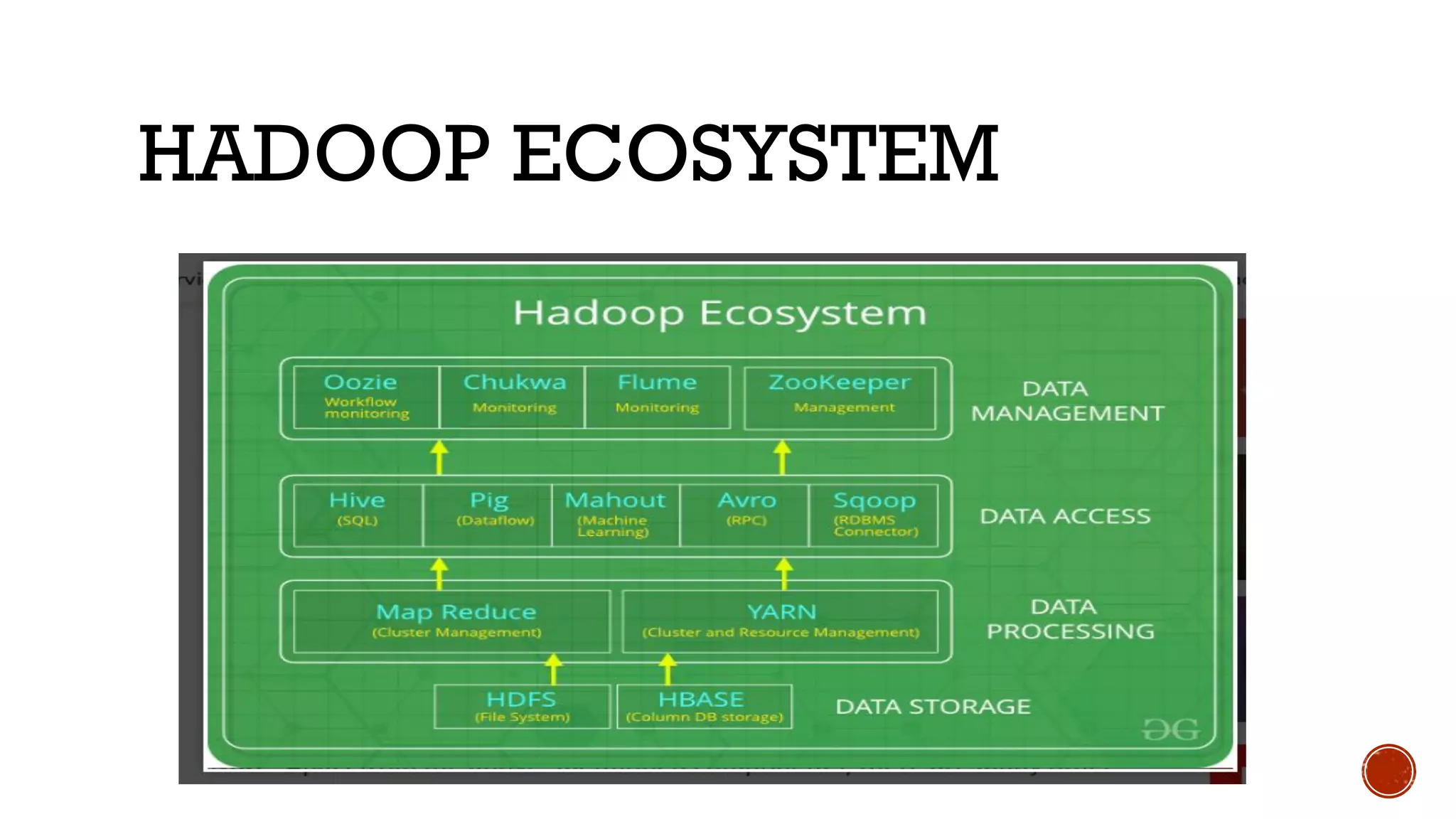
HADOOP ECOSYSTEM
▪ HDFS:
HDFS is the primary or major component of Hadoop ecosystem and is responsible
for storing large data sets of structured or unstructured data across various nodes
and thereby maintaining the metadata in the form of log files.
▪ HDFS consists of two core components i.e.
▪ Name node
▪ Data Node
▪ YARN:
Yet Another Resource Negotiator, as the name implies,YARN is the one who helps to
manage the resources across the clusters. In short, it performs scheduling and
resource allocation for the Hadoop System.
▪ Consists of three major components i.e.
▪ Resource Manager
▪ Nodes Manager
▪ Application Manager
▪ Advantages of HDFS:
It is inexpensive, immutable in nature, stores data reliably, ability to tolerate faults,
scalable, block structured, can process a large amount of data simultaneously and
many more.
▪ Disadvantages of HDFS:
It’s the biggest disadvantage is that it is not fit for small quantities of data. Also, it
has issues related to potential stability, restrictive and rough in nature.
▪ Hadoop also supports a wide range of software packages such as Apache Flumes,
Apache Oozie, Apache HBase, Apache Sqoop, Apache Spark, Apache Storm,
Apache Pig, Apache Hive, Apache Phoenix, Cloudera Impala.
▪ MapReduce:
▪ By making the use of distributed and parallel algorithms, MapReduce makes it
possible to carry over the processing’s logic and helps to write applications which
transform big data sets into a manageable one.
▪ MapReduce makes the use of two functions i.e. Map() and Reduce() whose task is:
▪ Map() performs sorting and filtering of data and thereby organizing them in the form of
group. Map generates a key-value pair based result which is later on processed by the
Reduce() method.
▪ Reduce(), as the name suggests does the summarization by aggregating the mapped data.
In simple, Reduce() takes the output generated by Map() as input and combines those
tuples into smaller set of tuples.
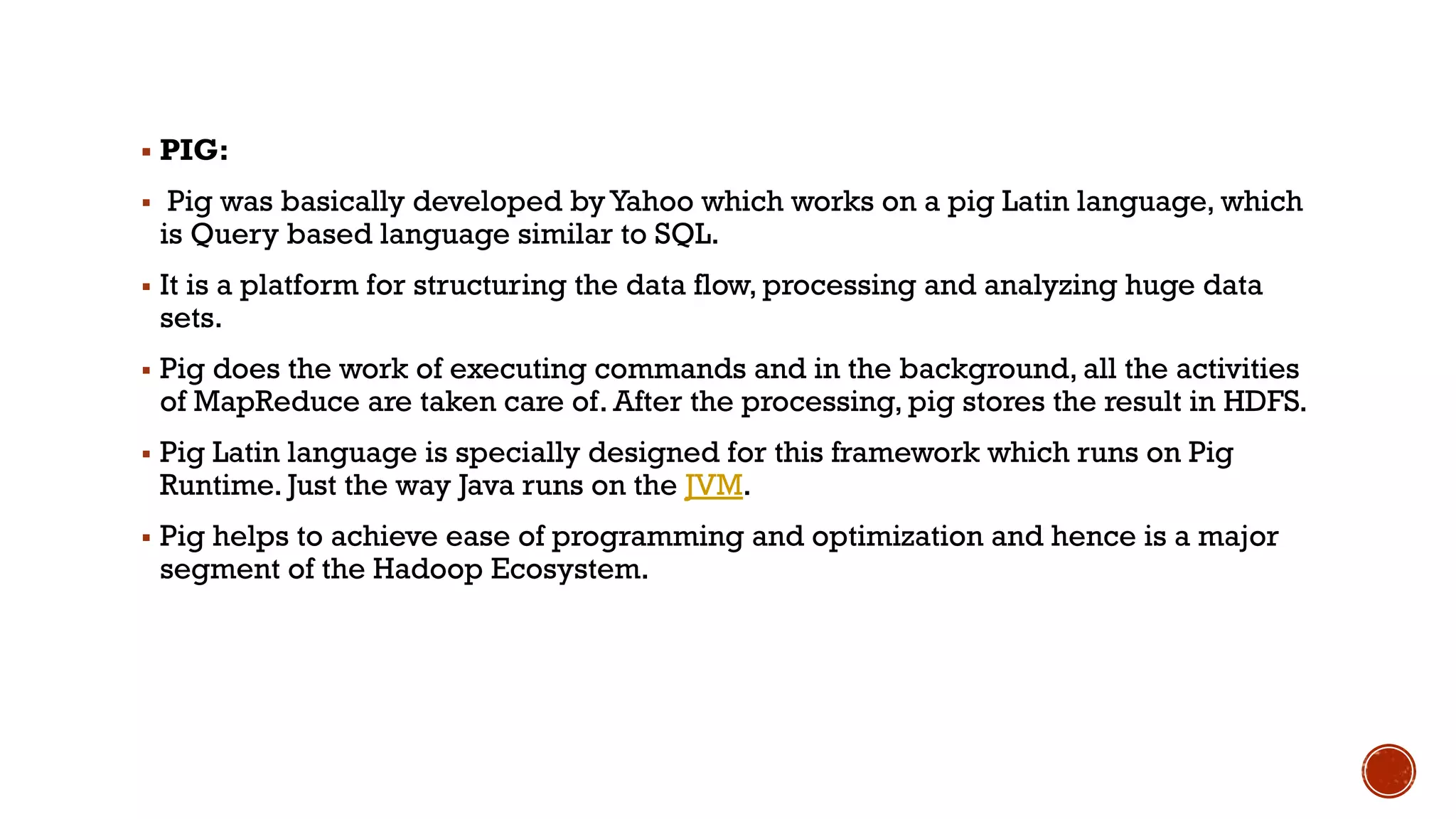
▪ PIG:
▪ Pig was basically developed byYahoo which works on a pig Latin language, which
is Query based language similar to SQL.
▪ It is a platform for structuring the data flow, processing and analyzing huge data
sets.
▪ Pig does the work of executing commands and in the background, all the activities
of MapReduce are taken care of. After the processing, pig stores the result in HDFS.
▪ Pig Latin language is specially designed for this framework which runs on Pig
Runtime. Just the way Java runs on the JVM.
▪ Pig helps to achieve ease of programming and optimization and hence is a major
segment of the Hadoop Ecosystem.
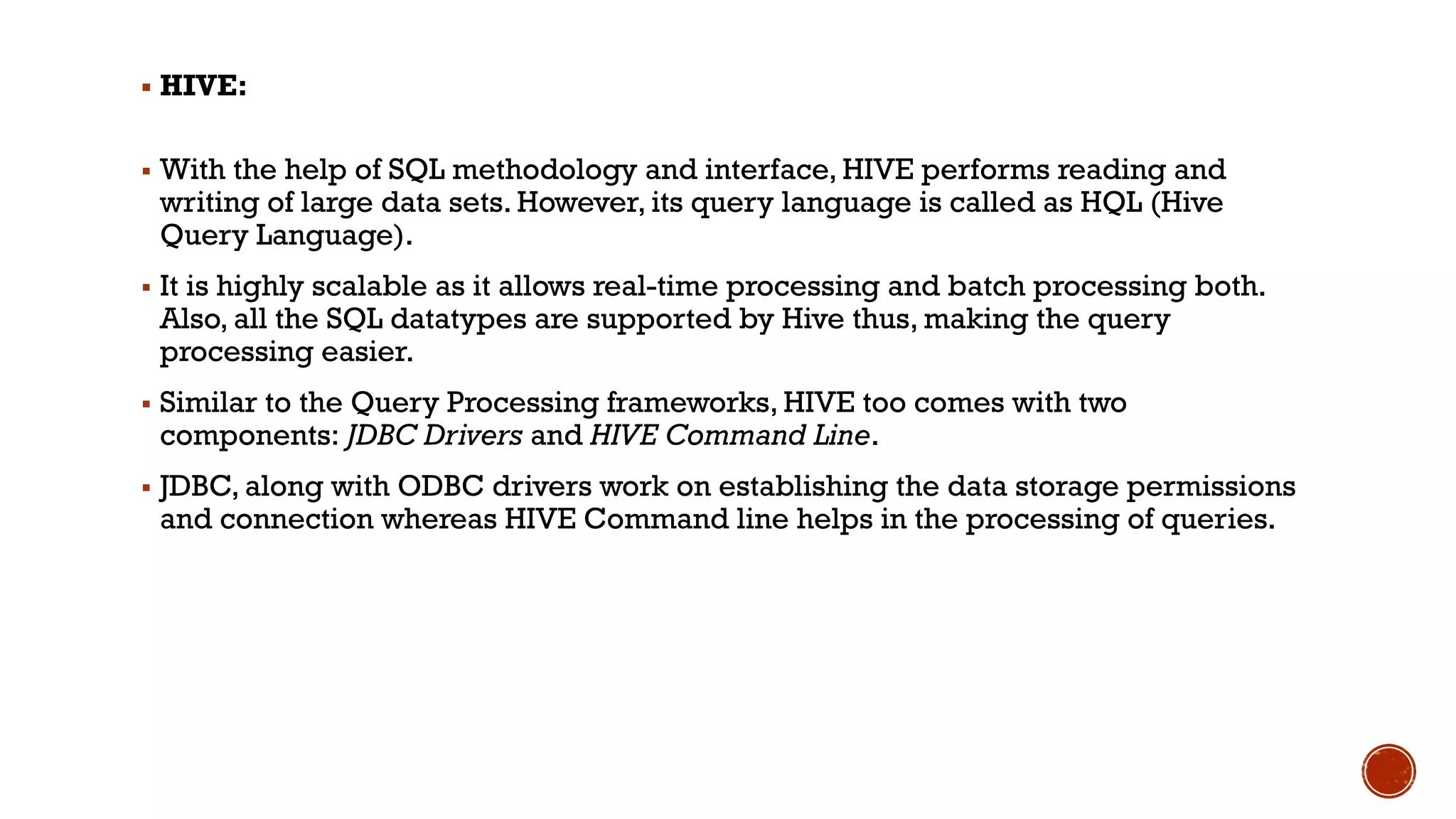
▪ HIVE:
▪ With the help of SQL methodology and interface, HIVE performs reading and
writing of large data sets. However, its query language is called as HQL (Hive
Query Language).
▪ It is highly scalable as it allows real-time processing and batch processing both.
Also, all the SQL datatypes are supported by Hive thus, making the query
processing easier.
▪ Similar to the Query Processing frameworks, HIVE too comes with two
components: JDBC Drivers and HIVE Command Line.
▪ JDBC, along with ODBC drivers work on establishing the data storage permissions
and connection whereas HIVE Command line helps in the processing of queries.
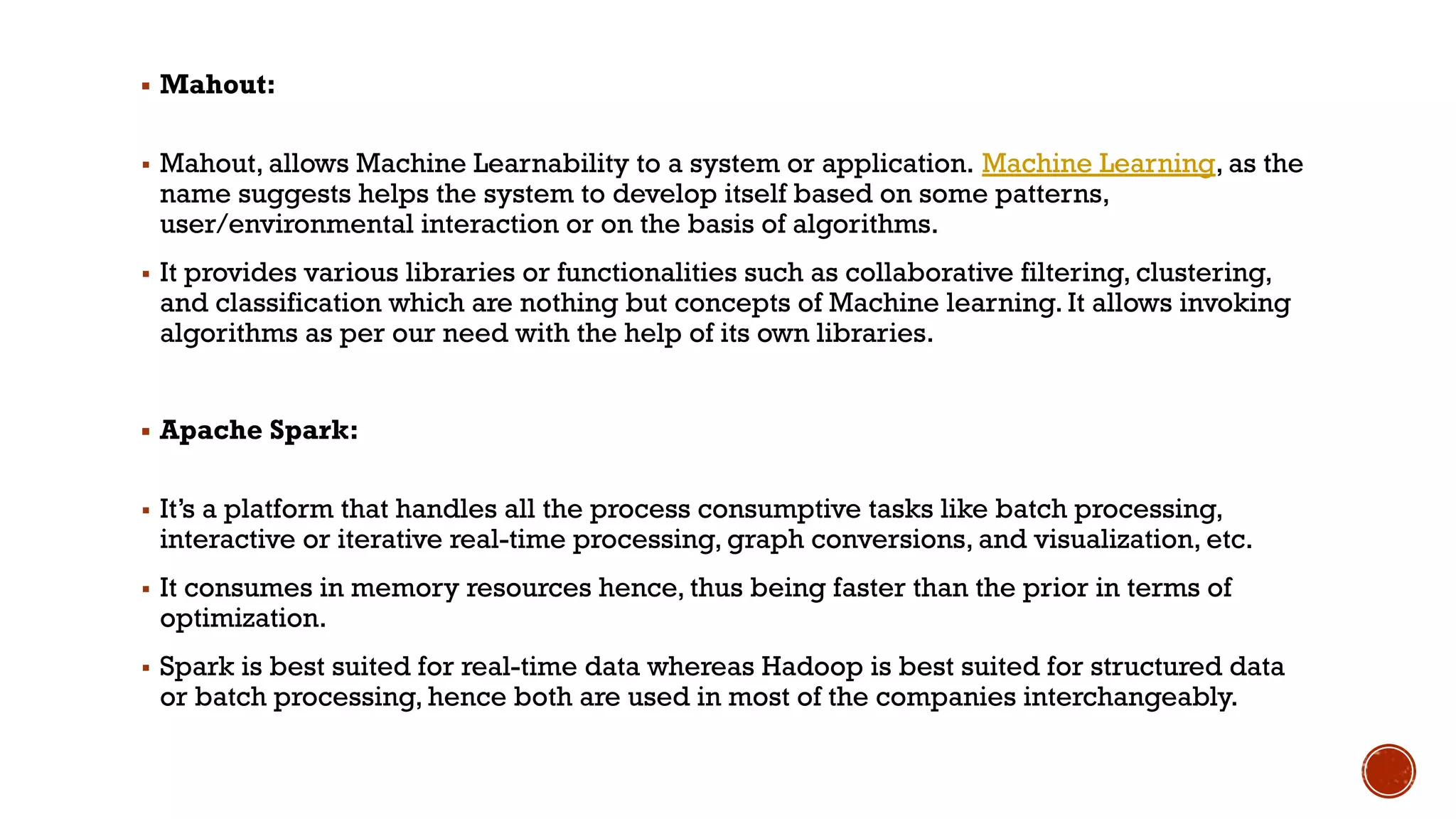
▪ Mahout:
▪ Mahout, allows Machine Learnability to a system or application. Machine Learning, as the
name suggests helps the system to develop itself based on some patterns,
user/environmental interaction or on the basis of algorithms.
▪ It provides various libraries or functionalities such as collaborative filtering, clustering,
and classification which are nothing but concepts of Machine learning. It allows invoking
algorithms as per our need with the help of its own libraries.
▪ Apache Spark:
▪ It’s a platform that handles all the process consumptive tasks like batch processing,
interactive or iterative real-time processing, graph conversions, and visualization, etc.
▪ It consumes in memory resources hence, thus being faster than the prior in terms of
optimization.
▪ Spark is best suited for real-time data whereas Hadoop is best suited for structured data
or batch processing, hence both are used in most of the companies interchangeably.
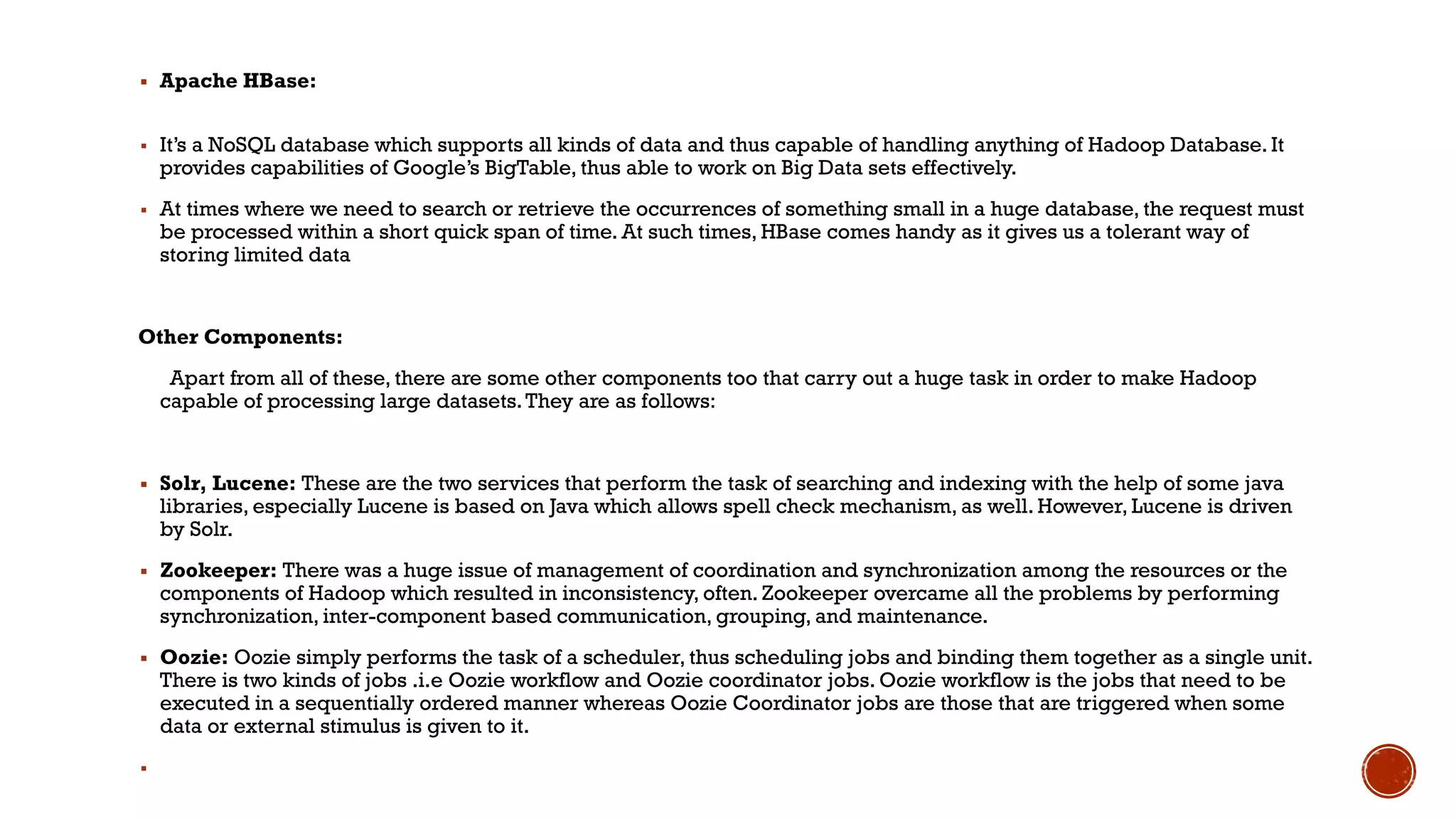
▪ Apache HBase:
▪ It’s a NoSQL database which supports all kinds of data and thus capable of handling anything of Hadoop Database. It
provides capabilities of Google’s BigTable, thus able to work on Big Data sets effectively.
▪ At times where we need to search or retrieve the occurrences of something small in a huge database, the request must
be processed within a short quick span of time. At such times, HBase comes handy as it gives us a tolerant way of
storing limited data
Other Components:
Apart from all of these, there are some other components too that carry out a huge task in order to make Hadoop
capable of processing large datasets.They are as follows:
▪ Solr, Lucene: These are the two services that perform the task of searching and indexing with the help of some java
libraries, especially Lucene is based on Java which allows spell check mechanism, as well. However, Lucene is driven
by Solr.
▪ Zookeeper: There was a huge issue of management of coordination and synchronization among the resources or the
components of Hadoop which resulted in inconsistency, often. Zookeeper overcame all the problems by performing
synchronization, inter-component based communication, grouping, and maintenance.
▪ Oozie: Oozie simply performs the task of a scheduler, thus scheduling jobs and binding them together as a single unit.
There is two kinds of jobs .i.e Oozie workflow and Oozie coordinator jobs. Oozie workflow is the jobs that need to be
executed in a sequentially ordered manner whereas Oozie Coordinator jobs are those that are triggered when some
data or external stimulus is given to it.
▪
Advantages and Disadvantages of Hadoop
▪ Advantages:
▪ Ability to store a large amount of data.
▪ High flexibility.
▪ Cost effective.
▪ High computational power.
▪ Tasks are independent.
▪ Linear scaling
▪ Disadvantages:
▪ Not very effective for small data.
▪ Hard cluster management.
▪ Has stability issues.
▪ Security concerns.

Introduction to HADOOP.pdf

  • 1.
  • 2.
    INTRODUCTION ▪Hadoop is anApache open source framework written in java that allows distributed processing of large datasets across clusters of computers using simple programming models.The Hadoop framework application works in an environment that provides distributed storage and computation across clusters of computers
  • 3.
    ARCHITECTURE At its core,Hadoop has two major layers namely − 1. Processing/Computation layer (MapReduce), 2. Storage layer (Hadoop Distributed File System). Apart from the above-mentioned two core components, Hadoop framework also includes the following two modules − Hadoop Common − These are Java libraries and utilities required by other Hadoop modules. HadoopYARN − This is a framework for job scheduling and cluster resource management.
  • 4.
    HOW DOES HADOOPWORK? Hadoop runs code across a cluster of computers. This process includes the following core tasks that Hadoop performs − ▪ Data is initially divided into directories and files. Files are divided into uniform sized blocks of 128M and 64M (preferably 128M). ▪ These files are then distributed across various cluster nodes for further processing. ▪ HDFS, being on top of the local file system, supervises the processing. ▪ Blocks are replicated for handling hardware failure. ▪ Checking that the code was executed successfully. ▪ Performing the sort that takes place between the map and reduce stages. ▪ Sending the sorted data to a certain computer. ▪ Writing the debugging logs for each job.
  • 5.
    ADVANTAGES OF HADOOP ▪adoop framework allows the user to quickly write and test distributed systems. It is efficient, and it automatic distributes the data and work across the machines and in turn, utilizes the underlying parallelism of the CPU cores. ▪ Hadoop does not rely on hardware to provide fault-tolerance and high availability (FTHA), rather Hadoop library itself has been designed to detect and handle failures at the application layer. ▪ Servers can be added or removed from the cluster dynamically and Hadoop continues to operate without interruption. ▪ Another big advantage of Hadoop is that apart from being open source, it is compatible on all the platforms since it is Java based
  • 6.
  • 7.
    ▪ HDFS: HDFS isthe primary or major component of Hadoop ecosystem and is responsible for storing large data sets of structured or unstructured data across various nodes and thereby maintaining the metadata in the form of log files. ▪ HDFS consists of two core components i.e. ▪ Name node ▪ Data Node ▪ YARN: Yet Another Resource Negotiator, as the name implies,YARN is the one who helps to manage the resources across the clusters. In short, it performs scheduling and resource allocation for the Hadoop System. ▪ Consists of three major components i.e. ▪ Resource Manager ▪ Nodes Manager ▪ Application Manager
  • 8.
    ▪ Advantages ofHDFS: It is inexpensive, immutable in nature, stores data reliably, ability to tolerate faults, scalable, block structured, can process a large amount of data simultaneously and many more. ▪ Disadvantages of HDFS: It’s the biggest disadvantage is that it is not fit for small quantities of data. Also, it has issues related to potential stability, restrictive and rough in nature. ▪ Hadoop also supports a wide range of software packages such as Apache Flumes, Apache Oozie, Apache HBase, Apache Sqoop, Apache Spark, Apache Storm, Apache Pig, Apache Hive, Apache Phoenix, Cloudera Impala.
  • 9.
    ▪ MapReduce: ▪ Bymaking the use of distributed and parallel algorithms, MapReduce makes it possible to carry over the processing’s logic and helps to write applications which transform big data sets into a manageable one. ▪ MapReduce makes the use of two functions i.e. Map() and Reduce() whose task is: ▪ Map() performs sorting and filtering of data and thereby organizing them in the form of group. Map generates a key-value pair based result which is later on processed by the Reduce() method. ▪ Reduce(), as the name suggests does the summarization by aggregating the mapped data. In simple, Reduce() takes the output generated by Map() as input and combines those tuples into smaller set of tuples.
  • 10.
    ▪ PIG: ▪ Pigwas basically developed byYahoo which works on a pig Latin language, which is Query based language similar to SQL. ▪ It is a platform for structuring the data flow, processing and analyzing huge data sets. ▪ Pig does the work of executing commands and in the background, all the activities of MapReduce are taken care of. After the processing, pig stores the result in HDFS. ▪ Pig Latin language is specially designed for this framework which runs on Pig Runtime. Just the way Java runs on the JVM. ▪ Pig helps to achieve ease of programming and optimization and hence is a major segment of the Hadoop Ecosystem.
  • 11.
    ▪ HIVE: ▪ Withthe help of SQL methodology and interface, HIVE performs reading and writing of large data sets. However, its query language is called as HQL (Hive Query Language). ▪ It is highly scalable as it allows real-time processing and batch processing both. Also, all the SQL datatypes are supported by Hive thus, making the query processing easier. ▪ Similar to the Query Processing frameworks, HIVE too comes with two components: JDBC Drivers and HIVE Command Line. ▪ JDBC, along with ODBC drivers work on establishing the data storage permissions and connection whereas HIVE Command line helps in the processing of queries.
  • 12.
    ▪ Mahout: ▪ Mahout,allows Machine Learnability to a system or application. Machine Learning, as the name suggests helps the system to develop itself based on some patterns, user/environmental interaction or on the basis of algorithms. ▪ It provides various libraries or functionalities such as collaborative filtering, clustering, and classification which are nothing but concepts of Machine learning. It allows invoking algorithms as per our need with the help of its own libraries. ▪ Apache Spark: ▪ It’s a platform that handles all the process consumptive tasks like batch processing, interactive or iterative real-time processing, graph conversions, and visualization, etc. ▪ It consumes in memory resources hence, thus being faster than the prior in terms of optimization. ▪ Spark is best suited for real-time data whereas Hadoop is best suited for structured data or batch processing, hence both are used in most of the companies interchangeably.
  • 13.
    ▪ Apache HBase: ▪It’s a NoSQL database which supports all kinds of data and thus capable of handling anything of Hadoop Database. It provides capabilities of Google’s BigTable, thus able to work on Big Data sets effectively. ▪ At times where we need to search or retrieve the occurrences of something small in a huge database, the request must be processed within a short quick span of time. At such times, HBase comes handy as it gives us a tolerant way of storing limited data Other Components: Apart from all of these, there are some other components too that carry out a huge task in order to make Hadoop capable of processing large datasets.They are as follows: ▪ Solr, Lucene: These are the two services that perform the task of searching and indexing with the help of some java libraries, especially Lucene is based on Java which allows spell check mechanism, as well. However, Lucene is driven by Solr. ▪ Zookeeper: There was a huge issue of management of coordination and synchronization among the resources or the components of Hadoop which resulted in inconsistency, often. Zookeeper overcame all the problems by performing synchronization, inter-component based communication, grouping, and maintenance. ▪ Oozie: Oozie simply performs the task of a scheduler, thus scheduling jobs and binding them together as a single unit. There is two kinds of jobs .i.e Oozie workflow and Oozie coordinator jobs. Oozie workflow is the jobs that need to be executed in a sequentially ordered manner whereas Oozie Coordinator jobs are those that are triggered when some data or external stimulus is given to it. ▪
  • 14.
    Advantages and Disadvantagesof Hadoop ▪ Advantages: ▪ Ability to store a large amount of data. ▪ High flexibility. ▪ Cost effective. ▪ High computational power. ▪ Tasks are independent. ▪ Linear scaling ▪ Disadvantages: ▪ Not very effective for small data. ▪ Hard cluster management. ▪ Has stability issues. ▪ Security concerns.