Good Laboratory Practice

The key to the delivery of quality service

                                          Positively United to Support Humanity
                    Guyana’s Faith-Based Holistic HIV Care and Treatment Initiative

                                                       Presented by: Lynette Hardy
Learning Objectives

  • Review elements of good laboratory
    practice
  • Review our role in laboratory operations
  • Remind ourselves of our commitment to
    provide quality results to our clients
  • Review our role as a team player in the
    deliverance of quality laboratory service
PUSH
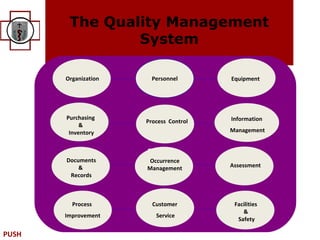
The Quality Management
                System

       Organization     Personnel       Equipment


       Purchasing                       Information
                      Process Control
            &
        Inventory                       Management


       Documents      Occurrence
           &          Management        Assessment
        Records


         Process        Customer         Facilities
                                            &
       Improvement       Service
                                          Safety

PUSH
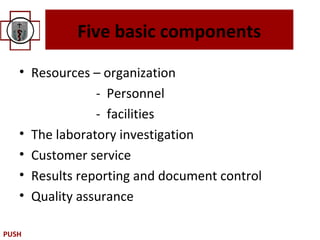
Five basic components
   • Resources – organization
                - Personnel
                - facilities
   • The laboratory investigation
   • Customer service
   • Results reporting and document control
   • Quality assurance

PUSH
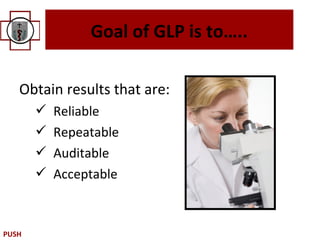
Goal of GLP is to…..

   Obtain results that are:
          Reliable
          Repeatable
          Auditable
          Acceptable


PUSH
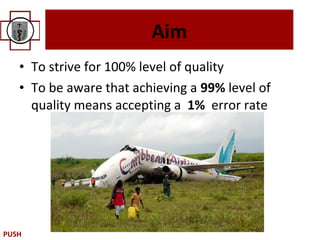
Aim
   • To strive for 100% level of quality
   • To be aware that achieving a 99% level of
     quality means accepting a 1% error rate


PUSH
In Guyana a 1% error rate would probably
 mean everyday.....

 • Six hours without electricity
 • Four hours without running water in the
    laboratory
 • Contaminated food being served at hotels
 • Incorrect blood being transfused
 • Incorrect results being given to patients
 • Crash landing of airplanes at Cheddie Jagan
  International Airport
PUSH
Advantages

       •   Limits the waste of resources
       •   Ensures high quality of results
       •   Ensures comparability of results
       •   Promotes the mutual recognition of
           results

PUSH
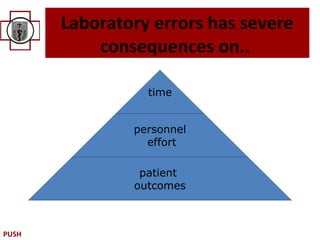
Laboratory errors has severe
           consequences on..

                 time


               personnel
                 effort

                patient
               outcomes


PUSH
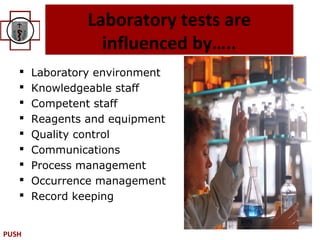
Laboratory tests are
                  influenced by…..
      Laboratory environment
      Knowledgeable staff
      Competent staff
      Reagents and equipment
      Quality control
      Communications
      Process management
      Occurrence management
      Record keeping


PUSH
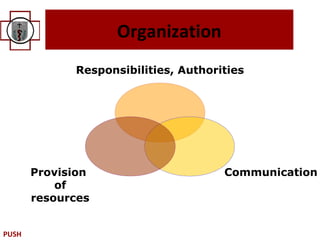
Organization
             Responsibilities, Authorities


       Provision                      Communication
           of
       resources


PUSH
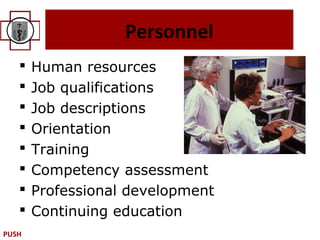
Personnel
      Human resources
      Job qualifications
      Job descriptions
      Orientation
      Training
      Competency assessment
      Professional development
      Continuing education
PUSH
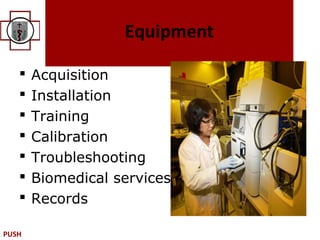
Equipment

      Acquisition
      Installation
      Training
      Calibration
      Troubleshooting
      Biomedical services
      Records

PUSH
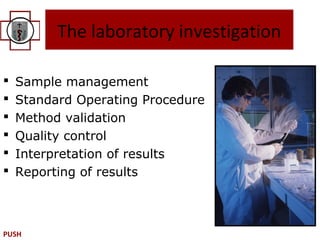
The laboratory investigation

   Sample management
   Standard Operating Procedure
   Method validation
   Quality control
   Interpretation of results
   Reporting of results


PUSH
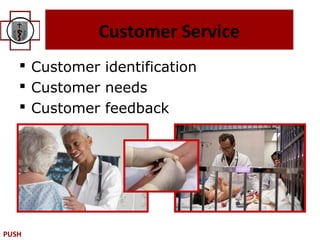
Customer Service
    Customer identification
    Customer needs
    Customer feedback


PUSH
Documents             Records
          creation           collection
   revisions and review       review
  control and distribution    storage
                             retention


PUSH
Quality Assurance
      Occurrence Management
      Complaints
      Documentation
      Root cause analysis
      Corrective actions
      Preventive actions


PUSH
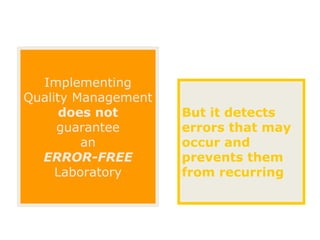
Implementing
Quality Management
      does not       But it detects
     guarantee       errors that may
         an          occur and
  ERROR-FREE         prevents them
     Laboratory      from recurring
A laboratory is a complex
 system and all aspects
must function properly to
     achieve quality
Thank You

Introduction To Good Laboratory Practise

  • 1.
    Good Laboratory Practice Thekey to the delivery of quality service Positively United to Support Humanity Guyana’s Faith-Based Holistic HIV Care and Treatment Initiative Presented by: Lynette Hardy
  • 2.
    Learning Objectives • Review elements of good laboratory practice • Review our role in laboratory operations • Remind ourselves of our commitment to provide quality results to our clients • Review our role as a team player in the deliverance of quality laboratory service PUSH
  • 3.
    The Quality Management System Organization Personnel Equipment Purchasing Information Process Control & Inventory Management Documents Occurrence & Management Assessment Records Process Customer Facilities & Improvement Service Safety PUSH
  • 4.
    Five basic components • Resources – organization - Personnel - facilities • The laboratory investigation • Customer service • Results reporting and document control • Quality assurance PUSH
  • 5.
    Goal of GLPis to….. Obtain results that are:  Reliable  Repeatable  Auditable  Acceptable PUSH
  • 6.
    Aim • To strive for 100% level of quality • To be aware that achieving a 99% level of quality means accepting a 1% error rate PUSH
  • 7.
    In Guyana a1% error rate would probably mean everyday..... • Six hours without electricity • Four hours without running water in the laboratory • Contaminated food being served at hotels • Incorrect blood being transfused • Incorrect results being given to patients • Crash landing of airplanes at Cheddie Jagan International Airport PUSH
  • 8.
    Advantages • Limits the waste of resources • Ensures high quality of results • Ensures comparability of results • Promotes the mutual recognition of results PUSH
  • 9.
    Laboratory errors hassevere consequences on.. time personnel effort patient outcomes PUSH
  • 10.
    Laboratory tests are influenced by…..  Laboratory environment  Knowledgeable staff  Competent staff  Reagents and equipment  Quality control  Communications  Process management  Occurrence management  Record keeping PUSH
  • 11.
    Organization Responsibilities, Authorities Provision Communication of resources PUSH
  • 12.
    Personnel  Human resources  Job qualifications  Job descriptions  Orientation  Training  Competency assessment  Professional development  Continuing education PUSH
  • 13.
    Equipment  Acquisition  Installation  Training  Calibration  Troubleshooting  Biomedical services  Records PUSH
  • 14.
    The laboratory investigation  Sample management  Standard Operating Procedure  Method validation  Quality control  Interpretation of results  Reporting of results PUSH
  • 15.
    Customer Service  Customer identification  Customer needs  Customer feedback PUSH
  • 16.
    Documents Records creation collection revisions and review review control and distribution storage retention PUSH
  • 17.
    Quality Assurance  Occurrence Management  Complaints  Documentation  Root cause analysis  Corrective actions  Preventive actions PUSH
  • 18.
    Implementing Quality Management does not But it detects guarantee errors that may an occur and ERROR-FREE prevents them Laboratory from recurring
  • 19.
    A laboratory isa complex system and all aspects must function properly to achieve quality
  • 20.