Introduction to
Flow Cytometry
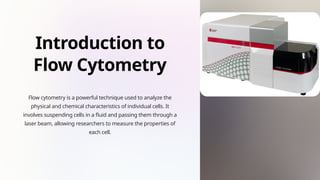
Flow cytometry is a powerful technique used to analyze the
physical and chemical characteristics of individual cells. It
involves suspending cells in a fluid and passing them through a
laser beam, allowing researchers to measure the properties of
each cell.
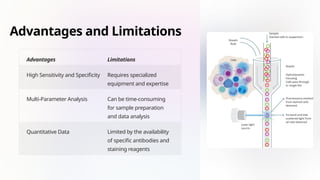
Principles of Flow Cytometry
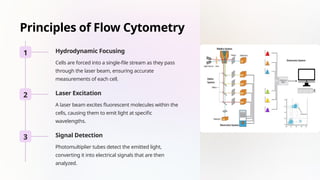
1 Hydrodynamic Focusing
Cells are forced into a single-file stream as they pass
through the laser beam, ensuring accurate
measurements of each cell.
2 Laser Excitation
A laser beam excites fluorescent molecules within the
cells, causing them to emit light at specific
wavelengths.
3 Signal Detection
Photomultiplier tubes detect the emitted light,
converting it into electrical signals that are then
analyzed.
Instrumentation and Components
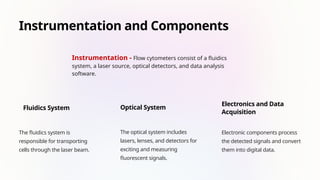
Fluidics System
The fluidics system is
responsible for transporting
cells through the laser beam.
Optical System
The optical system includes
lasers, lenses, and detectors for
exciting and measuring
fluorescent signals.
Electronics and Data
Acquisition
Electronic components process
the detected signals and convert
them into digital data.
Instrumentation - Flow cytometers consist of a fluidics
system, a laser source, optical detectors, and data analysis
software.
Sample Preparation and
Staining
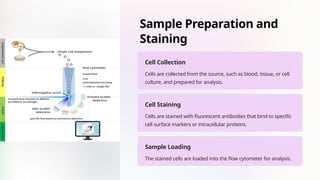
Cell Collection
Cells are collected from the source, such as blood, tissue, or cell
culture, and prepared for analysis.
Cell Staining
Cells are stained with fluorescent antibodies that bind to specific
cell surface markers or intracellular proteins.
Sample Loading
The stained cells are loaded into the flow cytometer for analysis.
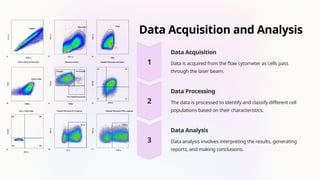
Data Acquisition and Analysis
Data Acquisition
Data is acquired from the flow cytometer as cells pass
through the laser beam.
Data Processing
The data is processed to identify and classify different cell
populations based on their characteristics.
Data Analysis
Data analysis involves interpreting the results, generating
reports, and making conclusions.
Applications of Flow Cytometry
1 Immunology
Flow cytometry is used to identify and quantify
immune cells, including lymphocytes,
macrophages, and neutrophils.
2 Cancer Research
Flow cytometry helps to analyze cancer cells,
study drug response, and monitor treatment
efficacy.
3 Infectious Disease
It is used to diagnose and monitor infectious
diseases by detecting specific pathogens and
immune responses.
4 Cell Biology
Flow cytometry allows researchers to
investigate cell cycle progression, cell
signaling, and apoptosis.
Advantages and Limitations
Advantages Limitations
High Sensitivity and Specificity Requires specialized
equipment and expertise
Multi-Parameter Analysis Can be time-consuming
for sample preparation
and data analysis
Quantitative Data Limited by the availability
of specific antibodies and
staining reagents
Future Developments in Flow Cytometr
Higher Throughput
Faster analysis speeds and increased sample throughput are being developed
to handle larger datasets.
Automation
Automated systems are being developed to streamline the workflow from
sample preparation to data analysis.
New Technologies
Emerging technologies, such as mass cytometry and microfluidic devices,
are expanding the capabilities of flow cytometry.

Introduction-to-Flow-Cytometry cancer detection method

  • 1.
    Introduction to Flow Cytometry Flowcytometry is a powerful technique used to analyze the physical and chemical characteristics of individual cells. It involves suspending cells in a fluid and passing them through a laser beam, allowing researchers to measure the properties of each cell.
  • 2.
    Principles of FlowCytometry 1 Hydrodynamic Focusing Cells are forced into a single-file stream as they pass through the laser beam, ensuring accurate measurements of each cell. 2 Laser Excitation A laser beam excites fluorescent molecules within the cells, causing them to emit light at specific wavelengths. 3 Signal Detection Photomultiplier tubes detect the emitted light, converting it into electrical signals that are then analyzed.
  • 3.
    Instrumentation and Components FluidicsSystem The fluidics system is responsible for transporting cells through the laser beam. Optical System The optical system includes lasers, lenses, and detectors for exciting and measuring fluorescent signals. Electronics and Data Acquisition Electronic components process the detected signals and convert them into digital data. Instrumentation - Flow cytometers consist of a fluidics system, a laser source, optical detectors, and data analysis software.
  • 4.
    Sample Preparation and Staining CellCollection Cells are collected from the source, such as blood, tissue, or cell culture, and prepared for analysis. Cell Staining Cells are stained with fluorescent antibodies that bind to specific cell surface markers or intracellular proteins. Sample Loading The stained cells are loaded into the flow cytometer for analysis.
  • 5.
    Data Acquisition andAnalysis Data Acquisition Data is acquired from the flow cytometer as cells pass through the laser beam. Data Processing The data is processed to identify and classify different cell populations based on their characteristics. Data Analysis Data analysis involves interpreting the results, generating reports, and making conclusions.
  • 6.
    Applications of FlowCytometry 1 Immunology Flow cytometry is used to identify and quantify immune cells, including lymphocytes, macrophages, and neutrophils. 2 Cancer Research Flow cytometry helps to analyze cancer cells, study drug response, and monitor treatment efficacy. 3 Infectious Disease It is used to diagnose and monitor infectious diseases by detecting specific pathogens and immune responses. 4 Cell Biology Flow cytometry allows researchers to investigate cell cycle progression, cell signaling, and apoptosis.
  • 7.
    Advantages and Limitations AdvantagesLimitations High Sensitivity and Specificity Requires specialized equipment and expertise Multi-Parameter Analysis Can be time-consuming for sample preparation and data analysis Quantitative Data Limited by the availability of specific antibodies and staining reagents
  • 8.
    Future Developments inFlow Cytometr Higher Throughput Faster analysis speeds and increased sample throughput are being developed to handle larger datasets. Automation Automated systems are being developed to streamline the workflow from sample preparation to data analysis. New Technologies Emerging technologies, such as mass cytometry and microfluidic devices, are expanding the capabilities of flow cytometry.