Introduction
• Firewalls controlthe flow of network traffic
• Firewalls have applicability in networks
where there is no internet connectivity
• Firewalls operate on number of layers
• Can also act as VPN gateways
• Active content filtering technologies
4.
Firewall Environments
• Thereare different types of environments
where a firewall can be implemented.
• Simple environment can be a packet filter
firewall
• Complex environments can be several
firewalls and proxies
5.
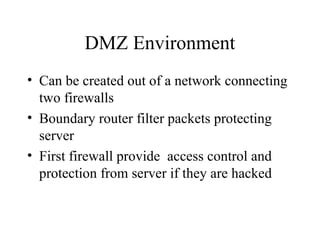
DMZ Environment
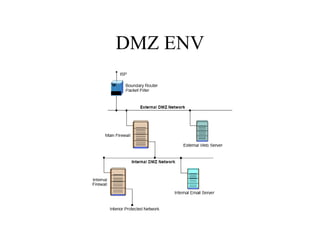
• Canbe created out of a network connecting
two firewalls
• Boundary router filter packets protecting
server
• First firewall provide access control and
protection from server if they are hacked
VPN
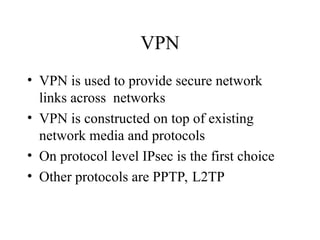
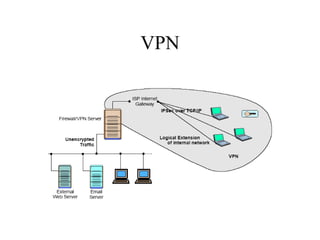
• VPN isused to provide secure network
links across networks
• VPN is constructed on top of existing
network media and protocols
• On protocol level IPsec is the first choice
• Other protocols are PPTP, L2TP
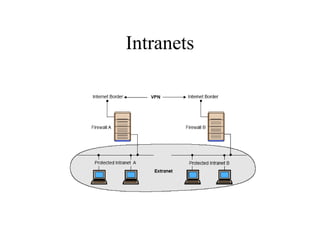
Intranets
• An intranetis a network that employs the
same types of services, applications, and
protocols present in an Internet
implementation, without involving external
connectivity
• Intranets are typically implemented behind
firewall environments.
Extranets
• Extranet isusually a business-to-business
intranet
• Controlled access to remote users via some
form of authentication and encryption such
as provided by a VPN
• Extranets employ TCP/IP protocols, along
with the same standard applications and
services
12.
Type is Firewalls
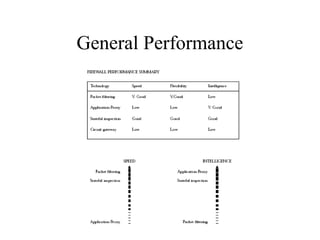
•Firewalls fall into four broad categories
• Packet filters
• Circuit level
• Application level
• Stateful multilayer
13.
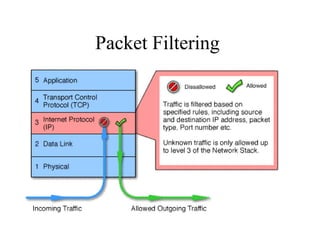
Packet Filter
• Workat the network level of the OSI model
• Each packet is compared to a set of criteria
before it is forwarded
• Packet filtering firewalls is low cost and
low impact on network performance
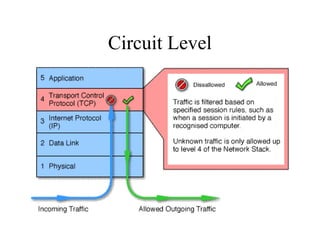
Circuit level
• Circuitlevel gateways work at the session
layer of the OSI model, or the TCP layer of
TCP/IP
• Monitor TCP handshaking between packets
to determine whether a requested session is
legitimate.
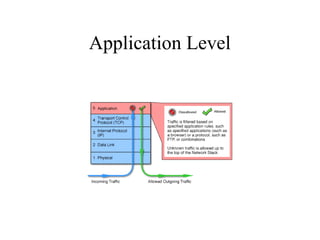
Application Level
• Applicationlevel gateways, also called
proxies, are similar to circuit-level gateways
except that they are application specific
• Gateway that is configured to be a web
proxy will not allow any ftp, gopher, telnet
or other traffic through
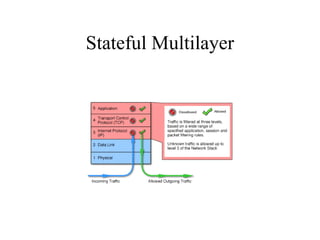
Stateful Multilayer
• Statefulmultilayer inspection firewalls
combine the aspects of the other three types
of firewalls
• They filter packets at the network layer,
determine whether session packets are
legitimate and evaluate contents of packets
at the application layer
Future of Firewalls
•Firewalls will continue to advance as the attacks
on IT infrastructure become more and more
sophisticated
• More and more client and server applications are
coming with native support for proxied
environments
• Firewalls that scan for viruses as they enter the
network and several firms are currently exploring
this idea, but it is not yet in wide use
23.
Conclusion
• It isclear that some form of security for
private networks connected to the Internet
is essential
• A firewall is an important and necessary
part of that security, but cannot be expected
to perform all the required security
functions.