NAME REGISTER NUMBER
IDRIS310623105018
NITHIYA PRAKASH 310623105037
DHARINEESH R M 310623105010
EASWARI ENGINEERING COLLEGE
GROUP PRESENTATION
EXPRESSION TREES
DATA
STRUCTURES
WITH C
231CSS421T
GROUP-16
DATE: 26-03-25
SECOND YEAR – IV SEM
2.
Introduction to Expression
ExpressionTrees
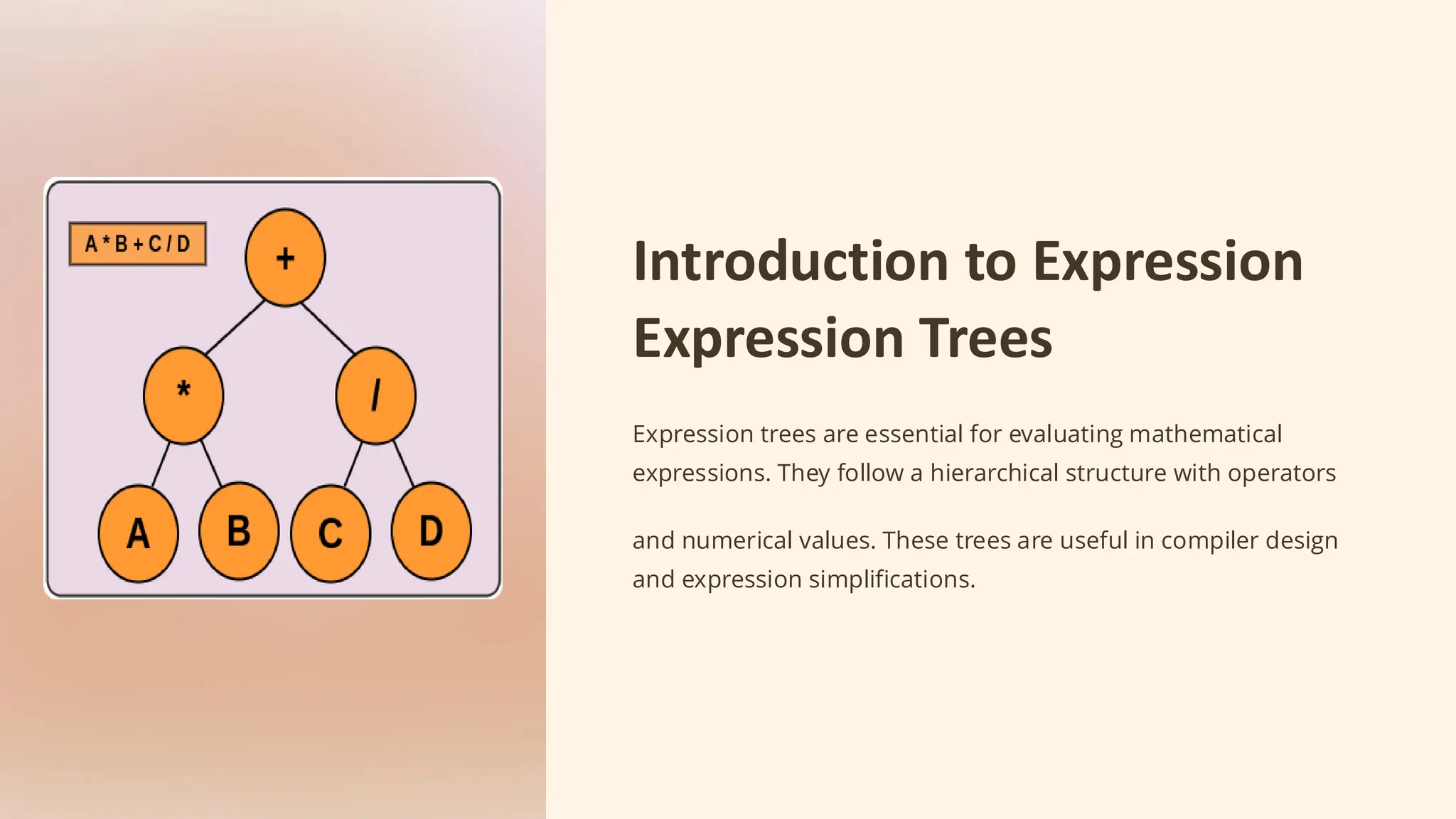
Expression trees are essential for evaluating mathematical
expressions. They follow a hierarchical structure with operators
and numerical values. These trees are useful in compiler design
and expression simplifications.
3.
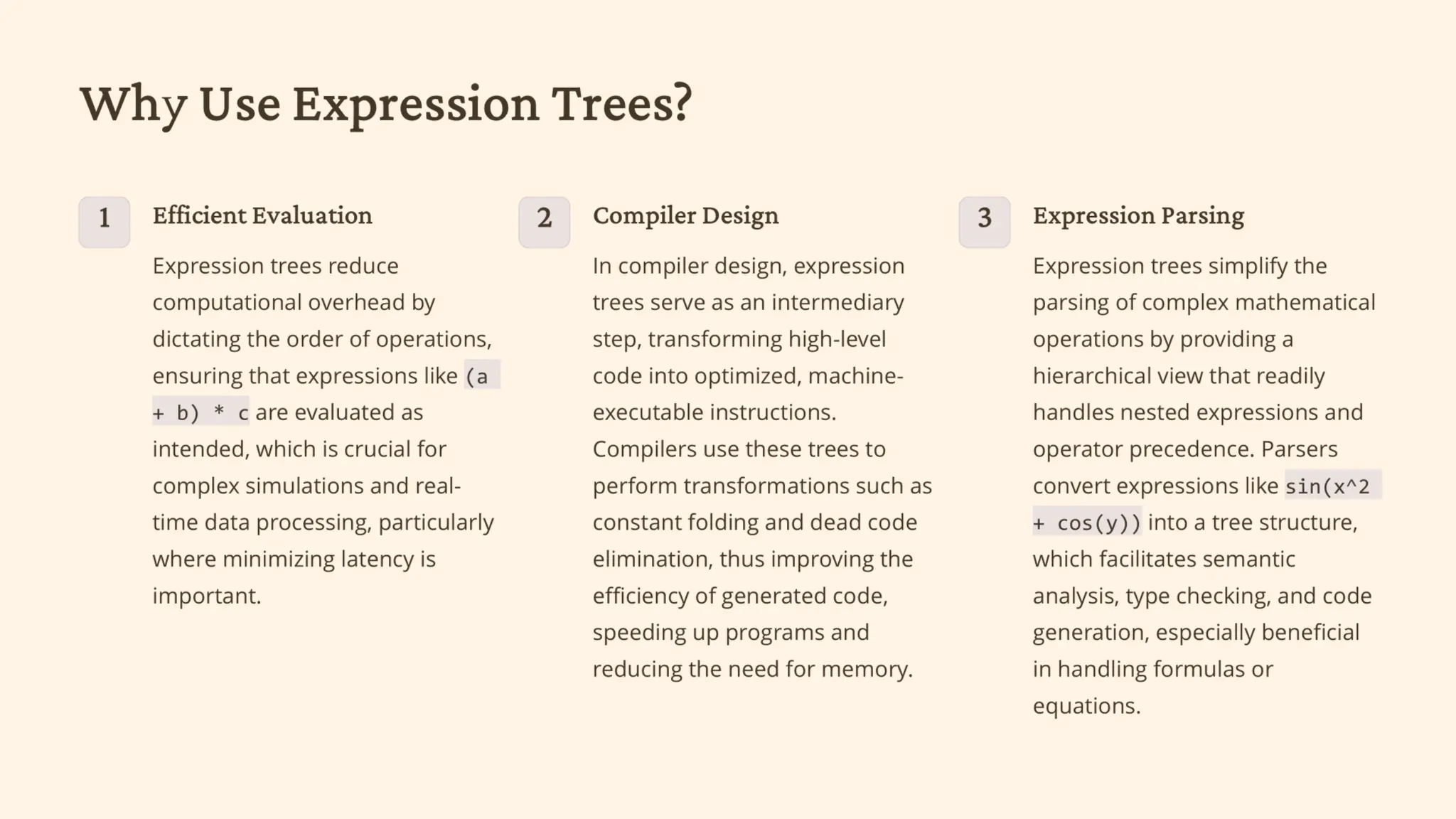
Why Use ExpressionTrees?
1 Efficient Evaluation
Preserves the correct order of
operations.
2 Compiler Design
Converts high-level code into
machine instructions.
3 Expression Parsing
Eases processing of complex
mathematical operations.
4.
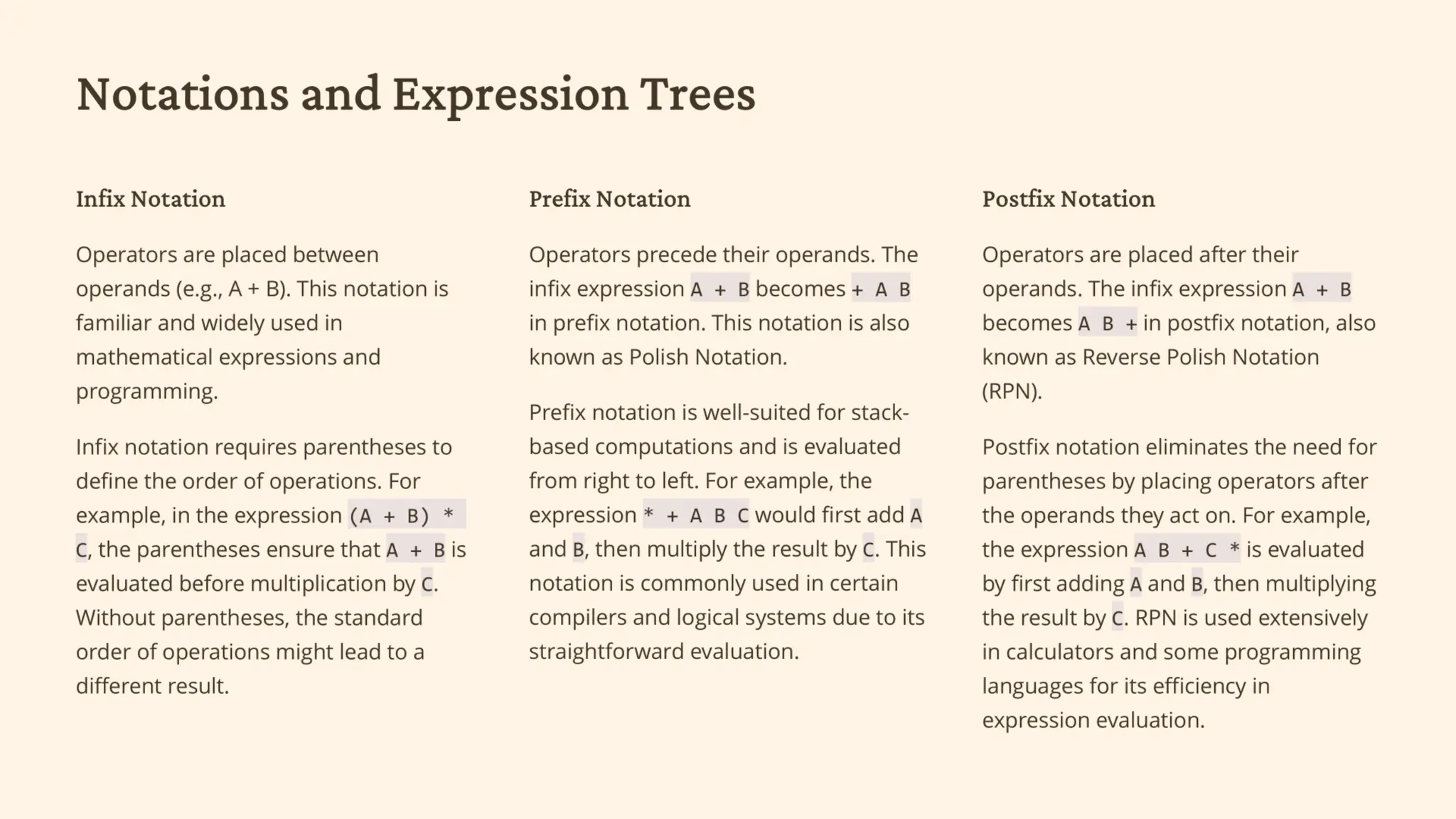
Notations and ExpressionTrees
Infix Notation
Operators appear between operands
(e.g., A + B).
Familiar and widely used, but requires
parentheses for precedence.
Prefix Notation
Operators come before their
operands.The infix expression "A + B"
becomes "+ A B" in prefix notation.
Suitable for stack-based
computations, evaluates left to right.
Postfix Notation
Operators are placed after the
operands.The infix expression "A + B"
becomes "A B +" in postfix notation.
Eliminates parentheses by placing
operators before operands.
5.
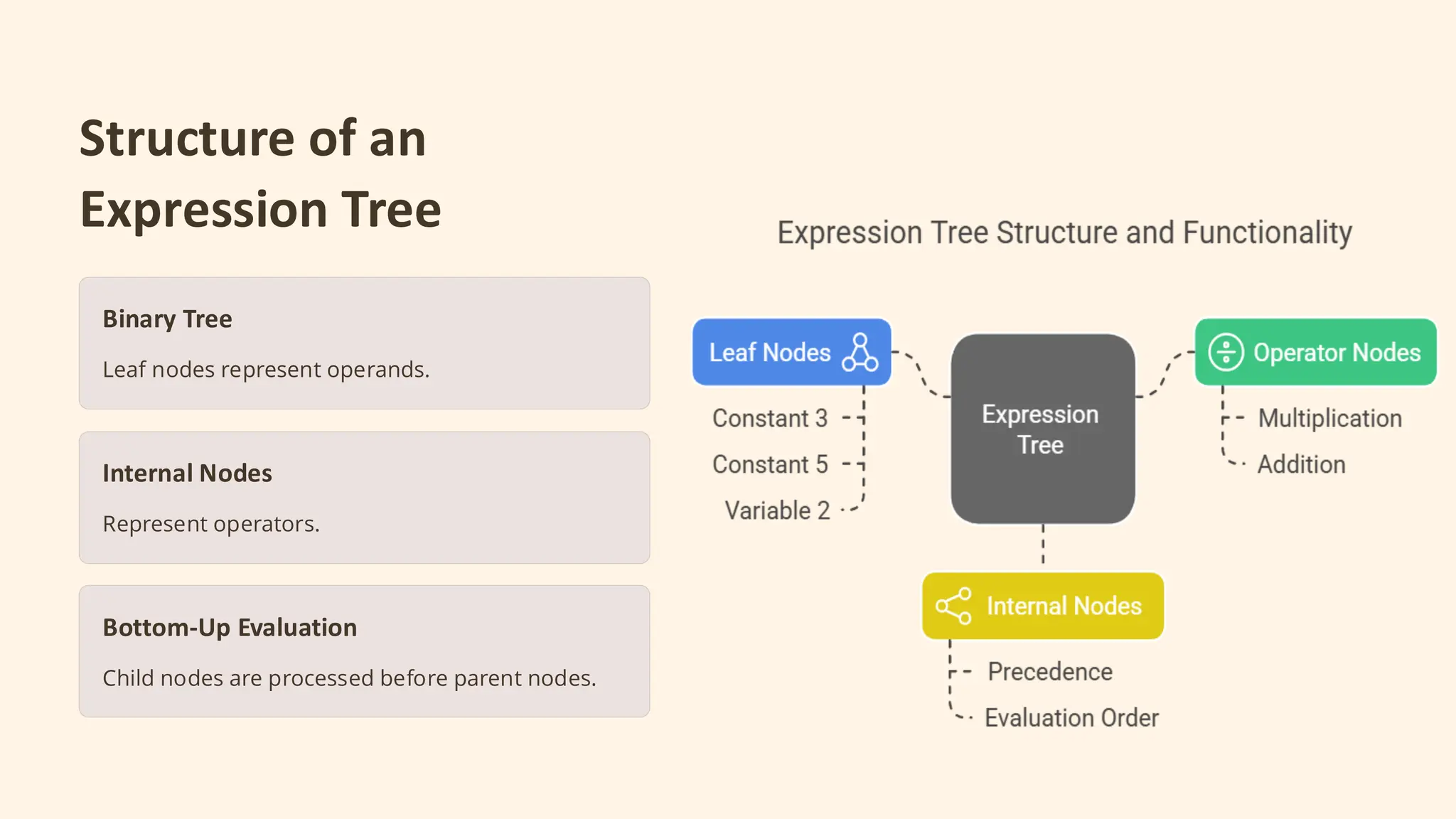
Structure of an
ExpressionTree
Binary Tree
Leaf nodes represent operands.
Internal Nodes
Represent operators.
Bottom-Up Evaluation
Child nodes are processed before parent nodes.
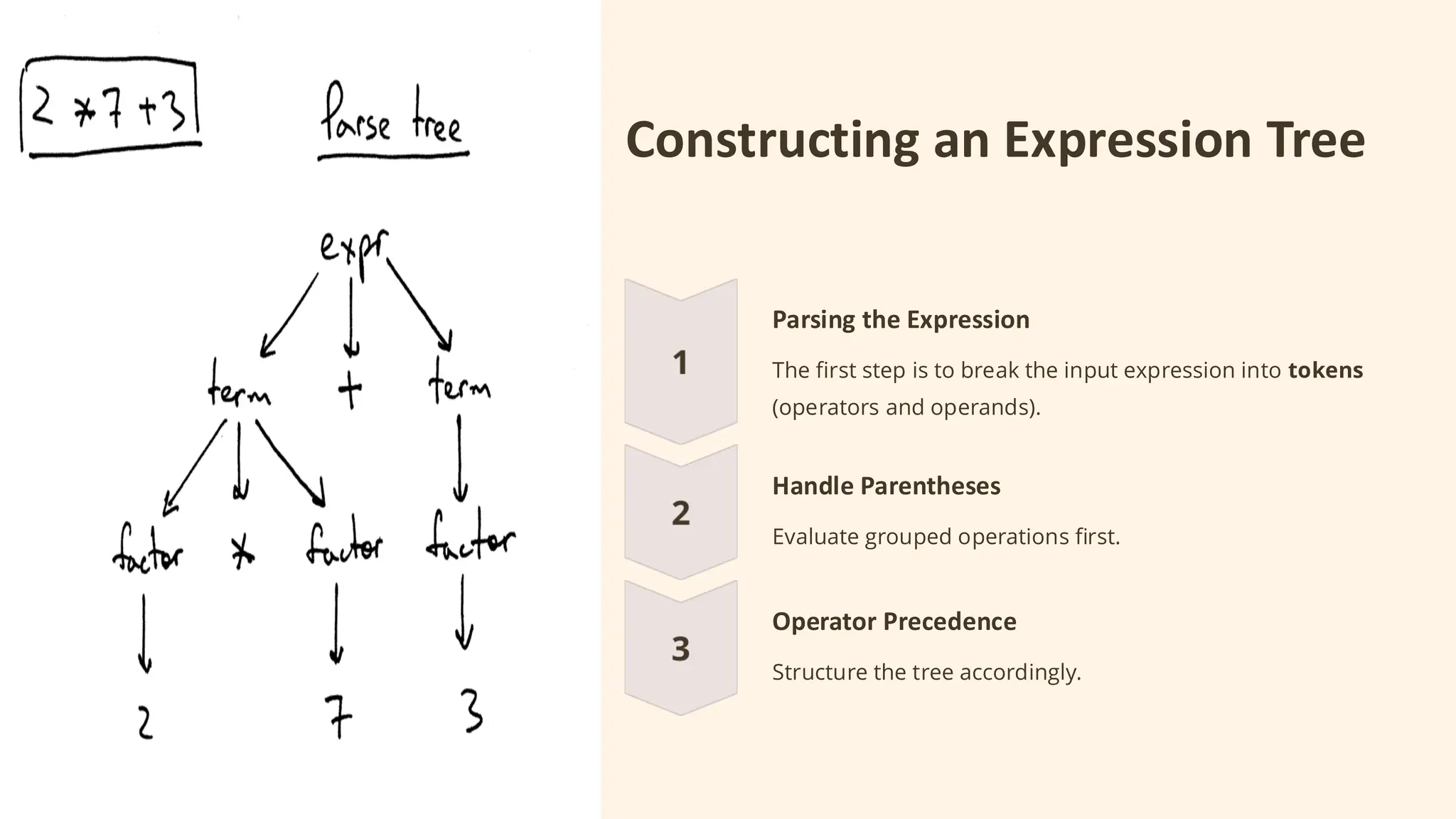
Constructing an ExpressionTree
Parsing the Expression
The first step is to break the input expression into tokens
(operators and operands).
Handle Parentheses
Evaluate grouped operations first.
Operator Precedence
Structure the tree accordingly.
8.
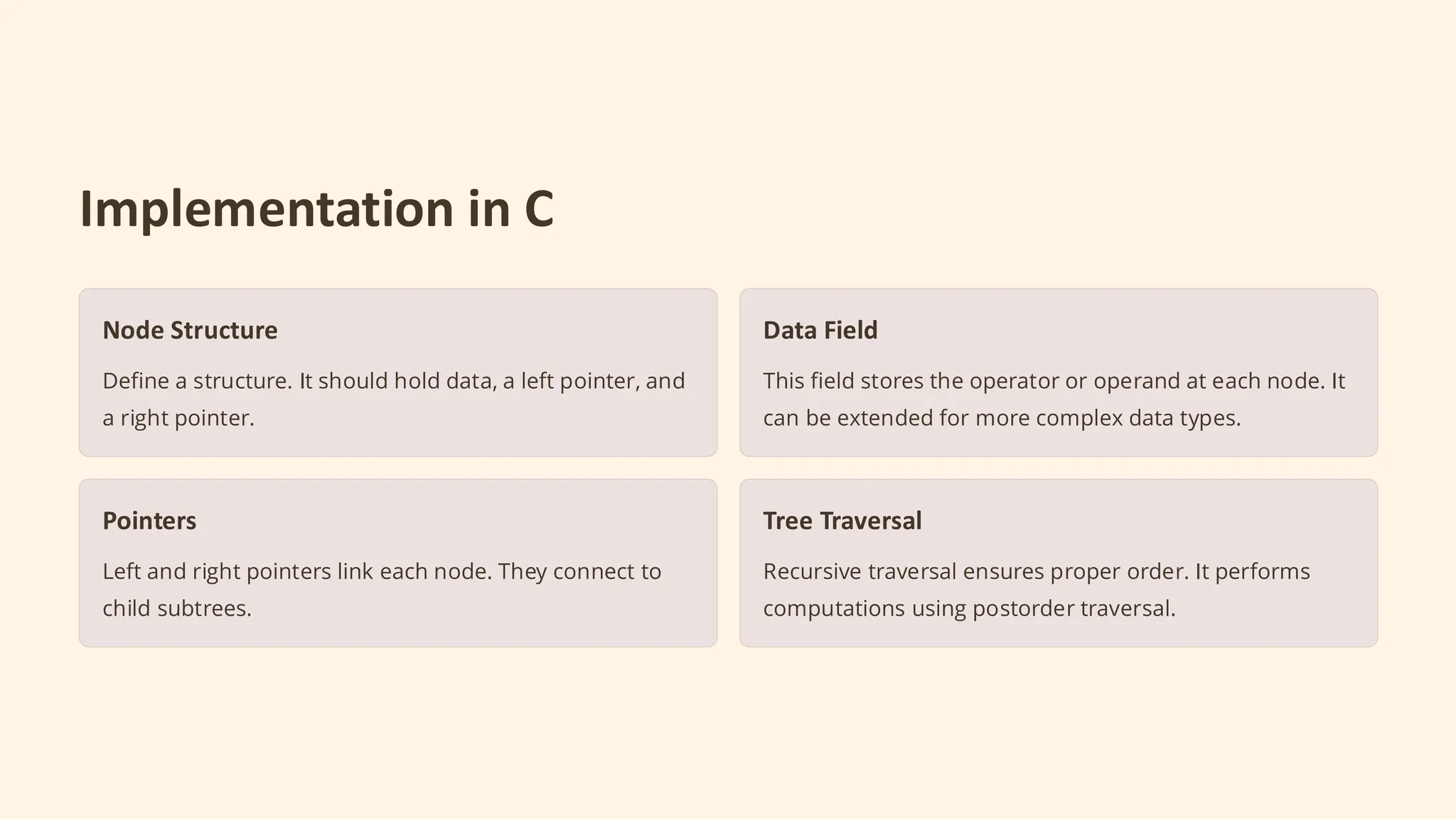
Implementation in C
NodeStructure
Define a structure. It should hold data, a left pointer, and
a right pointer.
Data Field
This field stores the operator or operand at each node. It
can be extended for more complex data types.
Pointers
Left and right pointers link each node. They connect to
child subtrees.
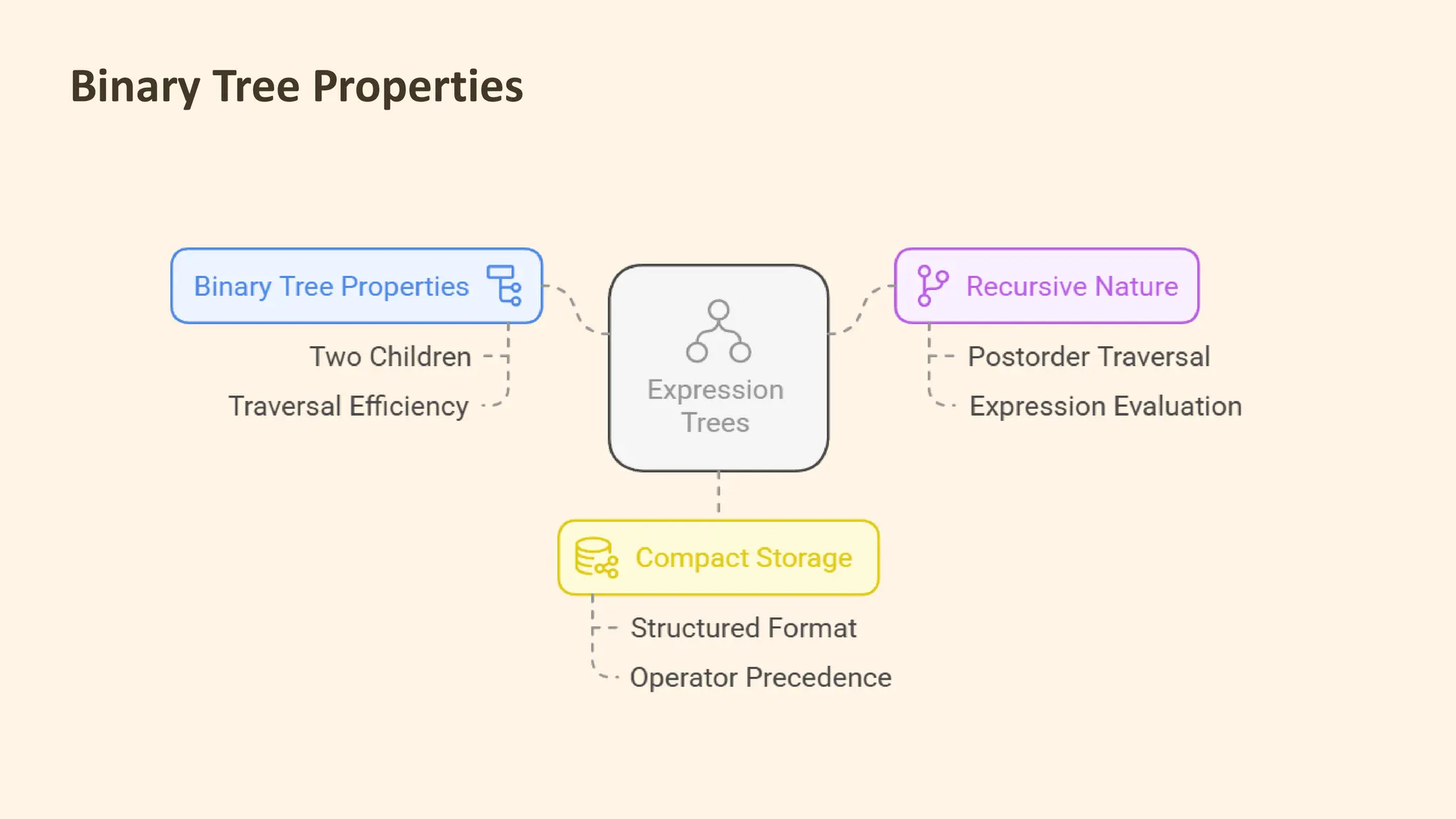
Tree Traversal
Recursive traversal ensures proper order. It performs
computations using postorder traversal.
9.
Complete C Program:Expression Tree Implementation
#include <stdio.h>
#include <stdlib.h>
#include <ctype.h>
#include <string.h>
// Structure definition for tree nodes
typedef struct Node {
char data;
struct Node *left, *right;
} Node;
// Function to create a new node
Node* createNode(char data) {
Node* newNode =
(Node*)malloc(sizeof(Node));
newNode->data = data;
newNode->left = newNode->right =
NULL;
return newNode;
// Stack structure for tree nodes
typedef struct Stack {
Node* data[100]; // Stack to hold tree nodes
int top;
} Stack;
// Initialize stack
void initStack(Stack* stack) {
stack->top = -1;
}
// Push node onto stack
void push(Stack* stack, Node* node) {
stack->data[++stack->top] = node;
}
// Pop node from stack
Node* pop(Stack* stack) {
return stack->data[stack->top--];
10.
// Function toconstruct an expression tree from
postfix expression
Node* constructTree(char postfix[]) {
Stack stack;
initStack(&stack);
int i;
for (i = 0; i < strlen(postfix); i++) {
char ch = postfix[i];
// If operand, create node and push onto stack
if (isdigit(ch)) {
push(&stack, createNode(ch));
}
// If operator, pop two nodes, create subtree,
and push back
else {
Node* newNode = createNode(ch);
newNode->right = pop(&stack);
newNode->left = pop(&stack);
push(&stack, newNode);
}
}
return pop(&stack); // Root node }
// Function to evaluate the expression
tree using recursion
int evaluate(Node* root) {
// If leaf node, return the operand
if (root->left == NULL && root->right == NULL)
return root->data - '0'; // Convert char to int
// Evaluate left and right subtrees
int leftVal = evaluate(root->left);
int rightVal = evaluate(root->right);
// Perform the corresponding arithmetic operation
switch (root->data) {
case '+': return leftVal + rightVal;
case '-': return leftVal - rightVal;
case '*': return leftVal * rightVal;
case '/': return leftVal / rightVal;
}
return 0;
}
![Complete C Program: Expression Tree Implementation
#include <stdio.h>
#include <stdlib.h>
#include <ctype.h>
#include <string.h>
// Structure definition for tree nodes
typedef struct Node {
char data;
struct Node *left, *right;
} Node;
// Function to create a new node
Node* createNode(char data) {
Node* newNode =
(Node*)malloc(sizeof(Node));
newNode->data = data;
newNode->left = newNode->right =
NULL;
return newNode;
// Stack structure for tree nodes
typedef struct Stack {
Node* data[100]; // Stack to hold tree nodes
int top;
} Stack;
// Initialize stack
void initStack(Stack* stack) {
stack->top = -1;
}
// Push node onto stack
void push(Stack* stack, Node* node) {
stack->data[++stack->top] = node;
}
// Pop node from stack
Node* pop(Stack* stack) {
return stack->data[stack->top--];](https://image.slidesharecdn.com/introduction-to-expression-trees-250326000744-cf410c3e/75/Introduction-to-Expression-Trees-pdf-9-2048.jpg)
![// Function to construct an expression tree from
postfix expression
Node* constructTree(char postfix[]) {
Stack stack;
initStack(&stack);
int i;
for (i = 0; i < strlen(postfix); i++) {
char ch = postfix[i];
// If operand, create node and push onto stack
if (isdigit(ch)) {
push(&stack, createNode(ch));
}
// If operator, pop two nodes, create subtree,
and push back
else {
Node* newNode = createNode(ch);
newNode->right = pop(&stack);
newNode->left = pop(&stack);
push(&stack, newNode);
}
}
return pop(&stack); // Root node }
// Function to evaluate the expression
tree using recursion
int evaluate(Node* root) {
// If leaf node, return the operand
if (root->left == NULL && root->right == NULL)
return root->data - '0'; // Convert char to int
// Evaluate left and right subtrees
int leftVal = evaluate(root->left);
int rightVal = evaluate(root->right);
// Perform the corresponding arithmetic operation
switch (root->data) {
case '+': return leftVal + rightVal;
case '-': return leftVal - rightVal;
case '*': return leftVal * rightVal;
case '/': return leftVal / rightVal;
}
return 0;
}](https://image.slidesharecdn.com/introduction-to-expression-trees-250326000744-cf410c3e/75/Introduction-to-Expression-Trees-pdf-10-2048.jpg)
![// Inorder traversal (Left -> Root -> Right)
void inorder(Node* root) {
if (root != NULL) {
inorder(root->left);
printf("%c ", root->data);
inorder(root->right);
}
}
// Postorder traversal (Left -> Right -> Root)
void postorder(Node* root) {
if (root != NULL) {
postorder(root->left);
postorder(root->right);
printf("%c ", root->data);
}
}
// Preorder traversal (Root -> Left -> Right)
void preorder(Node* root) {
if (root != NULL) {
printf("%c ", root->data);
preorder(root->left);
preorder(root->right); } }
// Main function
int main() {
char postfix[] = "35+2*"; // Example expression: (3
+ 5) * 2
Node* root = constructTree(postfix);
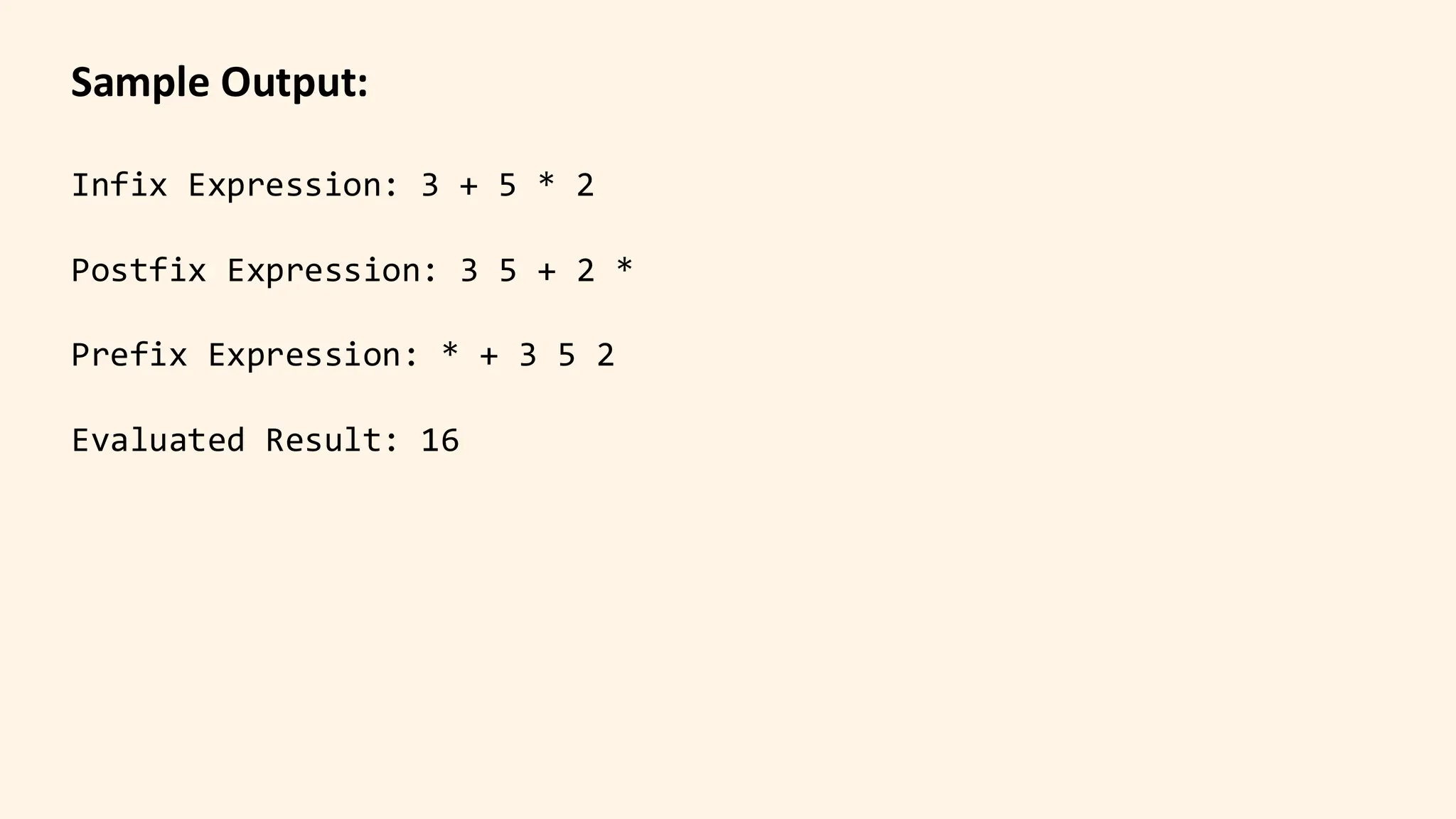
printf("Infix Expression: ");
inorder(root);
printf("n");
printf("Postfix Expression: ");
postorder(root);
printf("n");
printf("Prefix Expression: ");
preorder(root);
printf("n");
printf("Evaluated Result: %dn", evaluate(root));
return 0;
}](https://image.slidesharecdn.com/introduction-to-expression-trees-250326000744-cf410c3e/75/Introduction-to-Expression-Trees-pdf-11-2048.jpg)