Introduction to Ethical Hacking
©Great Learning. All Rights Reserved. Unauthorized use or distribution prohibited
What is Hacking?
©Great Learning. All Rights Reserved. Unauthorized use or distribution prohibited
What is Hacking?
Ethical Hacking is the protection of inter-connected systems,
including hardware, software and data, from cyber attacks.
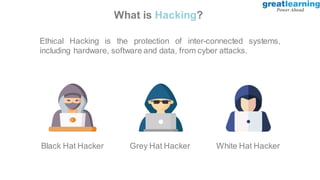
White Hat Hacker
Grey Hat Hacker
Black Hat Hacker
Computer Security Threats
• Computer Virus
• Computer Worm
• Scareware
• Key logger
• Adware
• Malware
• Backdoor
• Trojan
• Ransomware
• Spyware
Goals of ethical Hacking
• Protect the privacy of an Organization
• Transparently report all the identified bugs/weaknesses/vulnerabilities to
the organization.
• Inform the vendors about the security measures and patches.
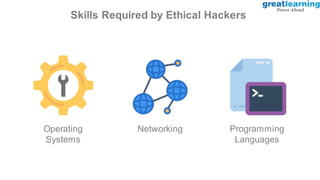
Skills Required by Ethical Hackers
Operating
Systems
Programming
Languages
Networking
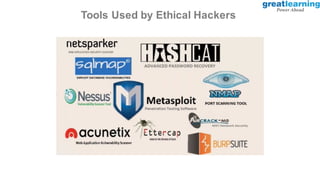
Tools Used by Ethical Hackers
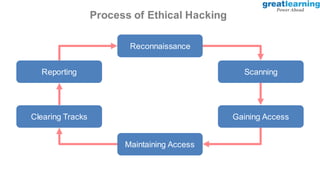
Process of Ethical Hacking
Reconnaissance
Maintaining Access
Scanning
Gaining Access
Reporting
Clearing Tracks
Reconnaissance
This is the first step of hacking. It is also called as Foot printing and
information gathering phase. This is the preparatory phase where
we collect as much as information as possible about these the
target. We usually collect information about three groups:
• Network
• Host
• People Involved
Scanning
Three types of scanning are involved:
Port scanning: This phase involves scanning the target for the
information like open ports, live systems, various services running
on the host.
Vulnerability Scanning: Checking the target for the weakness or
vulnerabilities which can be exploited. Usually done with the help of
automated tools.
Network Mapping: Finding the topology of network, routers,
firewalls servers if any, and host information and drawing a network
diagram with the available information. This map may serve as a
valuable piece of information. This map may serve as a valuable
piece of information throughout the hacking process.
Clearing Tracks
No thief wants to get caught. An intelligent hacker always clears all
the evidence so that in later point of time, no one will find any traces
leading to him. This involves modifying/corrupting/deleting the
values of logs, modifying registry values and uninstalling all the
applications he used and deleting all folders he created.
Demonstration
©Great Learning. All Rights Reserved. Unauthorized use or distribution prohibited
Ethical Hacking Across Domains
At it’s core, Ethical Hacking occupies a prominent role in various
verticals such as:
• WebApplication Environment
• Mobile Applications
• And many more…
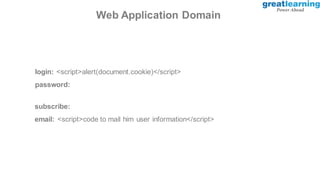
Web Application Domain
Two Major Categories:
• Client side vulnerabilities
• Server side vulnerabilities
All attacks can be categorized intro 3 major attacks:
• Parameter Tampering
• Unvalidated inputs
• Directory TraversalAttacks
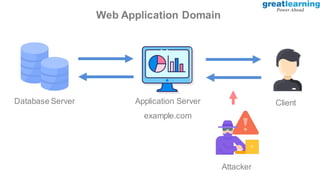
Web Application Domain
Client
Database Server Application Server
example.com
Attacker
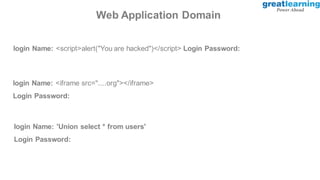
Web Application Domain
login Name: <script>alert("You are hacked")</script> Login Password:
login Name: 'Union select * from users'
Login Password:
login Name: <iframe src="....org"></iframe>
Login Password:
Common Web Application attacks
• Injection Flaws eg. SQL injection, HTML injection, etc.
• Cross site Scripting eg. Reflected, Stored, etc.
• WebServices Attacks eg. DNS Cache Poising, File uploads etc.
Web Application Domain
login: <script>alert(document.cookie)</script>
password:
subscribe:
email: <script>code to mail him user information</script>
Hacking Methodology
• WebFootprinting – Gathering Information
• Vulnerability Scanners – w3af, Acunetix
• Identify Entry Points and Attack surface
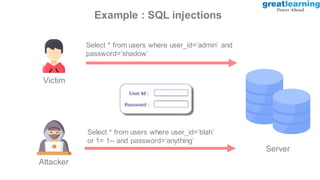
Example : SQL injections
Victim
Attacker
Server
Select * from users where user_id=‘admin’ and
password=‘shadow’
Select * from users where user_id=‘blah’
or 1= 1-- and password=‘anything’
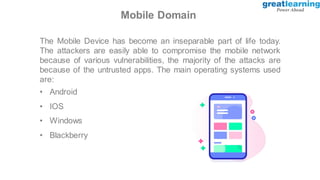
Mobile Domain
The Mobile Device has become an inseparable part of life today.
The attackers are easily able to compromise the mobile network
because of various vulnerabilities, the majority of the attacks are
because of the untrusted apps. The main operating systems used
are:
• Android
• IOS
• Windows
• Blackberry
©Great Learning. All Rights Reserved. Unauthorized use or distribution prohibited
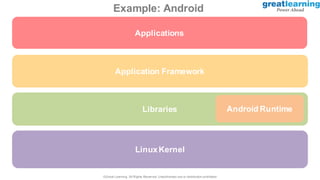
Example: Android
Libraries
Applications
Application Framework
LinuxKernel
Android Runtime
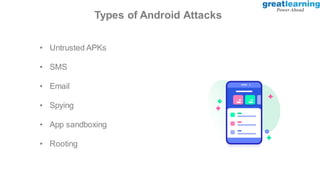
Types of Android Attacks
• Untrusted APKs
• SMS
• Email
• Spying
• App sandboxing
• Rooting
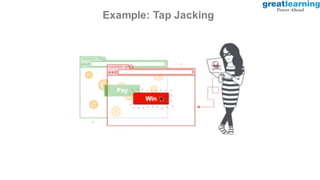
Example: Tap Jacking
Network Domain
A network is an attempt to gain unauthorised access to an
organisation’s network, with the objective of stealing data or perform
other malicious activity. There are two main types of network attacks:
• Passive: Attackers gain access to a network and can monitor or
steal sensitive information, but without making any change to data,
leaving it intact.
• Active: Attackers not only gain unauthorised access but also modify
data , either deleting, encrypting or otherwise harming it.
Types of Network Attacks
Endpoint attacks – gaining unauthorised access to user devices,
servers or other endpoints, typically compromising them by infecting
them with malware.
Malware attacks – infecting IT resources with malware, allowing
attackers to compromise systems, steal data and do damage. These
also include ransomware attacks.
Vulnerabilities, exploits and attacks – exploiting vulnerabilities in
software used in the organization, to gain unauthorised access,
compromise or sabotage systems.
Advanced persistent threats – These are complex multi-layered threats,
which include network attacks but also other attack types.
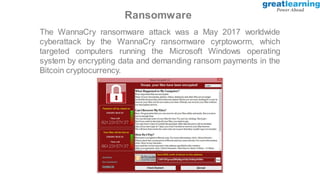
Ransomware
The WannaCry ransomware attack was a May 2017 worldwide
cyberattack by the WannaCry ransomware cyrptoworm, which
targeted computers running the Microsoft Windows operating
system by encrypting data and demanding ransom payments in the
Bitcoin cryptocurrency.
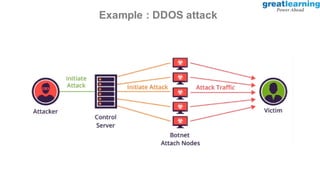
Example : DDOS attack
Other Domains
• Cloud Computing
• IOT
• Block chain
• Edge Computing
Demonstration – SQL injection
©Great Learning. All Rights Reserved. Unauthorized use or distribution prohibited

Introduction to Ethical Hacking pdf file

  • 1.
    Introduction to EthicalHacking ©Great Learning. All Rights Reserved. Unauthorized use or distribution prohibited
  • 2.
    What is Hacking? ©GreatLearning. All Rights Reserved. Unauthorized use or distribution prohibited
  • 3.
    What is Hacking? EthicalHacking is the protection of inter-connected systems, including hardware, software and data, from cyber attacks. White Hat Hacker Grey Hat Hacker Black Hat Hacker
  • 4.
    Computer Security Threats •Computer Virus • Computer Worm • Scareware • Key logger • Adware • Malware • Backdoor • Trojan • Ransomware • Spyware
  • 5.
    Goals of ethicalHacking • Protect the privacy of an Organization • Transparently report all the identified bugs/weaknesses/vulnerabilities to the organization. • Inform the vendors about the security measures and patches.
  • 6.
    Skills Required byEthical Hackers Operating Systems Programming Languages Networking
  • 7.
    Tools Used byEthical Hackers
  • 8.
    Process of EthicalHacking Reconnaissance Maintaining Access Scanning Gaining Access Reporting Clearing Tracks
  • 9.
    Reconnaissance This is thefirst step of hacking. It is also called as Foot printing and information gathering phase. This is the preparatory phase where we collect as much as information as possible about these the target. We usually collect information about three groups: • Network • Host • People Involved
  • 10.
    Scanning Three types ofscanning are involved: Port scanning: This phase involves scanning the target for the information like open ports, live systems, various services running on the host. Vulnerability Scanning: Checking the target for the weakness or vulnerabilities which can be exploited. Usually done with the help of automated tools. Network Mapping: Finding the topology of network, routers, firewalls servers if any, and host information and drawing a network diagram with the available information. This map may serve as a valuable piece of information. This map may serve as a valuable piece of information throughout the hacking process.
  • 11.
    Clearing Tracks No thiefwants to get caught. An intelligent hacker always clears all the evidence so that in later point of time, no one will find any traces leading to him. This involves modifying/corrupting/deleting the values of logs, modifying registry values and uninstalling all the applications he used and deleting all folders he created.
  • 12.
    Demonstration ©Great Learning. AllRights Reserved. Unauthorized use or distribution prohibited
  • 13.
    Ethical Hacking AcrossDomains At it’s core, Ethical Hacking occupies a prominent role in various verticals such as: • WebApplication Environment • Mobile Applications • And many more…
  • 14.
    Web Application Domain TwoMajor Categories: • Client side vulnerabilities • Server side vulnerabilities All attacks can be categorized intro 3 major attacks: • Parameter Tampering • Unvalidated inputs • Directory TraversalAttacks
  • 15.
    Web Application Domain Client DatabaseServer Application Server example.com Attacker
  • 16.
    Web Application Domain loginName: <script>alert("You are hacked")</script> Login Password: login Name: 'Union select * from users' Login Password: login Name: <iframe src="....org"></iframe> Login Password:
  • 17.
    Common Web Applicationattacks • Injection Flaws eg. SQL injection, HTML injection, etc. • Cross site Scripting eg. Reflected, Stored, etc. • WebServices Attacks eg. DNS Cache Poising, File uploads etc.
  • 18.
    Web Application Domain login:<script>alert(document.cookie)</script> password: subscribe: email: <script>code to mail him user information</script>
  • 19.
    Hacking Methodology • WebFootprinting– Gathering Information • Vulnerability Scanners – w3af, Acunetix • Identify Entry Points and Attack surface
  • 20.
    Example : SQLinjections Victim Attacker Server Select * from users where user_id=‘admin’ and password=‘shadow’ Select * from users where user_id=‘blah’ or 1= 1-- and password=‘anything’
  • 21.
    Mobile Domain The MobileDevice has become an inseparable part of life today. The attackers are easily able to compromise the mobile network because of various vulnerabilities, the majority of the attacks are because of the untrusted apps. The main operating systems used are: • Android • IOS • Windows • Blackberry
  • 22.
    ©Great Learning. AllRights Reserved. Unauthorized use or distribution prohibited Example: Android Libraries Applications Application Framework LinuxKernel Android Runtime
  • 23.
    Types of AndroidAttacks • Untrusted APKs • SMS • Email • Spying • App sandboxing • Rooting
  • 24.
  • 25.
    Network Domain A networkis an attempt to gain unauthorised access to an organisation’s network, with the objective of stealing data or perform other malicious activity. There are two main types of network attacks: • Passive: Attackers gain access to a network and can monitor or steal sensitive information, but without making any change to data, leaving it intact. • Active: Attackers not only gain unauthorised access but also modify data , either deleting, encrypting or otherwise harming it.
  • 26.
    Types of NetworkAttacks Endpoint attacks – gaining unauthorised access to user devices, servers or other endpoints, typically compromising them by infecting them with malware. Malware attacks – infecting IT resources with malware, allowing attackers to compromise systems, steal data and do damage. These also include ransomware attacks. Vulnerabilities, exploits and attacks – exploiting vulnerabilities in software used in the organization, to gain unauthorised access, compromise or sabotage systems. Advanced persistent threats – These are complex multi-layered threats, which include network attacks but also other attack types.
  • 27.
    Ransomware The WannaCry ransomwareattack was a May 2017 worldwide cyberattack by the WannaCry ransomware cyrptoworm, which targeted computers running the Microsoft Windows operating system by encrypting data and demanding ransom payments in the Bitcoin cryptocurrency.
  • 28.
  • 29.
    Other Domains • CloudComputing • IOT • Block chain • Edge Computing
  • 30.
    Demonstration – SQLinjection ©Great Learning. All Rights Reserved. Unauthorized use or distribution prohibited
  • 31.
    ©Great Learning. AllRights Reserved. Unauthorized use or distribution prohibited