INTRODUCTION TO DI
ENGINEERING EXPLORER
February 2016
2
DI ENGINEERING EXPLORER: OVERVIEW
DI Engineering Explorer is a proprietary tool allowing customers to visualize completion
and production data. With well-level analysis and intelligence on over 130,000 wells, DI
Engineering Explorer saves customers over $800,000 in up-front costs and over a year
of man-hours. Find correlations between specific completion techniques and production,
understand how the best producers are completing their wells, identify the names,
number, calculated mass, density, trade name, supplier and purpose of materials in the
best producing wells, and find the most profitable investment and business
opportunities.
3
PRODUCT OVERVIEW: DI ENGINEERING EXPLORER
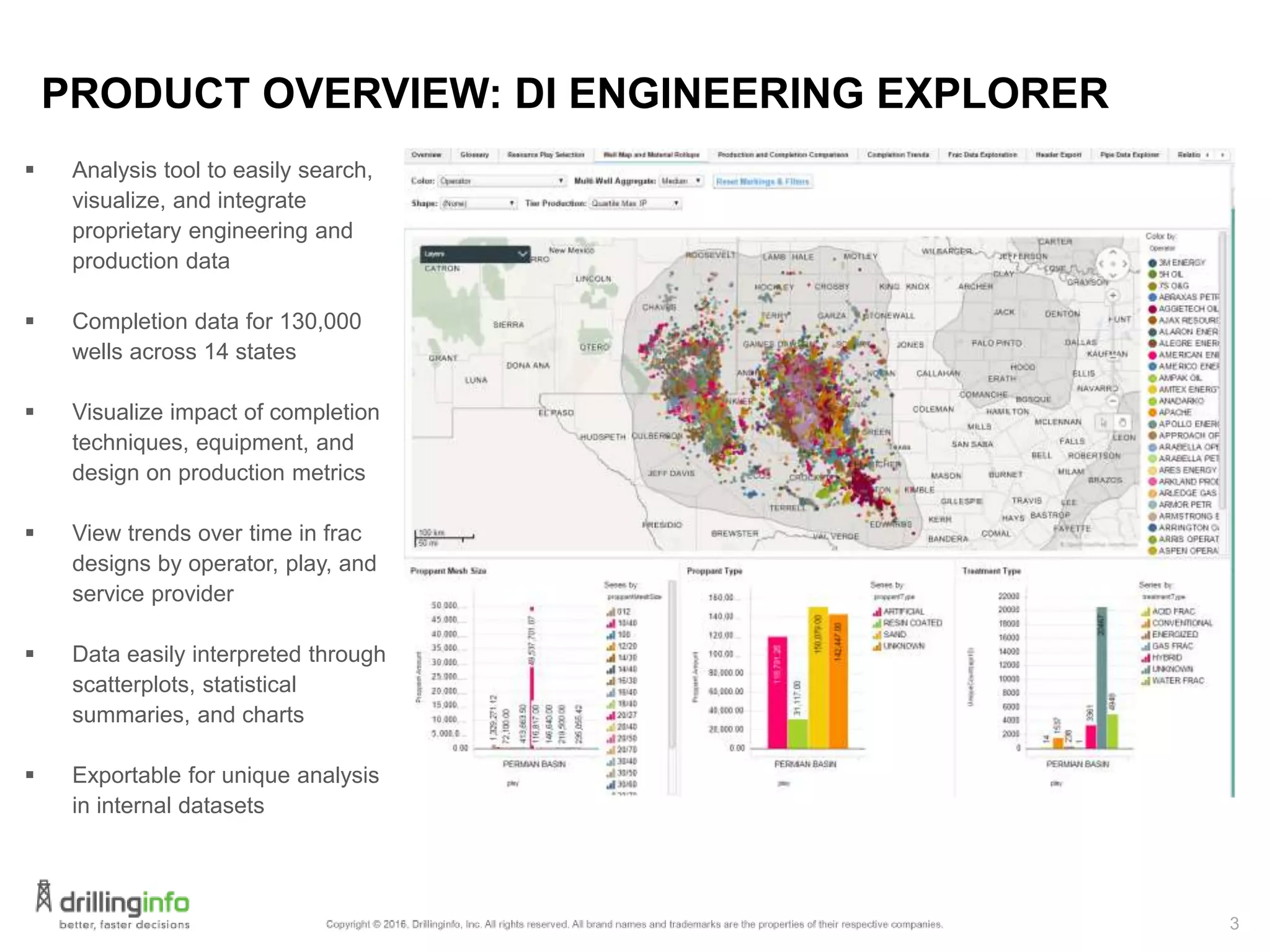
 Analysis tool to easily search,
visualize, and integrate
proprietary engineering and
production data
 Completion data for 130,000
wells across 14 states
 Visualize impact of completion
techniques, equipment, and
design on production metrics
 View trends over time in frac
designs by operator, play, and
service provider
 Data easily interpreted through
scatterplots, statistical
summaries, and charts
 Exportable for unique analysis
in internal datasets
4
QUESTIONS ANSWERED WITH DI ENGINEERING
EXPLORER
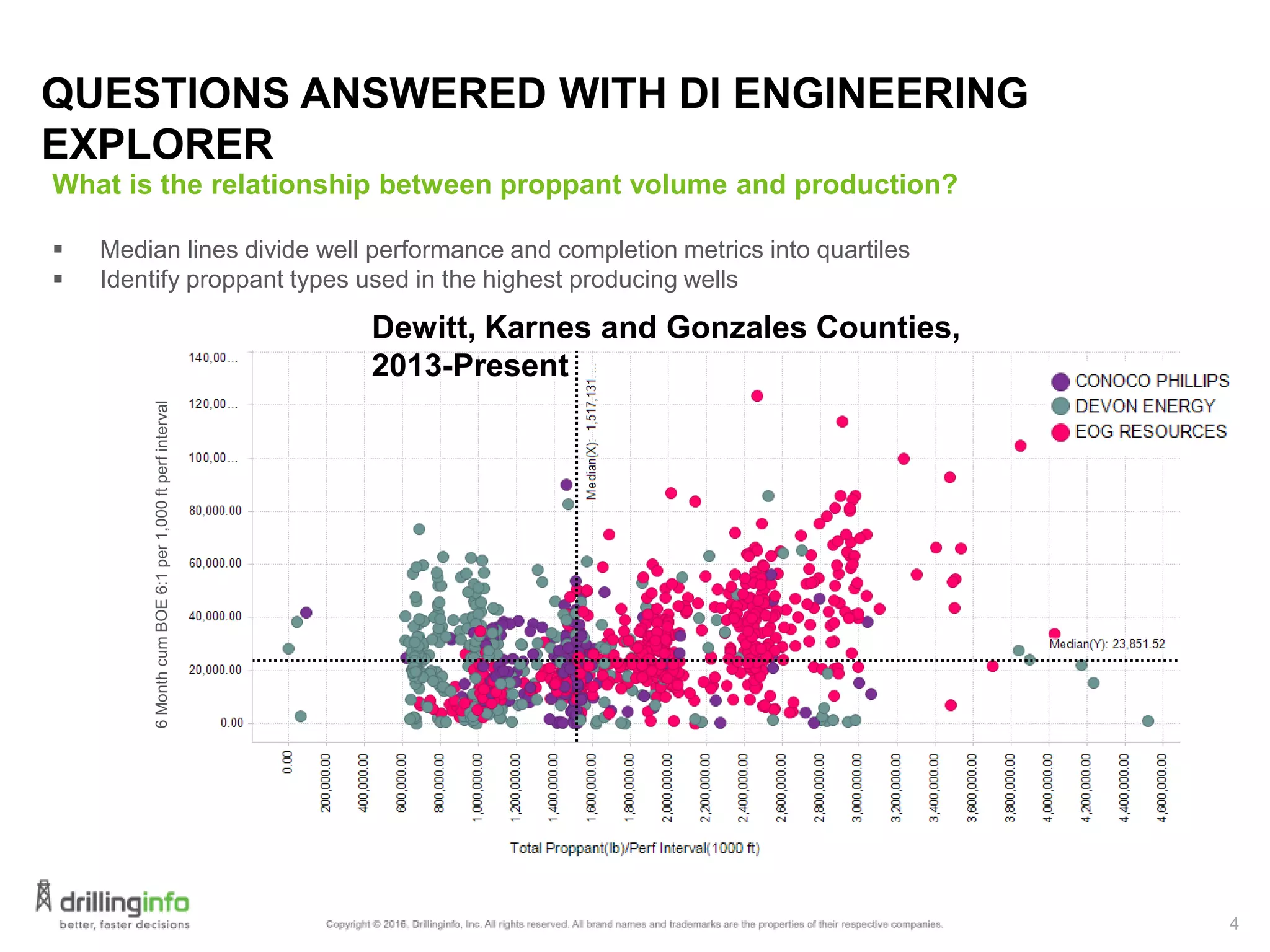
What is the relationship between proppant volume and production?
 Median lines divide well performance and completion metrics into quartiles
 Identify proppant types used in the highest producing wells
6MonthcumBOE6:1per1,000ftperfinterval
Dewitt, Karnes and Gonzales Counties,
2013-Present
5
QUESTIONS ANSWERED WITH DI ENGINEERING
EXPLORER
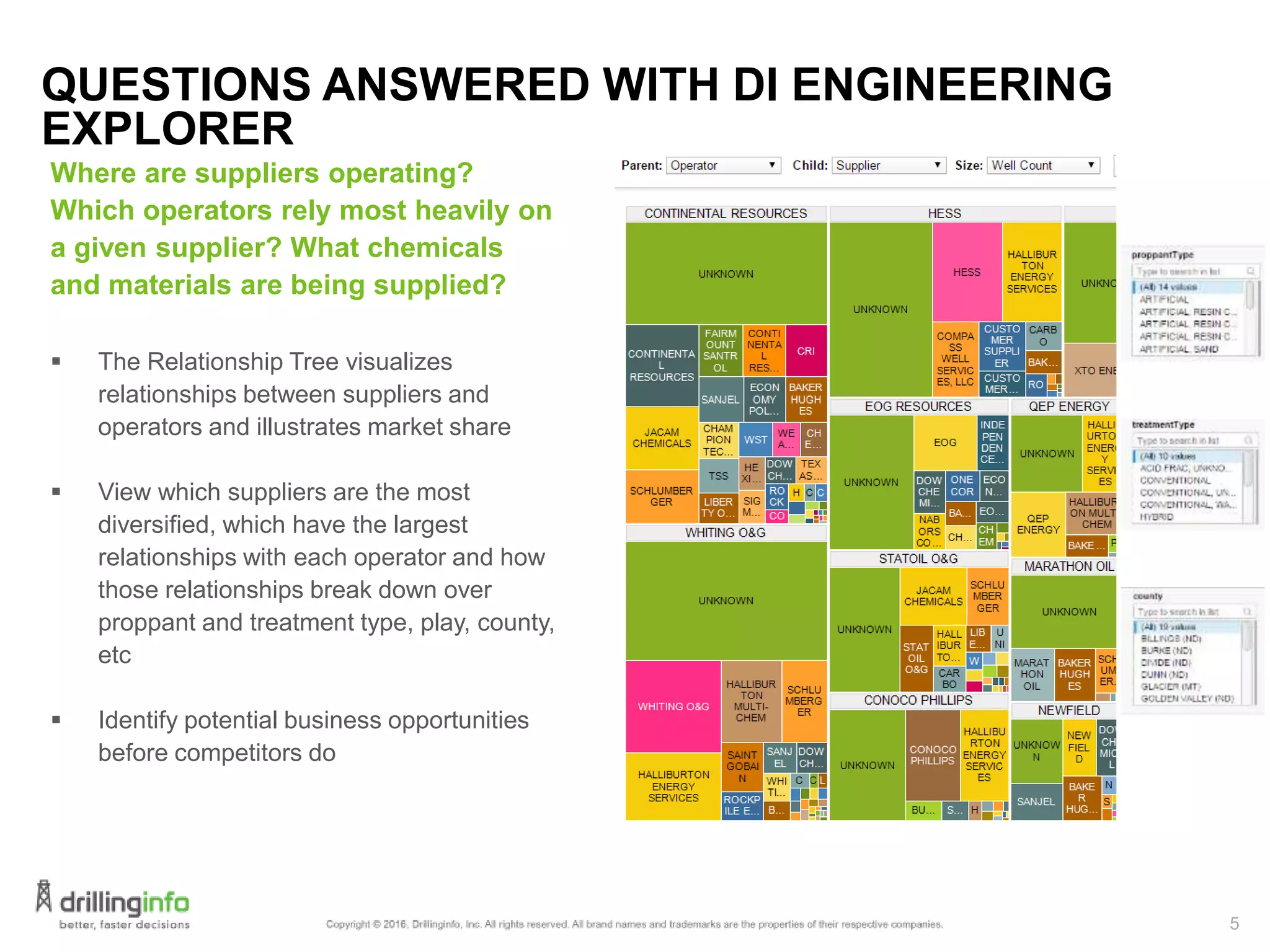
Where are suppliers operating?
Which operators rely most heavily on
a given supplier? What chemicals
and materials are being supplied?
 The Relationship Tree visualizes
relationships between suppliers and
operators and illustrates market share
 View which suppliers are the most
diversified, which have the largest
relationships with each operator and how
those relationships break down over
proppant and treatment type, play, county,
etc
 Identify potential business opportunities
before competitors do
6
QUESTIONS ANSWERED WITH DI ENGINEERING
EXPLORER
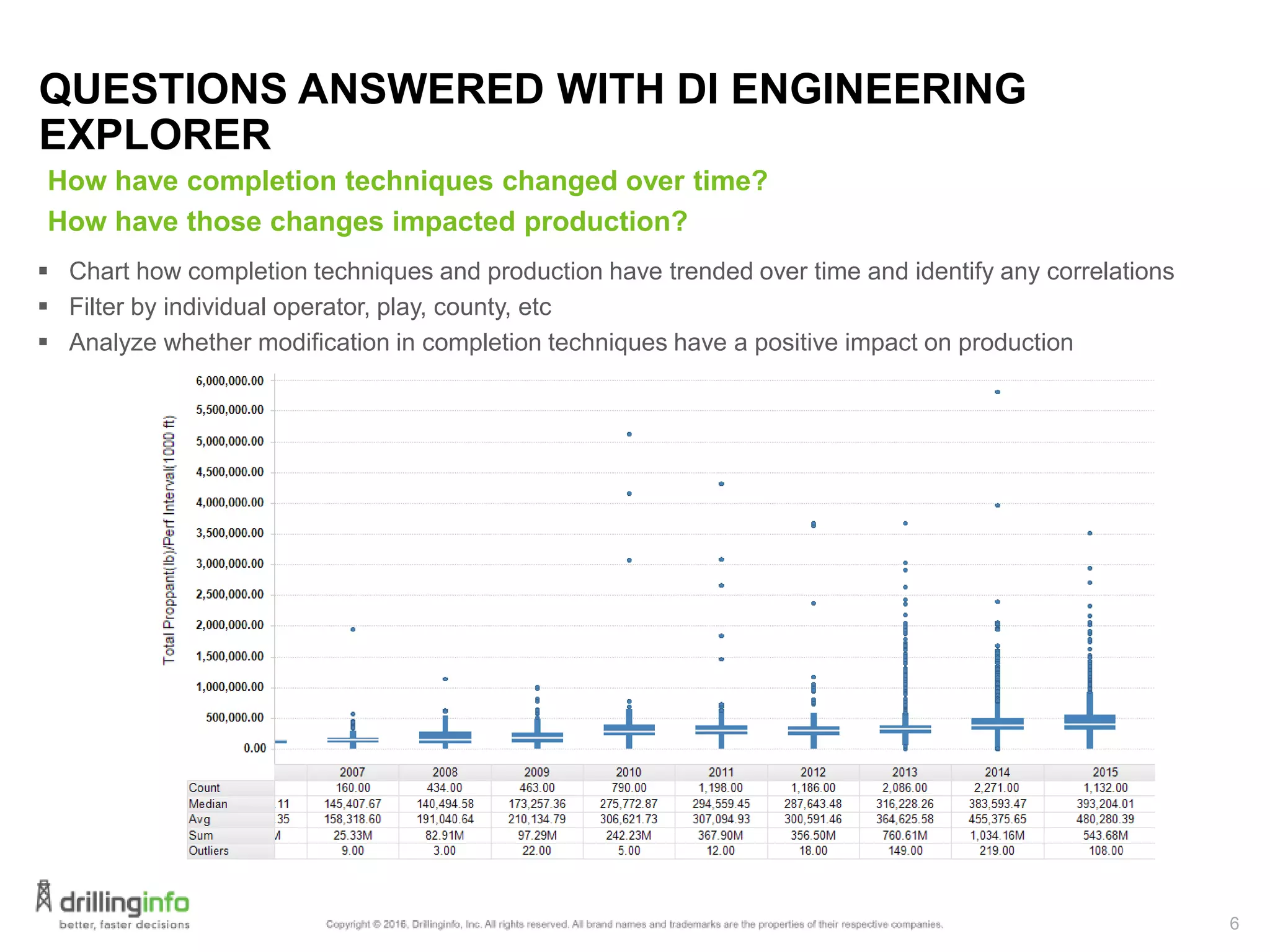
How have completion techniques changed over time?
How have those changes impacted production?
 Chart how completion techniques and production have trended over time and identify any correlations
 Filter by individual operator, play, county, etc
 Analyze whether modification in completion techniques have a positive impact on production
7
QUESTIONS ANSWERED WITH DI ENGINEERING
EXPLORER
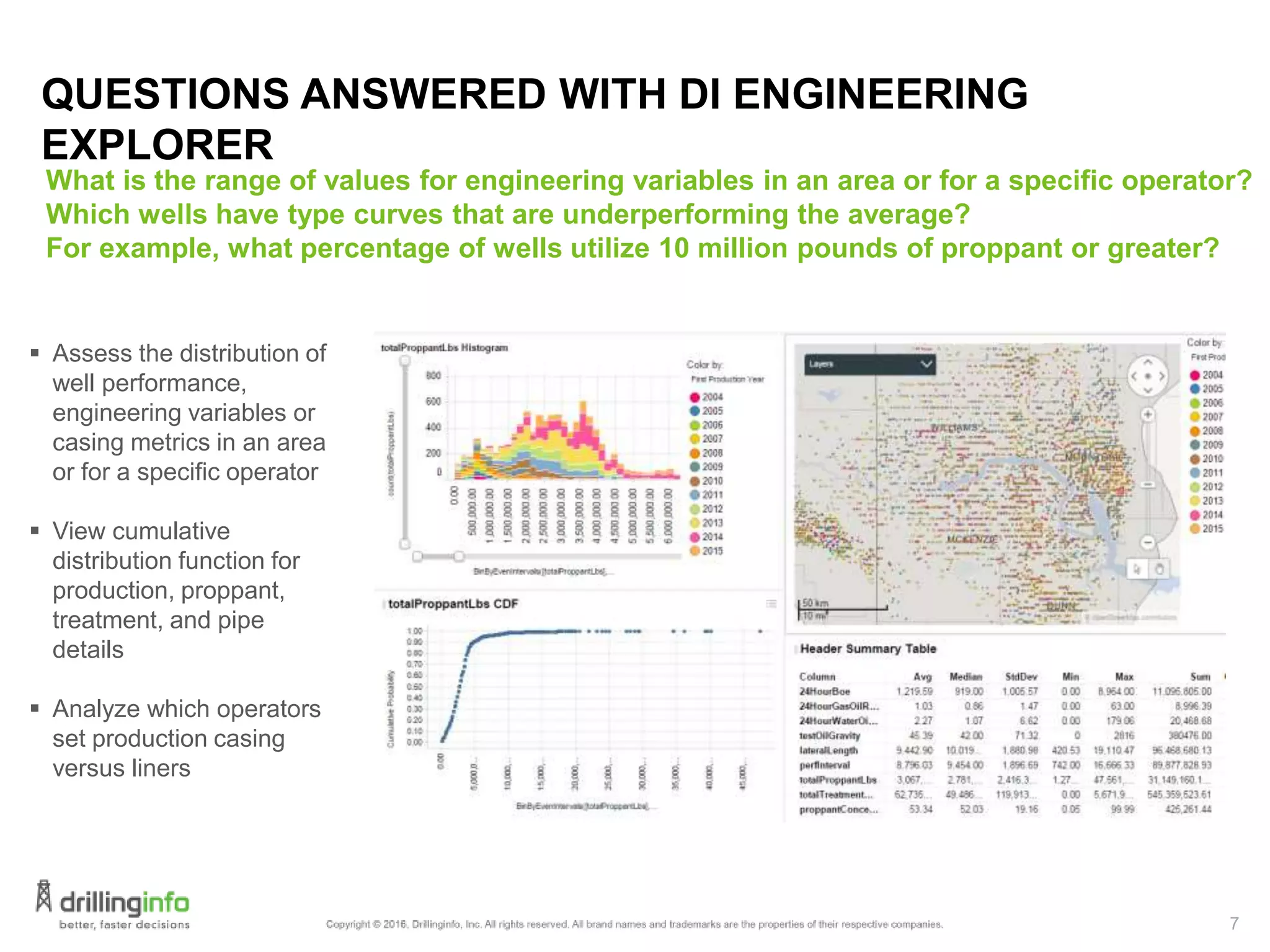
 Assess the distribution of
well performance,
engineering variables or
casing metrics in an area
or for a specific operator
 View cumulative
distribution function for
production, proppant,
treatment, and pipe
details
 Analyze which operators
set production casing
versus liners
What is the range of values for engineering variables in an area or for a specific operator?
Which wells have type curves that are underperforming the average?
For example, what percentage of wells utilize 10 million pounds of proppant or greater?
8
KEY HIGHLIGHTS
 Built in cooperation with
major multinational
operator
 Unbiased, third-party
information
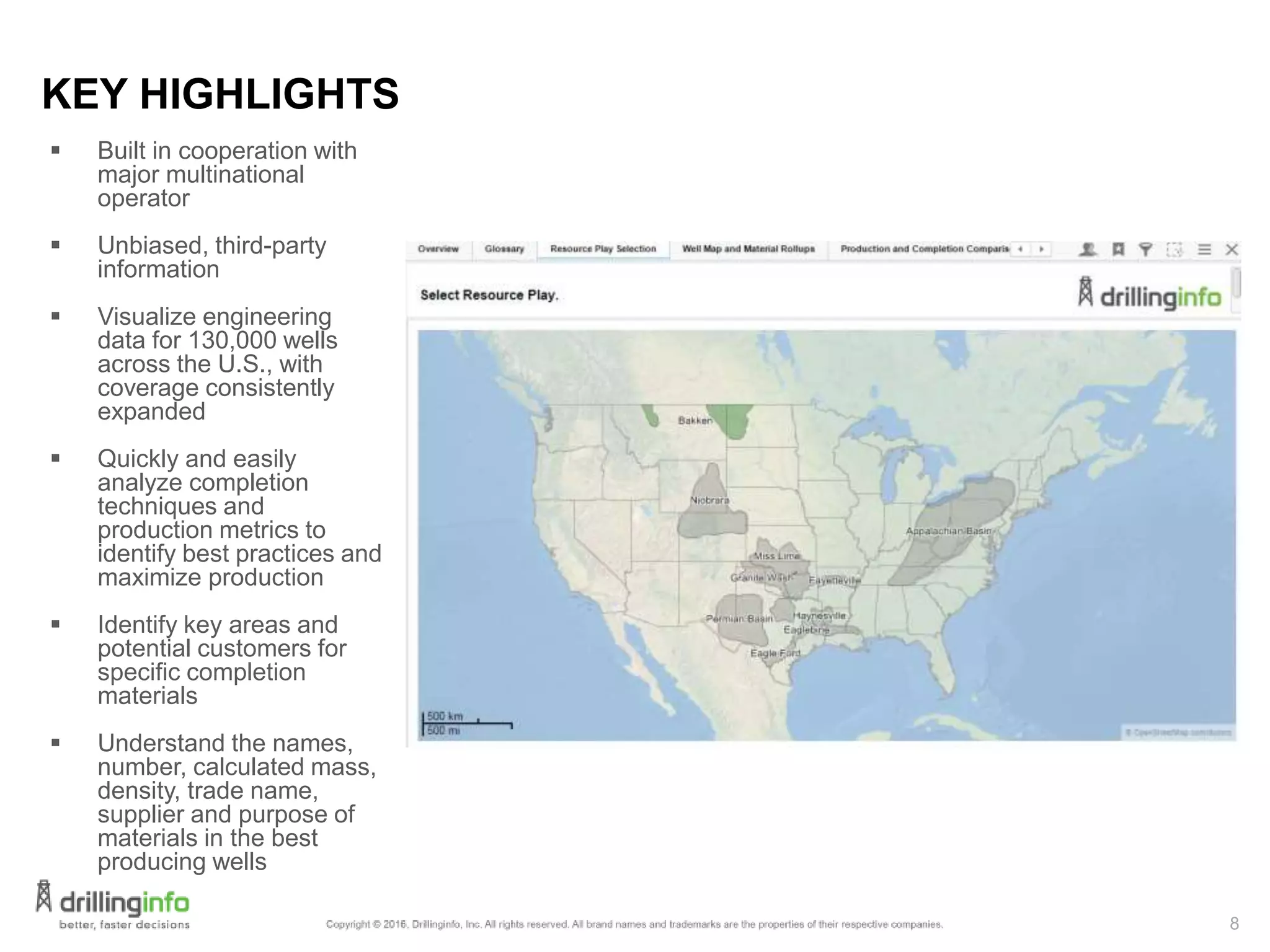
 Visualize engineering
data for 130,000 wells
across the U.S., with
coverage consistently
expanded
 Quickly and easily
analyze completion
techniques and
production metrics to
identify best practices and
maximize production
 Identify key areas and
potential customers for
specific completion
materials
 Understand the names,
number, calculated mass,
density, trade name,
supplier and purpose of
materials in the best
producing wells
9
Unbiased intelligence to find the best opportunities faster
DI ENGINEERING EXPLORER AT A GLANCE
 Save labor costs by leveraging up-to-date competitive intelligence to find
the most profitable opportunities
 Target business development efficiently around areas where
services/products/technologies are in greatest demand
 Identify competitors’ relative market share and their major customers
 Utilize dynamic, current data to find business opportunities before
competitors do
 Correlate completion design/technology to production to validate efficacy of
products and services
10
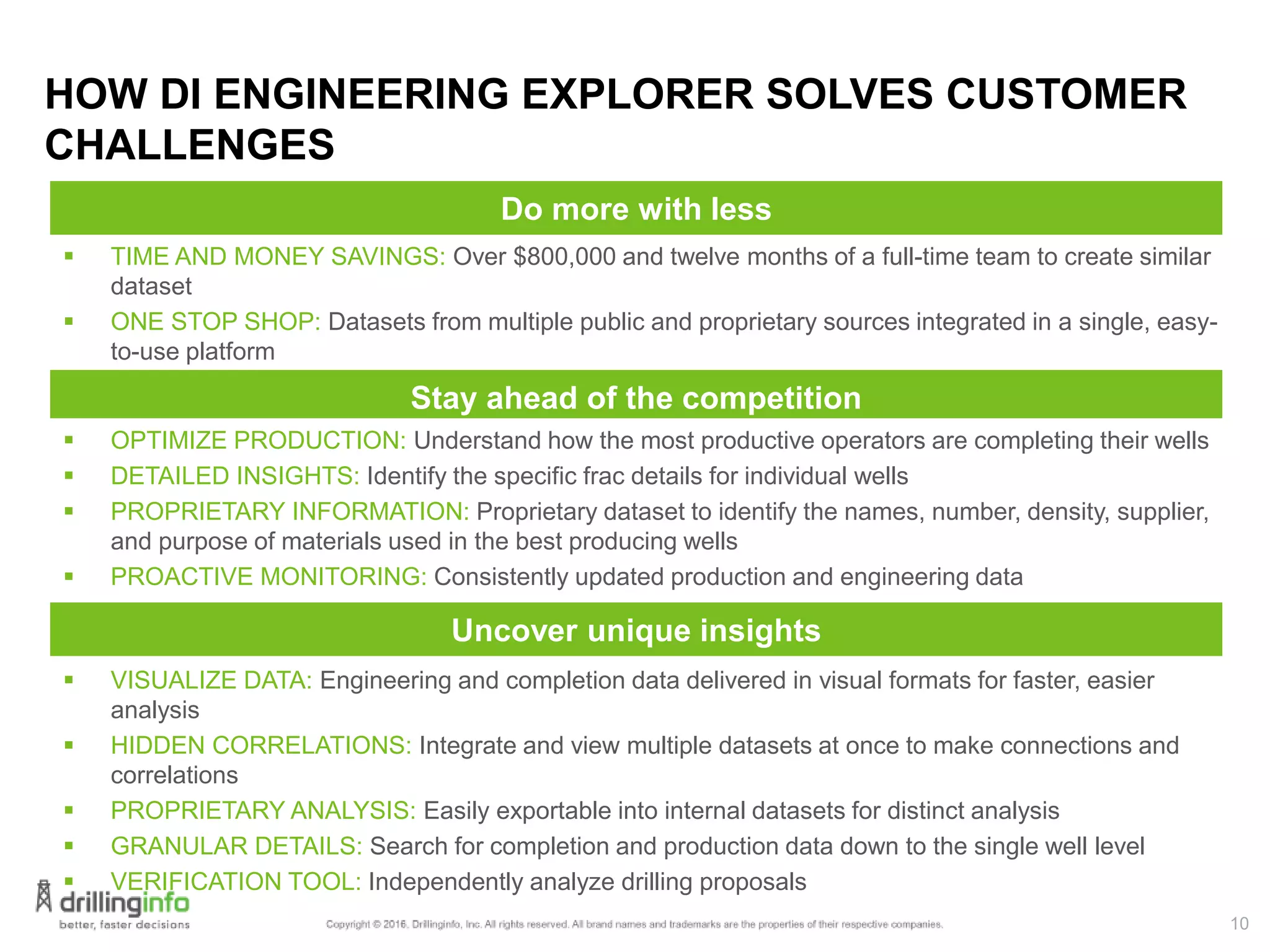
HOW DI ENGINEERING EXPLORER SOLVES CUSTOMER
CHALLENGES
Stay ahead of the competition
 OPTIMIZE PRODUCTION: Understand how the most productive operators are completing their wells
 DETAILED INSIGHTS: Identify the specific frac details for individual wells
 PROPRIETARY INFORMATION: Proprietary dataset to identify the names, number, density, supplier,
and purpose of materials used in the best producing wells
 PROACTIVE MONITORING: Consistently updated production and engineering data
Uncover unique insights
 VISUALIZE DATA: Engineering and completion data delivered in visual formats for faster, easier
analysis
 HIDDEN CORRELATIONS: Integrate and view multiple datasets at once to make connections and
correlations
 PROPRIETARY ANALYSIS: Easily exportable into internal datasets for distinct analysis
 GRANULAR DETAILS: Search for completion and production data down to the single well level
 VERIFICATION TOOL: Independently analyze drilling proposals
Do more with less
 TIME AND MONEY SAVINGS: Over $800,000 and twelve months of a full-time team to create similar
dataset
 ONE STOP SHOP: Datasets from multiple public and proprietary sources integrated in a single, easy-
to-use platform
11
FEATURES/BENEFITS: DI ENGINEERING EXPLORER
Feature Benefit
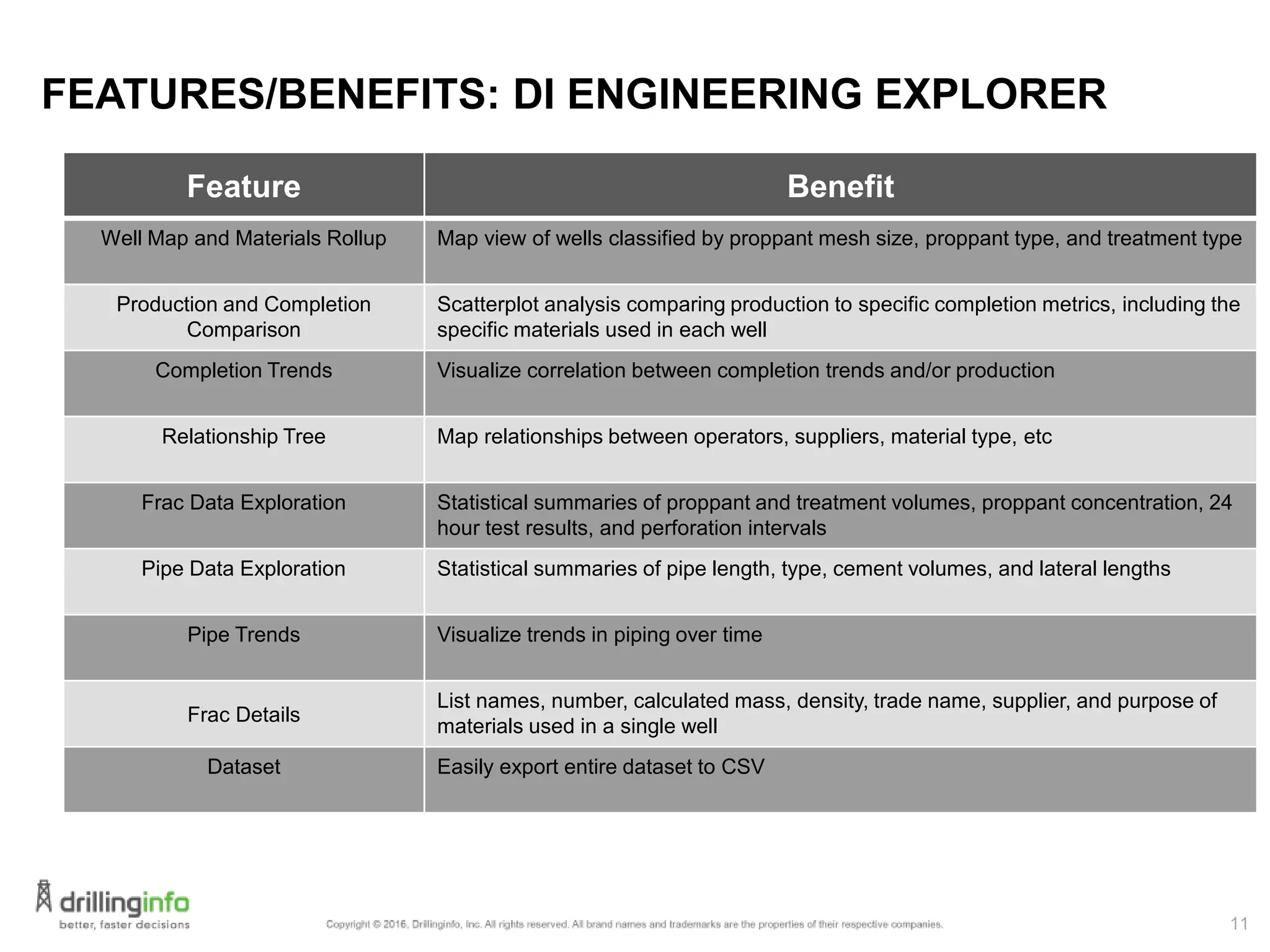
Well Map and Materials Rollup Map view of wells classified by proppant mesh size, proppant type, and treatment type
Production and Completion
Comparison
Scatterplot analysis comparing production to specific completion metrics, including the
specific materials used in each well
Completion Trends Visualize correlation between completion trends and/or production
Relationship Tree Map relationships between operators, suppliers, material type, etc
Frac Data Exploration Statistical summaries of proppant and treatment volumes, proppant concentration, 24
hour test results, and perforation intervals
Pipe Data Exploration Statistical summaries of pipe length, type, cement volumes, and lateral lengths
Pipe Trends Visualize trends in piping over time
Frac Details
List names, number, calculated mass, density, trade name, supplier, and purpose of
materials used in a single well
Dataset Easily export entire dataset to CSV
12
CONTINUOUS IMPROVEMENT MODEL
Drillinginfo consistently invests a substantial amount of our revenue in research and
development. Our reinvestment allows us to develop and deliver continuous
improvements to customers every day. Legacy competitors do not evolve and adapt
to market needs in this way.
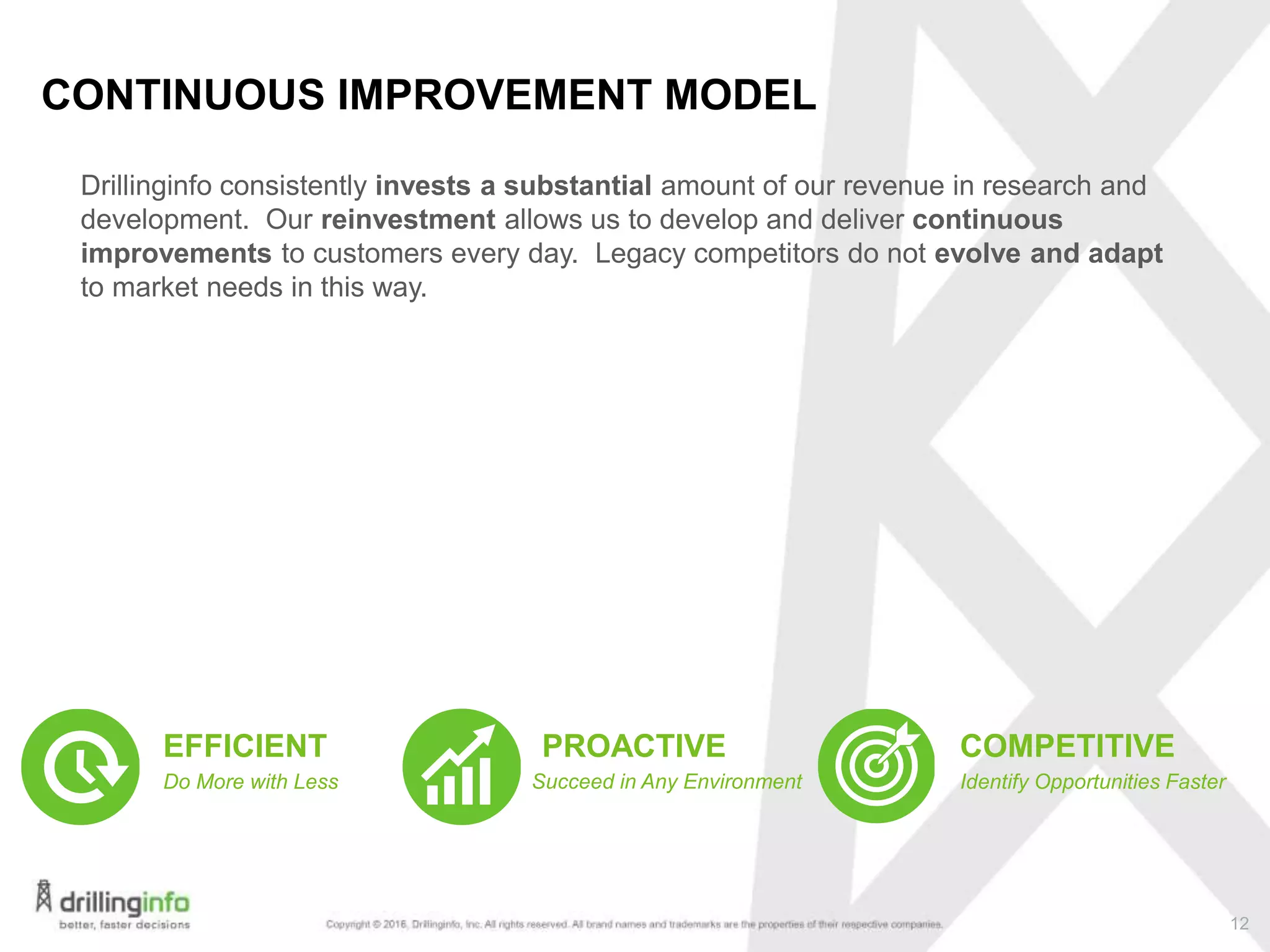
Do More with Less
EFFICIENT PROACTIVE
Identify Opportunities Faster
COMPETITIVE
Succeed in Any Environment
13
THANK YOU

Introduction to DI Engineering Explorer for Oilfield Services

  • 1.
    INTRODUCTION TO DI ENGINEERINGEXPLORER February 2016
  • 2.
    2 DI ENGINEERING EXPLORER:OVERVIEW DI Engineering Explorer is a proprietary tool allowing customers to visualize completion and production data. With well-level analysis and intelligence on over 130,000 wells, DI Engineering Explorer saves customers over $800,000 in up-front costs and over a year of man-hours. Find correlations between specific completion techniques and production, understand how the best producers are completing their wells, identify the names, number, calculated mass, density, trade name, supplier and purpose of materials in the best producing wells, and find the most profitable investment and business opportunities.
  • 3.
    3 PRODUCT OVERVIEW: DIENGINEERING EXPLORER  Analysis tool to easily search, visualize, and integrate proprietary engineering and production data  Completion data for 130,000 wells across 14 states  Visualize impact of completion techniques, equipment, and design on production metrics  View trends over time in frac designs by operator, play, and service provider  Data easily interpreted through scatterplots, statistical summaries, and charts  Exportable for unique analysis in internal datasets
  • 4.
    4 QUESTIONS ANSWERED WITHDI ENGINEERING EXPLORER What is the relationship between proppant volume and production?  Median lines divide well performance and completion metrics into quartiles  Identify proppant types used in the highest producing wells 6MonthcumBOE6:1per1,000ftperfinterval Dewitt, Karnes and Gonzales Counties, 2013-Present
  • 5.
    5 QUESTIONS ANSWERED WITHDI ENGINEERING EXPLORER Where are suppliers operating? Which operators rely most heavily on a given supplier? What chemicals and materials are being supplied?  The Relationship Tree visualizes relationships between suppliers and operators and illustrates market share  View which suppliers are the most diversified, which have the largest relationships with each operator and how those relationships break down over proppant and treatment type, play, county, etc  Identify potential business opportunities before competitors do
  • 6.
    6 QUESTIONS ANSWERED WITHDI ENGINEERING EXPLORER How have completion techniques changed over time? How have those changes impacted production?  Chart how completion techniques and production have trended over time and identify any correlations  Filter by individual operator, play, county, etc  Analyze whether modification in completion techniques have a positive impact on production
  • 7.
    7 QUESTIONS ANSWERED WITHDI ENGINEERING EXPLORER  Assess the distribution of well performance, engineering variables or casing metrics in an area or for a specific operator  View cumulative distribution function for production, proppant, treatment, and pipe details  Analyze which operators set production casing versus liners What is the range of values for engineering variables in an area or for a specific operator? Which wells have type curves that are underperforming the average? For example, what percentage of wells utilize 10 million pounds of proppant or greater?
  • 8.
    8 KEY HIGHLIGHTS  Builtin cooperation with major multinational operator  Unbiased, third-party information  Visualize engineering data for 130,000 wells across the U.S., with coverage consistently expanded  Quickly and easily analyze completion techniques and production metrics to identify best practices and maximize production  Identify key areas and potential customers for specific completion materials  Understand the names, number, calculated mass, density, trade name, supplier and purpose of materials in the best producing wells
  • 9.
    9 Unbiased intelligence tofind the best opportunities faster DI ENGINEERING EXPLORER AT A GLANCE  Save labor costs by leveraging up-to-date competitive intelligence to find the most profitable opportunities  Target business development efficiently around areas where services/products/technologies are in greatest demand  Identify competitors’ relative market share and their major customers  Utilize dynamic, current data to find business opportunities before competitors do  Correlate completion design/technology to production to validate efficacy of products and services
  • 10.
    10 HOW DI ENGINEERINGEXPLORER SOLVES CUSTOMER CHALLENGES Stay ahead of the competition  OPTIMIZE PRODUCTION: Understand how the most productive operators are completing their wells  DETAILED INSIGHTS: Identify the specific frac details for individual wells  PROPRIETARY INFORMATION: Proprietary dataset to identify the names, number, density, supplier, and purpose of materials used in the best producing wells  PROACTIVE MONITORING: Consistently updated production and engineering data Uncover unique insights  VISUALIZE DATA: Engineering and completion data delivered in visual formats for faster, easier analysis  HIDDEN CORRELATIONS: Integrate and view multiple datasets at once to make connections and correlations  PROPRIETARY ANALYSIS: Easily exportable into internal datasets for distinct analysis  GRANULAR DETAILS: Search for completion and production data down to the single well level  VERIFICATION TOOL: Independently analyze drilling proposals Do more with less  TIME AND MONEY SAVINGS: Over $800,000 and twelve months of a full-time team to create similar dataset  ONE STOP SHOP: Datasets from multiple public and proprietary sources integrated in a single, easy- to-use platform
  • 11.
    11 FEATURES/BENEFITS: DI ENGINEERINGEXPLORER Feature Benefit Well Map and Materials Rollup Map view of wells classified by proppant mesh size, proppant type, and treatment type Production and Completion Comparison Scatterplot analysis comparing production to specific completion metrics, including the specific materials used in each well Completion Trends Visualize correlation between completion trends and/or production Relationship Tree Map relationships between operators, suppliers, material type, etc Frac Data Exploration Statistical summaries of proppant and treatment volumes, proppant concentration, 24 hour test results, and perforation intervals Pipe Data Exploration Statistical summaries of pipe length, type, cement volumes, and lateral lengths Pipe Trends Visualize trends in piping over time Frac Details List names, number, calculated mass, density, trade name, supplier, and purpose of materials used in a single well Dataset Easily export entire dataset to CSV
  • 12.
    12 CONTINUOUS IMPROVEMENT MODEL Drillinginfoconsistently invests a substantial amount of our revenue in research and development. Our reinvestment allows us to develop and deliver continuous improvements to customers every day. Legacy competitors do not evolve and adapt to market needs in this way. Do More with Less EFFICIENT PROACTIVE Identify Opportunities Faster COMPETITIVE Succeed in Any Environment
  • 13.

Editor's Notes

  • #6 Diversification of drillers will indicate with drillers are most dependent on operators and vice versa. Use that info to predict how drillers or operators will be affected when partners downsize or stop business
  • #8 Add note about update status
  • #9 Add note about update status