ASET
Lecture 1
Introduction to Data
Communication
Module 1
ASET
Receiver
Sender
Message
Protocol
Rules
.
.
.
Rules
.
.
.
Protocol
Transmission Medium
Data Communication
• Data Communications are the exchange of data between two
devices via some form of transmission.
ASET
1. Message: data.
2. Sender: The device that send the message.
3. Receiver: The device that receive the message.
4. Transmission Medium: The physical path between
sender and receiver, the message travel.
5. Protocol: Protocol is a set of rules that governs data
communication. It represents an agreement between
the communicating devices. Without a protocol, two
devices may be connected but not communicating.
Components of Data Communication
ASET
Data Communication Characteristics
1. Delivery: The system must deliver data to the correct
destination.
2. Accuracy:
 Data delivered accurately.
 Altered data which left uncorrected are unusable.
3. Timelines:
The system must deliver data in timely manner without delay
(real-time).
ASET
Data Flow in Communication
• Simplex: one direction only.
• Always one side sender and another side
receiver.
Remote Control TV
ASET
Data Flow in Communication
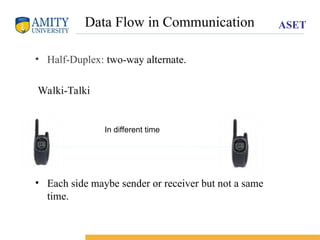
• Half-Duplex: two-way alternate.
Walki-Talki
• Each side maybe sender or receiver but not a same
time.
In different time
ASET
Data Flow in Communication
cont.
• Duplex: two-way concurrent.
Computer network
Mobile Network
• Each side sender and receiver at same time.
At same time
ASET
Network
 A Network is a set of node connect together by
communication link to sharing of resources and to transmit
information.
 Node: Computer, Printer, Scanner, Software , PDA, etc.
 Information: text, voice, picture, etc.
ASET
Network Services
 Sharing (file, printer, application).
 Internet browsing.
 Fax Service.
 Telephony.
 Conferencing.
 Database.
 Backup.
 Etc……..
ASET
Network Components
 Transmission media (wired, wireless ).
 Network Operating System (NOS).
 Network Interface Card (NIC).
 Network Hardware:-
1. Hubs.
2. Switches.
3. Routers.
4. Gateways.
5. Access Point.
6. Repeaters.
ASET
Network Classification
• Upon the transmission medium (type of connection):-
1. Point-to-point:
2. Multipoint:
ASET
Point-to-Point
• A pair of nodes connected together via dedicated link.
PC PC
Link
ASET
Multipoint
• Number of node connected and share a single link.
Server
PC
PC
PC
Link
ASET
Network Classification
Upon the scale (size):-
1. PAN (Personal Area Network).
2. LAN (Local Area Network).
3. CAN (Campus Area Network).
4. MAN (Metropolitan Area Network).
5. WAN (Wide Area Network).
ASET
PAN (Personal Area Network)
• PAN is a short-distance network design to individual user
(person).
• PAN may be contain:- printer, mobile, computer, wireless
printers , PDA, etc.
• components of PAN connected together via Bluetooth , USB
cable ,IrDA (infrared), etc.
ASET
PAN cont.
Wireless Printer
Bluetooth
IrDA
PDA
USB Cable
Scanner
ASET
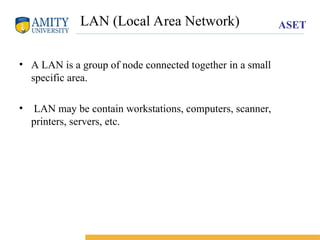
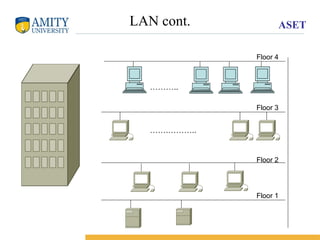
LAN (Local Area Network)
• A LAN is a group of node connected together in a small
specific area.
• LAN may be contain workstations, computers, scanner,
printers, servers, etc.
ASET
LAN cont.
………..
…….………..
Floor 1
Floor 2
Floor 3
Floor 4
ASET
CAN (Campus Area Network)
• A CAN is a group of interconnection LAN within limited
geographical area.
• A CAN using in school campus, military base, university
campus ,etc.
ASET
CAN cont.
ABS
University library
ASET
ASET
MAN (Metropolitan Area Network)
• A MAN is a large computer network uses to connect between
LAN in different location (cities).
• A MAN is a group of node connect together over city.
ASET
MAN cont.
LAN 1
CAN 4
LAN 3
LAN 2
Connect different branch
location in city
ASET
WAN (Wide Area Network)
• A WAN is a computer network that covers large geographical
area.
• WANs are used to connect types of networks together.
ASET
WAN cont.
ASET
WAN
MAN
CAN
LAN
PAN
ASET
Network Criteria
 A network must be able to meet a certain number of
criteria.
 The most important of these are Performance, Reliability,
and Security.
Data communication
network criteria
Performance Reliability Security
ASET
Performance:
 The performance of network depends on a number of
factors:
Number of users
Type of transmission medium
Hardware
Software.
 The performance is evaluate by two networking metric :
Throughput and Delay.
Network Criteria
ASET
Reliability:
The network reliability is measured by the frequency of failure,
(the time it takes a link to recover from of failure).
In addition to accuracy of delivery, network reliability is
measured by
1. Frequency of failure
2. Recovery time of a network after a failure
Network Criteria
ASET
Network Criteria cont.
• Security:
Network security include protecting data from unauthorized
access, protecting data from damage, and write policies and
implementing it for security issues.
ASET
Network Modes
• Unicast Mode : Single source send to single node.
one-to-one
one-to-one
ASET
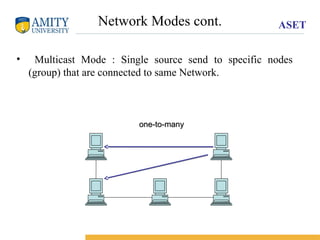
Network Modes cont.
• Multicast Mode : Single source send to specific nodes
(group) that are connected to same Network.
one-to-many
one-to-many
ASET
Network Modes cont.
 Broadcast Mode : Single source send to all others node that
are connected to same Network
one-to-all
one-to-all
ASET
Network Software
• Protocol Hierarchies
• Design Issues for the Layers
• Connection-Oriented and Connectionless Services
• Service Primitives
• The Relationship of Services to Protocols
ASET
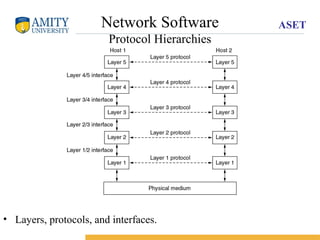
Network Software
Protocol Hierarchies
• Layers, protocols, and interfaces.
ASET
Design Issues for the Layers
• Addressing
• Error Control
• Flow Control
• Multiplexing
• Routing
ASET
Reference Models
• The OSI Reference Model
• The TCP/IP Reference Model
• A Comparison of OSI and TCP/IP
• A Critique of the OSI Model and Protocols
• A Critique of the TCP/IP Reference Model
ASET
OSI Reference Models
ASET
Reference Models (2)
• The TCP/IP reference model.
ASET
Hybrid Model
• The hybrid reference model .

introduction to data communication lecture