ADITYA COLLEGE OF ENGINEERING & TECHNOLOGY
Tuesday, May 5, 2020
CONTROL SYSTEMS
Presented by
Mrs. RAMA VASANTHA ADIRAJU
Sr.Asst.Professor
Department of Electronics and Communication Engineering
STAY SAFE
Time: 9:00 AM to 10.30 AMTopic
Introduction to Control Systems
II ECE- CONTROL SYSTEMS Mrs. RAMA VASANTHA ADIRAJU
Aditya College of Engineering & Technology
Tuesday, May 5, 2020
• Introduction
• Block diagram
• Types of Systems
• Open loop system
• Close Loop system
• Comparison of Systems
• Translational system
OVERVIEW OF PRESENTATION
II ECE- CONTROL SYSTEMS Mrs. RAMA VASANTHA ADIRAJU
Aditya College of Engineering & Technology
• Control system are an integral part of our lives and play very important role.
• From a simple bread toaster to complex power plant, control system are all
around us .
• Generally there are two types of control systems
• Man made CS
• Natural CS
INTRODUCTION
Tuesday, May 5, 2020
II ECE- CONTROL SYSTEMS Mrs. RAMA VASANTHA ADIRAJU
Aditya College of Engineering & Technology
Natural Made
Control systems
Tuesday, May 5, 2020
II ECE- CONTROL SYSTEMS Mrs. RAMA VASANTHA ADIRAJU
Aditya College of Engineering & Technology
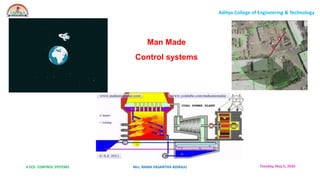
Man Made
Control systems
Tuesday, May 5, 2020
II ECE- CONTROL SYSTEMS Mrs. RAMA VASANTHA ADIRAJU
Aditya College of Engineering & Technology
• System: When number of elements connected in a sequence to perform a
particular task is called a system.
• Input quantity: is an excitation of the system
• Output quantity : is a response of the system
• Control System: when the output quantity is controlled by the input quantity is
called a control system
INTRODUCTION
Tuesday, May 5, 2020
II ECE- CONTROL SYSTEMS Mrs. RAMA VASANTHA ADIRAJU
Aditya College of Engineering & Technology
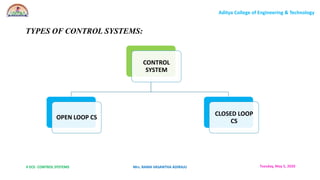
CONTROL
SYSTEM
OPEN LOOP CS
CLOSED LOOP
CS
TYPES OF CONTROL SYSTEMS:
Tuesday, May 5, 2020
II ECE- CONTROL SYSTEMS Mrs. RAMA VASANTHA ADIRAJU
Aditya College of Engineering & Technology
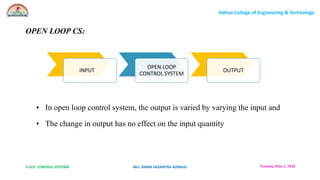
OPEN LOOP CS:
INPUT
OPEN LOOP
CONTROL SYSTEM
OUTPUT
• In open loop control system, the output is varied by varying the input and
• The change in output has no effect on the input quantity
Tuesday, May 5, 2020
II ECE- CONTROL SYSTEMS Mrs. RAMA VASANTHA ADIRAJU
Aditya College of Engineering & Technology
Tuesday, May 5, 2020
• Advantages
• Simple Construction & Design
• Economic
• Easy maintenance
• Stability
• Disadvantages
• unreliable
• Internal Disturbance
• Recalibration is required time to time
OPEN LOOP CS:
Applications
• In the traffic light controlling system
• TV remote control
• Iron box
• Simple Switch
II ECE- CONTROL SYSTEMS Mrs. RAMA VASANTHA ADIRAJU
Aditya College of Engineering & Technology
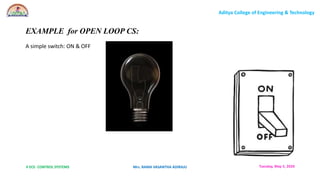
EXAMPLE for OPEN LOOP CS:
A simple switch: ON & OFF
Tuesday, May 5, 2020
II ECE- CONTROL SYSTEMS Mrs. RAMA VASANTHA ADIRAJU
Aditya College of Engineering & Technology
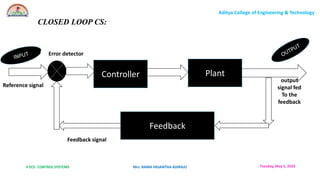
Controller Plant
Feedback
Error detector
CLOSED LOOP CS:
Feedback signal
output
signal fed
To the
feedback
Reference signal
Tuesday, May 5, 2020
II ECE- CONTROL SYSTEMS Mrs. RAMA VASANTHA ADIRAJU
Aditya College of Engineering & Technology
Tuesday, May 5, 2020
• Advantages
• More accurate
• Feedback
• More flexible
• Less affected to external disturbances
• Disadvantages
• Complex Construction & Design
• Expensive
• Difficult to maintenance
• UnStability
CLOSED LOOP CS:
Applications
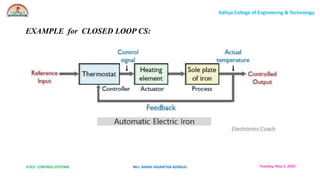
•Automatic Iron box
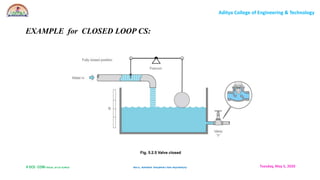
• Automatic water overflow control
•Temperature control system
II ECE- CONTROL SYSTEMS Mrs. RAMA VASANTHA ADIRAJU
Aditya College of Engineering & Technology
EXAMPLE for CLOSED LOOP CS:
Tuesday, May 5, 2020
II ECE- CONTROL SYSTEMS Mrs. RAMA VASANTHA ADIRAJU
Aditya College of Engineering & Technology
EXAMPLE for CLOSED LOOP CS:
Tuesday, May 5, 2020
II ECE- CONTROL SYSTEMS Mrs. RAMA VASANTHA ADIRAJU
Aditya College of Engineering & Technology
EXAMPLE for CLOSED LOOP CS:
Tuesday, May 5, 2020
II ECE- CONTROL SYSTEMS Mrs. RAMA VASANTHA ADIRAJU
Aditya College of Engineering & Technology
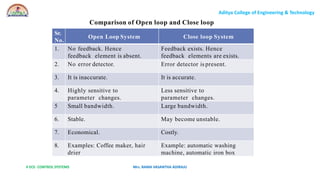
Comparison of Open loop and Close loop
systemSr.
No.
Open Loop System Close loop System
1. No feedback. Hence
feedback element is absent.
Feedback exists. Hence
feedback elements are exists.
2. No error detector. Error detector is present.
3. It is inaccurate. It is accurate.
4. Highly sensitive to
parameter changes.
Less sensitive to
parameter changes.
5 Small bandwidth. Large bandwidth.
6. Stable. May become unstable.
7. Economical. Costly.
8. Examples: Coffee maker, hair
drier
Example: automatic washing
machine, automatic iron box
II ECE- CONTROL SYSTEMS Mrs. RAMA VASANTHA ADIRAJU
Aditya College of Engineering & Technology
Learn about transfer function
Electric network
Translational mechanical system
Rotational mechanical system
TRANSTIONAL MECHNAICAL SYSTEM:
Tuesday, May 5, 2020
II ECE- CONTROL SYSTEMS Mrs. RAMA VASANTHA ADIRAJU
Aditya College of Engineering & Technology
Laplace transform review
Tuesday, May 5, 2020
II ECE- CONTROL SYSTEMS Mrs. RAMA VASANTHA ADIRAJU
Aditya College of Engineering & Technology
You are going to apply transfer function in three types of mathematical modeling.
Electric network
Translational mechanical system
Rotational mechanical system
Transfer function
Tuesday, May 5, 2020
II ECE- CONTROL SYSTEMS Mrs. RAMA VASANTHA ADIRAJU
Aditya College of Engineering & Technology
Electric Network Transfer Functions
Component
Voltage-
Current
Current-
voltage
Voltage-
charge
Impedance
Z(s)=
V(s)/I(s)
Admittance
Y(s)=
I(s)/V(s)
Tuesday, May 5, 2020
II ECE- CONTROL SYSTEMS Mrs. RAMA VASANTHA ADIRAJU
Aditya College of Engineering & Technology
Electric Network Transfer Functions
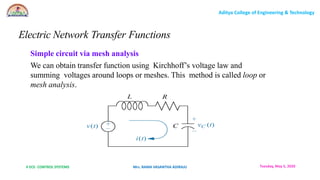
Simple circuit via mesh analysis
We can obtain transfer function using Kirchhoff’s voltage law and
summing voltages around loops or meshes. This method is called loop or
mesh analysis.
Tuesday, May 5, 2020
II ECE- CONTROL SYSTEMS Mrs. RAMA VASANTHA ADIRAJU
Aditya College of Engineering & Technology
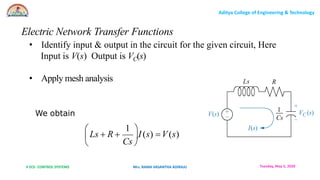
• Identify input & output in the circuit for the given circuit, Here
Input is V(s) Output is VC(s)
• Apply mesh analysis
We obtain
I(s) V(s)
Cs 
1 


Ls  R 
Electric Network Transfer Functions
Tuesday, May 5, 2020
II ECE- CONTROL SYSTEMS Mrs. RAMA VASANTHA ADIRAJU
Aditya College of Engineering & Technology
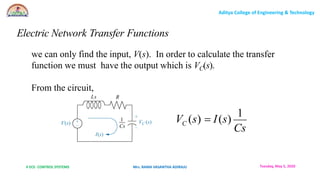
we can only find the input, V(s). In order to calculate the transfer
function we must have the output which is VC(s).
From the circuit,
Cs
CV (s)  I(s)
1
Electric Network Transfer Functions
Tuesday, May 5, 2020
II ECE- CONTROL SYSTEMS Mrs. RAMA VASANTHA ADIRAJU
Aditya College of Engineering & Technology
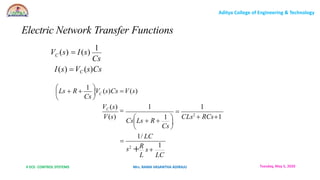
L LC
1/ LC
CLs2
 RCs1
Cs

V(s)
VC (s)

C
Cs

1
s2
R
s 
11





CsLs  R 
1 



Ls  R 
1 V (s)Cs V(s)
Cs
CV (s)  I(s)
1
I(s) VC (s)Cs
Electric Network Transfer Functions
Tuesday, May 5, 2020
II ECE- CONTROL SYSTEMS Mrs. RAMA VASANTHA ADIRAJU
Aditya College of Engineering & Technology
Cs
CV (s)  I(s)
1
I(s) VC (s)Cs
L LC
1/ LC
CLs2
 RCs1
Cs

V(s)
VC (s)

C
Cs

1
s2
R
s 
11





CsLs  R 
1 



Ls  R 
1 V (s)Cs V(s)
Cs
CV (s)  I(s)
1
I(s) VC (s)Cs
Electric Network Transfer Functions
Tuesday, May 5, 2020
II ECE- CONTROL SYSTEMS Mrs. RAMA VASANTHA ADIRAJU
Aditya College of Engineering & Technology
Electric Network Transfer Functions
We can also present our answer in block diagram
Tuesday, May 5, 2020
II ECE- CONTROL SYSTEMS Mrs. RAMA VASANTHA ADIRAJU
Aditya College of Engineering & Technology
Electric Network Transfer Functions
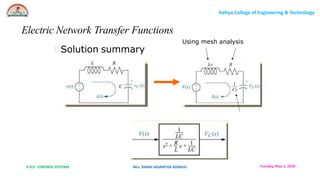
Solution summary
Using mesh analysis
Tuesday, May 5, 2020
II ECE- CONTROL SYSTEMS Mrs. RAMA VASANTHA ADIRAJU
Aditya College of Engineering & Technology
Electric Network Transfer Functions
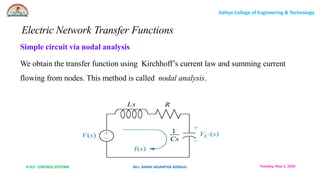
Simple circuit via nodal analysis
We obtain the transfer function using Kirchhoff’s current law and summing current
flowing from nodes. This method is called nodal analysis.
Tuesday, May 5, 2020
II ECE- CONTROL SYSTEMS Mrs. RAMA VASANTHA ADIRAJU
Aditya College of Engineering & Technology
Electric Network Transfer Functions
Solution:
We will look at the current flowing in and out of the node whose voltage is VC(s). We
assume the current leaving the node is positive and current entering the node is
negative.
L LC
R Ls
VC (s)

V sVC s
1/ Cs R Ls
VC (s)

V sVC s0
1/ Cs
VC (s)

1/ LC
1V(s) s2
R
s 
Tuesday, May 5, 2020
II ECE- CONTROL SYSTEMS Mrs. RAMA VASANTHA ADIRAJU
Aditya College of Engineering & Technology
STAY SAFE
STAY AT HOME
HAPPY LEARNING
Tuesday, May 5, 2020

Introduction to control system( open loop & closed loop system)

  • 1.
    ADITYA COLLEGE OFENGINEERING & TECHNOLOGY Tuesday, May 5, 2020 CONTROL SYSTEMS Presented by Mrs. RAMA VASANTHA ADIRAJU Sr.Asst.Professor Department of Electronics and Communication Engineering STAY SAFE Time: 9:00 AM to 10.30 AMTopic Introduction to Control Systems
  • 2.
    II ECE- CONTROLSYSTEMS Mrs. RAMA VASANTHA ADIRAJU Aditya College of Engineering & Technology Tuesday, May 5, 2020 • Introduction • Block diagram • Types of Systems • Open loop system • Close Loop system • Comparison of Systems • Translational system OVERVIEW OF PRESENTATION
  • 3.
    II ECE- CONTROLSYSTEMS Mrs. RAMA VASANTHA ADIRAJU Aditya College of Engineering & Technology • Control system are an integral part of our lives and play very important role. • From a simple bread toaster to complex power plant, control system are all around us . • Generally there are two types of control systems • Man made CS • Natural CS INTRODUCTION Tuesday, May 5, 2020
  • 4.
    II ECE- CONTROLSYSTEMS Mrs. RAMA VASANTHA ADIRAJU Aditya College of Engineering & Technology Natural Made Control systems Tuesday, May 5, 2020
  • 5.
    II ECE- CONTROLSYSTEMS Mrs. RAMA VASANTHA ADIRAJU Aditya College of Engineering & Technology Man Made Control systems Tuesday, May 5, 2020
  • 6.
    II ECE- CONTROLSYSTEMS Mrs. RAMA VASANTHA ADIRAJU Aditya College of Engineering & Technology • System: When number of elements connected in a sequence to perform a particular task is called a system. • Input quantity: is an excitation of the system • Output quantity : is a response of the system • Control System: when the output quantity is controlled by the input quantity is called a control system INTRODUCTION Tuesday, May 5, 2020
  • 7.
    II ECE- CONTROLSYSTEMS Mrs. RAMA VASANTHA ADIRAJU Aditya College of Engineering & Technology CONTROL SYSTEM OPEN LOOP CS CLOSED LOOP CS TYPES OF CONTROL SYSTEMS: Tuesday, May 5, 2020
  • 8.
    II ECE- CONTROLSYSTEMS Mrs. RAMA VASANTHA ADIRAJU Aditya College of Engineering & Technology OPEN LOOP CS: INPUT OPEN LOOP CONTROL SYSTEM OUTPUT • In open loop control system, the output is varied by varying the input and • The change in output has no effect on the input quantity Tuesday, May 5, 2020
  • 9.
    II ECE- CONTROLSYSTEMS Mrs. RAMA VASANTHA ADIRAJU Aditya College of Engineering & Technology Tuesday, May 5, 2020 • Advantages • Simple Construction & Design • Economic • Easy maintenance • Stability • Disadvantages • unreliable • Internal Disturbance • Recalibration is required time to time OPEN LOOP CS: Applications • In the traffic light controlling system • TV remote control • Iron box • Simple Switch
  • 10.
    II ECE- CONTROLSYSTEMS Mrs. RAMA VASANTHA ADIRAJU Aditya College of Engineering & Technology EXAMPLE for OPEN LOOP CS: A simple switch: ON & OFF Tuesday, May 5, 2020
  • 12.
    II ECE- CONTROLSYSTEMS Mrs. RAMA VASANTHA ADIRAJU Aditya College of Engineering & Technology Controller Plant Feedback Error detector CLOSED LOOP CS: Feedback signal output signal fed To the feedback Reference signal Tuesday, May 5, 2020
  • 13.
    II ECE- CONTROLSYSTEMS Mrs. RAMA VASANTHA ADIRAJU Aditya College of Engineering & Technology Tuesday, May 5, 2020 • Advantages • More accurate • Feedback • More flexible • Less affected to external disturbances • Disadvantages • Complex Construction & Design • Expensive • Difficult to maintenance • UnStability CLOSED LOOP CS: Applications •Automatic Iron box • Automatic water overflow control •Temperature control system
  • 14.
    II ECE- CONTROLSYSTEMS Mrs. RAMA VASANTHA ADIRAJU Aditya College of Engineering & Technology EXAMPLE for CLOSED LOOP CS: Tuesday, May 5, 2020
  • 15.
    II ECE- CONTROLSYSTEMS Mrs. RAMA VASANTHA ADIRAJU Aditya College of Engineering & Technology EXAMPLE for CLOSED LOOP CS: Tuesday, May 5, 2020
  • 16.
    II ECE- CONTROLSYSTEMS Mrs. RAMA VASANTHA ADIRAJU Aditya College of Engineering & Technology EXAMPLE for CLOSED LOOP CS: Tuesday, May 5, 2020
  • 17.
    II ECE- CONTROLSYSTEMS Mrs. RAMA VASANTHA ADIRAJU Aditya College of Engineering & Technology Comparison of Open loop and Close loop systemSr. No. Open Loop System Close loop System 1. No feedback. Hence feedback element is absent. Feedback exists. Hence feedback elements are exists. 2. No error detector. Error detector is present. 3. It is inaccurate. It is accurate. 4. Highly sensitive to parameter changes. Less sensitive to parameter changes. 5 Small bandwidth. Large bandwidth. 6. Stable. May become unstable. 7. Economical. Costly. 8. Examples: Coffee maker, hair drier Example: automatic washing machine, automatic iron box
  • 18.
    II ECE- CONTROLSYSTEMS Mrs. RAMA VASANTHA ADIRAJU Aditya College of Engineering & Technology Learn about transfer function Electric network Translational mechanical system Rotational mechanical system TRANSTIONAL MECHNAICAL SYSTEM: Tuesday, May 5, 2020
  • 19.
    II ECE- CONTROLSYSTEMS Mrs. RAMA VASANTHA ADIRAJU Aditya College of Engineering & Technology Laplace transform review Tuesday, May 5, 2020
  • 20.
    II ECE- CONTROLSYSTEMS Mrs. RAMA VASANTHA ADIRAJU Aditya College of Engineering & Technology You are going to apply transfer function in three types of mathematical modeling. Electric network Translational mechanical system Rotational mechanical system Transfer function Tuesday, May 5, 2020
  • 21.
    II ECE- CONTROLSYSTEMS Mrs. RAMA VASANTHA ADIRAJU Aditya College of Engineering & Technology Electric Network Transfer Functions Component Voltage- Current Current- voltage Voltage- charge Impedance Z(s)= V(s)/I(s) Admittance Y(s)= I(s)/V(s) Tuesday, May 5, 2020
  • 22.
    II ECE- CONTROLSYSTEMS Mrs. RAMA VASANTHA ADIRAJU Aditya College of Engineering & Technology Electric Network Transfer Functions Simple circuit via mesh analysis We can obtain transfer function using Kirchhoff’s voltage law and summing voltages around loops or meshes. This method is called loop or mesh analysis. Tuesday, May 5, 2020
  • 23.
    II ECE- CONTROLSYSTEMS Mrs. RAMA VASANTHA ADIRAJU Aditya College of Engineering & Technology • Identify input & output in the circuit for the given circuit, Here Input is V(s) Output is VC(s) • Apply mesh analysis We obtain I(s) V(s) Cs  1    Ls  R  Electric Network Transfer Functions Tuesday, May 5, 2020
  • 24.
    II ECE- CONTROLSYSTEMS Mrs. RAMA VASANTHA ADIRAJU Aditya College of Engineering & Technology we can only find the input, V(s). In order to calculate the transfer function we must have the output which is VC(s). From the circuit, Cs CV (s)  I(s) 1 Electric Network Transfer Functions Tuesday, May 5, 2020
  • 25.
    II ECE- CONTROLSYSTEMS Mrs. RAMA VASANTHA ADIRAJU Aditya College of Engineering & Technology L LC 1/ LC CLs2  RCs1 Cs  V(s) VC (s)  C Cs  1 s2 R s  11      CsLs  R  1     Ls  R  1 V (s)Cs V(s) Cs CV (s)  I(s) 1 I(s) VC (s)Cs Electric Network Transfer Functions Tuesday, May 5, 2020
  • 26.
    II ECE- CONTROLSYSTEMS Mrs. RAMA VASANTHA ADIRAJU Aditya College of Engineering & Technology Cs CV (s)  I(s) 1 I(s) VC (s)Cs L LC 1/ LC CLs2  RCs1 Cs  V(s) VC (s)  C Cs  1 s2 R s  11      CsLs  R  1     Ls  R  1 V (s)Cs V(s) Cs CV (s)  I(s) 1 I(s) VC (s)Cs Electric Network Transfer Functions Tuesday, May 5, 2020
  • 27.
    II ECE- CONTROLSYSTEMS Mrs. RAMA VASANTHA ADIRAJU Aditya College of Engineering & Technology Electric Network Transfer Functions We can also present our answer in block diagram Tuesday, May 5, 2020
  • 28.
    II ECE- CONTROLSYSTEMS Mrs. RAMA VASANTHA ADIRAJU Aditya College of Engineering & Technology Electric Network Transfer Functions Solution summary Using mesh analysis Tuesday, May 5, 2020
  • 29.
    II ECE- CONTROLSYSTEMS Mrs. RAMA VASANTHA ADIRAJU Aditya College of Engineering & Technology Electric Network Transfer Functions Simple circuit via nodal analysis We obtain the transfer function using Kirchhoff’s current law and summing current flowing from nodes. This method is called nodal analysis. Tuesday, May 5, 2020
  • 30.
    II ECE- CONTROLSYSTEMS Mrs. RAMA VASANTHA ADIRAJU Aditya College of Engineering & Technology Electric Network Transfer Functions Solution: We will look at the current flowing in and out of the node whose voltage is VC(s). We assume the current leaving the node is positive and current entering the node is negative. L LC R Ls VC (s)  V sVC s 1/ Cs R Ls VC (s)  V sVC s0 1/ Cs VC (s)  1/ LC 1V(s) s2 R s  Tuesday, May 5, 2020
  • 31.
    II ECE- CONTROLSYSTEMS Mrs. RAMA VASANTHA ADIRAJU Aditya College of Engineering & Technology STAY SAFE STAY AT HOME HAPPY LEARNING Tuesday, May 5, 2020