Introduction to
Concurrent Programming
CS4532 Concurrent Programming
Dilum Bandara
Dilum.Bandara@uom.lk
Slides adapted from “The Art of Multiprocessor Programming”
by Maurice Herlihy & Nir Shavit Slightly, & Dr. Srinath Perera
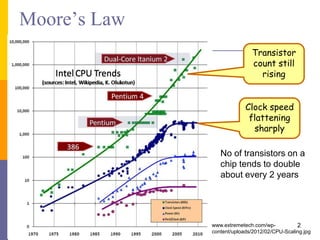
Moore’s Law
2
No of transistors on a
chip tends to double
about every 2 years
Transistor
count still
rising
Clock speed
flattening
sharply
www.extremetech.com/wp-
content/uploads/2012/02/CPU-Scaling.jpg
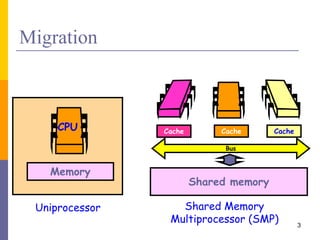
Migration
Memory
CPU
3
Uniprocessor Shared Memory
Multiprocessor (SMP)
Cache
Bus
Shared memory
Cache
Cache
Why Do We Care?
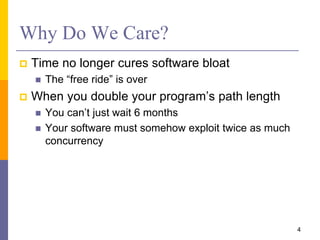
 Time no longer cures software bloat
 The “free ride” is over
 When you double your program’s path length
 You can’t just wait 6 months
 Your software must somehow exploit twice as much
concurrency
4
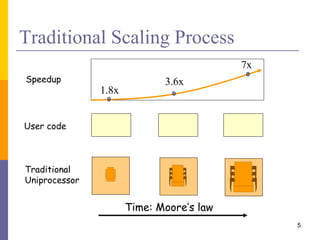
Traditional Scaling Process
5
User code
Traditional
Uniprocessor
Speedup
1.8x
7x
3.6x
Time: Moore’s law
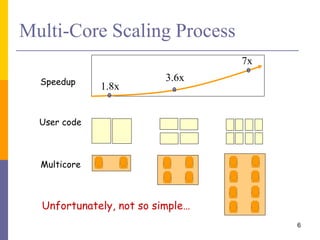
Multi-Core Scaling Process
6
User code
Multicore
Speedup
1.8x
7x
3.6x
Unfortunately, not so simple…
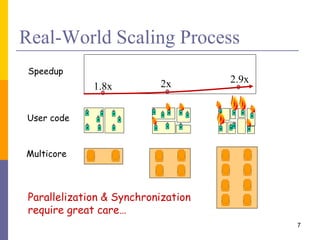
Real-World Scaling Process
7
1.8x 2x 2.9x
User code
Multicore
Speedup
Parallelization & Synchronization
require great care…
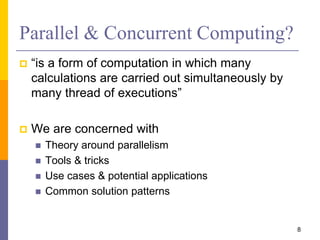
Parallel & Concurrent Computing?
 “is a form of computation in which many
calculations are carried out simultaneously by
many thread of executions”
 We are concerned with
 Theory around parallelism
 Tools & tricks
 Use cases & potential applications
 Common solution patterns
8
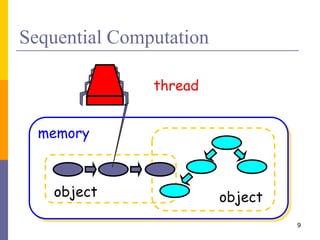
Sequential Computation
9
memory
object object
thread
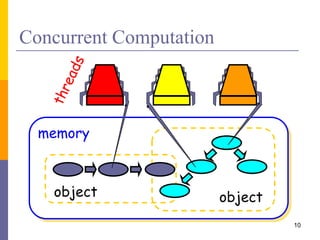
Concurrent Computation
10
memory
object object
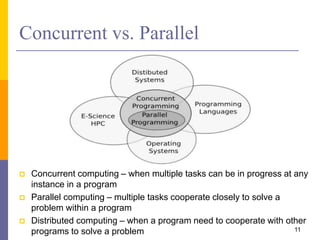
Concurrent vs. Parallel
 Concurrent computing – when multiple tasks can be in progress at any
instance in a program
 Parallel computing – multiple tasks cooperate closely to solve a
problem within a program
 Distributed computing – when a program need to cooperate with other
programs to solve a problem 11
Asynchrony
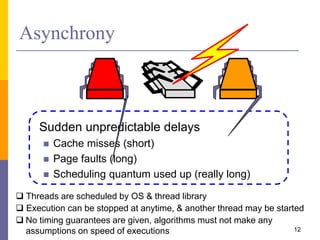
Sudden unpredictable delays
 Cache misses (short)
 Page faults (long)
 Scheduling quantum used up (really long)
12
 Threads are scheduled by OS & thread library
 Execution can be stopped at anytime, & another thread may be started
 No timing guarantees are given, algorithms must not make any
assumptions on speed of executions
Why Parallel/Concurrent Computing?
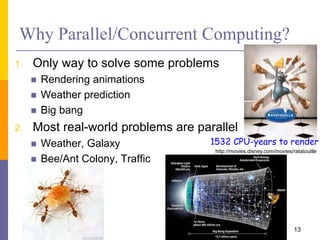
1. Only way to solve some problems
 Rendering animations
 Weather prediction
 Big bang
2. Most real-world problems are parallel
 Weather, Galaxy
 Bee/Ant Colony, Traffic
13
http://movies.disney.com/movies/ratatouille
1532 CPU-years to render
Why Parallel/Concurrent Computing?
3. To fully utilize your computer
 Computer often spend time waiting on I/O, which
takes much more time than CPU processing
 Unless application is number crunching, which is
often not the case, parallelism can give lots of gains
4. To make use of the cloud
 Cloud going to place 100’s to 1000’s of machines on
normal people’s finger tips
 Do you know how to use them?
 Solution is parallel computing
14
Flynn’s Taxonomy
 SISD
 Normal sequential programs
 Uniprocessor
 SIMD
 Data parallelism
 GPUs & vector processors
 MISD
 Fault tolerant schemes
 MIMD
 Most parallel programs
 Multi-core
I – instruction, D – data, S – Single, M - Multiple 15
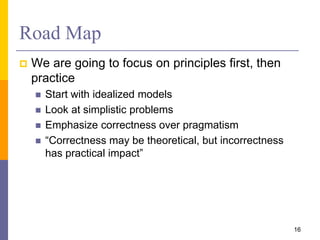
Road Map
 We are going to focus on principles first, then
practice
 Start with idealized models
 Look at simplistic problems
 Emphasize correctness over pragmatism
 “Correctness may be theoretical, but incorrectness
has practical impact”
16
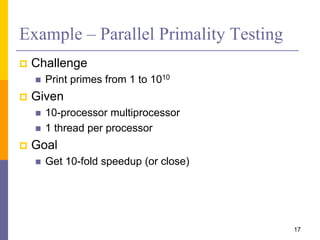
Example – Parallel Primality Testing
 Challenge
 Print primes from 1 to 1010
 Given
 10-processor multiprocessor
 1 thread per processor
 Goal
 Get 10-fold speedup (or close)
17
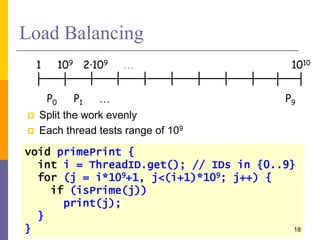
void primePrint {
int i = ThreadID.get(); // IDs in {0..9}
for (j = i*109+1, j<(i+1)*109; j++) {
if (isPrime(j))
print(j);
}
}
Load Balancing
 Split the work evenly
 Each thread tests range of 109
18
…
…
109 1010
2·109
1
P0 P1 P9
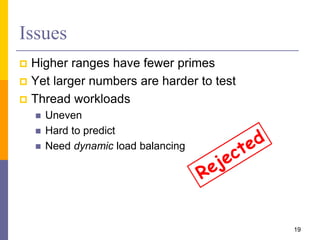
Issues
 Higher ranges have fewer primes
 Yet larger numbers are harder to test
 Thread workloads
 Uneven
 Hard to predict
 Need dynamic load balancing
19
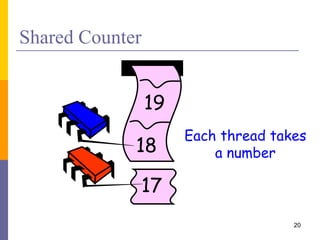
Shared Counter
20
17
18
19
Each thread takes
a number
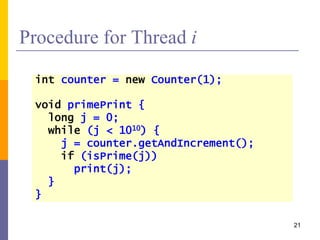
Procedure for Thread i
21
int counter = new Counter(1);
void primePrint {
long j = 0;
while (j < 1010) {
j = counter.getAndIncrement();
if (isPrime(j))
print(j);
}
}
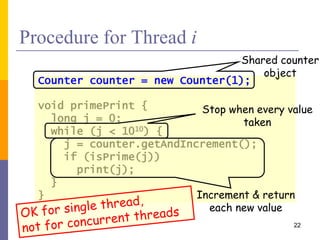
Procedure for Thread i
22
Counter counter = new Counter(1);
void primePrint {
long j = 0;
while (j < 1010) {
j = counter.getAndIncrement();
if (isPrime(j))
print(j);
}
}
Shared counter
object
Stop when every value
taken
Increment & return
each new value
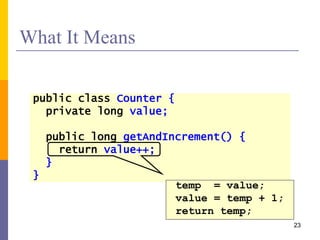
What It Means
23
public class Counter {
private long value;
public long getAndIncrement() {
return value++;
}
}
temp = value;
value = temp + 1;
return temp;
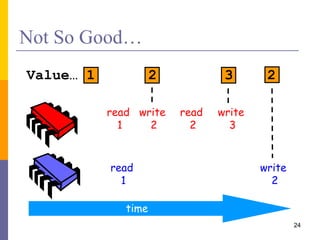
Not So Good…
24
time
Value… 1
read
1
read
1
write
2
read
2
write
3
write
2
2 3 2
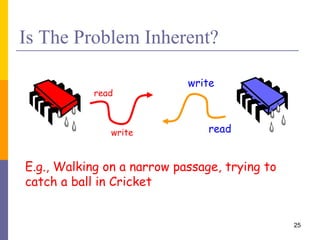
Is The Problem Inherent?
25
E.g., Walking on a narrow passage, trying to
catch a ball in Cricket
read
write read
write
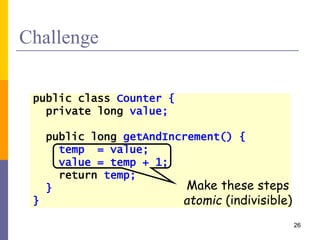
Challenge
26
public class Counter {
private long value;
public long getAndIncrement() {
temp = value;
value = temp + 1;
return temp;
}
}
Make these steps
atomic (indivisible)
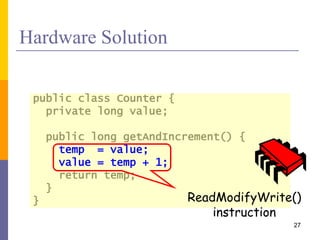
Hardware Solution
27
public class Counter {
private long value;
public long getAndIncrement() {
temp = value;
value = temp + 1;
return temp;
}
} ReadModifyWrite()
instruction
An Aside: Java™
28
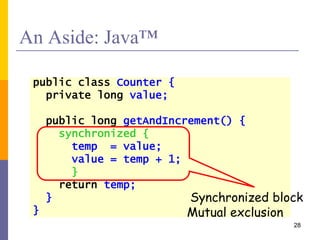
public class Counter {
private long value;
public long getAndIncrement() {
synchronized {
temp = value;
value = temp + 1;
}
return temp;
}
}
Synchronized block
Mutual exclusion
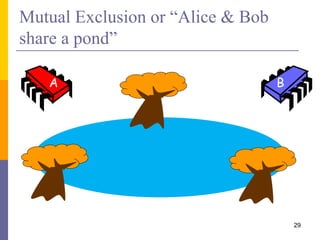
Mutual Exclusion or “Alice & Bob
share a pond”
29
A B
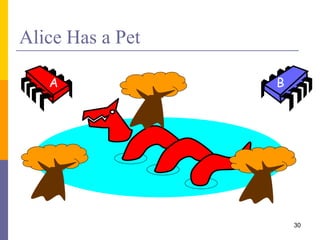
Alice Has a Pet
30
A B
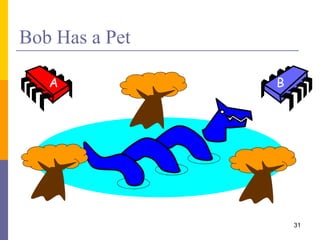
Bob Has a Pet
31
A B
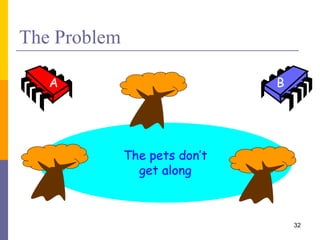
The Problem
32
A B
The pets don’t
get along
Formalizing the Problem
 2 types of formal properties in asynchronous
computation
 Safety Properties
 Nothing bad happens ever
 Consistency
 Liveness Properties
 Something good happens eventually
 No deadlock, starvation
 Efficiency is also important
 You have to look at your solution for those
properties, & you will be graded on that
33
Formalizing our Problem
 Mutual Exclusion
 Both pets never in pond simultaneously
 This is a safety property
 No Deadlock
 If only 1 wants in, it gets in
 If both want in, 1 gets in
 This is a liveness property
 How can we allow 2 pets to use pond without
getting into trouble???
34
Simple Protocol
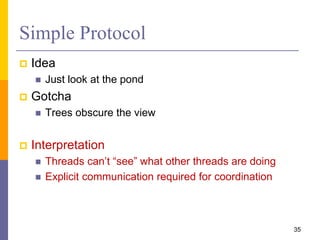
 Idea
 Just look at the pond
 Gotcha
 Trees obscure the view
 Interpretation
 Threads can’t “see” what other threads are doing
 Explicit communication required for coordination
35
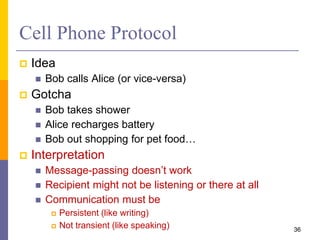
Cell Phone Protocol
 Idea
 Bob calls Alice (or vice-versa)
 Gotcha
 Bob takes shower
 Alice recharges battery
 Bob out shopping for pet food…
 Interpretation
 Message-passing doesn’t work
 Recipient might not be listening or there at all
 Communication must be
 Persistent (like writing)
 Not transient (like speaking) 36
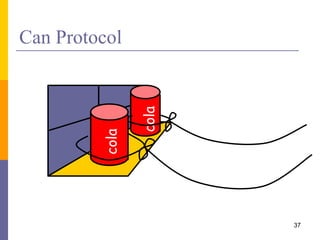
Can Protocol
37
cola
cola
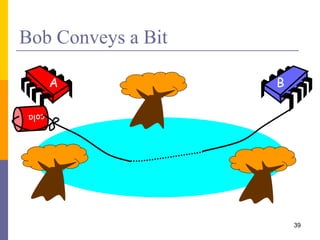
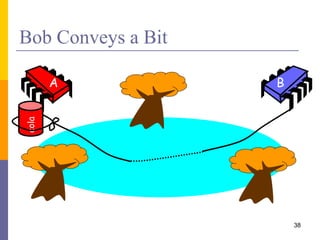
Bob Conveys a Bit
38
A B
cola
Bob Conveys a Bit
39
A B
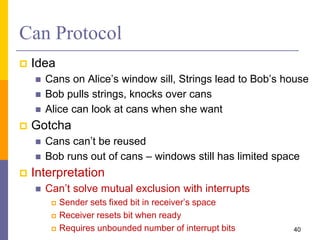
Can Protocol
 Idea
 Cans on Alice’s window sill, Strings lead to Bob’s house
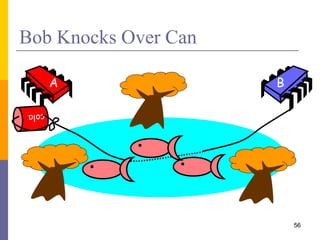
 Bob pulls strings, knocks over cans
 Alice can look at cans when she want
 Gotcha
 Cans can’t be reused
 Bob runs out of cans – windows still has limited space
 Interpretation
 Can’t solve mutual exclusion with interrupts
 Sender sets fixed bit in receiver’s space
 Receiver resets bit when ready
 Requires unbounded number of interrupt bits 40
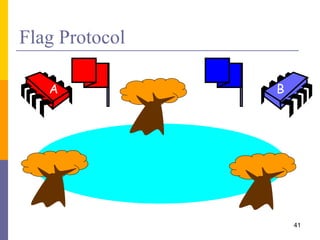
Flag Protocol
41
A B
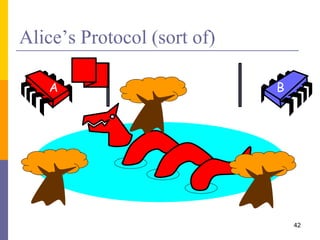
Alice’s Protocol (sort of)
42
A B
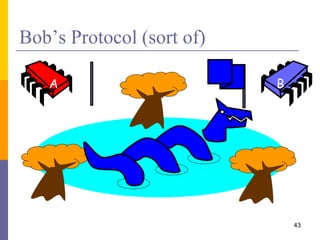
Bob’s Protocol (sort of)
43
A B
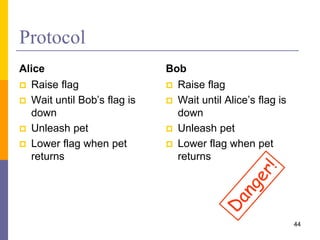
Protocol
Alice
 Raise flag
 Wait until Bob’s flag is
down
 Unleash pet
 Lower flag when pet
returns
Bob
 Raise flag
 Wait until Alice’s flag is
down
 Unleash pet
 Lower flag when pet
returns
44
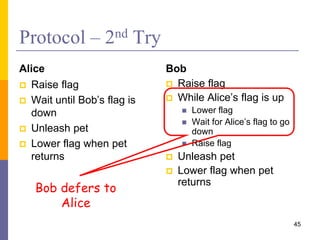
Protocol – 2nd Try
Alice
 Raise flag
 Wait until Bob’s flag is
down
 Unleash pet
 Lower flag when pet
returns
Bob
 Raise flag
 While Alice’s flag is up
 Lower flag
 Wait for Alice’s flag to go
down
 Raise flag
 Unleash pet
 Lower flag when pet
returns
45
Bob defers to
Alice
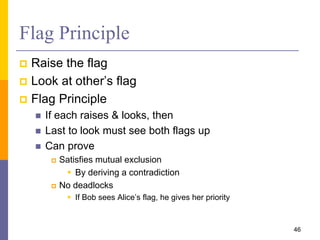
Flag Principle
 Raise the flag
 Look at other’s flag
 Flag Principle
 If each raises & looks, then
 Last to look must see both flags up
 Can prove
 Satisfies mutual exclusion
 By deriving a contradiction
 No deadlocks
 If Bob sees Alice’s flag, he gives her priority
46
Remarks
 Protocol is unfair
 Bob’s pet might never get in
 Protocol uses waiting
 If Bob is eaten by his pet, Alice’s pet might never get in
47
Waiting
 Both solutions use waiting
 Alice & Bob need time to decide “is the flag really up?”
 Flag can be in infinitely many positions
 You need to time to think & take a decision
 while(mumble){}
 Waiting is problematic
 If one participant is delayed
 So is everyone else
 But delays are common & unpredictable
48
Moral of Story
 Mutual Exclusion can’t be solved by
 Message passing – e.g., cell phones
 Transient communication
 Interrupts – e.g., tin cans
 Can be postponed
 It can be solved by
 One-bit shared variables that can be read or written,
i.e., a flag
49
The Fable Continues
 Alice & Bob fall in love & marry
 Then they fall out of love & divorce
 She gets the pets
 He has to feed them
 Leading to a new coordination problem
 Producer-Consumer
50
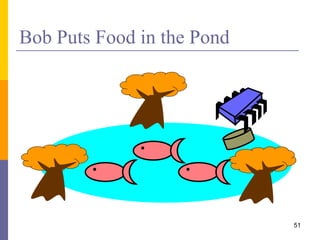
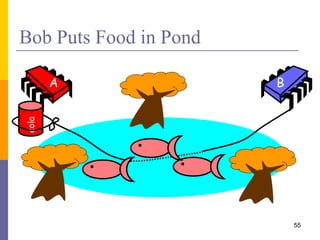
Bob Puts Food in the Pond
51
A
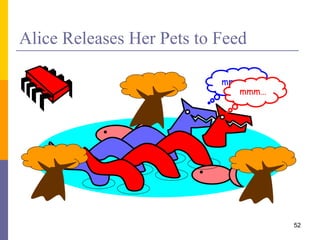
Alice Releases Her Pets to Feed
52
mmm… B
mmm…
Producer/Consumer
 Alice & Bob can’t meet
 Each has restraining order on other
 So he puts food in pond
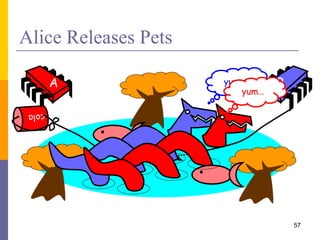
 And later, she releases pets
 Avoid
 Releasing pets when there’s no food
 Putting out food, if uneaten food remains
 Need a mechanism so that
 Bob lets Alice know when food has been put out
 Alice lets Bob know when to put out more food
53
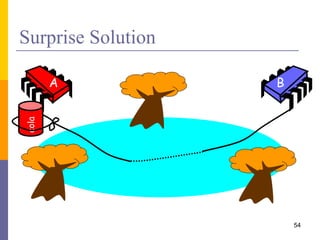
Surprise Solution
54
A B
cola
Bob Puts Food in Pond
55
A B
cola
Bob Knocks Over Can
56
A B
Alice Releases Pets
57
A B
yum… B
yum…
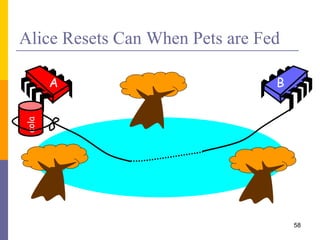
Alice Resets Can When Pets are Fed
58
A B
cola
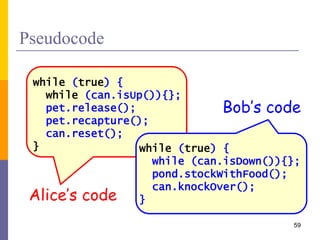
Pseudocode
59
while (true) {
while (can.isUp()){};
pet.release();
pet.recapture();
can.reset();
}
Alice’s code
while (true) {
while (can.isDown()){};
pond.stockWithFood();
can.knockOver();
}
Bob’s code
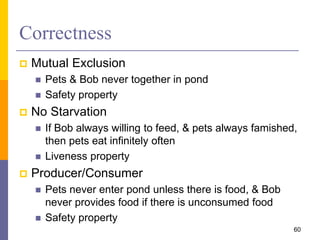
Correctness
 Mutual Exclusion
 Pets & Bob never together in pond
 Safety property
 No Starvation
 If Bob always willing to feed, & pets always famished,
then pets eat infinitely often
 Liveness property
 Producer/Consumer
 Pets never enter pond unless there is food, & Bob
never provides food if there is unconsumed food
 Safety property
60
But
 Didn’t we say mutual exclusion can’t be solved
with Interrupts (tin cans)???
 Well, this problem is somewhat different
 There’s a need for Alice & Bob to cooperate
 If not, pets will die & Bob will be in Jail
 Hence, resetting the tin can (i.e., interrupt-bit) can’t be
postponed forever
 Producer & consumer take turns
 Like setting & resetting an interrupt bit
61
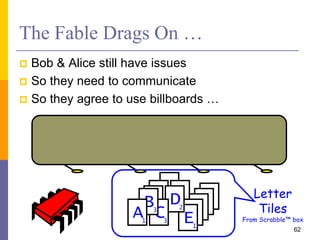
The Fable Drags On …
 Bob & Alice still have issues
 So they need to communicate
 So they agree to use billboards …
62
E1
D2
C3
B3
A1
Letter
Tiles
From Scrabble™ box
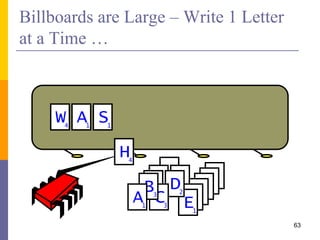
Billboards are Large – Write 1 Letter
at a Time …
63
E1
D2
C3
B3
A1
W4
A1
S1
H4
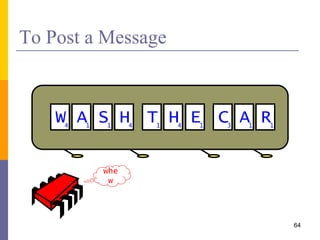
To Post a Message
64
W4
A1
S1
H4
A1
C3
R1
T1
H4
E1
whe
w
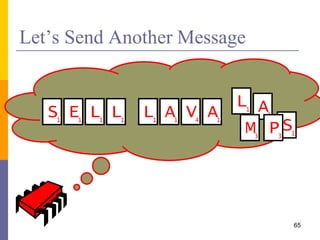
Let’s Send Another Message
65
S1
S1
E1
L1
L1
L1
V4
L1 A1
M3
A1
A1
P3
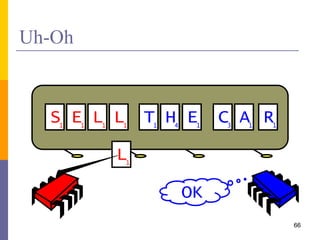
Uh-Oh
66
A1
C3
R1
T1
H4
E1
S1
E1
L1
L1
L1
OK
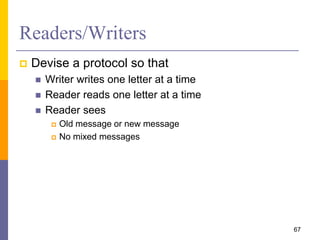
Readers/Writers
 Devise a protocol so that
 Writer writes one letter at a time
 Reader reads one letter at a time
 Reader sees
 Old message or new message
 No mixed messages
67
Readers/Writers (Cont.)
 Easy with mutual exclusion
 But mutual exclusion requires waiting
 One waits for the other
 Everyone executes sequentially
 Remarkably
 We can solve R/W without mutual exclusion
68
Summary
 Why concurrent programming?
 Mutual exclusion & cooperation
 Requirements
 Safety, Liveliness, & Efficiency
 What to avoid
 Race Conditions, Deadlocks, & Starvation
69

Introduction to Concurrent Programming

  • 1.
    Introduction to Concurrent Programming CS4532Concurrent Programming Dilum Bandara Dilum.Bandara@uom.lk Slides adapted from “The Art of Multiprocessor Programming” by Maurice Herlihy & Nir Shavit Slightly, & Dr. Srinath Perera
  • 2.
    Moore’s Law 2 No oftransistors on a chip tends to double about every 2 years Transistor count still rising Clock speed flattening sharply www.extremetech.com/wp- content/uploads/2012/02/CPU-Scaling.jpg
  • 3.
  • 4.
    Why Do WeCare?  Time no longer cures software bloat  The “free ride” is over  When you double your program’s path length  You can’t just wait 6 months  Your software must somehow exploit twice as much concurrency 4
  • 5.
    Traditional Scaling Process 5 Usercode Traditional Uniprocessor Speedup 1.8x 7x 3.6x Time: Moore’s law
  • 6.
    Multi-Core Scaling Process 6 Usercode Multicore Speedup 1.8x 7x 3.6x Unfortunately, not so simple…
  • 7.
    Real-World Scaling Process 7 1.8x2x 2.9x User code Multicore Speedup Parallelization & Synchronization require great care…
  • 8.
    Parallel & ConcurrentComputing?  “is a form of computation in which many calculations are carried out simultaneously by many thread of executions”  We are concerned with  Theory around parallelism  Tools & tricks  Use cases & potential applications  Common solution patterns 8
  • 9.
  • 10.
  • 11.
    Concurrent vs. Parallel Concurrent computing – when multiple tasks can be in progress at any instance in a program  Parallel computing – multiple tasks cooperate closely to solve a problem within a program  Distributed computing – when a program need to cooperate with other programs to solve a problem 11
  • 12.
    Asynchrony Sudden unpredictable delays Cache misses (short)  Page faults (long)  Scheduling quantum used up (really long) 12  Threads are scheduled by OS & thread library  Execution can be stopped at anytime, & another thread may be started  No timing guarantees are given, algorithms must not make any assumptions on speed of executions
  • 13.
    Why Parallel/Concurrent Computing? 1.Only way to solve some problems  Rendering animations  Weather prediction  Big bang 2. Most real-world problems are parallel  Weather, Galaxy  Bee/Ant Colony, Traffic 13 http://movies.disney.com/movies/ratatouille 1532 CPU-years to render
  • 14.
    Why Parallel/Concurrent Computing? 3.To fully utilize your computer  Computer often spend time waiting on I/O, which takes much more time than CPU processing  Unless application is number crunching, which is often not the case, parallelism can give lots of gains 4. To make use of the cloud  Cloud going to place 100’s to 1000’s of machines on normal people’s finger tips  Do you know how to use them?  Solution is parallel computing 14
  • 15.
    Flynn’s Taxonomy  SISD Normal sequential programs  Uniprocessor  SIMD  Data parallelism  GPUs & vector processors  MISD  Fault tolerant schemes  MIMD  Most parallel programs  Multi-core I – instruction, D – data, S – Single, M - Multiple 15
  • 16.
    Road Map  Weare going to focus on principles first, then practice  Start with idealized models  Look at simplistic problems  Emphasize correctness over pragmatism  “Correctness may be theoretical, but incorrectness has practical impact” 16
  • 17.
    Example – ParallelPrimality Testing  Challenge  Print primes from 1 to 1010  Given  10-processor multiprocessor  1 thread per processor  Goal  Get 10-fold speedup (or close) 17
  • 18.
    void primePrint { inti = ThreadID.get(); // IDs in {0..9} for (j = i*109+1, j<(i+1)*109; j++) { if (isPrime(j)) print(j); } } Load Balancing  Split the work evenly  Each thread tests range of 109 18 … … 109 1010 2·109 1 P0 P1 P9
  • 19.
    Issues  Higher rangeshave fewer primes  Yet larger numbers are harder to test  Thread workloads  Uneven  Hard to predict  Need dynamic load balancing 19
  • 20.
  • 21.
    Procedure for Threadi 21 int counter = new Counter(1); void primePrint { long j = 0; while (j < 1010) { j = counter.getAndIncrement(); if (isPrime(j)) print(j); } }
  • 22.
    Procedure for Threadi 22 Counter counter = new Counter(1); void primePrint { long j = 0; while (j < 1010) { j = counter.getAndIncrement(); if (isPrime(j)) print(j); } } Shared counter object Stop when every value taken Increment & return each new value
  • 23.
    What It Means 23 publicclass Counter { private long value; public long getAndIncrement() { return value++; } } temp = value; value = temp + 1; return temp;
  • 24.
    Not So Good… 24 time Value…1 read 1 read 1 write 2 read 2 write 3 write 2 2 3 2
  • 25.
    Is The ProblemInherent? 25 E.g., Walking on a narrow passage, trying to catch a ball in Cricket read write read write
  • 26.
    Challenge 26 public class Counter{ private long value; public long getAndIncrement() { temp = value; value = temp + 1; return temp; } } Make these steps atomic (indivisible)
  • 27.
    Hardware Solution 27 public classCounter { private long value; public long getAndIncrement() { temp = value; value = temp + 1; return temp; } } ReadModifyWrite() instruction
  • 28.
    An Aside: Java™ 28 publicclass Counter { private long value; public long getAndIncrement() { synchronized { temp = value; value = temp + 1; } return temp; } } Synchronized block Mutual exclusion
  • 29.
    Mutual Exclusion or“Alice & Bob share a pond” 29 A B
  • 30.
    Alice Has aPet 30 A B
  • 31.
    Bob Has aPet 31 A B
  • 32.
    The Problem 32 A B Thepets don’t get along
  • 33.
    Formalizing the Problem 2 types of formal properties in asynchronous computation  Safety Properties  Nothing bad happens ever  Consistency  Liveness Properties  Something good happens eventually  No deadlock, starvation  Efficiency is also important  You have to look at your solution for those properties, & you will be graded on that 33
  • 34.
    Formalizing our Problem Mutual Exclusion  Both pets never in pond simultaneously  This is a safety property  No Deadlock  If only 1 wants in, it gets in  If both want in, 1 gets in  This is a liveness property  How can we allow 2 pets to use pond without getting into trouble??? 34
  • 35.
    Simple Protocol  Idea Just look at the pond  Gotcha  Trees obscure the view  Interpretation  Threads can’t “see” what other threads are doing  Explicit communication required for coordination 35
  • 36.
    Cell Phone Protocol Idea  Bob calls Alice (or vice-versa)  Gotcha  Bob takes shower  Alice recharges battery  Bob out shopping for pet food…  Interpretation  Message-passing doesn’t work  Recipient might not be listening or there at all  Communication must be  Persistent (like writing)  Not transient (like speaking) 36
  • 37.
  • 38.
    Bob Conveys aBit 38 A B cola
  • 39.
    Bob Conveys aBit 39 A B
  • 40.
    Can Protocol  Idea Cans on Alice’s window sill, Strings lead to Bob’s house  Bob pulls strings, knocks over cans  Alice can look at cans when she want  Gotcha  Cans can’t be reused  Bob runs out of cans – windows still has limited space  Interpretation  Can’t solve mutual exclusion with interrupts  Sender sets fixed bit in receiver’s space  Receiver resets bit when ready  Requires unbounded number of interrupt bits 40
  • 41.
  • 42.
  • 43.
  • 44.
    Protocol Alice  Raise flag Wait until Bob’s flag is down  Unleash pet  Lower flag when pet returns Bob  Raise flag  Wait until Alice’s flag is down  Unleash pet  Lower flag when pet returns 44
  • 45.
    Protocol – 2ndTry Alice  Raise flag  Wait until Bob’s flag is down  Unleash pet  Lower flag when pet returns Bob  Raise flag  While Alice’s flag is up  Lower flag  Wait for Alice’s flag to go down  Raise flag  Unleash pet  Lower flag when pet returns 45 Bob defers to Alice
  • 46.
    Flag Principle  Raisethe flag  Look at other’s flag  Flag Principle  If each raises & looks, then  Last to look must see both flags up  Can prove  Satisfies mutual exclusion  By deriving a contradiction  No deadlocks  If Bob sees Alice’s flag, he gives her priority 46
  • 47.
    Remarks  Protocol isunfair  Bob’s pet might never get in  Protocol uses waiting  If Bob is eaten by his pet, Alice’s pet might never get in 47
  • 48.
    Waiting  Both solutionsuse waiting  Alice & Bob need time to decide “is the flag really up?”  Flag can be in infinitely many positions  You need to time to think & take a decision  while(mumble){}  Waiting is problematic  If one participant is delayed  So is everyone else  But delays are common & unpredictable 48
  • 49.
    Moral of Story Mutual Exclusion can’t be solved by  Message passing – e.g., cell phones  Transient communication  Interrupts – e.g., tin cans  Can be postponed  It can be solved by  One-bit shared variables that can be read or written, i.e., a flag 49
  • 50.
    The Fable Continues Alice & Bob fall in love & marry  Then they fall out of love & divorce  She gets the pets  He has to feed them  Leading to a new coordination problem  Producer-Consumer 50
  • 51.
    Bob Puts Foodin the Pond 51 A
  • 52.
    Alice Releases HerPets to Feed 52 mmm… B mmm…
  • 53.
    Producer/Consumer  Alice &Bob can’t meet  Each has restraining order on other  So he puts food in pond  And later, she releases pets  Avoid  Releasing pets when there’s no food  Putting out food, if uneaten food remains  Need a mechanism so that  Bob lets Alice know when food has been put out  Alice lets Bob know when to put out more food 53
  • 54.
  • 55.
    Bob Puts Foodin Pond 55 A B cola
  • 56.
    Bob Knocks OverCan 56 A B
  • 57.
    Alice Releases Pets 57 AB yum… B yum…
  • 58.
    Alice Resets CanWhen Pets are Fed 58 A B cola
  • 59.
    Pseudocode 59 while (true) { while(can.isUp()){}; pet.release(); pet.recapture(); can.reset(); } Alice’s code while (true) { while (can.isDown()){}; pond.stockWithFood(); can.knockOver(); } Bob’s code
  • 60.
    Correctness  Mutual Exclusion Pets & Bob never together in pond  Safety property  No Starvation  If Bob always willing to feed, & pets always famished, then pets eat infinitely often  Liveness property  Producer/Consumer  Pets never enter pond unless there is food, & Bob never provides food if there is unconsumed food  Safety property 60
  • 61.
    But  Didn’t wesay mutual exclusion can’t be solved with Interrupts (tin cans)???  Well, this problem is somewhat different  There’s a need for Alice & Bob to cooperate  If not, pets will die & Bob will be in Jail  Hence, resetting the tin can (i.e., interrupt-bit) can’t be postponed forever  Producer & consumer take turns  Like setting & resetting an interrupt bit 61
  • 62.
    The Fable DragsOn …  Bob & Alice still have issues  So they need to communicate  So they agree to use billboards … 62 E1 D2 C3 B3 A1 Letter Tiles From Scrabble™ box
  • 63.
    Billboards are Large– Write 1 Letter at a Time … 63 E1 D2 C3 B3 A1 W4 A1 S1 H4
  • 64.
    To Post aMessage 64 W4 A1 S1 H4 A1 C3 R1 T1 H4 E1 whe w
  • 65.
    Let’s Send AnotherMessage 65 S1 S1 E1 L1 L1 L1 V4 L1 A1 M3 A1 A1 P3
  • 66.
  • 67.
    Readers/Writers  Devise aprotocol so that  Writer writes one letter at a time  Reader reads one letter at a time  Reader sees  Old message or new message  No mixed messages 67
  • 68.
    Readers/Writers (Cont.)  Easywith mutual exclusion  But mutual exclusion requires waiting  One waits for the other  Everyone executes sequentially  Remarkably  We can solve R/W without mutual exclusion 68
  • 69.
    Summary  Why concurrentprogramming?  Mutual exclusion & cooperation  Requirements  Safety, Liveliness, & Efficiency  What to avoid  Race Conditions, Deadlocks, & Starvation 69