
INRODUCTION
Bank Concurrent Audit
NEED OF CONCURRENT AUDIT
 Concurrent audit is designed for the
continuous external control on the branch
 Concurrent audit is the first check on
transactions by bank
OBJECTIVES OF CONCURRENT AUDIT
 To supplement the efforts of the bank in carrying out
simultaneous internal checks, not just reporting the errors
identified.
 To reduce the interval between a transaction and its
examination by an independent person not involved in its
documentation.
 To improve the functioning of the bank, resulting in the
upgradation of the working of the bank.
 To identify whether the Systems & Procedures of the bank have
been properly complied and implemented by the bank.
MAIN PRODUCTS OF A BANK
 Savings Bank Account
 Cash Credit Account
 Retail loans
 Gold Loans
 Current Account
 Bank Guarantees
 Letter of credit
 Lockers
SCOPE OF AUDIT
 Verification of Advances –
 Appraisal,
 Pre-sanction
 Documentation
 Post-sanction
 Unit inspection
 Review & Renewal, etc.,
 Verification of Deposits –
 New accounts opened including operations in SB/CA,
 Transactions regarding Term deposits,
 Inoperative accounts,
 KYC Norms, etc.,
 Verification of House keeping–
 Cash Management,
 Cheques & DDs,
 Vouchers,
 Periodical returns to Controlling office,
 Maintenance of Specified Registers and Records
Sensitive stationeries,
Locker maintenance, etc.,
Verification of Revenue Leakage –
 Identification of Under recovery & Excess recovery of
Income & Expenditure including Interest credited & paid,
 P&L Analysis,
 Budgetary comparison, etc.,
 Verification of FOREX transactions–
 NRE/NRO/FCNR accounts,
 FCRA transactions,
 Packing Credit,
 Foreign currency business,
 Submission of Returns, etc.,
Verification of Other Key areas –
 TDS, Service tax,
 Staff matters, Government transactions, etc.,
PERUSAL OF FOLLOWING REPORTS:
 CONCURRENT AUDIT REPORT OF THE PREVIOUS MONTH – to understand the
Current Status of concurrent audit.
 RBI/CO INSPECTION REPORT (Latest) – to make note of the Major findings &
 observations regarding any account, particularly Advances.
 STOCK AUDIT REPORTS – regarding Cash credit accounts more than Rs. One crores.
 REVENUE AUDIT REPORTS – to understand the major deficiency found in the
Revenue aspect of the Branch
 SPECIAL AUDITS (if any) – regarding any prime issue covered under such audits.
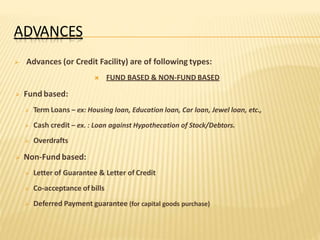
ADVANCES
 Advances (or Credit Facility) are of following types:
 FUND BASED & NON-FUND BASED
 Fund based:
 Term Loans – ex: Housing loan, Education loan, Car loan, Jewel loan, etc.,
 Cash credit – ex. : Loan against Hypothecation of Stock/Debtors.
 Overdrafts
 Non-Fundbased:
 Letter of Guarantee & Letter of Credit
 Co-acceptance of bills
 Deferred Payment guarantee (for capital goods purchase)
PERIODICAL ASSESSMENT OF THE LOAN
ACCOUNT:
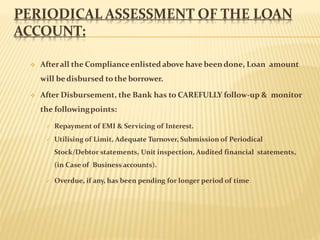
 Afterall the Complianceenlistedabove have beendone, Loan amount
will bedisbursed tothe borrower.
 After Disbursement, the Bank has to CAREFULLY follow-up & monitor
the followingpoints:
 Repayment of EMI & Servicing of Interest.
 Utilising of Limit, Adequate Turnover, Submission of Periodical
Stock/Debtor statements, Unit inspection, Audited financial statements,
(in Case of Business accounts).
 Overdue, if any, has been pending for longer period of time
PERIODICAL ASSESSMENT OF THE LOAN
ACCOUNT:
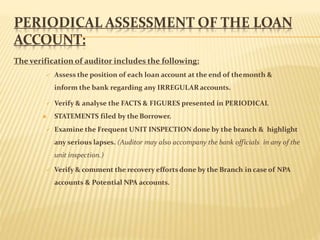
The verification of auditor includes the following:
 Assess the position of each loan account at the end of themonth &
inform the bank regarding any IRREGULARaccounts.
 Verify & analyse the FACTS & FIGURES presented in PERIODICAL
 STATEMENTS filed by the Borrower.
 Examine the Frequent UNIT INSPECTION done by the branch & highlight
any serious lapses. (Auditor may also accompany the bank officials in any of the
unit inspection.)
 Verify & comment the recovery effortsdone by the Branch in case of NPA
accounts & Potential NPA accounts.
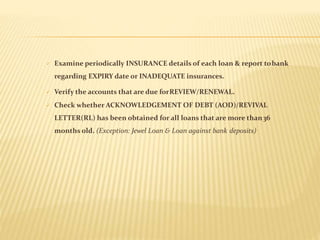
 Examine periodically INSURANCE details of each loan & report tobank
regarding EXPIRY date or INADEQUATE insurances.
 Verify the accounts that are due forREVIEW/RENEWAL.
 Check whether ACKNOWLEDGEMENT OF DEBT (AOD)/REVIVAL
LETTER(RL) has been obtained for all loans that are more than36
months old. (Exception: Jewel Loan & Loan against bank deposits)
 MORTGAGE:
 It isanofficial registration whichgivesright to bank to hold itas security
for theloan.
 Mortgage isdonefor Immovableproperty.
 Mortgage is of TWOTYPES:
 SIMPLE MORTGAGE
 EQUITABLE MORTAGE
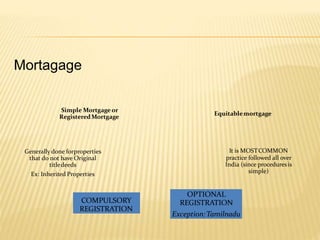
Mortagage
Simple Mortgage or
RegisteredMortgage
Generally done forproperties
that do not have Original
titledeeds
Ex: Inherited Properties
COMPULSORY
REGISTRATION
Equitablemortgage
It is MOSTCOMMON
practice followed all over
India (since proceduresis
simple)
OPTIONAL
REGISTRATION
Exception:Tamilnadu
 HYPOTHECATION:
 It issimilar to Mortgage but it isapplicableto MOVABLE
PROPERTIES thataregivenassecurity.
 Even though the bank does not have Direct control over these
securities, Still the bank has theright to take thepossession of them
whenever required.
 UnlikeMortgage, thereare no Stringent Procedures to be followed.
 Ex: STOCK, DEBTORS, VEHICLES, ETC.,
 PLEDGE OR LIEN:
 Pledgeor Lien issurrendering of the Security tothe bank’scontrol for
theloan.
 Hence, the Bank have 100% control overtheasset.
 Ex: Jewel Loan, Loan against deposits
 Cash credit (CC)/Overdraft loansaccountsaredistinctfrom
Other type of loan accounts due to following reasons:
 It is Limit based accountmainlygiven for Businesspurposes.
 (Mostly to meet the Working capital gap)
 It isacontinuousaccountwherein the Borrower utilizes the limit as
 & whenrequired.
 There is no Fixed EMI repaymentto this loan.
 The Bank expectsthe borrowertorouteall this business turnover
through thisaccount.
 The Credits in thisaccountshould besufficientenoughtoatleast
service the Interestdebited.
 Cash credit (CC)/Overdraft loansaccountsaredistinctfrom Other
type of loan accounts due to following reasons:
 Every month Bank fixes the Drawing power periodically(mostly monthly)
for thisaccount.
 Bank reviews the functioning & operation of thisaccount
periodically (mostlyquarterly).
ADVANCES
CC/OD ACCOUNTS – SPECIAL POINTS
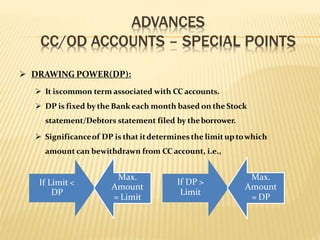
 DRAWING POWER(DP):
 It iscommon term associated with CC accounts.
 DP is fixed by the Bank each month based on the Stock
statement/Debtors statement filed by theborrower.
 Significanceof DP is that itdetermines the limitup towhich
amount can bewithdrawn from CC account, i.e.,
If Limit <
DP
Max.
Amount
= Limit
If DP >
Limit
Max.
Amount
= DP
 TEMPORARY OVERDRAFT (TOD)/EXCESSALLOWED:
 Auditor has toverify whether:
 Branch manager has used his powers judiciously.
 FrequentTODs granted to the sameaccount more than the prescribed
 times.
 Proper documents & security have beenobtained.
 TODs have been settled within theduedates or there are still
outstanding in suchaccounts.
NON-PERFORMING ASSETS (NPA):
 NPA isonewhichdoes notgenerateany incometothe bank.
 Following may becauses to become NPA:
 Interest/EMI overdue for more than 90days.
 OD/CC account is out of order for more than 90days.
 In case of NPA, the bankshould
 Make Provision for Bad debts
 Should Recognise Income only on RECEIPT basis not onACCRUAL
BASIS
 VERIFICATION OF NPA:
 Auditorisconcerned with whetherthe bank has
 Correctly Classification of Each of Loan account as per IRAC norms
 Provisioning has been doneaccurately.
 Interest & other incomes have been charged as per thenorms
 Auditorshould examinethe Efforts taken by the Bank forrecovery of
theseaccounts. Recoveryprocedures may beas follows:
 Regular Follow-up of the accounts & theborrower.
 Filing Suits in theCourts.
 Taking action under the Securitization and Reconstruction of Financial
assets and Enforcement of Security Interest Act, 2002. (SARFAESI act)
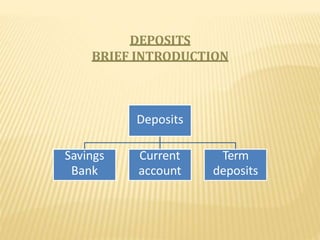
DEPOSITS
BRIEF INTRODUCTION
Deposits
Savings
Bank
Current
account
Term
deposits
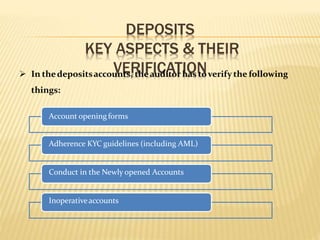
DEPOSITS
KEY ASPECTS & THEIR
VERIFICATION In thedepositsaccounts, theauditorhas toverify the following
things:
Account opening forms
Adherence KYC guidelines (including AML)
Conduct in the Newly opened Accounts
Inoperativeaccounts
INOPERATIVE ACCOUNTS:
 TheAuditor has toverify the Operations & Statusof the Inoperative
Accountsonce inaweek in Off-site.
 If anydiscrepancy is noticed, itshould beexamined soas toensure NO
SERIOUS issue pertains toit.
 Auditorshould alsodiscusswith the bank whenanydormant is
shifted to ACTIVEstatus.
HOUSE-KEEPING
 LOCKER MAINTENANCE:
 Safe Custody Lockersareprovided by Banks totheircustomers for
storing & maintaining their Essential items &documents.
 For Locker operations, One key is provided to the Customer &
Anotherkey isavailable with theconcerned official. Onlywith these
two keys, lockers can beaccessed.
 Lockersof differentsizeare held by Bank.
 Forthis service, the Bank chargesappropriate Lockerrent.
HOUSE-KEEPING
 LOCKER MAINTENANCE:
 Auditor should verifywhether:
 Locker Accessing Register are signed by customer before operatingthe
locker.
 Locker rent is collected eachyear.
 In case of Locker Rent Arrears, Reminders has been sent &customers
are prohibited from accessing the locker.
 After the Locker is closed, the bank should interchange the Lock &Keys
before sanctioning it to anothercustomer.
 In case of a locker not being accessed fora longer time, the Branch has
referred the higher authority for breaking thelock.
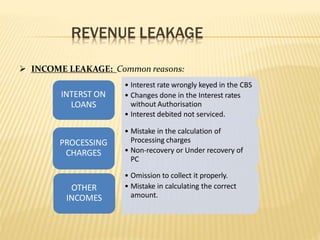
REVENUE LEAKAGE
 INCOME LEAKAGE: Common reasons:
• Interest rate wrongly keyed in the CBS
• Changes done in the Interest rates
without Authorisation
• Interest debited not serviced.
INTERST ON
LOANS
• Mistake in the calculation of
Processing charges
• Non-recovery or Under recovery of
PC
PROCESSING
CHARGES
• Omission to collect it properly.
• Mistake in calculating the correct
amount.
OTHER
INCOMES
REVENUE LEAKAGE
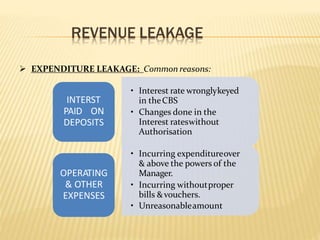
 EXPENDITURE LEAKAGE: Common reasons:
• Interest rate wronglykeyed
in theCBS
• Changes done in the
Interest rateswithout
Authorisation
INTERST
PAID ON
DEPOSITS
• Incurring expenditureover
& above the powers of the
Manager.
• Incurring withoutproper
bills &vouchers.
• Unreasonableamount
OPERATING
& OTHER
EXPENSES
OTHER KEY AREAS
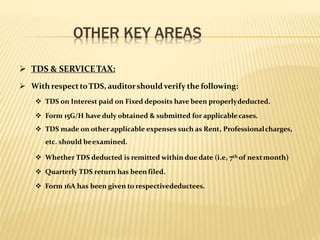
 TDS & SERVICETAX:
 With respecttoTDS, auditorshouldverify the following:
 TDS on Interest paid on Fixed deposits have been properlydeducted.
 Form 15G/H have duly obtained & submitted for applicablecases.
 TDS made on other applicable expenses such as Rent, Professionalcharges,
etc. should beexamined.
 Whether TDS deducted is remitted within due date (i.e, 7th of nextmonth)
 Quarterly TDS return has been filed.
 Form 16A has been given to respectivedeductees.
OTHER KEY AREAS
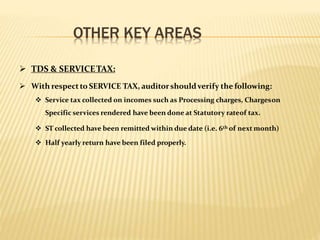
 TDS & SERVICETAX:
 With respectto SERVICE TAX, auditorshouldverify the following:
 Service tax collected on incomes such as Processing charges, Chargeson
Specific services rendered have been done at Statutory rateof tax.
 ST collected have been remitted within due date (i.e. 6th of next month)
 Half yearly return have been filed properly.
BY
VAMSI LADE
&
LAXMAN REDDY

Introduction to concurrent audit

  • 1.
  • 2.
    NEED OF CONCURRENTAUDIT  Concurrent audit is designed for the continuous external control on the branch  Concurrent audit is the first check on transactions by bank
  • 3.
    OBJECTIVES OF CONCURRENTAUDIT  To supplement the efforts of the bank in carrying out simultaneous internal checks, not just reporting the errors identified.  To reduce the interval between a transaction and its examination by an independent person not involved in its documentation.  To improve the functioning of the bank, resulting in the upgradation of the working of the bank.  To identify whether the Systems & Procedures of the bank have been properly complied and implemented by the bank.
  • 4.
    MAIN PRODUCTS OFA BANK  Savings Bank Account  Cash Credit Account  Retail loans  Gold Loans  Current Account  Bank Guarantees  Letter of credit  Lockers
  • 5.
    SCOPE OF AUDIT Verification of Advances –  Appraisal,  Pre-sanction  Documentation  Post-sanction  Unit inspection  Review & Renewal, etc.,
  • 6.
     Verification ofDeposits –  New accounts opened including operations in SB/CA,  Transactions regarding Term deposits,  Inoperative accounts,  KYC Norms, etc.,
  • 7.
     Verification ofHouse keeping–  Cash Management,  Cheques & DDs,  Vouchers,  Periodical returns to Controlling office,  Maintenance of Specified Registers and Records Sensitive stationeries, Locker maintenance, etc.,
  • 8.
    Verification of RevenueLeakage –  Identification of Under recovery & Excess recovery of Income & Expenditure including Interest credited & paid,  P&L Analysis,  Budgetary comparison, etc.,
  • 9.
     Verification ofFOREX transactions–  NRE/NRO/FCNR accounts,  FCRA transactions,  Packing Credit,  Foreign currency business,  Submission of Returns, etc.,
  • 10.
    Verification of OtherKey areas –  TDS, Service tax,  Staff matters, Government transactions, etc.,
  • 11.
    PERUSAL OF FOLLOWINGREPORTS:  CONCURRENT AUDIT REPORT OF THE PREVIOUS MONTH – to understand the Current Status of concurrent audit.  RBI/CO INSPECTION REPORT (Latest) – to make note of the Major findings &  observations regarding any account, particularly Advances.  STOCK AUDIT REPORTS – regarding Cash credit accounts more than Rs. One crores.  REVENUE AUDIT REPORTS – to understand the major deficiency found in the Revenue aspect of the Branch  SPECIAL AUDITS (if any) – regarding any prime issue covered under such audits.
  • 12.
    ADVANCES  Advances (orCredit Facility) are of following types:  FUND BASED & NON-FUND BASED  Fund based:  Term Loans – ex: Housing loan, Education loan, Car loan, Jewel loan, etc.,  Cash credit – ex. : Loan against Hypothecation of Stock/Debtors.  Overdrafts  Non-Fundbased:  Letter of Guarantee & Letter of Credit  Co-acceptance of bills  Deferred Payment guarantee (for capital goods purchase)
  • 13.
    PERIODICAL ASSESSMENT OFTHE LOAN ACCOUNT:  Afterall the Complianceenlistedabove have beendone, Loan amount will bedisbursed tothe borrower.  After Disbursement, the Bank has to CAREFULLY follow-up & monitor the followingpoints:  Repayment of EMI & Servicing of Interest.  Utilising of Limit, Adequate Turnover, Submission of Periodical Stock/Debtor statements, Unit inspection, Audited financial statements, (in Case of Business accounts).  Overdue, if any, has been pending for longer period of time
  • 14.
    PERIODICAL ASSESSMENT OFTHE LOAN ACCOUNT: The verification of auditor includes the following:  Assess the position of each loan account at the end of themonth & inform the bank regarding any IRREGULARaccounts.  Verify & analyse the FACTS & FIGURES presented in PERIODICAL  STATEMENTS filed by the Borrower.  Examine the Frequent UNIT INSPECTION done by the branch & highlight any serious lapses. (Auditor may also accompany the bank officials in any of the unit inspection.)  Verify & comment the recovery effortsdone by the Branch in case of NPA accounts & Potential NPA accounts.
  • 15.
     Examine periodicallyINSURANCE details of each loan & report tobank regarding EXPIRY date or INADEQUATE insurances.  Verify the accounts that are due forREVIEW/RENEWAL.  Check whether ACKNOWLEDGEMENT OF DEBT (AOD)/REVIVAL LETTER(RL) has been obtained for all loans that are more than36 months old. (Exception: Jewel Loan & Loan against bank deposits)
  • 16.
     MORTGAGE:  Itisanofficial registration whichgivesright to bank to hold itas security for theloan.  Mortgage isdonefor Immovableproperty.  Mortgage is of TWOTYPES:  SIMPLE MORTGAGE  EQUITABLE MORTAGE
  • 17.
    Mortagage Simple Mortgage or RegisteredMortgage Generallydone forproperties that do not have Original titledeeds Ex: Inherited Properties COMPULSORY REGISTRATION Equitablemortgage It is MOSTCOMMON practice followed all over India (since proceduresis simple) OPTIONAL REGISTRATION Exception:Tamilnadu
  • 18.
     HYPOTHECATION:  Itissimilar to Mortgage but it isapplicableto MOVABLE PROPERTIES thataregivenassecurity.  Even though the bank does not have Direct control over these securities, Still the bank has theright to take thepossession of them whenever required.  UnlikeMortgage, thereare no Stringent Procedures to be followed.  Ex: STOCK, DEBTORS, VEHICLES, ETC.,
  • 19.
     PLEDGE ORLIEN:  Pledgeor Lien issurrendering of the Security tothe bank’scontrol for theloan.  Hence, the Bank have 100% control overtheasset.  Ex: Jewel Loan, Loan against deposits
  • 20.
     Cash credit(CC)/Overdraft loansaccountsaredistinctfrom Other type of loan accounts due to following reasons:  It is Limit based accountmainlygiven for Businesspurposes.  (Mostly to meet the Working capital gap)  It isacontinuousaccountwherein the Borrower utilizes the limit as  & whenrequired.  There is no Fixed EMI repaymentto this loan.  The Bank expectsthe borrowertorouteall this business turnover through thisaccount.  The Credits in thisaccountshould besufficientenoughtoatleast service the Interestdebited.
  • 21.
     Cash credit(CC)/Overdraft loansaccountsaredistinctfrom Other type of loan accounts due to following reasons:  Every month Bank fixes the Drawing power periodically(mostly monthly) for thisaccount.  Bank reviews the functioning & operation of thisaccount periodically (mostlyquarterly).
  • 22.
    ADVANCES CC/OD ACCOUNTS –SPECIAL POINTS  DRAWING POWER(DP):  It iscommon term associated with CC accounts.  DP is fixed by the Bank each month based on the Stock statement/Debtors statement filed by theborrower.  Significanceof DP is that itdetermines the limitup towhich amount can bewithdrawn from CC account, i.e., If Limit < DP Max. Amount = Limit If DP > Limit Max. Amount = DP
  • 23.
     TEMPORARY OVERDRAFT(TOD)/EXCESSALLOWED:  Auditor has toverify whether:  Branch manager has used his powers judiciously.  FrequentTODs granted to the sameaccount more than the prescribed  times.  Proper documents & security have beenobtained.  TODs have been settled within theduedates or there are still outstanding in suchaccounts.
  • 24.
    NON-PERFORMING ASSETS (NPA): NPA isonewhichdoes notgenerateany incometothe bank.  Following may becauses to become NPA:  Interest/EMI overdue for more than 90days.  OD/CC account is out of order for more than 90days.  In case of NPA, the bankshould  Make Provision for Bad debts  Should Recognise Income only on RECEIPT basis not onACCRUAL BASIS
  • 25.
     VERIFICATION OFNPA:  Auditorisconcerned with whetherthe bank has  Correctly Classification of Each of Loan account as per IRAC norms  Provisioning has been doneaccurately.  Interest & other incomes have been charged as per thenorms  Auditorshould examinethe Efforts taken by the Bank forrecovery of theseaccounts. Recoveryprocedures may beas follows:  Regular Follow-up of the accounts & theborrower.  Filing Suits in theCourts.  Taking action under the Securitization and Reconstruction of Financial assets and Enforcement of Security Interest Act, 2002. (SARFAESI act)
  • 26.
  • 27.
    DEPOSITS KEY ASPECTS &THEIR VERIFICATION In thedepositsaccounts, theauditorhas toverify the following things: Account opening forms Adherence KYC guidelines (including AML) Conduct in the Newly opened Accounts Inoperativeaccounts
  • 28.
    INOPERATIVE ACCOUNTS:  TheAuditorhas toverify the Operations & Statusof the Inoperative Accountsonce inaweek in Off-site.  If anydiscrepancy is noticed, itshould beexamined soas toensure NO SERIOUS issue pertains toit.  Auditorshould alsodiscusswith the bank whenanydormant is shifted to ACTIVEstatus.
  • 29.
    HOUSE-KEEPING  LOCKER MAINTENANCE: Safe Custody Lockersareprovided by Banks totheircustomers for storing & maintaining their Essential items &documents.  For Locker operations, One key is provided to the Customer & Anotherkey isavailable with theconcerned official. Onlywith these two keys, lockers can beaccessed.  Lockersof differentsizeare held by Bank.  Forthis service, the Bank chargesappropriate Lockerrent.
  • 30.
    HOUSE-KEEPING  LOCKER MAINTENANCE: Auditor should verifywhether:  Locker Accessing Register are signed by customer before operatingthe locker.  Locker rent is collected eachyear.  In case of Locker Rent Arrears, Reminders has been sent &customers are prohibited from accessing the locker.  After the Locker is closed, the bank should interchange the Lock &Keys before sanctioning it to anothercustomer.  In case of a locker not being accessed fora longer time, the Branch has referred the higher authority for breaking thelock.
  • 31.
    REVENUE LEAKAGE  INCOMELEAKAGE: Common reasons: • Interest rate wrongly keyed in the CBS • Changes done in the Interest rates without Authorisation • Interest debited not serviced. INTERST ON LOANS • Mistake in the calculation of Processing charges • Non-recovery or Under recovery of PC PROCESSING CHARGES • Omission to collect it properly. • Mistake in calculating the correct amount. OTHER INCOMES
  • 32.
    REVENUE LEAKAGE  EXPENDITURELEAKAGE: Common reasons: • Interest rate wronglykeyed in theCBS • Changes done in the Interest rateswithout Authorisation INTERST PAID ON DEPOSITS • Incurring expenditureover & above the powers of the Manager. • Incurring withoutproper bills &vouchers. • Unreasonableamount OPERATING & OTHER EXPENSES
  • 33.
    OTHER KEY AREAS TDS & SERVICETAX:  With respecttoTDS, auditorshouldverify the following:  TDS on Interest paid on Fixed deposits have been properlydeducted.  Form 15G/H have duly obtained & submitted for applicablecases.  TDS made on other applicable expenses such as Rent, Professionalcharges, etc. should beexamined.  Whether TDS deducted is remitted within due date (i.e, 7th of nextmonth)  Quarterly TDS return has been filed.  Form 16A has been given to respectivedeductees.
  • 34.
    OTHER KEY AREAS TDS & SERVICETAX:  With respectto SERVICE TAX, auditorshouldverify the following:  Service tax collected on incomes such as Processing charges, Chargeson Specific services rendered have been done at Statutory rateof tax.  ST collected have been remitted within due date (i.e. 6th of next month)  Half yearly return have been filed properly.
  • 35.