
Concurrency in C++

                Peter A. Buhr


http: //plg.uwaterloo.ca / ˜ usystem /uC++.html
1 Introduction
1.1 Why Concurrency
 • Processor speed has slowed (stopped).
 • Use transistors from Moore’s law for parallelism to increase speed.
 • But concurrent programming is necessary to utilize parallel hardware.
 • Some success in implicitly discovering concurrency in sequential
   programs.
 • Fundamental limits to finding parallelism and only for certain kinds of
   problems.
 • Alternatively, programmer explicitly thinks about and specifies the
   concurrency.
 • Implicit and explicit approaches are complementary, i.e., can appear
   together.
 • However, the limitations of the implicit approach mandate an explicit
   approach.
   Except as otherwise noted, the content of this presentation is licensed under the Creative Com-
mons Attribution 2.5 License.

                                                2
3
1.2 Why C++
• C+ is one of the dominant programming languages.
    +
• Why?
  – based on C, which has a large programmer and code base,
  – as efficient as C in most situations,
  – low-level features, e.g., direct memory access, needed for:
    ∗ systems programming
    ∗ memory management
    ∗ embedded / real-time
  – high-level features, e.g., objects, polymorphism, exception handling,
    STL, etc., which programmers now demand,
  – allows direct interaction with UNIX/Windows.

1.3 Concurrency in C++
• C+ has no concurrency!
    +
• Many different concurrency approaches for C+ have been implemented
                                              +
  with only varying degrees of adoption.
4
• No de facto approach dominating concurrent programming in C+   +.
   – C has two dominant but incompatible concurrency libraries: pthreads
     and Win32.
• C+ lack of concurrency limits its future in the parallel domain.
     +’s
• Therefore, it is imperative C+ be augmented with concurrency facilities
                                +
  to extend its programming base.
• Interestingly, concurrency CANNOT be safely added to ANY language
  via library code.

1.4 High-Level Concurrency
• Want a single consistent high-level powerful concurrency mechanism,
  but what should it look like?
• In theory, any high-level concurrency paradigm/model can be adapted
  into C+ +.
• However, C+ does not support all concurrency approaches equally well,
                +
  e.g., tuple space, message passing, channels.
• C+ is fundamentally based on a class model using routine call, and its
    +
  other features leverage this model.
5
• Any concurrency approach matching the C+ model is better served
                                              +
  because its concepts interact consistently with the language.
• Apply “Principle of Least Astonishment” whenever possible.
• Let C+ dictate which concurrency approaches fits best via its design
        +
  principles.
• For OO language, thread/stack is best associated with class, and
  mutual-exclusion/synchronization with member routines.

1.5 µC+ : Advanced Control Flow for C+
       +                              +
• integrate advanced control flow tightly into C++
   – leverage all class features
   – threads are light-weight: M:N thread model versus 1:1
• use mutex objects to contain mutual exclusion and synchronization
   – communication using routine call (versus messages/channels)
   – statically typed
• handle multi-processor environment
6
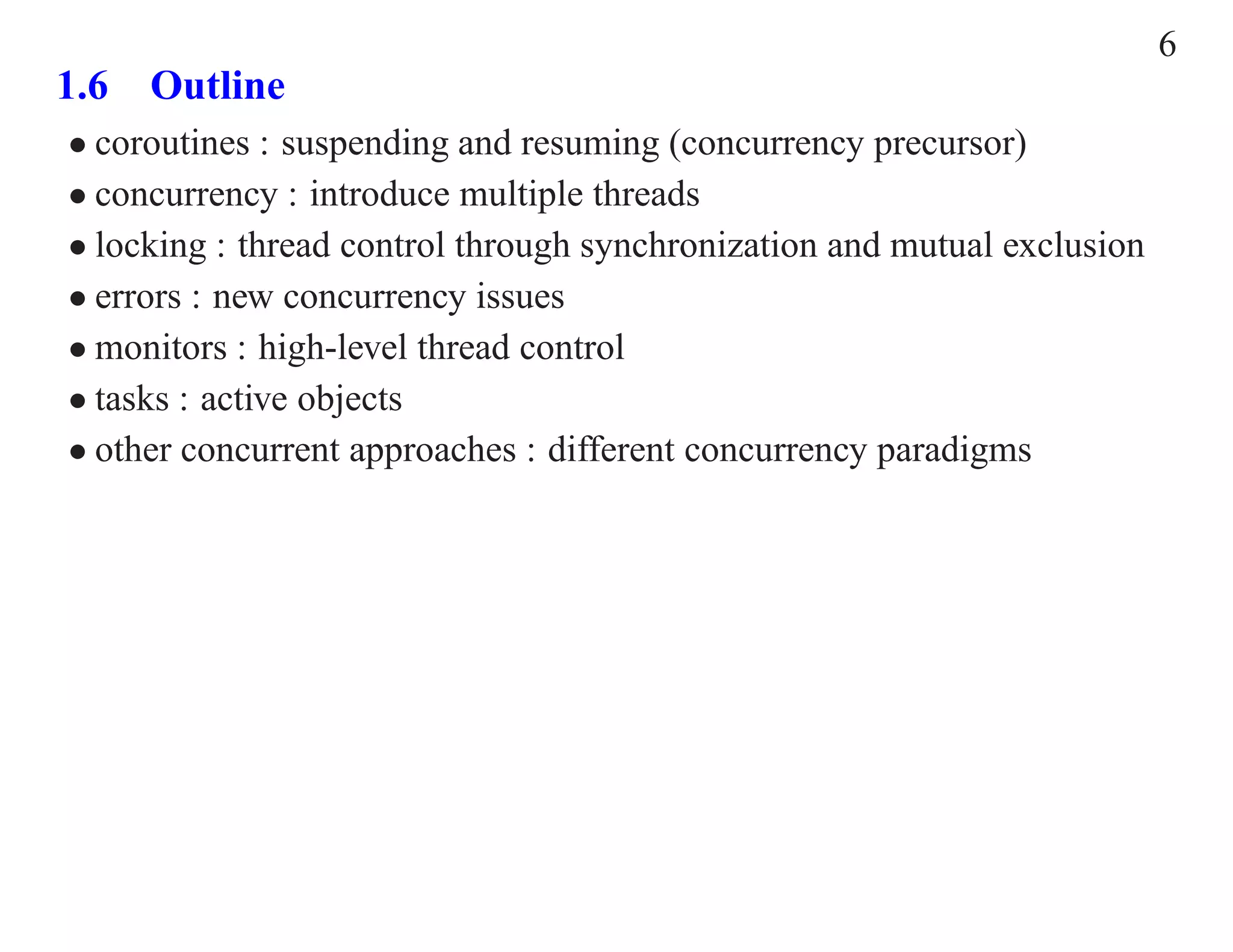
1.6 Outline
• coroutines : suspending and resuming (concurrency precursor)
• concurrency : introduce multiple threads
• locking : thread control through synchronization and mutual exclusion
• errors : new concurrency issues
• monitors : high-level thread control
• tasks : active objects
• other concurrent approaches : different concurrency paradigms

Introduction to Concurrency

  • 1.
    Concurrency in C++ Peter A. Buhr http: //plg.uwaterloo.ca / ˜ usystem /uC++.html
  • 2.
    1 Introduction 1.1 WhyConcurrency • Processor speed has slowed (stopped). • Use transistors from Moore’s law for parallelism to increase speed. • But concurrent programming is necessary to utilize parallel hardware. • Some success in implicitly discovering concurrency in sequential programs. • Fundamental limits to finding parallelism and only for certain kinds of problems. • Alternatively, programmer explicitly thinks about and specifies the concurrency. • Implicit and explicit approaches are complementary, i.e., can appear together. • However, the limitations of the implicit approach mandate an explicit approach. Except as otherwise noted, the content of this presentation is licensed under the Creative Com- mons Attribution 2.5 License. 2
  • 3.
    3 1.2 Why C++ •C+ is one of the dominant programming languages. + • Why? – based on C, which has a large programmer and code base, – as efficient as C in most situations, – low-level features, e.g., direct memory access, needed for: ∗ systems programming ∗ memory management ∗ embedded / real-time – high-level features, e.g., objects, polymorphism, exception handling, STL, etc., which programmers now demand, – allows direct interaction with UNIX/Windows. 1.3 Concurrency in C++ • C+ has no concurrency! + • Many different concurrency approaches for C+ have been implemented + with only varying degrees of adoption.
  • 4.
    4 • No defacto approach dominating concurrent programming in C+ +. – C has two dominant but incompatible concurrency libraries: pthreads and Win32. • C+ lack of concurrency limits its future in the parallel domain. +’s • Therefore, it is imperative C+ be augmented with concurrency facilities + to extend its programming base. • Interestingly, concurrency CANNOT be safely added to ANY language via library code. 1.4 High-Level Concurrency • Want a single consistent high-level powerful concurrency mechanism, but what should it look like? • In theory, any high-level concurrency paradigm/model can be adapted into C+ +. • However, C+ does not support all concurrency approaches equally well, + e.g., tuple space, message passing, channels. • C+ is fundamentally based on a class model using routine call, and its + other features leverage this model.
  • 5.
    5 • Any concurrencyapproach matching the C+ model is better served + because its concepts interact consistently with the language. • Apply “Principle of Least Astonishment” whenever possible. • Let C+ dictate which concurrency approaches fits best via its design + principles. • For OO language, thread/stack is best associated with class, and mutual-exclusion/synchronization with member routines. 1.5 µC+ : Advanced Control Flow for C+ + + • integrate advanced control flow tightly into C++ – leverage all class features – threads are light-weight: M:N thread model versus 1:1 • use mutex objects to contain mutual exclusion and synchronization – communication using routine call (versus messages/channels) – statically typed • handle multi-processor environment
  • 6.
    6 1.6 Outline • coroutines: suspending and resuming (concurrency precursor) • concurrency : introduce multiple threads • locking : thread control through synchronization and mutual exclusion • errors : new concurrency issues • monitors : high-level thread control • tasks : active objects • other concurrent approaches : different concurrency paradigms