Outline
definition ofkey terms
history of computers
usage of computers
types of computers
number systems
data storage and representation
3.
definition of keyterms
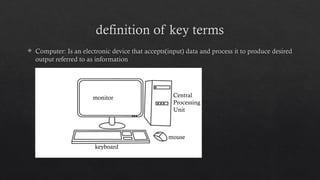
Computer: Is an electronic device that accepts(input) data and process it to produce desired
output referred to as information
monitor Central
Processing
Unit
mouse
keyboard
4.
definition of keyterms
Data: raw or unprocessed information facts that do not have meaning to the user.
A computer program, also known simply as software, is a set of instructions that tell a computer how to
perform a specific task or set of tasks.
These instructions are written in a programming language, such as Python, Java, C++, or many others.
Information: refers to data that has been processed or organized in a meaningful way.
Communication: refers to exchanging of information using medium such as telephones, computers,
satellites etc.
Technology: refers to application of scientific knowledge for practical purposes
Information Technology (IT): is the use of hardware, software and other technologies to collect,
organise, process, store and disseminate(distribute) information.
Information and Communication Technology (ICT): integration of communication technologies to
collect, process, store and distribute information.
5.
computer system
refersto the complete computer, which includes all the hardware and software required for
the computer to work
A computer system allows users to input, process, output and store data
What is the difference between data and information?
6.
Data
is allthe raw facts and figures that a computer processes by following a set of instructions
called a program
Data by itself has no meaning; it can be in the form of letters (a, b, c, d ... x, y, z, and so
on), numbers (1, 2, 3, 15, 456, and so on), pictures, sounds or symbols
7.
Information
It isonly when we attach meaning to data that we get information.
For example, if you collect the temperature of your classroom each day for a month, you have collected
data. When you instruct a computer to arrange (sort) this data, you could get information such as:
n the highest temperature over
the period
n the lowest temperature over
the period
n the mean (average) temperature
over the period
8.
What is thedifference between ICT, IT and computer science?
We often confuse the terms ‘information and communications technology’ (ICT), ‘information technology’
(IT) and ‘computer science’, and use them interchangeably. However, these are all very different fields
1. Information and communications technology (ICT) involves the use of computer hardware, software and
telecommunications devices to store, manipulate, convert, protect, send and receive data
The banking and finance industry relies heavily on ICT for things like customer service, fraud protection, investment, and
more
2. Information technology (IT) deals with the study of data and data processing, and may also apply to the
management of computer systems, particularly in a business setting
3. Computer science is the study of computer hardware and software design. It includes both the study of
theoretical algorithms and the practical problems involved in implementing them through computer hardware and
software. The study of computer science has many branches, including AI, software engineering, programming
and computer graphics.
9.
Why do weuse computers?
Data-processing speed: Computers are quick; they can perform tens of millions of operations per second. With
this speed comes the power to undertake many different tasks, such as predicting weather forecasts, modelling,
data crunching and producing thousands of bills for utility companies. Data crunching refers to the analysis of
large amounts of data so that it becomes useful in making decisions.
Data-processing accuracy: Computers are very accurate. Errors occur only if there is an error in the way the
hardware and software have been set up, or if there are errors in the data that has been input. When errors occur,
it is usually because of some human error. Computers can only do what they are set up and programmed to do.
Ability to store large amounts of information in a small space: There are many types of computer storage
media that can be used to store large volumes of data and information. For example, a single CD-ROM disc or
flash drive can hold the equivalent of a shelf of library books in electronic form.
Ability to work continuously: Computers can work continuously for very long periods, only stopping for
upgrading or maintenance checks. In fact, most modern computers can be left switched on all the time if desired,
24 hours per day and 7 days a week
10.
Hardware and software
To process data to produce information, a computer needs both hardware and software
Hardware is all the physical parts of the computer system you can see and touch.
central processing unit (CPU), Random Access Memory (RAM) and Read Only Memory
(ROM) chips, and others.
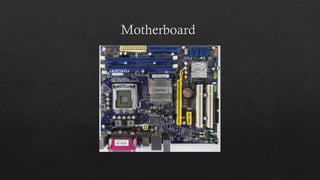
The motherboard is the main printed circuit board of a computer; it allows all the parts of
a computer to receive power and communicate with one another. The central processing
unit (CPU) and the RAM and ROM chips are all on the motherboard.