Introduction to
Computers
By K. Torrey
1. Computer System
2. Standard Menus
3. Cyber Safety
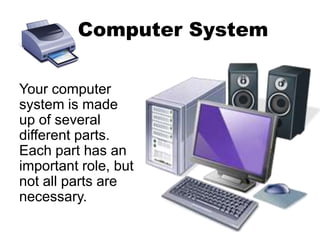
Your computer
system is made
up of several
different parts.
Each part has an
important role, but
not all parts are
necessary.
Computer System
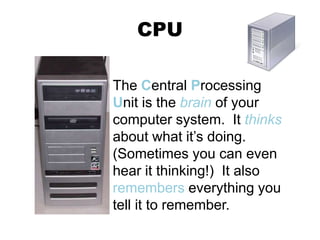
CPU
The Central Processing
Unit is the brain of your
computer system. It thinks
about what it’s doing.
(Sometimes you can even
hear it thinking!) It also
remembers everything you
tell it to remember.
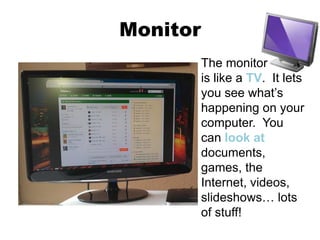
Monitor
The monitor
is like a TV. It lets
you see what’s
happening on your
computer. You
can look at
documents,
games, the
Internet, videos,
slideshows… lots
of stuff!
Caring for your Monitor
• Don’t touch the screen with dirty fingers
• Don’t use your pen or pencil as a pointer
• Don’t press any buttons on your monitor
• If your screen is dirty, tell the teacher
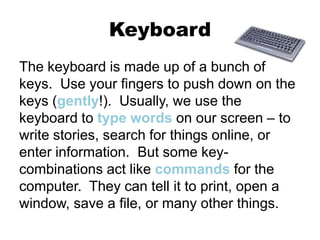
Keyboard
The keyboard is made up of a bunch of
keys. Use your fingers to push down on the
keys (gently!). Usually, we use the
keyboard to type words on our screen – to
write stories, search for things online, or
enter information. But some key-
combinations act like commands for the
computer. They can tell it to print, open a
window, save a file, or many other things.
Caring for your Keyboard
• Be nice to the keys – should tap gently on
them.
• Air duster – if they are getting dusty between
them, ask your teacher to clean them with an
air-sprayer
• No food/drink – you should never eat or
drink around your keyboard. Crumbs and
liquids can fall between the keys.
• Clean hands - you should always be sure
your hands are clean before you use a
computer.
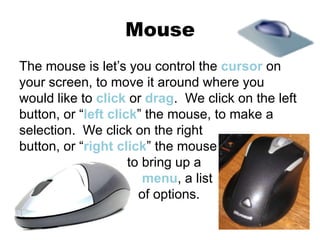
Mouse
The mouse is let’s you control the cursor on
your screen, to move it around where you
would like to click or drag. We click on the left
button, or “left click” the mouse, to make a
selection. We click on the right
button, or “right click” the mouse
to bring up a
menu, a list
of options.
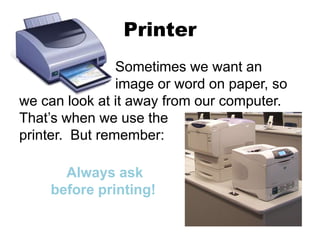
Printer
Sometimes we want an
image or word on paper, so
we can look at it away from our computer.
That’s when we use the
printer. But remember:
Always ask
before printing!
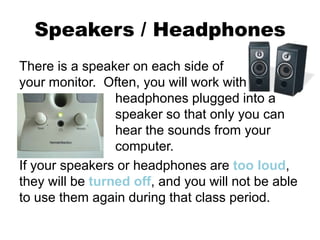
There is a speaker on each side of
your monitor. Often, you will work with
headphones plugged into a
speaker so that only you can
hear the sounds from your
computer.
If your speakers or headphones are too loud,
they will be turned off, and you will not be able
to use them again during that class period.
Speakers / Headphones
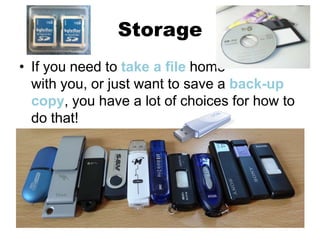
Storage
• If you need to take a file home
with you, or just want to save a back-up
copy, you have a lot of choices for how to
do that!
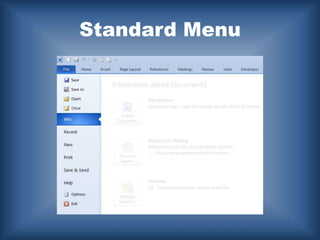
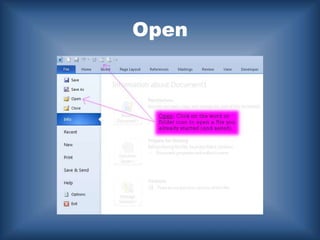
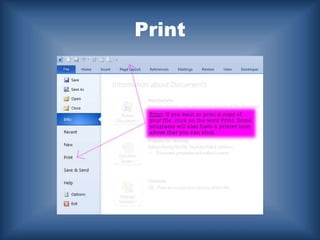
Standard Menu
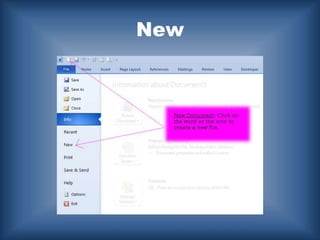
New
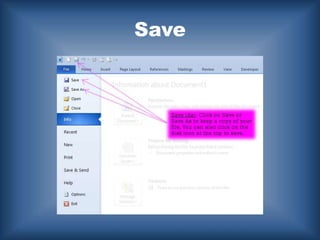
Save
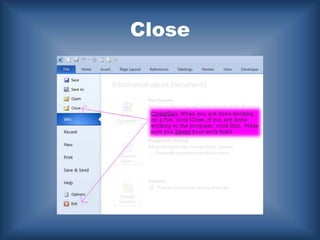
Close
Open
Print
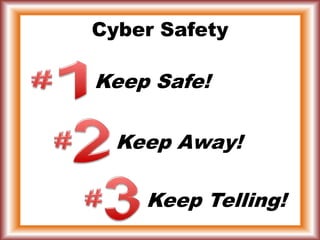
Cyber Safety
Keep Safe!
Keep Away!
Keep Telling!
Sources
• Michigan Department of Education (October 2009). 2009 Michigan Educational Technology Standards for
Students, Grades PK-2. Retrieved from http://techplan.edzone.net/METS/METS2009PK2.pdf
• Images
– Clipart: Microsoft Office
– Screenshots: K. Torrey and Microsoft Office
– CPU: Adam Duston, “Finished build” May 7, 2008 via Flickr, Creative Commons Attribution,
Noncommercial, Share Alike.
– Monitor: Roscoe Ellis, “new computer monitor” June 20, 2012 via Flickr, Creative Commons
Attribution, Noncommericla, Share Alike.
– Mouse (side view): Matt Trostle, “Computer Mouse Isolated on White Background” October 16,
2011 via Flickr, Creative Commons Attribution.
– Mouse (top view): Nathaniel Rand, “Mouse” September 9, 2007 via Flickr, Creative Commons
Attribution, Noncommericial.
– Printers: Ted Sakshaug, “This morning in the computer lab..” January 1, 2004 via Flickr, Creative
Commons Attribution.
– Speaker: LividFiction, “harman/kardon” December 19, 2005 via Flickr, Creative Commons
Attribution, Share Alike.
– Disks: Edmund Tse, “Computer Disks” January 11, 2008 via Flickr, Creative Commons Attribution.
– Jumpdrives: Mark Wilson, “So Many Thumb Drives” March 14, 2013 via Flickr, Creative Commons
Attribution.
– SD Cards: Clive Darra, “bytestor 1GB sd card twin pack” March 8, 2009 via Flickr, Creative
Commons Attribution, Share Alike.

Introduction to computers

  • 1.
    Introduction to Computers By K.Torrey 1. Computer System 2. Standard Menus 3. Cyber Safety
  • 2.
    Your computer system ismade up of several different parts. Each part has an important role, but not all parts are necessary. Computer System
  • 3.
    CPU The Central Processing Unitis the brain of your computer system. It thinks about what it’s doing. (Sometimes you can even hear it thinking!) It also remembers everything you tell it to remember.
  • 4.
    Monitor The monitor is likea TV. It lets you see what’s happening on your computer. You can look at documents, games, the Internet, videos, slideshows… lots of stuff!
  • 5.
    Caring for yourMonitor • Don’t touch the screen with dirty fingers • Don’t use your pen or pencil as a pointer • Don’t press any buttons on your monitor • If your screen is dirty, tell the teacher
  • 6.
    Keyboard The keyboard ismade up of a bunch of keys. Use your fingers to push down on the keys (gently!). Usually, we use the keyboard to type words on our screen – to write stories, search for things online, or enter information. But some key- combinations act like commands for the computer. They can tell it to print, open a window, save a file, or many other things.
  • 7.
    Caring for yourKeyboard • Be nice to the keys – should tap gently on them. • Air duster – if they are getting dusty between them, ask your teacher to clean them with an air-sprayer • No food/drink – you should never eat or drink around your keyboard. Crumbs and liquids can fall between the keys. • Clean hands - you should always be sure your hands are clean before you use a computer.
  • 8.
    Mouse The mouse islet’s you control the cursor on your screen, to move it around where you would like to click or drag. We click on the left button, or “left click” the mouse, to make a selection. We click on the right button, or “right click” the mouse to bring up a menu, a list of options.
  • 9.
    Printer Sometimes we wantan image or word on paper, so we can look at it away from our computer. That’s when we use the printer. But remember: Always ask before printing!
  • 10.
    There is aspeaker on each side of your monitor. Often, you will work with headphones plugged into a speaker so that only you can hear the sounds from your computer. If your speakers or headphones are too loud, they will be turned off, and you will not be able to use them again during that class period. Speakers / Headphones
  • 11.
    Storage • If youneed to take a file home with you, or just want to save a back-up copy, you have a lot of choices for how to do that!
  • 12.
  • 13.
  • 14.
  • 15.
  • 16.
  • 17.
  • 18.
    Cyber Safety Keep Safe! KeepAway! Keep Telling!
  • 19.
    Sources • Michigan Departmentof Education (October 2009). 2009 Michigan Educational Technology Standards for Students, Grades PK-2. Retrieved from http://techplan.edzone.net/METS/METS2009PK2.pdf • Images – Clipart: Microsoft Office – Screenshots: K. Torrey and Microsoft Office – CPU: Adam Duston, “Finished build” May 7, 2008 via Flickr, Creative Commons Attribution, Noncommercial, Share Alike. – Monitor: Roscoe Ellis, “new computer monitor” June 20, 2012 via Flickr, Creative Commons Attribution, Noncommericla, Share Alike. – Mouse (side view): Matt Trostle, “Computer Mouse Isolated on White Background” October 16, 2011 via Flickr, Creative Commons Attribution. – Mouse (top view): Nathaniel Rand, “Mouse” September 9, 2007 via Flickr, Creative Commons Attribution, Noncommericial. – Printers: Ted Sakshaug, “This morning in the computer lab..” January 1, 2004 via Flickr, Creative Commons Attribution. – Speaker: LividFiction, “harman/kardon” December 19, 2005 via Flickr, Creative Commons Attribution, Share Alike. – Disks: Edmund Tse, “Computer Disks” January 11, 2008 via Flickr, Creative Commons Attribution. – Jumpdrives: Mark Wilson, “So Many Thumb Drives” March 14, 2013 via Flickr, Creative Commons Attribution. – SD Cards: Clive Darra, “bytestor 1GB sd card twin pack” March 8, 2009 via Flickr, Creative Commons Attribution, Share Alike.