Introduction to
Computer Science
in Environmental Studies
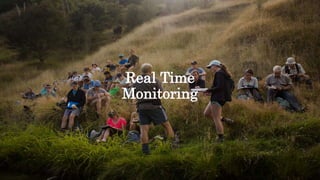
Real Time
Monitoring
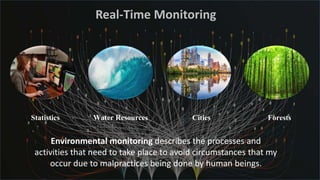
Real-Time Monitoring
Statistics Water Resources Cities Forests
Environmental monitoring describes the processes and
activities that need to take place to avoid circumstances that my
occur due to malpractices being done by human beings.
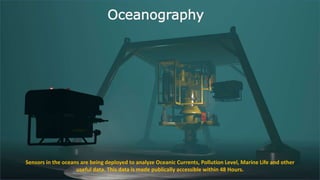
Oceanography
Sensors in the oceans are being deployed to analyze Oceanic Currents, Pollution Level, Marine Life and other
useful data. This data is made publically accessible within 48 Hours.
Artificial Intelligence
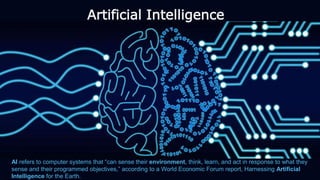
AI refers to computer systems that “can sense their environment, think, learn, and act in response to what they
sense and their programmed objectives,” according to a World Economic Forum report, Harnessing Artificial
Intelligence for the Earth.
AI in Weather
Forecasting & Disaster
Prediction
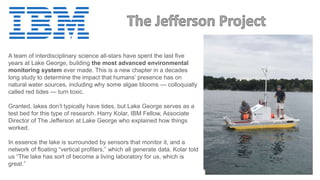
A team of interdisciplinary science all-stars have spent the last five
years at Lake George, building the most advanced environmental
monitoring system ever made. This is a new chapter in a decades
long study to determine the impact that humans’ presence has on
natural water sources, including why some algae blooms — colloquially
called red tides — turn toxic.
Granted, lakes don’t typically have tides, but Lake George serves as a
test bed for this type of research. Harry Kolar, IBM Fellow, Associate
Director of The Jefferson at Lake George who explained how things
worked.
In essence the lake is surrounded by sensors that monitor it, and a
network of floating “vertical profilers,” which all generate data. Kolar told
us “The lake has sort of become a living laboratory for us, which is
great.”
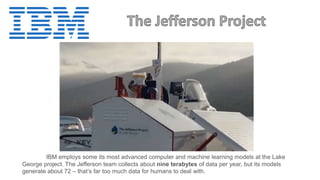
IBM employs some its most advanced computer and machine learning models at the Lake
George project. The Jefferson team collects about nine terabytes of data per year, but its models
generate about 72 – that’s far too much data for humans to deal with.
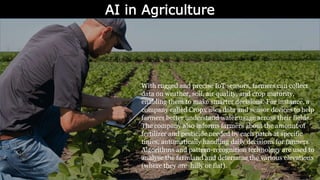
AI in Agriculture
With rugged and precise IoT sensors, farmers can collect
data on weather, soil, air quality, and crop maturity,
enabling them to make smarter decisions. For instance, a
company called Cropx uses data and sensor devices to help
farmers better understand water usage across their fields.
The company also informs farmers about the amount of
fertilizer and pesticide needed by each patch at specific
times, automatically handling daily decisions for farmers.
Algorithms and pattern-recognition technology are used to
analyse the farmland and determine the various elevations
(where they are hilly or flat).
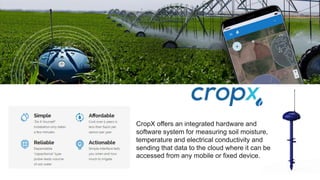
CropX offers an integrated hardware and
software system for measuring soil moisture,
temperature and electrical conductivity and
sending that data to the cloud where it can be
accessed from any mobile or fixed device.
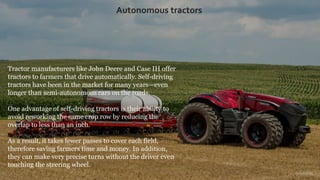
Tractor manufacturers like John Deere and Case IH offer
tractors to farmers that drive automatically. Self-driving
tractors have been in the market for many years—even
longer than semi-autonomous cars on the roads.
One advantage of self-driving tractors is their ability to
avoid reworking the same crop row by reducing the
overlap to less than an inch.
As a result, it takes fewer passes to cover each field,
therefore saving farmers time and money. In addition,
they can make very precise turns without the driver even
touching the steering wheel.
Autonomous tractors
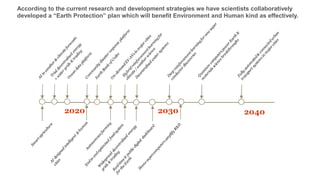
According to the current research and development strategies we have scientists collaboratively
developed a “Earth Protection” plan which will benefit Environment and Human kind as effectively.
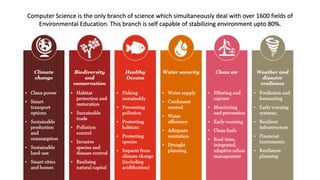
Computer Science is the only branch of science which simultaneously deal with over 1600 fields of
Environmental Education. This branch is self capable of stabilizing environment upto 80%.
Introduction to computer science in Environmental Studies

Introduction to computer science in Environmental Studies

  • 1.
  • 3.
  • 4.
    Real-Time Monitoring Statistics WaterResources Cities Forests Environmental monitoring describes the processes and activities that need to take place to avoid circumstances that my occur due to malpractices being done by human beings.
  • 5.
    Oceanography Sensors in theoceans are being deployed to analyze Oceanic Currents, Pollution Level, Marine Life and other useful data. This data is made publically accessible within 48 Hours.
  • 7.
    Artificial Intelligence AI refersto computer systems that “can sense their environment, think, learn, and act in response to what they sense and their programmed objectives,” according to a World Economic Forum report, Harnessing Artificial Intelligence for the Earth.
  • 8.
    AI in Weather Forecasting& Disaster Prediction
  • 9.
    A team ofinterdisciplinary science all-stars have spent the last five years at Lake George, building the most advanced environmental monitoring system ever made. This is a new chapter in a decades long study to determine the impact that humans’ presence has on natural water sources, including why some algae blooms — colloquially called red tides — turn toxic. Granted, lakes don’t typically have tides, but Lake George serves as a test bed for this type of research. Harry Kolar, IBM Fellow, Associate Director of The Jefferson at Lake George who explained how things worked. In essence the lake is surrounded by sensors that monitor it, and a network of floating “vertical profilers,” which all generate data. Kolar told us “The lake has sort of become a living laboratory for us, which is great.”
  • 10.
    IBM employs someits most advanced computer and machine learning models at the Lake George project. The Jefferson team collects about nine terabytes of data per year, but its models generate about 72 – that’s far too much data for humans to deal with.
  • 11.
    AI in Agriculture Withrugged and precise IoT sensors, farmers can collect data on weather, soil, air quality, and crop maturity, enabling them to make smarter decisions. For instance, a company called Cropx uses data and sensor devices to help farmers better understand water usage across their fields. The company also informs farmers about the amount of fertilizer and pesticide needed by each patch at specific times, automatically handling daily decisions for farmers. Algorithms and pattern-recognition technology are used to analyse the farmland and determine the various elevations (where they are hilly or flat).
  • 12.
    CropX offers anintegrated hardware and software system for measuring soil moisture, temperature and electrical conductivity and sending that data to the cloud where it can be accessed from any mobile or fixed device.
  • 13.
    Tractor manufacturers likeJohn Deere and Case IH offer tractors to farmers that drive automatically. Self-driving tractors have been in the market for many years—even longer than semi-autonomous cars on the roads. One advantage of self-driving tractors is their ability to avoid reworking the same crop row by reducing the overlap to less than an inch. As a result, it takes fewer passes to cover each field, therefore saving farmers time and money. In addition, they can make very precise turns without the driver even touching the steering wheel. Autonomous tractors
  • 14.
    According to thecurrent research and development strategies we have scientists collaboratively developed a “Earth Protection” plan which will benefit Environment and Human kind as effectively.
  • 15.
    Computer Science isthe only branch of science which simultaneously deal with over 1600 fields of Environmental Education. This branch is self capable of stabilizing environment upto 80%.

Editor's Notes