Introduction to
Computational Social Science
by Talha Oz
May 2014, Princeton University
Second GrandEng Workshop
CSS: Three fundamental challenges
1. Computational modeling
– Complexity of theoretical issues in social sciences
– Santa Fe Institute, George Mason University
2. Analysis of social observational data
– Knowledge discovery and data mining
– Cell phones, emails, blogs, OSN services
3. Virtual lab–style experiments
– Handling large scale social experiments
– Experimental macrosociology, crowdsourcing (AMT)
This 3-fold categorization is done by D. J. Watts, “Computational Social Science Exciting
Progress and Future Directions,” Bridge Natl. Acad. Eng., vol. 43/4, Winter 2013
Computation in Social Sciences
• Computation in theory / empirical tools
– Social network analysis (SNA)
– Geospatial analysis, social GIS
– Information retrieval, web scraping
– Machine learning, data mining
– Computational linguistics
• Computation as theory / a theoretical tool
– Modeling the behavior of the individuals & institutes
– Capturing emergent behaviors of groups & societies
Why Model? [Epstein]
• You are a modeler
– Who projects or imagines how a social dynamic
would unfold is running some model
• Assumptions are hidden, internal consistency untested,
logical consequences & relation to data is unknown
• 17 reasons to build models
– Predict, explain, guide data collection, illuminate core
dynamics, suggest analogies, freedom to doubt, etc.
• “Art is a lie that helps us see the truth” Picasso
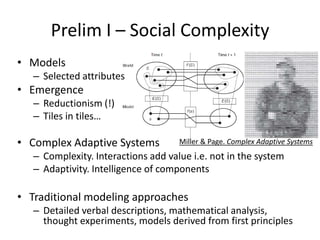
Miller & Page. Complex Adaptive Systems
Prelim I – Social Complexity
• Models
– Selected attributes
• Emergence
– Reductionism (!)
– Tiles in tiles…
• Complex Adaptive Systems
– Complexity. Interactions add value i.e. not in the system
– Adaptivity. Intelligence of components
• Traditional modeling approaches
– Detailed verbal descriptions, mathematical analysis,
thought experiments, models derived from first principles
Prelim II - Neoclassical Economics
• Three assumptions in neoclassical economics
1. People have rational preferences
2. Individuals maximize utility & firms maximize profits
3. People act independently with full and relevant info.
• Mathematical constraints
– Agents subsumed into a single representative agent
– Computation used to solve numerical methods
Agent-based Modeling
• Agent is an object that represents an individual/institution
– Autonomous (unlike DES)
– Own features & behavior [OOP: attributes & methods]
– Rationally bounded; limited vision
– Decision-making strategies; learning algorithms
– Agent-agent & agent-environment interaction
• Simulation environment & time
– Abstract or spatially explicit models (GIS incorporated)
– Neighborhood size; social network
– A step might be in seconds, days, years, etc.
– At each step agents are activated in some order
• ABM Frameworks: NetLogo, MASON, RePast, Swarm, etc.
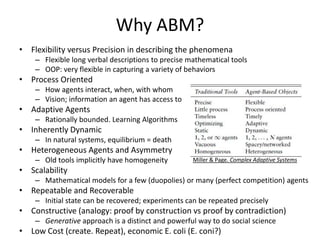
Why ABM?
• Flexibility versus Precision in describing the phenomena
– Flexible long verbal descriptions to precise mathematical tools
– OOP: very flexible in capturing a variety of behaviors
• Process Oriented
– How agents interact, when, with whom
– Vision; information an agent has access to
• Adaptive Agents
– Rationally bounded. Learning Algorithms
• Inherently Dynamic
– In natural systems, equilibrium = death
• Heterogeneous Agents and Asymmetry
– Old tools implicitly have homogeneity
• Scalability
– Mathematical models for a few (duopolies) or many (perfect competition) agents
• Repeatable and Recoverable
– Initial state can be recovered; experiments can be repeated precisely
• Constructive (analogy: proof by construction vs proof by contradiction)
– Generative approach is a distinct and powerful way to do social science
• Low Cost (create. Repeat), economic E. coli (E. coni?)
Miller & Page. Complex Adaptive Systems
DEMOS
• Agent-based modeling
– Ants foraging [NetLogo]
– Standing ovation problem
• Social media analysis
– Turkish media readership
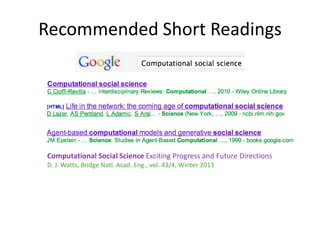
Recommended Short Readings
Computational Social Science Exciting Progress and Future Directions
D. J. Watts, Bridge Natl. Acad. Eng., vol. 43/4, Winter 2013

Introduction to Computational Social Science

  • 1.
    Introduction to Computational SocialScience by Talha Oz May 2014, Princeton University Second GrandEng Workshop
  • 2.
    CSS: Three fundamentalchallenges 1. Computational modeling – Complexity of theoretical issues in social sciences – Santa Fe Institute, George Mason University 2. Analysis of social observational data – Knowledge discovery and data mining – Cell phones, emails, blogs, OSN services 3. Virtual lab–style experiments – Handling large scale social experiments – Experimental macrosociology, crowdsourcing (AMT) This 3-fold categorization is done by D. J. Watts, “Computational Social Science Exciting Progress and Future Directions,” Bridge Natl. Acad. Eng., vol. 43/4, Winter 2013
  • 3.
    Computation in SocialSciences • Computation in theory / empirical tools – Social network analysis (SNA) – Geospatial analysis, social GIS – Information retrieval, web scraping – Machine learning, data mining – Computational linguistics • Computation as theory / a theoretical tool – Modeling the behavior of the individuals & institutes – Capturing emergent behaviors of groups & societies
  • 4.
    Why Model? [Epstein] •You are a modeler – Who projects or imagines how a social dynamic would unfold is running some model • Assumptions are hidden, internal consistency untested, logical consequences & relation to data is unknown • 17 reasons to build models – Predict, explain, guide data collection, illuminate core dynamics, suggest analogies, freedom to doubt, etc. • “Art is a lie that helps us see the truth” Picasso
  • 5.
    Miller & Page.Complex Adaptive Systems Prelim I – Social Complexity • Models – Selected attributes • Emergence – Reductionism (!) – Tiles in tiles… • Complex Adaptive Systems – Complexity. Interactions add value i.e. not in the system – Adaptivity. Intelligence of components • Traditional modeling approaches – Detailed verbal descriptions, mathematical analysis, thought experiments, models derived from first principles
  • 6.
    Prelim II -Neoclassical Economics • Three assumptions in neoclassical economics 1. People have rational preferences 2. Individuals maximize utility & firms maximize profits 3. People act independently with full and relevant info. • Mathematical constraints – Agents subsumed into a single representative agent – Computation used to solve numerical methods
  • 7.
    Agent-based Modeling • Agentis an object that represents an individual/institution – Autonomous (unlike DES) – Own features & behavior [OOP: attributes & methods] – Rationally bounded; limited vision – Decision-making strategies; learning algorithms – Agent-agent & agent-environment interaction • Simulation environment & time – Abstract or spatially explicit models (GIS incorporated) – Neighborhood size; social network – A step might be in seconds, days, years, etc. – At each step agents are activated in some order • ABM Frameworks: NetLogo, MASON, RePast, Swarm, etc.
  • 8.
    Why ABM? • Flexibilityversus Precision in describing the phenomena – Flexible long verbal descriptions to precise mathematical tools – OOP: very flexible in capturing a variety of behaviors • Process Oriented – How agents interact, when, with whom – Vision; information an agent has access to • Adaptive Agents – Rationally bounded. Learning Algorithms • Inherently Dynamic – In natural systems, equilibrium = death • Heterogeneous Agents and Asymmetry – Old tools implicitly have homogeneity • Scalability – Mathematical models for a few (duopolies) or many (perfect competition) agents • Repeatable and Recoverable – Initial state can be recovered; experiments can be repeated precisely • Constructive (analogy: proof by construction vs proof by contradiction) – Generative approach is a distinct and powerful way to do social science • Low Cost (create. Repeat), economic E. coli (E. coni?) Miller & Page. Complex Adaptive Systems
  • 9.
    DEMOS • Agent-based modeling –Ants foraging [NetLogo] – Standing ovation problem • Social media analysis – Turkish media readership
  • 10.
    Recommended Short Readings ComputationalSocial Science Exciting Progress and Future Directions D. J. Watts, Bridge Natl. Acad. Eng., vol. 43/4, Winter 2013