Computational Social
Science
Kiarash Kiani
What Is CSS?
Computational social science refers to the academic
sub-disciplines concerned with computational
approaches to the social sciences.
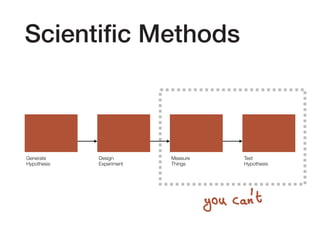
Scientific Methods
Generate
Hypothesis
Design
Experiment
Measure
Things
Test
Hypothesis
Bigger Problems
• Social phenomena involve many individuals interacting to
produce collective entities

- Firms, markets, cultures, political parties, social movements,
audiences

- “Micro-Macro” problem (aka “Emergence”)

• Micro-Macro problems are hard to study empirically

- Difficult to collect observational data about individuals, networks,
and population at the same time

• Difficulty of manipulating large-scale social/organizations
experimentally
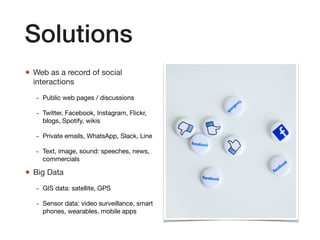
Solutions
• Web as a record of social
interactions 

- Public web pages / discussions

- Twitter, Facebook, Instagram, Flickr,
blogs, Spotify, wikis

- Private emails, WhatsApp, Slack, Line

- Text, image, sound: speeches, news,
commercials

• Big Data

- GIS data: satellite, GPS

- Sensor data: video surveillance, smart
phones, wearables, mobile apps
The Main Areas of CSS
• Simulation 

• Big Data 

• Social Network Analysis 

• Virtual Lab-Style Experiments
Simulation
Residential Segregation
Model
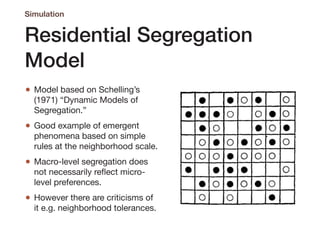
• Model based on Schelling’s
(1971) “Dynamic Models of
Segregation.”

• Good example of emergent
phenomena based on simple
rules at the neighborhood scale.

• Macro-level segregation does
not necessarily reflect micro-
level preferences.

• However there are criticisms of
it e.g. neighborhood tolerances.
Simulation
Extending Opinion Dynamics to
Model Public Health Problems
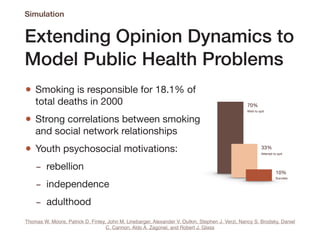
• Smoking is responsible for 18.1% of
total deaths in 2000

• Strong correlations between smoking
and social network relationships

• Youth psychosocial motivations:

- rebellion 

- independence 

- adulthood
Simulation
Thomas W. Moore, Patrick D. Finley, John M. Linebarger, Alexander V. Outkin, Stephen J. Verzi, Nancy S. Brodsky, Daniel
C. Cannon, Aldo A. Zagonel, and Robert J. Glass
70%
33%
10%
Wish to quit
Attempt to quit
Success
Big Data
Predicting Poverty and Wealth
From Mobile Phone Metadata
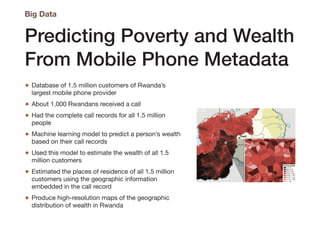
• Database of 1.5 million customers of Rwanda’s
largest mobile phone provider

• About 1,000 Rwandans received a call

• Had the complete call records for all 1.5 million
people

• Machine learning model to predict a person’s wealth
based on their call records

• Used this model to estimate the wealth of all 1.5
million customers

• Estimated the places of residence of all 1.5 million
customers using the geographic information
embedded in the call record

• Produce high-resolution maps of the geographic
distribution of wealth in Rwanda
Big Data
Social Network
Analysis
State of the Union
Addresses
Virtual Lab-Style
Experiments
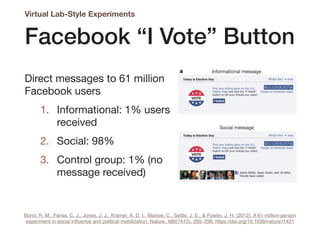
Facebook “I Vote” Button
Direct messages to 61 million
Facebook users

1. Informational: 1% users
received

2. Social: 98%

3. Control group: 1% (no
message received)
Virtual Lab-Style Experiments
Bond, R. M., Fariss, C. J., Jones, J. J., Kramer, A. D. I., Marlow, C., Settle, J. E., & Fowler, J. H. (2012). A 61-million-person
experiment in social influence and political mobilization. Nature, 489(7415), 295–298. https://doi.org/10.1038/nature11421

Computational Social Science

  • 1.
  • 2.
    What Is CSS? Computationalsocial science refers to the academic sub-disciplines concerned with computational approaches to the social sciences.
  • 3.
  • 4.
    Bigger Problems • Socialphenomena involve many individuals interacting to produce collective entities - Firms, markets, cultures, political parties, social movements, audiences - “Micro-Macro” problem (aka “Emergence”) • Micro-Macro problems are hard to study empirically - Difficult to collect observational data about individuals, networks, and population at the same time • Difficulty of manipulating large-scale social/organizations experimentally
  • 5.
    Solutions • Web asa record of social interactions - Public web pages / discussions - Twitter, Facebook, Instagram, Flickr, blogs, Spotify, wikis - Private emails, WhatsApp, Slack, Line - Text, image, sound: speeches, news, commercials • Big Data - GIS data: satellite, GPS - Sensor data: video surveillance, smart phones, wearables, mobile apps
  • 6.
    The Main Areasof CSS • Simulation • Big Data • Social Network Analysis • Virtual Lab-Style Experiments
  • 7.
  • 8.
    Residential Segregation Model • Modelbased on Schelling’s (1971) “Dynamic Models of Segregation.” • Good example of emergent phenomena based on simple rules at the neighborhood scale. • Macro-level segregation does not necessarily reflect micro- level preferences. • However there are criticisms of it e.g. neighborhood tolerances. Simulation
  • 9.
    Extending Opinion Dynamicsto Model Public Health Problems • Smoking is responsible for 18.1% of total deaths in 2000 • Strong correlations between smoking and social network relationships • Youth psychosocial motivations: - rebellion - independence - adulthood Simulation Thomas W. Moore, Patrick D. Finley, John M. Linebarger, Alexander V. Outkin, Stephen J. Verzi, Nancy S. Brodsky, Daniel C. Cannon, Aldo A. Zagonel, and Robert J. Glass 70% 33% 10% Wish to quit Attempt to quit Success
  • 10.
  • 11.
    Predicting Poverty andWealth From Mobile Phone Metadata • Database of 1.5 million customers of Rwanda’s largest mobile phone provider • About 1,000 Rwandans received a call • Had the complete call records for all 1.5 million people • Machine learning model to predict a person’s wealth based on their call records • Used this model to estimate the wealth of all 1.5 million customers • Estimated the places of residence of all 1.5 million customers using the geographic information embedded in the call record • Produce high-resolution maps of the geographic distribution of wealth in Rwanda Big Data
  • 12.
  • 13.
    State of theUnion Addresses
  • 14.
  • 15.
    Facebook “I Vote”Button Direct messages to 61 million Facebook users 1. Informational: 1% users received 2. Social: 98% 3. Control group: 1% (no message received) Virtual Lab-Style Experiments Bond, R. M., Fariss, C. J., Jones, J. J., Kramer, A. D. I., Marlow, C., Settle, J. E., & Fowler, J. H. (2012). A 61-million-person experiment in social influence and political mobilization. Nature, 489(7415), 295–298. https://doi.org/10.1038/nature11421