CREDIT DEFAULT SWAP
(CDS )
By: CA. Badshah Motashim Husain
INTRODUCTION TO CDS
 It is a Financial Swap Agreement between Two counterparties.
 Where the Protection Seller will compensate the Protection
Buyer.
 In the Event of Loan Default or other Credit Events.
 The Protection Buyer makes a series of payments to the
Protection seller and in turn receive the payoff if the loan
Defaults.
 It is Simply a Credit Derivative.
 CDS are not traded on any Stock exchange.
UNDERSTANDING THE TERMINOLOGIES
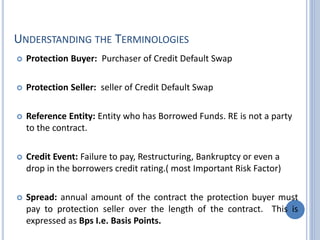
 Protection Buyer: Purchaser of Credit Default Swap
 Protection Seller: seller of Credit Default Swap
 Reference Entity: Entity who has Borrowed Funds. RE is not a party
to the contract.
 Credit Event: Failure to pay, Restructuring, Bankruptcy or even a
drop in the borrowers credit rating.( most Important Risk Factor)
 Spread: annual amount of the contract the protection buyer must
pay to protection seller over the length of the contract. This is
expressed as Bps I.e. Basis Points.
EXAMPLE OF CDS
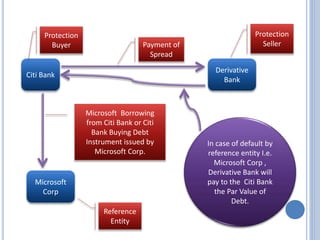
 suppose that Citi Bank has lent money to Microsoft Corp in
the form of a $1,000 bond.
 Citi Bank may then purchase a credit default swap from
another company e.g. a Hedge Fund / Derivative Bank.
 If the firm (Microsoft Corp ) default on the loan, then the
Derivative Bank will pay Citi Bank the value of the loan.
 Thus Citi Bank have insurance against loan default. The
Derivative Bank has the opportunity to make profit, so long
as the firm does not default on the loan.
 The more risky the loan, the higher will be the premium
required on buying a credit default swap.
 Premium expressed in term of bps ( Basis Points ).
Citi Bank
Derivative
Bank
Microsoft
Corp
Protection
Seller
Protection
Buyer
Microsoft Borrowing
from Citi Bank or Citi
Bank Buying Debt
Instrument issued by
Microsoft Corp.
Payment of
Spread
In case of default by
reference entity I.e.
Microsoft Corp ,
Derivative Bank will
pay to the Citi Bank
the Par Value of
Debt.
Reference
Entity
ANALYSIS OF THE EXAMPLE
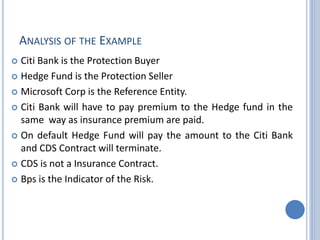
 Citi Bank is the Protection Buyer
 Hedge Fund is the Protection Seller
 Microsoft Corp is the Reference Entity.
 Citi Bank will have to pay premium to the Hedge fund in the
same way as insurance premium are paid.
 On default Hedge Fund will pay the amount to the Citi Bank
and CDS Contract will terminate.
 CDS is not a Insurance Contract.
 Bps is the Indicator of the Risk.
RISK
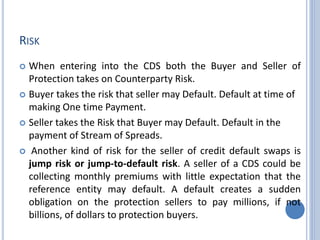
 When entering into the CDS both the Buyer and Seller of
Protection takes on Counterparty Risk.
 Buyer takes the risk that seller may Default. Default at time of
making One time Payment.
 Seller takes the Risk that Buyer may Default. Default in the
payment of Stream of Spreads.
 Another kind of risk for the seller of credit default swaps is
jump risk or jump-to-default risk. A seller of a CDS could be
collecting monthly premiums with little expectation that the
reference entity may default. A default creates a sudden
obligation on the protection sellers to pay millions, if not
billions, of dollars to protection buyers.
SPREAD-
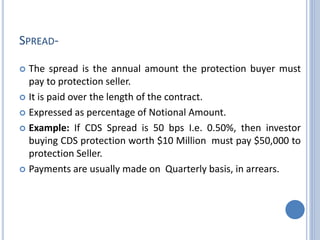
 The spread is the annual amount the protection buyer must
pay to protection seller.
 It is paid over the length of the contract.
 Expressed as percentage of Notional Amount.
 Example: If CDS Spread is 50 bps I.e. 0.50%, then investor
buying CDS protection worth $10 Million must pay $50,000 to
protection Seller.
 Payments are usually made on Quarterly basis, in arrears.
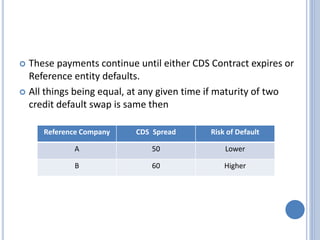
 These payments continue until either CDS Contract expires or
Reference entity defaults.
 All things being equal, at any given time if maturity of two
credit default swap is same then
Reference Company CDS Spread Risk of Default
A 50 Lower
B 60 Higher
WHETHER IT IS AN INSURANCE CONTRACT?
 CDS Contract have been compared with insurance,
because buyer pays the premium and in return receive
the sum of money if one of the defaulting event
specified in the contract occurs.
 However there are number of differences between
insurance contract and CDS
 Buyer of CDS doesn’t need to own underlying security
 In fact the buyer need not to suffer the loss from defaulting
event.
 Insurance contract provides an indemnity against the losses
actually suffered.
 Cost of insurance is based on actuarial analysis. CDS are
derivatives whose cost is determined using financial models.
The CDS is not an Insurance.
USES OF CDS
 Speculation – Profit making through price changes
 Hedging – Insulation against price risk
 Arbitrage – look for opportunity that arise out of the product
being price differently in two markets. ( Capital Structure
Arbitrage is an example of arbitrage strategy that utilizes CDS
transaction. )
NAKED CDS
 A CDS in which the buyer doesn't own the underlying
debt is referred to as Naked CDS.
 There is a debate in the US and Europe that whether
speculative uses of CDS should be banned.
 Critics asserts that Naked CDS should be banned,
comparing them to buying fire insurance on your
Neighbor’s house, which creates huge incentives for the
arson.
 Proponents of Naked CDS says that it increases liquidity
in the market and also benefits hedging.
SETTLEMENT
 If the credit event occurs then CDS Contract can either be
Physically settled or Cash Settled.
 Physical Settlement
 The Protection seller pays the buyer par value and In turns take
delivery of a debt obligation of reference entity. Example: A Hedge
fund has Bought from a Derivative Bank $5 Million protection on a
Debt of the Company. In the event of default the Derivative bank
pays the fund $5 Million and Hedge Fund must deliver $5 Million
face value of Debt of the reference company.
 Cash Settlement
 The protection seller pays the buyer the difference between par
value and market value of Debt Obligation of the reference entity.
Example: A Hedge fund has Bought from a Derivative Bank $5 Million
protection on a Debt of the Company. This company has now
defaulted and its bonds are now trading @ 25% of value, since the
market believes that bondholder will receive 25% of the money they
are owed once the company is wound up. Therefore the bank must
pay the hedge fund only 75% ( 100% - 25% ).
WHY CDS?????
 JP Morgan Stanly was trying to get its head around a
Question: How do you mitigate your risk when you loan
money to someone?
 By mid 90s JP Morgan's Book was loaded with Billions of
Dollars in Loan to corporations and Foreign
Governments.
 It had to keep huge amount of capital in reserves as per
Basel II norm.
 It created a device that would protect it if those loan
defaulted, and free up that capital adequacy
requirement.
 Unregulated CDS allowed banks to get around the Basel
rules.
CDS-NUCLEAR BOMB
 Like Robert Oppenheimer and his team of nuclear
physicists in the 1940s, JPMorgan didn't realize they
were creating a monster.
 The country's biggest insurance company, AIG, had to be
bailed out by American taxpayers after it defaulted on
$14 billion worth of credit default swaps it had made to
investment banks, insurance companies other entities.
 There's a reason Warren Buffett called these
instruments "financial weapons of mass destruction."
Since credit default swaps are privately negotiated
contracts between two parties and aren't regulated by
the government, there's no central reporting
mechanism to determine their value.
THANK YOU FRIENDS

Introduction to CDS

  • 1.
    CREDIT DEFAULT SWAP (CDS) By: CA. Badshah Motashim Husain
  • 2.
    INTRODUCTION TO CDS It is a Financial Swap Agreement between Two counterparties.  Where the Protection Seller will compensate the Protection Buyer.  In the Event of Loan Default or other Credit Events.  The Protection Buyer makes a series of payments to the Protection seller and in turn receive the payoff if the loan Defaults.  It is Simply a Credit Derivative.  CDS are not traded on any Stock exchange.
  • 3.
    UNDERSTANDING THE TERMINOLOGIES Protection Buyer: Purchaser of Credit Default Swap  Protection Seller: seller of Credit Default Swap  Reference Entity: Entity who has Borrowed Funds. RE is not a party to the contract.  Credit Event: Failure to pay, Restructuring, Bankruptcy or even a drop in the borrowers credit rating.( most Important Risk Factor)  Spread: annual amount of the contract the protection buyer must pay to protection seller over the length of the contract. This is expressed as Bps I.e. Basis Points.
  • 4.
    EXAMPLE OF CDS suppose that Citi Bank has lent money to Microsoft Corp in the form of a $1,000 bond.  Citi Bank may then purchase a credit default swap from another company e.g. a Hedge Fund / Derivative Bank.  If the firm (Microsoft Corp ) default on the loan, then the Derivative Bank will pay Citi Bank the value of the loan.  Thus Citi Bank have insurance against loan default. The Derivative Bank has the opportunity to make profit, so long as the firm does not default on the loan.  The more risky the loan, the higher will be the premium required on buying a credit default swap.  Premium expressed in term of bps ( Basis Points ).
  • 5.
    Citi Bank Derivative Bank Microsoft Corp Protection Seller Protection Buyer Microsoft Borrowing fromCiti Bank or Citi Bank Buying Debt Instrument issued by Microsoft Corp. Payment of Spread In case of default by reference entity I.e. Microsoft Corp , Derivative Bank will pay to the Citi Bank the Par Value of Debt. Reference Entity
  • 6.
    ANALYSIS OF THEEXAMPLE  Citi Bank is the Protection Buyer  Hedge Fund is the Protection Seller  Microsoft Corp is the Reference Entity.  Citi Bank will have to pay premium to the Hedge fund in the same way as insurance premium are paid.  On default Hedge Fund will pay the amount to the Citi Bank and CDS Contract will terminate.  CDS is not a Insurance Contract.  Bps is the Indicator of the Risk.
  • 7.
    RISK  When enteringinto the CDS both the Buyer and Seller of Protection takes on Counterparty Risk.  Buyer takes the risk that seller may Default. Default at time of making One time Payment.  Seller takes the Risk that Buyer may Default. Default in the payment of Stream of Spreads.  Another kind of risk for the seller of credit default swaps is jump risk or jump-to-default risk. A seller of a CDS could be collecting monthly premiums with little expectation that the reference entity may default. A default creates a sudden obligation on the protection sellers to pay millions, if not billions, of dollars to protection buyers.
  • 8.
    SPREAD-  The spreadis the annual amount the protection buyer must pay to protection seller.  It is paid over the length of the contract.  Expressed as percentage of Notional Amount.  Example: If CDS Spread is 50 bps I.e. 0.50%, then investor buying CDS protection worth $10 Million must pay $50,000 to protection Seller.  Payments are usually made on Quarterly basis, in arrears.
  • 9.
     These paymentscontinue until either CDS Contract expires or Reference entity defaults.  All things being equal, at any given time if maturity of two credit default swap is same then Reference Company CDS Spread Risk of Default A 50 Lower B 60 Higher
  • 10.
    WHETHER IT ISAN INSURANCE CONTRACT?  CDS Contract have been compared with insurance, because buyer pays the premium and in return receive the sum of money if one of the defaulting event specified in the contract occurs.  However there are number of differences between insurance contract and CDS  Buyer of CDS doesn’t need to own underlying security  In fact the buyer need not to suffer the loss from defaulting event.  Insurance contract provides an indemnity against the losses actually suffered.  Cost of insurance is based on actuarial analysis. CDS are derivatives whose cost is determined using financial models. The CDS is not an Insurance.
  • 11.
    USES OF CDS Speculation – Profit making through price changes  Hedging – Insulation against price risk  Arbitrage – look for opportunity that arise out of the product being price differently in two markets. ( Capital Structure Arbitrage is an example of arbitrage strategy that utilizes CDS transaction. )
  • 12.
    NAKED CDS  ACDS in which the buyer doesn't own the underlying debt is referred to as Naked CDS.  There is a debate in the US and Europe that whether speculative uses of CDS should be banned.  Critics asserts that Naked CDS should be banned, comparing them to buying fire insurance on your Neighbor’s house, which creates huge incentives for the arson.  Proponents of Naked CDS says that it increases liquidity in the market and also benefits hedging.
  • 13.
    SETTLEMENT  If thecredit event occurs then CDS Contract can either be Physically settled or Cash Settled.  Physical Settlement  The Protection seller pays the buyer par value and In turns take delivery of a debt obligation of reference entity. Example: A Hedge fund has Bought from a Derivative Bank $5 Million protection on a Debt of the Company. In the event of default the Derivative bank pays the fund $5 Million and Hedge Fund must deliver $5 Million face value of Debt of the reference company.
  • 14.
     Cash Settlement The protection seller pays the buyer the difference between par value and market value of Debt Obligation of the reference entity. Example: A Hedge fund has Bought from a Derivative Bank $5 Million protection on a Debt of the Company. This company has now defaulted and its bonds are now trading @ 25% of value, since the market believes that bondholder will receive 25% of the money they are owed once the company is wound up. Therefore the bank must pay the hedge fund only 75% ( 100% - 25% ).
  • 15.
    WHY CDS?????  JPMorgan Stanly was trying to get its head around a Question: How do you mitigate your risk when you loan money to someone?  By mid 90s JP Morgan's Book was loaded with Billions of Dollars in Loan to corporations and Foreign Governments.  It had to keep huge amount of capital in reserves as per Basel II norm.  It created a device that would protect it if those loan defaulted, and free up that capital adequacy requirement.  Unregulated CDS allowed banks to get around the Basel rules.
  • 16.
    CDS-NUCLEAR BOMB  LikeRobert Oppenheimer and his team of nuclear physicists in the 1940s, JPMorgan didn't realize they were creating a monster.  The country's biggest insurance company, AIG, had to be bailed out by American taxpayers after it defaulted on $14 billion worth of credit default swaps it had made to investment banks, insurance companies other entities.  There's a reason Warren Buffett called these instruments "financial weapons of mass destruction." Since credit default swaps are privately negotiated contracts between two parties and aren't regulated by the government, there's no central reporting mechanism to determine their value.
  • 17.