Introduction to C
S.MUTHUGANESH M.Sc.,B.Ed
ASSISTANT PROFESSOR OF COMPUTER SCIENCE
VIVEKANANDA COLLEGE
About C
▪ C was originally developed in the 1970s, by Dennis Ritchie at Bell
Telephone Laboratories, Inc.
▪ the C language is a general-purpose language. It is an efficient, flexible and
portable language.
▪ Portability refers to the casein which a unit of software written on one computer may
be moved to another computer without any or little modification.
▪ C is a High level , general –purpose structured programming language
▪ C to be used for system programming as well as for applications
programming
Basic types of elements
▪ The C language is composed of the following basic types of elements:
▪ constants, identifiers, operators, punctuation, and keywords
▪ These elements are collectively known as tokens.
▪ The tokens are,
number - identifier (variable)
= - operator
+ - operator
1 - constant
; - punctuation
constant
▪ A constant is of numeric or non-numeric type.
▪ It can be a number, a character or a character stringthat can be used as a
value in a program.
▪ The value of a constant cannot be modified.
▪ Eg 1,a,b,hai,school
▪ Numeric data is primarily made up of numbers and can include
decimal points.
▪ Non-numeric data may be composed of numbers, letters, blanks
and any special characters
Contd,..
Numeric constants are of threetypes:
• integer constant(o-9),(0xa12-hexa-decimal),(0-7-octal)
• floating-point constant(1.56,3.14)
• character constant(‘a’,”hello”) string literal
▪ An escape sequence may be used to represent a single quote as a character constant. Character combinations
consisting of a backslash ‘’ followed by a letter are called escape sequences. Examples:
▪ ‘a’ Bell (beep)
▪ ‘b’ Backspace
▪ ‘f’ Form feed
▪ ‘r’ Carriage return
▪ ‘n’ New line
▪ ‘0’ null character
Identifiers
▪ Identifiers are the names that are to be given to the variables, functions, data types and labels in a program.
▪ The name of a variable can consist of alphabets (letters)and numbers.
▪ Blank spaces are not allowed.
▪ An underscore(_) character can be used as a valid character in the variable name.
▪ The variable name starts with an alphabet and its length may vary from one character to 32 characters.
▪ The first character in a variable’s name should be an alphabet, ie., a number is not allowed as a first character
in the variable name.
▪ The valid variable names are:
x
length
x_value
y_value
a123
Keywords (which have special meaning in C) cannot be used as identifiers
Invalid identifiers
▪ The following variable names are invalid and the reasons are stated.
▪ 123 -The first character is a number
▪ 1abc -The first character is a number
▪ x value - A blank character is used
▪ x&y - A character other than alphabet and number is used & is not a
▪ valid character in a variable name.
▪ for - It is a keyword
Punctuation and Keywords
▪ C’s punctuation symbols and their uses are listed as follows:
▪ [ ] - used to represent array index (square brackets)
▪ { } - used to cover the body of the function (curly braces)
▪ ( ) - used to represent a function, to group items and to group expressions (simple parentheses)
▪ < > - used to enclose a header file in a preprocessor statement (angular brackets)
▪ “ “ - used to represent string literals (double quotes)
▪ ‘ ‘ - used to represent a character constant (single quotes)
▪ /* */ - used to represent a comment
▪ ; - used as a statement terminator
▪ , - used to separate items
keywords
▪ The following are the list of important keywords.They cannot be used as identifiers for
the variables in a program.
▪ Auto, break, case, char, continue, default, do, else,
if, float, for, int, return, static, switch, while.
▪ For example, auto is a keyword, whereas, Auto or AUTO are not keywords
Fundamental Data Types
▪ Data is one of the most commonly used terms in programming. Data can be defined as the raw information
input to the computer. Data is differentiated into various types in C.
▪ There are three numeric data types that comprise the fundamental or primary data types.The fundamental
data types are: int, float and char.
▪ They are also called as pre-defined primitive types associated with the C
▪ The following are the declaration statements of variables of different types:
▪ int x;
▪ float f;
▪ char ch;
▪ We know already that an integer is a whole number(0-9)(2bytes), a float is a real
number(0.89)(4bytes) and a character(‘a’)(1bytes) is represented within single
quotes.
Derived Types
▪ Long, double, unsigned, arrays and pointers are the derived
typesfrom the fundamental primitive types. A long integer can be declared as follows:
▪ long int i;
▪ or
▪ long i;
▪ To store a long integer value, four bytes of memory are required.To store the
real (float) values more precisely, the type double is used. It occupies 8 bytes in the
memory.
operator
▪ C has rich set of operators. Operators are what make things happen. An operator is defined as a
symbol that specifies an operation to be performed.
▪ Operators inform the computer what tasks it has to perform as well as the order in which to
perform them.
▪ There are three types of operators in C.
▪ Unary operators(++,--,&,!,*)
▪ Binary operators
▪ Ternary operator
Unary Operators
▪ Order of precedence is high for the unary operators and they have only one operand.The order of
evaluation (associativity) is from right to left
Binary Operators
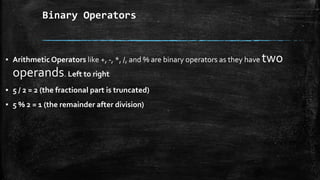
▪ Arithmetic Operators like +, -, *, /, and % are binary operators as they have two
operands. Left to right
▪ 5 / 2 = 2 (the fractional part is truncated)
▪ 5 % 2 = 1 (the remainder after division)
Relational Operators
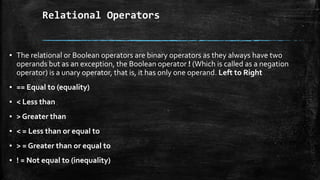
▪ The relational or Boolean operators are binary operators as they always have two
operands but as an exception, the Boolean operator ! (Which is called as a negation
operator) is a unary operator, that is, it has only one operand. Left to Right
▪ == Equal to (equality)
▪ < Less than
▪ > Greater than
▪ < = Less than or equal to
▪ > = Greater than or equal to
▪ ! = Not equal to (inequality)
Assignment Operators
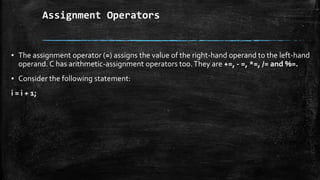
▪ The assignment operator (=) assigns the value of the right-hand operand to the left-hand
operand. C has arithmetic-assignment operators too.They are +=, - =, *=, /= and %=.
▪ Consider the following statement:
i = i + 1;
The order of evaluation
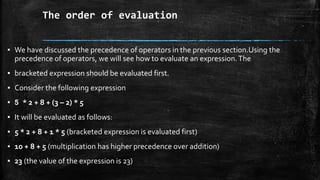
▪ We have discussed the precedence of operators in the previous section.Using the
precedence of operators, we will see how to evaluate an expression.The
▪ bracketed expression should be evaluated first.
▪ Consider the following expression
▪ 5 * 2 + 8 + (3 – 2) * 5
▪ It will be evaluated as follows:
▪ 5 * 2 + 8 + 1 * 5 (bracketed expression is evaluated first)
▪ 10 + 8 + 5 (multiplication has higher precedence over addition)
▪ 23 (the value of the expression is 23)
Ternary Operator
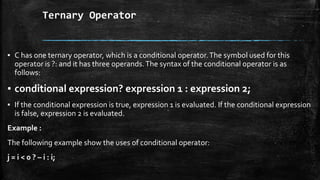
▪ C has one ternary operator, which is a conditional operator.The symbol used for this
operator is ?: and it has three operands.The syntax of the conditional operator is as
follows:
▪ conditional expression? expression 1 : expression 2;
▪ If the conditional expression is true, expression 1 is evaluated. If the conditional expression
is false, expression 2 is evaluated.
Example :
The following example show the uses of conditional operator:
j = i < 0 ? – i : i;
A Sample C Program
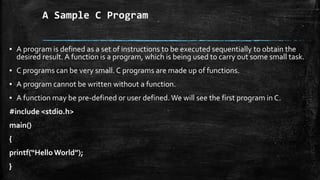
▪ A program is defined as a set of instructions to be executed sequentially to obtain the
desired result. A function is a program, which is being used to carry out some small task.
▪ C programs can be very small. C programs are made up of functions.
▪ A program cannot be written without a function.
▪ A function may be pre-defined or user defined. We will see the first program in C.
#include <stdio.h>
main()
{
printf(“HelloWorld”);
}
Thank you

Introduction to c

  • 1.
    Introduction to C S.MUTHUGANESHM.Sc.,B.Ed ASSISTANT PROFESSOR OF COMPUTER SCIENCE VIVEKANANDA COLLEGE
  • 2.
    About C ▪ Cwas originally developed in the 1970s, by Dennis Ritchie at Bell Telephone Laboratories, Inc. ▪ the C language is a general-purpose language. It is an efficient, flexible and portable language. ▪ Portability refers to the casein which a unit of software written on one computer may be moved to another computer without any or little modification. ▪ C is a High level , general –purpose structured programming language ▪ C to be used for system programming as well as for applications programming
  • 3.
    Basic types ofelements ▪ The C language is composed of the following basic types of elements: ▪ constants, identifiers, operators, punctuation, and keywords ▪ These elements are collectively known as tokens. ▪ The tokens are, number - identifier (variable) = - operator + - operator 1 - constant ; - punctuation
  • 4.
    constant ▪ A constantis of numeric or non-numeric type. ▪ It can be a number, a character or a character stringthat can be used as a value in a program. ▪ The value of a constant cannot be modified. ▪ Eg 1,a,b,hai,school ▪ Numeric data is primarily made up of numbers and can include decimal points. ▪ Non-numeric data may be composed of numbers, letters, blanks and any special characters
  • 5.
    Contd,.. Numeric constants areof threetypes: • integer constant(o-9),(0xa12-hexa-decimal),(0-7-octal) • floating-point constant(1.56,3.14) • character constant(‘a’,”hello”) string literal ▪ An escape sequence may be used to represent a single quote as a character constant. Character combinations consisting of a backslash ‘’ followed by a letter are called escape sequences. Examples: ▪ ‘a’ Bell (beep) ▪ ‘b’ Backspace ▪ ‘f’ Form feed ▪ ‘r’ Carriage return ▪ ‘n’ New line ▪ ‘0’ null character
  • 6.
    Identifiers ▪ Identifiers arethe names that are to be given to the variables, functions, data types and labels in a program. ▪ The name of a variable can consist of alphabets (letters)and numbers. ▪ Blank spaces are not allowed. ▪ An underscore(_) character can be used as a valid character in the variable name. ▪ The variable name starts with an alphabet and its length may vary from one character to 32 characters. ▪ The first character in a variable’s name should be an alphabet, ie., a number is not allowed as a first character in the variable name. ▪ The valid variable names are: x length x_value y_value a123 Keywords (which have special meaning in C) cannot be used as identifiers
  • 7.
    Invalid identifiers ▪ Thefollowing variable names are invalid and the reasons are stated. ▪ 123 -The first character is a number ▪ 1abc -The first character is a number ▪ x value - A blank character is used ▪ x&y - A character other than alphabet and number is used & is not a ▪ valid character in a variable name. ▪ for - It is a keyword
  • 8.
    Punctuation and Keywords ▪C’s punctuation symbols and their uses are listed as follows: ▪ [ ] - used to represent array index (square brackets) ▪ { } - used to cover the body of the function (curly braces) ▪ ( ) - used to represent a function, to group items and to group expressions (simple parentheses) ▪ < > - used to enclose a header file in a preprocessor statement (angular brackets) ▪ “ “ - used to represent string literals (double quotes) ▪ ‘ ‘ - used to represent a character constant (single quotes) ▪ /* */ - used to represent a comment ▪ ; - used as a statement terminator ▪ , - used to separate items
  • 9.
    keywords ▪ The followingare the list of important keywords.They cannot be used as identifiers for the variables in a program. ▪ Auto, break, case, char, continue, default, do, else, if, float, for, int, return, static, switch, while. ▪ For example, auto is a keyword, whereas, Auto or AUTO are not keywords
  • 10.
    Fundamental Data Types ▪Data is one of the most commonly used terms in programming. Data can be defined as the raw information input to the computer. Data is differentiated into various types in C. ▪ There are three numeric data types that comprise the fundamental or primary data types.The fundamental data types are: int, float and char. ▪ They are also called as pre-defined primitive types associated with the C ▪ The following are the declaration statements of variables of different types: ▪ int x; ▪ float f; ▪ char ch; ▪ We know already that an integer is a whole number(0-9)(2bytes), a float is a real number(0.89)(4bytes) and a character(‘a’)(1bytes) is represented within single quotes.
  • 11.
    Derived Types ▪ Long,double, unsigned, arrays and pointers are the derived typesfrom the fundamental primitive types. A long integer can be declared as follows: ▪ long int i; ▪ or ▪ long i; ▪ To store a long integer value, four bytes of memory are required.To store the real (float) values more precisely, the type double is used. It occupies 8 bytes in the memory.
  • 12.
    operator ▪ C hasrich set of operators. Operators are what make things happen. An operator is defined as a symbol that specifies an operation to be performed. ▪ Operators inform the computer what tasks it has to perform as well as the order in which to perform them. ▪ There are three types of operators in C. ▪ Unary operators(++,--,&,!,*) ▪ Binary operators ▪ Ternary operator Unary Operators ▪ Order of precedence is high for the unary operators and they have only one operand.The order of evaluation (associativity) is from right to left
  • 13.
    Binary Operators ▪ ArithmeticOperators like +, -, *, /, and % are binary operators as they have two operands. Left to right ▪ 5 / 2 = 2 (the fractional part is truncated) ▪ 5 % 2 = 1 (the remainder after division)
  • 14.
    Relational Operators ▪ Therelational or Boolean operators are binary operators as they always have two operands but as an exception, the Boolean operator ! (Which is called as a negation operator) is a unary operator, that is, it has only one operand. Left to Right ▪ == Equal to (equality) ▪ < Less than ▪ > Greater than ▪ < = Less than or equal to ▪ > = Greater than or equal to ▪ ! = Not equal to (inequality)
  • 15.
    Assignment Operators ▪ Theassignment operator (=) assigns the value of the right-hand operand to the left-hand operand. C has arithmetic-assignment operators too.They are +=, - =, *=, /= and %=. ▪ Consider the following statement: i = i + 1;
  • 16.
    The order ofevaluation ▪ We have discussed the precedence of operators in the previous section.Using the precedence of operators, we will see how to evaluate an expression.The ▪ bracketed expression should be evaluated first. ▪ Consider the following expression ▪ 5 * 2 + 8 + (3 – 2) * 5 ▪ It will be evaluated as follows: ▪ 5 * 2 + 8 + 1 * 5 (bracketed expression is evaluated first) ▪ 10 + 8 + 5 (multiplication has higher precedence over addition) ▪ 23 (the value of the expression is 23)
  • 17.
    Ternary Operator ▪ Chas one ternary operator, which is a conditional operator.The symbol used for this operator is ?: and it has three operands.The syntax of the conditional operator is as follows: ▪ conditional expression? expression 1 : expression 2; ▪ If the conditional expression is true, expression 1 is evaluated. If the conditional expression is false, expression 2 is evaluated. Example : The following example show the uses of conditional operator: j = i < 0 ? – i : i;
  • 18.
    A Sample CProgram ▪ A program is defined as a set of instructions to be executed sequentially to obtain the desired result. A function is a program, which is being used to carry out some small task. ▪ C programs can be very small. C programs are made up of functions. ▪ A program cannot be written without a function. ▪ A function may be pre-defined or user defined. We will see the first program in C. #include <stdio.h> main() { printf(“HelloWorld”); }
  • 19.