Blockchain
Technology and Its
Applications
Introduction to Blockchain Technology
1
2
3
What is Blockchain?
Decentralization
Distributed Ledger
Yaga, D., Mell, P., Roby, N., & Scarfone, K. (2018).
Blockchain Technology Overview. National Institute of
Standards and Technology Internal Report (NISTIR)
8202. National Institute of Standards and Technology.
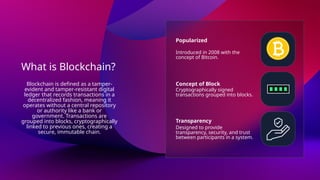
What is Blockchain?
Popularized
Concept of Block
Transparency
Introduced in 2008 with the
concept of Bitcoin.
Cryptographically signed
transactions grouped into blocks.
Designed to provide
transparency, security, and trust
between participants in a system.
Blockchain is defined as a tamper-
evident and tamper-resistant digital
ledger that records transactions in a
decentralized fashion, meaning it
operates without a central repository
or authority like a bank or
government. Transactions are
grouped into blocks, cryptographically
linked to previous ones, creating a
secure, immutable chain.
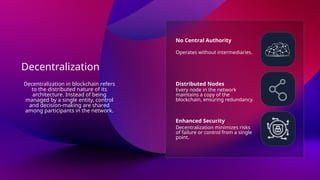
Decentralization
No Central Authority
Distributed Nodes
Enhanced Security
Operates without intermediaries.
Every node in the network
maintains a copy of the
blockchain, ensuring redundancy.
Decentralization minimizes risks
of failure or control from a single
point.
Decentralization in blockchain refers
to the distributed nature of its
architecture. Instead of being
managed by a single entity, control
and decision-making are shared
among participants in the network.
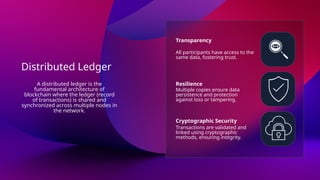
Distributed Ledger
Transparency
Resilience
Cryptographic Security
All participants have access to the
same data, fostering trust.
Multiple copies ensure data
persistence and protection
against loss or tampering.
Transactions are validated and
linked using cryptographic
methods, ensuring integrity.
A distributed ledger is the
fundamental architecture of
blockchain where the ledger (record
of transactions) is shared and
synchronized across multiple nodes in
the network.
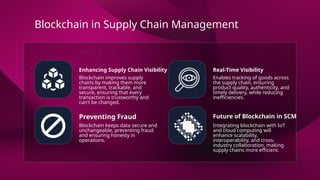
Enhancing Supply Chain Visibility Real-Time Visibility
Preventing Fraud Future of Blockchain in SCM
Blockchain improves supply
chains by making them more
transparent, trackable, and
secure, ensuring that every
transaction is trustworthy and
can't be changed.
Enables tracking of goods across
the supply chain, ensuring
product quality, authenticity, and
timely delivery, while reducing
inefficiencies.
Blockchain keeps data secure and
unchangeable, preventing fraud
and ensuring honesty in
operations.
Integrating blockchain with IoT
and cloud computing will
enhance scalability,
interoperability, and cross-
industry collaboration, making
supply chains more efficient.
Blockchain in Supply Chain Management
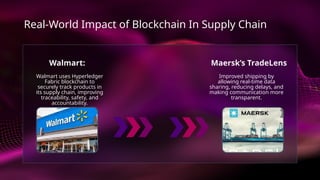
Maersk’s TradeLens
Improved shipping by
allowing real-time data
sharing, reducing delays, and
making communication more
transparent.
Walmart:
Walmart uses Hyperledger
Fabric blockchain to
securely track products in
its supply chain, improving
traceability, safety, and
accountability.
Real-World Impact of Blockchain In Supply Chain
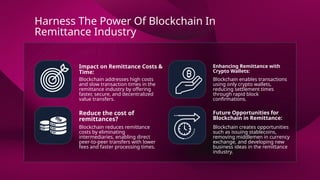
Impact on Remittance Costs &
Time:
Enhancing Remittance with
Crypto Wallets:
Reduce the cost of
remittances?
Future Opportunities for
Blockchain in Remittance:
Blockchain addresses high costs
and slow transaction times in the
remittance industry by offering
faster, secure, and decentralized
value transfers.
Blockchain enables transactions
using only crypto wallets,
reducing settlement times
through rapid block
confirmations.
Blockchain reduces remittance
costs by eliminating
intermediaries, enabling direct
peer-to-peer transfers with lower
fees and faster processing times.
Blockchain creates opportunities
such as issuing stablecoins,
removing middlemen in currency
exchange, and developing new
business ideas in the remittance
industry.
Harness The Power Of Blockchain In
Remittance Industry
Stellar:
Stellar blockchain helps cut
down remittance fees and
transaction time by working
with financial and nonprofit
partners for global money
transfers.
Ripple:
Ripple's blockchain technology
enables faster and cheaper cross-
border payments, which has been
adopted by various financial
institutions for remittance
services.
Real-World Examples of Blockchain In Remittance
Industry
How Blockchain Helped: Transparency:
Privacy: Decentralization:
Security: Blockchain locks votes
in a tamper-proof ledger,
preventing fraud or changes. .
Voting records are verifiable
without compromising privacy.
Encryption ensures voter
anonymity, protecting identities.
Control is spread across nodes,
reducing risks of manipulation.
Secure and Transparent E-Voting
Systems with Blockchain Technology in
the Context of Palestine
Ease of Use:
Secure, user-friendly web
interface with OTP for
authentication.
Scalability:
Efficiently handles large voter
bases, ideal for national elections.
Secure and Transparent E-Voting
Systems with Blockchain Technology in the Context of
Palestine
Advantages of Blockchain Technology
Decentralization
Transparency
Security
Efficiency
Removes intermediaries, reducing risks of a single point of failure.
Public ledger enhances trust and accountability among participants.
Cryptographic algorithms protect data from tampering and unauthorized access.
Smart contracts automate processes, reducing delays and manual
intervention.
J. Golosova and A. Romanovs, "The Advantages and Disadvantages of the Blockchain Technology," in Proc.
2018 IEEE 6th Workshop on Advances in Information, Electronic and Electrical Engineering (AIEEE)
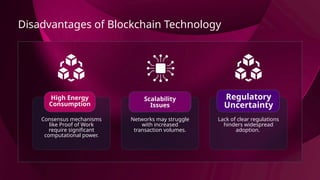
Disadvantages of Blockchain Technology
Consensus mechanisms
like Proof of Work
require significant
computational power.
High Energy
Consumption
Networks may struggle
with increased
transaction volumes.
Scalability
Issues
Lack of clear regulations
hinders widespread
adoption.
Regulatory
Uncertainty
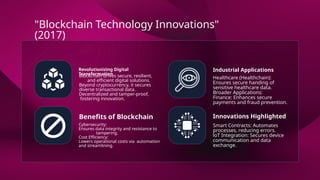
Revolutionizing Digital
Transformation
Industrial Applications
Benefits of Blockchain Innovations Highlighted
Blockchain drives secure, resilient,
and efficient digital solutions.
Beyond cryptocurrency, it secures
diverse transactional data.
Decentralized and tamper-proof,
fostering innovation.
Healthcare (Healthchain):
Ensures secure handing of
sensitive healthcare data.
Broader Applications:
Finance: Enhances secure
payments and fraud prevention.
Cybersecurity:
Ensures data integrity and resistance to
tampering.
Cost Efficiency:
Lowers operational costs via automation
and streamlining.
Smart Contracts: Automates
processes, reducing errors.
loT Integration: Secures device
communication and data
exchange.
"Blockchain Technology Innovations"
(2017)
References
• https://wjarr.co.in/wjarr-2024-1895
• https://ieeexplore.ieee.org/abstract/document/8592253
• https://www.researchgate.net/publication/
382143475_Transforming_the_remittance_industry_harnessing_the_power_of_blockchai
n_technology
• https://nvlpubs.nist.gov/nistpubs/ir/2018/nist.ir.8202.pdf
• https://adi-journal.org/index.php/ajri/article/view/1065
THANK YOU

Blockchain Technology and Its Applications | Pros & Cons | Case Studies | Researches

  • 1.
  • 2.
    Introduction to BlockchainTechnology 1 2 3 What is Blockchain? Decentralization Distributed Ledger Yaga, D., Mell, P., Roby, N., & Scarfone, K. (2018). Blockchain Technology Overview. National Institute of Standards and Technology Internal Report (NISTIR) 8202. National Institute of Standards and Technology.
  • 3.
    What is Blockchain? Popularized Conceptof Block Transparency Introduced in 2008 with the concept of Bitcoin. Cryptographically signed transactions grouped into blocks. Designed to provide transparency, security, and trust between participants in a system. Blockchain is defined as a tamper- evident and tamper-resistant digital ledger that records transactions in a decentralized fashion, meaning it operates without a central repository or authority like a bank or government. Transactions are grouped into blocks, cryptographically linked to previous ones, creating a secure, immutable chain.
  • 4.
    Decentralization No Central Authority DistributedNodes Enhanced Security Operates without intermediaries. Every node in the network maintains a copy of the blockchain, ensuring redundancy. Decentralization minimizes risks of failure or control from a single point. Decentralization in blockchain refers to the distributed nature of its architecture. Instead of being managed by a single entity, control and decision-making are shared among participants in the network.
  • 5.
    Distributed Ledger Transparency Resilience Cryptographic Security Allparticipants have access to the same data, fostering trust. Multiple copies ensure data persistence and protection against loss or tampering. Transactions are validated and linked using cryptographic methods, ensuring integrity. A distributed ledger is the fundamental architecture of blockchain where the ledger (record of transactions) is shared and synchronized across multiple nodes in the network.
  • 6.
    Enhancing Supply ChainVisibility Real-Time Visibility Preventing Fraud Future of Blockchain in SCM Blockchain improves supply chains by making them more transparent, trackable, and secure, ensuring that every transaction is trustworthy and can't be changed. Enables tracking of goods across the supply chain, ensuring product quality, authenticity, and timely delivery, while reducing inefficiencies. Blockchain keeps data secure and unchangeable, preventing fraud and ensuring honesty in operations. Integrating blockchain with IoT and cloud computing will enhance scalability, interoperability, and cross- industry collaboration, making supply chains more efficient. Blockchain in Supply Chain Management
  • 7.
    Maersk’s TradeLens Improved shippingby allowing real-time data sharing, reducing delays, and making communication more transparent. Walmart: Walmart uses Hyperledger Fabric blockchain to securely track products in its supply chain, improving traceability, safety, and accountability. Real-World Impact of Blockchain In Supply Chain
  • 8.
    Impact on RemittanceCosts & Time: Enhancing Remittance with Crypto Wallets: Reduce the cost of remittances? Future Opportunities for Blockchain in Remittance: Blockchain addresses high costs and slow transaction times in the remittance industry by offering faster, secure, and decentralized value transfers. Blockchain enables transactions using only crypto wallets, reducing settlement times through rapid block confirmations. Blockchain reduces remittance costs by eliminating intermediaries, enabling direct peer-to-peer transfers with lower fees and faster processing times. Blockchain creates opportunities such as issuing stablecoins, removing middlemen in currency exchange, and developing new business ideas in the remittance industry. Harness The Power Of Blockchain In Remittance Industry
  • 9.
    Stellar: Stellar blockchain helpscut down remittance fees and transaction time by working with financial and nonprofit partners for global money transfers. Ripple: Ripple's blockchain technology enables faster and cheaper cross- border payments, which has been adopted by various financial institutions for remittance services. Real-World Examples of Blockchain In Remittance Industry
  • 10.
    How Blockchain Helped:Transparency: Privacy: Decentralization: Security: Blockchain locks votes in a tamper-proof ledger, preventing fraud or changes. . Voting records are verifiable without compromising privacy. Encryption ensures voter anonymity, protecting identities. Control is spread across nodes, reducing risks of manipulation. Secure and Transparent E-Voting Systems with Blockchain Technology in the Context of Palestine
  • 11.
    Ease of Use: Secure,user-friendly web interface with OTP for authentication. Scalability: Efficiently handles large voter bases, ideal for national elections. Secure and Transparent E-Voting Systems with Blockchain Technology in the Context of Palestine
  • 12.
    Advantages of BlockchainTechnology Decentralization Transparency Security Efficiency Removes intermediaries, reducing risks of a single point of failure. Public ledger enhances trust and accountability among participants. Cryptographic algorithms protect data from tampering and unauthorized access. Smart contracts automate processes, reducing delays and manual intervention. J. Golosova and A. Romanovs, "The Advantages and Disadvantages of the Blockchain Technology," in Proc. 2018 IEEE 6th Workshop on Advances in Information, Electronic and Electrical Engineering (AIEEE)
  • 13.
    Disadvantages of BlockchainTechnology Consensus mechanisms like Proof of Work require significant computational power. High Energy Consumption Networks may struggle with increased transaction volumes. Scalability Issues Lack of clear regulations hinders widespread adoption. Regulatory Uncertainty
  • 14.
    Revolutionizing Digital Transformation Industrial Applications Benefitsof Blockchain Innovations Highlighted Blockchain drives secure, resilient, and efficient digital solutions. Beyond cryptocurrency, it secures diverse transactional data. Decentralized and tamper-proof, fostering innovation. Healthcare (Healthchain): Ensures secure handing of sensitive healthcare data. Broader Applications: Finance: Enhances secure payments and fraud prevention. Cybersecurity: Ensures data integrity and resistance to tampering. Cost Efficiency: Lowers operational costs via automation and streamlining. Smart Contracts: Automates processes, reducing errors. loT Integration: Secures device communication and data exchange. "Blockchain Technology Innovations" (2017)
  • 15.
    References • https://wjarr.co.in/wjarr-2024-1895 • https://ieeexplore.ieee.org/abstract/document/8592253 •https://www.researchgate.net/publication/ 382143475_Transforming_the_remittance_industry_harnessing_the_power_of_blockchai n_technology • https://nvlpubs.nist.gov/nistpubs/ir/2018/nist.ir.8202.pdf • https://adi-journal.org/index.php/ajri/article/view/1065
  • 16.