Introduction to
Large Language
Models
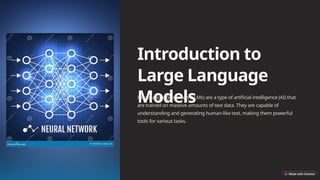
Large language models (LLMs) are a type of artificial intelligence (AI) that
are trained on massive amounts of text data. They are capable of
understanding and generating human-like text, making them powerful
tools for various tasks.
Capabilities of Large Language
Models
LLMs possess impressive capabilities, including text generation, translation,
summarization, question answering, and code generation. These models can
perform tasks that were previously considered challenging for traditional AI
systems.
Text Generation
Generating realistic and coherent
text, like writing articles, poems, or
even code.
Translation
Translating text from one language
to another accurately and fluently.
Summarization
Providing concise summaries of
lengthy documents, capturing the
key points.
Question Answering
Answering questions based on
given text or knowledge base,
providing insightful answers.
Training Other Models with Large
Language Models
LLMs can be used to train other models, transferring knowledge from the vast text
datasets they have been trained on. This process is called transfer learning and can
significantly improve the performance of downstream models.
Pre-training
LLMs are trained on large amounts of text data.
Fine-tuning
A smaller, task-specific model is trained on a smaller dataset using the LLM's
parameters as a starting point.
Application
The fine-tuned model is then deployed for the specific task it was trained on.
Interpreting Data using Large Language Models
LLMs can be used to interpret and analyze data in a variety of ways, such as identifying patterns, extracting insights, and
generating reports.
Textual Data
LLMs can analyze textual data, like customer reviews or social
media posts, to identify trends and customer sentiment.
Structured Data
LLMs can be used to analyze structured data, like financial
reports or scientific papers, to extract key information and
insights.
Using Large Language Models in Research
LLMs are becoming increasingly valuable tools in research, aiding in tasks such as literature review, hypothesis generation, and
data analysis.
1 Literature Review
LLMs can help researchers quickly
summarize and synthesize large
amounts of research literature.
2 Hypothesis Generation
LLMs can be used to generate
novel hypotheses based on
existing data and research
findings.
3 Data Analysis
LLMs can analyze complex
datasets to identify patterns and
trends, assisting in scientific
discovery.
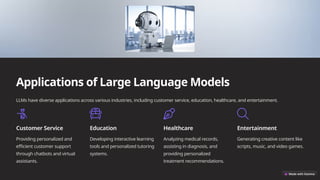
Applications of Large Language Models
LLMs have diverse applications across various industries, including customer service, education, healthcare, and entertainment.
Customer Service
Providing personalized and
efficient customer support
through chatbots and virtual
assistants.
Education
Developing interactive learning
tools and personalized tutoring
systems.
Healthcare
Analyzing medical records,
assisting in diagnosis, and
providing personalized
treatment recommendations.
Entertainment
Generating creative content like
scripts, music, and video games.
Advantages of Large Language Models
LLMs offer several advantages over traditional models, including improved accuracy, efficiency, and scalability.
High Accuracy LLMs are capable of achieving high accuracy in various tasks due
to their extensive training on massive datasets.
Efficiency LLMs can process and analyze large amounts of data quickly,
making them efficient for tasks requiring rapid analysis.
Scalability LLMs can be scaled to handle large and complex datasets,
making them suitable for handling real-world applications.
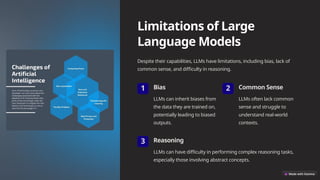
Limitations of Large
Language Models
Despite their capabilities, LLMs have limitations, including bias, lack of
common sense, and difficulty in reasoning.
1 Bias
LLMs can inherit biases from
the data they are trained on,
potentially leading to biased
outputs.
2 Common Sense
LLMs often lack common
sense and struggle to
understand real-world
contexts.
3 Reasoning
LLMs can have difficulty in performing complex reasoning tasks,
especially those involving abstract concepts.
Comparison to Traditional Models
LLMs differ significantly from traditional models, offering several advantages and disadvantages compared to traditional methods.
Traditional Models
Typically trained on smaller datasets and focused on specific
tasks. They often require expert knowledge and can be less
adaptable.
Large Language Models
Trained on massive datasets and capable of performing a
wider range of tasks. They are more adaptable but can be
more resource-intensive.
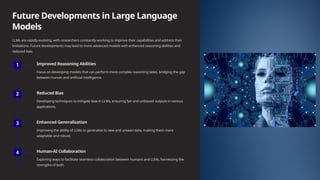
Future Developments in Large Language
Models
LLMs are rapidly evolving, with researchers constantly working to improve their capabilities and address their
limitations. Future developments may lead to more advanced models with enhanced reasoning abilities and
reduced bias.
1 Improved Reasoning Abilities
Focus on developing models that can perform more complex reasoning tasks, bridging the gap
between human and artificial intelligence.
2 Reduced Bias
Developing techniques to mitigate bias in LLMs, ensuring fair and unbiased outputs in various
applications.
3 Enhanced Generalization
Improving the ability of LLMs to generalize to new and unseen data, making them more
adaptable and robust.
4 Human-AI Collaboration
Exploring ways to facilitate seamless collaboration between humans and LLMs, harnessing the
strengths of both.

Introduction-to-Large-Language-Models.pptx

  • 1.
    Introduction to Large Language Models Largelanguage models (LLMs) are a type of artificial intelligence (AI) that are trained on massive amounts of text data. They are capable of understanding and generating human-like text, making them powerful tools for various tasks.
  • 2.
    Capabilities of LargeLanguage Models LLMs possess impressive capabilities, including text generation, translation, summarization, question answering, and code generation. These models can perform tasks that were previously considered challenging for traditional AI systems. Text Generation Generating realistic and coherent text, like writing articles, poems, or even code. Translation Translating text from one language to another accurately and fluently. Summarization Providing concise summaries of lengthy documents, capturing the key points. Question Answering Answering questions based on given text or knowledge base, providing insightful answers.
  • 3.
    Training Other Modelswith Large Language Models LLMs can be used to train other models, transferring knowledge from the vast text datasets they have been trained on. This process is called transfer learning and can significantly improve the performance of downstream models. Pre-training LLMs are trained on large amounts of text data. Fine-tuning A smaller, task-specific model is trained on a smaller dataset using the LLM's parameters as a starting point. Application The fine-tuned model is then deployed for the specific task it was trained on.
  • 4.
    Interpreting Data usingLarge Language Models LLMs can be used to interpret and analyze data in a variety of ways, such as identifying patterns, extracting insights, and generating reports. Textual Data LLMs can analyze textual data, like customer reviews or social media posts, to identify trends and customer sentiment. Structured Data LLMs can be used to analyze structured data, like financial reports or scientific papers, to extract key information and insights.
  • 5.
    Using Large LanguageModels in Research LLMs are becoming increasingly valuable tools in research, aiding in tasks such as literature review, hypothesis generation, and data analysis. 1 Literature Review LLMs can help researchers quickly summarize and synthesize large amounts of research literature. 2 Hypothesis Generation LLMs can be used to generate novel hypotheses based on existing data and research findings. 3 Data Analysis LLMs can analyze complex datasets to identify patterns and trends, assisting in scientific discovery.
  • 6.
    Applications of LargeLanguage Models LLMs have diverse applications across various industries, including customer service, education, healthcare, and entertainment. Customer Service Providing personalized and efficient customer support through chatbots and virtual assistants. Education Developing interactive learning tools and personalized tutoring systems. Healthcare Analyzing medical records, assisting in diagnosis, and providing personalized treatment recommendations. Entertainment Generating creative content like scripts, music, and video games.
  • 7.
    Advantages of LargeLanguage Models LLMs offer several advantages over traditional models, including improved accuracy, efficiency, and scalability. High Accuracy LLMs are capable of achieving high accuracy in various tasks due to their extensive training on massive datasets. Efficiency LLMs can process and analyze large amounts of data quickly, making them efficient for tasks requiring rapid analysis. Scalability LLMs can be scaled to handle large and complex datasets, making them suitable for handling real-world applications.
  • 8.
    Limitations of Large LanguageModels Despite their capabilities, LLMs have limitations, including bias, lack of common sense, and difficulty in reasoning. 1 Bias LLMs can inherit biases from the data they are trained on, potentially leading to biased outputs. 2 Common Sense LLMs often lack common sense and struggle to understand real-world contexts. 3 Reasoning LLMs can have difficulty in performing complex reasoning tasks, especially those involving abstract concepts.
  • 9.
    Comparison to TraditionalModels LLMs differ significantly from traditional models, offering several advantages and disadvantages compared to traditional methods. Traditional Models Typically trained on smaller datasets and focused on specific tasks. They often require expert knowledge and can be less adaptable. Large Language Models Trained on massive datasets and capable of performing a wider range of tasks. They are more adaptable but can be more resource-intensive.
  • 10.
    Future Developments inLarge Language Models LLMs are rapidly evolving, with researchers constantly working to improve their capabilities and address their limitations. Future developments may lead to more advanced models with enhanced reasoning abilities and reduced bias. 1 Improved Reasoning Abilities Focus on developing models that can perform more complex reasoning tasks, bridging the gap between human and artificial intelligence. 2 Reduced Bias Developing techniques to mitigate bias in LLMs, ensuring fair and unbiased outputs in various applications. 3 Enhanced Generalization Improving the ability of LLMs to generalize to new and unseen data, making them more adaptable and robust. 4 Human-AI Collaboration Exploring ways to facilitate seamless collaboration between humans and LLMs, harnessing the strengths of both.