• Meaning ofIntelligence
• Meaning of Artificial Intelligence
• Ad. & Disad. of Artificial Intelligence
• Goals
• Programming
• Terms related to AI
OBJECTIVES
3.
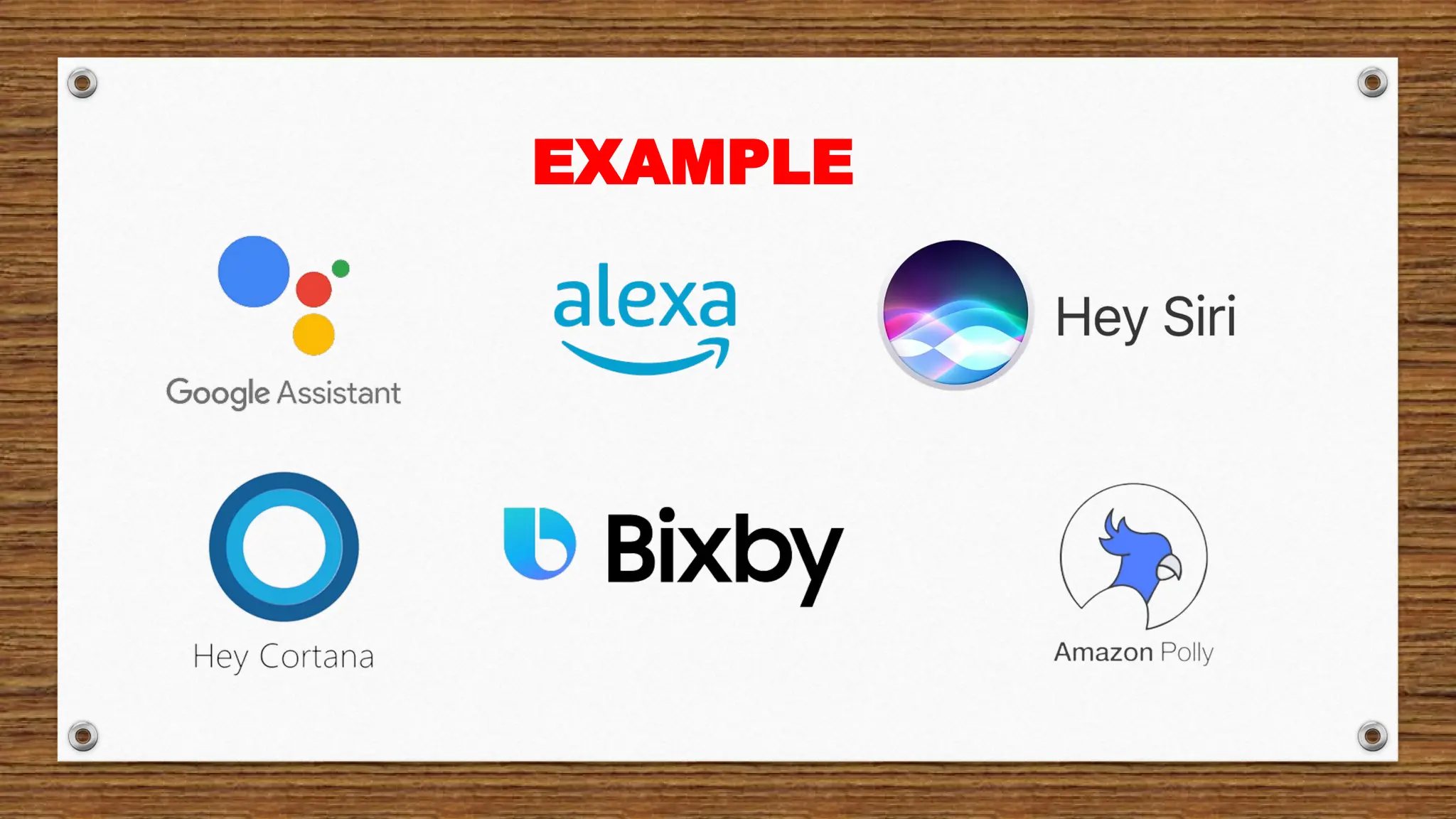
GET SET GO!!!!!
Write the name of any five
Applications ,softwares or devices
that can understand human speech.
Intelligence
• The abilityto solve problems
• The ability to adapt and learn from daily experiences.
• Having characteristics such as creativity and
interpersonal skills
• The mental ability that enables one to adapt according
to the environment.
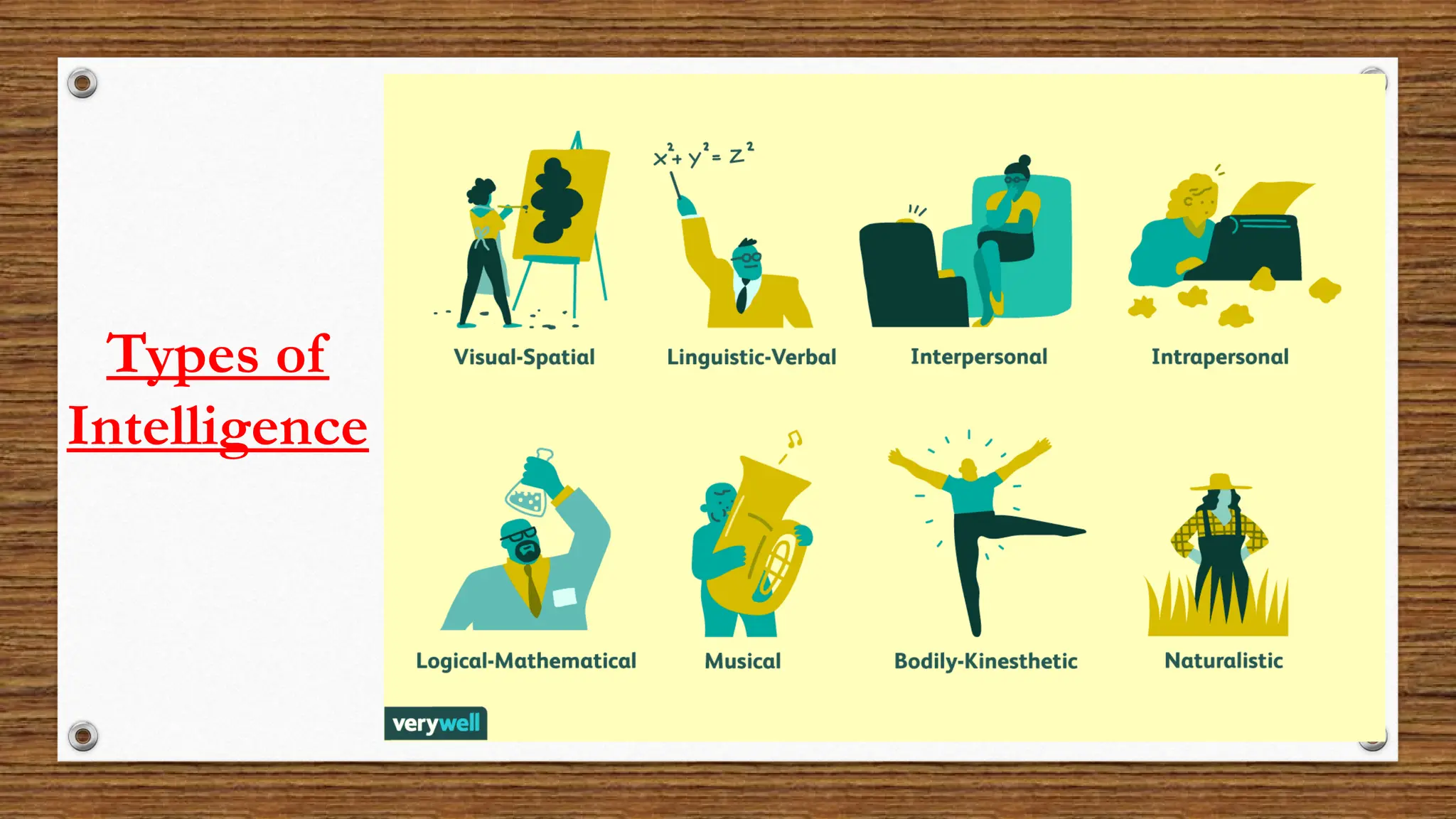
Mathematical Intelligence
• Thisis the ability to carry out mathematical
operations
• It also includes an understanding of objects
and symbols used in mathematics
9.
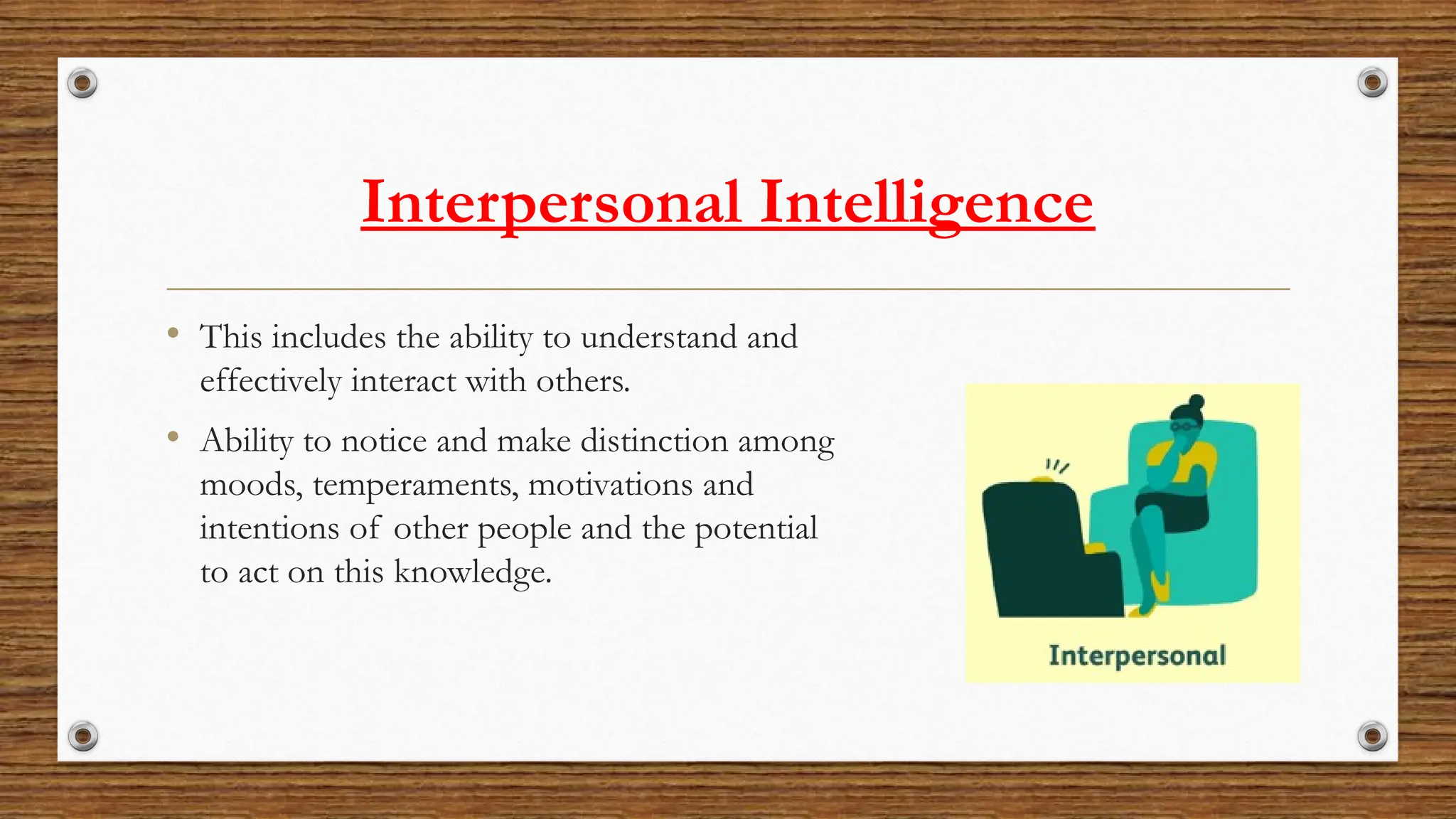
Interpersonal Intelligence
• Thisincludes the ability to understand and
effectively interact with others.
• Ability to notice and make distinction among
moods, temperaments, motivations and
intentions of other people and the potential
to act on this knowledge.
10.
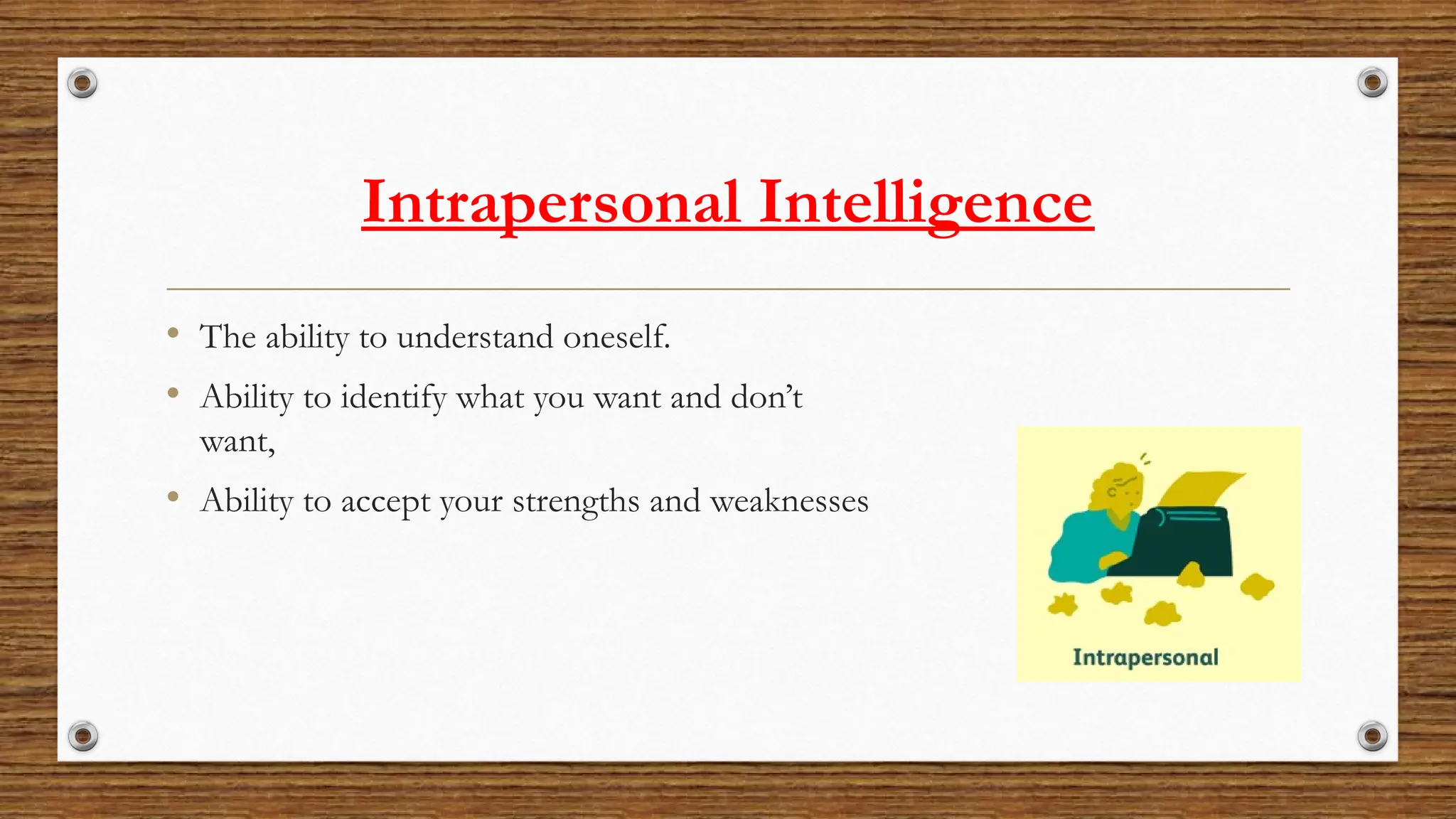
Intrapersonal Intelligence
• Theability to understand oneself.
• Ability to identify what you want and don’t
want,
• Ability to accept your strengths and weaknesses
11.
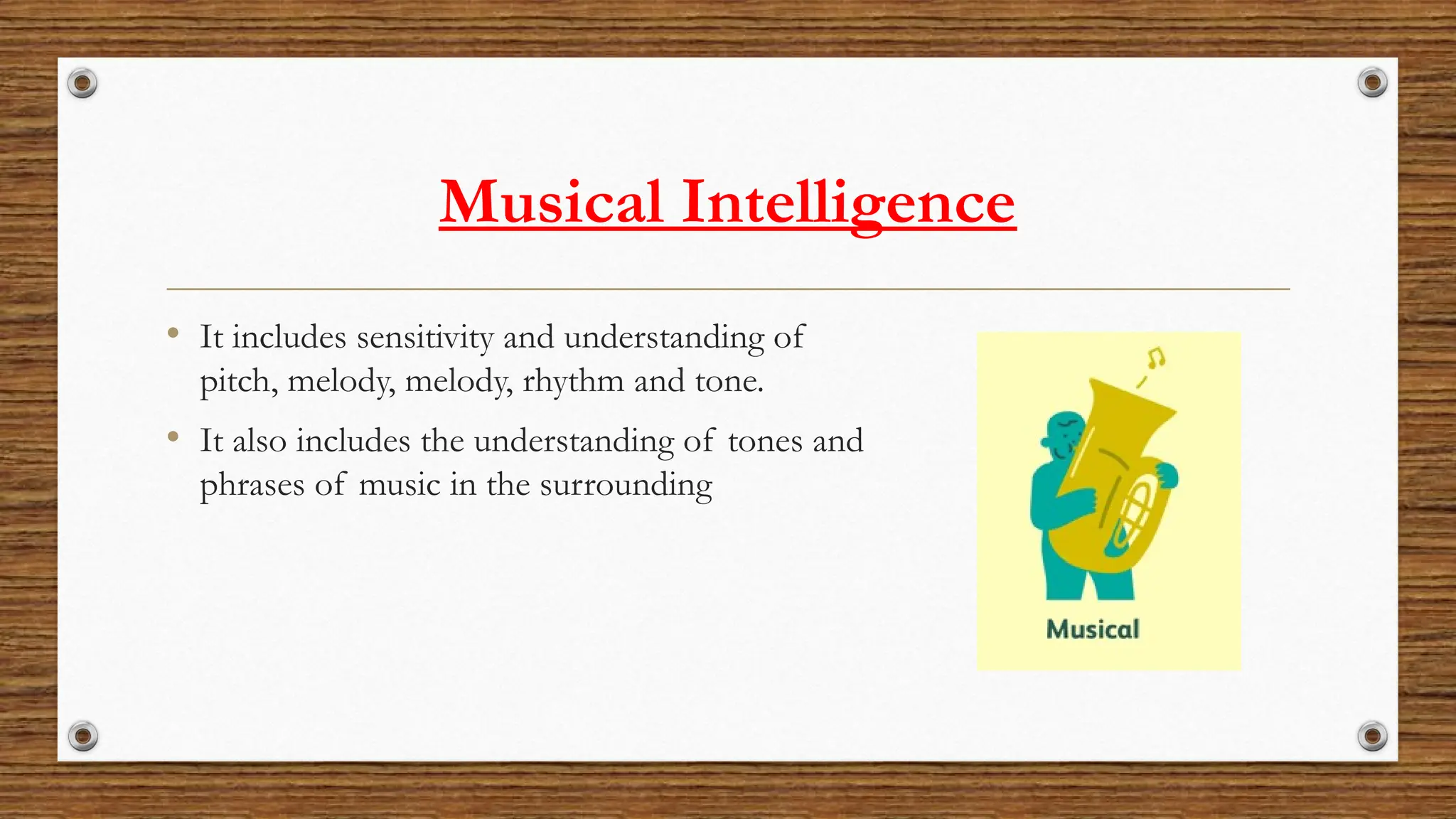
Musical Intelligence
• Itincludes sensitivity and understanding of
pitch, melody, melody, rhythm and tone.
• It also includes the understanding of tones and
phrases of music in the surrounding
Knowledge
• It isa collection of information and skills a person
acquires through experience
• Intelligence is the ability to apply knowledge
• Its values may change over time. It is developed
though a learning process.
• It is beneficial only if it is applied.
16.
Knowledge vs Intelligence
•Knowledge is contextual . It depends
on the circumstances of the individual.
• It is a collection of information and
skills a person acquires through
experience
• It is developed through Learning
Process
• Intelligence is a cognitive skill.
Cognitive skills are core skills your
brain uses to think , read and learn.
• It is the ability to apply acquired
knowledge.
• It is inborn personal quality
17.
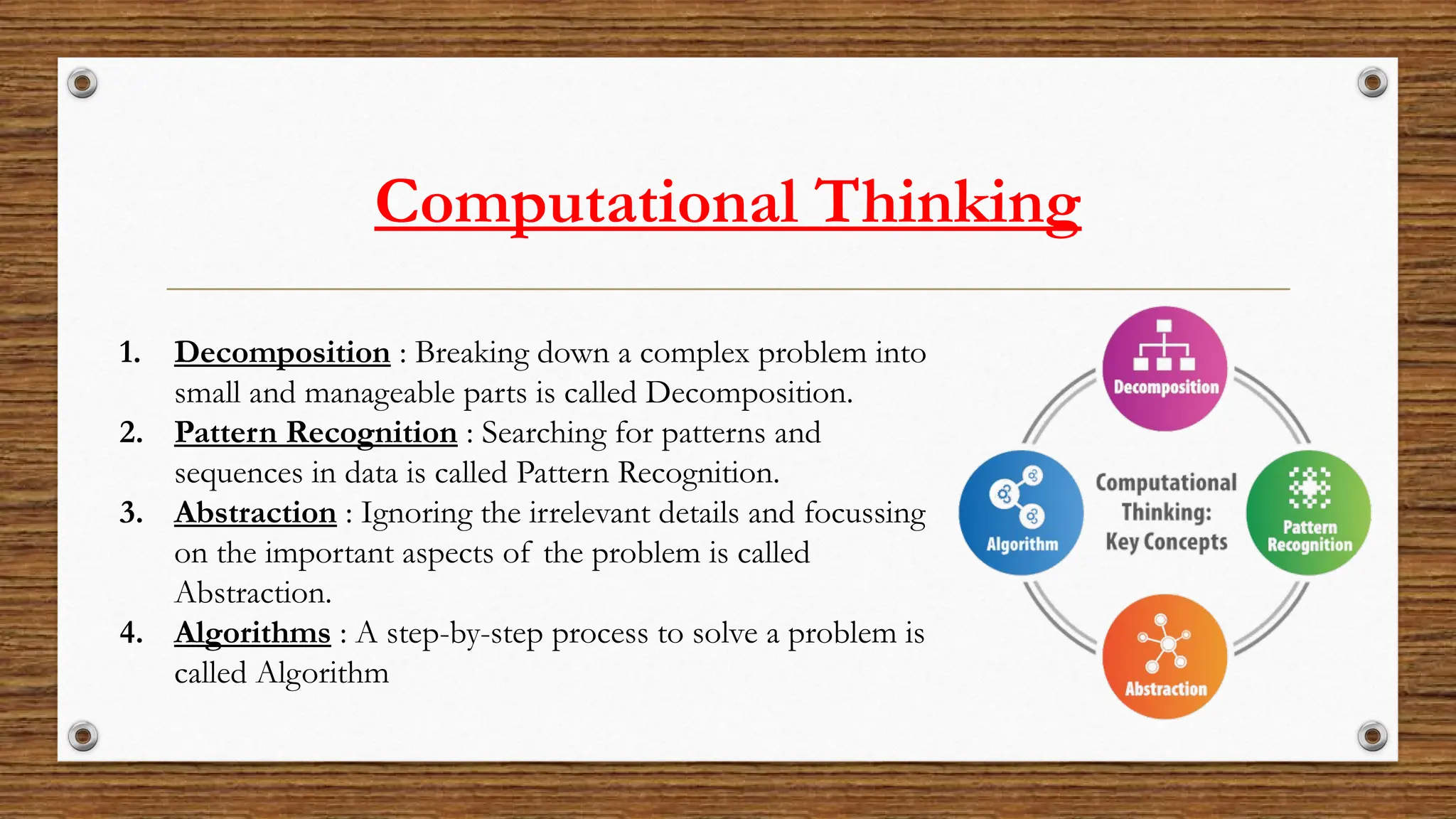
Computational Thinking
1. Decomposition: Breaking down a complex problem into
small and manageable parts is called Decomposition.
2. Pattern Recognition : Searching for patterns and
sequences in data is called Pattern Recognition.
3. Abstraction : Ignoring the irrelevant details and focussing
on the important aspects of the problem is called
Abstraction.
4. Algorithms : A step-by-step process to solve a problem is
called Algorithm
18.
Benefits of ComputationalThinking
• To use most suitable computing tools and techniques to help
solve a problem or situation
• To apply computing strategies such as ‘Divide and Conquer’ to
any situation
• To apply or adapt a computing tool or technique for a new use.
19.
Artificial Intelligence
• ArtificialIntelligence (AI) is a technology that
makes a machine act like a human but with higher
level of intelligence.
• It can imitate the capabilities of sense and
comprehension.
• AI refers to the ability of machines to perform tasks
such as thinking, learning, decision making and
problem-solving.
20.
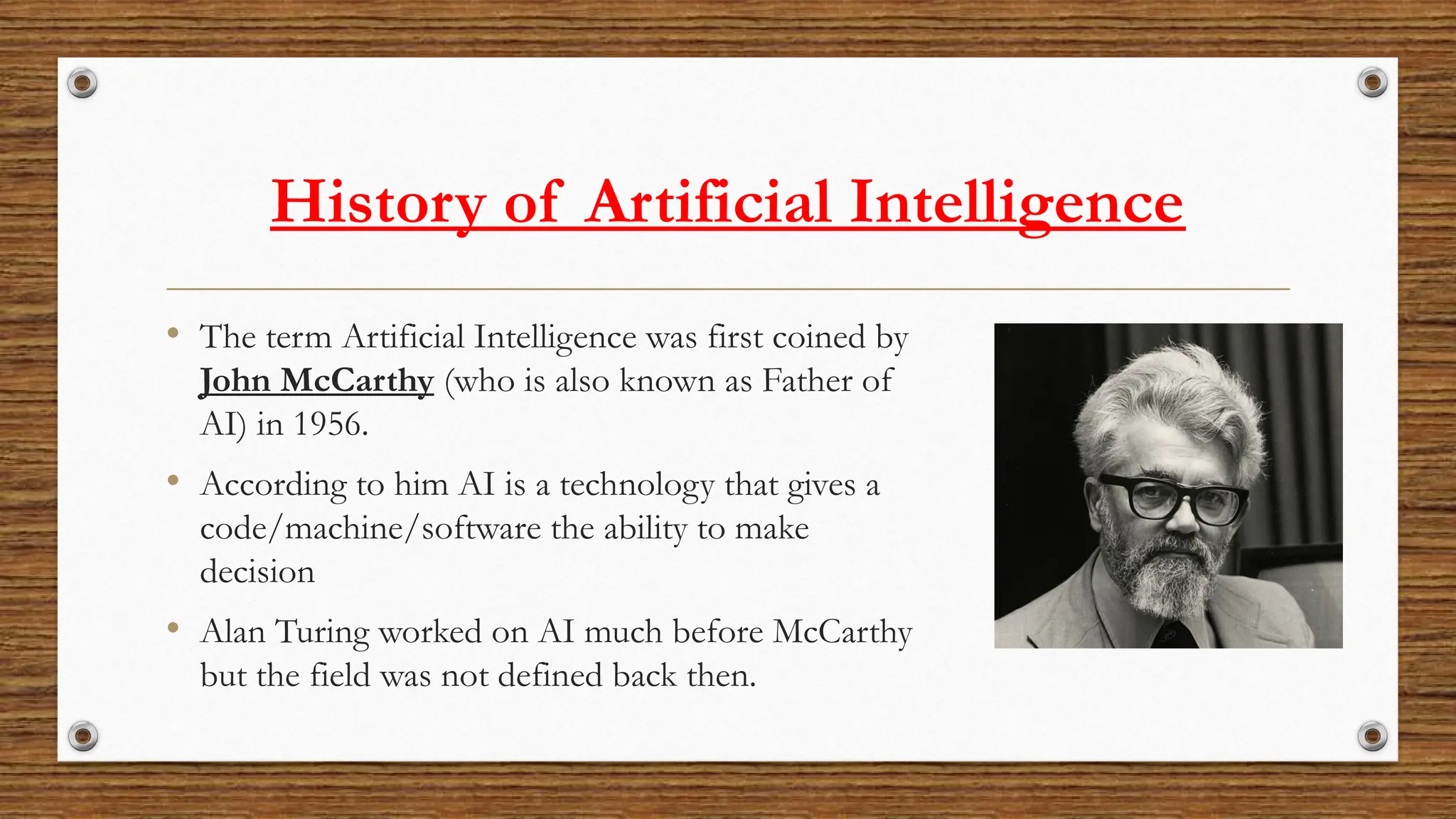
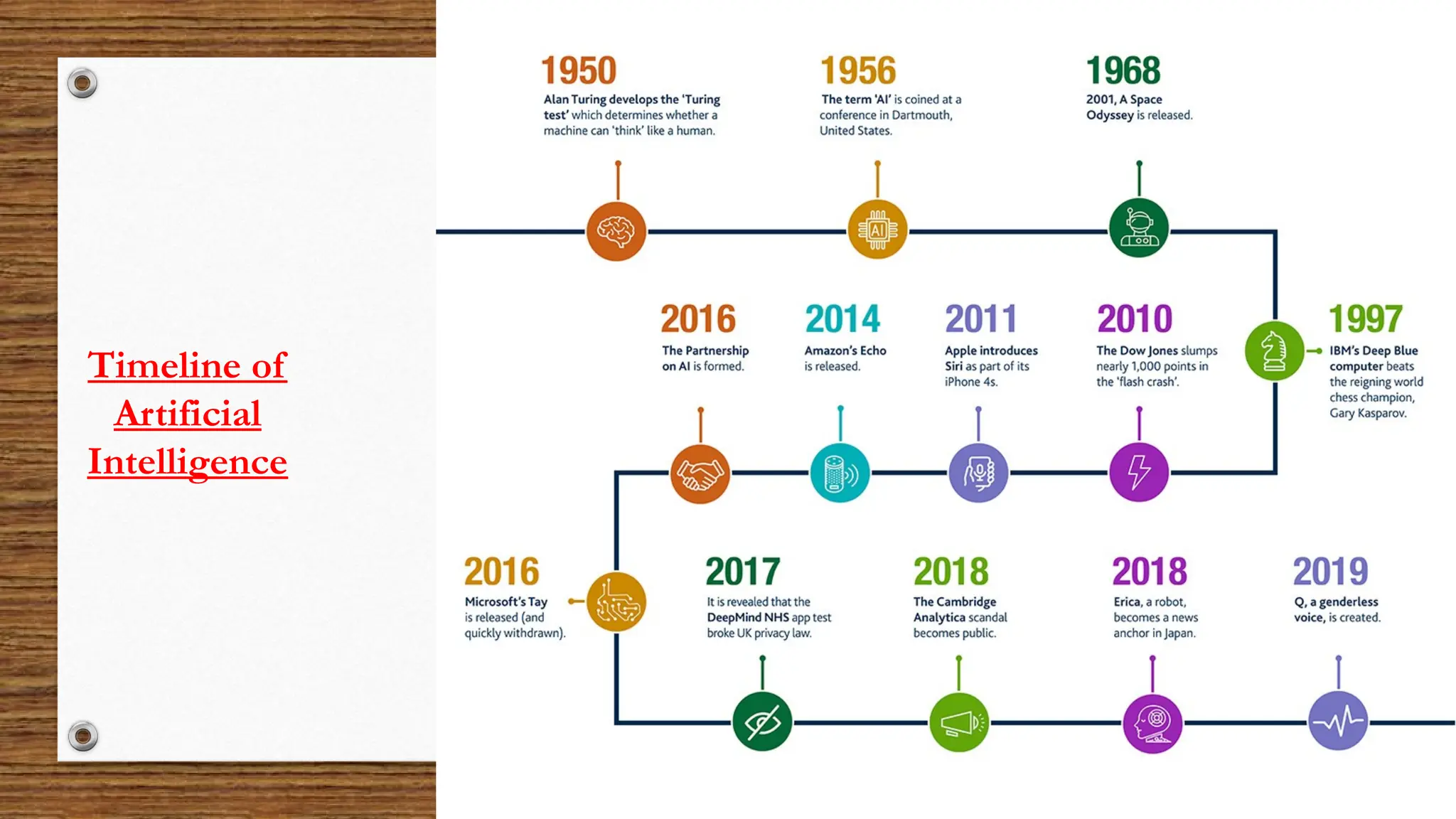
History of ArtificialIntelligence
• The term Artificial Intelligence was first coined by
John McCarthy (who is also known as Father of
AI) in 1956.
• According to him AI is a technology that gives a
code/machine/software the ability to make
decision
• Alan Turing worked on AI much before McCarthy
but the field was not defined back then.
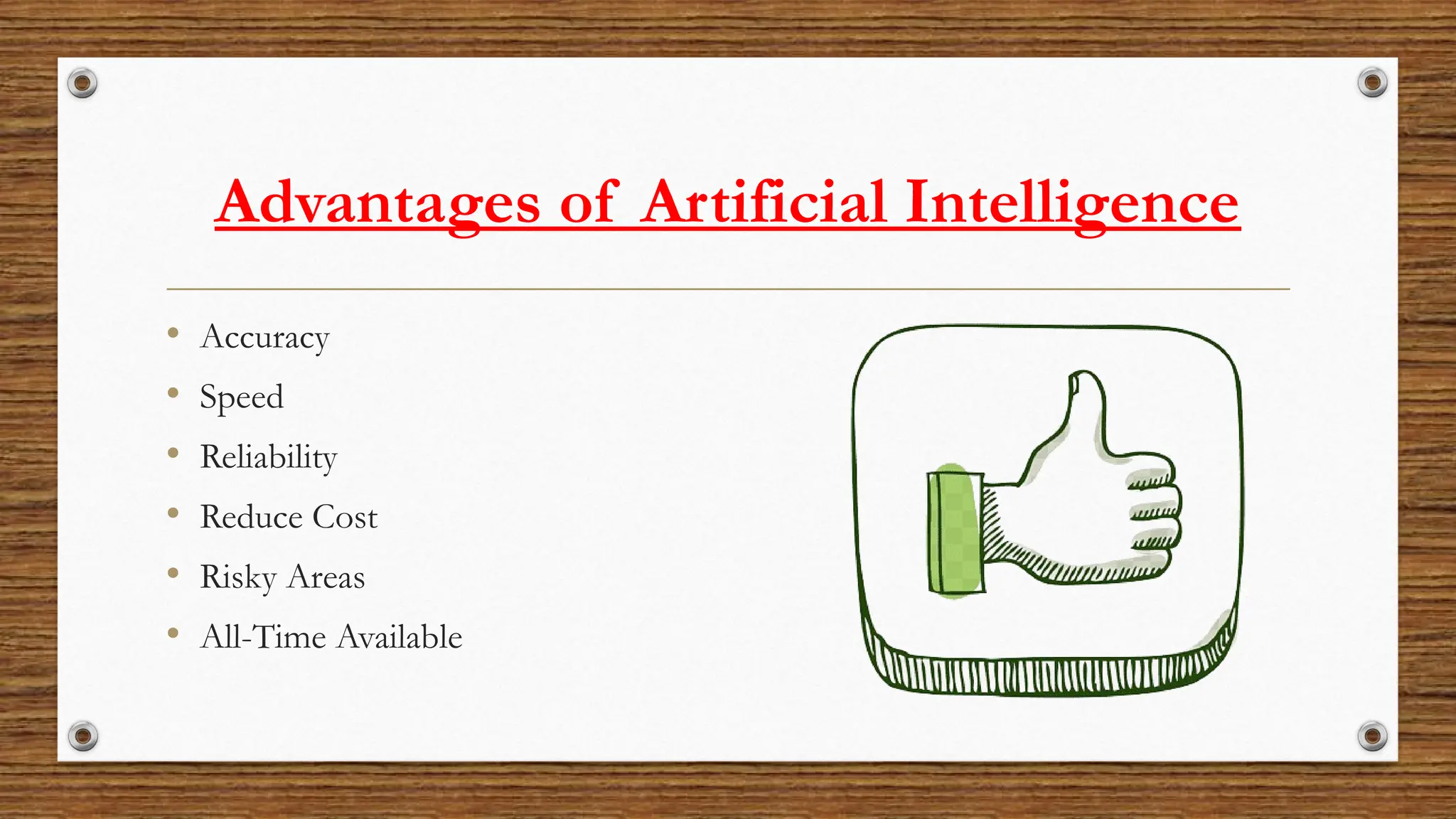
Advantages of ArtificialIntelligence
• Accuracy
• Speed
• Reliability
• Reduce Cost
• Risky Areas
• All-Time Available
23.
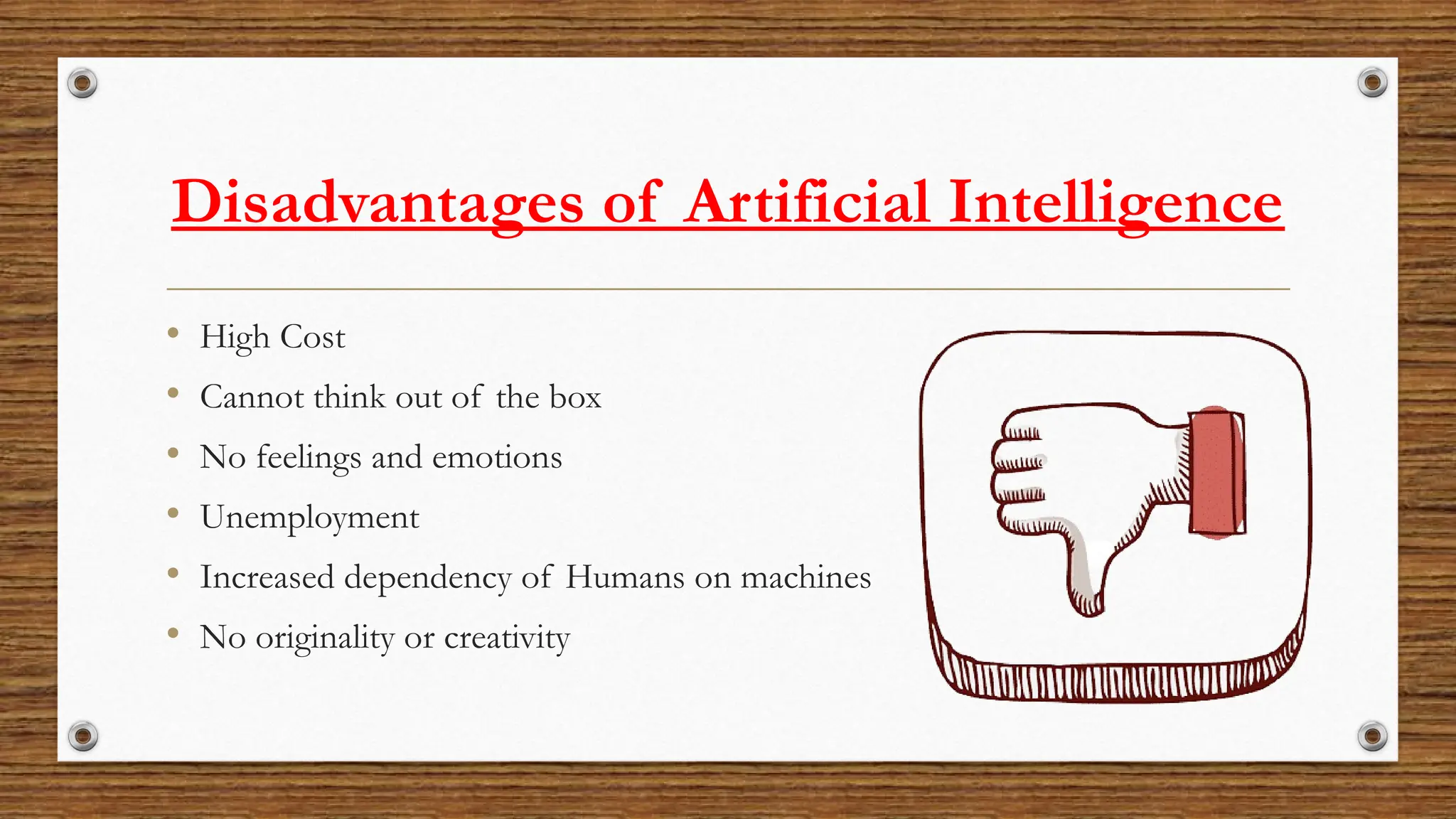
Disadvantages of ArtificialIntelligence
• High Cost
• Cannot think out of the box
• No feelings and emotions
• Unemployment
• Increased dependency of Humans on machines
• No originality or creativity
24.
Trivia
• Do youthink AI in machines can replace humans? Write
your thoughts in favor or against.
• What is the difference between Human Intelligence and
Artificial Intelligence.
25.
Goals of ArtificialIntelligence
• Reasoning
• Problem Solving
• Knowledge Representation
• Learning
• Natural Language Processing
• Perception
• Social and General Intelligence
26.
Goals of ArtificialIntelligence
• Reasoning
The ability of a system to logically process
information of a system and draw conclusions based
on that information.
Ex : Using rules, logic and algorithm analyze new
information from existing data
27.
Goals of ArtificialIntelligence
• Problem Solving
It involves developing algorithms and techniques that
enable computers to find solutions to complex
problems.
Ex : AI uses various approaches such as search
algorithms, optimization methods and machine
learning to tackle different types of problems
28.
Goals of ArtificialIntelligence
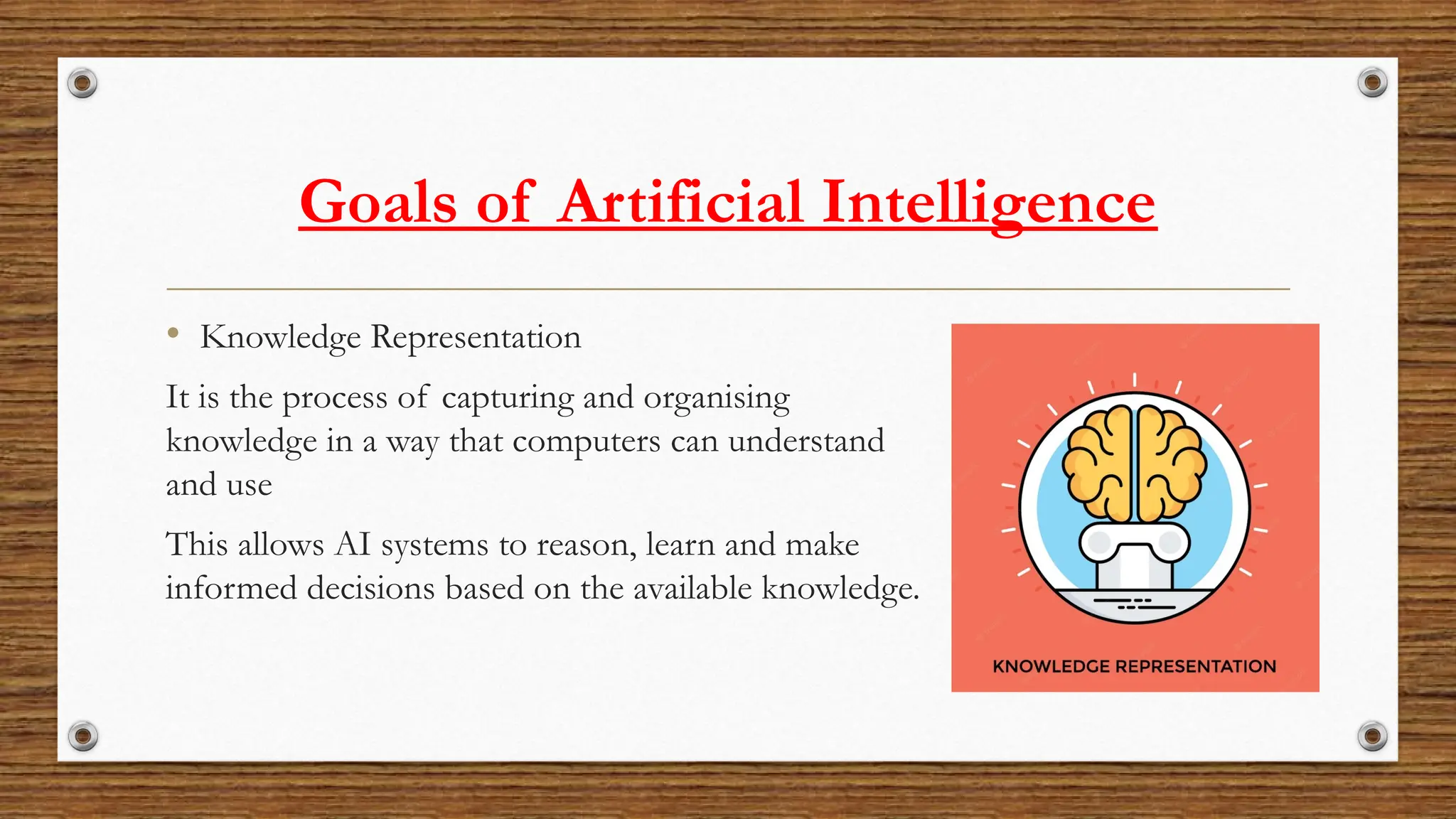
• Knowledge Representation
It is the process of capturing and organising
knowledge in a way that computers can understand
and use
This allows AI systems to reason, learn and make
informed decisions based on the available knowledge.
29.
Goals of ArtificialIntelligence
• Learning
It is the ability of systems to acquire knowledge and
improve their performance based on experience or
data.
AI systems employ machine learning algorithms to
automatically learn patterns and relationships from
large datasets
30.
Goals of ArtificialIntelligence
• Natural Language Processing
NLP is a field of AI that focusses on enabling
computers to understand, interpret and generate
human language.
NLP involves speech recognition, sentiment analysis,
Machine translation and text generation.
31.
Goals of ArtificialIntelligence
• Perception
Perception in AI refers to ability of machines to sense
and interpret the environment through various sensors
and databases.
This includes computer vision, speech recognition,
sensor fusion, and other techniques that enable
machines to perceive and understand the physical
world
32.
Goals of ArtificialIntelligence
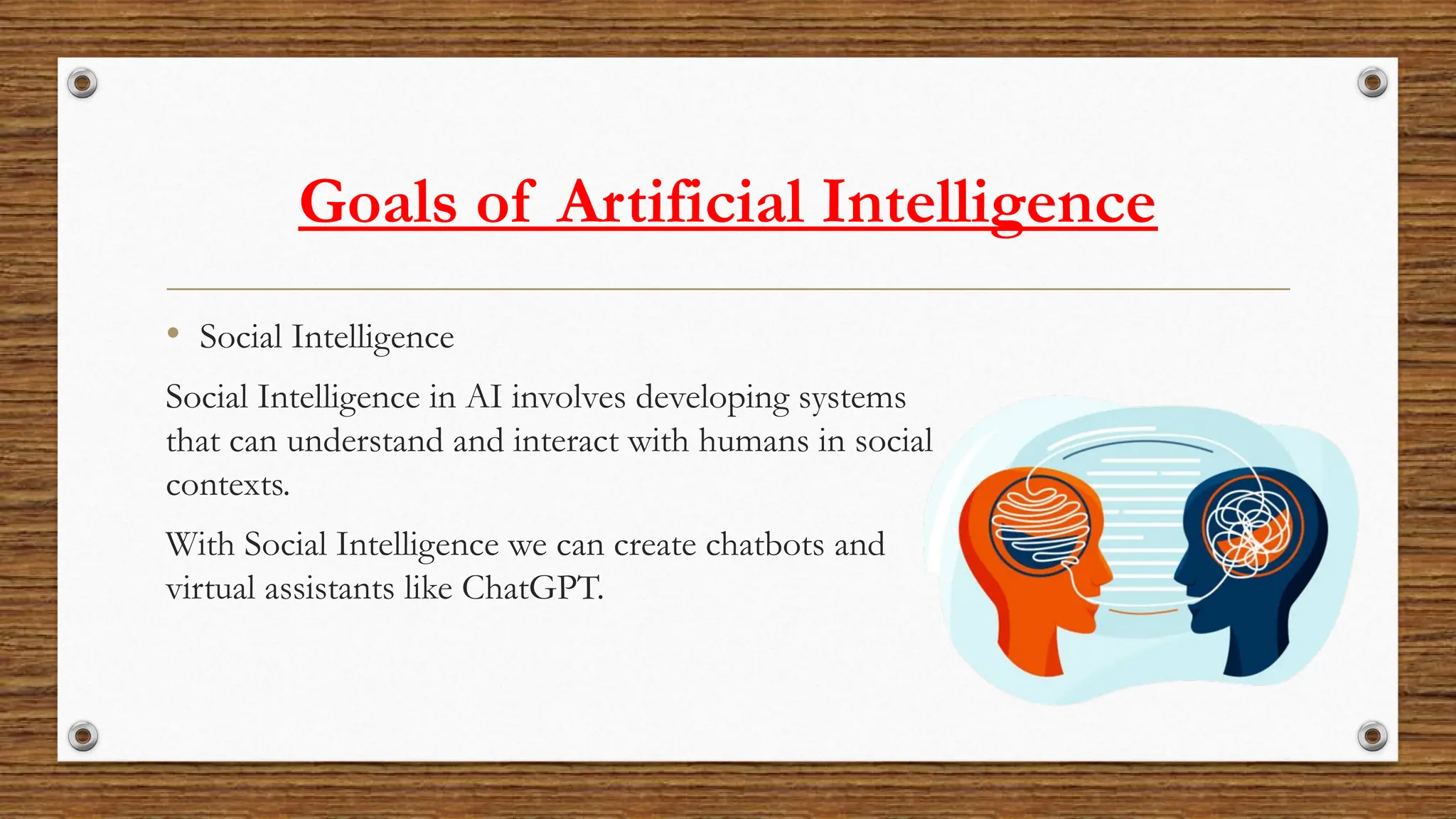
• Social Intelligence
Social Intelligence in AI involves developing systems
that can understand and interact with humans in social
contexts.
With Social Intelligence we can create chatbots and
virtual assistants like ChatGPT.
33.
Goals of ArtificialIntelligence
• General Intelligence
The ability of AI to exhibit human-like intelligence
across a wide range of tasks and domains.
It is the capability to understand, learn, reason and
solve problems like humans.
34.
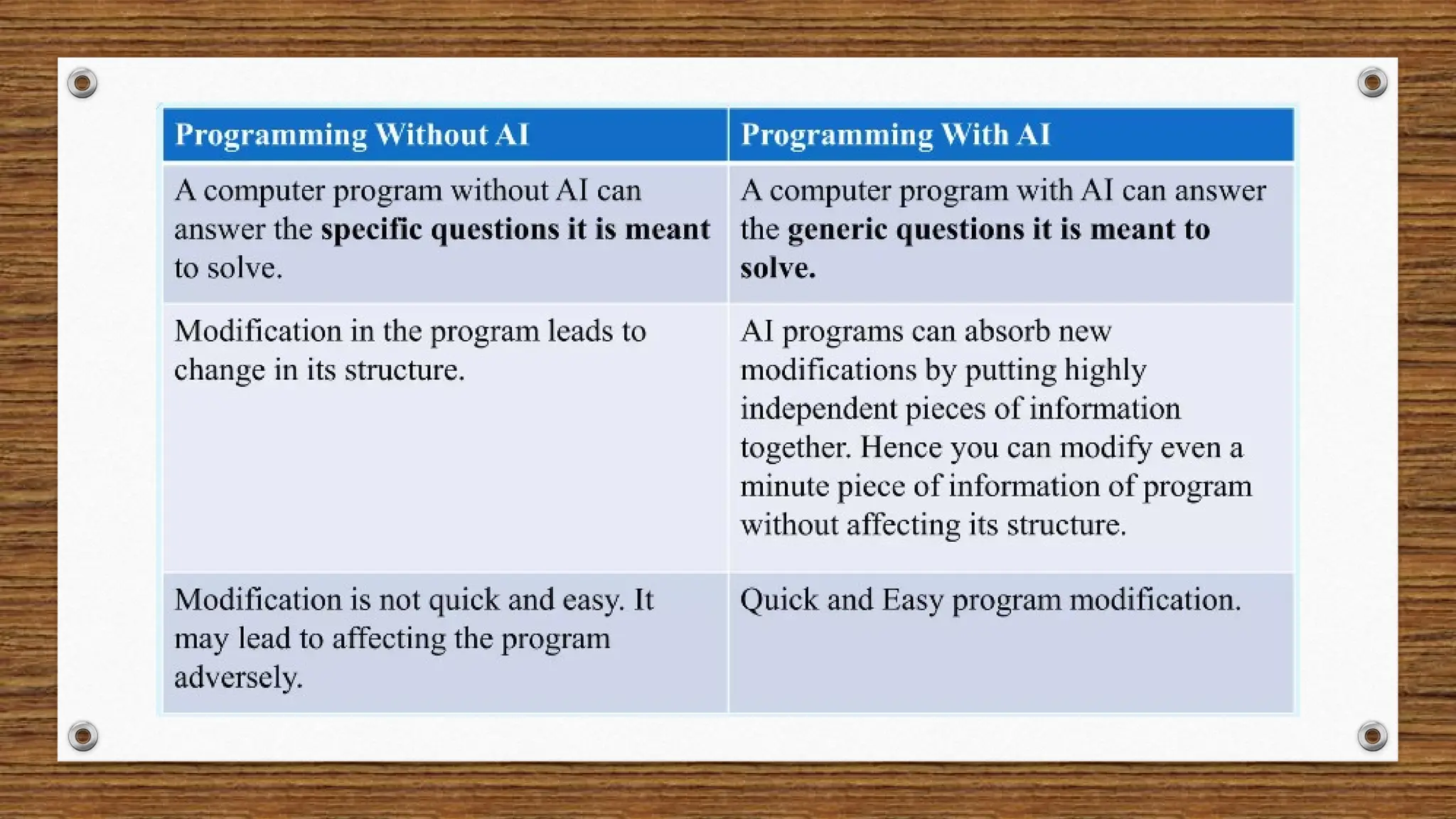
Programming with orwithout AI
• A set of instructions that tells a computer how to
perform a task is programming
• The languages which are used for programming and
contain English like words is called High-Level
Language
• The languages which are easily understood by the
computer are called Low-Level Languages
36.
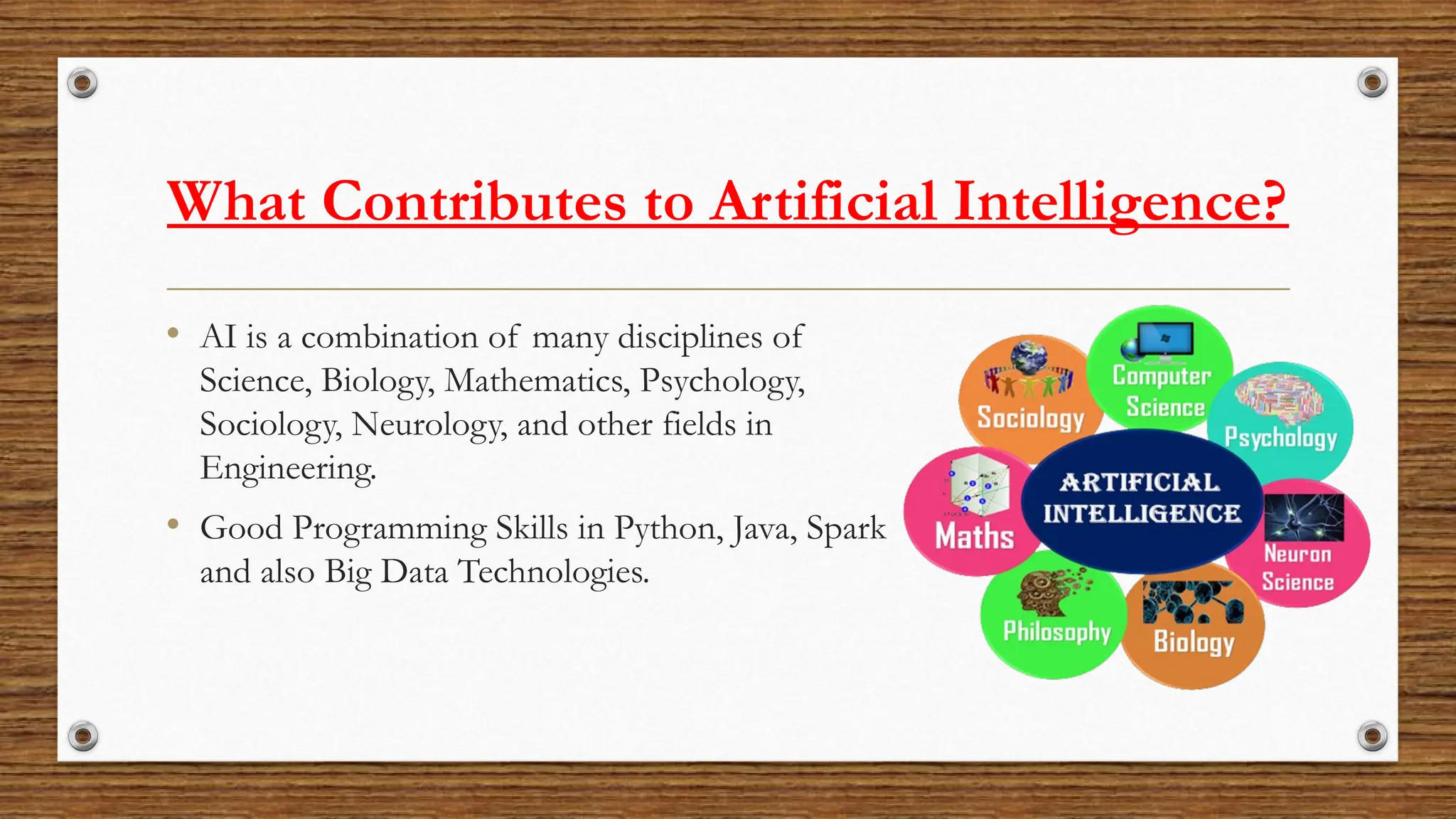
What Contributes toArtificial Intelligence?
• AI is a combination of many disciplines of
Science, Biology, Mathematics, Psychology,
Sociology, Neurology, and other fields in
Engineering.
• Good Programming Skills in Python, Java, Spark
and also Big Data Technologies.
37.
Terms Related toArtificial Intelligence
• Automation
When a repetitive task that is rule-based is automated
by software, it is called automation
It can be called Robotic Process Automation (RPA)
38.
Terms Related toArtificial Intelligence
• Machine Learning
In Machine Learning, programming is minimized so
that the machine learns from experience and actions as
a human does.
This is a science of getting a computer to act without
programming.
39.
Terms Related toArtificial Intelligence
• Machine Vision
This technology gives eyes to the machine. The
machine captures visual information through camera.
Signature identification and medical analysis are a few
applications of this technology
40.
Terms Related toArtificial Intelligence
• Data Science
Data Science uses vast amount of data for deriving
information from it, making decisions and finding
patterns
Data Science collects, analyses and learns from this
data to help perform decision making.
41.
Terms Related toArtificial Intelligence
• Robotics
The field of engineering that focuses on the design
and manufacturing of robots is called robotics.
Robots are used in the assembly line of car
manufacturing.