Table Of Contents
●Basic Fuzzy set operation
● Properties of fuzzy set
● Crisp relation
3.
What is Fuzzyset?
This function can be generalized to such that the values assigned
to the elements of the universal set for within a specified a range
and indicate the membership grade of these element in the set in
question. Larger values denote higher degrees of set membership
such a function is called a membership function and set the
defined by it a fuzzy set.
The most commonly used to range of values of membership
functions is the unit interval [0,1]
4.
A Fuzzy setis a set whose elements have degrees of membership.
Fuzzy sets are an extension of the classical notion of set (known
as a Crisp Set). More mathematically, a fuzzy set is a pair (A, µA)
where A is a set and µA : A → [0, 1]. For all x ∈ A, µA(x) is
called the grade of membership of x
Fuzzy set
5.
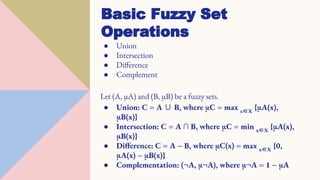
● Union
● Intersection
●Difference
● Complement
Let (A, µA) and (B, µB) be a fuzzy sets.
● Union: C = A ∪ B, where µC = max x∈X
{µA(x),
µB(x)}
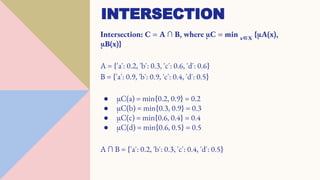
● Intersection: C = A ∩ B, where µC = min x∈X
{µA(x),
µB(x)}
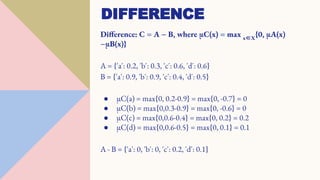
● Difference: C = A − B, where µC(x) = max x∈X
{0,
µA(x) − µB(x)}
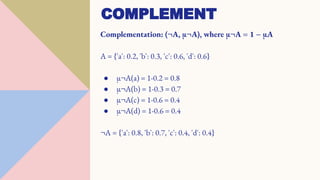
● Complementation: (¬A, µ¬A), where µ¬A = 1 − µA
Basic Fuzzy Set
Operations
6.
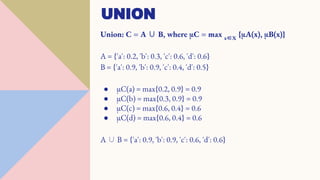
Union: C =A ∪ B, where µC = max x∈X
{µA(x), µB(x)}
A = {'a': 0.2, 'b': 0.3, 'c': 0.6, 'd': 0.6}
B = {'a': 0.9, 'b': 0.9, 'c': 0.4, 'd': 0.5}
● µC(a) = max{0.2, 0.9} = 0.9
● µC(b) = max{0.3, 0.9} = 0.9
● µC(c) = max{0.6, 0.4} = 0.6
● µC(d) = max{0.6, 0.4} = 0.6
A ∪ B = {'a': 0.9, 'b': 0.9, 'c': 0.6, 'd': 0.6}
UNION
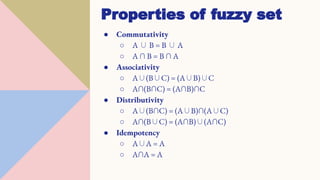
● Commutativity
○ A∪ B = B ∪ A
○ A ∩ B = B ∩ A
● Associativity
○ A∪(B∪C) = (A∪B)∪C
○ A∩(B∩C) = (A∩B)∩C
● Distributivity
○ A∪(B∩C) = (A∪B)∩(A∪C)
○ A∩(B∪C) = (A∩B)∪(A∩C)
● Idempotency
○ A∪A = A
○ A∩A = A
Properties of fuzzy set
11.
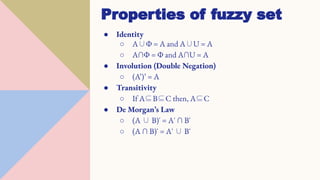
● Identity
○ A∪Φ= A and A∪U = A
○ A∩Φ = Φ and A∩U = A
● Involution (Double Negation)
○ (A’)’ = A
● Transitivity
○ If A⊆B⊆C then, A⊆C
● De Morgan’s Law
○ (A ∪ B)' = A' ∩ B'
○ (A ∩ B)' = A' ∪ B'
Properties of fuzzy set
12.
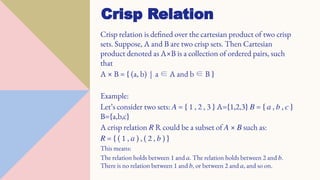
Crisp relation isdefined over the cartesian product of two crisp
sets. Suppose, A and B are two crisp sets. Then Cartesian
product denoted as A×B is a collection of ordered pairs, such
that
A × B = { (a, b) | a ∈ A and b ∈ B }
Example:
Let’s consider two sets: 𝐴 = { 1 , 2 , 3 } A={1,2,3} 𝐵 = { 𝑎 , 𝑏 , 𝑐 }
B={a,b,c}
A crisp relation 𝑅 R could be a subset of 𝐴 × 𝐵 such as:
𝑅 = { ( 1 , 𝑎 ) , ( 2 , 𝑏 ) }
This means:
The relation holds between 1 and 𝑎. The relation holds between 2 and 𝑏.
There is no relation between 1 and 𝑏, or between 2 and 𝑎, and so on.
Crisp Relation



![What is Fuzzy set?
This function can be generalized to such that the values assigned
to the elements of the universal set for within a specified a range
and indicate the membership grade of these element in the set in
question. Larger values denote higher degrees of set membership
such a function is called a membership function and set the
defined by it a fuzzy set.
The most commonly used to range of values of membership
functions is the unit interval [0,1]](https://image.slidesharecdn.com/computationalmathematics-250215153825-837e543b/85/Fuzzy-sets-in-COMPUTATIONAL-MATHEMATICS-Computer-Science-3-320.jpg)
![A Fuzzy set is a set whose elements have degrees of membership.
Fuzzy sets are an extension of the classical notion of set (known
as a Crisp Set). More mathematically, a fuzzy set is a pair (A, µA)
where A is a set and µA : A → [0, 1]. For all x ∈ A, µA(x) is
called the grade of membership of x
Fuzzy set](https://image.slidesharecdn.com/computationalmathematics-250215153825-837e543b/85/Fuzzy-sets-in-COMPUTATIONAL-MATHEMATICS-Computer-Science-4-320.jpg)