© ABB Group
February 15, 2024 | Slide 1
ABB Analytical Instrumentation
Introducing the new Aztec 600
Colorimetric Range
© ABB Group
February 15, 2024 | Slide 2
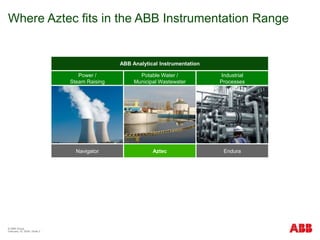
Where Aztec fits in the ABB Instrumentation Range
Industrial
Processes
Potable Water /
Municipal Wastewater
Power /
Steam Raising
ABB Analytical Instrumentation
Aztec Endura
Navigator
© ABB Group
February 15, 2024 | Slide 3
Water, our most fundamental natural resource
 Demand for fresh water is
increasing at three times the rate
of population
 Water resources around the
globe are threatened by climate
change, misuse and pollution
 Water supply industry is
continually challenged to supply
constant safe supply of drinking
water.
© ABB Group
February 15, 2024 | Slide 4
ABB’s analytical instrumentation portfolio
For when quality and accuracy matter
 ABB has been supplying online analytical instrumentation to the water
industry for over 50 years
 Able to measure a wide range of parameters on-line
 Physical, Inorganic and Organic
 Based on a number of different sensing technologies
 Ion selective, potentiometric, amperometric, absorption, optical, colorimetric
© ABB Group
February 15, 2024 | Slide 5
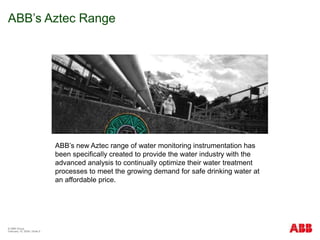
ABB’s Aztec Range
ABB’s new Aztec range of water monitoring instrumentation has
been specifically created to provide the water industry with the
advanced analysis to continually optimize their water treatment
processes to meet the growing demand for safe drinking water at
an affordable price.
© ABB Group
February 15, 2024 | Slide 6
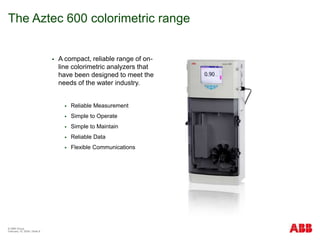
The Aztec 600 colorimetric range
 A compact, reliable range of on-
line colorimetric analyzers that
have been designed to meet the
needs of the water industry.
 Reliable Measurement
 Simple to Operate
 Simple to Maintain
 Reliable Data
 Flexible Communications
© ABB Group
February 15, 2024 | Slide 7
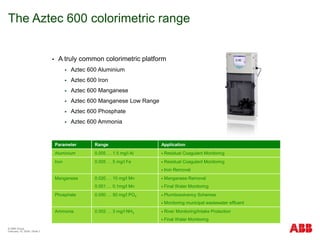
The Aztec 600 colorimetric range
 A truly common colorimetric platform
 Aztec 600 Aluminium
 Aztec 600 Iron
 Aztec 600 Manganese
 Aztec 600 Manganese Low Range
 Aztec 600 Phosphate
 Aztec 600 Ammonia
Parameter Range Application
Aluminium 0.005 … 1.5 mg/l Al  Residual Coagulant Monitoring
Iron 0.005 … 5 mg/l Fe  Residual Coagulant Monitoring
 Iron Removal
Manganese 0.020 … 10 mg/l Mn
0.001 … 0.1mg/l Mn
 Manganese Removal
 Final Water Monitoring
Phosphate 0.050 … 50 mg/l PO4  Plumbosolvency Schemes
 Monitoring municipal wastewater effluent
Ammonia 0.002 … 3 mg/l NH3  River Monitoring/Intake Protection
 Final Water Monitoring
© ABB Group
February 15, 2024 | Slide 8
The Aztec 600 colorimetric range
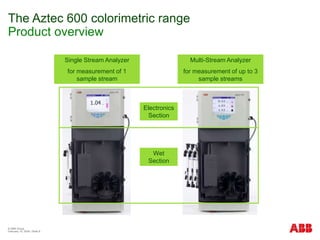
Product overview
Single Stream Analyzer
for measurement of 1
sample stream
Multi-Stream Analyzer
for measurement of up to 3
sample streams
Electronics
Section
Wet
Section
© ABB Group
February 15, 2024 | Slide 9
Fluid Handling
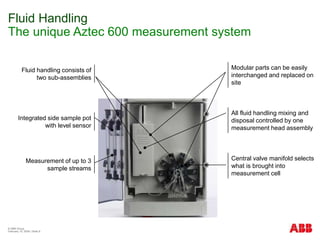
The unique Aztec 600 measurement system
Integrated side sample pot
with level sensor
Central valve manifold selects
what is brought into
measurement cell
Fluid handling consists of
two sub-assemblies
Modular parts can be easily
interchanged and replaced on
site
All fluid handling mixing and
disposal controlled by one
measurement head assembly
Measurement of up to 3
sample streams
© ABB Group
February 15, 2024 | Slide 10
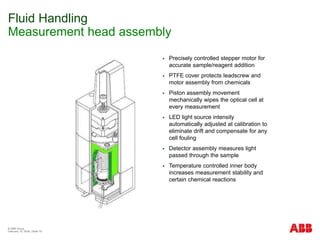
Fluid Handling
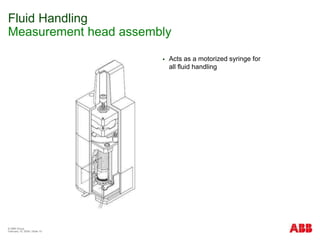
Measurement head assembly
 Acts as a motorized syringe for
all fluid handling
© ABB Group
February 15, 2024 | Slide 11
Fluid Handling
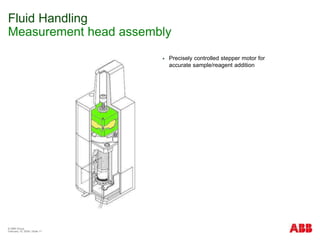
Measurement head assembly
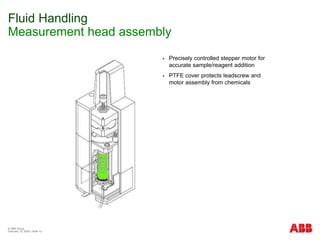
 Precisely controlled stepper motor for
accurate sample/reagent addition
© ABB Group
February 15, 2024 | Slide 12
Fluid Handling
Measurement head assembly
 Precisely controlled stepper motor for
accurate sample/reagent addition
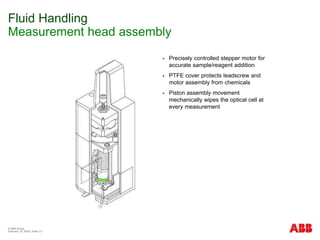
 PTFE cover protects leadscrew and
motor assembly from chemicals
© ABB Group
February 15, 2024 | Slide 13
Fluid Handling
Measurement head assembly
 Precisely controlled stepper motor for
accurate sample/reagent addition
 PTFE cover protects leadscrew and
motor assembly from chemicals
 Piston assembly movement
mechanically wipes the optical cell at
every measurement
© ABB Group
February 15, 2024 | Slide 14
Fluid Handling
Measurement head assembly
 Precisely controlled stepper motor for
accurate sample/reagent addition
 PTFE cover protects leadscrew and
motor assembly from chemicals
 Piston assembly movement
mechanically wipes the optical cell at
every measurement
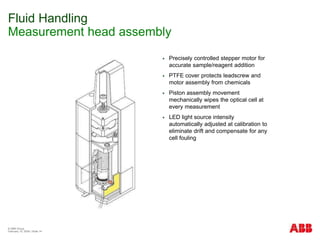
 LED light source intensity
automatically adjusted at calibration to
eliminate drift and compensate for any
cell fouling
© ABB Group
February 15, 2024 | Slide 15
Fluid Handling
Measurement head assembly
 Precisely controlled stepper motor for
accurate sample/reagent addition
 PTFE cover protects leadscrew and
motor assembly from chemicals
 Piston assembly movement
mechanically wipes the optical cell at
every measurement
 LED light source intensity
automatically adjusted at calibration to
eliminate drift and compensate for any
cell fouling
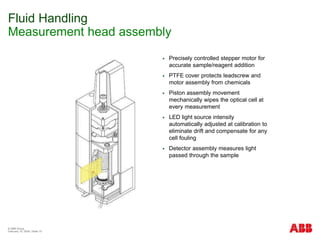
 Detector assembly measures light
passed through the sample
© ABB Group
February 15, 2024 | Slide 16
Fluid Handling
Measurement head assembly
 Precisely controlled stepper motor for
accurate sample/reagent addition
 PTFE cover protects leadscrew and
motor assembly from chemicals
 Piston assembly movement
mechanically wipes the optical cell at
every measurement
 LED light source intensity
automatically adjusted at calibration to
eliminate drift and compensate for any
cell fouling
 Detector assembly measures light
passed through the sample
 Temperature controlled inner body
increases measurement stability and
certain chemical reactions
© ABB Group
February 15, 2024 | Slide 17
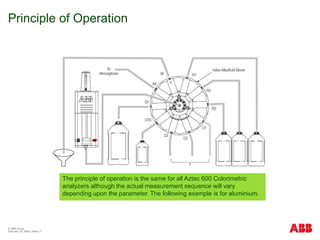
Principle of Operation
The principle of operation is the same for all Aztec 600 Colorimetric
analyzers although the actual measurement sequence will vary
depending upon the parameter. The following example is for aluminium.
© ABB Group
February 15, 2024 | Slide 18
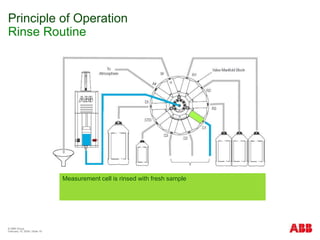
Principle of Operation
Rinse Routine
Measurement cell is rinsed with fresh sample
© ABB Group
February 15, 2024 | Slide 19
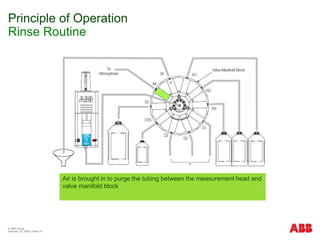
Principle of Operation
Rinse Routine
Air is brought in to purge the tubing between the measurement head and
valve manifold block
© ABB Group
February 15, 2024 | Slide 20
Principle of Operation
Rinse Routine
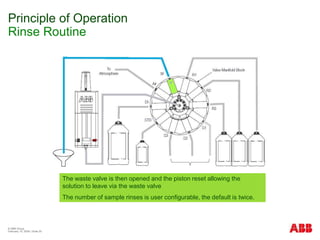
The waste valve is then opened and the piston reset allowing the
solution to leave via the waste valve
The number of sample rinses is user configurable, the default is twice.
© ABB Group
February 15, 2024 | Slide 21
Principle of Operation
Measurement Sequence
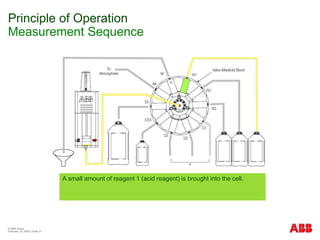
A small amount of reagent 1 (acid reagent) is brought into the cell.
© ABB Group
February 15, 2024 | Slide 22
Principle of Operation
Measurement Sequence
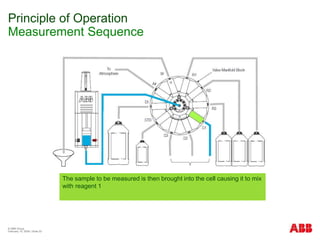
The sample to be measured is then brought into the cell causing it to mix
with reagent 1
© ABB Group
February 15, 2024 | Slide 23
Principle of Operation
Measurement Sequence
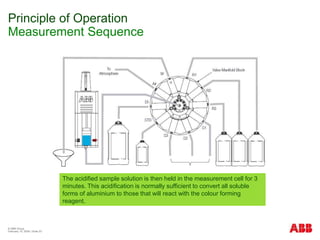
The acidified sample solution is then held in the measurement cell for 3
minutes. This acidification is normally sufficient to convert all soluble
forms of aluminium to those that will react with the colour forming
reagent.
© ABB Group
February 15, 2024 | Slide 24
Principle of Operation
Measurement Sequence
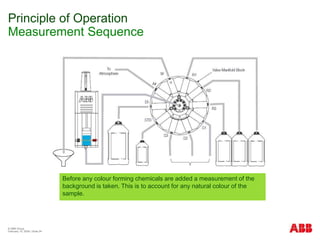
Before any colour forming chemicals are added a measurement of the
background is taken. This is to account for any natural colour of the
sample.
© ABB Group
February 15, 2024 | Slide 25
Principle of Operation
Measurement Sequence
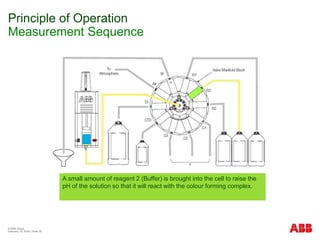
A small amount of reagent 2 (Buffer) is brought into the cell to raise the
pH of the solution so that it will react with the colour forming complex.
© ABB Group
February 15, 2024 | Slide 26
Principle of Operation
Measurement Sequence
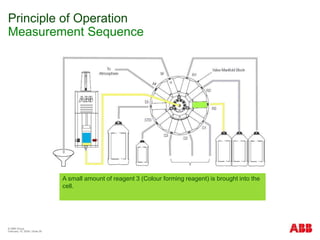
A small amount of reagent 3 (Colour forming reagent) is brought into the
cell.
© ABB Group
February 15, 2024 | Slide 27
Principle of Operation
Measurement Sequence
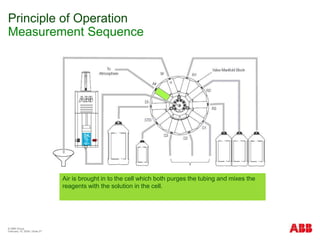
Air is brought in to the cell which both purges the tubing and mixes the
reagents with the solution in the cell.
© ABB Group
February 15, 2024 | Slide 28
Principle of Operation
Measurement Sequence
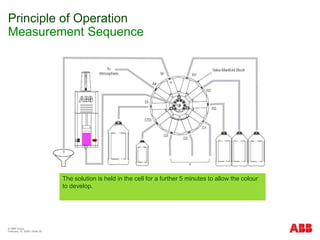
The solution is held in the cell for a further 5 minutes to allow the colour
to develop.
© ABB Group
February 15, 2024 | Slide 29
Principle of Operation
Measurement Sequence
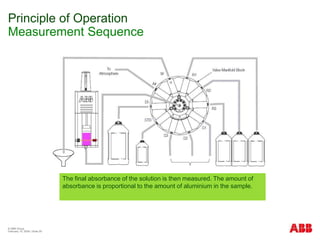
The final absorbance of the solution is then measured. The amount of
absorbance is proportional to the amount of aluminium in the sample.
© ABB Group
February 15, 2024 | Slide 30
Principle of Operation
Measurement Sequence
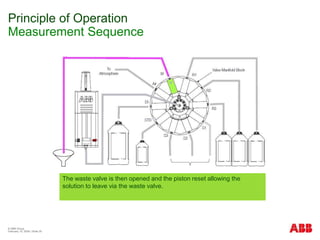
The waste valve is then opened and the piston reset allowing the
solution to leave via the waste valve.
© ABB Group
February 15, 2024 | Slide 31
Principle of Operation
Measurement Sequence
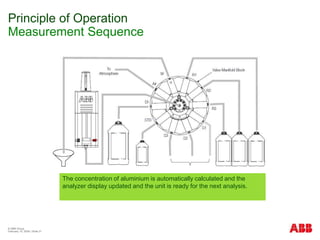
The concentration of aluminium is automatically calculated and the
analyzer display updated and the unit is ready for the next analysis.
© ABB Group
February 15, 2024 | Slide 32
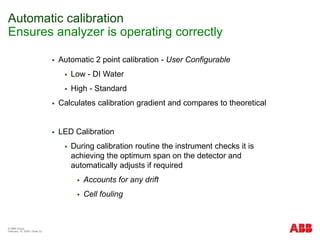
Automatic calibration
Ensures analyzer is operating correctly
 Automatic 2 point calibration - User Configurable
 Low - DI Water
 High - Standard
 Calculates calibration gradient and compares to theoretical
 LED Calibration
 During calibration routine the instrument checks it is
achieving the optimum span on the detector and
automatically adjusts if required
 Accounts for any drift
 Cell fouling
© ABB Group
February 15, 2024 | Slide 33
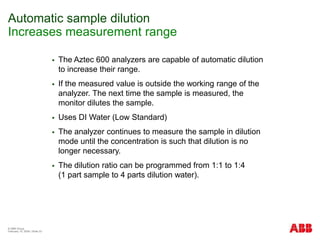
Automatic sample dilution
Increases measurement range
 The Aztec 600 analyzers are capable of automatic dilution
to increase their range.
 If the measured value is outside the working range of the
analyzer. The next time the sample is measured, the
monitor dilutes the sample.
 Uses DI Water (Low Standard)
 The analyzer continues to measure the sample in dilution
mode until the concentration is such that dilution is no
longer necessary.
 The dilution ratio can be programmed from 1:1 to 1:4
(1 part sample to 4 parts dilution water).
© ABB Group
February 15, 2024 | Slide 34
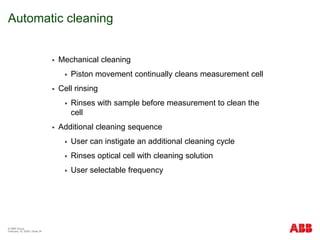
Automatic cleaning
 Mechanical cleaning
 Piston movement continually cleans measurement cell
 Cell rinsing
 Rinses with sample before measurement to clean the
cell
 Additional cleaning sequence
 User can instigate an additional cleaning cycle
 Rinses optical cell with cleaning solution
 User selectable frequency
© ABB Group
February 15, 2024 | Slide 35
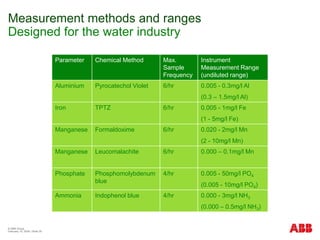
Measurement methods and ranges
Designed for the water industry
Parameter Chemical Method Max.
Sample
Frequency
Instrument
Measurement Range
(undiluted range)
Aluminium Pyrocatechol Violet 6/hr 0.005 - 0.3mg/l Al
(0.3 – 1.5mg/l Al)
Iron TPTZ 6/hr 0.005 - 1mg/l Fe
(1 - 5mg/l Fe)
Manganese Formaldoxime 6/hr 0.020 - 2mg/l Mn
(2 - 10mg/l Mn)
Manganese Leucomalachite 6/hr 0.000 – 0.1mg/l Mn
Phosphate Phosphomolybdenum
blue
4/hr 0.005 - 50mg/l PO4
(0.005 - 10mg/l PO4)
Ammonia Indophenol blue 4/hr 0.000 - 3mg/l NH3
(0.000 – 0.5mg/l NH3)
© ABB Group
February 15, 2024 | Slide 36
Simple device interaction
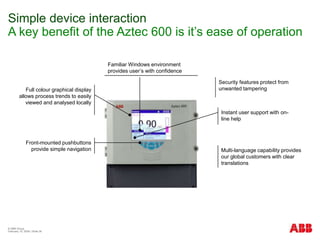
A key benefit of the Aztec 600 is it’s ease of operation
Familiar Windows environment
provides user’s with confidence
Full colour graphical display
allows process trends to easily
viewed and analysed locally
Front-mounted pushbuttons
provide simple navigation
Instant user support with on-
line help
Multi-language capability provides
our global customers with clear
translations
Security features protect from
unwanted tampering
© ABB Group
February 15, 2024 | Slide 37
Comprehensive Data Processing
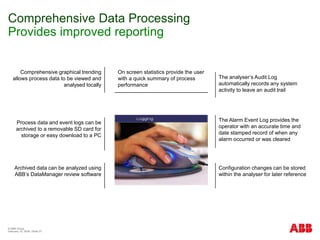
Provides improved reporting
The analyser’s Audit Log
automatically records any system
activity to leave an audit trail
Process data and event logs can be
archived to a removable SD card for
storage or easy download to a PC
The Alarm Event Log provides the
operator with an accurate time and
date stamped record of when any
alarm occurred or was cleared
Comprehensive graphical trending
allows process data to be viewed and
analysed locally
On screen statistics provide the user
with a quick summary of process
performance
Configuration changes can be stored
within the analyser for later reference
Archived data can be analyzed using
ABB’s DataManager review software
© ABB Group
February 15, 2024 | Slide 38
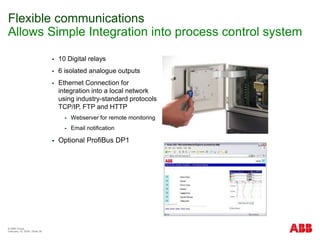
Flexible communications
Allows Simple Integration into process control system
 10 Digital relays
 6 isolated analogue outputs
 Ethernet Connection for
integration into a local network
using industry-standard protocols
TCP/IP, FTP and HTTP
 Webserver for remote monitoring
 Email notification
 Optional ProfiBus DP1
© ABB Group
February 15, 2024 | Slide 39
Simple to maintain
Due to inherent product design
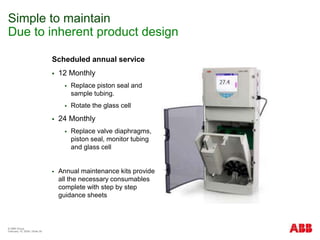
Scheduled annual service
 12 Monthly
 Replace piston seal and
sample tubing.
 Rotate the glass cell
 24 Monthly
 Replace valve diaphragms,
piston seal, monitor tubing
and glass cell
 Annual maintenance kits provide
all the necessary consumables
complete with step by step
guidance sheets
© ABB Group
February 15, 2024 | Slide 40
One basic design for all parameters
Benefits of a truly modular design
 Common Operational
Procedures
 Common Maintenance
Procedures
 Common Spare Parts
 Switch parameters
© ABB Group
February 15, 2024 | Slide 41
The Aztec 600 colorimetric range
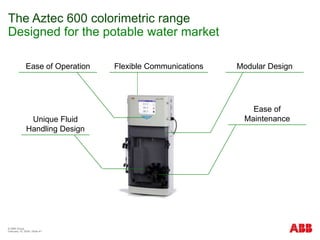
Designed for the potable water market
Unique Fluid
Handling Design
Ease of Operation
Ease of
Maintenance
Modular Design
Flexible Communications
© ABB Group
February 15, 2024 | Slide 42
ABB’s Aztec Range of Instrumentation
Enjoy the Aztec Influence
© ABB Group
February 15, 2024 | Slide 43

Introducing the new Aztec 600 Colorimetric Range_v4.ppt

  • 1.
    © ABB Group February15, 2024 | Slide 1 ABB Analytical Instrumentation Introducing the new Aztec 600 Colorimetric Range
  • 2.
    © ABB Group February15, 2024 | Slide 2 Where Aztec fits in the ABB Instrumentation Range Industrial Processes Potable Water / Municipal Wastewater Power / Steam Raising ABB Analytical Instrumentation Aztec Endura Navigator
  • 3.
    © ABB Group February15, 2024 | Slide 3 Water, our most fundamental natural resource  Demand for fresh water is increasing at three times the rate of population  Water resources around the globe are threatened by climate change, misuse and pollution  Water supply industry is continually challenged to supply constant safe supply of drinking water.
  • 4.
    © ABB Group February15, 2024 | Slide 4 ABB’s analytical instrumentation portfolio For when quality and accuracy matter  ABB has been supplying online analytical instrumentation to the water industry for over 50 years  Able to measure a wide range of parameters on-line  Physical, Inorganic and Organic  Based on a number of different sensing technologies  Ion selective, potentiometric, amperometric, absorption, optical, colorimetric
  • 5.
    © ABB Group February15, 2024 | Slide 5 ABB’s Aztec Range ABB’s new Aztec range of water monitoring instrumentation has been specifically created to provide the water industry with the advanced analysis to continually optimize their water treatment processes to meet the growing demand for safe drinking water at an affordable price.
  • 6.
    © ABB Group February15, 2024 | Slide 6 The Aztec 600 colorimetric range  A compact, reliable range of on- line colorimetric analyzers that have been designed to meet the needs of the water industry.  Reliable Measurement  Simple to Operate  Simple to Maintain  Reliable Data  Flexible Communications
  • 7.
    © ABB Group February15, 2024 | Slide 7 The Aztec 600 colorimetric range  A truly common colorimetric platform  Aztec 600 Aluminium  Aztec 600 Iron  Aztec 600 Manganese  Aztec 600 Manganese Low Range  Aztec 600 Phosphate  Aztec 600 Ammonia Parameter Range Application Aluminium 0.005 … 1.5 mg/l Al  Residual Coagulant Monitoring Iron 0.005 … 5 mg/l Fe  Residual Coagulant Monitoring  Iron Removal Manganese 0.020 … 10 mg/l Mn 0.001 … 0.1mg/l Mn  Manganese Removal  Final Water Monitoring Phosphate 0.050 … 50 mg/l PO4  Plumbosolvency Schemes  Monitoring municipal wastewater effluent Ammonia 0.002 … 3 mg/l NH3  River Monitoring/Intake Protection  Final Water Monitoring
  • 8.
    © ABB Group February15, 2024 | Slide 8 The Aztec 600 colorimetric range Product overview Single Stream Analyzer for measurement of 1 sample stream Multi-Stream Analyzer for measurement of up to 3 sample streams Electronics Section Wet Section
  • 9.
    © ABB Group February15, 2024 | Slide 9 Fluid Handling The unique Aztec 600 measurement system Integrated side sample pot with level sensor Central valve manifold selects what is brought into measurement cell Fluid handling consists of two sub-assemblies Modular parts can be easily interchanged and replaced on site All fluid handling mixing and disposal controlled by one measurement head assembly Measurement of up to 3 sample streams
  • 10.
    © ABB Group February15, 2024 | Slide 10 Fluid Handling Measurement head assembly  Acts as a motorized syringe for all fluid handling
  • 11.
    © ABB Group February15, 2024 | Slide 11 Fluid Handling Measurement head assembly  Precisely controlled stepper motor for accurate sample/reagent addition
  • 12.
    © ABB Group February15, 2024 | Slide 12 Fluid Handling Measurement head assembly  Precisely controlled stepper motor for accurate sample/reagent addition  PTFE cover protects leadscrew and motor assembly from chemicals
  • 13.
    © ABB Group February15, 2024 | Slide 13 Fluid Handling Measurement head assembly  Precisely controlled stepper motor for accurate sample/reagent addition  PTFE cover protects leadscrew and motor assembly from chemicals  Piston assembly movement mechanically wipes the optical cell at every measurement
  • 14.
    © ABB Group February15, 2024 | Slide 14 Fluid Handling Measurement head assembly  Precisely controlled stepper motor for accurate sample/reagent addition  PTFE cover protects leadscrew and motor assembly from chemicals  Piston assembly movement mechanically wipes the optical cell at every measurement  LED light source intensity automatically adjusted at calibration to eliminate drift and compensate for any cell fouling
  • 15.
    © ABB Group February15, 2024 | Slide 15 Fluid Handling Measurement head assembly  Precisely controlled stepper motor for accurate sample/reagent addition  PTFE cover protects leadscrew and motor assembly from chemicals  Piston assembly movement mechanically wipes the optical cell at every measurement  LED light source intensity automatically adjusted at calibration to eliminate drift and compensate for any cell fouling  Detector assembly measures light passed through the sample
  • 16.
    © ABB Group February15, 2024 | Slide 16 Fluid Handling Measurement head assembly  Precisely controlled stepper motor for accurate sample/reagent addition  PTFE cover protects leadscrew and motor assembly from chemicals  Piston assembly movement mechanically wipes the optical cell at every measurement  LED light source intensity automatically adjusted at calibration to eliminate drift and compensate for any cell fouling  Detector assembly measures light passed through the sample  Temperature controlled inner body increases measurement stability and certain chemical reactions
  • 17.
    © ABB Group February15, 2024 | Slide 17 Principle of Operation The principle of operation is the same for all Aztec 600 Colorimetric analyzers although the actual measurement sequence will vary depending upon the parameter. The following example is for aluminium.
  • 18.
    © ABB Group February15, 2024 | Slide 18 Principle of Operation Rinse Routine Measurement cell is rinsed with fresh sample
  • 19.
    © ABB Group February15, 2024 | Slide 19 Principle of Operation Rinse Routine Air is brought in to purge the tubing between the measurement head and valve manifold block
  • 20.
    © ABB Group February15, 2024 | Slide 20 Principle of Operation Rinse Routine The waste valve is then opened and the piston reset allowing the solution to leave via the waste valve The number of sample rinses is user configurable, the default is twice.
  • 21.
    © ABB Group February15, 2024 | Slide 21 Principle of Operation Measurement Sequence A small amount of reagent 1 (acid reagent) is brought into the cell.
  • 22.
    © ABB Group February15, 2024 | Slide 22 Principle of Operation Measurement Sequence The sample to be measured is then brought into the cell causing it to mix with reagent 1
  • 23.
    © ABB Group February15, 2024 | Slide 23 Principle of Operation Measurement Sequence The acidified sample solution is then held in the measurement cell for 3 minutes. This acidification is normally sufficient to convert all soluble forms of aluminium to those that will react with the colour forming reagent.
  • 24.
    © ABB Group February15, 2024 | Slide 24 Principle of Operation Measurement Sequence Before any colour forming chemicals are added a measurement of the background is taken. This is to account for any natural colour of the sample.
  • 25.
    © ABB Group February15, 2024 | Slide 25 Principle of Operation Measurement Sequence A small amount of reagent 2 (Buffer) is brought into the cell to raise the pH of the solution so that it will react with the colour forming complex.
  • 26.
    © ABB Group February15, 2024 | Slide 26 Principle of Operation Measurement Sequence A small amount of reagent 3 (Colour forming reagent) is brought into the cell.
  • 27.
    © ABB Group February15, 2024 | Slide 27 Principle of Operation Measurement Sequence Air is brought in to the cell which both purges the tubing and mixes the reagents with the solution in the cell.
  • 28.
    © ABB Group February15, 2024 | Slide 28 Principle of Operation Measurement Sequence The solution is held in the cell for a further 5 minutes to allow the colour to develop.
  • 29.
    © ABB Group February15, 2024 | Slide 29 Principle of Operation Measurement Sequence The final absorbance of the solution is then measured. The amount of absorbance is proportional to the amount of aluminium in the sample.
  • 30.
    © ABB Group February15, 2024 | Slide 30 Principle of Operation Measurement Sequence The waste valve is then opened and the piston reset allowing the solution to leave via the waste valve.
  • 31.
    © ABB Group February15, 2024 | Slide 31 Principle of Operation Measurement Sequence The concentration of aluminium is automatically calculated and the analyzer display updated and the unit is ready for the next analysis.
  • 32.
    © ABB Group February15, 2024 | Slide 32 Automatic calibration Ensures analyzer is operating correctly  Automatic 2 point calibration - User Configurable  Low - DI Water  High - Standard  Calculates calibration gradient and compares to theoretical  LED Calibration  During calibration routine the instrument checks it is achieving the optimum span on the detector and automatically adjusts if required  Accounts for any drift  Cell fouling
  • 33.
    © ABB Group February15, 2024 | Slide 33 Automatic sample dilution Increases measurement range  The Aztec 600 analyzers are capable of automatic dilution to increase their range.  If the measured value is outside the working range of the analyzer. The next time the sample is measured, the monitor dilutes the sample.  Uses DI Water (Low Standard)  The analyzer continues to measure the sample in dilution mode until the concentration is such that dilution is no longer necessary.  The dilution ratio can be programmed from 1:1 to 1:4 (1 part sample to 4 parts dilution water).
  • 34.
    © ABB Group February15, 2024 | Slide 34 Automatic cleaning  Mechanical cleaning  Piston movement continually cleans measurement cell  Cell rinsing  Rinses with sample before measurement to clean the cell  Additional cleaning sequence  User can instigate an additional cleaning cycle  Rinses optical cell with cleaning solution  User selectable frequency
  • 35.
    © ABB Group February15, 2024 | Slide 35 Measurement methods and ranges Designed for the water industry Parameter Chemical Method Max. Sample Frequency Instrument Measurement Range (undiluted range) Aluminium Pyrocatechol Violet 6/hr 0.005 - 0.3mg/l Al (0.3 – 1.5mg/l Al) Iron TPTZ 6/hr 0.005 - 1mg/l Fe (1 - 5mg/l Fe) Manganese Formaldoxime 6/hr 0.020 - 2mg/l Mn (2 - 10mg/l Mn) Manganese Leucomalachite 6/hr 0.000 – 0.1mg/l Mn Phosphate Phosphomolybdenum blue 4/hr 0.005 - 50mg/l PO4 (0.005 - 10mg/l PO4) Ammonia Indophenol blue 4/hr 0.000 - 3mg/l NH3 (0.000 – 0.5mg/l NH3)
  • 36.
    © ABB Group February15, 2024 | Slide 36 Simple device interaction A key benefit of the Aztec 600 is it’s ease of operation Familiar Windows environment provides user’s with confidence Full colour graphical display allows process trends to easily viewed and analysed locally Front-mounted pushbuttons provide simple navigation Instant user support with on- line help Multi-language capability provides our global customers with clear translations Security features protect from unwanted tampering
  • 37.
    © ABB Group February15, 2024 | Slide 37 Comprehensive Data Processing Provides improved reporting The analyser’s Audit Log automatically records any system activity to leave an audit trail Process data and event logs can be archived to a removable SD card for storage or easy download to a PC The Alarm Event Log provides the operator with an accurate time and date stamped record of when any alarm occurred or was cleared Comprehensive graphical trending allows process data to be viewed and analysed locally On screen statistics provide the user with a quick summary of process performance Configuration changes can be stored within the analyser for later reference Archived data can be analyzed using ABB’s DataManager review software
  • 38.
    © ABB Group February15, 2024 | Slide 38 Flexible communications Allows Simple Integration into process control system  10 Digital relays  6 isolated analogue outputs  Ethernet Connection for integration into a local network using industry-standard protocols TCP/IP, FTP and HTTP  Webserver for remote monitoring  Email notification  Optional ProfiBus DP1
  • 39.
    © ABB Group February15, 2024 | Slide 39 Simple to maintain Due to inherent product design Scheduled annual service  12 Monthly  Replace piston seal and sample tubing.  Rotate the glass cell  24 Monthly  Replace valve diaphragms, piston seal, monitor tubing and glass cell  Annual maintenance kits provide all the necessary consumables complete with step by step guidance sheets
  • 40.
    © ABB Group February15, 2024 | Slide 40 One basic design for all parameters Benefits of a truly modular design  Common Operational Procedures  Common Maintenance Procedures  Common Spare Parts  Switch parameters
  • 41.
    © ABB Group February15, 2024 | Slide 41 The Aztec 600 colorimetric range Designed for the potable water market Unique Fluid Handling Design Ease of Operation Ease of Maintenance Modular Design Flexible Communications
  • 42.
    © ABB Group February15, 2024 | Slide 42 ABB’s Aztec Range of Instrumentation Enjoy the Aztec Influence
  • 43.
    © ABB Group February15, 2024 | Slide 43