Introduction To SQL Unit 8 Modern Business Technology Introduction To TSQL Unit 8 Developed by Michael Hotek
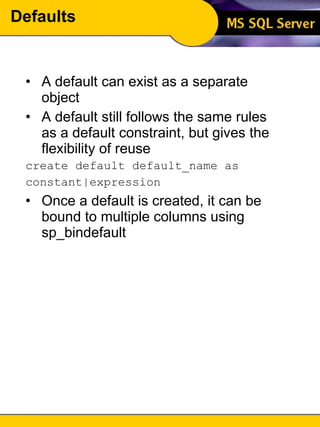
Defaults A default can exist as a separate object A default still follows the same rules as a default constraint, but gives the flexibility of reuse create default default_name as constant|expression Once a default is created, it can be bound to multiple columns using sp_bindefault
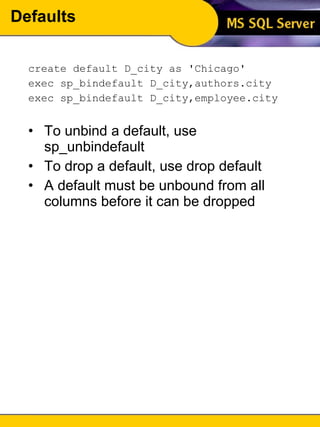
Defaults create default D_city as 'Chicago' exec sp_bindefault D_city,authors.city exec sp_bindefault D_city,employee.city To unbind a default, use sp_unbindefault To drop a default, use drop default A default must be unbound from all columns before it can be dropped
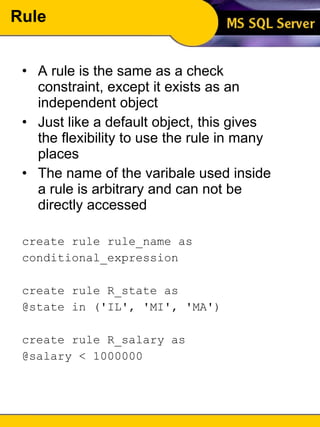
Rule A rule is the same as a check constraint, except it exists as an independent object Just like a default object, this gives the flexibility to use the rule in many places The name of the varibale used inside a rule is arbitrary and can not be directly accessed create rule rule_name as conditional_expression create rule R_state as @state in ('IL', 'MI', 'MA') create rule R_salary as @salary < 1000000
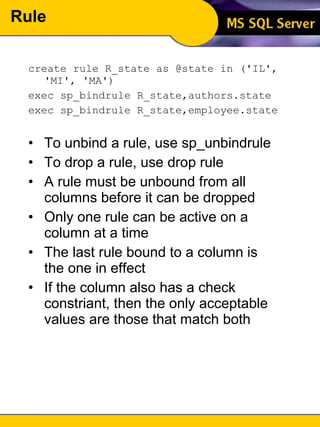
Rule create rule R_state as @state in ('IL', 'MI', 'MA')  exec sp_bindrule R_state,authors.state exec sp_bindrule R_state,employee.state To unbind a rule, use sp_unbindrule To drop a rule, use drop rule A rule must be unbound from all columns before it can be dropped Only one rule can be active on a column at a time The last rule bound to a column is the one in effect If the column also has a check constriant, then the only acceptable values are those that match both
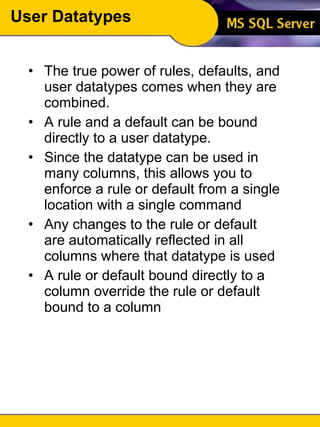
User Datatypes The true power of rules, defaults, and user datatypes comes when they are combined. A rule and a default can be bound directly to a user datatype. Since the datatype can be used in many columns, this allows you to enforce a rule or default from a single location with a single command Any changes to the rule or default are automatically reflected in all columns where that datatype is used A rule or default bound directly to a column override the rule or default bound to a column
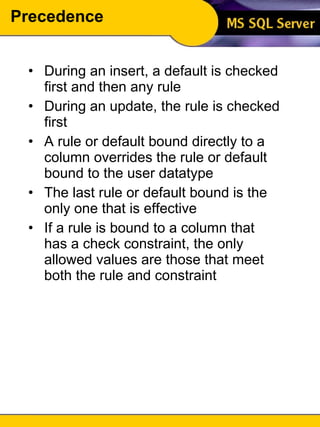
Precedence During an insert, a default is checked first and then any rule During an update, the rule is checked first A rule or default bound directly to a column overrides the rule or default bound to the user datatype The last rule or default bound is the only one that is effective If a rule is bound to a column that has a check constraint, the only allowed values are those that meet both the rule and constraint
Definitions Just like every other object in the database, information concerning a rule or default can be obtained from the system procedure sp_helptext sp_helptext object_name
Unique Index Unique indexes are used to enforce uniqueness within a column or group of columns A unique index is created in three cases: Primary key constraint is defined Unique constraint is defined A unique index is explicitly created When the index is created, the data is checked for uniqueness.  If duplicates are present, the creation of the index fails The index is then enforced on all subsequent inserts and updates
Implementing RI Which method to choose?
Unit 8 Review Defaults can be created as separate objects sp_bindefault binds a default to a column or datatype Rules can also be created as separate objects sp_bindrule binds a rule to a column or datatype Rules and defaults promote reusablity They can be combined with user datatypes for increased power and flexibility The last rule or default bound to a datatype takes effect A rule or default bound directly to a column overrides a rule or default bound to the column's datatype A unique index is used to enforce uniqueness within a column or group of columns
Unit 8 Exercises Time allotted for exercises is 30 minutes

Intro to tsql unit 8

  • 1.
    Introduction To SQLUnit 8 Modern Business Technology Introduction To TSQL Unit 8 Developed by Michael Hotek
  • 2.
    Defaults A defaultcan exist as a separate object A default still follows the same rules as a default constraint, but gives the flexibility of reuse create default default_name as constant|expression Once a default is created, it can be bound to multiple columns using sp_bindefault
  • 3.
    Defaults create defaultD_city as 'Chicago' exec sp_bindefault D_city,authors.city exec sp_bindefault D_city,employee.city To unbind a default, use sp_unbindefault To drop a default, use drop default A default must be unbound from all columns before it can be dropped
  • 4.
    Rule A ruleis the same as a check constraint, except it exists as an independent object Just like a default object, this gives the flexibility to use the rule in many places The name of the varibale used inside a rule is arbitrary and can not be directly accessed create rule rule_name as conditional_expression create rule R_state as @state in ('IL', 'MI', 'MA') create rule R_salary as @salary < 1000000
  • 5.
    Rule create ruleR_state as @state in ('IL', 'MI', 'MA') exec sp_bindrule R_state,authors.state exec sp_bindrule R_state,employee.state To unbind a rule, use sp_unbindrule To drop a rule, use drop rule A rule must be unbound from all columns before it can be dropped Only one rule can be active on a column at a time The last rule bound to a column is the one in effect If the column also has a check constriant, then the only acceptable values are those that match both
  • 6.
    User Datatypes Thetrue power of rules, defaults, and user datatypes comes when they are combined. A rule and a default can be bound directly to a user datatype. Since the datatype can be used in many columns, this allows you to enforce a rule or default from a single location with a single command Any changes to the rule or default are automatically reflected in all columns where that datatype is used A rule or default bound directly to a column override the rule or default bound to a column
  • 7.
    Precedence During aninsert, a default is checked first and then any rule During an update, the rule is checked first A rule or default bound directly to a column overrides the rule or default bound to the user datatype The last rule or default bound is the only one that is effective If a rule is bound to a column that has a check constraint, the only allowed values are those that meet both the rule and constraint
  • 8.
    Definitions Just likeevery other object in the database, information concerning a rule or default can be obtained from the system procedure sp_helptext sp_helptext object_name
  • 9.
    Unique Index Uniqueindexes are used to enforce uniqueness within a column or group of columns A unique index is created in three cases: Primary key constraint is defined Unique constraint is defined A unique index is explicitly created When the index is created, the data is checked for uniqueness. If duplicates are present, the creation of the index fails The index is then enforced on all subsequent inserts and updates
  • 10.
    Implementing RI Whichmethod to choose?
  • 11.
    Unit 8 ReviewDefaults can be created as separate objects sp_bindefault binds a default to a column or datatype Rules can also be created as separate objects sp_bindrule binds a rule to a column or datatype Rules and defaults promote reusablity They can be combined with user datatypes for increased power and flexibility The last rule or default bound to a datatype takes effect A rule or default bound directly to a column overrides a rule or default bound to the column's datatype A unique index is used to enforce uniqueness within a column or group of columns
  • 12.
    Unit 8 ExercisesTime allotted for exercises is 30 minutes

Editor's Notes