Intro to HBase
                      Internals &
                     Schema Design
                           (for HBase Users)
                     Alex Baranau, Sematext International, 2012


Monday, July 9, 12
About Me


                     Software Engineer at Sematext International

                     http://blog.sematext.com/author/abaranau

                     @abaranau

                     http://github.com/sematext (abaranau)


Monday, July 9, 12
Agenda


                     Logical view

                     Physical view

                     Schema design

                     Other/Advanced topics


Monday, July 9, 12
Why?
                     Why should I (HBase user) care about
                     HBase internals?

                       HBase will not adjust cluster
                       settings to optimal based on usage
                       patterns automatically

                       Schema design, table settings
                       (defined upon creation), etc.
                       depend on HBase implementation
                       aspects


Monday, July 9, 12
Logical View


Monday, July 9, 12
Logical View: Regions
                     HBase cluster serves multiple tables, distinguished by
                     name

                     Each table contains of rows

                     Each row contains cells:
                     (row key, column family, column, timestamp) -> value

                     Table is split into Regions (table shards, each
                     contains full rows), defined by start and end row keys


Monday, July 9, 12
Logical View: Regions are
                              Shards
                     Regions are “atoms of distribution”

                     Each region assigned to single RegionServer
                     (HBase cluster slave)

                       Rows of particular Region served by single
                       RS (cluster slave)

                       Regions are distributed evenly across RSs

                       Region has configurable max size

                     When region reaches max size (or on request)
                     it is split into two smaller regions, which
                     can be assigned to different RSs


Monday, July 9, 12
Logical View: Regions on
                              Cluster
                                                ZooKeeper
                                                ZooKeeper
                                                 ZooKeeper


                     client              HMaster
                                          HMaster


                                          Region   Region

                                         RegionServer


                              Region   Region      Region   Region
                                                   RegionServer
                                                    RegionServer
                              RegionServer         RegionServer


Monday, July 9, 12
Logical View: Regions Load

                     It is essential for Regions under the
                     load to be evenly distributed across
                     the cluster

                     It is HBase user’s job to make sure
                     the above is true. Note: even
                     distribution of Regions over cluster
                     doesn’t imply that the load is evenly
                     distributed


Monday, July 9, 12
Logical View: Regions Load

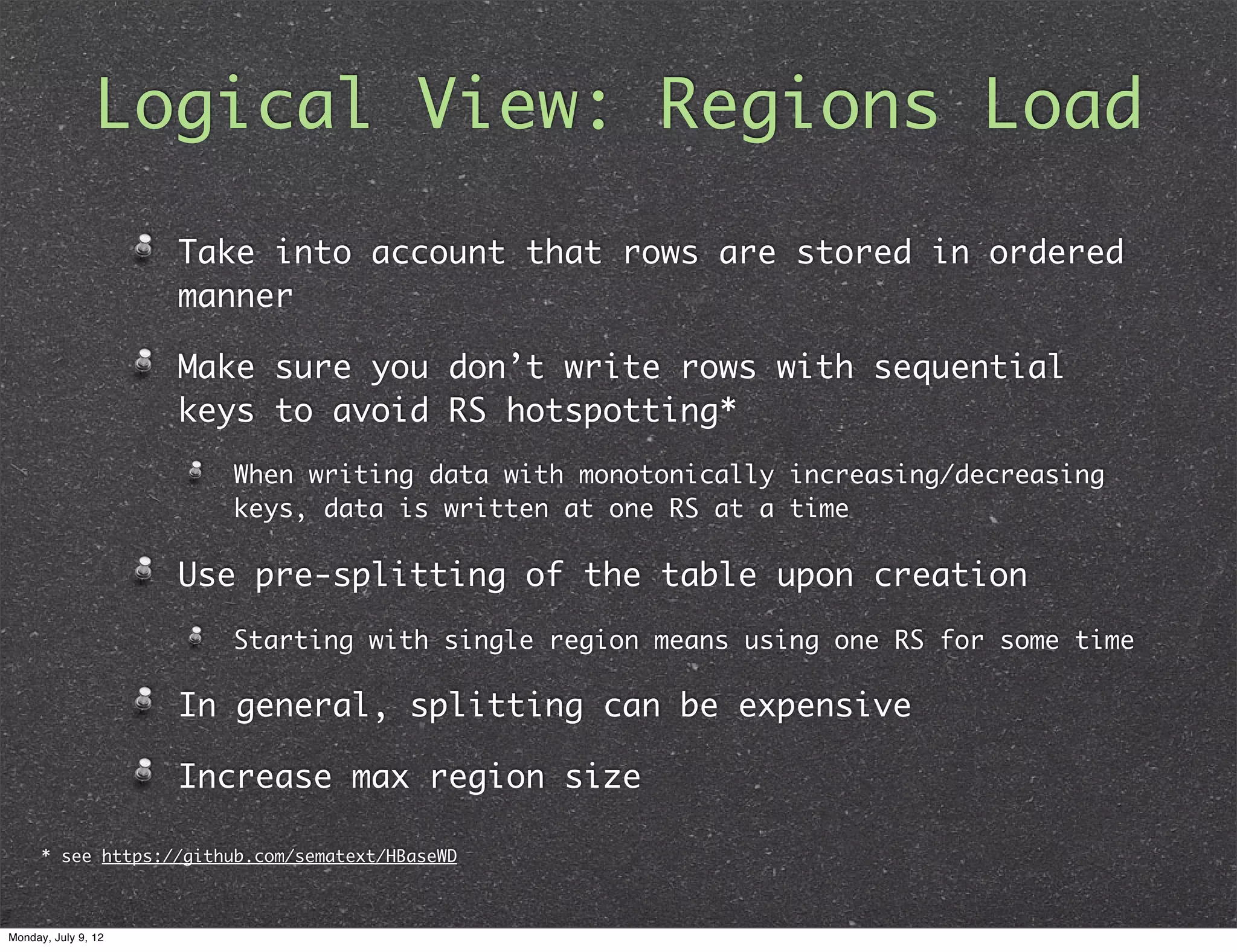
                     Take into account that rows are stored in ordered
                     manner

                     Make sure you don’t write rows with sequential
                     keys to avoid RS hotspotting*
                        When writing data with monotonically increasing/decreasing
                        keys, data is written at one RS at a time

                     Use pre-splitting of the table upon creation
                        Starting with single region means using one RS for some time

                     In general, splitting can be expensive

                     Increase max region size

      * see https://github.com/sematext/HBaseWD


Monday, July 9, 12
Logical View: Slow RSs
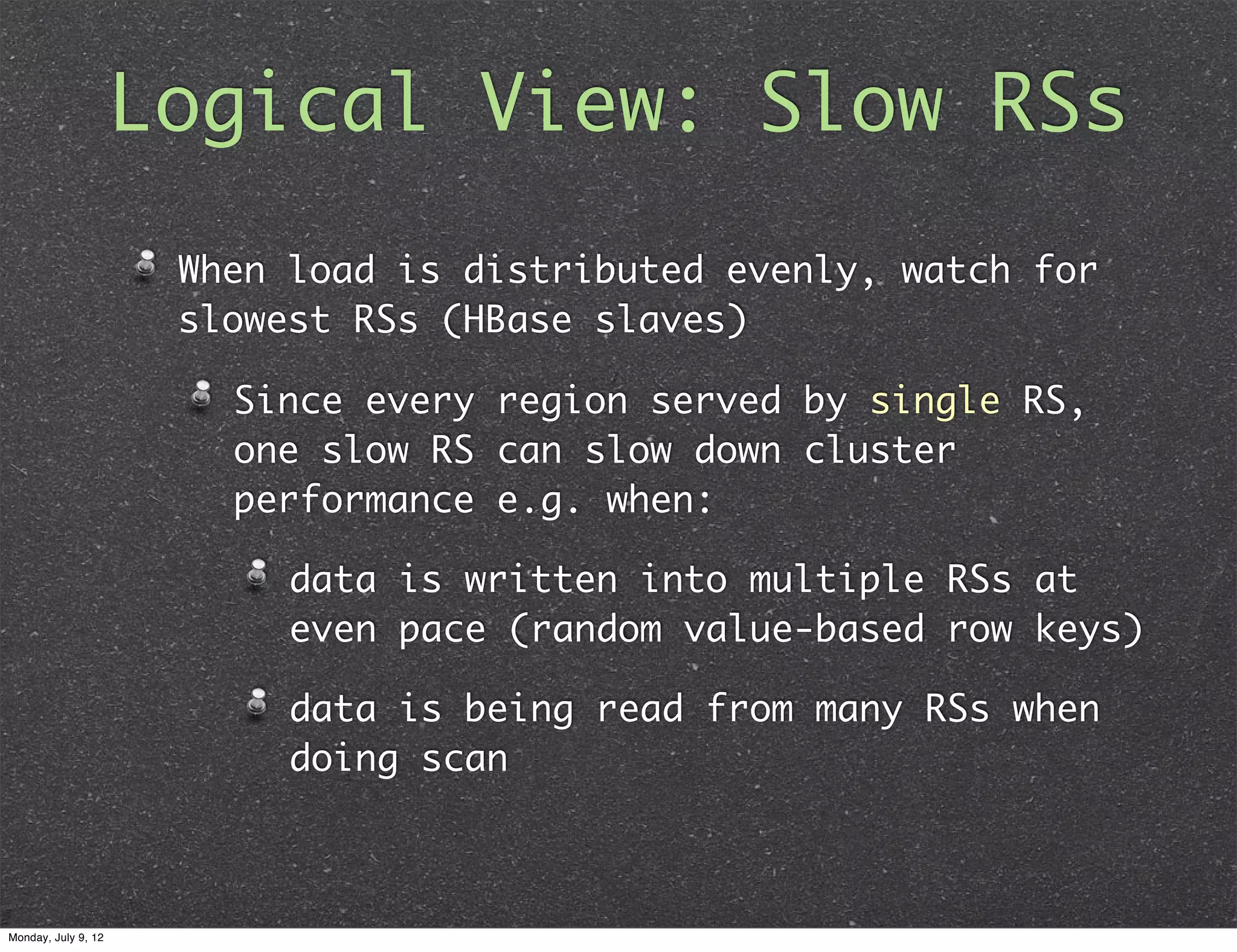
                      When load is distributed evenly, watch for
                      slowest RSs (HBase slaves)

                        Since every region served by single RS,
                        one slow RS can slow down cluster
                        performance e.g. when:

                           data is written into multiple RSs at
                           even pace (random value-based row keys)

                           data is being read from many RSs when
                           doing scan


Monday, July 9, 12
Physical View


Monday, July 9, 12
Physical View: Write/Read Flow
                     HTable       client                           client
                       buffer                          HTable


               write                                     read         RegionServer

                         Region                    z            Region ...
                                                                                         ...
                                        Store                               Store
                       MemStore                                  MemStore
                                        (per CF)                            (per CF)

                          flush

                       HFile    HFile     ...            HFile     HFile


                                          Write Ahead Log

                                                                                       HDFS
Monday, July 9, 12
Physical: Speed up Writing

                     Enabling & increasing client-side buffer reduces RPC
                     operations amount

                       warn: possible loss of buffered data

                          in case of client failure; design for failover

                          in case of write failure (networking/server-
                          side issues); can be handled on client

                     Disabling WAL increases write speed

                       warn: possible data loss in case of RS failure

                     Use bulk import functionality (writes HFiles
                     directly, which can be later added to HBase)


Monday, July 9, 12
Physical: Memstore Flushes
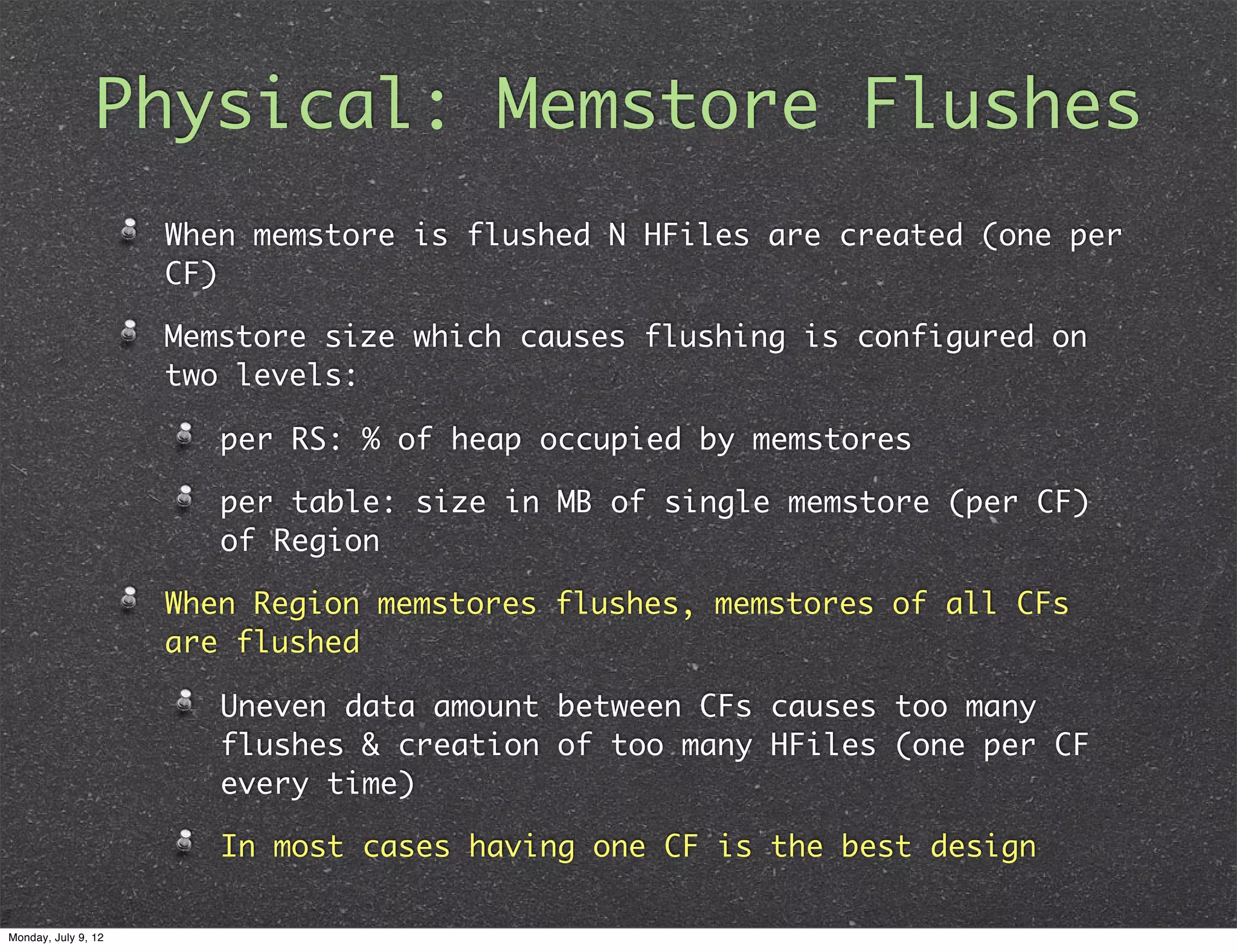
                     When memstore is flushed N HFiles are created (one per
                     CF)

                     Memstore size which causes flushing is configured on
                     two levels:

                        per RS: % of heap occupied by memstores

                        per table: size in MB of single memstore (per CF)
                        of Region

                     When Region memstores flushes, memstores of all CFs
                     are flushed

                        Uneven data amount between CFs causes too many
                        flushes & creation of too many HFiles (one per CF
                        every time)

                        In most cases having one CF is the best design

Monday, July 9, 12
Physical: Memstore Flushes
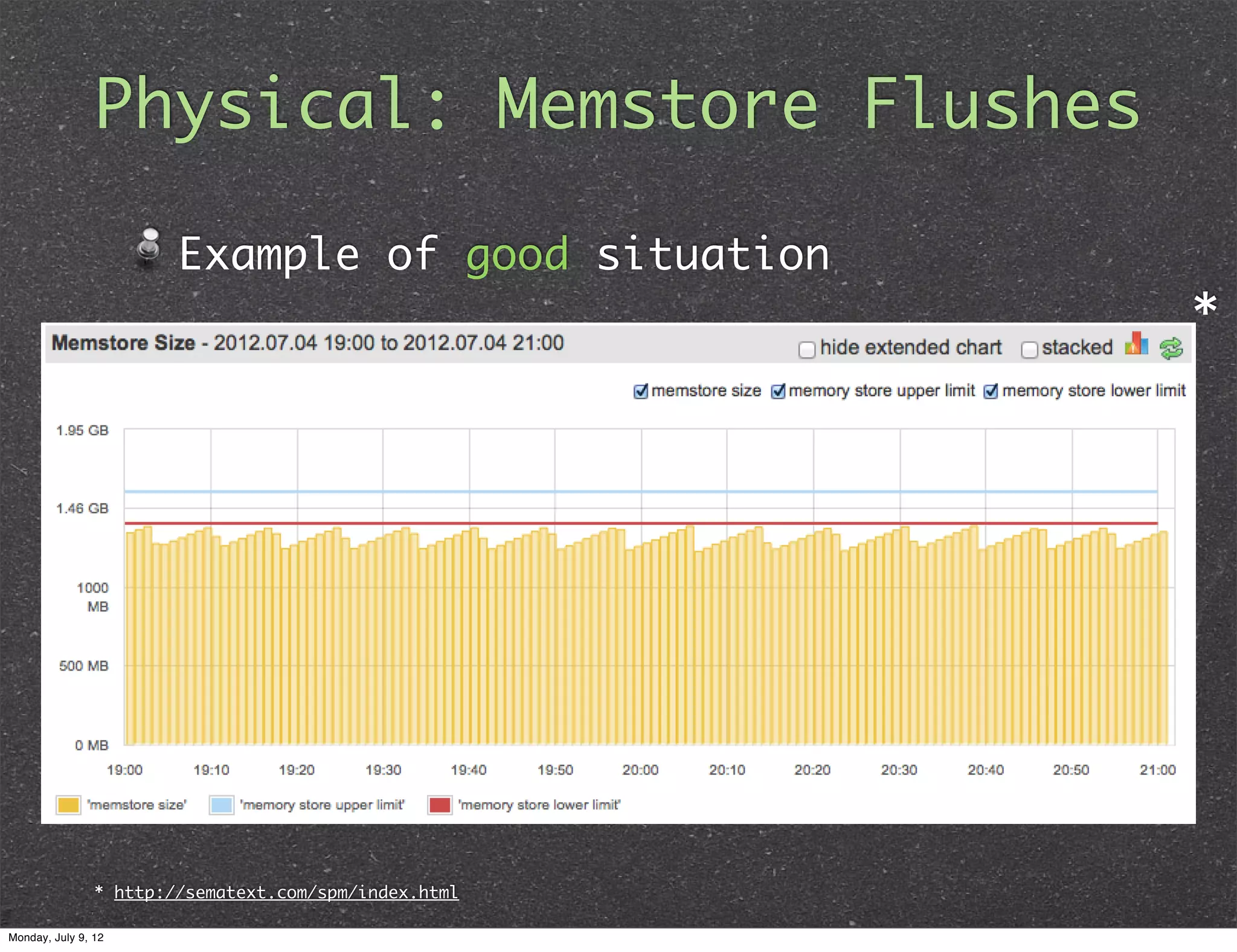
                     Important: there are Memstore size
                     thresholds which cause writes to be blocked,
                     so slow memstore flushes and overuse of
                     memory by memstore can cause write perf
                     degradation

                       Hint: watch for flush queue size metric on
                       RSs

                     At the same time the more memory memstore
                     uses the better for writing/reading perf
                     (unless it reaches those “write blocking”
                     thresholds)


Monday, July 9, 12
Physical: Memstore Flushes

                        Example of good situation
                                                       *


                * http://sematext.com/spm/index.html

Monday, July 9, 12
Physical: HFiles Compaction
                     HFiles are periodically compacted into bigger
                     HFiles containing same data

                       Reading from less HFiles faster

                     Important: there’s a configured max number of files
                     in Store which, when reached causes writes to block

                       Hint: watch for compaction queue size metric on
                       RSs


                                    read                       Store
                                                    MemStore
                                                               (per CF)


                                            HFile     HFile


Monday, July 9, 12
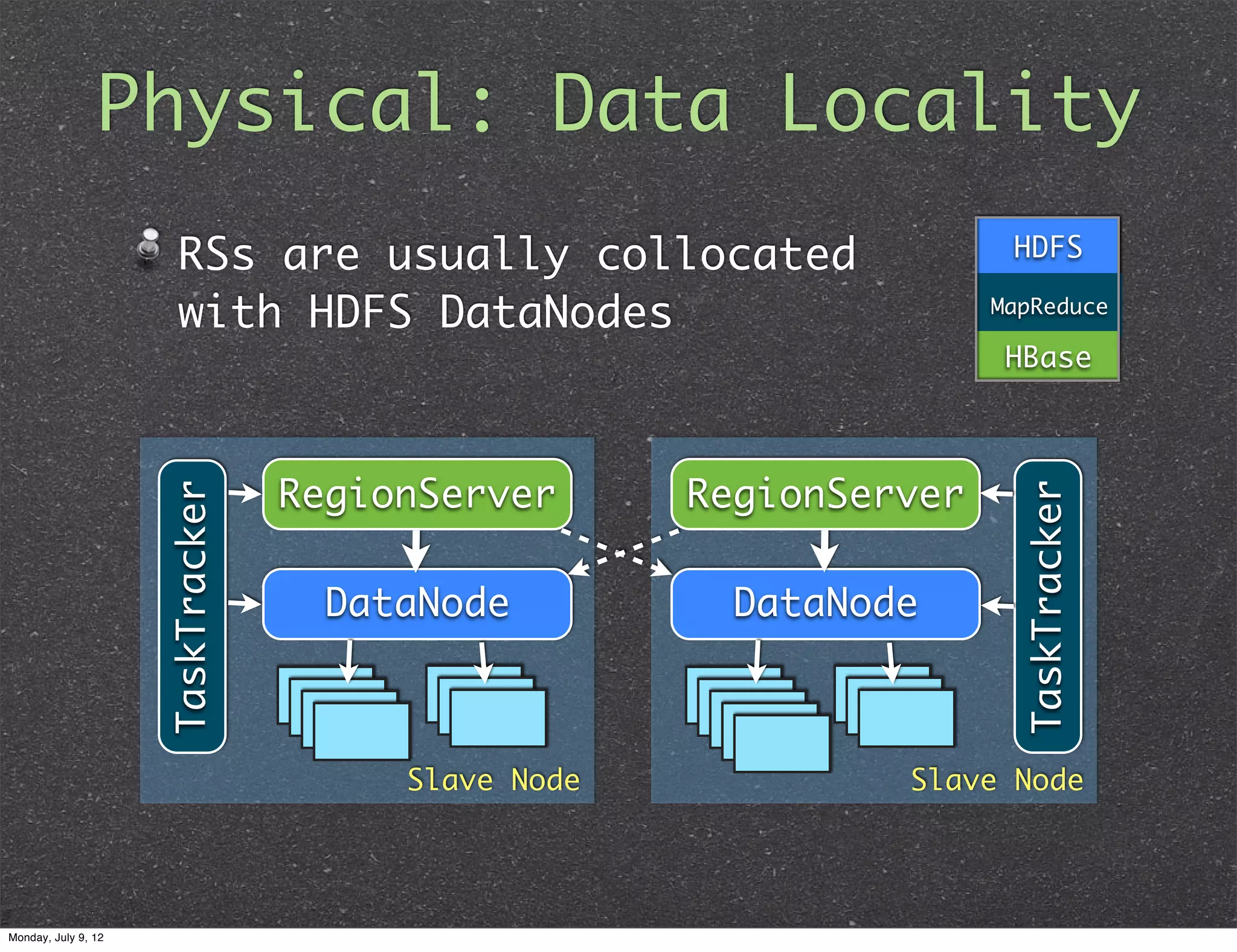
Physical: Data Locality
                       RSs are usually collocated                    HDFS

                       with HDFS DataNodes                          MapReduce

                                                                     HBase


                                   RegionServer      RegionServer


                                                                      TaskTracker
                     TaskTracker


                                     DataNode          DataNode


                                        Slave Node            Slave Node


Monday, July 9, 12
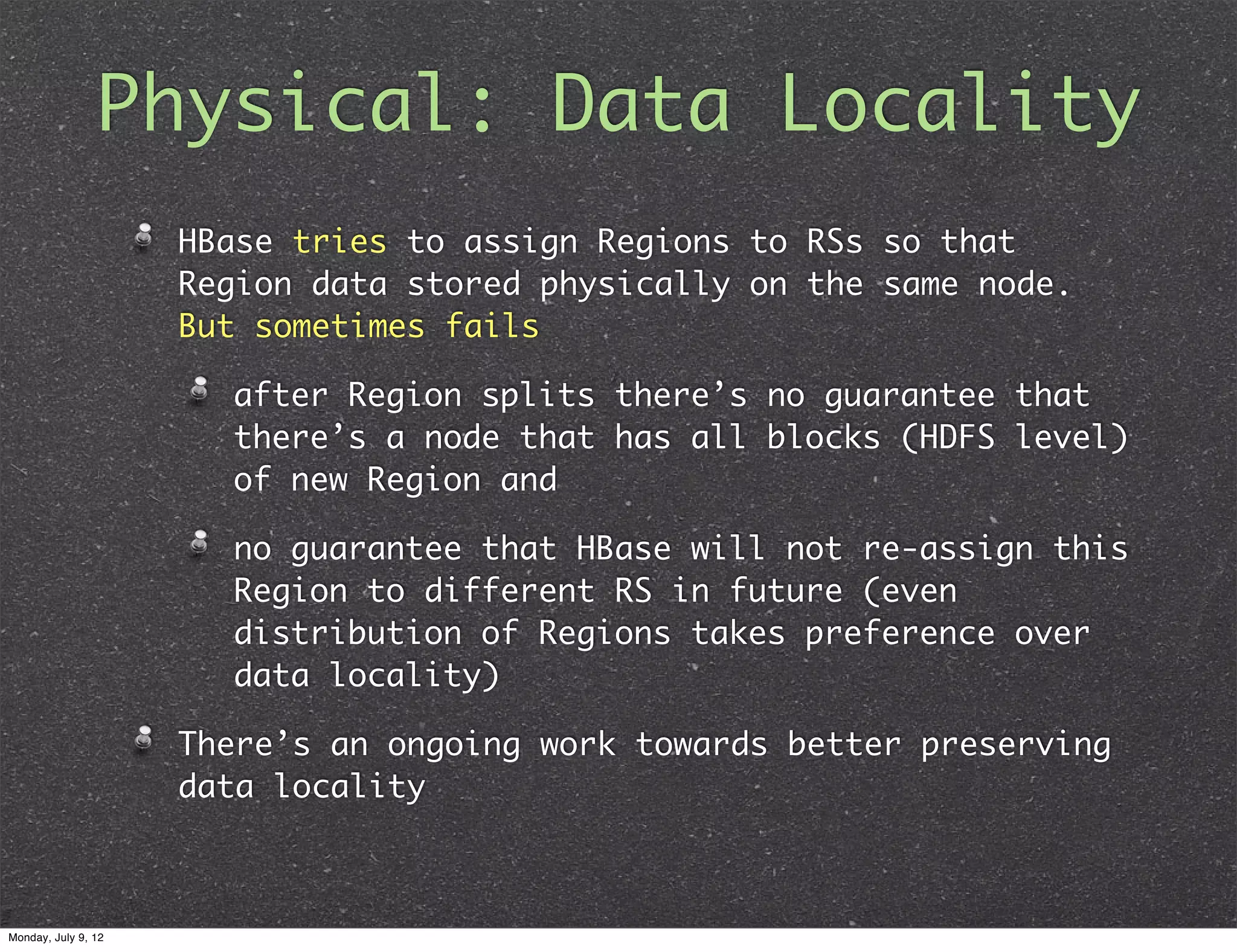
Physical: Data Locality
                     HBase tries to assign Regions to RSs so that
                     Region data stored physically on the same node.
                     But sometimes fails

                       after Region splits there’s no guarantee that
                       there’s a node that has all blocks (HDFS level)
                       of new Region and

                       no guarantee that HBase will not re-assign this
                       Region to different RS in future (even
                       distribution of Regions takes preference over
                       data locality)

                     There’s an ongoing work towards better preserving
                     data locality


Monday, July 9, 12
Physical: Data Locality
                     Also, data locality can break when:

                        Adding new slaves to cluster

                        Removing slaves from cluster

                            Incl. node failures

                     Hint: look at networking IO between slaves when writing/reading
                     data, it should be minimal

                     Important:

                        make sure HDFS is well balanced (use balancer tool)

                        try to rebalance Regions in HBase cluster if possible (HBase
                        Master restart will do that) to regain data locality

                        Pre-split table on creation to limit (ideally avoid) splits
                        and regions movement; manage splits manually sometimes helps


Monday, July 9, 12
Schema Design
                       (very briefly)


Monday, July 9, 12
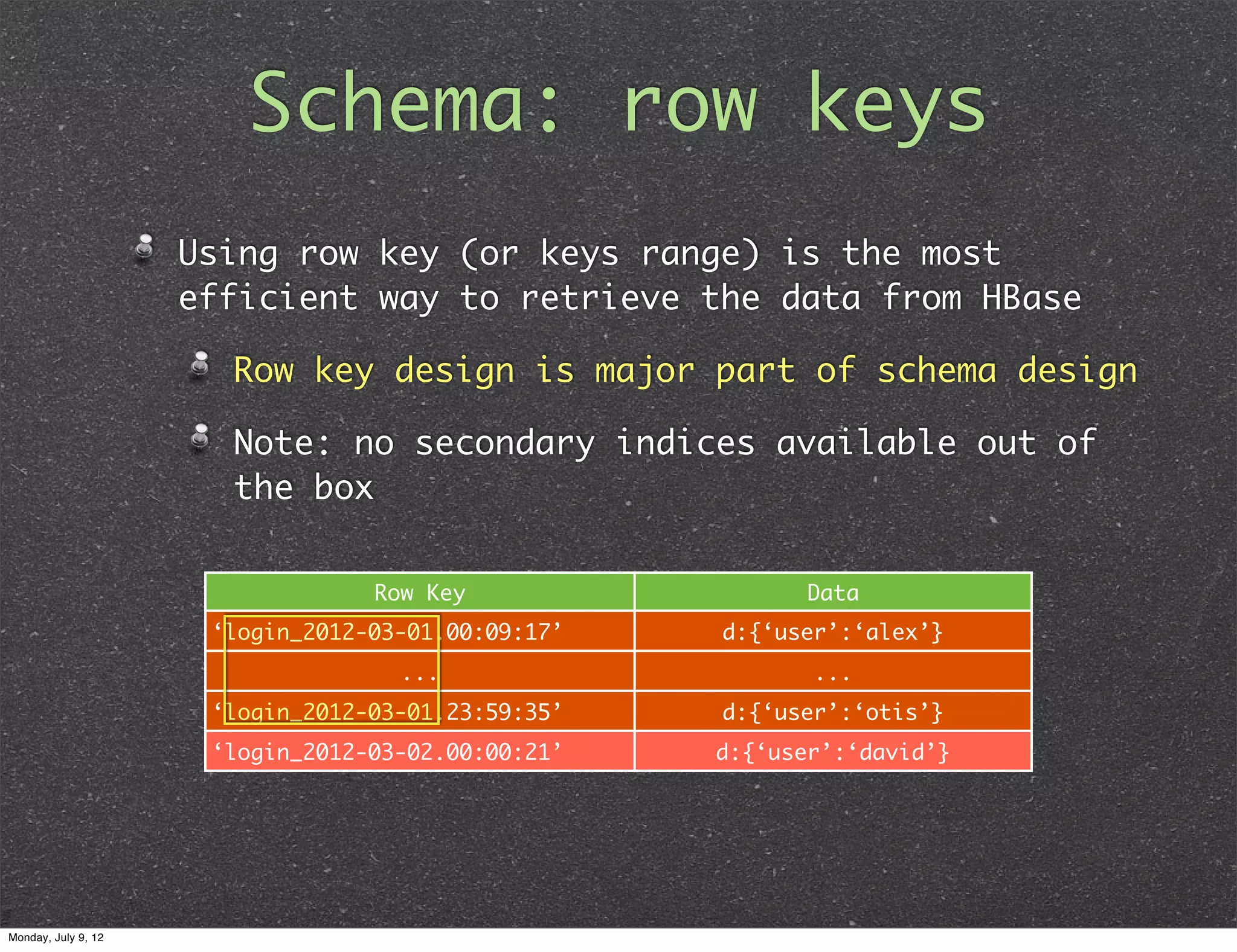
Schema: row keys
                     Using row key (or keys range) is the most
                     efficient way to retrieve the data from HBase

                       Row key design is major part of schema design

                       Note: no secondary indices available out of
                       the box


                                  Row Key                  Data
                      ‘login_2012-03-01.00:09:17’   d:{‘user’:‘alex’}
                                    ...                    ...
                      ‘login_2012-03-01.23:59:35’   d:{‘user’:‘otis’}
                      ‘login_2012-03-02.00:00:21’   d:{‘user’:‘david’}


Monday, July 9, 12
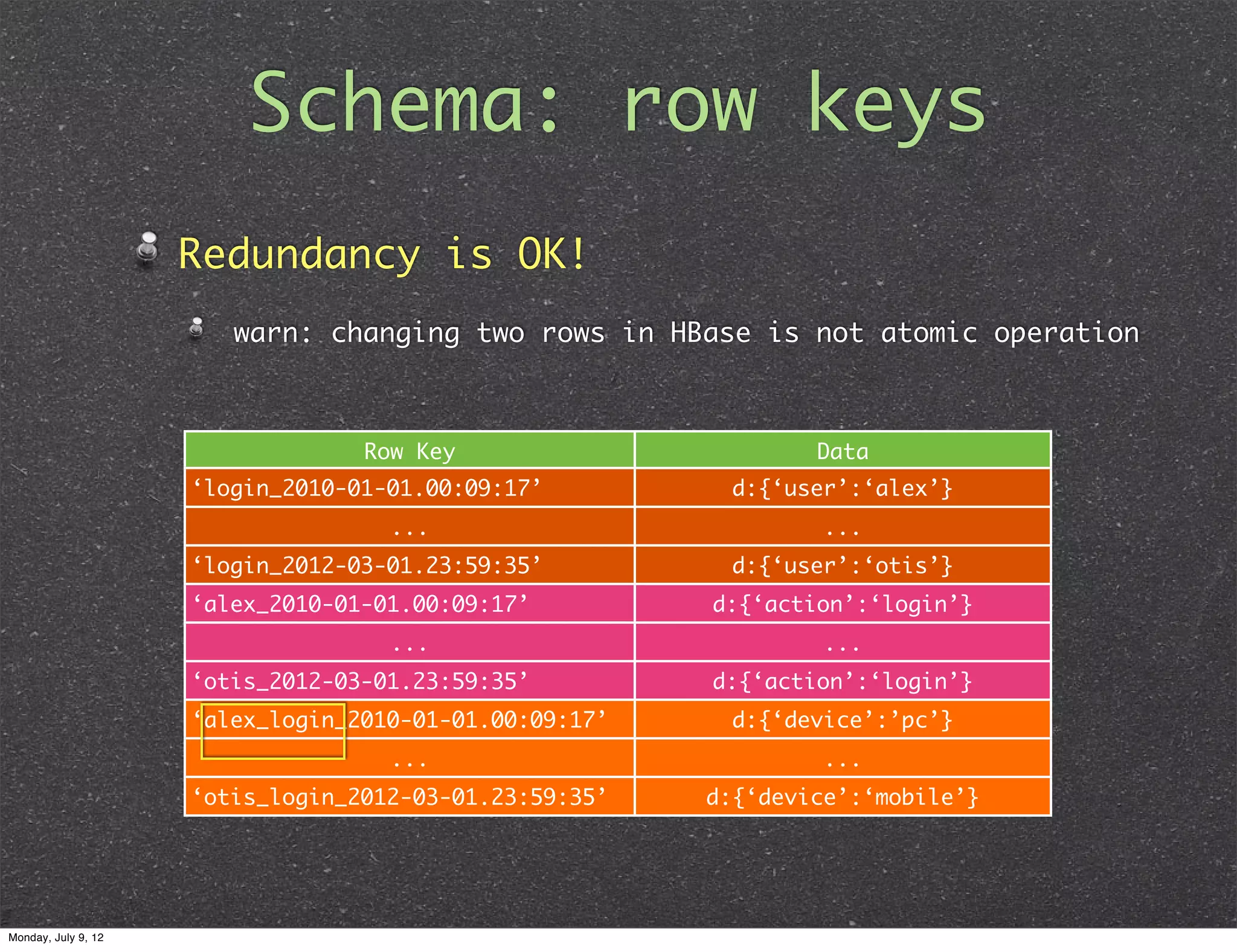
Schema: row keys
                     Redundancy is OK!
                        warn: changing two rows in HBase is not atomic operation


                                  Row Key                       Data
                     ‘login_2010-01-01.00:09:17’          d:{‘user’:‘alex’}
                                    ...                          ...
                     ‘login_2012-03-01.23:59:35’          d:{‘user’:‘otis’}
                     ‘alex_2010-01-01.00:09:17’         d:{‘action’:‘login’}
                                    ...                          ...
                     ‘otis_2012-03-01.23:59:35’         d:{‘action’:‘login’}
                     ‘alex_login_2010-01-01.00:09:17’     d:{‘device’:’pc’}
                                    ...                          ...
                     ‘otis_login_2012-03-01.23:59:35’   d:{‘device’:‘mobile’}


Monday, July 9, 12
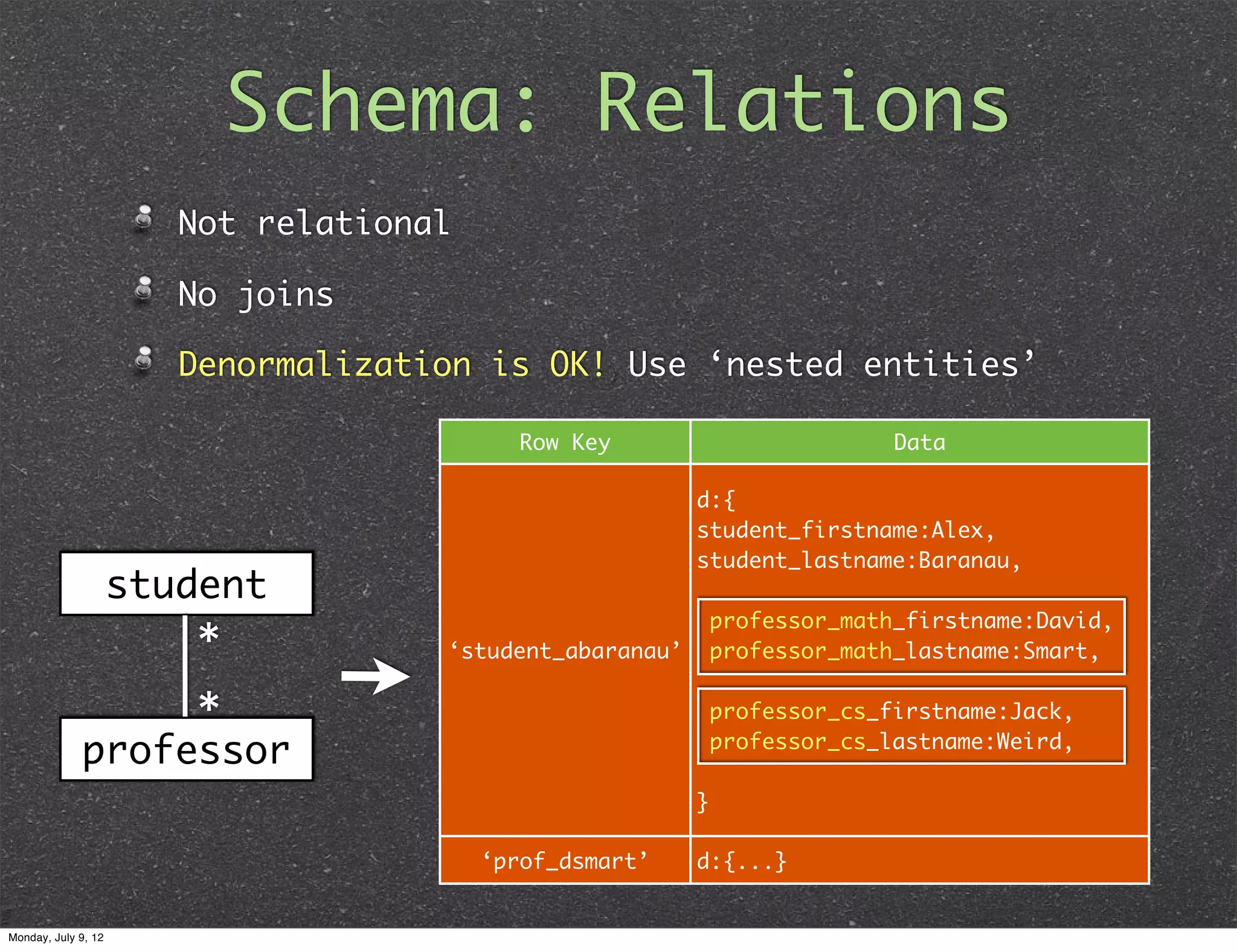
Schema: Relations
                        Not relational

                        No joins

                        Denormalization is OK! Use ‘nested entities’

                                            Row Key                         Data

                                                          d:{
                                                          student_firstname:Alex,
                                                          student_lastname:Baranau,
                     student
                                                              professor_math_firstname:David,
                        *            ‘student_abaranau’       professor_math_lastname:Smart,


                        *                                     professor_cs_firstname:Jack,

             professor                                        professor_cs_lastname:Weird,

                                                          }

                                         ‘prof_dsmart’    d:{...}


Monday, July 9, 12
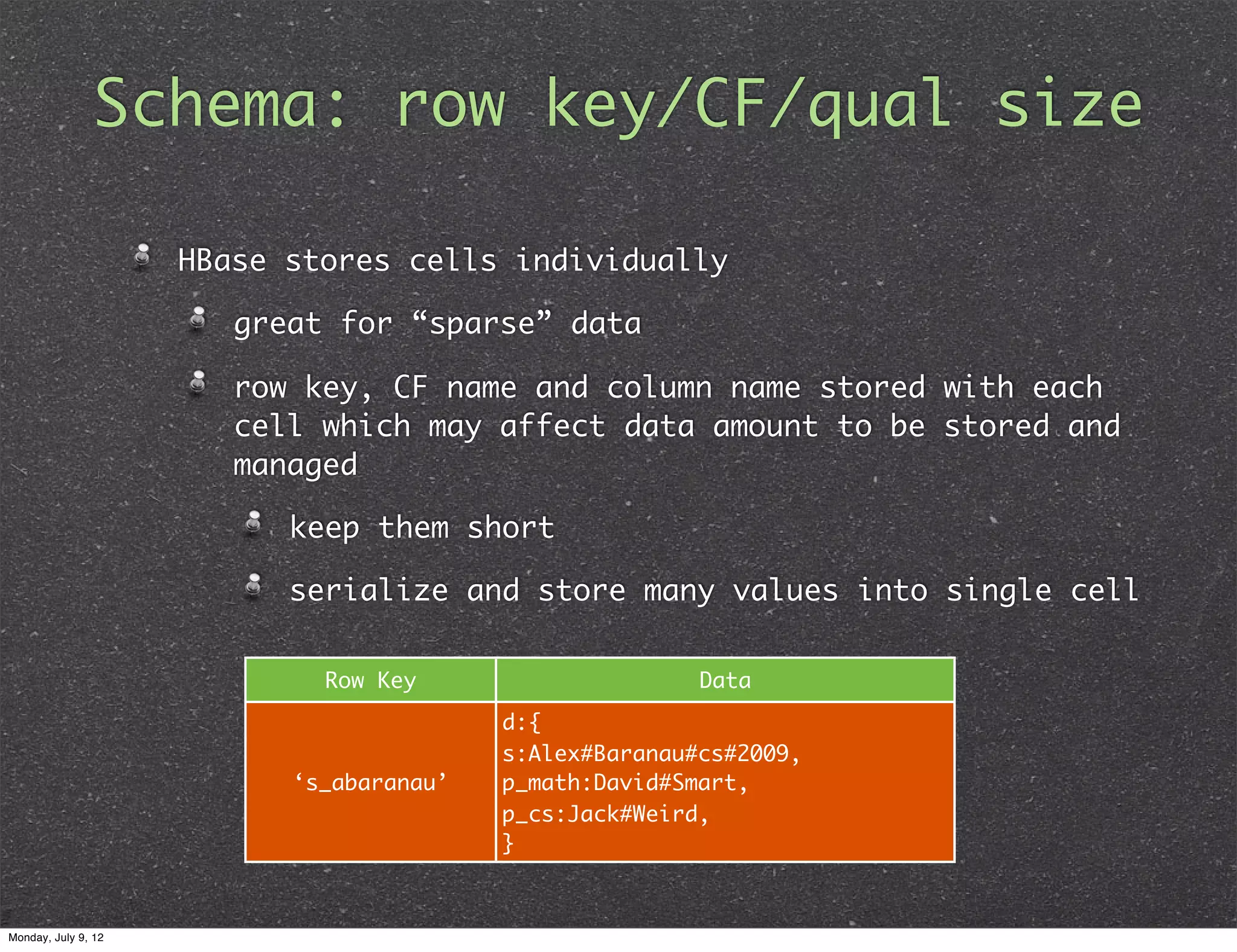
Schema: row key/CF/qual size

                     HBase stores cells individually

                        great for “sparse” data

                        row key, CF name and column name stored with each
                        cell which may affect data amount to be stored and
                        managed

                           keep them short

                           serialize and store many values into single cell

                             Row Key                     Data
                                          d:{
                                          s:Alex#Baranau#cs#2009,
                           ‘s_abaranau’   p_math:David#Smart,
                                          p_cs:Jack#Weird,
                                          }


Monday, July 9, 12
Other/Advanced
                         Topics


Monday, July 9, 12
Advanced: Co-Processors
                     CoProcessors API (HBase 0.92.0+) allows to:

                       execute (querying/aggregation/etc.)
                       logic on server side (you may think of
                       it as of stored procedures in RDBMS)

                       perform auditing of actions performed on
                       server-side (you may think of it as of
                       triggers in RDBMS)

                       apply security rules for data access

                       and many more cool stuff


Monday, July 9, 12
Other: Use Compression
                      Using compression:

                         reduces data amount to be stored on disks

                         reduces data amount to be transferred when RS reading data not
                         from local replica

                         increases amount of CPU used, but CPU isn’t usually a bottleneck

                      Favor compression speed over compression ratio

                         SNAPPY is good

                      Use wisely:

                         e.g. avoid wasting CPU cycles on compressing images

                             compression can be configured on per CF basis, so storing
                             non-compressible data in separate CF sometimes helps

                         data blocks are uncompressed in memory, avoid this to cause OOME

                         note: when scanning (seeking data to return for scan) many data
                         blocks can be uncompressed even if none of the data will be
                         returned from those block


Monday, July 9, 12
Other: Use Monitoring


                        TBD

                        Ganglia, Cacti, other*, Just use it!


                * http://sematext.com/spm/index.html

Monday, July 9, 12
Qs?


                     Sematext is hiring!
Monday, July 9, 12

Intro to HBase Internals & Schema Design (for HBase users)

  • 1.
    Intro to HBase Internals & Schema Design (for HBase Users) Alex Baranau, Sematext International, 2012 Monday, July 9, 12
  • 2.
    About Me Software Engineer at Sematext International http://blog.sematext.com/author/abaranau @abaranau http://github.com/sematext (abaranau) Monday, July 9, 12
  • 3.
    Agenda Logical view Physical view Schema design Other/Advanced topics Monday, July 9, 12
  • 4.
    Why? Why should I (HBase user) care about HBase internals? HBase will not adjust cluster settings to optimal based on usage patterns automatically Schema design, table settings (defined upon creation), etc. depend on HBase implementation aspects Monday, July 9, 12
  • 5.
  • 6.
    Logical View: Regions HBase cluster serves multiple tables, distinguished by name Each table contains of rows Each row contains cells: (row key, column family, column, timestamp) -> value Table is split into Regions (table shards, each contains full rows), defined by start and end row keys Monday, July 9, 12
  • 7.
    Logical View: Regionsare Shards Regions are “atoms of distribution” Each region assigned to single RegionServer (HBase cluster slave) Rows of particular Region served by single RS (cluster slave) Regions are distributed evenly across RSs Region has configurable max size When region reaches max size (or on request) it is split into two smaller regions, which can be assigned to different RSs Monday, July 9, 12
  • 8.
    Logical View: Regionson Cluster ZooKeeper ZooKeeper ZooKeeper client HMaster HMaster Region Region RegionServer Region Region Region Region RegionServer RegionServer RegionServer RegionServer Monday, July 9, 12
  • 9.
    Logical View: RegionsLoad It is essential for Regions under the load to be evenly distributed across the cluster It is HBase user’s job to make sure the above is true. Note: even distribution of Regions over cluster doesn’t imply that the load is evenly distributed Monday, July 9, 12
  • 10.
    Logical View: RegionsLoad Take into account that rows are stored in ordered manner Make sure you don’t write rows with sequential keys to avoid RS hotspotting* When writing data with monotonically increasing/decreasing keys, data is written at one RS at a time Use pre-splitting of the table upon creation Starting with single region means using one RS for some time In general, splitting can be expensive Increase max region size * see https://github.com/sematext/HBaseWD Monday, July 9, 12
  • 11.
    Logical View: SlowRSs When load is distributed evenly, watch for slowest RSs (HBase slaves) Since every region served by single RS, one slow RS can slow down cluster performance e.g. when: data is written into multiple RSs at even pace (random value-based row keys) data is being read from many RSs when doing scan Monday, July 9, 12
  • 12.
  • 13.
    Physical View: Write/ReadFlow HTable client client buffer HTable write read RegionServer Region z Region ... ... Store Store MemStore MemStore (per CF) (per CF) flush HFile HFile ... HFile HFile Write Ahead Log HDFS Monday, July 9, 12
  • 14.
    Physical: Speed upWriting Enabling & increasing client-side buffer reduces RPC operations amount warn: possible loss of buffered data in case of client failure; design for failover in case of write failure (networking/server- side issues); can be handled on client Disabling WAL increases write speed warn: possible data loss in case of RS failure Use bulk import functionality (writes HFiles directly, which can be later added to HBase) Monday, July 9, 12
  • 15.
    Physical: Memstore Flushes When memstore is flushed N HFiles are created (one per CF) Memstore size which causes flushing is configured on two levels: per RS: % of heap occupied by memstores per table: size in MB of single memstore (per CF) of Region When Region memstores flushes, memstores of all CFs are flushed Uneven data amount between CFs causes too many flushes & creation of too many HFiles (one per CF every time) In most cases having one CF is the best design Monday, July 9, 12
  • 16.
    Physical: Memstore Flushes Important: there are Memstore size thresholds which cause writes to be blocked, so slow memstore flushes and overuse of memory by memstore can cause write perf degradation Hint: watch for flush queue size metric on RSs At the same time the more memory memstore uses the better for writing/reading perf (unless it reaches those “write blocking” thresholds) Monday, July 9, 12
  • 17.
    Physical: Memstore Flushes Example of good situation * * http://sematext.com/spm/index.html Monday, July 9, 12
  • 18.
    Physical: HFiles Compaction HFiles are periodically compacted into bigger HFiles containing same data Reading from less HFiles faster Important: there’s a configured max number of files in Store which, when reached causes writes to block Hint: watch for compaction queue size metric on RSs read Store MemStore (per CF) HFile HFile Monday, July 9, 12
  • 19.
    Physical: Data Locality RSs are usually collocated HDFS with HDFS DataNodes MapReduce HBase RegionServer RegionServer TaskTracker TaskTracker DataNode DataNode Slave Node Slave Node Monday, July 9, 12
  • 20.
    Physical: Data Locality HBase tries to assign Regions to RSs so that Region data stored physically on the same node. But sometimes fails after Region splits there’s no guarantee that there’s a node that has all blocks (HDFS level) of new Region and no guarantee that HBase will not re-assign this Region to different RS in future (even distribution of Regions takes preference over data locality) There’s an ongoing work towards better preserving data locality Monday, July 9, 12
  • 21.
    Physical: Data Locality Also, data locality can break when: Adding new slaves to cluster Removing slaves from cluster Incl. node failures Hint: look at networking IO between slaves when writing/reading data, it should be minimal Important: make sure HDFS is well balanced (use balancer tool) try to rebalance Regions in HBase cluster if possible (HBase Master restart will do that) to regain data locality Pre-split table on creation to limit (ideally avoid) splits and regions movement; manage splits manually sometimes helps Monday, July 9, 12
  • 22.
    Schema Design (very briefly) Monday, July 9, 12
  • 23.
    Schema: row keys Using row key (or keys range) is the most efficient way to retrieve the data from HBase Row key design is major part of schema design Note: no secondary indices available out of the box Row Key Data ‘login_2012-03-01.00:09:17’ d:{‘user’:‘alex’} ... ... ‘login_2012-03-01.23:59:35’ d:{‘user’:‘otis’} ‘login_2012-03-02.00:00:21’ d:{‘user’:‘david’} Monday, July 9, 12
  • 24.
    Schema: row keys Redundancy is OK! warn: changing two rows in HBase is not atomic operation Row Key Data ‘login_2010-01-01.00:09:17’ d:{‘user’:‘alex’} ... ... ‘login_2012-03-01.23:59:35’ d:{‘user’:‘otis’} ‘alex_2010-01-01.00:09:17’ d:{‘action’:‘login’} ... ... ‘otis_2012-03-01.23:59:35’ d:{‘action’:‘login’} ‘alex_login_2010-01-01.00:09:17’ d:{‘device’:’pc’} ... ... ‘otis_login_2012-03-01.23:59:35’ d:{‘device’:‘mobile’} Monday, July 9, 12
  • 25.
    Schema: Relations Not relational No joins Denormalization is OK! Use ‘nested entities’ Row Key Data d:{ student_firstname:Alex, student_lastname:Baranau, student professor_math_firstname:David, * ‘student_abaranau’ professor_math_lastname:Smart, * professor_cs_firstname:Jack, professor professor_cs_lastname:Weird, } ‘prof_dsmart’ d:{...} Monday, July 9, 12
  • 26.
    Schema: row key/CF/qualsize HBase stores cells individually great for “sparse” data row key, CF name and column name stored with each cell which may affect data amount to be stored and managed keep them short serialize and store many values into single cell Row Key Data d:{ s:Alex#Baranau#cs#2009, ‘s_abaranau’ p_math:David#Smart, p_cs:Jack#Weird, } Monday, July 9, 12
  • 27.
    Other/Advanced Topics Monday, July 9, 12
  • 28.
    Advanced: Co-Processors CoProcessors API (HBase 0.92.0+) allows to: execute (querying/aggregation/etc.) logic on server side (you may think of it as of stored procedures in RDBMS) perform auditing of actions performed on server-side (you may think of it as of triggers in RDBMS) apply security rules for data access and many more cool stuff Monday, July 9, 12
  • 29.
    Other: Use Compression Using compression: reduces data amount to be stored on disks reduces data amount to be transferred when RS reading data not from local replica increases amount of CPU used, but CPU isn’t usually a bottleneck Favor compression speed over compression ratio SNAPPY is good Use wisely: e.g. avoid wasting CPU cycles on compressing images compression can be configured on per CF basis, so storing non-compressible data in separate CF sometimes helps data blocks are uncompressed in memory, avoid this to cause OOME note: when scanning (seeking data to return for scan) many data blocks can be uncompressed even if none of the data will be returned from those block Monday, July 9, 12
  • 30.
    Other: Use Monitoring TBD Ganglia, Cacti, other*, Just use it! * http://sematext.com/spm/index.html Monday, July 9, 12
  • 31.
    Qs? Sematext is hiring! Monday, July 9, 12