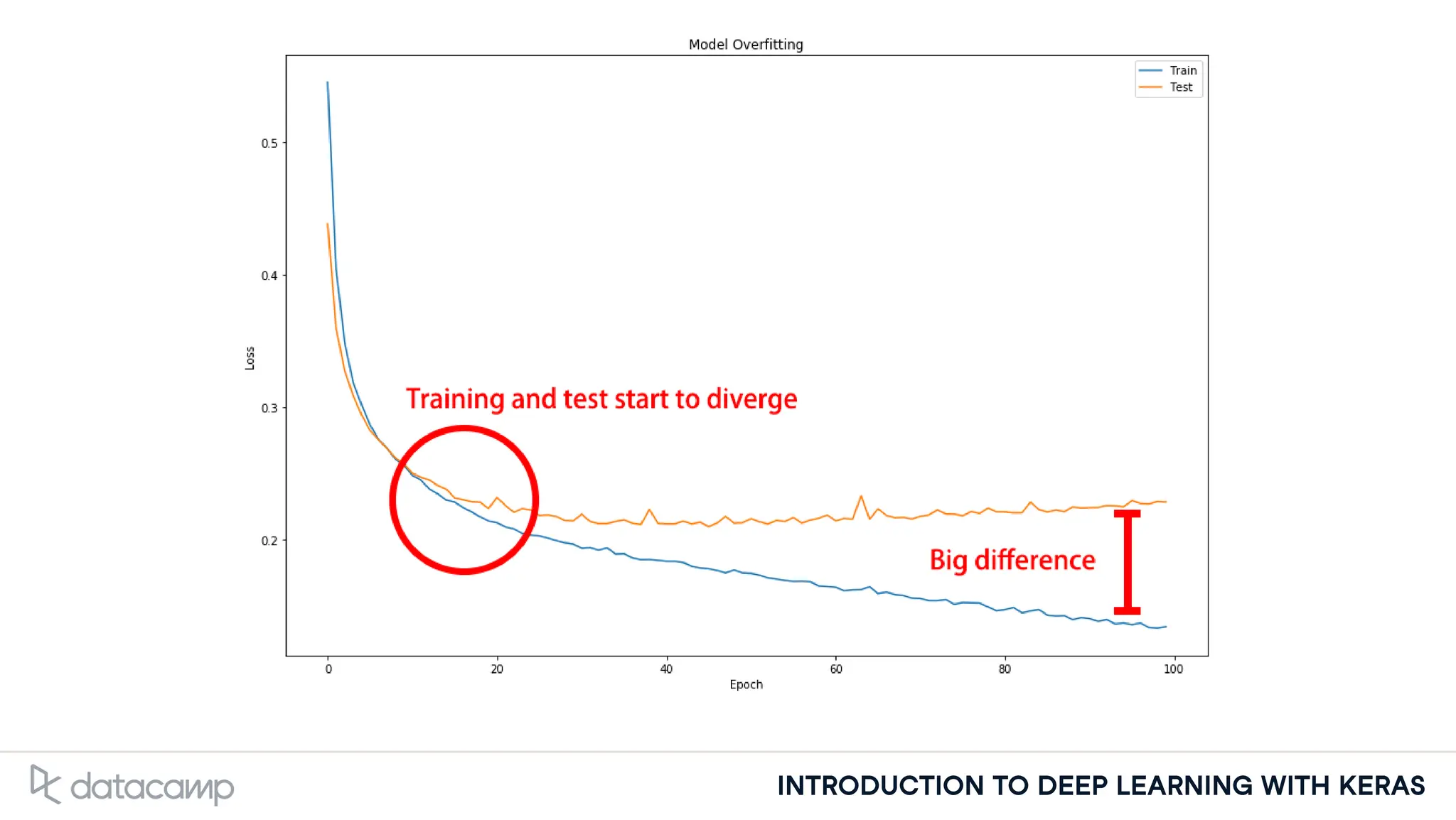
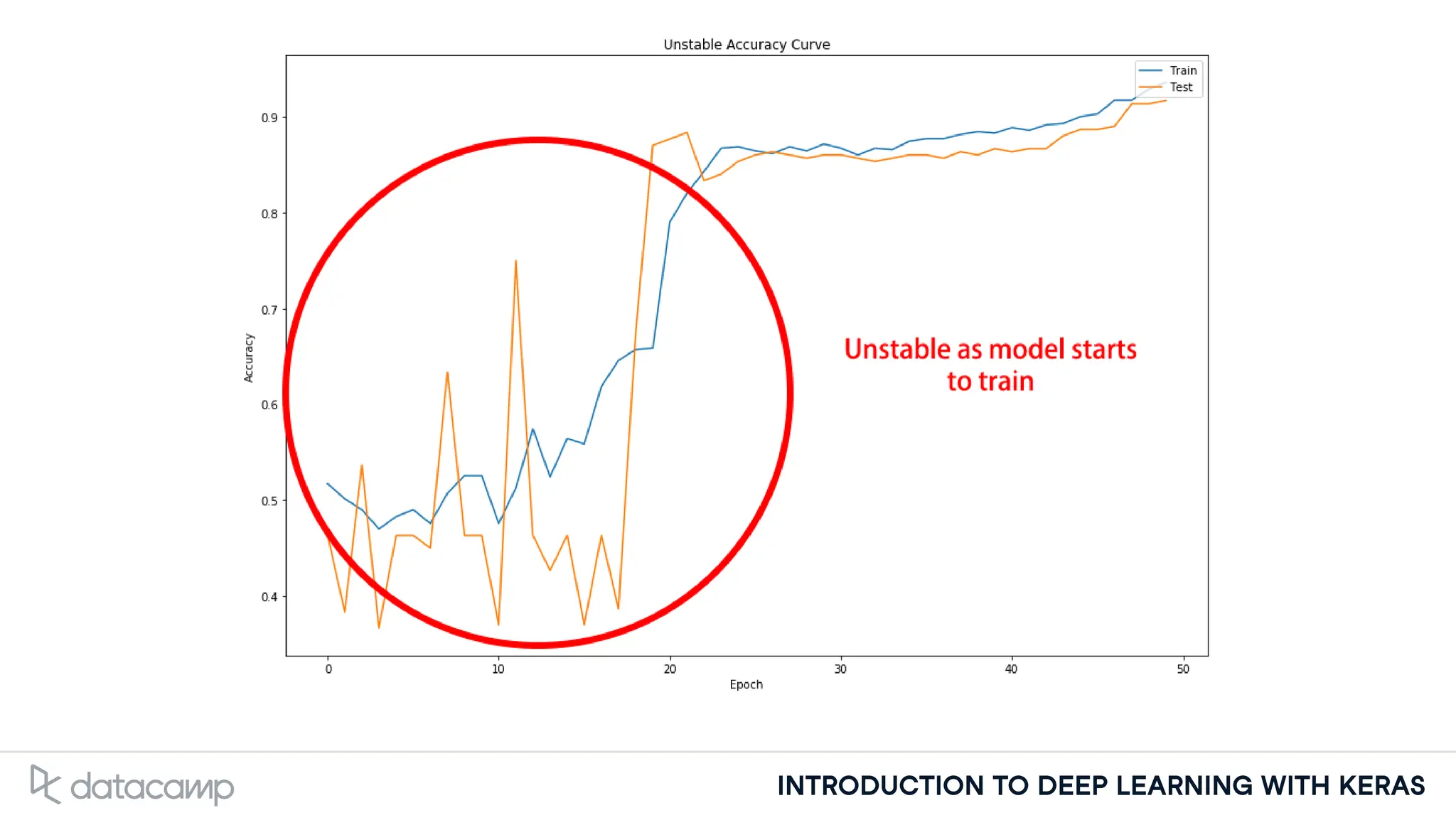
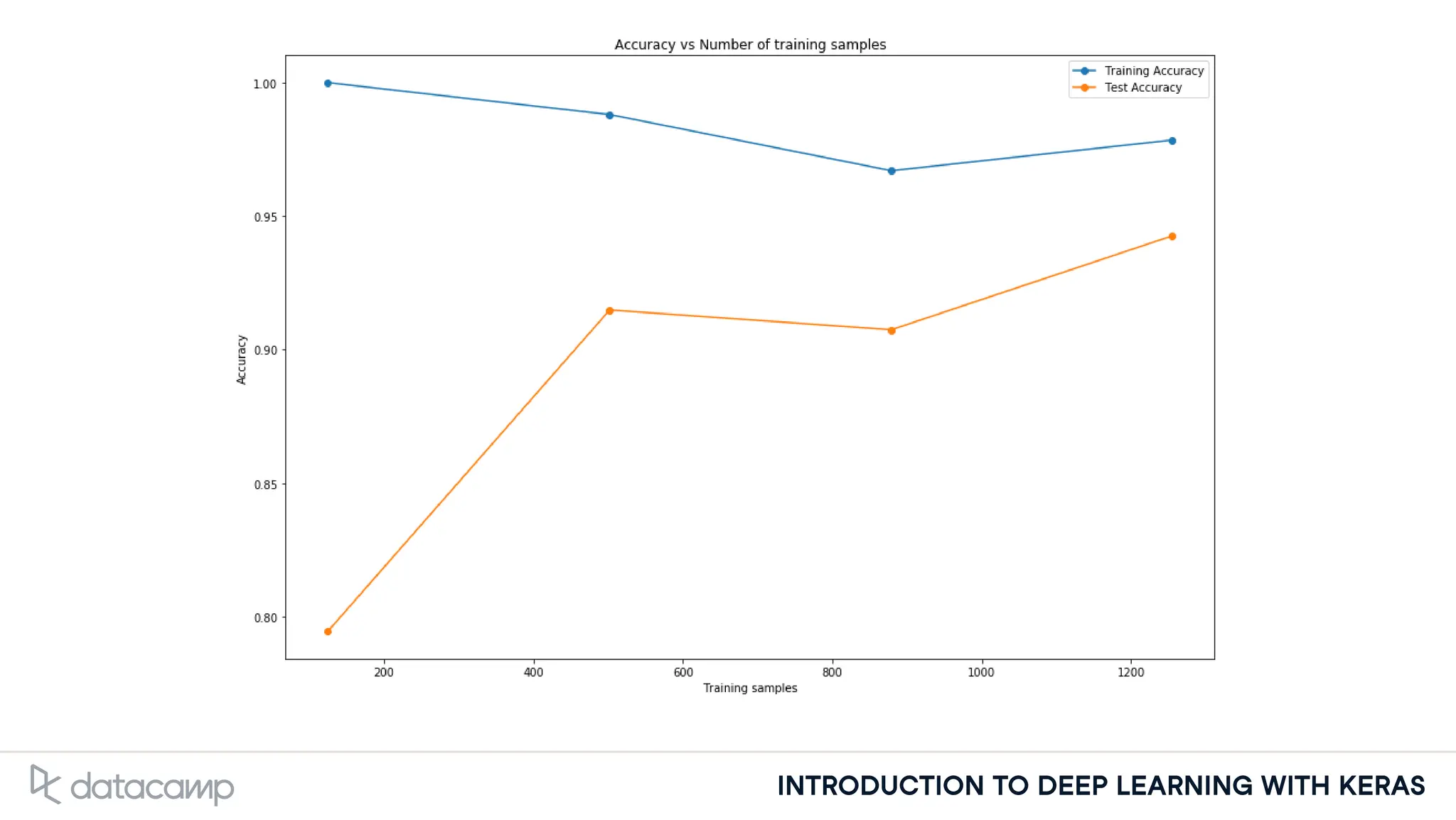
Learning curves
INTRODUCTION TO DEEP LEARNING WITH KERAS
Miguel Esteban
Data Scientist & Founder
INTRODUCTION TO DEEP LEARNING WITH KERAS
# Store initial model weights
init_weights = model.get_weights()
# Lists for storing accuracies
train_accs = []
tests_accs = []
INTRODUCTION TO DEEP LEARNING WITH KERAS
for train_size in train_sizes:
# Split a fraction according to train_size
X_train_frac, _, y_train_frac, _ =
train_test_split(X_train, y_train, train_size=train_size)
# Set model initial weights
model.set_weights(initial_weights)
# Fit model on the training set fraction
model.fit(X_train_frac, y_train_frac, epochs=100,
verbose=0,
callbacks=[EarlyStopping(monitor='loss', patience=1)])
# Get the accuracy for this training set fraction
train_acc = model.evaluate(X_train_frac, y_train_frac, verbose=0)[1]
train_accs.append(train_acc)
# Get the accuracy on the whole test set
test_acc = model.evaluate(X_test, y_test, verbose=0)[1]
test_accs.append(test_acc)
print("Done with size: ", train_size)
Time to dominate all
curves!
INTRODUCTION TO DEEP LEARNING WITH KERAS
Activation functions
INTRODUCTION TO DEEP LEARNING WITH KERAS
Miguel Esteban
Data Scientist & Founder
INTRODUCTION TO DEEP LEARNING WITH KERAS
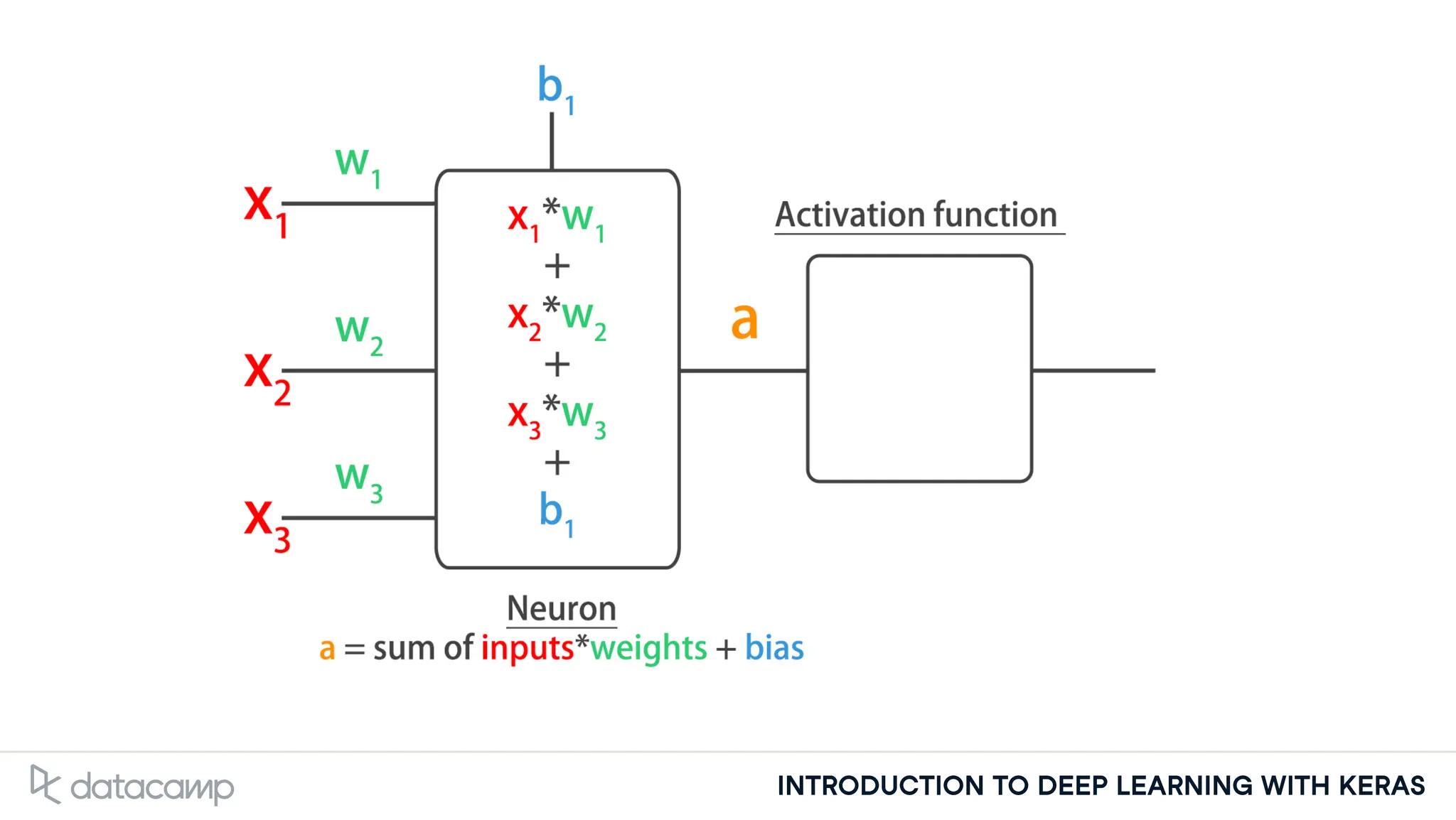
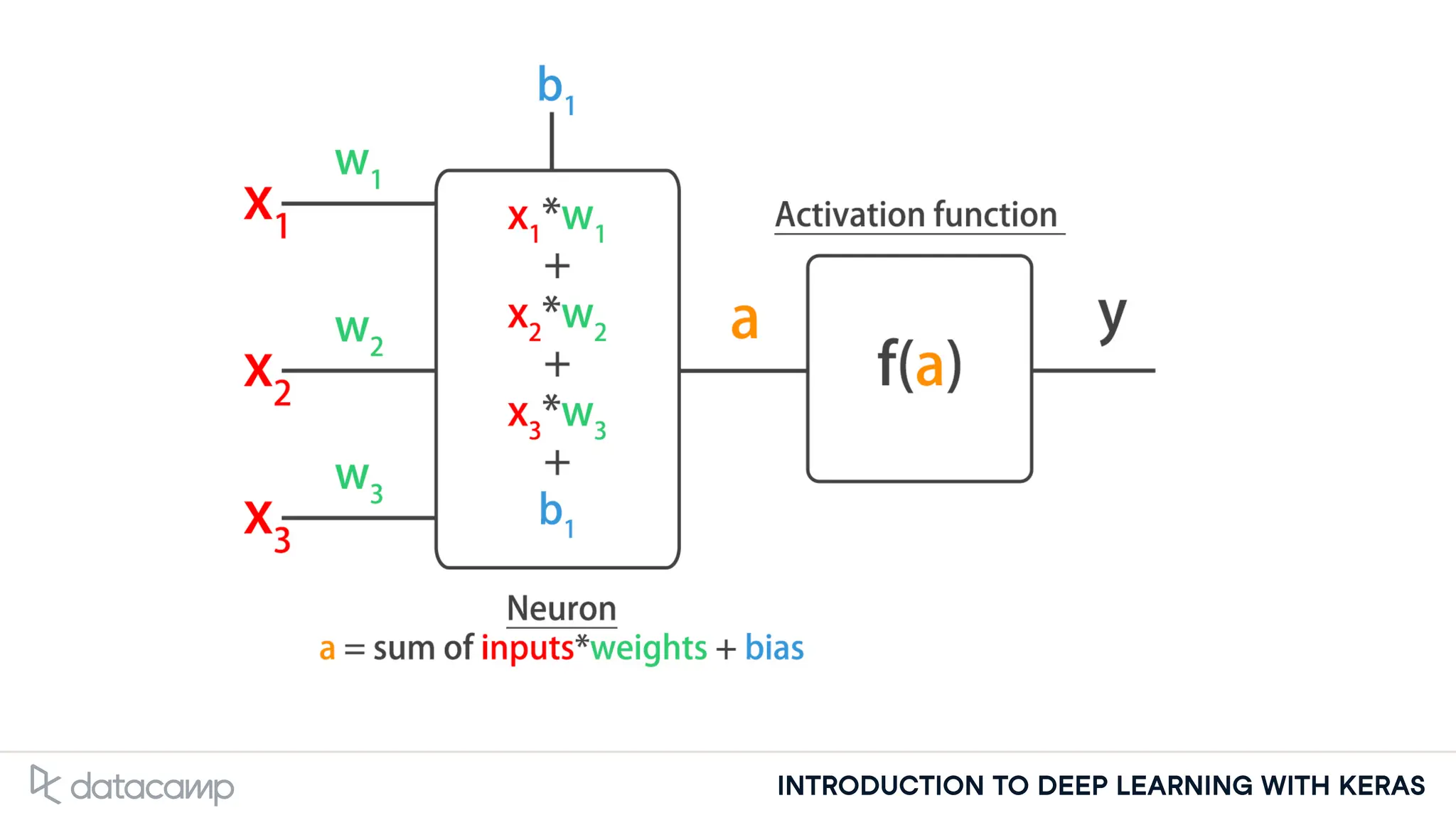
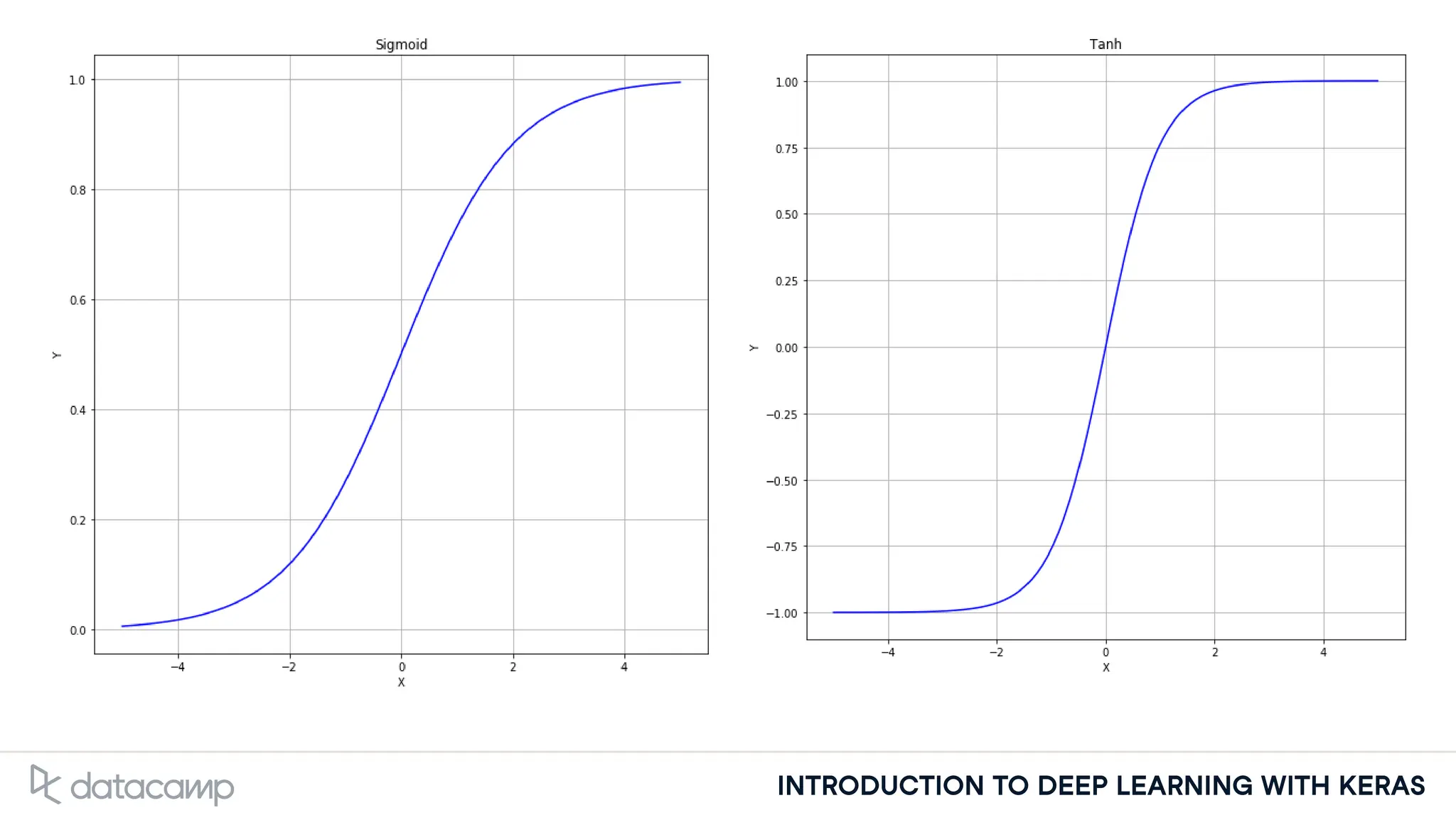
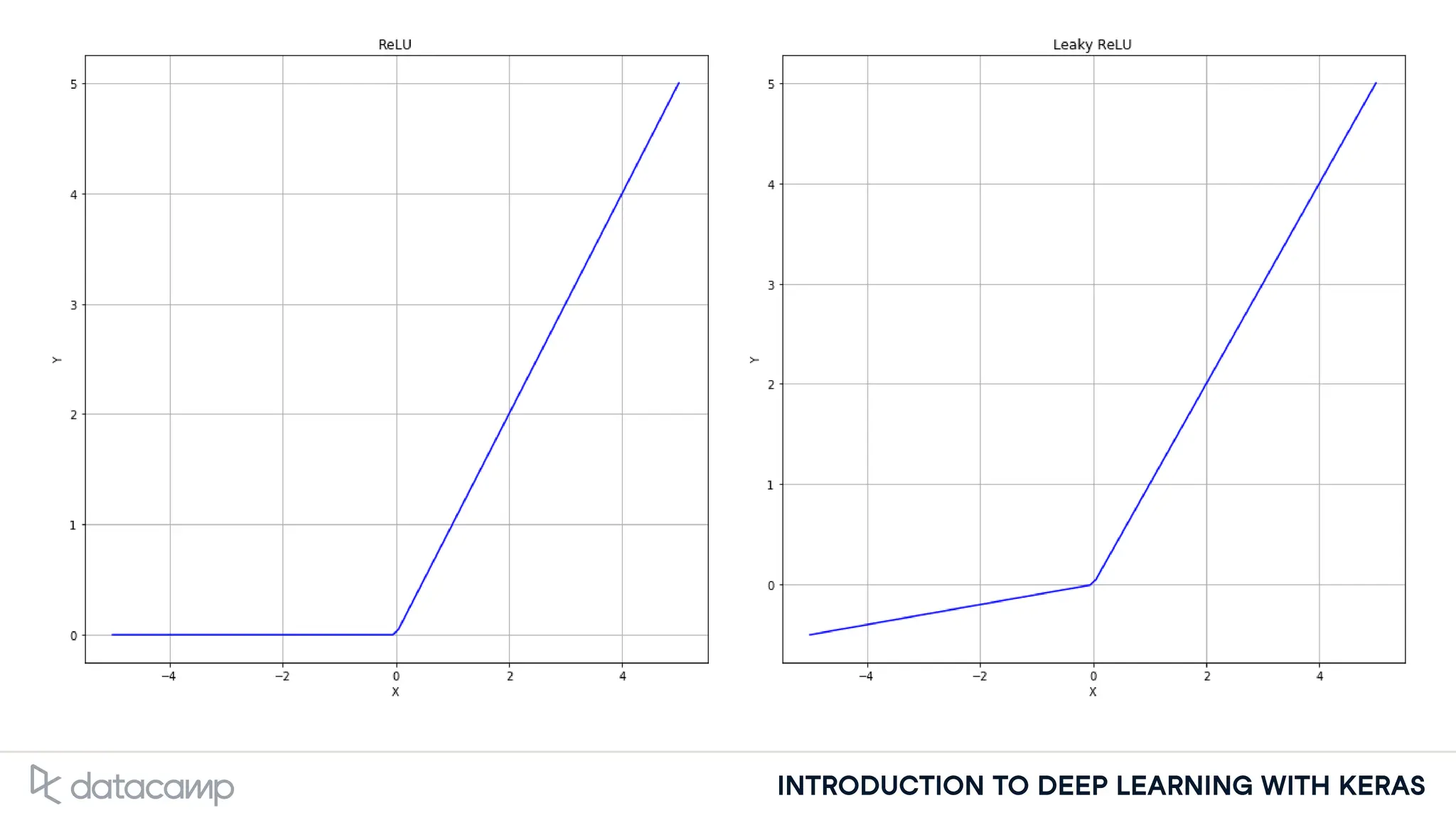
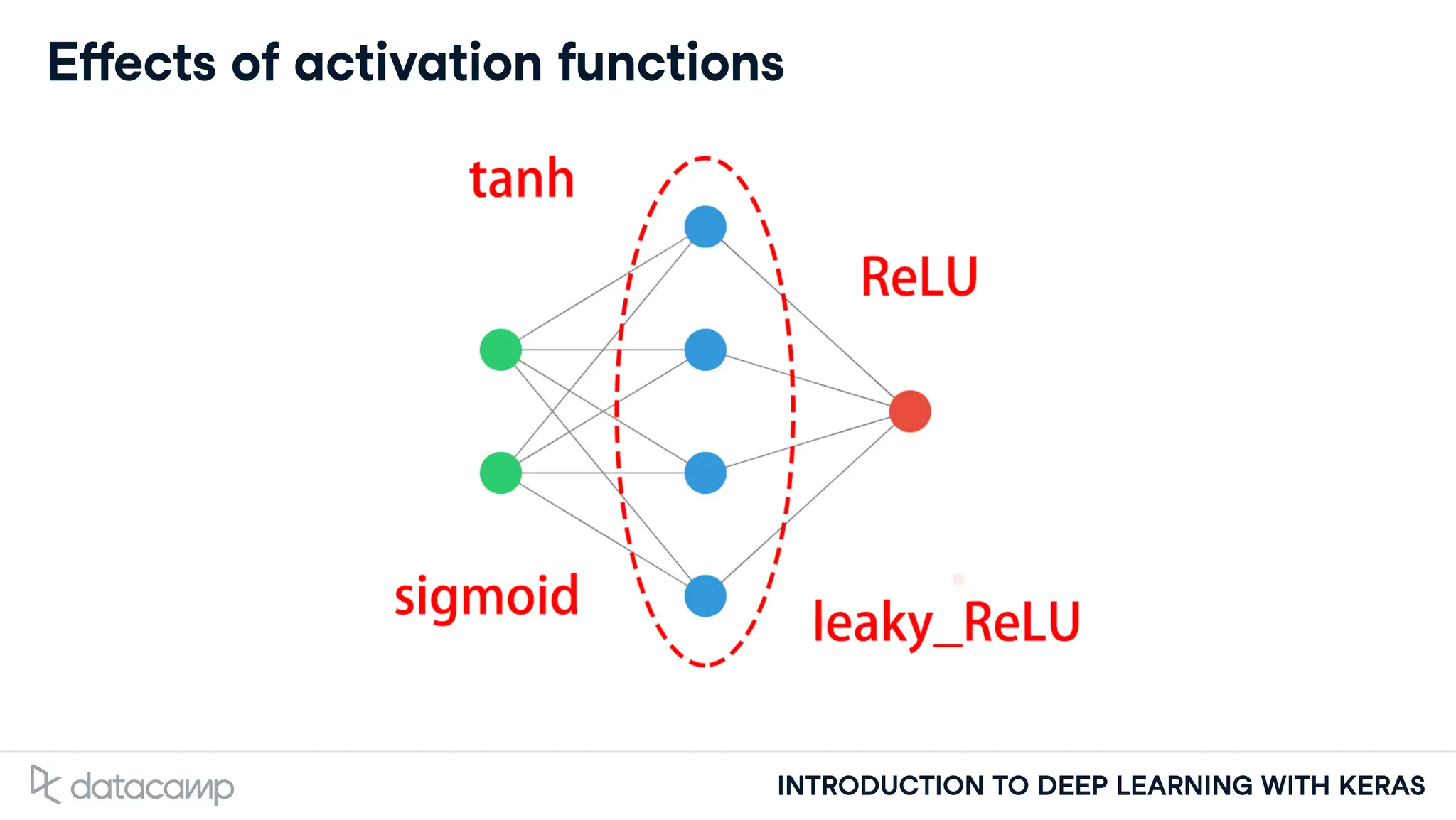
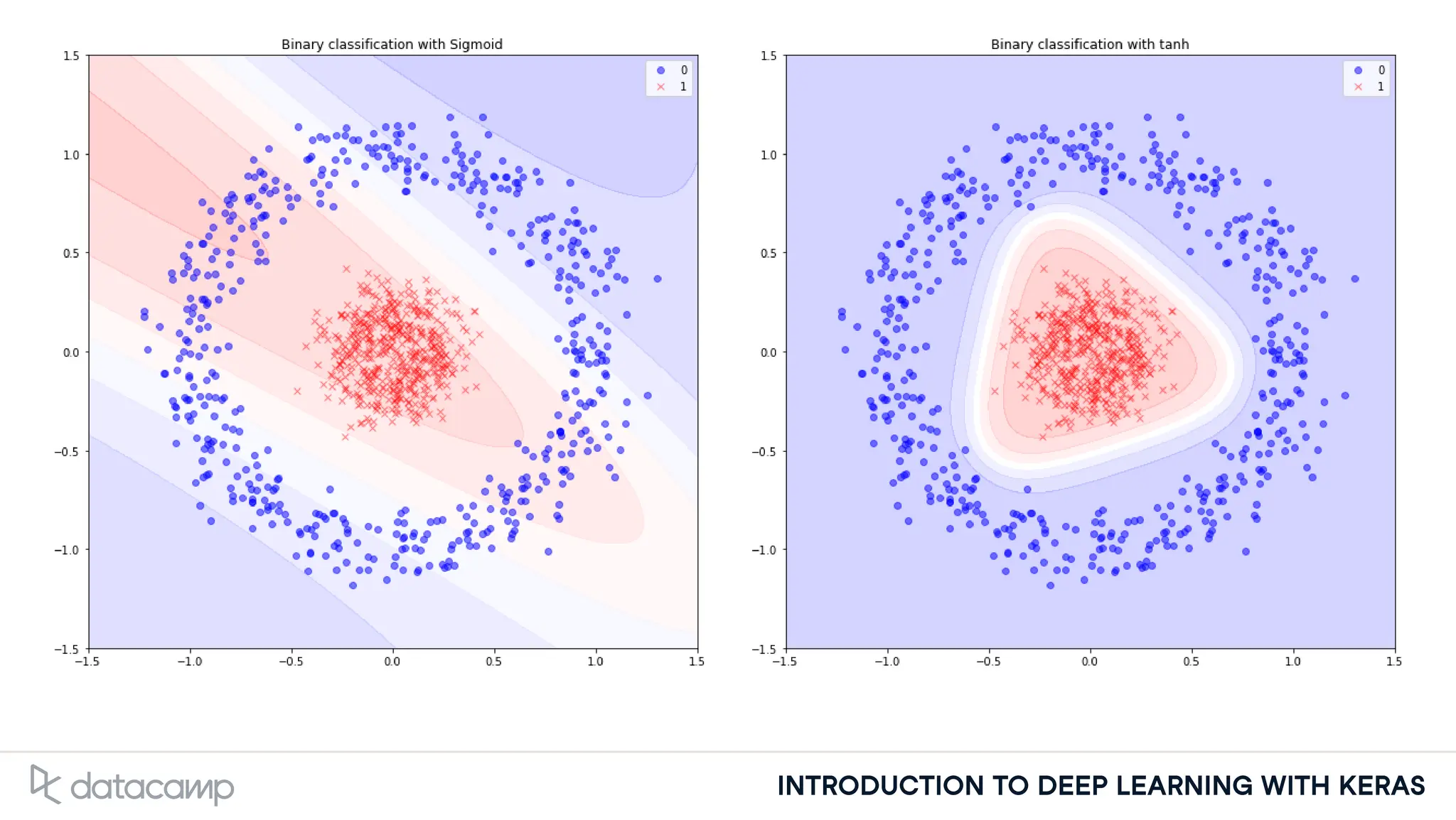
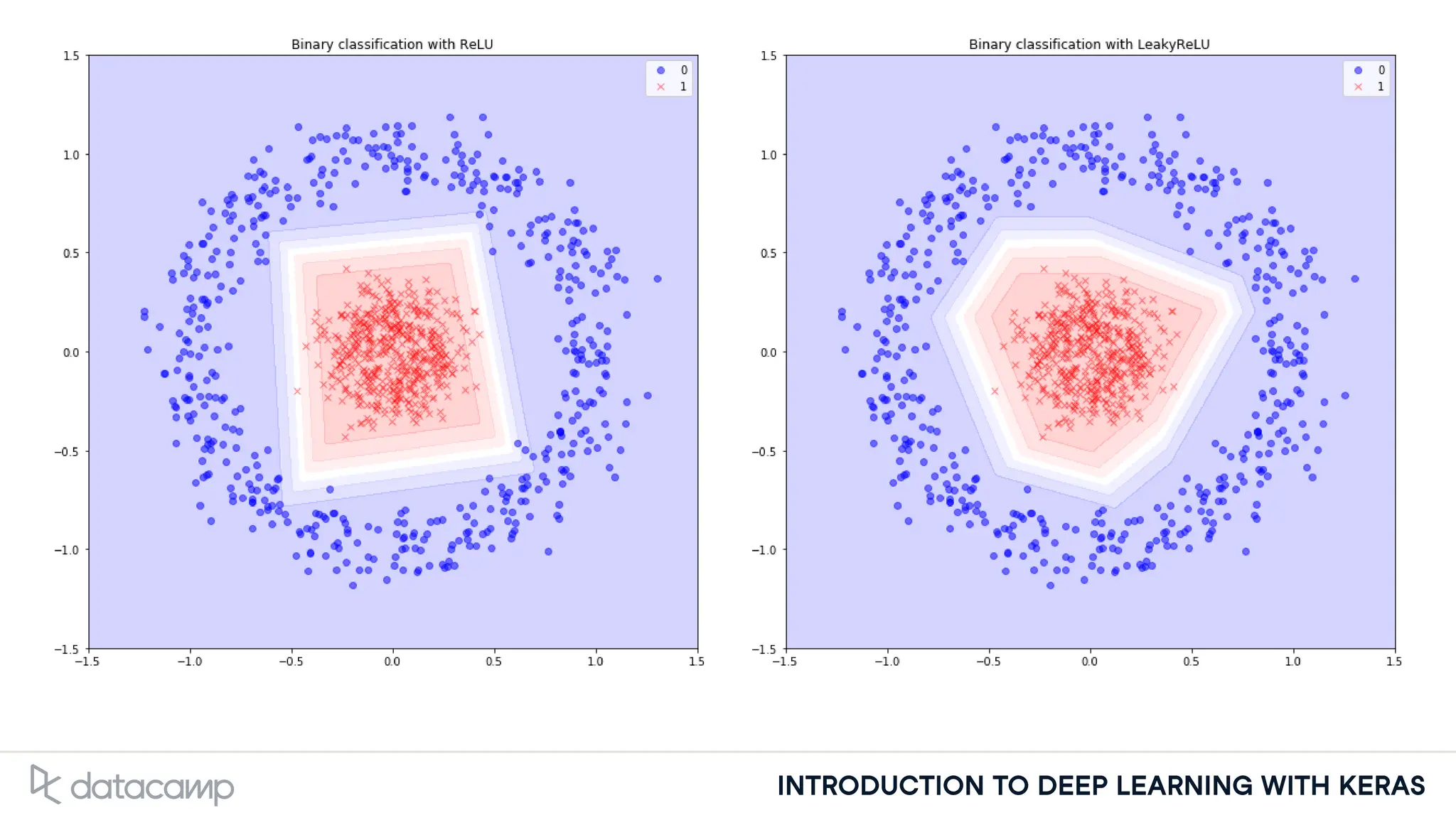
Effects of activation functions
INTRODUCTION TO DEEP LEARNING WITH KERAS
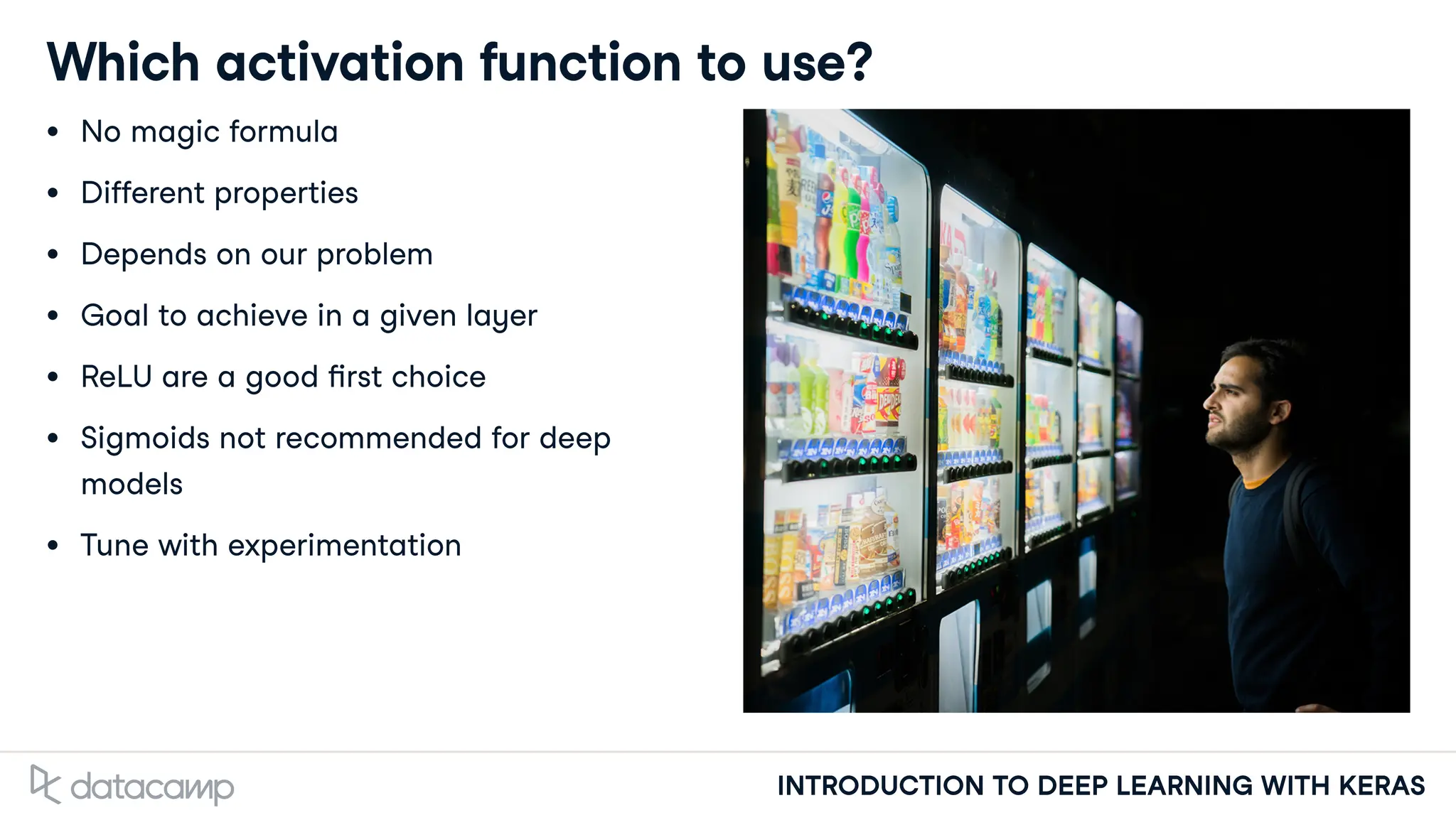
Which activation function to use?
No magic formula
Di erent properties
Depends on our problem
Goal to achieve in a given layer
ReLU are a good rst choice
Sigmoids not recommended for deep
models
Tune with experimentation
INTRODUCTION TO DEEP LEARNING WITH KERAS
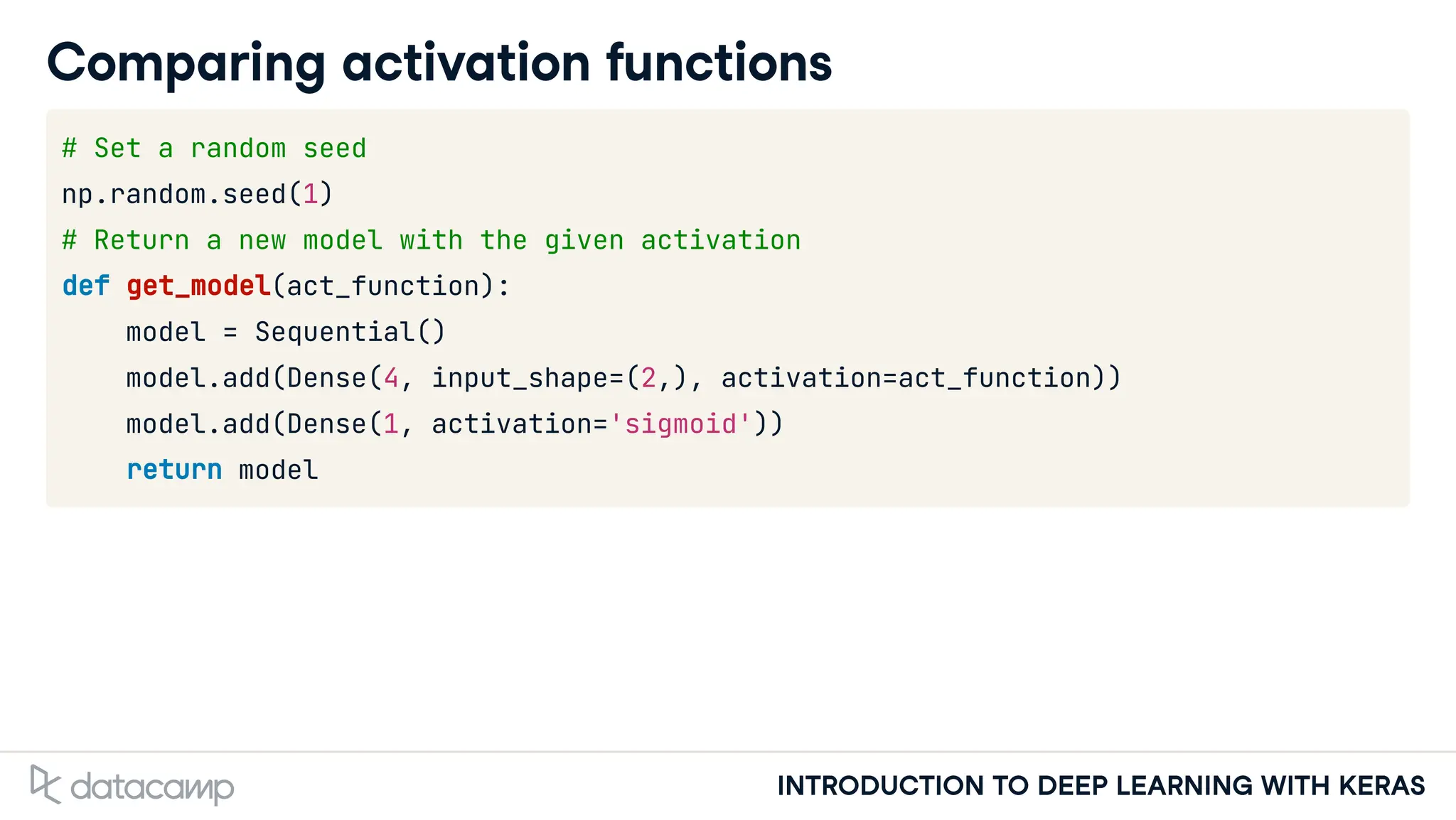
Comparing activation functions
# Set a random seed
np.random.seed(1)
# Return a new model with the given activation
def get_model(act_function):
model = Sequential()
model.add(Dense(4, input_shape=(2,), activation=act_function))
model.add(Dense(1, activation='sigmoid'))
return model
INTRODUCTION TO DEEP LEARNING WITH KERAS
Comparing activation functions
# Activation functions to try out
activations = ['relu', 'sigmoid', 'tanh']
# Dictionary to store results
activation_results = {}
for funct in activations:
model = get_model(act_function=funct)
history = model.fit(X_train, y_train,
validation_data=(X_test, y_test),
epochs=100, verbose=0)
activation_results[funct] = history
INTRODUCTION TO DEEP LEARNING WITH KERAS
Comparing activation functions
import pandas as pd
# Extract val_loss history of each activation function
val_loss_per_funct = {k:v.history['val_loss'] for k,v in activation_results.items()}
# Turn the dictionary into a pandas dataframe
val_loss_curves = pd.DataFrame(val_loss_per_funct)
# Plot the curves
val_loss_curves.plot(title='Loss per Activation function')
Let's practice!
INTRODUCTION TO DEEP LEARNING WITH KERAS
Batch size and
batch normalization
INTRODUCTION TO DEEP LEARNING WITH KERAS
Miguel Esteban
Data Scientist & Founder
INTRODUCTION TO DEEP LEARNING WITH KERAS
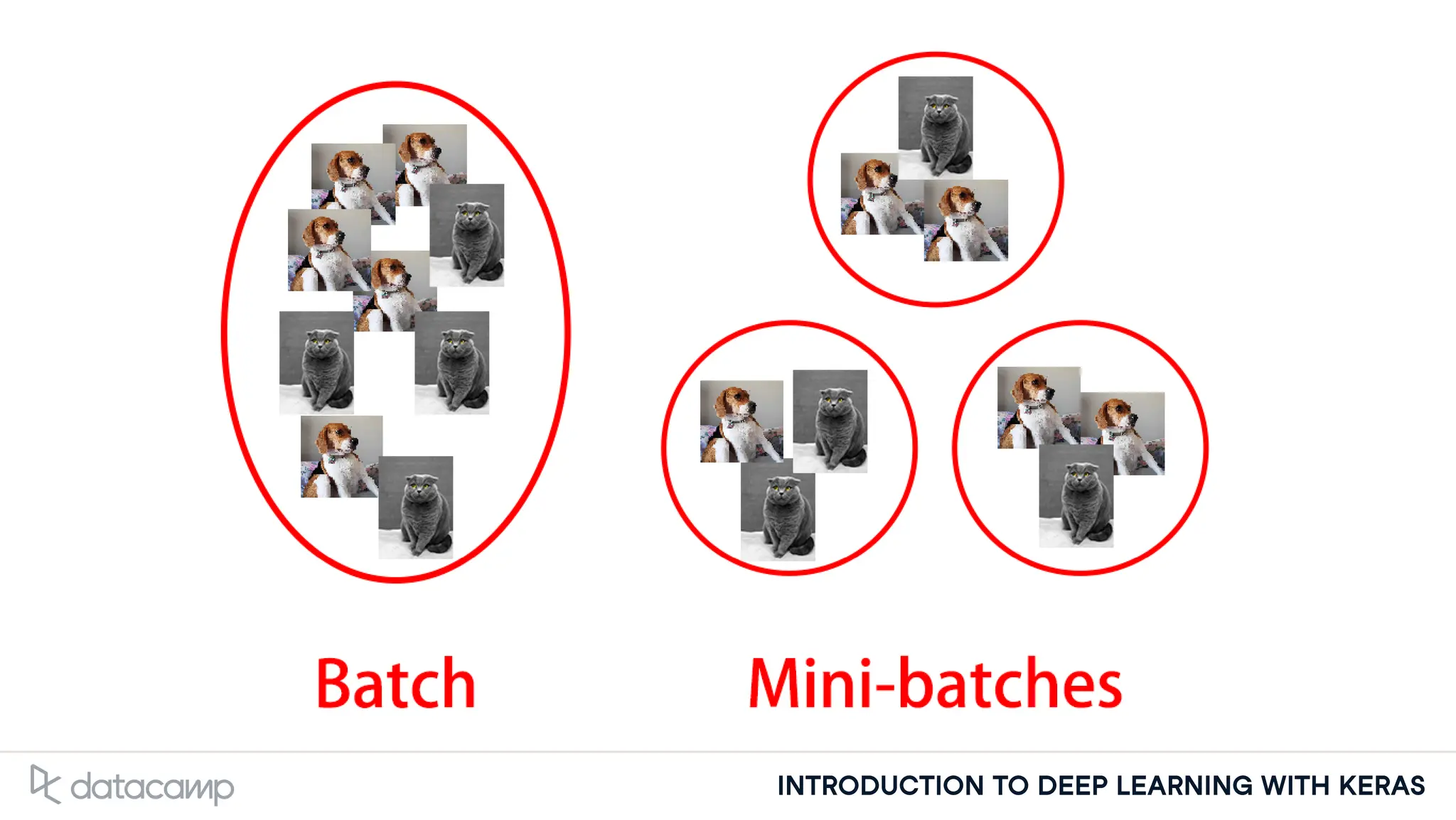
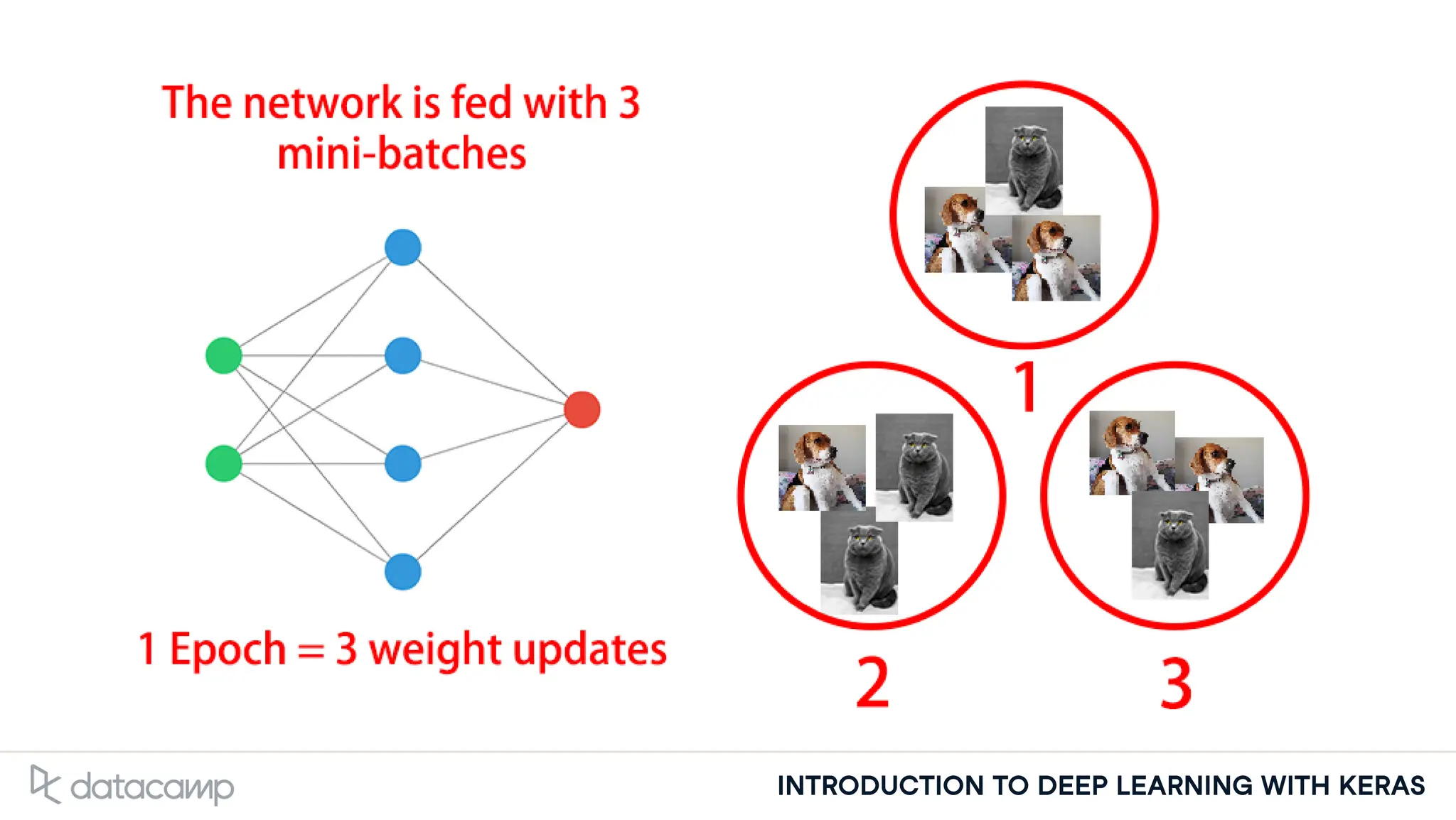
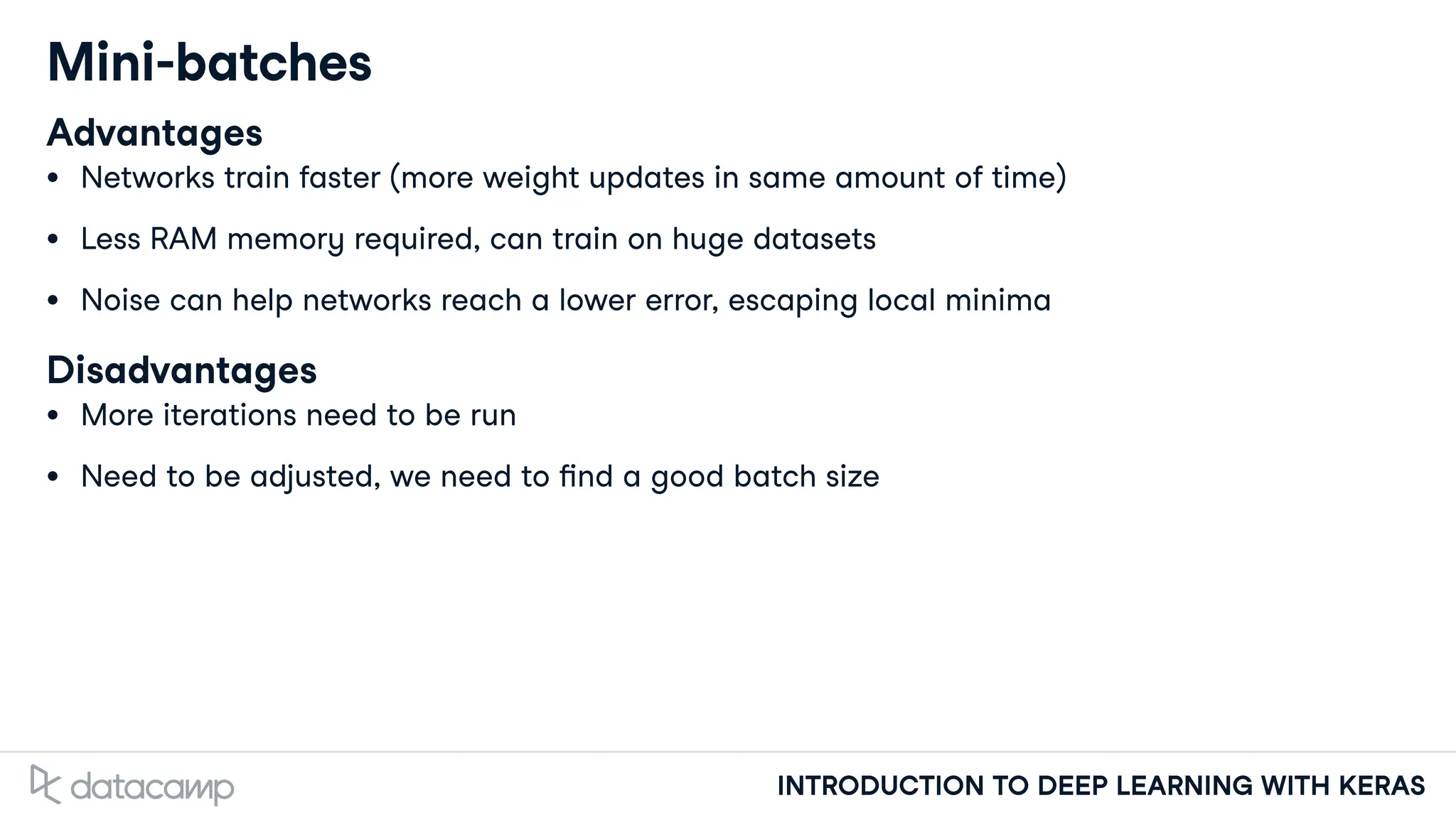
Mini-batches
Advantages
Networks train faster (more weight updates in same amount of time)
Less RAM memory required, can train on huge datasets
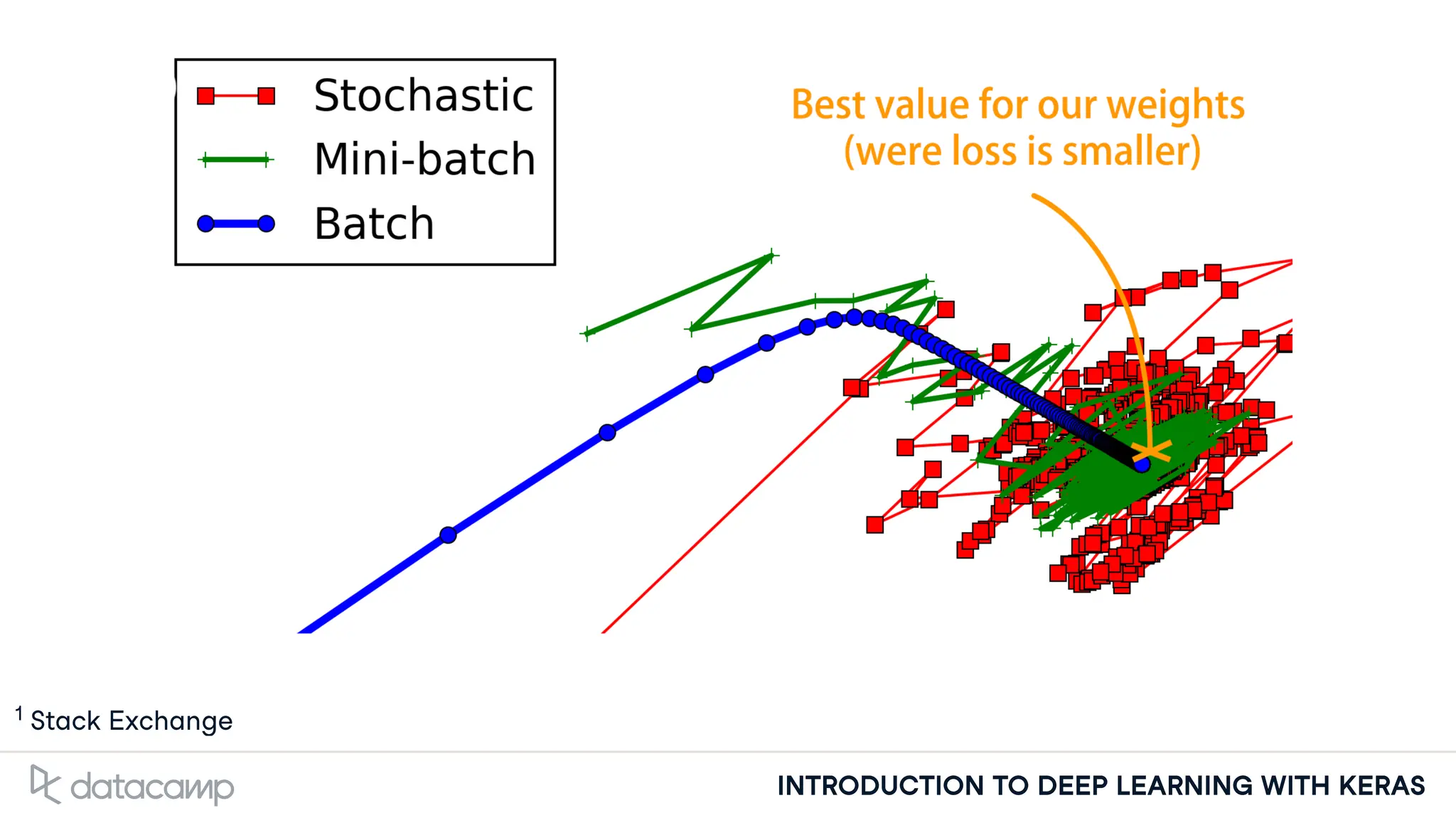
Noise can help networks reach a lower error, escaping local minima
Disadvantages
More iterations need to be run
Need to be adjusted, we need to nd a good batch size
INTRODUCTION TO DEEP LEARNING WITH KERAS
Stack Exchange
1
INTRODUCTION TO DEEP LEARNING WITH KERAS
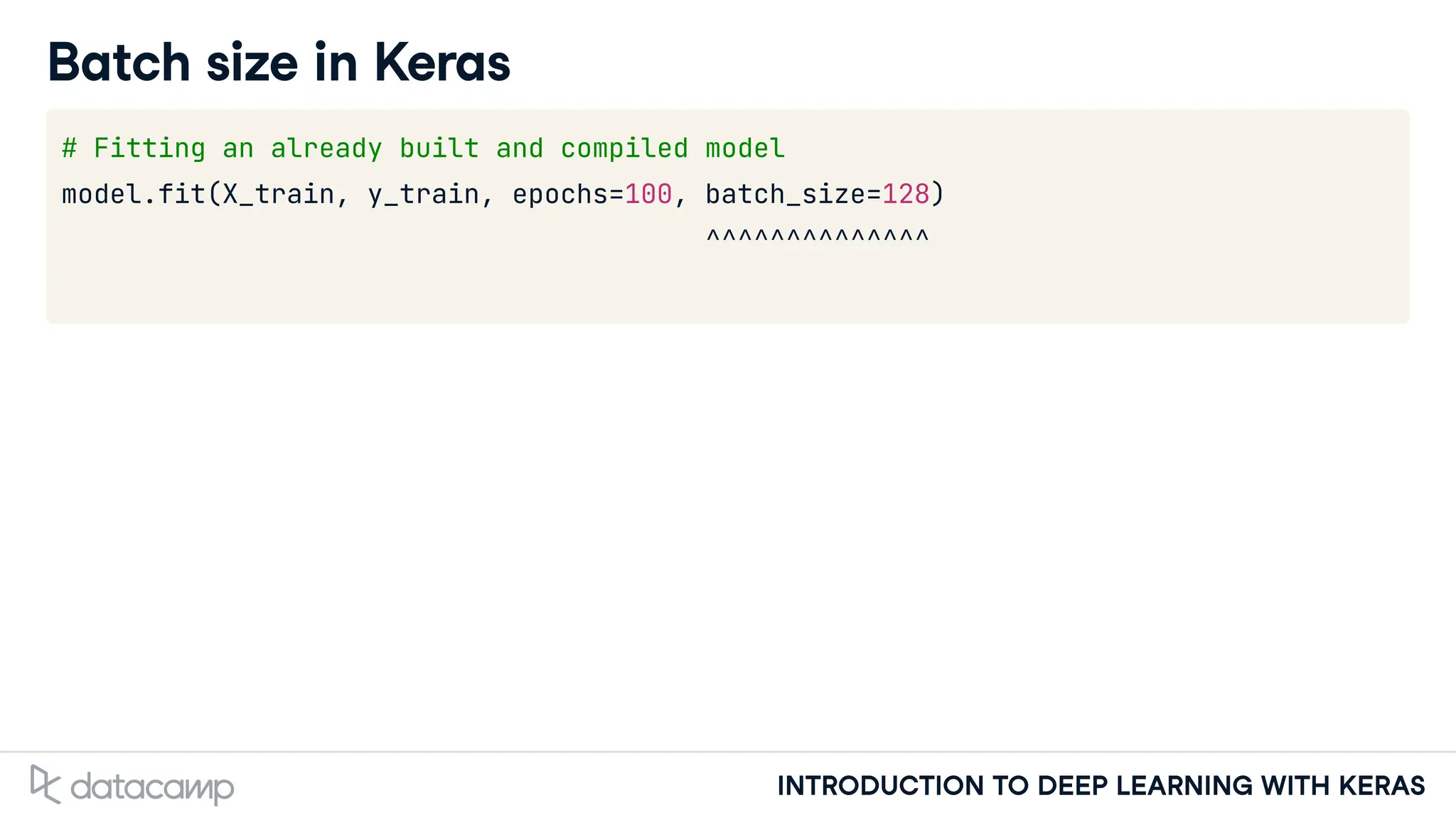
Batch size in Keras
# Fitting an already built and compiled model
model.fit(X_train, y_train, epochs=100, batch_size=128)
^^^^^^^^^^^^^^
INTRODUCTION TO DEEP LEARNING WITH KERAS
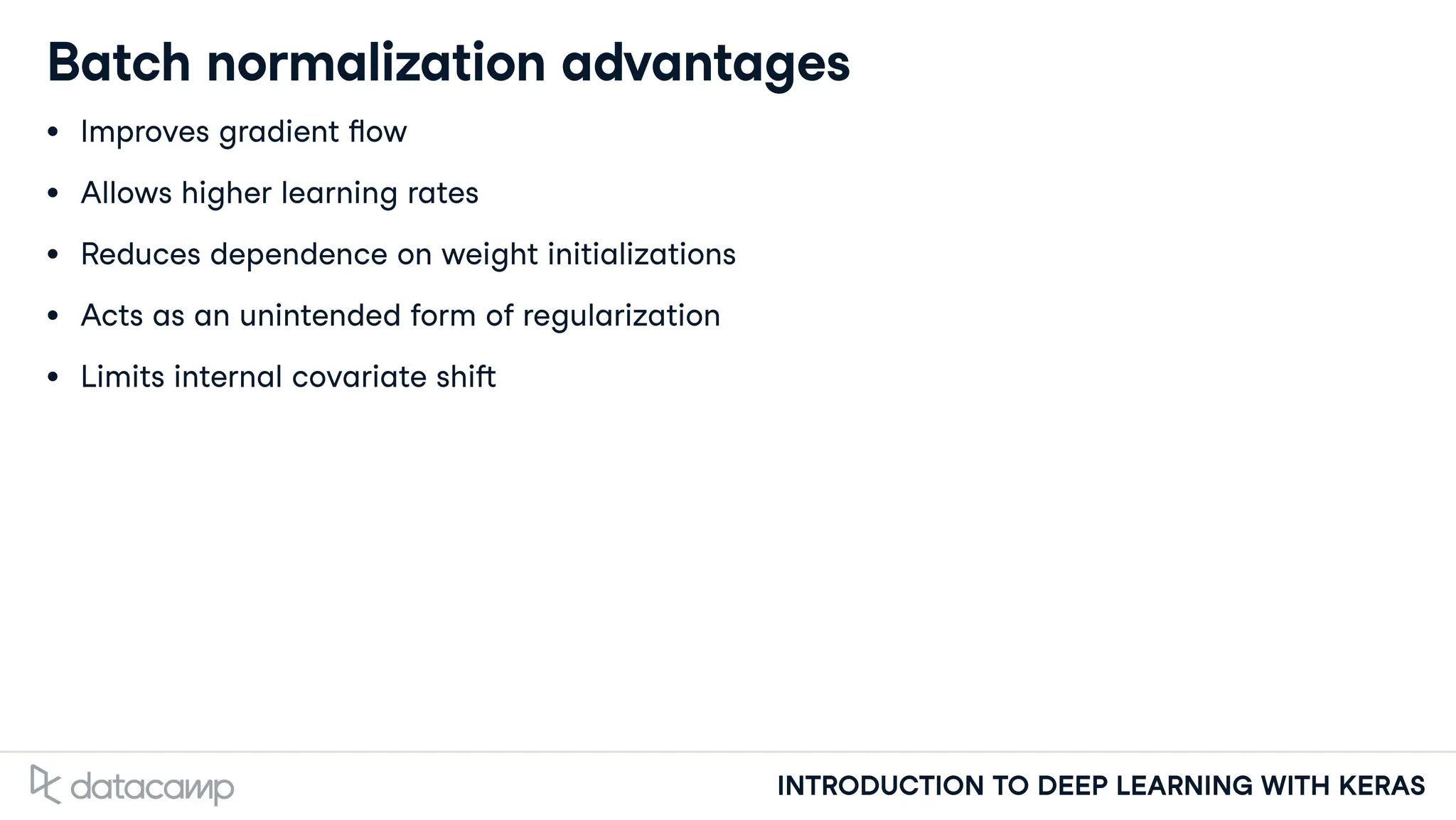
Batch normalization advantages
Improves gradient ow
Allows higher learning rates
Reduces dependence on weight initializations
Acts as an unintended form of regularization
Limits internal covariate shi
INTRODUCTION TO DEEP LEARNING WITH KERAS
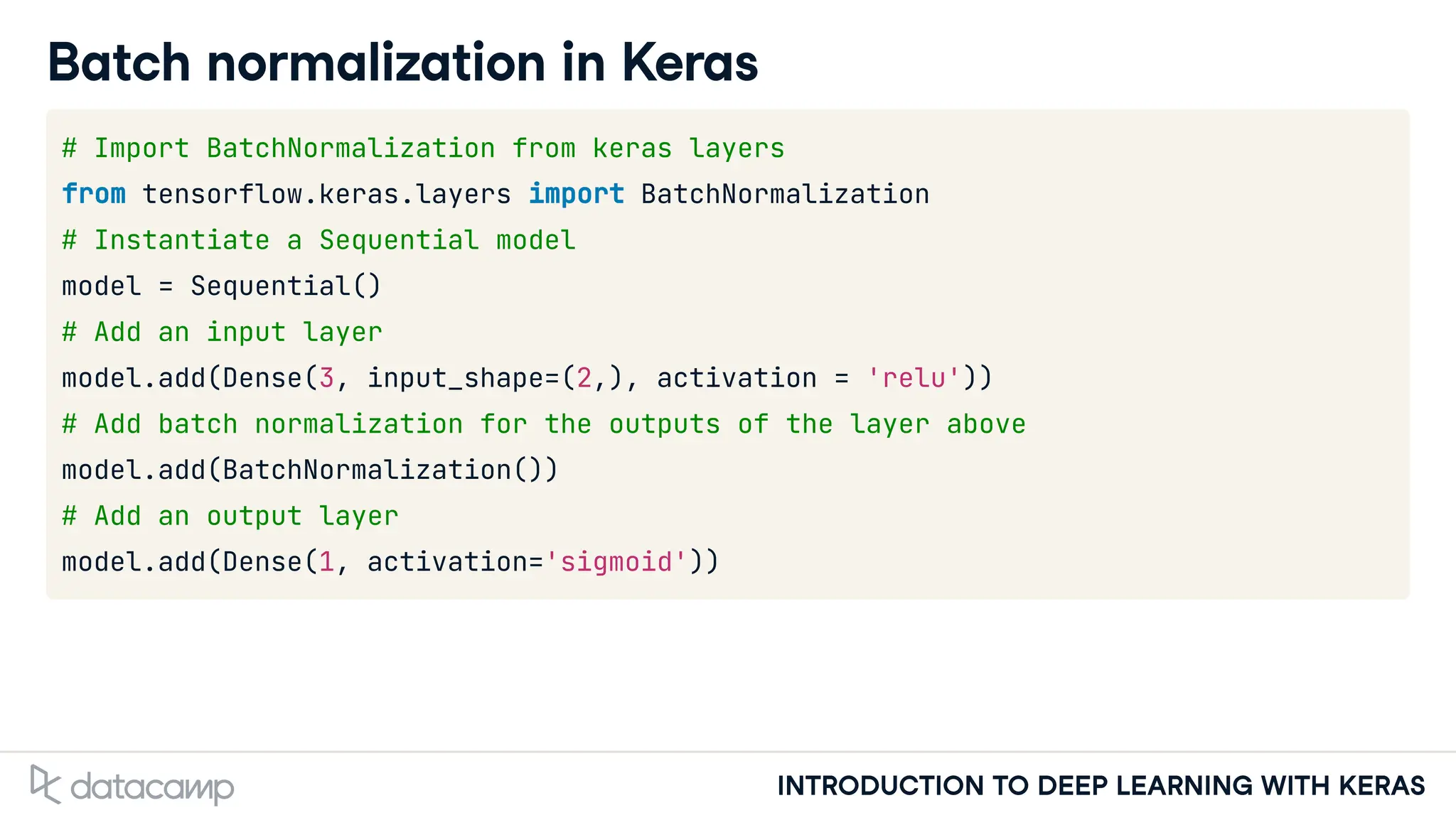
Batch normalization in Keras
# Import BatchNormalization from keras layers
from tensorflow.keras.layers import BatchNormalization
# Instantiate a Sequential model
model = Sequential()
# Add an input layer
model.add(Dense(3, input_shape=(2,), activation = 'relu'))
# Add batch normalization for the outputs of the layer above
model.add(BatchNormalization())
# Add an output layer
model.add(Dense(1, activation='sigmoid'))
Let's practice!
INTRODUCTION TO DEEP LEARNING WITH KERAS
Hyperparameter
tuning
INTRODUCTION TO DEEP LEARNING WITH KERAS
Miguel Esteban
Data Scientist & Founder
INTRODUCTION TO DEEP LEARNING WITH KERAS
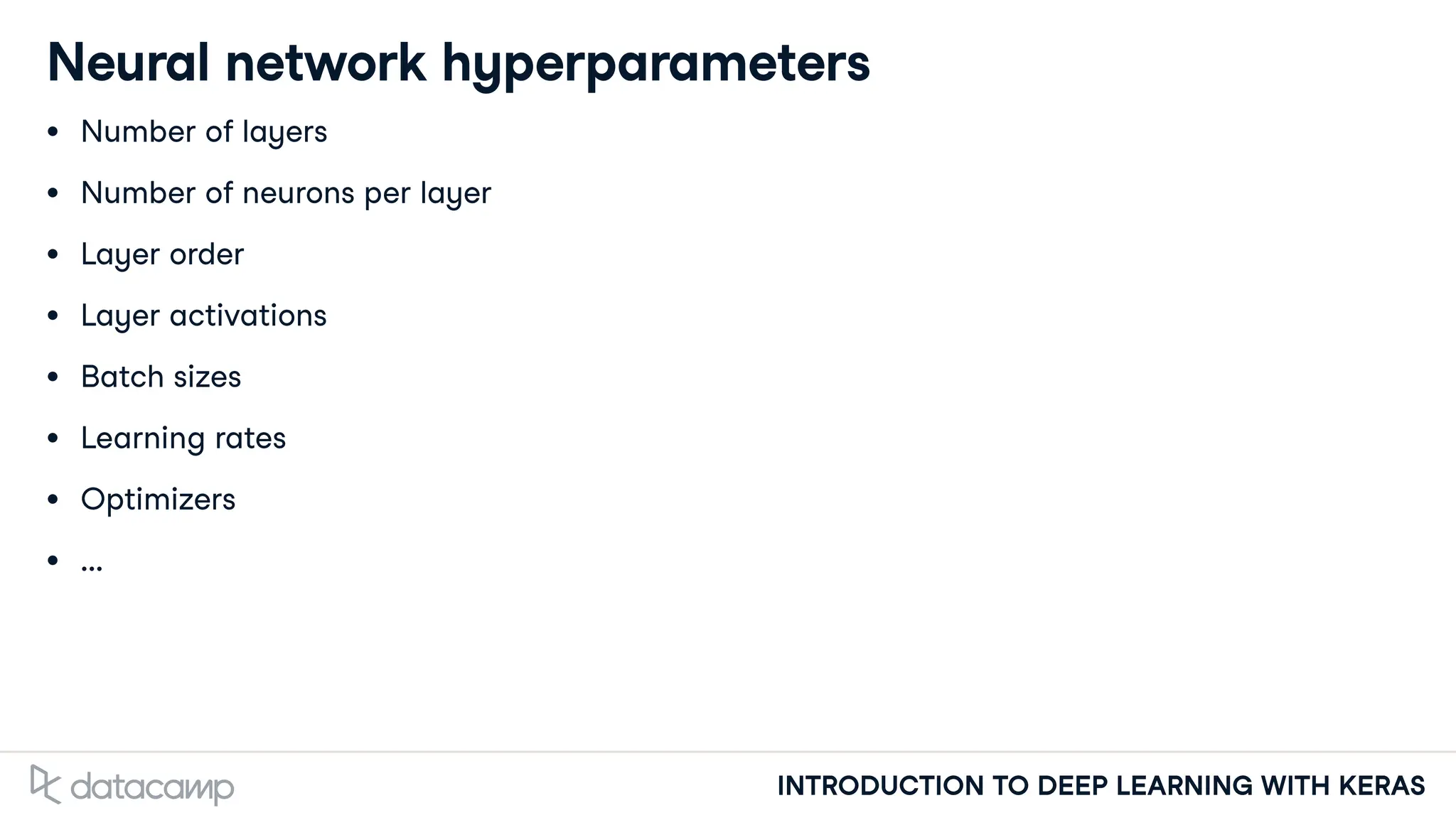
Neural network hyperparameters
Number of layers
Number of neurons per layer
Layer order
Layer activations
Batch sizes
Learning rates
Optimizers
...
INTRODUCTION TO DEEP LEARNING WITH KERAS
Sklearn recap
# Import RandomizedSearchCV
from sklearn.model_selection import RandomizedSearchCV
# Instantiate your classifier
tree = DecisionTreeClassifier()
# Define a series of parameters to look over
params = {'max_depth':[3,None], "max_features":range(1,4), 'min_samples_leaf': range(1,4)}
# Perform random search with cross validation
tree_cv = RandomizedSearchCV(tree, params, cv=5)
tree_cv.fit(X,y)
# Print the best parameters
print(tree_cv.best_params_)
{'min_samples_leaf': 1, 'max_features': 3, 'max_depth': 3}
INTRODUCTION TO DEEP LEARNING WITH KERAS
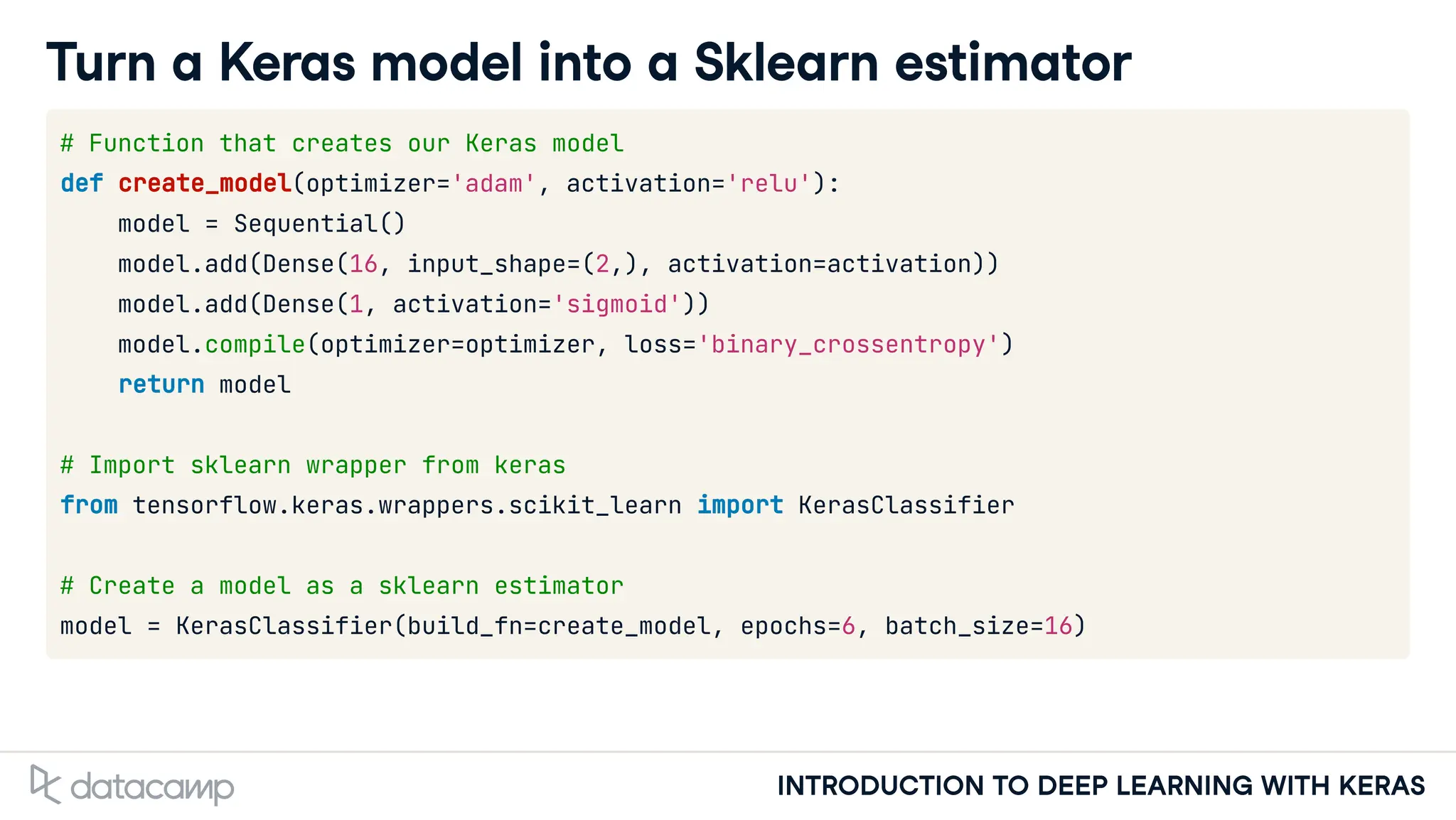
Turn a Keras model into a Sklearn estimator
# Function that creates our Keras model
def create_model(optimizer='adam', activation='relu'):
model = Sequential()
model.add(Dense(16, input_shape=(2,), activation=activation))
model.add(Dense(1, activation='sigmoid'))
model.compile(optimizer=optimizer, loss='binary_crossentropy')
return model
# Import sklearn wrapper from keras
from tensorflow.keras.wrappers.scikit_learn import KerasClassifier
# Create a model as a sklearn estimator
model = KerasClassifier(build_fn=create_model, epochs=6, batch_size=16)
INTRODUCTION TO DEEP LEARNING WITH KERAS
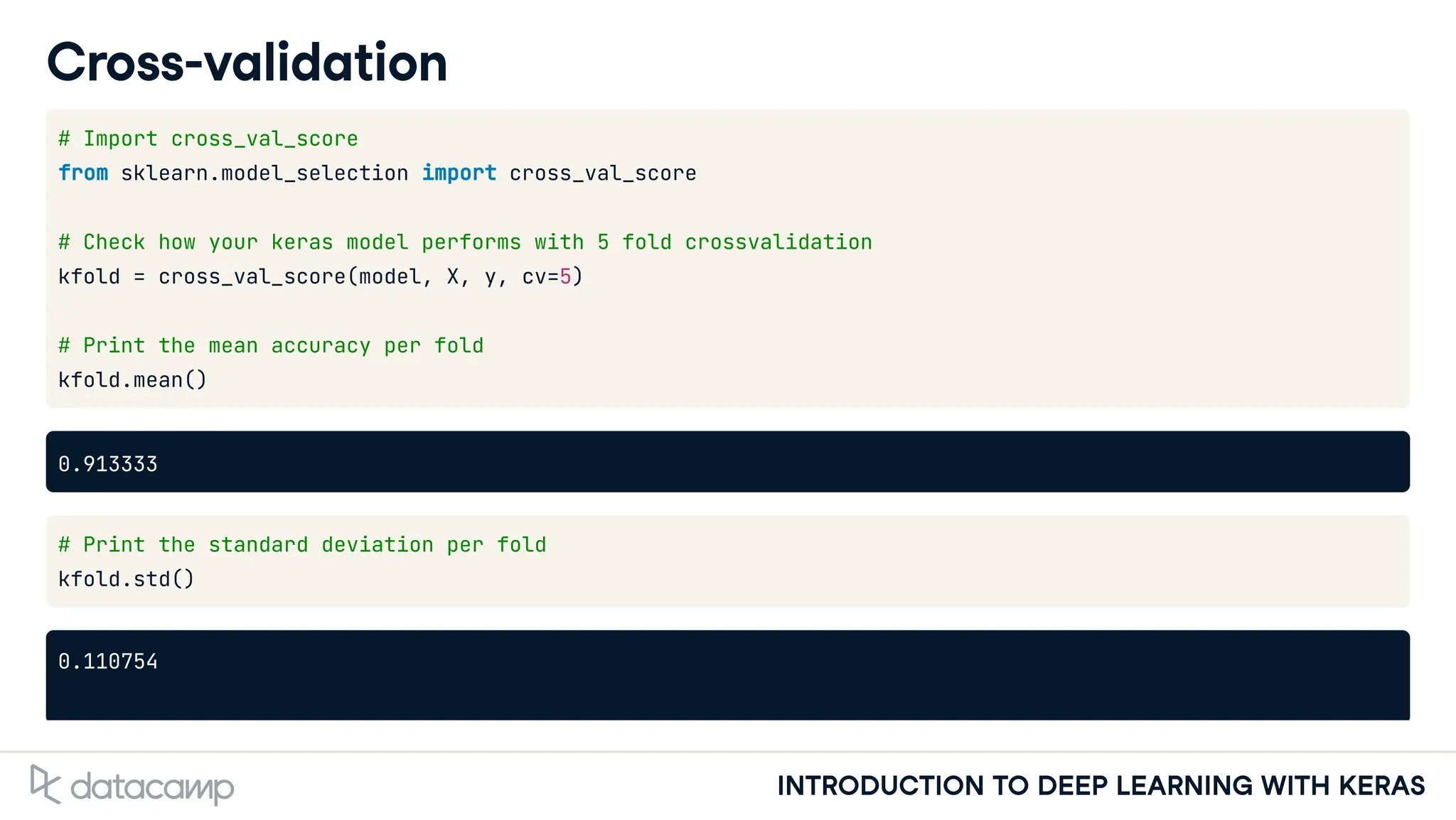
Cross-validation
# Import cross_val_score
from sklearn.model_selection import cross_val_score
# Check how your keras model performs with 5 fold crossvalidation
kfold = cross_val_score(model, X, y, cv=5)
# Print the mean accuracy per fold
kfold.mean()
0.913333
# Print the standard deviation per fold
kfold.std()
0.110754
INTRODUCTION TO DEEP LEARNING WITH KERAS
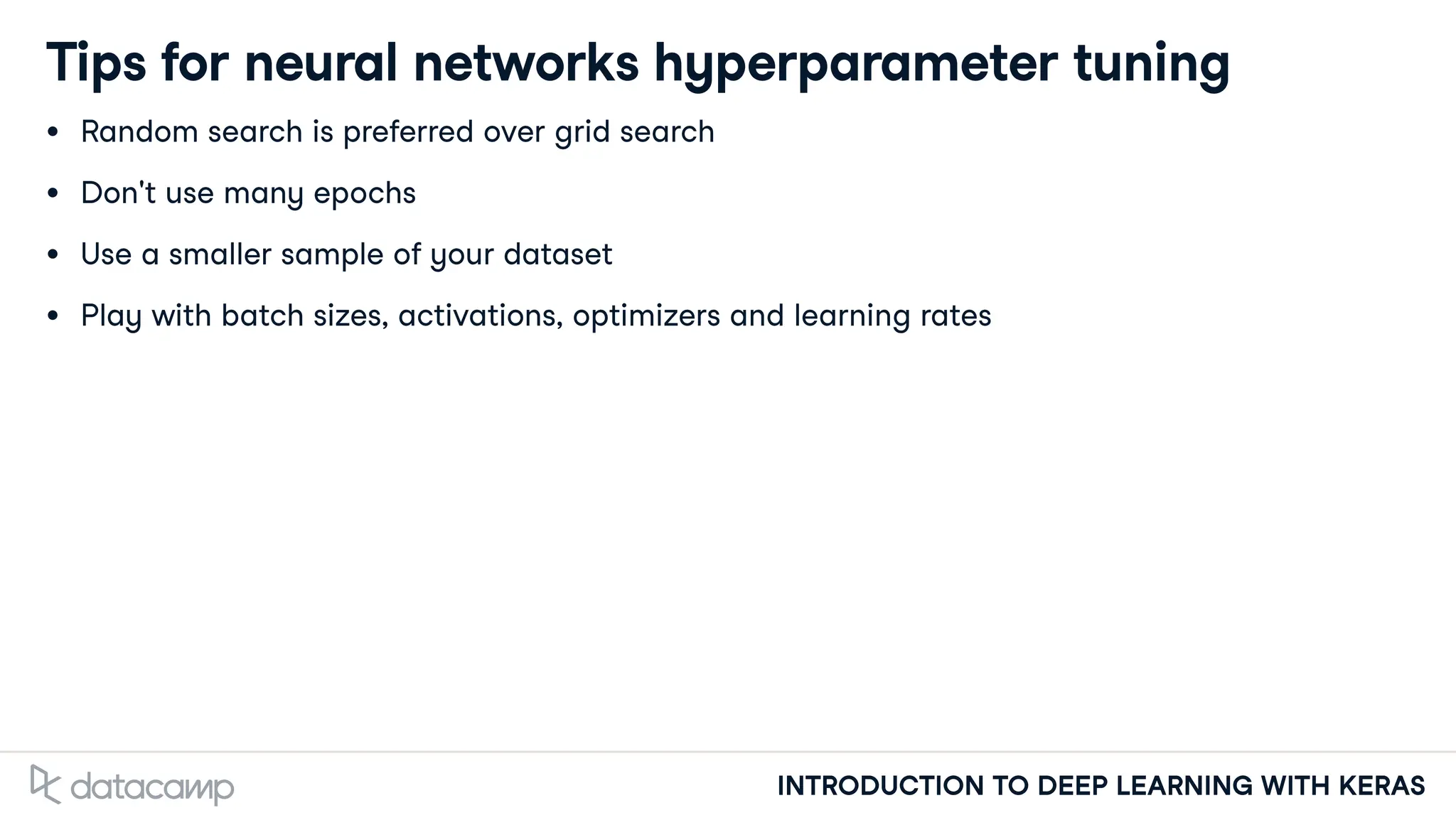
Tips for neural networks hyperparameter tuning
Random search is preferred over grid search
Don't use many epochs
Use a smaller sample of your dataset
Play with batch sizes, activations, optimizers and learning rates
INTRODUCTION TO DEEP LEARNING WITH KERAS
Random search on Keras models
# Define a series of parameters
params = dict(optimizer=['sgd', 'adam'], epochs=3,
batch_size=[5, 10, 20], activation=['relu','tanh'])
# Create a random search cv object and fit it to the data
random_search = RandomizedSearchCV(model, params_dist=params, cv=3)
random_search_results = random_search.fit(X, y)
# Print results
print("Best: %f using %s".format(random_search_results.best_score_,
random_search_results.best_params_))
Best: 0.94 using {'optimizer': 'adam', 'epochs': 3, 'batch_size': 10, 'activation': 'relu'}
INTRODUCTION TO DEEP LEARNING WITH KERAS
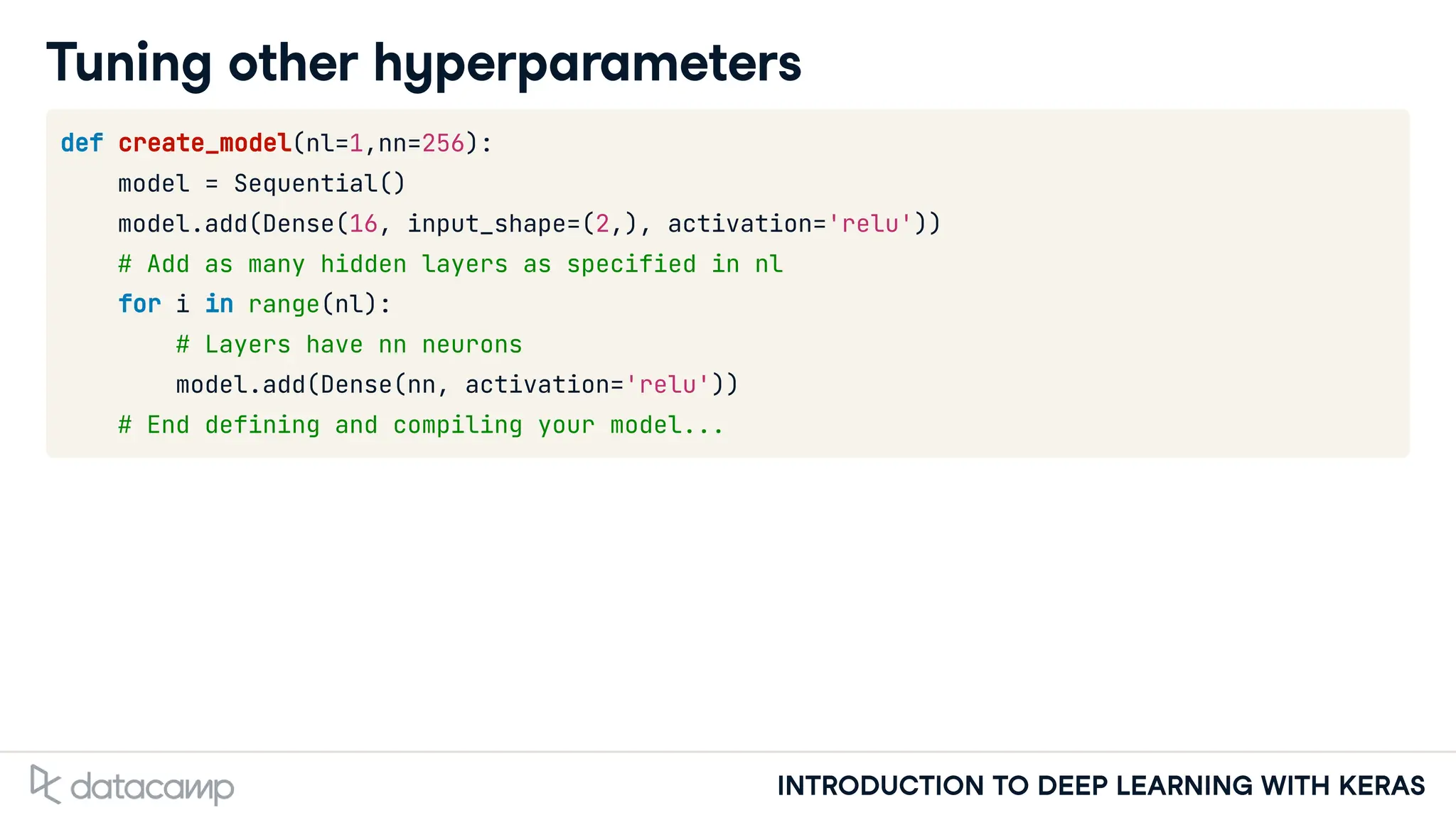
Tuning other hyperparameters
def create_model(nl=1,nn=256):
model = Sequential()
model.add(Dense(16, input_shape=(2,), activation='relu'))
# Add as many hidden layers as specified in nl
for i in range(nl):
# Layers have nn neurons
model.add(Dense(nn, activation='relu'))
# End defining and compiling your model...
INTRODUCTION TO DEEP LEARNING WITH KERAS
Tuning other hyperparameters
# Define parameters, named just like in create_model()
params = dict(nl=[1, 2, 9], nn=[128,256,1000])
# Repeat the random search...
# Print results...
Best: 0.87 using {'nl': 2,'nn': 128}
Let's tune some
networks!
INTRODUCTION TO DEEP LEARNING WITH KERAS

Intro to DL with Keras - chapter3 - datacamp.pdf

  • 1.
    Learning curves INTRODUCTION TODEEP LEARNING WITH KERAS Miguel Esteban Data Scientist & Founder
  • 2.
    INTRODUCTION TO DEEPLEARNING WITH KERAS
  • 3.
    INTRODUCTION TO DEEPLEARNING WITH KERAS
  • 4.
    INTRODUCTION TO DEEPLEARNING WITH KERAS
  • 5.
    INTRODUCTION TO DEEPLEARNING WITH KERAS
  • 6.
    INTRODUCTION TO DEEPLEARNING WITH KERAS
  • 7.
    INTRODUCTION TO DEEPLEARNING WITH KERAS
  • 8.
    INTRODUCTION TO DEEPLEARNING WITH KERAS
  • 9.
    INTRODUCTION TO DEEPLEARNING WITH KERAS
  • 10.
    INTRODUCTION TO DEEPLEARNING WITH KERAS # Store initial model weights init_weights = model.get_weights() # Lists for storing accuracies train_accs = [] tests_accs = []
  • 11.
    INTRODUCTION TO DEEPLEARNING WITH KERAS for train_size in train_sizes: # Split a fraction according to train_size X_train_frac, _, y_train_frac, _ = train_test_split(X_train, y_train, train_size=train_size) # Set model initial weights model.set_weights(initial_weights) # Fit model on the training set fraction model.fit(X_train_frac, y_train_frac, epochs=100, verbose=0, callbacks=[EarlyStopping(monitor='loss', patience=1)]) # Get the accuracy for this training set fraction train_acc = model.evaluate(X_train_frac, y_train_frac, verbose=0)[1] train_accs.append(train_acc) # Get the accuracy on the whole test set test_acc = model.evaluate(X_test, y_test, verbose=0)[1] test_accs.append(test_acc) print("Done with size: ", train_size)
  • 12.
    Time to dominateall curves! INTRODUCTION TO DEEP LEARNING WITH KERAS
  • 13.
    Activation functions INTRODUCTION TODEEP LEARNING WITH KERAS Miguel Esteban Data Scientist & Founder
  • 14.
    INTRODUCTION TO DEEPLEARNING WITH KERAS
  • 15.
    INTRODUCTION TO DEEPLEARNING WITH KERAS
  • 16.
    INTRODUCTION TO DEEPLEARNING WITH KERAS
  • 17.
    INTRODUCTION TO DEEPLEARNING WITH KERAS
  • 18.
    INTRODUCTION TO DEEPLEARNING WITH KERAS
  • 19.
    INTRODUCTION TO DEEPLEARNING WITH KERAS Effects of activation functions
  • 20.
    INTRODUCTION TO DEEPLEARNING WITH KERAS
  • 21.
    INTRODUCTION TO DEEPLEARNING WITH KERAS
  • 22.
    INTRODUCTION TO DEEPLEARNING WITH KERAS Which activation function to use? No magic formula Di erent properties Depends on our problem Goal to achieve in a given layer ReLU are a good rst choice Sigmoids not recommended for deep models Tune with experimentation
  • 23.
    INTRODUCTION TO DEEPLEARNING WITH KERAS Comparing activation functions # Set a random seed np.random.seed(1) # Return a new model with the given activation def get_model(act_function): model = Sequential() model.add(Dense(4, input_shape=(2,), activation=act_function)) model.add(Dense(1, activation='sigmoid')) return model
  • 24.
    INTRODUCTION TO DEEPLEARNING WITH KERAS Comparing activation functions # Activation functions to try out activations = ['relu', 'sigmoid', 'tanh'] # Dictionary to store results activation_results = {} for funct in activations: model = get_model(act_function=funct) history = model.fit(X_train, y_train, validation_data=(X_test, y_test), epochs=100, verbose=0) activation_results[funct] = history
  • 25.
    INTRODUCTION TO DEEPLEARNING WITH KERAS Comparing activation functions import pandas as pd # Extract val_loss history of each activation function val_loss_per_funct = {k:v.history['val_loss'] for k,v in activation_results.items()} # Turn the dictionary into a pandas dataframe val_loss_curves = pd.DataFrame(val_loss_per_funct) # Plot the curves val_loss_curves.plot(title='Loss per Activation function')
  • 26.
    Let's practice! INTRODUCTION TODEEP LEARNING WITH KERAS
  • 27.
    Batch size and batchnormalization INTRODUCTION TO DEEP LEARNING WITH KERAS Miguel Esteban Data Scientist & Founder
  • 28.
    INTRODUCTION TO DEEPLEARNING WITH KERAS
  • 29.
    INTRODUCTION TO DEEPLEARNING WITH KERAS
  • 30.
    INTRODUCTION TO DEEPLEARNING WITH KERAS Mini-batches Advantages Networks train faster (more weight updates in same amount of time) Less RAM memory required, can train on huge datasets Noise can help networks reach a lower error, escaping local minima Disadvantages More iterations need to be run Need to be adjusted, we need to nd a good batch size
  • 31.
    INTRODUCTION TO DEEPLEARNING WITH KERAS Stack Exchange 1
  • 32.
    INTRODUCTION TO DEEPLEARNING WITH KERAS Batch size in Keras # Fitting an already built and compiled model model.fit(X_train, y_train, epochs=100, batch_size=128) ^^^^^^^^^^^^^^
  • 33.
    INTRODUCTION TO DEEPLEARNING WITH KERAS
  • 34.
    INTRODUCTION TO DEEPLEARNING WITH KERAS
  • 35.
    INTRODUCTION TO DEEPLEARNING WITH KERAS
  • 36.
    INTRODUCTION TO DEEPLEARNING WITH KERAS Batch normalization advantages Improves gradient ow Allows higher learning rates Reduces dependence on weight initializations Acts as an unintended form of regularization Limits internal covariate shi
  • 37.
    INTRODUCTION TO DEEPLEARNING WITH KERAS Batch normalization in Keras # Import BatchNormalization from keras layers from tensorflow.keras.layers import BatchNormalization # Instantiate a Sequential model model = Sequential() # Add an input layer model.add(Dense(3, input_shape=(2,), activation = 'relu')) # Add batch normalization for the outputs of the layer above model.add(BatchNormalization()) # Add an output layer model.add(Dense(1, activation='sigmoid'))
  • 38.
    Let's practice! INTRODUCTION TODEEP LEARNING WITH KERAS
  • 39.
    Hyperparameter tuning INTRODUCTION TO DEEPLEARNING WITH KERAS Miguel Esteban Data Scientist & Founder
  • 40.
    INTRODUCTION TO DEEPLEARNING WITH KERAS Neural network hyperparameters Number of layers Number of neurons per layer Layer order Layer activations Batch sizes Learning rates Optimizers ...
  • 41.
    INTRODUCTION TO DEEPLEARNING WITH KERAS Sklearn recap # Import RandomizedSearchCV from sklearn.model_selection import RandomizedSearchCV # Instantiate your classifier tree = DecisionTreeClassifier() # Define a series of parameters to look over params = {'max_depth':[3,None], "max_features":range(1,4), 'min_samples_leaf': range(1,4)} # Perform random search with cross validation tree_cv = RandomizedSearchCV(tree, params, cv=5) tree_cv.fit(X,y) # Print the best parameters print(tree_cv.best_params_) {'min_samples_leaf': 1, 'max_features': 3, 'max_depth': 3}
  • 42.
    INTRODUCTION TO DEEPLEARNING WITH KERAS Turn a Keras model into a Sklearn estimator # Function that creates our Keras model def create_model(optimizer='adam', activation='relu'): model = Sequential() model.add(Dense(16, input_shape=(2,), activation=activation)) model.add(Dense(1, activation='sigmoid')) model.compile(optimizer=optimizer, loss='binary_crossentropy') return model # Import sklearn wrapper from keras from tensorflow.keras.wrappers.scikit_learn import KerasClassifier # Create a model as a sklearn estimator model = KerasClassifier(build_fn=create_model, epochs=6, batch_size=16)
  • 43.
    INTRODUCTION TO DEEPLEARNING WITH KERAS Cross-validation # Import cross_val_score from sklearn.model_selection import cross_val_score # Check how your keras model performs with 5 fold crossvalidation kfold = cross_val_score(model, X, y, cv=5) # Print the mean accuracy per fold kfold.mean() 0.913333 # Print the standard deviation per fold kfold.std() 0.110754
  • 44.
    INTRODUCTION TO DEEPLEARNING WITH KERAS Tips for neural networks hyperparameter tuning Random search is preferred over grid search Don't use many epochs Use a smaller sample of your dataset Play with batch sizes, activations, optimizers and learning rates
  • 45.
    INTRODUCTION TO DEEPLEARNING WITH KERAS Random search on Keras models # Define a series of parameters params = dict(optimizer=['sgd', 'adam'], epochs=3, batch_size=[5, 10, 20], activation=['relu','tanh']) # Create a random search cv object and fit it to the data random_search = RandomizedSearchCV(model, params_dist=params, cv=3) random_search_results = random_search.fit(X, y) # Print results print("Best: %f using %s".format(random_search_results.best_score_, random_search_results.best_params_)) Best: 0.94 using {'optimizer': 'adam', 'epochs': 3, 'batch_size': 10, 'activation': 'relu'}
  • 46.
    INTRODUCTION TO DEEPLEARNING WITH KERAS Tuning other hyperparameters def create_model(nl=1,nn=256): model = Sequential() model.add(Dense(16, input_shape=(2,), activation='relu')) # Add as many hidden layers as specified in nl for i in range(nl): # Layers have nn neurons model.add(Dense(nn, activation='relu')) # End defining and compiling your model...
  • 47.
    INTRODUCTION TO DEEPLEARNING WITH KERAS Tuning other hyperparameters # Define parameters, named just like in create_model() params = dict(nl=[1, 2, 9], nn=[128,256,1000]) # Repeat the random search... # Print results... Best: 0.87 using {'nl': 2,'nn': 128}
  • 48.
    Let's tune some networks! INTRODUCTIONTO DEEP LEARNING WITH KERAS