@farhan. M Lecture: 1.1 Introduction to Control Systems 1
Hello Class
Lecture 1.1
Introduction to Control Systems
Prepared by
Engr. Dr. Muhammad Farhan
Email: mfarhan@gcuf.edu.pk
Control Systems
Course Lecture Series
for
Undergraduate BSc Electrical, Electronics
& Computer Systems Engineering
EngiTech
Learn
Plex
Lecture: 1.1 Introduction to Control Systems
2
Hello Class Course Description
@farhan. M Lecture 1.1 Course Description 2
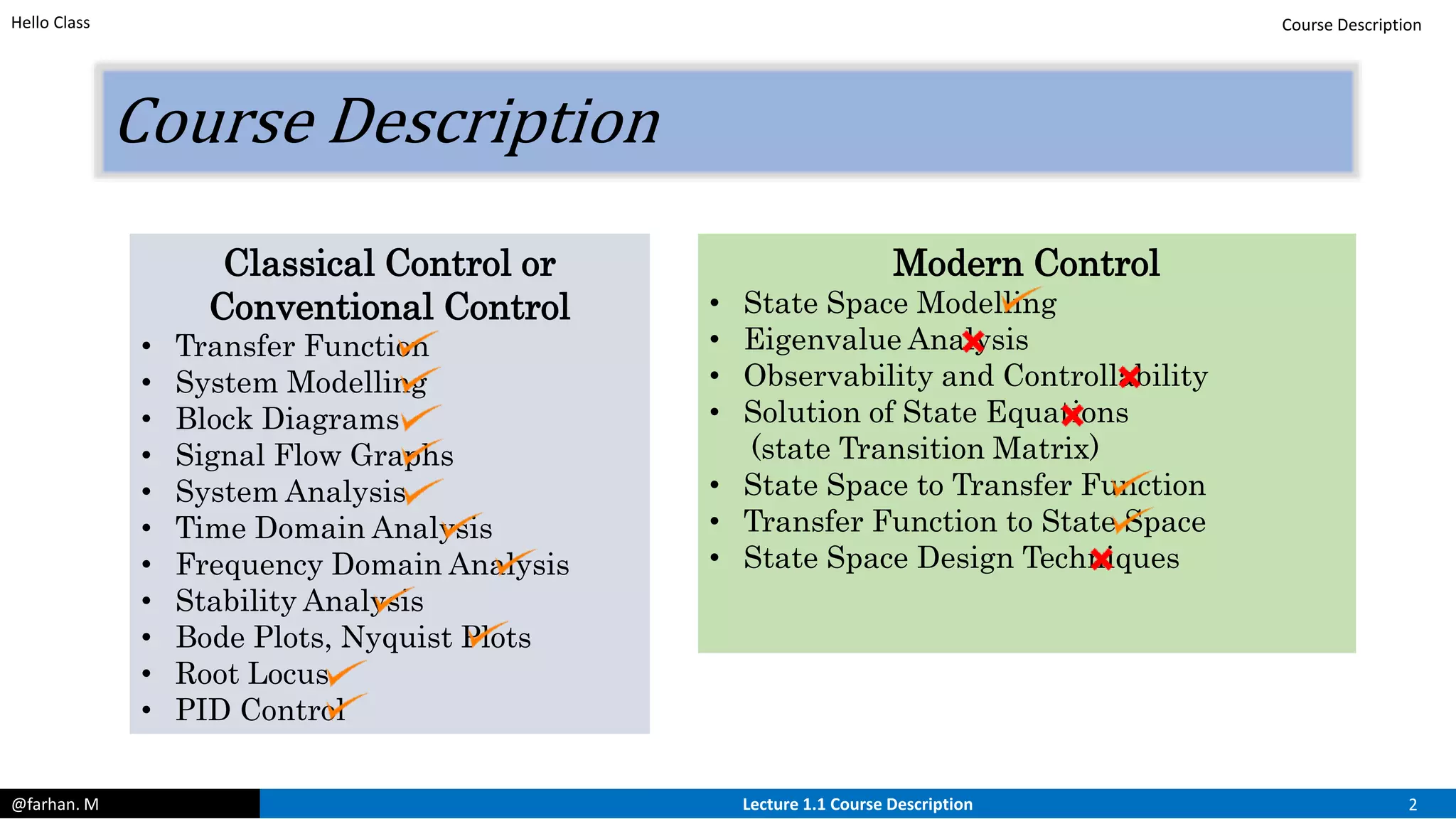
Course Description
Classical Control or
Conventional Control
• Transfer Function
• System Modelling
• Block Diagrams
• Signal Flow Graphs
• System Analysis
• Time Domain Analysis
• Frequency Domain Analysis
• Stability Analysis
• Bode Plots, Nyquist Plots
• Root Locus
• PID Control
Modern Control
• State Space Modelling
• Eigenvalue Analysis
• Observability and Controllability
• Solution of State Equations
(state Transition Matrix)
• State Space to Transfer Function
• Transfer Function to State Space
• State Space Design Techniques
• Differential equations
• Laplace Transforms
• Love to multiply and add things.
• Books generally followed by different universities
1. Control Systems Engineering by Norman S. Nise.
2. Modern Control Engineering by Katsuhiko Ogata.
3. Automatic Control Systems by Benjamin C. Kuo
4. Control Systems Engineering by U. V. Bakshi
3
Hello Class Prerequisites and Books
@farhan. M Lecture 1.1 Prerequisites and Books 3
Prerequisites and Books
• MATLAB software might be required for verification of
solutions
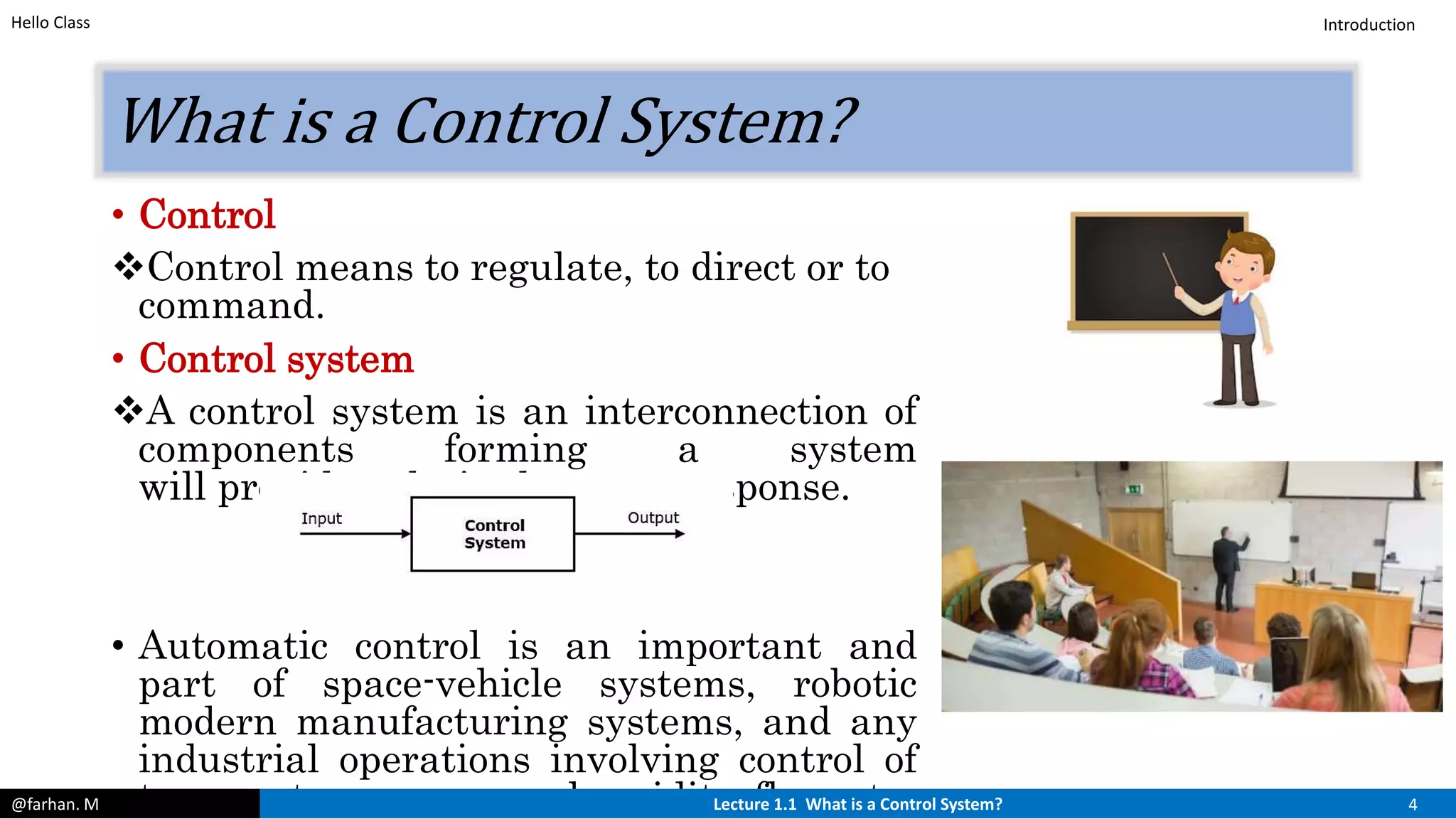
• Control
Control means to regulate, to direct or to
command.
• Control system
A control system is an interconnection of
components forming a system
will provide a desired system response.
• Automatic control is an important and
part of space-vehicle systems, robotic
modern manufacturing systems, and any
industrial operations involving control of
temperature, pressure, humidity, flow, etc.
4
Hello Class Introduction
@farhan. M Lecture 1.1 What is a Control System? 4
What is a Control System?
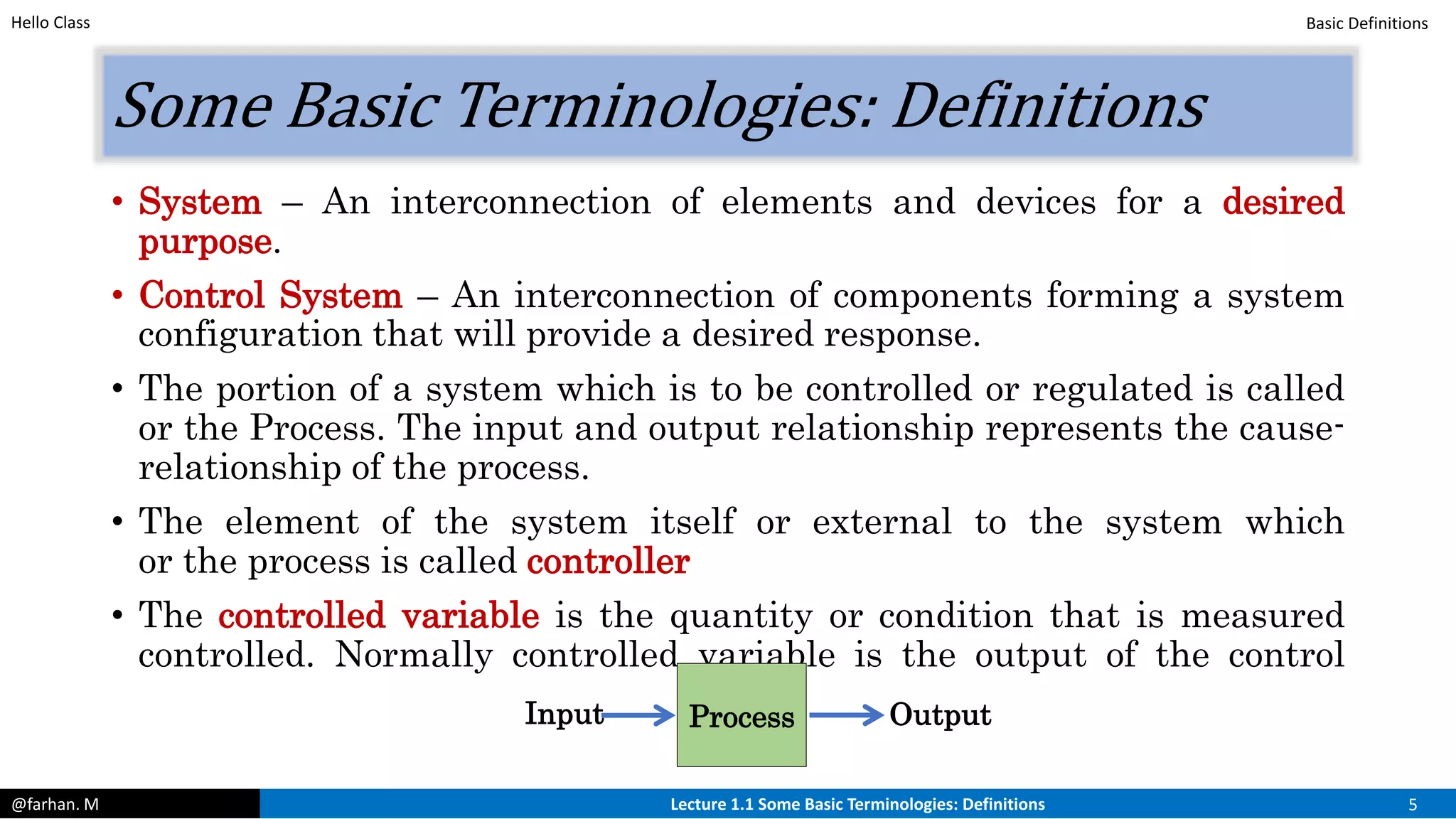
• System – An interconnection of elements and devices for a desired
purpose.
• Control System – An interconnection of components forming a system
configuration that will provide a desired response.
• The portion of a system which is to be controlled or regulated is called
or the Process. The input and output relationship represents the cause-
relationship of the process.
• The element of the system itself or external to the system which
or the process is called controller
• The controlled variable is the quantity or condition that is measured
controlled. Normally controlled variable is the output of the control
5
Hello Class Basic Definitions
@farhan. M Lecture 1.1 Some Basic Terminologies: Definitions 5
Some Basic Terminologies: Definitions
Process Output
Input
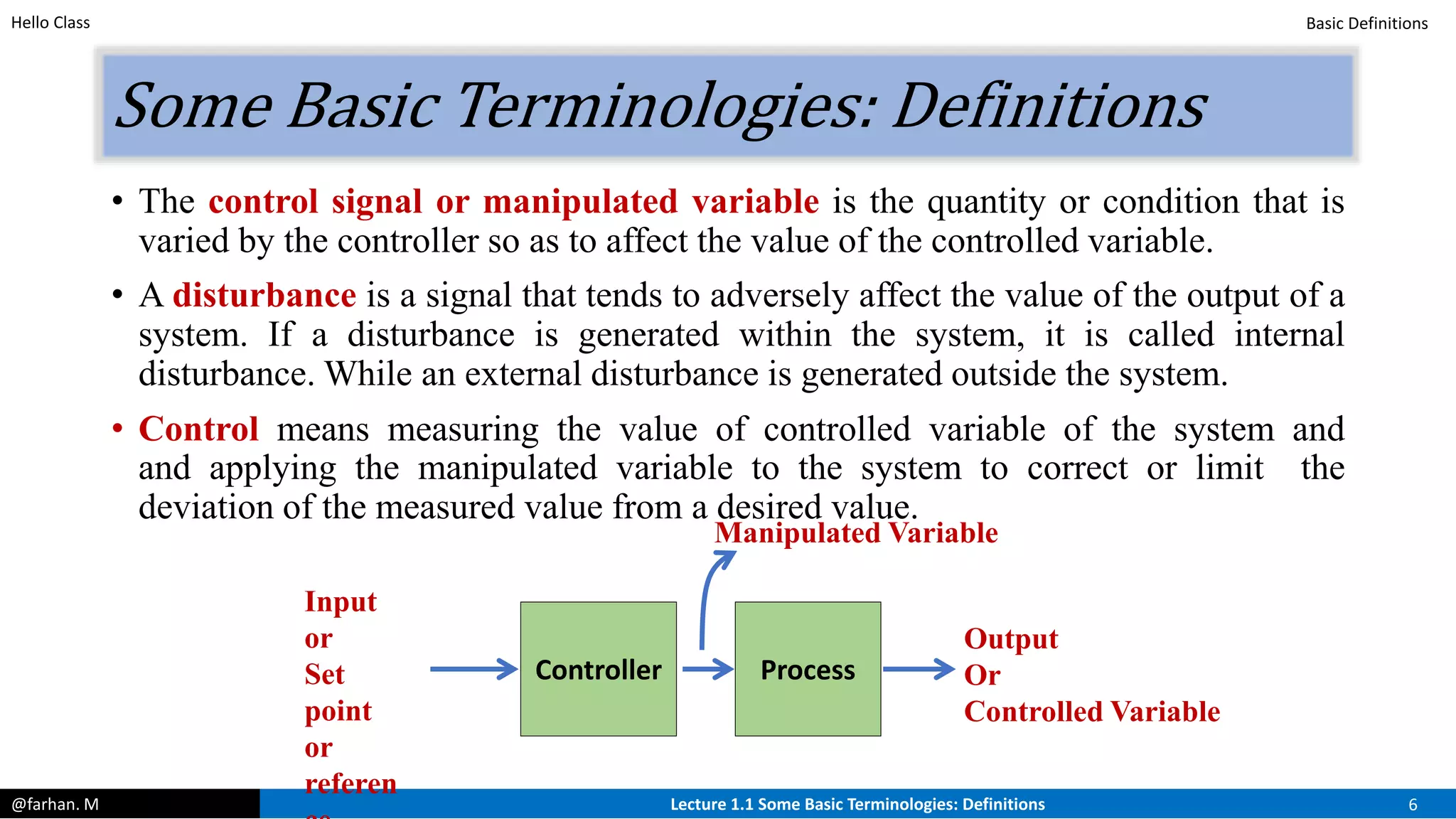
• The control signal or manipulated variable is the quantity or condition that is
varied by the controller so as to affect the value of the controlled variable.
• A disturbance is a signal that tends to adversely affect the value of the output of a
system. If a disturbance is generated within the system, it is called internal
disturbance. While an external disturbance is generated outside the system.
• Control means measuring the value of controlled variable of the system and
and applying the manipulated variable to the system to correct or limit the
deviation of the measured value from a desired value.
6
Hello Class Basic Definitions
@farhan. M Lecture 1.1 Some Basic Terminologies: Definitions 6
Some Basic Terminologies: Definitions
Controller
Output
Or
Controlled Variable
Input
or
Set
point
or
referen
Process
Manipulated Variable
7
Hello Class History
@farhan. M Lecture 1.1 History of Control Engineering 7
History of Control Engineering (Notable
Work)
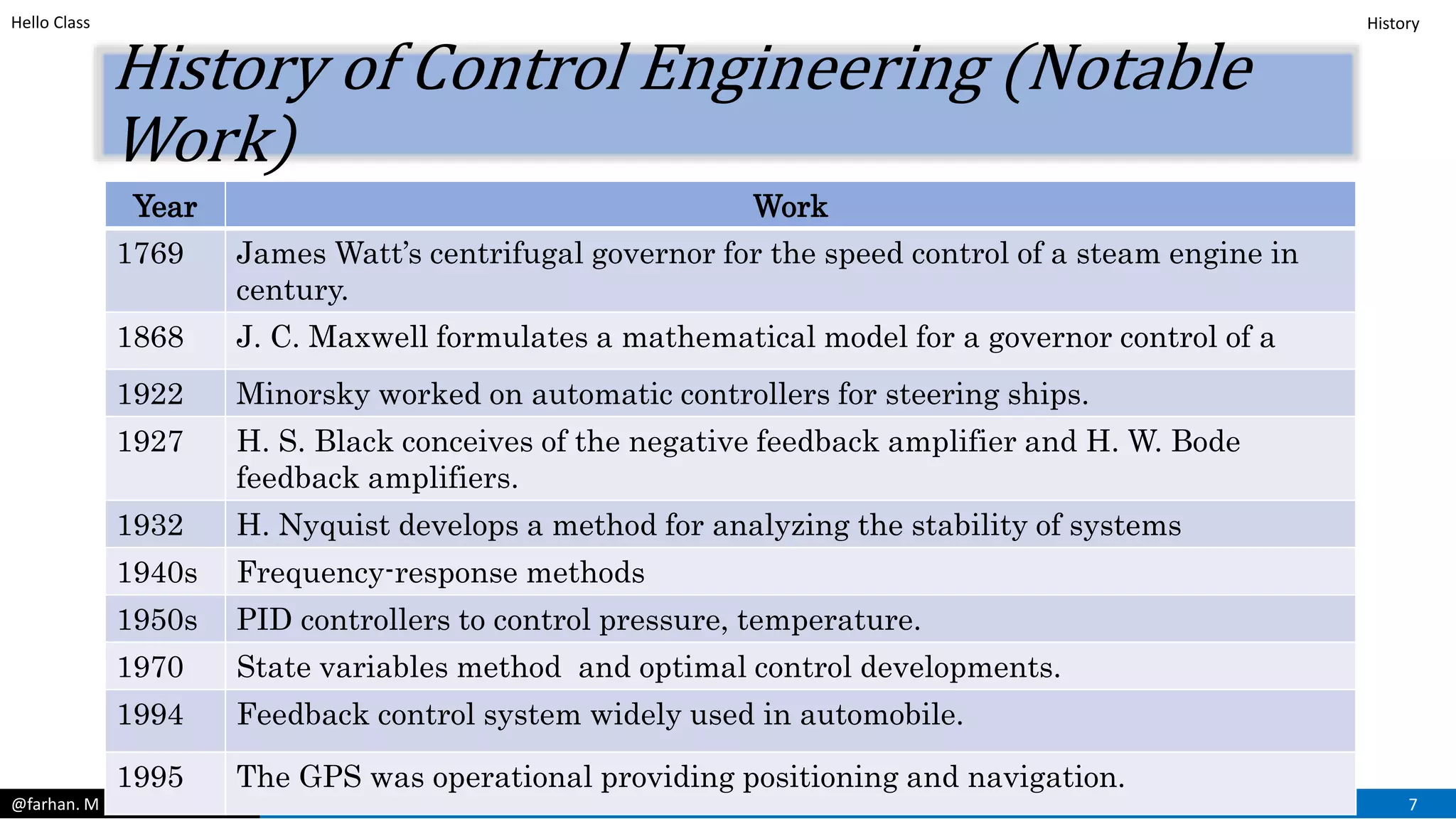
Year Work
1769 James Watt’s centrifugal governor for the speed control of a steam engine in
century.
1868 J. C. Maxwell formulates a mathematical model for a governor control of a
1922 Minorsky worked on automatic controllers for steering ships.
1927 H. S. Black conceives of the negative feedback amplifier and H. W. Bode
feedback amplifiers.
1932 H. Nyquist develops a method for analyzing the stability of systems
1940s Frequency-response methods
1950s PID controllers to control pressure, temperature.
1970 State variables method and optimal control developments.
1994 Feedback control system widely used in automobile.
1995 The GPS was operational providing positioning and navigation.
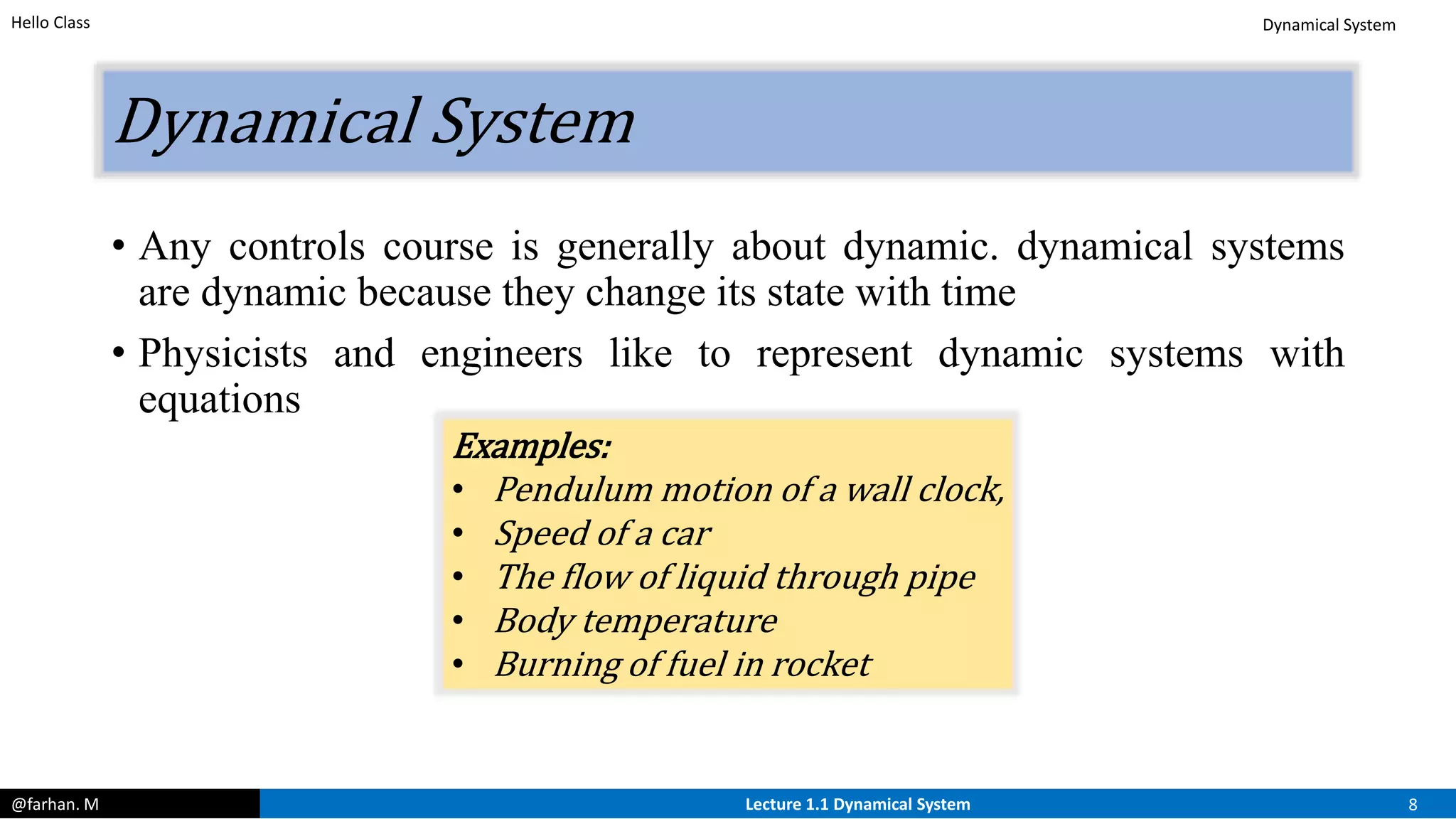
• Any controls course is generally about dynamic. dynamical systems
are dynamic because they change its state with time
• Physicists and engineers like to represent dynamic systems with
equations
8
Hello Class Dynamical System
@farhan. M Lecture 1.1 Dynamical System 8
Dynamical System
Examples:
• Pendulum motion of a wall clock,
• Speed of a car
• The flow of liquid through pipe
• Body temperature
• Burning of fuel in rocket
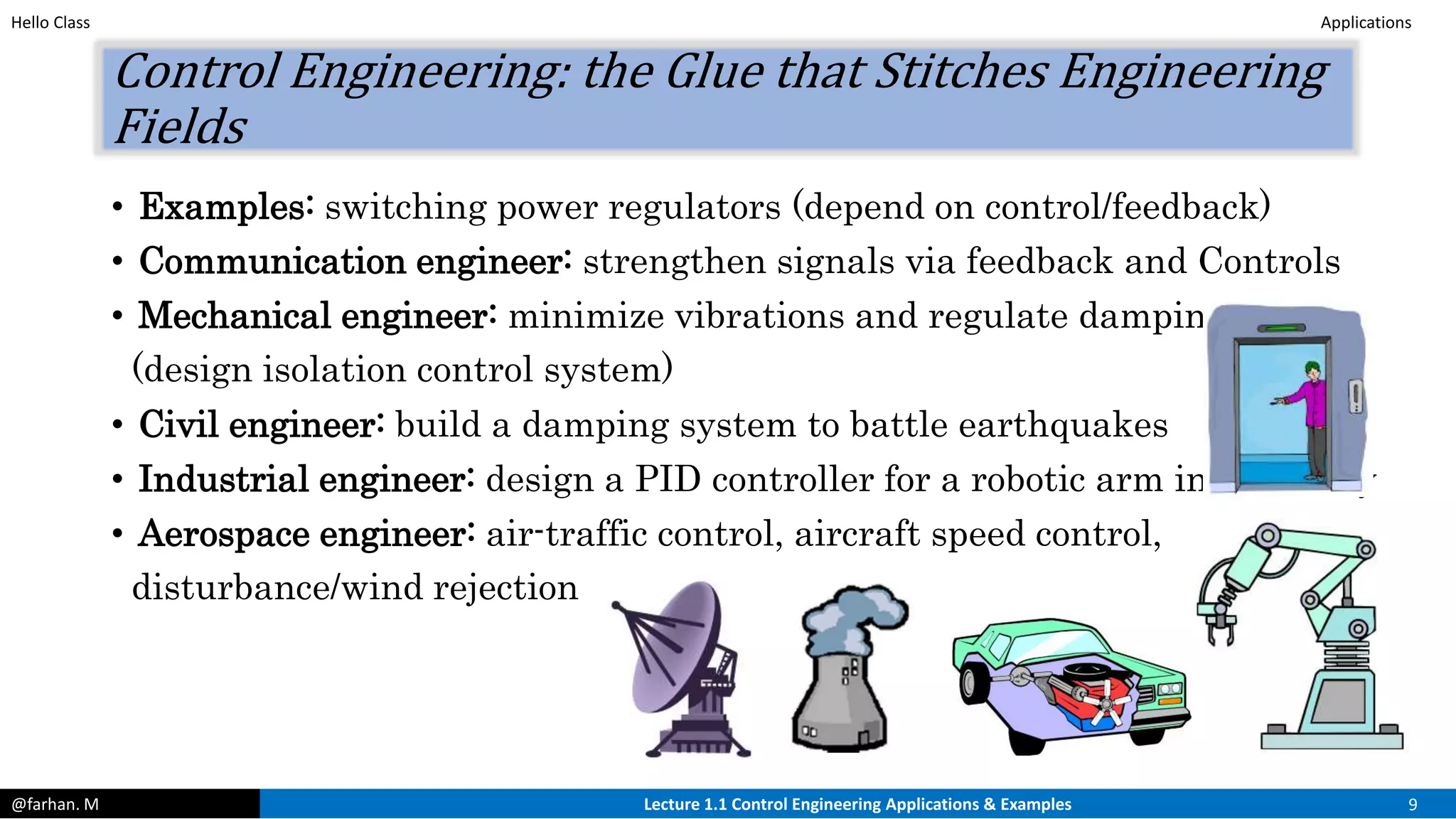
• Examples: switching power regulators (depend on control/feedback)
• Communication engineer: strengthen signals via feedback and Controls
• Mechanical engineer: minimize vibrations and regulate damping
(design isolation control system)
• Civil engineer: build a damping system to battle earthquakes
• Industrial engineer: design a PID controller for a robotic arm in a Factory
• Aerospace engineer: air-traffic control, aircraft speed control,
disturbance/wind rejection
9
Hello Class Applications
@farhan. M Lecture 1.1 Control Engineering Applications & Examples 9
Control Engineering: the Glue that Stitches Engineering
Fields

Intro to control system

  • 1.
    @farhan. M Lecture:1.1 Introduction to Control Systems 1 Hello Class Lecture 1.1 Introduction to Control Systems Prepared by Engr. Dr. Muhammad Farhan Email: mfarhan@gcuf.edu.pk Control Systems Course Lecture Series for Undergraduate BSc Electrical, Electronics & Computer Systems Engineering EngiTech Learn Plex Lecture: 1.1 Introduction to Control Systems
  • 2.
    2 Hello Class CourseDescription @farhan. M Lecture 1.1 Course Description 2 Course Description Classical Control or Conventional Control • Transfer Function • System Modelling • Block Diagrams • Signal Flow Graphs • System Analysis • Time Domain Analysis • Frequency Domain Analysis • Stability Analysis • Bode Plots, Nyquist Plots • Root Locus • PID Control Modern Control • State Space Modelling • Eigenvalue Analysis • Observability and Controllability • Solution of State Equations (state Transition Matrix) • State Space to Transfer Function • Transfer Function to State Space • State Space Design Techniques
  • 3.
    • Differential equations •Laplace Transforms • Love to multiply and add things. • Books generally followed by different universities 1. Control Systems Engineering by Norman S. Nise. 2. Modern Control Engineering by Katsuhiko Ogata. 3. Automatic Control Systems by Benjamin C. Kuo 4. Control Systems Engineering by U. V. Bakshi 3 Hello Class Prerequisites and Books @farhan. M Lecture 1.1 Prerequisites and Books 3 Prerequisites and Books • MATLAB software might be required for verification of solutions
  • 4.
    • Control Control meansto regulate, to direct or to command. • Control system A control system is an interconnection of components forming a system will provide a desired system response. • Automatic control is an important and part of space-vehicle systems, robotic modern manufacturing systems, and any industrial operations involving control of temperature, pressure, humidity, flow, etc. 4 Hello Class Introduction @farhan. M Lecture 1.1 What is a Control System? 4 What is a Control System?
  • 5.
    • System –An interconnection of elements and devices for a desired purpose. • Control System – An interconnection of components forming a system configuration that will provide a desired response. • The portion of a system which is to be controlled or regulated is called or the Process. The input and output relationship represents the cause- relationship of the process. • The element of the system itself or external to the system which or the process is called controller • The controlled variable is the quantity or condition that is measured controlled. Normally controlled variable is the output of the control 5 Hello Class Basic Definitions @farhan. M Lecture 1.1 Some Basic Terminologies: Definitions 5 Some Basic Terminologies: Definitions Process Output Input
  • 6.
    • The controlsignal or manipulated variable is the quantity or condition that is varied by the controller so as to affect the value of the controlled variable. • A disturbance is a signal that tends to adversely affect the value of the output of a system. If a disturbance is generated within the system, it is called internal disturbance. While an external disturbance is generated outside the system. • Control means measuring the value of controlled variable of the system and and applying the manipulated variable to the system to correct or limit the deviation of the measured value from a desired value. 6 Hello Class Basic Definitions @farhan. M Lecture 1.1 Some Basic Terminologies: Definitions 6 Some Basic Terminologies: Definitions Controller Output Or Controlled Variable Input or Set point or referen Process Manipulated Variable
  • 7.
    7 Hello Class History @farhan.M Lecture 1.1 History of Control Engineering 7 History of Control Engineering (Notable Work) Year Work 1769 James Watt’s centrifugal governor for the speed control of a steam engine in century. 1868 J. C. Maxwell formulates a mathematical model for a governor control of a 1922 Minorsky worked on automatic controllers for steering ships. 1927 H. S. Black conceives of the negative feedback amplifier and H. W. Bode feedback amplifiers. 1932 H. Nyquist develops a method for analyzing the stability of systems 1940s Frequency-response methods 1950s PID controllers to control pressure, temperature. 1970 State variables method and optimal control developments. 1994 Feedback control system widely used in automobile. 1995 The GPS was operational providing positioning and navigation.
  • 8.
    • Any controlscourse is generally about dynamic. dynamical systems are dynamic because they change its state with time • Physicists and engineers like to represent dynamic systems with equations 8 Hello Class Dynamical System @farhan. M Lecture 1.1 Dynamical System 8 Dynamical System Examples: • Pendulum motion of a wall clock, • Speed of a car • The flow of liquid through pipe • Body temperature • Burning of fuel in rocket
  • 9.
    • Examples: switchingpower regulators (depend on control/feedback) • Communication engineer: strengthen signals via feedback and Controls • Mechanical engineer: minimize vibrations and regulate damping (design isolation control system) • Civil engineer: build a damping system to battle earthquakes • Industrial engineer: design a PID controller for a robotic arm in a Factory • Aerospace engineer: air-traffic control, aircraft speed control, disturbance/wind rejection 9 Hello Class Applications @farhan. M Lecture 1.1 Control Engineering Applications & Examples 9 Control Engineering: the Glue that Stitches Engineering Fields