Nonlinear Control Systems 1st Edition Zoran
Vuki■ download
https://ebookgate.com/product/nonlinear-control-systems-1st-
edition-zoran-vukic/
Get Instant Ebook Downloads – Browse at https://ebookgate.com
Get Your Digital Files Instantly: PDF, ePub, MOBI and More
Quick Digital Downloads: PDF, ePub, MOBI and Other Formats
Optimal Control of Singularly Perturbed Linear Systems
and Applications Automation and Control Engineering 1st
Edition Zoran Gajic
https://ebookgate.com/product/optimal-control-of-singularly-
perturbed-linear-systems-and-applications-automation-and-control-
engineering-1st-edition-zoran-gajic/
Control of Nonlinear Distributed Parameter Systems 1st
Edition Goong Chen
https://ebookgate.com/product/control-of-nonlinear-distributed-
parameter-systems-1st-edition-goong-chen/
Nonlinear H Infinity Control Hamiltonian Systems and
Hamilton Jacobi Equations 1st Edition M.D.S. Aliyu
https://ebookgate.com/product/nonlinear-h-infinity-control-
hamiltonian-systems-and-hamilton-jacobi-equations-1st-edition-m-
d-s-aliyu/
Nonlinear H Infinity Control Hamiltonian Systems and
Hamilton Jacobi Equations 1st Edition M.D.S. Aliyu
https://ebookgate.com/product/nonlinear-h-infinity-control-
hamiltonian-systems-and-hamilton-jacobi-equations-1st-edition-m-
d-s-aliyu-2/
Control Systems 1st Edition W. Bolton
https://ebookgate.com/product/control-systems-1st-edition-w-
bolton/
Nonlinear Dynamics of Production Systems 1st Edition
Günter Radons
https://ebookgate.com/product/nonlinear-dynamics-of-production-
systems-1st-edition-gunter-radons/
Reading Detective A1 1st Edition Cheryl Block
https://ebookgate.com/product/reading-detective-a1-1st-edition-
cheryl-block/
Signals and Control Systems 1st Edition Femmam
https://ebookgate.com/product/signals-and-control-systems-1st-
edition-femmam/
Republic of Georgia Zoran Pavlovic
https://ebookgate.com/product/republic-of-georgia-zoran-pavlovic/
MARCEL
NONLINEAR
CONTROL
SYSTEMS
Zoran Vukic
Ljubomir Kuljaca
University of'Zagreb
'Zagreb, Croatia
Dali Donlagic
University ofMaribor
Maribor, Slovenia
Sejid Tesnjak
University ofZagreb
Zagreb, Croatia
n MARCEL DEKKER, INC. NEW YORK • BASEL
DEKKER
Copyright © 2003 by Marcel Dekker, Inc.
Library of Congress Cataloging-in-Publication Data
A catalog record for this book is available from the Library of Congress.
ISBN: 0-8247-4112-9
This book is printed on acid-free paper.
Headquarters
Marcel Dekker, Inc.
270 Madison Avenue, New York, NY 10016
tel: 212-696-9000; fax: 212-685-4540
Eastern Hemisphere Distribution
Marcel Dekker AG
Hutgasse 4, Postfach 812, CH-4001 Basel, Switzerland
tel: 41-61-260-6300; fax: 41-61-260-6333
World Wide Web
http://www.dekker.com
The publisher offers discounts on this book when ordered in bulk quantities. For more infor­
mation, write to Special Sales/Professional Marketing at the headquarters address above.
Copyright © 2003 by Marcel Dekker, Inc. All Rights Reserved.
Neither this book nor any part may be reproduced or transmitted in any form or by any
means, electronic or mechanical, including photocopying, microfilming, and recording, or
by any information storage and retrieval system, without permission in writing from the
publisher.
Current printing (last digit):
10 9 8 7 6 5 4 3 2
PRINTED IN THE UNITED STATES OF AMERICA
Copyright © 2003 by Marcel Dekker, Inc.
CONTROL ENGINEERING
A SeriesofReferenceBooksandTextbooks
Editor
NEIL MUNRO, PH.D., D.Sc.
Professor
Applied Control Engineering
University ofManchester Institute of Science and Technology
Manchester, United Kingdom
1. Nonlinear Control of Electric Machinery, Darren M. Dawson, Jun Hu, and
Timothy C. Burg
2. Computational Intelligence in Control Engineering, Robert E. King
3. Quantitative Feedback Theory: Fundamentals and Applications, Con­
stantine H. Houpis and Steven J. Rasmussen
4. Self-Learning Control of Finite Markov Chains, A. S. Poznyak, K. Najim,
and E. Gomez-Ramirez
5. Robust Control and Filtering for Time-Delay Systems, Magdi S. Mahmoud
6. Classical Feedback Control: With MATLAB, Boris J. Lurie and Paul J.
Enright
7. Optimal Control of Singularly Perturbed Linear Systems and Applications:
High-Accuracy Techniques, Zoran Gajic and Myo-Taeg Lim
8. Engineering System Dynamics: A Unified Graph-Centered Approach,
Forbes T. Brown
9. Advanced Process Identification and Control, Enso lkonen and Kaddour
Najim
10. Modern Control Engineering, P. N. Paraskevopoulos
11. Sliding Mode Control in Engineering, edited by Wilfrid Perruquetti and
Jean Pierre Barbot
12. Actuator Saturation Control, edited by Vikram Kapila and Karo/as M.
Grigoriadis
13. Nonlinear Control Systems, Zoran Vuki6, Ljubomir Kuljaca, Dali
£Jonlagi6, Sejid Tesnjak
Additional VolumesinPreparation
Copyright © 2003 by Marcel Dekker, Inc.
Series Introduction
Many textbooks have been written on control engineering, describing
new techniques for controlling systems, or new and better ways of
mathematically formulating existing methods to solve the ever­
increasing complex problems faced by practicing engineers. However,
few of these books fully address the applications aspects of control en­
gineering. It is the intention of this new series to redress this situation.
The series will stress applications issues, and not just the
mathematics of control engineering. It will provide texts that present
not only both new and well-established techniques, but also detailed
examples of the application of these methods to the solution of real­
world problems. The authors will be drawn from both the academic
world and the relevant applications sectors.
There are already many exciting examples of the application of
control techniques in the established fields of electrical, mechanical
(including aerospace), and chemical engineering. We have only to look
around in today's highly automated society to see the use of advanced
robotics techniques in the manufacturing industries; the use of auto­
mated control and navigation systems in air and surface transport sys­
tems; the increasing use of intelligent control systems in the many arti­
facts available to the domestic consumer market; and the reliable sup­
ply of water, gas, and electrical power to the domestic consumer and to
industry. However, there are currently many challenging problems
that could benefit from wider exposure to the applicability of control
methodologies, and the systematic systems-oriented basis inherent in
the application of control techniques.
This series presents books that draw on expertise from both the
academic world and the applications domains, and will be useful not
only as academically recommended course texts but also as handbooks
for practitioners in many applications domains. Nonlinear Control Sys­
tems is another outstanding entry to Dekker's Control Engineering se­
ries.
ill
Copyright © 2003 by Marcel Dekker, Inc.
Preface
Nonlinear control designs are very important because new technology asks for
more and more sophisticated solutions. The development of nonlinear
geometric methods (Isidori, 1995), feedback passivation (Fradkov and Hill,
1998), a recursive design - backstepping (Sontag and Sussmann, 1988; Krstic et
al, 1995), output feedback design (Khalil, 1996) and unconventional methods of
fuzzy/neuro control (Kosko, 1992), to mention just few of them, emiched our
capability to solve practical control problems. For the interested reader a
tutorial overview is given in Kokotovic, 1991 and Kokotovic'.: and Arcak, 2001.
Analysis always precedes design and this book is primarily focusing on
nonlinear control system analysis. The book is written for the reader who has
the necessary prerequisite knowledge of mathematics acquired up to the 3rd or
4th year in an undergraduate electrical and/or mechanical engineering program,
covering mathematical analysis (theory of linear differential equations, theory of
complex variables, linear algebra), theory of linear systems and signals and
design of linear control systems. The book evolved from the lectures given at
the University of Zagreb, Croatia and the University of Maribor, Slovenia for
undergraduate and graduate courses, and also from our research and
development projects over the years.
Fully aware of the fact that for nonlinear systems some new and
promising results were recently obtained, we nevertheless decided in favor of
classical techniques that are still useful in engineering practice. We believe that
the knowledge of classical analysis methods is necessary for anyone willing to
acquire new design methods. The topics covered in the book are for advanced
undergraduate and introductory graduate courses. These topics will be
interesting also for researchers, electrical, mechanical and chemical engineers in
the area of control engineering for their self-study. We also believe that those
engineers dealing with modernization of industrial plants, consulting, or design
will also benefit from this book. The main topics of the book cover classical
methods such as: stability analysis, analysis ofnonlinear control systems by use
ofthe describing function method and the describing function method applied to
fuzzy control systems. Many examples given in the book help the reader to
better understand the topic. Our experience is that with these examples and
similar problems given to students as project-type homework, they can quite
successfully-with the help of some computer jrograms with viable control
system computational tools (such as MATLAB , by The Mathworks, Inc.)­
learn about nonlinear control systems. The material given in the book is
extensive and can't be covered in a one-semester course. What will be covered
v
Copyright © 2003 by Marcel Dekker. Inc.
VI Preface
in a particular course is up to the lecturer. We wanted to achieve better
readability and presentation of this difficult area, but not by compromising the
rigor of mathematics. This goal was not easy to achieve and the reader will
judge if we succeeded in that. The basic knowledge necessary for the further
study of nonlinear control systems is given, and we hope that readers will enjoy
it.
Acknowledgments
It is our privilege to thank the many colleagues and students who were involved
and have helped us in the various stages ofthe book preparation. We would like
to thank our colleagues, listed in alphabetical order: Professors, Guy 0. Beale,
Petar Kokotovic, Luka Karkut, Frank Lewis, Manfred Morari, Tugomir Surina,
Boris Tovomik, Kirnon Valavanis, and Tine Zoric for their valuable suggestions
and help. We are grateful to our research students, in alphabetical order: Vedran
Bakaric, Bruno Borovic, Krunoslav Horvat, Ognjen Kuljaea, Ozren Kuljaca,
Nenad Muskinja, Edin Omerdic, Henrieta Ozbolt, and Dean Pavlekovic. They
helped in the preparation of figures (Ozren, Nenad, Dean) and in solving
examples given in the book (all of them). Useful comments and help in
preparation of the camera-ready copy were done by Dean. We would also like
to thank B.J. Clark and Brian Black from Marcel Dekker, Inc. for their help and
support.
We are grateful to our families for their patience, understanding and
support in the course of the preparation of this book. The book is dedicated to
them.
Zoran Vukic
Ljubomir Kuljaea
Dali Donlagic
Sejid Tesnjak
Copyright © 2003 by Marcel Dekker, Inc.
Contents
SeriesIntroduction
Preface
Ill
v
1 Properties of Nonlinear Systems
1 . 1 Problems i n the Theory ofNonlinear Systems
1 .2 Basic Mathematical and Structural Models ofNonlinear
Systems
1 .3 Basic Specific Properties ofNonlinear Systems
1 .4 Stability and Equilibrium States
1 .5 Basic Properties ofNonlinear Functions
1 .6 Typical Nonlinear Elements
1 .7
1 .8
1 .9
1 .6.1 Nonlinear Elements with Single-Valued
Continuous Characteristics
1 .6.2 Nonlinear Elements with Single-Valued
Discontinuous Characteristics
1 .6.3 Nonlinear Elements with Double-Valued
Characteristics
1 .6.4 Nonlinear Elements with Multi-Valued
Characteristics
Atypical (Non-Standard) Nonlinear Elements
Basic Nonlinearity Classes
Conclusion
1
1
4
1 3
23
25
29
29
32
34
36
4 1
44
46
2 Stability 49
2.1 Equilibrium States and Concepts ofStability 5 1
2.1 . 1 Stability ofa Nonlinear System Based on
Stability ofthe Linearized System 53
2.2 Lyapunov Stability 56
2.2.1 Definitions ofStability 57
2.2.2 Lyapunov Direct Method 64
2.3 Absolute Stability 1 00
2.4 Absolute Stability ofEquilibrium States ofan Unforced
System (Popov Criterion) 108
2.4.1 Geometrical Interpretation ofPopov Criterion 110
2.4.2 Absolute Stability with Unstable Linear Part 115
2.5 Examples ofDetermining Absolute Stability by
Using Popov Plot 119
Vll
Copyright © 2003 byMarcel Dekker, Inc.
Vlll Contents
2.6 Absolute Stability ofan Unforced System with
Time-Varying Nonlinear Characteristic 1 24
2.7 Absolute Stability ofForced Nonlinear Systems 133
2.7.1 Absolute Stability ofForced Nonlinear
Systems with an Unstable Linear Part 1 35
2.8 Conclusion 138
3 Linearization Methods 141
3 . 1 Graphical Linearization Methods 142
3.2 Algebraic Linearization 144
3.3 Analytical Linearization Method (Linearization in the
Vicinity ofthe Operating Point) 146
3.4 Evaluation ofLinearization Coefficients by
Least-Squares Method 1 52
3.5 Harmonic Linearization 155
3.6 Describing Function 159
3.7 Statistical Linearization 168
3.8 Combined (Dual-Input) Describing Functions 1 74
3.9 Conclusion 1 79
4 Operating Modes and Dynamic Analysis Methods 181
4.1 Operating Modes ofNonlinear Control Systems 1 8 1
4.1 . l Self-Oscillations 1 82
4.1 .2 Forced Oscillations 1 84
4.1.3 Effects ofHigh-Frequency Signal-Dither 1 84
4.2 Methods ofDynamic Analysis ofNonlinear Systems 1 88
5 Phase Trajectories in Dynamic Analysis ofNonlinear Systems 191
5.1 Phase Plane 1 93
5 . 1 . l Phase Trajectories ofLinear Systems 193
5. 1 .2 Phase Trajectories ofNonlinear Systems 201
5.2 Methods ofDefining Phase Trajectories 206
5.2. 1 Estimation ofStability and Performance by
Means ofPhase Trajectories 214
5.3 Examples ofApplication ofVarious Methods to
Obtain Phase Trajectories 218
5.4 Conclusion 224
6 Harmonic Linearization in Dynamic Analysis of
Nonlinear Control Systems Operating in Stabilization Mode 227
6.1 Describing Function in Dynamic Analysis ofUnforced
Nonlinear Control Systems 227
6.1 . 1 Analysis ofSymmetrical Self-Oscillations 229
6.1 .2 Analytical Stability Criterion ofSelf-Oscillations 237
Copyright © 2003 byMarcel Dekker. Inc.
Contents
7
8
9
ix
6. 1 .3 Determination ofSymmetrical Self-Oscillations 242
6. 1.4 Asymmetrical Self-Oscillations-Systems with
Asymmetrical Nonlinear Static Characteristic 244
6. 1 .5 Asymmetrical Self-Oscillations-Systems with
Symmetrical Nonlinear Characteristic 25 1
6.1 .6 Reliability ofthe Describing Function Method 258
6.2 Forced Oscillations ofNonlinear Systems 260
6.2. l Symmetrical Forced Oscillations 260
6.2.2 Asymmetrical Forced Oscillations 269
6.2.3 Resonance Jump 272
6.3 Conclusion 281
Harmonic Linearization in Dynamic Analysis of
Nonlinear Control Systems in Tracking Mode of Operation
7. 1 Vibrational Linearization with Self-Oscillations
7.2 Dynamic Analysis ofNonlinear Control Systems in
Tracking Mode ofOperation with Forced Oscillations
Performance Estimation of Nonlinear Control System
Transient Responses
8.1 Determining Symmetrical Transient Responses
Near Periodic Solutions
8.2 Performance Diagrams ofNonlinear System Transient
Responses
Describing Function Method in Fuzzy Control Systems
9. 1 Basics ofFuzzy Logic
9. 1 . 1 Introduction
9.1 .2 Fuzzy Sets Fundamentals
9.1 .3 Crisp and Fuzzy Sets and Their
Membership Functions
9. 1 .4 Fuzzy Set Parameter Presentation
9.1 .5 Basic Operation on Fuzzy Sets in
Control Systems
9. 1 .6 Language Variable Operators
9. 1 .7 General Language Variable Operators
9.1 .8 Fuzzy Relations
9. 1 .9 Fuzzy Relational Equations
9.1 . 1 0 Use ofLanguage Variables and Language
Expressions
9.1 .1 1 Fuzzification
9.1 .12 Language Description ofthe System by Means
ofIF-THEN Rules
283
283
294
305
306
3 1 7
325
326
326
327
328
331
333
337
338
339
342
343
344
345
Copyright © 2003 by Marcel Dekker, Inc.
x
9.2
9.3
9.4
Appendix A
Appendix B
Bibliography
9. l.13 Language Description of the System
with Fuzzy Decision Making
9.1.14 Defuzzification or Fuzzy Set Adjustment
(Calculating Crisp Output Values)
Describing Function of SISO Fuzzy Element
Stability Analysis of a Fuzzy Control System
Influence of Fuzzy Regulator on Resonance Jump
Harmonic Linearization
Popov Diagrams
Copyrighl © 2003 by Marcel Dekker. Jnc.
Contents
348
350
352
355
361
365
375
379
Chapter 1
Properties of Nonlinear
Systems
Nonlinear systems behave naturally. Our experience and experiments are proving
that every day. However, our students are indoctrinated by the linear theories
throughout their first years of study. We have to admit that we also contribute
to that through our lectures. So, it seems appropriate, at the beginning of this
book, to briefly present properties or dynamical phenomena ofnonlinear systems
in order to refresh our knowledge about some types ofdynamic behavior which we
all experience more or less in our surroundings or in the laboratory. Some basic
definitions and theorems which will be useful for understanding the subsequent
text are also given here. Definitions have to be mathematically rigorous and maybe
for some ofour readers not so appealing.
1.1 Problems in the Theory of Nonlinear Systems
Physical systems in general, and technical systems in particular, are as a rule non­
linear, i.e. they comprise nonlinearities. By nonlinearities we imply any deflec­
tions from linear characteristics or from linearequations ofthe system's dynamics.
In general, analysisofautomatic control system dynamics starts withthe math­
ematical description of the individual elements of the closed-loop system. The
description involves linear or nonlinear differential equations, which - combined
with the external quantities acting on the system- form the mathematical model
ofthe dynamic performance ofthe system.
If the dynamic performance of all elements can be described by linear dif­
ferential equations, then the system as a whole can be described by a linear dif­
ferential equation. This is called a linear controlsystem. Linear control theory
Copyright © 2003 by Marcel Dekker, Inc.
2 Chapter 1
based on linear models is useful in the beginning stages ofresearch, but in general
cannot comprise all the diversities of the dynamic performance of a real system.
Namely, it is well known that the stability of the equilibrium state of the linear
system depends neither on initial conditions nor on external quantities which act
on the system, but is dependent exclusively on the system's parameters. On the
other hand, the stability ofthe equilibrium states ofa nonlinear system is predom­
inantly dependent on the system's parameters, initial conditions as well as on the
form and magnitude ofacting external quantities. Linear system theory has signif­
icant advantages which enable a relatively simple analysis and design of control
systems. The system is linear under three presumptions:
(i) Additivity ofzero-input and zero-state response,
(ii) Linearity in relation to initial conditions (linearity ofzero-input response),
(iii) Linearity in relation to inputs (linearity ofzero-state response1).
DEFINITION 1 . 1 (LINEARITY OF THE FUNCTION)
Thefunctionf(x) islinearwith respecttoindependentvariablex ifandonly ifit
satisfies two conditions:
1. Additivity: f(x1 + x2) = f(x1)+f(x2), lx1,x2 in domain ofthefunctionf,
2. Homogeneity: f(ax) = af(x), Ix in domain ofthefunction f, and all
scalars a.
The systems which don't satisfy the conditions (i), (ii) and (iii) are nonlinear
systems.
A linear system can be classified according tovarious criteria. One ofthe most
important properties is stability. It is said that a linear system is:
Stable ifafter a certain time the system settles to a new equilibrium state,
Unstable ifthe system is not settled in a new equilibrium state,
Neutral ifthe system state obtains the form of a periodic function with constant
amplitude.
An important class ofthe linear systems are time-invariantsystems2. Mathemati­
cally, they can be described by a linear function which does not depend on time,
i.e. a first-order vector differential equation:
i(t) =f[x(t),u(t)];
y(t) = h[x(t),u(t)];
It ?_ 0
It ?_ 0
1 The principle oflinear superposition is related only to the zero-state responses ofthe system.
2Manyauthors use the notion stationary systems insteadoftime-invariant systems, when the system
is discussed through input and output signals. The otherterm in use is autonomous systems.
Copyright © 2003 byMarcel Dekker, Inc.
Properties of Nonlinear Systems 3
where x(t) is n-dimensional column state vector ofthe system states, x E 9n; u(t)
is m-dimensional column input vector ofthe system excitations, u E 9rn; y(t) is r­
dimensional column output vector ofthe system responses, y E 9'; f,h are linear
vector functions ofindependent variables x and u and t is a scalar variable (time),
t E 9+.
Among the linear time-invariant systems, of special interest are the systems
whose dynamic behavior is described by differential equations with constant co­
efficients. Such systems are unique since they are coveredby a general mathemat­
ical theory.
When the physical systems are discussed, it is often not possible to avoid vari­
ous nonlinearities inherentto the system. They arise either from energy limitations
or imperfectly made elements, or from intentionally added special nonlinear ele­
ments which improve dynamic properties ofthe system. All these nonlinearities
can be classified either as nonessential, i.e. which can be neglected, or essential
ones, i.e. which directly influence the system's dynamics.
Automatic control systems with at least one nonlinearity are called nonlinear
systems. Their dynamics are described by nonlinear mathematical models. Con­
trary to linear system theory, there doesn't exist a general theory applicable to
all nonlinear systems. Instead, a much more complicated mathematical appara­
tus is applied, such as functional analysis, differential geometry or the theory of
nonlinear differential equations. From this theory is known that except in some
special cases (Riccati or Bemouilli equations, equations which generate elliptic
integrals), a general solution cannot be found. Instead, individual procedures are
applied, which are often improper and too complex for engineering practice. This
is the reason why a series of approximate procedures are in use, in order to get
some necessary knowledge about the system's dynamic properties. With such ap­
proximate procedures, nonlinear characteristics ofreal elements are substituted by
idealized ones, which can be described mathematically.
Currentprocedures for the analysis ofnonlinear control systems are classified
in two categories: exactand approximate. Exact procedures are applied ifapprox­
imate procedures do not yield satisfying results or when a theoretical basis for
various synthesis approaches is needed.
The theory ofnonlinear control systems comprises two basic problems:
1 . Analysisproblem consists oftheoretical and experimental research in order
to find either the properties of the system or an appropriate mathematical
model ofthe system.
2. Synthesis problem consists of determining the structure, parameters, and
control system elements in order to obtain desired performance ofa nonlin­
ear control system. Further, a mathematical model must be set as well as
the technical realization ofthe model. Since the controlled object is usually
known, the synthesis consists ofdefining a controller in a broad sense.
Copyright © 2003 by Marcel Dekker. Inc.
4 Chapter 1
1.2 Basic Mathematical and Structural Models of
Nonlinear Systems
Nonlinear time-variant continuous systems can be described by first-order vector
differential equations ofthe form:
x(t) = f[t,x(t),u(t)]
y(t) = h[t,x(t),u(t)]
or in the case ofdiscrete nonlinear systems, by difference equations:
x(k+ 1 ) = f[k,x(k),u(k)]
y(k) = h[k,x(k),u(k)]
( 1 . 1)
(1.2)
where xis n x 1 state vector, x E 9n; uis mx I input vector, uE 9m and yis rx 1
output vector, y E 9r.
The existence and uniqueness of solutions are not guaranteed if some limita­
tions on the vector function f(t) are not introduced. By the solution ofdifferential
equation (1 .1 ) in the interval [O,T] we mean such x(t)that has everywhere deriva­
tives, and for which (1.1) is valid for every t. Therefore, the required limitation is
that fis n-dimensional column vector ofnonlinearfunctions which are locally Lip­
schitz. With continuous systems, which are ofexclusive interest in this text, the
function fassociates to each value t, x(t) and u(t) a corresponding n-dimensional
vector x(t). This is denoted by the following notation:
and also:
h: 9+ X 9n X 9m i--+ 9r
There is no restriction that in the expressions (1 . 1) only differential equations of
the first order are present, since any differential equation of n-th order can be
substituted by n differential equations offirst order.
DEFIN!TION 1 .2 (LOCALLY LIPSCHITZ FUNCTION)
Thefunction fissaidtobelocallyLipschitzforthevariable x(t) ifnearthepoint
x(O) = xo itsatisfies theLipschitzcriterion:
llf(x) -f(y)II :S. kllx-yll (1.3)
forallx andy in thevicinityofxo, wherekis apositiveconstantandthe norm is
Euclidian3.
3Euclid norm is defined as llxll = Jx1+xi+...+x�.
Copyright ©2003by Marcel Dekker, Inc.
Properties ofNonlinear Systems 5
Lipschitz criterion guarantees that (1.1) has an unique solution for an initial con­
dition x(to) = xo.
The study of the dynamics of a nonlinear system can be done through the
input-output signals or through the state variables, as is the case with equation
(1.1). Although in the rest of this text only systems with one input and out­
put4 will be treated, a short survey of the mathematical description of a multi­
variable5 nonlinear system will be done. For example, the mathematical model
with n state variables x = [x1x2...xnf, m inputs u= [u1 u2.. .umf and r outputs
Y = lY1Y2 . . .y,y can be written:
m
x(t) = r[x(t)J+ L g;(x)u;(t)
i=l (1 .4)
y;(t) = h;[x(t)]; 1:::; i:::; r
where f,g1,g2,. . . ,gm are real functions which map one point x in the open set
U C 9n, while h1,hz,. .. ,hr are also real functions defined on U. These functions
are presented as follows:
[f1 (x1,... ,xn) l
fz(xi ,. . .,xn)
f(x) = . ;
fn(Xt ,... ,xn)
[gu(x1,. . . ,xn) l
g2;(x1,. . . ,xn)
g;(x) = . ;
gn;(xi,. . . ,xn)
h;(x) = h;(x1,. . . ,xn)
The equations (1.4) describe most physical nonlinear systems met in control engi­
neering, including also linear systems which have the same mathematical model,
with the following limitations:
1. f(x) is a linear function ofx, givenby f(x) = Ax,where Ais a square matrix
with the dimension n x n,
2. g,(x),. . . ,gm(x) are constant functions of x, g;(x) = b;; i = 1,2, ... ,m,
where b1, b2, . . . ,bm are column vectors of real numbers with the dimen­
sion n x 1.
3. Real functions h1(x),... ,hr(x) are also linear functions of x, i.e. h; (x) =
c;x;i = 1, 2, . . . , r, where c1,c2,. . . , Cr are row vectors ofreal numbers with
the dimension 1 x n.
With these limitations - by means of state variables - a linear system can be
describedwith the well-known model:
x(t) = Ax(t)+ Bu(t); x E 9n,uE 9m
y(t) = Cx(t); y E 9r
4For the system with one input and one output the term scalar system is also used.
( 1 .5)
5In the text the term multivariable system means that there is more than one input or/and output.
Copyright ©2003by Marcel Dekker, Inc.
6 Chapter 1
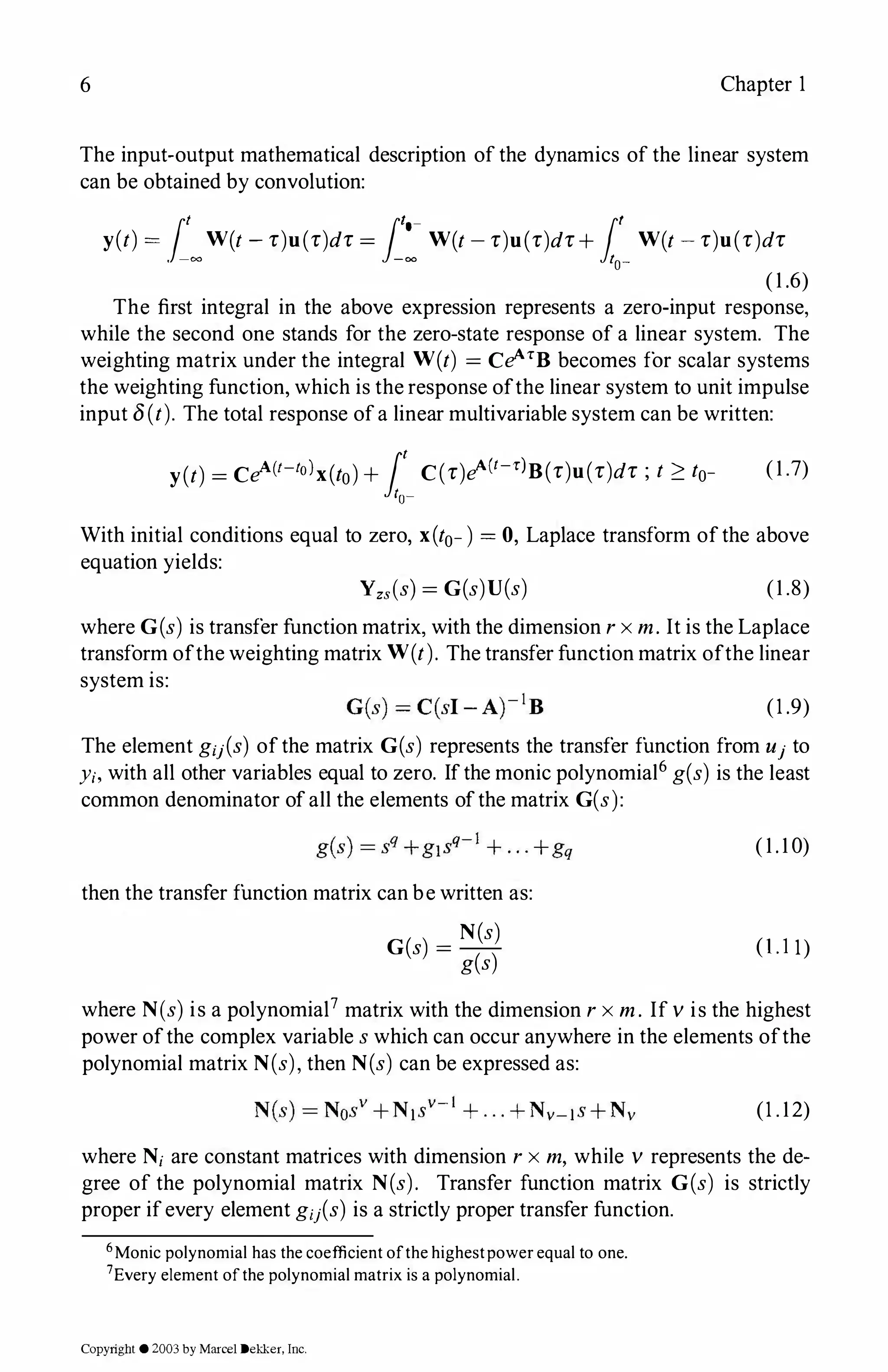
The input-output mathematical description of the dynamics of the linear system
can be obtained by convolution:
y(t) = ,[�W(t -r)u(r)dr = .[:-W(t-r)u(r)dr+ J:_W(t -r)u(r)dr
(1 .6)
The first integral in the above expression represents a zero-input response,
while the second one stands for the zero-state response of a linear system. The
weighting matrix under the integral W(t) = CeATB becomes for scalar systems
the weighting function, which is the response ofthe linear system to unit impulse
input 8(t). The total response ofa linear multivariable system can be written:
y(t) = CeA(t-tolx(to)+ 1:_C(r)eA(t-r)B(r)u(r)dr ; t � to- (1 .7)
With initial conditions equal to zero, x(to-) = 0, Laplace transform ofthe above
equation yields:
Yzs(s) = G(s)U(s) (1 .8)
where G(s) is transfer function matrix, with the dimension r x m. It is the Laplace
transform ofthe weighting matrix W(t). The transfer function matrix ofthe linear
system is:
(1 .9)
The element giJ(s) ofthe matrix G(s) represents the transfer function from u1 to
y;, with all other variables equal to zero. Ifthe monic polynomial6 g(s) is the least
common denominator of all the elements ofthe matrix G(s):
then the transfer function matrix can be written as:
G(s) =
N(s)
g(s)
( 1 . 1 0)
(1.11)
where N(s) is a polynomial7 matrix with the dimension r x m . If v is the highest
power ofthe complex variable s which can occur anywhere in the elements ofthe
polynomial matrix N(s), then N(s) can be expressed as:
(1 . 12)
where N; are constant matrices with dimension r x m, while v represents the de­
gree of the polynomial matrix N(s). Transfer function matrix G(s) is strictly
proper ifevery element g;1(s) is a strictly proper transfer function.
6Monic polynomial has the coefficient ofthe highestpowerequal to one.
7Every element ofthe polynomial matrix is a polynomial.
Copyright ©2003by Marcel Dekker, Inc.
Properties ofNonlinear Systems
EXAMPLE 1 . 1
Fora linearsystem which hasfollowingmatrices:
[ 1 0 0 l
A = 0 1 0 ;
0 0 2
thetransferfunction matrixis:
G(s) = C(sl-A)-1B= [ :i: :i{]
1 [ 3(s-2) s-2 ]
(s- l)(s-2) s-2 -8 (s- l )
where:
G(s) = s2 -�s+2 {[ � �8 ]s+ [ =� -2
8
No = [ � 1
] [ -6
-8 '
Ni = -2
-2 ]
8
7
]}
It must be observed that g(s) differs from the characteristic polynomial of the
matrix A, i.e. g(s) =J isl-Al = (s- 1)2(s-2). Beside such external description
by means of a transfer function matrix (1.9) and (1. 1 1), the linear system can be
represented by the external matrix factorized description:
(1 .13)
where N(s) is r x m coprime8 polynomial matrix, Dr(s) is m x m right coprime
polynomial matrix, IDr(s)I -j. O;Dr(s) =g(s)Im, D1(s) is rx r left coprime poly­
nomial matrix; ID1(s)I -j. O;D1(s) = g(s)Irand g(s) is monic polynomial oforder
q, given by (1.10), which is the least common denominator of all the elements of
the transfer function matrix G(s).
The expression (1.1 3) is called the right, respectively the left, polynomial fac­
torized representation, depending whether the right or the left coprime polynomial
matrix is used. Polynomial matrix N(s) is the numerator while Dr(s) or D1(s) are
called denominators. The notations follow as a natural generalization ofthe scalar
systemsforwhich G(s) is arational function ofthe complex variable s, while N(s)
and Dr(s) or D1(s) are scalar polynomials in the numerator and denominator, re­
spectively.
By applying inverse Laplace transform to the expression (1. 13), with left poly­
nomial factorized representation, a set of n-th order differential equations with
input-output signals is obtained:
D1(P)Yzs(t) =N(p)u(t) (l.14)
8Elements of a coprime polynomial matrix are coprime polynomials or polynomials without a
common factor.
Copyright ©2003by Marcel Dekker. Inc.
8 Chapter 1
where p= 1ft. The expression (1.14) is an external representation of the linear
multivariable system (1.5). For scalar systems (1.14)becomes:
(anpn+an-IPn-l +...+ao)y(t) = (bmpm+bm-IPm-I+...+bo)u(t)
[a11(t)p"+a11-1(t)pn-I +...+ao(t)]y(t) = [bm(t)pm+bm-1(t)pm-I +...+
+bo(t)]u(t)
(1.15)
where a;and b.h i= 0, 1,. . . , n; j = 0, 1,2, . . . , m, are constant coefficients, while
with time-variant linear systems a;(t)andb1(t)are time-variant coefficients. Anal­
ysis ofthe linear time-variant systems (1.15) is much more cumbersome. Namely,
applying Laplace or Fourier transform to convolution oftwo time functions leads
to the convolution integral with respect to the complex variable. In general case,
solving the equations with variable parameters is achieved in the time domain.
From the presented material, it follows that for linear systems there exist sev­
eral possibilities to describe their dynamics. Two basic approaches are:
1. External description by input-output signals of a linear system, given by
(1.7), (1.8), (1.11), (1.13)and (1.14),
2. Internal description by state variables ofthe linear system, given by (1.5).
These internal descriptions are not unique, for example they depend on the choice
of state variables. However, they may reliably describe the performance of the
linear system within a certainrange ofinput signals and initial conditions changes.
The conversion from internal to external description is a direct one, as given in
(1.9).
Ifthe differential equation for a given system cannot be written in the forms of
(1.14)or (1.15),the system is nonlinear. Solving the nonlinear equations ofhigher
order is usually very difficult and time-consuming, because a special procedure is
needed for every type ofthe nonlinear differential equation. Moreover, nonlinear
relations are often impossible to express mathematically; the nonlinearities are in
such cases presentednonanalytically. The basic difficulty in solving nonlinear dif­
ferential equations lies in the factthat in nonlinear systems a separate treatment of
stationary and transient states is meaningless, since the signal cannot be decom­
posed to separately treated components; the signal must be taken as a whole. Like
linear systems, the dynamics ofnonlinear systems can be described by external
and internal descriptions, or rather with mathematical model. The internal de­
scription (1.1)and (1.4) is the starting point to findthe external description, which
- like the linear systems - can have several forms.
As the dynamics ofthe nonlinear systems is "richer" than in the case oflinear
ones, the mathematical models must be consequently more complex. Nonlinear
expansion ofthe description with theweightingmatrix is known as the description
Copyright ©2003by Marcel Dekker, Inc.
Properties ofNonlinear Systems 9
with Wiener-Volterra series. Modified description (1.1)by means ofa series is also
Fliess series expansion ofthe functionals, which can be used for the description
of the nonlinear system. In further text neither Wiener-Volterra series nor Fliess
series expansion of functionals will be mentioned, and the interested reader can
consult the books ofNijmeijer and Van der Schaft (1990)and Isidori (1995).
DEFINITION 1.3 (FORCED AND UNFORCED SYSTEM)
A continuoussystem issaidto be.forcedifan inputsignalispresent:
i(t) = f[t,x(t),u(t)];'v't � 0,u(t) # 0 (1.16)
A continuoussystem issaidto be unforcedifthereisno input (excitation) signal:
x(t) = f[t,x(t)];'v't � 0,u(t) = 0 (1.17)
Under the excitation ofthe system, all external signals such as measurement noise,
disturbance, reference value, etc. are understood. All such signals are included in
the inputvector u(t). A clear difference between a forced and an unforced system
does not exist, since a function fu : 9+ x 9n f-o> 9n can be always defined with
fu(t,x) = f[t,x(t),u(t)] so that a forced system ensues i(t) = fu[t,x(t)];It � 0.
DEFINITION 1.4 (TIME-VARYING AND TIME-INVARIANT SYSTEM)
A system is time-invariant9 ifthejunction fdoesnotexplicitlydependon time, i.e.
thesystem can bedescribedwith:
i(t) = f[x(t),u(t)]; It � 0 (1.18)
A system is time-varying10 (fthe.function fexplicitlydepends on the time, i.e. the
system can bedescribedwith:
i(t) = f[t,x(t),u(t)]; It � 0 (1.19)
DEFINITION 1.5 (EQUILIBRIUM STATE)
An equilibriumstatecan bedefinedasastatewhich thesystem retains ifno exter­
nalsignal u(t) ispresent. Mathematically, the equilibrium state is expressedby
thevectorXe E 9n. Thesystemremainsinequilibriumstateifattheinitialmoment
thestatewastheequilibriumstate, i.e. att = t0- x(to) = Xe. Inotherwords, ifthe
system beginsfrom theequilibriumstate, itremains in thisstatex(t) = Xe, It � to
underpresumption that no externalsignalacts, i.e. u(t) = 0.
9In the literature the term autonomous is also used for time-invariant systems. The authors decided
to use the latter term for such systems. In Russian literature the term autonomous is used for unforced
nonlinear systems.
1°For such system the term nonautonomous is sometimes used.
Copyright ©2003by Marcel Dekker. Inc.
10 Chapter 1
It is common to choose the origin of the coordinate system as the equilibrium
state, i.e. Xe = 0. If this is not the case, and the equilibrium state is somewhere
else in 9n, translation of the coordinate system x' = x-Xe will bring any such
point to the origin. For an unforced continuous system, the equilibrium state will
be f(t,xe,O) = O;it:?: t0. Unforced discrete-time systems described by x(k+1) =
f[k,x(k),u(k)] will have the equilibrium state given by f(k,Xe,0) = Xe;ik:?: 0.
DEFINITION 1 .6 (SYSTEM'S TRAJECTORY-SOLUTION)
An unforcedsystem isdescribedbythevectordifferentialequation:
i(t) = f[t,x(t)];it:?: 0 (1.20)
wherex E 9n, t E 9+ andcontinuousfunction f: 9+ x 9n f-> 9n.
It is supposed that (1.20) has a unique trajectory (solution), which corresponds
to a particular initial condition x(to) = xo, where xo -1- Xe. The trajectory can be
denoted by s(t,to,xo), and the system's state will be described from the moment
to as:
x(t) = s(t,to,xo); it:?:to:?:0 (1 .21)
where the functions: 9+ x 9n f-> 9n. Ifthe trajectory is a solution, it must satisfy
its differential equation:
s(t,to,xo) = f[t,s(t,to,xo)]; it:?: O; s(to,to,xo) = xo (1.22)
Trajectory (solution) has the following properties:
(a) s(to,to,xo) = xo; ixo E 9n
(b) s[t,t1,s(t1,to,xo)] = s(t,to,xo); it:?: t1:?: to:?: O; ixo E 9n
The existence of the solution of the nonlinear differential equation (1.20) is not
guaranteed if appropriate limitations on the function f are not introduced. The
solution of the equation in the interval [O,T] means that x(t) is everywhere dif­
ferentiable, and that differential equation (1.20) is valid for every t. Ifvector x(t)
is the solution of (1.20) in the interval [O,T], and if f is a vector of continuous
functions, then x(t) statisfies the integral equation:
x(t) = x0+ f'1f[r,x(r)]dr ; t E [O,T]
.fto
(1 .23)
Equations (1.20) and (1.23) are equivalent in the sense that any solution of(1 .20)
is atthe same time the solution of(1 .23) and vice versa.
Local conditions which assure that (1.20) has an unique solution within a finite
interval [O,r]whenever r is small enough are given by the following theorem:
Copyright ©2003by Marcel Dekker. Inc.
Properties of Nonlinear Systems 1 1
THEOREM 1 . 1 (LOCAL EXISTENCE AND UNIQUENESS)
With thepresumption that ffrom (1.20) is continuous on t andx, and.finite con­
stantsh, r, kand T exist, sothat:
llf(t,x)-f(t,y) ll::; kllx-yll; Vx,y E B,Vt E [O,T]
llf(t,xo)ll ::; h; ft E [O,T]
whereB is a ballin 9n oftheform:
(1 .24)
(1.25)
(1 .26)
then (1.20) hasjustonesolution in the interval [O,r] wherethenumberr issuffi­
cientlysmall tosatisfYthe inequalities:
forsomeconstantp < 1
hrek1: ::; r
r ::; min {T,�,h;kr}
Proofofthe theorem is in Vidyasagar (1993, p. 34).
Remarks:
(1 .27)
(l.28)
1 . Condition ( 1 .24) is known as the Lipschitz condition, and k as the Lips­
chitz constant. Ifkis a Lipschitz constant for the function f,then so is any
constant greater than k.
2. A function f which statisfies the Lipschitz condition is a Lipschitz continu­
ous function. It is also absolutely continuous, and is differentiable almost
anywhere.
3. Lipschitz condition (1.24) is known as a local Lipschitz condition since it
holds only for Vx, y in a ball around xo for Vt E [O,T].
4. For given finite constants h, r,R, T, the conditions (1.27) and (1 .28) can be
always satisfied with a sufficiently small r.
THEOREM 1 .2 (GLOBAL EXISTENCE AND UNIQUENESS)
Supposethatforeach T E [0,00) thereexist.finiteconstants hr andkrsuch that
llf(t, x)-f(t,y)II::; krllx-yll; Vx,y E 9n,Vt E [O,T]
llf(t,xo)ll::; hr;ft E [O,T]
Then (1.20) hasonlyonesolutionin theinterval [O,oo].
Proofofthe theorem is in Vidyasagar (1993, p. 38).
(1 .29)
(1 .30)
It can be demonstrated that all differential equations with continuous functions
fhave an unique solution (Vidyasagar, 1993, p. 469), andthat Lipschitz continuity
does not depend upon the norm in 9n which is used (Vidyasagar, 1 993, p. 45).
Copyright © 2003by Marcel Dekker, Inc.
12
r(t) +
_...
w(t)
x(t)
B
G1(p) 1---
-
--..i F(x,px)
L------' uJt)
G,(p)
Figure 1 . 1 : Block diagram ofa nonlinear system.
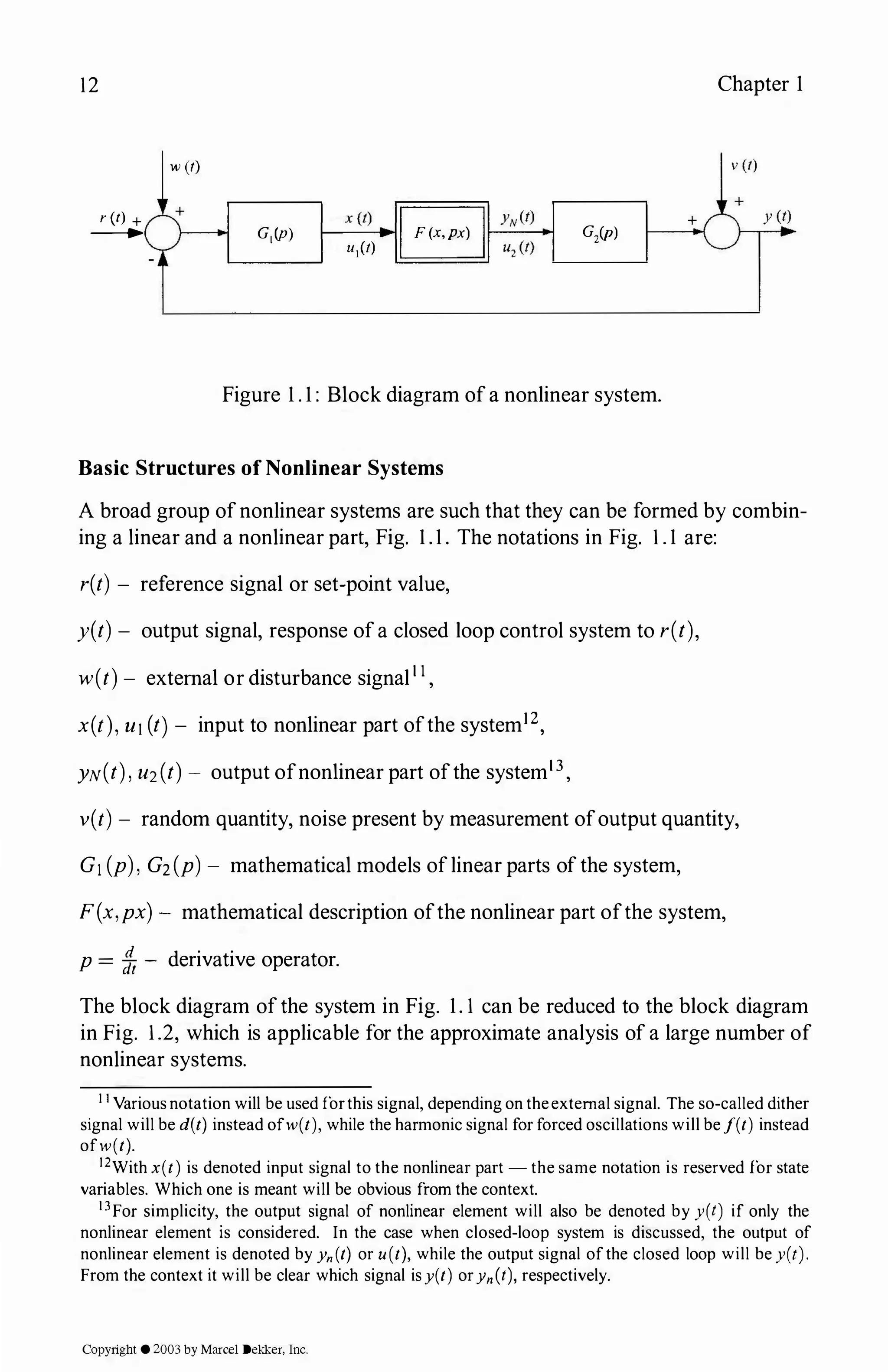
Basic Structures ofNonlinear Systems
Chapter 1
A broad group ofnonlinear systems are such that they can be formed by combin­
ing a linear and a nonlinear part, Fig. 1 . 1 . The notations in Fig. 1. 1 are:
r(t) - reference signal or set-point value,
y(t) - output signal, response ofa closed loop control system to r(t),
w(t) - external or disturbance signal1 1 ,
x(t), u1(t)- input to nonlinear part ofthe system12,
YN(t), u2(t) - output ofnonlinear part ofthe system13,
v(t) - random quantity, noise present by measurement ofoutput quantity,
G1 (p), G2(p) - mathematical models oflinear parts ofthe system,
F(x,px) - mathematical description ofthe nonlinear part ofthe system,
p = fh - derivative operator.
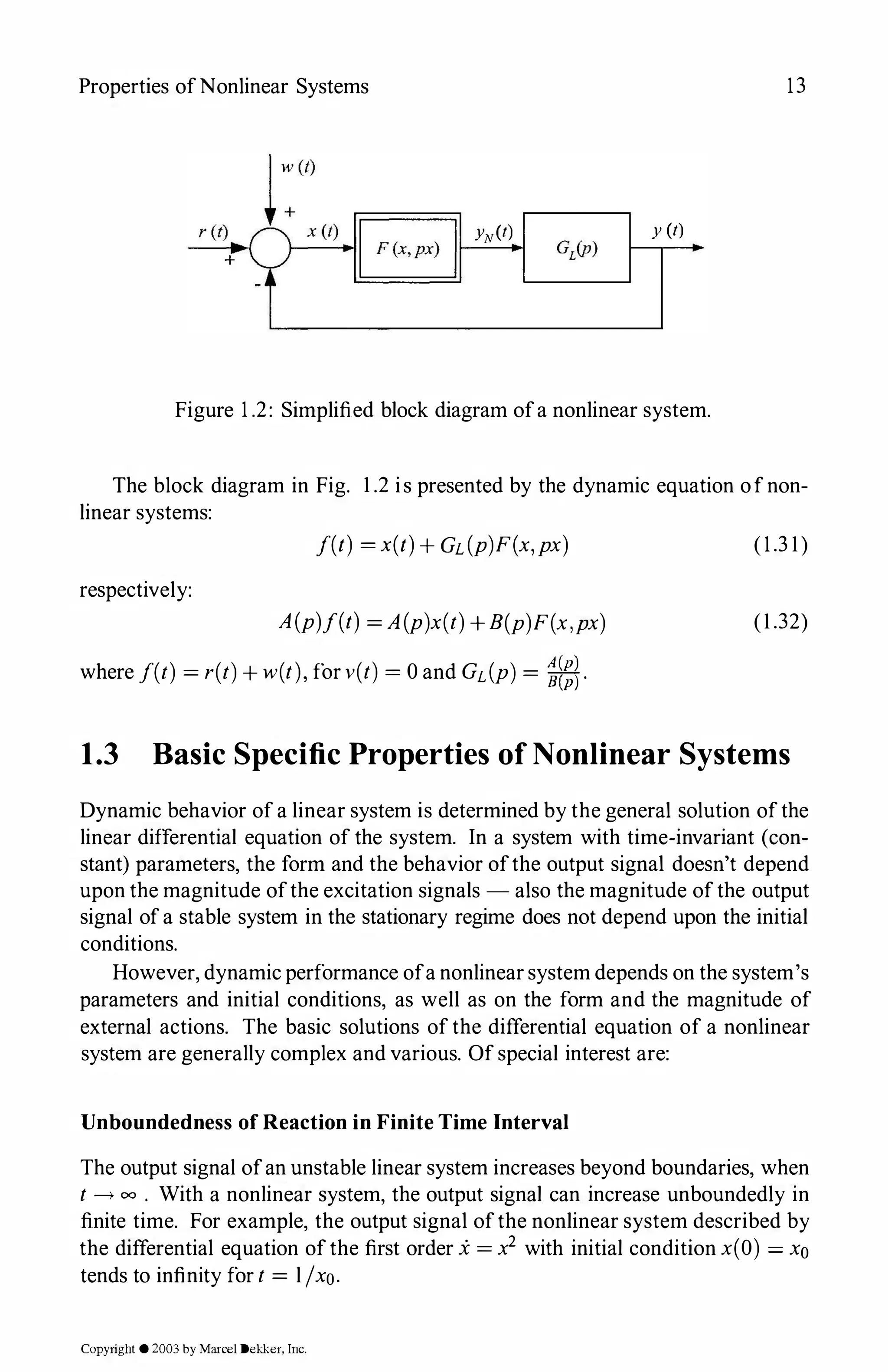
The block diagram ofthe system in Fig. 1.1 can be reduced to the block diagram
in Fig. 1.2, which is applicable for the approximate analysis of a large number of
nonlinear systems.
11 Variousnotation will be used forthis signal, depending on theexternal signal. The so-called dither
signal will be d(t) instead ofw(t), while the harmonic signal for forced oscillations will bef(t) instead
ofw(t).
12With x(t) is denoted input signal to the nonlinear part - the same notation is reserved for state
variables. Which one is meant will be obvious from the context.
13For simplicity, the output signal of nonlinear element will also be denoted by y(t) if only the
nonlinear element is considered. In the case when closed-loop system is discussed, the output of
nonlinear element is denoted by Yn(t) or u(t), while the output signal ofthe closed loop will be y(t).
From the context it will be clear which signal isy(t) orYn(t), respectively.
Copyright ©2003by Marcel Dekker, Inc.
Properties ofNonlinear Systems
� yN(t)
1---.i�
y (t)
'---------'
Figure 1.2: Simplified block diagram ofa nonlinear system.
13
The block diagram in Fig. 1.2 is presented by the dynamic equation ofnon­
linear systems:
J(t) =x(t)+GL(p)F(x,px)
respectively:
A(p)f(t) =A(p)x(t)+B(p)F(x,px)
where J(t) =r(t)+w(t),for v(t) = 0and GL(P) = �-
(1.31)
(1.32)
1.3 Basic Specific Properties of Nonlinear Systems
Dynamic behavior of a linear system is determined by the general solution ofthe
linear differential equation of the system. In a system with time-invariant (con­
stant) parameters, the form and the behavior ofthe output signal doesn't depend
upon the magnitude ofthe excitation signals - also the magnitude ofthe output
signal ofa stable system in the stationary regime does not depend upon the initial
conditions.
However, dynamic performance ofa nonlinear system depends on the system's
parameters and initial conditions, as well as on the form and the magnitude of
external actions. The basic solutions of the differential equation of a nonlinear
system are generally complex and various. Of special interest are:
Unboundedness of Reaction in Finite Time Interval
The output signal ofan unstable linear system increases beyond boundaries, when
t __,, oo . With a nonlinear system, the output signal can increase unboundedly in
finite time. For example, the output signal ofthe nonlinear system described by
the differential equation of the first order i =x2 with initial condition x(O) =x0
tends to infinity for t = l /xo.
Copyright ©2003by Marcel Dekker. Inc.
14
8
7
6
5
4
8 3
>-:
2
0
-1
0.5 1 .5 2
t[s]
2.5 3
Chapter l
3.5 4
Figure l .3 : State trajectories ofa nonlinear system in Example l .2.
Equilibrium State ofNonlinear System
Linear stable systems have one equilibrium state. As an example, the response of
a linear stable system to the unit pulse input is damped towards zero.
Nonlinear stable systems may possess several equilibrium states, i.e. a pos­
sible equilibrium state is determined by a system's parameters, initial conditions
and the magnitudes and forms ofexternal excitations.
EXAMPLE 1.2
(DEPEN DENCY OF EQUILIBRIUM STATE ON INITIAL CONDITIONS)
Thefirst-order nonlinear system described byi(t) = -x(t) +x2(t) with initial
conditionsx(O) = xo, has thesolution (trajectory)given by:
-/
( ) xoe
x t = ----­
l -xo+xoe-1
Depending on initial conditions, the trajectory can end in one oftwo possible
equilibriumstatesXe = 0 andXe = I , as illustratedinFig. 1.3.
For all initial conditions x(O) > l, the trajectories will diverge, whilefor
x(O) < l they will approach the equilibrium stateXe = 0. Forx(O) = l the tra­
jectory willremain constantx(t) = l ,'Vt, andthe equilibrium state willbeXe = I .
Therefore, thisnonlinearsystem hasonestableequilibriumstate (xe = 0) andone
unstable equilibrium state, while the equilibrium stateXe = l can be declaredas
neutrallystable14. The linearization ofthis nonlinearsystemfor x < l (by dis-
14Exact definitions of the stability of the equilibrium state will be discussed in Chapter 2.
Copyright © 2003 by Marcel Dekker, Inc.
Properties ofNonlinear Systems 15
cardingthenonlinearterm)yieldsx(t) = -x(t) with thesolution (statetrajectory)
x(t) = x(O)e-1. ThisshowsthattheuniqueequilibriumstateXe = 0isstable.forall
initial conditions, since all the trajectories - notwithstanding initial conditions
-willendattheorigin.
EXAMPLE 1 .3 (DEPENDENCE OF EQUILIBRIUM STATE ON THE INPUT)
A simplifiedmathematicalmodelofan unmannedunderwatervehicle inforward
motion is:
mi(t)+dlx(t)jx(t) = r(t)
where v(t) = x(t)isthevelocityoftheunderwatervehicleandr(t)isthethrustof
thepropulsor. Thenonlinearterm lv(t)Iv(t) isdueto thehydrodynamiceffect, the
so-calledaddedinertia. Withm = 200[kg] andd= 50[kg/m], andwithapulsefor
thethrust(Fig. 1.4a), thevelocityoftheunderwatervehiclewillbeasinFig. I.4b.
The diagram reveals thefact that the velocity change isfaster with the increase
ofthrustthan in reversecase-this can beexplainedbythe inertialproperties of
theunderwatervehicle. Iftheexperimentisrepeatedwith ten timesgreaterthrust
(Fig. 1.5a), the change ofvelocitywillbe as in Fig. 1.5b. The velocity has not
increased ten times, as would be the case with a linear system. Such behavior
ofan unmannedunderwatervehiclemust be taken into account when the control
system isdesigned. Ifthe underwatervehicle is in the mission ofapproachingan
underwaterfixedmine, thethrustoftheunderwatervehiclemustbeappropriately
regulated, inorderthatthemission besuccessful.
Self-Oscillations - Limit Cycles
The possibility ofundamped oscillations in a linear time-invariant system is linked
with the existence ofa pair ofpoles on the imaginary axis ofthe complex plane.
The amplitude ofoscillations is in this case given by initial conditions.
In nonlinear systems it is possible to have oscillations with amplitude and
frequency which are not dependent upon the value of initial conditions, but their
occurrence depends upon these initial conditions. Such oscillations are called se(f
oscillations (limitcycles)15 and they belong to one ofseveral stability concepts of
the dynamic behavior of nonlinear systems.
Subharmonic, Harmonic or Periodic and Oscillatory Processes with Har­
monic Inputs
In a stable linear system, a sinusoidal input causes a sinusoidal output ofthe same
frequency. A nonlinear system under a sinusoidal input can produce an unex­
pected response. Depending on the type ofnonlinearity, the output can be a signal
with a frequency which is:
15The term limit cycles will be used for the type of a singular point, when the state (or phase)
trajectory enters this shape in case ofself-oscillatory behavior ofa system.
Copyright © 2003 by Marcel Dekker, Inc.
16 Chapter 1
0.2
1.8 0. 18
l.6 0.16
1.4 0.14
1.2
0.1
0.8
0.6 0.06
0.4 0.04
0.2 0.02
0 0
0 100 200 300 400 500 600 0 100 200 300 400 500 600
t[s] t[s]
(a) (b)
Figure 1.4: Thrust (a) and velocity (b) ofan underwater vehicle.
12 0.5
0.45
10
0.4
0.35
0.3
0.25
0.2
0.15
0.1
0.05
0 0
0 100 200 300 400 500 600
0 100 200 300 400 500 600
l[s] t[s]
(a) (b)
Figure 1.5: Thrust (a) and velocity (b) ofan underwater vehicle.
Copyright © 2003 by Marcel Dekker, Inc.
Properties ofNonlinear Systems 17
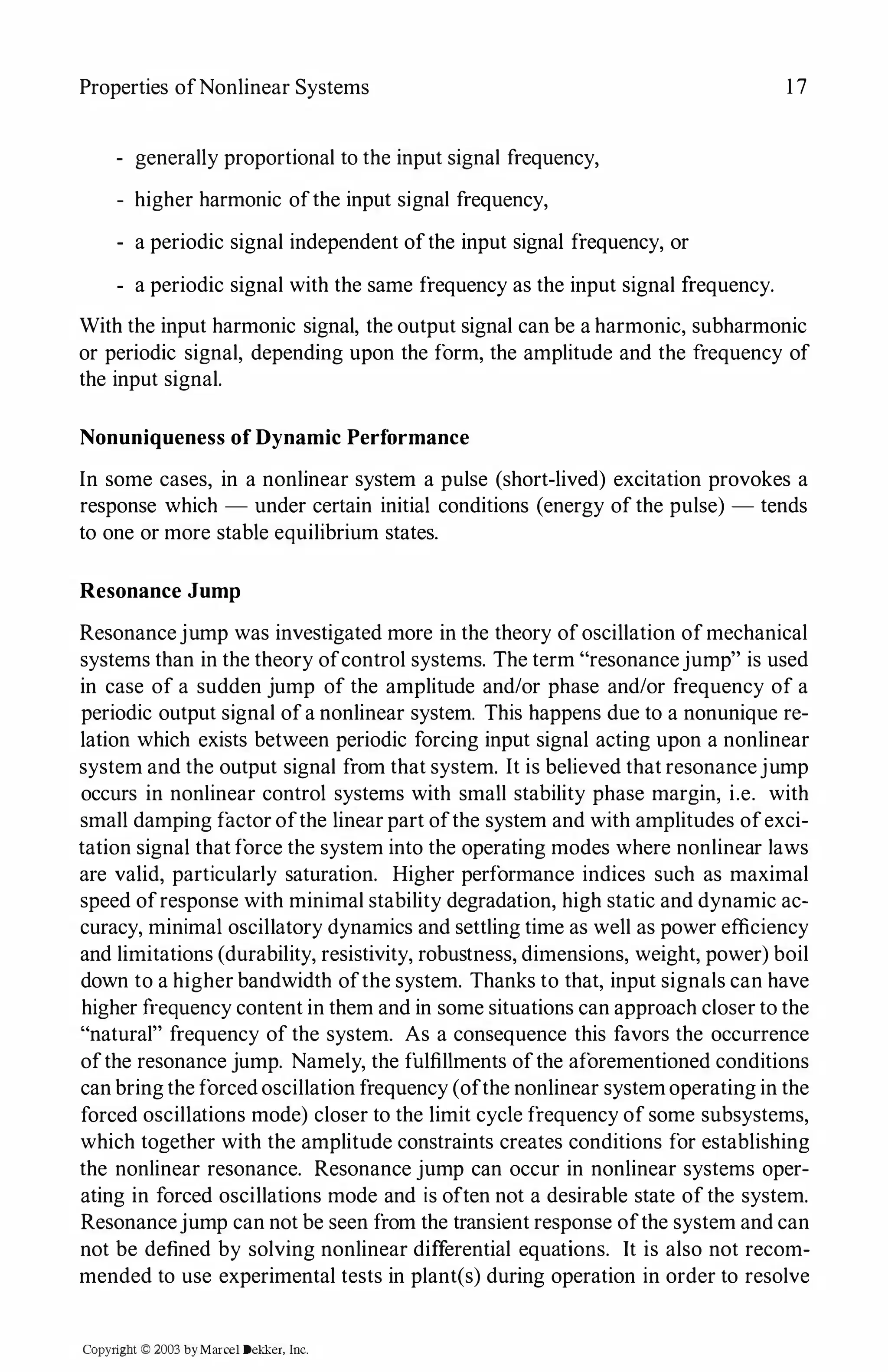
- generally proportional to the input signal frequency,
- higher harmonic ofthe input signal frequency,
- a periodic signal independent ofthe input signal frequency, or
- a periodic signal with the same frequency as the input signal frequency.
With the input harmonic signal, the output signal can be a harmonic, subharmonic
or periodic signal, depending upon the form, the amplitude and the frequency of
the input signal.
Nonuniqueness ofDynamic Performance
In some cases, in a nonlinear system a pulse (short-lived) excitation provokes a
response which - under certain initial conditions (energy of the pulse) - tends
to one or more stable equilibrium states.
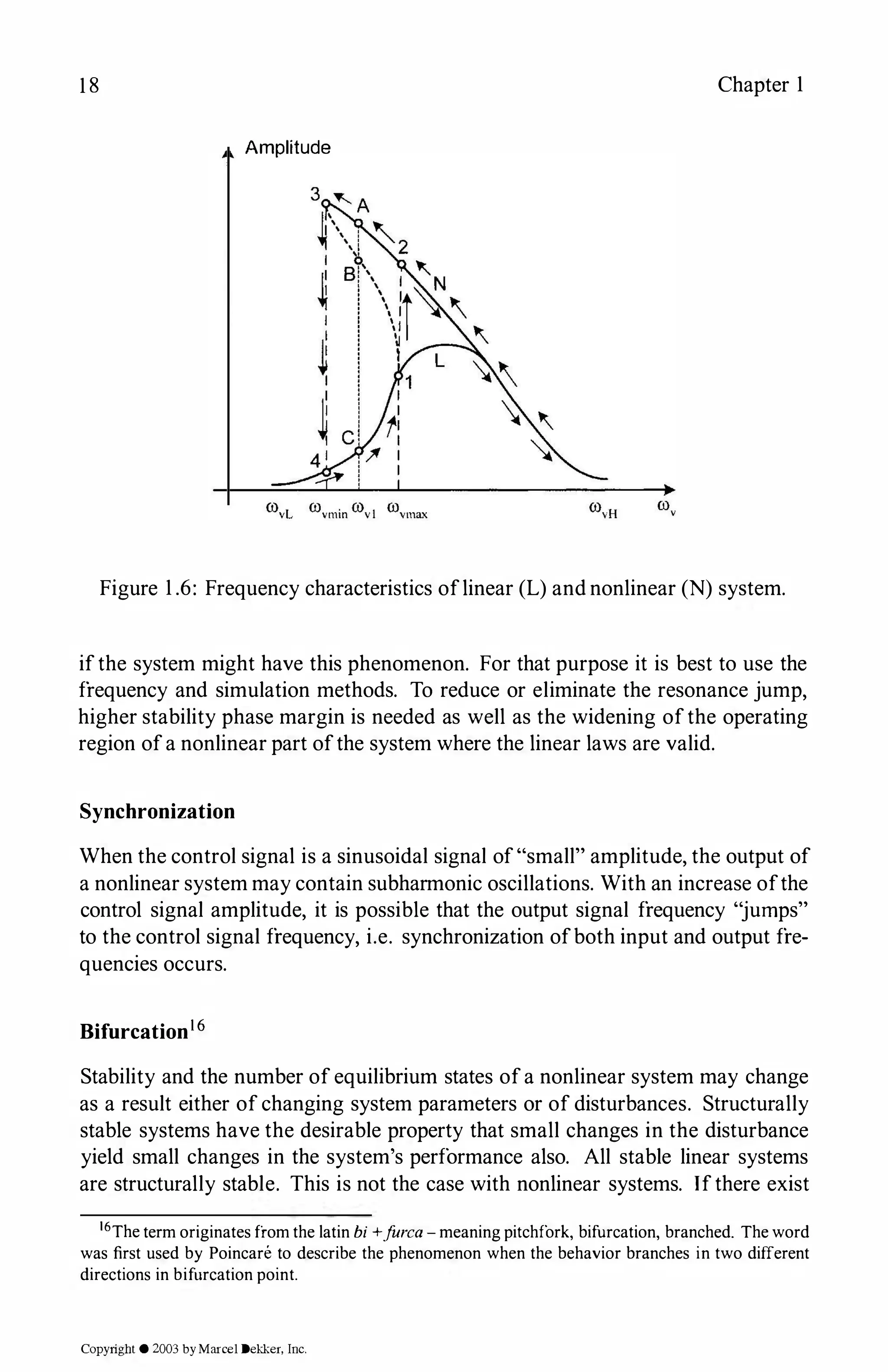
Resonance Jump
Resonancejump was investigated more in the theory ofoscillation ofmechanical
systems than in the theory ofcontrol systems. The term "resonancejump" is used
in case of a sudden jump of the amplitude and/or phase and/or frequency of a
periodic output signal ofa nonlinear system. This happens due to a nonunique re­
lation which exists between periodic forcing input signal acting upon a nonlinear
system and the output signal from that system. It is believed that resonancejump
occurs in nonlinear control systems with small stability phase margin, i.e. with
small damping factor ofthe linear part ofthe system and with amplitudes ofexci­
tation signal that force the system into the operating modes where nonlinear laws
are valid, particularly saturation. Higher performance indices such as maximal
speed ofresponse with minimal stability degradation, high static and dynamic ac­
curacy, minimal oscillatory dynamics and settling time as well as power efficiency
and limitations (durability, resistivity, robustness, dimensions, weight, power) boil
down to a higher bandwidth ofthe system. Thanks to that, input signals can have
higher frequency content in them and in some situations can approach closer to the
"natural" frequency of the system. As a consequence this favors the occurrence
ofthe resonance jump. Namely, the fulfillments ofthe aforementioned conditions
can bring the forced oscillation frequency (ofthe nonlinear systemoperating in the
forced oscillations mode) closer to the limit cycle frequency of some subsystems,
which together with the amplitude constraints creates conditions for establishing
the nonlinear resonance. Resonance jump can occur in nonlinear systems oper­
ating in forced oscillations mode and is often not a desirable state of the system.
Resonancejump can not be seen from the transient response ofthe system and can
not be defined by solving nonlinear differential equations. It is also not recom­
mended to use experimental tests in plant(s) during operation in order to resolve
Copyright © 2003 byMarcel Dekker, Inc.
18 Chapter 1
Amplitude
Figure 1.6: Frequency characteristics oflinear (L) and nonlinear (N) system.
ifthe system might have this phenomenon. For that purpose it is best to use the
frequency and simulation methods. To reduce or eliminate the resonance jump,
higher stability phase margin is needed as well as the widening ofthe operating
region ofa nonlinear part ofthe system where the linear laws are valid.
Synchronization
When the control signal is a sinusoidal signal of"small" amplitude, the output of
a nonlinear system may contain subharmonic oscillations. With an increase ofthe
control signal amplitude, it is possible that the output signal frequency "jumps"
to the control signal frequency, i.e. synchronization ofboth input and output fre­
quencies occurs.
Bifurcation16
Stability and the number of equilibrium states ofa nonlinear system may change
as a result either of changing system parameters or of disturbances. Structurally
stable systems have the desirable property that small changes in the disturbance
yield small changes in the system's performance also. All stable linear systems
are structurally stable. This is not the case with nonlinear systems. Ifthere exist
16The term originates from the latin bi +f
urca - meaning pitchfork, bifurcation, branched. The word
was first used by Poincare to describe the phenomenon when the behavior branches in two different
directions in bifurcation point.
Copyright © 2003 byMarcel Dekker, Inc.
Properties ofNonlinear Systems 1 9
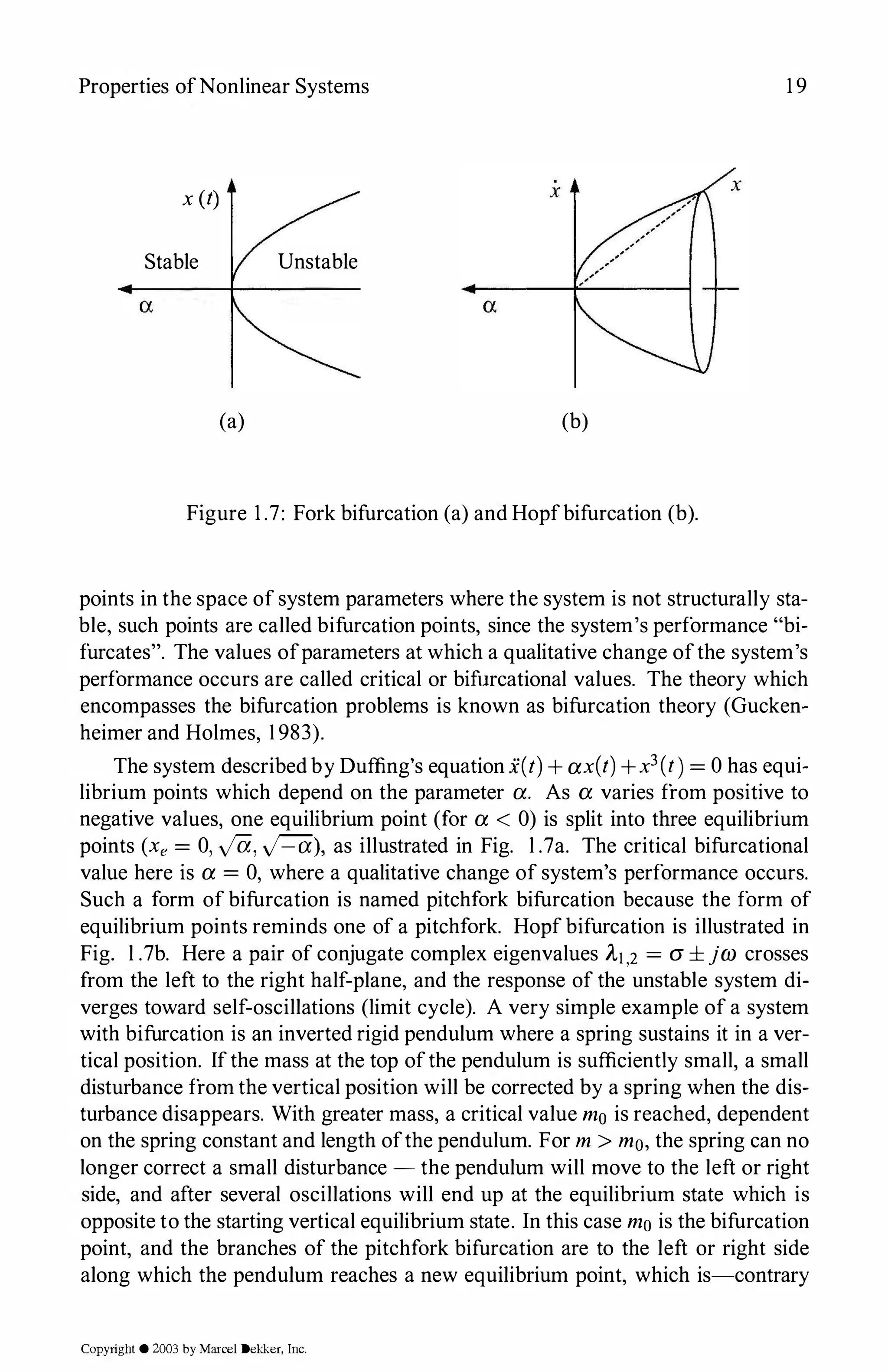
x(t) x
Stable Unstable
(a) (b)
Figure 1 .7: Fork bifurcation (a) and Hopfbifurcation (b).
points in the space of system parameters where the system is not structurally sta­
ble, such points are called bifurcation points, since the system's performance "bi­
furcates". The values ofparameters at which a qualitative change ofthe system's
performance occurs are called critical or bifurcational values. The theory which
encompasses the bifurcation problems is known as bifurcation theory (Gucken­
heimer and Holmes, 1 983).
The system described by Duffing's equation .X(t)+ax(t)+x3(t)=0 has equi­
librium points which depend on the parameter a. As a varies from positive to
negative values, one equilibrium point (for a < 0) is split into three equilibrium
points (xe= 0, ya, y'=(i), as illustrated in Fig. l .7a. The critical bifurcational
value here is a=0, where a qualitative change of system's performance occurs.
Such a form of bifurcation is named pitchfork bifurcation because the form of
equilibrium points reminds one of a pitchfork. Hopf bifurcation is illustrated in
Fig. l .7b. Here a pair of conjugate complex eigenvalues A-1,2 = CJ ± jw crosses
from the left to the right half-plane, and the response of the unstable system di­
verges toward self-oscillations (limit cycle). A very simple example of a system
with bifurcation is an inverted rigid pendulum where a spring sustains it in a ver­
tical position. Ifthe mass at the top ofthe pendulum is sufficiently small, a small
disturbance from the vertical position will be corrected by a spring when the dis­
turbance disappears. With greater mass, a critical value m0 is reached, dependent
on the spring constant and length ofthe pendulum. For m > m0, the spring can no
longer correct a small disturbance - the pendulum will move to the left or right
side, and after several oscillations will end up at the equilibrium state which is
opposite to the starting vertical equilibrium state. In this case mo is the bifurcation
point, and the branches of the pitchfork bifurcation are to the left or right side
along which the pendulum reaches a new equilibrium point, which is-contrary
Copyright © 2003 by Marcel Dekker. Inc.
20 Chapter I
to Fig. l .7a - stable for both branches.
If the bifurcation points exist in a nonlinear control system, it is important to
know the regions of structural stability in the parameter plane and in the phase
plane and it is necessary to ensure thatthe parameters and the states ofthe system
remain within these regions. Structural instability can be expected with control
systems whose objects (processes) are nonlinear, with certain types of adaptive
control systems, and generally with the systems whose action and reaction forces
cannot reach the equilibrium state. If a bifurcation appears, the system can come
to a chaotic state - this is of mostly theoretical interest since for safety reasons
every control system has built-in activities which prevent any such situation. The
consequence ofbifurcation can be the transfer to a state with unbounded behavior.
Forthe majority oftechnical systems this can lead to serious damages ifthe system
has no built in protection.
Chaos
With stable linear systems, small variations ofinitial conditions can result in small
variations in response. Not so with nonlinear systems-small variations ofinitial
conditions can cause large variations in response. This phenomenon is named
chaos. It is a characteristic ofchaos thatthe behavior ofthe system is unexpected,
an entirely deterministic system which has no uncertainty in the modes ofthe sys­
tem, excitation or initial conditions yields an unexpected response. Researchers
of this phenomenon have shown that some order exists in chaos, or that under
chaotic behavior there are some nice geometric forms which create randomness.
The same is true for a card player when he deals the cards or when a mixer mixes
pastry for cakes. On one side the discovery ofchaos enables one to place bound­
aries on the anticipation, and on the other side the determinism which is inherent
to the chaos implies that many random phenomena can be better foreseen as be­
lieved. The research into chaos enables one to see an order in different systems
which were up to now considered unpredictable. For example the dynamics of
the atmosphere behaves as a chaotic system which prevents a long-range weather
forecast. Similar behaviors include the turbulence flow in fluid dynamics, or the
rolling and capsizing ofa ship in stormyweather. Some mechanical systems (stop­
type elements, systems with aeroelastic dynamics, etc.) as well as some electrical
systems possess a chaotic behavior.
EXAMPLE 1.4
(CHAOTIC SYSTEM-CHUA ELECTRIC CIRCUIT (MATSUMOTO, 1 987))
A verysimple deterministicsystem withjustafew elements can generate chaotic
behavior, as theexampleofChua electriccircuitshows.
The schematic ofthe Chua circuit is given in Fig. 1.Ba, while the nonlinear
current vs. voltage characteristic ofa nonlinear resistor is given in Fig. 1.8b.
With nominal values ofthe components: Ci = 0.0053[µF], C2 = 0.047[µF], L =
Copyright ©2003by Marcel Dekker, Inc.
Properties ofNonlinear Systems 2 1
G iR
----"---+-
+
iLi + +
c2
VC2 L c1
VCJ
VR
(a)
(b) (c)
Figure 1 .8: Electrical scheme of Chua circuit (a), nonlinear characteristic ofthe
resistor (b), modified resistor characteristic (c).
6.8[mH] andR = 1 .2 1 [H2], the dynamics ofthe electric circuitcan be described
bythefollowingmathematicalmodel:
Simulation with normalizedparameters l/C1 = 9; l/C2 = 1; l /L = 7; G = 0.7;
mo = -0.5; m1 = -0.8; Bp = 1, andwith initialconditionsh(O) = 0.3, VcJ (0) =
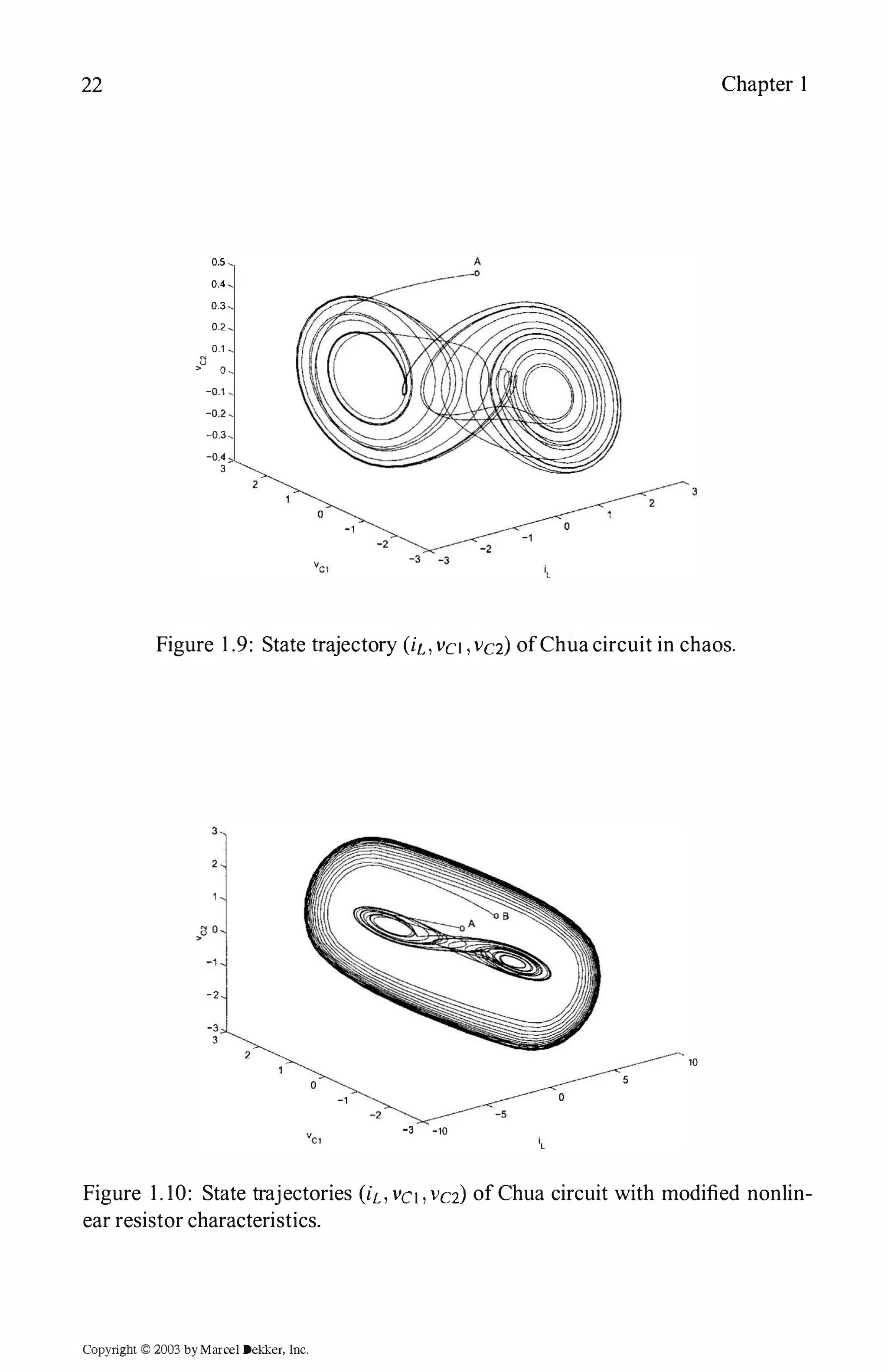
-0. 1 andVc2 (0) =0.5givesthestatetrajectoryofthisnonlinearsysteminFig. 1.9
(initialstate is denotedwithpointA). The equilibrium state with such attraction
ofall trajectories has the appropriate name - attractor. In the Chua electric
circuittheattractoris ofthetypedoublescrollattractor (Fig. I. 9). Such a circuit
Copyright © 2003 by Marcel Dekker, Inc.
22
0.5
0.4
0.3
0.2
0.1
,
u 0
-0.1
-0.2
-0.3
-0.4
3
Chapter 1
-1
Figure 1 .9: State trajectory (h, vc1 , vC2) ofChua circuit in chaos.
-1
-2
-3
3
-1
-3 -10
10
Figure 1. 10: State trajectories (iL, vc1 , VC2) of Chua circuit with modified nonlin­
ear resistor characteristics.
Copyright © 2003 byMarcel Dekker, Inc.
Properties ofNonlinear Systems 23
withgiven initialconditionsbehaves as a chaotic system. Depending on initial
conditions, achaos isformed, anditisinherenttosuchsystemsthatthetrajectory
neverfollows the samepath (Chua, KamoroandMatsumoto, 1986).
By introducing a small modification into the characteristic ofthe nonlinear
resistor, i.e. adding thepositiveresistancesegments asshown in Fig. l.8c, other
interestingaspects ofnonlinearsystems can beobserved. JnFig. 1.10the trajec­
tory ofsuch system is shownfor the same initial conditions as inprevious case
(pointA) wherethe behaviorofthesystem ischaotic. Ifwechangetheinitialcon­
ditionstoiL(O) = 3, vc1 (0) = -0.1 andvc2(0) = 0.6 (pointB) thesystemsettlesto
thestable limit cycle outside the chaotic attractor region. Here one can observe
qualitativelycompletelydifferentbehaviorsofthenonlinear:,ystem which depend
onlyon initialconditions.
1.4 Stability and Equilibrium States
Very often the dynamic behavior of a system is characterized by the phrase "the
system is stable". Under the concept of system stability, in practice it is under­
stood that by small variations ofinput signals, initial conditions or parameters of
the system, the state of the system does not have large deviations, i.e. these are
minimal requirements which the system must satisfy. Whereas the linear systems
have only one17 possible stable equilibrium state, nonlinear systems can generally
have several stable equilibrium states and dynamic performances.
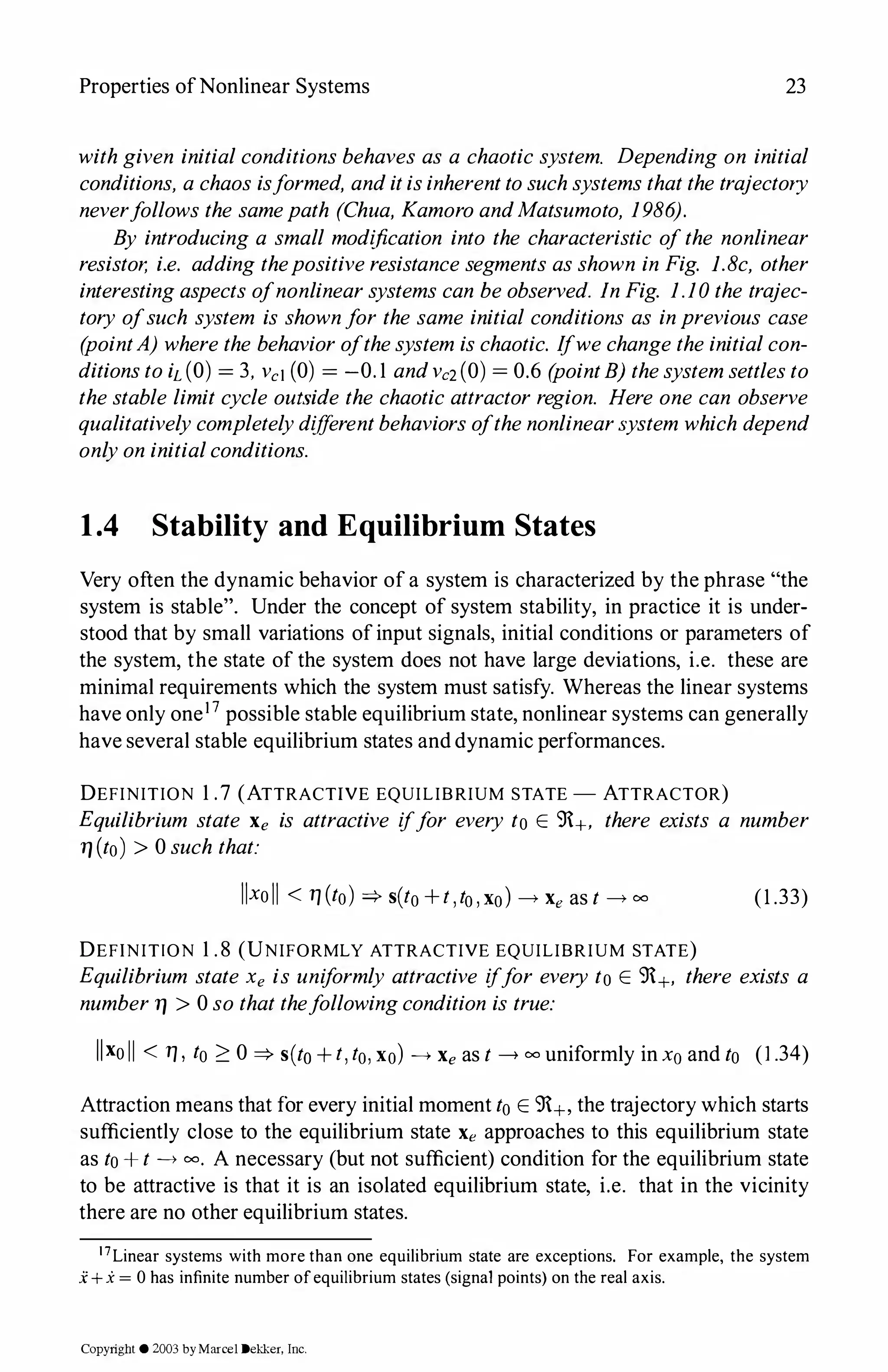
DEFINITION 1.7 (ATTRACTIVE EQUILIBRIUM STATE - ATTRACTOR)
Equilibrium state Xe is attractive iffor every to E 9+, there exists a number
11 (to) > 0such that:
llxoll < 17 (to) =? s(to+t,to,xo)---->Xe as t ---->00 (1 .33)
DEFINITION 1 .8 (UNIFORMLY ATTRACTIVE EQUILIBRIUM STATE)
Equilibrium state Xe is uniformly attractive iffor every to E 9+, there exists a
number11 > 0so thatthefollowingcondition is true:
llxoII < 17 , to 2 0 =? s(to + t,to,xo) ----> Xe as t ----> 00 uniformly in xo and to (1.34)
Attraction means that for every initial moment toE 9+, the trajectory which starts
sufficiently close to the equilibrium state Xe approaches to this equilibrium state
as to+t ----> 00• A necessary (but not sufficient) condition for the equilibrium state
to be attractive is that it is an isolated equilibrium state, i.e. that in the vicinity
there are no other equilibrium states.
17Linear systems with more than one equilibrium state are exceptions. For example, the system
.i: + x = 0 has infinite number ofequilibrium states (signal points) on the real axis.
Copyright © 2003 byMarcel Dekker, Inc.
24 Chapter 1
DEFINITION 1 .9 (REGION OF ATTRACTION)
Ifan unforcednonlineartime-invariantsystem describedby i(t) = f[x(t)] hasan
equilibrium stateXe = 0 whichisattractive, thentheregion ofattraction D(xe) is
definedby:
D(O) = {xo E 9n: s(t,0, xo) -+ 0 when t -+ 00} (1.35)
Every attractive equilibrium state has its own region ofattraction. Such a region
in state space means that trajectories which start from any initial condition inside
the region ofattraction are attracted by the attractive equilibrium state.
The attractive equilibrium states are called attractors. The equilibrium states
with repellent properties have the name repellers, while the equilibrium states
which attract on one side and repel on the other side are saddles.
EXAMPLE 1 .5
(ATTRACTORS AND REPELLERS (HARTLEY, BEALE AND CHICATELLI, 1 994))
A nonlinearsystem offirstorderis describedbyx(t) = f(x, u) = x-x3 + u. With
the inputsignalu(t) = 0, the equilibriumstates ofthesystem willbe at thepoints
wherex(t) = 0 andf(x) = x-x3 = 0, respectively (Fig. 1.11).
EquilibriumstatesareXet = 0, Xe2 = +1 andXe
3 = - 1. Localstabilityofthese
states can be determinedgraphicallyfrom the gradient (slope ofthe tangent) at
thesepoints. Soateveryequilibriumpoint:
1 .5
J = [a.x] = 1 - 3x;
dx Xe
'
'
------- 1--------t·-------- ---------1---------1---------
-- -----r--------1---------- ---------r---------1---------
0.5 ----- ---t-------·t··----------------t---------1---------
0 1-----0�---+------------'l�---1
' ' '
' ' '
' ' '
' ' '
-0.5 --------r-------r------- --------r-------r- -----
1
-
; ::::::::r::::::r::::::::::::::+:::::+::::_:-
-2 �-�--�--�--�-�--�
-1.5 - I -0.5 0 0.5 1 .5
x
Figure 1 . 1 1 : State trajectory ofthe system x= x -x3.
Copyright ©2003by Marcel Dekker, Inc.
Properties ofNonlinear Systems 25
andfurther:
[di] [di]
forXet : dx _
= + l ; forXe2 : dx _ = -2; forXe3 :
Xe1 -0 Xe2- l
[di] = -2
dx xe3 =- l
Therefore Xet is an unstable equilibrium state orrepeller, while Xe2 andXe3 are
stable equilibrium states or attractors. Every attractor has his own region of
attraction. FortheequilibriumstateXe2 = +1, theregion ofattraction istheright
half-plane wherex > 0, whileforXe3 = - 1 it is the left halfplane wherex < 0.
Itmust be remarked that the tangents at equilibrium states are equivalent to the
polesofthe linearizedmathematicalmodelofthesystem.
1.5 Basic Properties of Nonlinear Functions
Nonlinearities which are present in automatic control systembelongtotwogroups:
1 . Inevitably present - inherent nonlinearities ofthe controlled process,
2. Intended - nonlinearities which are built in the system with the purpose to
realize the desired control algorithm or to improve dynamic performance of
the system.
In every nonlinear control system one or more nonlinearparts can be separated­
these are the nonlinear elements. In analogy to the theory of linear systems, the
theory of nonlinear systems presents the system elements with unidirectional ac­
tion (Fig. 1 . 1 2) (Netushil, 1983).
Nonlinear elements with the output as a function of one variable (Fig. l . 12a)
comprise typical nonlinear elements described by a nonlinear function which de­
pends on the input quantity x(t) and on its derivative i= qg:
x (t) r=-:::1
----�
(a)
YN =F(x,i)
xi(t)
�
- I F(xi'pxi' x2, px2, ... , xm, px,,) I
�
(b)
(1.36)
yN (t2
.
Figure 1 . 12: Nonlinear element presented in block diagrams ofnonlinear systems.
Copyright ©2003byMarcel Dekker, Inc.
26 Chapter 1
Besides nonlinearities with one input, there are nonlinearities with more input
variables (Fig. l .12b), described by the equation:
(1 .37)
When the nonlinear characteristic depends on time, the nonlinear element is called
time-varying, andthe equations (1.36) and (1.37) take the form:
YN = F(t,x,i) (1.38)
(1.39)
Inherent nonlinearities include typical nonlinear elements: saturation, dead zone,
hysteresis, Coulomb friction and backlash. Intended nonlinearities are nonlin­
ear elements of various characteristics of relay type, AID and D/A converters,
modulators, as well as dynamic components designed to realize nonlinear control
algorithms.
Nonlinearities can be classified according to their properties: smoothness,
symmetry, uniqueness, nonuniqueness, continuity, discontinuity, etc. It is de­
sirable to have a classification of nonlinearities, since the systems with similar
properties can be treated as a group or class.
DEFINITION I . I0 (UNIQUENESS)
Nonlinear characteristicYN(x) is unique orsingle-valued ifto any value ofthe
inputsignalxtherecorrespondsonlyonespecificvalue ofthe output quantityYN·
DEFINITION 1 . 1 1 (NON-UNIQUENESS)
Nonlinear characteristicYN(x) is non-unique or multi-valued when some value
ofthe input signalxprovokesseveralvalues ofthe outputsignalYN· depending
on theprevious state ofthe system. The number ofpossible quantities YN can
befrom 2 to 00• Multi-valuednonlinearities include allnonlinearities ofthe type
hysteresis.
DEFINITION 1 . 1 2 (SMOOTHNESS)
NonlinearcharacteristicYN(x) issmooth ifateverypointthereexistsaderivative
dy��x), Fig. 1.14 (Netushil, 1983).
DEFINITION 1 . 1 3 (SYMMETRY)
Fromtheviewpointofsymmetry, twogroupsaredistinguished:
1. IfthefunctionYN(x) satisfies thecondition:
(1.40)
Copyright © 2003 byMarcel Dekker. Inc.
Properties ofNonlinear Systems 27
=x
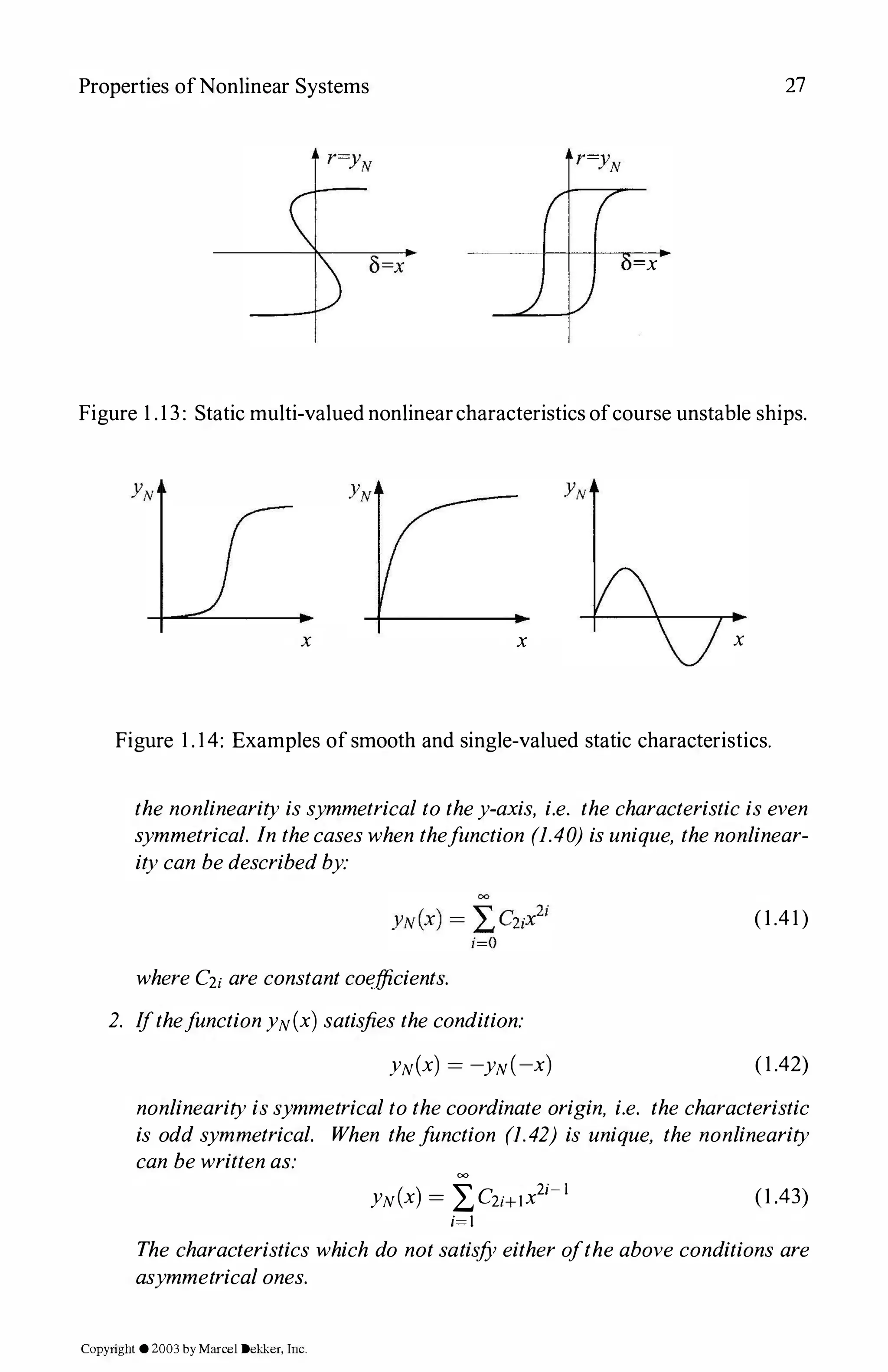
Figure 1 .13: Static multi-valued nonlinearcharacteristics ofcourse unstable ships.
x x x
Figure 1 . 14: Examples ofsmooth and single-valued static characteristics.
the nonlinearity issymmetrical to they-axis, i.e. the characteristic iseven
symmetrical. In thecaseswhen thefunction (1.40) isunique, thenonlinear­
itycan bedescribedby:
(1.41)
whereC2;are constantcoefficients.
2. IfthefunctionYN(x) satisfies thecondition:
YN(x) = -yN(-x) (1.42)
nonlinearityissymmetricaltothecoordinate origin, i.e. the characteristic
is odd symmetrical. When thefunction (1.42) is unique, the nonlinearity
can bewrittenas: =
YN(x) = :2,C2;+1x2i-l
i=I (1 .43)
The characteristics which do notsatisfY either oftheabove conditions are
asymmetricalones.
Copyright ©2003by Marcel Dekker, Inc.
28 Chapter 1
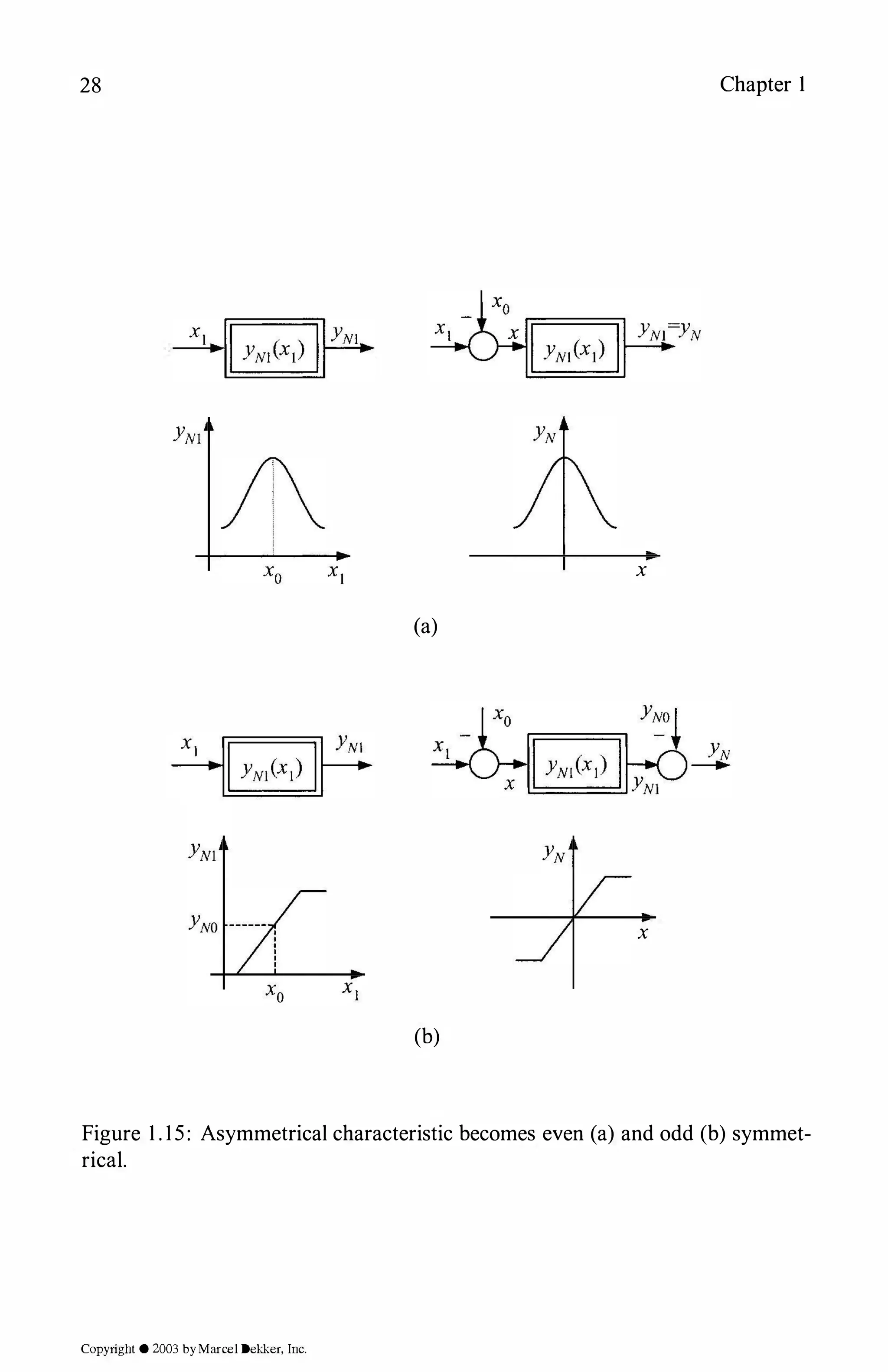
____-:i___�
�
x
(a)
x
(b)
Figure 1 . 15: Asymmetrical characteristic becomes even (a) and odd (b) symmet­
rical.
Copyright © 2003 byMarcel Dekker, Inc.
Properties ofNonlinear Systems 29
In themajority ofcases, by shift ofthe coordinate origin,the asymmetrical charac­
teristics can be reduced to symmetrical characteristics. The shift ofthe coordinate
origin means the introduction of additional signals at all inputs and the output of
the nonlinear element, Fig. l . 1 5a and 1 . 1 5b.
In Fig. l . 15a, assymetrical characteristicYNi (x1 ) with the coordinate transfor­
mation x1 = xo + x becomes even symmetrical, i.e. symmetrical with respect to
y-axis. Similarly, asymmetrical characteristic from Fig. 1 .1 5b by additional sig­
nals x1 = xo + x and YN1 = YNo +YN becomes odd symmetrical, i.e. symmetrical
with respect to the coordinate origin.
1.6 Typical Nonlinear Elements
Typical nonlinear elements are most often seen in automatic control systems
where static characteristics can be normalized and approximated by straight line
segments. If classified, such elements can be symmetric, asymmetric, unique,
nonunique and discontinuous functions.
1.6.1 Nonlinear Elements with Single-Valued Continuous
Characteristics
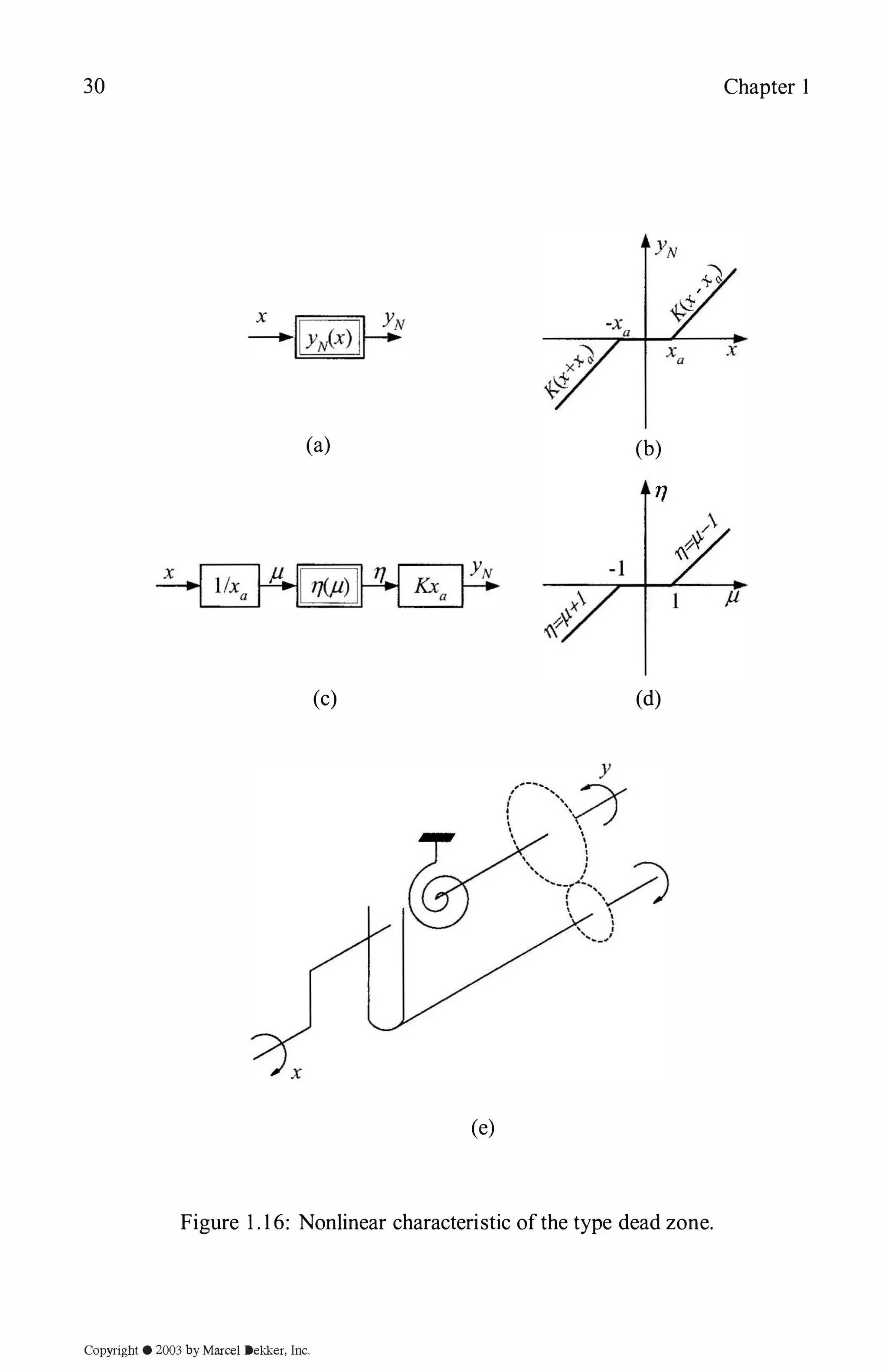
Dead zone. Presented with static characteristic as in Fig. 1 .1 6, a dead zone is
present in all types ofamplifierswhenthe input signals are small. The mechanical
model of the dead zone (Fig. 1 .16e) is given by a fork joint of the drive and
driven shaft. Vertical (neutral) position of the driven shaft is maintained by a
spring. When the drive shaft (input quantity) is rotated by an angle x, the driven
shaft remains at a standstill until the deflection x is equal to Xa. With x > Xa, the
driven shaft (output quantity) rotates simultaneously with the drive shaft. When
the drive shaft rotates in the opposite direction, because of the spring action, the
driven shaft will follow the drive shaft until the moment when neutral position is
reached. During the time the output shaft doesn't rotate, it goes through the dead
zone of 2xa. Static characteristic of the dead zone element (Fig. l . 1 6a) is given
by the equations:
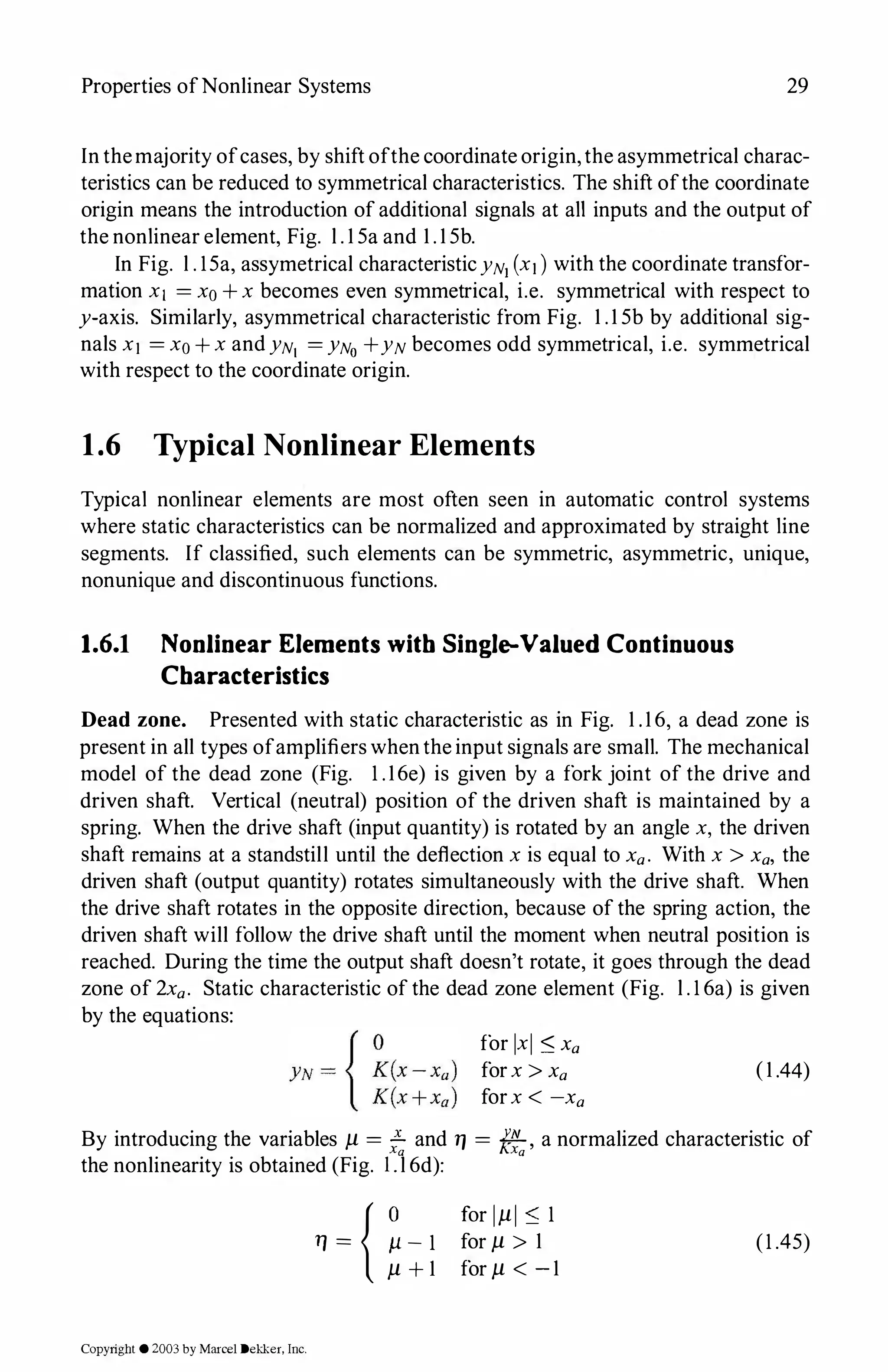
for IxI :::;; Xa
forx > Xa
forx < -xa
(1 .44)
By introducing the variables µ = .£ and 1J = .il:L
KN , a normalized characteristic of
Xa Xa
the nonlinearity is obtained (Fig. l .l 6d):
11 = { �- 1
µ + 1
Copyright ©2003by Marcel Dekker, Inc.
for 1µ1 :::;; 1
for µ > 1
for µ < - 1
(1 .45)
30
(a)
(c)
(e)
(b)
.,.,
(d)
Figure 1 . 1 6: Nonlinear characteristic ofthe type dead zone.
Copyright © 2003 by Marcel Dekker, Inc.
Chapter 1
Properties ofNonlinear Systems 31
x
(a) (b)
Figure 1 . 17: Nonlinear characteristic ofthe type saturation.
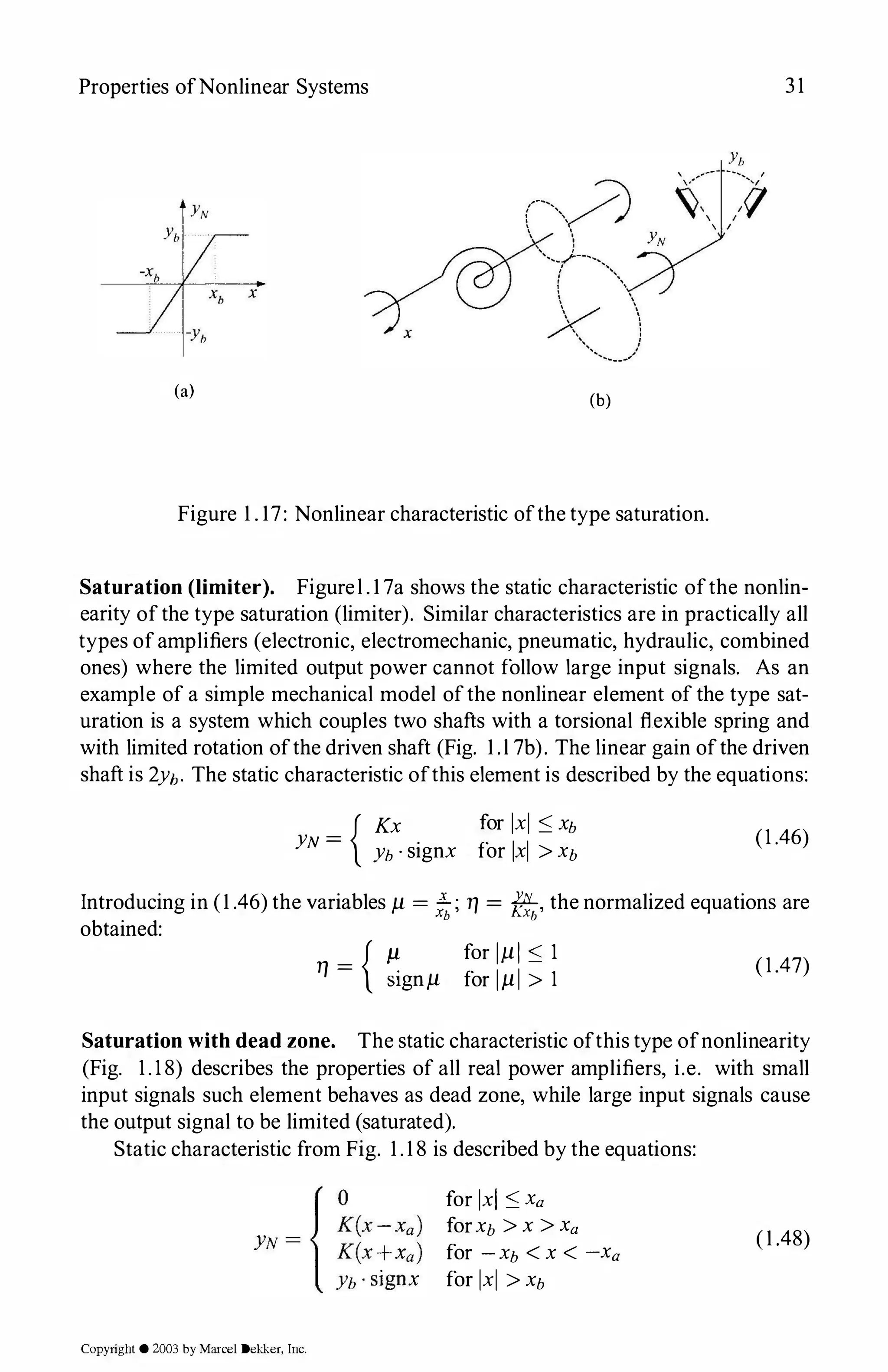
Saturation (limiter). Figurel . 1 7a shows the static characteristic ofthe nonlin­
earity ofthe type saturation (limiter). Similar characteristics are in practically all
types ofamplifiers (electronic, electromechanic, pneumatic, hydraulic, combined
ones) where the limited output power cannot follow large input signals. As an
example of a simple mechanical model ofthe nonlinear element of the type sat­
uration is a system which couples two shafts with a torsional flexible spring and
with limited rotation ofthe driven shaft (Fig. 1 .l 7b). The linear gain ofthe driven
shaft is 2Yh· The static characteristic ofthis element is described by the equations:
{ Kx for lxl :::; Xb
YN = Yb · signx for lxl > Xb
(1 .46)
Introducing in (1 .46) the variables µ = !i;; T/ = f!f:{,, the normalized equations are
obtained:
T/ = { �gnµ
for 1µ1 :::; 1
for lµI > 1
(1.47)
Saturation with dead zone. The static characteristic ofthis type ofnonlinearity
(Fig. 1.18) describes the properties of all real power amplifiers, i.e. with small
input signals such element behaves as dead zone, while large input signals cause
the output signal to be limited (saturated).
Static characteristic from Fig. 1 . 1 8 is described by the equations:
Copyright © 2003 by Marcel Dekker, Inc.
for lxl :::; Xa
forXb > x > Xa
for - Xb < X < -Xa
for lxl > Xb
(1 .48)
32 Chapter 1
YN
Yb
-x
h
-xa
x
a
xb x
-yb
Figure 1 .1 8: Static characteristic ofsaturation with dead zone.
Normalized form of the equation (1.48) is obtained by introducing µ = ..!.., TJ =
Xa
1'1L and m = � :
Kxa Xa
{0
µ - 1
TJ = µ + l
(m - l) · signµ
for 1µ 1 :::; 1
for m > µ > 1
for - m < x < - 1
for lµI > m
(1.49)
1.6.2 Nonlinear Elements with Single-Valued Discontinuous
Characteristics
Typical elements with single-valued discontinuous characteristics are practically
covered by the two-position and three-position relay without hysteresis.
Two-position relay without hysteresis. Single-valued static characteristic of
two-position polarized relay is shown in Fig. 1 .19.
-x
Figure 1 . 19: Static characteristic of a two-position polarized relay without hys­
teresis.
Copyright © 2003 byMarcel Dekker, Inc.
Properties ofNonlinear Systems
Yb
�
'
'
'
'
'
'
'
'
33
Figure 1.20: Static characteristic ofa three-position relay without hysteresis.
From this static characteristic it is seen that the relay contacts are open in the
interval !xi < Xb, i.e. the output signal YN is undefined. In the region !xi > Xb, the
output signal has the value +Yb or -yb, depending on the sign ofthe input signal
x. The corresponding equation for the two-position relay without hysteresis is:
{ Yb · signx for lxl ?: Xb
YN = undefined for !xi < Xb (1 .50)
Three-position relay without hysteresis. Single-valued static characteristic of
a three-position relay without hysteresis is shown in Fig. 1 .20. The equations
which describe the static characteristic from Fig. 1 .20 are:
{Yh · sign x
YN = 0
undefined
for lxl ?: xh
for !xi :::; Xa
forXa < !xi < Xb
(1.5 1)
Ideal two-position relay. For the analysis and synthesis ofvarious relay control
systems, use is made ofthe idealized static characteristic of a two-position relay.
Here at our disposal are equations (1.46), (1.48), (1.50) and (1.51). With the
boundary conditions Xb --+ 0 and K --+ oo for Kxb = Yb substituted into equation
(1 .46), we obtain:
{ Yb · signx
YN =
-yb < y < Yb
for lxl > 0
forx = 0
(1.52)
A graphical display ofan ideal relay characteristic described by (1 .52) is given in
Fig. 1.21a.
By inserting the boundary conditions in (1.50), the static characteristic in Fig.
1.21b is obtained, together with the equation:
_ { Yb · signx for !xi > 0
YN -
undefined forx = 0
Copyright © 2003 by Marcel Dekker. Inc.
(1.53)
34 Chapter 1
YN
Yb
YN
Yb
YN
yh
x x x
-yb
-yb
-yb
(a) (b) (c)
Figure 1.21: Ideal static characteristics ofa two-position relay.
By analogy, ifthe boundary conditions are inserted in (1 .48) and (1.51), the static
characteristic in Fig. 1.21c ensues and the equation is as follows:
_ { Yb·signx for lxl > 0
YN -
0 forx = 0
(1 .54)
For the analysis ofrelay systems with feedback loops, it is indispensable to exam­
ine various conditions of the system behavior for x = 0, for every characteristic
from Fig. 1.21.
The characteristics from Fig. 1 .21 described by the equation (1 .52) are called
nonlinearity ofthe signum type. The signum function can be defined analytically
as:
respectively:
·
l
'
-(2n+I)
YN =Yb·signx =Yb 1m x
n�=
( )2n+l
. YN . YN
x = as1gn - = hm -
Yb n�= Yb
(1.55)
(1 .56)
1.6.3 Nonlinear Elements with Double-Valued Characteristics
Two-position relay with hysteresis. The discussed single-valued relay static
characteristic represents an idealized characteristic ofreal systems. In reality, the
values ofthe input signal at the discontinuity in the value ofthe output signal YN
are different, depending on whether the relay switches in one or the other direc­
tion. For example, with a two-position polarized relay with symmetric control,
closing of the contacts in one direction comes with an input voltage x, and the
closing in the reverse direction requires the input voltage -x. The characteristic
of a two-position relay with double-valued characteristic is shown in Fig. 1 .22,
Copyright © 2003 by Marcel Dekker, Inc.
Discovering Diverse Content Through
Random Scribd Documents
“His conversation had no other course
Than that presented to his simple view
Of what concerned his saddle, groom, or horse;
Beyond this theme he little cared or knew:
Tell him of beauty and harmonious sounds,
He’d show his mare, and talk about his hounds.”
He was what was called Foxy all over—in his language, dress, and
associations. He wore a pin with a knob, something smaller than a
tea-saucer, of Caughley china, with the head of a fox upon it; and
everything nearest his person, so far as he could manage it, had
something to put him in mind of his favourite sport. His bed-room
walls were hung with sporting prints, and on his mantelpiece were
more substantial trophies of the hunt—as the brush of some
remarkable victim of the pack, his boots and spurs, &c. His famous
drinking-horn, which we have engraved together with his trencher in
the trophy at the head of this chapter, was equally embellished with
a representation of a hunt, very elaborately carved with the point of
a pen-knife. At the top is a wind-mill, and below a number of
horsemen and a lady, well mounted, in full chase, and with hounds
in full cry after a fox, which is seen on the lower part of the horn. A
fox’s brush forms the finis. The date upon the horn, which in size
and shape resembles those in use in the mansions of the gentry in
past centuries when hospitality was dispensed in their halls with
such a free and generous hand, is 1663. It is a relic still treasured
by members of the Wheatland Hunt, who look back to the time
when the shrill voice of Moody cheered the pack over the heavy
Wheatlands; and together with his cap, of which we also give a
representation, is often made to do duty at annual social gatherings.
Tom was a small eight or nine stone man, with roundish face,
marked with small pox, and a pair of eyes that twinkled with good
humour. He possessed great strength as well as courage and
resolution, and displayed an equanimity of temper which made him
many friends. The huntsman was John Sewell, and under him he
performed his duties in a way so satisfactory to his master and all
who hunted with him, as to be deemed the best whipper-in in
England. None, it was said, could bring up the tail end of a pack, or
sustain the burst of a long chase, and be in at the death with every
hound well up, like Tom. His plan was to allow his hounds their own
cast without lifting, unless they showed wildness; and if young
hounds dwelt on a stale drag behind the pack he whipped them on
to those on the right line. He never aspired to be more than “a
serving-man;” he wished, however, to be considered “a good
whipper-in,” and his fame as such spread through the country.
There was not a spark of envy in his composition, and he was one of
the happiest fellows in the universe. The lessons he seemed to have
learnt, and which appeared to have sunk deepest into his
unsophisticated nature, were those of being honest and of ordering
himself “lowly and reverently towards his betters,” for whom he had
a reverence which grew profound if they happened to have added to
their qualifications of being good sportsmen that of being
“Parliament men.”
Tom’s voice was something extraordinary, and on one occasion when
he had fallen into an old pit shaft, which had given way on the sides,
and could not get out, it saved him. His halloo to the dogs brought
him assistance, and he was extricated. It was capable of wonderful
modulations, and to hear him rehearse the sports of the day in the
big roomy servants’ kitchen at the Hall, and give his tally-ho, or who-
who-hoop, was considered a treat. On one occasion, when Tom was
in better trim than usual, the old housekeeper is said to have
remarked, “La! Tom, you have given the who-who-hoop, as you call
it, so very loud and strong to-day that you have set the cups and
saucers a dancing;” to which a gentleman, who had purposely
placed himself within hearing, replied, “I am not at all surprised—his
voice is music itself. I am astonished and delighted, and hardly
know how to praise it enough. I never heard anything so attractive
and inspiring before in the whole course of my life; its tones are as
fine and mellow as a French horn.”
When Squire Forester gave up hunting, the hounds went to
Aldenham, as trencher hounds; the farmers of the district agreeing
to keep them. They were collected the night before the hunt, fed
after a day’s sport, and dismissed at a crack of the whip, each dog
going off to the farm at which he was kept. But it was a great trial
to Tom to see them depart; and he begged to be allowed to keep an
old favourite, with which he might often have been seen sunning
himself in the yard. He continued with his master from first to last,
with the exception of the short time he lived with Mr. Corbet, when
the Sundorne roof-trees were wont to ring to the toast of “Old
Trojan,” and when the elder Sebright was his fellow-whip.
Like the old Squire, Tom never married, although, like his master, he
had a leaning towards the softer sex, and spent much of his time in
the company of his lady friends. One he made his banker, and the
presents made to him might have amounted to something
considerable if he had taken care of them. In lodging them in safe
keeping he usually begged that they might be let out to him a
shilling a time; but he made so many calls and pleaded so earnestly
and availingly for more, and was so constant a visitor at Hangster’s
Gate, that the stock never was very large. Indeed he was on
familiar terms with “Chalk Farm,” as the score behind the ale-house
door was termed; still he never liked getting into debt, and it was
always a relief to his mind to see the sponge applied to the score.
Tom was a great gun at this little way-side inn, which was altogether
a primitive institution of the kind even at that period, but which was
afterwards swept away when the present Hall was built. It then
stood on the old road from Bridgnorth to Wenlock, which came
winding past the Hall; and in the old coaching days was a well-
known hostelry and a favourite tippling shop for local notables,
among whom were old Scale, the Barrow schoolmaster and parish
clerk; the Cartwrights and Crumps, of Broseley; and a few local
farmers. One attraction was the old coach, which called there and
brought newspapers, and still later news in troubled times when
battles, sieges, and the movements of armies were the chief topics
of conversation. Neither coachmen nor travellers ever appeared to
hurry, but would wait to communicate the news, particularly in the
pig killing season, when a pork pie and a jug of ale would be
sufficient to keep the coach a good half hour if need be. We speak
of course of “The time when George III. was king,” before “His
Majesty’s Mail” became an important institution, and when one old
man in a scarlet coat, with a face that lost nothing by reflection
therewith—excepting that a slight tinge of purple was visible—who
had many more calling places than post offices on the road, carried
pistols in his holsters, and brought all the letters and newspapers
Willey, Wenlock, Broseley, Benthall, Ironbridge, Coalbrookdale, and
some other places then required; and these, even, took the whole
day to distribute. Although the lumbering old vehicle was constantly
tumbling over on going down slight declivities, it was a great
institution of the period; it was—
“Hurrah for the old stage coach,
Be it never so worn and rusty!
Hurrah for the smooth high road,
Be it glaring, and scorching, and dusty!
“Hurrah for the snug little inn,
At the sign of the Plough and Harrow,
And the frothy juice of the dangling hop,
That tickles your spinal marrow.”
It was a great treat to travellers, who would sometimes get off the
coach and order a chaise to be sent for them from Bridgnorth or
Wenlock, to stop and listen to Tom relating the incidents of a day’s
sport, and a still greater treat to witness his acting, to hear his tally-
ho, his who-who-hoop, or to hear him strike up—
“A southerly wind and a cloudy sky
Proclaim a hunting morning.”
Another favourite country song just then was the following, which
has been attributed to Bishop Still, called—
THE JUG OF ALE.
“As I was sitting one afternoon
Of a pleasant day in the month of June,
I heard a thrush sing down the vale,
And the tune he sang was ‘the jug of ale,’
And the tune he sang was the jug of ale.
“The white sheet bleaches on the hedge,
And it sets my wisdom teeth on edge,
When dry with telling your pedlar’s tale,
Your only comfort’s a jug of ale,
Your only comfort’s a jug of ale.
“I jog along the footpath way,
For a merry heart goes all the day;
But at night, whoever may flout and rail,
I sit down with my friend, the jug of ale,
With my good old friend, the jug of ale.
“Whether the sweet or sour of the year,
I tramp and tramp though the gallows be near.
Oh, while I’ve a shilling I will not fail
To drown my cares in a jug of ale,
Drown my cares in a jug of ale!”
To which old Amen, as the parish clerk was called, in order to be
orthodox, would add from the same convivial prelate’s farce-comedy
of “Gammer Gurton’s Needle:”—
“I cannot eat but little meat
My stomach is not good;
But sure I think that I can drink
With him that wears a hood.”
A pleasant cheerful glass or two, Tom was wont to say, would hurt
nobody, and he could toss off a horn or two of “October” without
moving a muscle or winking an eye. His constitution was as sound
as a roach; and whilst he could get up early and sniff the fragrant
gale, they did not appear to tell. But he had a spark in his throat, as
he said, and he indulged in such frequent libations to extinguish it,
that, towards the end of the year 1796, he was well nigh worn out.
After a while, finding himself becoming weak, and feeling that his
end was approaching, he expressed a desire to see his old master,
who at once gratified the wish of the sufferer, and, without thinking
that his end was so near, inquired what he wanted. “I have,” said
Tom, “one request to make, and it is the last favour I shall crave.”
“Well,” said the Squire, “what is it, Tom?” “My time here won’t be
long,” Tom added; “and when I am dead I wish to be buried at
Barrow, under the yew tree, in the churchyard there, and to be
carried to the grave by six earth-stoppers; my old horse, with my
whip, boots, spurs, and cap, slung on each side of the saddle, and
the brush of the last fox when I was up at the death, at the side of
the forelock, and two couples of old hounds to follow me to the
grave as mourners. When I am laid in the grave let three halloos be
given over me; and then, if I don’t lift up my head, you may fairly
conclude that Tom Moody’s dead.” The old whipper-in expired
shortly afterwards, and his request was carried out to the letter, as
the following characteristic letter from the Squire to his friend
Chambers, describing the circumstances, will show:—
“Dear Chambers,
“On Tuesday last died poor Tom Moody, as good for rough and
smooth as ever entered Wildmans Wood. He died brave and
honest, as he lived—beloved by all, hated by none that ever
knew him. I took his own orders as to his will, funeral, and
every other thing that could be thought of. He died sensible
and fully collected as ever man died—in short, died game to the
last; for when he could hardly swallow, the poor old lad took the
farewell glass for success to fox-bunting, and his poor old
master (as he termed it), for ever. I am sole executor, and the
bulk of his fortune he left to me—six-and-twenty shillings, real
and bonâ fide sterling cash, free from all incumbrance, after
every debt discharged to a farthing. Noble deeds for Tom,
you’d say. The poor old ladies at the Ring of Bells are to have a
knot each in remembrance of the poor old lad.
“Salop paper will show the whole ceremony of his burial, but for
fear you should not see that paper, I send it to you, as under:—
“‘Sportsmen, attend.—On Tuesday, 29th inst., was buried at
Barrow, near Wenlock, Salop, Thomas Moody, the well-known
whipper-in to G. Forester, Esq.’s fox-hounds for twenty years.
He was carried to the grave by a proper number of earth-
stoppers, and attended by many other sporting friends, who
heartily mourned for him.’
“Directly after the corpse followed his old favourite horse (which
he always called his ‘Old Soul’), thus accoutred: carrying his last
fox’s brush in the front of his bridle, with his cap, whip, boots,
spurs, and girdle, across his saddle. The ceremony being over,
he (by his own desire), had three clear rattling view haloos o’er
his grave; and thus ended the career of poor Tom, who lived
and died an honest fellow, but alas! a very wet one.
“I hope you and your family are well, and you’ll believe me,
much yours,
“G. Forester.
“Willey, Dec. 5, 1796.”
We need add nothing to the description the Squire gave of the way
in which Tom’s last wishes were carried out, and shall merely remark
that the old fellow kept on his livery to the last, and that he died in
his boots, which were for some time kept as relics—a circumstance
which leads us to appropriate the following lines, which appeared a
few years ago in the Sporting Magazine:—
“You have ofttimes indulged in a sneer
At the old pair of boots I’ve kept year after year,
And I promised to tell you (when ‘funning’ last night)
The reasons I have thus to keep them in sight.
“Those boots were Tom Moody’s (a better ne’er strode
A hunter or hack, in the field—on the road—
None more true to his friend, or his bottle when full,
In short, you may call him a thorough John Bull).
“Now this world you must own’s a strange compound of fate,
(A kind of tee-to-turn resembling of late)
Where hope promised joy there will sorrow be found,
And the vessel best trimm’d is oft soonest aground.
“I’ve come in for my share of ‘Take-up’ and ‘Put-down,’
And that rogue, Disappointment, oft makes me look brown,
And then (you may sneer and look wise if you will)
From those old pair of boots I can comfort distil.
“I but cast my eyes on them and old Willey Hall
Is before me again, with its ivy-crown’d wall,
Its brook of soft murmurs—its rook-laden trees,
The gilt vane on its dovecot swung round by the breeze.
“I see its old owner descend from the door,
I feel his warm grasp as I felt it of yore;
Whilst old servants crowd round—as they once us’d to do,
And their old smiles of welcome beam on me anew.
“I am in the old bedroom that looks on the lawn,
The old cock is crowing to herald the dawn;
There! old Jerry is rapping, and hark how he hoots,
‘’Tis past five o’clock, Tom, and here are your boots.’
“I am in the old homestead, and here comes ‘old Jack,’
And old Stephens has help’d Master George to his back;
Whilst old Childers, old Pilot, and little Blue-boar
Lead the merry-tongued hounds through the old kennel door.
“I’m by the old wood, and I hear the old cry—
‘Od’s rat ye dogs—wind him! Hi! Nimble, lad, hi!’
I see the old fox steal away through the gap,
Whilst old Jack cheers the hounds with his old velvet cap.
“I’m seated again by my old grandad’s chair,
Around me old friends and before me old fare;
Every guest is a sportsman, and scarlet his suit,
And each leg ’neath the table is cas’d in a boot.
“I hear the old toasts and the old songs again,
‘Old Maiden’—‘Tom Moody’—‘Poor Jack’—‘Honest Ben;’
I drink the old wine, and I hear the old call—
‘Clean glasses, fresh bottles, and pipes for us all.’”
CHAPTER XII.
SUCCESS OF THE SONG.
Dibdin’s Song—Dibdin and the Squire good fellows well met—
Moody a Character after Dibdin’s own heart—The Squire’s Gift—
Incledon—The Shropshire Fox-hunters on the Stage at Drury
Lane.
The reader will have perceived that George Forester and Charles
Dibdin were good fellows well met, and that no two men were ever
better fitted to appreciate each other. Like the popular monarch of
the time, each prided himself upon being a Briton; each admired
every new distinguishing trait of nationality, and gloried in any
special development of national pluck and daring. No one more than
Mr. Forester was ready to endorse that charming bit of history Dibdin
gave of his native land in his song of “The snug little Island,” or
would join more heartily in the chorus:—
“Search the globe round, none can be found
So happy as this little island.”
No one could have done its geography or have painted the features
of its inhabitants in fewer words or stronger colours. We use the
word stronger rather than brighter, remembering that Dibdin drew
his heroes redolent of tar, of rum, and tobacco. He had the knack of
seizing upon broad national characteristics, and, like a true artist, of
bringing them prominently into the foreground by means of such
simple accessories as seemed to give them force and effect.
In the Willey whipper-in Dibdin found the same unsophisticated bit
of primitive nature cropping up which he so successfully brought out
in his portraits of salt-water heroes; he found the same spirit
differently manifested; for had Moody served in the cock-pit, the
gun-room, on deck, or at the windlass, he would have been a “Ben
Backstay” or a “Poor Jack”—from that singleness of aim and daring
which actuated him. How clearly Dibdin set forth this sentiment in
that stanza of the song of “Poor Jack,” in which the sailor,
commenting upon the sermon of the chaplain, draws this conclusion:
—
“D’ye mind me, a sailor should be, every inch,
All as one as a piece of a ship;
And, with her, brave the world without off’ring to flinch,
From the moment the anchor’s a-trip.
As to me, in all weathers, all times, tides, and ends,
Nought’s a trouble from duty that springs;
My heart is my Poll’s, and my rhino my friend’s,
And as for my life, ’tis my King’s.”
The country was indebted to this faculty of rhyming for much of that
daring and devotion to its interests which distinguished soldiers and
sailors at that remarkable period. Dibdin’s songs, as he, with pride,
was wont to say, were “the solace of sailors on long voyages, in
storms, and in battles.” His “Tom Moody” illustrated the same pluck
and daring which under the vicissitudes and peculiarities of the times
—had it been Tom’s fortune to have served under Drake or Blake,
Howe, Jervis, or Nelson—would equally have supplied materials for a
stave.
From the letter of the Squire the reader will see how truthfully the
great English Beranger, as he has been called, adhered to the
circumstances in his song:—
“You all knew Tom Moody, the whipper-in, well.
The bell that’s done tolling was honest Tom’s knell;
A more able sportsman ne’er followed a hound
Through a country well known to him fifty miles round.
No hound ever open’d with Tom near a wood,
But he’d challenge the tone, and could tell if it were good;
And all with attention would eagerly mark,
When he cheer’d up the pack, ‘Hark! to Rockwood, hark! hark!
Hie!—wind him! and cross him! Now, Rattler, boy! Hark!’
“Six crafty earth-stoppers, in hunter’s green drest,
Supported poor Tom to an earth made for rest.
His horse, which he styled his ‘Old Soul,’ next appear’d,
On whose forehead the brush of his last fox was rear’d:
Whip, cap, boots, and spurs, in a trophy were bound,
And here and there followed an old straggling hound.
Ah! no more at his voice yonder vales will they trace!
Nor the welkin resound his burst in the chase!
With high over! Now press him! Tally-ho! Tally-ho!
“Thus Tom spoke his friends ere he gave up his breath:
‘Since I see you’re resolved to be in at the death,
One favour bestow—’tis the last I shall crave,
Give a rattling view-halloo thrice over my grave;
And unless at that warning I lift up my head,
My boys, you may fairly conclude I am dead!’
Honest Tom was obeyed, and the shout rent the sky,
For every one joined in the tally-ho cry!
Tally-ho! Hark forward! Tally-ho! Tally-ho!”
On leaving Willey, Mr. Forester asked Dibdin what he could do to
discharge the obligation he felt himself under for his services; the
great ballad writer, whom Pitt pensioned, replied “Nothing;” he had
been so well treated that he could not accept anything. Finding
artifice necessary, Mr. Forester asked him if he would deliver a letter
for him personally at his banker’s on his arrival in London. Of course
Dibdin consented, and on doing so he found it was an order to pay
him £100!
When the song first came out Charles Incledon, by the “human voice
divine,” was drawing vast audiences at Drury Lane Theatre. On
play-bills, in largest type, forming the most attractive morceaux of
the bill of fare, this song, varied by others of Dibdin’s composing,
would be seen; and when he was first announced to sing it, a few
fox-hunting friends of the Squire went to London to hear it. Taking
up their positions in the pit, they were all attention as the inimitable
singer rolled out, with that full volume of voice which at once
delighted and astounded his audience, the verse commencing:—
“You all knew Tom Moody the whipper-in well.”
But the great singer did not succeed to the satisfaction of the small
knot of Shropshire fox-hunters in the “tally-ho chorus.” Detecting
the technical defect which practical experience in the field alone
could supply, they jumped upon the stage, and gave the audience a
specimen of what Shropshire lungs could do.
The song soon became popular. It seized at once upon the sporting
mind, and upon the mind of the country generally. The London
publishers took it up, and gave it with the music, together with
woodcuts and lithographic illustrations, and it soon found a ready
sale. But the illustrations were untruthful. The church was
altogether a fancy sketch, exceedingly unlike the quaint old simple
structure still standing. A print published by Wolstenholme, in 1832,
contains a very faithful representation of the church on the northern
side, with the grave, and a large gathering of sportsmen and
spectators, at the moment the “view halloo” is supposed to have
been given. It is altogether spiritedly drawn and well coloured, and
makes a pleasing subject; but the view is taken on the wrong side of
the church, the artist having evidently chosen this, the northern
side, because of the distance and middle distance, and in order to
make a taking picture. The view has this advantage, however, it
shows the Clee Hills in the distance. Tom’s grave is covered by a
simple slab, containing the following inscription,
TOM MOODY,
Buried Nov. 19th, 1796,
and is on the opposite side, near the old porch, and chief entrance
to the church.
In the full-page engraving, representing a meet near “Hangster’s
Gate,” a famous “fixture” in the old Squire’s time, the assembled
sportsmen are supposed to be startled by the re-appearance of Tom
upon the ground of his former exploits. It is the belief of some that
when a corpse is laid in the grave an angel gives notice of the
coming of two examiners. The dead person is then made to
undergo the ordeal before two spirits of terrible appearance.
Whether this was the faith of Tom’s friends or not we cannot say, but
Tom was supposed to have been anything but satisfied with his
quarters or his company, and to have returned to visit the Willey
Woods. The picture presents a group of sportsmen and hounds
beneath the trees, and attention is directed towards the spectre, an
old decayed stump. The following lines refer to the tradition:—
“See the shade of Tom Moody, you all have known well,
To our sports now returning, not liking to dwell
In a region where pleasure’s not found in the chase,
So Tom’s just returned to view his old place.
No sooner the hounds leave the kennel to try,
Than his spirit appears to join in the cry;
Now all with attention, his signal well mark,
For see his hand’s up for the cry of Hark! Hark!
Then cheer him, and mark him, Tally-ho! Boys! Tally-ho!”
CHAPTER XIII.
THE WILLEY SQUIRE MEMBER FOR WENLOCK.
The Willey Squire recognises the Duties of his Position, and
becomes Member for Wenlock—Addison’s View of Whig Jockeys
and Tory Fox-hunters—State of Parties—Pitt in Power—“Fiddle-
Faddle”—Local Improvements—The Squire Mayor of Wenlock—
The Mace now carried before the Chief Magistrate.
There is an old English maxim that “too much of anything is good for
nothing;” the obvious meaning being that a man should not addict
himself over much to any one pursuit; and it is only justice to the
Willey Squire that it should be fully understood that whilst
passionately fond of the pleasures of the chase, he was not
unmindful of the duties of his position. Willey was the centre of the
sporting country we have described; but it was also contiguous to a
district remarkable for its manufacturing activity—for its iron works,
its pot works, and its brick works, the proprietors of which, no less
than the agricultural portion of the population, felt that they had an
interest in questions of legislation. Mr. Forester considered that
whatever concerned his neighbourhood and his country concerned
him, and his influence and popularity in the borough led to his taking
upon himself the duty of representing it in Parliament. There was
about the temper of the times something more suited to the
temperament of a country gentleman than at present, and a
member of Parliament was less bound to his constituents. His duties
as a representative sat much more lightly, whilst the pugnacious
elements of the nation generally were such that when Mr. Forester
entered upon public life there was nearly as much excitement in the
House of Commons—and not unlike in kind—as was to be found in
the cockpit or the hunting-field.
As long as Mr. Forester could remember, parties had been as sharply
defined as at present, and men were as industriously taught to
believe that whatever ranged itself under one form of faith was
praiseworthy, whilst everything on the other side was to be
condemned. Addison, in his usually happy style, had already
described this state of things in the Spectator, where he says:—
“This humour fills the country with several periodical meetings
of Whig jockeys and Tory fox-hunters; not to mention the
innumerable curses, frowns, and whispers it produces at a
quarter sessions. . . . In all our journey from London to this
house we did not so much as bait at a Whig inn; or if by chance
the coachman stopped at a wrong place, one of Sir Roger’s
servants would ride up to his master full speed, and whisper to
him that the master of the house was against such an one in
the last election. This often betrayed us into hard beds and bad
cheer, for we were not so inquisitive about the inn as the
innkeeper; and, provided our landlord’s principles were sound,
did not take any notice of the staleness of the provisions.”
So that Whig and Tory had even then long been names representing
those principles by which the Constitution was balanced, names
representing those popular and monarchical ingredients which it was
supposed assured liberty and order, progress and stability. But
about the commencement of Mr. Forester’s parliamentary career
parties had been in a great measure broken up into sections, if not
into factions—into Pelhamites, Cobhamites, Foxites, Pittites, and
Wilkites—the questions uppermost being place, power, and
distinction, ministry and opposition—the Ins and the Outs. The Ins,
when Whigs, pretty much as now, adopted Tory principles, and
Tories in opposition appealed to popular favour for support; indeed
from the fall of Walpole to the American war, as now, there were few
statesmen who were not by turns the colleagues and the
adversaries, the friends and the foes of their contemporaries. The
general pulse, it is true, beat more feverishly, and men went to
Parliament or into battle as readily as to the hunting-field—for the
excitement of the thing. To epitomise, mighty armies, such as
Europe had not seen since the days of Marlborough, were moving in
every direction. Four hundred and fifty-two thousand men were
gathering to crush the Prince of a German state, with one hundred
and fifty thousand men in the field to encounter them. The English
and Hanoverian army, under the Duke of Cumberland, was relied
upon to prevent the French attacking Prussia, with whom we had
formed an alliance. England felt an intense interest in the struggle,
and bets were made as to the result. Mr. Forester was returned to
the new Parliament, which met in December, 1757, in time, we
believe, to vote for the subsidy of £670,000 asked for by the king for
his “good brother and ally,” the King of Prussia. A minister like Pitt,
who was then inspiring the people with his spirit, and raising the
martial ardour of the nation to a pitch it had never known before,
who drew such pictures of England’s power and pluck as to cause
the French envoy to jump out of the window, was a man after the
Squire’s own heart, and he gave him his hearty “aye,” to subsidy
after subsidy. As a contemporary satirist wrote:—
“No more they make a fiddle-faddle
About a Hessian horse or saddle.
No more of continental measures;
No more of wasting British treasures.
Ten millions, and a vote of credit.
’Tis right. He can’t be wrong who did it.”
Mr. Forester gave way to Cecil Forester, a few months prior to the
marriage of the King to the Princess Charlotte; but was returned
again, in 1768, with Sir Henry Bridgeman, and sat till 1774, during
what has been called the “Unreported Parliament.” He was returned
in October of the same year with the same gentleman. He was also
returned to the new Parliament in 1780, succeeding Mr. Whitmore,
who, having been returned for Wenlock and Bridgnorth, elected to
sit for the latter; and he sat till 1784. Sir H. Bridgeman and John
Simpson, Esq., were then returned, and sat till the following year;
when Mr. Simpson accepted the Chiltern Hundreds, and Mr. Forester,
being again solicited to represent the interests of the borough, was
returned, and continued to sit until the sixteenth Parliament of Great
Britain, having nearly completed its full term of seven years, was
dissolved, soon after its prorogation in June, 1790.
It is not our intention to comment upon the votes given by the
Squire in his place in Parliament during the thirty years he sat in the
House; suffice it to say, that we believe he gave an honest support
to measures which came before the country, and that he was neither
bought nor bribed, as many members of that period were. He was
active in getting the sanction of Parliament for local improvements,
for the construction of a towing-path along the Severn, and for the
present handsome iron bridge—the first of its kind—over it, to
connect the districts of Broseley and Madeley. On retiring from the
office of chief magistrate of the borough, which he filled for some
years, he presented to the corporation the handsome mace now in
use, which bears the following inscription:—
“The gift of George Forester of Willey, Esq., to the Bailiff,
Burgesses, and Commonalty of the Borough of Wenlock, as a
token of his high esteem and regard for the attachment and
respect they manifested towards him during the many years he
represented the borough in Parliament, and served the office of
Chief Magistrate and Justice thereof.”
CHAPTER XIV.
THE SQUIRE AND HIS VOLUNTEERS.
The Squire and the Wenlock Volunteers—Community of Feeling—
Threats of Invasion—“We’ll follow the Squire to Hell if
necessary”—The Squire’s Speech—His Birthday—His Letter to the
Shrewsbury Chronicle—Second Corps—Boney and Beacons—The
Squire in a Rage—The Duke of York and Prince of Orange came
down.
“Not once or twice, in our rough island story,
The path of duty was the way to glory.”
We fancy there was a greater community of feeling in Squire
Forester’s day than now, and that whether indulging in sport or in
doing earnest work, men acted more together. Differences of wealth
caused less differences of caste, of speech, and of habit; men of
different classes saw more of each other and were more together;
consequently there was more cohesion of the particles of which
society is composed, and, if the term be admissible, the several
grades were more interpenetrated by agencies which served to
make them one. Gentlemen were content with the good old English
sports and pastimes of the period, and these caused them to live on
their own estates, surrounded by and in the presence of those whom
modern refinements serve to separate; and their dependants
therefore were more alive to those reciprocal, neighbourly, and social
duties out of which patriotism springs. They might not have been
better or wiser, but they appear to have approached nearer to that
state of society when every citizen considered himself to be so
closely identified with the nation as to feel bound to bear arms
against an invading enemy, and, as far as possible, to avert a
danger. Never was the rivalry of England and France more
vehement. Emboldened by successes, the French began to think
themselves all but invincible, and burned to meet in mortal combat
their ancient enemies, whilst our countrymen, equally defiant, and
with recollections of former glory, sought no less an opportunity of
measuring their strength with the veteran armies of their rivals. The
embers of former passions yet lay smouldering when the French
Minister of Marine talked of making a descent on England, and of
destroying the Government; a threat calculated to influence the
feelings of old sportsmen like Squire Forester, who nourished a love
of country, whose souls throbbed with the same national feeling, and
who were equally ready to respond to a call to maintain the
sacredness of their homes, or to risk their lives in their defence.
Oneyers and Moneyers—men “whose words upon ’change would go
much further than their blows in battle,” as Falstaff says, came
forward, if for nothing else, as examples to others. On both banks
of the Severn men looked upon the Squire as a sort of local centre,
and as the head of a district, as a leader whom they would follow—
as one old tradesman said—to hell, if necessary. A general meeting
was called at the Guildhall, Wenlock, and a still more enthusiastic
gathering took place at Willey. Mr. Forester never did things by
halves, and what he did he did at once. He was not much at
speech-making, but he had that ready wit and happy knack of going
to the point and hitting the nail on the head in good round Saxon,
that told amazingly with his old foxhunting friends.
“Gentlemen,” he said, “you know very well that I have retired from
the representation of the borough. I did so in the belief that I had
discharged, as long as need be, those public duties I owe to my
neighbours; and in the hope that I should be permitted henceforth
to enjoy the pleasures of retirement. I parted with my hounds, and
gave up hunting; but here I am, continually on horseback, hunting
up men all round the Wrekin! The movement is general, and
differences of feeling are subsiding into one for the defence of the
nation. Whigs and Tories stand together in the ranks; and as I told
the Lord-Lieutenant the other day, we must have not less than four
or five thousand men in uniform, equipped, every Jack-rag of ’em,
without a farthing cost to the country. (Applause.) There are some
dastardly devils who run with the hare, but hang with the hounds,
damn ’em (laughter); whose patriotism, by G—d, hangs by such a
small strand that I believe the first success of the enemies of the
country would sever it. They are a lot of damnation Jacobins, all of
’em, whining black-hearted devils, with distorted intellects, who
profess to perceive no danger. And, by G—d, the more plain it is,
the less they see it. It is, as I say, put an owl into daylight, stick a
candle on each side of him, and the more light the poor devil has
the less he sees.” (Cries of “Bravo, hurrah for the Squire.”) In
conclusion he called upon the lawyer, the ironmaster, the pot maker,
the artisan, and the labourer to drill, and prepare for defending their
hearths and homes; they had property to defend, shops that might
be plundered, houses that might be burned, or children to save from
being brained, and wives or daughters to protect from treatment
which sometimes prevailed in time of war.
As a result of his exertions, a strong and efficient company was
formed, called “The Wenlock Loyal Volunteers.” The Squire was
major, and he spared neither money nor trouble in rendering it
efficient. He always gave the members a dinner on the 4th of June,
the birthday of George III., who had won his admiration and
devotion by his boldness as a fox-hunter, no less than by his daring
proposal, during the riots of 1780, to ride at the head of his guards
into the midst of the fires of the capital. On New Year’s Day, that
being the birthday of Major Forester, the officers and men invariably
dined together in honour of their commander. The corps were
disbanded, we believe, in 1802, for we find in a cutting from a
Shrewsbury paper of the 12th of January, 1803, that about that time
a subscription was entered into for the purchase of a handsome
punch-bowl. The newspaper states that
“On New Year’s Day, 1803, the members of the late corps of
Wenlock Loyal Volunteers, commanded by Major Forester, dined
at the Raven Inn, Much Wenlock, in honour of their much-
respected major’s birthday, when the evening was spent with
that cheerful hilarity and orderly conduct which always
characterised this respectable corps, when embodied for the
service of their king and country. In the morning of the day the
officers, deputed by the whole corps, waited on the Major, at
Willey, and presented him, in an appropriate speech, with a
most elegant bowl, of one hundred guineas value, engraved
with his arms, and the following inscription, which the Major
was pleased to accept, and returned a suitable answer:—‘To
George Forester, of Willey, Esq., Major Commandant of the
Wenlock Loyal Volunteers, for his sedulous attention and
unbounded liberality to his corps, raised and disciplined under
his command without any expense to Government, and
rendered essentially serviceable during times of unprecedented
difficulty and danger; this humble token of their gratitude and
esteem is most respectfully presented to him by his truly faithful
and very obedient servants,
“‘The Wenlock Volunteers.
“‘Major Forester.’”
The following reply appeared in the same paper the succeeding
week:—
“Major Forester, seeing an account in the Shrewsbury papers
relative to the business which occurred at Willey upon New
Year’s Day last, between him and his late corps of Wenlock
Volunteers, presumes to trouble the public eye with his answer
thereto, thinking it an unbounded duty of gratitude and respect
owing to his late corps, to return them (as their late
commander) his most explicit public thanks, as well as his most
grateful and most sincere acknowledgments, for the high
honour lately conferred upon him, by their kind present of a
silver bowl, value one hundred guineas. Major Forester’s
unwearied attention, as well as his liberality to his late corps,
were ever looked upon by him as a part of his duty, in order to
make some compensation to a body of distinguished
respectable yeomanry, who had so much the interest and
welfare of him and their country at heart, that he plainly
perceived himself, and so must every other intelligent spectator
on the ground at the time of exercise, that they only waited
impatiently for the word to put the order into execution directly;
but with such regularity as their commander required and ever
had cheerfully granted to him. A return of mutual regard
between the major and his late corps was all he wished for, and
he is now more fully convinced, by this public mark of favour, of
their real esteem and steady friendship. He therefore hopes
they will (to a man) give him credit when he not only assures
them of his future constant sincerity and unabated affection, but
further take his word when he likewise promises them that his
gratitude and faithful remembrance of the Wenlock Loyal
Volunteers shall never cease but with the last period of his
worldly existence.
“Willey, 12th Jan., 1803.”
Soon after the first corps of volunteers was disbanded, the Squire
was entertaining his guests with the toast—
“God save the king, and bless the land
In plenty, song, and peace;
And grant henceforth that foul debates
’Twixt noblemen may cease—”
when he received a letter from London, stating that at an audience
given to Cornwallis, the First Consul was very gracious; that he
inquired after the health of the king, and “spoke of the British nation
in terms of great respect, intimating that as long as they remained
friends there would be no interruption to the peace of Europe.”
One of the guests added—
“And that I think’s a reason fair to drink and fill again.”
It was clear to all, however, who looked beneath the surface, that
the peace was a hollow truce, and that good grounds existed for
timidity, if not for fear, respecting a descent upon our shores:
“Sometimes the vulgar see and judge aright.”
Month by month, week by week, clouds were gathering upon a sky
which the Peace of Amiens failed to clear.
The First Consul declared against English commerce, and
preparations on a gigantic scale were being made by the
construction of vessels on the opposite shores of the Channel for
invasion.
The public spirit in France was invoked; the spirit of this country was
also aroused, and vigorous efforts were made by Parliament and the
people to maintain the inviolability of our shores. Newspaper
denunciations excited the ire of the First Consul, who demanded of
the English Government that it should restrict their power. A
recriminatory war of words, of loud and fierce defiances, influenced
the temper of the people on each side of the Channel, and it again
became evident that differences existed which could only be settled
by the sword. In a conversation with Lord Whitworth, Napoleon was
reported to have said:—“A descent upon your coasts is the only
means of offence I possess; and that I am determined to attempt,
and to put myself at its head. But can you suppose that, after
having gained the height on which I stand, I would risk my life and
reputation in so hazardous an undertaking, unless compelled to it by
absolute necessity. I know that the probability is that I myself, and
the greatest part of the expedition, will go to the bottom. There are
a hundred chances to one against me; but I am determined to make
the attempt; and such is the disposition of the troops that army after
army will be found ready to engage in the enterprise.” This
conversation took place on the 21st of February, 1803; and such
were the energetic measures taken by the English Government and
people, that on the 25th of March, independent of the militia, 80,000
strong, which were called out at that date, and the regular army of
130,000 already voted, the House of Commons, on June 28th,
agreed to the very unusual step of raising 50,000 men additional, by
drafting, in the proportion of 34,000 for England, 10,000 for Ireland,
and 6,000 for Scotland, which it was calculated would raise the
regular troops in Great Britain to 112,000 men, besides a large
surplus force for offensive operations. In addition to this a bill was
brought in shortly afterwards to enable the king to call out the levy
en masse to repel the invasion of the enemy, and empowering the
lord-lieutenants of the several counties to enrol all the men in the
kingdom, between seventeen and fifty-five years of age, to be
divided into regiments according to their several ages and
professions: those persons to be exempt who were members of any
volunteer corps approved of by his Majesty. Such was the state of
public feeling generally that the king was enabled to review, in Hyde
Park, sixty battalions of volunteers, 127,000 men, besides cavalry, all
equipped at their own expense. The population of the country at
the time was but a little over ten millions, about a third of what it is
at present; yet such was the zeal and enthusiasm that in a few
weeks 300,000 men were enrolled, armed, and disciplined, in the
different parts of the kingdom.
The movement embraced all classes and professions. It was
successful in providing a powerful reserve of trained men to
strengthen the ranks and to supply the vacancies of the regular
army, thus contributing in a remarkable manner to produce a
patriotic ardour and feeling among the people, and laying the
foundation of that spirit which enabled Great Britain at length to
appear as principal in the contest, and to beat down the power of
France, even where hitherto she had obtained unexampled success.
Thus, after the first Wenlock Loyal Volunteers were disbanded,
Squire Forester found but little respite; he and the Willey fox-hunters
again felt it their duty to come forward and enroll themselves in the
Second Wenlock Royal Volunteers.
“Design whate’er we will,
There is a fate which overrules us still.”
No man was better fitted to undertake the task; no one knew better
how
“By winning words to conquer willing hearts,
And make persuasion do the work of fear.”
And, mainly through his exertions, an able corps was formed,
consisting of a company and a half at Much Wenlock, a company
and a half at Broseley, and half a company at Little Wenlock;
altogether forming a battalion of 280 men. For the county
altogether there were raised 940 cavalry, 5,022 infantry; rank and
file, 5,852. Mr. Harries, of Benthall; Mr. Turner, of Caughley; Mr.
Pritchard and Mr. Onions, of Broseley; Messrs. W. and R. Anstice, of
Madeley Wood and Coalport; Mr. Collins, Mr. Jeffries, and Mr. Hinton,
of Wenlock; and others, were among the officers and leading
members. The uniform was handsome, the coat being scarlet,
turned up with yellow, the trousers and waistcoat white, and the hat
Welcome to Our Bookstore - The Ultimate Destination for Book Lovers
Are you passionate about books and eager to explore new worlds of
knowledge? At our website, we offer a vast collection of books that
cater to every interest and age group. From classic literature to
specialized publications, self-help books, and children’s stories, we
have it all! Each book is a gateway to new adventures, helping you
expand your knowledge and nourish your soul
Experience Convenient and Enjoyable Book Shopping Our website is more
than just an online bookstore—it’s a bridge connecting readers to the
timeless values of culture and wisdom. With a sleek and user-friendly
interface and a smart search system, you can find your favorite books
quickly and easily. Enjoy special promotions, fast home delivery, and
a seamless shopping experience that saves you time and enhances your
love for reading.
Let us accompany you on the journey of exploring knowledge and
personal growth!
ebookgate.com


Nonlinear Control Systems 1st Edition Zoran Vukić

  • 1.
    Nonlinear Control Systems1st Edition Zoran Vuki■ download https://ebookgate.com/product/nonlinear-control-systems-1st- edition-zoran-vukic/ Get Instant Ebook Downloads – Browse at https://ebookgate.com
  • 2.
    Get Your DigitalFiles Instantly: PDF, ePub, MOBI and More Quick Digital Downloads: PDF, ePub, MOBI and Other Formats Optimal Control of Singularly Perturbed Linear Systems and Applications Automation and Control Engineering 1st Edition Zoran Gajic https://ebookgate.com/product/optimal-control-of-singularly- perturbed-linear-systems-and-applications-automation-and-control- engineering-1st-edition-zoran-gajic/ Control of Nonlinear Distributed Parameter Systems 1st Edition Goong Chen https://ebookgate.com/product/control-of-nonlinear-distributed- parameter-systems-1st-edition-goong-chen/ Nonlinear H Infinity Control Hamiltonian Systems and Hamilton Jacobi Equations 1st Edition M.D.S. Aliyu https://ebookgate.com/product/nonlinear-h-infinity-control- hamiltonian-systems-and-hamilton-jacobi-equations-1st-edition-m- d-s-aliyu/ Nonlinear H Infinity Control Hamiltonian Systems and Hamilton Jacobi Equations 1st Edition M.D.S. Aliyu https://ebookgate.com/product/nonlinear-h-infinity-control- hamiltonian-systems-and-hamilton-jacobi-equations-1st-edition-m- d-s-aliyu-2/
  • 3.
    Control Systems 1stEdition W. Bolton https://ebookgate.com/product/control-systems-1st-edition-w- bolton/ Nonlinear Dynamics of Production Systems 1st Edition Günter Radons https://ebookgate.com/product/nonlinear-dynamics-of-production- systems-1st-edition-gunter-radons/ Reading Detective A1 1st Edition Cheryl Block https://ebookgate.com/product/reading-detective-a1-1st-edition- cheryl-block/ Signals and Control Systems 1st Edition Femmam https://ebookgate.com/product/signals-and-control-systems-1st- edition-femmam/ Republic of Georgia Zoran Pavlovic https://ebookgate.com/product/republic-of-georgia-zoran-pavlovic/
  • 5.
    MARCEL NONLINEAR CONTROL SYSTEMS Zoran Vukic Ljubomir Kuljaca Universityof'Zagreb 'Zagreb, Croatia Dali Donlagic University ofMaribor Maribor, Slovenia Sejid Tesnjak University ofZagreb Zagreb, Croatia n MARCEL DEKKER, INC. NEW YORK • BASEL DEKKER Copyright © 2003 by Marcel Dekker, Inc.
  • 6.
    Library of CongressCataloging-in-Publication Data A catalog record for this book is available from the Library of Congress. ISBN: 0-8247-4112-9 This book is printed on acid-free paper. Headquarters Marcel Dekker, Inc. 270 Madison Avenue, New York, NY 10016 tel: 212-696-9000; fax: 212-685-4540 Eastern Hemisphere Distribution Marcel Dekker AG Hutgasse 4, Postfach 812, CH-4001 Basel, Switzerland tel: 41-61-260-6300; fax: 41-61-260-6333 World Wide Web http://www.dekker.com The publisher offers discounts on this book when ordered in bulk quantities. For more infor­ mation, write to Special Sales/Professional Marketing at the headquarters address above. Copyright © 2003 by Marcel Dekker, Inc. All Rights Reserved. Neither this book nor any part may be reproduced or transmitted in any form or by any means, electronic or mechanical, including photocopying, microfilming, and recording, or by any information storage and retrieval system, without permission in writing from the publisher. Current printing (last digit): 10 9 8 7 6 5 4 3 2 PRINTED IN THE UNITED STATES OF AMERICA Copyright © 2003 by Marcel Dekker, Inc.
  • 7.
    CONTROL ENGINEERING A SeriesofReferenceBooksandTextbooks Editor NEILMUNRO, PH.D., D.Sc. Professor Applied Control Engineering University ofManchester Institute of Science and Technology Manchester, United Kingdom 1. Nonlinear Control of Electric Machinery, Darren M. Dawson, Jun Hu, and Timothy C. Burg 2. Computational Intelligence in Control Engineering, Robert E. King 3. Quantitative Feedback Theory: Fundamentals and Applications, Con­ stantine H. Houpis and Steven J. Rasmussen 4. Self-Learning Control of Finite Markov Chains, A. S. Poznyak, K. Najim, and E. Gomez-Ramirez 5. Robust Control and Filtering for Time-Delay Systems, Magdi S. Mahmoud 6. Classical Feedback Control: With MATLAB, Boris J. Lurie and Paul J. Enright 7. Optimal Control of Singularly Perturbed Linear Systems and Applications: High-Accuracy Techniques, Zoran Gajic and Myo-Taeg Lim 8. Engineering System Dynamics: A Unified Graph-Centered Approach, Forbes T. Brown 9. Advanced Process Identification and Control, Enso lkonen and Kaddour Najim 10. Modern Control Engineering, P. N. Paraskevopoulos 11. Sliding Mode Control in Engineering, edited by Wilfrid Perruquetti and Jean Pierre Barbot 12. Actuator Saturation Control, edited by Vikram Kapila and Karo/as M. Grigoriadis 13. Nonlinear Control Systems, Zoran Vuki6, Ljubomir Kuljaca, Dali £Jonlagi6, Sejid Tesnjak Additional VolumesinPreparation Copyright © 2003 by Marcel Dekker, Inc.
  • 8.
    Series Introduction Many textbookshave been written on control engineering, describing new techniques for controlling systems, or new and better ways of mathematically formulating existing methods to solve the ever­ increasing complex problems faced by practicing engineers. However, few of these books fully address the applications aspects of control en­ gineering. It is the intention of this new series to redress this situation. The series will stress applications issues, and not just the mathematics of control engineering. It will provide texts that present not only both new and well-established techniques, but also detailed examples of the application of these methods to the solution of real­ world problems. The authors will be drawn from both the academic world and the relevant applications sectors. There are already many exciting examples of the application of control techniques in the established fields of electrical, mechanical (including aerospace), and chemical engineering. We have only to look around in today's highly automated society to see the use of advanced robotics techniques in the manufacturing industries; the use of auto­ mated control and navigation systems in air and surface transport sys­ tems; the increasing use of intelligent control systems in the many arti­ facts available to the domestic consumer market; and the reliable sup­ ply of water, gas, and electrical power to the domestic consumer and to industry. However, there are currently many challenging problems that could benefit from wider exposure to the applicability of control methodologies, and the systematic systems-oriented basis inherent in the application of control techniques. This series presents books that draw on expertise from both the academic world and the applications domains, and will be useful not only as academically recommended course texts but also as handbooks for practitioners in many applications domains. Nonlinear Control Sys­ tems is another outstanding entry to Dekker's Control Engineering se­ ries. ill Copyright © 2003 by Marcel Dekker, Inc.
  • 9.
    Preface Nonlinear control designsare very important because new technology asks for more and more sophisticated solutions. The development of nonlinear geometric methods (Isidori, 1995), feedback passivation (Fradkov and Hill, 1998), a recursive design - backstepping (Sontag and Sussmann, 1988; Krstic et al, 1995), output feedback design (Khalil, 1996) and unconventional methods of fuzzy/neuro control (Kosko, 1992), to mention just few of them, emiched our capability to solve practical control problems. For the interested reader a tutorial overview is given in Kokotovic, 1991 and Kokotovic'.: and Arcak, 2001. Analysis always precedes design and this book is primarily focusing on nonlinear control system analysis. The book is written for the reader who has the necessary prerequisite knowledge of mathematics acquired up to the 3rd or 4th year in an undergraduate electrical and/or mechanical engineering program, covering mathematical analysis (theory of linear differential equations, theory of complex variables, linear algebra), theory of linear systems and signals and design of linear control systems. The book evolved from the lectures given at the University of Zagreb, Croatia and the University of Maribor, Slovenia for undergraduate and graduate courses, and also from our research and development projects over the years. Fully aware of the fact that for nonlinear systems some new and promising results were recently obtained, we nevertheless decided in favor of classical techniques that are still useful in engineering practice. We believe that the knowledge of classical analysis methods is necessary for anyone willing to acquire new design methods. The topics covered in the book are for advanced undergraduate and introductory graduate courses. These topics will be interesting also for researchers, electrical, mechanical and chemical engineers in the area of control engineering for their self-study. We also believe that those engineers dealing with modernization of industrial plants, consulting, or design will also benefit from this book. The main topics of the book cover classical methods such as: stability analysis, analysis ofnonlinear control systems by use ofthe describing function method and the describing function method applied to fuzzy control systems. Many examples given in the book help the reader to better understand the topic. Our experience is that with these examples and similar problems given to students as project-type homework, they can quite successfully-with the help of some computer jrograms with viable control system computational tools (such as MATLAB , by The Mathworks, Inc.)­ learn about nonlinear control systems. The material given in the book is extensive and can't be covered in a one-semester course. What will be covered v Copyright © 2003 by Marcel Dekker. Inc.

  • 10.
    VI Preface in aparticular course is up to the lecturer. We wanted to achieve better readability and presentation of this difficult area, but not by compromising the rigor of mathematics. This goal was not easy to achieve and the reader will judge if we succeeded in that. The basic knowledge necessary for the further study of nonlinear control systems is given, and we hope that readers will enjoy it. Acknowledgments It is our privilege to thank the many colleagues and students who were involved and have helped us in the various stages ofthe book preparation. We would like to thank our colleagues, listed in alphabetical order: Professors, Guy 0. Beale, Petar Kokotovic, Luka Karkut, Frank Lewis, Manfred Morari, Tugomir Surina, Boris Tovomik, Kirnon Valavanis, and Tine Zoric for their valuable suggestions and help. We are grateful to our research students, in alphabetical order: Vedran Bakaric, Bruno Borovic, Krunoslav Horvat, Ognjen Kuljaea, Ozren Kuljaca, Nenad Muskinja, Edin Omerdic, Henrieta Ozbolt, and Dean Pavlekovic. They helped in the preparation of figures (Ozren, Nenad, Dean) and in solving examples given in the book (all of them). Useful comments and help in preparation of the camera-ready copy were done by Dean. We would also like to thank B.J. Clark and Brian Black from Marcel Dekker, Inc. for their help and support. We are grateful to our families for their patience, understanding and support in the course of the preparation of this book. The book is dedicated to them. Zoran Vukic Ljubomir Kuljaea Dali Donlagic Sejid Tesnjak Copyright © 2003 by Marcel Dekker, Inc.
  • 11.
    Contents SeriesIntroduction Preface Ill v 1 Properties ofNonlinear Systems 1 . 1 Problems i n the Theory ofNonlinear Systems 1 .2 Basic Mathematical and Structural Models ofNonlinear Systems 1 .3 Basic Specific Properties ofNonlinear Systems 1 .4 Stability and Equilibrium States 1 .5 Basic Properties ofNonlinear Functions 1 .6 Typical Nonlinear Elements 1 .7 1 .8 1 .9 1 .6.1 Nonlinear Elements with Single-Valued Continuous Characteristics 1 .6.2 Nonlinear Elements with Single-Valued Discontinuous Characteristics 1 .6.3 Nonlinear Elements with Double-Valued Characteristics 1 .6.4 Nonlinear Elements with Multi-Valued Characteristics Atypical (Non-Standard) Nonlinear Elements Basic Nonlinearity Classes Conclusion 1 1 4 1 3 23 25 29 29 32 34 36 4 1 44 46 2 Stability 49 2.1 Equilibrium States and Concepts ofStability 5 1 2.1 . 1 Stability ofa Nonlinear System Based on Stability ofthe Linearized System 53 2.2 Lyapunov Stability 56 2.2.1 Definitions ofStability 57 2.2.2 Lyapunov Direct Method 64 2.3 Absolute Stability 1 00 2.4 Absolute Stability ofEquilibrium States ofan Unforced System (Popov Criterion) 108 2.4.1 Geometrical Interpretation ofPopov Criterion 110 2.4.2 Absolute Stability with Unstable Linear Part 115 2.5 Examples ofDetermining Absolute Stability by Using Popov Plot 119 Vll Copyright © 2003 byMarcel Dekker, Inc.
  • 12.
    Vlll Contents 2.6 AbsoluteStability ofan Unforced System with Time-Varying Nonlinear Characteristic 1 24 2.7 Absolute Stability ofForced Nonlinear Systems 133 2.7.1 Absolute Stability ofForced Nonlinear Systems with an Unstable Linear Part 1 35 2.8 Conclusion 138 3 Linearization Methods 141 3 . 1 Graphical Linearization Methods 142 3.2 Algebraic Linearization 144 3.3 Analytical Linearization Method (Linearization in the Vicinity ofthe Operating Point) 146 3.4 Evaluation ofLinearization Coefficients by Least-Squares Method 1 52 3.5 Harmonic Linearization 155 3.6 Describing Function 159 3.7 Statistical Linearization 168 3.8 Combined (Dual-Input) Describing Functions 1 74 3.9 Conclusion 1 79 4 Operating Modes and Dynamic Analysis Methods 181 4.1 Operating Modes ofNonlinear Control Systems 1 8 1 4.1 . l Self-Oscillations 1 82 4.1 .2 Forced Oscillations 1 84 4.1.3 Effects ofHigh-Frequency Signal-Dither 1 84 4.2 Methods ofDynamic Analysis ofNonlinear Systems 1 88 5 Phase Trajectories in Dynamic Analysis ofNonlinear Systems 191 5.1 Phase Plane 1 93 5 . 1 . l Phase Trajectories ofLinear Systems 193 5. 1 .2 Phase Trajectories ofNonlinear Systems 201 5.2 Methods ofDefining Phase Trajectories 206 5.2. 1 Estimation ofStability and Performance by Means ofPhase Trajectories 214 5.3 Examples ofApplication ofVarious Methods to Obtain Phase Trajectories 218 5.4 Conclusion 224 6 Harmonic Linearization in Dynamic Analysis of Nonlinear Control Systems Operating in Stabilization Mode 227 6.1 Describing Function in Dynamic Analysis ofUnforced Nonlinear Control Systems 227 6.1 . 1 Analysis ofSymmetrical Self-Oscillations 229 6.1 .2 Analytical Stability Criterion ofSelf-Oscillations 237 Copyright © 2003 byMarcel Dekker. Inc.
  • 13.
    Contents 7 8 9 ix 6. 1 .3Determination ofSymmetrical Self-Oscillations 242 6. 1.4 Asymmetrical Self-Oscillations-Systems with Asymmetrical Nonlinear Static Characteristic 244 6. 1 .5 Asymmetrical Self-Oscillations-Systems with Symmetrical Nonlinear Characteristic 25 1 6.1 .6 Reliability ofthe Describing Function Method 258 6.2 Forced Oscillations ofNonlinear Systems 260 6.2. l Symmetrical Forced Oscillations 260 6.2.2 Asymmetrical Forced Oscillations 269 6.2.3 Resonance Jump 272 6.3 Conclusion 281 Harmonic Linearization in Dynamic Analysis of Nonlinear Control Systems in Tracking Mode of Operation 7. 1 Vibrational Linearization with Self-Oscillations 7.2 Dynamic Analysis ofNonlinear Control Systems in Tracking Mode ofOperation with Forced Oscillations Performance Estimation of Nonlinear Control System Transient Responses 8.1 Determining Symmetrical Transient Responses Near Periodic Solutions 8.2 Performance Diagrams ofNonlinear System Transient Responses Describing Function Method in Fuzzy Control Systems 9. 1 Basics ofFuzzy Logic 9. 1 . 1 Introduction 9.1 .2 Fuzzy Sets Fundamentals 9.1 .3 Crisp and Fuzzy Sets and Their Membership Functions 9. 1 .4 Fuzzy Set Parameter Presentation 9.1 .5 Basic Operation on Fuzzy Sets in Control Systems 9. 1 .6 Language Variable Operators 9. 1 .7 General Language Variable Operators 9.1 .8 Fuzzy Relations 9. 1 .9 Fuzzy Relational Equations 9.1 . 1 0 Use ofLanguage Variables and Language Expressions 9.1 .1 1 Fuzzification 9.1 .12 Language Description ofthe System by Means ofIF-THEN Rules 283 283 294 305 306 3 1 7 325 326 326 327 328 331 333 337 338 339 342 343 344 345 Copyright © 2003 by Marcel Dekker, Inc.
  • 14.
    x 9.2 9.3 9.4 Appendix A Appendix B Bibliography 9.l.13 Language Description of the System with Fuzzy Decision Making 9.1.14 Defuzzification or Fuzzy Set Adjustment (Calculating Crisp Output Values) Describing Function of SISO Fuzzy Element Stability Analysis of a Fuzzy Control System Influence of Fuzzy Regulator on Resonance Jump Harmonic Linearization Popov Diagrams Copyrighl © 2003 by Marcel Dekker. Jnc. Contents 348 350 352 355 361 365 375 379
  • 15.
    Chapter 1 Properties ofNonlinear Systems Nonlinear systems behave naturally. Our experience and experiments are proving that every day. However, our students are indoctrinated by the linear theories throughout their first years of study. We have to admit that we also contribute to that through our lectures. So, it seems appropriate, at the beginning of this book, to briefly present properties or dynamical phenomena ofnonlinear systems in order to refresh our knowledge about some types ofdynamic behavior which we all experience more or less in our surroundings or in the laboratory. Some basic definitions and theorems which will be useful for understanding the subsequent text are also given here. Definitions have to be mathematically rigorous and maybe for some ofour readers not so appealing. 1.1 Problems in the Theory of Nonlinear Systems Physical systems in general, and technical systems in particular, are as a rule non­ linear, i.e. they comprise nonlinearities. By nonlinearities we imply any deflec­ tions from linear characteristics or from linearequations ofthe system's dynamics. In general, analysisofautomatic control system dynamics starts withthe math­ ematical description of the individual elements of the closed-loop system. The description involves linear or nonlinear differential equations, which - combined with the external quantities acting on the system- form the mathematical model ofthe dynamic performance ofthe system. If the dynamic performance of all elements can be described by linear dif­ ferential equations, then the system as a whole can be described by a linear dif­ ferential equation. This is called a linear controlsystem. Linear control theory Copyright © 2003 by Marcel Dekker, Inc.
  • 16.
    2 Chapter 1 basedon linear models is useful in the beginning stages ofresearch, but in general cannot comprise all the diversities of the dynamic performance of a real system. Namely, it is well known that the stability of the equilibrium state of the linear system depends neither on initial conditions nor on external quantities which act on the system, but is dependent exclusively on the system's parameters. On the other hand, the stability ofthe equilibrium states ofa nonlinear system is predom­ inantly dependent on the system's parameters, initial conditions as well as on the form and magnitude ofacting external quantities. Linear system theory has signif­ icant advantages which enable a relatively simple analysis and design of control systems. The system is linear under three presumptions: (i) Additivity ofzero-input and zero-state response, (ii) Linearity in relation to initial conditions (linearity ofzero-input response), (iii) Linearity in relation to inputs (linearity ofzero-state response1). DEFINITION 1 . 1 (LINEARITY OF THE FUNCTION) Thefunctionf(x) islinearwith respecttoindependentvariablex ifandonly ifit satisfies two conditions: 1. Additivity: f(x1 + x2) = f(x1)+f(x2), lx1,x2 in domain ofthefunctionf, 2. Homogeneity: f(ax) = af(x), Ix in domain ofthefunction f, and all scalars a. The systems which don't satisfy the conditions (i), (ii) and (iii) are nonlinear systems. A linear system can be classified according tovarious criteria. One ofthe most important properties is stability. It is said that a linear system is: Stable ifafter a certain time the system settles to a new equilibrium state, Unstable ifthe system is not settled in a new equilibrium state, Neutral ifthe system state obtains the form of a periodic function with constant amplitude. An important class ofthe linear systems are time-invariantsystems2. Mathemati­ cally, they can be described by a linear function which does not depend on time, i.e. a first-order vector differential equation: i(t) =f[x(t),u(t)]; y(t) = h[x(t),u(t)]; It ?_ 0 It ?_ 0 1 The principle oflinear superposition is related only to the zero-state responses ofthe system. 2Manyauthors use the notion stationary systems insteadoftime-invariant systems, when the system is discussed through input and output signals. The otherterm in use is autonomous systems. Copyright © 2003 byMarcel Dekker, Inc.
  • 17.
    Properties of NonlinearSystems 3 where x(t) is n-dimensional column state vector ofthe system states, x E 9n; u(t) is m-dimensional column input vector ofthe system excitations, u E 9rn; y(t) is r­ dimensional column output vector ofthe system responses, y E 9'; f,h are linear vector functions ofindependent variables x and u and t is a scalar variable (time), t E 9+. Among the linear time-invariant systems, of special interest are the systems whose dynamic behavior is described by differential equations with constant co­ efficients. Such systems are unique since they are coveredby a general mathemat­ ical theory. When the physical systems are discussed, it is often not possible to avoid vari­ ous nonlinearities inherentto the system. They arise either from energy limitations or imperfectly made elements, or from intentionally added special nonlinear ele­ ments which improve dynamic properties ofthe system. All these nonlinearities can be classified either as nonessential, i.e. which can be neglected, or essential ones, i.e. which directly influence the system's dynamics. Automatic control systems with at least one nonlinearity are called nonlinear systems. Their dynamics are described by nonlinear mathematical models. Con­ trary to linear system theory, there doesn't exist a general theory applicable to all nonlinear systems. Instead, a much more complicated mathematical appara­ tus is applied, such as functional analysis, differential geometry or the theory of nonlinear differential equations. From this theory is known that except in some special cases (Riccati or Bemouilli equations, equations which generate elliptic integrals), a general solution cannot be found. Instead, individual procedures are applied, which are often improper and too complex for engineering practice. This is the reason why a series of approximate procedures are in use, in order to get some necessary knowledge about the system's dynamic properties. With such ap­ proximate procedures, nonlinear characteristics ofreal elements are substituted by idealized ones, which can be described mathematically. Currentprocedures for the analysis ofnonlinear control systems are classified in two categories: exactand approximate. Exact procedures are applied ifapprox­ imate procedures do not yield satisfying results or when a theoretical basis for various synthesis approaches is needed. The theory ofnonlinear control systems comprises two basic problems: 1 . Analysisproblem consists oftheoretical and experimental research in order to find either the properties of the system or an appropriate mathematical model ofthe system. 2. Synthesis problem consists of determining the structure, parameters, and control system elements in order to obtain desired performance ofa nonlin­ ear control system. Further, a mathematical model must be set as well as the technical realization ofthe model. Since the controlled object is usually known, the synthesis consists ofdefining a controller in a broad sense. Copyright © 2003 by Marcel Dekker. Inc.
  • 18.
    4 Chapter 1 1.2Basic Mathematical and Structural Models of Nonlinear Systems Nonlinear time-variant continuous systems can be described by first-order vector differential equations ofthe form: x(t) = f[t,x(t),u(t)] y(t) = h[t,x(t),u(t)] or in the case ofdiscrete nonlinear systems, by difference equations: x(k+ 1 ) = f[k,x(k),u(k)] y(k) = h[k,x(k),u(k)] ( 1 . 1) (1.2) where xis n x 1 state vector, x E 9n; uis mx I input vector, uE 9m and yis rx 1 output vector, y E 9r. The existence and uniqueness of solutions are not guaranteed if some limita­ tions on the vector function f(t) are not introduced. By the solution ofdifferential equation (1 .1 ) in the interval [O,T] we mean such x(t)that has everywhere deriva­ tives, and for which (1.1) is valid for every t. Therefore, the required limitation is that fis n-dimensional column vector ofnonlinearfunctions which are locally Lip­ schitz. With continuous systems, which are ofexclusive interest in this text, the function fassociates to each value t, x(t) and u(t) a corresponding n-dimensional vector x(t). This is denoted by the following notation: and also: h: 9+ X 9n X 9m i--+ 9r There is no restriction that in the expressions (1 . 1) only differential equations of the first order are present, since any differential equation of n-th order can be substituted by n differential equations offirst order. DEFIN!TION 1 .2 (LOCALLY LIPSCHITZ FUNCTION) Thefunction fissaidtobelocallyLipschitzforthevariable x(t) ifnearthepoint x(O) = xo itsatisfies theLipschitzcriterion: llf(x) -f(y)II :S. kllx-yll (1.3) forallx andy in thevicinityofxo, wherekis apositiveconstantandthe norm is Euclidian3. 3Euclid norm is defined as llxll = Jx1+xi+...+x�. Copyright ©2003by Marcel Dekker, Inc.
  • 19.
    Properties ofNonlinear Systems5 Lipschitz criterion guarantees that (1.1) has an unique solution for an initial con­ dition x(to) = xo. The study of the dynamics of a nonlinear system can be done through the input-output signals or through the state variables, as is the case with equation (1.1). Although in the rest of this text only systems with one input and out­ put4 will be treated, a short survey of the mathematical description of a multi­ variable5 nonlinear system will be done. For example, the mathematical model with n state variables x = [x1x2...xnf, m inputs u= [u1 u2.. .umf and r outputs Y = lY1Y2 . . .y,y can be written: m x(t) = r[x(t)J+ L g;(x)u;(t) i=l (1 .4) y;(t) = h;[x(t)]; 1:::; i:::; r where f,g1,g2,. . . ,gm are real functions which map one point x in the open set U C 9n, while h1,hz,. .. ,hr are also real functions defined on U. These functions are presented as follows: [f1 (x1,... ,xn) l fz(xi ,. . .,xn) f(x) = . ; fn(Xt ,... ,xn) [gu(x1,. . . ,xn) l g2;(x1,. . . ,xn) g;(x) = . ; gn;(xi,. . . ,xn) h;(x) = h;(x1,. . . ,xn) The equations (1.4) describe most physical nonlinear systems met in control engi­ neering, including also linear systems which have the same mathematical model, with the following limitations: 1. f(x) is a linear function ofx, givenby f(x) = Ax,where Ais a square matrix with the dimension n x n, 2. g,(x),. . . ,gm(x) are constant functions of x, g;(x) = b;; i = 1,2, ... ,m, where b1, b2, . . . ,bm are column vectors of real numbers with the dimen­ sion n x 1. 3. Real functions h1(x),... ,hr(x) are also linear functions of x, i.e. h; (x) = c;x;i = 1, 2, . . . , r, where c1,c2,. . . , Cr are row vectors ofreal numbers with the dimension 1 x n. With these limitations - by means of state variables - a linear system can be describedwith the well-known model: x(t) = Ax(t)+ Bu(t); x E 9n,uE 9m y(t) = Cx(t); y E 9r 4For the system with one input and one output the term scalar system is also used. ( 1 .5) 5In the text the term multivariable system means that there is more than one input or/and output. Copyright ©2003by Marcel Dekker, Inc.
  • 20.
    6 Chapter 1 Theinput-output mathematical description of the dynamics of the linear system can be obtained by convolution: y(t) = ,[�W(t -r)u(r)dr = .[:-W(t-r)u(r)dr+ J:_W(t -r)u(r)dr (1 .6) The first integral in the above expression represents a zero-input response, while the second one stands for the zero-state response of a linear system. The weighting matrix under the integral W(t) = CeATB becomes for scalar systems the weighting function, which is the response ofthe linear system to unit impulse input 8(t). The total response ofa linear multivariable system can be written: y(t) = CeA(t-tolx(to)+ 1:_C(r)eA(t-r)B(r)u(r)dr ; t � to- (1 .7) With initial conditions equal to zero, x(to-) = 0, Laplace transform ofthe above equation yields: Yzs(s) = G(s)U(s) (1 .8) where G(s) is transfer function matrix, with the dimension r x m. It is the Laplace transform ofthe weighting matrix W(t). The transfer function matrix ofthe linear system is: (1 .9) The element giJ(s) ofthe matrix G(s) represents the transfer function from u1 to y;, with all other variables equal to zero. Ifthe monic polynomial6 g(s) is the least common denominator of all the elements ofthe matrix G(s): then the transfer function matrix can be written as: G(s) = N(s) g(s) ( 1 . 1 0) (1.11) where N(s) is a polynomial7 matrix with the dimension r x m . If v is the highest power ofthe complex variable s which can occur anywhere in the elements ofthe polynomial matrix N(s), then N(s) can be expressed as: (1 . 12) where N; are constant matrices with dimension r x m, while v represents the de­ gree of the polynomial matrix N(s). Transfer function matrix G(s) is strictly proper ifevery element g;1(s) is a strictly proper transfer function. 6Monic polynomial has the coefficient ofthe highestpowerequal to one. 7Every element ofthe polynomial matrix is a polynomial. Copyright ©2003by Marcel Dekker, Inc.
  • 21.
    Properties ofNonlinear Systems EXAMPLE1 . 1 Fora linearsystem which hasfollowingmatrices: [ 1 0 0 l A = 0 1 0 ; 0 0 2 thetransferfunction matrixis: G(s) = C(sl-A)-1B= [ :i: :i{] 1 [ 3(s-2) s-2 ] (s- l)(s-2) s-2 -8 (s- l ) where: G(s) = s2 -�s+2 {[ � �8 ]s+ [ =� -2 8 No = [ � 1 ] [ -6 -8 ' Ni = -2 -2 ] 8 7 ]} It must be observed that g(s) differs from the characteristic polynomial of the matrix A, i.e. g(s) =J isl-Al = (s- 1)2(s-2). Beside such external description by means of a transfer function matrix (1.9) and (1. 1 1), the linear system can be represented by the external matrix factorized description: (1 .13) where N(s) is r x m coprime8 polynomial matrix, Dr(s) is m x m right coprime polynomial matrix, IDr(s)I -j. O;Dr(s) =g(s)Im, D1(s) is rx r left coprime poly­ nomial matrix; ID1(s)I -j. O;D1(s) = g(s)Irand g(s) is monic polynomial oforder q, given by (1.10), which is the least common denominator of all the elements of the transfer function matrix G(s). The expression (1.1 3) is called the right, respectively the left, polynomial fac­ torized representation, depending whether the right or the left coprime polynomial matrix is used. Polynomial matrix N(s) is the numerator while Dr(s) or D1(s) are called denominators. The notations follow as a natural generalization ofthe scalar systemsforwhich G(s) is arational function ofthe complex variable s, while N(s) and Dr(s) or D1(s) are scalar polynomials in the numerator and denominator, re­ spectively. By applying inverse Laplace transform to the expression (1. 13), with left poly­ nomial factorized representation, a set of n-th order differential equations with input-output signals is obtained: D1(P)Yzs(t) =N(p)u(t) (l.14) 8Elements of a coprime polynomial matrix are coprime polynomials or polynomials without a common factor. Copyright ©2003by Marcel Dekker. Inc.
  • 22.
    8 Chapter 1 wherep= 1ft. The expression (1.14) is an external representation of the linear multivariable system (1.5). For scalar systems (1.14)becomes: (anpn+an-IPn-l +...+ao)y(t) = (bmpm+bm-IPm-I+...+bo)u(t) [a11(t)p"+a11-1(t)pn-I +...+ao(t)]y(t) = [bm(t)pm+bm-1(t)pm-I +...+ +bo(t)]u(t) (1.15) where a;and b.h i= 0, 1,. . . , n; j = 0, 1,2, . . . , m, are constant coefficients, while with time-variant linear systems a;(t)andb1(t)are time-variant coefficients. Anal­ ysis ofthe linear time-variant systems (1.15) is much more cumbersome. Namely, applying Laplace or Fourier transform to convolution oftwo time functions leads to the convolution integral with respect to the complex variable. In general case, solving the equations with variable parameters is achieved in the time domain. From the presented material, it follows that for linear systems there exist sev­ eral possibilities to describe their dynamics. Two basic approaches are: 1. External description by input-output signals of a linear system, given by (1.7), (1.8), (1.11), (1.13)and (1.14), 2. Internal description by state variables ofthe linear system, given by (1.5). These internal descriptions are not unique, for example they depend on the choice of state variables. However, they may reliably describe the performance of the linear system within a certainrange ofinput signals and initial conditions changes. The conversion from internal to external description is a direct one, as given in (1.9). Ifthe differential equation for a given system cannot be written in the forms of (1.14)or (1.15),the system is nonlinear. Solving the nonlinear equations ofhigher order is usually very difficult and time-consuming, because a special procedure is needed for every type ofthe nonlinear differential equation. Moreover, nonlinear relations are often impossible to express mathematically; the nonlinearities are in such cases presentednonanalytically. The basic difficulty in solving nonlinear dif­ ferential equations lies in the factthat in nonlinear systems a separate treatment of stationary and transient states is meaningless, since the signal cannot be decom­ posed to separately treated components; the signal must be taken as a whole. Like linear systems, the dynamics ofnonlinear systems can be described by external and internal descriptions, or rather with mathematical model. The internal de­ scription (1.1)and (1.4) is the starting point to findthe external description, which - like the linear systems - can have several forms. As the dynamics ofthe nonlinear systems is "richer" than in the case oflinear ones, the mathematical models must be consequently more complex. Nonlinear expansion ofthe description with theweightingmatrix is known as the description Copyright ©2003by Marcel Dekker, Inc.
  • 23.
    Properties ofNonlinear Systems9 with Wiener-Volterra series. Modified description (1.1)by means ofa series is also Fliess series expansion ofthe functionals, which can be used for the description of the nonlinear system. In further text neither Wiener-Volterra series nor Fliess series expansion of functionals will be mentioned, and the interested reader can consult the books ofNijmeijer and Van der Schaft (1990)and Isidori (1995). DEFINITION 1.3 (FORCED AND UNFORCED SYSTEM) A continuoussystem issaidto be.forcedifan inputsignalispresent: i(t) = f[t,x(t),u(t)];'v't � 0,u(t) # 0 (1.16) A continuoussystem issaidto be unforcedifthereisno input (excitation) signal: x(t) = f[t,x(t)];'v't � 0,u(t) = 0 (1.17) Under the excitation ofthe system, all external signals such as measurement noise, disturbance, reference value, etc. are understood. All such signals are included in the inputvector u(t). A clear difference between a forced and an unforced system does not exist, since a function fu : 9+ x 9n f-o> 9n can be always defined with fu(t,x) = f[t,x(t),u(t)] so that a forced system ensues i(t) = fu[t,x(t)];It � 0. DEFINITION 1.4 (TIME-VARYING AND TIME-INVARIANT SYSTEM) A system is time-invariant9 ifthejunction fdoesnotexplicitlydependon time, i.e. thesystem can bedescribedwith: i(t) = f[x(t),u(t)]; It � 0 (1.18) A system is time-varying10 (fthe.function fexplicitlydepends on the time, i.e. the system can bedescribedwith: i(t) = f[t,x(t),u(t)]; It � 0 (1.19) DEFINITION 1.5 (EQUILIBRIUM STATE) An equilibriumstatecan bedefinedasastatewhich thesystem retains ifno exter­ nalsignal u(t) ispresent. Mathematically, the equilibrium state is expressedby thevectorXe E 9n. Thesystemremainsinequilibriumstateifattheinitialmoment thestatewastheequilibriumstate, i.e. att = t0- x(to) = Xe. Inotherwords, ifthe system beginsfrom theequilibriumstate, itremains in thisstatex(t) = Xe, It � to underpresumption that no externalsignalacts, i.e. u(t) = 0. 9In the literature the term autonomous is also used for time-invariant systems. The authors decided to use the latter term for such systems. In Russian literature the term autonomous is used for unforced nonlinear systems. 1°For such system the term nonautonomous is sometimes used. Copyright ©2003by Marcel Dekker. Inc.
  • 24.
    10 Chapter 1 Itis common to choose the origin of the coordinate system as the equilibrium state, i.e. Xe = 0. If this is not the case, and the equilibrium state is somewhere else in 9n, translation of the coordinate system x' = x-Xe will bring any such point to the origin. For an unforced continuous system, the equilibrium state will be f(t,xe,O) = O;it:?: t0. Unforced discrete-time systems described by x(k+1) = f[k,x(k),u(k)] will have the equilibrium state given by f(k,Xe,0) = Xe;ik:?: 0. DEFINITION 1 .6 (SYSTEM'S TRAJECTORY-SOLUTION) An unforcedsystem isdescribedbythevectordifferentialequation: i(t) = f[t,x(t)];it:?: 0 (1.20) wherex E 9n, t E 9+ andcontinuousfunction f: 9+ x 9n f-> 9n. It is supposed that (1.20) has a unique trajectory (solution), which corresponds to a particular initial condition x(to) = xo, where xo -1- Xe. The trajectory can be denoted by s(t,to,xo), and the system's state will be described from the moment to as: x(t) = s(t,to,xo); it:?:to:?:0 (1 .21) where the functions: 9+ x 9n f-> 9n. Ifthe trajectory is a solution, it must satisfy its differential equation: s(t,to,xo) = f[t,s(t,to,xo)]; it:?: O; s(to,to,xo) = xo (1.22) Trajectory (solution) has the following properties: (a) s(to,to,xo) = xo; ixo E 9n (b) s[t,t1,s(t1,to,xo)] = s(t,to,xo); it:?: t1:?: to:?: O; ixo E 9n The existence of the solution of the nonlinear differential equation (1.20) is not guaranteed if appropriate limitations on the function f are not introduced. The solution of the equation in the interval [O,T] means that x(t) is everywhere dif­ ferentiable, and that differential equation (1.20) is valid for every t. Ifvector x(t) is the solution of (1.20) in the interval [O,T], and if f is a vector of continuous functions, then x(t) statisfies the integral equation: x(t) = x0+ f'1f[r,x(r)]dr ; t E [O,T] .fto (1 .23) Equations (1.20) and (1.23) are equivalent in the sense that any solution of(1 .20) is atthe same time the solution of(1 .23) and vice versa. Local conditions which assure that (1.20) has an unique solution within a finite interval [O,r]whenever r is small enough are given by the following theorem: Copyright ©2003by Marcel Dekker. Inc.
  • 25.
    Properties of NonlinearSystems 1 1 THEOREM 1 . 1 (LOCAL EXISTENCE AND UNIQUENESS) With thepresumption that ffrom (1.20) is continuous on t andx, and.finite con­ stantsh, r, kand T exist, sothat: llf(t,x)-f(t,y) ll::; kllx-yll; Vx,y E B,Vt E [O,T] llf(t,xo)ll ::; h; ft E [O,T] whereB is a ballin 9n oftheform: (1 .24) (1.25) (1 .26) then (1.20) hasjustonesolution in the interval [O,r] wherethenumberr issuffi­ cientlysmall tosatisfYthe inequalities: forsomeconstantp < 1 hrek1: ::; r r ::; min {T,�,h;kr} Proofofthe theorem is in Vidyasagar (1993, p. 34). Remarks: (1 .27) (l.28) 1 . Condition ( 1 .24) is known as the Lipschitz condition, and k as the Lips­ chitz constant. Ifkis a Lipschitz constant for the function f,then so is any constant greater than k. 2. A function f which statisfies the Lipschitz condition is a Lipschitz continu­ ous function. It is also absolutely continuous, and is differentiable almost anywhere. 3. Lipschitz condition (1.24) is known as a local Lipschitz condition since it holds only for Vx, y in a ball around xo for Vt E [O,T]. 4. For given finite constants h, r,R, T, the conditions (1.27) and (1 .28) can be always satisfied with a sufficiently small r. THEOREM 1 .2 (GLOBAL EXISTENCE AND UNIQUENESS) Supposethatforeach T E [0,00) thereexist.finiteconstants hr andkrsuch that llf(t, x)-f(t,y)II::; krllx-yll; Vx,y E 9n,Vt E [O,T] llf(t,xo)ll::; hr;ft E [O,T] Then (1.20) hasonlyonesolutionin theinterval [O,oo]. Proofofthe theorem is in Vidyasagar (1993, p. 38). (1 .29) (1 .30) It can be demonstrated that all differential equations with continuous functions fhave an unique solution (Vidyasagar, 1993, p. 469), andthat Lipschitz continuity does not depend upon the norm in 9n which is used (Vidyasagar, 1 993, p. 45). Copyright © 2003by Marcel Dekker, Inc.
  • 26.
    12 r(t) + _... w(t) x(t) B G1(p) 1--- - --..iF(x,px) L------' uJt) G,(p) Figure 1 . 1 : Block diagram ofa nonlinear system. Basic Structures ofNonlinear Systems Chapter 1 A broad group ofnonlinear systems are such that they can be formed by combin­ ing a linear and a nonlinear part, Fig. 1 . 1 . The notations in Fig. 1. 1 are: r(t) - reference signal or set-point value, y(t) - output signal, response ofa closed loop control system to r(t), w(t) - external or disturbance signal1 1 , x(t), u1(t)- input to nonlinear part ofthe system12, YN(t), u2(t) - output ofnonlinear part ofthe system13, v(t) - random quantity, noise present by measurement ofoutput quantity, G1 (p), G2(p) - mathematical models oflinear parts ofthe system, F(x,px) - mathematical description ofthe nonlinear part ofthe system, p = fh - derivative operator. The block diagram ofthe system in Fig. 1.1 can be reduced to the block diagram in Fig. 1.2, which is applicable for the approximate analysis of a large number of nonlinear systems. 11 Variousnotation will be used forthis signal, depending on theexternal signal. The so-called dither signal will be d(t) instead ofw(t), while the harmonic signal for forced oscillations will bef(t) instead ofw(t). 12With x(t) is denoted input signal to the nonlinear part - the same notation is reserved for state variables. Which one is meant will be obvious from the context. 13For simplicity, the output signal of nonlinear element will also be denoted by y(t) if only the nonlinear element is considered. In the case when closed-loop system is discussed, the output of nonlinear element is denoted by Yn(t) or u(t), while the output signal ofthe closed loop will be y(t). From the context it will be clear which signal isy(t) orYn(t), respectively. Copyright ©2003by Marcel Dekker, Inc.
  • 27.
    Properties ofNonlinear Systems �yN(t) 1---.i� y (t) '---------' Figure 1.2: Simplified block diagram ofa nonlinear system. 13 The block diagram in Fig. 1.2 is presented by the dynamic equation ofnon­ linear systems: J(t) =x(t)+GL(p)F(x,px) respectively: A(p)f(t) =A(p)x(t)+B(p)F(x,px) where J(t) =r(t)+w(t),for v(t) = 0and GL(P) = �- (1.31) (1.32) 1.3 Basic Specific Properties of Nonlinear Systems Dynamic behavior of a linear system is determined by the general solution ofthe linear differential equation of the system. In a system with time-invariant (con­ stant) parameters, the form and the behavior ofthe output signal doesn't depend upon the magnitude ofthe excitation signals - also the magnitude ofthe output signal ofa stable system in the stationary regime does not depend upon the initial conditions. However, dynamic performance ofa nonlinear system depends on the system's parameters and initial conditions, as well as on the form and the magnitude of external actions. The basic solutions of the differential equation of a nonlinear system are generally complex and various. Of special interest are: Unboundedness of Reaction in Finite Time Interval The output signal ofan unstable linear system increases beyond boundaries, when t __,, oo . With a nonlinear system, the output signal can increase unboundedly in finite time. For example, the output signal ofthe nonlinear system described by the differential equation of the first order i =x2 with initial condition x(O) =x0 tends to infinity for t = l /xo. Copyright ©2003by Marcel Dekker. Inc.
  • 28.
    14 8 7 6 5 4 8 3 >-: 2 0 -1 0.5 1.5 2 t[s] 2.5 3 Chapter l 3.5 4 Figure l .3 : State trajectories ofa nonlinear system in Example l .2. Equilibrium State ofNonlinear System Linear stable systems have one equilibrium state. As an example, the response of a linear stable system to the unit pulse input is damped towards zero. Nonlinear stable systems may possess several equilibrium states, i.e. a pos­ sible equilibrium state is determined by a system's parameters, initial conditions and the magnitudes and forms ofexternal excitations. EXAMPLE 1.2 (DEPEN DENCY OF EQUILIBRIUM STATE ON INITIAL CONDITIONS) Thefirst-order nonlinear system described byi(t) = -x(t) +x2(t) with initial conditionsx(O) = xo, has thesolution (trajectory)given by: -/ ( ) xoe x t = ----­ l -xo+xoe-1 Depending on initial conditions, the trajectory can end in one oftwo possible equilibriumstatesXe = 0 andXe = I , as illustratedinFig. 1.3. For all initial conditions x(O) > l, the trajectories will diverge, whilefor x(O) < l they will approach the equilibrium stateXe = 0. Forx(O) = l the tra­ jectory willremain constantx(t) = l ,'Vt, andthe equilibrium state willbeXe = I . Therefore, thisnonlinearsystem hasonestableequilibriumstate (xe = 0) andone unstable equilibrium state, while the equilibrium stateXe = l can be declaredas neutrallystable14. The linearization ofthis nonlinearsystemfor x < l (by dis- 14Exact definitions of the stability of the equilibrium state will be discussed in Chapter 2. Copyright © 2003 by Marcel Dekker, Inc.
  • 29.
    Properties ofNonlinear Systems15 cardingthenonlinearterm)yieldsx(t) = -x(t) with thesolution (statetrajectory) x(t) = x(O)e-1. ThisshowsthattheuniqueequilibriumstateXe = 0isstable.forall initial conditions, since all the trajectories - notwithstanding initial conditions -willendattheorigin. EXAMPLE 1 .3 (DEPENDENCE OF EQUILIBRIUM STATE ON THE INPUT) A simplifiedmathematicalmodelofan unmannedunderwatervehicle inforward motion is: mi(t)+dlx(t)jx(t) = r(t) where v(t) = x(t)isthevelocityoftheunderwatervehicleandr(t)isthethrustof thepropulsor. Thenonlinearterm lv(t)Iv(t) isdueto thehydrodynamiceffect, the so-calledaddedinertia. Withm = 200[kg] andd= 50[kg/m], andwithapulsefor thethrust(Fig. 1.4a), thevelocityoftheunderwatervehiclewillbeasinFig. I.4b. The diagram reveals thefact that the velocity change isfaster with the increase ofthrustthan in reversecase-this can beexplainedbythe inertialproperties of theunderwatervehicle. Iftheexperimentisrepeatedwith ten timesgreaterthrust (Fig. 1.5a), the change ofvelocitywillbe as in Fig. 1.5b. The velocity has not increased ten times, as would be the case with a linear system. Such behavior ofan unmannedunderwatervehiclemust be taken into account when the control system isdesigned. Ifthe underwatervehicle is in the mission ofapproachingan underwaterfixedmine, thethrustoftheunderwatervehiclemustbeappropriately regulated, inorderthatthemission besuccessful. Self-Oscillations - Limit Cycles The possibility ofundamped oscillations in a linear time-invariant system is linked with the existence ofa pair ofpoles on the imaginary axis ofthe complex plane. The amplitude ofoscillations is in this case given by initial conditions. In nonlinear systems it is possible to have oscillations with amplitude and frequency which are not dependent upon the value of initial conditions, but their occurrence depends upon these initial conditions. Such oscillations are called se(f oscillations (limitcycles)15 and they belong to one ofseveral stability concepts of the dynamic behavior of nonlinear systems. Subharmonic, Harmonic or Periodic and Oscillatory Processes with Har­ monic Inputs In a stable linear system, a sinusoidal input causes a sinusoidal output ofthe same frequency. A nonlinear system under a sinusoidal input can produce an unex­ pected response. Depending on the type ofnonlinearity, the output can be a signal with a frequency which is: 15The term limit cycles will be used for the type of a singular point, when the state (or phase) trajectory enters this shape in case ofself-oscillatory behavior ofa system. Copyright © 2003 by Marcel Dekker, Inc.
  • 30.
    16 Chapter 1 0.2 1.80. 18 l.6 0.16 1.4 0.14 1.2 0.1 0.8 0.6 0.06 0.4 0.04 0.2 0.02 0 0 0 100 200 300 400 500 600 0 100 200 300 400 500 600 t[s] t[s] (a) (b) Figure 1.4: Thrust (a) and velocity (b) ofan underwater vehicle. 12 0.5 0.45 10 0.4 0.35 0.3 0.25 0.2 0.15 0.1 0.05 0 0 0 100 200 300 400 500 600 0 100 200 300 400 500 600 l[s] t[s] (a) (b) Figure 1.5: Thrust (a) and velocity (b) ofan underwater vehicle. Copyright © 2003 by Marcel Dekker, Inc.
  • 31.
    Properties ofNonlinear Systems17 - generally proportional to the input signal frequency, - higher harmonic ofthe input signal frequency, - a periodic signal independent ofthe input signal frequency, or - a periodic signal with the same frequency as the input signal frequency. With the input harmonic signal, the output signal can be a harmonic, subharmonic or periodic signal, depending upon the form, the amplitude and the frequency of the input signal. Nonuniqueness ofDynamic Performance In some cases, in a nonlinear system a pulse (short-lived) excitation provokes a response which - under certain initial conditions (energy of the pulse) - tends to one or more stable equilibrium states. Resonance Jump Resonancejump was investigated more in the theory ofoscillation ofmechanical systems than in the theory ofcontrol systems. The term "resonancejump" is used in case of a sudden jump of the amplitude and/or phase and/or frequency of a periodic output signal ofa nonlinear system. This happens due to a nonunique re­ lation which exists between periodic forcing input signal acting upon a nonlinear system and the output signal from that system. It is believed that resonancejump occurs in nonlinear control systems with small stability phase margin, i.e. with small damping factor ofthe linear part ofthe system and with amplitudes ofexci­ tation signal that force the system into the operating modes where nonlinear laws are valid, particularly saturation. Higher performance indices such as maximal speed ofresponse with minimal stability degradation, high static and dynamic ac­ curacy, minimal oscillatory dynamics and settling time as well as power efficiency and limitations (durability, resistivity, robustness, dimensions, weight, power) boil down to a higher bandwidth ofthe system. Thanks to that, input signals can have higher frequency content in them and in some situations can approach closer to the "natural" frequency of the system. As a consequence this favors the occurrence ofthe resonance jump. Namely, the fulfillments ofthe aforementioned conditions can bring the forced oscillation frequency (ofthe nonlinear systemoperating in the forced oscillations mode) closer to the limit cycle frequency of some subsystems, which together with the amplitude constraints creates conditions for establishing the nonlinear resonance. Resonance jump can occur in nonlinear systems oper­ ating in forced oscillations mode and is often not a desirable state of the system. Resonancejump can not be seen from the transient response ofthe system and can not be defined by solving nonlinear differential equations. It is also not recom­ mended to use experimental tests in plant(s) during operation in order to resolve Copyright © 2003 byMarcel Dekker, Inc.
  • 32.
    18 Chapter 1 Amplitude Figure1.6: Frequency characteristics oflinear (L) and nonlinear (N) system. ifthe system might have this phenomenon. For that purpose it is best to use the frequency and simulation methods. To reduce or eliminate the resonance jump, higher stability phase margin is needed as well as the widening ofthe operating region ofa nonlinear part ofthe system where the linear laws are valid. Synchronization When the control signal is a sinusoidal signal of"small" amplitude, the output of a nonlinear system may contain subharmonic oscillations. With an increase ofthe control signal amplitude, it is possible that the output signal frequency "jumps" to the control signal frequency, i.e. synchronization ofboth input and output fre­ quencies occurs. Bifurcation16 Stability and the number of equilibrium states ofa nonlinear system may change as a result either of changing system parameters or of disturbances. Structurally stable systems have the desirable property that small changes in the disturbance yield small changes in the system's performance also. All stable linear systems are structurally stable. This is not the case with nonlinear systems. Ifthere exist 16The term originates from the latin bi +f urca - meaning pitchfork, bifurcation, branched. The word was first used by Poincare to describe the phenomenon when the behavior branches in two different directions in bifurcation point. Copyright © 2003 byMarcel Dekker, Inc.
  • 33.
    Properties ofNonlinear Systems1 9 x(t) x Stable Unstable (a) (b) Figure 1 .7: Fork bifurcation (a) and Hopfbifurcation (b). points in the space of system parameters where the system is not structurally sta­ ble, such points are called bifurcation points, since the system's performance "bi­ furcates". The values ofparameters at which a qualitative change ofthe system's performance occurs are called critical or bifurcational values. The theory which encompasses the bifurcation problems is known as bifurcation theory (Gucken­ heimer and Holmes, 1 983). The system described by Duffing's equation .X(t)+ax(t)+x3(t)=0 has equi­ librium points which depend on the parameter a. As a varies from positive to negative values, one equilibrium point (for a < 0) is split into three equilibrium points (xe= 0, ya, y'=(i), as illustrated in Fig. l .7a. The critical bifurcational value here is a=0, where a qualitative change of system's performance occurs. Such a form of bifurcation is named pitchfork bifurcation because the form of equilibrium points reminds one of a pitchfork. Hopf bifurcation is illustrated in Fig. l .7b. Here a pair of conjugate complex eigenvalues A-1,2 = CJ ± jw crosses from the left to the right half-plane, and the response of the unstable system di­ verges toward self-oscillations (limit cycle). A very simple example of a system with bifurcation is an inverted rigid pendulum where a spring sustains it in a ver­ tical position. Ifthe mass at the top ofthe pendulum is sufficiently small, a small disturbance from the vertical position will be corrected by a spring when the dis­ turbance disappears. With greater mass, a critical value m0 is reached, dependent on the spring constant and length ofthe pendulum. For m > m0, the spring can no longer correct a small disturbance - the pendulum will move to the left or right side, and after several oscillations will end up at the equilibrium state which is opposite to the starting vertical equilibrium state. In this case mo is the bifurcation point, and the branches of the pitchfork bifurcation are to the left or right side along which the pendulum reaches a new equilibrium point, which is-contrary Copyright © 2003 by Marcel Dekker. Inc.
  • 34.
    20 Chapter I toFig. l .7a - stable for both branches. If the bifurcation points exist in a nonlinear control system, it is important to know the regions of structural stability in the parameter plane and in the phase plane and it is necessary to ensure thatthe parameters and the states ofthe system remain within these regions. Structural instability can be expected with control systems whose objects (processes) are nonlinear, with certain types of adaptive control systems, and generally with the systems whose action and reaction forces cannot reach the equilibrium state. If a bifurcation appears, the system can come to a chaotic state - this is of mostly theoretical interest since for safety reasons every control system has built-in activities which prevent any such situation. The consequence ofbifurcation can be the transfer to a state with unbounded behavior. Forthe majority oftechnical systems this can lead to serious damages ifthe system has no built in protection. Chaos With stable linear systems, small variations ofinitial conditions can result in small variations in response. Not so with nonlinear systems-small variations ofinitial conditions can cause large variations in response. This phenomenon is named chaos. It is a characteristic ofchaos thatthe behavior ofthe system is unexpected, an entirely deterministic system which has no uncertainty in the modes ofthe sys­ tem, excitation or initial conditions yields an unexpected response. Researchers of this phenomenon have shown that some order exists in chaos, or that under chaotic behavior there are some nice geometric forms which create randomness. The same is true for a card player when he deals the cards or when a mixer mixes pastry for cakes. On one side the discovery ofchaos enables one to place bound­ aries on the anticipation, and on the other side the determinism which is inherent to the chaos implies that many random phenomena can be better foreseen as be­ lieved. The research into chaos enables one to see an order in different systems which were up to now considered unpredictable. For example the dynamics of the atmosphere behaves as a chaotic system which prevents a long-range weather forecast. Similar behaviors include the turbulence flow in fluid dynamics, or the rolling and capsizing ofa ship in stormyweather. Some mechanical systems (stop­ type elements, systems with aeroelastic dynamics, etc.) as well as some electrical systems possess a chaotic behavior. EXAMPLE 1.4 (CHAOTIC SYSTEM-CHUA ELECTRIC CIRCUIT (MATSUMOTO, 1 987)) A verysimple deterministicsystem withjustafew elements can generate chaotic behavior, as theexampleofChua electriccircuitshows. The schematic ofthe Chua circuit is given in Fig. 1.Ba, while the nonlinear current vs. voltage characteristic ofa nonlinear resistor is given in Fig. 1.8b. With nominal values ofthe components: Ci = 0.0053[µF], C2 = 0.047[µF], L = Copyright ©2003by Marcel Dekker, Inc.
  • 35.
    Properties ofNonlinear Systems2 1 G iR ----"---+- + iLi + + c2 VC2 L c1 VCJ VR (a) (b) (c) Figure 1 .8: Electrical scheme of Chua circuit (a), nonlinear characteristic ofthe resistor (b), modified resistor characteristic (c). 6.8[mH] andR = 1 .2 1 [H2], the dynamics ofthe electric circuitcan be described bythefollowingmathematicalmodel: Simulation with normalizedparameters l/C1 = 9; l/C2 = 1; l /L = 7; G = 0.7; mo = -0.5; m1 = -0.8; Bp = 1, andwith initialconditionsh(O) = 0.3, VcJ (0) = -0. 1 andVc2 (0) =0.5givesthestatetrajectoryofthisnonlinearsysteminFig. 1.9 (initialstate is denotedwithpointA). The equilibrium state with such attraction ofall trajectories has the appropriate name - attractor. In the Chua electric circuittheattractoris ofthetypedoublescrollattractor (Fig. I. 9). Such a circuit Copyright © 2003 by Marcel Dekker, Inc.
  • 36.
    22 0.5 0.4 0.3 0.2 0.1 , u 0 -0.1 -0.2 -0.3 -0.4 3 Chapter 1 -1 Figure1 .9: State trajectory (h, vc1 , vC2) ofChua circuit in chaos. -1 -2 -3 3 -1 -3 -10 10 Figure 1. 10: State trajectories (iL, vc1 , VC2) of Chua circuit with modified nonlin­ ear resistor characteristics. Copyright © 2003 byMarcel Dekker, Inc.
  • 37.
    Properties ofNonlinear Systems23 withgiven initialconditionsbehaves as a chaotic system. Depending on initial conditions, achaos isformed, anditisinherenttosuchsystemsthatthetrajectory neverfollows the samepath (Chua, KamoroandMatsumoto, 1986). By introducing a small modification into the characteristic ofthe nonlinear resistor, i.e. adding thepositiveresistancesegments asshown in Fig. l.8c, other interestingaspects ofnonlinearsystems can beobserved. JnFig. 1.10the trajec­ tory ofsuch system is shownfor the same initial conditions as inprevious case (pointA) wherethe behaviorofthesystem ischaotic. Ifwechangetheinitialcon­ ditionstoiL(O) = 3, vc1 (0) = -0.1 andvc2(0) = 0.6 (pointB) thesystemsettlesto thestable limit cycle outside the chaotic attractor region. Here one can observe qualitativelycompletelydifferentbehaviorsofthenonlinear:,ystem which depend onlyon initialconditions. 1.4 Stability and Equilibrium States Very often the dynamic behavior of a system is characterized by the phrase "the system is stable". Under the concept of system stability, in practice it is under­ stood that by small variations ofinput signals, initial conditions or parameters of the system, the state of the system does not have large deviations, i.e. these are minimal requirements which the system must satisfy. Whereas the linear systems have only one17 possible stable equilibrium state, nonlinear systems can generally have several stable equilibrium states and dynamic performances. DEFINITION 1.7 (ATTRACTIVE EQUILIBRIUM STATE - ATTRACTOR) Equilibrium state Xe is attractive iffor every to E 9+, there exists a number 11 (to) > 0such that: llxoll < 17 (to) =? s(to+t,to,xo)---->Xe as t ---->00 (1 .33) DEFINITION 1 .8 (UNIFORMLY ATTRACTIVE EQUILIBRIUM STATE) Equilibrium state Xe is uniformly attractive iffor every to E 9+, there exists a number11 > 0so thatthefollowingcondition is true: llxoII < 17 , to 2 0 =? s(to + t,to,xo) ----> Xe as t ----> 00 uniformly in xo and to (1.34) Attraction means that for every initial moment toE 9+, the trajectory which starts sufficiently close to the equilibrium state Xe approaches to this equilibrium state as to+t ----> 00• A necessary (but not sufficient) condition for the equilibrium state to be attractive is that it is an isolated equilibrium state, i.e. that in the vicinity there are no other equilibrium states. 17Linear systems with more than one equilibrium state are exceptions. For example, the system .i: + x = 0 has infinite number ofequilibrium states (signal points) on the real axis. Copyright © 2003 byMarcel Dekker, Inc.
  • 38.
    24 Chapter 1 DEFINITION1 .9 (REGION OF ATTRACTION) Ifan unforcednonlineartime-invariantsystem describedby i(t) = f[x(t)] hasan equilibrium stateXe = 0 whichisattractive, thentheregion ofattraction D(xe) is definedby: D(O) = {xo E 9n: s(t,0, xo) -+ 0 when t -+ 00} (1.35) Every attractive equilibrium state has its own region ofattraction. Such a region in state space means that trajectories which start from any initial condition inside the region ofattraction are attracted by the attractive equilibrium state. The attractive equilibrium states are called attractors. The equilibrium states with repellent properties have the name repellers, while the equilibrium states which attract on one side and repel on the other side are saddles. EXAMPLE 1 .5 (ATTRACTORS AND REPELLERS (HARTLEY, BEALE AND CHICATELLI, 1 994)) A nonlinearsystem offirstorderis describedbyx(t) = f(x, u) = x-x3 + u. With the inputsignalu(t) = 0, the equilibriumstates ofthesystem willbe at thepoints wherex(t) = 0 andf(x) = x-x3 = 0, respectively (Fig. 1.11). EquilibriumstatesareXet = 0, Xe2 = +1 andXe 3 = - 1. Localstabilityofthese states can be determinedgraphicallyfrom the gradient (slope ofthe tangent) at thesepoints. Soateveryequilibriumpoint: 1 .5 J = [a.x] = 1 - 3x; dx Xe ' ' ------- 1--------t·-------- ---------1---------1--------- -- -----r--------1---------- ---------r---------1--------- 0.5 ----- ---t-------·t··----------------t---------1--------- 0 1-----0�---+------------'l�---1 ' ' ' ' ' ' ' ' ' ' ' ' -0.5 --------r-------r------- --------r-------r- ----- 1 - ; ::::::::r::::::r::::::::::::::+:::::+::::_:- -2 �-�--�--�--�-�--� -1.5 - I -0.5 0 0.5 1 .5 x Figure 1 . 1 1 : State trajectory ofthe system x= x -x3. Copyright ©2003by Marcel Dekker, Inc.
  • 39.
    Properties ofNonlinear Systems25 andfurther: [di] [di] forXet : dx _ = + l ; forXe2 : dx _ = -2; forXe3 : Xe1 -0 Xe2- l [di] = -2 dx xe3 =- l Therefore Xet is an unstable equilibrium state orrepeller, while Xe2 andXe3 are stable equilibrium states or attractors. Every attractor has his own region of attraction. FortheequilibriumstateXe2 = +1, theregion ofattraction istheright half-plane wherex > 0, whileforXe3 = - 1 it is the left halfplane wherex < 0. Itmust be remarked that the tangents at equilibrium states are equivalent to the polesofthe linearizedmathematicalmodelofthesystem. 1.5 Basic Properties of Nonlinear Functions Nonlinearities which are present in automatic control systembelongtotwogroups: 1 . Inevitably present - inherent nonlinearities ofthe controlled process, 2. Intended - nonlinearities which are built in the system with the purpose to realize the desired control algorithm or to improve dynamic performance of the system. In every nonlinear control system one or more nonlinearparts can be separated­ these are the nonlinear elements. In analogy to the theory of linear systems, the theory of nonlinear systems presents the system elements with unidirectional ac­ tion (Fig. 1 . 1 2) (Netushil, 1983). Nonlinear elements with the output as a function of one variable (Fig. l . 12a) comprise typical nonlinear elements described by a nonlinear function which de­ pends on the input quantity x(t) and on its derivative i= qg: x (t) r=-:::1 ----� (a) YN =F(x,i) xi(t) � - I F(xi'pxi' x2, px2, ... , xm, px,,) I � (b) (1.36) yN (t2 . Figure 1 . 12: Nonlinear element presented in block diagrams ofnonlinear systems. Copyright ©2003byMarcel Dekker, Inc.
  • 40.
    26 Chapter 1 Besidesnonlinearities with one input, there are nonlinearities with more input variables (Fig. l .12b), described by the equation: (1 .37) When the nonlinear characteristic depends on time, the nonlinear element is called time-varying, andthe equations (1.36) and (1.37) take the form: YN = F(t,x,i) (1.38) (1.39) Inherent nonlinearities include typical nonlinear elements: saturation, dead zone, hysteresis, Coulomb friction and backlash. Intended nonlinearities are nonlin­ ear elements of various characteristics of relay type, AID and D/A converters, modulators, as well as dynamic components designed to realize nonlinear control algorithms. Nonlinearities can be classified according to their properties: smoothness, symmetry, uniqueness, nonuniqueness, continuity, discontinuity, etc. It is de­ sirable to have a classification of nonlinearities, since the systems with similar properties can be treated as a group or class. DEFINITION I . I0 (UNIQUENESS) Nonlinear characteristicYN(x) is unique orsingle-valued ifto any value ofthe inputsignalxtherecorrespondsonlyonespecificvalue ofthe output quantityYN· DEFINITION 1 . 1 1 (NON-UNIQUENESS) Nonlinear characteristicYN(x) is non-unique or multi-valued when some value ofthe input signalxprovokesseveralvalues ofthe outputsignalYN· depending on theprevious state ofthe system. The number ofpossible quantities YN can befrom 2 to 00• Multi-valuednonlinearities include allnonlinearities ofthe type hysteresis. DEFINITION 1 . 1 2 (SMOOTHNESS) NonlinearcharacteristicYN(x) issmooth ifateverypointthereexistsaderivative dy��x), Fig. 1.14 (Netushil, 1983). DEFINITION 1 . 1 3 (SYMMETRY) Fromtheviewpointofsymmetry, twogroupsaredistinguished: 1. IfthefunctionYN(x) satisfies thecondition: (1.40) Copyright © 2003 byMarcel Dekker. Inc.
  • 41.
    Properties ofNonlinear Systems27 =x Figure 1 .13: Static multi-valued nonlinearcharacteristics ofcourse unstable ships. x x x Figure 1 . 14: Examples ofsmooth and single-valued static characteristics. the nonlinearity issymmetrical to they-axis, i.e. the characteristic iseven symmetrical. In thecaseswhen thefunction (1.40) isunique, thenonlinear­ itycan bedescribedby: (1.41) whereC2;are constantcoefficients. 2. IfthefunctionYN(x) satisfies thecondition: YN(x) = -yN(-x) (1.42) nonlinearityissymmetricaltothecoordinate origin, i.e. the characteristic is odd symmetrical. When thefunction (1.42) is unique, the nonlinearity can bewrittenas: = YN(x) = :2,C2;+1x2i-l i=I (1 .43) The characteristics which do notsatisfY either oftheabove conditions are asymmetricalones. Copyright ©2003by Marcel Dekker, Inc.
  • 42.
    28 Chapter 1 ____-:i___� � x (a) x (b) Figure1 . 15: Asymmetrical characteristic becomes even (a) and odd (b) symmet­ rical. Copyright © 2003 byMarcel Dekker, Inc.
  • 43.
    Properties ofNonlinear Systems29 In themajority ofcases, by shift ofthe coordinate origin,the asymmetrical charac­ teristics can be reduced to symmetrical characteristics. The shift ofthe coordinate origin means the introduction of additional signals at all inputs and the output of the nonlinear element, Fig. l . 1 5a and 1 . 1 5b. In Fig. l . 15a, assymetrical characteristicYNi (x1 ) with the coordinate transfor­ mation x1 = xo + x becomes even symmetrical, i.e. symmetrical with respect to y-axis. Similarly, asymmetrical characteristic from Fig. 1 .1 5b by additional sig­ nals x1 = xo + x and YN1 = YNo +YN becomes odd symmetrical, i.e. symmetrical with respect to the coordinate origin. 1.6 Typical Nonlinear Elements Typical nonlinear elements are most often seen in automatic control systems where static characteristics can be normalized and approximated by straight line segments. If classified, such elements can be symmetric, asymmetric, unique, nonunique and discontinuous functions. 1.6.1 Nonlinear Elements with Single-Valued Continuous Characteristics Dead zone. Presented with static characteristic as in Fig. 1 .1 6, a dead zone is present in all types ofamplifierswhenthe input signals are small. The mechanical model of the dead zone (Fig. 1 .16e) is given by a fork joint of the drive and driven shaft. Vertical (neutral) position of the driven shaft is maintained by a spring. When the drive shaft (input quantity) is rotated by an angle x, the driven shaft remains at a standstill until the deflection x is equal to Xa. With x > Xa, the driven shaft (output quantity) rotates simultaneously with the drive shaft. When the drive shaft rotates in the opposite direction, because of the spring action, the driven shaft will follow the drive shaft until the moment when neutral position is reached. During the time the output shaft doesn't rotate, it goes through the dead zone of 2xa. Static characteristic of the dead zone element (Fig. l . 1 6a) is given by the equations: for IxI :::;; Xa forx > Xa forx < -xa (1 .44) By introducing the variables µ = .£ and 1J = .il:L KN , a normalized characteristic of Xa Xa the nonlinearity is obtained (Fig. l .l 6d): 11 = { �- 1 µ + 1 Copyright ©2003by Marcel Dekker, Inc. for 1µ1 :::;; 1 for µ > 1 for µ < - 1 (1 .45)
  • 44.
    30 (a) (c) (e) (b) .,., (d) Figure 1 .1 6: Nonlinear characteristic ofthe type dead zone. Copyright © 2003 by Marcel Dekker, Inc. Chapter 1
  • 45.
    Properties ofNonlinear Systems31 x (a) (b) Figure 1 . 17: Nonlinear characteristic ofthe type saturation. Saturation (limiter). Figurel . 1 7a shows the static characteristic ofthe nonlin­ earity ofthe type saturation (limiter). Similar characteristics are in practically all types ofamplifiers (electronic, electromechanic, pneumatic, hydraulic, combined ones) where the limited output power cannot follow large input signals. As an example of a simple mechanical model ofthe nonlinear element of the type sat­ uration is a system which couples two shafts with a torsional flexible spring and with limited rotation ofthe driven shaft (Fig. 1 .l 7b). The linear gain ofthe driven shaft is 2Yh· The static characteristic ofthis element is described by the equations: { Kx for lxl :::; Xb YN = Yb · signx for lxl > Xb (1 .46) Introducing in (1 .46) the variables µ = !i;; T/ = f!f:{,, the normalized equations are obtained: T/ = { �gnµ for 1µ1 :::; 1 for lµI > 1 (1.47) Saturation with dead zone. The static characteristic ofthis type ofnonlinearity (Fig. 1.18) describes the properties of all real power amplifiers, i.e. with small input signals such element behaves as dead zone, while large input signals cause the output signal to be limited (saturated). Static characteristic from Fig. 1 . 1 8 is described by the equations: Copyright © 2003 by Marcel Dekker, Inc. for lxl :::; Xa forXb > x > Xa for - Xb < X < -Xa for lxl > Xb (1 .48)
  • 46.
    32 Chapter 1 YN Yb -x h -xa x a xbx -yb Figure 1 .1 8: Static characteristic ofsaturation with dead zone. Normalized form of the equation (1.48) is obtained by introducing µ = ..!.., TJ = Xa 1'1L and m = � : Kxa Xa {0 µ - 1 TJ = µ + l (m - l) · signµ for 1µ 1 :::; 1 for m > µ > 1 for - m < x < - 1 for lµI > m (1.49) 1.6.2 Nonlinear Elements with Single-Valued Discontinuous Characteristics Typical elements with single-valued discontinuous characteristics are practically covered by the two-position and three-position relay without hysteresis. Two-position relay without hysteresis. Single-valued static characteristic of two-position polarized relay is shown in Fig. 1 .19. -x Figure 1 . 19: Static characteristic of a two-position polarized relay without hys­ teresis. Copyright © 2003 byMarcel Dekker, Inc.
  • 47.
    Properties ofNonlinear Systems Yb � ' ' ' ' ' ' ' ' 33 Figure1.20: Static characteristic ofa three-position relay without hysteresis. From this static characteristic it is seen that the relay contacts are open in the interval !xi < Xb, i.e. the output signal YN is undefined. In the region !xi > Xb, the output signal has the value +Yb or -yb, depending on the sign ofthe input signal x. The corresponding equation for the two-position relay without hysteresis is: { Yb · signx for lxl ?: Xb YN = undefined for !xi < Xb (1 .50) Three-position relay without hysteresis. Single-valued static characteristic of a three-position relay without hysteresis is shown in Fig. 1 .20. The equations which describe the static characteristic from Fig. 1 .20 are: {Yh · sign x YN = 0 undefined for lxl ?: xh for !xi :::; Xa forXa < !xi < Xb (1.5 1) Ideal two-position relay. For the analysis and synthesis ofvarious relay control systems, use is made ofthe idealized static characteristic of a two-position relay. Here at our disposal are equations (1.46), (1.48), (1.50) and (1.51). With the boundary conditions Xb --+ 0 and K --+ oo for Kxb = Yb substituted into equation (1 .46), we obtain: { Yb · signx YN = -yb < y < Yb for lxl > 0 forx = 0 (1.52) A graphical display ofan ideal relay characteristic described by (1 .52) is given in Fig. 1.21a. By inserting the boundary conditions in (1.50), the static characteristic in Fig. 1.21b is obtained, together with the equation: _ { Yb · signx for !xi > 0 YN - undefined forx = 0 Copyright © 2003 by Marcel Dekker. Inc. (1.53)
  • 48.
    34 Chapter 1 YN Yb YN Yb YN yh xx x -yb -yb -yb (a) (b) (c) Figure 1.21: Ideal static characteristics ofa two-position relay. By analogy, ifthe boundary conditions are inserted in (1 .48) and (1.51), the static characteristic in Fig. 1.21c ensues and the equation is as follows: _ { Yb·signx for lxl > 0 YN - 0 forx = 0 (1 .54) For the analysis ofrelay systems with feedback loops, it is indispensable to exam­ ine various conditions of the system behavior for x = 0, for every characteristic from Fig. 1.21. The characteristics from Fig. 1 .21 described by the equation (1 .52) are called nonlinearity ofthe signum type. The signum function can be defined analytically as: respectively: · l ' -(2n+I) YN =Yb·signx =Yb 1m x n�= ( )2n+l . YN . YN x = as1gn - = hm - Yb n�= Yb (1.55) (1 .56) 1.6.3 Nonlinear Elements with Double-Valued Characteristics Two-position relay with hysteresis. The discussed single-valued relay static characteristic represents an idealized characteristic ofreal systems. In reality, the values ofthe input signal at the discontinuity in the value ofthe output signal YN are different, depending on whether the relay switches in one or the other direc­ tion. For example, with a two-position polarized relay with symmetric control, closing of the contacts in one direction comes with an input voltage x, and the closing in the reverse direction requires the input voltage -x. The characteristic of a two-position relay with double-valued characteristic is shown in Fig. 1 .22, Copyright © 2003 by Marcel Dekker, Inc.
  • 49.
    Discovering Diverse ContentThrough Random Scribd Documents
  • 50.
    “His conversation hadno other course Than that presented to his simple view Of what concerned his saddle, groom, or horse; Beyond this theme he little cared or knew: Tell him of beauty and harmonious sounds, He’d show his mare, and talk about his hounds.” He was what was called Foxy all over—in his language, dress, and associations. He wore a pin with a knob, something smaller than a tea-saucer, of Caughley china, with the head of a fox upon it; and everything nearest his person, so far as he could manage it, had something to put him in mind of his favourite sport. His bed-room walls were hung with sporting prints, and on his mantelpiece were more substantial trophies of the hunt—as the brush of some remarkable victim of the pack, his boots and spurs, &c. His famous drinking-horn, which we have engraved together with his trencher in the trophy at the head of this chapter, was equally embellished with a representation of a hunt, very elaborately carved with the point of a pen-knife. At the top is a wind-mill, and below a number of horsemen and a lady, well mounted, in full chase, and with hounds in full cry after a fox, which is seen on the lower part of the horn. A fox’s brush forms the finis. The date upon the horn, which in size and shape resembles those in use in the mansions of the gentry in past centuries when hospitality was dispensed in their halls with such a free and generous hand, is 1663. It is a relic still treasured by members of the Wheatland Hunt, who look back to the time when the shrill voice of Moody cheered the pack over the heavy Wheatlands; and together with his cap, of which we also give a representation, is often made to do duty at annual social gatherings. Tom was a small eight or nine stone man, with roundish face, marked with small pox, and a pair of eyes that twinkled with good humour. He possessed great strength as well as courage and resolution, and displayed an equanimity of temper which made him many friends. The huntsman was John Sewell, and under him he performed his duties in a way so satisfactory to his master and all
  • 51.
    who hunted withhim, as to be deemed the best whipper-in in England. None, it was said, could bring up the tail end of a pack, or sustain the burst of a long chase, and be in at the death with every hound well up, like Tom. His plan was to allow his hounds their own cast without lifting, unless they showed wildness; and if young hounds dwelt on a stale drag behind the pack he whipped them on to those on the right line. He never aspired to be more than “a serving-man;” he wished, however, to be considered “a good whipper-in,” and his fame as such spread through the country. There was not a spark of envy in his composition, and he was one of the happiest fellows in the universe. The lessons he seemed to have learnt, and which appeared to have sunk deepest into his unsophisticated nature, were those of being honest and of ordering himself “lowly and reverently towards his betters,” for whom he had a reverence which grew profound if they happened to have added to their qualifications of being good sportsmen that of being “Parliament men.” Tom’s voice was something extraordinary, and on one occasion when he had fallen into an old pit shaft, which had given way on the sides, and could not get out, it saved him. His halloo to the dogs brought him assistance, and he was extricated. It was capable of wonderful modulations, and to hear him rehearse the sports of the day in the big roomy servants’ kitchen at the Hall, and give his tally-ho, or who- who-hoop, was considered a treat. On one occasion, when Tom was in better trim than usual, the old housekeeper is said to have remarked, “La! Tom, you have given the who-who-hoop, as you call it, so very loud and strong to-day that you have set the cups and saucers a dancing;” to which a gentleman, who had purposely placed himself within hearing, replied, “I am not at all surprised—his voice is music itself. I am astonished and delighted, and hardly know how to praise it enough. I never heard anything so attractive and inspiring before in the whole course of my life; its tones are as fine and mellow as a French horn.”
  • 52.
    When Squire Forestergave up hunting, the hounds went to Aldenham, as trencher hounds; the farmers of the district agreeing to keep them. They were collected the night before the hunt, fed after a day’s sport, and dismissed at a crack of the whip, each dog going off to the farm at which he was kept. But it was a great trial to Tom to see them depart; and he begged to be allowed to keep an old favourite, with which he might often have been seen sunning himself in the yard. He continued with his master from first to last, with the exception of the short time he lived with Mr. Corbet, when the Sundorne roof-trees were wont to ring to the toast of “Old Trojan,” and when the elder Sebright was his fellow-whip. Like the old Squire, Tom never married, although, like his master, he had a leaning towards the softer sex, and spent much of his time in the company of his lady friends. One he made his banker, and the presents made to him might have amounted to something considerable if he had taken care of them. In lodging them in safe keeping he usually begged that they might be let out to him a shilling a time; but he made so many calls and pleaded so earnestly and availingly for more, and was so constant a visitor at Hangster’s Gate, that the stock never was very large. Indeed he was on familiar terms with “Chalk Farm,” as the score behind the ale-house door was termed; still he never liked getting into debt, and it was always a relief to his mind to see the sponge applied to the score. Tom was a great gun at this little way-side inn, which was altogether a primitive institution of the kind even at that period, but which was afterwards swept away when the present Hall was built. It then stood on the old road from Bridgnorth to Wenlock, which came winding past the Hall; and in the old coaching days was a well- known hostelry and a favourite tippling shop for local notables, among whom were old Scale, the Barrow schoolmaster and parish clerk; the Cartwrights and Crumps, of Broseley; and a few local farmers. One attraction was the old coach, which called there and brought newspapers, and still later news in troubled times when battles, sieges, and the movements of armies were the chief topics
  • 53.
    of conversation. Neithercoachmen nor travellers ever appeared to hurry, but would wait to communicate the news, particularly in the pig killing season, when a pork pie and a jug of ale would be sufficient to keep the coach a good half hour if need be. We speak of course of “The time when George III. was king,” before “His Majesty’s Mail” became an important institution, and when one old man in a scarlet coat, with a face that lost nothing by reflection therewith—excepting that a slight tinge of purple was visible—who had many more calling places than post offices on the road, carried pistols in his holsters, and brought all the letters and newspapers Willey, Wenlock, Broseley, Benthall, Ironbridge, Coalbrookdale, and some other places then required; and these, even, took the whole day to distribute. Although the lumbering old vehicle was constantly tumbling over on going down slight declivities, it was a great institution of the period; it was— “Hurrah for the old stage coach, Be it never so worn and rusty! Hurrah for the smooth high road, Be it glaring, and scorching, and dusty! “Hurrah for the snug little inn, At the sign of the Plough and Harrow, And the frothy juice of the dangling hop, That tickles your spinal marrow.” It was a great treat to travellers, who would sometimes get off the coach and order a chaise to be sent for them from Bridgnorth or Wenlock, to stop and listen to Tom relating the incidents of a day’s sport, and a still greater treat to witness his acting, to hear his tally- ho, his who-who-hoop, or to hear him strike up— “A southerly wind and a cloudy sky Proclaim a hunting morning.” Another favourite country song just then was the following, which has been attributed to Bishop Still, called—
  • 54.
    THE JUG OFALE. “As I was sitting one afternoon Of a pleasant day in the month of June, I heard a thrush sing down the vale, And the tune he sang was ‘the jug of ale,’ And the tune he sang was the jug of ale. “The white sheet bleaches on the hedge, And it sets my wisdom teeth on edge, When dry with telling your pedlar’s tale, Your only comfort’s a jug of ale, Your only comfort’s a jug of ale. “I jog along the footpath way, For a merry heart goes all the day; But at night, whoever may flout and rail, I sit down with my friend, the jug of ale, With my good old friend, the jug of ale. “Whether the sweet or sour of the year, I tramp and tramp though the gallows be near. Oh, while I’ve a shilling I will not fail To drown my cares in a jug of ale, Drown my cares in a jug of ale!” To which old Amen, as the parish clerk was called, in order to be orthodox, would add from the same convivial prelate’s farce-comedy of “Gammer Gurton’s Needle:”— “I cannot eat but little meat My stomach is not good; But sure I think that I can drink With him that wears a hood.” A pleasant cheerful glass or two, Tom was wont to say, would hurt nobody, and he could toss off a horn or two of “October” without moving a muscle or winking an eye. His constitution was as sound
  • 55.
    as a roach;and whilst he could get up early and sniff the fragrant gale, they did not appear to tell. But he had a spark in his throat, as he said, and he indulged in such frequent libations to extinguish it, that, towards the end of the year 1796, he was well nigh worn out. After a while, finding himself becoming weak, and feeling that his end was approaching, he expressed a desire to see his old master, who at once gratified the wish of the sufferer, and, without thinking that his end was so near, inquired what he wanted. “I have,” said Tom, “one request to make, and it is the last favour I shall crave.” “Well,” said the Squire, “what is it, Tom?” “My time here won’t be long,” Tom added; “and when I am dead I wish to be buried at Barrow, under the yew tree, in the churchyard there, and to be carried to the grave by six earth-stoppers; my old horse, with my whip, boots, spurs, and cap, slung on each side of the saddle, and the brush of the last fox when I was up at the death, at the side of the forelock, and two couples of old hounds to follow me to the grave as mourners. When I am laid in the grave let three halloos be given over me; and then, if I don’t lift up my head, you may fairly conclude that Tom Moody’s dead.” The old whipper-in expired shortly afterwards, and his request was carried out to the letter, as the following characteristic letter from the Squire to his friend Chambers, describing the circumstances, will show:— “Dear Chambers, “On Tuesday last died poor Tom Moody, as good for rough and smooth as ever entered Wildmans Wood. He died brave and honest, as he lived—beloved by all, hated by none that ever knew him. I took his own orders as to his will, funeral, and every other thing that could be thought of. He died sensible and fully collected as ever man died—in short, died game to the last; for when he could hardly swallow, the poor old lad took the farewell glass for success to fox-bunting, and his poor old master (as he termed it), for ever. I am sole executor, and the bulk of his fortune he left to me—six-and-twenty shillings, real and bonâ fide sterling cash, free from all incumbrance, after
  • 56.
    every debt dischargedto a farthing. Noble deeds for Tom, you’d say. The poor old ladies at the Ring of Bells are to have a knot each in remembrance of the poor old lad. “Salop paper will show the whole ceremony of his burial, but for fear you should not see that paper, I send it to you, as under:— “‘Sportsmen, attend.—On Tuesday, 29th inst., was buried at Barrow, near Wenlock, Salop, Thomas Moody, the well-known whipper-in to G. Forester, Esq.’s fox-hounds for twenty years. He was carried to the grave by a proper number of earth- stoppers, and attended by many other sporting friends, who heartily mourned for him.’ “Directly after the corpse followed his old favourite horse (which he always called his ‘Old Soul’), thus accoutred: carrying his last fox’s brush in the front of his bridle, with his cap, whip, boots, spurs, and girdle, across his saddle. The ceremony being over, he (by his own desire), had three clear rattling view haloos o’er his grave; and thus ended the career of poor Tom, who lived and died an honest fellow, but alas! a very wet one. “I hope you and your family are well, and you’ll believe me, much yours, “G. Forester. “Willey, Dec. 5, 1796.” We need add nothing to the description the Squire gave of the way in which Tom’s last wishes were carried out, and shall merely remark that the old fellow kept on his livery to the last, and that he died in his boots, which were for some time kept as relics—a circumstance which leads us to appropriate the following lines, which appeared a few years ago in the Sporting Magazine:— “You have ofttimes indulged in a sneer At the old pair of boots I’ve kept year after year,
  • 57.
    And I promisedto tell you (when ‘funning’ last night) The reasons I have thus to keep them in sight. “Those boots were Tom Moody’s (a better ne’er strode A hunter or hack, in the field—on the road— None more true to his friend, or his bottle when full, In short, you may call him a thorough John Bull). “Now this world you must own’s a strange compound of fate, (A kind of tee-to-turn resembling of late) Where hope promised joy there will sorrow be found, And the vessel best trimm’d is oft soonest aground. “I’ve come in for my share of ‘Take-up’ and ‘Put-down,’ And that rogue, Disappointment, oft makes me look brown, And then (you may sneer and look wise if you will) From those old pair of boots I can comfort distil. “I but cast my eyes on them and old Willey Hall Is before me again, with its ivy-crown’d wall, Its brook of soft murmurs—its rook-laden trees, The gilt vane on its dovecot swung round by the breeze. “I see its old owner descend from the door, I feel his warm grasp as I felt it of yore; Whilst old servants crowd round—as they once us’d to do, And their old smiles of welcome beam on me anew. “I am in the old bedroom that looks on the lawn, The old cock is crowing to herald the dawn; There! old Jerry is rapping, and hark how he hoots, ‘’Tis past five o’clock, Tom, and here are your boots.’ “I am in the old homestead, and here comes ‘old Jack,’ And old Stephens has help’d Master George to his back; Whilst old Childers, old Pilot, and little Blue-boar Lead the merry-tongued hounds through the old kennel door.
  • 58.
    “I’m by theold wood, and I hear the old cry— ‘Od’s rat ye dogs—wind him! Hi! Nimble, lad, hi!’ I see the old fox steal away through the gap, Whilst old Jack cheers the hounds with his old velvet cap. “I’m seated again by my old grandad’s chair, Around me old friends and before me old fare; Every guest is a sportsman, and scarlet his suit, And each leg ’neath the table is cas’d in a boot. “I hear the old toasts and the old songs again, ‘Old Maiden’—‘Tom Moody’—‘Poor Jack’—‘Honest Ben;’ I drink the old wine, and I hear the old call— ‘Clean glasses, fresh bottles, and pipes for us all.’”
  • 59.
    CHAPTER XII. SUCCESS OFTHE SONG. Dibdin’s Song—Dibdin and the Squire good fellows well met— Moody a Character after Dibdin’s own heart—The Squire’s Gift— Incledon—The Shropshire Fox-hunters on the Stage at Drury Lane. The reader will have perceived that George Forester and Charles Dibdin were good fellows well met, and that no two men were ever better fitted to appreciate each other. Like the popular monarch of the time, each prided himself upon being a Briton; each admired every new distinguishing trait of nationality, and gloried in any special development of national pluck and daring. No one more than Mr. Forester was ready to endorse that charming bit of history Dibdin gave of his native land in his song of “The snug little Island,” or would join more heartily in the chorus:— “Search the globe round, none can be found So happy as this little island.”
  • 60.
    No one couldhave done its geography or have painted the features of its inhabitants in fewer words or stronger colours. We use the word stronger rather than brighter, remembering that Dibdin drew his heroes redolent of tar, of rum, and tobacco. He had the knack of seizing upon broad national characteristics, and, like a true artist, of bringing them prominently into the foreground by means of such simple accessories as seemed to give them force and effect. In the Willey whipper-in Dibdin found the same unsophisticated bit of primitive nature cropping up which he so successfully brought out in his portraits of salt-water heroes; he found the same spirit differently manifested; for had Moody served in the cock-pit, the gun-room, on deck, or at the windlass, he would have been a “Ben Backstay” or a “Poor Jack”—from that singleness of aim and daring which actuated him. How clearly Dibdin set forth this sentiment in that stanza of the song of “Poor Jack,” in which the sailor, commenting upon the sermon of the chaplain, draws this conclusion: — “D’ye mind me, a sailor should be, every inch, All as one as a piece of a ship; And, with her, brave the world without off’ring to flinch,
  • 61.
    From the momentthe anchor’s a-trip. As to me, in all weathers, all times, tides, and ends, Nought’s a trouble from duty that springs; My heart is my Poll’s, and my rhino my friend’s, And as for my life, ’tis my King’s.” The country was indebted to this faculty of rhyming for much of that daring and devotion to its interests which distinguished soldiers and sailors at that remarkable period. Dibdin’s songs, as he, with pride, was wont to say, were “the solace of sailors on long voyages, in storms, and in battles.” His “Tom Moody” illustrated the same pluck and daring which under the vicissitudes and peculiarities of the times —had it been Tom’s fortune to have served under Drake or Blake, Howe, Jervis, or Nelson—would equally have supplied materials for a stave. From the letter of the Squire the reader will see how truthfully the great English Beranger, as he has been called, adhered to the circumstances in his song:— “You all knew Tom Moody, the whipper-in, well. The bell that’s done tolling was honest Tom’s knell; A more able sportsman ne’er followed a hound Through a country well known to him fifty miles round. No hound ever open’d with Tom near a wood, But he’d challenge the tone, and could tell if it were good; And all with attention would eagerly mark, When he cheer’d up the pack, ‘Hark! to Rockwood, hark! hark! Hie!—wind him! and cross him! Now, Rattler, boy! Hark!’ “Six crafty earth-stoppers, in hunter’s green drest, Supported poor Tom to an earth made for rest. His horse, which he styled his ‘Old Soul,’ next appear’d, On whose forehead the brush of his last fox was rear’d: Whip, cap, boots, and spurs, in a trophy were bound, And here and there followed an old straggling hound. Ah! no more at his voice yonder vales will they trace!
  • 62.
    Nor the welkinresound his burst in the chase! With high over! Now press him! Tally-ho! Tally-ho! “Thus Tom spoke his friends ere he gave up his breath: ‘Since I see you’re resolved to be in at the death, One favour bestow—’tis the last I shall crave, Give a rattling view-halloo thrice over my grave; And unless at that warning I lift up my head, My boys, you may fairly conclude I am dead!’ Honest Tom was obeyed, and the shout rent the sky, For every one joined in the tally-ho cry! Tally-ho! Hark forward! Tally-ho! Tally-ho!” On leaving Willey, Mr. Forester asked Dibdin what he could do to discharge the obligation he felt himself under for his services; the great ballad writer, whom Pitt pensioned, replied “Nothing;” he had been so well treated that he could not accept anything. Finding artifice necessary, Mr. Forester asked him if he would deliver a letter for him personally at his banker’s on his arrival in London. Of course Dibdin consented, and on doing so he found it was an order to pay him £100! When the song first came out Charles Incledon, by the “human voice divine,” was drawing vast audiences at Drury Lane Theatre. On play-bills, in largest type, forming the most attractive morceaux of the bill of fare, this song, varied by others of Dibdin’s composing, would be seen; and when he was first announced to sing it, a few fox-hunting friends of the Squire went to London to hear it. Taking up their positions in the pit, they were all attention as the inimitable singer rolled out, with that full volume of voice which at once delighted and astounded his audience, the verse commencing:— “You all knew Tom Moody the whipper-in well.” But the great singer did not succeed to the satisfaction of the small knot of Shropshire fox-hunters in the “tally-ho chorus.” Detecting the technical defect which practical experience in the field alone
  • 63.
    could supply, theyjumped upon the stage, and gave the audience a specimen of what Shropshire lungs could do. The song soon became popular. It seized at once upon the sporting mind, and upon the mind of the country generally. The London publishers took it up, and gave it with the music, together with woodcuts and lithographic illustrations, and it soon found a ready sale. But the illustrations were untruthful. The church was altogether a fancy sketch, exceedingly unlike the quaint old simple structure still standing. A print published by Wolstenholme, in 1832, contains a very faithful representation of the church on the northern side, with the grave, and a large gathering of sportsmen and spectators, at the moment the “view halloo” is supposed to have been given. It is altogether spiritedly drawn and well coloured, and makes a pleasing subject; but the view is taken on the wrong side of the church, the artist having evidently chosen this, the northern side, because of the distance and middle distance, and in order to make a taking picture. The view has this advantage, however, it shows the Clee Hills in the distance. Tom’s grave is covered by a simple slab, containing the following inscription, TOM MOODY, Buried Nov. 19th, 1796, and is on the opposite side, near the old porch, and chief entrance to the church. In the full-page engraving, representing a meet near “Hangster’s Gate,” a famous “fixture” in the old Squire’s time, the assembled sportsmen are supposed to be startled by the re-appearance of Tom upon the ground of his former exploits. It is the belief of some that when a corpse is laid in the grave an angel gives notice of the coming of two examiners. The dead person is then made to undergo the ordeal before two spirits of terrible appearance. Whether this was the faith of Tom’s friends or not we cannot say, but Tom was supposed to have been anything but satisfied with his quarters or his company, and to have returned to visit the Willey
  • 64.
    Woods. The picturepresents a group of sportsmen and hounds beneath the trees, and attention is directed towards the spectre, an old decayed stump. The following lines refer to the tradition:— “See the shade of Tom Moody, you all have known well, To our sports now returning, not liking to dwell In a region where pleasure’s not found in the chase, So Tom’s just returned to view his old place. No sooner the hounds leave the kennel to try, Than his spirit appears to join in the cry; Now all with attention, his signal well mark, For see his hand’s up for the cry of Hark! Hark! Then cheer him, and mark him, Tally-ho! Boys! Tally-ho!”
  • 65.
    CHAPTER XIII. THE WILLEYSQUIRE MEMBER FOR WENLOCK. The Willey Squire recognises the Duties of his Position, and becomes Member for Wenlock—Addison’s View of Whig Jockeys and Tory Fox-hunters—State of Parties—Pitt in Power—“Fiddle- Faddle”—Local Improvements—The Squire Mayor of Wenlock— The Mace now carried before the Chief Magistrate. There is an old English maxim that “too much of anything is good for nothing;” the obvious meaning being that a man should not addict himself over much to any one pursuit; and it is only justice to the Willey Squire that it should be fully understood that whilst passionately fond of the pleasures of the chase, he was not unmindful of the duties of his position. Willey was the centre of the sporting country we have described; but it was also contiguous to a district remarkable for its manufacturing activity—for its iron works, its pot works, and its brick works, the proprietors of which, no less than the agricultural portion of the population, felt that they had an interest in questions of legislation. Mr. Forester considered that whatever concerned his neighbourhood and his country concerned him, and his influence and popularity in the borough led to his taking upon himself the duty of representing it in Parliament. There was about the temper of the times something more suited to the temperament of a country gentleman than at present, and a member of Parliament was less bound to his constituents. His duties as a representative sat much more lightly, whilst the pugnacious elements of the nation generally were such that when Mr. Forester entered upon public life there was nearly as much excitement in the
  • 66.
    House of Commons—andnot unlike in kind—as was to be found in the cockpit or the hunting-field. As long as Mr. Forester could remember, parties had been as sharply defined as at present, and men were as industriously taught to believe that whatever ranged itself under one form of faith was praiseworthy, whilst everything on the other side was to be condemned. Addison, in his usually happy style, had already described this state of things in the Spectator, where he says:— “This humour fills the country with several periodical meetings of Whig jockeys and Tory fox-hunters; not to mention the innumerable curses, frowns, and whispers it produces at a quarter sessions. . . . In all our journey from London to this house we did not so much as bait at a Whig inn; or if by chance the coachman stopped at a wrong place, one of Sir Roger’s servants would ride up to his master full speed, and whisper to him that the master of the house was against such an one in the last election. This often betrayed us into hard beds and bad cheer, for we were not so inquisitive about the inn as the innkeeper; and, provided our landlord’s principles were sound, did not take any notice of the staleness of the provisions.” So that Whig and Tory had even then long been names representing those principles by which the Constitution was balanced, names representing those popular and monarchical ingredients which it was supposed assured liberty and order, progress and stability. But about the commencement of Mr. Forester’s parliamentary career parties had been in a great measure broken up into sections, if not into factions—into Pelhamites, Cobhamites, Foxites, Pittites, and Wilkites—the questions uppermost being place, power, and distinction, ministry and opposition—the Ins and the Outs. The Ins, when Whigs, pretty much as now, adopted Tory principles, and Tories in opposition appealed to popular favour for support; indeed from the fall of Walpole to the American war, as now, there were few statesmen who were not by turns the colleagues and the
  • 67.
    adversaries, the friendsand the foes of their contemporaries. The general pulse, it is true, beat more feverishly, and men went to Parliament or into battle as readily as to the hunting-field—for the excitement of the thing. To epitomise, mighty armies, such as Europe had not seen since the days of Marlborough, were moving in every direction. Four hundred and fifty-two thousand men were gathering to crush the Prince of a German state, with one hundred and fifty thousand men in the field to encounter them. The English and Hanoverian army, under the Duke of Cumberland, was relied upon to prevent the French attacking Prussia, with whom we had formed an alliance. England felt an intense interest in the struggle, and bets were made as to the result. Mr. Forester was returned to the new Parliament, which met in December, 1757, in time, we believe, to vote for the subsidy of £670,000 asked for by the king for his “good brother and ally,” the King of Prussia. A minister like Pitt, who was then inspiring the people with his spirit, and raising the martial ardour of the nation to a pitch it had never known before, who drew such pictures of England’s power and pluck as to cause the French envoy to jump out of the window, was a man after the Squire’s own heart, and he gave him his hearty “aye,” to subsidy after subsidy. As a contemporary satirist wrote:— “No more they make a fiddle-faddle About a Hessian horse or saddle. No more of continental measures; No more of wasting British treasures. Ten millions, and a vote of credit. ’Tis right. He can’t be wrong who did it.” Mr. Forester gave way to Cecil Forester, a few months prior to the marriage of the King to the Princess Charlotte; but was returned again, in 1768, with Sir Henry Bridgeman, and sat till 1774, during what has been called the “Unreported Parliament.” He was returned in October of the same year with the same gentleman. He was also returned to the new Parliament in 1780, succeeding Mr. Whitmore, who, having been returned for Wenlock and Bridgnorth, elected to
  • 68.
    sit for thelatter; and he sat till 1784. Sir H. Bridgeman and John Simpson, Esq., were then returned, and sat till the following year; when Mr. Simpson accepted the Chiltern Hundreds, and Mr. Forester, being again solicited to represent the interests of the borough, was returned, and continued to sit until the sixteenth Parliament of Great Britain, having nearly completed its full term of seven years, was dissolved, soon after its prorogation in June, 1790. It is not our intention to comment upon the votes given by the Squire in his place in Parliament during the thirty years he sat in the House; suffice it to say, that we believe he gave an honest support to measures which came before the country, and that he was neither bought nor bribed, as many members of that period were. He was active in getting the sanction of Parliament for local improvements, for the construction of a towing-path along the Severn, and for the present handsome iron bridge—the first of its kind—over it, to connect the districts of Broseley and Madeley. On retiring from the office of chief magistrate of the borough, which he filled for some
  • 69.
    years, he presentedto the corporation the handsome mace now in use, which bears the following inscription:— “The gift of George Forester of Willey, Esq., to the Bailiff, Burgesses, and Commonalty of the Borough of Wenlock, as a token of his high esteem and regard for the attachment and respect they manifested towards him during the many years he represented the borough in Parliament, and served the office of Chief Magistrate and Justice thereof.”
  • 70.
    CHAPTER XIV. THE SQUIREAND HIS VOLUNTEERS. The Squire and the Wenlock Volunteers—Community of Feeling— Threats of Invasion—“We’ll follow the Squire to Hell if necessary”—The Squire’s Speech—His Birthday—His Letter to the Shrewsbury Chronicle—Second Corps—Boney and Beacons—The Squire in a Rage—The Duke of York and Prince of Orange came down. “Not once or twice, in our rough island story, The path of duty was the way to glory.” We fancy there was a greater community of feeling in Squire Forester’s day than now, and that whether indulging in sport or in
  • 71.
    doing earnest work,men acted more together. Differences of wealth caused less differences of caste, of speech, and of habit; men of different classes saw more of each other and were more together; consequently there was more cohesion of the particles of which society is composed, and, if the term be admissible, the several grades were more interpenetrated by agencies which served to make them one. Gentlemen were content with the good old English sports and pastimes of the period, and these caused them to live on their own estates, surrounded by and in the presence of those whom modern refinements serve to separate; and their dependants therefore were more alive to those reciprocal, neighbourly, and social duties out of which patriotism springs. They might not have been better or wiser, but they appear to have approached nearer to that state of society when every citizen considered himself to be so closely identified with the nation as to feel bound to bear arms against an invading enemy, and, as far as possible, to avert a danger. Never was the rivalry of England and France more vehement. Emboldened by successes, the French began to think themselves all but invincible, and burned to meet in mortal combat their ancient enemies, whilst our countrymen, equally defiant, and with recollections of former glory, sought no less an opportunity of measuring their strength with the veteran armies of their rivals. The embers of former passions yet lay smouldering when the French Minister of Marine talked of making a descent on England, and of destroying the Government; a threat calculated to influence the feelings of old sportsmen like Squire Forester, who nourished a love of country, whose souls throbbed with the same national feeling, and who were equally ready to respond to a call to maintain the sacredness of their homes, or to risk their lives in their defence. Oneyers and Moneyers—men “whose words upon ’change would go much further than their blows in battle,” as Falstaff says, came forward, if for nothing else, as examples to others. On both banks of the Severn men looked upon the Squire as a sort of local centre, and as the head of a district, as a leader whom they would follow— as one old tradesman said—to hell, if necessary. A general meeting was called at the Guildhall, Wenlock, and a still more enthusiastic
  • 72.
    gathering took placeat Willey. Mr. Forester never did things by halves, and what he did he did at once. He was not much at speech-making, but he had that ready wit and happy knack of going to the point and hitting the nail on the head in good round Saxon, that told amazingly with his old foxhunting friends. “Gentlemen,” he said, “you know very well that I have retired from the representation of the borough. I did so in the belief that I had discharged, as long as need be, those public duties I owe to my neighbours; and in the hope that I should be permitted henceforth to enjoy the pleasures of retirement. I parted with my hounds, and gave up hunting; but here I am, continually on horseback, hunting up men all round the Wrekin! The movement is general, and differences of feeling are subsiding into one for the defence of the nation. Whigs and Tories stand together in the ranks; and as I told the Lord-Lieutenant the other day, we must have not less than four or five thousand men in uniform, equipped, every Jack-rag of ’em, without a farthing cost to the country. (Applause.) There are some dastardly devils who run with the hare, but hang with the hounds, damn ’em (laughter); whose patriotism, by G—d, hangs by such a small strand that I believe the first success of the enemies of the country would sever it. They are a lot of damnation Jacobins, all of ’em, whining black-hearted devils, with distorted intellects, who profess to perceive no danger. And, by G—d, the more plain it is, the less they see it. It is, as I say, put an owl into daylight, stick a candle on each side of him, and the more light the poor devil has the less he sees.” (Cries of “Bravo, hurrah for the Squire.”) In conclusion he called upon the lawyer, the ironmaster, the pot maker, the artisan, and the labourer to drill, and prepare for defending their hearths and homes; they had property to defend, shops that might be plundered, houses that might be burned, or children to save from being brained, and wives or daughters to protect from treatment which sometimes prevailed in time of war. As a result of his exertions, a strong and efficient company was formed, called “The Wenlock Loyal Volunteers.” The Squire was
  • 73.
    major, and hespared neither money nor trouble in rendering it efficient. He always gave the members a dinner on the 4th of June, the birthday of George III., who had won his admiration and devotion by his boldness as a fox-hunter, no less than by his daring proposal, during the riots of 1780, to ride at the head of his guards into the midst of the fires of the capital. On New Year’s Day, that being the birthday of Major Forester, the officers and men invariably dined together in honour of their commander. The corps were disbanded, we believe, in 1802, for we find in a cutting from a Shrewsbury paper of the 12th of January, 1803, that about that time a subscription was entered into for the purchase of a handsome punch-bowl. The newspaper states that “On New Year’s Day, 1803, the members of the late corps of Wenlock Loyal Volunteers, commanded by Major Forester, dined at the Raven Inn, Much Wenlock, in honour of their much- respected major’s birthday, when the evening was spent with that cheerful hilarity and orderly conduct which always characterised this respectable corps, when embodied for the service of their king and country. In the morning of the day the officers, deputed by the whole corps, waited on the Major, at Willey, and presented him, in an appropriate speech, with a most elegant bowl, of one hundred guineas value, engraved with his arms, and the following inscription, which the Major was pleased to accept, and returned a suitable answer:—‘To George Forester, of Willey, Esq., Major Commandant of the Wenlock Loyal Volunteers, for his sedulous attention and unbounded liberality to his corps, raised and disciplined under his command without any expense to Government, and rendered essentially serviceable during times of unprecedented difficulty and danger; this humble token of their gratitude and esteem is most respectfully presented to him by his truly faithful and very obedient servants, “‘The Wenlock Volunteers.
  • 74.
    “‘Major Forester.’” The followingreply appeared in the same paper the succeeding week:— “Major Forester, seeing an account in the Shrewsbury papers relative to the business which occurred at Willey upon New Year’s Day last, between him and his late corps of Wenlock Volunteers, presumes to trouble the public eye with his answer thereto, thinking it an unbounded duty of gratitude and respect owing to his late corps, to return them (as their late commander) his most explicit public thanks, as well as his most grateful and most sincere acknowledgments, for the high honour lately conferred upon him, by their kind present of a silver bowl, value one hundred guineas. Major Forester’s unwearied attention, as well as his liberality to his late corps, were ever looked upon by him as a part of his duty, in order to make some compensation to a body of distinguished respectable yeomanry, who had so much the interest and welfare of him and their country at heart, that he plainly perceived himself, and so must every other intelligent spectator on the ground at the time of exercise, that they only waited impatiently for the word to put the order into execution directly; but with such regularity as their commander required and ever had cheerfully granted to him. A return of mutual regard between the major and his late corps was all he wished for, and he is now more fully convinced, by this public mark of favour, of their real esteem and steady friendship. He therefore hopes they will (to a man) give him credit when he not only assures them of his future constant sincerity and unabated affection, but further take his word when he likewise promises them that his gratitude and faithful remembrance of the Wenlock Loyal Volunteers shall never cease but with the last period of his worldly existence. “Willey, 12th Jan., 1803.”
  • 75.
    Soon after thefirst corps of volunteers was disbanded, the Squire was entertaining his guests with the toast— “God save the king, and bless the land In plenty, song, and peace; And grant henceforth that foul debates ’Twixt noblemen may cease—” when he received a letter from London, stating that at an audience given to Cornwallis, the First Consul was very gracious; that he inquired after the health of the king, and “spoke of the British nation in terms of great respect, intimating that as long as they remained friends there would be no interruption to the peace of Europe.” One of the guests added— “And that I think’s a reason fair to drink and fill again.” It was clear to all, however, who looked beneath the surface, that the peace was a hollow truce, and that good grounds existed for timidity, if not for fear, respecting a descent upon our shores: “Sometimes the vulgar see and judge aright.” Month by month, week by week, clouds were gathering upon a sky which the Peace of Amiens failed to clear. The First Consul declared against English commerce, and preparations on a gigantic scale were being made by the construction of vessels on the opposite shores of the Channel for invasion. The public spirit in France was invoked; the spirit of this country was also aroused, and vigorous efforts were made by Parliament and the people to maintain the inviolability of our shores. Newspaper denunciations excited the ire of the First Consul, who demanded of the English Government that it should restrict their power. A recriminatory war of words, of loud and fierce defiances, influenced
  • 76.
    the temper ofthe people on each side of the Channel, and it again became evident that differences existed which could only be settled by the sword. In a conversation with Lord Whitworth, Napoleon was reported to have said:—“A descent upon your coasts is the only means of offence I possess; and that I am determined to attempt, and to put myself at its head. But can you suppose that, after having gained the height on which I stand, I would risk my life and reputation in so hazardous an undertaking, unless compelled to it by absolute necessity. I know that the probability is that I myself, and the greatest part of the expedition, will go to the bottom. There are a hundred chances to one against me; but I am determined to make the attempt; and such is the disposition of the troops that army after army will be found ready to engage in the enterprise.” This conversation took place on the 21st of February, 1803; and such were the energetic measures taken by the English Government and people, that on the 25th of March, independent of the militia, 80,000 strong, which were called out at that date, and the regular army of 130,000 already voted, the House of Commons, on June 28th, agreed to the very unusual step of raising 50,000 men additional, by drafting, in the proportion of 34,000 for England, 10,000 for Ireland, and 6,000 for Scotland, which it was calculated would raise the regular troops in Great Britain to 112,000 men, besides a large surplus force for offensive operations. In addition to this a bill was brought in shortly afterwards to enable the king to call out the levy en masse to repel the invasion of the enemy, and empowering the lord-lieutenants of the several counties to enrol all the men in the kingdom, between seventeen and fifty-five years of age, to be divided into regiments according to their several ages and professions: those persons to be exempt who were members of any volunteer corps approved of by his Majesty. Such was the state of public feeling generally that the king was enabled to review, in Hyde Park, sixty battalions of volunteers, 127,000 men, besides cavalry, all equipped at their own expense. The population of the country at the time was but a little over ten millions, about a third of what it is at present; yet such was the zeal and enthusiasm that in a few
  • 77.
    weeks 300,000 menwere enrolled, armed, and disciplined, in the different parts of the kingdom. The movement embraced all classes and professions. It was successful in providing a powerful reserve of trained men to strengthen the ranks and to supply the vacancies of the regular army, thus contributing in a remarkable manner to produce a patriotic ardour and feeling among the people, and laying the foundation of that spirit which enabled Great Britain at length to appear as principal in the contest, and to beat down the power of France, even where hitherto she had obtained unexampled success. Thus, after the first Wenlock Loyal Volunteers were disbanded, Squire Forester found but little respite; he and the Willey fox-hunters again felt it their duty to come forward and enroll themselves in the Second Wenlock Royal Volunteers. “Design whate’er we will, There is a fate which overrules us still.” No man was better fitted to undertake the task; no one knew better how “By winning words to conquer willing hearts, And make persuasion do the work of fear.” And, mainly through his exertions, an able corps was formed, consisting of a company and a half at Much Wenlock, a company and a half at Broseley, and half a company at Little Wenlock; altogether forming a battalion of 280 men. For the county altogether there were raised 940 cavalry, 5,022 infantry; rank and file, 5,852. Mr. Harries, of Benthall; Mr. Turner, of Caughley; Mr. Pritchard and Mr. Onions, of Broseley; Messrs. W. and R. Anstice, of Madeley Wood and Coalport; Mr. Collins, Mr. Jeffries, and Mr. Hinton, of Wenlock; and others, were among the officers and leading members. The uniform was handsome, the coat being scarlet, turned up with yellow, the trousers and waistcoat white, and the hat
  • 78.
    Welcome to OurBookstore - The Ultimate Destination for Book Lovers Are you passionate about books and eager to explore new worlds of knowledge? At our website, we offer a vast collection of books that cater to every interest and age group. From classic literature to specialized publications, self-help books, and children’s stories, we have it all! Each book is a gateway to new adventures, helping you expand your knowledge and nourish your soul Experience Convenient and Enjoyable Book Shopping Our website is more than just an online bookstore—it’s a bridge connecting readers to the timeless values of culture and wisdom. With a sleek and user-friendly interface and a smart search system, you can find your favorite books quickly and easily. Enjoy special promotions, fast home delivery, and a seamless shopping experience that saves you time and enhances your love for reading. Let us accompany you on the journey of exploring knowledge and personal growth! ebookgate.com