CMPUT101 Introduction to Computing (c) Yngvi Bjornsson 1
An Introduction to
Computer Science
Chapter 1
Topics:
The Definition of Computer Science
Algorithms
CMPUT101 Introduction to Computing (c) Yngvi Bjornsson 2
Misconceptions about
Computer Science
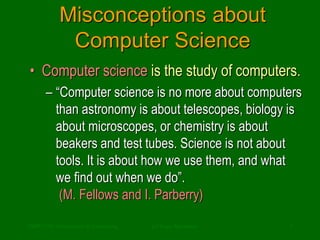
• Computer science is the study of computers.
– “Computer science is no more about computers
than astronomy is about telescopes, biology is
about microscopes, or chemistry is about
beakers and test tubes. Science is not about
tools. It is about how we use them, and what
we find out when we do”.
(M. Fellows and I. Parberry)
CMPUT101 Introduction to Computing (c) Yngvi Bjornsson 3
Misconceptions ( cont. … )
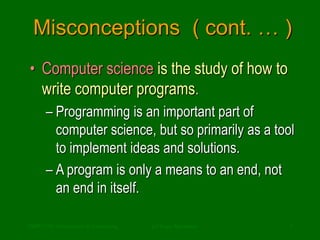
• Computer science is the study of how to
write computer programs.
– Programming is an important part of
computer science, but so primarily as a tool
to implement ideas and solutions.
– A program is only a means to an end, not
an end in itself.
CMPUT101 Introduction to Computing (c) Yngvi Bjornsson 4
Misconceptions ( cont. … )
• Computer science is the study of the
uses and applications of computers and
software.
– Learning how to use a computer/software
is no more part of computer science than
driver’s education is a branch of automotive
engineering.
CMPUT101 Introduction to Computing (c) Yngvi Bjornsson 5
What is Computer Science
then?
• The previous definitions:
– although not necessarily (completely) wrong, are
incomplete and thus misleading.
• A more accurate definition:
Computer science is the study of algorithms,
including their properties, their hardware and
linguistic realizations, and their applications.
CMPUT101 Introduction to Computing (c) Yngvi Bjornsson 6
OK, but what is an
algorithm?
• Formal definition:
– A well-ordered collection of unambiguous and
effectively computable operations that, when
executed, produces a result and halts in a
finite amount of time.
• Or, more informally:
A step-by-step method for accomplishing
some task.
CMPUT101 Introduction to Computing (c) Yngvi Bjornsson 7
“Algorithms” in our Daily
Life
• Algorithms are not necessarily limited to
specify mathematical tasks.
• We use “algorithms” all the time in our daily
life, for example:
– Cooking recipes.
– Instructions for assembling things.
– Directions how to get to places.
– When performing routine tasks.
CMPUT101 Introduction to Computing (c) Yngvi Bjornsson 8
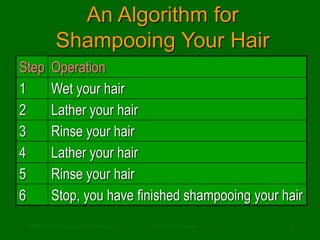
An Algorithm for
Shampooing Your Hair
Step Operation
1 Wet your hair
2 Lather your hair
3 Rinse your hair
4 Lather your hair
5 Rinse your hair
6 Stop, you have finished shampooing your hair
CMPUT101 Introduction to Computing (c) Yngvi Bjornsson 9
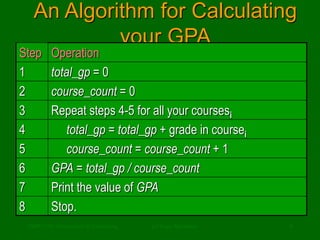
An Algorithm for Calculating
your GPA
Step Operation
1 total_gp = 0
2 course_count = 0
3 Repeat steps 4-5 for all your coursesi
4 total_gp = total_gp + grade in coursei
5 course_count = course_count + 1
6 GPA = total_gp / course_count
7 Print the value of GPA
8 Stop.
CMPUT101 Introduction to Computing (c) Yngvi Bjornsson 10
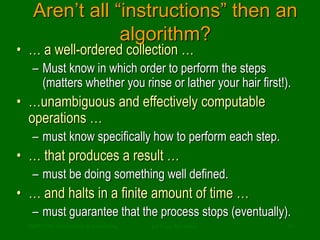
Aren’t all “instructions” then an
algorithm?
• … a well-ordered collection …
– Must know in which order to perform the steps
(matters whether you rinse or lather your hair first!).
• …unambiguous and effectively computable
operations …
– must know specifically how to perform each step.
• … that produces a result …
– must be doing something well defined.
• … and halts in a finite amount of time …
– must guarantee that the process stops (eventually).
CMPUT101 Introduction to Computing (c) Yngvi Bjornsson 11
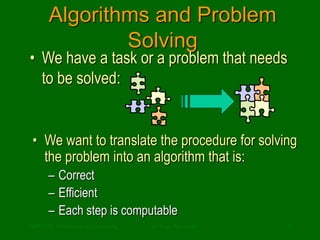
Algorithms and Problem
Solving
• We have a task or a problem that needs
to be solved:
• We want to translate the procedure for solving
the problem into an algorithm that is:
– Correct
– Efficient
– Each step is computable
CMPUT101 Introduction to Computing (c) Yngvi Bjornsson 12
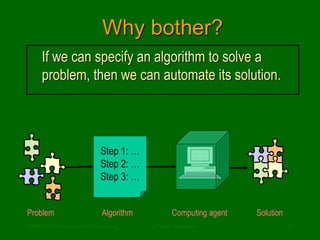
Why bother?
If we can specify an algorithm to solve a
problem, then we can automate its solution.
Step 1: …
Step 2: …
Step 3: …
Computing agent
Problem Algorithm Solution
CMPUT101 Introduction to Computing (c) Yngvi Bjornsson 13
Computing Agent
• A computing agent is an entity capable of
performing the steps described in the
algorithm, that is, execute the algorithm.
• Could be a:
– Person
– DNA (!)
– Computer
• In our case, typically a computer.
CMPUT101 Introduction to Computing (c) Yngvi Bjornsson 14
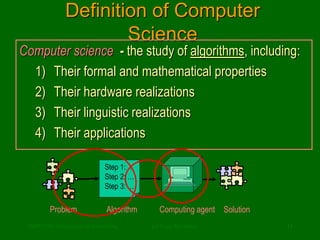
Definition of Computer
Science
Computer science - the study of algorithms, including:
1) Their formal and mathematical properties
2) Their hardware realizations
3) Their linguistic realizations
4) Their applications
Step 1: …
Step 2: …
Step 3: …
Computing agent
Problem Algorithm Solution
CMPUT101 Introduction to Computing (c) Yngvi Bjornsson 15
1) Formal and Mathematical
Properties
• Computer Science is about:
– How to design algorithms to solve a wide
range of problems.
– How to determine whether problems are
(efficiently) computable
• That is, can be specified as an algorithm!
– Studying the behavior of algorithms to
decide whether they are correct and how
efficient they are.
CMPUT101 Introduction to Computing (c) Yngvi Bjornsson 16
2) Their Hardware
Realization
• Computer Science is about:
– Designing and building computer systems
capable of executing algorithms.
– Non-stopping technological advances:
• Faster and faster computers, networks, …
• Parallel computing
• “Quantum computing”?
CMPUT101 Introduction to Computing (c) Yngvi Bjornsson 17
3) Their linguistic
realizations
• Computer Science is about:
– Designing programming languages and
translating algorithms into these languages
so they can be executed by the hardware.
• Functional programming
• Object Oriented programming
• Visual programming
• …
CMPUT101 Introduction to Computing (c) Yngvi Bjornsson 18
4) Their applications
• Computer Science is about:
– Identifying important problems (new uses) for
computers.
– Designing software to solve these new problems.
• New and new applications:
– First computers were used mainly for numerical
calculations and massive data storage/retrieval.
– Then, … business use, graphics, multimedia,
games, Internet, WWW, cars, house appliances, …
• What’s to come?

Intro to Computer Science.ppt

  • 1.
    CMPUT101 Introduction toComputing (c) Yngvi Bjornsson 1 An Introduction to Computer Science Chapter 1 Topics: The Definition of Computer Science Algorithms
  • 2.
    CMPUT101 Introduction toComputing (c) Yngvi Bjornsson 2 Misconceptions about Computer Science • Computer science is the study of computers. – “Computer science is no more about computers than astronomy is about telescopes, biology is about microscopes, or chemistry is about beakers and test tubes. Science is not about tools. It is about how we use them, and what we find out when we do”. (M. Fellows and I. Parberry)
  • 3.
    CMPUT101 Introduction toComputing (c) Yngvi Bjornsson 3 Misconceptions ( cont. … ) • Computer science is the study of how to write computer programs. – Programming is an important part of computer science, but so primarily as a tool to implement ideas and solutions. – A program is only a means to an end, not an end in itself.
  • 4.
    CMPUT101 Introduction toComputing (c) Yngvi Bjornsson 4 Misconceptions ( cont. … ) • Computer science is the study of the uses and applications of computers and software. – Learning how to use a computer/software is no more part of computer science than driver’s education is a branch of automotive engineering.
  • 5.
    CMPUT101 Introduction toComputing (c) Yngvi Bjornsson 5 What is Computer Science then? • The previous definitions: – although not necessarily (completely) wrong, are incomplete and thus misleading. • A more accurate definition: Computer science is the study of algorithms, including their properties, their hardware and linguistic realizations, and their applications.
  • 6.
    CMPUT101 Introduction toComputing (c) Yngvi Bjornsson 6 OK, but what is an algorithm? • Formal definition: – A well-ordered collection of unambiguous and effectively computable operations that, when executed, produces a result and halts in a finite amount of time. • Or, more informally: A step-by-step method for accomplishing some task.
  • 7.
    CMPUT101 Introduction toComputing (c) Yngvi Bjornsson 7 “Algorithms” in our Daily Life • Algorithms are not necessarily limited to specify mathematical tasks. • We use “algorithms” all the time in our daily life, for example: – Cooking recipes. – Instructions for assembling things. – Directions how to get to places. – When performing routine tasks.
  • 8.
    CMPUT101 Introduction toComputing (c) Yngvi Bjornsson 8 An Algorithm for Shampooing Your Hair Step Operation 1 Wet your hair 2 Lather your hair 3 Rinse your hair 4 Lather your hair 5 Rinse your hair 6 Stop, you have finished shampooing your hair
  • 9.
    CMPUT101 Introduction toComputing (c) Yngvi Bjornsson 9 An Algorithm for Calculating your GPA Step Operation 1 total_gp = 0 2 course_count = 0 3 Repeat steps 4-5 for all your coursesi 4 total_gp = total_gp + grade in coursei 5 course_count = course_count + 1 6 GPA = total_gp / course_count 7 Print the value of GPA 8 Stop.
  • 10.
    CMPUT101 Introduction toComputing (c) Yngvi Bjornsson 10 Aren’t all “instructions” then an algorithm? • … a well-ordered collection … – Must know in which order to perform the steps (matters whether you rinse or lather your hair first!). • …unambiguous and effectively computable operations … – must know specifically how to perform each step. • … that produces a result … – must be doing something well defined. • … and halts in a finite amount of time … – must guarantee that the process stops (eventually).
  • 11.
    CMPUT101 Introduction toComputing (c) Yngvi Bjornsson 11 Algorithms and Problem Solving • We have a task or a problem that needs to be solved: • We want to translate the procedure for solving the problem into an algorithm that is: – Correct – Efficient – Each step is computable
  • 12.
    CMPUT101 Introduction toComputing (c) Yngvi Bjornsson 12 Why bother? If we can specify an algorithm to solve a problem, then we can automate its solution. Step 1: … Step 2: … Step 3: … Computing agent Problem Algorithm Solution
  • 13.
    CMPUT101 Introduction toComputing (c) Yngvi Bjornsson 13 Computing Agent • A computing agent is an entity capable of performing the steps described in the algorithm, that is, execute the algorithm. • Could be a: – Person – DNA (!) – Computer • In our case, typically a computer.
  • 14.
    CMPUT101 Introduction toComputing (c) Yngvi Bjornsson 14 Definition of Computer Science Computer science - the study of algorithms, including: 1) Their formal and mathematical properties 2) Their hardware realizations 3) Their linguistic realizations 4) Their applications Step 1: … Step 2: … Step 3: … Computing agent Problem Algorithm Solution
  • 15.
    CMPUT101 Introduction toComputing (c) Yngvi Bjornsson 15 1) Formal and Mathematical Properties • Computer Science is about: – How to design algorithms to solve a wide range of problems. – How to determine whether problems are (efficiently) computable • That is, can be specified as an algorithm! – Studying the behavior of algorithms to decide whether they are correct and how efficient they are.
  • 16.
    CMPUT101 Introduction toComputing (c) Yngvi Bjornsson 16 2) Their Hardware Realization • Computer Science is about: – Designing and building computer systems capable of executing algorithms. – Non-stopping technological advances: • Faster and faster computers, networks, … • Parallel computing • “Quantum computing”?
  • 17.
    CMPUT101 Introduction toComputing (c) Yngvi Bjornsson 17 3) Their linguistic realizations • Computer Science is about: – Designing programming languages and translating algorithms into these languages so they can be executed by the hardware. • Functional programming • Object Oriented programming • Visual programming • …
  • 18.
    CMPUT101 Introduction toComputing (c) Yngvi Bjornsson 18 4) Their applications • Computer Science is about: – Identifying important problems (new uses) for computers. – Designing software to solve these new problems. • New and new applications: – First computers were used mainly for numerical calculations and massive data storage/retrieval. – Then, … business use, graphics, multimedia, games, Internet, WWW, cars, house appliances, … • What’s to come?

Editor's Notes

  • #19 Chapter 1: An Introduction to Computer Science