Dr. Deepak Mishra
Dept. of Sports Psychology
SAI NSNIS, Patiala.
INTRODUCTION TO SPORTS
PSYCHOLOGY
Sports Psychology
 Sports + Psychology
 Sports is “any physical activity for the purposes of
competition, recreation, education or health”
(European Federation of Sport Psychology,
FEPSAC, 1996).
 Psychology is “ Scientific study of human mind and
behavior”(Gross, 2005).
Sports Psychology
 Thus, Sports Psychology can be defined as ‘Sport
Psychology is the study of the psychological basis,
processes and effects of sport.’
 Sports psychology is a broad church.
 Sports psychologist often distinguished between two
sub divisions of Sports Psychology.
1. Academic Sports Psychology
2. Applied Sports Psychology
Sports Psychology
 Academic Sports Psychology: Focuses on all the
factors affecting participation and performance in
sport.
 Applied Sport Psychology: Focuses purely on
applying psychology to enhance athletic performance.
Objectives of Sport Psychology
 It aims to improve both the sports performance and general well-
being of the athlete, through the application of psychological
principles and techniques.
 It involves the study of how psychological factors affect
performance and how participation in sport and exercise affect
psychological and physical factors.
 The goal of applied practice is to optimize performance and
enjoyment through the use of psychological skills and the use of
psychometrics and psychological assessment.
 It aims to help the sportspersons deal with precompetitive Stress and
Anxiety which is debilitative to their sports performance.
Three roles
What Sport and Exercise Psychology
Specialists do
Early Years (1895-1924)
Research
• Triplett (1899): 1st Sports Psychology
Experiment
• Lab based procedures
• Topics focused on Personality and Motor
Learning
Teaching – None
Consultation - None
Griffith Era (1925-1938)
Research
• Conducted a systematic program of theoretical and
applied research
• Lab-based
• Topics focused on Motor Learning and Sport
Performance (e.g., football stance)
§Teaching
• Developed Sport Psychology class and taught principles
in several classes
Griffith Era (1925-1938)
 Consulting
• Wrote books
ØPsychology of Coaching
ØPsychology and Athletics
• Outlined functions of Sport Psychologists
• Consulted with a wide variety of Illinois Athletic
teams.
Dark Ages (1939-1964)
 Research
• Little systematic lab-based research
• Alan Slater-Hammel -- Motor Learning
• Emma McCloy -- Motor Abilities
 Teaching
• John Lawther (1951) Psychology and Coaching
§Consultation
• Minimal consultation being conducted
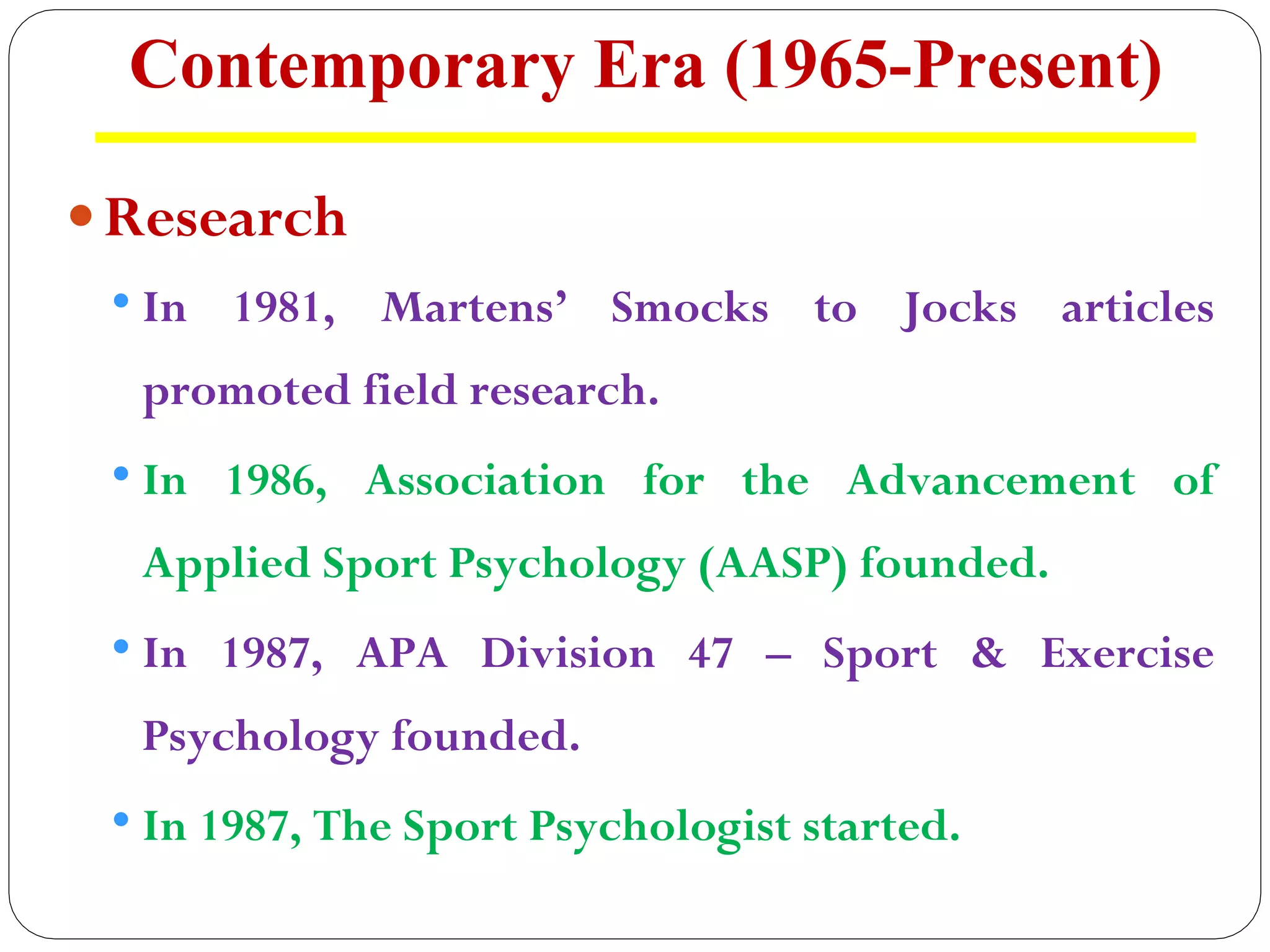
Contemporary Era (1965-Present)
Research
• In 1981, Martens’ Smocks to Jocks articles
promoted field research.
• In 1986, Association for the Advancement of
Applied Sport Psychology (AASP) founded.
• In 1987, APA Division 47 – Sport & Exercise
Psychology founded.
• In 1987, The Sport Psychologist started.
Sport Psychology Organizations
§Association of Applied Sport Psychology
(AASP)
§APA Division 47 – Sport & Exercise
Psychology (DIV-47)
§North American Society for the
Psychology of Sport and Physical Activity
(NASPSPA)
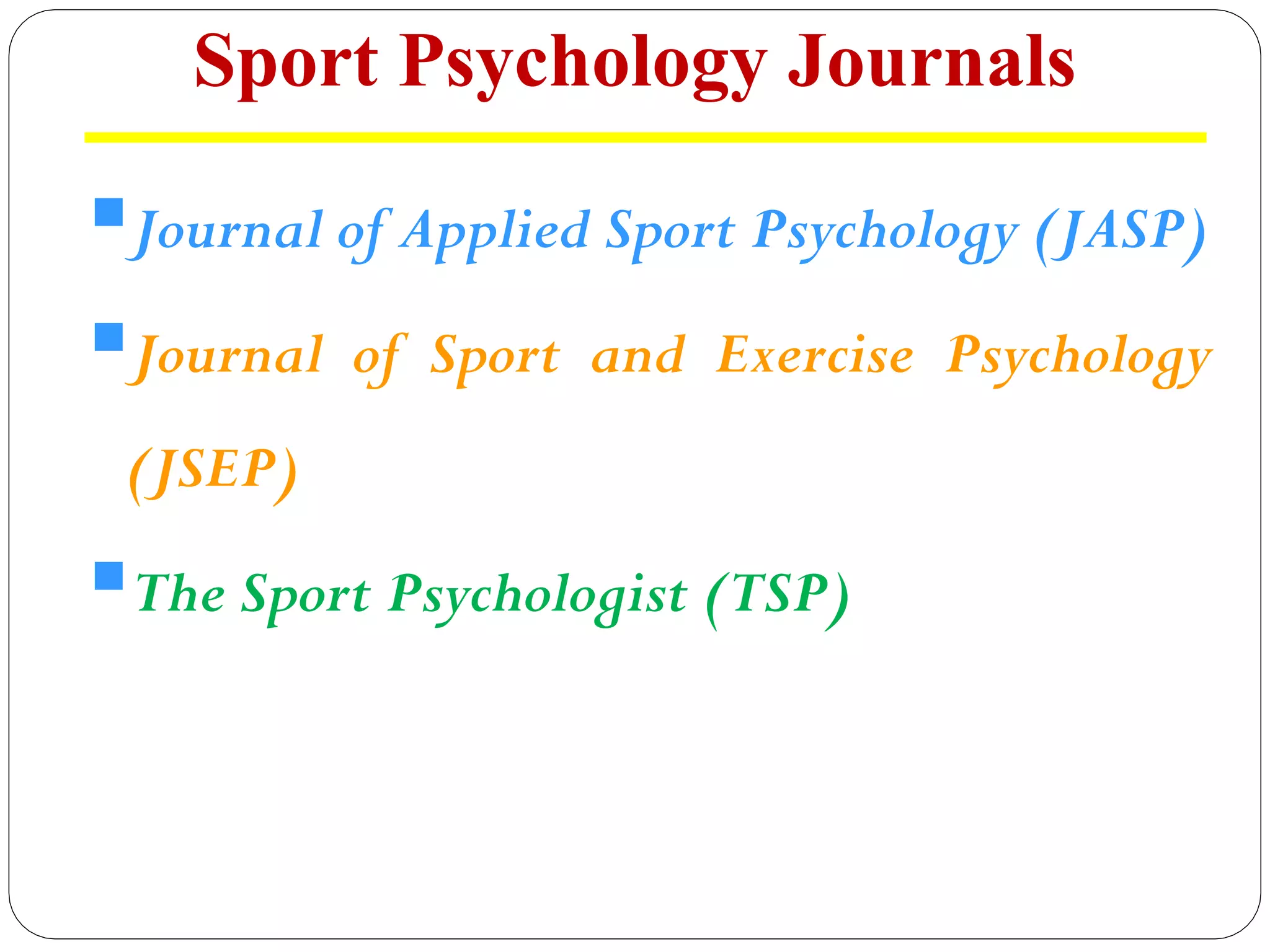
Sport Psychology Journals
§Journal of Applied Sport Psychology (JASP)
§Journal of Sport and Exercise Psychology
(JSEP)
§The Sport Psychologist (TSP)
History of Sports Psychology in India
 Can’t be understood without reference to the context of
development of Physical Education in relation to sport-coaching
system.
 Started with establishment of YMCA college of physical
education in Madras (1920), curricula of principles of Education
Psychology.
 Largely on “academic lines”.
 Introduction of Masters course at LNCPE, PGCPE (Patiala),
Educational Psychology become more Sports oriented.
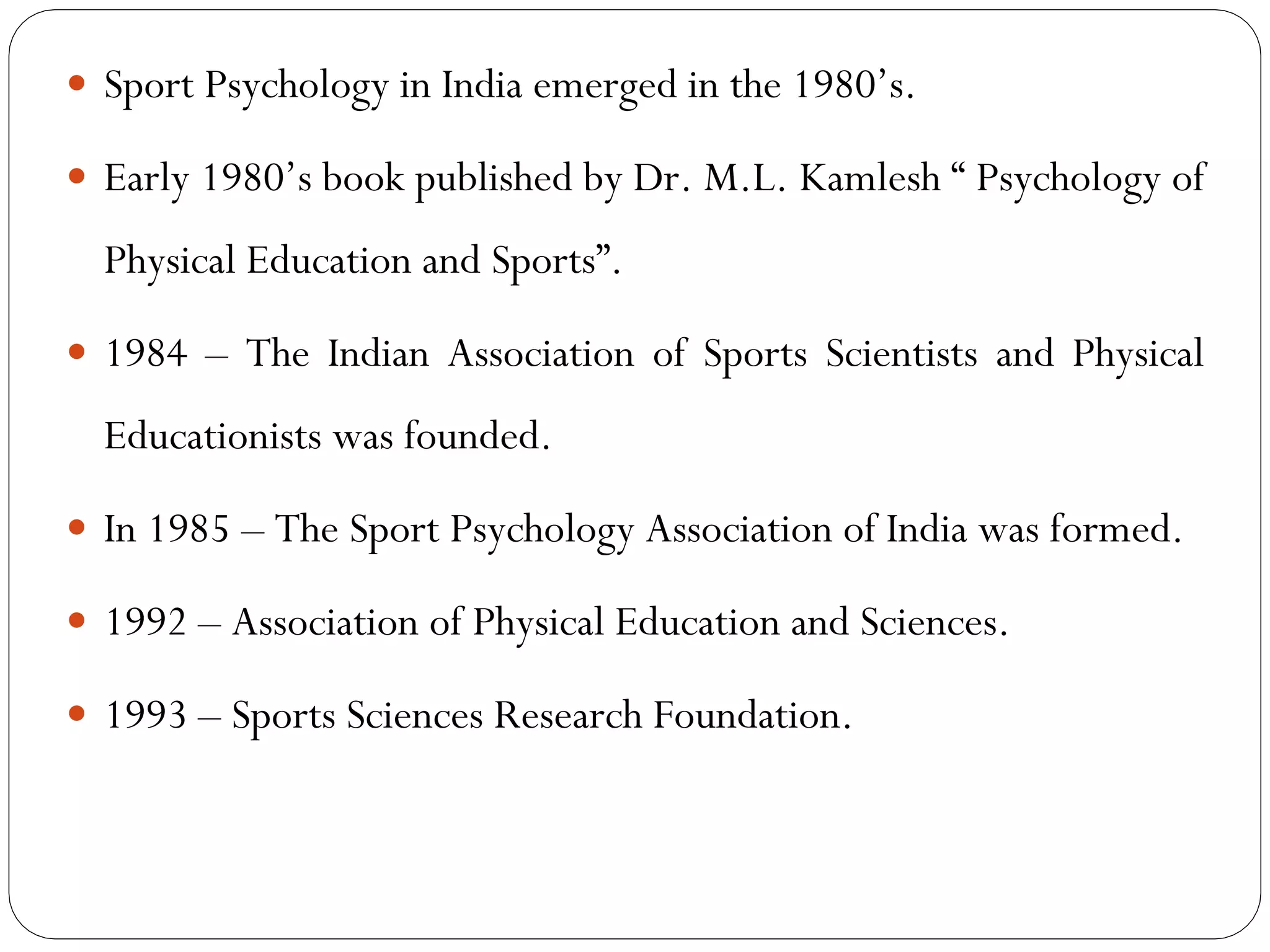
 Sport Psychology in India emerged in the 1980’s.
 Early 1980’s book published by Dr. M.L. Kamlesh “ Psychology of
Physical Education and Sports”.
 1984 – The Indian Association of Sports Scientists and Physical
Educationists was founded.
 In 1985 – The Sport Psychology Association of India was formed.
 1992 – Association of Physical Education and Sciences.
 1993 – Sports Sciences Research Foundation.
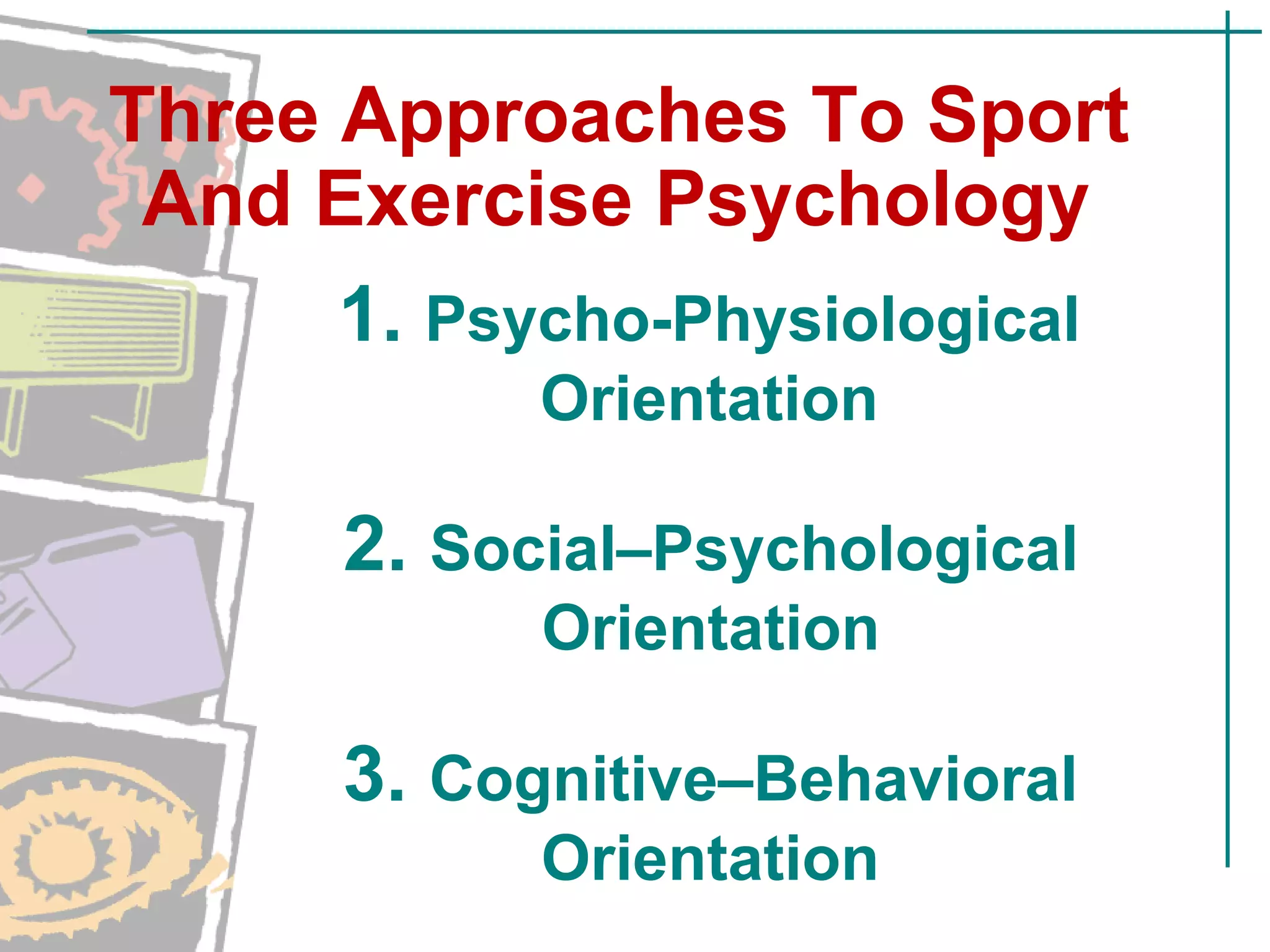
1. Psycho-Physiological
Orientation
2. Social–Psychological
Orientation
3. Cognitive–Behavioral
Orientation
Three Approaches To Sport
And Exercise Psychology
Psycho-Physiological
Orientation
Examines underlying Psycho-
Physiological processes of the
brain in terms of primary causes
of behavior.
Example:
Biofeedback training
Social–Psychological
Orientation
Behavior is determined by a
complex interaction of the social
environment and the personal
make-up of the athlete or
exerciser.
Example:
How a leader’s style and strategies
foster group cohesion
Cognitive–Behavioral
Orientation
Behavior is determined by both
the environment and thoughts
(cognitions).
Example:
Studying differences on confidence,
anxiety, concentration, goal setting
skills etc. among players
 Emotional reconditioning
 Motivational technique for learning new skills
 Psychological preparation for a contest and the hazards
involved in it
 Motivation for peak performance
 Teaching and coaching methods
 Perceptual development and the learning of movement
patterns
 Relationship of personality traits to athletic prowess etc.
Sports problems of psychological
nature faced by athletes
v How can highly skilled performance be
developed?
v What factors should be emphasized to enhance
the learning situation?
v What factors of growth and development need to
be considered?
v What is the role of personality profiles or specific
traits in contributing to the outstanding
Sports problems of psychological
nature faced by Coaches
 What are the main areas where
experimentation in sports is needed?
 How the interpersonal and social
relationships between the individual players
in the same group affect the performance of
the team?
 What types of psychic problems occur in the
field of sports?
CHIEF COMPLAINTS & SHORT TERM
INTERVENTION TECHNIQUES
Chief Complaints Suggested Techniques
Warm- up dependency • Psycho- education regarding physical and
mental training
• Thought Changing technique
Lack of Confidence • Positive self talk strategy
• Set realistic performance goals
• Pep-up talk
• Imagery
Negative thought • Positive attitude building
• Thought Changing technique
• JPMR
• Autogenic relaxation technique
CHIEF COMPLAINTS & SHORT TERM
INTERVENTION TECHNIQUES
Chief Complaints Suggested Techniques
Aggressiveness/ Frustration
during bout
• Relaxation techniques with imagery
• Decision making and planning session
• Hassel log Technique
• Arousal monitoring
Poor Concentration • Attention Control Training (like focusing
on most relevant cues)
• Cue-words
• Attention Control Training (like focusing
on most relevant cues)
• Cue-words
• Here and now technique
• Mixed reaction timer technique,
• digit span
Psycho- social stress • Counseling
• Support from team n family members
LONG TERM INTERVENTION PLAN &
TECHNIQUES
Chief Complaints Suggested Techniques
Mental toughness • Assertiveness training,
• Mental toughness procedures,
• Proactivity
• Hardiness
Communication skills • Assertiveness training,
• Transactional analysis,
• Free association,
• Social skill training,
• Ice breaking technique
Motivation • Motivation enhancement therapy
• Psyche-up Technique
LONG TERM INTERVENTION PLAN &
TECHNIQUES
Chief Complaints Suggested Techniques
Burnout • Intervention on training schedule
• Rescheduling reinforcement
• Promoting self-actualization
Psycho- social Stress • Cognitive behavioral intervention
• Cognitive restructuring
Fatigue • Mental fatigue management
• Training on Flicker- eye movement test
• Eye movement desensitization and
Reprocessing Therapy (EMDRT)
Aspects Of Sport Psychology
 Cognitive Aspects
 Affective Aspects
 Conative Aspects
 Motivation
 Goal setting
 Personality Traits
 Aggression
 Leadership
 Self Confidence and Self Efficacy
Cognitive Aspects
 Sensation
 Perception
 Attention
 Concentration
 Thinking
 Memory
 Imagery
 Decision making
 Problem Solving
 Intelligence
Affective Aspects
Emotions and Feelings
Anger Management
Arousal
Anxiety
Conative Aspects
 Motor Learning
 Aggression
 Skill Demonstration
 Laws of Learning
 Transfer of Training
 Plateau
Thank You

intro Sports Psychology.pdf

  • 1.
    Dr. Deepak Mishra Dept.of Sports Psychology SAI NSNIS, Patiala. INTRODUCTION TO SPORTS PSYCHOLOGY
  • 2.
    Sports Psychology  Sports+ Psychology  Sports is “any physical activity for the purposes of competition, recreation, education or health” (European Federation of Sport Psychology, FEPSAC, 1996).  Psychology is “ Scientific study of human mind and behavior”(Gross, 2005).
  • 3.
    Sports Psychology  Thus,Sports Psychology can be defined as ‘Sport Psychology is the study of the psychological basis, processes and effects of sport.’  Sports psychology is a broad church.  Sports psychologist often distinguished between two sub divisions of Sports Psychology. 1. Academic Sports Psychology 2. Applied Sports Psychology
  • 4.
    Sports Psychology  AcademicSports Psychology: Focuses on all the factors affecting participation and performance in sport.  Applied Sport Psychology: Focuses purely on applying psychology to enhance athletic performance.
  • 5.
    Objectives of SportPsychology  It aims to improve both the sports performance and general well- being of the athlete, through the application of psychological principles and techniques.  It involves the study of how psychological factors affect performance and how participation in sport and exercise affect psychological and physical factors.  The goal of applied practice is to optimize performance and enjoyment through the use of psychological skills and the use of psychometrics and psychological assessment.  It aims to help the sportspersons deal with precompetitive Stress and Anxiety which is debilitative to their sports performance.
  • 6.
    Three roles What Sportand Exercise Psychology Specialists do
  • 7.
    Early Years (1895-1924) Research •Triplett (1899): 1st Sports Psychology Experiment • Lab based procedures • Topics focused on Personality and Motor Learning Teaching – None Consultation - None
  • 8.
    Griffith Era (1925-1938) Research •Conducted a systematic program of theoretical and applied research • Lab-based • Topics focused on Motor Learning and Sport Performance (e.g., football stance) §Teaching • Developed Sport Psychology class and taught principles in several classes
  • 9.
    Griffith Era (1925-1938) Consulting • Wrote books ØPsychology of Coaching ØPsychology and Athletics • Outlined functions of Sport Psychologists • Consulted with a wide variety of Illinois Athletic teams.
  • 10.
    Dark Ages (1939-1964) Research • Little systematic lab-based research • Alan Slater-Hammel -- Motor Learning • Emma McCloy -- Motor Abilities  Teaching • John Lawther (1951) Psychology and Coaching §Consultation • Minimal consultation being conducted
  • 11.
    Contemporary Era (1965-Present) Research •In 1981, Martens’ Smocks to Jocks articles promoted field research. • In 1986, Association for the Advancement of Applied Sport Psychology (AASP) founded. • In 1987, APA Division 47 – Sport & Exercise Psychology founded. • In 1987, The Sport Psychologist started.
  • 12.
    Sport Psychology Organizations §Associationof Applied Sport Psychology (AASP) §APA Division 47 – Sport & Exercise Psychology (DIV-47) §North American Society for the Psychology of Sport and Physical Activity (NASPSPA)
  • 13.
    Sport Psychology Journals §Journalof Applied Sport Psychology (JASP) §Journal of Sport and Exercise Psychology (JSEP) §The Sport Psychologist (TSP)
  • 14.
    History of SportsPsychology in India  Can’t be understood without reference to the context of development of Physical Education in relation to sport-coaching system.  Started with establishment of YMCA college of physical education in Madras (1920), curricula of principles of Education Psychology.  Largely on “academic lines”.  Introduction of Masters course at LNCPE, PGCPE (Patiala), Educational Psychology become more Sports oriented.
  • 15.
     Sport Psychologyin India emerged in the 1980’s.  Early 1980’s book published by Dr. M.L. Kamlesh “ Psychology of Physical Education and Sports”.  1984 – The Indian Association of Sports Scientists and Physical Educationists was founded.  In 1985 – The Sport Psychology Association of India was formed.  1992 – Association of Physical Education and Sciences.  1993 – Sports Sciences Research Foundation.
  • 16.
    1. Psycho-Physiological Orientation 2. Social–Psychological Orientation 3.Cognitive–Behavioral Orientation Three Approaches To Sport And Exercise Psychology
  • 17.
    Psycho-Physiological Orientation Examines underlying Psycho- Physiologicalprocesses of the brain in terms of primary causes of behavior. Example: Biofeedback training
  • 18.
    Social–Psychological Orientation Behavior is determinedby a complex interaction of the social environment and the personal make-up of the athlete or exerciser. Example: How a leader’s style and strategies foster group cohesion
  • 19.
    Cognitive–Behavioral Orientation Behavior is determinedby both the environment and thoughts (cognitions). Example: Studying differences on confidence, anxiety, concentration, goal setting skills etc. among players
  • 20.
     Emotional reconditioning Motivational technique for learning new skills  Psychological preparation for a contest and the hazards involved in it  Motivation for peak performance  Teaching and coaching methods  Perceptual development and the learning of movement patterns  Relationship of personality traits to athletic prowess etc. Sports problems of psychological nature faced by athletes
  • 21.
    v How canhighly skilled performance be developed? v What factors should be emphasized to enhance the learning situation? v What factors of growth and development need to be considered? v What is the role of personality profiles or specific traits in contributing to the outstanding Sports problems of psychological nature faced by Coaches
  • 22.
     What arethe main areas where experimentation in sports is needed?  How the interpersonal and social relationships between the individual players in the same group affect the performance of the team?  What types of psychic problems occur in the field of sports?
  • 23.
    CHIEF COMPLAINTS &SHORT TERM INTERVENTION TECHNIQUES Chief Complaints Suggested Techniques Warm- up dependency • Psycho- education regarding physical and mental training • Thought Changing technique Lack of Confidence • Positive self talk strategy • Set realistic performance goals • Pep-up talk • Imagery Negative thought • Positive attitude building • Thought Changing technique • JPMR • Autogenic relaxation technique
  • 24.
    CHIEF COMPLAINTS &SHORT TERM INTERVENTION TECHNIQUES Chief Complaints Suggested Techniques Aggressiveness/ Frustration during bout • Relaxation techniques with imagery • Decision making and planning session • Hassel log Technique • Arousal monitoring Poor Concentration • Attention Control Training (like focusing on most relevant cues) • Cue-words • Attention Control Training (like focusing on most relevant cues) • Cue-words • Here and now technique • Mixed reaction timer technique, • digit span Psycho- social stress • Counseling • Support from team n family members
  • 25.
    LONG TERM INTERVENTIONPLAN & TECHNIQUES Chief Complaints Suggested Techniques Mental toughness • Assertiveness training, • Mental toughness procedures, • Proactivity • Hardiness Communication skills • Assertiveness training, • Transactional analysis, • Free association, • Social skill training, • Ice breaking technique Motivation • Motivation enhancement therapy • Psyche-up Technique
  • 26.
    LONG TERM INTERVENTIONPLAN & TECHNIQUES Chief Complaints Suggested Techniques Burnout • Intervention on training schedule • Rescheduling reinforcement • Promoting self-actualization Psycho- social Stress • Cognitive behavioral intervention • Cognitive restructuring Fatigue • Mental fatigue management • Training on Flicker- eye movement test • Eye movement desensitization and Reprocessing Therapy (EMDRT)
  • 27.
    Aspects Of SportPsychology  Cognitive Aspects  Affective Aspects  Conative Aspects  Motivation  Goal setting  Personality Traits  Aggression  Leadership  Self Confidence and Self Efficacy
  • 28.
    Cognitive Aspects  Sensation Perception  Attention  Concentration  Thinking  Memory  Imagery  Decision making  Problem Solving  Intelligence
  • 29.
    Affective Aspects Emotions andFeelings Anger Management Arousal Anxiety
  • 30.
    Conative Aspects  MotorLearning  Aggression  Skill Demonstration  Laws of Learning  Transfer of Training  Plateau
  • 31.