
Geography 110
Physical
Geography
Reference # 4322
Online Course
Professor Lisa Schmidt
Important Information
• Professor Lisa Schmidt
• Ref. 4332
• Online
• ProfessorLisaS@gmail.com
• Fall 2015
• (909) 384-5221 Voice Mail
• (760) 440-8977 Text or Voice Mail
• http://schmidtphysicalgeography.wikispaces.com
Physical Geography
• Welcome to Geography 110, Physical
Geography. In this class, you will learn
the basic elements of geography. We will
study climate, landforms, water, soils,
native animal life and native vegetation.
We will examine the inter-relationships
between these things and we will look at
their patterns of distribution throughout the
world.
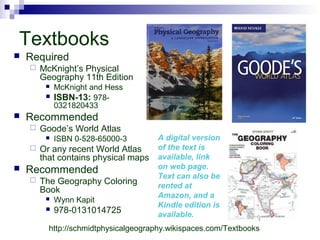
Textbooks
 Required
 McKnight’s Physical
Geography 11th Edition
 McKnight and Hess
 ISBN-13: 978-
0321820433
 Recommended
 Goode’s World Atlas
 ISBN 0-528-65000-3
 Or any recent World Atlas
that contains physical maps
 Recommended
 The Geography Coloring
Book
 Wynn Kapit
 978-0131014725
A digital version
of the text is
available, link
on web page.
Text can also be
rented at
Amazon, and a
Kindle edition is
available.
http://schmidtphysicalgeography.wikispaces.com/Textbooks
Required Materials
 Internet Access
 Access to a computer – not just a tablet or
a phone
 Pencils
 Pens
 Paper
Recommended Materials
 Colored Pens or Pencils
For map studies
Course Description
 The goal of this course is to introduce students
to basic concepts in physical geography…
(please read course description in the syllabus)
 Since it is an introductory course, it is assumed
students have little or no background in physical
geography.
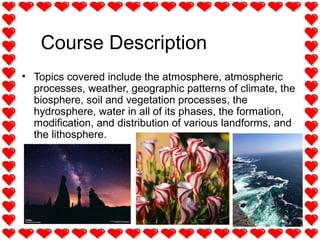
Course Description
• Topics covered include the atmosphere, atmospheric
processes, weather, geographic patterns of climate, the
biosphere, soil and vegetation processes, the
hydrosphere, water in all of its phases, the formation,
modification, and distribution of various landforms, and
the lithosphere.
Course Objectives
• You will gain an understanding of the geographic
perspective within natural and environmental sciences,
including place, space, map scale, map projection,
spatial connection, and spatial diffusion.
• You will better understand how to use maps, in
particular, the geographic distribution of natural
phenomena.
• You will learn about the four environmental spheres,
atmosphere, hydrosphere, biosphere, and lithosphere,
and how they interact across the surface of the Earth.
In particular, you will learn the role of humankind within
the environment.
Assignments & Grading
• Weekly Postings 18 @ 10
points each = 180
• Chapter Quizzes 14 @ 10
points each = 140
• Map Quizzes 5 @ 25 points
each = 125
• Exams 4 @ 100 = 400
• Project 1 @ 115 = 115
• Total Possible = 960
• 100-90% 906-864 A
• 89-80% 863-768 B
• 79-70% 767-672 C
• 69-60% 671-576 D
• 59-0% 576-0 F
Note: You must earn at least
60% to pass this class. You
may be dropped for falling below
60%. Please refer to your syllabus.
Weekly Reading & Map Studies
 Each week you will be required to read
chapters of your text and/or study your maps.
 You will have a posting assignment based on
the reading or map study and you will be
quizzed on the material as well.
Weekly Postings
• There will be a posting assignment
for each week of the course.
• Topics will be selected from the
current material for that week.
• Posting assignments will be due
one week after they are assigned
at 11:59 PM.
Chapter Quizzes
 There will be a quiz for each
chapter in the textbook.
 Quizzes will be posted each week on
Blackboard.
 Quizzes will be due one week after
they are posted by 11:59 PM.
 There will be 14 quizzes.
 The format will be multiple choice,
true/false, and or matching.
 Quiz questions may be used on
exams.
 You will want to take notes from your
quizzes and study them.
You can always access the
quizzes you have taken so you
can study from them-go into
“My Grades” on Blackboard and
click your score, that will take
you into yourr quiz.
Timed: 30 minutes
2 chances
Map Quizzes
 We will study the physical features of Earth.
 Colored pens or pencils will be helpful.
 You will have five map quizzes.
 North America 25 points
 South America 25 points
 Europe 25 points
 Asia 25 points
 Africa 25 points
 Total 125 points
Also given using Blackboard
Timed 30 minutes
2 chances
1 week close at 11:59 PM
Exams
 There will be four exams.
 Exams will be given using Blackboard.
 The format will be multiple choice, true and
false, and/or matching.
 Each exam will be worth 100 points.
 The final exam will be cumulative.
 A study guide will be available for each exam.
Also given using Blackboard
Timed: 60 minutes
ONE chance – close 11:59 PM
Presentation/Project
 You are required to write a research paper
and create a presentation for this Physical
Geography course.
 You will be able to choose from a list of
topics.
 Details will be posted on the class web
page.
Changes
• The dates, topics, assignments, and due
dates in the syllabus are tentative.
• There may be changes, it is your
responsibility to stay informed of changes.
• I recommend you make friends…
Class Web Page
• I have created a web page for your class.
• All of the presentations and maps used in class
are posted there already.
• You can print out a copy of the lecture and bring
it to class so you can take notes on it…
– I often lecture quickly, but ALL of the information is
online so I do not expect you to write down my slides
word for word as I lecture because you can access
them at any time.
• Each chapter has supplemental material as well,
like videos and pictures or articles that connect
the topics to our lives in the real world.
http://schmidtphysicalgeography.wikispaces.com/
Late Work and Exams
 Late work ...
 You are allowed one late
assignment. This can be a
quiz, map quiz, exam, or
part of your project. Use this
wisely…
Late work will not be allowed
after the end of class this
semester, so use this option
in a timely manner as well.
Dropping
 It is your responsibility to drop if you
decide you want to.
 If you stop doing your work and you do
not drop, you will receive an F.
 If you miss your assignments two
consecutive weeks in a row and you do
not contact me, I may drop you – but do
not rely on this, ultimately it is your
responsibility to drop.
Extra Credit
 Some extra credit may be assigned
throughout the semester.
 It must be turned in by the end of the
semester, if I have not stated a due date.
I started you with some extra credit on your syllabus…
Note the Quotes…
Academic Honesty
 Cheating of any kind will not be tolerated.
Any incidences of cheating or plagiarism will
be reported to the deans office.
Please refer to San Bernardino Valley
College’s policy on academic honesty.
Cell Phones
 I encourage the use of cell
phones for geography, please
note apps posted to the class
web page that relate to the
various chapters…
 You are carrying around a
small computer!! LOL when I
was a kid these things took up
whole rooms!! Young people
are so lucky! Use it for
everything you can!
Disability
Accommodations
• If you need accommodations for this course,
please contact me.
• If you have or think you may have a disability that
might affect your performance in this course,
please contact the office of Disabled Students
Programs and Services at (909) 384-4443.
Blackboard
• Blackboard will be used for this class.
– You will need to log in to Blackboard to take
your quizzes and exams and links to your
assignments.
– http://blackboard.valleycollege.edu
• If you have questions about blackboard, stay after
class, I am here to help.
Contact Information
• The best way to reach me is by e-mail.
• My e-mail address is:
ProfessorLisaS@gmail.com
• My mailbox is located in this building, in
the office just below us.
• You may text me at (760) 440-8977 and
you can leave voice mail at this number
too.
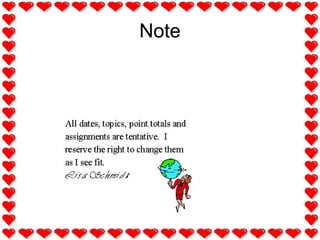
Note
Disruptive
Behavior
• You may be asked to
leave class if you
disrupt the learning
process for others.
This includes talking
during lecture or during
classmate's
presentations. If you
are asked to leave,
and disciplinary action
is taken, you may be
suspended from the
next class meeting.
I left this slide in the intro because I want
To issue a caution to all of you – I
expect you to be respectful of each other
Through any class communication –
this means postings or discussions or
group work. Treat other people the way
you want to be treated. If you are
having a bad day and feel like
posting something negative, just
walk away from the computer and
come back when you are in a better
mood. I will not tolerate any meanness or
bullying and the same rules apply to you
that apply to in class students as far as your
conduct with each other.
For Online Students…
Course
Schedule
At this time, I would like you to look at the
Schedule in your syllabus…
Note that it is quite detailed, you have information
On the topics being covered each night, what opens on
Blackboard, what closes, when parts of your project are due,
When maps studies happen, and when exams happen.
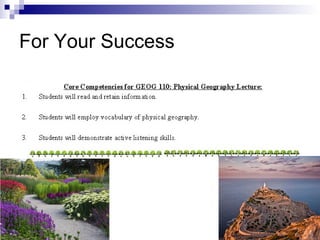
For Your Success
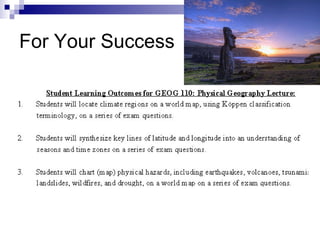
For Your Success
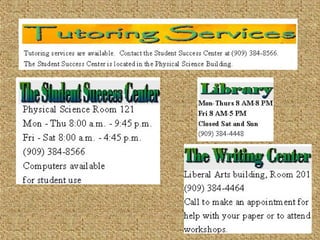
Service Available For Your
Success
• EOPS 384-4412
• Counseling – Educational
384-4404 &
Psychological 384-4495
• Childcare Center
384-4440
• Veterans Services
384-4441
• Health Center 384-4495
• Tutoring Services
• Student Success Centers
• Open Computer Labs
• STEM-Science
Technology Engineering
Mathematics
– Has a club
– Has its own counselor
– Has money for book
grants and more
And more… If you need something, there is probably an
office on campus that can help, ask me too.
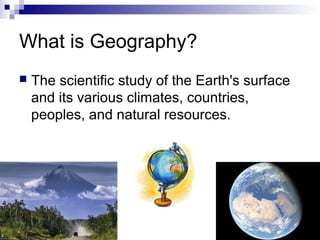
What is Geography?
 The scientific study of the Earth's surface
and its various climates, countries,
peoples, and natural resources.
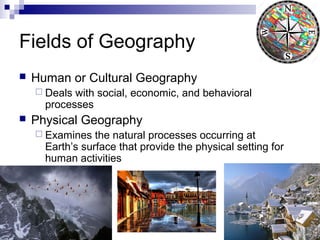
Fields of Geography
 Human or Cultural Geography
 Deals with social, economic, and behavioral
processes
 Physical Geography
 Examines the natural processes occurring at
Earth’s surface that provide the physical setting for
human activities
Branches of Human Geography
 Developmental
Geography
 Economic Geography
 Medical Geography
 Transportation
Geography
 Urban Geography
 Cultural Geography
 Historical Geography
 Political Geography
 Population
Geography
 Demography
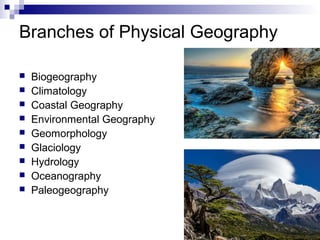
Branches of Physical Geography
 Biogeography
 Climatology
 Coastal Geography
 Environmental Geography
 Geomorphology
 Glaciology
 Hydrology
 Oceanography
 Paleogeography
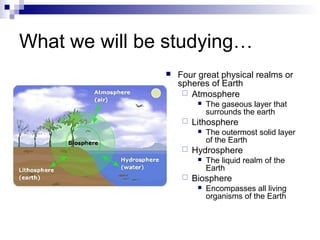
What we will be studying…
 Four great physical realms or
spheres of Earth
 Atmosphere
 The gaseous layer that
surrounds the earth
 Lithosphere
 The outermost solid layer
of the Earth
 Hydrosphere
 The liquid realm of the
Earth
 Biosphere
 Encompasses all living
organisms of the Earth
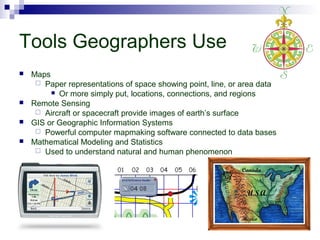
Tools Geographers Use
 Maps
 Paper representations of space showing point, line, or area data
 Or more simply put, locations, connections, and regions
 Remote Sensing
 Aircraft or spacecraft provide images of earth’s surface
 GIS or Geographic Information Systems
 Powerful computer mapmaking software connected to data bases
 Mathematical Modeling and Statistics
 Used to understand natural and human phenomenon
Week One
Assignments
• Check in! Complete the check in survey if
you have not already.
• Complete surveys, post an introduction,
post branches/tools/careers assignment.

Intro fall 2015 online physical geography

  • 1.
    Geography 110 Physical Geography Reference #4322 Online Course Professor Lisa Schmidt
  • 2.
    Important Information • ProfessorLisa Schmidt • Ref. 4332 • Online • ProfessorLisaS@gmail.com • Fall 2015 • (909) 384-5221 Voice Mail • (760) 440-8977 Text or Voice Mail • http://schmidtphysicalgeography.wikispaces.com
  • 3.
    Physical Geography • Welcometo Geography 110, Physical Geography. In this class, you will learn the basic elements of geography. We will study climate, landforms, water, soils, native animal life and native vegetation. We will examine the inter-relationships between these things and we will look at their patterns of distribution throughout the world.
  • 4.
    Textbooks  Required  McKnight’sPhysical Geography 11th Edition  McKnight and Hess  ISBN-13: 978- 0321820433  Recommended  Goode’s World Atlas  ISBN 0-528-65000-3  Or any recent World Atlas that contains physical maps  Recommended  The Geography Coloring Book  Wynn Kapit  978-0131014725 A digital version of the text is available, link on web page. Text can also be rented at Amazon, and a Kindle edition is available. http://schmidtphysicalgeography.wikispaces.com/Textbooks
  • 5.
    Required Materials  InternetAccess  Access to a computer – not just a tablet or a phone  Pencils  Pens  Paper
  • 6.
    Recommended Materials  ColoredPens or Pencils For map studies
  • 7.
    Course Description  Thegoal of this course is to introduce students to basic concepts in physical geography… (please read course description in the syllabus)  Since it is an introductory course, it is assumed students have little or no background in physical geography.
  • 8.
    Course Description • Topicscovered include the atmosphere, atmospheric processes, weather, geographic patterns of climate, the biosphere, soil and vegetation processes, the hydrosphere, water in all of its phases, the formation, modification, and distribution of various landforms, and the lithosphere.
  • 9.
    Course Objectives • Youwill gain an understanding of the geographic perspective within natural and environmental sciences, including place, space, map scale, map projection, spatial connection, and spatial diffusion. • You will better understand how to use maps, in particular, the geographic distribution of natural phenomena. • You will learn about the four environmental spheres, atmosphere, hydrosphere, biosphere, and lithosphere, and how they interact across the surface of the Earth. In particular, you will learn the role of humankind within the environment.
  • 10.
    Assignments & Grading •Weekly Postings 18 @ 10 points each = 180 • Chapter Quizzes 14 @ 10 points each = 140 • Map Quizzes 5 @ 25 points each = 125 • Exams 4 @ 100 = 400 • Project 1 @ 115 = 115 • Total Possible = 960 • 100-90% 906-864 A • 89-80% 863-768 B • 79-70% 767-672 C • 69-60% 671-576 D • 59-0% 576-0 F Note: You must earn at least 60% to pass this class. You may be dropped for falling below 60%. Please refer to your syllabus.
  • 11.
    Weekly Reading &Map Studies  Each week you will be required to read chapters of your text and/or study your maps.  You will have a posting assignment based on the reading or map study and you will be quizzed on the material as well.
  • 12.
    Weekly Postings • Therewill be a posting assignment for each week of the course. • Topics will be selected from the current material for that week. • Posting assignments will be due one week after they are assigned at 11:59 PM.
  • 13.
    Chapter Quizzes  Therewill be a quiz for each chapter in the textbook.  Quizzes will be posted each week on Blackboard.  Quizzes will be due one week after they are posted by 11:59 PM.  There will be 14 quizzes.  The format will be multiple choice, true/false, and or matching.  Quiz questions may be used on exams.  You will want to take notes from your quizzes and study them. You can always access the quizzes you have taken so you can study from them-go into “My Grades” on Blackboard and click your score, that will take you into yourr quiz. Timed: 30 minutes 2 chances
  • 14.
    Map Quizzes  Wewill study the physical features of Earth.  Colored pens or pencils will be helpful.  You will have five map quizzes.  North America 25 points  South America 25 points  Europe 25 points  Asia 25 points  Africa 25 points  Total 125 points Also given using Blackboard Timed 30 minutes 2 chances 1 week close at 11:59 PM
  • 15.
    Exams  There willbe four exams.  Exams will be given using Blackboard.  The format will be multiple choice, true and false, and/or matching.  Each exam will be worth 100 points.  The final exam will be cumulative.  A study guide will be available for each exam. Also given using Blackboard Timed: 60 minutes ONE chance – close 11:59 PM
  • 16.
    Presentation/Project  You arerequired to write a research paper and create a presentation for this Physical Geography course.  You will be able to choose from a list of topics.  Details will be posted on the class web page.
  • 17.
    Changes • The dates,topics, assignments, and due dates in the syllabus are tentative. • There may be changes, it is your responsibility to stay informed of changes. • I recommend you make friends…
  • 18.
    Class Web Page •I have created a web page for your class. • All of the presentations and maps used in class are posted there already. • You can print out a copy of the lecture and bring it to class so you can take notes on it… – I often lecture quickly, but ALL of the information is online so I do not expect you to write down my slides word for word as I lecture because you can access them at any time. • Each chapter has supplemental material as well, like videos and pictures or articles that connect the topics to our lives in the real world. http://schmidtphysicalgeography.wikispaces.com/
  • 19.
    Late Work andExams  Late work ...  You are allowed one late assignment. This can be a quiz, map quiz, exam, or part of your project. Use this wisely… Late work will not be allowed after the end of class this semester, so use this option in a timely manner as well.
  • 20.
    Dropping  It isyour responsibility to drop if you decide you want to.  If you stop doing your work and you do not drop, you will receive an F.  If you miss your assignments two consecutive weeks in a row and you do not contact me, I may drop you – but do not rely on this, ultimately it is your responsibility to drop.
  • 21.
    Extra Credit  Someextra credit may be assigned throughout the semester.  It must be turned in by the end of the semester, if I have not stated a due date. I started you with some extra credit on your syllabus… Note the Quotes…
  • 22.
    Academic Honesty  Cheatingof any kind will not be tolerated. Any incidences of cheating or plagiarism will be reported to the deans office. Please refer to San Bernardino Valley College’s policy on academic honesty.
  • 23.
    Cell Phones  Iencourage the use of cell phones for geography, please note apps posted to the class web page that relate to the various chapters…  You are carrying around a small computer!! LOL when I was a kid these things took up whole rooms!! Young people are so lucky! Use it for everything you can!
  • 24.
    Disability Accommodations • If youneed accommodations for this course, please contact me. • If you have or think you may have a disability that might affect your performance in this course, please contact the office of Disabled Students Programs and Services at (909) 384-4443.
  • 25.
    Blackboard • Blackboard willbe used for this class. – You will need to log in to Blackboard to take your quizzes and exams and links to your assignments. – http://blackboard.valleycollege.edu • If you have questions about blackboard, stay after class, I am here to help.
  • 26.
    Contact Information • Thebest way to reach me is by e-mail. • My e-mail address is: ProfessorLisaS@gmail.com • My mailbox is located in this building, in the office just below us. • You may text me at (760) 440-8977 and you can leave voice mail at this number too.
  • 27.
  • 28.
    Disruptive Behavior • You maybe asked to leave class if you disrupt the learning process for others. This includes talking during lecture or during classmate's presentations. If you are asked to leave, and disciplinary action is taken, you may be suspended from the next class meeting. I left this slide in the intro because I want To issue a caution to all of you – I expect you to be respectful of each other Through any class communication – this means postings or discussions or group work. Treat other people the way you want to be treated. If you are having a bad day and feel like posting something negative, just walk away from the computer and come back when you are in a better mood. I will not tolerate any meanness or bullying and the same rules apply to you that apply to in class students as far as your conduct with each other. For Online Students…
  • 29.
    Course Schedule At this time,I would like you to look at the Schedule in your syllabus… Note that it is quite detailed, you have information On the topics being covered each night, what opens on Blackboard, what closes, when parts of your project are due, When maps studies happen, and when exams happen.
  • 30.
  • 31.
  • 33.
    Service Available ForYour Success • EOPS 384-4412 • Counseling – Educational 384-4404 & Psychological 384-4495 • Childcare Center 384-4440 • Veterans Services 384-4441 • Health Center 384-4495 • Tutoring Services • Student Success Centers • Open Computer Labs • STEM-Science Technology Engineering Mathematics – Has a club – Has its own counselor – Has money for book grants and more And more… If you need something, there is probably an office on campus that can help, ask me too.
  • 34.
    What is Geography? The scientific study of the Earth's surface and its various climates, countries, peoples, and natural resources.
  • 35.
    Fields of Geography Human or Cultural Geography  Deals with social, economic, and behavioral processes  Physical Geography  Examines the natural processes occurring at Earth’s surface that provide the physical setting for human activities
  • 36.
    Branches of HumanGeography  Developmental Geography  Economic Geography  Medical Geography  Transportation Geography  Urban Geography  Cultural Geography  Historical Geography  Political Geography  Population Geography  Demography
  • 37.
    Branches of PhysicalGeography  Biogeography  Climatology  Coastal Geography  Environmental Geography  Geomorphology  Glaciology  Hydrology  Oceanography  Paleogeography
  • 38.
    What we willbe studying…  Four great physical realms or spheres of Earth  Atmosphere  The gaseous layer that surrounds the earth  Lithosphere  The outermost solid layer of the Earth  Hydrosphere  The liquid realm of the Earth  Biosphere  Encompasses all living organisms of the Earth
  • 39.
    Tools Geographers Use Maps  Paper representations of space showing point, line, or area data  Or more simply put, locations, connections, and regions  Remote Sensing  Aircraft or spacecraft provide images of earth’s surface  GIS or Geographic Information Systems  Powerful computer mapmaking software connected to data bases  Mathematical Modeling and Statistics  Used to understand natural and human phenomenon
  • 40.
    Week One Assignments • Checkin! Complete the check in survey if you have not already. • Complete surveys, post an introduction, post branches/tools/careers assignment.