Mobile Convergence Trends: A Canadian Perspective
Handol Kim, Intrinsyc Software International
Mobile Monday Tokyo
2008/09/22
© 2008 Intrinsyc Software International – Page 2
Contents
2
1. The Canadian Mobile Industry Landscape
  Intrinsyc Software Corporate Overview
2. Key Assumptions - Mega-Trends
3. One Device – Many Functions
4. It’s the UI – not the OS
5. The New OEM – Operator Relationship
© 2008 Intrinsyc Software International – Page
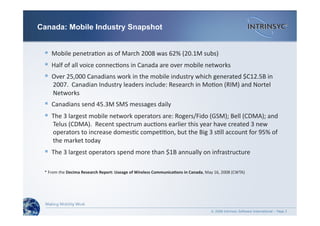
  Mobile penetra-on as of March 2008 was 62% (20.1M subs) 
  Half of all voice connec-ons in Canada are over mobile networks 
  Over 25,000 Canadians work in the mobile industry which generated $C12.5B in
 2007.  Canadian Industry leaders include: Research in Mo-on (RIM) and Nortel
 Networks 
  Canadians send 45.3M SMS messages daily 
  The 3 largest mobile network operators are: Rogers/Fido (GSM); Bell (CDMA); and
 Telus (CDMA).  Recent spectrum auc-ons earlier this year have created 3 new
 operators to increase domes-c compe--on, but the Big 3 s-ll account for 95% of
 the market today 
  The 3 largest operators spend more than $1B annually on infrastructure 
* From the Decima Research Report: Useage of Wireless Communica8ons in Canada, May 16, 2008 (CWTA) 
3
Canada: Mobile Industry Snapshot
© 2008 Intrinsyc Software International – Page
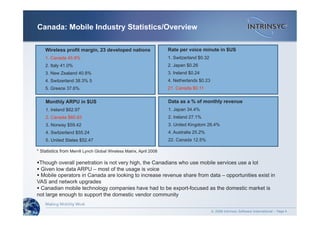
Wireless profit margin, 23 developed nations
1. Canada 45.9%
2. Italy 41.0%
3. New Zealand 40.8%
4. Switzerland 38.3% 5
5. Greece 37.6%
4
Canada: Mobile Industry Statistics/Overview
Monthly ARPU in $US
1. Ireland $62.97
2. Canada $60.83
3. Norway $59.42
4. Switzerland $55.24
5. United States $52.47
Rate per voice minute in $US
1. Switzerland $0.32
2. Japan $0.26
3. Ireland $0.24
4. Netherlands $0.23
21. Canada $0.11
Data as a % of monthly revenue
1. Japan 34.4%
2. Ireland 27.1%
3. United Kingdom 26.4%
4. Australia 25.2%
22. Canada 12.5%
* Statistics from Merrill Lynch Global Wireless Matrix, April 2008
 Though overall penetration is not very high, the Canadians who use mobile services use a lot
 Given low data ARPU – most of the usage is voice
 Mobile operators in Canada are looking to increase revenue share from data – opportunities exist in
VAS and network upgrades
 Canadian mobile technology companies have had to be export-focused as the domestic market is
not large enough to support the domestic vendor community
Intrinsyc So=ware Interna8onal: Corporate Overview 
5 
© 2008 Intrinsyc Software International – Page
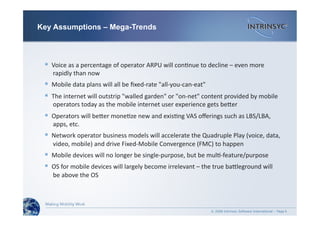
  Voice as a percentage of operator ARPU will con-nue to decline – even more
 rapidly than now 
  Mobile data plans will all be fixed‐rate "all‐you‐can‐eat" 
  The internet will outstrip "walled garden" or "on‐net" content provided by mobile
 operators today as the mobile internet user experience gets beder 
  Operators will beder mone-ze new and exis-ng VAS offerings such as LBS/LBA,
 apps, etc. 
  Network operator business models will accelerate the Quadruple Play (voice, data,
 video, mobile) and drive Fixed‐Mobile Convergence (FMC) to happen 
  Mobile devices will no longer be single‐purpose, but be mul-‐feature/purpose 
  OS for mobile devices will largely become irrelevant – the true badleground will
 be above the OS 
6
Key Assumptions – Mega-Trends
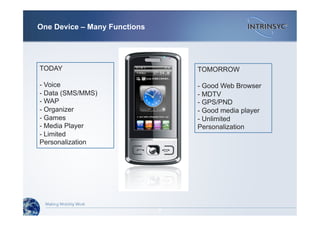
One Device – Many Functions
7
TODAY
- Voice
- Data (SMS/MMS)
- WAP
- Organizer
- Games
- Media Player
- Limited
Personalization
TOMORROW
- Good Web Browser
- MDTV
- GPS/PND
- Good media player
- Unlimited
Personalization
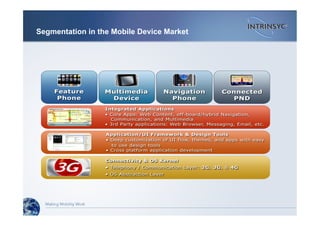
Segmentation in the Mobile Device Market
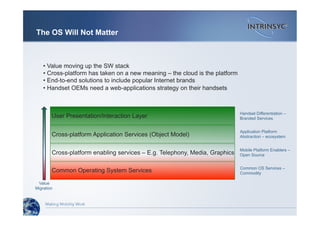
The OS Will Not Matter
Common Operating System Services
Cross-platform enabling services – E.g. Telephony, Media, Graphics
Cross-platform Application Services (Object Model)
User Presentation/Interaction Layer
Value
Migration
Handset Differentiation –
Branded Services
Application Platform
Abstraction – ecosystem
Mobile Platform Enablers –
Open Source
Common OS Services –
Commodity
• Value moving up the SW stack
• Cross-platform has taken on a new meaning – the cloud is the platform
• End-to-end solutions to include popular Internet brands
• Handset OEMs need a web-applications strategy on their handsets
© 2008 Intrinsyc Software International – Page 10
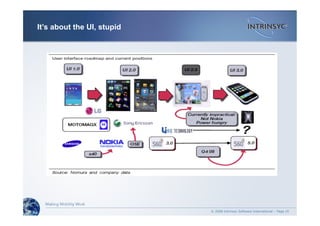
It’s about the UI, stupid
© 2008 Intrinsyc Software International – Page 11
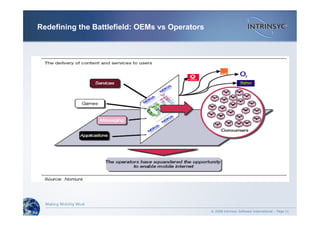
Redefining the Battlefield: OEMs vs Operators
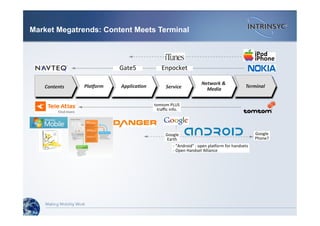
Market Megatrends: Content Meets Terminal
Contents  Service 
Network &
 Media 
Applica7on Pla9orm  Terminal 
Enpocket Gate5 
iPod 
iPhone 
tomtom PLUS 
traffic info. 
Google 
Phone? 
Google 
Earth 
‐ “Android” : open planorm for handsets 
‐ Open Handset Alliance 

Intrinsyc Mobile Monday Japan

  • 1.
    Mobile Convergence Trends:A Canadian Perspective Handol Kim, Intrinsyc Software International Mobile Monday Tokyo 2008/09/22
  • 2.
    © 2008 IntrinsycSoftware International – Page 2 Contents 2 1. The Canadian Mobile Industry Landscape   Intrinsyc Software Corporate Overview 2. Key Assumptions - Mega-Trends 3. One Device – Many Functions 4. It’s the UI – not the OS 5. The New OEM – Operator Relationship
  • 3.
    © 2008 IntrinsycSoftware International – Page   Mobile penetra-on as of March 2008 was 62% (20.1M subs)    Half of all voice connec-ons in Canada are over mobile networks    Over 25,000 Canadians work in the mobile industry which generated $C12.5B in  2007.  Canadian Industry leaders include: Research in Mo-on (RIM) and Nortel  Networks    Canadians send 45.3M SMS messages daily    The 3 largest mobile network operators are: Rogers/Fido (GSM); Bell (CDMA); and  Telus (CDMA).  Recent spectrum auc-ons earlier this year have created 3 new  operators to increase domes-c compe--on, but the Big 3 s-ll account for 95% of  the market today    The 3 largest operators spend more than $1B annually on infrastructure  * From the Decima Research Report: Useage of Wireless Communica8ons in Canada, May 16, 2008 (CWTA)  3 Canada: Mobile Industry Snapshot
  • 4.
    © 2008 IntrinsycSoftware International – Page Wireless profit margin, 23 developed nations 1. Canada 45.9% 2. Italy 41.0% 3. New Zealand 40.8% 4. Switzerland 38.3% 5 5. Greece 37.6% 4 Canada: Mobile Industry Statistics/Overview Monthly ARPU in $US 1. Ireland $62.97 2. Canada $60.83 3. Norway $59.42 4. Switzerland $55.24 5. United States $52.47 Rate per voice minute in $US 1. Switzerland $0.32 2. Japan $0.26 3. Ireland $0.24 4. Netherlands $0.23 21. Canada $0.11 Data as a % of monthly revenue 1. Japan 34.4% 2. Ireland 27.1% 3. United Kingdom 26.4% 4. Australia 25.2% 22. Canada 12.5% * Statistics from Merrill Lynch Global Wireless Matrix, April 2008  Though overall penetration is not very high, the Canadians who use mobile services use a lot  Given low data ARPU – most of the usage is voice  Mobile operators in Canada are looking to increase revenue share from data – opportunities exist in VAS and network upgrades  Canadian mobile technology companies have had to be export-focused as the domestic market is not large enough to support the domestic vendor community
  • 5.
  • 6.
    © 2008 IntrinsycSoftware International – Page   Voice as a percentage of operator ARPU will con-nue to decline – even more  rapidly than now    Mobile data plans will all be fixed‐rate "all‐you‐can‐eat"    The internet will outstrip "walled garden" or "on‐net" content provided by mobile  operators today as the mobile internet user experience gets beder    Operators will beder mone-ze new and exis-ng VAS offerings such as LBS/LBA,  apps, etc.    Network operator business models will accelerate the Quadruple Play (voice, data,  video, mobile) and drive Fixed‐Mobile Convergence (FMC) to happen    Mobile devices will no longer be single‐purpose, but be mul-‐feature/purpose    OS for mobile devices will largely become irrelevant – the true badleground will  be above the OS  6 Key Assumptions – Mega-Trends
  • 7.
    One Device –Many Functions 7 TODAY - Voice - Data (SMS/MMS) - WAP - Organizer - Games - Media Player - Limited Personalization TOMORROW - Good Web Browser - MDTV - GPS/PND - Good media player - Unlimited Personalization
  • 8.
    Segmentation in theMobile Device Market
  • 9.
    The OS WillNot Matter Common Operating System Services Cross-platform enabling services – E.g. Telephony, Media, Graphics Cross-platform Application Services (Object Model) User Presentation/Interaction Layer Value Migration Handset Differentiation – Branded Services Application Platform Abstraction – ecosystem Mobile Platform Enablers – Open Source Common OS Services – Commodity • Value moving up the SW stack • Cross-platform has taken on a new meaning – the cloud is the platform • End-to-end solutions to include popular Internet brands • Handset OEMs need a web-applications strategy on their handsets
  • 10.
    © 2008 IntrinsycSoftware International – Page 10 It’s about the UI, stupid
  • 11.
    © 2008 IntrinsycSoftware International – Page 11 Redefining the Battlefield: OEMs vs Operators
  • 12.
    Market Megatrends: ContentMeets Terminal Contents  Service  Network &  Media  Applica7on Pla9orm  Terminal  Enpocket Gate5  iPod  iPhone  tomtom PLUS  traffic info.  Google  Phone?  Google  Earth  ‐ “Android” : open planorm for handsets  ‐ Open Handset Alliance