SKILLS
ENHANCEMENT
Nursing Procedures
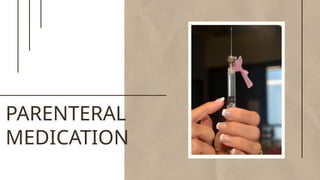
PARENTERAL
MEDICATION
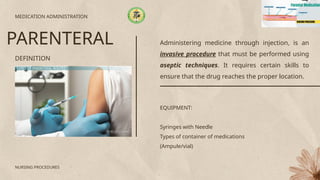
Administering medicine through injection, is an
invasive procedure that must be performed using
aseptic techniques. It requires certain skills to
ensure that the drug reaches the proper location.
EQUIPMENT:
Syringes with Needle
Types of container of medications
(Ampule/vial)
DEFINITION
MEDICATION ADMINISTRATION
PARENTERAL
NURSING PROCEDURES
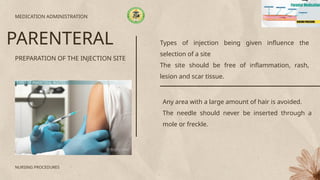
Types of injection being given influence the
selection of a site
The site should be free of inflammation, rash,
lesion and scar tissue.
PREPARATION OF THE INJECTION SITE
MEDICATION ADMINISTRATION
PARENTERAL
NURSING PROCEDURES
Any area with a large amount of hair is avoided.
The needle should never be inserted through a
mole or freckle.
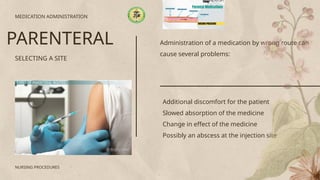
Administration of a medication by wrong route can
cause several problems:
SELECTING A SITE
MEDICATION ADMINISTRATION
PARENTERAL
NURSING PROCEDURES
Additional discomfort for the patient
Slowed absorption of the medicine
Change in effect of the medicine
Possibly an abscess at the injection site
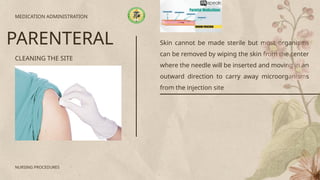
Skin cannot be made sterile but most organisms
can be removed by wiping the skin from the center
where the needle will be inserted and moving in an
outward direction to carry away microorganisms
from the injection site
CLEANING THE SITE
MEDICATION ADMINISTRATION
PARENTERAL
NURSING PROCEDURES
CLEANING THE SITE
MEDICATION ADMINISTRATION
PARENTERAL
NURSING PROCEDURES
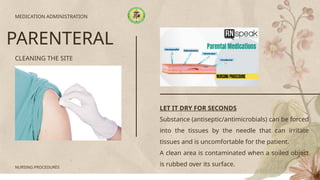
LET IT DRY FOR SECONDS
Substance (antiseptic/antimicrobials) can be forced
into the tissues by the needle that can irritate
tissues and is uncomfortable for the patient.
A clean area is contaminated when a soiled object
is rubbed over its surface.
ADMINISTERING INJECTIONS
MEDICATION ADMINISTRATION
PARENTERAL
NURSING PROCEDURES
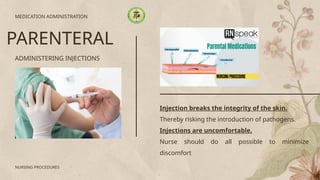
Injection breaks the integrity of the skin.
Thereby risking the introduction of pathogens.
Injections are uncomfortable.
Nurse should do all possible to minimize
discomfort
ADMINISTERING INJECTIONS
MEDICATION ADMINISTRATION
PARENTERAL
NURSING PROCEDURES
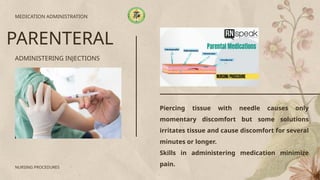
Piercing tissue with needle causes only
momentary discomfort but some solutions
irritates tissue and cause discomfort for several
minutes or longer.
Skills in administering medication minimize
pain.
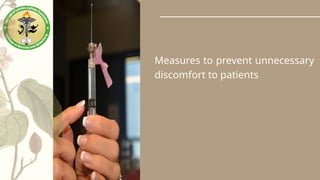
Measures to prevent unnecessary
discomfort to patients
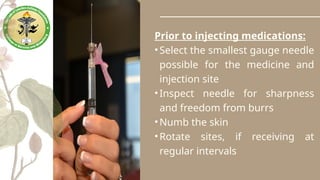
Prior to injecting medications:
•Select the smallest gauge needle
possible for the medicine and
injection site
•Inspect needle for sharpness
and freedom from burrs
•Numb the skin
•Rotate sites, if receiving at
regular intervals
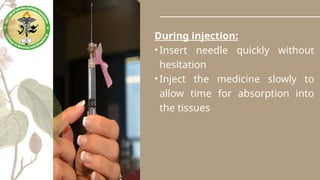
During injection:
•Insert needle quickly without
hesitation
•Inject the medicine slowly to
allow time for absorption into
the tissues
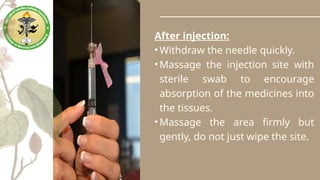
After injection:
•Withdraw the needle quickly.
•Massage the injection site with
sterile swab to encourage
absorption of the medicines into
the tissues.
•Massage the area firmly but
gently, do not just wipe the site.
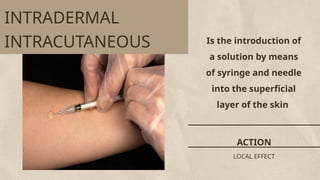
Is the introduction of
a solution by means
of syringe and needle
into the superficial
layer of the skin
ACTION
LOCAL EFFECT
INTRADERMAL
INTRACUTANEOUS
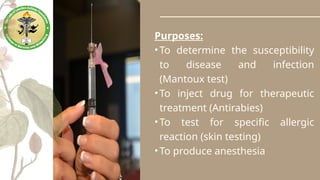
Purposes:
•To determine the susceptibility
to disease and infection
(Mantoux test)
•To inject drug for therapeutic
treatment (Antirabies)
•To test for specific allergic
reaction (skin testing)
•To produce anesthesia
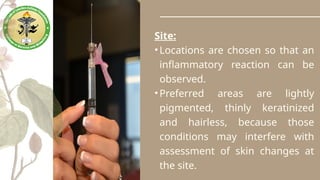
Site:
•Locations are chosen so that an
inflammatory reaction can be
observed.
•Preferred areas are lightly
pigmented, thinly keratinized
and hairless, because those
conditions may interfere with
assessment of skin changes at
the site.
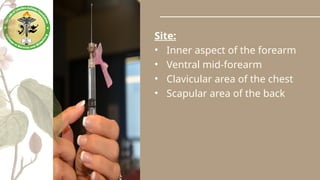
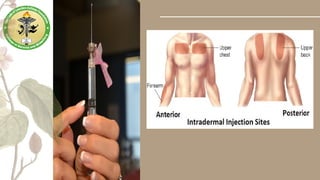
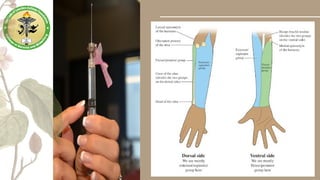
Site:
• Inner aspect of the forearm
• Ventral mid-forearm
• Clavicular area of the chest
• Scapular area of the back
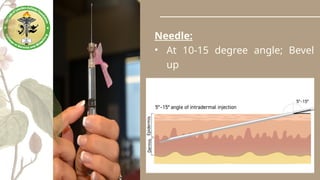
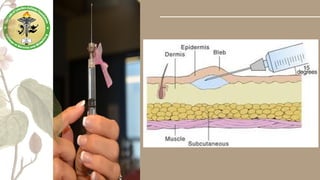
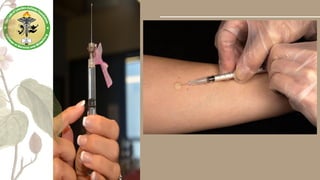
Needle:
• At 10-15 degree angle; Bevel
up
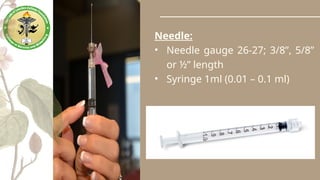
Needle:
• Needle gauge 26-27; 3/8”, 5/8”
or ½” length
• Syringe 1ml (0.01 – 0.1 ml)
• Observe general principles of giving medicines
• Report immediately any untoward effect of the drug
• Avoid danger such as;
• Causing an abscess
• Breaking the needle in the tissue
• Striking a bone
• Capillary tissue damage
GENERAL CONSIDERATION
SKILLS
THANK YOU!

Intradermal - Parenteral Administrations

  • 1.
  • 2.
  • 3.
    Administering medicine throughinjection, is an invasive procedure that must be performed using aseptic techniques. It requires certain skills to ensure that the drug reaches the proper location. EQUIPMENT: Syringes with Needle Types of container of medications (Ampule/vial) DEFINITION MEDICATION ADMINISTRATION PARENTERAL NURSING PROCEDURES
  • 4.
    Types of injectionbeing given influence the selection of a site The site should be free of inflammation, rash, lesion and scar tissue. PREPARATION OF THE INJECTION SITE MEDICATION ADMINISTRATION PARENTERAL NURSING PROCEDURES Any area with a large amount of hair is avoided. The needle should never be inserted through a mole or freckle.
  • 5.
    Administration of amedication by wrong route can cause several problems: SELECTING A SITE MEDICATION ADMINISTRATION PARENTERAL NURSING PROCEDURES Additional discomfort for the patient Slowed absorption of the medicine Change in effect of the medicine Possibly an abscess at the injection site
  • 6.
    Skin cannot bemade sterile but most organisms can be removed by wiping the skin from the center where the needle will be inserted and moving in an outward direction to carry away microorganisms from the injection site CLEANING THE SITE MEDICATION ADMINISTRATION PARENTERAL NURSING PROCEDURES
  • 7.
    CLEANING THE SITE MEDICATIONADMINISTRATION PARENTERAL NURSING PROCEDURES LET IT DRY FOR SECONDS Substance (antiseptic/antimicrobials) can be forced into the tissues by the needle that can irritate tissues and is uncomfortable for the patient. A clean area is contaminated when a soiled object is rubbed over its surface.
  • 8.
    ADMINISTERING INJECTIONS MEDICATION ADMINISTRATION PARENTERAL NURSINGPROCEDURES Injection breaks the integrity of the skin. Thereby risking the introduction of pathogens. Injections are uncomfortable. Nurse should do all possible to minimize discomfort
  • 9.
    ADMINISTERING INJECTIONS MEDICATION ADMINISTRATION PARENTERAL NURSINGPROCEDURES Piercing tissue with needle causes only momentary discomfort but some solutions irritates tissue and cause discomfort for several minutes or longer. Skills in administering medication minimize pain.
  • 10.
    Measures to preventunnecessary discomfort to patients
  • 11.
    Prior to injectingmedications: •Select the smallest gauge needle possible for the medicine and injection site •Inspect needle for sharpness and freedom from burrs •Numb the skin •Rotate sites, if receiving at regular intervals
  • 12.
    During injection: •Insert needlequickly without hesitation •Inject the medicine slowly to allow time for absorption into the tissues
  • 13.
    After injection: •Withdraw theneedle quickly. •Massage the injection site with sterile swab to encourage absorption of the medicines into the tissues. •Massage the area firmly but gently, do not just wipe the site.
  • 14.
    Is the introductionof a solution by means of syringe and needle into the superficial layer of the skin ACTION LOCAL EFFECT INTRADERMAL INTRACUTANEOUS
  • 15.
    Purposes: •To determine thesusceptibility to disease and infection (Mantoux test) •To inject drug for therapeutic treatment (Antirabies) •To test for specific allergic reaction (skin testing) •To produce anesthesia
  • 16.
    Site: •Locations are chosenso that an inflammatory reaction can be observed. •Preferred areas are lightly pigmented, thinly keratinized and hairless, because those conditions may interfere with assessment of skin changes at the site.
  • 17.
    Site: • Inner aspectof the forearm • Ventral mid-forearm • Clavicular area of the chest • Scapular area of the back
  • 20.
    Needle: • At 10-15degree angle; Bevel up
  • 23.
    Needle: • Needle gauge26-27; 3/8”, 5/8” or ½” length • Syringe 1ml (0.01 – 0.1 ml)
  • 24.
    • Observe generalprinciples of giving medicines • Report immediately any untoward effect of the drug • Avoid danger such as; • Causing an abscess • Breaking the needle in the tissue • Striking a bone • Capillary tissue damage GENERAL CONSIDERATION
  • 25.
  • 26.